
John 1:15

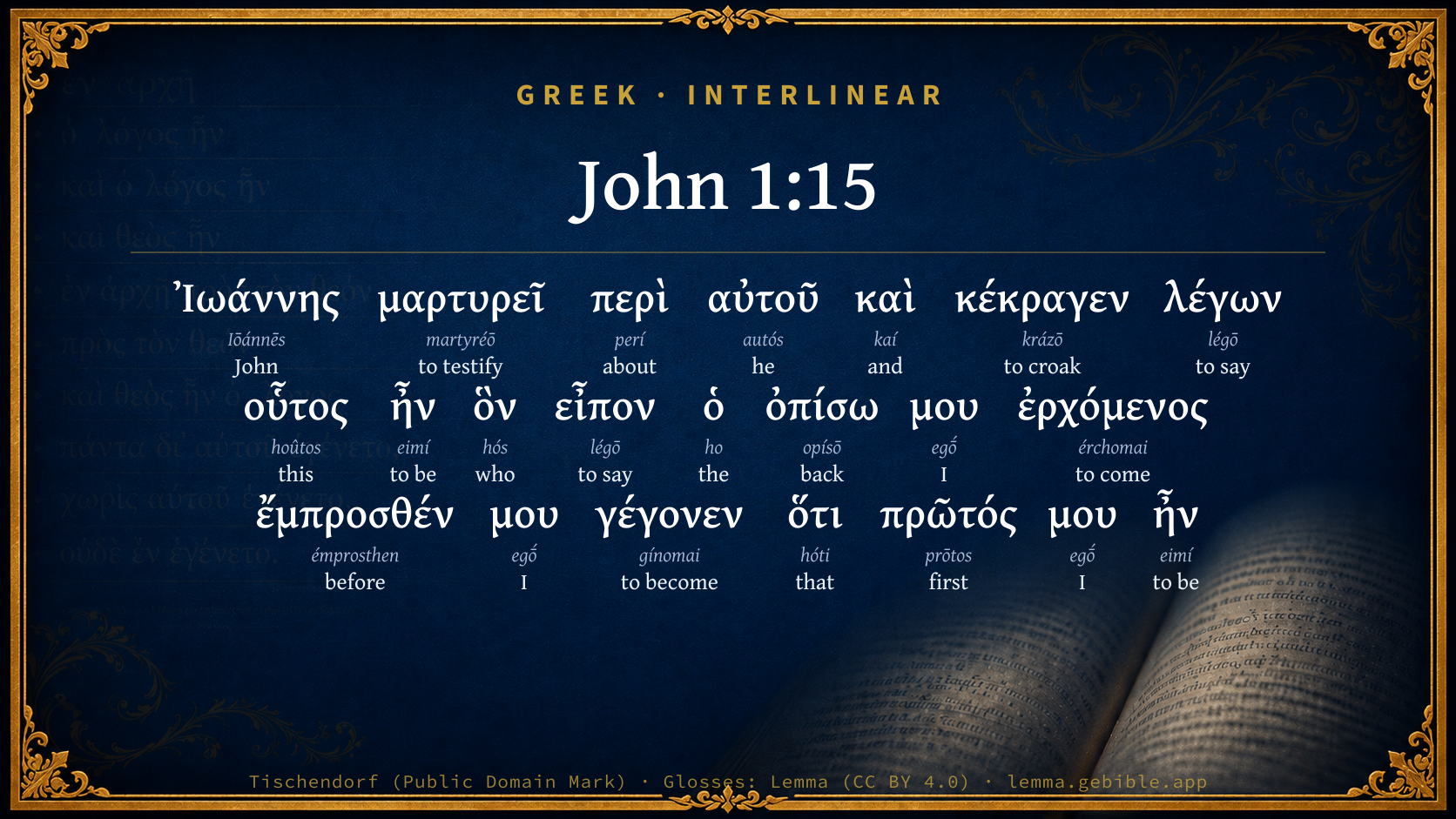
Greek (Tischendorf 8th ed.) John 1:15 appears in the Greek New Testament. The text above is from the Tischendorf 8th edition. Each word links to its Strong’s number and a concise gloss. Click any word for its full Thayer’s Greek Lexicon entry.
Download image
Cite this verse

John 1:15 (World English Bible). Public Domain. Lemma interlinear Bible study tool, https://lemma.gebible.app/v/john/1/15.

Show BibTeX & RIS
BibTeX
RIS
English Translation
John testified about him. He cried out, saying, "This was he of whom I said, 'He who comes after me has surpassed me, for he was before me.'"
World English Bible · Public Domain
Download a study sheet

One document with this verse’s original text, its word-by-word gloss line, the meaning frame, cross-references with their text, attributed commentary, and full source and license credits — printable, and it pastes into notes with its structure intact.

This verse Autodidact and up

Study sheet (.html) Plain text (.txt)

A passage Seminary Student

Up to 50 verses in one chapter. A passage sheet keeps up to 6 commentary sources and 12 cross-references per verse, in the order this page ranks them, and says so on the sheet whenever that leaves anything out. Ask for a single verse and you get the Autodidact verse sheet above.

Everything on this page stays free to read, with no account — the sheet is a download of what is already on screen, not access to it.

Want to remove ads? Support Godless Engineer
Compare translations 3

The same verse in 3 English versions, stacked beneath the original-language interlinear above. Click any original word for its lexicon entry.

Each is an independent rendering of the whole verse — the interlinear is not word-aligned to these translations.

Highlighted words mark where these versions differ — a whole-verse word diff, not a word-by-word alignment.

  • World English Bible Public Domain
    John testified about him. He cried out, saying, "This was he of whom I said, 'He who comes after me has surpassed me, for he was before me.'"
  • King James Version Public Domain
    John bare witness of him, and cried, saying, This was he of whom I spake, He that cometh after me is preferred before me: for he was before me.
  • unfoldingWord Literal Text CC BY-SA 4.0
    John testifies about him and has cried out, saying, “This was the one of whom I said, ‘The one coming after me has become greater than me, for he was before me.’”

unfoldingWord Literal Text — © unfoldingWord, licensed CC BY-SA 4.0. Word-aligned USFM3 via Door43 (git.door43.org/unfoldingWord/en_ult).

Versions to compare (up to 4)

3 of 4 selected

Show all 19 translations

Every available English version of this verse, each an independent rendering of the whole verse.

  • World English Bible Public Domain
    John testified about him. He cried out, saying, "This was he of whom I said, 'He who comes after me has surpassed me, for he was before me.'"
  • Berean Standard Bible Public Domain
    John testified concerning Him. He cried out, saying, “This is He of whom I said, ‘He who comes after me has surpassed me because He was before me.’”
  • Majority Standard Bible Public Domain
    John testified concerning Him. He cried out, saying, “This is He of whom I said, ‘He who comes after me has surpassed me because He was before me.’”
  • King James Version Public Domain
    John bare witness of him, and cried, saying, This was he of whom I spake, He that cometh after me is preferred before me: for he was before me.
  • American Standard Version (1901) Public Domain
    John beareth witness of him, and crieth, saying, This was he of whom I said, He that cometh after me is become before me: for he was before me.
  • Revised Version (1885) Public Domain
    John beareth witness of him, and crieth, saying, This was he of whom I said, He that cometh after me is become before me: for he was before me.
  • Geneva Bible (1599) Public Domain
    Iohn bare witnesse of him, and cryed, saying, This was he of whom I said, He that commeth after me, was before me: for he was better then I.
  • Douay-Rheims (1899) Public Domain
    John beareth witness of him, and crieth out, saying: This was he of whom I spoke: He that shall come after me, is preferred before me: because he was before me.
  • Young's Literal Translation Public Domain
    John doth testify concerning him, and hath cried, saying, `This was he of whom I said, He who after me is coming, hath come before me, for he was before me;'
  • Literal Standard Version CC BY-SA 4.0
    John testifies concerning Him, and has cried, saying, “This was He of whom I said, He who is coming after me has come before me, for He was before me.”
  • Unlocked Literal Bible CC BY-SA 4.0
    John testified about him and cried out, saying, “This was the one of whom I said, 'He who comes after me is greater than I am, for he was before me.'”
  • unfoldingWord Literal Text CC BY-SA 4.0
    John testifies about him and has cried out, saying, “This was the one of whom I said, ‘The one coming after me has become greater than me, for he was before me.’”
  • Darby Bible Public Domain
    (John bears witness of him, and he has cried, saying, This was he of whom I said, He that comes after me is preferred before me, for he was before me;)
  • World Messianic Bible Public Domain
    Yochanan testified about him. He cried out, saying, “This was he of whom I said, ‘He who comes after me has surpassed me, for he was before me.’”
  • Webster's Bible Public Domain
    John testified concerning him, and cried, saying, This was he of whom I spoke, He that cometh after me, is preferred before me; for he was before me.
  • Free Bible Version CC BY-SA 4.0
    John gave his testimony about him, shouting out to the people, “This is the one I was telling you about when I said, ‘The one who is coming after me is more important than me, for before I ever existed he already was.’”
  • Bible in Basic English Public Domain
    John gave witness about him, crying, This is he of whom I said, He who is coming after me is put over me because he was in existence before me.
  • Text-Critical English NT CC BY 4.0
    John testified about him and cried out, “This is he of whom I said, ‘He who comes after me ranks ahead of me, because he existed before me.’ ”
  • Tyndale New Testament (1534) Public Domain
    Iohn bare witnes of him and cryed sayinge: This was he of whome I spake he that cometh after me was before me because he was yer then I.

Literal Standard Version (2020), Covenant Press — licensed CC BY-SA 4.0. Text via the HelloAO Bible API (eBible.org). Unlocked Literal Bible (unfoldingWord) — licensed CC BY-SA 4.0. Text via the HelloAO Bible API (eBible.org). unfoldingWord Literal Text — © unfoldingWord, licensed CC BY-SA 4.0. Word-aligned USFM3 via Door43 (git.door43.org/unfoldingWord/en_ult). Free Bible Version, Dr. Jonathan Gallagher — licensed CC BY-SA 4.0. Text via the HelloAO Bible API (eBible.org).

Word by word

More ways to search: Search by grammar → Find every occurrence → Compare this word →

Practice this passage: Drill this verse → Learn its vocabulary →

ὀπίσω
opísō
G3694
“back”
Adverb
Part of Speech
Adverb
Full Thayer's Definition

Origin: from the same as G3693 with enclitic of direction

TDNT: 09:49,7

1. back, behind, after, afterwards a. of place: things that are behind b. of time: after
  1. Ἰωάννης Iōánnēs G2491 “John” Noun, Nominative, Singular, Masculine
  2. μαρτυρεῖ martyréō G3140 “to testify” Verb, Present, Active, Indicative, 3rd person, Singular
  3. περὶ perí G4012 “about” Preposition
  4. αὐτοῦ autós G846 “he” Personal pronoun, Genitive, Singular, Masculine
  5. καὶ kaí G2532 “and” Conjunction
  6. κέκραγεν krázō G2896 “to croak” Verb, Perfect, Active, Indicative, 3rd person, Singular
  7. λέγων légō G3004 “to say” Verb, Present, Active, Participle, Nominative, Singular, Masculine
  8. οὗτος hoûtos G3778 “this” Demonstrative pronoun, Nominative, Singular, Masculine
  9. ἦν eimí G1510 “to be” Verb, Imperfect, Active, Indicative, 3rd person, Singular
  10. ὃν hós G3739 “who” Relative pronoun, Accusative, Singular, Masculine
  11. εἶπον légō G3004 “to say” Verb, Aorist, Active, Indicative, 1st person, Singular
  12. ὁ ho G3588 “the” Article, Nominative, Singular, Masculine
  13. μου egṓ G1473 “I” Personal pronoun, 1st person, Genitive, Singular
  14. ἐρχόμενος érchomai G2064 “to come” Verb, Present, Middle or Passive deponent, Participle, Nominative, Singular, Masculine
  15. ἔμπροσθέν émprosthen G1715 “before” Preposition
  16. μου egṓ G1473 “I” Personal pronoun, 1st person, Genitive, Singular
  17. γέγονεν gínomai G1096 “to become” Verb, Perfect, Active, Indicative, 3rd person, Singular
  18. ὅτι hóti G3754 “that” Conjunction
  19. πρῶτός prōtos G4413 “first” Adjective, Nominative, Singular, Masculine, Superlative
  20. μου egṓ G1473 “I” Personal pronoun, 1st person, Genitive, Singular
  21. ἦν eimí G1510 “to be” Verb, Imperfect, Active, Indicative, 3rd person, Singular

About this verse

These counts appear in no published source. They are computed here, from the morphology-tagged text and Lemma’s own curated glosses. What Lemma adds →

22
words
18
distinct lemmas
Gospels
section

Shared distinctive vocabulary

ὀπίσω back G3694 occurs in 35 verses of the Greek New Testament. Also found in:
Repetition

Words recur within this verse:

Cross-references

20

Topical passages linked to John 1:15 in the Treasury of Scripture Knowledge — connected by theme and wording, ordered by reader-vote popularity; previews shown in the World English Bible.

  • Matthew 3:11 I indeed baptize you in water for repentance, but he who comes after me is mightier than I, whose shoes I am not worthy to carry. He will baptize you in the Holy Spirit.
  • Colossians 1:17 He is before all things, and in him all things are held together.
  • Luke 3:16 John answered them all, "I indeed baptize you with water, but he comes who is mightier than I, the latchet of whose sandals I am not worthy to loosen. He will baptize you in the Holy Spirit and fire,
  • John 1:1–2 In the beginning was the Word, and the Word was with God, and the Word was God.
  • John 1:29–34 The next day, he saw Jesus coming to him, and said, "Behold, the Lamb of God, who takes away the sin of the world!
  • Matthew 3:13–17 Then Jesus came from Galilee to the Jordan to John, to be baptized by him.
  • John 1:7–8 The same came as a witness, that he might testify about the light, that all might believe through him.
  • John 3:26–36 They came to John, and said to him, "Rabbi, he who was with you beyond the Jordan, to whom you have testified, behold, the same baptizes, and everyone is coming to him."
  • John 5:33–36 You have sent to John, and he has testified to the truth.
  • Micah 5:2 But you, Bethlehem Ephrathah, Being small among the clans of Judah, Out of you one will come forth to me that is to be ruler in Israel; Whose goings forth are from of old, from everlasting.
  • Mark 1:7 He preached, saying, "After me comes he who is mightier than I, the thong of whose sandals I am not worthy to stoop down and loosen.
  • John 1:27 He is the one who comes after me, who is preferred before me, whose sandal strap I'm not worthy to loosen."
  • John 17:5 Now, Father, glorify me with your own self with the glory which I had with you before the world existed.
  • Isaiah 9:6 For to us a child is born, to us a son is given; and the government shall be on his shoulder: and his name shall be called Wonderful, Counselor, Mighty God, Everlasting Father, Prince of Peace.
  • John 8:58 Jesus said to them, "Most assuredly, I tell you, before Abraham came into existence, I AM."
  • Revelation 1:17–18 When I saw him, I fell at his feet like a dead man. He laid his right hand on me, saying, "Don't be afraid. I am the first and the last,
  • Revelation 2:8 "To the angel of the assembly in Smyrna write: "The first and the last, who was dead, and has come to life says these things:
  • Proverbs 8:22 "Yahweh possessed me in the beginning of his work, Before his deeds of old.
  • Philippians 2:6–7 who, existing in the form of God, didn't consider it robbery to be equal with God,
  • Hebrews 13:8 Jesus Christ is the same yesterday, today, and forever.

Cross-references courtesy of OpenBible.info (CC BY 4.0).

Commentary

Notes on John 1:15 from classic Christian and Jewish commentators (each source and its license shown beneath its notes). The classic Christian expositions comment on the surrounding passage and are grouped to its opening verse, so a note may address several verses; the Jewish commentaries on the Tanakh (Rashi and others) are per-verse, so they appear only where the commentator wrote on this verse.

Lemma curates 59 commentaries, every one of them public domain or Creative Commons licensed, each selected and text-cleaned for this edition rather than reprinted as found. About our sources →

Matthew Henry's Commentary

In these verses,

I. The evangelist begins again to give us John Baptist's testimony concerning Christ, Joh 1:15. He had said (Joh 1:8) that he came for a witness; now here he tells us that he did accordingly bear witness. Here, Observe,

1. How he expressed his testimony: He cried, according to the prediction that he should be the voice of one crying. The Old Testament prophets cried aloud, to show people their sins; this New Testament prophet cried aloud, to show people their Saviour. This intimates, (1.) That it was an open public testimony, proclaimed, that all manner of persons might take notice of it, for all are concerned in it. False teachers entice secretly, but wisdom publishes her dictates in the chief places of concourse. (2.) That he was free and hearty in bearing this testimony. He cried as one that was both well assured of the truth to which he witnessed and well affected to it. He that had leaped in his mother's womb for joy of Christ's approach, when newly conceived, does now with a like exultation of spirit welcome his public appearance.

2. What his testimony was. He appeals to what he had said at the beginning of his ministry, when he had directed them to expect one that should come after him, whose forerunner he was, and never intended any other than to lead them to him, and to prepare his way. This he had given them notice of from the first. Note, It is very comfortable to a minister to have the testimony of his conscience for him that he set out in his ministry with honest principles and sincere intentions, with a single eye to the glory and honour of Christ. Now what he had then said he applies to this Jesus whom he had lately baptized, and who was so remarkably owned from heaven: This was he of whom I spoke. John did not tell them that there would shortly appear such a one among them, and then leave them to find him out; but in this he went beyond all the Old Testament prophets that he particularly specified the person: "This was he, the very man I told you of, and to him all I said is to be accommodated." Now what was it he said?

(1.) He had given the preference to this Jesus: He that comes after me, in the time of his birth and public appearance, is preferred before me; he that succeeds me in preaching and making disciples is a more excellent person, upon all accounts; as the prince or peer that comes after is preferred before the harbinger or gentleman-usher that makes way for him. Note, Jesus Christ, who was to be called the Son of the Highest (Luk 1:32), was preferred before John Baptist, who was to be called only the prophet of the Highest, Luk 1:76. John was a minister of the New Testament, but Christ was the Mediator of the New Testament. And observe, though John was a great man, and had a great name and interest, yet he was forward to give the preference to him to whom it belonged. Note, All the ministers of Christ must prefer him and his interest before themselves and their own interests; they will make an ill account that seek their own things, not the things of Christ, Phi 2:21. He comes after me, and yet is preferred before me. Note, God dispenses his gifts according to his good pleasure, and many times crosses hands, as Jacob did, preferring the younger before the elder. Paul far outstripped those that were in Christ before him.

(2.) He here gives a good reason for it: For he was before me, prōtos mou ēn - He was my first, or first to me; he was my first Cause, my original. The First is one of God's names, Isa 44:6. He is before me, is my first, [1.] In respect of seniority: he was before me, for he was before Abraham, Joh 8:58. Nay, he was before all things, Col 1:17. I am but of yesterday, he from eternity. It was but in those days that John Baptist came (Mat 3:1), but the goings forth of our Lord Jesus were of old, from everlasting, Mic 5:2. This proves two natures in Christ. Christ, as man, came after John as to his public appearance; Christ, as God, was before him; and how could he otherwise be before him but by an eternal existence? [2.] In respect of supremacy; for he was my prince; so some princes are called the first; prōton, "It is he for whose sake and service I am sent: he is my Master, I am his minister and messenger."

II. He presently returns again to speak of Jesus Christ, and cannot go on with John Baptist's testimony till Joh 1:19. The Joh 1:16 has a manifest connection with Joh 1:14, where the incarnate Word was said to be full of grace and truth. Now here he makes this the matter, not only of our adoration, but of our thankfulness, because from that fulness of his we all have received. He received gifts for men (Psa 68:18), that he might give gifts to men, Eph 4:8. He was filled, that he might fill all in all (Eph 1:23), might fill our treasures, Pro 8:21. He has a fountain of fulness overflowing: We all have received. All we apostles; so some. We have received the favour of this apostleship, that is grace; and a fitness for it, that is truth. Or, rather, All we believers; as many as received him (Joh 1:16), received from him. Note, All true believers receive from Christ's fulness; the best and greatest saints cannot live without him, the meanest and weakest may live by him. This excludes proud boasting, that we have nothing but we have received it; and silences perplexing fears, that we want nothing but we may receive it. Let us see what it is that we have received.

1. We have received grace for grace. Our receivings by Christ are all summed up in this one word, grace; we have received kai charin - even grace, so great a gift, so rich, so invaluable; we have received no less than grace; this is a gift to be spoken of with an emphasis. It is repeated, grace for grace; for to every stone in this building, as well as to the top-stone, we must cry, Grace, grace. Observe,

(1.) The blessing received. It is grace; the good will of God towards us, and the good work of God in us. God's good will works the good work, and then the good work qualifies us for further tokens of his good will. As the cistern receives water from the fulness of the fountain, the branches sap from the fulness of the root, and the air light from the fulness of the sun, so we receive grace from the fulness of Christ.

(2.) The manner of its reception: Grace for grace - charin anti charitos. The phrase is singular, and interpreters put different senses upon it, each of which will be of use to illustrate the unsearchable riches of the grace of Christ. Grace for grace bespeaks, [1.] The freeness of this grace. It is grace for grace' sake; so Grotius. We receive grace, not for our sakes (be it known to us), but even so, Father, because it seemed good in thy sight. It is a gift according to grace, Rom 12:6. It is grace to us for the sake of grace to Jesus Christ. God was well pleased in him, and is therefore well pleased with us in him, Eph 1:6. [2.] The fulness of this grace. Grace for grace is abundance of grace, grace upon grace (so Camero), one grace heaped upon another; as skin for skin is skin after skin, even all that a man has, Job 2:4. It is a blessing poured out, that there shall not be room to receive it, plenteous redemption: one grace a pledge of more grace. Joseph - he will add. It is such a fulness as is called the fulness of God which we are filled with. We are not straitened in the grace of Christ, if we be not straitened in our own bosoms. [3.] The serviceableness of this grace. Grace for grace is grace for the promoting and advancing of grace. Grace to be exercised by ourselves; gracious habits for gracious acts. Grace to be ministered to others; gracious vouchsafements for gracious performances: grace is a talent to be traded with. The apostles received grace (Rom 1:5; Eph 3:8), that they might communicate it, Pe1 4:10. [4.] The substitution of New Testament grace in the room and stead of Old Testament grace: so Beza. And this sense is confirmed by what follows (Joh 1:17); for the Old Testament had grace in type, the New Testament has grace in truth. There was a grace under the Old Testament, the gospel was preached then (Gal 3:8); but that grace is superseded, and we have gospel grace instead of it, a glory which excelleth, Co2 3:10. Discoveries of grace are now more clear, distributions of grace far more plentiful; this is grace instead of grace. [5.] It bespeaks the augmentation and continuance of grace. Grace for grace is one grace to improve, confirm, and perfect another grace. We are changed into the divine image, from glory to glory, from one degree of glorious grace to another, Co2 3:18. Those that have true grace have that for more grace, Jam 4:6. When God gives grace he saith, Take this in part; for he who hath promised will perform. [6.] It bespeaks the agreeableness and conformity of grace in the saints to the grace that is in Jesus Christ; so Mr. Clark. Grace for grace is grace in us answering to grace in him, as the impression upon the wax answers the seal line for line. The grace we receive from Christ changes us into the same image (Co2 3:18), the image of the Son (Rom 8:29), the image of the heavenly, Co1 15:49.

2. We have received grace and truth, Joh 1:17. He had said (Joh 1:14) that Christ was full of grace and truth; now here he says that by him grace and truth came to us. From Christ we receive grace; this is a string he delights to harp upon, he cannot go off from it. Two things he further observes in this verse concerning this grace: - (1.) Its preference above the law of Moses: The law was given by Moses, and it was a glorious discovery, both of God's will concerning man and his good will to man; but the gospel of Christ is a much clearer discovery both of duty and happiness. That which was given by Moses was purely terrifying and threatening, and bound with penalties, a law which could not give life, which was given with abundance of terror (Heb 12:18); but that which is given by Jesus Christ is of another nature; it has all the beneficial uses of the law, but not the terror, for it is grace: grace teaching (Tit 2:11), grace reigning, Rom 5:21. It is a law, but a remedial law. The endearments of love are the genius of the gospel, not the affrightments of law and the curse. (2.) Its connection with truth: grace and truth. In the gospel we have the discovery of the greatest truths to be embraced by the understanding, as well as of the richest grace to be embraced by the will and affections. It is a faithful saying, and worthy of all acceptation; that is, it is grace and truth. The offers of grace are sincere, and what we may venture our souls upon; they are made in earnest, for it is grace and truth. It is grace and truth with reference to the law that was given by Moses. For it is, [1.] The performance of all the Old Testament promises. In the Old Testament we often find mercy and truth put together, that is, mercy according to promise; so here grace and truth denote grace according to promise. See Luk 1:72; Kg1 8:56. [2.] It is the substance of all the Old Testament types and shadows. Something of grace there was both in the ordinances that were instituted for Israel and the providences that occurred concerning Israel; but they were only shadows of good things to come, even of the grace that is to be brought to us by the revelation of Jesus Christ. He is the true paschal lamb, the true scape-goat, the true manna. They had grace in the picture; we have grace in the person, that is, grace and truth. Grace and truth came, egeneto - was made; the same word that was used (Joh 1:3) concerning Christ's making all things. The law was only made known by Moses, but the being of this grace and truth, as well as the discovery of them, is owing to Jesus Christ; this was made by him, as the world at first was; and by him this grace and truth do consist.

3. Another thing we receive from Christ is a clear revelation of God to us (Joh 1:18): He hath declared God to us, whom no man hath seen at any time. This was the grace and truth which came by Christ, the knowledge of God and an acquaintance with him. Observe,

(1.) The insufficiency of all other discoveries: No man hath seen God at any time. This intimates, [1.] That the nature of God being spiritual, he is invisible to bodily eyes, he is a being whom no man hath seen, nor can see, Ti1 6:16. We have therefore need to live by faith, by which we see him that is invisible, Heb 11:27. [2.] That the revelation which God made of himself in the Old Testament was very short and imperfect, in comparison with that which he has made by Christ: No man hath seen God at any time; that is, what was seen and known of God before the incarnation of Christ was nothing to that which is now seen and known; life and immortality are now brought to a much clearer light than they were then. [3.] That none of the Old Testament prophets were so well qualified to make known the mind and will of God to the children of men as our Lord Jesus was, for none of them had seen God at any time. Moses beheld the similitude of the Lord (Num 12:8), but was told that he could not see his face, Exo 33:20. But this recommends Christ's holy religion to us that it was founded by one that had seen God, and knew more of his mind than any one else ever did.

(2.) The all-sufficiency of the gospel discovery proved from its author: The only-begotten Son, who is in the bosom of the Father, he has declared him. Observe here,

[1.] How fit he was to make this discovery, and every way qualified for it. He and he alone was worthy to take the book, and to open the seals, Rev 5:9. For, First, He is the only-begotten Son; and who so likely to know the Father as the Son? or in whom is the Father better known than in the Son? Mat 11:27. He is of the same nature with the Father, so that he who hath seen him hath seen the Father, Joh 14:9. The servant is not supposed to know so well what his Lord does as the Son, Joh 15:15. Moses was faithful as a servant, but Christ as a Son. Secondly, He is in the bosom of the Father. He had lain in his bosom from eternity. When he was here upon earth, yet still, as God, he was in the bosom of the Father, and thither he returned when he ascended. In the bosom of the Father; that is, 1. In the bosom of his special love, dear to him, in whom he was well pleased, always his delight. All God's saints are in his hand, but his Son was in his bosom, one in nature and essence, and therefore in the highest degree one in love. 2. In the bosom of his secret counsels. As there was a mutual complacency, so there was a mutual consciousness, between the Father and Son (Mat 11:27); none so fit as he to make known God, for none knew his mind as he did. Our most secret counsels we are said to hide in our bosom (in pectore); Christ was privy to the bosom-counsels of the Father. The prophets sat down at his feet as scholars; Christ lay in his bosom as a friend. See Eph 3:11.

[2.] How free he was in making this discovery: He hath declared. Him is not in the original. He has declared that of God which no man had at any time seen or known; not only that which was hid of God, but that which was hid in God (Eph 3:9), exēgēsato - it signifies a plain, clear, and full discovery, not by general and doubtful hints, but by particular explications. He that runs may now read the will of God and the way of salvation. This is the grace, this the truth, that came by Jesus Christ.

Matthew Henry's Commentary on the Whole Bible (1708–1710) — public domain (CC PDM 1.0). Text via the HelloAO Bible API.

Jamieson, Fausset & Brown

Robert Jamieson, A. R. Fausset & David Brown

A SAYING OF THE BAPTIST CONFIRMATORY OF THIS. (Joh 1:15)

after me--in official manifestation.

before me--in rank and dignity.

for he was before me--in existence; "His goings forth being from of old, from everlasting" (Mic 5:2). (Anything lower than this His words cannot mean); that is, "My Successor is my Superior, for He was my Predecessor." This enigmatic play upon the different senses of the words "before" and "after" was doubtless employed by the Baptist to arrest attention, and rivet the thought; and the Evangelist introduces it just to clinch his own statements.

Jamieson, Fausset & Brown — Commentary Critical and Explanatory on the Whole Bible (1871) — public domain (CC PDM 1.0). Text via the HelloAO Bible API.

The Biblical Illustrator

Joseph S. Exell

Joh_1:15-18

John bare witness of Him

The pre-eminence of Christ

I.

CHRISTS SUPERIORITY TO JOHN THE BAPTIST.

1. John refers to and repeats previous testimonies, applying them to Him whom the congregation had just seen depart. The testimony was pointed, warm, confident, bold.

2. The substance and form of the testimony that, though Jesus was after John as to His birth and ministry, He was before him as to the dignity of His person, His mediatorial office, and above all His Deity.

II. CHRISTS SUPERIORITY TO ALL BELIEVERS.

1. All the fulness demanded for their wants, the entire supply for their need, is treasured up in Him.

(1) This might be asserted of the Word.

(2) But it is here asserted of Him as made flesh.

2. What has the believer that he has not received from Christ? By nature he is empty.

3. How exalting to Christ the truth that all are and always have been, and always will be, dependent on Him.

4. We derive from Christ, not through merit, grace after grace, and grace corresponding in nature to that poured on Christ.

III. CHRISTS SUPERIORITY TO MOSES.

1. Moses held a high place--the Law was given by him.

2. Nevertheless, no comparison could be made of Moses with Christ. He fulfilled his ministry and passed away, but Christ abides as the eternal administrator of grace and truth.

(1) The Law gives knowledge of sin and leaves us: grace and truth come with salvation from sin.

(2) The Law was the shadow of good things to come: the grace and truth of Christ were those good things.

IV. CHRISTS SUPERIORITY TO ALL CREATED INTELLIGENCES.

1. God is invisible and incomprehensible to all except His Son Jesus Christ.

2. Many are sons of God, Christ alone is the only-begotten of the Father.

3. Christ has declared the Father as no creature has done, revealing His nature, perfections, counsels, by His teaching, example, and secret influence on the minds of His people.

4. The eternal life of the best of His creatures consist in the knowledge of Him. (A. Beith, D. D.)

Christ pre-eminent

I. IT IS CHRIST ALONE WHO SUPPLIES THE SPIRITUAL WANTS OF ALL BELIEVERS (Joh_1:16).

1. The Spirit of Life is His special gift to the Church, and conveys from Him, as from a great root, sap and vigour to all the believing branches.

2. He is rich in mercy, wisdom, righteousness, holiness.

3. Out of His fulness believers in every age have been supplied.

4. Every saint in glory will acknowledge that he is Christs debtor for all he is.

II. THE VAST SUPERIORITY OF CHRIST TO MOSES AND THE GOSPEL TO THE LAW (Joh_1:17).

1. Moses was employed as a servant to convey the moral and ceremonial law which could not justify.

2. Christ as a Son came with the keys of Gods treasury of grace and truth Heb_3:6).

(1) Grace bringing salvation through faith.

(2) Truth fulfilling in His own Person the types of the Old

Testament.

III. IT IS CHRIST ALONE WHO HAS REVEALED THE FATHER TO MAN (verse 18).

1. No man could see God and live.

2. Yet all that man is capable of knowing of God the Father is revealed to us by God the Son. In His words, deeds, life, and death we see the wisdom, love, and holiness of God.

IV. How GREAT THE HONOUR OF THE BAPTIST AND CHRISTIAN MINISTERS in heralding such a Being. (Bp. Ryle.)

Face to face with Jesus Christ

How far ahead John was of the apostles in his conception and reception of the Saviour. Throughout the Baptist was not only a seer of the light but was drenched by the light.

I. JOHNS EXPERIENCE AND TESTIMONY. Verse 15 is information that the Apostle evidently thought very valuable. Having affirmed the Incarnation he recalls the testimony of the Baptist to that Incarnation. In this testimony lay the power and grace of the Forerunner. His was no outside knowledge or second-hand information, but experience, direct and personal. So now the man of permanent power is the man who speaks, or teaches, or works out of personal and spiritual experience. Learning, culture, travel, profoundest and most masterly thinking are well in their several places, because sanctifiable; but sanctity based on experience of the witness of the Spirit in us and to us individually is the grand thing.

II. JOHNS FULL-VOICED, ARTICULATE UTTERANCE OF THAT EXPERIENCE. Combine the two, beareth and crieth, and you have the perfection of Christ-like witness. Sometimes in law-courts witnesses have again and again to be instructed to speak out or up. There is self-evident reserve, hesitancy, a wish to say as little as possible. But John had no reserves, concealments, trickeries, and so cried out. Fitting it should have been so. Your private letter or personal explanation may be quiet and unobtrusive; but if your stand is in the public market, and the proclamation is a royal one, security must be taken that all around hear and know. If our heart be in our utterance the voice will answer to the heart. The testimony must not be chirped or whined, or spoken in falsetto. An unnatural twang will spoil the best speaking, albeit roaring, violence, physical sensationalism must not be confounded with crying.

III. THE WELL-BASED AND SELF-ABNEGATING CHARACTER OF JOHNS TESTIMONY. It was the experience of no mere mood or frame, but the granitic conviction and enunciation that he was only the runner before another.

1. His aim was to keep men from leaning on himself.

2. He disclaimed any intention of founding a sect or organizing a Church. He called himself a Voice, not a foundation.

3. His great purpose was to lead men to Christ. From this he never swerved. Johns conduct in drawing attention away from self to Christ should be imitated by every worker for Christ. Explanation, system-making, to say nothing of self-proclamation, is often sheer waste of that strength which can only be profitably utilized in sending men straight to Christ.

IV. JOHNS UNEXAGGERATED, almost charily worded, RECOGNITION OF CHRISTS DIVINITY. There was no gospel for him as there is none for us if Christ were not human. He was a Man, but a Man who was co-eternal with the Father. But the Baptists economy of words in proclaiming that fact is noticeable. He was before me. Simple, ordinary-looking, superficially unremarkable, but they hold in them an absolute statement of the pre-existence and Divinity of the Man Christ Jesus.

V. THE SIMPLICITY AND DIRECTNESS OF JOHNS WITNESS TO THE PERSON AND WORK OF CHRIST. This is He. To-day the message of the servant of Christ in relation to every problem of life and destiny must be, this is He. There lies the spell, the mission, the divinest success. Not His gospel even, but Himself. Not about Him, but to Him. Not the Bible or the Church, but Himself. (A. B. Grosart, D. D.)

The effectiveness of the Baptists ministry

He who follows me preceded me. Here, then, is an apparent contradiction, intended to excite attention and stimulate mental activity. The enigmatical form must have also contributed to impress this important declaration on the memory of the hearers. (F. Godet, D. D.)

Public attention drawn to Christ

The coming forth of the Incarnate Word among men was not in secrecy and silence, as a king might go forth incognito among his subjects; but public attention was directed to Him. This was done most efficiently by John. (J. Culross, D. D.)

Johns self-effacement

Not only is the moon changeable, waving and waning, and its shape and light declining as it grows older, and itself approaches nearer and nearer to the sun; but so soon as the sun arises, though the moon should be yet in its full size and roundness, its light immediately fades from view, and itself becomes as if it no longer existed, for the superior glory of that incomprehensible luminary. And so both John the Baptist and the Jewish form of worship faded and shrunk, and became as non-existent, after they had performed their parts and offices as witnesses and schoolmasters to the great and glorious appearing of the Son of God Himself, the Sun of righteousness, the Word made flesh, the Godhead incarnate, the light and life of men and all creation, embodied in shape, and planted in place, and made visible: though too bright and dazzling to be comprehended, except by those who had opened and exercised their eyes to see His witnesses in the hours of darkness, when others were immersed in sleep, and so were not forced to shut them close in the daytime, in the blindness of unbelief. (S. A. Bosanquet.)

The Biblical Illustrator, edited by Joseph S. Exell (c. 1880s–1900s) — public domain. Text from a community e-Sword module.

Joseph Benson's Commentary

Joh 1:15. John bare witness of him, saying, This is he, &c. — “This might probably happen at the time when Jesus made his first appearance among those that came to be baptized by John; when, at his offering to receive his baptism, though John before had been a stranger to him, and knew him not by any personal acquaintance with him, yet, by some powerful impression on his mind, he presently discerned that this was He whom he before had taught the people to expect, and of whose person he had given them so high a character. For it was plainly from his knowledge of him, that John at first would have declined baptizing him as an honour of which he looked upon himself to be unworthy. Nor is it to be doubted, that when first he knew the person, of whose appearance he had raised such expectations by his preaching, he would immediately be ready to acquaint his hearers, that this was he who was intended by him; which they themselves might have been ready to conclude from the uncommon veneration and respect with which the Baptist treated him, who had been always used to treat men with the greatest plainness.” He that cometh after me is preferred before me — Namely, by God. “Erasmus supposes, that John here refers to the honours which he knew had been paid to Jesus in his infancy, by the angel who announced his birth to the shepherds; by the shepherds themselves; by the eastern sages; by Simeon and Anna; honours which could not be paralleled by any thing which had happened to him. But the words seem to have a more extensive meaning, comprehending the superior dignity of Christ’s nature, office, commission, and exaltation, as Mediator. See Mat 3:11, the passage here referred to. For he was before me — It is fit that Jesus should be raised above me, because he is a person superior in nature to me. For though he was born after me, he existed before me.” “This must undoubtedly refer to the state of glory in which Christ existed before his incarnation, of which the Baptist speaks so plainly, Joh 3:31.” See Doddridge and Macknight.

Joseph Benson's Commentary on the Old and New Testaments (1811–1818) — public domain. Text from a community e-Sword module.

Tyndale Open Study Notes

Tyndale Open Resources

1:15 he existed long before me: In a society where age was respected and honored (Lev 19:32; contrast Isa 3:5), John the Baptist emphasized Jesus’ honor by pointing to his existence even before creation (John 1:1-3).

Tyndale Open Study Notes — © Tyndale Open Resources, licensed CC BY-SA 4.0. Text via the HelloAO Bible API.

Bengel's Gnomon

Johann Albrecht Bengel

Joh 1:15. Μαρτυρεῖ, bears witness) From this point the testimony of John is described more at large; and the whole passage, from Joh 1:15-28, is indeed composed of two members, but, however, both parts fall on the one day: for, in Joh 1:19, it is not said on the following day, or any like expression: and the discourse, Joh 1:29, etc., which John spake on the following day, has reference to the former part of the whole passage, rather than to the latter. Moreover, the following days are so closely connected with this one day, that the baptism of the Lord, and His sojourn in the wilderness, ought not to be interposed or subjoined, but be placed before. Therefore John in testifying of Him, and crying out [Joh 1:15], This is He of whom I spake, must either then have had Jesus before his eyes, after He had returned from the wilderness—comp. Joh 1:29; Joh 1:36, “John seeth Jesus coming unto Him: looking upon Jesus as He walked”—or at least have heard previously striking reports concerning Him.—κέκραγε, cried [cries]) This has the force of a present, as Joh 1:19, this is the record: because it is connected with μαρτυρεῖ, bears witness, and this itself, in its turn, is put instead of the Preterite. Some compare with this passage Aristides, who says, ἡ πόλις αὐτὴ συνομολογεῖ καὶ κέκραγε. John cries with confidence and joy, as becomes a great preacher [herald]: Joh 1:23 “The voice of one crying in the wilderness, Make straight the way of the Lord,” in order that all might hear and believe, Joh 1:7 [to bear witness of the Light, that all men through Him might believe].—λέγων, saying) After the baptism of Jesus.—οὗτος, This) Jesus. John had spoken indefinitely before the baptism of the Lord, concerning the Christ coming after John, and he had not himself known Him by face: but in His baptism he recognised Him first, and immediately after bare witness that this Jesus is the Christ, the Son of God.—εἶπον, I spake) Before the baptism of Jesus. Matthew, Mark, and Luke, describe what John the Baptist said before the baptism of Jesus: but the Evangelist John records what John the Baptist said after the baptism of Jesus, in such a way, however, that at the same time he refers himself to what had been said previously. In Joh 1:15 the expression is, ὃν εἶπὸν, whom I spake of, not περὶ οὗ εἶπον, respecting whom I said: wherefore there is no need to suppose that the whole subsequent discourse is here referred to, as if uttered by John before the baptism of the Lord. It is enough that he said, that after him comes One much more powerful, ἰσχυρότερος. The other words, ἔμπροσθεν, κ.τ.λ., the evangelist has appended, as promulgated by John the Baptist after that baptism. The speech is concise [in mode of expression] as often, in this sense: I spake, that there is one who is to come after me. And This is the very person who is come after me. This is the very person, saith he, who was made [is preferred] before me. (A similar mode of expression occurs Deu 33:18, “And of Zebulun he said, Rejoice, Zebulun, in thy going out; and, Issachar, in thy tents,” where similarly, under the title [lemmate] And to [or of] Zebulun he said, that also which he spake to Issachar is narrated). But, in verse 30, it is περὶ οὗ, concerning whom: and in the same passage the εἶπον, I said, now [no longer bearing the meaning it had in Joh 1:15] denotes those things which John the Baptist, at the actual time of the baptism, and immediately after and previously.—γέγονεν, was made) This is not said of His Divine nature, but of the office of the Christ: and it is said again, Joh 1:27, and a third time, Joh 1:30, where He is called ανήρ, a man. In this sense: He who was behind my back is now before my face, and has outstripped me, and left me behind Him. Jesus obtained this priority in His baptism [wherein He was proclaimed by GOD Himself to be the Son of GOD, before that He had any disciple.—V. g.]; Joh 1:31; Joh 1:34, “I knew Him not, but that He should be made manifest to Israel—I saw and bare record that this is the Son of God;” ch. Joh 3:30, “He must increase, but I must decrease;” comp. Php 3:13, “Forgetting those things which are behind, and reaching forth unto those things which are before,” where ὀπίσω and ἔμπροσθε are contrasted: nor does ἔμπροσθεν ever mean before [prius], in reference to time; in which case there would be nothing else asserted in this clause than what is asserted in the following [for He was before me]: but it means before [ante], in reference to position, and here in reference to grade. Γίνεσθαι καὶ εἶναι, to become, and to be, with an adverb, often change the signification of the adverb into that of a noun: ch. Joh 6:25 [πότε ὧδε γέγονας]; Act 13:5 [γενόμενοι ἐν Σαλαμῖνι]; Eph 2:13 [οἵ ποτε ὄντες μακρὰν ἐγγὺς ἐγενήθητε]; 2Th 2:7 [ἔως ἐκ μέσου γένηται]; 2Ti 1:17 [γενόμενος ἐν Ῥώμῃ]; Rom 7:3 [εἂν γένηται ἀνδρὶ ἑτέρῷ]; ch. Joh 16:7 [γέγονασίν ἐν Χρίστῳ.] So 2Sa 11:23, ἐγενήθημεν ἐπʼ αὐτοὺς; Act 5:34, ἔξω ποιῆσαι. E. Schmid has collected more examples, at Mar 4:10 [ἐγένετο κατὰ μόνας].—ὅτι, because) This is the idea: [I said that] He who was coming after me outstripped and left me behind, because He was far before me. The infinite excellence of His person is the foundation of His precedency, so to speak, in office.—πρῶτος μου) Before me [nay, even prior to Abraham; yea, also prior to the world.—V. g.] A parallel expression is that: I am not worthy to unloose His shoe’s latchet [thong], Joh 1:27.

Bengel's Gnomon of the New Testament — English translation (T&T Clark, Edinburgh, 1860) — public domain. Text from a community e-Sword module.

Meyer's Critical & Exegetical Commentary

Heinrich August Wilhelm Meyer

Joh_1:15. It is to this great fact of salvation to which the Baptist bears testimony, and his testimony was confirmed by the gracious experience of us all (Joh_1:16).

μαρτυρεῖ] Representation of it as present, as if the testimony were still sounding forth.

κέκραγε] clamat Joh. cum fiducia et gaudio, uti magnum praeconem decet, Bengel. He crieth, comp. Joh_7:28; Joh_7:37, Joh_12:44; Rom_9:27. The Perfect in the usual classical sense as a present (βοῶν … καὶ κεκραγώς, Dem. 271, 11; Soph. Aj. 1136; Arist. Plut. 722, Vesp. 415). Not so elsewhere in the N. T. Observe, too, the solemn circumstantial manner in which the testimony is introduced: John bears witness of Him, and cries while he says.

οὗτος ἦν] ἦν is used, because John is conceived as speaking at the present time, and therefore as pointing back to a testimony historically past: This was He whom I meant at the time when I said. With εἰπεῖν τινα, to speak of any one, comp. Joh_10:36; Xen. Cyr. vii. 3. 5; Plato, Crat. p. 432 C; Hom. Il. ζ. 479. See on Joh_8:27.

ὁ ὀπίσω μου ἐρχόμ. ἔμπροσθέν μου γέγονεν] He who cometh after me is come before me;in how far is stated in the clause ὅτι πρῶτός μου ἦν, which assigns the reason. The meaning of the sentence and the point of the expression depend upon this,namely, that Christ in His human manifestation appeared after John, but yet, as the pre-mundane Logos, preceded him, because He existed before John. On γίνεσθαι with an adverb, especially of place, in the sense of coming as in Joh_7:25, see Krüger on Xen. Anab. i. 2. 7; Kühner, II. p. 39; Nägelsbach, note on Iliad, ed. 3, p. 295. Comp. Xen. Cyrop. vii. 1. 22, ἐγένετο ὄπισθεν τῶν ἁρμαμαξῶν; Anab. vii. 1. 10; i. 8. 24. Both are adverbs of place, so that, however, the time is represented as local, not the rank (ἐντιμότερός μοῦ ἐστι, Chrysostom; so most critics, even Lücke, Tholuck, Olshausen, Maier, De Wette),[102] which would involve a diversity in the manner of construing the two particles (the first being taken as relating to time), and the sentence then becomes trivial, and loses its enigmatical character, since, indeed, the one who appears later need not possess on that account any lower dignity. Origen long ago rightly understood both clauses as relating to time, though the second is not therefore to be rendered He was before me (Luther and many, also Brückner, Baeumlein), since ἦν is not the word;[103] nor yet: He came into being before me, which would not be referable to the O. T. advent of Christ (Lange), but, in harmony with the idea of μονογενής, to His having come forth from God prior to all time. It is decisive against both, that ὍΤΙ ΠΡῶΤΌς ΜΟΥ ἮΝ would be tautological,an argument which is not to be set aside by any fanciful rendering of ΠΡῶΤΟς (see below). Nonnus well remarks: ΠΡῶΤΟς ἘΜΕῖΟ ΒΈΒΗΚΕΝ, ὈΠΊΣΤΕΡΟς ὍΣΤΙς ἹΚΆΝΕΙ. Comp. Godet and Hengstenberg; also in his Christol. III. 1, p. 675, my successor is my predecessor, where, however, his assumption of a reference to Mal_3:1 is without any hint to that effect in the words. According to Luthardt (comp Hofmann, Weissag. u. Erf. II. 256), what is meant to be said is: He who at first walked behind me, as if he were my disciple, has taken precedence of me, i.e. He has become my master. But the enigma of the sentence lies just in this, that ὁ ὀπίσω μου ἐρχόμ. expresses something still future, as this also answers to the formal ἔρχεσθαι used of the Messiahs advent. Hofmanns view, therefore, is more correct, Schriftbew. II. 1, p. 10 ff.,namely, that the meaning of the Baptist is, while Jesus is coming after him, He is already before him. But even thus ἐμπρ. μου γέγ. amounts to a figurative designation of rank, which is not appropriate to the clause ὅτι πρῶτός μου ἦν, which assigns the reason, and manifestly refers to time.

ὍΤΙ ΠΡῶΤΌς ΜΟΥ ἮΝ] is a direct portion of the Baptists testimony which has just been adduced (against Hengstenberg), as Joh_1:30 shows, presenting the key to the preceding Oxymoron: for before me He was in existence. The reference to rank (Chrysostom, Erasmus, Beza, Calvin, Grotius, and most comm., also B. Crusius and Hofmann), according to which we should construe, He was more than I, is at once overthrown by ἦν, instead of which we ought to have ἘΣΤΊΝ. Comp. Mat_3:11. Only a rendering which refers to time (i.e. only the pre-existence of the Logos) solves the apparent opposition between subject and predicate in the preceding declaration.

πρῶτος in the sense of ΠΡΌΤΕΡΟς, answering to the representation, first in comparison with me.[104] See Herm. ad Viger. p. 718; Dorvill. ad Charit. p. 478; Bernhardy, Eratosth. 42, p. 122. We must not, with Winer and Baur, force in the idea of absolute priority.[105] Comp. Joh_15:18; and Buttmann, neut. Gr. p. 74 [E. T. p. 84]. This also against Ewald (far earlier), Hengstenberg, Brückner, Godet (the principle of my existence). To refuse to the Baptist all idea of the pre-existence of the Messiah, and to represent his statement merely as one put into his mouth by the evangelist (Strauss, Weisse, B. Bauer, De Wette, Scholten, and many others), is the more baseless, the more pointed and peculiar is the testimony; the greater the weight the evangelist attaches to it, the less it can be questioned that deep-seeing men were able, by means of such O. T. passages as Mal_3:1, Isa_6:1 ff., Dan_7:13 ff., to attain to that idea, which has even Rabbinical testimony in its support (Bertholdt, Christol. p. 131), and the more resolutely the pioneer of the Messiah, under the influence of divine revelation, took his stand as the last of the prophets, the Elias who had come.

[102] This rendering is not ungrammatical (in opposition to Hengstenberg), if it only be maintained that, even while adopting it, the local meaning of ἔμπροσθεν is not changed. (Comp. Gen_48:20; Bar_2:5.)

[103] So, too, in Mat_19:8 and Joh_20:27, γίνεσθαι does not mean esse, but fieri (against Baeumlein); so also in passages such as Luk_1:5, 2Pe_2:1.

[104] Comp. the genitive relation in πρωτότοκος πάσης κτίσεως, Col_1:15.

[105] Philippi, d. Eingang d. Joh. Ev. p. 179: He is the unconditioned first (i.e. the eternal), in relation to me. The comparison of A and Ω in the Revelation is inapplicable here, because we have not the absolute ὁ πρῶτος, but πρῶτός μου.

Meyer — Critical and Exegetical Commentary on the New Testament — English translation by Peter Christie, edited by Frederick Crombie (T&T Clark, 1880) — public domain. Text from a community e-Sword module.

Expositor's Greek Testament

ed. W. Robertson Nicoll

Joh 1:15 . Ἰωάννης μαρτυρεῖ … πρῶτός μοῦ ἦν . At first sight this verse seems an irrelevant interpolation thrust in between the πλήρης of Joh 1:14 and the. πλήρωμα of Joh 1:16 . Euthymius gives the connection: εἰ καὶ μὴ ἐγώ , φησι , δοκῶ τισιν ἴσως ἀξιόπισ · τος , ἀλλὰ πρὸ ἐμοῦ ὁ Ἰωάννης μαρτυρεῖ περὶ τῆς θεότητος αὐτοῦ · Ἰωάννης ἐκεῖνος οὗ τὸ ὄνομα μέγα καὶ περιβόητον παρὰ πᾶσι τοῖς Ἰονδαίοις . “John witnesses and cries, saying οὗτος ἦν ὃν εἶπον . This was He of whom I said ὁ ὀπίσω μου ἐρχόμενος ,” etc. This testimony was given to Andrew and John, Joh 1:30 ; but when the previous “saying” occurred we do not know, unless it be referred to the answer to the authorities, Joh 1:27 . The meaning of the testimony will be considered in the next section of the Gospel, which is entitled “The Testimony of John”.

The Expositor's Greek Testament, edited by W. Robertson Nicoll (1897–1910) — public domain. Text from a community e-Sword module.

Godet's Commentaries

Frédéric Louis Godet

[See also the "General Considerations on the Prologue" in the comments of Joh 1:18.]

Ver. 15. John bears witness of him, and cries, saying:This is he of whom I spoke when I said, He who comes after me hath preceded me, because he was before me.”

The present, bears witness is ordinarily explained by the permanent value of this testimony; but perhaps it is due rather to the fact that the author transports himself in a life-like way backward to the moment when he heard this mysterious saying coming from such lips; he seems to himself to hear it still. The perfect κέκραγε is always used in Greek in the sense of the present: he cries; this declaration was made with the solemnity of an official proclamation.

According to the reading of B. C. and Origen, we must, in order to give sense to these words: it was he who spake, put them in a parenthesis, as Westcott and Hort do, and thus ascribe to the evangelist the most inept of repetitions. See where these critics lead us by the critical system which they have once for all adopted! The reading of א is equally inadmissible. According to Joh 1:30, the forerunner uttered this saying on the next day after the deputation of the Sanhedrim had officially presented to him the question relating to his mission. After having expressly declined the honor of being the Messiah in the presence of these delegates, he had added in mysterious words, that that personage was already present and was immediately to succeed him, although in reality He had been already present before him (Joh 1:26-27).

The next day, he made this declaration again before the people, but this time designating Jesus positively as the one of whom he had spoken on the preceding day, and adding an explanation with reference to that previous existence which he attributed to Him as compared with himself (Joh 1:30). This second more full declaration the evangelist quotes in Joh 1:15; because it was the first which referred personally and intelligibly to Jesus,—Jesus not being present on the previous day. It may be asked why there is this slight difference between the cited declaration and that of Joh 1:15, that there John the Baptist says οὖτός ἐστι, “this is he,” while, in Joh 1:15, the evangelist makes him say: οὖτος ἦν, “this was he.” The first form seems more in harmony with the immediate presence of the one to whom the testimony refers: “This is he of whom I was saying yesterday...You see him there!” This form perfectly suits the original testimony. The form: This was, might have been also suitable in the Baptist’s mouth. It only called up the fact that it was He of whom he had thought on the preceding day, when speaking as he had done. But it proceeds rather from the evangelist; for it is natural from the standpoint more remote from the fact, at which he now is.

The testimony here reproduced by the apostle has a paradoxical cast in harmony with the original character of John the Baptist: “He who follows me has preceded me.” There was something in the apparent contradiction of these two verbs to excite the attention and stimulate the mental activity of those to whom the saying was addressed. Many interpreters, as if making a point of depriving this saying of what in fact gives it its point, have assigned to the word has preceded me the sense of has surpassed me (Chrysostom, Tholuck, Olshausen, de Wette, Lucke, Luthardt). But what is there surprising in the fact that he who comes afterward should be superior to the one who goes before him? Is it not so in ordinary life? Does not the herald precede the sovereign? A platitude, therefore, is ascribed to John the Baptist. Hofmann has felt this. And instead of referring one of these verbs to time and the other to dignity, he applies them both to dignity, in this sense: “He who was at first inferior to me (who went behind me as my disciple) has become my superior (goes before me now as my master).”

But Jesus was never in the position of a disciple with relation to John, and no more did He become his master. Besides, the words μείζων and ἐλάσσων would have presented themselves much more naturally for the expression of this idea. Let us remember that the evangelist has as his aim to prove by the testimony of the forerunner the dignity of the Logos incarnate, which is attributed to Jesus; now it is precisely thetemporal sense which is adapted to this aim, and if one of the two prepositions refers to time, the other must refer to it also: for the apparent contradiction of the two terms is what gives this saying all its meaning. “He who is my successor preceded me” (Luther, Meyer, Baumlein, Weiss, Keil, etc.). My successor: as to the Messianic work; Jesus appeared on the stage after John. And yet He was before Him. How so? By His presence and activity in the whole period of the Old Covenant. The Christ really preceded His forerunner in the world; comp. Joh 12:41; 1Co 10:4, and the passage in Malachi (Joh 3:1), where John the Baptist found this idea, as we shall see. The perfect γέγονε does not mean existed, but was there (in fact); comp. Joh 6:25.

On repeating this enigmatical word on the next day, John added to it the phrase which should give a glimpse of the solution of the enigma: because he was before me, or more literally, “my first.” Here also, many refer the word first to superiority of rank, not of time, (Chrysostom, Beza, Calvin, Hofmann, Luthardt); but the imperfect wasis opposed to this sense; is would have been necessary. Objection is made to the tautology between this proposition and the preceding one, if both refer to time. But it is forgotten that there is a difference between γέγονε, which places us on the ground of history: was there, and ἦν, was, which refers to the essence of the Logos, to the eternal order to which He by nature belongs. He did not pass from nothingness into being, like His forerunner.

If He preceded the latter on the field of history, it was because, in reality, He belonged to an order of things superior to that of time. Many interpreters (Meyer, Baumlein), who take the word first in the same sense as ourselves, say that the superlative πρῶτος is put here for the comparative πρότερος, anterior to, and they cite as an example Joh 15:18. But John avoids the comparative because it would refer to the relation of two persons, who both belonged to the same order of things, and consequently might be compared with each other. Now it is not so in this case; and any comparison is impossible. Jesus is not only anterior to John; He is, speaking absolutely, first with relation to him and to everything that is in time. Hence the expression: my first. And such, indeed, is also the meaning in Joh 15:18. For Jesus was not merely persecuted before the disciples, as their equal; He it is who in them is the real object of the persecution. This last clause contains, accordingly, the solution of the apparent contradiction presented by the two preceding clauses. It was possible for Him to be the predecessor of His forerunner, since He appertains to the eternal order.

It is alleged that John the Baptist cannot have uttered such a saying, which already implies knowledge of the divinity of the Messiah, a knowledge which was developed only afterwards in the Church. It is the evangelist, then, who puts it into his mouth (Strauss, Weiss, de Wette), or who, at least, modifies in this way some expression which he had heard from his mouth, and in which the forerunner proclaimed the superior dignity of Jesus (Weiss). On the other hand, Lucke, Meyer, Bruckner and others, defend the historical accuracy of this saying. And, in fact, the pre-existence of the Messiah already forms a part of the teaching of the Old Testament; comp. Isa 9:5; Mic 5:1; Dan 7:13-14. Bertholdt, in hisChristologia Judaeorum, p. 131, has demonstrated the presence of this idea in the Rabbinical writings. It is found in the book of Enoch and in the fourth book of Esdras (Schurer, Lehrb. der N. T. Gesch., § 29, 3).

Far from having borrowed it from the Christians, the Jewish theology turned away from it rather, in its struggle with Christianity (Schurer, ibid.). If this saying were, either in whole or in part, a composition of the evangelist, it would be sufficient for him to place it in his Prologue; he would not allow himself to return to it again twice in the course of the following narrative, in order to point out the historical situation in which John had uttered it, fixing exactly the place, the moment, the occasion (Joh 1:26-27; Joh 1:30), and marking the progress in its terms from one occasion to the other. Besides, the original and enigmatical form in which it is presented would be enough to guarantee its authenticity. In this respect, it offers a full analogy to the indisputably authentic saying of the forerunner in Joh 3:30. Let us not forget that there was in the Old Testament a passage which, more than any other, contained, as it were, the programme of John the Baptist’s mission, a passage which he must have read again and again, and which was the text of the declaration which occupies our attention. It is Mal 3:1 : “Behold, I send my messenger before me, and he prepares my way.” If the Messiah sends His messenger before Him, that is, in order Himself soon to follow him, and if this sending consists in a birth, it is clear that the Messiah must necessarily exist before His successor. Simple common sense forces upon us this conclusion, which John the Baptist well knew how to draw. Finally, even independently of all this, the forerunner had received special revelations, instructions relative to his mission: “He who sent me to baptize with water, he said to me;” thus he expresses himself, alluding to a direct communication, a sort of theophany which had been granted to him (Joh 1:33). It is impossible, therefore, that, with the vision of the baptism to crown this special prophetic preparation, he should not have had his eyes open to understand fully the superior dignity of the One whom God Himself saluted with the title of His well-beloved Son.

The evangelist has made us hear the testimony of the immediate witnesses of the life of Christ (Joh 1:14), then, that of the herald sent to prepare the way for Him (Joh 1:15); it only remains for him to formulate that which comes forth from the experience of the whole Church.

Frédéric Louis Godet — Commentaries on Luke, John, Romans, and 1 Corinthians — English translation (T&T Clark, Edinburgh, 1870s–1890s) — public domain. Text from a community e-Sword module.

Geneva Bible (1599)

Geneva Bible translators

That is, He before whom I am sent to prepare him the way: so that these words are referred to the time of his calling, and not of his age, for John was six months older than he.

John is a faithful witness of the excellency of Christ.

This sentence hath in it a turning of the reason as we call it, as who would say, a setting of that first which should be last, and that last which should be first: for in plain speech this it is: He that cometh after me, is better than I am, for he was before me. The like kind of turning the reason we find in Luke 7:47: many sins are forgiven her, because she loved much, which is thus much to say, she loved much, because many sins are forgiven her.

Geneva Bible (1599) marginal notes — public domain. Text via Bolls.life.

Adam Clarke's Commentary

Verse 15. Of him] The glorious personage before mentioned: John the Baptist, whose history was well known to the persons to whom this Gospel came in the beginning, bare witness; and he cried, - being deeply convinced of the importance and truth of the subject, he delivered his testimony with the utmost zeal and earnestness, - saying, This is he of whom I spake, He that cometh after me - for I am no other than the voice of the crier in the wilderness, Isa 40:3, the forerunner of the Messiah.

Was before me.] Speaking by the prophets, and warning your fathers to repent and return to God, as I now warn you; for he was before me-he was from eternity, and from him I have derived both my being and my ministry.

Adam Clarke's Commentary on the Bible (1810–1826) — public domain. Text from a community e-Sword/MySword module.

John Calvin's Commentaries

15. John testifieth. He now relates what was the preaching of John. By using the verb testifieth (μαρτυρεῖ) in the present tense, he denotes a continued act, and certainly this doctrine must be continually in force, as if the voice of John were continually resounding in the ears of men. In the same manner he afterwards uses the word cry, to intimate that the doctrine of John was in no degree obscure or ambiguous, and that he did not mutter among a few men, but openly, and with a loud voice, preached Christ. The first sentence is intended to convey the statement, that he was sent for the sake of Christ, and therefore that it would have been unreasonable that he should be exalted, while Christ was lying low.

This is he of whom I spoke. By these words he means that his intention was, from the beginning, to make Christ known, and that this was the design of his public discourses; as, indeed, there was no other way in which he could discharge his office as ambassador than by calling his disciples to Christ.

Who, coming after me. Though John the Baptist was older than Christ by a few months, yet he does not now speak of age; but as he had discharged the office of prophet for a short period before Christ appeared in public, so he makes himself the predecessor with respect to time. With respect, therefore, to public manifestation, Christ came after John the Baptist. The words which follow might be literally rendered, he was made before me, for he was before me; but the meaning is, that Christ was justly preferred to John, because he was more excellent. He therefore surrenders his office to Christ and — as the proverb runs — “delivers to him the torch,” or gives way to him as his successor. But as he arose later in the order of time, John reminds his hearers that this is no reason why he should not be preferred to himself, as his rank deserved. Thus, all who are superior to others, either in the gifts of God or in any degree of honor, must remain in their own rank, so as to be placed below Christ.

John Calvin's Commentaries (1540-1563) — public domain. Text from the Calvin Translation Society English edition (1840s-50s) via the Christian Classics Ethereal Library (ccel.org). Calvin's coverage is partial (roughly two-thirds of the Bible); uncommented books and verses are honest gaps, never fabricated. The 19th-century editor's footnotes and remarks are omitted so the notes are faithfully Calvin's own voice.

Ellicott's Commentary for English Readers

(15) John bare witness of him, and cried.—Better, John beareth witness of him, and crieth. The latter verb is past in tense, but present in meaning. For the sense comp. Note on Joh_7:37. The writer thinks of the testimony as ever present, ever forceful. Twice on successive days had he heard them from the lips of the Baptist; three times within a few verses does he himself record them. (Comp. Joh_1:27; Joh_1:30.) They are among the words stamped on the heart in the crisis of life, and as fresh in the aged Apostle as they had been in the youthful inquirer. He remembers how he heard them, and from whom they came. That wondrous spiritual power in their midst which all men felt, whose witness men would have accepted had he declared that he was himself the Christ, uttered his witness then, and it holds good now. It is quoted here as closely bound up with the personal reminiscence of Joh_1:14, and with the thought of Joh_1:6-7.

A Bible Commentary for English Readers, edited by Charles John Ellicott (1878–1897) — public domain. Text from a community e-Sword module.

The Cambridge Bible for Schools and Colleges

gen. ed. J. J. S. Perowne

15. bare witness] Better, bears witness. At the end of a long life this testimony of the Baptist abides still fresh in the heart of the aged Apostle. Three times in 20 verses (15, 27, 30) he records the cry which was such an epoch in his own life. The testimony remains as a memory for him, a truth for all.

and cried] Better, and cries. The word indicates strong emotion, characteristic of a prophet. Comp. Joh_7:28; Joh_7:37, Joh_12:44; Isa_40:3.

of whom I spake] As if his first utterance under the influence of the Spirit had been scarcely intelligible to himself.

He that cometh after, &c.] The exact meaning seems to be—‘He who is coming after me (in His ministry as in His birth) has become superior to me, for He was in existence from all eternity before me.’ Christ’s pre-existence in eternity a great deal more than cancelled John’s pre-existence in the world; and as soon as He appeared as a teacher He at once eclipsed His forerunner. But this is not quite certain. The words translated ‘is preferred before me,’ or ‘is become superior to me,’ literally mean ‘has come to be before me;’ and this may refer to time and not to dignity. But the perfect tense ‘has come to be, has become’ points to dignity rather than time. Moreover if ‘has become before me’ refers to time, this is almost tautology with ‘for He was before me,’ which must refer to time.

he was before me] The Greek is peculiar, being the superlative instead of the comparative; not simply ‘prior to me,’ but ‘first of me.’ Perhaps it means ‘before me and first of all.’

The Cambridge Bible for Schools and Colleges (gen. ed. J. J. S. Perowne; Cambridge University Press, 1878–1918) — public domain. Text from a community e-Sword module.

John Gill's Exposition

John bare witness of him,.... Which was his office and business, for which purpose he was sent, Joh 1:6.

and cried; this agrees with his work and office, according to the prophecy of him in Isa 40:3 and with the time of his ministry, the year of jubilee; and with the nature of his ministry, which was clear, open, and public; and performed with vigour, and in a powerful manner, with much assurance and certainty, with boldness and intrepidity, and with great zeal and fervency, and in an evangelical way; for it was such a cry as debased the creature, and exalted Christ:

this was he, of whom I spake; when he first entered upon his ministry and baptism, before he saw Christ, or baptized him; see Mat 3:11.

he that cometh after me; for Christ came into the world after John; he was born six months after him; he came after him to be baptized by him, and attended on his ministry; and came later into the public ministry than he did,

is preferred before me; by God, the Father, in setting him up as Mediator; constituting him the head of the church; causing a fulness of grace to dwell in him; appointing him the Saviour of his people; and ordaining him judge of quick and dead. And by the prophets, who spake much of him, and sparingly of John; and of him as the Messiah and Saviour, and of John only as his harbinger: and by John himself, who represents him as coming from above, and as above all; and himself as of the earth, earthly: and by all Gospel ministers, and every true believer; and good reason there is for it:

for he was before me; which cannot be meant of honour and dignity; for this is expressed before; and it would be proving one thing by the same: nor of his birth, as man; for John in that sense was before him, being born before him; besides, being born before another, is no proof of superior worth; others were born before John, whom he yet excelled: but of his eternal existence, as the word, and Son of God, who was before John, or any of the prophets; before Abraham, and Noah, and Adam, or any creature whatever: the Arabic and Persic versions read, "for he was more ancient than me"; being from everlasting, from the beginning, or ever the earth was.

John Gill's Exposition of the Whole Bible (1746–1763) — public domain (CC PDM 1.0). Text via the HelloAO Bible API.

Trapp's Complete Commentary

John Trapp

15 John bare witness of him, and cried, saying, This was he of whom I spake, He that cometh after me is preferred before me: for he was before me.

Ver. 15. John cried, saying] He entered upon his calling in the year of Jubilee, which was wont to be published by the voice of a crier, with the sound of a trumpet. And hitherto allude the prophets and evangelists, that say he cried, and call him, "the voice of a crier."

John Trapp, A Commentary or Exposition upon All the Books of the Old and New Testament (1647–1656) — public domain. Text from a community e-Sword module.

Albert Barnes' Notes on the Bible

John bare witness of him - The evangelist now returns to the testimony of John the Baptist. He had stated that the Word became incarnate, and he now appeals to the testimony of John to show that, thus incarnate, he was the Messiah.

He that cometh after me - He of whom I am the forerunner, or whose way I am come to prepare. See the notes at Mat 3:3.

Is preferred before me - Is superior to me. Most critics have supposed that the words translated “is preferred” relate to “time,” and not to “dignity;” meaning that though he came after him publicly, being six months younger than John, as well as entering on his work after John, yet that he had existed long before him. Most, however, have understood it more correctly, as our translators seem to have done, as meaning, He was worthy of more honor than I am.

He was before me - This can refer to nothing but his pre-existence, and can be explained only on the supposition that he existed before John, or, as the evangelist had before shown, from the beginning. He came “after” John in his public ministry and in his human nature, but in his divine nature he had existed long before John had a being - from eternity. We may learn here that it is one mark of the true spirit of a minister of Christ to desire and feel that Christ is always to be preferred to ourselves. We should keep ourselves out of view. The great object is to hold up the Saviour; and however much ministers may be honored or blessed, yet they should lay all at the feet of Jesus, and direct all men to him as the undivided object of affection and honor. It is the business of every Christian, as well as of every Christian minister, to be a witness for Christ, and to endeavor to convince the world that he is worthy of confidence and love.

Albert Barnes' Notes on the Bible (1834–1885) — public domain. Text from a community e-Sword/MySword module.

Haydock's Catholic Bible Commentary

Is preferred before me.[4] Literally, is made before me. The sense, says St. John Chrysostom is, that he is greater in dignity, deserves greater honour, &c. though born after me, he was from eternity. (Witham)

===============================

[BIBLIOGRAPHY]

and 27. Aute me factus est, Greek: emprosthen mou gegonen, is preferred before me: St. John Chrysostom says, he is Greek: lamproteros, entimoteros, illustrios, honorabilior.

George Leo Haydock (1774–1849), Haydock's Catholic Family Bible and Commentary, 1859 edition — public domain. Excludes Psalms (Douay-Rheims chapter numbering differs from Protestant) and Deuterocanonical books (Catholic canon only).

Matthew Poole's English Annotations

John bare witness of him, and cried, saying: John was not he, but only a witness to him; and he continueth to bear witness (the verb is in the present tense); nor did he give an obscure or cold testimony, but an open, and plain, and fervent testimony, according to the prophecies, his testimony was the voice of one crying in the wilderness.

This was he of whom I spake; he first testified that Christ was he of whom he had before spoken; possibly when he was preaching in the wilderness, and Christ came to him to be baptized of him, Mat 3:11,14.

He that cometh after me is preferred before me; he that cometh after me, in order of time, or in the ministerial office and employment, or, as if he were my disciple, Joh 8:12, is become, or is made, before me.

For he was before me, both in the eternal destination, and in respect of his Divine nature; as also in dignity and eminency, considered as a prophet, i.e. one that revealeth my Father’s will. This John said before, though not in terms, yet in effect, when he said, Mat 3:11, He that cometh after me is mightier than I, whose shoes I am not worthy to bear, & c. So Mar 1:7; Luk 3:16. This is the first thing which is here mentioned, as John’s testimony concerning Christ, respecting the excellency of his person.

Matthew Poole's English Annotations on the Holy Bible (1683–1685) — public domain. Text from a community e-Sword/MySword module.

Whedon's Commentary on the Bible

Daniel D. Whedon

15. John bare witness of him—Our Evangelist adduces the Baptist’s testimony not to prove (as he will in Joh_1:19-34) that Jesus, and not himself, was the Messiah; but to prove what he is just now saying, that the Messiah was truly of this exalted nature. And cried—The great truth was maintained with a cry; a lofty voice that made the wilderness ring.

Cometh after me… preferred before me—Put in the form of a paradox; my successor is my predecessor. He is my successor in time, my predecessor in a previous eternity. This was indeed crying up the divine Comer to his true divine height.

For he was before me—Literally, he was my First. Not merely my former, but my absolute FIRST: first in the train of all my predecessors; therefore at the eternal beginning. The quotation of the Baptist’s words embraces but this verse, and then follows the Evangelist in continuance.

Daniel D. Whedon (gen. ed.), Commentary on the Old and New Testaments (1874–1909) — public domain. Text from a community e-Sword module.

The Pulpit Commentary

(6) The testimony to this fact by the prophetic spirit. The evangelist, in support and vindication of the profound impression produced upon himself and others by the Christ, cites the startling and paradoxical testimony of the Baptist, which in John"s own hearing the great forerunner had twice uttered, under very extraordinary circumstances (see vers. 26, 30). In the later verses this testimony is put in its proper place. Its repetition deepens the impression which the narrative gives of the vivid reality, and of the fact that the evangelist was trusting to a strongly impressed recollection, and is not romanticizing, as the Tubingen critics suppose. The sharp paradoxical form is thoroughly characteristic of the man who called on scribes and Pharisees to "repent," and spoke of God raising up seed to Abraham from the stones of the ground. From the synoptists we learn that John declared that the Coming One was "mightier" than himself, would deal with the Holy Ghost and with fire as he was able to do with water. He knew not the kind of manifestation which was coming on apace. But an enormous change passed over John the Baptist when he came into contact with our Lord, and at his baptism he sank abashed before the revelations which flashed on his soul. The enigmatical form of the Baptist"s utterances was the beginning of the evangelist"s faith in the personal pre-existence of the Logos who had become flesh in Christ. The testimony of the Baptist is here brought in, as the last great word of the prophetic ministry of the Old Testament, apart from the historic setting in which it afterwards occurs, as if, moreover, it was an abiding word which was yet sounding in the ears of men. The greatest of the sons of woman, and "more than a prophet," he who gathered up in his immense personality all the functions of prophet, priest, Nazarite, and master and teacher of men, the Elijah of the new revelation John, the very ideal of Divine and supernatural voice in this world of ours, John, the veritable historic man, moreover, to whose disastrous martyrdom some of the Jews (Josephus, "Ant.," 18, 5, 2) referred the terrible judgments that befell their nationJohn beareth witness. That was his function, and his testimony still stands, his "voice" is still heard wherever his great career is known or properly appreciated in Palestine, in Alexandria, in Ephesus or Corinth. And he crieth (kekragen ); or, hath cried; and the cry is still heard among men: This was he of whom I spake; implying that John uttered words of strange enigmatical significance before he saw Jesus coming to his baptism, and that, as the evangelist subsequently shows, on two memorable occasions, the prophet recalled them and reaffirmed their truthfulness. Before I saw him, I said it: He that is coming after me hath become hath been in mighty activitybefore me. He came forth in many ways from the Father, and was the central reality of the old covenant; gegonen , he hath come in the voice of the Lord, in the Shechinah glory, in the Angel of the presence, chronologically "before me." The English Version has followed the traditionary interpretation from Chrysostom to Lucke, De Wette, Alford, McLellan, and has seen in this emprosyen mou gegonen a reference to the higher rank or dignity of the Logos incarnate, and translated the second clause "is preferred before me," or "hath been made before me," etc. But such a statement would not have conveyed any thought of great importance. A herald is naturally exceeded and superseded by the dignity and rank of him for whom he prepares the way. Moreover, the two adverbs of place are used in metaphorical sense as adverbs of time (derived from the relative position of individuals in a line or procession), and it is scarcely probable that the second should be used in another sense altogether, which would have disturbed the antithesis between them. On the other hand, Hengstenberg, Meyer, Lange, Godet, etc., recognize the perception of the Baptist, and his utterance of belief in the pre-existence of the Christ, and that from such passages as Isa_6:1 and Mal_3:1 he knew that he who was coming into the world, and about to baptize with the Holy Ghost and with fire, to take the fan in his hand, etc., had been in reality before him. The difficulty of this interpretation is said to be that the proof which followsbecause, or for (prwtov mou hn), he was before me would be tautologous in the extreme; the reason given for the Lord having become before him being simply the asseveration of the fact. But the two very remarkable expressions, emprosyen mou gegonen and prwtov nou hn , are not identical. The first may easily refer to the historic precedence of the activity of the Coming One in all the operations of the Logos; the second may refer to the absolute and eternal precedence of the Logos in itself. If so, the whole significance of the previous fourteen verses is gathered up, and shown to have been flashed upon the consciousness of John the Baptist, and uttered with such intensity that the evangelist caught the idea, and saw in it the key to the whole mystery. It would seem, however, that the oti prwtov did not form part of the original utterance of John. After the baptism, the whole truth had broken upon the Baptist, and he clenched or saw an explanation of the mystery.

The testimony of John the Baptist.

I THE IDENTIFICATION OF THE MESSIAH. "This was he of whom I spake." Thus he was the true forerunner of Christ.

II THE TRUE POSITION OF THE MESSIAH IN RELATION TO THE BAPTIST. "He that cometh after me is preferred before me: for he was before me.

1. There is here a recognition of the pre-existence of Christ, as well as of his higher dignity. (Joh_3:33)

2. It is a testimony that bespeaks the sincere humility of the Baptist.

Though "amongst them that were born of women there was not a greater than John the Baptist," he took his true place of inferiority at the feet of Jesus. To exalt Christ was his mission. He never thinks of himself.

The Pulpit Commentary (1880–1919), ed. H.D.M. Spence-Jones & Joseph S. Exell — public domain. Text from a community e-Sword module.

John Wesley's Explanatory Notes

John cried - With joy and confidence; This is he of whom I said - John had said this before our Lord's baptism, although he then knew him not in person: he knew him first at his baptism, and afterward cried, This is he of whom I said. &c. He is preferred before me - in his office: for he was before me - in his nature.

John Wesley, Explanatory Notes Upon the Whole Bible (1754–1765) — public domain. Text via the GEBible commentary corpus.

Kretzmann's Popular Commentary

Paul E. Kretzmann

The closing testimony of the prologue:

v. 15. John bare witness of Him and cried, saying, This was He of whom I spake, He that cometh after me is preferred before me; for He was before me.

v. 16. And of His fullness have all we received, and grace for grace.

v. 17. For the Law was given by Moses, but grace and truth came by Jesus Christ.

v. 18. No man hath seen God at any time; the only-begotten Son, which is in the bosom of the Father, He hath declared Him.

The glory of the Messiah, of the Word Incarnate, had been testified to even by John the Baptist, and the evangelist was not the first one to call attention to this feature. He had called out loud, without fear and dread of the consequences. His witnessing and preaching had been in the nature of continual, earnest, impressive urging and pleading, in order to prepare the hearts for the reception of Christ. John had pointed forward to Jesus and His coming. Christ came after him in point of time, but He was before His herald in point of honor, authority, power, glory. In these things the Master had at once gained the ascendancy, leaving John far behind. He was prior to John, as the eternal Son of God, and His priority was evident in every respect. This testimony of John the Baptist agreed in substance exactly with that of the evangelist.

And the latter now continues his testimony. Out of the fullness of Jesus we all, all believers, have received, and grace for grace. The fount of mercy never dries up; ever and again fresh grace and mercy appears over and above that already received. Because sin abounds and ever again brings on transgressions, therefore grace and mercy must abound still more Though we use up grace daily, there is always anew and rich supply on hand from the inexhaustible store of God, Rom 5:20. The river of grace flowing from the Savior is always full of water. Under the Old Covenant, indeed, the opposite of grace, merit and works, was prominent. The Law as given by Moses demanded full obedience and threatened the transgressor with temporal and eternal punishment. But Moses, though the keeper and preacher of the Law by God’s command, was a mere man, and therefore the Law itself could not have lasting value in the way in which it had been in use among the Jews. But Christ is the God-man, the Word of God Incarnate; He brings grace and truth which will have an abiding place in the world. Grace, the fullness of the assurance of free pardon, and truth, the Word of the Gospel which proclaims grace and mercy, and is the sum and substance of the truth and faithfulness of God, came through Jesus Christ, who came down in His own person, not only to preach the Gospel, but to be the exponent of the Gospel and make its proclamation possible. And another fact the Christians should remember. God is the essence of faithfulness and mercy toward all men. But His essence is hidden before the eyes of men. So far as the knowledge and the application of His beautiful attributes are therefore concerned, someone had to reveal them to men, otherwise the veil of Moses would have been before their eyes until the end of time. And so the only-begotten Son, He who was with the Father from eternity, and, as a matter of fact, is in eternity in the bosom of the Father, could and did reveal and proclaim the Father to us. He is of the same essence with the Father, He is one with the Father, He was intimately acquainted with the counsel of love for the salvation of mankind. And this He revealed to us, giving us thereby the correct picture of God, not one representing Him as the threatening, terrible Judge, but as the gracious Father for the sake of the Son that earned salvation for all men. Note: The proclaiming of the secrets of God was done by Christ at the same time that He was in God’s bosom. While He was on earth, He was yet in the bosom of the Father; for He is in the bosom of the Father from everlasting to everlasting. In coming to this earth to assume true human nature, He did not leave the bosom of His Father. The glorious intimacy of the Holy Trinity was never interrupted.

Paul E. Kretzmann, Popular Commentary of the Bible (1921–1924) — public domain. Text from a community e-Sword module.

Burkitt's Expository Notes on the New Testament

William Burkitt

Here we have John Baptist’s first testimony concerning Christ the promised Messiah: and it consists of four parts.

1. John prefers Christ before himself, as being surpassingly above himself. He that cometh after me is preferred before me, that is, in the dignity of his person, and in the eminency of his office, as being the eternal God. Now amongst them that were born of women, there was not a greater than John the Baptist; if Christ then was greater than John, it was in regard of his being God. He is therefore preferred before him, because he was before him, as being God from all eternity.

Learn hence, That the dignity and eternity of Christ;s person as God, sets him up above all his ministers; yea, above all creatures, how excellent soever. He that cometh after me in time, is preferred before me in dignity; for he was before me, even from all eternity.

2. John prefers Christ before all believers, in point of fulness and sufficiency of divine grace: Of his fulness do they receive. They have their failings, Christ has his fulness; theirs is the fulness of a vessel, his is the fulness of a fountain: their fulness is derivative, his fulness is original, yet also ministerial, on purpose in him to give out to us, that we may receive grace for grace; that is, grace answerable for kind and quality, though not for measure and degree. As a child in generation receives from its parent member for member, or as the paper in the printing-press receives letter for letter, and the wax under the seal receives print for print; so in the work of regeneration, whatever grace is in Christ, there is the like for kind stamped upon the Christian;s soul. All the members of Christ being made plentiful partakers of his spiritual endowments.

Learn hence, That all fulness of grace, by way of supply for believers, is treasured up in Christ, and communicated by him, as their wants and necessities do require: his fulness is inexhaustible, it can never be drawn low, much less drawn dry: Of his fulness do we receive grace for grace: that is, grace freely, grace plentifully; God grant that none of us may receive the grace of Christ in vain.

John prefers Christ before Moses, whom the Jews doted so much upon. The law was given by Moses, not as the author, but as the dispenser of it. Moses was God’s minister, by whom the law which reveals wrath, was given to the Jews; but grace and truth came by Jesus Christ.

Grace, in opposition to the condemnatory curse and sentence of the law; and truth, in opposition to the types, shadows, and ceremonies of the legal administration.

Learn hence, That all grace for the remission of sin, and for performace of duty, is given from Christ, the Fountain of grace: Grace came by Jesus Christ. The grace of pardon and reconciliation; the grace of holiness and sanctification; the grace of love and adoption; even all that grace that fits us for service here, and glory hereafter. Christ is both the Dispenser and the Author of it. Grace came by Jesus Christ.

Again, 4. John the Baptist here Joh 1:18 doth not only prefer Christ before himself, before Moses, before all believers, but even before all persons whatsoever, in point of knowing and revealing the mind of God. No man hath seen God at any time; that is, no mere man hath ever seen God in his essence, whilst he was in this mortal state. Here God’s invisibility is asserted: next Christ’s intimacy with the Father, is declared.

The only-begotten Son, that is in the bosom of the Father. This expression implies three things.

1. Unity of natures; the bosom is the child’s place, who is part of ourselves.

2. Dearness of affection. None lie in the bosom, but the person that is dear to us. A bosom friend is the dearest of friends.

3. It implies communication of secrets. Christ’s lying in his Father’s bosom intimates his being conscious to all his Father’s secrets, to know all his counsels, and to understand his whole will and pleasure.

Now as Christ’s lying in his Father’s bosom implies unity of nature, it teaches us to give the same worship to Christ which we give to God the Father, because he is of the same nature with the Father. As it implies dearness of affection betwixt the Father and the Son, it teaches us to place our chief love upon Christ the Son, because God the Father doth so: he, who is the Son of God’s love, should be the object of our love; as God hath an bosom for Christ, so should we have also; the noblest object challenges the highest affection.

Again, as Christ’s lying in the Father’s bosom implies the knowlege of his mind and will, it teaches us to apply ourselves to Christ, to his word and Spirit, for illumination. Whither should we go for instruction, but to this great Prophet; for direction, but to this wonderful Counselor: We can never be made wise unto salvation, if Christ, the wisdom of the Father, doth not make us so.

William Burkitt's Expository Notes on the New Testament (1700–1703) — public domain. Text from a community e-Sword module.

The People's New Testament

B. W. Johnson

15. John bare witness. At the time of Christ's baptism when the Spirit descended. See 1:33.

B. W. Johnson's The People's New Testament with Notes (1889–1891) — public domain. Electronic text from the Christian Classics Ethereal Library (CCEL) ThML edition.

Cambridge Greek Testament for Schools and Colleges

15. μαρτυρεῖ. Present tense; beareth witness. At the end of a long life this testimony of the Baptist still abides fresh in the heart of the aged Apostle. He records three times in twenty verses (15, 27, 30) the cry that was such an epoch in his own life. The testimony abides as a memory for him, as a truth for all.

κέκραγεν. Perfect with present meaning; cries. See on Joh 5:42. The word indicates strong emotion, as of a prophet. Cf. Joh 7:28; Joh 7:37, Joh 12:44; Isa 40:3.

ὃν εἶπον. As if his first utterance under the influence of the Spirit had been hardly intelligible to himself. For ὅν = ‘of whom’ cf. Joh 6:71, Joh 8:27.

ὁ ὀπίσω κ.τ.λ. The first and last of these three clauses must refer to time; ὀπίσω = ‘later in time,’ πρῶτος = ‘first in time.’ The middle clause is ambiguous: ἔμπροσθεν = ‘before’ either (1) in time, or (2) in dignity. Γέγονεν seems to be decisive against (1). Christ as God was before John in time, as the third clause states; but John could not say, ‘He has come to be before me,’ or ‘has become before me,’ in time. Moreover, to make the second clause refer to time involves tautology with the third. It is better to follow the A.V. ‘is preferred before me,’ i.e. ‘has become before me’ in dignity: and the meaning will be, ‘He who is coming after me (in His ministry as in His birth) has become superior to me, for He was in existence from all eternity before me.’ Christ’s pre-existence in eternity a great deal more than cancelled John’s pre-existence in the world: and as soon as He appeared as a teacher He at once eclipsed His forerunner.

πρῶτός μου ἦν. Cf. Joh 1:30 and Joh 15:18, where we again have a genitive after a superlative as if it were a comparative. It is not strange that ‘first of two,’ or ‘former,’ should be sometimes confused with ‘first of many,’ or ‘first,’ and the construction proper to the one be given to the other. Explained thus the words would mean ‘first in reference to me,’ or ‘my first.’ But perhaps there is more than this; viz., ‘He was before me, as no other can be,’ i.e. ‘He was before me and first of all,’ πρωτότοκος πάσης κτίσεως.

Cambridge Greek Testament for Schools and Colleges (Cambridge University Press, 1896; 21 vols, various authors incl. Carr, Maclear, Plummer, Farrar, Lumby, Moule, M. R. James, Simcox) — public domain. Text from a community e-Sword module.

Alford’s Greek Testament

Henry Alford

15.] The testimony of John, so important as being the fulfilment of the very object for which he was ἀπεσταλμένος παρὰ θεοῦ, is in this prologue ranged, so to speak, parallel with the assertions and testimony of the Evangelist himself. So that this verse does not interrupt the train of thought, but confirms by this important testimony the assertion ὁ λόγος σὰρξ ἐγ., shewing that John bore witness to His præ-existence. Then (ver. 16) the πλήρ. χ. κ. ἀλ. is again taken up. Euthymius paraphrases: εἰ καὶ μὴ ἐγώ, φησί, δοκῶ τισιν ἴσως ἀξιόπιστος, ἀλλὰ πρὸ ἐμοῦ ὁ Ἰωάννης μαρτυρεῖ περὶ τῆς θεότητος αὐτοῦ, Ἰωάννης ἐκεῖνος, οὗ τὸ ὄνομα μέγα καὶ περιβόητον παρὰ πᾶσι τοῖς Ἰουδαίοις.

μαρτυρεῖ, present, for solemnity—as part of the testimony to Him, not only once given, but still subsisting.

κέκραγεν] crieth (the perfect being, in sense, present; ‘hath cried,’ so that the voice is still sounding), see ch. 7:37: “clamat Johannes cum fiducia et gaudio, uti magnum præconem decet.” Bengel.

οὗτος ἦν ὃν εἶπον …] This form of the words seems to shew, as indeed would appear from the announcement of his own office by the Baptist, that he had uttered these words in the power of the Spirit concerning Him whose forerunner he was before he saw and recognized Him in the flesh. Then, on doing so, he exclaimed, This was He of whom I said, &c. This view seems to be borne out by his own statement, ver. 33, and by the order of the narrative in Mat 3:11, Mat 3:12, Mat 3:13.

ὀπίσω μ. ἐρχ.] In point of time; not of birth merely or principally, nor of commencement of official life: but, inasmuch as John was His Forerunner, on account of official position.

ἔμπροσθέν μ. γέγονεν] The E. V. is here very accurate,—is preferred before me; the γέγονεν setting forth the advancement to official dignity before which John’s office waned and decreased (ch. 3:30), which took place even while John’s course was being fulfilled. The only objection to ‘preferred’ is, its possible ambiguity. Even Dr. Johnson has fallen into the mistake, in his Dictionary, of quoting this passage as an instance of the sense “to love more than another.” [‘Taketh place,’] ‘is advanced,’ ‘hath come to be’ (which however again is ambiguous), are other possible renderings. This sense of ἔμπροσθεν (besides reff.) is justified by classical usage in Plato, who uses ἔμπροσθεν τιθέναι for præponere, Legg. vii. 805. See also i. 631; v. 743. Also Demosthenes, κατὰ Διονυσοδώρου, p. 1296. 26, … τὰς αἰτίας τῶν ἡδικηκότων ἔμπροσθεν οὔσας τοῦ δικαίου.

ὅτι πρῶτός μου ἦν] The only sense which these words will bear, is, because (or, for, but better because) He was (not ἐγένετο, but ἦν as in ver. 1) before Me; i.e. ‘He existed, was in being, before me.’ The question raised by Lücke and De Wette, whether it is probable that the Baptist had, or expressed such views of the præ-existence of Christ, is not one for us to deal with, in the face of so direct a testimony as is given to the fact, here and in ch. 3:27 ff. In all probability, the Evangelist was himself a disciple of the Baptist: and if he has given us a fuller and somewhat differing account of his testimony to Christ, it is because his means of information were ampler than those of the other Evangelists. The questioners seem to forget that the Baptist was divinely raised up and commissioned, and full of the Holy Ghost, and spoke in that power; his declarations were not therefore merely conclusions which he had arrived at by natural means,—the study of the prophecies, &c. (Lücke, p. 353): but inspirations and revelations of the Spirit. This last is fully recognized by Olshausen (ii. 61).

Henry Alford, The Greek Testament (1849–1861) — public domain. Text from a community e-Sword module.

International Critical Commentary

15. The verse is parenthetical, interpolating at this point the Baptist’s witness to the pre-existence of Christ, which has been implied in v. 14.

μαρτυρεῖ, the historic present. What John said is, and remains, a witness to the pre-mundane dignity of Christ.

καὶ κέκραγεν, “and he hath cried aloud”; his voice was still sounding when the Fourth Gospel was written. For κράζειν, see on 7:28. א*D om. λέγων after κέκραγεν.

οὗτος. See on 1:2.

οὗτος ἦν ὃν εἶπον, “this was He of whom I spake”; cf. 8:27, 10:35 for the constr. ὃν εἶπον. At v. 30 we have the more usual ὑπὲρ οὗ εἶπον. The awkwardness of the constr. is responsible for variant readings. ὁ εἰπών is read by אaB*C*, but this is impossible; ὃν εἶπον is found in אcbAB3DLΘ, and must be accepted despite the inferiority of its attestation.2

ὃν εἶπον. It would seem from all four Gospels that the Baptist proclaimed “the Coming One” (ὁ ἐρχόμενος) before he had identified Him with Jesus. The terms of John’s proclamation are repeated in v. 30, almost verbally, and must be placed beside the Synoptic forms. We have seen on v. 6 above that the correspondences between Jn. and Mk. as to the Baptist’s witness are very close;3 and it is clear that at this point ἔμπροσθέν μου γέγονεν is intended by Jn. to express what Mk. (and also Mt., Lk.) meant by ἰσχυρότερός μου (see also on v. 27). Thus ἔμπροσθεν does not indicate priority in time as at 3:28 (that is brought out in the next clause), but in dignity, as at Gen 48:20, where it is said that Jacob made Ephraim ἔμπροσθεν τοῦ Μανασσῆ. “He that comes after me has come-to-be before me” (cf. 6:25 for a like use of γέγονε).

ὅτι πρῶτός μου ἦν. This is a Johannine addition to the Synoptic proclamation of the Baptist. It has been rendered in two different ways. (a) To render πρῶτός μου as “my Chief,” “my Superior,” is defensible, and Abbott (Diat. 2665) cites some authorities for a similar use of πρῶτος. But “He was my Chief” would be a tame addition to the great saying, “He that cometh after me is preferred before me.” (b) The usual interpretation treats πρῶτος as equivalent to πρότερος, “He was before me,” sc. in His pre-Incarnate life, although He was born into the world six months after the Baptist. The verb ἦν favours this (cf. 8:58 and vv. 1, 2, 4, 10 above). πρῶτός μου, then, is parallel to πρῶτον ὑμῶν at 15:18, in both cases πρῶτος meaning anterior. This use of a superlative for a comparative may be supported by classical examples, e.g. Xenophon, Mem. 1. ii. 46 δεινότατος σαυτοῦ ταῦτα ἦσθα, and we may compare Justin, Apol. i. 12, where οὗ βασιλικώτατον καὶ δικαιότατον … οὐδένα οἴδαμεν means “than whom we know no one more regal and just.” On this rendering of πρῶτος “because He was before me,” Jn. ascribes to the Baptist a knowledge of Christ’s Pre-existence, which it is improbable that he had realised. But it is quite in the manner of in. to attribute to the Baptist that fuller understanding of Christ’s Person which was not appreciated even by the apostles until after His Resurrection (see on v. 29).

Explanation of V. 14: Christ the Giver of Grace (Vv. 16, 17)

International Critical Commentary — older volumes (1896–1929), various authors — public domain. Text from a community e-Sword module.

Lesson kit

Teaching starters — assembled from the data on this page, not authored interpretation. Every prompt links to the verse data it draws on. Edit before teaching.

John, in the Gospels, opens this verse with 22 words (18 distinct Greek lemmas). Its most distinctive word is opísō (“back”). A historical commentator’s framing appears above. Read the whole chapter for the surrounding context.

Discussion questions

  1. The word opísō carries the sense “back.” How does it shape the verse?
  2. Matthew 3:11 shares the word «back» with this verse. How do the two illuminate each other?
  3. “to say” occurs 2× in this one verse. What is the effect of the repetition?
  4. These translations render this verse differently. What is at stake in choosing one wording over another?
  5. Reading how Matthew Henry's Commentary and Jamieson, Fausset & Brown read this verse, where do the two commentators agree and where do they part?

Things to notice

Reading settings

Reading text

Shown beneath each verse's original-language words.

Old Testament
Old Testament edition

Read the OT as the Masoretic Hebrew (MT) or the Greek Septuagint (LXX).

English shown for the Greek Septuagint (in the Hebrew ↔ Greek comparison).

Comparing translations? Open the Compare panel on any verse page to stack up to four side by side.