John 1:17

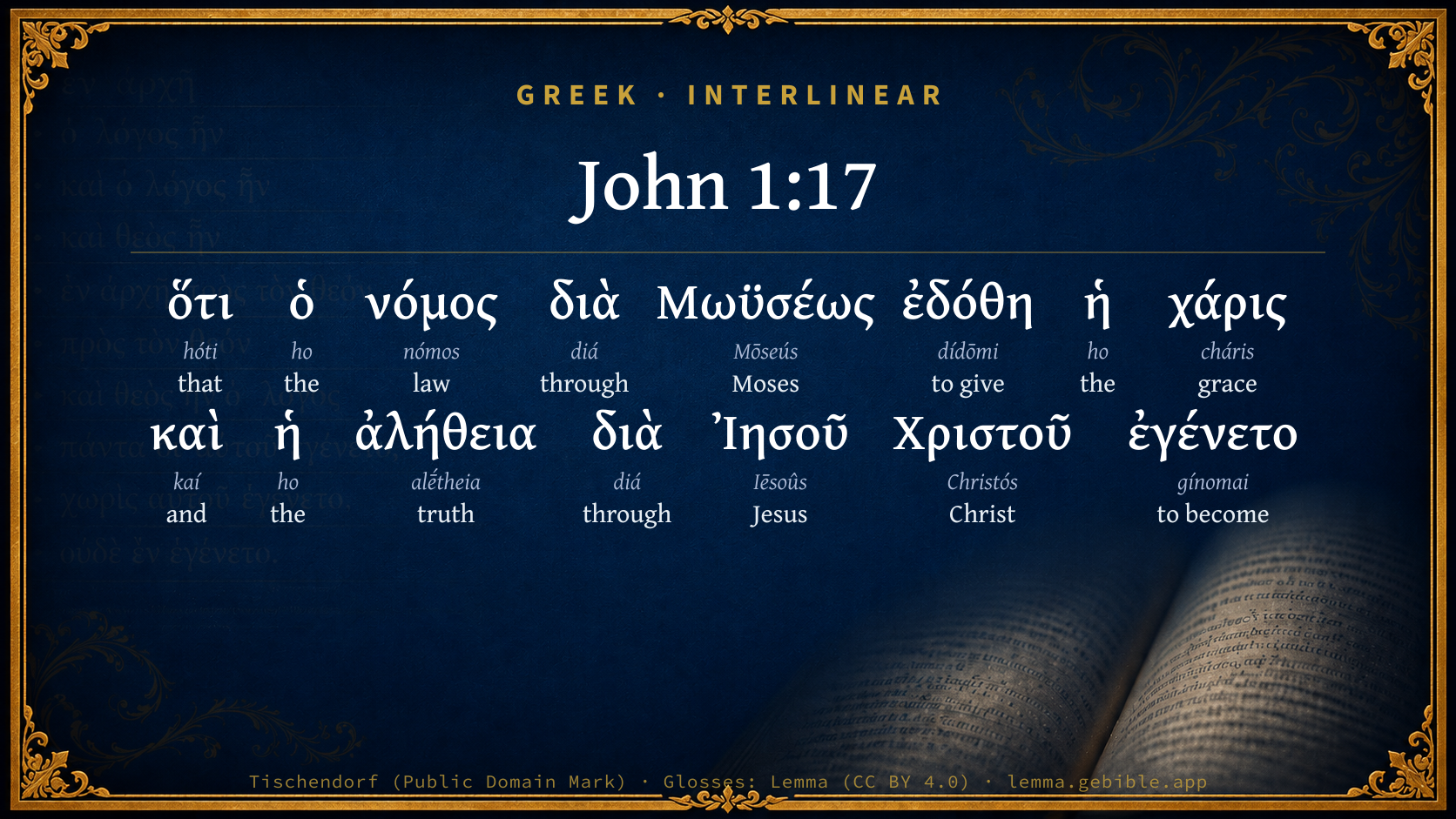
Greek (Tischendorf 8th ed.) John 1:17 appears in the Greek New Testament. The text above is from the Tischendorf 8th edition. Each word links to its Strong’s number and a concise gloss. Click any word for its full Thayer’s Greek Lexicon entry.
Download image
Cite this verse

John 1:17 (World English Bible). Public Domain. Lemma interlinear Bible study tool, https://lemma.gebible.app/v/john/1/17.

Show BibTeX & RIS
BibTeX
RIS
English Translation
For the law was given through Moses. Grace and truth came through Jesus Christ.
World English Bible · Public Domain
Download a study sheet

One document with this verse’s original text, its word-by-word gloss line, the meaning frame, cross-references with their text, attributed commentary, and full source and license credits — printable, and it pastes into notes with its structure intact.

This verse Autodidact and up

Study sheet (.html) Plain text (.txt)

A passage Seminary Student

Up to 50 verses in one chapter. A passage sheet keeps up to 6 commentary sources and 12 cross-references per verse, in the order this page ranks them, and says so on the sheet whenever that leaves anything out. Ask for a single verse and you get the Autodidact verse sheet above.

Everything on this page stays free to read, with no account — the sheet is a download of what is already on screen, not access to it.

Want to remove ads? Support Godless Engineer
Compare translations 3

The same verse in 3 English versions, stacked beneath the original-language interlinear above. Click any original word for its lexicon entry.

Each is an independent rendering of the whole verse — the interlinear is not word-aligned to these translations.

Highlighted words mark where these versions differ — a whole-verse word diff, not a word-by-word alignment.

  • World English Bible Public Domain
    For the law was given through Moses. Grace and truth came through Jesus Christ.
  • King James Version Public Domain
    For the law was given by Moses, but grace and truth came by Jesus Christ.
  • unfoldingWord Literal Text CC BY-SA 4.0
    For the law was given through Moses. Grace and truth came about through Jesus Christ.

unfoldingWord Literal Text — © unfoldingWord, licensed CC BY-SA 4.0. Word-aligned USFM3 via Door43 (git.door43.org/unfoldingWord/en_ult).

Versions to compare (up to 4)

3 of 4 selected

Show all 19 translations

Every available English version of this verse, each an independent rendering of the whole verse.

  • World English Bible Public Domain
    For the law was given through Moses. Grace and truth came through Jesus Christ.
  • Berean Standard Bible Public Domain
    For the law was given through Moses; grace and truth came through Jesus Christ.
  • Majority Standard Bible Public Domain
    For the law was given through Moses; grace and truth came through Jesus Christ.
  • King James Version Public Domain
    For the law was given by Moses, but grace and truth came by Jesus Christ.
  • American Standard Version (1901) Public Domain
    For the law was given through Moses; grace and truth came through Jesus Christ.
  • Revised Version (1885) Public Domain
    For the law was given by Moses; grace and truth came by Jesus Christ.
  • Geneva Bible (1599) Public Domain
    For the Lawe was giuen by Moses, but grace, and trueth came by Iesus Christ.
  • Douay-Rheims (1899) Public Domain
    For the law was given by Moses; grace and truth came by Jesus Christ.
  • Young's Literal Translation Public Domain
    for the law through Moses was given, the grace and the truth through Jesus Christ did come;
  • Literal Standard Version CC BY-SA 4.0
    for the Law was given through Moses, the grace and the truth came through Jesus Christ.
  • Unlocked Literal Bible CC BY-SA 4.0
    For the law was given through Moses. Grace and truth came through Jesus Christ.
  • unfoldingWord Literal Text CC BY-SA 4.0
    For the law was given through Moses. Grace and truth came about through Jesus Christ.
  • Darby Bible Public Domain
    For the law was given by Moses: grace and truth subsists through Jesus Christ.
  • World Messianic Bible Public Domain
    For the Torah was given through Moses. Grace and truth were realized through Yeshua the Messiah.
  • Webster's Bible Public Domain
    For the law was given by Moses, but grace and truth came by Jesus Christ.
  • Free Bible Version CC BY-SA 4.0
    For the law was given through Moses; grace and truth came through Jesus Christ.
  • Bible in Basic English Public Domain
    For the law was given through Moses; grace and the true way of life are ours through Jesus Christ.
  • Text-Critical English NT CC BY 4.0
    For the law was given through Moses, but grace and truth came through Jesus Christ.
  • Tyndale New Testament (1534) Public Domain
    For the lawe was geven by Moses but grace and truthe came by Iesus Christ.

Literal Standard Version (2020), Covenant Press — licensed CC BY-SA 4.0. Text via the HelloAO Bible API (eBible.org). Unlocked Literal Bible (unfoldingWord) — licensed CC BY-SA 4.0. Text via the HelloAO Bible API (eBible.org). unfoldingWord Literal Text — © unfoldingWord, licensed CC BY-SA 4.0. Word-aligned USFM3 via Door43 (git.door43.org/unfoldingWord/en_ult). Free Bible Version, Dr. Jonathan Gallagher — licensed CC BY-SA 4.0. Text via the HelloAO Bible API (eBible.org).

Word by word

More ways to search: Search by grammar → Find every occurrence → Compare this word →

Practice this passage: Drill this verse → Learn its vocabulary →

Μωϋσέως
Mōseús
G3475
“Moses”
Noun, Genitive, Singular, Masculine
Part of Speech
Noun
Case
Genitive
Number
Singular
Gender
Masculine
Full Thayer's Definition

Origin: of hebrew origin H4872

TDNT: 18:08,6

Moses = "drawing out" 1. the legislator of the Jewish people and in a certain sense the founder of the Jewish religion. He wrote the first five books of the Bible, commonly referred to as the Books of Moses.
  1. ὅτι hóti G3754 “that” Conjunction
  2. ὁ ho G3588 “the” Article, Nominative, Singular, Masculine
  3. νόμος nómos G3551 “law” Noun, Nominative, Singular, Masculine
  4. διὰ diá G1223 “through” Preposition
  5. ἐδόθη dídōmi G1325 “to give” Verb, Aorist, Passive, Indicative, 3rd person, Singular
  6. ἡ ho G3588 “the” Article, Nominative, Singular, Feminine
  7. χάρις cháris G5485 “grace” Noun, Nominative, Singular, Feminine
  8. καὶ kaí G2532 “and” Conjunction
  9. ἡ ho G3588 “the” Article, Nominative, Singular, Feminine
  10. ἀλήθεια alḗtheia G225 “truth” Noun, Nominative, Singular, Feminine
  11. διὰ diá G1223 “through” Preposition
  12. Ἰησοῦ Iēsoûs G2424 “Jesus” Noun, Genitive, Singular, Masculine
  13. Χριστοῦ Christós G5547 “Christ” Noun, Genitive, Singular, Masculine
  14. ἐγένετο gínomai G1096 “to become” Verb, Aorist, Middle deponent, Indicative, 3rd person, Singular

About this verse

These counts appear in no published source. They are computed here, from the morphology-tagged text and Lemma’s own curated glosses. What Lemma adds →

15
words
12
distinct lemmas
Gospels
section

Repetition

Words recur within this verse:

Cross-references

36

Topical passages linked to John 1:17 in the Treasury of Scripture Knowledge — connected by theme and wording, ordered by reader-vote popularity; previews shown in the World English Bible.

  • Romans 6:14 For sin will not have dominion over you. For you are not under law, but under grace.
  • John 14:6 Jesus said to him, "I am the way, the truth, and the life. No one comes to the Father, except through me.
  • Romans 3:19–26 Now we know that whatever things the law says, it speaks to those who are under the law, that every mouth may be closed, and all the world may be brought under the judgment of God.
  • Romans 5:20–21 The law came in besides, that the trespass might abound; but where sin abounded, grace did abound more exceedingly;
  • John 1:14 The Word became flesh, and lived among us. We saw his glory, such glory as of the one and only Son of the Father, full of grace and truth.
  • Hebrews 9:22 According to the law, nearly everything is cleansed with blood, and apart from shedding of blood there is no remission.
  • John 8:32 You will know the truth, and the truth will make you free."
  • John 7:19 Didn't Moses give you the law, and yet none of you keeps the law? Why do you seek to kill me?"
  • 2 Corinthians 3:7–10 But if the service of death, written engraved on stones, came with glory, so that the children of Israel could not look steadfastly on the face of Moses for the glory of his face; which was passing away:
  • Hebrews 3:5–6 Moses indeed was faithful in all his house as a servant, for a testimony of those things which were afterward to be spoken,
  • Genesis 22:18 In your seed will all the nations of the earth be blessed, because you have obeyed my voice."
  • Acts 28:23 When they had appointed him a day, many people came to him at his lodging. He explained to them, testifying about the Kingdom of God, and persuading them concerning Jesus, both from the law of Moses and from the prophets, from morning until evening.
  • Galatians 3:10–13 For as many as are of the works of the law are under a curse. For it is written, "Cursed is everyone who doesn't continue in all things that are written in the book of the law, to do them."
  • Hebrews 8:8–12 For finding fault with them, he said, "Behold, the days come," says the Lord, "That I will make a new covenant with the house of Israel and with the house of Judah;
  • Hebrews 10:4–10 For it is impossible that the blood of bulls and goats should take away sins.
  • Deuteronomy 5:1 Moses called to all Israel, and said to them, Hear, Israel, the statutes and the ordinances which I speak in your ears this day, that you may learn them, and observe to do them.
  • Revelation 7:9–17 After these things I looked, and behold, a great multitude, which no man could number, out of every nation and of all tribes, peoples, and languages, standing before the throne and before the Lamb, dressed in white robes, with palm branches in their hands.
  • Luke 1:54–55 He has given help to Israel, his servant, that he might remember mercy,
  • Galatians 3:17 Now I say this. A covenant confirmed beforehand by God in Christ, the law, which came four hundred thirty years after, does not annul, so as to make the promise of no effect.
  • Revelation 5:8–10 Now when he had taken the book, the four living creatures and the twenty-four elders fell down before the Lamb, each one having a harp, and golden bowls full of incense, which are the prayers of the saints.
  • Acts 7:38 This is he who was in the assembly in the wilderness with the angel that spoke to him on Mount Sinai, and with our fathers, who received living oracles to give to us,
  • Romans 15:8–12 Now I say that Christ has been made a minister of the circumcision for the truth of God, that he might confirm the promises given to the fathers,
  • Genesis 3:15 I will put enmity between you and the woman, and between your offspring and her offspring. He will bruise your head, and you will bruise his heel."
  • Exodus 20:1–17 God spoke all these words, saying,
  • Psalms 85:10 Mercy and truth meet together. Righteousness and peace have kissed each other.
  • Luke 1:68–79 "Blessed be the Lord, the God of Israel, For he has visited and worked redemption for his people;
  • John 5:45 "Don't think that I will accuse you to the Father. There is one who accuses you, even Moses, on whom you have set your hope.
  • Acts 13:34–39 "Concerning that he raised him up from the dead, now no more to return to corruption, he has spoken thus: 'I will give you the holy and sure blessings of David.'
  • Hebrews 11:39–40 These all, having had testimony given to them through their faith, didn't receive the promise,
  • Deuteronomy 4:44 This is the law which Moses set before the children of Israel:
  • Deuteronomy 33:4 Moses commanded us a law, An inheritance for the assembly of Jacob.
  • Psalms 98:3 He has remembered his loving kindness and his faithfulness toward the house of Israel. All the ends of the earth have seen the salvation of our God.
  • Micah 7:20 You will give truth to Jacob, and mercy to Abraham, As you have sworn to our fathers from the days of old.
  • John 9:29 We know that God has spoken to Moses. But as for this man, we don't know where he comes from."
  • 2 Corinthians 1:20 For however many are the promises of God, in him is the "Yes." Therefore also through him is the "Amen," to the glory of God through us.
  • Psalms 89:1–2 I will sing of the loving kindness of Yahweh forever. With my mouth, I will make known your faithfulness to all generations.

Cross-references courtesy of OpenBible.info (CC BY 4.0).

Commentary

Notes on John 1:17 from classic Christian and Jewish commentators (each source and its license shown beneath its notes). The classic Christian expositions comment on the surrounding passage and are grouped to its opening verse, so a note may address several verses; the Jewish commentaries on the Tanakh (Rashi and others) are per-verse, so they appear only where the commentator wrote on this verse.

Lemma curates 59 commentaries, every one of them public domain or Creative Commons licensed, each selected and text-cleaned for this edition rather than reprinted as found. About our sources →

The Cambridge Bible for Schools and Colleges

gen. ed. J. J. S. Perowne

17. The mention of ‘grace’ reminds the Evangelist that this was the characteristic of the Gospél and marked its superiority to the Law; for the Law could only condemn transgressors, grace forgives them.

For] Better, Because.

by Moses] The preposition translated ‘by’ in Joh_1:3; Joh_1:10; Joh_1:17, and ‘through’ in Joh_1:7, is one and the same in the Greek. The meaning in all five cases is ‘by means of.’ Moses did not give the Law any more than he gave the manna (Joh_6:32): he was only the mediate agent by whose hand it was given (Gal_3:19).

truth] Like grace, truth is opposed to the Law, not as truth to falsehood, but as perfection to imperfection.

came] Note the change from ‘was given.’ The grace and truth which came through Christ were His own; the Law given through Moses was not his own.

Jesus Christ] S. John no longer speaks of the Logos: the Logos has become incarnate (Joh_1:14) and is spoken of henceforth by the names which He has borne in history.

The Cambridge Bible for Schools and Colleges (gen. ed. J. J. S. Perowne; Cambridge University Press, 1878–1918) — public domain. Text from a community e-Sword module.

The Biblical Illustrator

Joseph S. Exell

Joh_1:17

The Law was given by Moses

Points, of contrast between Judaism and Christianity

I.

IN THE PERSONS REPRESENTING JUDAISM AND CHRISTIANITY.

1. Moses was the servant, Christ the master.

2. Moses was a subject, dependent, Christ was King of kings.

3. Moses was only a man, but Christ was the God-man.

4. Moses was the agent smiting the rock, Christ was the rock smitten.

5. Moses was but the channel of communication between God and His people; Christ is the source of all our mercy.

6. Moses was only the student; in Christ dwelt all the fulness of wisdom.

7. Moses was delegated; Christ spoke in His own name and on His own authority.

II. IN THE CREDENTIALS OF THE WORK OF MOSES AND THOSE OF THE WORK OF CHRIST.

1. The ten plagues were wrought for punishment. The thirty-two miracles of Christ were performed in mercy.

2. The miracles of Moses were a national calamity; those of Christ a national blessing.

3. The miracles of Moses were destructive; those of Christ remedial.

4. Those of Moses were wrought on matter; many of those of Christ on mind or spirit.

5. Those of Moses were wrought by power derived from God; those of Christ by Himself.

III. IN THE FESTIVALS OF JUDAISM AND CHRISTIANITY.

1. The former refer to temporal deliverances and to carnal things; the latter commemorate spiritual deliverances, and refer to the heavenly and the Divine. The Passover, e.g., sets forth the emancipation from Egypt; the Lords Supper of redemption from sin.

2. The Jewish Sabbath, the last day of the week, commemorated the creation of the world; the Christian Sabbath, the first of the week, is the sign of the new creation.

3. The Jewish Pentecost commemorated the giving of the Law on Sinai; our Pentecost, the baptism of the Spirit.

IV. ABOUT JUDAISM WE HAVE THE OUTWARD; ABOUT GRACE AND TRUTH WE HAVE THE INWARD.

1. The virtue in the Jewish sacrifices was outwardly derived; the virtue in the Atonement is the inward.

2. Their laws were given amidst the external thundering and lightning of Sinai; ours amid the calmness and quietness peculiar to Christ.

3. The Jews were separated from the world more by outward signs; we are separated by the circumcision of the heart.

V. THE LIFE OF OBEDIENCE GOD REQUIRED FROM THE JEWS WAS EMBODIED IN A CODE OF LAWS; THAT OF THE CHRISTIAN IS IN THE LIFE OF CHRIST. (S. Jones.)

The Law by Moses

Gods education of the world, class by class--the Law one of the most important lessons ever taught it. Advisable to review these old lessons.

I. THE LAW. Wider and narrower meanings of the word.

1. Political, representing the theocratic idea.

2. The ceremonial, representing the sacrificial.

3. Moral, representing the inculcation of holiness. A remarkable foreshadowing of the Holy Trinity.

II. BY WHOM GIVEN: Moses. Fulness of accounts concerning him. Scenes and dates of his life easily traceable.

1. His outer life.

(1) Education.

(2) Energy.

(3) Patriotism.

2. His inner life.

(1) Meekness, disinterestedness (Exo_32:20-32).

(2) Prayerfulness.

III. TO WHOM GIVEN

1. Not to the world, but to a peculiar people; this contrary to human practice, and a proof of heavenly origin.

2. To a people specially prepared from the time of Abraham in all the circumstances of their national life and location.

3. To a people who nevertheless failed to keep it in its entirety for a single generation. Hence we see that, while God has always a law, and that law has always been in its great characteristics the same, man has always failed to keep it. (W. L.)

Grace and truth by Jesus Christ

I. GRACE.

1. The Divine message.

2. The heavenly gift.

3. The supernatural help.

II. TRUTH. This grace, embodied in the life, working outwards from the heart

III. CAME BY JESUS CHRIST.

1. They could come by no other.

2. From Him they were inseparable. The twofold nature of the

Divine Man.

IV. FOR WHOM. Not like the law for a people, but for the world Mat_11:28; Joh_3:16; 1Ti_2:4; Tit_2:11). (W. L.)

Moses and Christ

I. A COMPARISON.

1. Both men.

2. Both messengers from God.

3. Both bearers of a revelation.

II. A CONTRAST.

1. Moses only man; Christ the Son of God.

2. Moses raised up by God; Christ sent forth from God.

3. Moses the bearer of a revelation outside of himself; Christ the bringer of a revelation in Himself.

4. Moses a lawgiver; Christ a declarer of grace and truth. (T. Whitelaw, D. D.)

The three dispensations in history and in the soul

(cf. Gal_3:6)

I. The dispensation of NATURAL RELIGIOUS FEELING.

1. The race was in childhood. It acted from impulse. It obeyed no written code of moral regulations. The man chosen as the representative of this period was Abraham. The record of it is the book of Genesis. That writing is the first grand chapter in the biography of man; and its very literary structure--so dramatic in contents, so careless of the rules of art, so like a childs story in its sublime simplicity--answers to the spontaneous period it pictures. The patriarchal age we call it. Throughout the whole of this era, reaching from Adam to Joseph, there were beautiful virtues, flowering into the light by the spontaneous energy of nature, but poisoned in many spots by the slime of sensuality. The human stock threw out its forms of life with a certain negligence, as the prodigal force of nature does her forests--as a boy swings his limbs in the open air. Character needed a staunch vertebral column to secure its uprightness.

2. Corresponding to this impulsive religious age of the race, is the natural state of the individual. It is the condition we are born into, and the multitudes never pass beyond it, because they are never renewed or made Christian. Morally, they are children all their lives. Bad dispositions mix with good. Conduct is not brought to the bar of a governmental examination, and judged by an unbending principle. Nature, true enough, is always interesting; and spontaneous products may be beautiful. But man, with his free agency, beset before and behind by evil, is not like a lily growing under Gods sun and dew, with no sin to deform its grace or stain its colouring. He has to contend, struggle, resist. He is tried, enticed, besieged. Natural religion might possibly answer in the woods or in some solitary cell. But let the young man travel to the city, and the young woman lend her ears to the flatteries of that silver-tongued sorceress, society; and all this natural piety is like a silken thread held over a blazing furnace.

3. And as the first dispensation ended in a slavery in Egypt, or broods darkly over Pagan nations still, so the lawless motions of every self-guided will end in a servitude to some Pharaoh in the members that cries aloud for emancipation--a settled alienation from the household of the good.

II. Next comes the LEGAL OR JUDICIAL stage.

1. The worlds religious experience is concentrated in Judaea, human progress running on through Hebrew channels. Others have wandered off into hopeless idolatries. Now God calls Moses and appoints him the head of the second epoch. A period of law begins. Instinct must be curbed, for it has done mischief enough. Impulse must be controlled by principle, for it has proved itself insufficient. There must be positive commands, ceremonies, and ordinances, coercive restraints, and penalties.

2. So with all of us; there comes a time when we feel that we cannot act by inclination, but must follow law. The principle of duty is that law. Babyhood is passed, and its instincts suffice us no longer. To do as we like would still be pleasant, but it is dangerous and false. We become stewards, and must give account of our stewardship. Life has put its harness upon us, and we must work in it. The beneficence as well as the rectitude of this is apparent. By obeying a law, we acquire superiority to it. Voluntarily submitting to certain rules for a time, our virtue is strengthened and finally becomes independent of them, so that it can go alone. The inebriate binds himself by a pledge, and thus regains his freedom. Let us not despise law, for every day practical proofs are scattered before us that it is a schoolmaster to bring us to Christ.

III. But there is a THIRD DISPENSATION, and at the head of it one greater than Moses. These outgrew the period of literal commandment. It became a dead profession, a school of foolish questions, a shelter of hypocrisies. The enlarging soul of the race asks a freer, more sincere, more vital nurture, and it comes. If the simple religious instincts of Abraham had been accepted for righteousness; if the law had been given by Moses, grace and truth enter in by Jesus Christ--grace for the heart, truth for the understanding.

1. Christ does not abrogate law, but by His own life and sacrifice first satisfies its conditions. Think not that I came to destroy, but to fulfil. The Cross does not unbind the cords of accountability, but tightens and strengthens them. Divine laws never looked so sacred as when they took sanctity from the redemption of the Crucified. We must still be under discipline; but the Lawgiver is lost in the Redeemer. The drudgery of obedience is beautified into the privilege of reconciliation. Love has cast out fear. The soul is released from the bondage.

2. Neither of these three stages, whether of the general or the personal progress, denies or cuts off its predecessor. Nature prepares the way for law, making the heart restless by an unsatisfying experiment without it. The

Law disciplined wayward, uncultured man, making him ready for Christ. Judaism and Moses looked forward to the Messiah. So, in the heart of childhood, there are expectations of the responsible second stage of manhood; it is too thoughtless yet to look beyond, to the age of mature Christian holiness. But see, again, when that second age of stern command and strict obedience comes, it grows sober and reflective. It feels heavily that it is not sufficient to itself. It must look forward for the consolations of the Cross.

3. Each stage requires fidelity in the preceding. You must have been true to the better impulses of youth, that you may be, to the best advantage, a servant of the law of maturity. You must be faithfully obedient to duty before you are fit to be a subject of grace. Do not imagine you can glide over into the favour of heaven, without first keeping the commandment. Abraham, Moses, Christ; impulse, discipline, faith; nature, law, gospel; instinct, obedience, grace; Mature, Sinai, Calvary; this is that Divine order--not bound by rigid rules of chronological succession, but having the freeplay and various intershadings of a moral growth--to which we are to conform our lives. (Bp. Huntington.)

Use of the law

You never saw a woman sewing without a needle! She would come but poor speed, if she only sewed wi the thread. So, I think, when were dealing wi sinners, we maun aye put in the needle o the law first; for the fact is, theyre sleepin sound, and they need to be awakened up wi something sharp. But when weve got the needle of the law fairly in, we may draw as lang a thread as you like o gospel consolation after it. (F. Lockhart.)

The law shows us our need of Christ

One of the persecutors, in Queen Marys days, pursuing a poor Protestant, and searching the house for him, charged an old woman to show him the heretic. She points to a great chest of linen, on the top whereof lay a fair looking-glass. He opens the chest, and asks where the heretic was. She suddenly replied, Do you not see one? meaning that he was the heretic, and that he might easily see himself in the glass. And thus Gods law is the glass that shows us all our spots. Let us hold it right to our intellectual eye; not behind us, as the wicked do, they cast Gods word behind them; not beside us, like the rich worldling that called to Christ--not to turn the back of the glass towards us, which is the very trick of all hypocrites; nor, lastly, to look upon ourselves in this glass when we are muffled, masked, or cased, for under those veils we cannot discern our own complexions. But let us see the clear glass before our face, and our open face to the glass, and then we shall soon perceive that the sight of our filthiness is the first step towards cleanliness. (J. Spencer.)

Grace and truth came by Jesus Christ

I. HOW THEY CAME.

1. Let us begin with truth. Truth came by Jesus Christ.

(1) The truth of performance in distinction from engagement. You read of the promise made unto the fathers. It was first announced in Paradise, and was renewed from time to time. That promise has been fulfilled by Jesus Christ.

(2) The truth of reality in distinction from prefiguration. The Law was a shadow of good things to come. We are in possession of the truth, of Which the paschal lamb, the manna, the rock, the altar, the mercy-seat, etc., were the shadows.

(3) The truth of certainty in distinction to error and falsehood. What is heathenism? An assemblage of false gods, temples, sacrifices, hopes, fears: turned the truth of God into a lie. What is Mohammedanism? A vast improvement on heathenism. Mohammed was a man of great talent; but that his communications from God, that his puerile and depraved notions were Divinely inspired, is a lie. What is Popery? Take her traditions, rites of saints, miracles, infallibility--what are these but lying wonders? What is justification by works? What is antinomianism, but a lie? But the gospel is the truth, and we can point to its incontestible evidences.

(4) The truth of importance in distinction from all other truth. Things may be equally true, and yet not equally valuable. There is physical, historical, and moral truth; but I lay my hand on the Bible and say, This is life eternal.

(5) This is truth the most honourable to God, suited to man, most influential, most beneficent; and we do not wonder at Paul saying, I count all things but loss, for the excellency of it.

2. Grace came by Jesus Christ.

(1) Because He revealed it (Joh_1:18). Never man spoke as this man. Grace was poured into His lips, therefore the common people heard Him gladly.

(2) Because He is the effect of it. God so loved, etc.

(3) Because He is the medium of it. Everything worthy of the name flows from His mediation--promises which are yea and amen through Him; redemption, which is through His blood.

(4) Because He is the exemplifier of it. Look at His Old Testament emblems, and those in the New: a lamb is the image of His Person, a dove of His Spirit. Righteousness and joy and peace is the character of His kingdom.

II. WHAT ARE WE TO DO WITH THEM NOW THEY ARE COME. We must have something to do with them, or they will have something to do with us. Having come in contact with the gospel you cannot shake it off. It will either be a savour of life or a savour of death.

1. We are to receive them. Not grace without truth or truth without grace. The gospel is truth, and therefore to be received with the firmness of conviction and assent; grace, therefore to be received with cordiality, gratitude, and joy.

2. To exemplify them. Under the agency of the Spirit we are softened from our natural hardness to receive Divine impression, and fashioned into the very character of the gospel so that we realize it, embody it, and render it visible, so that we adorn the doctrine of God our Saviour by showing what it is. Whatever the gospel is we are required to copy it--if light, we are to be illuminated; if salt, we are to be seasoned; if love, we are to be lovely; if holiness, we are to be holy. There are some who are all truth who are not all that grace requires. The perfection of the Christian arises from the harmony and proportion of these excellencies. In your zeal for orthodoxy you must not renounce charity and candour.

3. To extend and diffuse them. Though grace and truth came by Jesus Christ, there are millions who have never heard of the Saviour. But are they to remain ignorant always? (W. Jay.)

The purpose of the law

The law threatened, not helped; commanded, not healed; showed, not took away, our feebleness. But it made ready for the Physician, who was to come with grace and truth. (Augustine.)

Law and grace

The Law was given, but grace came, because the one was sent by a servant, the other was brought by the Son. (Bp. Wordsworth.)

Grace and truth one with Christ

The words was given imply the external and positive institution of the Law; came denotes grace and truth appearing historically in the very person of Him who is their essential source (Joh_1:4), and becoming realized in His life and communicated through Him. Moses may disappear, the Law remains nevertheless; it is only given by him. But take Jesus Christ away, and grace and truth are gone; for these gifts have come by Him, and are closely united to His Person. (F. Godet, D. D.)

Claim and gift

There was first, in the Law, Gods claim of right, which man could not meet, and now, in Jesus Christ, Gods gift of salvation. (J. Culross, D. D.)

The one could only give the command, but the other supplies motives and strength to keep it. The one could only show in figure, what the other exhibits in fact, the means whereby we may obtain pardon where the command has unhappily been broken. (G. J. Brown, M. A.)

Grace and truth

Grace in opposition to the curse of the moral law; truth in opposition to the figures of the ceremonial law. (Bp. Reynolds.)

Grace comprehends all the perfections of the will; truth all the virtues of the understanding. (Dr. Preston.)

Truth

It is plain that the antithesis cannot be between the false and the true, but only between the imperfect and the perfect, the shadowy and the substantial. So, too, the eternal word is declared to be τὸ φῶς τὸ ἀληθινόν (Joh_1:9), not denying thereby that the Baptist was also a burning and a shining light (Joh_5:35), or that the faithful are lights in the world (Php_2:15; Mat_5:14); but only claiming for a greater than all to be the Light that lighteth every man that cometh into the world. Christ declares Himself ὀ ἄρτος ὀ ἀληθὶνος (Joh_6:32), not that the bread which Moses gave was not also bread of heaven Psa_105:40), but it was such only in a secondary inferior degree; it was not food in the highest sense, inasmuch as it did not nourish up into eternal life those that ate it (Joh_6:49). He is ἠ ἀμπελος ἠ ἀληθινὴ Joh_15:1), not thereby denying that Israel also was Gods vine, which we know it was (Psa_80:8; Jer_2:21), but affirming that none except Himself realized this name, and all which this name implied, to the full (Hos_10:1; Deu_32:32). The fact that in Johns writings the word ἀληθὶνος is used two and twenty times as against five times in all the rest of the New Testament, is one which we can scarcely dismiss as accidental. (Archbishop Trench.)

Jesus Christ

It is at this point that the Apostle for the first-time announces the great name so long expected. In proportion as the history of the mercies of the Word towards humanity unfolds before his view, the spectacle inspires him with terms even more concrete and more human. The Loges of Joh_1:1 appeared as Light in Joh_1:5; as Son, Joh_1:14; and in Joh_1:17 He is at length called Jesus Christ. (F. Godet, D. D.)

Law and grace

These great words have stood here in Johns Gospel for eighteen hundred years, but I am afraid there are millions of Christian people who have not discovered their glorious meaning. They are still under law, and are still surrounded by the unreal shadows of darkness. About the grace and the truth which have come through Jesus Christ, they know almost nothing. I will begin with what is most obvious. We find ourselves living in a world in which the forces of nature are constant, in which what we describe as natural laws are uniform and invariable. There is an iron rigidity in the constitution of things. We have to discover that constitution. We cannot change it. We have to take account of it in the conduct of life. What we call Nature seems to show no mercy to those who disregard her method. She will give us harvests, but we must pay her price, and her full price. We can have health and strength, but only upon her conditions. Now this relentlessness of nature forms men to think of God sometimes as relentless; for nature, they say, is the revelation of God. We are under law--this is the inference--under law throughout every province of life, and we can never escape the natural consequences of our sins. We must exhaust the penalty in this world or other worlds, we must pay the debt to the uttermost farthing. Christ meets us in nature and contradicts that inference. Nature is only the partial and incomplete revelation of God. Christ reveals the actual truth. You believe that there is no release from the natural consequences of ignorance, of folly, of recklessness, of vice, and that in the full and unqualified sense of the words What a man soweth that shall he also reap. But the whole story of Christs life contradicts that belief. If natural laws were supreme, men born blind would remain blind to the end of their days. Christ gave them sight. That is not merely part of the evidence of the gospel. It is a very substantial part of the gospel itself, and a part of the gospel exceptionally necessary in our times. If natural laws were supreme, deaf would remain deaf, the dumb would remain dumb. Christ gave them hearing, speech. The laws of nature are not supreme. In Christ, the gracious power of the Eternal revealed, not to one age only but to all ages, that nature is not supreme, but that God is supreme. Nature may be relentless; God is not. And it was in the natural order itself that Christ by His miracles gave us this great discovery. The universe is a great school for the discipline of the intellect and the virtue of mankind, and it could not be an effective discipline if the natural order were not constant. But to infer that the methods of God are bound by the methods of nature is a false inference. Let me take another illustration of how Christ contradicts what may be called our natural belief in law. We are conscious of fault, perhaps of something that ought to be described by a darker name. It lies upon our conscience, and we cannot escape from it. We say, No, it is impossible that I should ever escape. The guilt is mine, and if I live for a thousand years it will be mine still. Grace came by Jesus Christ. You think that by an eternal law you must suffer for your sins. The Christian gospel declares that Christ suffered for them. His relations to us--you will discover this, I hope, some day if you have not discovered ityet--are of a kind which made it possible for Him, as it was possible for no one else. But does He deliver from the external and natural consequences of wrong-doing? Not obviously. Perhaps not frequently. If He delivered men from these obviously and frequently, the moral discipline which we are to derive from the constancy of the order of nature would be imperilled. Sometimes, indeed--and far more often than we even suppose--I am inclined to believe that Christ does really deliver us even from thenatural consequences of wrong-doing. But even when these remain their whole character is changed. As sins they are forgiven. Then they become simply the natural consequences of what we have done, not the penal consequences. We do not see behind them a God that is punishing us for having done wrong, but a God who has pardoned us, and who is standing by us to discipline us by certain hard conditions of life to a higher perfection. Consequences which were penal as long as we were unforgiven, become simply natural and disciplinary as soon as sin has been remitted. Do you say that if the consequences remain it makes no difference whether they are penal or whether they are natural and disciplinary? You would hardly say that if you knew the difference from experience. But even apart from experience you may get some glimpse of the truth. Here is a man who, as the result of his recklessness and his gross vices, is suffering disease for which there is no cure. He is miserably weak, sometimes he is in great pain. His condition is the natural result of his evil life, and since he brought it on himself by his vices, he feels that it is the penal result of his evil life. Here is another man, suffering from weakness equally prostrating, from pain equally severe, but his weakness and pain came upon him from no fault of his own. They are the result of exposure to damp air acting on some original defect of the constitution, or the result of overwork for the sake of his wife and children, or of accident, or they came upon him on the battlefield when fighting for his country. They are natural consequences of certain past events in the mans history; they are not the penal results of the mans vices. Would not the first man give a great deal to exchange the weakness and the suffering which are penal for the weakness and the suffering which are merely natural? That is what Christ reveals. Law came by Moses, grace came by Jesus Christ. Let me take another illustration. Law, moral law, law as we know it--and I am using the word in its popular sense--begins by imposing duty. The law of consequence begins by imposing duty. The law given to the Jewish people so far forth as it was law begins by imposing duty, and it makes the fulfilment of duty the condition of peace with God and of larger power to do well and of eternal blessedness. All this is of the very essence of what we call law. Grace came by Jesus Christ. He begins in altogether a different way. He does not say Live righteously, and God will be at peace with you,, but God is at peace with you, therefore bye righteously. He finds us in our sin. Whenever He really finds us we are conscious of our sin, and so we are ready in our strong belief in that form of law which is familiar to us to say, God can be no friend of mine as yet; I must amend my ways, I must break off my evil habits, I must master my evil passions, I must become pure, devout, earnest about religion, and then God will be at peace with me. That is law. What Christ says is, God is already at peace with you, is already your Friend. He will not wait till you have amended your ways before He dismisses the remembrance of your sin. He dismisses it at once, and will help you to mend your ways, will help you to break off evil habits, will help you to master evil passions, will help you to become pure, devout, and earnest about religion. That is grace. People do not see the glory of it, do not see what it means. They think that Christ only came to make some things plainer to the world than they were before. It never occurred to them that it would not have been worth while for the eternal Word of God to become flesh in order to do that. Truth--there is an infinite suggestiveness in the way John puts the contrast between what Moses did and what Christ has done. He does not merely say, The law was given by Moses, grace came by Jesus Christ. What he says is, The law was given by Moses, grace came--grace and truth came by Jesus Christ. Judaism was evidently wanting in grace; it was wanting in reality too. All its institutions were elementary, visible, material illustrations of the spiritual realities, the very truth of things, which are ours in Christ. Not only grace and truth, reality came by Jesus Christ. And wherever the grace is obscured, the truth, the very reality and substance of the Christian revelation loses its place, and the mere shadows of heavenly things remain. It was so among the Judaising opponents of Paul. You remember how they insisted on the necessity of circumcision if men were to be saved. But, said Paul, circumcision is nothing. It is a shadow, it produces no real change in a man. We Christians have the true thing, of which circumcision is but the shadow, the circumcision of the heart, in the spirit, not in the letter, whose praise is not of man but of God. I entreat you to dismiss shadows, all shadows. Recognize the truth, the reality that has come by Jesus Christ, and in the truth you will find grace. There is a real sacrifice for sin, the eternal Son of God. There is a real Priest. While we deal with the shadows of sin, the shadows of sacrifices and the shadows of priests may avail for us; but when the sin comes home to us in its reality, be sure of this, that only the sacrifice that is real and the Priest that is real will give us courage and peace. And the glory of what Christ has achieved, and the revelation of grace which has come by Christ, is this, that while Christ has cancelled the old and infirm form of law, Christ creates a righteousness transcending all that law had demanded. Grace comes, grants us to begin with more than man had ever hoped for by perfect obedience, and grace tells man that, by an obedience he would never have been capable of before, he is to retain this great wealth and constantly to augment it. And so in a higher region grace and law blend. The law is not made void--it is established; the righteousness that law demands grace renders possible; and so man is glorified for ever in the eternal glory of God. (B. W. Dale, M. A.)

The Biblical Illustrator, edited by Joseph S. Exell (c. 1880s–1900s) — public domain. Text from a community e-Sword module.

Joseph Benson's Commentary

Joh 1:17. For the law — Working wrath, and containing shadows; was given by Moses, but grace and truth came by Jesus Christ — Grace, opposed to the condemnation and wrath by the law, and truth, opposed to the ceremonies thereof. Further, in the gospel we have a discovery of the most important truths to be received by the understanding, as well as of the richest grace to be embraced by the will and affections. It is a faithful saying, and worthy of all acceptation; that is, it is truth and grace. The offers of grace are sincere, and what we may venture our souls upon. The gospel is grace and truth, with reference to the law; for, 1st, It is the performance of all the Old Testament promises. 2d, It is the substance of all the Old Testament types and shadows. There was a measure of grace, both in the ordinances that were instituted for Israel, and the providences that were concerning Israel; but they were only shadows of good things to come, even of that grace which is brought to us by the revelation of Jesus Christ. He is the true paschal lamb, the true scape-goat, the true manna. They had grace in the sign and picture, we have it in the thing signified and the reality. Because, in this passage, the apostle, speaking of the law, says, εδοθη, it was given by Moses; but that grace and truth, εγενετο, was, or came by Jesus Christ, Erasmus supposes, that the expressions were meant to imply, that whereas Moses was only the messenger of the law, Christ was the original of the grace and truth he brought into the world by the gospel. But it must be observed, that the preposition δια, through, is here used of Christ as well as of Moses, so that, in this passage, both of them seem to be represented as messengers, though of very different dispensations, and the former of infinitely greater dignity than the latter.

Joseph Benson's Commentary on the Old and New Testaments (1811–1818) — public domain. Text from a community e-Sword module.

MacLaren's Expositions of Holy Scripture

Alexander MacLaren

John

GRACE AND TRUTH

Joh 1:17.

There are scarcely any traces, in the writings of the Apostle John, of that great controversy as to the relation of the Law and the Gospel which occupied and embittered so much of the work of the Apostle Paul. We have floated into an entirely different region in John’s writings. The old controversies are dead-settled, I suppose, mainly by Paul’s own words, and also to a large extent by the logic of events. This verse is almost the only one in which John touches upon that extinct controversy, and here the Law is introduced simply as a foil to set off the brightness of the Gospel. All artists know the value of contrast in giving prominence. A dark background flashes up brighter colours into brilliancy. White is never so white as when it is relieved against black. And so here the special preciousness and distinctive peculiarities of what we receive in Christ are made more vivid and more distinct by contrast with what in old days ‘was given by Moses.’

Every word in this verse is significant. ‘Law’ is set against ‘grace and truth.’ It was ‘given’; they ‘came.’ Moses is contrasted with Christ. So we have a threefold antithesis as between Law and Gospel: in reference to their respective contents; in reference to the manner of their communication; and in reference to the person of their Founders. And I think, if we look at these three points, we shall get some clear apprehension of the glories of that Gospel which the Apostle would thereby commend to our affection and to our faith.

I. First of all, then, we have here the special glory of the contents of the Gospel heightened by the contrast with Law.

Law has no tenderness, no pity, no feeling. Tables of stone and a pen of iron are its fitting vehicles. Flashing lightnings and rolling thunders symbolise the fierce light which it casts upon men’s duty and the terrors of its retribution. Inflexible, and with no compassion for human weakness, it tells us what we ought to be, but it does not help us to be it. It ‘binds heavy burdens, and grievous to be borne,’ upon men’s consciences, but puts not forth ‘the tip of a finger’ to enable men to bear them. And this is true about law in all forms, whether it be the Mosaic Law, or whether it be the law of our own country, or whether it be the laws written upon men’s consciences. These all partake of the one characteristic, that they help nothing to the fulfilment of their own behests, and that they are barbed with threatenings of retribution. Like some avenging goddess, law comes down amongst men, terrible in her purity, awful in her beauty, with a hard light in her clear grey eyes-in the one hand the tables of stone, bearing the commandments which we have broken, and in the other a sharp two-edged sword.

And this is the opposite of all that comes to us in the Gospel. The contrast divides into two portions. The ‘Law’ is set against ‘grace and truth.’ Let us look at these two in order.

What we have in Christ is not law, but grace. Law, as I said, has no heart; the meaning of the Gospel is the unveiling of the heart of God. Law commands and demands; it says: ‘This shalt thou do, or else-’; and it has nothing more that it can say. What is the use of standing beside a lame man, and pointing to a shining summit, and saying to him, ‘Get up there, and you will breathe a purer atmosphere’? He is lying lame at the foot of it. There is no help for any soul in law. Men are not perishing because they do not know what they ought to do. Men are not bad because they doubt as to what their duty is. The worst man in the world knows a great deal more of what he ought to do than the best man in the world practises. So it is not for want of precepts that so many of us are going to destruction, but it is for want of power to fulfil the precepts.

Grace is love giving. Law demands, grace bestows. Law comes saying ‘Do this,’ and our consciences respond to the imperativeness of the obligation. But grace comes and says, ‘I will help thee to do it.’ Law is God requiring; grace is God bestowing. ‘Give what Thou commandest, and then command what Thou wilt.’

Oh, brethren! we have all of us written upon the fleshly tablets of our hearts solemn commandments which we know are binding upon us; and which we sometimes would fain keep, but cannot. Is this not a message of hope and blessedness that comes to us? Grace has drawn near in Jesus Christ, and a giving God, who bestows upon us a life that will unfold itself in accordance with the highest law, holds out the fulness of His gift in that Incarnate Word. Law has no heart; the Gospel is the unveiling of the heart of God. Law commands; grace is God bestowing Himself.

And still further, law condemns. Grace is love that bends down to an evildoer, and deals not on the footing of strict retribution with the infirmities and the sins of us poor weaklings. And so, seeing that no man that lives but hears in his heart an accusing voice, and that every one of us knows what it is to gaze upon lofty duties that we have shrunk from, upon plain obligations from the yoke of which we have selfishly and cowardly withdrawn our necks; seeing that every man, woman, and child listening to me now has, lurking in some corner of their hearts, a memory that only needs to be quickened to be a torture, and deeds that only need to have the veil drawn away from them to terrify and shame them-oh! surely it ought to be a word of gladness for every one of us that, in front of any law that condemns us, stands forth the gentle, gracious form of the Christ that brings pardon, and ‘the grace of God that bringeth salvation unto all men.’ Thank God! law needed to be ‘given,’ but it was only the foundation on which was to be reared a better thing. ‘The law was given By Moses’-’a schoolmaster,’ as conscience is to-day, ‘to bring us to Christ’ by whom comes the grace that loves, that stoops, that gives, and that pardons.

Still further, there is another antithesis here. The Gospel which comes by Christ is not law, but truth. The object of law is to regulate conduct, and only subordinately to inform the mind or to enlighten the understanding. The Mosaic Law had for its foundation, of course, a revelation of God. But that revelation of God was less prominent, proportionately, than the prescription for man’s conduct. The Gospel is the opposite of this. It has for its object the regulation of conduct; but that object is less prominent, proportionately, than the other, the manifestation and the revelation of God. The Old Testament says ‘Thou shalt’; the New Testament says ‘God is.’ The Old was Law; the New is Truth.

And so we may draw the inference, on which I do not need to dwell, how miserably inadequate and shallow a conception of Christianity that is which sets it forth as being mainly a means of regulating conduct, and how false and foolish that loose talk is that we hear many a time.-’Never mind about theological subtleties; conduct is the main thing.’ Not so. The Gospel is not law; the Gospel is truth. It is a revelation of God to the understanding and to the heart, in order that thereby the will may be subdued, and that then the conduct may be shaped and moulded. But let us begin where it begins, and let us remember that the morality of the New Testament has never long been held up high and pure, where the theology of the New Testament has been neglected and despised. ‘The law came by Moses; truth came by Jesus Christ.’

But, still further, let me remind you that, in the revelation of a God who is gracious, giving to our emptiness and forgiving our sins-that is to say, in the revelation of grace-we have a far deeper, nobler, more blessed conception of the divine nature than in law. It is great to think of a righteous God, it is great and ennobling to think of One whose pure eyes cannot look upon sin, and who wills that men should live pure and noble and Godlike lives. But it is far more and more blessed, transcending all the old teaching, when we sit at the feet of the Christ who gives, and who pardons, and look up into His deep eyes, with the tears of compassion shining in them, and say: ‘Lo! This is our God! We have waited for Him and He will save us.’ That is a better truth, a deeper truth than prophets and righteous men of old possessed; and to us there has come, borne on the wings of the mighty angel of His grace, the precious revelation of the Father-God whose heart is love. ‘The law was given by Moses,’ but brighter than the gleam of the presence between the Cherubim is the lambent light of gentle tenderness that shines from the face of Jesus Christ. Grace, and therefore truth, a deeper truth, came by Him.

And, still further, let me remind you of how this contrast is borne out by the fact that all that previous system was an adumbration, a shadow and a premonition of the perfect revelation that was to come. Temple, priest, sacrifice, law, the whole body of the Mosaic constitution of things was, as it were, a shadow thrown along the road in advance by the swiftly coming King. The shadow fell before Him, but when He came the shadow disappeared. The former was a system of types, symbols, pictures. Here is the reality that antiquates and fulfils and transcends them all. ‘The law was given by Moses; grace and truth came by Jesus Christ.’

II. Now, secondly, look at the other contrast that is here, between giving and coming.

I do not know that I have quite succeeded in making clear to my own mind the precise force of this antithesis. Certainly there is a profound meaning if one can fathom it; perhaps one might put it best in something like the following fashion.

The word rendered ‘came’ might be more correctly translated ‘became,’ or ‘came into being.’ The law was given; grace and truth came to be.

Now, what do we mean when we talk about a law being given? We simply mean, I suppose, that it is promulgated, either in oral or in written words. It is, after all, no more than so many words. It is given when it is spoken or published. It is a verbal communication at the best. ‘But grace and truth came to be.’ They are realities; they are not words. They are not communicated by sentences, they are actual existences; and they spring into being as far as man’s historical possession and experience of them are concerned-they spring into being in Jesus Christ, and through Him they belong to us all. Not that there was no grace, no manifest lore of God, in the world, nor any true knowledge of Him before the Incarnation, but the earlier portions of this chapter remind us that all of grace, however restrained and partial, that all of truth, however imperfect and shadowy it may have been, which were in the world before Christ came, were owing to the operation of that Eternal Word ‘Who became flesh and dwelt among us,’ and that these, in comparison with the affluence and the fulness and the nearness of grace and truth after Christ’s coming, were so small and remote that it is not an exaggeration to say that, as far as man’s possession and experience of them are concerned, the giving love of God and the clear and true knowledge of His deep heart of tenderness and grace, sprang into being with the historical manifestation of Jesus Christ the Lord.

He comes to reveal by no words. His gift is not like the gift that Moses brought down from the mountain, merely a writing upon tables; His gift is not the letter of an outward commandment, nor the letter of an outward revelation. It is the thing itself which He reveals by being it. He does not speak about grace, He brings it; He does not show us God by His words, He shows us God by His acts. He does not preach about Him, but He lives Him, He manifests Him. His gentleness, His compassion, His miracles, His wisdom, His patience, His tears, His promises; all these are the very Deity in action before our eyes; and instead of a mere verbal revelation, which is so imperfect and so worthless, grace and truth, the living realities, are flashed upon a darkened world in the face of Jesus Christ. How cold, how hard, how superficial, in comparison with that fleshly table of the heart of Christ on which grace and truth were written, are the stony tables of law, which bore after all, for all their majesty, only words which are breath and nothing besides.

III. And so, lastly, look at the contrast that is drawn here between the persons of the Founders.

I do not suppose that we are to take into consideration the difference between the limitations of the one and the completeness of the other. I do not suppose that the Apostle was thinking about the difference between the reluctant service of the Lawgiver and the glad obedience of the Son; or between the passion and the pride that sometimes marred Moses’ work, and the continual calmness and patient meekness that perfected the sacrifice of Jesus. Nor do I suppose that there flashed before his memory the difference between that strange tomb where God buried the prophet, unknown of men, in the stern solitude of the desert, true symbol of the solemn mystery and awful solitude with which the law which we have broken invests death, to our trembling consciences, and the grave in the garden with the spring flowers bursting round it, and visited by white-robed angels, who spoke comfort to weeping friends, true picture of what His death makes the grave for all His followers.

But I suppose he was mainly thinking of the contrast between the relation of Moses to his law, and of Christ to His Gospel. Moses was but a medium. His personality had nothing to do with his message. You may take away Moses, and the law stands all the same. But Christ is so interwoven with Christ’s message that you cannot rend the two apart; you cannot have the figure of Christ melt away, and the gift that Christ brought remain. If you extinguish the sun you cannot keep the sunlight; if you put away Christ in the fulness of His manhood and of His divinity, in the power of His Incarnation and the omnipotence of His cross-if you put away Christ from Christianity, it collapses into dust and nothingness.

So, dear brethren, do not let any of us try that perilous experiment. You cannot melt away Jesus and keep grace and truth. You cannot tamper with His character, with His nature, with the mystery of His passion, with the atoning power of His cross, and preserve the blessings that He has brought to the world. If you want the grace which is the unveiling of the heart of God, the gift of a giving God and the pardon of a forgiving Judge; or if you want the truth, the reality of the knowledge of Him, you can only get them by accepting Christ. ‘I am the Truth, and the Way, and the Life.’ There is a ‘law given which gives life,’ and ‘righteousness is by that law.’ There is a Person who is the Truth, and our knowledge of the truth is through that Person, and through Him alone. By humble faith receive Him into your hearts, and He will come bringing to you the fulness of grace and truth.

Alexander MacLaren, Expositions of Holy Scripture (1904–1910) — public domain. Text from a community e-Sword module.

Scofield Reference Notes

C. I. Scofield

grace

Grace. Summary:

(1) Grace is "the kindness and love of God our Saviour toward man.. . not by works of righteousness which we have done" Tit 3:4; Tit 3:5.

It is, therefore, constantly set in contrast to law, under which God demands righteousness from man, as, under grace, he gives righteousness to man Rom 3:21; Rom 3:22; Rom 8:4; Php 3:9. Law is connected with Moses and works; grace with Christ and faith; Joh 1:17; Rom 10:4-10. Law blesses the good; grace saves the bad; Exo 19:5; Eph 2:1-9. Law demands that blessings be earned; grace is a free gift; Deu 28:1-6; Eph 2:8; Rom 4:4; Rom 4:5.

(2) As a dispensation, grace begins with the death and resurrection of Christ Rom 3:24-26 Rom 4:24; Rom 4:25. The point of testing is no longer legal obedience as the condition of salvation, but acceptance or rejection of Christ, with good works as a fruit of salvation,; Joh 1:12; Joh 1:13; Joh 3:36; Mat 21:37; Mat 22:24; Joh 15:22; Joh 15:25; Heb 1:2; 1Jn 5:10-12. The immediate result of this testing was the rejection of Christ by the Jews, and His crucifixion by Jew and Gentile Act 4:27. The predicted end of the testing of man under grace is the apostasy of the professing church: See "Apostasy" (See Scofield "2Ti 3:1") 2Ti 3:1-8 and the resultant apocalyptic judgments.

(3) Grace has a twofold manifestation: in salvation Rom 3:24 and in the walk and service of the saved Rom 6:15.

See, for the other six dispensations:

Innocence, (See Scofield "Gen 1:28")

Conscience, (See Scofield "Gen 3:23")

Human Government, (See Scofield "Gen 8:21")

Promise, (See Scofield "Gen 12:1")

Law, (See Scofield "Exo 19:8")

Kingdom, (See Scofield "Eph 1:10").

The Scofield Reference Bible (1917 edition), notes by C. I. Scofield — public domain. Text from a community e-Sword module.

Tyndale Open Study Notes

Tyndale Open Resources

1:17 the law: That is, the torah, the body of instruction given to Moses at Mount Sinai. • Although God’s unfailing love and faithfulness are in the torah, these qualities are fully revealed in Christ (3:16; 13:1).

Tyndale Open Study Notes — © Tyndale Open Resources, licensed CC BY-SA 4.0. Text via the HelloAO Bible API.

Bengel's Gnomon

Johann Albrecht Bengel

Joh 1:17. Ὃ νόμος, the law) producing wrath [Rom 4:15], and having a shadow [Heb 10:1]: the moral and ceremonial law.—ἐδόθη, was given) No philosopher so accurately employs words, and observes their distinctions, as John, and especially in this chapter: afterwards he says, ἐγένετο [Grace and truth came by Jesus Christ; for]. The law is not Moses’ own: [but] grace and truth are Christ’s own.—ἡ χάρις, grace) The conjunction is elegantly omitted; for both an adversative and copulative, had place [“locum habebat;” a ‘but’ was to be looked for here]. To grace and truth the law gives way, ch. Joh 4:23 [The true worshippers shall worship the Father in spirit and truth: for the Father seeketh such to worship Him]. Concerning grace, an explanation was given at Joh 1:16: concerning truth, see below, Joh 1:18 [Comp. 2Jn 1:3, Grace be with you, mercy, and peace, from God the Father, and from the Lord Jesus Christ, the Son of the Father, in truth and love].—Ιἠσοῦ, Jesus) John when once he had made mention of the incarnation, Joh 1:14, never afterwards puts the noun λόγος, the word, in this signification, throughout this whole book: comp. 1Jn 1:1 with 3 [That—which we have heard, which we have seen,—of the word of life. That which we have seen and heard, declare we unto you, that ye also may have fellowship with us; and truly our fellowship is with the Father and with His Son Jesus Christ] where also he begins with the name λόγος; but as he goes onward, he names Him Jesus Christ.—ἐγένετο, were made [came into being]) Previously the world had neither known, nor had had grace.

Bengel's Gnomon of the New Testament — English translation (T&T Clark, Edinburgh, 1860) — public domain. Text from a community e-Sword module.

Meyer's Critical & Exegetical Commentary

Heinrich August Wilhelm Meyer

Joh_1:17. Antithetical confirmation of χάριν ἀντὶ χάριτος; for how high above what was formerly given by Moses, does that stand which came through Jesus Christ! Comp. Rom_4:15; Rom_10:4; Gal_3:10 ff., al. The former is the law, viewed by Paul as the antithesis of grace (Rom_6:14; Rom_7:3; Gal_4:4, and many other passages), in so far as it only lays us under obligation, condemns us, and in fact arouses and intensifies the need of grace, but does not bestow peace, which latter gift has been realized for us through Christ. The antithesis without μὲν

δέ has rhetorical force (Joh_4:22, Joh_6:63); Buttm. N. T. Gk. p. 344 [E. T. p. 364].

ἡ χάρις] in the definite and formal sense of redemption, saving grace, i.e. the grace of the Father in the Son. Hence also καὶ ἡ ἀλήθεια is added with a pragmatical reference to Joh_1:14; this, like all Christs gifts of grace, was regarded as included in the universal χάριν ἀντὶ χάριτος of Joh_1:16. Moreover, the ἀλήθεια was not given in the law, in so far as its substance, which was not indeed untrue, but an outflow of the divine will for salvation (Rom_7:10 sqq.; Act_7:38), was yet related only as type and preparation to the absolute revelation of truth in Christ; and hence through its very fulfilment (Mat_5:17) it had come to be done away (Rom_10:4; Col_2:14; Heb_10:1 ff; Heb_7:18). Comp. Gal_3:24. Grace was still wanting to the law, and with it truth also in the full meaning of the word. See also 2Co_3:13 ff.

ἐγένετο] The non-repetition of ἐδόθη is not to point out the independent work of the Logos (Clemens, Paedag. i. 7), to which διὰ would be opposed, or of God (Origen), whose work the law also was; but the change of thought, though not recognised by Lücke, lies in this, that each clause sets forth the historical phenomenon as it actually occurred. In the case of the law, this took place in the historical form of being given, whereas grace and truth originated, came into being, not absolutely, but in relation to mankind, for whom they had not before existed as a matter of experience, but which now, in the manifestation and work of Christ, unfolded their historical origin. Comp. 1Co_1:30.

Observe how appropriately, in harmony with the creative skilful plan of the Prologue, after the incarnation of the Logos, and the revelation of His glory which was therewith connected, have been already set forth with glowing animation, there is now announced for the first time the great historical NAME, Jesus Christ, which designates the incarnate Logos as the complete concrete embodiment of His manifestation. Comp. 1Jn_1:1-3. Only now is the Prologue so fully developed, that Jesus Christ, the historical person of the λόγος ἔνσαρκος (who therefore is all the less to be understood throughout, with Hofmann and Luthardt, under the title λόγος), comes before the eye of the reader, who now, however, knows how to gather up in this name the full glory of the God-man.

Meyer — Critical and Exegetical Commentary on the New Testament — English translation by Peter Christie, edited by Frederick Crombie (T&T Clark, 1880) — public domain. Text from a community e-Sword module.

Expositor's Greek Testament

ed. W. Robertson Nicoll

Joh 1:17 . ὅτι ὁ νόμος … ἐγένετο . What is the connection? His statement that the Incarnate Logos was the inexhaustible supply of grace might seem to disparage Moses and the previous manifestations of God. He therefore explains. And he seems to have in view the same distinction between the old and the new that is so frequently emerging in the Pauline writings. Through Moses, here taken as representing the pre-Christian dispensation, was given the law, which made great demands but gave nothing, which was a true revelation of God’s will, and so far was good, but brought men no ability to become liker God. But through Jesus Christ (here for the first time named in the Gospel, because we are now fully on the ground of history) came grace and truth. In contrast to the inexorable demands of a law that brought no spiritual life. Jesus Christ brought “grace,” the unearned favour of God. The Law said: Do this and live; Christ says: God gives you life, accept it. “Truth” also was brought by Christ. ἀλήθεια here means “reality” as opposed to the symbolism of the Law ( cf. Joh 4:23 ). In the Law was a shadow of good things to come: in Christ we have the good things themselves. Several good critics find a contrast between ἐδόθη and ἐγένετο ; the law being “given” for a special purpose, “grace and truth” “coming” in the natural course and as the issue of all that had gone before.

The Expositor's Greek Testament, edited by W. Robertson Nicoll (1897–1910) — public domain. Text from a community e-Sword module.

Cambridge Greek Testament for Schools and Colleges

17. The mention of χάρις reminds the Evangelist that this was the characteristic of the new dispensation and marked its superiority to the old: the Law condemned transgressors, χάρις forgives them.

διὰ Μωυσέως. It is regrettable that the translation of διὰ in this prologue is not uniform in the A.V. In Joh 1:3; Joh 1:10; Joh 1:17 we have ‘by,’ in Joh 1:7 ‘through.’ ‘By means of’ is the meaning in all five cases. Moses did not give the Law any more than he gave the manna (Joh 6:32); he was only the mediate agent, the μεσίτης by whose hand it was given (Gal 3:19). The form Μωυσέως is rightly given in the best MSS. The derivation is said to be from two Egyptian words mo = aqua, and ugai = servari. Hence the Septuagint, which was made in Egypt, and the best MSS., which mainly represent the text current in Egypt, keep nearest to the Egyptian form.

ἐδόθη. Not ἐγένετο. The Law given through Moses was not his own; the grace and truth that came through Christ were His own.

ἡ χάρις. The asyndeton is remarkable: the Coptic and Peshito supply an equivalent for δέ, but this is a common insertion in versions, and no proof that a δέ has dropped out of the Greek texts.

ἡ ἀλήθεια. Like χάρις, ἀλήθεια is opposed to νόμος, not as truth to falsehood, but as a perfect to an imperfect revelation.

Ἰησοῦ Χριστοῦ. “To us ‘Christ’ has become a proper name, and as such rejects the definite article. But in the Gospel narratives, if we except the headings, or prefaces, and the after comments of the Evangelists themselves (e.g. Mat 1:1; Mar 1:1; Joh 1:17) no instance of this usage can be found. In the body of the narratives we read only of ὁ Χριστός, the Christ, the Messiah, whom the Jews had long expected.… The very exceptions (Mar 9:41; Luk 2:11; Joh 9:22; Joh 17:3) strengthen the rule.” Lightfoot, On Revision, p. 100. Note that S. John no longer speaks of the Logos: the Logos has become incarnate (Joh 1:14) and is spoken of henceforth by the names which He has borne in history.

Cambridge Greek Testament for Schools and Colleges (Cambridge University Press, 1896; 21 vols, various authors incl. Carr, Maclear, Plummer, Farrar, Lumby, Moule, M. R. James, Simcox) — public domain. Text from a community e-Sword module.

Jamieson, Fausset & Brown

Robert Jamieson, A. R. Fausset & David Brown

For, &c.--The Law elicits the consciousness of sin and the need of redemption; it only typifies the reality. The Gospel, on the contrary, actually communicates reality and power from above (compare Rom 6:14). Hence Paul terms the Old Testament "shadow," while he calls the New Testament "substance" (Col 2:17) [OLSHAUSEN].

Jamieson, Fausset & Brown — Commentary Critical and Explanatory on the Whole Bible (1871) — public domain (CC PDM 1.0). Text via the HelloAO Bible API.

Adam Clarke's Commentary

Verse 17. The law was given by Moses] Moses received the law from God, and through him it was given to the Jews, Ac 7:38.

But grace and truth] Which he had already mentioned, and which were to be the subject of the book which he was now writing, came to all mankind through Jesus Christ, who is the mediator of the new covenant, as Moses was of the old: Heb 8:6; Heb 9:15; Ga 3:19. See a fine discourse on this text by Mr. Claude, "Essay on the Composition of a Sermon," vol. i. p. 119, c. edit. Lond. 1788.

The law of Moses, however excellent in itself, was little in comparison of the Gospel: as it proceeded from the justice and holiness of God, and was intended to convict men of sin, that the way of the Gospel might be the better prepared, it was a law of rigour, condemnation, and death: Ro 4:15; 2Co 3:7-8. It was a law of shadows, types, and figures: Heb 10:1, and incapable of expiating sin by its sacrifices: Ro 8:3; Heb 7:18-19; Heb 10:1, Heb 10:11. But Christ has brought that grace which is opposed to condemnation: Ro 5:15, Ro 5:20-21; Ro 8:1; Ga 3:10; and he is himself the spirit and substance of all those shadows: Col 2:19; Heb 10:1.

Jesus Christ.] JESUS the CHRIST, the Messiah, or anointed prophet, priest, and king, sent from heaven. To what has already been said on the important name Jesus, (See Mt 1:21, and the places there referred to,) I shall add the following explanation, chiefly taken from Professor Schultens, who has given a better view of the ideal meaning of the root ישע yasha, than any other divine or critic.

He observes that this root, in its true force, meaning, and majesty, both in Hebrew and Arabic, includes the ideas of amplitude, expansion, and space, and should be translated, he was spacious-open-ample; and, particularly, he possessed a spacious or extensive degree or rank: and is applied,

1. To a person possessing abundance of riches.

2. To one possessing abundant power.

3. To one possessing abundant or extensive knowledge.

4. To one possessing abundance of happiness, beatitude, and glory.

Hence we may learn the true meaning of Zec 9:9: Rejoice greatly, O daughter of Zion - behold, thy king cometh unto thee; he is JUST, and having SALVATION: - הושיע - he is possessed of all power to enrich, strengthen, teach, enlarge, and raise to glory and happiness, them who trust in him. Man by nature is in want and poverty: in abjectness and weakness: in darkness and ignorance: in straits and captivity: in wretchedness and infamy. His Redeemer is called ישועה JESUS - he who looses, enlarges, and endows with salvation.

1. He enriches man's poverty:

2. strengthens his weakness:

3. teaches his ignorance:

4. brings him out of straits and difficulties: and

5. raises him to happiness, beatitude, and glory.

And the aggregate of these is SALVATION. Hence that saying, His name shall be called JESUS: for he shall save his people from their sins. See Schultens Origines Hebraeae, p. 15.

Adam Clarke's Commentary on the Bible (1810–1826) — public domain. Text from a community e-Sword/MySword module.

John Calvin's Commentaries

17. For the Law was given by Moses. This is an anticipation, by which he meets an objection that was likely to arise; for so highly was Moses esteemed by the Jews that they could hardly receive anything that differed from him. The Evangelist therefore shows how far inferior the ministry of Moses was to the power of Christ. At the same time, this comparison sheds no small luster on the power of Christ; for while the utmost possible deference was rendered to Moses by the Jews, the Evangelist reminds them that what he brought was exceedingly small, when compared with the grace of Christ. It would otherwise have been a great hindrance, that they expected to receive from the Law what we can only obtain through Christ.

But we must attend to the antithesis, when he contrasts the law with grace and truth; for his meaning is, that the law wanted both of them. The word Truth denotes, in my opinion, a fixed and permanent state of things. By the word Grace I understand the spiritual fulfillment of those things, the bare letter of which was contained in the Law. And those two words may be supposed to refer to the same thing, by a well-known figure of speech, (hypallage;) as if he had said, that grace, in which the truth of the Law consists, was at length exhibited in Christ. But as the meaning will be in no degree affected, it is of no importance whether you view them as united or as distinguished. This at least is certain, that the Evangelist means, that in the Law there was nothing more than a shadowy image of spiritual blessings, but that they are actually found in Christ; whence it follows, that if you separate the Law from Christ, there remains nothing in it but empty figures. For this reason Paul says that

the shadows were in the law, but the body is in Christ, (Colossians 2:17.)

And yet it must not be supposed that anything was exhibited by the Law in a manner fitted to deceive; for Christ is the soul which gives life to that which would otherwise have been dead under the law. But here a totally different question meets us, namely, what the law could do by itself and without Christ; and the Evangelist maintains that nothing permanently valuable is found in it until we come to Christ. This truth consists in our obtaining through Christ that grace which the law could not at all bestow; and therefore I take the word grace in a general sense, as denoting both the unconditional forgiveness of sins, and the renewal of the heart. For while the Evangelist points out briefly the distinction between the Old and New Testaments, (which is more fully described in Jeremiah 31:31,) he includes in this word all that relates to spiritual righteousness. Now this righteousness consists of two parts; first, that God is reconciled to us by free grace, in not imputing to us our sins; and, secondly, that he has engraven his law in our hearts, and, by his Spirit, renews men within to obedience to it; from which it is evident that the Law is incorrectly and falsely expounded, if there are any whose attention it fixes on itself, or whom it hinders from coming to Christ

John Calvin's Commentaries (1540-1563) — public domain. Text from the Calvin Translation Society English edition (1840s-50s) via the Christian Classics Ethereal Library (ccel.org). Calvin's coverage is partial (roughly two-thirds of the Bible); uncommented books and verses are honest gaps, never fabricated. The 19th-century editor's footnotes and remarks are omitted so the notes are faithfully Calvin's own voice.

Ellicott's Commentary for English Readers

(17) The word “for” connects this verse by way of explanation with what has gone before. The Old Testament thought of grace and truth has been already present in Joh_1:14. The fulness of these divine attributes has been beheld in the glory of the Word. The revelation of them, that is, the removing of the veil which hides the knowable, has been made dependent on the use of the already known. But this is the essence of Christianity as distinct from Judaism; of a spiritual religion developed from within as distinct from a formal religion imposed from without; of a religion of principles, and therefore true for all time and for all men, as distinct from a religion of works, based, indeed, on an eternal truth (the oneness and the righteousness of God) but still specially designed for a chosen people and for a period of preparation. The law was given (from without) by the human agency of Moses. The true grace and truth came into being by means of Jesus Christ. Therefore it is that we receive grace for grace, there being in Him an ever constant fulness of grace, and for the man who uses the grace thus given an ever constant realisation of deeper truth. Note that here, when the divinity and humanity have both been dwelt upon, and in contrast to the historic Moses, the name Jesus Christ first appears. Is there, too, in this union of the human and divine names a reference to the union in Him of the faculty to receive and the truth to fulfil? St. Luke speaks of Him as “increasing in wisdom and stature, and in favour (grace) with God and man” (Luk_2:52; see Note there).

A Bible Commentary for English Readers, edited by Charles John Ellicott (1878–1897) — public domain. Text from a community e-Sword module.

John Gill's Exposition

For the law was given by Moses,.... Both moral and ceremonial. The moral law was given to Adam, in innocence, which having been broken, and almost lost out of the minds, and memories of men, was given by Moses, in a new edition of it in writing; and points out what is man's duty both to God and men; discovers sin, accuses of it, convicts of it, and condemns for it; nor could it give strength to perform its demands; nor does it give the least hint of forgiveness; nor will it admit of repentance: and hence is opposed to grace; though it was a benefit to men, being in its own nature good and useful in its effects. The ceremonial law pointed out the pollution of human nature, the guilt and punishment of sin; was a type and shadow of deliverance by Christ, but could not give the grace it shadowed, and therefore is opposed both to grace and truth. Now both these were given by Moses to the people of the Jews, not as the maker, but the minister of them: it was God who appointed each of these laws, and ordained them in the hand of the mediator Moses, who received them from him, by the disposition of angels, and delivered them to the people of Israel; and a very high office this was he was put into, and a very great honour was conferred upon him; but Jesus Christ is a far greater person, and in an higher office:

but grace and truth came by Jesus Christ: by grace and truth, is meant the Gospel, in opposition to the law; which is called grace, because it is a declaration of the love, and grace, of God to men; it ascribes salvation, in all the parts of it, to the free grace and favour of God; and is the means of implanting and increasing grace in the hearts of men. And "truth", not only because it contains truth, and nothing but truth, it coming from the God of truth; and the substance of it being Christ, who is the truth; and being revealed, applied, and led into by the Spirit of truth; but because it is the truth of the types, and the substance of the shadows of the law: or these two may mean distinct things; grace may design all the blessings of grace which are in Christ, and come by him; and truth, the promises, and the fulfilment of them, which are all yea, and amen, in Christ: and when these are said to be by him, the meaning is, not that they are by him, as an instrument, but as the author of them; for Christ is the author of the Gospel, and the fulfiller of the promises, and the giver of all grace; which shows the superior excellency of Christ to Moses, and to all men, and even to angels also.

John Gill's Exposition of the Whole Bible (1746–1763) — public domain (CC PDM 1.0). Text via the HelloAO Bible API.

Trapp's Complete Commentary

John Trapp

17 For the law was given by Moses, but grace and truth came by Jesus Christ.

Ver. 17. For the law, &c.] Lex iubet, gratia iuvat. Petamus ut det, quod ut habeamus iubet, The law command, grace assists. Let us ask that he may give, that we have what he commands, saith Augustine. We have his promise ever going along with his precept. The covenant of grace turns precepts into promises, and the Spirit of grace turns both into prayers.

John Trapp, A Commentary or Exposition upon All the Books of the Old and New Testament (1647–1656) — public domain. Text from a community e-Sword module.

Albert Barnes' Notes on the Bible

The law was given - The Old Testament economy. The institutions under which the Jews lived.

By Moses - By Moses, as the servant of God. He was the great legislator of the Jews, by whom, under God, their polity was formed. The law worketh wrath Rom 4:15; it was attended with many burdensome rites and ceremonies Act 15:10; it was preparatory to another state of things. The gospel succeeded that and took its place, and thus showed the greatness of the gospel economy, as well as its grace and truth.

Grace and truth came by Jesus Christ - A system of religion full of favors, and the “true” system, was revealed by him. The old system was one of “law,” and “shadows,” and “burdensome rites;” “this” was full of mercy to mankind, and was true in all things. We may learn from these verses:

1.That all our mercies come from Jesus Christ.

“All true believers receive from Christ’s fulness; the best and greatest saints cannot live without him, the meanest and weakest may live by him. This excludes proud boasting that we have nothing but ‘we have received it,’ and silenceth perplexing fears that we want nothing but ‘we may receive it.’”

Albert Barnes' Notes on the Bible (1834–1885) — public domain. Text from a community e-Sword/MySword module.

Matthew Poole's English Annotations

For the law was given by Moses; the law, moral and ceremonial, came not by Moses, but was given by Moses as God’s minister and servant; that law by which no man can be justified, Rom 3:28. In this was Moses’s honour, of whom you glory, Joh 5:45. God indeed made an eminent use of him, as his minister, by whom he revealed his will to you; both in matters of his worship, according to that dispensation; and in matters which concern you in your whole conversation; but yet there is an eminent difference between him and Jesus Christ. The law is no where called grace, neither doth it discover any thing but duty and wrath; it showeth no remission, in case that duty be not done, nor affordeth strength for the doing of it.

But grace and truth came by Jesus Christ; all that is from Christ; all the favour of God for the remission and pardon of sin, and for strength and assistance to the performance of duty, is (not given from God by Christ, as the law by Moses, but) from Christ as the fountain of grace; and not grace only, but truth, whether taken for solid and real mercy, or with respect to the law; the fulfilling of all the types and prophecies in it was by and in Christ.

Matthew Poole's English Annotations on the Holy Bible (1683–1685) — public domain. Text from a community e-Sword/MySword module.

Whedon's Commentary on the Bible

Daniel D. Whedon

17. The law was given by Moses—The law is the expression of absolute justice, which in itself knows not grace nor mercy. This was given from God to men by Moses; but if there were nobody better than Moses, we should have had nothing but law alone. There would have been no grace to bring salvation from its penalty; no consequent truth to reveal that grace. These came, even into the Old Testament dispensation, by Jesus Christ. All the mixture of grace with law in the Old Testament is from Christ.

Daniel D. Whedon (gen. ed.), Commentary on the Old and New Testaments (1874–1909) — public domain. Text from a community e-Sword module.

The Pulpit Commentary

The carin anti caritov is sustained by calling attention to the contrast between the two methods of Divine communication. Because the Law was given through Moses; " Law," which in Paul"s writings had been even looked at by itself as an "antithesis to grace". (Rom_4:15 Rom_6:14 Rom_7:3 Rom_10:4 Gal_3:10 Gal_4:4) The Law principle of approach to God fails through the weakness of the flesh. The will is too far enslaved for it to yield spontaneously to the majesty of the Lawgiver, or to feel the attractions of obedience. The Law condemns, it is incapable of justifying the ungodly: the Law terrifies, it never reconciles. The Law even provokes to sin and excites the passions which it punishes. Law was given through Moses, pointing to the historic fact of the pomp and splendour of its first delivery, associated therefore with the greatest human name in all past history. Law was a "gift," a Divine bestowment of entirely unspeakable value to those who were ignorant of the mind and will of God. Even the ministration of death was glorious. The knowledge of an ideal perfection is a great advance, even though no power should accompany the ideal to draw the soul towards it. To know what is right, even without help to do it, save in the form of sanction, or penalty appealing to the lower nature, is better and nobler than to sin in utter ignorance. The Law was given through" the mind, voice, conscience, and will of Moses. And alongside of him may be supposed to be ranged all the mighty sages and legislators of the human race all who have thus been the mouthpiece of the Divine idea, all who have impressed the "ought" and "ought not," the "shall" and "shall not," upon mankind. Moses is not the author of the Law, the "giving" of the Law was not by Moses, but through his instrumentality. Grace and truth, however, came became, passed into activity in human nature through Jesus Christ. For "grace and truth" (see notes, ver. 14), the highest manifestation and self-communication of Divine love and Divine thought, came into human experience through Jesus Christ. A vast and wonderful contrast is here made between all earlier or other dispensations and that of which the apostle proceeds to speak. Divine favour and help, the life of God himself in the soul of man, awakening love in response to the Divine love; and Divine thought so made known as to bring all the higher faculties of man into direct contact with reality, are an enormous advance upon Lawgiving. The appropriate human response to Law is obedience; the appropriate human response to love is of the same nature with itself nothing less than love; so the only adequate response to Divine truth is faith; to Divine thought may follow human thought. All this forth streaming of grace and truth originated in the person of Jesus Christ, and became possible through him. This great Name, this blending of the human and Divine, of saving grace and Messianic dignity, of ancient expectations and recent realization, is only twice more used in the Gospel; (cf. Joh_17:3 and Joh_20:31) but it pervades it throughout, and, though not actually said to be equivalent to the Word made flesh, yet no shadow of doubt is left that this was the apostle"s meaning. Here the full significance of the prologue really bursts into view to one who reads it for the first time. (1Jn_1:1-3) Difficulty may be felt by some as to the actual Capacity of Jesus Christ to reveal the Divine thought, or the truth, and so the closing verse of the prologue vindicates the claim of the Saviour of the world to be the truth. (cf. Joh_14:6)

Moses and Christ.

Let us proceed at once to particular instances of the Law given through Moses, and of the grace and truth coming through Jesus Christ. Thus we shall better see how Moses is brought into connection with Christ, and Law into connection with grace and truth. Look, then, at Exodus 20, where the great principles of the Law given through Moses are stated.

I CONSIDER, THE BASIS OF JEHOVAH"S CLAIM. "I am Jehovah thy God, which brought thee out of the land of Egypt, out of the house of bondage." The fact of deliverance was indisputable, and just as indisputable the fact that the people had not delivered themselves; and for a while the delivered people hardly knew why they were delivered. Left to themselves, they might have scattered; but there was a compulsion on them all the time a compulsion into liberty, a compulsion to go through the Bed Sea, a compulsion towards the awful solitudes of Sinai. Then at last Jehovah tells them what he expects. He who has done great things for them wants to know what they will do for him; and, lest they be inattentive, he states, to begin with, the solid basis of his claim. Then turn from Moses to Jesus Christ, and we have but another aspect of the same Jehovah. Jehovah was really gracious in the giving of the Law; but the grace got hidden. In Jesus Christ grace is manifest to all. There is the basis of a claim on you. You have but to look back on the experiences of others, human beings like yourselves like in infirmity, like in manifold needs, like in the pollution of an evil heart, like in suffering and sorrow, like in sickness and mortality. As Jesus in the flesh actually dealt with men in various positions, so now, in the spirit according to his view of your needs, will he deal with you. Jesus turned no water to blood, smote no cattle with pestilence, bruised no fields With hail, gathered no clouds of locusts, wrapt no land in gross darkness, robbed no parents of their firstborn, overwhelmed no armies in the sea. A little child can see that grace and truth are in Jesus Christ.

II CONSIDER THE CLAIM OF JEHOVAH ITSELF. Take the first item. "Thou shall have no other gods before me." Look at all that is involved in this claim. It means that we are to worship Jehovah alone, and that, of course, assumes that we are actually worshippers of the one God to begin with. What if we are deluding ourselves with mere outward performances before a name? Do we know what we worship? Labelling the unknown with the name of God does not make it better known. And Moses gave no help in revealing the nature of God. He uttered bare law.

But Jesus comes with a grace and truth which are strangely self-revealing. He winds gently into the hearts of men, by every entrance he can find. He quietly accepts as his right the reverence and adoration of every heart willing to render them. No long elucidations are needed to make it plain that he is a gracious Being. We need no formal command to worship him. We are instinctively drawn to our knees in his presence. He carries the essence of his commandments charactered in his gracious face. Thus by considering all the ten commandments, we should get illustrations of the grace and truth in Jesus Christ. The ten commandments, just by themselves, however often repeated, can bring comfort to no human being, only a deeper conviction of one"s sin and misery. Jesus brings the Law just as vigorously as Moses; but he brings more than Law. Through his demands there shine forth gloriously grace and truth, favour and reality. Not simply good wishes on the one side, or bare reality on the other. Christ brings a grace that is truthful, and a truth that is gracious. He comes as both the kindest and ablest of physicians. He gives strength before he asks service. Grace and truth flow from him to us, and then in due time grace and truth flow forth from us also. Y.

The Pulpit Commentary (1880–1919), ed. H.D.M. Spence-Jones & Joseph S. Exell — public domain. Text from a community e-Sword module.

John Wesley's Explanatory Notes

The law - Working wrath and containing shadows: was given - No philosopher, poet, or orator, ever chose his words so accurately as St. John. The law, saith he, was given by Moses: grace was by Jesus Christ. Observe the reason for placing each word thus: The law of Moses was not his own. The grace of Christ was. His grace was opposite to the wrath, his truth to the shadowy ceremonies of the law. Jesus - St. John having once mentioned the incarnation (ver. 14,) no more uses that name, the Word, in all his book.

John Wesley, Explanatory Notes Upon the Whole Bible (1754–1765) — public domain. Text via the GEBible commentary corpus.

The People's New Testament

B. W. Johnson

17. The law was given by Moses. It was not a system of grace, nor could it make men perfect; in contrast with it the system of grace and truth (see verse 14) was given by Jesus Christ.

B. W. Johnson's The People's New Testament with Notes (1889–1891) — public domain. Electronic text from the Christian Classics Ethereal Library (CCEL) ThML edition.

Alford’s Greek Testament

Henry Alford

17.] The connexion of this verse with the foregoing lies in the words τοῦ πληρώμ. αὐτοῦ (ver. 16), and in χάρις κ. ἀλ. (ver. 14). ‘We received from His fulness continual additions of grace, because that fulness is not, like the law, a positive enactment, finite and circumscribed, of which it could be said that it ἐδόθη, but the bringing in of grace and truth, which ἐγένετο by Jesus Christ.’

ἐδόθη and ἐγένετο have been variously distinguished,—αὐθεντικὸν μὲν τὸ ἐγένετο, δουλικὸν δὲ τὸ ἐδόθη, Theophyl. Similarly Bengel, “Mosis non sua est lex; Christi sua est gratia et veritas.” Pæd. i. 7, p. 134 , says: διὸ καί φησιν ἡ γραφὴ “ὁ νόμος διὰ Μωυσέως ἐδόθη,” οὐχὶ ὑπὸ Μωυσέως, ἀλλὰ ὑπὸ μὲν τοῦ λόγου, διὰ Μωυσέως δὲ τοῦ θεράποντος αὐτοῦ· διὸ καὶ πρόσκαιρος ἐγίνετο, ἡ δὲ ἀΐδιος χάρις καὶ ἡ ἀλήθεια διὰ Ἰησοῦ χριστοῦ ἐγένετο, κ.τ.λ. Origen (in Joan. tom. vi. c. 3, vol. iv. p. 107) speaks very similarly. But the distinction laid down above, which is hinted at by De Wette, seems to me to be the most obvious, and best suited to the context, where the πλήρωμα of Christ is set against the narrowness of positive enactment in the law. Certainly, the distinction must not be lost sight of, nor denied, as Lücke attempts to do: for Bengel truly observes: “Nullus philosophus tam accurate verba ponit, differentiamque eorum observat, quam Johannes, in hoc præsertim capite.”

χάρις κ. ἀλ.] I must again caution the student against any such wholly inadequate explanations as that these words are put ‘per hendiadyn’ for χάρις ἀληθινή. It is in this way that the depths of Scripture have been covered over by the rubbish of expositors. Such was not the method of investigation pursued by the great men of former centuries: witness Origen in loc.: εἰ γὰρ Ἰησοῦς ἐστιν ὁ φάσκων “ἐγώ εἰμι ἡ ἀλήθεια,” πῶς ἡ ἀλήθεια διὰ Ἰησοῦ χριστοῦ γίνεται; αὐτὸς γάρ τις διʼ ἑαυτοῦ οὐ γίνεται. ἀλλὰ νοητέον ὅτι ἡ αὐτοαλήθεια ἡ οὐσιώδης καὶ ἵνʼ οὕτως εἴπω πρωτότυπος τῆς ἐν ταῖς λογικαῖς ψυχαῖς ἀληθείας … οὐχὶ διὰ Ἰησοῦ χριστοῦ ἐγένετο, οὐδʼ ὅλως διά τινος, ἀλλʼ ὑπὸ θεοῦ ἐγένετο· ὡς καὶ ὁ λόγος οὐ διά τινος, ὁ ἐν ἀρχῇ πρὸς τὸν θεόν, καὶ ἡ σοφία, ἣν ἔκτισεν ἀρχὴν ὁδῶν αὐτοῦ ὁ θεός, οὐ διά τινος, οὕτως οὐδὲ ἡ ἀλήθεια διά τινος. ἡ δὲ παρʼ ἀνθρώποις ἀλήθεια διὰ Ἰησοῦ χριστοῦ ἐγένετο· οἷον ἡ ἐν Παύλῳ ἀλ. καὶ τοῖς ἀποστόλοις διὰ Ἰησοῦ χριστοῦ ἐγένετο (vol. iv. p. 107).

Henry Alford, The Greek Testament (1849–1861) — public domain. Text from a community e-Sword module.

International Critical Commentary

17. The paratactic construction (see p. lxxix) is unmistakable; we should expect ὁ νόμος μὲν … ἡ χάρις δὲ καὶ ἡ ἀλήθεια κτλ.

In v. 16 the evangelist exults in the “grace for grace,” i.e. the grace after grace, which all believers have received in Christ. This is, indeed, in marked contrast with the spiritual condition of those who were “under the law,” as Paul would have expressed it, for it is pre-eminently through Christ that “grace” comes into play. χάρις is never spoken of in the LXX as a privilege of the Jew, and the contrast between law and grace is a master-thought of Paul (Rom 4:16, Rom 4:6:14, Rom 4:15, Gal 5:4). Here it is explicit; it had become a Christian commonplace by the time that the Prologue came to be written, but Jn. never returns to it in the body of his Gospel.

The contrast is between νόμος and χάρις, as in Paul, but καὶ ἡ ἀλήθεια was added by Jn. after χάρις, the two having been combined in v. 14. The thought of the freedom which truth brings appears again at 8:32, and ἀλήθεια is very apposite here. Its addition to χάρις is Jn.’s contribution to Paul’s contrast of law and grace. It is not that the Mosaic law was not true, as far as it went; but that the truth of Christ emancipates the believer from the bondage of the law.

That the law was given through Moses is repeated 7:19 (cf. 6:32); but the grace and the truth (ἡ ἀλήθεια; cf. 14:6) came through Jesus Christ. Moses was only the mediator through whom God gave the law; but Christ is Himself the source of grace and truth.

The full historical name “Jesus Christ” appears here for the first time in Jn. It was not used by the contemporaries of Jesus in His public ministry, and is only found in the Synoptists Mar 1:1, Mat 1:1. It appears again Joh 17:3, and also 1Jn 1:3, 1Jn 2:1, 1Jn 3:23, 1Jn 4:2, 1Jn 5:20. In the Acts it occurs 2:38, 3:6, 4:10, 10:36, 16:18, five times in the Apocalypse, and often in Paul (see Introd., p. cxxxvi).

The Logos Hymn Concluded: The Logos the Revealer of God (V. 18)

International Critical Commentary — older volumes (1896–1929), various authors — public domain. Text from a community e-Sword module.

Godet's Commentaries

Frédéric Louis Godet

[See also the "General Considerations on the Prologue" in the comments of Joh 1:18.]

Ver. 17. “For the law was given by Moses; grace and truth came by Jesus Christ.”

John, who had reached the light of the new revelation through the preparatory system of the old, could not fail to point out in this Prologue, at least summarily, the relation between the two; and he does it naturally in this place, where the mention of the two divine gifts obtained through Jesus Christ summons him to a comparison with those which the ancient people of God had received, especially with the law. The for refers to the idea of grace, which has been so forcibly expressed in Joh 1:16 : “grace upon grace; for the legal system has given place henceforth to that of free grace which is, at the same time, that of truth.” We meet again, in this verse, the parallel construction peculiar to the Hebrew; a Greek writer would not have failed to mark the antithesis between the two clauses of this verse by the particles μέν and δέ . The office of the law is to command and to demand; the peculiarity of grace, the essence of the Gospel, is to offer and to give.

The law connects salvation with a work which it exacts; Christ gives gratuitously a salvation which is to become the cause of works. Now this whole manifestation of grace fully reveals at last the true character of God, which remained veiled in the law, and consequently it reveals truth which is the perfect knowledge of God. Bengelexplains the opposition between the law and the two following terms by this ingenious formula: lex iram parans et umbram habens; but perhaps this is the mark of Paul rather than of John. Weiss makes grace consist in the revelation of truth; that is to say, of God as love. Keil, in the opposite way, makes the truth of God consist in the revelation of His grace, which is more true. But John seems to me rather to place these two gifts in juxtaposition and to regard them as distinct from each other; grace is God possessed; truth is God known. These two gifts are joined together, but they are distinct. So John, after having developed the first in Joh 1:16, sets forth the second in Joh 1:18.

The term was given, ἐδόθη, recalls the positive and outward institution of the law, its official promulgation. The expression came, literally became, suits better the historical manifestation of grace and truth in the person and in the ministry of Jesus Christ. Moses may disappear; the law given by him remains. But take away Jesus Christ, and the grace and truth manifested in Him disappear. “John,” says Bengel on this point, “chose his expressions with the strictness of a philosopher.” Let us rather say, with the emphatic precision which is the characteristic of inspiration.

It is at this point of the Prologue that the apostle introduces, for the first time, the name so long expected,Jesus Christ. He descends gradually from the divine to the human: the Logos (Joh 1:1), the only-begotten Son (Joh 1:14), finally, Jesus Christ, in whom the heavenly world fully assumes for us life and reality. The apostle now passes to the second characteristic of the divine glory of Jesus Christ: truth, Joh 1:18.

Frédéric Louis Godet — Commentaries on Luke, John, Romans, and 1 Corinthians — English translation (T&T Clark, Edinburgh, 1870s–1890s) — public domain. Text from a community e-Sword module.

Lesson kit

Teaching starters — assembled from the data on this page, not authored interpretation. Every prompt links to the verse data it draws on. Edit before teaching.

John, in the Gospels, opens this verse with 15 words (12 distinct Greek lemmas). Its most distinctive word is Mōseús (“Moses”). A historical commentator’s framing appears above. Read the whole chapter for the surrounding context.

Discussion questions

  1. The word Mōseús carries the sense “Moses.” How does it shape the verse?
  2. Romans 6:14 shares this passage’s theme. How do the two illuminate each other?
  3. “through” occurs 2× in this one verse. What is the effect of the repetition?
  4. These translations render this verse differently. What is at stake in choosing one wording over another?
  5. Reading how The Cambridge Bible for Schools and Colleges and The Biblical Illustrator read this verse, where do the two commentators agree and where do they part?

Things to notice

  • These translations choose different wording for 2 words in this verse.
  • “through” occurs 2× in this single verse.
  • 12 distinct Greek lemmas span 15 words in this verse.

Reading settings

Reading text

Shown beneath each verse's original-language words.

Old Testament
Old Testament edition

Read the OT as the Masoretic Hebrew (MT) or the Greek Septuagint (LXX).

English shown for the Greek Septuagint (in the Hebrew ↔ Greek comparison).

Comparing translations? Open the Compare panel on any verse page to stack up to four side by side.