

Matthew 7:13
Greek (Tischendorf 8th ed.) Matthew 7:13 appears in the Greek New Testament. The text above is from the Tischendorf 8th edition. Each word links to its Strong’s number and a concise gloss. Click any word for its full Thayer’s Greek Lexicon entry.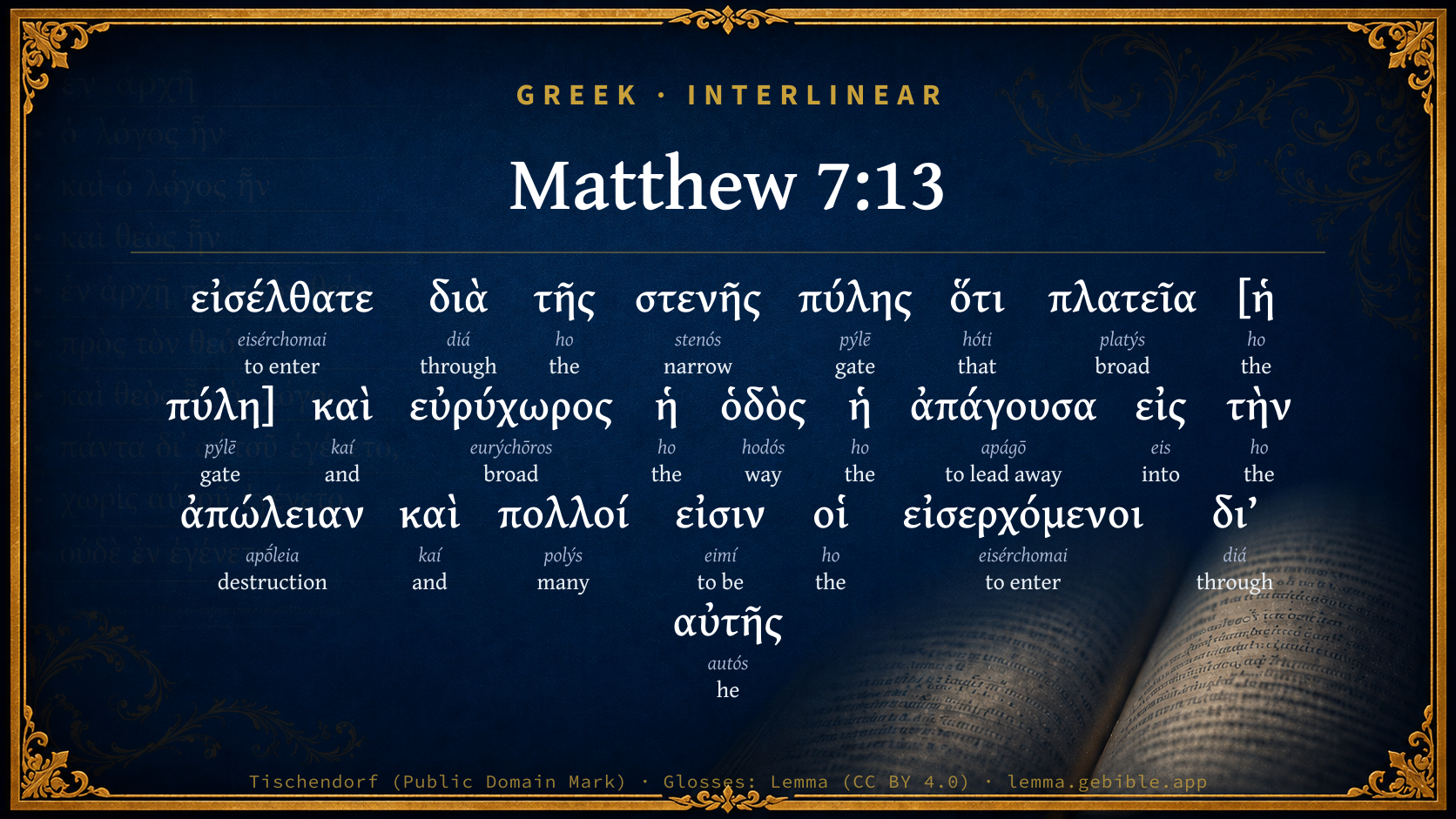
"Enter in by the narrow gate; for wide is the gate and broad is the way that leads to destruction, and many are those who enter in by it.
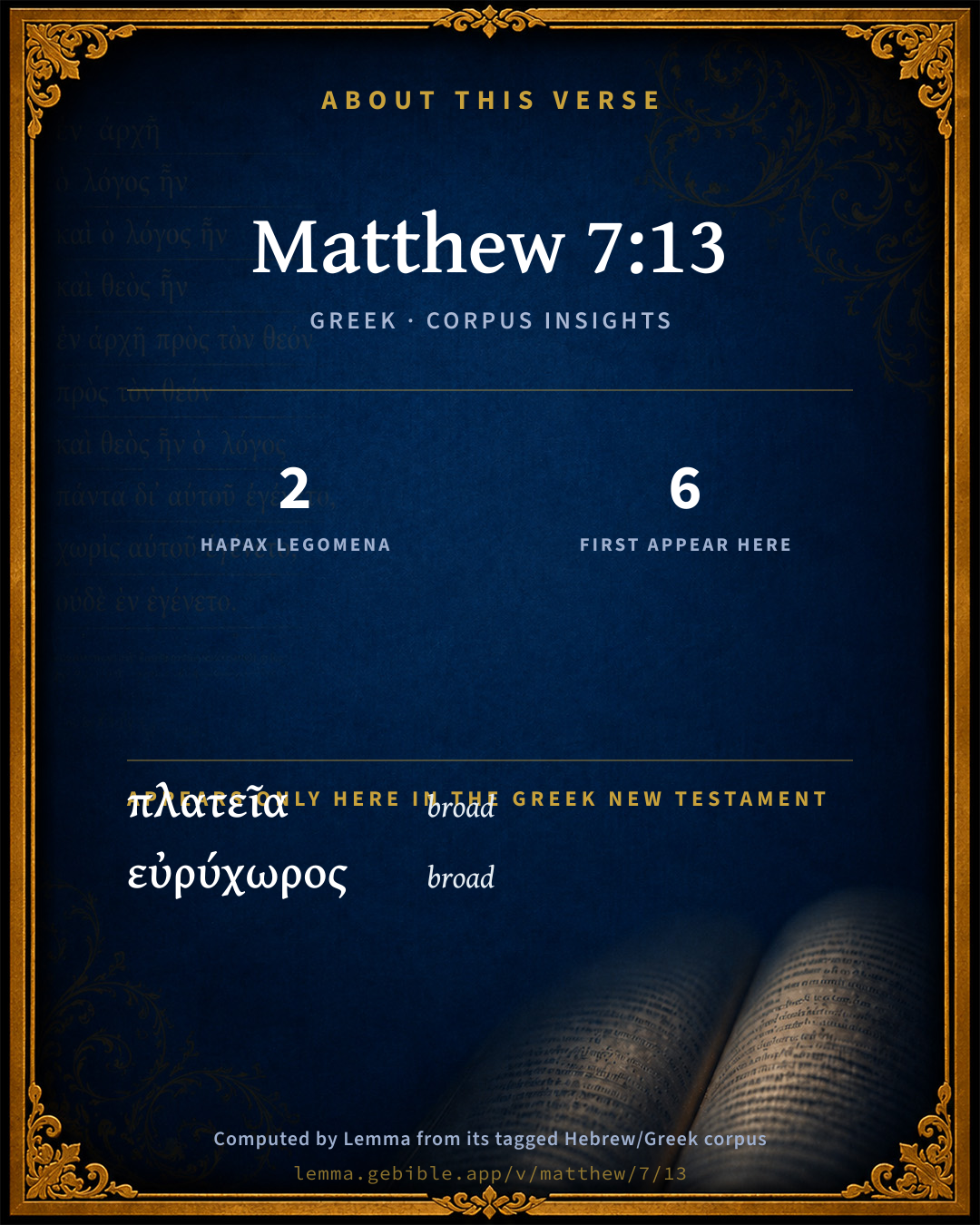
- 2 hapax legomena — only here in the Greek New Testament
- 6 first appearances in the Greek New Testament
Download a study sheet
One document with this verse’s original text, its word-by-word gloss line, the meaning frame, cross-references with their text, attributed commentary, and full source and license credits — printable, and it pastes into notes with its structure intact.
This verse Autodidact and up
A passage Seminary Student
Up to 50 verses in one chapter. A passage sheet keeps up to 6 commentary sources and 12 cross-references per verse, in the order this page ranks them, and says so on the sheet whenever that leaves anything out. Ask for a single verse and you get the Autodidact verse sheet above.
Everything on this page stays free to read, with no account — the sheet is a download of what is already on screen, not access to it.
Compare translations 3
The same verse in 3 English versions, stacked beneath the original-language interlinear above. Click any original word for its lexicon entry.
Each is an independent rendering of the whole verse — the interlinear is not word-aligned to these translations.
Highlighted words mark where these versions differ — a whole-verse word diff, not a word-by-word alignment.
-
World English Bible Public Domain
"Enter in by the narrow gate; for wide is the gate and broad is the way that leads to destruction, and many are those who enter in by it.
-
King James Version Public Domain
Enter ye in at the strait gate: for wide is the gate, and broad is the way, that leadeth to destruction, and many there be which go in thereat:
-
unfoldingWord Literal Text CC BY-SA 4.0
Enter through the narrow gate. For wide the gate and broad the road that is leading to destruction, and there are many entering through it.
unfoldingWord Literal Text — © unfoldingWord, licensed CC BY-SA 4.0. Word-aligned USFM3 via Door43 (git.door43.org/unfoldingWord/en_ult).
Show all 19 translations
Every available English version of this verse, each an independent rendering of the whole verse.
-
World English Bible Public Domain
"Enter in by the narrow gate; for wide is the gate and broad is the way that leads to destruction, and many are those who enter in by it.
-
Berean Standard Bible Public Domain
Enter through the narrow gate. For wide is the gate and broad is the way that leads to destruction, and many enter through it.
-
Majority Standard Bible Public Domain
Enter through the narrow gate. For wide is the gate and broad is the way that leads to destruction, and many enter through it.
-
King James Version Public Domain
Enter ye in at the strait gate: for wide is the gate, and broad is the way, that leadeth to destruction, and many there be which go in thereat:
-
American Standard Version (1901) Public Domain
Enter ye in by the narrow gate: for wide is the gate, and broad is the way, that leadeth to destruction, and many are they that enter in thereby.
-
Revised Version (1885) Public Domain
Enter ye in by the narrow gate: for wide is the gate, and broad is the way, that leadeth to destruction, and many be they that enter in thereby.
-
Geneva Bible (1599) Public Domain
Enter in at the streight gate: for it is the wide gate, and broade way that leadeth to destruction: and many there be which goe in thereat,
-
Douay-Rheims (1899) Public Domain
Enter ye in at the narrow gate: for wide is the gate, and broad is the way that leadeth to destruction, and many there are who go in thereat.
-
Young's Literal Translation Public Domain
`Go ye in through the strait gate, because wide `is' the gate, and broad the way that is leading to the destruction, and many are those going in through it;
-
Literal Standard Version CC BY-SA 4.0
Go in through the narrow gate, because wide [is] the gate and broad the way that is leading to the destruction, and many are those going in through it;
-
Unlocked Literal Bible CC BY-SA 4.0
Enter through the narrow gate. For wide is the gate and broad is the way that leads to destruction, and there are many people who go through it.
-
unfoldingWord Literal Text CC BY-SA 4.0
Enter through the narrow gate. For wide the gate and broad the road that is leading to destruction, and there are many entering through it.
-
Darby Bible Public Domain
Enter in through the narrow gate, for wide the gate and broad the way that leads to destruction, and many are they who enter in through it.
-
World Messianic Bible Public Domain
“Enter in by the narrow gate; for the gate is wide and the way is broad that leads to destruction, and there are many who enter in by it.
-
Webster's Bible Public Domain
Enter ye in at the strait gate; for wide is the gate, and broad is the way, that leadeth to destruction, and many there are who go in by it.
-
Free Bible Version CC BY-SA 4.0
Enter by the narrow entrance. For the entrance is wide, and the way is broad that leads to destruction, and many travel that way.
-
Bible in Basic English Public Domain
Go in by the narrow door; for wide is the door and open is the way which goes to destruction, and great numbers go in by it.
-
Text-Critical English NT CC BY 4.0
“Enter through the narrow gate, for wide is the gate, and broad is the way that leads to destruction, and there are many who enter through it.
-
Tyndale New Testament (1534) Public Domain
Enter in at the strayte gate: for wyde is the gate and broade is the waye that leadeth to destruccion: and many ther be which goo yn therat.
Literal Standard Version (2020), Covenant Press — licensed CC BY-SA 4.0. Text via the HelloAO Bible API (eBible.org). Unlocked Literal Bible (unfoldingWord) — licensed CC BY-SA 4.0. Text via the HelloAO Bible API (eBible.org). unfoldingWord Literal Text — © unfoldingWord, licensed CC BY-SA 4.0. Word-aligned USFM3 via Door43 (git.door43.org/unfoldingWord/en_ult). Free Bible Version, Dr. Jonathan Gallagher — licensed CC BY-SA 4.0. Text via the HelloAO Bible API (eBible.org).
Word by word
More ways to search: Search by grammar → Find every occurrence → Compare this word →
Practice this passage: Drill this verse → Learn its vocabulary →
- Appears 1× in the Greek New Testament
- First appears here
- Part of Speech
- Adjective
- Case
- Nominative
- Number
- Singular
- Gender
- Feminine
Full Thayer's Definition
- εἰσέλθατε eisérchomai G1525 “to enter” Verb, Aorist, Active, Imperative, 2nd person, Plural
- διὰ diá G1223 “through” Preposition
- τῆς ho G3588 “the” Article, Genitive, Singular, Feminine
- στενῆς stenós G4728 “narrow” Adjective, Genitive, Singular, Feminine
- πύλης pýlē G4439 “gate” Noun, Genitive, Singular, Feminine
- ὅτι hóti G3754 “that” Conjunction
- πλατεῖα platýs G4116 “broad” Adjective, Nominative, Singular, Feminine
- [ἡ ho G3588 “the” Article, Nominative, Singular, Feminine
- πύλη] pýlē G4439 “gate” Noun, Nominative, Singular, Feminine
- καὶ kaí G2532 “and” Conjunction
- εὐρύχωρος eurýchōros G2149 “broad” Adjective, Nominative, Singular, Feminine
- ἡ ho G3588 “the” Article, Nominative, Singular, Feminine
- ὁδὸς hodós G3598 “way” Noun, Nominative, Singular, Feminine
- ἡ ho G3588 “the” Article, Nominative, Singular, Feminine
- ἀπάγουσα apágō G520 “to lead away” Verb, Present, Active, Participle, Nominative, Singular, Feminine
- εἰς eis G1519 “into” Preposition
- τὴν ho G3588 “the” Article, Accusative, Singular, Feminine
- ἀπώλειαν apṓleia G684 “destruction” Noun, Accusative, Singular, Feminine
- καὶ kaí G2532 “and” Conjunction
- πολλοί polýs G4183 “many” Adjective, Nominative, Plural, Masculine
- εἰσιν eimí G1510 “to be” Verb, Present, Active, Indicative, 3rd person, Plural
- οἱ ho G3588 “the” Article, Nominative, Plural, Masculine
- εἰσερχόμενοι eisérchomai G1525 “to enter” Verb, Present, Middle or Passive deponent, Participle, Nominative, Plural, Masculine
- δι’ diá G1223 “through” Preposition
- αὐτῆς autós G846 “he” Personal pronoun, Genitive, Singular, Feminine
About this verse
These counts appear in no published source. They are computed here, from the morphology-tagged text and Lemma’s own curated glosses. What Lemma adds →
- 25
- words
- 16
- distinct lemmas
- Gospels
- section
Notable vocabulary
2 hapax legomena — words that appear only here in the entire Greek New Testament:
First appearance in Scripture
These words make their first canonical appearance in the Greek New Testament here:
Shared distinctive vocabulary
στενῆς narrow G4728 occurs in 3 verses of the Greek New Testament. Also found in:
Cross-references
36Topical passages linked to Matthew 7:13 in the Treasury of Scripture Knowledge — connected by theme and wording, ordered by reader-vote popularity; previews shown in the World English Bible.
- Luke 13:24–25 "Strive to enter in by the narrow door, for many, I tell you, will seek to enter in, and will not be able.
- Proverbs 16:25 There is a way which seems right to a man, But in the end it leads to death.
- John 14:6 Jesus said to him, "I am the way, the truth, and the life. No one comes to the Father, except through me.
- John 10:9 I am the door. If anyone enters in by me, he will be saved, and will go in and go out, and will find pasture.
- Isaiah 55:7 let the wicked forsake his way, and the unrighteous man his thoughts; and let him return to Yahweh, and he will have mercy on him; and to our God, for he will abundantly pardon.
- Proverbs 9:6 Leave your simple ways, and live. Walk in the way of understanding."
- Galatians 5:24 Those who belong to Christ have crucified the flesh with its passions and lusts.
- Ezekiel 18:27–32 Again, when the wicked man turns away from his wickedness that he has committed, and does that which is lawful and right, he shall save his soul alive.
- Matthew 3:2 "Repent, for the Kingdom of Heaven is at hand!"
- Matthew 3:8 Therefore bring forth fruit worthy of repentance!
- 2 Corinthians 6:17 Therefore, "'Come out from among them, And be separate,' says the Lord, 'Touch no unclean thing. I will receive you.
- Revelation 20:15 If anyone was not found written in the book of life, he was cast into the lake of fire.
- Matthew 23:13 "Woe to you, scribes and Pharisees, hypocrites! For you devour widows' houses, and as a pretense you make long prayers. Therefore you will receive greater condemnation.
- 1 Peter 4:17–18 For the time has come for judgment to begin at the house of God. If it begins first with us, what will happen to those who don't obey the Gospel of God?
- Ephesians 2:2–3 in which you once walked according to the course of this world, according to the prince of the powers of the air, the spirit who now works in the children of disobedience;
- Philippians 3:19 whose end is destruction, whose god is the belly, and whose glory is in their shame, who think about earthly things.
- Matthew 18:2–3 Jesus called a little child to himself, and set him in the midst of them,
- 2 Corinthians 4:4 in whom the god of this world has blinded the minds of the unbelieving, that the light of the Gospel of the glory of Christ, who is the image of God, should not dawn on them.
- Matthew 25:46 These will go away into eternal punishment, but the righteous into eternal life."
- 1 John 5:19 We know that we are of God, and the whole world lies in the power of the evil one.
- Acts 3:19 "Repent therefore, and turn again, that your sins may be blotted out, so that there may come times of refreshing from the presence of the Lord,
- 2 Thessalonians 1:8–9 giving vengeance to those who don't know God, and to those who don't obey the Gospel of our Lord Jesus,
- Revelation 20:3 and cast him into the abyss, and shut it, and sealed it over him, that he should deceive the nations no more, until the thousand years were finished. After this, he must be freed for a short time.
- Genesis 6:12 God saw the earth, and saw that it was corrupt, for all flesh had corrupted their way on the earth.
- Isaiah 1:9 Unless Yahweh of hosts had left to us a very small remnant, We would have been as Sodom; We would have been like Gomorrah.
- Matthew 25:41 Then he will say also to those on the left hand, 'Depart from me, you cursed, into the eternal fire which is prepared for the devil and his angels;
- Luke 14:33 So therefore whoever of you who doesn't renounce all that he has, he can't be my disciple.
- Acts 2:38–40 Peter said to them, "Repent, and be baptized, everyone of you, in the name of Jesus Christ for the forgiveness of sins, and you will receive the gift of the Holy Spirit.
- Romans 9:22 What if God, willing to show his wrath, and to make his power known, endured with much patience vessels of wrath made for destruction,
- Revelation 12:9 The great dragon was thrown down, the old serpent, he who is called the devil and Satan, the deceiver of the whole world. He was thrown down to the earth, and his angels were thrown down with him.
- Revelation 13:8 All who dwell on the earth will worship him, everyone whose name has not been written from the foundation of the world in the book of life of the Lamb who has been killed.
- Romans 3:9–19 What then? Are we better than they? No, in no way. For we previously charged both Jews and Greeks, that they are all under sin.
- Genesis 6:5 Yahweh saw that the wickedness of man was great in the earth, and that every imagination of the thoughts of his heart was only evil continually.
- Psalms 14:2–3 Yahweh looked down from heaven on the children of men, To see if there were any who did understand, Who did seek after God.
- Proverbs 7:27 Her house is the way to Sheol, Going down to the chambers of death.
- Luke 9:33 It happened, as they were parting from him, that Peter said to Jesus, "Master, it is good for us to be here. Let's make three tents: one for you, and one for Moses, and one for Elijah," not knowing what he said.
Cross-references courtesy of OpenBible.info (CC BY 4.0).
Lesson kit
Teaching starters — assembled from the data on this page, not authored interpretation. Every prompt links to the verse data it draws on. Edit before teaching.
Matthew, in the Gospels, opens this verse with 25 words (16 distinct Greek lemmas). Its most distinctive word is platýs (“broad”). A historical commentator’s framing appears above. Read the whole chapter for the surrounding context.
Discussion questions
- The word platýs carries the sense “broad.” How does it shape the verse?
- 2 words here appear nowhere else in the Greek New Testament. Why might the author reach for such rare wording?
- 6 words make their first appearance in Scripture here. What does this debut establish?
- How does Matthew 7:14, which shares the word «narrow», read alongside this verse?
- What does the repetition of “to enter” (2× in this one verse) do in this verse?
- These translations render this verse differently; the difference is in the English rendering, not the original. What questions does that raise?
- Compare how Jamieson, Fausset & Brown and The Biblical Illustrator read this verse. Where do they agree or differ?
Things to notice
- 2 words in this verse appear nowhere else in the Greek New Testament.
- 6 words make their first canonical appearance in Scripture here.
- These translations choose different wording for 14 words in this verse.
- “to enter” occurs 2× in this single verse.
- 16 distinct Greek lemmas span 25 words in this verse.
Commentary
Notes on Matthew 7:13 from classic Christian and Jewish commentators (each source and its license shown beneath its notes). The classic Christian expositions comment on the surrounding passage and are grouped to its opening verse, so a note may address several verses; the Jewish commentaries on the Tanakh (Rashi and others) are per-verse, so they appear only where the commentator wrote on this verse.
Lemma curates 59 commentaries, every one of them public domain or Creative Commons licensed, each selected and text-cleaned for this edition rather than reprinted as found. About our sources →
Jamieson, Fausset & Brown
Robert Jamieson, A. R. Fausset & David Brown
Jamieson, Fausset & Brown — Commentary Critical and Explanatory on the Whole Bible (1871) — public domain (CC PDM 1.0). Text via the HelloAO Bible API.
The Biblical Illustrator
Joseph S. Exell
The Biblical Illustrator, edited by Joseph S. Exell (c. 1880s–1900s) — public domain. Text from a community e-Sword module.
Joseph Benson's Commentary
Joseph Benson's Commentary on the Old and New Testaments (1811–1818) — public domain. Text from a community e-Sword module.
Whedon's Commentary on the Bible
Daniel D. Whedon
Daniel D. Whedon (gen. ed.), Commentary on the Old and New Testaments (1874–1909) — public domain. Text from a community e-Sword module.
The Preacher's Complete Homiletical Commentary
Joseph S. Exell (gen. ed.)
The Preacher's Complete Homiletical Commentary (gen. ed. Joseph S. Exell; Funk & Wagnalls, c. 1892) — public domain (pre-1929). A full-Bible homiletical/sermon-outline anthology covering 65 of 66 books (2 John is absent from the source module). Text from a community e-Sword module.
Broadus on Matthew
John A. Broadus
John A. Broadus, Commentary on the Gospel of Matthew (American Baptist Publication Society, 1886) — public domain. Text from a community e-Sword module.
Tyndale Open Study Notes
Tyndale Open Resources
Tyndale Open Study Notes — © Tyndale Open Resources, licensed CC BY-SA 4.0. Text via the HelloAO Bible API.
Bengel's Gnomon
Johann Albrecht Bengel
Bengel's Gnomon of the New Testament — English translation (T&T Clark, Edinburgh, 1860) — public domain. Text from a community e-Sword module.
Meyer's Critical & Exegetical Commentary
Heinrich August Wilhelm Meyer
Meyer — Critical and Exegetical Commentary on the New Testament — English translation by Peter Christie, edited by Frederick Crombie (T&T Clark, 1880) — public domain. Text from a community e-Sword module.
Expositor's Greek Testament
ed. W. Robertson Nicoll
The Expositor's Greek Testament, edited by W. Robertson Nicoll (1897–1910) — public domain. Text from a community e-Sword module.
Geneva Bible (1599)
Geneva Bible translators
Geneva Bible (1599) marginal notes — public domain. Text via Bolls.life.
Adam Clarke's Commentary
Adam Clarke's Commentary on the Bible (1810–1826) — public domain. Text from a community e-Sword/MySword module.
Ellicott's Commentary for English Readers
A Bible Commentary for English Readers, edited by Charles John Ellicott (1878–1897) — public domain. Text from a community e-Sword module.
The Cambridge Bible for Schools and Colleges
gen. ed. J. J. S. Perowne
The Cambridge Bible for Schools and Colleges (gen. ed. J. J. S. Perowne; Cambridge University Press, 1878–1918) — public domain. Text from a community e-Sword module.
John Gill's Exposition
John Gill's Exposition of the Whole Bible (1746–1763) — public domain (CC PDM 1.0). Text via the HelloAO Bible API.
Trapp's Complete Commentary
John Trapp
John Trapp, A Commentary or Exposition upon All the Books of the Old and New Testament (1647–1656) — public domain. Text from a community e-Sword module.
Albert Barnes' Notes on the Bible
Albert Barnes' Notes on the Bible (1834–1885) — public domain. Text from a community e-Sword/MySword module.
Haydock's Catholic Bible Commentary
George Leo Haydock (1774–1849), Haydock's Catholic Family Bible and Commentary, 1859 edition — public domain. Excludes Psalms (Douay-Rheims chapter numbering differs from Protestant) and Deuterocanonical books (Catholic canon only).
Matthew Poole's English Annotations
Matthew Poole's English Annotations on the Holy Bible (1683–1685) — public domain. Text from a community e-Sword/MySword module.
The Pulpit Commentary
The Pulpit Commentary (1880–1919), ed. H.D.M. Spence-Jones & Joseph S. Exell — public domain. Text from a community e-Sword module.
John Wesley's Explanatory Notes
John Wesley, Explanatory Notes Upon the Whole Bible (1754–1765) — public domain. Text via the GEBible commentary corpus.
Kretzmann's Popular Commentary
Paul E. Kretzmann
Paul E. Kretzmann, Popular Commentary of the Bible (1921–1924) — public domain. Text from a community e-Sword module.
Burkitt's Expository Notes on the New Testament
William Burkitt
William Burkitt's Expository Notes on the New Testament (1700–1703) — public domain. Text from a community e-Sword module.
McGarvey & Pendleton's Commentaries
J. W. McGarvey
J. W. McGarvey (with Philip Y. Pendleton), Commentaries on the New Testament (The Fourfold Gospel, 1914; Acts; and the epistles) — public domain. Text from a community e-Sword/MySword module.
The People's New Testament
B. W. Johnson
B. W. Johnson's The People's New Testament with Notes (1889–1891) — public domain. Electronic text from the Christian Classics Ethereal Library (CCEL) ThML edition.
unfoldingWord translationNotes
Door43 World Missions Community
unfoldingWord translationNotes — © Distant Shores Media and the Door43 World Missions Community, licensed CC BY-SA 4.0. Source: git.door43.org/Door43/en_tn.
Cambridge Greek Testament for Schools and Colleges
Cambridge Greek Testament for Schools and Colleges (Cambridge University Press, 1896; 21 vols, various authors incl. Carr, Maclear, Plummer, Farrar, Lumby, Moule, M. R. James, Simcox) — public domain. Text from a community e-Sword module.
Alford’s Greek Testament
Henry Alford
Henry Alford, The Greek Testament (1849–1861) — public domain. Text from a community e-Sword module.
International Critical Commentary
International Critical Commentary — older volumes (1896–1929), various authors — public domain. Text from a community e-Sword module.
Vincent's Word Studies in the New Testament
Marvin R. Vincent
Marvin R. Vincent, Word Studies in the New Testament (1887–1900) — public domain. Text from a community e-Sword/MySword module.