
John 6:39

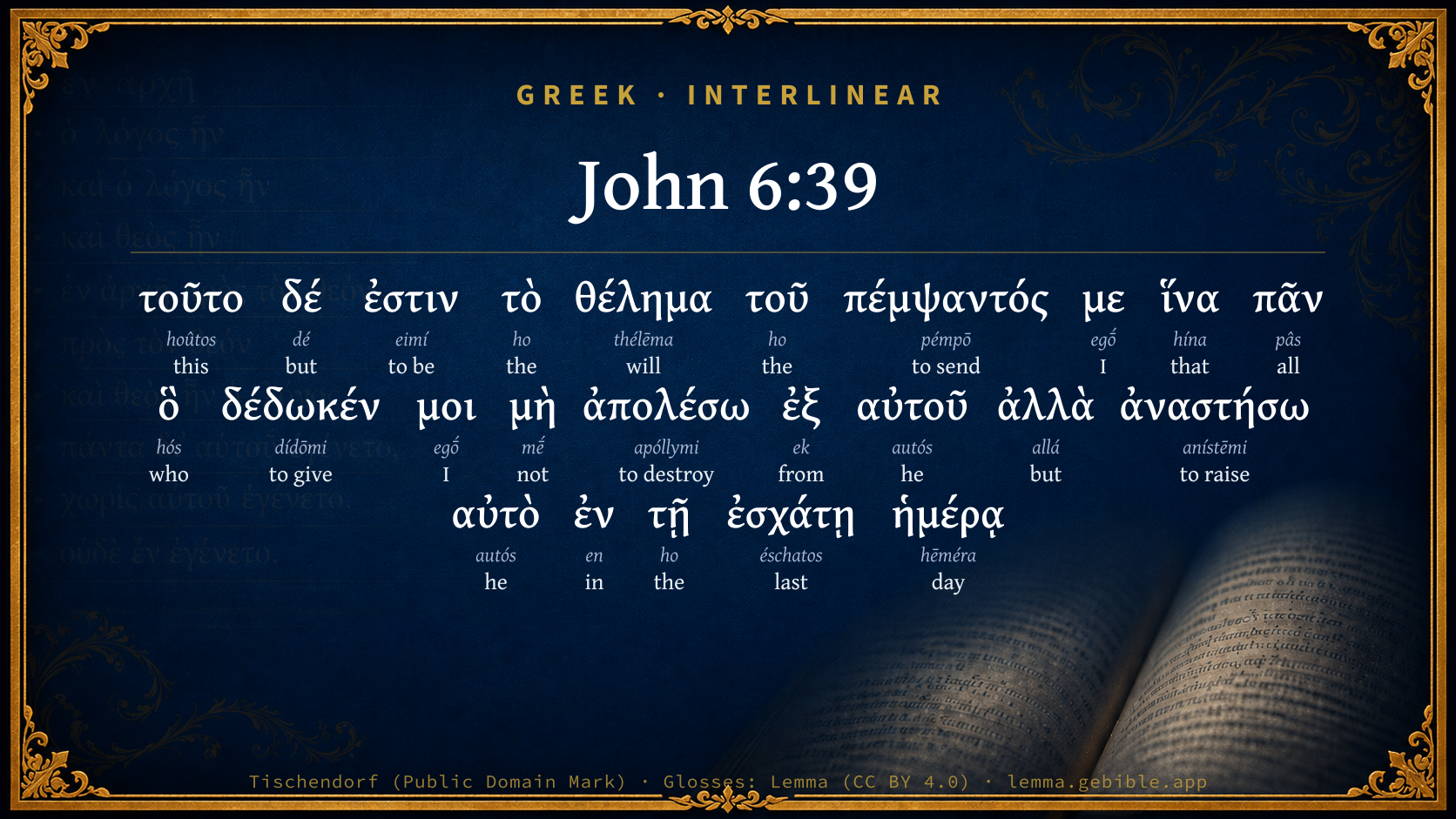
Greek (Tischendorf 8th ed.) John 6:39 appears in the Greek New Testament. The text above is from the Tischendorf 8th edition. Each word links to its Strong’s number and a concise gloss. Click any word for its full Thayer’s Greek Lexicon entry.
Download image
Cite this verse

John 6:39 (World English Bible). Public Domain. Lemma interlinear Bible study tool, https://lemma.gebible.app/v/john/6/39.

Show BibTeX & RIS
BibTeX
RIS
English Translation
This is the will of my Father who sent me, that of all he has given to me I should lose nothing, but should raise him up at the last day.
World English Bible · Public Domain
Download a study sheet

One document with this verse’s original text, its word-by-word gloss line, the meaning frame, cross-references with their text, attributed commentary, and full source and license credits — printable, and it pastes into notes with its structure intact.

This verse Autodidact and up

Study sheet (.html) Plain text (.txt)

A passage Seminary Student

Up to 50 verses in one chapter. A passage sheet keeps up to 6 commentary sources and 12 cross-references per verse, in the order this page ranks them, and says so on the sheet whenever that leaves anything out. Ask for a single verse and you get the Autodidact verse sheet above.

Everything on this page stays free to read, with no account — the sheet is a download of what is already on screen, not access to it.

Want to remove ads? Support Godless Engineer
Compare translations 3

The same verse in 3 English versions, stacked beneath the original-language interlinear above. Click any original word for its lexicon entry.

Each is an independent rendering of the whole verse — the interlinear is not word-aligned to these translations.

Highlighted words mark where these versions differ — a whole-verse word diff, not a word-by-word alignment.

  • World English Bible Public Domain
    This is the will of my Father who sent me, that of all he has given to me I should lose nothing, but should raise him up at the last day.
  • King James Version Public Domain
    And this is the Father's will which hath sent me, that of all which he hath given me I should lose nothing, but should raise it up again at the last day.
  • unfoldingWord Literal Text CC BY-SA 4.0
    But this is the will of the one having sent me, that I would not lose from it anyone whom he has given me, but will raise it up on the last day.

unfoldingWord Literal Text — © unfoldingWord, licensed CC BY-SA 4.0. Word-aligned USFM3 via Door43 (git.door43.org/unfoldingWord/en_ult).

Versions to compare (up to 4)

3 of 4 selected

Show all 19 translations

Every available English version of this verse, each an independent rendering of the whole verse.

  • World English Bible Public Domain
    This is the will of my Father who sent me, that of all he has given to me I should lose nothing, but should raise him up at the last day.
  • Berean Standard Bible Public Domain
    And this is the will of Him who sent Me, that I shall lose none of those He has given Me, but raise them up at the last day.
  • Majority Standard Bible Public Domain
    And this is the will of the Father who sent Me, that I shall lose none of those He has given Me, but raise them up at the last day.
  • King James Version Public Domain
    And this is the Father's will which hath sent me, that of all which he hath given me I should lose nothing, but should raise it up again at the last day.
  • American Standard Version (1901) Public Domain
    And this is the will of him that sent me, that of all that which he hath given me I should lose nothing, but should raise it up at the last day.
  • Revised Version (1885) Public Domain
    And this is the will of him that sent me, that of all that which he hath given me I should lose nothing, but should raise it up at the last day.
  • Geneva Bible (1599) Public Domain
    And this is the Fathers will which hath sent mee, that of all which hee hath giuen mee, I should lose nothing, but shoulde raise it vp againe at the last day.
  • Douay-Rheims (1899) Public Domain
    Now this is the will of the Father who sent me: that of all that he hath given me, I should lose nothing; but should raise it up again in the last day.
  • Young's Literal Translation Public Domain
    `And this is the will of the Father who sent me, that all that He hath given to me I may not lose of it, but may raise it up in the last day;
  • Literal Standard Version CC BY-SA 4.0
    And this is the will of the Father who sent Me, that all that He has given to Me, I may lose none of it, but may raise it up in the last day;
  • Unlocked Literal Bible CC BY-SA 4.0
    This is the will of him who sent me, that I would lose not one of all those whom he has given me, but will raise them up on the last day.
  • unfoldingWord Literal Text CC BY-SA 4.0
    But this is the will of the one having sent me, that I would not lose from it anyone whom he has given me, but will raise it up on the last day.
  • Darby Bible Public Domain
    And this is the will of him that has sent me, that of all that he has given me I should lose nothing, but should raise it up in the last day.
  • World Messianic Bible Public Domain
    This is the will of my Father who sent me, that of all he has given to me I should lose nothing, but should raise him up at the last day.
  • Webster's Bible Public Domain
    And this is the Father's will who hath sent me, that of all which he hath given me, I should lose nothing, but should raise it up again at the last day.
  • Free Bible Version CC BY-SA 4.0
    What he wants is for me not to lose anyone he has given to me, but for me to raise them up at the last day.
  • Bible in Basic English Public Domain
    And this is the pleasure of him who sent me, that I am not to let out of my hands anything which he has given me, but I am to give it new life on the last day.
  • Text-Critical English NT CC BY 4.0
    And this is the will of the Father who sent me, that I should lose none of those he has given me, but should raise them up on the last day.
  • Tyndale New Testament (1534) Public Domain
    And this is the fathers will which hath sent me that of all which he hath geven me I shuld loose no thinge: but shuld rayse it vp agayne at the last daye.

Literal Standard Version (2020), Covenant Press — licensed CC BY-SA 4.0. Text via the HelloAO Bible API (eBible.org). Unlocked Literal Bible (unfoldingWord) — licensed CC BY-SA 4.0. Text via the HelloAO Bible API (eBible.org). unfoldingWord Literal Text — © unfoldingWord, licensed CC BY-SA 4.0. Word-aligned USFM3 via Door43 (git.door43.org/unfoldingWord/en_ult). Free Bible Version, Dr. Jonathan Gallagher — licensed CC BY-SA 4.0. Text via the HelloAO Bible API (eBible.org).

Word by word

More ways to search: Search by grammar → Find every occurrence → Compare this word →

Practice this passage: Drill this verse → Learn its vocabulary →

ἐσχάτῃ
éschatos
G2078
“last”
Adjective, Dative, Singular, Feminine, Superlative
Part of Speech
Adjective
Case
Dative
Number
Singular
Gender
Feminine
Degree
Superlative
Full Thayer's Definition

Origin: a superlative probably from G2192 (in the sense of contiguity)

TDNT: 13:37,3

1. extreme a. last in time or in place b. last in a series of places c. last in a temporal succession 2. the last a. last, referring to time b. of space, the uttermost part, the end, of the earth c. of rank, grade of worth, last i.e. lowest
  1. τοῦτο hoûtos G3778 “this” Demonstrative pronoun, Nominative, Singular, Neuter
  2. δέ dé G1161 “but” Conjunction
  3. ἐστιν eimí G1510 “to be” Verb, Present, Active, Indicative, 3rd person, Singular
  4. τὸ ho G3588 “the” Article, Nominative, Singular, Neuter
  5. θέλημα thélēma G2307 “will” Noun, Nominative, Singular, Neuter
  6. τοῦ ho G3588 “the” Article, Genitive, Singular, Masculine
  7. πέμψαντός pémpō G3992 “to send” Verb, Aorist, Active, Participle, Genitive, Singular, Masculine
  8. με egṓ G1473 “I” Personal pronoun, 1st person, Accusative, Singular
  9. ἵνα hína G2443 “that” Conjunction
  10. πᾶν pâs G3956 “all” Adjective, Accusative, Singular, Neuter
  11. ὃ hós G3739 “who” Relative pronoun, Accusative, Singular, Neuter
  12. δέδωκέν dídōmi G1325 “to give” Verb, Perfect, Active, Indicative, 3rd person, Singular
  13. μοι egṓ G1473 “I” Personal pronoun, 1st person, Dative, Singular
  14. μὴ mḗ G3361 “not” Particle, Negative
  15. ἀπολέσω apóllymi G622 “to destroy” Verb, Aorist, Active, Subjunctive, 1st person, Singular
  16. ἐξ ek G1537 “from” Preposition
  17. αὐτοῦ autós G846 “he” Personal pronoun, Genitive, Singular, Neuter
  18. ἀλλὰ allá G235 “but” Conjunction
  19. ἀναστήσω anístēmi G450 “to raise” Verb, Future, Active, Indicative, 1st person, Singular
  20. αὐτὸ autós G846 “he” Personal pronoun, Accusative, Singular, Neuter
  21. ἐν en G1722 “in” Preposition
  22. τῇ ho G3588 “the” Article, Dative, Singular, Feminine
  23. ἡμέρᾳ hēméra G2250 “day” Noun, Dative, Singular, Feminine

About this verse

These counts appear in no published source. They are computed here, from the morphology-tagged text and Lemma’s own curated glosses. What Lemma adds →

24
words
20
distinct lemmas
Gospels
section

Shared distinctive vocabulary

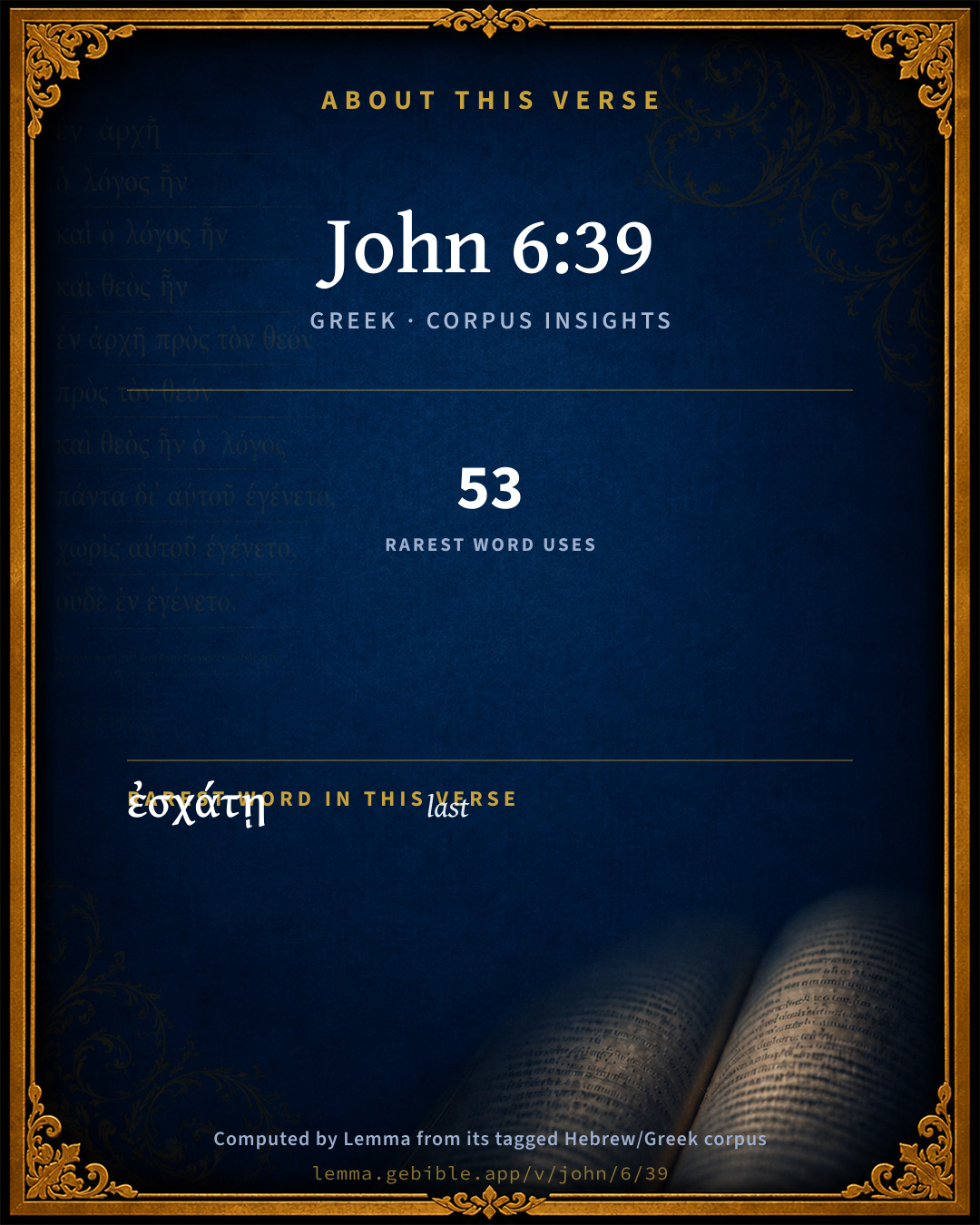
ἐσχάτῃ last G2078 occurs in 48 verses of the Greek New Testament. Also found in:
Repetition

Words recur within this verse:

Cross-references

21

Topical passages linked to John 6:39 in the Treasury of Scripture Knowledge — connected by theme and wording, ordered by reader-vote popularity; previews shown in the World English Bible.

  • John 17:12 While I was with them in the world, I kept them in your name. Those whom you have given me I have kept. None of them is lost, except the son of destruction, that the Scripture might be fulfilled.
  • John 6:40 This is the will of the one who sent me, that everyone who sees the Son, and believes in him, should have eternal life; and I will raise him up at the last day."
  • John 18:9 that the word might be fulfilled which he spoke, "Of those whom you have given me, I have lost none."
  • John 6:54 He who eats my flesh and drinks my blood has eternal life, and I will raise him up at the last day.
  • John 10:27–30 My sheep hear my voice, and I know them, and they follow me.
  • John 6:44 No one can come to me unless the Father who sent me draws him, and I will raise him up in the last day.
  • Romans 8:11 But if the Spirit of him who raised up Jesus from the dead dwells in you, he who raised up Christ Jesus from the dead will also give life to your mortal bodies through his Spirit who dwells in you.
  • Jude 1:1 Jude, a servant of Jesus Christ, and brother of James, to those who are called, sanctified by God the Father, and kept for Jesus Christ:
  • Philippians 3:20–21 For our citizenship is in heaven, from where we also wait for a Savior, the Lord Jesus Christ;
  • 2 Thessalonians 2:13–14 But we are bound to always give thanks to God for you, brothers loved by the Lord, because God chose you from the beginning for salvation through sanctification of the Spirit and belief in the truth;
  • Matthew 18:14 Even so it is not the will of your Father who is in heaven that one of these little ones should perish.
  • Luke 12:32 Don't be afraid, little flock, for it is your Father's good pleasure to give you the Kingdom.
  • John 6:37 All those who the Father gives me will come to me. Him who comes to me I will in no way throw out.
  • Colossians 3:3–4 For you died, and your life is hidden with Christ in God.
  • John 12:48 He who rejects me, and doesn't receive my sayings, has one who judges him. The word that I spoke, the same will judge him in the last day.
  • Romans 8:28–31 We know that all things work together for good for those who love God, to those who are called according to his purpose.
  • 1 Peter 1:5 who by the power of God are guarded through faith for a salvation ready to be revealed in the last time.
  • 1 Samuel 25:29 Though men be risen up to pursue you, and to seek your soul, yet the soul of my lord shall be bound in the bundle of life with Yahweh your God; and the souls of your enemies, them shall he sling out, as from the hollow of a sling.
  • John 5:28 Don't marvel at this, for the hour comes, in which all that are in the tombs will hear his voice,
  • John 11:24–26 Martha said to him, "I know that he will rise again in the resurrection at the last day."
  • 2 Timothy 2:19 However God's firm foundation stands, having this seal, "The Lord knows those who are his," and, "Let every one who names the name of the Lord depart from unrighteousness."

Cross-references courtesy of OpenBible.info (CC BY 4.0).

Where the printed editions differ

1 variant

Places in this verse where the major printed Greek editions disagree on the wording in a way that affects the translation — a comparison of editions, not a manuscript-by-manuscript collation. The editions are the modern critical texts (Nestlé-Aland 28/27, SBL, Westcott-Hort, Tregelles, Tyndale House) and the traditional texts behind the KJV (the Textus Receptus and the Byzantine/Majority text). It is not a claim about which reading is original.

  1. Extra text
    πατρός,

    “[the] Father,”

    In TRByz Not in NA28NA27TynSBLWHTreg

    πατρός, (patros) '[the] Father,' is only in traditional manuscripts (TR+Byz)

Textual data: Translators Amalgamated Greek New Testament (STEPBible TAGNT) · CC BY 4.0.

Commentary

Notes on John 6:39 from classic Christian and Jewish commentators (each source and its license shown beneath its notes). The classic Christian expositions comment on the surrounding passage and are grouped to its opening verse, so a note may address several verses; the Jewish commentaries on the Tanakh (Rashi and others) are per-verse, so they appear only where the commentator wrote on this verse.

Lemma curates 59 commentaries, every one of them public domain or Creative Commons licensed, each selected and text-cleaned for this edition rather than reprinted as found. About our sources →

Bengel's Gnomon

Johann Albrecht Bengel

Joh 6:39. Δὲ, moreover) The will of the Father, mentioned in Joh 6:38, is more fully declared in this ver.—τοῦ πέμψαντός με Πατρός—40, τοῦ Πατρὸς τοῦ πέμψαντός με, of Him who hath sent Me, even the Father—of the Father, who hath sent Me) Such is the oldest reading. [[135][136] Vulg. and Rec. Text read τοῦ πέμψαντός με Πατρός, at Joh 6:39; but [137][138][139][140][141][142] Hilar. 238, omit Πατρός. At Joh 6:40, [143][144][145][146][147] read τοῦ Πατρός μου: [148] and Rec. Text read τοῦ πέμψαντός με. Vulg. as Beng. reads both: patris mei, qui misit me.] At Joh 6:39, mention is made of His being sent; and at Joh 6:40, the name of the Father is appropriately placed first: for in Joh 6:39, on comparing it and Joh 6:38 together, the sending properly corresponds to the will of the Father; but at Joh 6:40, the name of the Father, and the name of the Son, properly refer to one another. [The correlatives are, at Joh 6:39, the sending (of the Father), and the care of Christ (to lose nothing of all given to Him); and at Joh 6:40, the will of the Father, and salvation in the Son.—Not. Crit.] The chief varieties of readings noticed in the introduction do not affect the main argument of this note.—[149] ΠᾶΝ, all) See note on Joh 6:37.—δέδωκέ μοι, hath given Me) They are given to the Son, to whomsoever faith is given. Comp. the following ver., “Every one which seeth the Son and believeth on Him.”—μὴ ἀπολέσω, I should not lose) To this losing [loss of the soul] is opposed everlasting life, Joh 6:40: ch. Joh 3:15, etc., “That, whosoever believeth in Him, should not perish, but have eternal life.”—ἐξ αὐτοῦ) of it, of all that, which the Father hath given to Me.—ἀναστήσω, raise it up again) to life, Joh 6:33, “He that—giveth life unto the world.” So Joh 6:40; Joh 6:44; Joh 6:54. This [the resurrection] is the ultimate limit, beyond which there is no danger. The Saviour engages to guarantee all things anterior to it. He gives a sign in this ver. and Joh 6:62, “What and if ye shall see the Son of man ascend up where He was before?” but a sign that was to be hereafter, whereas the Jews were importuning Him for a present sign; Joh 6:30. The resurrection, which presupposes death, is often here mentioned, because the Lord Himself was still about to die and rise again: comp. note, ch. Joh 11:25, “I am the resurrection and the life,” etc. But afterwards the apostles set before believers rather His glorious coming again.

[135] Bezæ, or Cantabrig.: Univ. libr., Cambridge: fifth cent.: publ. by Kipling, 1793: Gospels, Acts, and some Epp. def.

[136] Vercellensis of the old ‘Itala,’ or Latin Version before Jerome’s, probably made in Africa, in the second century: the Gospels.

[137] the Alexandrine MS.: in Brit. Museum: fifth century: publ. by Woide, 1786–1819: O. and N. Test. defective.

[138] the Vatican MS., 1209: in Vat. Iibr., Rome: fourth cent.: O. and N. Test. def.

[139] Bezæ, or Cantabrig.: Univ. libr., Cambridge: fifth cent.: publ. by Kipling, 1793: Gospels, Acts, and some Epp. def.

[140] Borgiana: Veletri: part of John: fourth or fifth cent.: publ. by Georgi, 1789.

[141] Cod. Reg., Paris, of the Gospels: the text akin to that of B: edited by Tisch.

[142] Colbertinus, do.

[143] the Vatican MS., 1209: in Vat. Iibr., Rome: fourth cent.: O. and N. Test. def.

[144] Ephræmi Rescriptus: Royal libr., Paris: fifth or sixth cent.: publ. by Tisch. 1843: O. and N. T. def.

[145] Bezæ, or Cantabrig.: Univ. libr., Cambridge: fifth cent.: publ. by Kipling, 1793: Gospels, Acts, and some Epp. def.

[146] Cod. Reg., Paris, of the Gospels: the text akin to that of B: edited by Tisch.

[147] Borgiana: Veletri: part of John: fourth or fifth cent.: publ. by Georgi, 1789.

[148] the Alexandrine MS.: in Brit. Museum: fifth century: publ. by Woide, 1786–1819: O. and N. Test. defective.

[149] For at the margin of Ed. 2 (to which the Germ. Vers. corresponds) it is recommended that, in ver. 30, the word πατρός should be omitted, and, at ver. 40, that the reading πατρός μου should be substituted for the reading τοῦ πἐμψαντός με.—E. B.

Bengel's Gnomon of the New Testament — English translation (T&T Clark, Edinburgh, 1860) — public domain. Text from a community e-Sword module.

Godet's Commentaries

Frédéric Louis Godet

Ver. 39. “Now this is the will of him who sent me, that I should lose nothing of all that which he has given me, but that I should raise it up at the last day.”

The δέ is progressive: now. The will of the Father is not only that Jesus should receive, but also that He should keep those whom He gives to Him. And He has clothed Him, indeed, with the necessary powers to save His own, even to the end. He is charged of God with leading them to the glorious end of salvation and even with delivering them from death. Πᾶν, all, nominative absolute: put afterwards in its regular case in the pronoun αὐτοῦ . Was Jesus thinking perchance of the bread, also a gift of God, of which no fragment should be lost (Joh 6:12), and in comparison with which the gift of God of which He here speaks is infinitely more precious?

The object of the verb is a τι understood.—The perfect has given transports us to a more advanced time than Joh 6:37 (gives). The gift is now realized by the faith of the man, on the one side, and the welcome of Jesus on the other. But the end is not yet attained by this. It is necessary first to prevent the believer from falling back into the state of sin which would destroy him again, then to free him at the last day from physical death to the end of presenting him glorious before the face of the Father. We find here again the two-fold action which Jesus described in Joh 5:21-29 : the communication of the new spiritual life and thereby the gift of the resurrection of the body, which alone exhausts the meaning of the expression: bread of life. Reuss wished to apply the term the last day to the time of the death of each believer. But the passage Joh 5:29 proves that Jesus is thinking, not of a particular phase of each individual existence, but of the solemn hour when all the dead, laid in the tombs, shall hear His voice and shall have a bodily resurrection. Reuss objects that “mystical theology has nothing to do with this notion.” This only proves one thing: that “the mystical theology” which Reuss attributes to John is very different from that of the apostle. If this notion had so little importance to the author’s mind, how is it that it reappears even four times in this passage and forms, as it were, its refrain (Joh 6:39-40; Joh 6:44; Joh 6:54)? It is beyond all dispute that the bodily resurrection is presented in this passage, as well as in the discourse of chap. 5, as the necessary crowning of the spiritual work accomplished by Christ in humanity. On this point, John is in accord with the Synoptics and with Paul (1 Corinthians 15). Bengel observes on these last words: Hic finis est ultra quem periculum nullum. On the inadmissibility of grace, see on Joh 10:28-30. In closing this first part of the conversation, Jesus again insists on the human condition of faith which must correspond with His own work, for it was this which was wanting to His interlocutors.

Frédéric Louis Godet — Commentaries on Luke, John, Romans, and 1 Corinthians — English translation (T&T Clark, Edinburgh, 1870s–1890s) — public domain. Text from a community e-Sword module.

Jamieson, Fausset & Brown

Robert Jamieson, A. R. Fausset & David Brown

And this--in the first place.

is the will of Him that sent me, that of all--everything.

which He hath given Me--(taking up the identical words of Joh 6:37).

I should lose nothing, but should raise it up at the last day--The meaning is not, of course, that He is charged to keep the objects entrusted to Him as He received them, so as they should merely suffer nothing in His hands. For as they were just "perishing" sinners of Adam's family, to let "nothing" of such "be lost," but "raise them up at the last day," must involve, first, giving His flesh for them (Joh 6:51), that they "might not perish, but have everlasting life"; and then, after "keeping them from falling," raising their sleeping dust in incorruption and glory, and presenting them, body and soul, perfect and entire, wanting nothing, to Him who gave them to Him, saying, "Behold I and the children which God hath given Me." So much for the first will of Him that sent Him, the divine side of man's salvation, whose every stage and movement is inscrutable to us, but infallibly certain.

Jamieson, Fausset & Brown — Commentary Critical and Explanatory on the Whole Bible (1871) — public domain (CC PDM 1.0). Text via the HelloAO Bible API.

Adam Clarke's Commentary

Verse 39. I should lose nothing] It is the will of God that every soul who believes should continue in the faith, and have a resurrection unto life eternal. But he wills this continuance in salvation, without purposing to force the persons so to continue. God may will a thing to be, without willing that it shall be. Judas was given to Christ by the Father, Joh 17:12. The Father willed that this Judas should continue in the faith, and have a resurrection unto life eternal: but Judas sinned and perished. Now it is evident that God willed that Judas might be saved, without willing that he must be saved infallibly and unconditionally. When a man is a worker together with the grace of God, he is saved; when he receives that grace of God in vain, he is lost-not through a lack of will or mercy in God, but through lack of his co-operation with Divine grace. God saves no man as a stock or a stone, but as a reasonable being and free agent. "That which thou hast heard, thou mayest hold fast, and persevere in, if thou wilt," Says St. Augustin. In eo quod audieras, et tenueras, perseverares, si velles. De Correct. Grat. c. 7. See Calmet.

Raise it up again at the last day] The Jews believed that the wicked should have no resurrection and that the principle that led to the resurrection of the body, in the righteous, was the indwelling Spirit of God. This is positively asserted in the Shir Hashirim Rabba. See Schoettgen.

Adam Clarke's Commentary on the Bible (1810–1826) — public domain. Text from a community e-Sword/MySword module.

John Calvin's Commentaries

39. And this is the will of the Father. He now testifies, that this is the design of the Father, that believers may find salvation secured in Christ; from which again it follows, that all who do not profit by the doctrine of the Gospel are reprobate. Wherefore, if we see that it turns to the ruin of many, we have no reason to despond, because those men willingly draw down the evil on themselves. Let us rest satisfied with this, that the Gospel will always have power to gather the elect to salvation.

That I should lose none of it. That is, “That I should not suffer it to be taken from me or perish;” by which he means, that he is not the guardian of our salvation for a single day, or for a few days, but that he will take care of it to the end, so that he will conduct us, as it were, from the commencement to the termination of our course; and therefore he mentions the last resurrection. This promise is highly necessary for us, who miserably groan under so great weakness of the flesh, of which every one of us is sufficiently aware; and at every moment, indeed, the salvation of the whole world might be ruined, were it not that believers, supported by the hand of Christ, advance boldly to the day of resurrection. Let this, therefore, be fixed in our minds, that Christ has stretched out his hand to us, that he may not desert us in the midst of the course, but that, relying on his goodness, we may boldly raise our eyes to the last day.

There is also another reason why he mentions the resurrection. It is because, so long as our life is hidden, (Colossians 3:3,) we are like dead men. For in what respect do believers differ from wicked men, but that, overwhelmed with afflictions, and like sheep destined for the slaughter, (Romans 8:36,) they have always one foot in the grave, and, indeed, are not far from being continually swallowed up by death? Thus there remains no other support of our faith and patience but this, that we keep out of view the condition of the present life, and apply our minds and our senses to the last day, and pass through the obstructions of the world, until the fruit of our faith at length appear.

John Calvin's Commentaries (1540-1563) — public domain. Text from the Calvin Translation Society English edition (1840s-50s) via the Christian Classics Ethereal Library (ccel.org). Calvin's coverage is partial (roughly two-thirds of the Bible); uncommented books and verses are honest gaps, never fabricated. The 19th-century editor's footnotes and remarks are omitted so the notes are faithfully Calvin's own voice.

Ellicott's Commentary for English Readers

(39) And this is the Father’s will.—Read, with best MSS., And this is the will of Him that sent Me. Comp. Note on Joh_6:40. These two verses further set forth the divine will in the mission of Christ, first in relation to the Father’s gift, and then in relation to man’s acceptance. Both verses make emphatic the expression of that will in the mission, Him that sent Me; both refer its fulfilment to the final victory over sin and death, at the last day. Both state the will of God in a single clause, prefaced by the most signal proof of divine love in God revealed on earth, and followed by its end, in man raised to heaven.

The “all” is here neuter, referring to the whole extent of the Messianic work. (Comp. Joh_6:37.) Vast as this is, beyond our power of thought, including all times, and all places, and all nations, and it may be other worlds, it is the divine will that nothing should be lost. In the moral, as well as in the physical world, no force can perish.

Hath given me . . .—The past tense here, because the gift is thought of in its completion at the last day. (See Joh_6:37.)

A Bible Commentary for English Readers, edited by Charles John Ellicott (1878–1897) — public domain. Text from a community e-Sword module.

The Cambridge Bible for Schools and Colleges

gen. ed. J. J. S. Perowne

39. this is the Father’s will, &c.] The true reading is; this is the will of Him that sent Me.

that of all] Literally, in order that of all: see on Joh_6:29.

all which he hath given me] ‘All’ is neuter as in Joh_6:37, and is placed first for emphasis. In the Greek it is a nominativus pendens.

raise it up again at the last day] This gracious utterance is repeated as a kind of refrain, Joh_6:40; Joh_6:44; Joh_6:54. ‘Again’ may be omitted. This is ‘the resurrection of life’ (Joh_5:29), ‘the first resurrection,’ the resurrection of the just.

the last day] This phrase is peculiar to S. John, and occurs seven times in this Gospel. Elsewhere it is called ‘the Day of the Lord,’ ‘the Great Day,’ &c.

The Cambridge Bible for Schools and Colleges (gen. ed. J. J. S. Perowne; Cambridge University Press, 1878–1918) — public domain. Text from a community e-Sword module.

John Gill's Exposition

And this is the will of him that sent me,.... The Vulgate Latin adds, "of my Father"; and all the Oriental versions read only, "and this is the will of my Father"; this is his declared, his revealed will in the Gospel, which the sons of men are made acquainted with, as the other was his secret will, which was only known to the Son till he discovered it.

That everyone which seeth the Son, and believeth on him; who so sees him as to believe in him; for this is not to be understood of a corporeal sight of Christ, or of a mere speculative knowledge of him, or historical faith in him; for it is not so to see him, as merely to believe what he is, the Son of God, the Messiah and Saviour of the world, or what he says, but to trust in him for righteousness, life, and happiness. Men are by nature blind, their eyes are shut to all that is spiritually good; it is the Spirit of God that opens blind eyes, and illuminates the understanding: and in his light men see not only themselves, their sin, and want of righteousness, and their lost state and condition, but Christ, and a beauty, glory, and excellency in him, ability and willingness to save, a suitableness in him for them, and a fulness of all grace; they see righteousness, peace, pardon, cleansing, wisdom, strength, grace, life, and salvation, and go out of themselves to him for all: and such a sight, though it may be but glimmering, is saving, and is self-abasing, soul rejoicing, surprising, and transforming; is attended with certainty, reality, and evidence, and is a foretaste of glory; for it is the will of God, and not man, of a gracious Father, of an unchangeable and eternal being, whose will cannot be resisted, and made void, that such

may have everlasting life; which will be a life of glory, and will consist in possessing glory both in soul and body; in beholding glory, the glory of one another, the glory of angels, the glory of divine truths, and mysterious providences, the glory of the divine perfections, and of the Lord Jesus Christ; and it will be a life of perfection, of perfect knowledge, holiness, obedience, love, peace, and joy; a life free from all the miseries and inconveniences of this, both in a natural and spiritual sense; a life of pleasure, and which will last for ever: to which Christ adds,

and I will raise him up at the last day; Christ will be the efficient cause, as well as he is the exemplar, the earnest, and first fruits of the resurrection of the dead; he will indeed raise all the dead by his power, but the saints particularly, by virtue of union to him, as the members of his body, and in the first place; and the very same shall rise, and with the same numerical body, that were given to him, and believe in him: and this will be at the last of the last days, at the end of all things; and is mentioned to show, that length of time will not hinder the resurrection of the dead, and in opposition to a Jewish notion, that the resurrection of the dead would be at the Messiah's coming: it will be at his second coming, but was not to be at his first; there was indeed then a resurrection of some particular persons, but not a general one of all the saints: that the Jews expect the resurrection of the dead when the Messiah comes, appears from their Targums, Talmuds, and other writers; so the Targumist on Hos 14:8,

"They shall be gathered from their captivity, they shall sit under the shadow of their Messiah, "and the dead shall live", and good shall be multiplied in the land.''

And in the Talmud (p) it is said,

"the holy blessed God will quicken the righteous, and they shall not return to their dust.''

The gloss upon it is,

"the holy blessed God will quicken them "in the days of" the Messiah.''

And so the land of the living is said to be,

"the land, whose dead live first in the days of the Messiah (q).''

And hence R. Jeremiah desired to he buried with his clothes and shoes on, and staff in his hand, that when the Messiah came, he might be ready (r) with which agree others of the more modern writers; so Kimchi on Isa 66:5.

"They shall live at the resurrection of the dead, in the days of the Messiah.''

And the same writer on Jer 23:20 observes it is said,

""ye" shall consider, and not "they" shall consider; which intimates the "resurrection of the dead in the days of the Messiah".''

And says Aben Ezra on Dan 12:2,

"The righteous which die in captivity shall live, when the Redeemer comes;''

though some of their writers differ in this point, and will not allow the days of the Messiah, and the resurrection of the dead, to be one and the same (s).

(p) T. Bab. Sanhedrin, fol. 92. 1. (q) T. Hieros. Kilaim, fol. 32. 3. (r) T. Hieros. Kilaim, foi. 32. 3. col. 2. (s) Zohar in Gen. fol. 82. 4.

John Gill's Exposition of the Whole Bible (1746–1763) — public domain (CC PDM 1.0). Text via the HelloAO Bible API.

Trapp's Complete Commentary

John Trapp

39 And this is the Father’s will which hath sent me, that of all which he hath given me I should lose nothing, but should raise it up again at the last day.

Ver. 39. I should raise it up again] By virtue of the union, a substance is preserved, and shall be raised up again to glory; yea, "the dead in Christ shall rise first," 1Th 4:16, by virtue derived from Christ’s resurrection, and by the mighty influence thereof. For he was raised to be a root and fountain of all supernatural life, both of our souls and bodies.

John Trapp, A Commentary or Exposition upon All the Books of the Old and New Testament (1647–1656) — public domain. Text from a community e-Sword module.

Albert Barnes' Notes on the Bible

Father’s will - His purpose; desire; intention. As this is the Father’s will, and Jesus came to execute his will, we have the highest security that it will be done. God’s will is always right, and he has power to execute it. Jesus was always faithful, and all power was given to him in heaven and on earth, and he will therefore most certainly accomplish the will of God.

Of all which - That is, of every one who believes on him, or of all who become Christians. See Joh 6:37.

I should lose nothing - Literally, “I should not destroy.” He affirms here that he will keep it to life eternal; that, thought the Christian will die, and his body return to corruption, yet he will not be destroyed. The Redeemer will watch over him, though in his grave, and keep him to the resurrection of the just. This is affirmed of all who are given to him by the Father; or, as in the next verse, “Everyone that believeth on him shall have everlasting life.”

At the last day - At the day of judgment. The Jews supposed that the righteous would be raised up at the appearing of the Messiah. See Lightfoot. Jesus directs them to a future resurrection, and declares to them that they will be raised at the last day - the day of judgment. It is also supposed and affirmed by some Jewish writers that they did not believe that the wicked would be raised. Hence, to speak of being raised up in the last day was the same as to say that one was righteous, or it was spoken of as the special privilege of the righteous. In accordance with this, Paul says, “If by any means I might attain unto the resurrection of the dead,” Phi 3:11.

Albert Barnes' Notes on the Bible (1834–1885) — public domain. Text from a community e-Sword/MySword module.

Matthew Poole's English Annotations

For this he revealeth to be his Father’s will, that of all his Father had given him, he should lose none; where by the Father’s giving must be meant, either his eternal act (having chosen some to eternal life) in giving them to his Son, for the work of their redemption; or, which is but the effect and product of that, the working, preserving, and upholding in them those habits and exercises of grace, by which that eternal life is to be obtained. Our Lord declareth it to be the will of his Father, that he should not suffer any of these to miscarry; but though their bodies die and turn into dust, yet Christ at the last day should come to raise the dead, and, in particular, raise them up: not that they only shall rise, (for how then shall all appear before the judgment seat of God, to receive according to what they have done in the flesh?) but they are those alone who shall receive any benefit by the resurrection; and therefore they are called the children of the resurrection; and the resurrection is sometimes spoken of in Scripture as if it were to be peculiar to them, Phi 3:2. By this the certainty of the resurrection is established; it being asserted as the effect of the will of God, which none hath resisted at any time.

Matthew Poole's English Annotations on the Holy Bible (1683–1685) — public domain. Text from a community e-Sword/MySword module.

Whedon's Commentary on the Bible

Daniel D. Whedon

39. Of all which he hath given me—Namely, all who fully obey the Father’s drawings and come to Christ.

I should lose nothing—There will be no erratic self-will in Christ, darting off from the divine plan; no remissness, no oversight, no failure. All who perseveringly believe in him, he will as faithfully and powerfully save as the will of the Father can require.

Raise it up—From the dead.

At the last day—The day that closes the series of human history and inaugurates the final judgment.

Daniel D. Whedon (gen. ed.), Commentary on the Old and New Testaments (1874–1909) — public domain. Text from a community e-Sword module.

The Pulpit Commentary

And this is the will of him (the Father) that sent me, that (with reference to) all that he hath given me I should not lose (sc. ti) anything, any fragment of it; i.e. from the entire mass of humanity thus given to me as the guerdon of my sacrificial work, given by the inward working of Divine grace which issues in their coming and reaching me, no solitary soul should be plucked out of my hand should be let slip away into perdition or destruction. The claim of a Divine authority and absolute power could not be put more strongly. The care with which the Divine hand can protect every fragment of his universe, and hold it by its everlasting laws and keep it in the career assigned to it from the beginning, illumines this passage. Should the speaker not sustain this stupendous assumption, it is only too certain that he was giving utterance to the most reckless raving. These words cannot be honestly watered down to the language of the influence of an ethical reformer or prophetic messenger. Jesus proceeds to clinch his argument and reassert his claims as follows. But in proof of the very opposite of the supposition that I can drop one atom of this great charge, I will raise it up at the last day. Reuss applies this to the resurrection of each believer on the "last day" of each life, for he seems unwilling to find in the Fourth Gospel any such idea as that of the general resurrection. But cf. Joh_5:29, and observe the repetition as in a wondrous refrain, vers. 40, 44, 54, in which he again speaks of the "last day the final consummation of his redemptive work. The next verse shows that the Lord did discriminate between eternal life already bestowed here and now, and the great consequence of such possession in the complete restoration of body as well as life. It is in the continuity and perpetuity of the eternal life that we find the condition of the resurrection life. The "when" of this "last day" is not positively asserted here.

The Pulpit Commentary (1880–1919), ed. H.D.M. Spence-Jones & Joseph S. Exell — public domain. Text from a community e-Sword module.

John Wesley's Explanatory Notes

Of all which he hath already given me - See chap. xvii, 6, 12. If they endure to the end. But Judas did not.

John Wesley, Explanatory Notes Upon the Whole Bible (1754–1765) — public domain. Text via the GEBible commentary corpus.

The People's New Testament

B. W. Johnson

39, 40. This is the Father's will. The Father's will is that “every one who sees the Son and believes upon him,” thus coming to, following and abiding in him, shall have eternal life, and that in the resurrection day Christ shall raise him from the grave. These verses show, (1) That there is not any secret decree of election. The will of the Father applies to every one who believes upon the Son. (2) The condition of eternal life is a faith that leads to and appropriates Christ; that makes him the Lord of the soul. (3) Christ hath brought to light immortality. He is the “resurrection and the life.”

B. W. Johnson's The People's New Testament with Notes (1889–1891) — public domain. Electronic text from the Christian Classics Ethereal Library (CCEL) ThML edition.

Cambridge Greek Testament for Schools and Colleges

39. τὸ θέλημα … ἵνα. See on Joh 1:8, Joh 4:47, Joh 17:3, and comp. Joh 6:29.

πᾶν. Casus pendens: comp. Joh 7:38, Joh 15:2, Joh 17:2; Luk 21:6. ‘Credentes dantur, credentibus datur.’ μὴ ἀπολέσω. His care for the fragments (Joh 6:12) would not be greater than His care for men’s souls. With ἐξ αὐτοῦ comp. ἐκ τῶν τ. in 2Jn 1:4, ἐξ ὑμῶν Rev 2:10.

ἀναστήσω. The same gracious utterance is repeated as a kind of refrain, Joh 6:40; Joh 6:44; Joh 6:54: but here ἀναστήσω probably depends on ἵνα, although it may be an independent future as in Joh 6:44; Joh 6:54. This is the ἀνάστασις ζωῆς (Joh 5:29), ἡ ἀν. ἡ πρώτη (Rev 20:5-6), ἡ ἀν. τῶν δικαίων (Luk 14:14); the ultimate end of Christ’s work.

τῇ ἐσχ. ἡμέρᾳ. The phrase is peculiar to S. John; Joh 6:40; Joh 6:44; Joh 6:54; Joh 11:24; Joh 12:48; comp. Joh 7:37. Elsewhere ἡ ἡμέρα τῆς κρίσεως (1Jn 4:17); ἡ ἡμ. ἡ μεγάλη (Rev 6:17; comp. Joh 16:14); ἐκείνη ἡ ἡμ. (Mat 7:22); ἡ ἡμ. τ. κυρίου (1Co 5:5); ἡ τ. θεοῦ ἡμ. (2Pe 3:12); ἡμ. Χριστοῦ (Php 1:10); ἡμ. αἰῶνος (2Pe 3:18); or simply ἡ ἡμέρα (Heb 10:25). The phrases from 2 Peter occur nowhere else.

Cambridge Greek Testament for Schools and Colleges (Cambridge University Press, 1896; 21 vols, various authors incl. Carr, Maclear, Plummer, Farrar, Lumby, Moule, M. R. James, Simcox) — public domain. Text from a community e-Sword module.

International Critical Commentary

39. After τοῦ πέμψαντός με, the rec. adds πατρός (from v. 40), but om. πατρός א*ABCW.

אADN insert ἐν before τῇ ἐσχάτῃ ἡμέρᾳ, but om. BCLTΘ (cf. v. 54). W has αὐτὸν τῇ ἐσχάτῃ.

For the broken construction of the sentence, a casus pendens (πᾶν ὃ κτλ.) followed by a pronoun, see on 1:12. This is frequent in Jn.

πᾶν ὃ δέδωκέν μοι refers to πᾶν ὃ δίδωδσίν μοι of v. 37. That none of them should perish finally is the will of the Father, and they are all therefore in the safe keeping of Christ. This is repeated in somewhat similar words at 10:28, 29; and there is a close parallel at Mat 18:14 οὐκ ἔστιν θέλημα ἔμπροσθεν τοῦ πατρὸς ὑμῶν … ἵνα ἀπόληται ἓν τῶν μικρῶν τούτων. Cf. also 17:12 (18:9), where the exception of Judas is mentioned.

ἀναστήσω αὐτὸ τῇ ἐσχάτῃ ἡμέρα. “Hic finis est, ultra quem periculum nullum” (Bengel). This great assurance is repeated four times, in vv. 39, 40, 44, 54, and recurs with the majesty of a solemn refrain (see on 3:16 and on 15:11). The expression ἡ ἐσχάτη ἡμέρα is found in Jn. only. In 7:37 it is used of the last day of the Feast of Tabernacles; but at 11:24, 12:48 it refers, as it does in this chapter, to the Day of Judgment.1 For the Christ, the Son of God, as the Agent of the Resurrection, see on 5:21, 28. It is He that will quicken the dead at last. Cf. 1Co 15:22.

Here it is only the resurrection of the righteous that is in view, whereas at 5:28 a general resurrection of the dead is spoken of as brought about by the Voice of the Son of God.

International Critical Commentary — older volumes (1896–1929), various authors — public domain. Text from a community e-Sword module.

Vincent's Word Studies in the New Testament

Marvin R. Vincent

The Father 's will. Omit the Father 's. Render, the will of Him, etc. That of all which He hath given me [ινα παν ο δεδωκε μοι] . The construction is a peculiar and broken one. All which He hath given, stands alone as an absolute nominative; a very emphatic and impressive mode of statement. Literally it reads, that all which He hath given me I should lose nothing out of it.

At the last day [εν τη εσχατη ημερα] . The phrase occurs only in John.

Marvin R. Vincent, Word Studies in the New Testament (1887–1900) — public domain. Text from a community e-Sword/MySword module.

Lesson kit

Teaching starters — assembled from the data on this page, not authored interpretation. Every prompt links to the verse data it draws on. Edit before teaching.

John, in the Gospels, opens this verse with 24 words (20 distinct Greek lemmas). Its most distinctive word is éschatos (“last”). A historical commentator’s framing appears above. Read the whole chapter for the surrounding context.

Discussion questions

  1. How does “last” (éschatos) shape what this verse is saying?
  2. How does Matthew 5:26, which shares the word «last», read alongside this verse?
  3. What does the repetition of “the” (3× in this one verse) do in this verse?
  4. The translations on this page render this verse differently — a whole-verse word diff, not a word-by-word alignment. What might account for the different wordings?
  5. Compare how Bengel's Gnomon and Godet's Commentaries read this verse. Where do they agree or differ?

Things to notice

Reading settings

Reading text

Shown beneath each verse's original-language words.

Old Testament
Old Testament edition

Read the OT as the Masoretic Hebrew (MT) or the Greek Septuagint (LXX).

English shown for the Greek Septuagint (in the Hebrew ↔ Greek comparison).

Comparing translations? Open the Compare panel on any verse page to stack up to four side by side.