
Luke 15:2

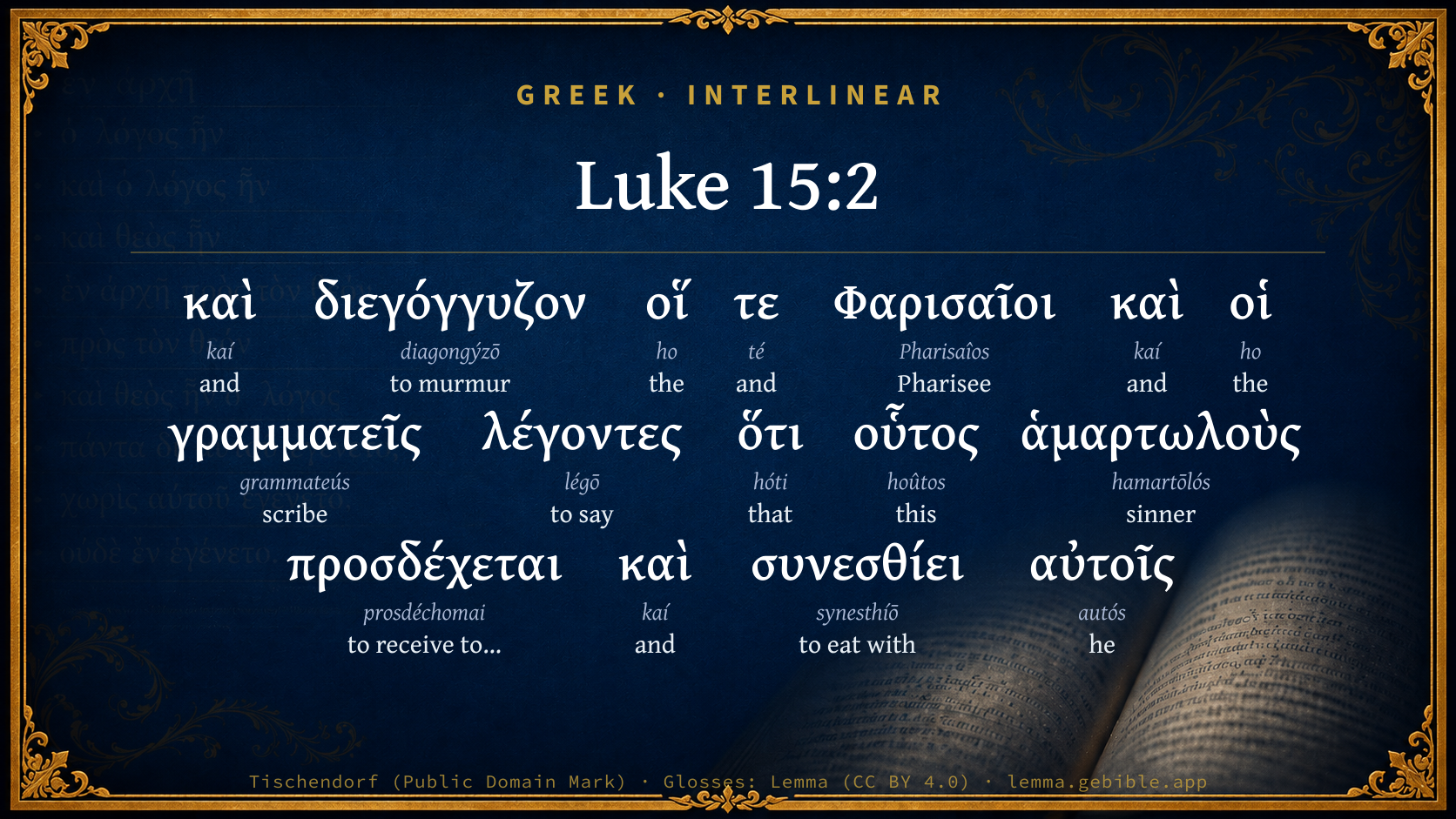
Greek (Tischendorf 8th ed.) Luke 15:2 appears in the Greek New Testament. The text above is from the Tischendorf 8th edition. Each word links to its Strong’s number and a concise gloss. Click any word for its full Thayer’s Greek Lexicon entry.
Download image
Cite this verse

Luke 15:2 (World English Bible). Public Domain. Lemma interlinear Bible study tool, https://lemma.gebible.app/v/luke/15/2.

Show BibTeX & RIS
BibTeX
RIS
English Translation
The Pharisees and the scribes murmured, saying, "This man welcomes sinners, and eats with them."
World English Bible · Public Domain
Highlights
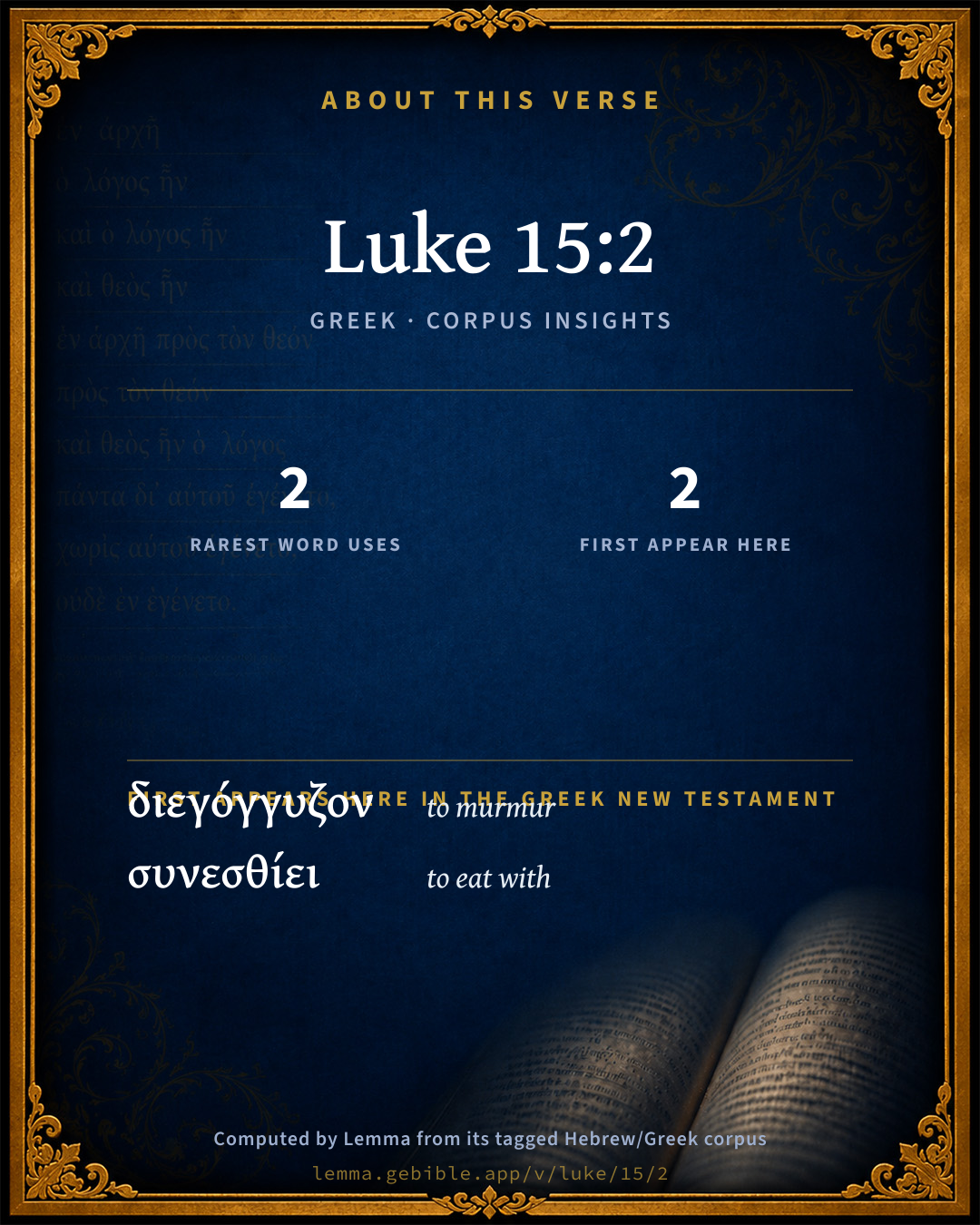
  • 2 first appearances in the Greek New Testament
Full analysis ↓
Download a study sheet

One document with this verse’s original text, its word-by-word gloss line, the meaning frame, cross-references with their text, attributed commentary, and full source and license credits — printable, and it pastes into notes with its structure intact.

This verse Autodidact and up

Study sheet (.html) Plain text (.txt)

A passage Seminary Student

Up to 50 verses in one chapter. A passage sheet keeps up to 6 commentary sources and 12 cross-references per verse, in the order this page ranks them, and says so on the sheet whenever that leaves anything out. Ask for a single verse and you get the Autodidact verse sheet above.

Everything on this page stays free to read, with no account — the sheet is a download of what is already on screen, not access to it.

Want to remove ads? Support Godless Engineer
Compare translations 3

The same verse in 3 English versions, stacked beneath the original-language interlinear above. Click any original word for its lexicon entry.

Each is an independent rendering of the whole verse — the interlinear is not word-aligned to these translations.

Highlighted words mark where these versions differ — a whole-verse word diff, not a word-by-word alignment.

  • World English Bible Public Domain
    The Pharisees and the scribes murmured, saying, "This man welcomes sinners, and eats with them."
  • King James Version Public Domain
    And the Pharisees and scribes murmured, saying, This man receiveth sinners, and eateth with them.
  • unfoldingWord Literal Text CC BY-SA 4.0
    And both the Pharisees and the scribes were grumbling, saying, “This one receives sinners and eats together with them.”

unfoldingWord Literal Text — © unfoldingWord, licensed CC BY-SA 4.0. Word-aligned USFM3 via Door43 (git.door43.org/unfoldingWord/en_ult).

Versions to compare (up to 4)

3 of 4 selected

Show all 19 translations

Every available English version of this verse, each an independent rendering of the whole verse.

  • World English Bible Public Domain
    The Pharisees and the scribes murmured, saying, "This man welcomes sinners, and eats with them."
  • Berean Standard Bible Public Domain
    So the Pharisees and scribes began to grumble: “This man welcomes sinners and eats with them.”
  • Majority Standard Bible Public Domain
    So the Pharisees and scribes began to grumble: “This man welcomes sinners and eats with them.”
  • King James Version Public Domain
    And the Pharisees and scribes murmured, saying, This man receiveth sinners, and eateth with them.
  • American Standard Version (1901) Public Domain
    And both the Pharisees and the scribes murmured, saying, This man receiveth sinners, and eateth with them.
  • Revised Version (1885) Public Domain
    And both the Pharisees and the scribes murmured, saying, This man receiveth sinners, and eateth with them.
  • Geneva Bible (1599) Public Domain
    Therefore the Pharises and Scribes murmured, saying, Hee receiueth sinners, and eateth with them.
  • Douay-Rheims (1899) Public Domain
    And the Pharisees and the scribes murmured, saying: This man receiveth sinners, and eateth with them.
  • Young's Literal Translation Public Domain
    and the Pharisees and the scribes were murmuring, saying -- This one doth receive sinners, and doth eat with them.'
  • Literal Standard Version CC BY-SA 4.0
    and the Pharisees and the scribes were murmuring, saying, “This One receives sinners, and eats with them.”
  • Unlocked Literal Bible CC BY-SA 4.0
    Both the Pharisees and the scribes grumbled to each other, saying, “This man welcomes sinners, and even eats with them.”
  • unfoldingWord Literal Text CC BY-SA 4.0
    And both the Pharisees and the scribes were grumbling, saying, “This one receives sinners and eats together with them.”
  • Darby Bible Public Domain
    and the Pharisees and the scribes murmured, saying, This [man] receives sinners and eats with them.
  • World Messianic Bible Public Domain
    The Pharisees and the scribes murmured, saying, “This man welcomes sinners, and eats with them.”
  • Webster's Bible Public Domain
    And the Pharisees and scribes murmured, saying, This man receiveth sinners, and eateth with them.
  • Free Bible Version CC BY-SA 4.0
    As a result the Pharisees and the religious teachers complained, “This man welcomes sinners, and eats with them.”
  • Bible in Basic English Public Domain
    And the Pharisees and scribes were angry, saying, This man gives approval to sinners, and takes food with them.
  • Text-Critical English NT CC BY 4.0
    But the Pharisees and the scribes grumbled, saying, “This man receives sinners and eats with them.”
  • Tyndale New Testament (1534) Public Domain
    And the pharises and scribes murmured sayinge: He receaved to his company synners and eateth with them.

Literal Standard Version (2020), Covenant Press — licensed CC BY-SA 4.0. Text via the HelloAO Bible API (eBible.org). Unlocked Literal Bible (unfoldingWord) — licensed CC BY-SA 4.0. Text via the HelloAO Bible API (eBible.org). unfoldingWord Literal Text — © unfoldingWord, licensed CC BY-SA 4.0. Word-aligned USFM3 via Door43 (git.door43.org/unfoldingWord/en_ult). Free Bible Version, Dr. Jonathan Gallagher — licensed CC BY-SA 4.0. Text via the HelloAO Bible API (eBible.org).

Word by word

More ways to search: Search by grammar → Find every occurrence → Compare this word →

Practice this passage: Drill this verse → Learn its vocabulary →

διεγόγγυζον
diagongýzō
G1234
“to murmur”
Verb, Imperfect, Active, Indicative, 3rd person, Plural
Part of Speech
Verb
Tense
Imperfect
Voice
Active
Mood
Indicative
Person
3rd person
Number
Plural
Full Thayer's Definition

Origin: from G1223 and G1111

TDNT: 13:15,1

1. to murmur a. either of a whole crowd, or among one another b. always used of many indignantly complaining
  1. καὶ kaí G2532 “and” Conjunction
  2. οἵ ho G3588 “the” Article, Nominative, Plural, Masculine
  3. τε té G5037 “and” Particle
  4. Φαρισαῖοι Pharisaîos G5330 “Pharisee” Noun, Nominative, Plural, Masculine
  5. καὶ kaí G2532 “and” Conjunction
  6. οἱ ho G3588 “the” Article, Nominative, Plural, Masculine
  7. γραμματεῖς grammateús G1122 “scribe” Noun, Nominative, Plural, Masculine
  8. λέγοντες légō G3004 “to say” Verb, Present, Active, Participle, Nominative, Plural, Masculine
  9. ὅτι hóti G3754 “that” Conjunction
  10. οὗτος hoûtos G3778 “this” Demonstrative pronoun, Nominative, Singular, Masculine
  11. ἁμαρτωλοὺς hamartōlós G268 “sinner” Adjective, Accusative, Plural, Masculine
  12. προσδέχεται prosdéchomai G4327 “to receive to oneself” Verb, Present, Middle or Passive deponent, Indicative, 3rd person, Singular
  13. καὶ kaí G2532 “and” Conjunction
  14. συνεσθίει synesthíō G4906 “to eat with” Verb, Present, Active, Indicative, 3rd person, Singular
  15. αὐτοῖς autós G846 “he” Personal pronoun, Dative, Plural, Masculine

About this verse

These counts appear in no published source. They are computed here, from the morphology-tagged text and Lemma’s own curated glosses. What Lemma adds →

16
words
13
distinct lemmas
Gospels
section

Notable vocabulary

The rarest word here is διεγόγγυζον to murmur G1234 — appearing just 2 times in the whole Greek New Testament.

First appearance in Scripture

These words make their first canonical appearance in the Greek New Testament here:

  • διεγόγγυζον to murmur G1234
  • συνεσθίει to eat with G4906

Shared distinctive vocabulary

διεγόγγυζον to murmur G1234 occurs in 2 verses of the Greek New Testament. Also found in:
Repetition

Words recur within this verse:

Cross-references

9

Topical passages linked to Luke 15:2 in the Treasury of Scripture Knowledge — connected by theme and wording, ordered by reader-vote popularity; previews shown in the World English Bible.

  • Matthew 9:11 When the Pharisees saw it, they said to his disciples, "Why does your teacher eat with tax collectors and sinners?"
  • Luke 7:39 Now when the Pharisee who had invited him saw it, he said to himself, "This man, if he were a prophet, would have perceived who and what kind of woman this is who touches him, that she is a sinner."
  • Luke 19:7 When they saw it, they all murmured, saying, "He has gone in to lodge with a man who is a sinner."
  • Luke 5:30 Their scribes and the Pharisees murmured against his disciples, saying, "Why do you eat and drink with the tax collectors and sinners?"
  • Acts 11:3 saying, "You went in to uncircumcised men, and ate with them!"
  • Luke 7:34 The Son of Man has come eating and drinking, and you say, 'Behold, a gluttonous man, and a drunkard; a friend of tax collectors and sinners!'
  • Galatians 2:12 For before some people came from James, he ate with the Gentiles. But when they came, he drew back and separated himself, fearing those who were of the circumcision.
  • Luke 15:29–30 But he answered his father, 'Behold, these many years I have served you, and I never disobeyed a commandment of yours, but you never gave me a goat, that I might celebrate with my friends.

Cross-references courtesy of OpenBible.info (CC BY 4.0).

Commentary

Notes on Luke 15:2 from classic Christian and Jewish commentators (each source and its license shown beneath its notes). The classic Christian expositions comment on the surrounding passage and are grouped to its opening verse, so a note may address several verses; the Jewish commentaries on the Tanakh (Rashi and others) are per-verse, so they appear only where the commentator wrote on this verse.

Lemma curates 59 commentaries, every one of them public domain or Creative Commons licensed, each selected and text-cleaned for this edition rather than reprinted as found. About our sources →

Joseph Benson's Commentary

Luk 15:2-7. And he spake this parable — That he might justify his conversing freely with sinners, in order to their reformation and salvation, he spake the parable of the lost sheep, which he had delivered once before, and also two other parables, which all declare, in direct contrariety to the Pharisees and scribes, in what manner God receiveth sinners. What man having a hundred sheep, &c. — See note on Mat 18:12-15. Doth not leave the ninety and nine in the wilderness — Where they used to feed. All uncultivated ground, like our commons, was by the Jews termed wilderness, or desert, in distinction from arable and enclosed land: and go after that which is lost — In recovering a lost soul, Christ, as it were, labours. May we not learn from hence, that to let them alone, who are in sin, is both unchristian and inhuman? And when he hath found it — After a long and tedious search, he layeth it on his shoulders, rejoicing, as a man in such circumstances naturally would. And calleth together his friends and neighbours — Who had been informed of his loss, and grieved on account of it: saying, Rejoice — With me, for my labour and search have not been in vain; I have found my sheep which was lost — To my great joy, especially as I was ready to despair of finding it. Likewise joy shall be in heaven — First, in our blessed Lord himself, and then among the angels of God, and the spirits of just men, perhaps informed thereof by God himself, or by the angels who ministered to them; over one sinner — Over one gross, open, notorious sinner; that repenteth — That is thoroughly changed in heart and life; more than over ninety and nine just — Δικαιοις, righteous persons, who need no repentance — No such universal change of mind and character, having been the subjects of it in their childhood or youth. It cannot, as Dr. Doddridge justly observes, be our Lord’s meaning here, that God esteems one penitent sinner more than ninety and nine confirmed and established saints; (who are, undoubtedly, the persons spoken of as needing no repentance, or no universal change of heart and life, in which sense the word μετανοια is commonly used;) for it would be inconsistent with the divine wisdom, goodness, and holiness to suppose this. But it is plainly as if he had said, “As a father peculiarly rejoices when an extravagant child, supposed to be utterly lost, is brought to a thorough sense of his duty, and is effectually reformed; or, as any other person who has recovered what he had given up for gone, has a more sensible satisfaction in it than in several other things equally valuable, but not in such danger: so do the holy inhabitants of heaven rejoice in the conversion of the most abandoned sinners. Yea, and God himself so readily forgives and receives them, that he may be represented as having part in the joy.” It must be observed, however, that, as the design of the parable is to represent divine things by images taken from the manners of men, what is here said must be understood as spoken with allusion to human passions, which are much more sensibly affected with the obtaining of what was long and vehemently desired, or with the gaining of that which was looked upon as lost, than with the continuance of the good long enjoyed. And when such passions are ascribed to God, they are to be taken in a figurative sense, entirely exclusive of those sensations which result from the commotions of animal nature in ourselves.

Joseph Benson's Commentary on the Old and New Testaments (1811–1818) — public domain. Text from a community e-Sword module.

Tyndale Open Study Notes

Tyndale Open Resources

15:2 In their self-righteous hard-heartedness, the Pharisees and teachers of religious law did not care about lost people. Jesus embodied the heart of God, who longs for his wayward children to return.

Tyndale Open Study Notes — © Tyndale Open Resources, licensed CC BY-SA 4.0. Text via the HelloAO Bible API.

Bengel's Gnomon

Johann Albrecht Bengel

Luk 15:2. Διεγόγγυζον, murmured among one another.

Bengel's Gnomon of the New Testament — English translation (T&T Clark, Edinburgh, 1860) — public domain. Text from a community e-Sword module.

Expositor's Greek Testament

ed. W. Robertson Nicoll

Luk 15:2 . διεγόγγυζον : the διὰ conveys the idea of a general pervasive murmuring. This is probably not an instance illustrating Hermann’s remark ( ad Viger. , p. 856) that this preposition in compound verbs often adds the notion of striving ( διαπίνειν , certare bibendo ). οἵ τε φ .: the τε ( [126] [127] [128] ) binds Pharisees and scribes together as one: as close a corporation as “publicans and sinners” (equivalent to “sinners” in their conception. ἁμαρτωλοὺς , Luk 15:2 ). Note the order, Pharisees and scribes; usually the other way. Pharisees answers to sinners, scribes to publicans; the two extremes in character and calling: the holiest and unholiest; the most reputable and the most disreputable occupations. And Jesus preferred the baser group! προσδέχεται , receives, admits to His presence; instead of repelling with involuntary loathing. καὶ συνεσθίει : not only admits but also eats with them . That was the main surprise and offence, and therefore just the thing done, because the thing which, while offending the Pharisees, would certainly gain the “sinners”. Jesus did what the reputedly good would not do, so winning their trust.

[126] Codex Sinaiticus (sæc. iv.), now at St. Petersburg, published in facsimile type by its discoverer, Tischendorf, in 1862.

[127] Codex Vaticanus (sæc. iv.), published in photographic facsimile in 1889 under the care of the Abbate Cozza-Luzi.

[128] Codex Regius--eighth century, represents an ancient text, and is often in agreement with א and B.

The Expositor's Greek Testament, edited by W. Robertson Nicoll (1897–1910) — public domain. Text from a community e-Sword module.

Jamieson, Fausset & Brown

Robert Jamieson, A. R. Fausset & David Brown

murmured, saying, &c.--took it ill, were scandalized at Him, and insinuated (on the principle that a man is known by the company he keeps) that He must have some secret sympathy with their character. But oh, what a truth of unspeakable preciousness do their lips, as on other occasions, unconsciously utter., Now follow three parables representing the sinner: (1) in his stupidity; (2) as all-unconscious of his lost condition; (3) knowingly and willingly estranged from God [BENGEL]. The first two set forth the seeking love of God; the last, His receiving love [TRENCH].

Jamieson, Fausset & Brown — Commentary Critical and Explanatory on the Whole Bible (1871) — public domain (CC PDM 1.0). Text via the HelloAO Bible API.

Adam Clarke's Commentary

Verse 2. Receiveth sinners] προσδεχεται. He receives them cordially, affectionately - takes them to his bosom; for so the word implies. What mercy! Jesus receives sinners in the most loving, affectionate manner, and saves them unto eternal life! Reader, give glory to God for ever!

Adam Clarke's Commentary on the Bible (1810–1826) — public domain. Text from a community e-Sword/MySword module.

Ellicott's Commentary for English Readers

(2) And the Pharisees and scribes . . .—Here, too, we may well believe that the speakers were some of the guests of Luk_14:15. They had followed Him to see what He would do, and were at once startled and shocked to find the Teacher who had spoken so sternly to those who were professedly godly, not only talking to, but eating with, those who were, at any rate, regarded as ungodly and sinful.

A Bible Commentary for English Readers, edited by Charles John Ellicott (1878–1897) — public domain. Text from a community e-Sword module.

The Cambridge Bible for Schools and Colleges

gen. ed. J. J. S. Perowne

2. the Pharisees and scribes] See Excursus VI.

murmured] Rather, were loudly murmuring (Luk_19:7; Jos_9:18). “With arid heart they blame the very Fount of Mercy,” Gregory the Great. In all ages it had been their sin that they ‘sought not the lost.’ Eze_34:4.

and eateth with them] Even their touch was regarded as unclean by the Pharisees. But our Lord, who read the heart, knew that the religious professors were often the worse sinners before God, and He associated with sinners that He might save them. “Ideo secutus est... usque ad mensam, ubi maxime peccatur.” Bengel. It is this yearning of redemptive love which finds its richest illustration in these three parables. They contain the very essence of the Glad Tidings, and two of them are peculiar to St Luke.

The Cambridge Bible for Schools and Colleges (gen. ed. J. J. S. Perowne; Cambridge University Press, 1878–1918) — public domain. Text from a community e-Sword module.

John Gill's Exposition

And the Pharisees and Scribes murmured,.... When they saw the easy access these wicked men had to Christ; and that he stopped and stayed with them, and very freely imparted instructions to them: saying,

this man receiveth sinners. The Persic version reads, "publicans and sinners", as in the preceding verse: the word "man" is not in the original text, it is only "this"; which is to be understood not by way of eminence, as this great person, this prophet, this master in Israel; but by way of diminution and reproach, this fellow; as it is sometimes supplied: the word "man" be very rightly inserted, for they took him to be a mere man; though it is certain he was more than a man, even the true and mighty God; and therefore was able to save those sinners that came to him: and great condescension and grace did he show in receiving them who were "sinners", not only by nature, but by practice; and not merely guilty of common infirmities, but were notorious sinners, covetous, extortioners, oppressors of the poor, and very debauched persons; and such as these Christ "receives": hence no man should be discouraged from coming to Christ, on account of sin; all that do come to him, should come as sinners, for he receives them as such; nor does he receive any for any worthiness there is in them: these persons he received first at his Father's hand, as he did all the elect, as his portion, and to be preserved and saved by him; with all gifts, grace, blessings, and promises for them; and in consequence of this, he receives them upon their coming to him as sinners, into his open love and affection, into his arms; which denotes communion and protection; into his house and family, and not only to hear him preach, or preached, but to converse and eat with him at his table, and even to live by faith upon him; and when he has freed them from all their sins, he will receive them to himself in glory. And there is the greatest reason imaginable to believe, that Christ still does, and will receive sinners; since he came to save the chief of sinners; and has bore their sins, and died for them; and now makes intercession for transgressors; and by the ministers of the word calls sinners to repentance.

And eateth with them; as he did in the houses of Matthew the publican, and of Zaccheus; see Mat 9:10 each of which occasioned great murmurings among the Pharisees; and who therefore traduced him as a friend of publicans and sinners; and he is indeed so in the best sense: and not only did he eat with them corporeally, but in a spiritual sense, as he still does; admitting them into his house to eat of the provisions of it, to live on him the bread of life, to sup with him, and he with them; and feeding and delighting himself in the exercise of those graces, which he himself is the donor and author of, in them.

John Gill's Exposition of the Whole Bible (1746–1763) — public domain (CC PDM 1.0). Text via the HelloAO Bible API.

Trapp's Complete Commentary

John Trapp

2 And the Pharisees and scribes murmured, saying, This man receiveth sinners, and eateth with them.

Ver. 2. But the scribes and Pharisees] Being sick of the devil’s disease, and doing his lusts, Joh 8:44.

John Trapp, A Commentary or Exposition upon All the Books of the Old and New Testament (1647–1656) — public domain. Text from a community e-Sword module.

Albert Barnes' Notes on the Bible

Murmured - They affected to suppose that if Jesus treated sinners kindly he must be fond of their society, and be a man of similar character. “They” considered it disgraceful to be with them or to eat with them, and they, therefore, brought a charge against him for it. They “would” not suppose that he admitted them to his society for the purpose of doing them good; nor did they remember that the very object of his coming was to call the wicked from their ways and to save them from death.

Receiveth sinners - Receives them in a tender manner; treats them with kindness; does not drive them from his presence.

And eateth with them - Contrary to the received maxims of the scribes. By eating with them he showed that he did not despise or overlook them.

Albert Barnes' Notes on the Bible (1834–1885) — public domain. Text from a community e-Sword/MySword module.

Whedon's Commentary on the Bible

Daniel D. Whedon

2. Pharisees and scribes—This would seem to imply that our Lord was in some populous town, where numbers of these classes were to be found. And the reply of Jesus, of which Luke doubtless gives us but an abbreviated sketch is still so full, as well as so regular and symmetrical, as to induce us to suppose that it was a public and even a synagogue discourse. It cannot be a mere collection by Luke of parables brought together by classification, but must be accepted as a threefold unit.

This man receiveth sinners—Accepts them as followers and even apostles, as Matthew.

Daniel D. Whedon (gen. ed.), Commentary on the Old and New Testaments (1874–1909) — public domain. Text from a community e-Sword module.

Scofield Reference Notes

C. I. Scofield

sinners

Sin. (See Scofield "Rom 3:23").

The Scofield Reference Bible (1917 edition), notes by C. I. Scofield — public domain. Text from a community e-Sword module.

The People's New Testament

B. W. Johnson

2. Pharisees. The orthodox leaders. Scribes. Primarily copyists, but also the great theologians. Eateth with them. That he should be on social terms with sinners the Pharisees could not overlook.

B. W. Johnson's The People's New Testament with Notes (1889–1891) — public domain. Electronic text from the Christian Classics Ethereal Library (CCEL) ThML edition.

Cambridge Greek Testament for Schools and Colleges

2. διεγόγγυζον. ‘Were loudly murmuring’ (Luk 19:7; Jos 9:18). “With arid heart they blame the very Fount of Mercy,” Gregory the Great. In all ages it had been their sin that they ‘sought not the lost.’ Eze 34:4.

οἵ τε Φαρισαῖοι καὶ οἱ γραμματεῖς. See Excursus VI.

καὶ συνεσθίει αὐτοῖς. He not only gives them a genial welcome (προσδέχεται) but publicly recognises them. They found in Him none of the bitter contempt to which they were accustomed from the ‘religious authorities’ of Palestine. Even their touch was regarded as unclean by the Pharisees. But our Lord, who read the heart, knew that the religious professors were often the worse sinners before God, and He associated with sinners that He might save them. “Ideo secutus est … usque ad mensam, ubi maxime peccatur.” Bengel. It is this yearning of redemptive love which finds its richest illustration in these three parables. They contain the very essence of the Glad Tidings, and two of them are peculiar to St Luke.

Cambridge Greek Testament for Schools and Colleges (Cambridge University Press, 1896; 21 vols, various authors incl. Carr, Maclear, Plummer, Farrar, Lumby, Moule, M. R. James, Simcox) — public domain. Text from a community e-Sword module.

Alford’s Greek Testament

Henry Alford

2.] προσδέχ., into His circle of adherents—συνεσθ., allows them to sit at meat with Him;—on the journey, or at entertainments, as in Mat 9:10. Stier remarks (iii. 214, edn. 2) that this ἁμαρτ. προσδέχ. is an important and affecting testimony, from the mouth of the enemies of our Lord, to His willingness to receive sinners.

The διεγόγγ. implies either throughout the journey;—or rather, one to another,—responsively.

Henry Alford, The Greek Testament (1849–1861) — public domain. Text from a community e-Sword module.

International Critical Commentary

2. διεγόγγυζον. “Murmured among themselves, throughout their whole company.” In N.T. only here and 19:7, which is very similar. Comp. Exo 16:2, Exo 16:7, Exo 16:8; Num 14:2; Jos 9:18. “The scribes” are usually placed before “the Pharisees” (5:21, 6:7, 11:53; Mat 12:38, etc.). Here perhaps the Pharisees took the lead: comp. 30 (true text); Mar 7:1, Mar 7:5.

προσδέχεται. “Allows them access, gives them a welcome”: Rom 16:2; Php 2:29.

συνεσθίει. A much more marked breach of Pharisaic decorum than προσδέχεται. He accepted invitations from Levi and other tax-collectors, and in His outdoor teaching He took His meals with them.

International Critical Commentary — older volumes (1896–1929), various authors — public domain. Text from a community e-Sword module.

Lesson kit

Teaching starters — assembled from the data on this page, not authored interpretation. Every prompt links to the verse data it draws on. Edit before teaching.

Luke, in the Gospels, opens this verse with 16 words (13 distinct Greek lemmas). Its most distinctive word is diagongýzō (“to murmur”). A historical commentator’s framing appears above. Read the whole chapter for the surrounding context.

Discussion questions

  1. What does “to murmur” (diagongýzō) contribute to the verse as a whole?
  2. 2 words make their first appearance in Scripture here. What does this debut establish?
  3. How does Luke 19:7, which shares the word «to murmur», read alongside this verse?
  4. What does the repetition of “and” (3× in this one verse) do in this verse?
  5. These translations render this verse differently. What is at stake in choosing one wording over another?
  6. Compare how Joseph Benson's Commentary and Tyndale Open Study Notes read this verse. Where do they agree or differ?

Things to notice

  • 2 words make their first canonical appearance in Scripture here.
  • These translations choose different wording for 11 words in this verse.
  • “and” occurs 3× in this single verse.
  • 13 distinct Greek lemmas span 16 words in this verse.

Reading settings

Reading text

Shown beneath each verse's original-language words.

Old Testament
Old Testament edition

Read the OT as the Masoretic Hebrew (MT) or the Greek Septuagint (LXX).

English shown for the Greek Septuagint (in the Hebrew ↔ Greek comparison).

Comparing translations? Open the Compare panel on any verse page to stack up to four side by side.