
John 2:15

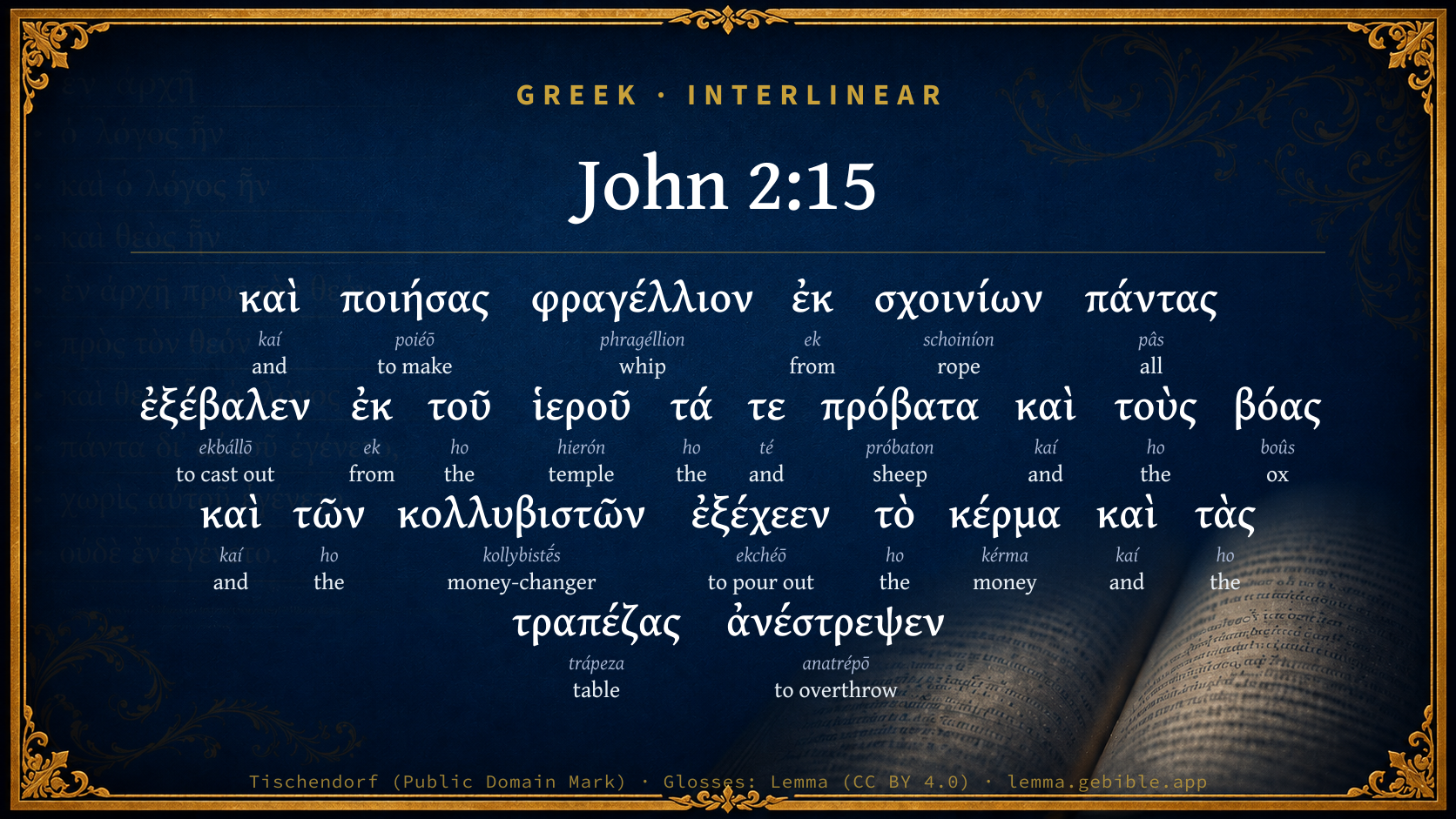
Greek (Tischendorf 8th ed.) John 2:15 appears in the Greek New Testament. The text above is from the Tischendorf 8th edition. Each word links to its Strong’s number and a concise gloss. Click any word for its full Thayer’s Greek Lexicon entry.
Download image
Cite this verse

John 2:15 (World English Bible). Public Domain. Lemma interlinear Bible study tool, https://lemma.gebible.app/v/john/2/15.

Show BibTeX & RIS
BibTeX
RIS
English Translation
He made a whip of cords, and threw all out of the temple, both the sheep and the oxen; and he poured out the changers' money, and overthrew their tables.
World English Bible · Public Domain
Highlights
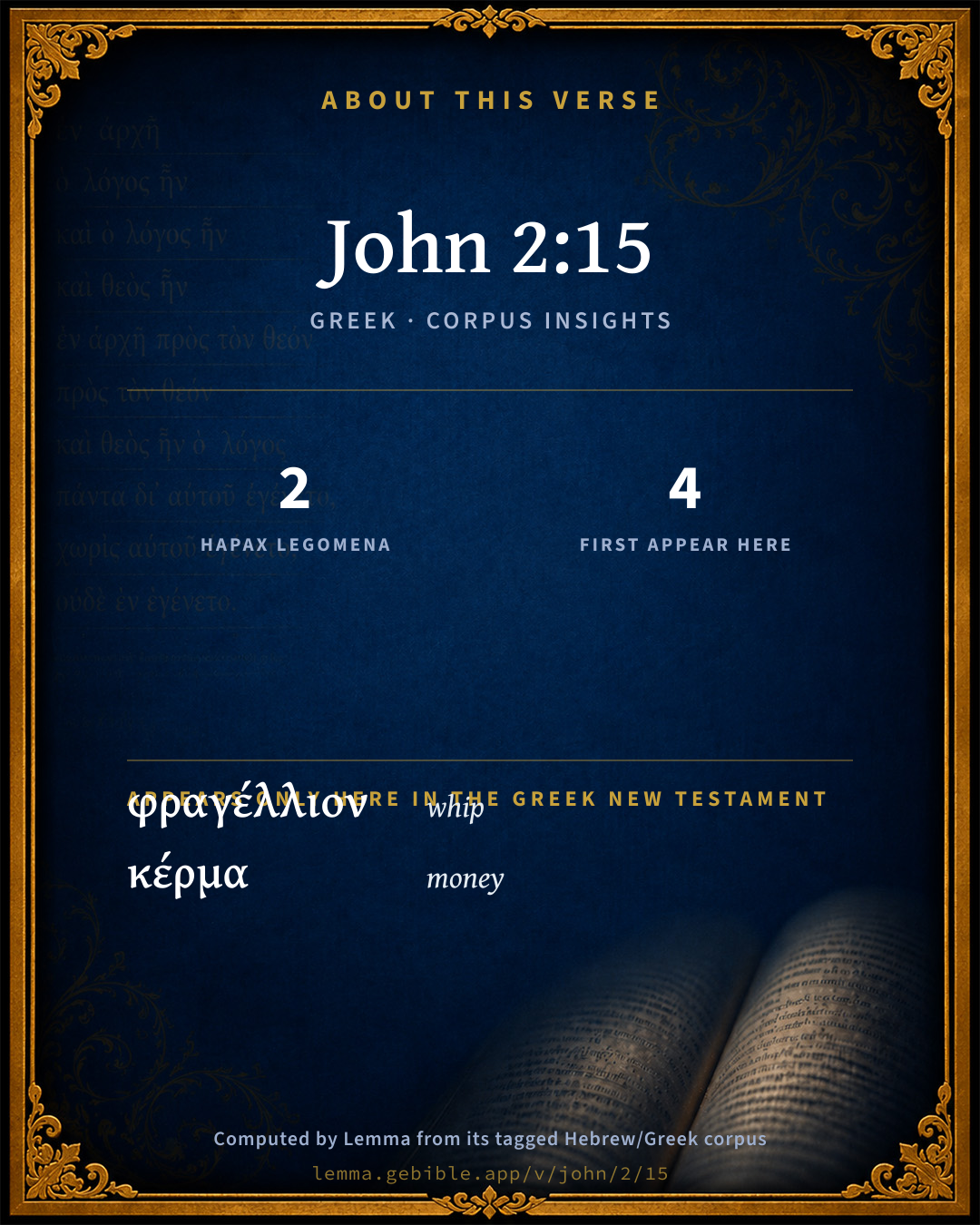
  • 2 hapax legomena — only here in the Greek New Testament
  • 4 first appearances in the Greek New Testament
Full analysis ↓
Download a study sheet

One document with this verse’s original text, its word-by-word gloss line, the meaning frame, cross-references with their text, attributed commentary, and full source and license credits — printable, and it pastes into notes with its structure intact.

This verse Autodidact and up

Study sheet (.html) Plain text (.txt)

A passage Seminary Student

Up to 50 verses in one chapter. A passage sheet keeps up to 6 commentary sources and 12 cross-references per verse, in the order this page ranks them, and says so on the sheet whenever that leaves anything out. Ask for a single verse and you get the Autodidact verse sheet above.

Everything on this page stays free to read, with no account — the sheet is a download of what is already on screen, not access to it.

Want to remove ads? Support Godless Engineer
Compare translations 3

The same verse in 3 English versions, stacked beneath the original-language interlinear above. Click any original word for its lexicon entry.

Each is an independent rendering of the whole verse — the interlinear is not word-aligned to these translations.

Highlighted words mark where these versions differ — a whole-verse word diff, not a word-by-word alignment.

  • World English Bible Public Domain
    He made a whip of cords, and threw all out of the temple, both the sheep and the oxen; and he poured out the changers' money, and overthrew their tables.
  • King James Version Public Domain
    And when he had made a scourge of small cords, he drove them all out of the temple, and the sheep, and the oxen; and poured out the changers' money, and overthrew the tables;
  • unfoldingWord Literal Text CC BY-SA 4.0
    And having made a whip from cords, he drove all out from the temple, and the sheep and the oxen, and he scattered the coins of the money changers and overthrew their tables.

unfoldingWord Literal Text — © unfoldingWord, licensed CC BY-SA 4.0. Word-aligned USFM3 via Door43 (git.door43.org/unfoldingWord/en_ult).

Versions to compare (up to 4)

3 of 4 selected

Show all 19 translations

Every available English version of this verse, each an independent rendering of the whole verse.

  • World English Bible Public Domain
    He made a whip of cords, and threw all out of the temple, both the sheep and the oxen; and he poured out the changers' money, and overthrew their tables.
  • Berean Standard Bible Public Domain
    So He made a whip out of cords and drove all from the temple courts, both sheep and cattle. He poured out the coins of the money changers and overturned their tables.
  • Majority Standard Bible Public Domain
    So He made a whip out of cords and drove all from the temple courts, both sheep and cattle. He poured out the coins of the money changers and overturned their tables.
  • King James Version Public Domain
    And when he had made a scourge of small cords, he drove them all out of the temple, and the sheep, and the oxen; and poured out the changers' money, and overthrew the tables;
  • American Standard Version (1901) Public Domain
    and he made a scourge of cords, and cast all out of the temple, both the sheep and the oxen; and he poured out the changers' money, and overthrew their tables;
  • Revised Version (1885) Public Domain
    and he made a scourge of cords, and cast all out of the temple, both the sheep and the oxen; and he poured out the changers’ money, and overthrew their tables;
  • Geneva Bible (1599) Public Domain
    Then hee made a scourge of small cordes, and draue them all out of the Temple with the sheepe and oxen, and powred out the changers money, and ouerthrewe the tables,
  • Douay-Rheims (1899) Public Domain
    And when he had made, as it were, a scourge of little cords, he drove them all out of the temple, the sheep also and the oxen, and the money of the changers he poured out, and the tables he overthrew.
  • Young's Literal Translation Public Domain
    and having made a whip of small cords, he put all forth out of the temple, also the sheep, and the oxen; and of the money-changers he poured out the coins, and the tables he overthrew,
  • Literal Standard Version CC BY-SA 4.0
    and having made a whip of small cords, He put all forth out of the temple, also the sheep, and the oxen; and He poured out the coins of the money-changers, and He overthrew the tables,
  • Unlocked Literal Bible CC BY-SA 4.0
    So he made a whip of cords and drove all of them out from the temple, including both the sheep and the oxen. He scattered the coins of the money changers and overthrew their tables.
  • unfoldingWord Literal Text CC BY-SA 4.0
    And having made a whip from cords, he drove all out from the temple, and the sheep and the oxen, and he scattered the coins of the money changers and overthrew their tables.
  • Darby Bible Public Domain
    and, having made a scourge of cords, he cast [them] all out of the temple, both the sheep and the oxen; and he poured out the change of the money-changers, and overturned the tables,
  • World Messianic Bible Public Domain
    He made a whip of cords and drove all out of the temple, both the sheep and the oxen; and he poured out the changers’ money and overthrew their tables.
  • Webster's Bible Public Domain
    And when he had made a scourge of small cords, he drove them all out of the temple, and the sheep, and the oxen; and poured out the changers' money, and overthrew the tables;
  • Free Bible Version CC BY-SA 4.0
    He made a whip out of cords and drove everyone out of the Temple, along with the sheep and cattle, scattering coins of the money-changers and turning over their tables.
  • Bible in Basic English Public Domain
    And he made a whip of small cords and put them all out of the Temple, with the sheep and the oxen, sending in all directions the small money of the changers and overturning their tables;
  • Text-Critical English NT CC BY 4.0
    So he made a whip of cords and drove them all out of the temple courts, along with their sheep and oxen. He also poured out the coins of the money changers and overturned their tables.
  • Tyndale New Testament (1534) Public Domain
    And he made a scourge of small cordes and drave them all out of the temple with the shepe and oxen and powred oute the changers money and overthrue the tables

Literal Standard Version (2020), Covenant Press — licensed CC BY-SA 4.0. Text via the HelloAO Bible API (eBible.org). Unlocked Literal Bible (unfoldingWord) — licensed CC BY-SA 4.0. Text via the HelloAO Bible API (eBible.org). unfoldingWord Literal Text — © unfoldingWord, licensed CC BY-SA 4.0. Word-aligned USFM3 via Door43 (git.door43.org/unfoldingWord/en_ult). Free Bible Version, Dr. Jonathan Gallagher — licensed CC BY-SA 4.0. Text via the HelloAO Bible API (eBible.org).

Word by word

More ways to search: Search by grammar → Find every occurrence → Compare this word →

Practice this passage: Drill this verse → Learn its vocabulary →

φραγέλλιον
phragéllion
G5416
“whip”
Noun, Accusative, Singular, Neuter
Part of Speech
Noun
Case
Accusative
Number
Singular
Gender
Neuter
Full Thayer's Definition

Origin: from a derivative from the base of G5417

TDNT: None

1. a scourge or whip
  1. καὶ kaí G2532 “and” Conjunction
  2. ποιήσας poiéō G4160 “to make” Verb, Aorist, Active, Participle, Nominative, Singular, Masculine
  3. ἐκ ek G1537 “from” Preposition
  4. σχοινίων schoiníon G4979 “rope” Noun, Genitive, Plural, Neuter
  5. πάντας pâs G3956 “all” Adjective, Accusative, Plural, Masculine
  6. ἐξέβαλεν ekbállō G1544 “to cast out” Verb, Aorist, Active, Indicative, 3rd person, Singular
  7. ἐκ ek G1537 “from” Preposition
  8. τοῦ ho G3588 “the” Article, Genitive, Singular, Neuter
  9. ἱεροῦ hierón G2411 “temple” Noun, Genitive, Singular, Neuter
  10. τά ho G3588 “the” Article, Accusative, Plural, Neuter
  11. τε té G5037 “and” Particle
  12. πρόβατα próbaton G4263 “sheep” Noun, Accusative, Plural, Neuter
  13. καὶ kaí G2532 “and” Conjunction
  14. τοὺς ho G3588 “the” Article, Accusative, Plural, Masculine
  15. βόας boûs G1016 “ox” Noun, Accusative, Plural, Masculine
  16. καὶ kaí G2532 “and” Conjunction
  17. τῶν ho G3588 “the” Article, Genitive, Plural, Masculine
  18. κολλυβιστῶν kollybistḗs G2855 “money-changer” Noun, Genitive, Plural, Masculine
  19. ἐξέχεεν ekchéō G1632 “to pour out” Verb, Aorist, Active, Indicative, 3rd person, Singular
  20. τὸ ho G3588 “the” Article, Accusative, Singular, Neuter
  21. κέρμα kérma G2772 “money” Noun, Accusative, Singular, Neuter
  22. καὶ kaí G2532 “and” Conjunction
  23. τὰς ho G3588 “the” Article, Accusative, Plural, Feminine
  24. τραπέζας trápeza G5132 “table” Noun, Accusative, Plural, Feminine
  25. ἀνέστρεψεν anatrépō G396 “to overthrow” Verb, Aorist, Active, Indicative, 3rd person, Singular

About this verse

These counts appear in no published source. They are computed here, from the morphology-tagged text and Lemma’s own curated glosses. What Lemma adds →

26
words
17
distinct lemmas
Gospels
section

Notable vocabulary

2 hapax legomena — words that appear only here in the entire Greek New Testament:

  • φραγέλλιον whip G5416
  • κέρμα money G2772

First appearance in Scripture

These words make their first canonical appearance in the Greek New Testament here:

  • φραγέλλιον whip G5416
  • σχοινίων rope G4979
  • κέρμα money G2772
  • ἀνέστρεψεν to overthrow G396

Shared distinctive vocabulary

σχοινίων rope G4979 occurs in 2 verses of the Greek New Testament. Also found in:
Repetition

Words recur within this verse:

Commentary

Notes on John 2:15 from classic Christian and Jewish commentators (each source and its license shown beneath its notes). The classic Christian expositions comment on the surrounding passage and are grouped to its opening verse, so a note may address several verses; the Jewish commentaries on the Tanakh (Rashi and others) are per-verse, so they appear only where the commentator wrote on this verse.

Lemma curates 59 commentaries, every one of them public domain or Creative Commons licensed, each selected and text-cleaned for this edition rather than reprinted as found. About our sources →

Joseph Benson's Commentary

Joh 2:15-17. And when he had made a scourge of small cords — Εκσχοινιων, of rushes, rather, which he found strewed on the ground. This circumstance, seemingly slight, was inserted to show that the instrument could not be the cause of so wonderful an effect as is here mentioned. He drove them all out — Namely, out of the court of the temple; both the sheep and the oxen — Though it does not appear that he struck even them, much less any of the men. But a terror from God, it is evident, fell upon them. And poured out the changers’ money — Upon the ground; and overthrew the tables — At which they were sitting. And said to them that sold doves, Take these things hence — Greek, ταυτα, the cages wherein the pigeons were exposed to sale, pointing to them. Make not my Father’s house a house of merchandise — Make not the temple, which is dedicated to the worship of God, a place for carrying on low traffic. It is remarkable, that the guilty persons did not offer to make the least resistance; probably, a consciousness of guilt restrained them, or the wonderful things which Jesus had performed at this festival, though not recorded, with the influence of Christ’s miraculous power on their minds, made them afraid to resist him. Nevertheless, in the apprehension of the disciples, he exposed him self to great danger, by turning out a body of factious men, whom the priests and rulers supported. On this occasion, therefore, they called to mind, Psa 69:10, The zeal of thy house hath eaten me up — Imputing their Master’s action to such a concern for the purity of God’s worship, as the psalmist of old was animated by. The truth is, it certainly was an evidence of a very extraordinary zeal indeed; a zeal nothing inferior to that for which the prophets were famed.

Joseph Benson's Commentary on the Old and New Testaments (1811–1818) — public domain. Text from a community e-Sword module.

Bengel's Gnomon

Johann Albrecht Bengel

Joh 2:15. Φραγέλλιον, a scourge) Admirable zeal!—ἐκ σχοινίων) of several cords: for so scourges were formerly made. Moreover there was no material which inflicted less lasting hurt on the body than this. Nor is it said, that He inflicted a single blow upon the men: He accomplished His purpose by the terror [which He inspired].

Bengel's Gnomon of the New Testament — English translation (T&T Clark, Edinburgh, 1860) — public domain. Text from a community e-Sword module.

Jamieson, Fausset & Brown

Robert Jamieson, A. R. Fausset & David Brown

small cords--likely some of the rushes spread for bedding, and when twisted used to tie up the cattle there collected. "Not by this slender whip but by divine majesty was the ejection accomplished, the whip being but a sign of the scourge of divine anger" [GROTIUS].

poured out . . . overthrew--thus expressing the mingled indignation and authority of the impulse.

Jamieson, Fausset & Brown — Commentary Critical and Explanatory on the Whole Bible (1871) — public domain (CC PDM 1.0). Text via the HelloAO Bible API.

Ellicott's Commentary for English Readers

(15) And the sheep, and the oxen.—For this read, both the sheep and the oxen. The change is of only one word, but it gives an entirely different sense. The driving out with the scourge was not of “all (men) and sheep and oxen,” but of “all,” i.e., both sheep and oxen.

A Bible Commentary for English Readers, edited by Charles John Ellicott (1878–1897) — public domain. Text from a community e-Sword module.

The Cambridge Bible for Schools and Colleges

gen. ed. J. J. S. Perowne

15. when he had made a scourge] Peculiar to this account; not in the similar narrative of the Synoptists.

and the sheep, &c.] Rather, both the sheep and the oxen. ‘All’ does not refer to the sellers and exchangers, but anticipates the sheep and the oxen. The men probably fled at once. The order is natural; first the driving out of the cattle, then the pouring out of the money and overturning the tables. The word for ‘money’ literally means ‘something cut up small,’ hence ‘change.’ The common exchange would be foreign money for Jewish, payments to the Temple being necessarily made in Jewish coin.

The Cambridge Bible for Schools and Colleges (gen. ed. J. J. S. Perowne; Cambridge University Press, 1878–1918) — public domain. Text from a community e-Sword module.

John Gill's Exposition

And when he had made a scourge of small cords,.... That is, Jesus, as the Persic version expresses it. This scourge might be made either of thongs cut out of the hides of beasts slain in sacrifice; or of the cords, with which the owners of the cattle had brought them to this place; or with which they had fastened them in it. And it seems to be made, and used, not so much for force and terror, as to intimate, that these persons, the violators of the holy place, deserved the scourge of divine wrath and punishment; as well as to show the miraculous power of Christ in driving such a number of men before him, with so small and insignificant a weapon; for the phrase is diminutive. The reason given by Dr. Lightfoot, and others, why Christ made use of a whip, or scourge, rather than a staff, is, because it was contrary to a Jewish canon (d) to go into the mountain of the house, or temple, with a staff in the hand; and yet the man of the mountain of the house, or the master of it, who used to go about every ward with torches burning before him, if he found a Levite asleep in his ward (e), struck him with his staff, and had power to burn his clothes.

He drove them all out of the temple; that is, he drove out "the men", as the Persic version reads; the merchants, the sellers of oxen, sheep, and doves, and the money changers: "and the sheep, and the oxen" likewise; the Persic version adds, "doves"; but these are after mentioned:

and poured out the changers money; off of the tables, or out of the boxes, or dishes, or drawers, or purses, in which it was put:

and overthrew the tables; at which they sat, and on which they told their money.

(d) Misn. Beracot, c. 9. sect. 5. (e) Misn. Middot, c. 1. sect. 2.

John Gill's Exposition of the Whole Bible (1746–1763) — public domain (CC PDM 1.0). Text via the HelloAO Bible API.

Trapp's Complete Commentary

John Trapp

15 And when he had made a scourge of small cords, he drove them all out of the temple, and the sheep, and the oxen; and poured out the changers’ money, and overthrew the tables;

Ver. 15. And when he had made a scourge] Here he put forth a beam of his Deity; while, as another Samson, he lays heaps upon heaps (yet without bloodshed) with the jaw bone of an ass. Zeal is attended by revenge, 2Co 7:11.

The changers’ money] Gr. small money, Κερμα παρα το κειρειν, in minuta frusta concidere.

John Trapp, A Commentary or Exposition upon All the Books of the Old and New Testament (1647–1656) — public domain. Text from a community e-Sword module.

Albert Barnes' Notes on the Bible

A scourge - A whip.

Of small cords - This whip was made as an emblem of authority, and also for the purpose of driving from the temple the cattle which had been brought there for sale. There is no evidence that he used any violence to the men engaged in that unhallowed traffic. The original word implies that these “cords” were made of twisted “rushes” or “reeds” - probably the ancient material for making ropes.

Albert Barnes' Notes on the Bible (1834–1885) — public domain. Text from a community e-Sword/MySword module.

Haydock's Catholic Bible Commentary

He drove them all out of the temple. According to St. John Chrysostom (hom. lxvii. in Matt.) this casting out was different from that which is there related, chap. xxi. ver. 12. (Witham) --- How could the Son of the carpenter, Joseph, whose divinity was yet unknown to the people, succeed in expelling so great a multitude from the temple! There was undoubtedly something divine in his whole conduct and appearance, which deterred all from making resistance. The evangelist seems to insinuate this by putting these words: "The house of my Father," into our Saviour’s mouth, which was making himself immediately the Son of God. This made Origen consider this miracle, in overcoming the unruly dispositions of so many, as a superior manifestation of power to what he had shewn in changing the nature of water at Cana. (Haydock) --- Jesus Christ here shews the respect he requires should be shewn to the temple of God; and St. Paul, speaking of the profaners of God’s Church, saith: If any man defile the temple of God, he will God destroy. (1 Corinthians iii. 17.) Which in a spiritual sense may be understood of the soul of man, which is the living temple of the living God. (Haydock)

George Leo Haydock (1774–1849), Haydock's Catholic Family Bible and Commentary, 1859 edition — public domain. Excludes Psalms (Douay-Rheims chapter numbering differs from Protestant) and Deuterocanonical books (Catholic canon only).

Matthew Poole's English Annotations

It concerns not us to inquire where our Saviour had the small cords, of which he made his whip; there were doubtless cords enough at hand, taken off from beasts brought thither, though he was himself in no Franciscan habit, as the papists idly dream. But herein was the mighty power of God seen, that Christ, a single, private, obscure person, should without any more noise or opposition drive out the multitude of these hucksters, and overturn their tables. Nor I think (after the consideration of this circumstance) need we inquire by what authority he did this? It was prophesied of him, Mal 3:1, that he should come to his temple; Mal 3:3, should sit as a refiner and purifier of silver; and purify the sons of Levi, and purge them as gold and silver. Christ here, according to that prophecy, cometh to his temple, and begins to purge it.

Matthew Poole's English Annotations on the Holy Bible (1683–1685) — public domain. Text from a community e-Sword/MySword module.

Whedon's Commentary on the Bible

Daniel D. Whedon

15. Scourge—Not mentioned in the second cleansing.

Drove them— Striking the cattle with the scourge; giving the doves to their owners; and terrifying and driving the men from the court; dealing with each class according to its nature. Meantime the rulers of the nation and the keepers of the temple, as if spell-bound and dumb-struck, retreat in confusion, or look on with a strange and tame submission.

Daniel D. Whedon (gen. ed.), Commentary on the Old and New Testaments (1874–1909) — public domain. Text from a community e-Sword module.

The Pulpit Commentary

And when he had made a scourge of small cords (scoinia of twisted rushes from the scattered fodder or litter of the cattle). This feature of the Lord"s action was not repeated at the close of the ministry. Observe that John singles out this punitive element in the first public appearance of the Lord for especial notice, and adds it to the otherwise resistless force which he was accustomed to wield by the glance of his eye or the tones of his voice. The "scourge," as Godet says, is a symbol, not an instrument. It was in Christ"s hands a conspicuous method of expressing his indignation, and augmenting the force of his command, by an indication that he meant to be obeyed there and then. He drove them all out of the temple court (ieron); that is, the intrusive sellers of the sacrificial beasts, the herdsmen, and traffickers. Also (ta te) the sheep and the oxen, which moved at once in a vast group, turning, fleeing to the great exits; and he poured out on the ground, and with his own hand, the coinsof the exchangers (kollubistwn), and overthrew the tables. "Christ had," as Hengstenberg says, "a powerful confederate in the consciences of the offenders." The presentiment of coming revolution and overthrow aided the impression produced by that majestic countenance and commanding glance, manner, and voice, that so often made men feel that they were utterly and absolutely in his power. (cf. Joh_18:6, note)

The Pulpit Commentary (1880–1919), ed. H.D.M. Spence-Jones & Joseph S. Exell — public domain. Text from a community e-Sword module.

John Wesley's Explanatory Notes

Having made a scourge of rushes - (Which were strewed on the ground, ) he drove all out of the temple, (that is, the court of it, ) both the sheep and the oxen - Though it does not appear that he struck even them; and much less, any of the men. But a terror from God, it is evident, fell upon them.

John Wesley, Explanatory Notes Upon the Whole Bible (1754–1765) — public domain. Text via the GEBible commentary corpus.

The People's New Testament

B. W. Johnson

15. Made a scourge of small cords. Rather as a symbol than for use. Drove them all out. He had the right to cleanse his Father's house and here first asserts his authority. The traffickers fled before his glance, awed by a superhuman majesty.

B. W. Johnson's The People's New Testament with Notes (1889–1891) — public domain. Electronic text from the Christian Classics Ethereal Library (CCEL) ThML edition.

unfoldingWord translationNotes

Door43 World Missions Community

So

This word marks an event that happens because of something else that has happened first. In this case, Jesus has seen the money changers sitting in the temple.

Stop making the house of my Father a marketplace

"Stop buying and selling things in my Father's house"

the house of my Father

This is a phrase Jesus uses to refer to the temple.

my Father

This is an important title that Jesus uses for God. (See: Translating Son and Father)

translationWords

temple

dove

God the Father

unfoldingWord translationNotes — © Distant Shores Media and the Door43 World Missions Community, licensed CC BY-SA 4.0. Source: git.door43.org/Door43/en_tn.

Cambridge Greek Testament for Schools and Colleges

15. ποιήσας φρ. Peculiar to this account: there is no such incident in the cleansing recorded by the Synoptists. The scourge was probably not used; to raise it would be enough. Σχοινίων are literally twisted rushes.

τά τε πρόβ. κ.τ.β. Both the sheep and the oxen, explanatory of πάντας, which does not refer to the sellers and exchangers, who probably fled at once: comp. Mat 22:10. The order is natural; first the driving out the cattle, then the pouring out the money and overturning the tables.

κολλυβιστῶν. From κόλλυβφς = ‘rate of exchange’ (Cic. Verr. II. iii. 78; Att. XII. vi. 1); this was very high, 10 or 12 per cent. Payments to the Temple were always made in Jewish coin, to avoid profanation by money stamped with idolatrous symbols.

Cambridge Greek Testament for Schools and Colleges (Cambridge University Press, 1896; 21 vols, various authors incl. Carr, Maclear, Plummer, Farrar, Lumby, Moule, M. R. James, Simcox) — public domain. Text from a community e-Sword module.

Alford’s Greek Testament

Henry Alford

15.] The σχοινία were probably the rushes which were littered down for the cattle to lie on. That our Lord used the scourge on the beasts only, not on the sellers of them, is almost necessarily contained in the form of the sentence here: the τά τε πρόβατα κ. τ. βόας being as it stands with τε and καί, merely epexegetical of πάντας, not conveying new particulars. So that it should be rendered as in A.V.R., “He drove all out of the temple, both the sheep and the oxen.” (ἐξέχεεν is the aor., not the resolved form of the imperfect: cf. Aristoph. Nub. 75, and see Lobeck’s note on Phryn. p. 222.) It has been imagined, that He dealt more mildly with those who sold the doves, which were for the offerings of the poor. But this was not so: He dealt alike with all. No other way was open with regard to them, than to order them to take their birds away.

This cleansing of the temple was in the direct course of His manifestation as the Messiah. Immediately after the prophetic announcement of the Forerunner, Mal 3:1, is that of the Lord’s coming suddenly to His temple, and purifying it. This act also answers (but like the fulfilment last mentioned, only in an imperfect and still prophetic sense) to the declaration of the Baptist “Whose fan is in His hand,” &c., Mat 3:12.

His proceeding was not altogether unexampled nor unauthorized, even in an uncommissioned person: for all had the right to reform an abuse of this sort, and the zealots put this right in practice. The disciples by their allusion in ver. 17 seem to refer the action to this latter class.

Henry Alford, The Greek Testament (1849–1861) — public domain. Text from a community e-Sword module.

Vincent's Word Studies in the New Testament

Marvin R. Vincent

A scourge [φραγελλιον] . Only here in the New Testament. Only John records this detail.

Of small cords [εκ σχοινιων] . The Rev. omits small, but the word is a diminutive of scoinov, a rush, and thence a rope of twisted rushes. The A. V. is therefore strictly literal. Herodotus says that when Croesus besieged Ephesus, the Ephesians made an offering of their city to Diana, by stretching a small rope [σχοινιον] from the town wall to the temple of the goddess, a distance of seven furlongs (i. 26). The schoene was an Egyptian measure of length, marked by a rush - rope. See Herodotus, 2 6. Some find in this the etymology of skein.

Drove out [εξεβαλεν] . Literally, as Rev., cast out. See on Mt 10:34; Mt 12:35; Mr 1:12; Jas 2:25.

All. Referring to the animals. The A. V. makes the reference to the traders; but Rev., correctly, "cast all out - both the sheep and the oxen."

Money. See on ver. 14.

Tables. Wyc., turned upside down the boards. See on Luk 19:23.

Marvin R. Vincent, Word Studies in the New Testament (1887–1900) — public domain. Text from a community e-Sword/MySword module.

Godet's Commentaries

Frédéric Louis Godet

Ver. 15. “And having made a small scourge of cords, he drove them all out of the temple, both the sheep and the oxen; and he poured out the changers’ money and overthrew their tables.”

This scourge was not an instrument, but an emblem. It was the sign of authority and of judgment. If it had been a matter of performing a physical act, the means would have been disproportionate to the end, and the effect would be even more so to the cause. The material use of the scourge had no place. The simple gesture was enough.— Πάντας, all, includes, according to many (comp. Baumlein, Weiss, Keil), only the two following objects connected by τε καί, “all, bothsheep and oxen.” But it is more natural to refer πάντας to τοὺς πωλοῦντας, the sellers, which precedes, and to make of the following words a simple apposition: “He drove them all out, both sheep and oxen.” The design of theτε καί, as well as, is certainly not to indicate by a lifeless disjoining of parts the contents of the word all, but to express the sort of bustle with which men and animals hastened off at His command and at the gesture which accompanied it. He overturned, with His own hand.—Κολλυβιστής, money-changer, from κόλλυβος, nummus minutus. — τὸ κέρμα, singular taken in the collective sense.

Frédéric Louis Godet — Commentaries on Luke, John, Romans, and 1 Corinthians — English translation (T&T Clark, Edinburgh, 1870s–1890s) — public domain. Text from a community e-Sword module.

Lesson kit

Teaching starters — assembled from the data on this page, not authored interpretation. Every prompt links to the verse data it draws on. Edit before teaching.

John, in the Gospels, opens this verse with 26 words (17 distinct Greek lemmas). Its most distinctive word is phragéllion (“whip”). A historical commentator’s framing appears above. Read the whole chapter for the surrounding context.

Discussion questions

  1. The word phragéllion carries the sense “whip.” How does it shape the verse?
  2. 2 words here appear nowhere else in the Greek New Testament. Why might the author reach for such rare wording?
  3. 4 words make their first appearance in Scripture here. What does this debut establish?
  4. How does Acts 27:32, which shares the word «rope», read alongside this verse?
  5. What does the repetition of “the” (6× in this one verse) do in this verse?
  6. These translations render this verse differently. What is at stake in choosing one wording over another?
  7. Compare how Joseph Benson's Commentary and Bengel's Gnomon read this verse. Where do they agree or differ?

Things to notice

  • 2 words in this verse appear nowhere else in the Greek New Testament.
  • 4 words make their first canonical appearance in Scripture here.
  • These translations choose different wording for 12 words in this verse.
  • “the” occurs 6× in this single verse.
  • 17 distinct Greek lemmas span 26 words in this verse.

Reading settings

Reading text

Shown beneath each verse's original-language words.

Old Testament
Old Testament edition

Read the OT as the Masoretic Hebrew (MT) or the Greek Septuagint (LXX).

English shown for the Greek Septuagint (in the Hebrew ↔ Greek comparison).

Comparing translations? Open the Compare panel on any verse page to stack up to four side by side.