John 6:14

Greek (Tischendorf 8th ed.) John 6:14 appears in the Greek New Testament. The text above is from the Tischendorf 8th edition. Each word links to its Strong’s number and a concise gloss. Click any word for its full Thayer’s Greek Lexicon entry.
Download image
Cite this verse

John 6:14 (World English Bible). Public Domain. Lemma interlinear Bible study tool, https://lemma.gebible.app/v/john/6/14.

Show BibTeX & RIS
BibTeX
RIS
English Translation
When therefore the people saw the sign which Jesus did, they said, "This is truly the prophet who comes into the world."
World English Bible · Public Domain
Download a study sheet

One document with this verse’s original text, its word-by-word gloss line, the meaning frame, cross-references with their text, attributed commentary, and full source and license credits — printable, and it pastes into notes with its structure intact.

This verse Autodidact and up

Study sheet (.html) Plain text (.txt)

A passage Seminary Student

Up to 50 verses in one chapter. A passage sheet keeps up to 6 commentary sources and 12 cross-references per verse, in the order this page ranks them, and says so on the sheet whenever that leaves anything out. Ask for a single verse and you get the Autodidact verse sheet above.

Everything on this page stays free to read, with no account — the sheet is a download of what is already on screen, not access to it.

Want to remove ads? Support Godless Engineer
Compare translations 3

The same verse in 3 English versions, stacked beneath the original-language interlinear above. Click any original word for its lexicon entry.

Each is an independent rendering of the whole verse — the interlinear is not word-aligned to these translations.

Highlighted words mark where these versions differ — a whole-verse word diff, not a word-by-word alignment.

  • World English Bible Public Domain
    When therefore the people saw the sign which Jesus did, they said, "This is truly the prophet who comes into the world."
  • King James Version Public Domain
    Then those men, when they had seen the miracle that Jesus did, said, This is of a truth that prophet that should come into the world.
  • unfoldingWord Literal Text CC BY-SA 4.0
    Therefore, the men, having seen the sign he did, said, “This truly is the Prophet coming into the world.”

unfoldingWord Literal Text — © unfoldingWord, licensed CC BY-SA 4.0. Word-aligned USFM3 via Door43 (git.door43.org/unfoldingWord/en_ult).

Versions to compare (up to 4)

3 of 4 selected

Show all 19 translations

Every available English version of this verse, each an independent rendering of the whole verse.

  • World English Bible Public Domain
    When therefore the people saw the sign which Jesus did, they said, "This is truly the prophet who comes into the world."
  • Berean Standard Bible Public Domain
    When the people saw the sign that Jesus had performed, they began to say, “Truly this is the Prophet who is to come into the world.”
  • Majority Standard Bible Public Domain
    When the people saw the sign that Jesus had performed, they began to say, “Truly this is the Prophet who is to come into the world.”
  • King James Version Public Domain
    Then those men, when they had seen the miracle that Jesus did, said, This is of a truth that prophet that should come into the world.
  • American Standard Version (1901) Public Domain
    When therefore the people saw the sign which he did, they said, This is of a truth the prophet that cometh into the world.
  • Revised Version (1885) Public Domain
    When therefore the people saw the sign which he did, they said, This is of a truth the prophet that cometh into the world.
  • Geneva Bible (1599) Public Domain
    Then the men, when they had seene the miracle that Iesus did, saide, This is of a trueth that Prophet that should come into the world.
  • Douay-Rheims (1899) Public Domain
    Now those men, when they had seen what a miracle Jesus had done, said: This is of a truth the prophet, that is to come into the world.
  • Young's Literal Translation Public Domain
    The men, then, having seen the sign that Jesus did, said -- `This is truly the Prophet, who is coming to the world;'
  • Literal Standard Version CC BY-SA 4.0
    The men, then, having seen the sign that Jesus did, said, “This is truly the Prophet who is coming into the world”;
  • Unlocked Literal Bible CC BY-SA 4.0
    Then, when the people saw this sign that he did, they said, “This truly is the prophet who is to come into the world.”
  • unfoldingWord Literal Text CC BY-SA 4.0
    Therefore, the men, having seen the sign he did, said, “This truly is the Prophet coming into the world.”
  • Darby Bible Public Domain
    The men therefore, having seen the sign which Jesus had done, said, This is truly the prophet which is coming into the world.
  • World Messianic Bible Public Domain
    When therefore the people saw the sign which Yeshua did, they said, “This is truly the Prophet who comes into the world.”
  • Webster's Bible Public Domain
    Then those men, when they had seen the miracle that Jesus performed, said, This is truly that prophet that should come into the world.
  • Free Bible Version CC BY-SA 4.0
    When the people saw this miracle, they said, “Surely this is the Prophet who was to come into the world.”
  • Bible in Basic English Public Domain
    And when the people saw the sign which he had done, they said, Truly, this is the prophet who is to come into the world.
  • Text-Critical English NT CC BY 4.0
    When the people saw the sign that Jesus had done, they said, “This is truly the Prophet who is to come into the world.”
  • Tyndale New Testament (1534) Public Domain
    Then the men when they had sene the myracle that Iesus dyd sayde: This is of a trueth the Prophet that shuld come into the worlde.

Literal Standard Version (2020), Covenant Press — licensed CC BY-SA 4.0. Text via the HelloAO Bible API (eBible.org). Unlocked Literal Bible (unfoldingWord) — licensed CC BY-SA 4.0. Text via the HelloAO Bible API (eBible.org). unfoldingWord Literal Text — © unfoldingWord, licensed CC BY-SA 4.0. Word-aligned USFM3 via Door43 (git.door43.org/unfoldingWord/en_ult). Free Bible Version, Dr. Jonathan Gallagher — licensed CC BY-SA 4.0. Text via the HelloAO Bible API (eBible.org).

Word by word

More ways to search: Search by grammar → Find every occurrence → Compare this word →

Practice this passage: Drill this verse → Learn its vocabulary →

ἀληθῶς
alēthōs
G230
“truly”
Adverb
Part of Speech
Adverb
Full Thayer's Definition

Origin: from G227

TDNT: None

1. truly, of a truth, in reality, most certainly
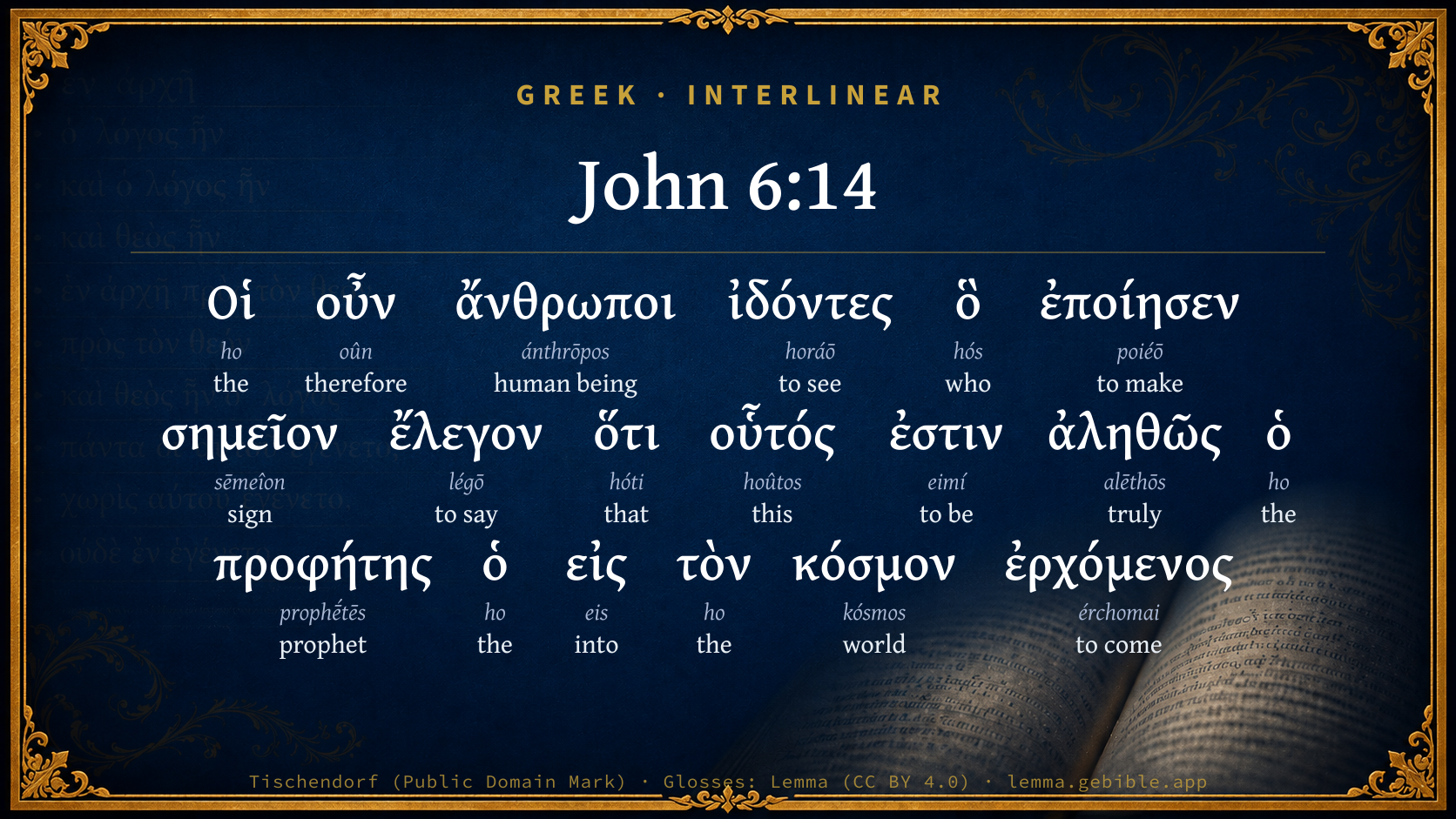
  1. Οἱ ho G3588 “the” Article, Nominative, Plural, Masculine
  2. οὖν oûn G3767 “therefore” Conjunction
  3. ἄνθρωποι ánthrōpos G444 “human being” Noun, Nominative, Plural, Masculine
  4. ἰδόντες horáō G3708 “to see” Verb, Aorist, Active, Participle, Nominative, Plural, Masculine
  5. ὃ hós G3739 “who” Relative pronoun, Accusative, Singular, Neuter
  6. ἐποίησεν poiéō G4160 “to make” Verb, Aorist, Active, Indicative, 3rd person, Singular
  7. σημεῖον sēmeîon G4592 “sign” Noun, Accusative, Singular, Neuter
  8. ἔλεγον légō G3004 “to say” Verb, Imperfect, Active, Indicative, 3rd person, Plural
  9. ὅτι hóti G3754 “that” Conjunction
  10. οὗτός hoûtos G3778 “this” Demonstrative pronoun, Nominative, Singular, Masculine
  11. ἐστιν eimí G1510 “to be” Verb, Present, Active, Indicative, 3rd person, Singular
  12. ὁ ho G3588 “the” Article, Nominative, Singular, Masculine
  13. προφήτης prophḗtēs G4396 “prophet” Noun, Nominative, Singular, Masculine
  14. ὁ ho G3588 “the” Article, Nominative, Singular, Masculine
  15. εἰς eis G1519 “into” Preposition
  16. τὸν ho G3588 “the” Article, Accusative, Singular, Masculine
  17. κόσμον kósmos G2889 “world” Noun, Accusative, Singular, Masculine
  18. ἐρχόμενος érchomai G2064 “to come” Verb, Present, Middle or Passive deponent, Participle, Nominative, Singular, Masculine

About this verse

These counts appear in no published source. They are computed here, from the morphology-tagged text and Lemma’s own curated glosses. What Lemma adds →

19
words
16
distinct lemmas
Gospels
section

Notable vocabulary

The rarest word here is ἀληθῶς truly G230 — appearing just 18 times in the whole Greek New Testament.

Shared distinctive vocabulary

ἀληθῶς truly G230 occurs in 18 verses of the Greek New Testament. Also found in:

Repetition

A word recurs within this verse:

Cross-references

13

Topical passages linked to John 6:14 in the Treasury of Scripture Knowledge — connected by theme and wording, ordered by reader-vote popularity; previews shown in the World English Bible.

  • Deuteronomy 18:15–18 Yahweh your God will raise up to you a prophet from the midst of you, of your brothers, like me; to him you shall listen;
  • Matthew 21:11 The multitudes said, "This is the prophet, Jesus, from Nazareth of Galilee."
  • Acts 7:37 This is that Moses, who said to the children of Israel, 'The Lord our God will raise up a prophet for you from among your brothers, like me.'
  • Matthew 11:3 and said to him, "Are you he who comes, or should we look for another?"
  • Genesis 49:10 The scepter will not depart from Judah, Nor the ruler's staff from between his feet, Until he comes to whom it belongs. To him will the obedience of the peoples be.
  • John 1:21 They asked him, "What then? Are you Elijah?" He said, "I am not." "Are you the Prophet?" He answered, "No."
  • John 7:40 Many of the multitude therefore, when they heard these words, said, "This is truly the prophet."
  • Acts 3:22–24 For Moses indeed said to the fathers, 'The Lord God will raise up a prophet for you from among your brothers, like me. You shall listen to him in all things whatever he says to you.
  • Luke 24:19 He said to them, "What things?" They said to him, "The things concerning Jesus, the Nazarene, who was a prophet mighty in deed and word before God and all the people;
  • John 4:19 The woman said to him, "Sir, I perceive that you are a prophet.
  • John 4:25 The woman said to him, "I know that Messiah comes," (he who is called Christ). "When he has come, he will declare to us all things."
  • John 4:42 They said to the woman, "Now we believe, not because of your speaking; for we have heard for ourselves, and know that this is indeed the Christ, the Savior of the world."
  • Luke 7:16 Fear took hold of all, and they glorified God, saying, "A great prophet has arisen among us!" and, "God has visited his people!"

Cross-references courtesy of OpenBible.info (CC BY 4.0).

Where the printed editions differ

1 variant

Places in this verse where the major printed Greek editions disagree on the wording in a way that affects the translation — a comparison of editions, not a manuscript-by-manuscript collation. The editions are the modern critical texts (Nestlé-Aland 28/27, SBL, Westcott-Hort, Tregelles, Tyndale House) and the traditional texts behind the KJV (the Textus Receptus and the Byzantine/Majority text). It is not a claim about which reading is original.

  1. Different wording
    σημεῖον

    “sign”

    In NA28NA27TynSBLTregTRByz Not in WH

    σημεῖα (sēmeia) 'signs' occurs in a few manuscripts (WH) instead of σημεῖον (sēmeion) 'sign' in older manuscripts (NA28+NA27+Tyn+SBL+Treg+TR+Byz)

Textual data: Translators Amalgamated Greek New Testament (STEPBible TAGNT) · CC BY 4.0.

Commentary

Notes on John 6:14 from classic Christian and Jewish commentators (each source and its license shown beneath its notes). The classic Christian expositions comment on the surrounding passage and are grouped to its opening verse, so a note may address several verses; the Jewish commentaries on the Tanakh (Rashi and others) are per-verse, so they appear only where the commentator wrote on this verse.

Lemma curates 59 commentaries, every one of them public domain or Creative Commons licensed, each selected and text-cleaned for this edition rather than reprinted as found. About our sources →

Jamieson, Fausset & Brown

Robert Jamieson, A. R. Fausset & David Brown

JESUS WALKS ON THE SEA. (Joh 6:14-21)

that prophet--(See on Joh 1:21).

Jamieson, Fausset & Brown — Commentary Critical and Explanatory on the Whole Bible (1871) — public domain (CC PDM 1.0). Text via the HelloAO Bible API.

The Biblical Illustrator

Joseph S. Exell

Joh_6:14-21

Then those men when they had seen the miracle

The sequel to the miracle

I.

THE EFFECT OF THE MIRACLE ON THE MIND OF THE MULTITUDE. They, like all Jews of the time, were expecting the Prophet like unto Moses. The Divine commission of Moses was authenticated by the miraculous manna; what then could this miracle mean but that He who worked it was the antitype of Moses. And then Moses had been king as well as prophet. Who could be better qualified for leader and commander of the people than Jesus: Time and place were both favourable for raising the standard of rebellion, and five thousand resolute hearts formed no mean nucleus of an army which would soon include every Jewish patriot. Measures, therefore, were taken to compel Christ to yield to their wishes.

1. In this incident we have an example of zeal without knowledge. Christ was indeed a King, but had they apprehended in what sense nothing would have been further from their wishes.

2. Zeal without knowledge must at all times be most injurious to the true interests of the cause of Christ.

II. THE PROCEDURE OF CHRIST (Joh_6:15).

1. He withdrew.

(1) To frustrate their purpose.

(2) To show that His kingdom was not of this world.

(3) To ascend a higher throne, not by popular election, but by the cross.

2. He withdrew to pray, thus indicating the nature of the glory He sought. He had much to plead for on behalf of the multitude on whom the miracle had been lost, and in behalf of His disciples who had more than half taken the infection. Lessons:

(1) Those who misuse Christ and His blessings must not wonder if they are deprived of His presence.

(2) Spiritual safety is closely connected with retirement from dangerous associations. Christ not only withdrew Himself but sent the disciples away Mat_14:22; Mar_6:45).

III. THE DANGER OF THE DISCIPLES (verses 17, 18).

1. Those who seek and find their delight in Christs presence know the bitterness of His absence. How often are Christs disciples tossed with tempests and constrained to hard and apparently fruitless service!

2. The Master is ever at hand when the storm is fiercest and where the labour is hardest.

IV. THE ADVENT OF CHRIST.

1. Aroused their fears.

2. Elicited their prayers.

3. Secured their safety.

4. Brought them safely to shore. (A. Beith, D. D.)

Three views of Christ

I. AMID THE MOUNTAINS (Joh_6:15).

1. A couch of repose after the physical exhaustion of the day.

2. A temple of prayer (Mat_14:23; Mar_6:46).

(1) For Himself that Be might resist the temptation He had just escaped as in the wilderness (Mat_4:8-10), and that He might be supplied with strength for the coming miracle.

(2) For the people who were as sheep without a shepherd.

(3) For the disciples gone on their perilous voyage.

3. A tower of observation of His disciples as now He watches us from heaven.

II. UPON THE SEA (Joh_6:19-20).

1. The mysterious apparition.

(1) What it was. Christ really walking on, not swimming in, the sea, not walking on the shore. There is no difficulty here to those who believe the previous miracle.

(2) Why it came. To proclaim Christ Lord as the Controller of nature, as the bread had proclaimed Him its Creator.

(3) When it appeared. Between three and six oclock in the morning when the rowers were at their wits end. So Christ interposes when our need is greatest (Amo_5:1).

(4) How it was regarded. With fear, as Christs unusual appearances often are.

2. The familiar voice.

(1) What it said (Joh_6:20). A note of assurance (Isa_43:2; Isa_54:11).

(2) How it acted. It dispelled their alarms.

III. IN THE BOAT (Joh_6:21).

1. The wind was hushed (Mat_14:32). To lull the souls hurricanes when Christ steps within (Joh_14:27).

2. The disciples were amazed (Mar_6:51), and led to worship Mat_14:33). Christs supremacy over nature unmistakably betokened His Divinity.

3. The voyage was completed.

Learn:

1. The dependence Jesus ever felt on prayer.

2. The notice Christ continues to take of His people.

3. The ability Christ possesses to help in the time of need.

4. The glory Christ shall yet bring to His people and to this material world.

5. The object of all Christs manifestations to lead men to recognize His Divinity. (T. Whitelaw, D. D.)

This is of a truth that Prophet

The distinguishing characteristics of Christ as a Teacher

I. THOSE WHICH CANNOT BE IMITATED.

1. His originality.

2. His miraculousness.

3. His authority.

II. THOSE WHICH MUST NOT BE IMITATED.

1. His positiveness.

2. His self-assurance.

3. His self-representation.

III. THOSE WHICH SHOULD BE IMITATED.

1. His naturalness.

2. His simplicity.

3. His variety.

4. His suggestiveness.

5. His definiteness.

6. His catholicity.

7. His spirituality.

8. His tenderness.

9. His faithfulness.

10. His consistency.

11. His devoutness. (W. H. Van Doren, D. D.)

The misinterpretation of the Divine sign by the perverseness of the carnal mind

They draw from the sign a correct conclusion (a true doctrine) and a false application (a bad moral). So with orthodox faith a false (ecclesiastical or secular) morality is often associated. (J. P. Lange, D. D.)

This is of a truth the prophet

1. They beheld in Jesus the fulfilment of prophecies fondly remembered, of hopes long deferred. The Law-giver who was to be a second Moses; the Deliverer who was to be a more mighty conqueror than Joshua; a King more glorious than David, wiser than Solomon, was come at last.

2. They who said so were not men learned in the Scriptures, like the Jewish scribes and rulers; book-learning, even of the highest sort, is apt to make those who have it slow in forming their judgments, backward and cold in declaring them. Nor were they men of the city, who might have gained some knowledge at second hand from those who had searched the Scriptures. But they were a crowd of rude, simple folk, come together from the hill country of Galilee, where old traditions had been handed down from age to age by word of mouth. With an instinct more true, more strong, than the opinions of the learned, they perceived that the bread which they received in such abundance could only have been supplied by God Himself, and that in Him who fed them thus God was revealed as clearly as when He spake by the profits to their forefathers.

3. Confessions of this kind, all the more impressive from their being artless and involuntary, are often to be met with in the four Gospels, and are just such as we might expect men would make on seeing of a sudden the supernatural power and wisdom of Christ (see Joh_1:49; Luk_5:8; Mar_15:39).

4. It is not to be supposed that the like effects should be wrought in us, who have heard and read a hundred times the record of these things. Miracles the most amazing, discourses the most persuasive, the heartrending tales of sufferings inconceivable, sound in our ears as old familiar truths; and familiarity too often leads to neglect, even though it may by no means breed contempt. They who live in sight of a beautiful landscape lose in some degree the perception of its loveliness. They would like to view it with fresh eyes; as the strangers do who come to visit them.

There is stealing over us a spirit of indifference, which for any saving purpose is as dangerous as the spirit of downright unbelief.

5. God does not suffer us to remain without a warning in this deadly stupor. Not by miracles, not by the visitation of angels, but in the course of His providence, by what we call the accidents of life, He arouses us and makes us see the Saviour as plainly revealed to our inward vision as He was to those men sitting on the grass and eating the bread which He gave them in the wilderness.

6. And what sort of things are they which bring us to see in His beauty and majesty that Saviour who hitherto has had no form or comeliness in our sight, so that we have even hid our faces from Him? Have we been led to look with abhorrence on one of our darling sins and yearn for the purity which once we had, and which we cannot of ourselves recover? And has a ray of comfort from Him been shed upon us, kindling a new hope in our breasts, making us embrace as a living truth what had become to us a dead form of words, that Jesus Christ came into the world to save sinners? Or has the heavenly ray reached you by another path? It is in love that thou art chastened, that the weight of thy affliction, which is but for a little moment, may gain thee the exceeding and eternal weight of glory. I have been the Man of sorrows, and now am at Gods right hand. I know thy afflictions, and even the glory here am touched with a feeling of them. But such is Gods law, equal for all; only through tribulation canst thou enter the kingdom here above. Have such consolations given a new turn to your thoughts, and thrown some light on the deep mystery of your life? If so, you might well exclaim, This is of a truth the Prophet that cometh--that Herald of life and joy, so greatly needed by the sons and daughters of affliction, so longed for by me, sorrow-stricken, sick at heart as I am! This is He, the Desire of all nations! And if, in any of these ways, the good impression has been made upon you, take care to keep it by giving good heed to it, and especially by often calling to mind the circumstances under which you first received it. Otherwise it will soon wear out like the stagnant pool of Bethesda, troubled for an instant by the angels wing. (W. W. G. HumphryG. Humphry, B. D.)

When Jesus therefore perceived that they would come and … make Him a King

Christ not a King by force

1. Some men have greatness thrust upon them. From all such Christ separates Himself, knowing that what is done by compulsion may by compulsion be undone. So He would not have a kingdom forced upon Him, nor would He be forced on a kingdom. Wonderful words are written on His royal banner: Put up thy sword, My kingdom is not of this world.

2. This is the second time that He declined a crown. It is not every man who has two such chances. Everything depends on how you get hold of your kingdom. If you have offered false worship for it, it will rot in your grip; if you have been forced on reluctant hearts, they will east you off in the spring tide of returning power.

3. There is something in this Man more than in any other man. The more His character is studied, the more independent we shall be of theological evidences. The grand claim of Christ to supremacy goes right up to the centre and necessity of things.

I. NOTHING HAS TO BE DONE IN THE KINGDOM OF HEAVEN BY VIOLENCE, by mere force. Did not Christ come to be a King? Yes. What matter then the way of becoming one? Everything. A man must prove his title to his seat, or he may be unseated.

1. It is not right to do right in a wrong way. It is right that you should come to church: it would be wrong to force you to come. The end does not sanctify the means.

2. Force is powerless in all high matters.

(1) You can force a man to kneel, to repeat devotional words while you stand over him sword in hand; but he defies you to make him pray.

(2) You can force a man to pay his debts, but you cannot make him honest. Honesty cannot be created by force, nor dishonesty be punished by it.

(3) You can compel a nation to build a church, but you cannot compel it to be religious. The very attempt to force a man to be religious destroys the temper which alone makes religion possible.

I. While all this is true on the human side, the real point to be considered is that JESUS CHRIST HIMSELF WOULD NEVER REIGN BY MERE FORCE. If you could force men to Christ, you could never force Christ to men. It is the Infinite that declines. Jesus reigns by the distinct consent of the human mind. If any man will open to Me, I will come in. Come unto Me all ye, etc.

III. If He will not be a King by force, BY WHAT MEANS WILL HE BECOME KING? 1, Preach Me, is one of His injunctions. Show My doctrine, purpose, spirit, throughout the world. That is a roundabout way, but the swing of the Divine astronomy is in it. It is not the thought of a common man.

2. Live Me: Let your light so shine, etc.; I have given you an example; Follow Me.

3. Lift Me up. If I be lifted up, etc.

(1) On the Cross of Atonement.

(2) By us when we love His law, submit to His bidding, reproduce His temper, receive with unquestioning heart all the gospel of His love.

IV. Now for the philosophical explanation of all this. WE LOVE HIM BECAUSE HE FIRST LOVED US. This Man lays hold of our entire love, and thereby secures an everlasting reign. The man who proceeded to capture human nature as this Man proceeded is presumably a true king. No adventurer could have acted as Jesus Christ.

1. Little child, Jesus would not have you forced to be good. He says, I am knocking at the door of your heart; let Me in.

2. He makes no proposition about going out.

3. The Church, like the Master, should not rule by force, but by love. (J. Parker, D. D.)

Secret prayer

Secret prayer feeds the soul as secret morsels feed the body; therefore it is said to be the banquet of grace, where the soul may solace itself with God, as Esther did with Ahasuerus at the banquet of wine, and have whatsoever heart can wish or need require. While the disciples were perilling and well-nigh perishing, Christ was praying for them; so He is still for us at the right hand of the Majesty on high. (J. Trapp.)

Jesus on the mountain above the political designs of men

He alone.

I. He alone THE FREE ONE who is more a King than any prince on earth.

II. He alone THE CLEAR-SIGHTED ONE, who sees above all craftiness of policy.

III. He alone THE SILENT BUT DECISIVE DISPOSER OF ALL THINGS. (Lange.)

The kingship of Christ

Like Joseph our Lord suffered for the sin He so carefully avoided. The charge of claiming to be King was brought up against Him at His trial. Yet while shunning the bauble of an earthly sceptre, He was King of kings, and will for ever wear many crowns. To make Him King was of the Father, not of poor mortals. How low their ideas of Messiahs kingdom! What had loaves and fishes multiplied to do with Thy throne, O God, is for ever and ever? (W. H. Van Doren, D. D.)

And when even was now come His disciples went down unto the sea and entered into a ship, and went over the sea toward Capernaum

A night upon the deep

I. OF DISAPPOINTED HOPE.

II. OF UNSUCCESSFUL EFFORT.

III. OF DEEPENING ALARM.

IV. OF DIVINE MANIFESTATION.

V. OF SUPERNATURAL DELIVERANCE. (T. Whitelaw, D,D.)

Jesus absent in darkness

It is sometimes worth while to try to meet the mournful and worried state of mind in tile churches, when the good are longing, and perhaps waiting, for a revival of religion to come.

I. THE PICTURE. In the course of description of the scene on Lake Genesaret, it will not be difficult to suggest these points:

1. The close and rather humiliating connection between wistful souls and weary bodies.

2. The disheartening result of a rapid transition from exhilarating crowds to unromantic and lonely labour.

3. The feeling of desertion when, perhaps, Jesus is praying for us all the time.

4. Desolate frames of feeling give no release from diligent duty. Our question now is, What did those disciples do?

II. THE LESSON.

1. They kept on rowing. That is, they did precisely what they would have done if Jesus had arrived.

2. They headed the boat for Capernaum. That was what He bade them do Mat_14:22).

3. They bailed out the water if any rushed into the boat. All the worldliness in the worlds sea cannot sink Christs Church, if only the waves are kept on the outside of it.

4. They strained their eyes in every direction for the least sign of Christs coming.

5. They cheered each other. (C. S. Robinson.)

The absent Christ

It is always dark until Jesus comes to us, or until we go to Jesus. This is the case with

I. THE AWAKENED SINNER who, in contact with Jesus, passes from darkness into light.

II. THE DESPONDING CHRISTIAN (Psa_43:1-5; Psa_51:1-19; Psa_130:1-8.).

III. THE AFFLICTED CHRISTIAN.

IV. THE BEREAVED. If Thou hadst been here our brother had not died. But when He comes He is the Resurrection and the Life. (W. M. Taylor, D. D.)

Christians in darkness when Christ is not near

I. CHRISTS THOUGHTS ABOUT HIS DISCIPLES.

1. He leaves men for a time in fear and danger.

(1) After the fall the whole world was thus left till Christ came in the flesh.

(2) After the Incarnation He remained thirty years in obscurity. He remained far distant from Bethany till Lazarus was dead. He fingered on the mountain while His disciples were struggling with the storm.

(3) At this day His people wonder at His absence, and exclaim, Thou art a God that hidest Thyself.

2. His delay is no proof of His neglect. His delights were with the children of men before His abode was among them. When absent from Lazarus His heart was full of a brothers love. Here His purpose was to allow their extremity to become His opportunity. So when He left the world it was that the Comforter might come. And now it is only love that detains Him within the veil.

3. Never, and nowhere, do they who wait on the Lord wait in vain. To weary watchers the time seemed long but the coming was sure. Faithful is He that promised. He that keepeth Israel shall not slumber.

II. THE DISCIPLES THOUGHTS ABOUT CHRIST.

1. It was a matter of the heart. In knowledge they were children; and like children, too, in single-eyed, confiding love. Afterwards they became more enlightened. But their first love was not weaker than their last.

2. Observe how this child-like love operates in time of trial.

(1) The waters were permitted to swell and frighten the children, although their Elder Brother held those waters in the hollow of His hand. But these true men would neither be bold in the absence of their Lord, nor faint in fear when He was at their side.

(2) The storm and darkness made their hearts quiver, and all the more surely did these hearts turn and point toward the mountain-top when Jesus, the Daysman, stood laying His hand upon God.

(3) But these dangers though great were material and temporal; whereas the dangers which induce us to seek a Saviour are our own sin, and the wages that it wins. But these burdens will make you doubly welcome.

(4) The example of these Galileans is shown here as in a glass, that every mourner may thereby be encouraged to long for the presence of the Lord Psa_50:15).

(5) Love to Christ in a human heart, kindled by Christs love to man and laying hold of the love that lighted it, is the one thing needed. (W. Arnot, D. D.)

Christ, though absent, has not deserted us

Jesus was absent all the while. He leaveth them, as it were, in the suburbs of hell. Howbeit as the eagle when she flieth highest of all from the nest doth ever cast a jealous eye upon her young, so doth this heavenly eagle. (J. Trapp.)

Night with Jesus

1. It was night, The disciples were alone, which made it double night.

2. It was night at sea. To be without Jesus in the day and on land was sad, but this was sadder.

3. It was a night of toil: rowing four miles in the teeth of the wind; and Christs absence made their labour doubly hard.

4. It was a night of danger. The storm had broken loose and there was no Jesus. Let us look at these works in their more general aspect in relation to the Saint and to the Church.

I. NIGHT.

1. The sinners history is one long starless night.

2. The saint has his night, too, of sorrow, bereavement, and pain.

3. The Church, too, has her night--poverty, persecution, desertion. There shall be no night there, but there is night now.

II. NIGHT WITHOUT JESUS.

1. The sinners night is altogether without Him.

2. The saint has night when Jesus seems distant. Without Him altogether we cannot be--Lo, I am with you always. But there are times when He is not realized; and the issue of these is to bring Him nearer.

III. NIGHT WITH JESUS. With Him the darkness is as the light. For having Him we have

1. Companionship.

2. Protection.

3. Safety.

4. Comfort.

5. Strength.

6. Assurance of the coming day.

IV. DAY WITH JESUS. He does not say, Let Me go, for the day breaketh. And if His presence has made the night pleasant, what will not that presence make the coming day! (H. Bonar, D. D.)

They see Jesus walking on the sea

Does He not always walk upon it? Is not His majestic tread on the Galilean waters typical

I. OF HIS MARCH ALONG THE AGES? No figure seems more literal than that by which we speak of the waves, the current, the sea of time. How constantly is the lapse of years, obliterating races, memorials, great names, the dykes set up by arms, laws, industries and enterprise. Of the civilized nations now on earth but one in Christs time had a name or a place except the Jews. The languages then spoken are now dead. The manners and religions have passed away. Meanwhile, Jesus has walked upon the waves. The gospel has never been submerged or been less than the one shaping, controlling power.

1. At the outset fierce and bitter persecution assailed Christianity, but from beneath the heel of the Caesars it mounted their throne.

2. Then commenced the severer trial of corrupting prosperity; and still its ordinances, doctrines, and influence could not be wholly corrupted.

3. Invading races threatened to destroy it, but yielded to it.

4. During the dark ages it gave birth to noble charities, home life, etc.

5. In these latter ages how many and powerful have been the assailing forces, scientific and infidel; but no sooner has any fountain of knowledge become deep and clear than it has invited His tread and rolled tributary waves to His feet.

6. And lo! as centuries roll on His circuit widens. His steps lay hold on the ends of the earth and the islands of the sea.

II. OF HIS WAY IN THE HEART OF MAN.

1. How fierce the waves that threaten our peace and well being! Passion, appetite, lust, pride, desire, fear. What power but Christs can walk these waves? But let Him enter and these billows know their Lord.

2. What miracles of mercy has He not wrought in these subject souls!

(1) Here was intemperance or lust. No love could stem the torrent; but Christ entered and appetite was quelled and all is now pure and peaceful.

(2) In that spirit passion raged; Christ entered and vengeance has given place to love and forgiveness.

3. In every soul into which He enters, He walks as sovereign. The forces of character mould themselves at His command.

III. OF HIS PATHS AS HERALD AND GUIDE TO THE LIFE ETERNAL. (A. P. Peabody, LL. D.)

Christ in the night storm

I. Many of my hearers may be just now in a FEARFUL NIGHT-STORM OF TROUBLE.

1. One is in the darkness of a mysterious providence.

2. Another is under a tempest of commercial disaster. He has lost the rigging of his prosperity; and his pride has come down as a top-sail comes down in a hurricane.

3. Another one is toiling with the oars against a head-sea of poverty.

4. The guiding rudder of a dear and trusted friend has been swept away by death.

5. Still another one is in a midnight of spiritual despondency, and the promise-stars seem to be all shut out under gloomy clouds. My friend A--is making a hard voyage, with her brood of fatherless children to provide for. Friend B--has a poor intemperate husband on board with her; and Brother C--s little bark hardly rises out of one wave of disaster before another sweeps over it. There are whole boat-loads of disciples who are toiling at rowing over a dark sea of trouble.

II. THE HOUR OF THE CHRISTIANS EXTREMITY IS THE HOUR OF CHRISTS OPPORTUNITY. At the right moment Christ makes His appearance. We do not wonder at the disciples astonishment and alarm. But straightway Jesus speaks unto them, and in an instant their fears vanished and the wind ceased. Now, good friends, who are breasting a midnight sea of trouble, open the eye of faith, and see that Form on the waves! It is not an apparition; it is not a fiction of priestly fancies. It is Jesus Himself! One who has been tried on all points as we are, and yet without sin. Christ comes to you as a sympathizing, cheering, consoling Saviour. His sweet assurance is, Lo! I am with you. Fear not; I have redeemed thee. Receive Him into the ship. No vessel can sink or founder with Jesus on board. Let the storms rage, if God sends them. Christ can pilot you through. It is I! There may be a night coming soon on some of you, when heart and flesh shall fail you, and the only shore ahead is the shore of eternity. If Jesus is only in the bark, be not afraid. Like glorious John Wesley, you will be able to cry aloud in the dying hour, The best of all is, God is with us!

III. THE TEACHINGS OF THIS INSPIRING SCENE TO THOSE WHO ARE IN A MID-SEA OF CONVICTIONS OF SIN AND TROUBLINGS OF CONSCIENCE. The storm of Divine threatenings against sin is breaking upon you. You acknowledge that you are guilty. Alarming passages from Gods Word foam up around your distressed and anxious soul. You cannot quell this storm, or escape out of it. Toiling at the oars of self-righteousness has not sent you a furlong nearer to the desired haven. You have found by sore experience that sin gives no rest, and that your oars are no match against Gods just and broken law. Friend! Listen! There is a voice that comes sounding through the storm. Hearken to it! It is a voice of infinite love, It is I! Whosoever believeth in Me shall not perish, but shall have everlasting life. If you will only admit this waiting, willing, loving Jesus into your tempest-tossed soul, the wind will cease. Christ can allay the storm. Receive Him. Do all He asks, surrender the helm to Him, and you can then feel as the rescued disciples did when they knelt down in the drenched bottom of their little boat, and cried out, Truly this is the Son of God! (T. L. Cuyler, D. D.)

It is I, be not afraid

The Lords voice to His people

I. PROCLAIMING HIS PRESENCE.

1. In unexpected places.

2. At unwonted times.

3. In unfamiliar forms.

II. DISPELLING FEAR

1. Of danger.

2. Of death.

3. Of evil. (T. Whitelaw, D. D.)

The recognition of Christ in the hour of death

The recognition of Christ coming to help and comfort in the hour of severest trial is ever the Christians privilege. If he see Him not in the storm, he must look again and again, for he has but failed to recognize Him. This truth we would apply only to that last fearful storm which wrecks the bark in which the soul has been crossing the sea of life.

I. TO RECOGNIZE HIM WE MUST EXPECT HIM.

1. He has promised to be there. Lo, I am with you alway. When thou passeth through the waters, I will be with thee.

2. He who has given His life for us will not fail us in that most trying moment.

II. BY WHAT SIGNS MAY THE CHRISTIAN KNOW HIM?

1. The Christian soul knows Him by His visage. Infinite love breaks through every disguise when viewed by the soul fitted to recognize it.

2. Knows Him because He announces Himself: It is I, be not afraid.

3. Knows Him because of the calm that comes with Him. Conclusion: Martyrs and Christians in all ages have borne testimony to the recognition of Christ in the last hour of life. (Homiletic Monthly.)

The symbolism of the voyage

A believer must have on the sea of life, Patience for his tackling, Hope for his anchor, Faith for his helm, the Bible for his chart, Christ for his captain, the breath of the Spirit to fill his canvas. (J. Trapp.)

Afraid of Christ

Of Him in whom was laid up all their comfort. How oft are we mistaken and befooled by our fears! (J. Trapp.)

Timely comfort

He waits to be gracious. Our extremity is His opportunity. God brings His people to the mount, with Abraham, yea, to the very brow of the hill, till their feet slip, and then delivers them. When all is given up for lost then comes He in, as oil of an engine. (J. Trapp.)

The storm on the lake

My experience in this region enabled me to sympathize with the disciples in their long nights contest with the wind. I have seen the face of the lake like a huge boiling cauldron. The wind howled down the valleys from the north-east and east with such fury that no efforts of rowers could have brought a boat to shore at any point along that coast. To understand the cause of these sudden and violent tempests we must remember the lake lies low--six hundred feet lower than the ocean--that water-courses have cut out profound ravines and wild gorges, converging to the head of the lake, and that these act like gigantic funnels to draw down the cold winds from the mountains. On the occasion referred to we pitched our tents on the shore, and remained for three days and nights exposed to this tremendous wind. We had to double-pin all the tent ropes, and frequently were obliged to hang with our whole weight upon them, to keep the quivering tabernacle from being carried up bodily into the air. No wonder the disciples toiled and rowed hard all that night. (W. M.Thomson, D. D.)

The disciples and their absent Master

I have observed that a shipmaster, especially when the presence of currents and the proximity of land make his burden heavy, shakes the compass sharply, and then watches the point on which the quivering needle finally settles down. The shaking makes the master more sure that the needle points truly to its pole. In those days the magnet was not known. No trembling compass on the deck that night told the steersman how to hold his helm, after the mountains had disappeared in night; but an instrument more mysterious and equally true within those simple seamen had once been touched by divine, forgiving mercy, and pointed steadfastly now to the Source of saving power. (W. Arnot, D. D.)

The pathway of the King

I. THE STRUGGLING TOILERS. Is it not the history of the Church in a nutshell? Is it not the symbol of life for us all? The solemn law under which we live demands persistent effort, and imposes continual antagonism upon us; there is no reason why we should regard that as evil, or think ourselves hardly used, because we are not fair-weather sailors. The end of life is to make men,; the meaning of all events is to mould character. Anything that makes me stronger is a blessing, anything that develops my morale is the highest good that can come to me. And so be thankful if, when the boat is crossing the mouth of some glen that opens upon the lake, a sudden gust smites the sheets and sends you to the helm, and takes all your effort to keep you from sinking. Do not murmur, or think that Gods Providence is strange, because many and many a time when it is dark, and Jesus is not yet come to us, the storm of wind comes down upon the lake and threatens to drive us from our course. Let us rather recognize Him as the Lord who, in love and kindness, sends all the different kinds of weather which according to the old proverb, makes up the full summed year. The solitary crew were not so solitary as they thought. That little dancing speck on the waters which held so much blind love, and so much fear and trouble, was in His sight, as on the calm mountain-top He communed with God. No wonder that weary hearts and lonely ones, groping amidst the darkness, and fighting with the tempests and the sorrows of life, have ever found in our story a symbol that comes to them with a prophecy of hope and an assurance of help, and have rejoiced to know that they on the sea are beheld of the Christ in the sky, and that the darkness hideth not from His loving eye.

II. THE APPROACHING CHRIST. If we look for a moment at the miraculous fact, apart from the symbolism, we have a revelation here of Christ as the Lord of the material universe, a kingdom wider in its range and profounder in its authority than that which that shouting crowd had sought to force upon Him. His will consolidates the yielding wave, or sustains His material body on the tossing surges. Two lessons may be drawn from this. One is that in His marvellous providence Christ uses all the tumults and unrest, the opposition and tempests which surround the ship that bears His followers as the means of achieving His purposes. We stand before a mystery to which we have no key when we think of these two certain facts; first, the Omnipotent redeeming will of God in Christ; and, second, the human antagonism which is able to rear itself against that. And we stand in the presence of another mystery, most blessed, and yet which we cannot unthread, when we think, as we most assuredly may, that in some mysterious fashion, He works His purposes by the very antagonism to His purposes, making even head-winds fill the sails, and planting His foot on the white crests of the angry and changeful billows. How often in the worlds history has this scene repeated itself, and by a Divine irony the enemies become the helpers of Christs cause, and what they plotted for destruction turned out rather to the furtherance of the gospel. Another lesson for our individual lives is this, that Christ, in His sweetness and His gentle sustaining help, comes near to us all across the sea of sorrow and trouble. A sweeter, a more gracious sense of His nearness to us, is ever granted to us in the time of our darkness and our grief than is possible to us in the sunny hours of joy. It is always the stormy sea that Christ comes across, to draw near to us; and they who have never experienced the tempest have yet to learn the inmost sweetness of His presence. Sorrow brings Him near to us. Do you see that sorrow does not drive you away from Him.

III. THE TERROR AND THE RECOGNITION. I do not dwell upon the fact that the average man, if he fancies that anything from out of the Unseen is near him, shrinks in fear. I do not ask you whether that is not a sign, and indication of the deep conviction that lies in mens souls, of a discord between themselves and the unseen world; but I ask you if we do not often mistake the coming Master, and tremble before Him when we ought to be glad? Let no absorption in cares and duties, let no unchildlike murmurings, let no selfish abandonment to sorrow, blind you to the Lord that always comes near troubled hearts, if they will only look and see. Let no reluctance to entertain religious ideas, no fear of contact with the Unseen, no shrinking from the thought of Christ as a Kill-joy keep you from seeing Him as He draws near to you in your troubles. And let no sly, mocking Mephistopheles of doubt, nor any poisonous air, blowing off the foul and stagnant marshes of present materialism, make you fancy that the living Reality, treading on the flood there, is a dream or a fancy or the projection of your own imagination on to the void of space. He is real, whatever may be phenomenal and surface. The storm is not so real as the Christ, the waves not so substantial as He who stands upon them. They will pass and melt, He will abide for ever. Lift up your hearts, and be glad, because the Lord comes to you across the waters. And hearken to His voice: It is I! Be not afraid. The encouragement not to fear follows the proclamation, It is I! What a thrill of glad confidence must have poured itself into their hearts, when once they rose to the height of that wondrous fact I There is no fear in the consciousness of His presence. It is His old word, Be not afraid. And He breathes it whithersoever He comes; for His coming is the banishment of danger and the exorcism of dread.

IV. THE END OF THE TEMPEST AND OF THE VOYAGE. It is not always true, it is very seldom true, that when Christ comes on board opposition ends, and the purpose is achieved. But it is always true that when Christ comes on board a new spirit comes into the men who have Him for their companion, and are conscious that they have. It makes their work easy, and makes them more than conquerors over what yet remains. With what a different spirit the weary men would bend their backs to the oars once more when they had the Master on board, and with what a different spirit you and I will set ourselves to our work if we are sure of His presence. The worst of trouble is gone when Christ shares it with us. Friends! Life is a voyage, anyhow, with plenty of storm, and danger, and difficulty, and weariness, and exposure, and anxiety, and dread, and sorrow, for every soul of man. But if you will take Christ on board it will be a very different thing from what it will be if you cross the wan waters alone. Without Him you will make shipwreck of yourselves; with Him your voyage may be as perilous and lonely as that of that poor Shetland woman in the Columbine a month ago, but He will take care of you, and you will be guided on shore, on the one little bit of beach where all the rest is iron-bound rocks, on which whoever smites will be shattered to pieces. Then are they glad … where they would be. (A. Maclaren, D. D.)

The Biblical Illustrator, edited by Joseph S. Exell (c. 1880s–1900s) — public domain. Text from a community e-Sword module.

Lange's Commentary on the Holy Scriptures

2. The Miraculous Withdrawal Over The Sea

Joh_6:14-21

EXEGETICAL AND CRITICAL

See the parallels in Mat_14:22-33; and Mar_6:45-56. [Omitted by Luke. Alford: “An important and interesting question arises, Why is this miracle here inserted by St. John? That he ever inserts for the mere purpose of narration, I cannot believe. The reason seems to me to be this: to give to the Twelve, in the prospect of so apparently strange a discourse respecting His Body, a view of the truth respecting that Body, that it and the things said of it were not to be understood in a gross corporeal, but in a supernatural and spiritual sense. And their very terror and reassurance, tended to impress that confidence in Him which kept them firm, when many left Him, Joh_6:66.”—P. S.]

Joh_6:14. The Prophet that is to come.—This denotes here not the fore-runner, but the Messiah, referring to Deu_18:15; as is proved (1) by the addition: “that should come into the world;” (2) by the inclination to make Him a king.

Joh_6:15. Take him by force.—Carry Him forcibly into their circle, and conduct Him in triumph—in order to make Him a king; as festival pilgrims, lead Him to Zion in triumphal procession. The arbitrary, confused, and premature idea of the subsequent triumphal entry.

He withdrew again into the mountain. The πάλιν denotes not only return to the mountain, but also a second withdrawal of Himself from the pressure of the people. He sought solitude, to escape the people; but this of course does not exclude His sanctifying the solitude by prayer.

Joh_6:16. And when evening came.—It would not appear from Joh_6:17, but it certainly does from the parallels, that this was the “second evening,” i.e., the later even-tide, from the decline of the day till night.

Joh_6:17. Having entered a ship.—The ἐμβάντες before ἤρχοντο is hardly intended to repeat once more that they had already gone to sea which had been said in Joh_6:16, but to express that, after embarking, they took an involuntary course, driven by a fearful storm. See Com. on Matthew and Mark on the passage. According to Mark the disciples were to go before the Lord in the direction of Bethsaida. This must mean the eastern Bethsaida, not the western, because the return itself was to Capernaum; therefore a coast-wise passage northerly is intended. Christ wished to embark in a solitary place, unseen by the people. The storm intervened; the disciples were driven out into the midst of the sea. Then Jesus came to them on the sea; i.e., He met them as a helper in their distress under a contrary wind; not merely went after them as they were driving with a favorable wind. [Dr. Thomson (The Land and the Book, 2 p. 30) maintains, in opposition to the usual view, that there was but one Bethsaida, and that it was situated at the entrance of the Jordan into the lake, a few miles north-east of Tell Hûm, the supposed present site of Capernaum. The disciples would naturally sail from the southeast toward Bethsaida in order to reach Capernaum.—P. S.]

And Jesus had not yet come to them.—As the disciples were not expecting Jesus to walk on the sea, the “yet” has been found troublesome, and has been dropped. But the sentence means: They had not yet been able to take up Jesus according to the original plan of the voyage. [See Text. Notes.]

Joh_6:18. And the sea began to rise.—An explanation of their misfortune. We repeat: A violent gale, by which they would have come immediately twenty or thirty furlongs westward, could not have been to them a contrary wind, if they had intended to go westward without Jesus.

Joh_6:19. Five and twenty or thirty furlongs.—The lake was forty stadii wide (Joseph. De Bell. Jud. III., 10, 11).48 The indefinite measure is very graphic; it reflects the situation: Darkness and an angry sea, in which accurate measurement of distance was impossible at the time. Matthew says “the midst” of the sea, Joh_14:24; denoting, however, an earlier moment, when Jesus was still on the shore. John marks the later moment, at which the disciples saw the Lord. The στάδιον is a Greek measure (Luther: Feldweg, furlong). Eight stadia made a Roman mile. A stadium is the fortieth part of a geographical or German mile [a little less than an eighth of an English mile, and nearly equal to the English furlong; so that the twenty-five or thirty stadia would come between three and four miles.—E. D. Y.]. Of the full two leagues’ breadth of the lake the ship had therefore already passed a league and a quarter or a league and a half.

They behold Jesus.—Graphic present. And they ware afraid.—Moderate expression of a powerful feeling. Compare the synoptical Evangelists. So little had they expected His coming to them in this way.

Joh_6:21. Then they desired to receive him.—They still desired to take Him into the ship; that is, they still stood to their purpose. In the effort to take up the Lord on the eastern shore, the ship had already gone nearly to the western. The Evangelist finds it superfluous to state that the Lord now embarked, and sailed the small remaining distance with the disciples. He likewise passes over the falling of the wind.

According to the usual view of the event, in which Jesus went after the disciples, instead of meeting them, the expression of John is very hard to be explained. And here again Meyer (after the example of Lücke and De Wette) brings out a collision with the synoptical Evangelists. “They wished to take Him into the ship, and immediately (before they carried out the ἐθέλειν) the ship was at the land.” He seems even to introduce here a wondrous agency of Jesus bringing the ship immediately to land, notwithstanding its distance of five or ten stadia and the “surging ” of the sea. “An unfortunate attempt at harmony [it is then said by Meyer, p. 255, 5th ed.]: They willingly received Him (Beza, Grotius, Kuinoel, Ammon, and many others; see against it Winer, p. 436); which is not helped by the assumed antithesis of a previous unwillingness (Ebrard, Tholuck).” The sentence says simply this: They were still occupied with the effort to take Him up on the eastern coast, when by this miraculous intervention of Christ they at once reached the western side.

The ὑπῆγον, in the versions and expositions, to a great extent fails of its full force. It often denotes a secret, skilful or mysterious removal, escape, or disappearance. And so especially here, where the Lord was put upon extreme deliberation, and could properly use a miracle to rid Him of the multitude. If they still followed Him in spite of all, we must consider that certainly all could not follow Him in the boats which had come from Tiberias, and that Christ still found it necessary in the synagogue at Capernaum to put off the people by meeting them sternly and with the boldest declarations.

DOCTRINAL AND ETHICAL

1. The culmination of the enthusiasm of the Galilean populace for Jesus is here brought out, and by John alone, with great distinctness. The great popular mass, a host of five thousand chiliastically excited men, would violently lift a Messianic standard with Him and for Him. But because Jesus cannot yield Himself to this project, the culmination of their enthusiasm is at the same time its turning-point.

2. In respect to the miracle of Christ’s walking on the sea; compare the Com. on Matthew and Mark.

HOMILETICAL AND PRACTICAL

The misinterpretation of the divine sign of Christ by the perverseness of earthly-minded men.—They draw from the sign a correct conclusion (a true doctrine) and a false application (a false moral).—So with orthodox faith a false (ecclesiastical or secular) morality is often associated.—The flight of Jesus before the revolutionary design of the people: It occasions (1) His retiring in solitude to the mountain; (2) His sending the disciples before Him with the ship; (3) His hastening in the night, ghostlike, over the sea.—Jesus on the mountain above the political designs of men; He alone: 1. He alone the free One, who is more a king than any prince of earth. 2. He alone the clear-sighted One, who sees far above all craftiness of policy. 3. He alone the silent but decisive Disposer of all things.—The flight from the sedition and tumult: 1. The flight of Christianity (Christ). 2. The flight of the Church (the ship).—The disciples in the ship, driven from east to west, a foreshadowing of the fortunes of the church.—The miracle of the walking on the sea, as to its holy motives: Occasioned (1) by a holy flight; (2) by a holy solicitude.—Christ’s superiority to nature.—Christ the sea-king (He, not Mary, the true Stella Maris).—Christ as master of the water—the helper in perils of the sea (not the holy Nepomuc).—Christ the helper in perils of water and of fire.—While they were wishing to take Him up on the eastern shore, they were ready to land on the western.—The hour when the Church becomes perfectly joyful in the presence of her Lord in this world, is the hour when she lands on the shore of the other.—How the Lord suddenly puts an end to the reverses of His people.—Every new necessity of the Christian, a new revelation of the glory of Christ. Every new necessity of man, a new revelation of the miraculous help of God.—Perils of the night; perils of storm; perils of the sea. Sufferings from night, from storm, and from sea; Christ, the Deliverer.

Starke: God’s wonders among them that go down to the sea in ships. Psa_107:23.—Pro_30:19.—Wis_14:3.—Be not troubled when thou must journey from one place to another, etc. The goal is all rest.—Comest thou into a dark night of tribulation, etc.: Jesus is there.—The perils of one’s calling.—Good fortune is followed again by ill; but to believers all is for the best.—Canstein: Christ lets His people come almost to extremity, but then loses not a moment. —In our troubles we commonly set God before us in a different character from the true; as an object of terror.—Zeisius: What a mighty hero is thy Saviour and mine!—Quesnel: Christ’s word and presence make everything good and tranquil again.—Cramer: Christ has more ways of helping than one.—Zeisius: Thus the saints come through great storms and trouble to the haven of eternal peace and safety.—Gossner: When Christ is in the ship, the ship receives more help from Him than He from it. So is everything which we call the service of God more profitable to the servant than to the Lord whom he serves.—Heubner: Distance, mountain, and sea cannot separate Him from His.—Schleiermacher: We see here at first a certain dependence on an immediate and bodily presence, which is always united with a certain want of faith in the spiritual, and of a sense of spiritual power and agency.—Schenkel: How do we stand towards Christ? (1) So as to have Him flee from us? (2) Or so as to have Him come to us?

[Wordsworth: Joh_6:20. “I am (Ἐγώ εἰμι), the Ever-living One, Jehovah, the Author of Life. I am always at hand and never pass by you, therefore be not afraid, but trust in Me. Our Lord allows us to be in trial and danger, to struggle in the storm, to endure for a long time, in order that our patience and perseverance and faith may be proved, and that we may resort to Him who alone can save us. We are often in darkness and in storms, and the devil and evil men assail and affright us: but let us listen to Christ’s voice, Ἐγέ εἰμι, μὴ φοβεῖσθε, and when human help fails, then divine aid will come. Terrors pass by, but Christ never passes by. He ever says, ‘It is I.’ I am He who always am, who ever remain; therefore have faith in Me. And if we are rowing in the Apostolic Ship of the Church, doing our duty there in our respective callings, and if we desire to receive Christ into the Ship, He will not only quell the storm, but give us a fair breeze, and we shall soon be at the harbor where we would be—the calm harbor of heavenly peace. They who are in the Ship, and are rowing in the storm; they who labor in the Church, and continue in good works to the end, will receive Christ, and will at length arrive at the waveless haven of everlasting life.”—A fine Greek poem of Anatolius on Christ in the tempest, translated by J. M. Neale: “Fierce was the wild billow” (see Schaff’s Christ in Song, p. 451).—P. S.]

Footnotes:

[48][According to Robinson, the lake is about twelve English miles long, and five or six broad.—P. S.]

Lange's Commentary on the Holy Scriptures (Critical, Doctrinal, and Homiletical), ed. John Peter Lange, English translation edited by Philip Schaff (1864–1880) — public domain. Text from a community e-Sword module.

Tyndale Open Study Notes

Tyndale Open Resources

6:14 he is the Prophet we have been expecting! The crowd understood the miracle as a fulfillment of Old Testament promises (see Deut 18:15, 18; Mal 4:5-6).

Tyndale Open Study Notes — © Tyndale Open Resources, licensed CC BY-SA 4.0. Text via the HelloAO Bible API.

Bengel's Gnomon

Johann Albrecht Bengel

Joh 6:14. Σημεῖον—ὁ προφήτης, miracle—the Prophet) Ch. Joh 3:2, [Nicodemus to Jesus] “No man can do these miracles that Thou doest, except God be with him;” Joh 9:17, [The restored blind man to the Jews] “He is a prophet.”

Bengel's Gnomon of the New Testament — English translation (T&T Clark, Edinburgh, 1860) — public domain. Text from a community e-Sword module.

Meyer's Critical & Exegetical Commentary

Heinrich August Wilhelm Meyer

Joh_6:14-15. Ὁ προφήτης, κ.τ.λ.] the Prophet who (according to the promise in Deu_18:15) cometh into the world, i.e. the Messiah.

ἁρπάζειν] come and carry Him away by force (Act_8:39; 2Co_12:2; 1Th_4:17), i.e. to Jerusalem, as the seat of the theocracy, whither they were journeying to the feast.

πάλιν] comp. Joh_6:3. He had come down from the mountain on account of the feeding, Joh_6:11.

αὐτὸς μόνος] as in Joh_12:24. See Toup. ad Longin. p. 526; Weisk.; Heind. ad Charm, p. 62.

The enthusiasm, of the people being of so sensuous a kind, does not contradict Joh_6:26.

The solitude which Jesus sought was, according to Mat_14:23, Mar_6:46, that of prayer, and this does not contradict Johns account; both accounts supplement each other.

Meyer — Critical and Exegetical Commentary on the New Testament — English translation by Peter Christie, edited by Frederick Crombie (T&T Clark, 1880) — public domain. Text from a community e-Sword module.

Expositor's Greek Testament

ed. W. Robertson Nicoll

Joh 6:14-25 . The immediate impression made by the miracle and the consequent movements of Jesus and the crowd .

Joh 6:14 . The conclusion drawn from the miracle by those who had witnessed it, was that this was “the beginning of that reign of earthly abundance, which the prophets were thought to have foretold”. See Lightfoot, Hor. Heb. , 552. This at once found expression in the words οὗτός ἐστιν … κόσμον . “This is indeed,” or “of a truth,” as if the subject had been previously debated by them, or as if some had told them He was “the prophet who should come into the world,” ὁ ἐρχόμενος , used of the Messiah by the Baptist (Mat 11:3 ) without further specification; but John adds his favourite expression εἰς τὸν κόσμον . That the people meant the Messiah ( cf. Deu 18:14-19 ) is shown by the action they were prepared to take.

The Expositor's Greek Testament, edited by W. Robertson Nicoll (1897–1910) — public domain. Text from a community e-Sword module.

Godet's Commentaries

Frédéric Louis Godet

Vv. 14, 15. “The people therefore, having seen the miracle which He did, said: This is of a truth the prophet that should come into the world. 15. Jesus therefore, knowing that they were about to come and take Him by force to make Him King, withdrew again into the mountain Himself alone.”

Here is the beginning of the crisis of which we are to see the development even to the end of the chapter. A selection among the adherents of Jesus becomes necessary to purify His work from all political alloy. Jesus had received this multitude with open arms; He had made a feast for them. It was an emblem of that feast which He was procuring for them in a higher realm. By thus giving His bread, He had symbolized that gift of Himself which He had just made to mankind.

But instead of rising to the hope and desire of such a spiritual banquet, the Galileans occupy their thoughts only with the material miracle, and in their exalted state see in it already the inauguration of a Messianic Kingdom such as they picture to themselves. This is what is expressed by the connection of the participle having seen, seen with their eyes, with the verb ἔλεγον, they said. This exalted state, altogether carnal it is true, is the indisputable proof of what was absolutely extraordinary in that which had just now occurred. The prophet, whom the multitude thought they recognized in Jesus, had been presented in Joh 1:21; Joh 1:25, as a personage distinct from the Messiah. But it seems from our Joh 6:14-15, that many regarded Him as possibly being the Messiah Himself. They imagined probably that, after having been once proclaimed by the people, He would become the Messiah. The plot of which Joh 6:15 speaks implies the highest degree of enthusiasm on the part of the multitude. John does not tell us how Jesus became aware of it.

The word γνούς, knowing, is explained, according to Weiss, by the conversations with these people; according to Keim, by certain indications in their mode of action. Certainly all this is possible. But an immediate perception, like that in Joh 5:6, is not to be denied. The participle ὁ ἐρχόμενος, he who comes, is the present of idea; it is an allusion to the prophecy on which the expectation of such a personage rested, Deu 18:18. The term ἁρπάζειν, to seize, does not allow us to doubt that the plan was to get possession of Jesus, even in spite of Himself, that they might go to Jerusalem and crown Him. The task of Jesus at this moment was a difficult one. If He went away again immediately with His disciples, the commotion instead of being quieted, would be in danger of extending widely in Galilee. If He remained there with His disciples, they might be infected by the contagion of this carnal enthusiasm which would find only too much sympathy in their hearts. It might even be asked whether some one among them, Judas for example, did not secretly direct the plot (Joh 6:70-71). It was necessary, therefore, to take measures speedily: First of all, Jesus bestirs Himself to send back His disciples to the other side of the sea, in order to break all immediate connection between them and the multitude. Thus is the singular expression of Matthew (Mat 14:22) and Mark (Mar 6:45) explained: “He straightway constrained His disciples to enter into the boat and to go before Him to the other side, till He should send the multitudes away.” This term constrain, which is not suggested by anything in the Synoptical narrative, is explained only by the fact which John has just related (Joh 6:14-15). Perhaps most of the apostles were ignorant of the true reason of this step which was so suddenly taken by Jesus. After this, Jesus calms and dismisses the multitude, which scatters itself through the neighboring region. Matthew and Mark also say: “And having sent the multitudes away, He withdrew to the mountain, apart, to pray.” This moment in their narrative evidently coincides with the end of our Joh 6:15. After this only a part of the multitude— undoubtedly, the most excited part—remained on the spot (comp. Joh 6:22).

The reading φεύγει, flees, of the Sinaitic MS., which is adopted by Tischendorf, is absurd, especially with πάλιν, again. This last word which is rejected by some Byzantine MSS. is to be retained. It contains an allusion to ἀνῆλθε, he went up(Joh 6:3), which was not understood by certain copyists. We must conclude from this that Jesus had approached the shore for the repast, which is in conformity with the Synoptics: He went forth, He received them; and now He returns to the heights whither He had at first gone with His disciples. Αὐτὸς μόνος, Himself alone, is in exact contrast to the words of Joh 6:3 : with His disciples. Weiss also places the πάλιν, again, in connection with Joh 6:3, but without holding that Jesus had descended for the multiplication of the loaves. The meaning would thus be: “He went up to a still higher point.” He supports his view by the: they descended (Joh 6:16), which, according to him, proves that the whole preceding scene had taken place on the height. This reason is of no value (see Joh 6:16), and to go up again is not equivalent to go up higher.

Frédéric Louis Godet — Commentaries on Luke, John, Romans, and 1 Corinthians — English translation (T&T Clark, Edinburgh, 1870s–1890s) — public domain. Text from a community e-Sword module.

Adam Clarke's Commentary

Verse 14. This is of a truth that prophet] Spoken of, De 18:15, viz. the Messiah. How near were these people at this time to the kingdom of heaven!

Adam Clarke's Commentary on the Bible (1810–1826) — public domain. Text from a community e-Sword/MySword module.

John Calvin's Commentaries

14. Those men, therefore. The miracle appears to have been attended by some advantage, that they acknowledge the author of it to be the Messiah; for Christ had no other object in view. But immediately they apply to a different and improper purpose the knowledge which they have obtained concerning Christ. And it is a fault extremely common among men, to corrupt and pervert his truth by their falsehoods, as soon as he has revealed himself to them; and even when they appear to have entered into the right path, they immediately fall away.

John Calvin's Commentaries (1540-1563) — public domain. Text from the Calvin Translation Society English edition (1840s-50s) via the Christian Classics Ethereal Library (ccel.org). Calvin's coverage is partial (roughly two-thirds of the Bible); uncommented books and verses are honest gaps, never fabricated. The 19th-century editor's footnotes and remarks are omitted so the notes are faithfully Calvin's own voice.

Ellicott's Commentary for English Readers

(14) Miracle.—Better, sign. (Comp. Joh_2:11.)

That Jesus did.—Better, that He did. The example is instructive, as showing how words were added at the beginning of a portion read in church. See, among other examples in the Book of Common Prayer, the Gospels for St. John the Evangelist’s Day (Joh_21:19), Quinquagesima (Luk_18:31), the Third Sunday in Lent (Luk_11:14), the Fifth Sunday in Lent (Joh_8:46), the Second Sunday after Easter (Joh_10:11).

This is of a truth that prophet.—This verse is peculiar to St. John. The reception or rejection of Christ is always present to his thoughts. He remembers that the effect of the miracle on the minds of those men, was that they were convinced that this was the Prophet whom they expected, and for whom they had before taken John the Baptist (Joh_1:21).

A Bible Commentary for English Readers, edited by Charles John Ellicott (1878–1897) — public domain. Text from a community e-Sword module.

The Cambridge Bible for Schools and Colleges

gen. ed. J. J. S. Perowne

14. Then those men] Rather, The men therefore.

the miracle that Jesus did] Better, the sign that He did. The name Jesus has been inserted here, as elsewhere, because this once was the beginning of a lesson read in church. The same thing has been done in our own Prayer Book in the Gospels for Quinquagesima and the 3rd Sunday in Lent: in the Gospel for S. John’s Day the names of both Jesus and Peter have been inserted; and in those for the 5th S. in Lent and 2nd S. after Easter the words ‘Jesus said’ have been inserted. In all cases a desire for clearness has caused the insertion. Comp. Joh_8:21.

that prophet that should come] Literally, the Prophet that cometh: the Prophet of Deu_18:15 (see on Joh_1:21). But perhaps the Greek participle here only represents the Hebrew participle, which is properly present, but is often used where a future participle would be used in Latin or Greek. S. John alone tells us the effect of the miracle on those who witnessed it: comp. Joh_2:11; Joh_2:23. These two verses (14, 15) supply “a decisive proof that the narrative in the fourth Gospel is not constructed out of that of the Synoptists, and we might almost add a decisive proof of the historical character of the Gospel itself … The Synoptists have nothing of this … Yet how exactly it corresponds with the current Messianic expectations! Our Lord had performed a miracle; and at once He is hailed as the Messiah. But it is as the Jewish, not the Christian Messiah. The multitude would take Him by force and make Him king. At last they have found the leader who will lead them victoriously against the Romans and ‘restore the kingdom to Israel.’ And just because He refused to do this we are told a few verses lower down that many of His disciples ‘went back, and walked no more with Him,’ and for the same cause, a year later, they crucified Him. It is this contrast between the popular Messianic belief and the sublimated form of it, as maintained and represented by Christ, that is the clue to all the fluctuations and oscillations to which the belief in Him was subject. This is why He was confessed one day and denied the next … It is almost superfluous to point out how impossible it would have been for a writer wholly ab extra to throw himself into the midst of these hopes and feelings, and to reproduce them, not as if they were something new that he had learned, but as part of an atmosphere that he had himself once breathed. There is no stronger proof both of the genuineness and of the authenticity of the fourth Gospel than the way in which it reflects the current Messianic idea.” S. pp. 123, 124.

The Cambridge Bible for Schools and Colleges (gen. ed. J. J. S. Perowne; Cambridge University Press, 1878–1918) — public domain. Text from a community e-Sword module.

John Gill's Exposition

Then those men,.... The five thousand men, who had been fed with the loaves and fishes:

when they had seen the miracle that Jesus did; in feeding so many of them, with so small a quantity of food; in multiplying the provision in such a prodigious manner, that after they had eaten to the full, so many baskets of fragments were taken up:

said, this is of a truth that prophet that should come into the world; meaning that prophet, that Moses spoke of, in Deu 18:15; for the ancient Jews understood this passage of the Messiah, though the modern ones apply it to others; See Gill on Act 3:22. And these men concluded that Jesus was that prophet, or the true Messiah, from the miracle he wrought; in which he appeared, not only to be like to Moses, but greater than he.

John Gill's Exposition of the Whole Bible (1746–1763) — public domain (CC PDM 1.0). Text via the HelloAO Bible API.

Trapp's Complete Commentary

John Trapp

14 Then those men, when they had seen the miracle that Jesus did, said, This is of a truth that prophet that should come into the world.

Ver. 14. This is of a truth that prophet] Yet anon they are at it, "What sign showest thou?" that you may know them to be the Pharisees’ disciples. Of whose sour leaven also that in the next verse savours; where they would needs take him by force to make him a king, Joh 6:15. They could not imagine a Messiah that had not an earthly kingdom.

John Trapp, A Commentary or Exposition upon All the Books of the Old and New Testament (1647–1656) — public domain. Text from a community e-Sword module.

Albert Barnes' Notes on the Bible

That Prophet ... - The Messiah. The power to work the miracle, and the benevolence manifested in it, showed that he was the long-expected Messiah.

Albert Barnes' Notes on the Bible (1834–1885) — public domain. Text from a community e-Sword/MySword module.

Haydock's Catholic Bible Commentary

The Prophet indeed. That is, the Messias. (Witham)

George Leo Haydock (1774–1849), Haydock's Catholic Family Bible and Commentary, 1859 edition — public domain. Excludes Psalms (Douay-Rheims chapter numbering differs from Protestant) and Deuterocanonical books (Catholic canon only).

Matthew Poole's English Annotations

When they had seen the miracle of Christ’s multiplying five loaves and two fishes, to the feeding of five thousand persons, besides women and children; a miracle of that nature, that never any such was wrought either by Moses or any prophet, and to the working of which a creating power was necessary; this brought them to a strong persuasion that this was the Messias; for he is signified by that phrase,

that prophet that should come into the world, as appeareth from Luk 7:19.

Matthew Poole's English Annotations on the Holy Bible (1683–1685) — public domain. Text from a community e-Sword/MySword module.

Whedon's Commentary on the Bible

Daniel D. Whedon

14. Of a truth that Prophet—This expresses the popular expectation of the Messiah, based on Deu_17:15-20. Upon the same passage the Samaritan woman, with higher feeling, expected a Messiah who would “teach us all things;” some of these expect a Messiah who will fill their bellies gratis. A Messiah-king who will furnish them a good living and lazy enjoyment is just the Messiah for them!

Daniel D. Whedon (gen. ed.), Commentary on the Old and New Testaments (1874–1909) — public domain. Text from a community e-Sword module.

The Pulpit Commentary

The people (anyrwpoi) therefore, when they saw the sign which he wrought when they witnessed the marvel, admitted that it was a testimony to what was special and authoritative in the great Healer and Life-giver, a "sign" of his higher naturesaid, This is verily the Prophet that is coming into the world. This was probably in reference to the great prediction (Deu_18:18) to which such frequent and solemn reference was made. From Joh_1:21, Joh_1:25, we learn that the Sanhedrists distinguished between "the Christ," "the Elijah," and "that Prophet;" but these verses show how the two ideas were blended in the minds of the people. As Jesus fulfilled one or more of the predictions of the Old Testament, and embodied the foreshadowings of his entire career which were given in the temple and the sabbath, in the ritual and the priest, in the prophet and the king, it was gradually revealed to the world that in him all fulness dwelt. At all events, just as in the ease of Nathanael, the prophetic gifts of Jesus suggested to the guileless man that he was King of Israel, so here we find a similar connection of ideas.

The Pulpit Commentary (1880–1919), ed. H.D.M. Spence-Jones & Joseph S. Exell — public domain. Text from a community e-Sword module.

Scofield Reference Notes

C. I. Scofield

world

kosmos = mankind. (See Scofield "Mat 4:8").

The Scofield Reference Bible (1917 edition), notes by C. I. Scofield — public domain. Text from a community e-Sword module.

The People's New Testament

B. W. Johnson

14. This is of a truth that prophet. The long expected prophet, foretold in Deut. 18:15, 16, and referred to by the delegation sent to visit John the Baptist (John 1:21). This expected prophet was to be the king of Israel, the head of the kingdom of God on the earth. In other words they said: “This is the Christ.”

B. W. Johnson's The People's New Testament with Notes (1889–1891) — public domain. Electronic text from the Christian Classics Ethereal Library (CCEL) ThML edition.

Cambridge Greek Testament for Schools and Colleges

14. Omit ὁ Ἰησοῦς after σημεῖον with אBD against A: comp. Joh 3:2, Joh 4:46, Joh 8:21.

14. οἱ οὖν ἄνθρ. The people therefore, the whole multitude. The plural, ἃ ἐπ. σημεῖα, which some authorities read, includes the effect of previous miracles. The imperf., ἔλεγον, indicates that this was repeatedly said. Ὁ Ἰησοῦς has been inserted here, as elsewhere, in some MSS., because this was once the beginning of a lesson read in church. The same thing has been done in our own Prayer Book in the Gospels for Quinquagesima and the 3rd Sunday in Lent: in the Gospel for S. John’s day the names of both Jesus and Peter have been inserted; and in those for the 5th S. in Lent and 2nd S. after Easter the words ‘Jesus said’ have been inserted. In all cases a desire for clearness has caused the insertion. Comp. Joh 8:21.

ὁ πρ. ὁ ἐρχ. The Prophet that cometh; the Prophet of Deu 18:15 (see on Joh 1:21 and Joh 11:27). The miracle perhaps reminded them of the manna, and Moses, and his promise of a greater than himself. S. John alone tells us of the effect of the miracle on the spectators (comp. Joh 2:11; Joh 2:23). It exactly corresponds with what we know of the prevailing Messianic expectations, and explains the strange fluctuations of opinion about Jesus. His ‘signs’ pointed to His being the Messiah, or at least a great Prophet: but He steadfastly refused to act the part expected from the Messiah.

Cambridge Greek Testament for Schools and Colleges (Cambridge University Press, 1896; 21 vols, various authors incl. Carr, Maclear, Plummer, Farrar, Lumby, Moule, M. R. James, Simcox) — public domain. Text from a community e-Sword module.

Alford’s Greek Testament

Henry Alford

14.] On ὁ προφ. see note on ch. 1:21,—ὁ προφ. εἶ σύ;

Henry Alford, The Greek Testament (1849–1861) — public domain. Text from a community e-Sword module.

International Critical Commentary

14. ὁ προφήτης ὁ ἐρχόμενος εἰς τὸν κόσμον. The people had already been attracted because of the “signs” of healing which Jesus did (v. 2); now this greater “sign” led them to think of him as “the prophet that cometh into the world.” The woman of Samaria had been convinced that He was “a prophet” (4:19), as the blind man whom He healed said of Him afterwards (9:17); but the miracle of the loaves and fishes inclined the eye-witnesses to go further, and to identify Jesus with the prophet of popular belief whom Israel expected (see on 1:21) as the fulfilment of the prophecy of Deu 18:15. “They began to say” (ἔλεγον), “This is truly the prophet that is coming into the world” (see on 11:27). Cf. v. 31.

ἀληθῶς is a favourite adverb with Jn.; cf. οὗτός ἐστιν ἀληθῶς ὁ προφήτης (7:40), and see on 1:47.

ὃ … σημεῖον, not ἃ … σημεῖα, is the true reading, the reference being to the particular “sign” which has just been described.

The rec., with ALNΓΔΘ, ins. ὁ Ἰησοῦς after σημεῖον, for clearness, but om. אBDW

International Critical Commentary — older volumes (1896–1929), various authors — public domain. Text from a community e-Sword module.

Vincent's Word Studies in the New Testament

Marvin R. Vincent

That should come [ο ερχομενος] . Literally, the one coming. Rev., that cometh. Vv. 15 - 21. Compare Mt 14:22 - 36; Mr 6:45 - 52.

Marvin R. Vincent, Word Studies in the New Testament (1887–1900) — public domain. Text from a community e-Sword/MySword module.

Lesson kit

Teaching starters — assembled from the data on this page, not authored interpretation. Every prompt links to the verse data it draws on. Edit before teaching.

John, in the Gospels, opens this verse with 19 words (16 distinct Greek lemmas). Its most distinctive word is alēthōs (“truly”). A historical commentator’s framing appears above. Read the whole chapter for the surrounding context.

Discussion questions

  1. How does “truly” (alēthōs) shape what this verse is saying?
  2. Matthew 14:33 shares the word «truly» with this verse. How do the two illuminate each other?
  3. “the” occurs 4× in this one verse. What is the effect of the repetition?
  4. These translations render this verse differently; the difference is in the English rendering, not the original. What questions does that raise?
  5. Reading how Jamieson, Fausset & Brown and The Biblical Illustrator read this verse, where do the two commentators agree and where do they part?

Things to notice

Reading settings

Reading text

Shown beneath each verse's original-language words.

Old Testament
Old Testament edition

Read the OT as the Masoretic Hebrew (MT) or the Greek Septuagint (LXX).

English shown for the Greek Septuagint (in the Hebrew ↔ Greek comparison).

Comparing translations? Open the Compare panel on any verse page to stack up to four side by side.