
Romans 1:26

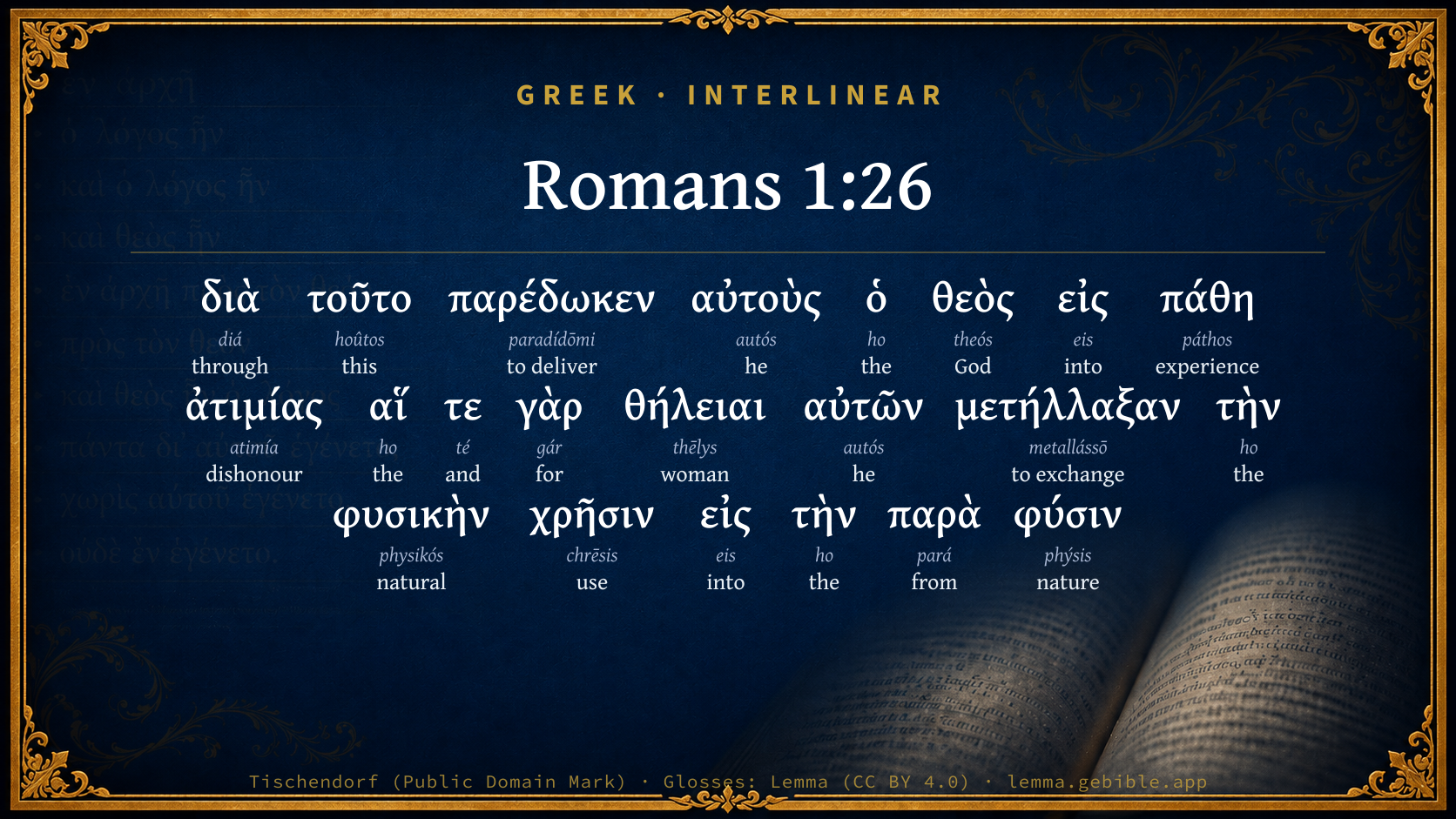
Greek (Tischendorf 8th ed.) Romans 1:26 appears in the Greek New Testament. The text above is from the Tischendorf 8th edition. Each word links to its Strong’s number and a concise gloss. Click any word for its full Thayer’s Greek Lexicon entry.
Download image
Cite this verse

Romans 1:26 (World English Bible). Public Domain. Lemma interlinear Bible study tool, https://lemma.gebible.app/v/romans/1/26.

Show BibTeX & RIS
BibTeX
RIS
English Translation
For this reason, God gave them up to vile passions. For their women changed the natural function into that which is against nature.
World English Bible · Public Domain
Highlights
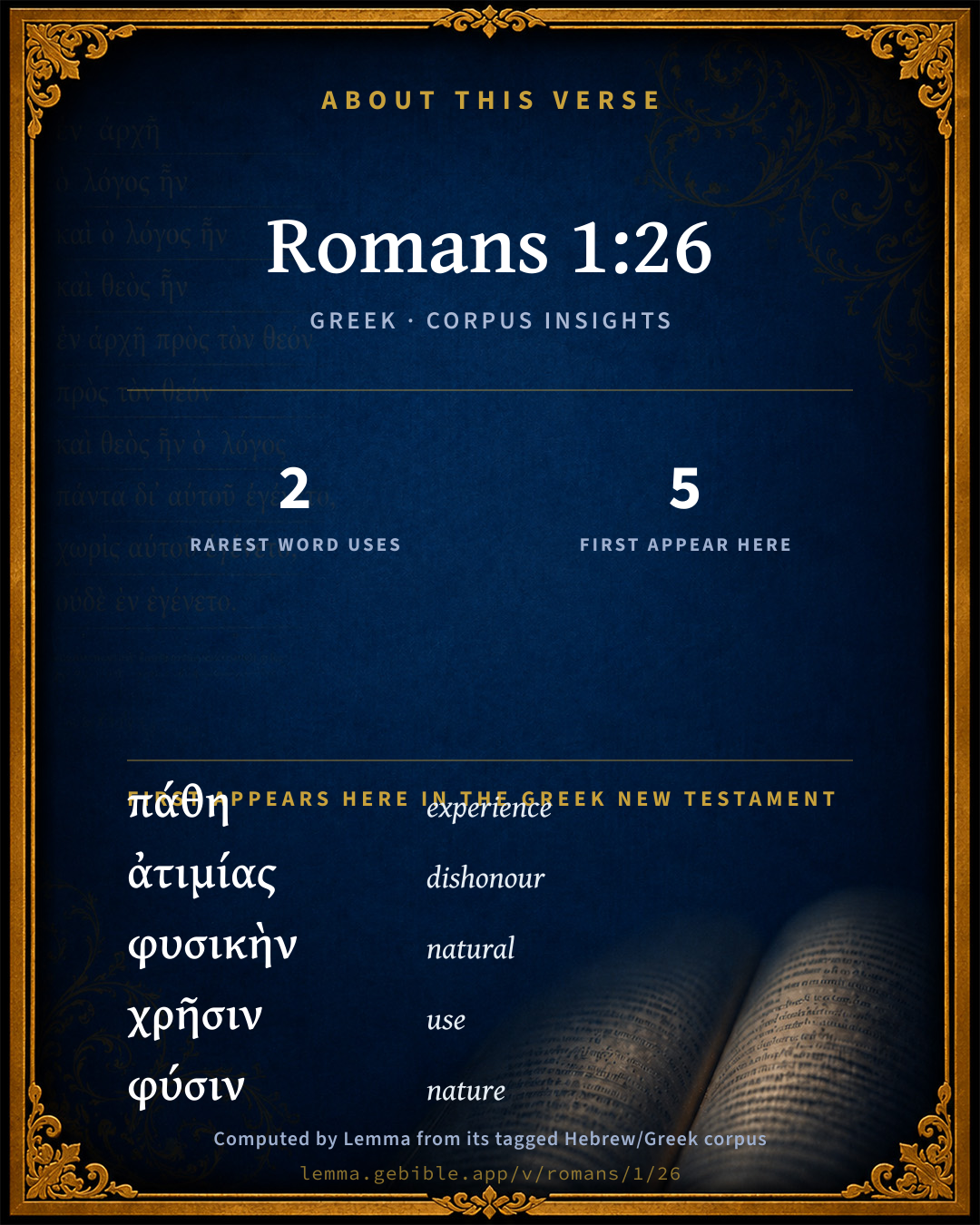
  • 5 first appearances in the Greek New Testament
Full analysis ↓
Download a study sheet

One document with this verse’s original text, its word-by-word gloss line, the meaning frame, cross-references with their text, attributed commentary, and full source and license credits — printable, and it pastes into notes with its structure intact.

This verse Autodidact and up

Study sheet (.html) Plain text (.txt)

A passage Seminary Student

Up to 50 verses in one chapter. A passage sheet keeps up to 6 commentary sources and 12 cross-references per verse, in the order this page ranks them, and says so on the sheet whenever that leaves anything out. Ask for a single verse and you get the Autodidact verse sheet above.

Everything on this page stays free to read, with no account — the sheet is a download of what is already on screen, not access to it.

Want to remove ads? Support Godless Engineer
Compare translations 3

The same verse in 3 English versions, stacked beneath the original-language interlinear above. Click any original word for its lexicon entry.

Each is an independent rendering of the whole verse — the interlinear is not word-aligned to these translations.

Highlighted words mark where these versions differ — a whole-verse word diff, not a word-by-word alignment.

  • World English Bible Public Domain
    For this reason, God gave them up to vile passions. For their women changed the natural function into that which is against nature.
  • King James Version Public Domain
    For this cause God gave them up unto vile affections: for even their women did change the natural use into that which is against nature:
  • unfoldingWord Literal Text CC BY-SA 4.0
    For this reason, God gave them over to passions of dishonor, for both their females exchanged the natural use for that contrary to nature,

unfoldingWord Literal Text — © unfoldingWord, licensed CC BY-SA 4.0. Word-aligned USFM3 via Door43 (git.door43.org/unfoldingWord/en_ult).

Versions to compare (up to 4)

3 of 4 selected

Show all 19 translations

Every available English version of this verse, each an independent rendering of the whole verse.

  • World English Bible Public Domain
    For this reason, God gave them up to vile passions. For their women changed the natural function into that which is against nature.
  • Berean Standard Bible Public Domain
    For this reason God gave them over to dishonorable passions. Even their women exchanged natural relations for unnatural ones.
  • Majority Standard Bible Public Domain
    For this reason God gave them over to dishonorable passions. Even their women exchanged natural relations for unnatural ones.
  • King James Version Public Domain
    For this cause God gave them up unto vile affections: for even their women did change the natural use into that which is against nature:
  • American Standard Version (1901) Public Domain
    For this cause God gave them up unto vile passions: for their women changed the natural use into that which is against nature:
  • Revised Version (1885) Public Domain
    For this cause God gave them up unto vile passions: for their women changed the natural use into that which is against nature:
  • Geneva Bible (1599) Public Domain
    For this cause God gaue them vp vnto vile affections: for euen their women did change the naturall vse into that which is against nature.
  • Douay-Rheims (1899) Public Domain
    For this cause God delivered them up to shameful affections. For their women have changed the natural use into that use which is against nature.
  • Young's Literal Translation Public Domain
    Because of this did God give them up to dishonourable affections, for even their females did change the natural use into that against nature;
  • Literal Standard Version CC BY-SA 4.0
    Because of this God gave them up to dishonorable affections, for even their females changed the natural use into that against nature;
  • Unlocked Literal Bible CC BY-SA 4.0
    Because of this, God gave them over to dishonorable passions, for their women exchanged natural relations for those that were unnatural.
  • unfoldingWord Literal Text CC BY-SA 4.0
    For this reason, God gave them over to passions of dishonor, for both their females exchanged the natural use for that contrary to nature,
  • Darby Bible Public Domain
    For this reason God gave them up to vile lusts; for both their females changed the natural use into that contrary to nature;
  • World Messianic Bible Public Domain
    For this reason, God gave them up to vile passions. For their women changed the natural function into that which is against nature.
  • Webster's Bible Public Domain
    For this cause God gave them up to vile affections. For even their women did change the natural use into that which is against nature:
  • Free Bible Version CC BY-SA 4.0
    That's why God abandoned them to their evil desires. Their women exchanged natural sex for that which is unnatural,
  • Bible in Basic English Public Domain
    For this reason God gave them up to evil passions, and their women were changing the natural use into one which is unnatural:
  • Text-Critical English NT CC BY 4.0
    For this reason God gave them up to dishonorable passions, for their women exchanged the natural function for that which is contrary to nature.
  • Tyndale New Testament (1534) Public Domain
    For this cause god gave them vp vnto shamfull lustes. For even their wemen did chaunge the naturall vse vnto the vnnaturall.

Literal Standard Version (2020), Covenant Press — licensed CC BY-SA 4.0. Text via the HelloAO Bible API (eBible.org). Unlocked Literal Bible (unfoldingWord) — licensed CC BY-SA 4.0. Text via the HelloAO Bible API (eBible.org). unfoldingWord Literal Text — © unfoldingWord, licensed CC BY-SA 4.0. Word-aligned USFM3 via Door43 (git.door43.org/unfoldingWord/en_ult). Free Bible Version, Dr. Jonathan Gallagher — licensed CC BY-SA 4.0. Text via the HelloAO Bible API (eBible.org).

Word by word

More ways to search: Search by grammar → Find every occurrence → Compare this word →

Practice this passage: Drill this verse → Learn its vocabulary →

μετήλλαξαν
metallássō
G3337
“to exchange”
Verb, Aorist, Active, Indicative, 3rd person, Plural
Part of Speech
Verb
Tense
Aorist
Voice
Active
Mood
Indicative
Person
3rd person
Number
Plural
Full Thayer's Definition

Origin: from G3326 and G236

TDNT: 05:19,4

1. to exchange, change
  1. διὰ diá G1223 “through” Preposition
  2. τοῦτο hoûtos G3778 “this” Demonstrative pronoun, Accusative, Singular, Neuter
  3. παρέδωκεν paradídōmi G3860 “to deliver” Verb, Aorist, Active, Indicative, 3rd person, Singular
  4. αὐτοὺς autós G846 “he” Personal pronoun, Accusative, Plural, Masculine
  5. ὁ ho G3588 “the” Article, Nominative, Singular, Masculine
  6. θεὸς theós G2316 “God” Noun, Nominative, Singular, Masculine
  7. εἰς eis G1519 “into” Preposition
  8. πάθη páthos G3806 “experience” Noun, Accusative, Plural, Neuter
  9. ἀτιμίας atimía G819 “dishonour” Noun, Genitive, Singular, Feminine
  10. αἵ ho G3588 “the” Article, Nominative, Plural, Feminine
  11. τε té G5037 “and” Particle
  12. γὰρ gár G1063 “for” Conjunction
  13. θήλειαι thēlys G2338 “woman” Adjective, Nominative, Plural, Feminine
  14. αὐτῶν autós G846 “he” Personal pronoun, Genitive, Plural, Masculine
  15. τὴν ho G3588 “the” Article, Accusative, Singular, Feminine
  16. φυσικὴν physikós G5446 “natural” Adjective, Accusative, Singular, Feminine
  17. χρῆσιν chrēsis G5540 “use” Noun, Accusative, Singular, Feminine
  18. εἰς eis G1519 “into” Preposition
  19. τὴν ho G3588 “the” Article, Accusative, Singular, Feminine
  20. παρὰ pará G3844 “from” Preposition
  21. φύσιν phýsis G5449 “nature” Noun, Accusative, Singular, Feminine

About this verse

These counts appear in no published source. They are computed here, from the morphology-tagged text and Lemma’s own curated glosses. What Lemma adds →

22
words
17
distinct lemmas
Pauline Epistles
section

Notable vocabulary

The rarest word here is μετήλλαξαν to exchange G3337 — appearing just 2 times in the whole Greek New Testament.

First appearance in Scripture

These words make their first canonical appearance in the Greek New Testament here:

  • πάθη experience G3806
  • ἀτιμίας dishonour G819
  • φυσικὴν natural G5446
  • χρῆσιν use G5540
  • φύσιν nature G5449

Shared distinctive vocabulary

μετήλλαξαν to exchange G3337 occurs in 2 verses of the Greek New Testament. Also found in:
Repetition

Words recur within this verse:

Cross-references

13

Topical passages linked to Romans 1:26 in the Treasury of Scripture Knowledge — connected by theme and wording, ordered by reader-vote popularity; previews shown in the World English Bible.

  • Jude 1:7 Even as Sodom and Gomorrah, and the cities around them, having, in the same way as these, given themselves over to sexual immorality and gone after strange flesh, are set forth as an example, suffering the punishment of eternal fire.
  • 1 Timothy 1:10 for the sexually immoral, for homosexuals, for slave-traders, for liars, for perjurers, and for any other thing contrary to the sound doctrine;
  • Leviticus 18:22–28 "'You shall not lie with a man, as with a woman. That is detestible.
  • Romans 1:24 Therefore God also gave them up in the lusts of their hearts to uncleanness, that their bodies should be dishonored among themselves,
  • 1 Corinthians 6:9 Or don't you know that the unrighteous will not inherit the Kingdom of God? Don't be deceived. Neither the sexually immoral, nor idolaters, nor adulterers, nor male prostitutes, nor homosexuals,
  • Ephesians 4:19 who having become callous gave themselves up to lust, to work all uncleanness with greediness.
  • Genesis 19:5 They called to Lot, and said to him, "Where are the men who came in to you this night? Bring them out to us, that we may have sex with them."
  • Judges 19:22 As they were making their hearts merry, behold, the men of the city, certain base fellows, beset the house round about, beating at the door; and they spoke to the master of the house, the old man, saying, Bring forth the man who came into your house, that we may know him.
  • Ephesians 5:12 For the things which are done by them in secret, it is a shame even to speak of.
  • Deuteronomy 23:17–18 There shall be no prostitute of the daughters of Israel, neither shall there be a sodomite of the sons of Israel.
  • Romans 1:28 Even as they refused to have God in their knowledge, God gave them up to a reprobate mind, to do those things which are not fitting;
  • 1 Thessalonians 4:5 not in the passion of lust, even as the Gentiles who don't know God;
  • Jude 1:10 But these speak evil of whatever things they don't know. What they understand naturally, like the creatures without reason, in these things are they destroyed.

Cross-references courtesy of OpenBible.info (CC BY 4.0).

Commentary

Notes on Romans 1:26 from classic Christian and Jewish commentators (each source and its license shown beneath its notes). The classic Christian expositions comment on the surrounding passage and are grouped to its opening verse, so a note may address several verses; the Jewish commentaries on the Tanakh (Rashi and others) are per-verse, so they appear only where the commentator wrote on this verse.

Lemma curates 59 commentaries, every one of them public domain or Creative Commons licensed, each selected and text-cleaned for this edition rather than reprinted as found. About our sources →

The Cambridge Bible for Schools and Colleges

gen. ed. J. J. S. Perowne

26. For this cause] Resuming Rom_1:24.

vile affections] Lit. passions of disgrace; stamped with essential degradation. (Far different is the Greek, where (in E. V.) the same word “vile” appears, in Php_3:21 : “the body of humiliation.”) On this and the next verse we must not comment in detail. The hideous vices here plainly named, one of them in particular, frightfully deface some of the very fairest pages of ancient literature. The tremendous condemnations of Scripture have made the like display almost impossible in modern writings; but the human heart is the same. (Jer_17:9.)

It is noteworthy (as an act of tenderness, perhaps,) that the sin of Rom_1:26 is touched more rapidly than that of Rom_1:27. It is also remarkable that in the Greek we have not “women” and “men,” but “females” and “males.”—Bengel’s remark on this passage is excellent: “Often, in exposing sin, we must call a spade a spade (scapha debet scapha dici). They often insist on an excessive delicacy who themselves are void of modesty.” These words apply to many passages of Scripture besides this.

The Cambridge Bible for Schools and Colleges (gen. ed. J. J. S. Perowne; Cambridge University Press, 1878–1918) — public domain. Text from a community e-Sword module.

The Biblical Illustrator

Joseph S. Exell

Rom_1:26-32

For this cause God gave them up to vile affections.

Human depravity

I. The cause of all this gross ignorance and corruption is assigned in Rom_1:28. They did not like to retain God in their knowledge.

1. The expression plainly assumes Gods having been known, and that the cause of corruption and loss of the original knowledge was entirely of a moral nature. This will appear--

(1) From the word itself--they did not like. Inability: whether arising from the want of evidence, or opportunity to observe, or capacity to understand it, is not alleged. The word clearly expresses the voluntariness of the defection, the indisposition to keep the knowledge as the true cause of the loss of it.

(2) From the consequence which followed in the Divine procedure: God gave them over to a reprobate mind, etc., is clearly judicial. Nothing of this description could ever be inflicted on account of mere deficiency of intellect, but must be connected with the disposition or state of the heart.

2. The true character of God it is impossible that corrupt creatures should relish. As a creature in love with sin, he wishes to believe that God is such an one as himself. In this way idolatry becomes an evidence of the deep and universal depravity of the human heart. This view of the case accords well with the character of the gods many and lords many of the heathen world. Men love sin; and they make their gods sinners, that they may practise evil under their sanction and patronage. The worship of their gods is such as might be anticipated from their characters. They consist, not merely of the most senseless fooleries and extravagances, but of the most disgusting impurities, and the most iron-hearted cruelties.

II. The consequences are clearly represented in Rom_1:26; Rom_1:28, as bringing upon them the just displeasure of a forgotten and insulted God.

1. God gave them over to vile affections, to a reprobate mind. God is not represented as infusing any evil principles; but simply as leaving them to the unrestrained operation of the principles of evil already in them. What an awful curse this was, will sufficiently appear from the portrait in the passage before us. The various evils are represented as not convenient--not becoming--against all propriety and all law; and as abounding--personal and social life being filled with them. The description shows the fearful length to which the corrupt affections of a reprobate mind will carry those who are given up to their unchecked dominion. We are not, it is true, to suppose all the evils enumerated to exist in individual characters. Many of them are of such different kinds that they could not exist together. It is with nations as with individuals. Some of the features of the picture may appear with more or less of characteristic aggravation or diminution, according to particular circumstances. But of the general state of the Gentile world, at that time and still the outline here drawn, hideous as it is, is not overcharged, but faithful to nature and to fact.

2. The displays of eternal power and Godhead in the works of God rendered mens forgetfulness and ignorance of Him without excuse. In like manner, the wickedness here described was also rendered inexcusable by what is stated in Rom_1:32. The judgment originally pronounced by Jehovah against sin was death. Of this tradition could not fail to carry down some remembrance, and tradition had the assistance of natural conscience. And while the sentence of death was thus engraven on the memories and consciences of sinful men, the early and singular institution of animal sacrifices spoke the very same language. And so did the regular fulfilment of the original sentence against sin--Dust thou art, and unto dust shalt thou return; together with all the judgments by which the Supreme Ruler manifested His displeasure against sin. Men, then, knew, and ought to have kept in mind, the judgment of God, that they which commit such things are worthy of death. Yet, instead of this, they cast off all restraint. Instead of striving against sin they strove to rid their minds of every check to the commission of it. (R. Wardlaw, D. D.)

Sin

I. Its name is legion.

II. Its nature is devilish.

III. Its effect is demoralising.

IV. Its judgment is death. (J. Lyth, D. D.)

Sin its own punishment

I. In the sins here enumerated. Which were--

1. Senseless;

2. Filthy;

3. Inhuman;

4. Self-deceptive;

5. God dishonouring.

II. In their effects, such as--

1. Health impaired and bodily frame debilitated.

2. Mental faculties enfeebled.

3. Conscience seared, and moral sense weakened and degraded.

4. Finer feelings and delicate sensibilities blunted and extinguished.

5. Incapacity to appreciate the natural affections.

6. Insensibility to the noble and good, the beautiful, and true. (T. Robinson, D. D.)

The Biblical Illustrator, edited by Joseph S. Exell (c. 1880s–1900s) — public domain. Text from a community e-Sword module.

Joseph Benson's Commentary

Rom 1:26-27. For this cause — To punish them for their inexcusable neglect, or contempt rather, of the ever-blessed God; and for all their idolatries and impieties; God gave them up unto vile affections — Abandoned them to the most infamous passions, to which the heathen Romans were enslaved to the last degree, and none more than the emperors themselves. For even their women — From whom the strictest modesty might reasonably be expected; did change the natural use of their bodies into that which is against nature — Prostituting and abusing them in the most abominable manner. Likewise also the men burned in their lust one toward another — “How just the apostle’s reflections are, and how pertinently he has placed this most abominable abuse of human nature at the head of the vices into which the heathen world were fallen, will be seen, if we observe that Cicero, the greatest philosopher in Rome, a little before the gospel was preached, in his book concerning the nature of the gods, (where may be found a thousand idle sentiments upon that subject,) introduces, without any mark of disapprobation, Cotta, a man of the first rank and genius, freely and familiarly owning, to other Romans of the same quality, this worse than beastly vice, as practised by himself; and quoting the authority of ancient philosophers in vindication of it. See lib. 1. sec. 28. Nay, and do we not even find the most elegant and correct, both of the Greek and Latin poets, avowing this vice, and even celebrating the objects of their abominable affection? Indeed, it is well known that this most detestable vice was long and generally practised, by all sorts of men, philosophers and others. Whence we may conclude that the apostle has done justice to the Gentile world in the other instances of their corruption.” — Dodd. Receiving in themselves that recompense of their error — Their idolatry; which was meet — Being punished with that unnatural lust, which was as horrible a dishonour to their bodies as their idolatry was to God, and with various bodily infirmities, disorders, and sufferings consequent on such abominable practices, rendering their lives most miserable on earth, and bringing them to an untimely grave, and an eternal hell. The reader will observe, “the apostle is not speaking simply of the Greeks committing the uncleanness which he mentions, but of their lawgivers authorizing these vices by their public institutions of religion, by their avowed doctrine, and by their own practice. With respect to fornication, the heathen actually made it a part of the worship of their deities. At Corinth, for example, as Strabo informs us, lib. 8. p. 581, there was a temple of Venus, where more than a thousand courtesans (the gift of pious persons of both sexes) prostituted themselves in honour of the goddess; and that thus the city was crowded, and became wealthy. In the court of the temple of Venus, at Cnidus, there were tents placed under the trees for the same lewd purposes. Lucian., Dial. Amores. With respect to sodomy, it is not so commonly known that it was practised by the heathen as a part of their religious worship; yet, in the history which is given of Josiah’s endeavours to destroy idolatry, there is direct evidence of it, 2Ki 23:7. That the Greek philosophers of the greatest reputation were guilty not only of fornication, but even of sodomy, is affirmed by ancient authors of good reputation. With the latter crime, Tertullian and Nazianzen have charged Socrates himself, in passages of their writings quoted by Estius. The same charge Athenæus, a heathen writer, hath brought against him, Deipnosophist, lib. 13.; not to speak of Lucian, who, in many passages of his writings, hath directly accused him of that vice. When, therefore, the statesmen, the philosophers, and the priests, notwithstanding they enjoyed the light of nature, improved by science, thus avowedly addicted themselves to the most abominable uncleannesses; nay, when the gods whom they worshipped were supposed by them to be guilty of the same enormities; when their temples were brothels, their pictures invitations to sin, their sacred groves places of prostitution, and their sacrifices a horrid mixture of superstition and cruelty; there was certainly the greatest need of the gospel revelation, to make mankind sensible of their brutality, and to bring them to a more holy practice. That some, professing Christianity, are guilty of the crimes of which we have been speaking, is true. But it is equally true, that their religion does not, like the religion of the heathen, encourage them in their crimes; but deters them, by denouncing, in the most direct terms, the heaviest wrath of God against all who are guilty of them. Besides, the gospel, by its divine light, hath led the nations to correct their civil laws; so that in every Christian country these enormities are prohibited, and when discovered are punished with the greatest severity. The gospel, therefore, hath made us far more knowing, and, I may add, more virtuous, than the most enlightened and most polished of the heathen nations were formerly.” — Macknight.

Joseph Benson's Commentary on the Old and New Testaments (1811–1818) — public domain. Text from a community e-Sword module.

Tyndale Open Study Notes

Tyndale Open Resources

1:26 women turned against the natural way: In this context, natural way refers to the nature of the world as God made it. As in the Old Testament, Paul singles out homosexuality as a key illustration of how people have fallen away from worship of the true God (see Gen 19:1-28; Lev 18:22; 20:13; Deut 23:17-18). God created human beings as male and female, and engaging in homosexual activity is a violation of God’s creative intention.

Tyndale Open Study Notes — © Tyndale Open Resources, licensed CC BY-SA 4.0. Text via the HelloAO Bible API.

Bengel's Gnomon

Johann Albrecht Bengel

Rom 1:26. Πάθη ἀτιμίας, lusts of dishonour) [vile affections—Engl. vers.] See Gerberi lib. unerkannte sünden (unknown sins), T. i., cap. 92; Von der geheimen Unzucht (on secret vices). The writings of the heathen are full of such things.—ἀτιμίας, dishonour). Honour is its opposite, 1Th 4:4.—θήλειαι, women) In stigmatizing sins, we must often call a spade a spade. Those generally demand from others a preposterous modesty [in speech], who are without chastity [in acts]. Paul, at the beginning of this epistle, thus writes more plainly to Rome, which he had not yet visited, than on any former occasion anywhere. The dignity and earnestness of the judicial style [which he employs], from the propriety of its language, does not offend modesty.—χρῆσιν, use) supply of themselves; but it is elliptical; the reason is found, 1Co 11:9; we must use, not enjoy. Herein is seen the gravity of style in the sacred writings.

Bengel's Gnomon of the New Testament — English translation (T&T Clark, Edinburgh, 1860) — public domain. Text from a community e-Sword module.

Meyer's Critical & Exegetical Commentary

Heinrich August Wilhelm Meyer

Rom_1:26-27. Διὰ τοῦτο] Beginning an independent, sentence (against Hofmann, see on Rom_1:25), refers to the description οἵτινες.… κτίσαντα contained in Rom_1:25. The giving up is set forth once more (comp Rom_1:24, διό) as the punishment of apostasy, and now indeed with such increasing force of delineation, that out of the category which is kept quite general in Rom_1:24 unnatural sensual abominations are specially adduced.

εἰς πάθη ἀτιμίας] Genitive of quality. Comp on πνεῦμα ἁγιωσύνης in Rom_1:4, and Bornemann, Schol. in Luc. p. 21. Parallel to the passions of a disgraceful character is εἰς ἀκαθαρσίαν in Rom_1:24; comp Col_3:5; but the stronger expression here selected prepares the way for the following description of a peculiarly abominable form of vice. Still the unnatural element is not implied in πάθη ἀτιμίας itself (Hofmann: they are a dishonouring, not merely of the body, but of humanity), since morally dishonouring passions are the agents, not only in the case of unnatural, but also in that of natural unchastity.

Respecting τὲ γάρ, namque, for.… indeed (Rom_7:7; 2Co_10:8), see Hermann, a[511] Soph. Trach. 1015; Hartung, I. p. 115; Klotz, a[512] Devar. p. 749 ff.

The expressions θήλειαι and ἄρσενες, their females and their males, not γυναῖκες and ἄνδρες, are chosen because the predominant point of view is simply that of sex; Reiche thinks: out of contempt, because the words would also be used of beasts; but in fact, such unnatural things are foreign to the very beasts. Besides, the words are used even of the gods (Homer, Il. viii. 7, and frequently).

τὴν φυσικὴν χρῆσιν] of their sex, not: of the male, which is unsuitable to the vice indicated. Regarding χρῆσις in the sense of sexual use, see Wetstein and Kypke, also Coray, a[513] Heliodor. Aeg., p. 31.

How very prevalent among the Gentiles (it was found also among the Jews, see Schoettgen, Hor. in loc[514]) was the so-called Lesbian vice, λεσβιάζειν (Lucian, D.Mer. 5. 2), women with women abusing their sex (tribades, in Tertullian frictrices), see Salmasius, foen. Trapez. p. 143 f., 152 f.; and the commentators on Ael. V. H. iii. 12. Comp the ἑταιρίστριαι in Plat. Symp. p. 191 E, and the ασέλγεια τριβακή in Luc. Amor. 28; and see Ruhnken, a[516] Tim. p. 124, and generally Rosenbaum, Gesch. d. Lustseuche im Alterth. ed. 2, 1845.

That ὁμοίως δὲ καί after the preceding τέ makes the latter an anakoluthon, is commonly assumed, but altogether without foundation, because in τὲ γάρ the τέ does not necessarily require any correlative. See Klotz l.c[517] If it were put correlatively, we should have in ὁμοίως δὲ καί the other corresponding member really present (as is actually the case, e.g. in Plat. Symp. p. 186 E), which however would in that case inappropriately stand out with greater emphasis and weight than the former[518] (Stallbaum, a[519] Plat. Polit. p. 270 D, Rep. p. 367 C; Dissen, a[520] Pind. Ol. viii. 56; Klausen, a[521] Aesch. Choeph. p. 199). The reading τέ (instead of δέ) in Elz., as well as the entire omission of the particle (C, min[522], Origen, Jerome), is a too hasty emendation.

ἐξεκαύθησαν] Stronger than the simple form. Comp Alciphr. iii. 67; ἐξεκαύθην εἰς ἔρωτα. Such a state is the πυροῦσθαι in 1Co_7:9. Moreover, Paul represents here not the heat that precedes the act of unchastity, but that which is kindled in the act itself (κατεργαζόμενοι.… ἀπολαμβάνοντες).

ἄρσενες ἐν ἄρσεσι] whilst they, males on males, performed the (known, from Rom_1:26) unseemliness. On the emphatic juxtaposition of ἄρσ. ἐν ἄρσ. comp generally Lobeck, a[525] Aj. 522, and in particular Porphyr. de abstin. iv. 20; and Wetstein in loc[526] On κατεργαζεσθαι, which is used both of evil (Rom_2:9, Rom_7:9, Rom_15:17 f.) and good (Rom_5:3, Rom_15:18; Php_2:12), but which, as distinguished from ἐργάζεσθαι, always expresses the bringing to pass, the accomplishment, comp especially Rom_2:9, and van Hengel thereon; 1Co_5:3; 2Co_7:10, and the critical remarks thereon. On ἀσχημ. see Gen_34:7.

τὴν ἀντιμισθίαν κ.τ.λ[528]] The aberration, which Paul means, see in Rom_1:21-23; Rom_1:28; it is the aberration from God to idols, not that implied in the sexual perversion of the divine order (Hofmann), which perversion, on the contrary, is brought by διό in Rom_1:24, and by ΔΙΆ ΤΟῦΤΟ in Rom_1:26, under the point of view of penal retribution for the πλάνη. By the recompense for the πλάνη Paul does not at all mean that the men have that done to them by their fellows, which they themselves do to theirs (Hofmann), but rather, in harmony with the connection of cause and effect, the abominable unnatural lusts just described, to which God has given up the Gentiles, and thereby, in recompensing godlessness through such wicked excesses (Rom_1:18), revealed His ὀργή. Therefore also ἭΝ ἘΔΕΙ is added, namely, in accordance with the necessity of the holy divine order. See Rom_1:24; Rom_1:26; Rom_1:28. On ἈΝΤΙΜΙΣΘΊΑ comp 2Co_6:13; Clem. Cor. II. 1. It occurs neither in Greek authors, who have the adjective ἈΝΤΊΜΙΣΘΟς (Aesch. Suppl. 273), nor in the LXX. or Apocrypha.

ἐν ἑαυτοῖς] on themselves mutually (ἐν ἀλλήλοις), as in Rom_1:24. It enhances the sadness of the description. For a number of passages attesting the prevalence of unchastity between man and man, especially of paederastia among the Gentiles, particularly the Greeks (it was forbidden to the Jews in Lev_18:22), see Becker, Charikl. I. p. 346 ff.; Hermann, Privatalterth. § 29; Bernhardy, Griech. Lit. ed. 2, p. 50 ff. Moreover, Bengel aptly observes regarding the whole of this unreserved exposure of Gentile unchastity: In peccatis arguendis saepe scapha debet scapha dici. Pudorem praeposterum ii fere postulant, qui pudicitia carent.… Gravitas et ardor stili judicialis proprietate verborum non violat verecundiam. Observe, nevertheless, how the Apostle delineates the female dishonour in less concrete traits than the male. He touches the matter in Rom_1:26 briefly and clearly enough, but with delicate avoidance of detailed description.

[511] d refers to the note of the commentator or editor named on the particular passage.

[512] d refers to the note of the commentator or editor named on the particular passage.

[513] d refers to the note of the commentator or editor named on the particular passage.

[514] n loc. refers to the note of the commentator or editor named on the particular passage.

[516] d refers to the note of the commentator or editor named on the particular passage.

[517] .c. loco citato or laudato.

[518] Hofmann thinks that with ὁμοίως δὲ καὶ κ.τ.λ. the argument ascends to the greater danger for the continuance of the human race. But that is a purely imported thought. The Apostles point of view is the moral ἀτιμία, which, in the case of female depravity, comes out most glaringly. And therefore Paul, in order to cast the most tragic light possible on these conditions, puts the brief delineation of female conduct in the foreground, in order then symmetrically to subjoin, with ὁμοίως δὲ καὶ, the male vice as the second part of the filthy category.

[519] d refers to the note of the commentator or editor named on the particular passage.

[520] d refers to the note of the commentator or editor named on the particular passage.

[521] d refers to the note of the commentator or editor named on the particular passage.

[522] in. codices minusculi, manuscripts in cursive writing. Where these are individually quoted, they are marked by the usual Arabic numerals, as 33, 89.

[525] d refers to the note of the commentator or editor named on the particular passage.

[526] n loc. refers to the note of the commentator or editor named on the particular passage.

[528] .τ.λ. καὶ τὰ λοιπά.

Meyer — Critical and Exegetical Commentary on the New Testament — English translation by Peter Christie, edited by Frederick Crombie (T&T Clark, 1880) — public domain. Text from a community e-Sword module.

Expositor's Greek Testament

ed. W. Robertson Nicoll

Rom 1:26 f. With the second παρέδωκεν the Apostle proceeds to a further stage in this judicial abandonment of men, which is at the same time a revelation of the wrath of God from heaven against them. It issues not merely like the first in sensuality, but in sensuality which perverts nature as well as disregards God. The πλάνη , error or going astray (Rom 1:27 ), is probably still the original one of idolatry; the ignoring or degrading of God is the first fatal step out of the way, which ends in this slough.

The Expositor's Greek Testament, edited by W. Robertson Nicoll (1897–1910) — public domain. Text from a community e-Sword module.

Godet's Commentaries

Frédéric Louis Godet

Vv. 26, 27. “For this cause God gave them up unto dishonoring passions: for even their women did change the natural use into that which is against nature: and likewise also the men, leaving the natural use of the woman, burned in their lust one toward another; men with men working infamy, and receiving in themselves the well-merited recompense of their error.”

Ver. 26 resumes the description begun in Rom 1:24, and which Paul had interrupted to ascend, Rom 1:25, from the punishment to its cause. The διὰ τοῦτο, for this cause, relates to Rom 1:25, and has the same logical bearing as the διό, wherefore, in Rom 1:24, which referred to Rom 1:23 (reproduced in Rom 1:25). It is therefore perfectly natural that the verb of the two propositions, Rom 1:24; Rom 1:26, should be one and the same (παρέδωκεν, He gave over).

The complement ἀτιμίας, of dishonor, is a genitive of quality (dishonoring, vile). This word goes back on the end of Rom 1:24: to dishonor their bodies among themselves. The term πάθη, passions, has something still more ignoble in it than ἐπιθυμίαι, lusts, in Rom 1:24; for it contains a more pronounced idea of moral passivity, of shameful bondage.

The picture which follows of the unnatural vices then prevalent in Gentile society is confirmed in all points by the frightful details contained in the works of Greek and Latin writers. But it is asked, How can Paul give himself up, with a sort of complacency, to such a delineation? The answer lies in the aim of the whole passage to show the divine wrath displayed on the Gentile world; comp. the term ἀντιμισθία, meet recompense, Rom 1:27. A law broods over human existence, a law which is at the same time a divine act: Such as thou makest thy God, such wilt thou make thyself.

The expressions ἄῤῥενες, θήλειαι, literally, males, females, are chosen to suit the spirit of the context.

The whole is calculated to show that there is here a just recompense on the part of God. The μετήλλαξαν, they changed, travestied, corresponds to the same verb, Rom 1:25, and the παρὰ φύσιν, contrary to nature, to the παρὰ τὸν κτίσαντα of the same verse.

There is in the ὁμοίως τε an idea of equality: and equally so, while the reading ὁμοίως δέ of four Mjj. contains further an idea of progress, as if the dishonoring of man by man were an intensification of that of woman.

In the ἣν ἔδει, which we have translated by “well-merited recompense” (literally, the recompense which was meet), one feels, as it were, the indignant breathing of God’s holy wrath. Justice could not let it be otherwise! The error, πλάνη, is not that of having sought satisfaction in such infamies; it is the voluntary lie of idolatry, the lie (ψεῦδος) of Rom 1:25, the quenching of the truth, Rom 1:18; for this is what explains the ἀντιμισθία, the withering retribution just described. Once again the clause in themselves brings out the depth of this blight; they bear it in themselves, it is visible to the eyes of all.

The moral sentiment in man is based on the conception of the holy God. To abandon the latter, is to paralyze the former. By honoring God we ennoble ourselves; by rejecting Him we infallibly ruin ourselves. Such, according to the apostle, is the relation between heathenism and moral corruption. Independent morality is not that of St. Paul.

He has described the ungodliness of the Gentile world, idolatry, and its punishment, unnatural impurities. He now describes the other aspect of the world’s sin, unrighteousness, and its punishment, the overflowing of monstrous iniquities committed by men against one another, and threatening to overwhelm society.

Frédéric Louis Godet — Commentaries on Luke, John, Romans, and 1 Corinthians — English translation (T&T Clark, Edinburgh, 1870s–1890s) — public domain. Text from a community e-Sword module.

Hodge's Commentary on Romans, Ephesians & First Corinthians

Charles Hodge

Rom_1:26

For this cause, etc. That is, because they worshipped the creature rather than the Creator, God gave them up to corrupt affections. Πάθη ἀτιμίας, shameful lusts, passions which are degrading, and the indulgence of which covers men with ignominy. This verse is therefore an amplification of the idea expressed in Rom_1:24. The reasons why Paul refers in the first instance to the sins of uncleanness, in illustration and proof of the degradation of the heathen, probably were, that those sins are always intimately connected with idolatry, forming at times even a, part of the service rendered to the false gods; that in turning from God and things spiritual, men naturally sink into the sensual; that the sins in question are peculiarly degrading; and that they were the most notorious, prevalent, and openly acknowledged of all the crimes of the heathen world. This corruption of morals was condemned to no one class or sex. The description given by profane writers of the moral corruption of the ante-Christian ages, is in all respects as revolting as that presented by the apostle. Of this the citations of Western and Grotius furnish abundant proof. Paul first refers to the degradation of females among the heathen, because they are always the last to be affected in the decay of morals, and their corruption is therefore proof that all virtue is lost.

Charles Hodge — Commentary on Romans (1835), First Corinthians (1857), and Ephesians (1856) — public domain. Text from a community e-Sword module.

Jamieson, Fausset & Brown

Robert Jamieson, A. R. Fausset & David Brown

For this cause God gave them up--(See on Rom 1:24).

for even their women--that sex whose priceless jewel and fairest ornament is modesty, and which, when that is once lost, not only becomes more shameless than the other sex, but lives henceforth only to drag the other sex down to its level.

did change, &c.--The practices here referred to, though too abundantly attested by classic authors, cannot be further illustrated, without trenching on things which "ought not to be named among us as become the saints." But observe how vice is here seen consuming and exhausting itself. When the passions, scourged by violent and continued indulgence in natural vices, became impotent to yield the craved enjoyment, resort was had to artificial stimulants by the practice of unnatural and monstrous vices. How early these were in full career, in the history of the world, the case of Sodom affectingly shows; and because of such abominations, centuries after that, the land of Canaan "spued out" its old inhabitants. Long before this chapter was penned, the Lesbians and others throughout refined Greece had been luxuriating in such debasements; and as for the Romans, TACITUS, speaking of the emperor Tiberius, tells us that new words had then to be coined to express the newly invented stimulants to jaded passion. No wonder that, thus sick and dying as was this poor humanity of ours under the highest earthly culture, its many-voiced cry for the balm in Gilead, and the Physician there, "Come over and help us," pierced the hearts of the missionaries of the Cross, and made them "not ashamed of the Gospel of Christ!"

Jamieson, Fausset & Brown — Commentary Critical and Explanatory on the Whole Bible (1871) — public domain (CC PDM 1.0). Text via the HelloAO Bible API.

Adam Clarke's Commentary

Verse 26. For this cause God gave them up, c.] Their system of idolatry necessarily produced all kinds of impurity. How could it be otherwise, when the highest objects of their worship were adulterers, fornicators, and prostitutes of the most infamous kind, such as Jupiter, Apollo, Mars, Venus, &c.? Of the abominable evils with which the apostle charges the Gentiles in this and the following verse I could produce a multitude of proofs from their own writings but it is needless to make the subject plainer than the apostle has left it.

Adam Clarke's Commentary on the Bible (1810–1826) — public domain. Text from a community e-Sword/MySword module.

John Calvin's Commentaries

26. God therefore gave them up, etc. After having introduced as it were an intervening clause, he returns to what he had before stated respecting the judgment of God: and he brings, as the first example, the dreadful crime of unnatural lust; and it hence appears that they not only abandoned themselves to beastly lusts, but became degraded beyond the beasts, since they reversed the whole order of nature. He then enumerates a long catalogue of vices which had existed in all ages, and then prevailed everywhere without any restraint.

It is not to the purpose to say, that every one was not laden with so great a mass of vices; for in arraigning the common baseness of men, it is proof enough if all to a man are constrained to acknowledge some faults. So then we must consider, that Paul here records those abominations which had been common in all ages, and were at that time especially prevalent everywhere; for it is marvelous how common then was that filthiness which even brute beasts abhor; and some of these vices were even popular. And he recites a catalogue of vices, in some of which the whole race of man were involved; for though all were not murderers, or thieves, or adulterers, yet there were none who were not found polluted by some vice or another. He calls those disgraceful passions, which are shameful even in the estimation of men, and redound to the dishonoring of God.

John Calvin's Commentaries (1540-1563) — public domain. Text from the Calvin Translation Society English edition (1840s-50s) via the Christian Classics Ethereal Library (ccel.org). Calvin's coverage is partial (roughly two-thirds of the Bible); uncommented books and verses are honest gaps, never fabricated. The 19th-century editor's footnotes and remarks are omitted so the notes are faithfully Calvin's own voice.

John Gill's Exposition

For this cause God gave them up unto vile affections,.... Because of their idolatrous practices, God left them to very dishonourable actions, sodomitical ones, both among the men and women:

for even the women did change the natural use into that which is against nature; either by prostituting themselves to, and complying with the "sodomitical" embraces of men, in a way that is against nature (h); or by making use of such ways and methods with themselves, or other women, to gratify their lusts, which were never designed by nature for such an use: of these vicious women, and their practices, Seneca (i) speaks, when he says,

"libidine veto nec maribus quidem cedunt, pati natae; Dii illas Deoeque, male perdant; adeo perversum commentae, genus impudicitiae, viros ineunt:''

also Clemens Alexandrinus (k) has respect to such, saying,

"gunaikev andrizontai para fusin, gamou men ai te kai .'

and such there were among the Jews, whom they call (l), and whom the priests were forbidden to marry.

(h) Vid. R. Sol Jarchi in Gen. xxiv. 16. (i) Epist. 95. (k) Paedagog. l. 3. p. 226. (l) T. Bab. Sabbat, fol. 65. 2. Piske Tosaph. ib. artic. 266. Yevamot, fol. 76. 1. & Piske Tosaph. ib. art. 141. Maimonides in Misn. Sanhedrin, c. 7. sect. 4. & Hilchot Issure Bia, c. 21. sect. 8, 9.

John Gill's Exposition of the Whole Bible (1746–1763) — public domain (CC PDM 1.0). Text via the HelloAO Bible API.

Trapp's Complete Commentary

John Trapp

26 For this cause God gave them up unto vile affections: for even their women did change the natural use into that which is against nature:

Ver. 26. Into that which is against nature] So against nature, that children (natures end) and posterity is utterly lost by it. Paul seems to point here at Messalina (that shame of her sex), the wife of Claudius the emperor.

John Trapp, A Commentary or Exposition upon All the Books of the Old and New Testament (1647–1656) — public domain. Text from a community e-Sword module.

Albert Barnes' Notes on the Bible

For this cause - On account of what had just been specified; to wit, that they did not glorify him as God, that they were unthankful, that they became polytheists and idolaters. In the previous verses he had stated their speculative belief. He now proceeds to show its practical influences on their conduct.

Vile affections - Disgraceful passions or desires. That is, to those which are immediately specified. The great object of the apostle here, it will be remembered, is to shew the state of the pagan world, and to prove that they had need of some other way of justification than the law of nature. For this purpose, it was necessary for him to enter into a detail of their sins. The sins which he proceeds to specify are the most indelicate, vile, and degrading which can be charged on man. But this is not the fault of the apostle. If they existed, it was necessary for him to charge them on the pagan world. His argument would not be complete without it. The shame is not in specifying them, but in their existence; not in the apostle, but in those who practiced them, and imposed on him the necessity of accusing them of these enormous offences. It may be further remarked, that the mere fact of his charging them with these sins is strong presumptive proof of their being practiced. If they did not exist, it would be easy for them to deny it, and put him to the proof of it. No man would venture charges like these without evidence; and the presumption is, that these things were known and practiced without shame. But this is not all. There is still abundant proof on record in the writings of the pagan themselves, that these crimes were known and extensively practiced.

For even their women ... - Evidence of the shameful and disgraceful fact here charged on the women is abundant in the Greek and Roman writers. Proof may be seen, which it would not be proper to specify, in the lexicons, under the words τριζὰς ὄλισβον trizas olisbon, and ἑταιρίστης hetairistēs. See also Seneca, epis. 95; Martial, epis. i. 90. Tholuck on the State of the pagan World, in the Biblical Repository, vol. ii.; Lucian, Dial. Meretric. v.; and Tertullian de Pallio.

Albert Barnes' Notes on the Bible (1834–1885) — public domain. Text from a community e-Sword/MySword module.

Haydock's Catholic Bible Commentary

God delivered them up. Not by being author of their sins, but by withdrawing his grace, and so permitting them, in punishment of their pride, to fall into those shameful sins. (Challoner)

George Leo Haydock (1774–1849), Haydock's Catholic Family Bible and Commentary, 1859 edition — public domain. Excludes Psalms (Douay-Rheims chapter numbering differs from Protestant) and Deuterocanonical books (Catholic canon only).

Matthew Poole's English Annotations

For this cause; i.e. for their idolatry and uncleanness both, for now their idolatry is aggravated by the uncleanness accompanying it.

Vile affections; Gr. affections of dishonour, i.e. the most dishonourable and shameful affections; for as we are exhorted, 1Th 4:4,5, to possess our vessels in honour, that is, to withhold our body from uncleanness; so they that give up themselves to uncleanness, dishonour themselves and their own bodies; see 1Co 6:18; if they, as this scripture tells us, that commit fornication dishonour their own bodies; then much more do they that practise the unnatural uncleanness hereafter mentioned.

For even their women, &c.; i.e γυναικες ανδριζονται, so Clem. Alexandr. Ad praeposteros et sodomiticos concubitus sese maribus prostituerunt. See Paraeus: a filthy practice not to be named, Eph 5:3.

Matthew Poole's English Annotations on the Holy Bible (1683–1685) — public domain. Text from a community e-Sword/MySword module.

Whedon's Commentary on the Bible

Daniel D. Whedon

26, 27. The apostle, holding the intensity of depravation in the sexual direction to be both the most signal instance of man’s depth of wickedness, and, as in a manner, both the accompaniment and cause of every other wickedness, recurs to and expatiates over it with a fascinated abhorrence.

Daniel D. Whedon (gen. ed.), Commentary on the Old and New Testaments (1874–1909) — public domain. Text from a community e-Sword module.

The Pulpit Commentary

For this cause God gave them up (paredwke , as before) to vile affections (payh atimiav , i.e. "passions of infamy;" cf. above, tou atimazesyai). For the use, on the other hand, of the words timh and timiov to denote seemly and honourable indulgence of the sexual affections, cf. 1Th_4:4 (To eautou skeuov ktasyai en agiasmw kai timh) and Heb_13:4 (Timiov o gamov en pasi kai h koith amiantov). For their women changed the natural use into that which is against nature.

The Pulpit Commentary (1880–1919), ed. H.D.M. Spence-Jones & Joseph S. Exell — public domain. Text from a community e-Sword module.

John Wesley's Explanatory Notes

Therefore God gave them up to vile affections - To which the heathen Roman were then abandoned to the last degree; and none more than the emperors themselves.

John Wesley, Explanatory Notes Upon the Whole Bible (1754–1765) — public domain. Text via the GEBible commentary corpus.

Kretzmann's Popular Commentary

Paul E. Kretzmann

The depths of immorality and godlessness:

v. 26. For this cause God gave them up into vile affections; for even their women did change the natural use into that which is against nature;

v. 27. and likewise also the men, leaving the natural use of the woman, burned in their lust one toward another: men with men working that which is unseemly, and receiving in themselves that recompense of their error which was meet.

v. 28. And even as they did not like to retain God in their knowledge, God gave them over to a reprobate mind to do those things which are not convenient;

v. 29. being filled with all unrighteousness, fornication, wickedness, covetousness, maliciousness; full of envy, murder, debate, deceit, malignity; whisperers,

v. 30. backbiters, haters of God, despiteful, proud, boasters, inventors of evil things, disobedient to parents,

v. 31. without understanding, covenant-breakers, without natural affection, implacable, unmerciful;

v. 32. who, knowing the judgment of God, that they which commit such things are worthy of death, not only do the same, but have pleasure in them that do them.

Here is a striking and terrible arraignment and characterization of the Gentile world in the time of Paul and of the unbelieving world of all times. It was because the Gentiles persisted in their idolatrous practices and refused to give heed to the knowledge which was before their eyes, which was actually bombarding their intelligence on every hand, that God gave them over, abandoned them: they fell to the very lowest depths which bestial passions may reach, into lusts and desires of dishonor and shame. The heinousness of their transgression is marked by the words referring to the sex of the transgressors, for they became guilty of the most unnatural and revolting filthiness, since the persons of the female sex among them (they can no longer be designated as women) changed the natural use according to God’s divine institution into one altogether at variance with nature, women practicing unchastity with women. And in the same way the persons of the male sex abandoned, gave up, the natural use of the opposite sex within the bonds of holy matrimony, and burned in their venereal lust and desire toward one another, males perpetrating shameless acts with males, and receiving the reward, the punishment for their error, for their willful, grievous departure from the order of God. It was necessary that they be punished in themselves, in their own bodies; it was demanded by the holiness and righteousness of God. The punishment for the sins of unchastity here referred to is in proportion to their unnaturalness and to the extent of the sinners’ departure from the service of the true God to all manner of base idolatry.

The apostle now adds another factor in the guilt of the idolaters. Just as they did not consider God worthy of being kept and regarded in their knowledge, God has also abandoned them to their reprobate mind. Their conduct and the consequences of their action are again placed in relation to each other. God had given them the opportunity to know Him, the book of nature was open before their eyes, and they could and did read the revelation offered there. But they refused to accept the finding of their own intelligence; they did not consider it worthwhile to seek the true God; they did not want to retain the true knowledge of God. A reprobate mind they showed, and to this mind they were condemned. They have lost all moral discrimination, and therefore they are abandoned to their nefarious acts, to do those things which are not proper. The apostle gives a long catalog of their sins in which they find their delight. See 2Co 12:20; Gal 5:19 ff. ; 1Ti 1:9 ff. ; 2Ti 3:2 ff. They are filled with, their hearts and minds know nothing but, unrighteousness, they delight in violating not only all divine, but also all human laws, especially such as pertain to the welfare of their neighbor. They are filled with wickedness, with the delight in doing evil, with badness or depravity, with covetousness that seeks only its own advantage. They are full of various vices: envy, murder, strife, deceit, malignity. The envious person begrudges his neighbor every advantage, and often reaches the point in which he plans and puts into execution his removal. And if it does not come to that point, there will be quarrels, maligning and calumniating talk. Body and life, money and goods, honor and good name, are attacked by people that have abandoned God and, in turn, have been abandoned by Him. The third group includes, in general, such people as have lost all sense of morality and decency: slanderous whisperers, that welcome every opportunity to harm the reputation of their neighbor; insolent persons hated by God, people that make it a practice to treat their neighbors with abject vileness; overbearing boasters, that put themselves forward at the expense of others, that boast and brag about their real and imaginary advantages and virtues; inventors of all evil and malice which wickedness can devise to harm their neighbor; disobedient to parents, denying even natural affection: without understanding, refusing to accept advice from anyone else; without all natural affection of love; without mercy, absolutely callous toward the needs and distress of others; in short, they have denied all human feeling and sympathy, they have become unnatural monsters. And all this because they would not accept God as their God. The depth of their profligacy is finally indicated by a summarizing sentence: Being such people, so constituted, that they knew the righteous judgment of God, fully conceding to Him the right to determine the relation of human beings toward one another, and fully aware also of the fact that all those that commit the sins mentioned by the apostle are guilty of death, yet they not only persist in doing them, but they also encourage obstinate malefactors in their persistent depravity.

This description of the godless world is strikingly correct at all times even in the midst of the highest intellectual enlightenment. If people deliberately take God’s honor away from Him and transfer it to creatures, the result will be that God will abandon them to the most terrible vices, uncleanness, unchastity, lack of charity and compassion, and every form of unrighteousness. Such conditions are not a mark of barbarism, but they are found in the very capitals of culture and learning in our days. The words of the apostle exactly characterize the situation in the world at the present time. Worship of heroes and mental giants has taken the place of true service of the revealed God. Lust of the flesh, lust of the eyes, lasciviousness, unmentionable sins, are prevalent. Corruption, insatiable greed and covetousness, have taken the place of real humanity and altruism, and all efforts at reform, especially by means of legal enactment, are vain. The world is rapidly drifting toward the brink of an abyss and will shortly find to its horror that the Day of Judgment has dawned.

Summary

The apostle salutes the Christians at Rome, tells of his longing to see them and of the duty he owes them in the Gospel message, states the theme of his letter, and pictures the deep depravity of the Gentiles that refuse to heed the admonition of the natural knowledge of God.

Paul E. Kretzmann, Popular Commentary of the Bible (1921–1924) — public domain. Text from a community e-Sword module.

Godbey's Commentary on the New Testament

William B. Godbey

26. “Therefore God gave them up to the lusts of dishonor.”…

William B. Godbey, Commentary on the New Testament (1896–1900) — public domain. Text from a community e-Sword module.

McGarvey & Pendleton's Commentaries

J. W. McGarvey

For this cause God gave them up unto vile passions: for their women changed the natural use into that which is against nature :

J. W. McGarvey (with Philip Y. Pendleton), Commentaries on the New Testament (The Fourfold Gospel, 1914; Acts; and the epistles) — public domain. Text from a community e-Sword/MySword module.

The People's New Testament

B. W. Johnson

26. For this cause. Because of the apostasy just described. God gave them up. Abandoned them to their own course, and thus it was shown to what depths men will fall without God. To vile passions. Vile, shameless, sensual indulgence, such as cannot now be named. The sodomy referred to here was common in the first century among the Romans, and is often spoken of without a sense of shame by their writers. It was prohibited neither by religion nor law, and was acknowledged without shame.

B. W. Johnson's The People's New Testament with Notes (1889–1891) — public domain. Electronic text from the Christian Classics Ethereal Library (CCEL) ThML edition.

unfoldingWord translationNotes

Door43 World Missions Community

Because of this

"Because of idolatry and sexual sin"

God gave them over to

"God allowed them to indulge in"

dishonorable passions

"shameful sexual desires"

for their women

"because their women"

exchanged natural relations for those that were unnatural

The idea of relations "that were unnatural" is a euphemism for immoral sexuality. AT: "started practicing sexuality in a way God did not design" (See: Euphemism)

men also left their natural relations with women

Here "natural relations" is a euphemism for sexual relationships. AT: "many men stopped having natural sexual desire for women" (See: Euphemism)

burned in their lust for one another

"experienced strong sexual desire for other men"

committed shameless acts

"committed acts for which they should have been ashamed, but they were not ashamed"

men and received in themselves the penalty they deserved for their error

"men, and God has punished them justly for the error they committed"

error

moral wrong, not a mistake about facts

translationWords

dishonor

lust

unfoldingWord translationNotes — © Distant Shores Media and the Door43 World Missions Community, licensed CC BY-SA 4.0. Source: git.door43.org/Door43/en_tn.

Cambridge Greek Testament for Schools and Colleges

26. διὰ τοῦτο. Wilful rejection of GOD’S self-revelation undermines self-respect, purity, and the whole sphere of duty.

πάθη ἀτιμίας. The gen. is descriptive—shameful passion. The thought of misuse is included in ἀτιμία; cf. Rom 9:21; as φυσική and κατὰ φύσιν mark a right use.

Cambridge Greek Testament for Schools and Colleges (Cambridge University Press, 1896; 21 vols, various authors incl. Carr, Maclear, Plummer, Farrar, Lumby, Moule, M. R. James, Simcox) — public domain. Text from a community e-Sword module.

Alford’s Greek Testament

Henry Alford

26.] πάθη ἀτιμ.,—see above, ver. 24,—stronger than ἄτιμα πάθη, as setting forth the status, ἀτιμία, to which the πάθη belonged. Contrast 1Th 4:4, τὸ ἑαυτοῦ σκεῦος κτᾶσθαι ἐν τιμῇ.

χρῆσιν usum venereum; see examples in Wetstein. This abuse is spoken of first, as being the most revolting to nature. “In peccatis arguendis sæpe scapha debet scapha dici. Pudorem præposterum ii fere postulant qui pudicitia carent … Gravitas et ardor stili judicialis, proprietate verborum non violat verecundiam.” Bengel.

Henry Alford, The Greek Testament (1849–1861) — public domain. Text from a community e-Sword module.

International Critical Commentary

26. διὰ τοῦτο παρέδωκεν κ. τ. λ. 14:16. εἶτα ἐν χρόνῳ κρατυνθὲν τὸ ἀσεβὲς ἔθος ὡς νόμος ἐφυλάχθη.

14:22. εἶτʼ οὐκ ἤρκεσε τὸ πλανᾶσθαι περὶ τὴν τοῦ Θεοῦ γνῶσιν, ἀλλὰ καὶ ἐν μεγάλῳ ζῶντες ἀγνοίας πολέμῳ τὰ τοσαῦτα κακὰ εἰρήνην προσαγορεύουσιν, 23. ἤ γὰρ τεκνοφόνους τελετὰς ἤ κρύφια μυστήρια ἤ ἐμμανεῖς ἐξάλλων θεσμῶν κώμους ἄγοντες, 24. οὔτε βίους οὔτε γάμους καθαροὺς ἔτι φυλάσσουσιν, ἔτερος δʼ ἕτερον ἤ λοχῶν ἀναιρεῖ ἢ νοθεύωι ὀδυνᾷ.

International Critical Commentary — older volumes (1896–1929), various authors — public domain. Text from a community e-Sword module.

Lesson kit

Teaching starters — assembled from the data on this page, not authored interpretation. Every prompt links to the verse data it draws on. Edit before teaching.

Romans, in the Pauline Epistles, opens this verse with 22 words (17 distinct Greek lemmas). Its most distinctive word is metallássō (“to exchange”). A historical commentator’s framing appears above. Read the whole chapter for the surrounding context.

Discussion questions

  1. What does “to exchange” (metallássō) contribute to the verse as a whole?
  2. 5 words make their first appearance in Scripture here. What does this debut establish?
  3. How does Romans 1:25, which shares the word «to exchange», read alongside this verse?
  4. What does the repetition of “into” (2× in this one verse) do in this verse?
  5. The translations on this page render this verse differently — a whole-verse word diff, not a word-by-word alignment. What might account for the different wordings?
  6. Compare how The Cambridge Bible for Schools and Colleges and The Biblical Illustrator read this verse. Where do they agree or differ?

Things to notice

  • 5 words make their first canonical appearance in Scripture here.
  • These translations choose different wording for 22 words in this verse.
  • “into” occurs 2× in this single verse.
  • 17 distinct Greek lemmas span 22 words in this verse.

Reading settings

Reading text

Shown beneath each verse's original-language words.

Old Testament
Old Testament edition

Read the OT as the Masoretic Hebrew (MT) or the Greek Septuagint (LXX).

English shown for the Greek Septuagint (in the Hebrew ↔ Greek comparison).

Comparing translations? Open the Compare panel on any verse page to stack up to four side by side.