Romans 16:25

Greek (Tischendorf 8th ed.) Romans 16:25 appears in the Greek New Testament. The text above is from the Tischendorf 8th edition. Each word links to its Strong’s number and a concise gloss. Click any word for its full Thayer’s Greek Lexicon entry.
Download image
Cite this verse

Romans 16:25. Public Domain. Lemma interlinear Bible study tool, https://lemma.gebible.app/v/romans/16/25.

Show BibTeX & RIS
BibTeX
RIS
Download a study sheet

One document with this verse’s original text, its word-by-word gloss line, the meaning frame, cross-references with their text, attributed commentary, and full source and license credits — printable, and it pastes into notes with its structure intact.

This verse Autodidact and up

Study sheet (.html) Plain text (.txt)

A passage Seminary Student

Up to 50 verses in one chapter. A passage sheet keeps up to 6 commentary sources and 12 cross-references per verse, in the order this page ranks them, and says so on the sheet whenever that leaves anything out. Ask for a single verse and you get the Autodidact verse sheet above.

Everything on this page stays free to read, with no account — the sheet is a download of what is already on screen, not access to it.

Want to remove ads? Support Godless Engineer
Compare translations 3

The same verse in 3 English versions, stacked beneath the original-language interlinear above. Click any original word for its lexicon entry.

Each is an independent rendering of the whole verse — the interlinear is not word-aligned to these translations.

Highlighted words mark where these versions differ — a whole-verse word diff, not a word-by-word alignment.

  • World English Bible Public Domain

    (No text available for this verse in this version)

  • King James Version Public Domain
    Now to him that is of power to stablish you according to my gospel, and the preaching of Jesus Christ, according to the revelation of the mystery, which was kept secret since the world began,
  • unfoldingWord Literal Text CC BY-SA 4.0
    Now to the one being able to establish you according to my gospel and the preaching of Jesus Christ, according to the revelation of the mystery, kept secret for long ages,

unfoldingWord Literal Text — © unfoldingWord, licensed CC BY-SA 4.0. Word-aligned USFM3 via Door43 (git.door43.org/unfoldingWord/en_ult).

Versions to compare (up to 4)

3 of 4 selected

Show all 16 translations

Every available English version of this verse, each an independent rendering of the whole verse.

  • Berean Standard Bible Public Domain
    Now to Him who is able to strengthen you by my gospel and by the proclamation of Jesus Christ, according to the revelation of the mystery concealed for ages past
  • Majority Standard Bible Public Domain
    Now to Him who is able to strengthen you by my gospel and by the proclamation of Jesus Christ, according to the revelation of the mystery concealed for ages past
  • King James Version Public Domain
    Now to him that is of power to stablish you according to my gospel, and the preaching of Jesus Christ, according to the revelation of the mystery, which was kept secret since the world began,
  • American Standard Version (1901) Public Domain
    Now to him that is able to establish you according to my gospel and the preaching of Jesus Christ, according to the revelation of the mystery which hath been kept in silence through times eternal,
  • Revised Version (1885) Public Domain
    Now to him that is able to stablish you according to my gospel and the preaching of Jesus Christ, according to the revelation of the mystery which hath been kept in silence through times eternal,
  • Geneva Bible (1599) Public Domain
    To him nowe that is of power to establish you according to my Gospel, and preaching of Iesus Christ, by the reuelation of the mysterie, which was kept secrete since the worlde began:
  • Douay-Rheims (1899) Public Domain
    Now to him that is able to establish you, according to my gospel, and the preaching of Jesus Christ, according to the revelation of the mystery, which was kept secret from eternity,
  • Young's Literal Translation Public Domain
    And to Him who is able to establish you, according to my good news, and the preaching of Jesus Christ, according to the revelation of the secret, in the times of the ages having been kept silent,
  • Literal Standard Version CC BY-SA 4.0
    And to Him who is able to establish you, according to my good news, and the preaching of Jesus Christ, according to the revelation of the secret, having been kept secret in the times of the ages,
  • Unlocked Literal Bible CC BY-SA 4.0
    Now to him who is able to make you stand according to my gospel and the preaching of Jesus Christ, according to the revelation of the mystery that had been kept secret for long ages,
  • unfoldingWord Literal Text CC BY-SA 4.0
    Now to the one being able to establish you according to my gospel and the preaching of Jesus Christ, according to the revelation of the mystery, kept secret for long ages,
  • Darby Bible Public Domain
    Now to him that is able to establish you, according to my glad tidings and the preaching of Jesus Christ, according to [the] revelation of [the] mystery, as to which silence has been kept in [the] times of the ages,
  • Webster's Bible Public Domain
    Now to him that is able to establish you according to my gospel, and the preaching of Jesus Christ, according to the revelation of the mystery, which hath been kept secret since the world began,
  • Free Bible Version CC BY-SA 4.0
    Now to him who can make you strong Through the good news I share and the message of Jesus Christ, According to the mystery of truth that has been revealed, The mystery of truth, hidden for eternity,
  • Bible in Basic English Public Domain
    Now to him who is able to make you strong in agreement with the good news which I gave you and the preaching of Jesus Christ, in the light of the revelation of that secret which has been kept through times eternal,
  • Tyndale New Testament (1534) Public Domain
    To him that is of power to stablisshe you accordinge to my gospell and preachinge of Iesus Christ in vtteringe of the mistery which was kept secret sence the worlde begane

Literal Standard Version (2020), Covenant Press — licensed CC BY-SA 4.0. Text via the HelloAO Bible API (eBible.org). Unlocked Literal Bible (unfoldingWord) — licensed CC BY-SA 4.0. Text via the HelloAO Bible API (eBible.org). unfoldingWord Literal Text — © unfoldingWord, licensed CC BY-SA 4.0. Word-aligned USFM3 via Door43 (git.door43.org/unfoldingWord/en_ult). Free Bible Version, Dr. Jonathan Gallagher — licensed CC BY-SA 4.0. Text via the HelloAO Bible API (eBible.org).

Word by word

More ways to search: Search by grammar → Find every occurrence → Compare this word →

Practice this passage: Drill this verse → Learn its vocabulary →

κήρυγμα
kḗrygma
G2782
“proclamation”
Noun, Accusative, Singular, Neuter
Part of Speech
Noun
Case
Accusative
Number
Singular
Gender
Neuter
Full Thayer's Definition

Origin: from G2784

TDNT: 14:54,4

1. that which is proclaimed by a herald or public crier, a proclamation by herald 2. in the NT the message or proclamation of the heralds of God or Christ
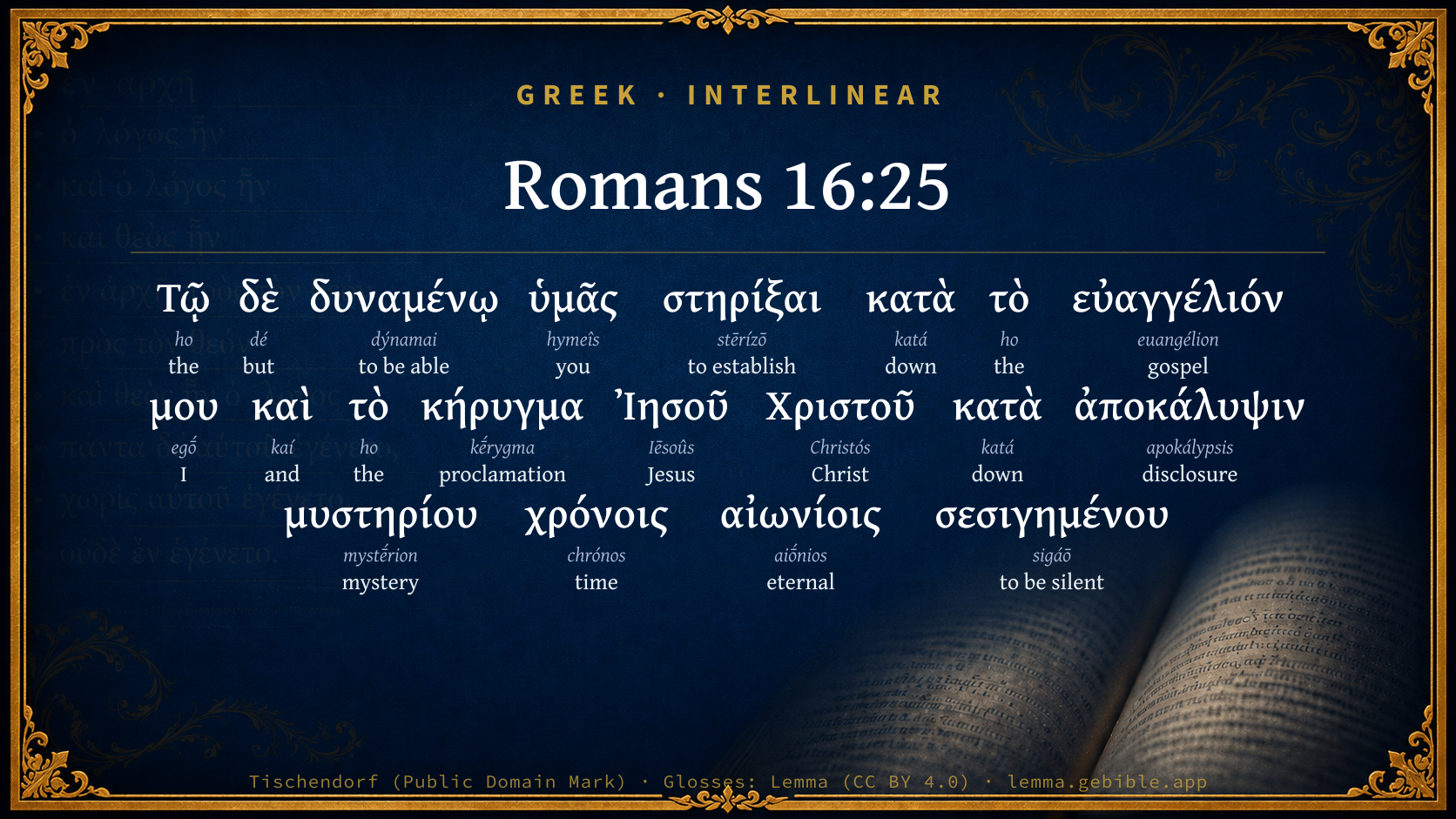
  1. Τῷ ho G3588 “the” Article, Dative, Singular, Masculine
  2. δὲ dé G1161 “but” Conjunction
  3. δυναμένῳ dýnamai G1410 “to be able” Verb, Present, Middle or Passive deponent, Participle, Dative, Singular, Masculine
  4. ὑμᾶς hymeîs G5210 “you” Personal pronoun, 2nd person, Accusative, Plural
  5. στηρίξαι stērízō G4741 “to establish” Verb, Aorist, Active, Infinitive
  6. κατὰ katá G2596 “down” Preposition
  7. τὸ ho G3588 “the” Article, Accusative, Singular, Neuter
  8. εὐαγγέλιόν euangélion G2098 “gospel” Noun, Accusative, Singular, Neuter
  9. μου egṓ G1473 “I” Personal pronoun, 1st person, Genitive, Singular
  10. καὶ kaí G2532 “and” Conjunction
  11. τὸ ho G3588 “the” Article, Accusative, Singular, Neuter
  12. Ἰησοῦ Iēsoûs G2424 “Jesus” Noun, Genitive, Singular, Masculine
  13. Χριστοῦ Christós G5547 “Christ” Noun, Genitive, Singular, Masculine
  14. κατὰ katá G2596 “down” Preposition
  15. ἀποκάλυψιν apokálypsis G602 “disclosure” Noun, Accusative, Singular, Feminine
  16. μυστηρίου mystḗrion G3466 “mystery” Noun, Genitive, Singular, Neuter
  17. χρόνοις chrónos G5550 “time” Noun, Dative, Plural, Masculine
  18. αἰωνίοις aiṓnios G166 “eternal” Adjective, Dative, Plural, Masculine
  19. σεσιγημένου sigáō G4601 “to be silent” Verb, Perfect, Passive, Participle, Genitive, Singular, Neuter

About this verse

These counts appear in no published source. They are computed here, from the morphology-tagged text and Lemma’s own curated glosses. What Lemma adds →

20
words
17
distinct lemmas
Pauline Epistles
section

Notable vocabulary

The rarest word here is κήρυγμα proclamation G2782 — appearing just 8 times in the whole Greek New Testament.

Shared distinctive vocabulary

κήρυγμα proclamation G2782 occurs in 8 verses of the Greek New Testament. Also found in:

Repetition

Words recur within this verse:

Cross-references

36

Topical passages linked to Romans 16:25 in the Treasury of Scripture Knowledge — connected by theme and wording, ordered by reader-vote popularity; previews shown in the World English Bible.

  • 1 Corinthians 2:7 But we speak God's wisdom in a mystery, the wisdom that has been hidden, which God foreordained before the worlds for our glory,
  • Colossians 1:26–27 the mystery which has been hidden for ages and generations. But now it has been revealed to his saints,
  • Romans 2:16 in the day when God will judge the secrets of men, according to my Gospel, by Jesus Christ.
  • Ephesians 1:9 making known to us the mystery of his will, according to his good pleasure which he purposed in him
  • 2 Thessalonians 2:14 to which he called you through our Gospel, for the obtaining of the glory of our Lord Jesus Christ.
  • 2 Corinthians 4:3 Even if our Gospel is veiled, it is veiled in those who perish;
  • Ephesians 3:3–5 how that by revelation the mystery was made known to me, as I wrote before in few words,
  • Ephesians 3:9 and to make all men see what is the administration of the mystery which for ages has been hidden in God, who created all things through Jesus Christ;
  • Ephesians 3:20–21 Now to him who is able to do exceedingly abundantly above all that we ask or think, according to the power that works in us,
  • Daniel 2:22 he reveals the deep and secret things; he knows what is in the darkness, and the light dwells with him.
  • Amos 3:7 Surely the Lord Yahweh will do nothing, Unless he reveals his secret to his servants the prophets.
  • 1 Peter 5:10 But may the God of all grace, who called you to his eternal glory by Christ Jesus, after you have suffered a little while, perfect, establish, strengthen, and settle you.
  • Matthew 13:17 For most assuredly I tell you that many prophets and righteous men desired to see the things which you see, and didn't see them; and to hear the things which you hear, and didn't hear them.
  • Matthew 13:35 that it might be fulfilled which was spoken through the prophet, saying, "I will open my mouth in parables; I will utter things hidden from the foundation of the world."
  • Luke 10:23–24 Turning to the disciples, he said privately, "Blessed are the eyes which see the things that you see,
  • Acts 9:20 Immediately in the synagogues he proclaimed the Christ, that he is the Son of God.
  • Acts 20:32 Now, brothers, I entrust you to God, and to the word of his grace, which is able to build up, and to give you the inheritance among all those who are sanctified.
  • 1 Corinthians 1:23 but we preach Christ crucified; a stumbling block to Jews, and foolishness to Greeks,
  • 1 Corinthians 2:1–2 When I came to you, brothers, I didn't come with excellence of speech or of wisdom, proclaiming to you the testimony of God.
  • 1 Corinthians 4:1 So let a man think of us as Christ's servants, and stewards of God's mysteries.
  • 2 Corinthians 4:5 For we don't preach ourselves, but Christ Jesus as Lord, and ourselves as your servants for Jesus' sake;
  • Galatians 2:2 I went up by revelation, and I laid before them the Gospel which I preach among the Gentiles, but privately before those who were respected, for fear that I might be running, or had run, in vain.
  • Ephesians 3:11 according to the eternal purpose which he purposed in Christ Jesus our Lord;
  • Ephesians 6:19 on my behalf, that utterance may be given to me in opening my mouth, to make known with boldness the mystery of the Gospel,
  • 2 Thessalonians 3:3 But the Lord is faithful, who will establish you, and guard you from the evil one.
  • 2 Timothy 1:9 who saved us and called us with a holy calling, not according to our works, but according to his own purpose and grace, which was given to us in Christ Jesus before times eternal,
  • 2 Timothy 2:8 Remember Jesus Christ, risen from the dead, of the seed of David, according to my Gospel,
  • Hebrews 7:25 Therefore he is also able to save to the uttermost those who draw near to God through him, seeing he ever lives to make intercession for them.
  • 1 Peter 1:10–12 Concerning this salvation, the prophets sought and searched diligently, who prophesied of the grace that would come to you,
  • Romans 14:4 Who are you who judge another's servant? To his own lord he stands or falls. Yes, he will be made to stand, for God has power to make him stand.
  • 1 Thessalonians 3:13 to the end he may establish your hearts blameless in holiness before our God and Father, at the coming of our Lord Jesus with all his saints.
  • 2 Thessalonians 2:16–17 Now our Lord Jesus Christ himself, and God our Father, who loved us and gave us eternal comfort and good hope through grace,
  • Titus 1:2 in hope of eternal life, which God, who can't lie, promised before eternal times;
  • 1 Peter 1:20 who was foreknown indeed before the foundation of the world, but was revealed at the end of times for your sake,
  • Jude 1:24–25 Now to him who is able to keep them from stumbling, and to present you faultless before the presence of his glory in great joy,
  • Psalms 78:2 I will open my mouth in a parable. I will utter dark sayings of old,

Cross-references courtesy of OpenBible.info (CC BY 4.0).

Commentary

Notes on Romans 16:25 from classic Christian and Jewish commentators (each source and its license shown beneath its notes). The classic Christian expositions comment on the surrounding passage and are grouped to its opening verse, so a note may address several verses; the Jewish commentaries on the Tanakh (Rashi and others) are per-verse, so they appear only where the commentator wrote on this verse.

Lemma curates 59 commentaries, every one of them public domain or Creative Commons licensed, each selected and text-cleaned for this edition rather than reprinted as found. About our sources →

Matthew Henry's Commentary

Here the apostle solemnly closes his epistle with a magnificent ascription of glory to the blessed God, as one that terminated all in the praise and glory of God, and studied to return all to him, seeing all is of him and from him. He does, as it were, breathe out his soul to these Romans in the praise of God, choosing to make that the end of his epistle which he made the end of his life. Observe here,

I. A description of the gospel of God, which comes in in a parenthesis; having occasion to speak of it as the means by which the power of God establishes souls, and the rule of that establishment: To establish you according to my gospel. Paul calls it his gospel, because he was the preacher of it and because he did so much glory in it. Some think he means especially that declaration, explication, and application, of the doctrine of the gospel, which he had now made in this epistle; but it rather takes in all the preaching and writing of the apostles, among whom Paul was a principal labourer. Through their word (Joh 17:20), the word committed to them. Ministers are the ambassadors, and the gospel is their embassy. Paul had his head and heart so full of the gospel that he could scarcely mention it without a digression to set forth the nature and excellency of it.

1. It is the preaching of Jesus Christ. Christ was the preacher of it himself; it began to be spoken by the Lord, Heb 2:3. So pleased was Christ with his undertaking for our salvation that he would himself be the publisher of it. Or, Christ is the subject-matter of it; the sum and substance of the whole gospel is Jesus Christ and him crucified. We preach not ourselves, says Paul, but Christ Jesus the Lord. That which establishes souls is the plain preaching of Jesus Christ.

2. It is the revelation of the mystery which was kept secret since the world began, and by the scriptures of the prophets made known. The subject-matter of the gospel is a mystery. Our redemption and salvation by Jesus Christ, in the foundation, method, and fruits of it, are, without controversy, a great mystery of godliness, Ti1 3:16. This bespeaks the honour of the gospel; it is no vulgar common thing, hammered out by any human wit, but it is the admirable product of the eternal wisdom and counsel of God, and has in it such an inconceivable height, such an unfathomable depth, as surpass knowledge. It is a mystery which the angels desire to look into, and cannot find the bottom of. And yet, blessed be God, there is as much of this mystery made plain as will suffice to bring us to heaven, if we do not wilfully neglect so great salvation. Now,

(1.) This mystery was kept secret since the world began: chronois aiōniois sisigēmenou. It was wrapped up in silence from eternity; so some - a temporibus aeternis; it is no new and upstart notion, no late invention, but took rise from the days of eternity and the purposes of God's everlasting love. Before the foundation of the world was laid, the mystery was hid in God, Eph 3:9. Or, since the world began, so we translate it. During all the times of the Old Testament this mystery was comparatively kept secret in the types and shadows of the ceremonial law, and the dark predictions of the prophets, which pointed at it, but so that they could not stedfastly look to the end of those things, Co2 3:13. Thus it was hid from ages and generations, even among the Jews, much more among the Gentiles that sat in darkness and had no notices at all of it. Even the disciples of Christ themselves, before his resurrection and ascension, were very much in the dark about the mystery of redemption, and their notion of it was very much clouded and confused; such a secret was it for many ages. But,

(2.) It is now made manifest. The veil is rent, the shadows of the evening are done away, and life and immortality are brought to light by the gospel, and the Sun of righteousness has risen upon the world. Paul does not pretend to have the monopoly of this discovery, as if he alone knew it; no, it is made manifest to many others. But how is it made manifest by the scriptures of the prophets? Surely, because now the event has given the best exposition to the prophecies of the Old Testament. Being accomplished, they are explained. The preaching of the prophets, as far as it related to this mystery, was in a great measure dark and unintelligible in the ages wherein they lived; but the scriptures of the prophets, the things which they left in writing, are now not only made plain in themselves, but by them this mystery is made known to all nations. The Old Testament does not only borrow light fRom. but return light to, the revelation of the New Testament. If the New Testament explains the Old, the Old Testament, by way of requital, very much illustrates the New. Thus the Old Testament prophets prophesy again, now their prophecies are fulfilled, before many people, and nations, and tongues. I refer to Rev 10:11, which this explains. Now Christ appears to have been the treasure hid in the field of the Old Testament. To him bear all the prophets witness. See Luk 24:27.

(3.) It is manifested according to the commandment of the everlasting God - the purpose, counsel, and decree of God from eternity, and the commission and appointment given first to Christ and then to the apostles, in the fulness of time. They received commandment from the Father to do what they did in preaching the gospel. Lest any should object, "Why was this mystery kept secret so long, and why made manifest now?" - he resolves it into the will of God, who is an absolute sovereign, and gives not an account of any of his matters. The commandment of the everlasting God was enough to bear out the apostles and ministers of the gospel in their preaching. The everlasting God. This attribute of eternity is here given up to God very emphatically. [1.] He is from everlasting, which intimates that though he had kept this mystery secret since the world began, and had but lately revealed it, yet he had framed and contrived it from everlasting, before the worlds were. The oaths and covenants in the written word are but the copy of the oath and covenant which were between the Father and the Son from eternity: those the extracts, these the original. And, [2.] He is to everlasting, intimating the eternal continuance to us. We must never look for any new revelation, but abide by this, for this is according to the commandment of the everlasting God. Christ, in the gospel, is the same yesterday, today, and for ever.

(4.) It is made known to all nations for the obedience of faith. The extent of this revelation he often takes notice of; that whereas hitherto in Judah only God was known, now Christ is salvation to the ends of the earth, to all nations. And the design of it is very observable; it is for the obedience of faith - that they may believe and obey it, receive it and be rules by it. The gospel is revealed, not to be talked of and disputed about, but to be submitted to. The obedience of faith is that obedience which is paid to the word of faith (see that phrase, Act 6:7), and which is produced by the grace of faith. See here what is the right faith - even that which works in obedience; and what is the right obedience - even that which springs from faith; and what is the design of the gospel - to bring us to both.

II. A doxology to that God whose gospel it is, ascribing glory to him for ever (Rom 16:27), acknowledging that he is a glorious God, and adoring him accordingly, with the most awful affections, desiring and longing to be at this work with the holy angels, where we shall be doing it to eternity. This is praising God, ascribing glory to him for ever. Observe,

1. The matter of this praise. In thanking God, we fasten upon his favours to us; in praising and adoring God, we fasten upon his perfections in himself. Two of his principal attributes are here taken notice of: - (1.) His power (Rom 16:25): To him that is of power to establish you. It is no less than a divine power that establishes the saints. Considering the disposition there is in them to fall, the industry of their spiritual enemies that seek to overthrow them, and the shaking times into which their lot is cast, no less than an almighty power will establish them. That power of God which is put forth for the establishment of the saints is and ought to be the matter of our praise, as Jde 1:24, To him that is able to keep you from falling. In giving God the glory of this power we may, and must, take to ourselves the comfort of it - that whatever our doubts, and difficulties, and fears, may be, our God, whom we serve, is of power to establish us. See Pe1 1:5; Joh 10:29. (2.) His wisdom (Rom 16:27): To God only wise. Power to effect without wisdom to contrive, and wisdom to contrive without power to effect, are alike vain and fruitless; but both together, and both infinite, make a perfect being. He is only wise; not the Father only wise, exclusive of the Son, but Father, Son, and Holy Ghost, three persons and one God, only wise, compared with the creatures. Man; the wisest of all the creatures in the lower world, is born like a wild ass's colt; nay, the angels themselves are charged with folly, in comparison with God. He only is perfectly and infallibly wise; he only is originally wise, in and of himself; for he is the spring and fountain of all the wisdom of the creatures, the Father of all the lights of wisdom that any creature can pretend to (Jam 1:17): with him are strength and wisdom, the deceived and deceiver are his.

2. The Mediator of this praise: Through Jesus Christ. To God only wise through Jesus Christ; so some. It is in and through Christ that God is manifested to the world as the only wise God; for he is the wisdom of God, and the power of God. Or rather, as we read it, glory through Jesus Christ. All the glory that passes from fallen man to God, so as to be accepted of him, must go through the hands of the Lord Jesus, in whom alone it is that our persons and performances are, or can be, pleasing to God. Of his righteousness therefore we must make mention, even of his only, who, as he is the Mediator of all our prayers, so he is, and I believe will be to eternity, the Mediator of all our praises.

Matthew Henry's Commentary on the Whole Bible (1708–1710) — public domain (CC PDM 1.0). Text via the HelloAO Bible API.

The Biblical Illustrator

Joseph S. Exell

Rom_16:25-27

Now to Him that is of power to stablish you according to my gospel.

Apostolic praise

What a doxology! Full of Divine melody; full of grace and truth!

I. The stablishing. He is the Creator.

(1) He is the mighty God. He is of power (literally, able) to stablish you.

(2) The fountain-head of the mystery of hidden wisdom.

(3) He is the everlasting God (Psa_90:1).

(4) He is the God only wise. Such is our Stablisher! Can we fear or be discouraged? Shall our weakness, or frailty, or the number of our foes appal us?

II. The stablishing. The word expresses steadfastness, fixture, and strength (see Luk_9:51; Rom_1:11; 1Th_3:2; 1Th_3:13; 2Th_2:17; 2Th_3:3; Jam_5:8; 1Pe_5:10). It assumes that on our part there is weakness, wavering, changeableness; that there is peril. The process of stablishing is what we need so much; it is more than being kept from falling, and we require both. The gospel

(1) says to us, Be steadfast;

(2) shows us what steadfastness is;

(3) supplies us with the means of steadfastness. In clasping that gospel, we are holding that which alone can keep us from being moved.

III. The stablished. These are, first of all, the saints at Rome, called, beloved of God, whose faith was spoken of throughout the whole world. They needed stablishing, though apostles were their pastors and teachers. (H. Bonar, D.D.)

The doxology

This Epistle is remarkable for the number of its endings. The invocation at the end of chap. 15. may be regarded as closing the Epistle itself. Then the first benediction (chap. 16:20) was doubtless intended to be indeed the conclusion of the whole. But now Pauls companions desired to send greetings, which having been done, we have the benediction a second time (Rom_15:24). The pen of Tertius was now put down. The Epistle must be read aloud for review and correction. What was done in the latter respect we cannot tell. But the apostle and his companions were filled with profound emotions; and so Tertius was bidden to again take up the pen, and to write, Now to Him, etc. And then the MS. was devoutly rolled up and sealed, and delivered to Phebe. Notice--

I. The establishment of the Roman Christians in the faith. Observe--

1. That in respect to which the establishment is to be effected: the gospel. It is described in respect to--

(1) Its subjective medium and source--my gospel. Not that his gospel differed essentially from the gospel of any other apostle, though he had not learnt it from any of them; but it was his as distinguished from all corrupted gospels (Gal_1:6-7).

(2) Its objective character and contents.

(1) It is the revelation of a mystery which--

(a) had been kept silent in eternal times, i.e., from eternity up to the time of the advent of Christ; but--

(b) had now, since the appearance of Christ, been made fully manifest. It is the great mystery of redemption through the One Divine-human Mediator, so called, not in respect to its incomprehensible character, but because it never could have been imagined by unaided human reason, nor appreciated by men before it had been evolved in history (Eph_1:9; 2Ti_1:9-10).

(2) Enigmatical portions of the truth concerning it were disclosed from time to time in type and prophecy; but given in such separate fragments, that there was not skill to bring piece to piece, and so combine the whole as to discover the mystery. Even the prophets themselves were perplexed as to what could be the true significance of their predictions (Peter 1:10-12).

(3) But now, since the advent, the whole mystery had been manifested, and the time for silence has passed away: Go ye into all the world, etc.

2. The establishment itself.

(1) This was not simply that they should become so steadfast as never to apostatise; nor only that they should so maintain personal faith in Christ to inherit everlasting life; but also that they should have such a clear understanding of the spirit and purpose of Christianity; such a grasp of its various facts and truths, as that they should be in no danger of enfeebling the gospel by heterogeneous additions, or by an incomplete apprehension or enunciation of its truths.

(2) Those who should thus be firmly established in the truth concerning Christ, are also supposed to hold firmly to Him, by personal living faith, who is Himself the Truth.

II. The ascription of glory to the only wise God through Christ, who was able to do this thing for them.

1. The ability here spoken of is not an ability of mere power, but one which is manifested, and which becomes effective, through wisdom. Men are established in the truth by a clear apprehension of it, and of its grounds and bearings (Eph_4:14; Heb_5:12-14). God has made abundant provision to present to believers the truth in an unmistakable form, and to give them every aid in mastering that form.

2. But the establishment includes, not only apprehension and belief, but also love, of the truth. And in all this God has manifested not His sole wisdom only, but His surpassing love; and we may be fully assured that He who thus appeals to the understanding by intelligible truth for the purpose of salvation will also, by the gentle and persuasive influence of love, appeal to the heart.

3. And this ascription of praise to the only wise God through Christ who is able to do this, was itself also intended to be one of the means to promote this very end. There are contained therein both incentive and encouragement. (W. Tyson.)

Praise

I. Belongs to god--as--

1. The God of power.

2. The only wise.

II. Is due to god.

1. For everything.

2. But especially for the gospel.

(1) Its revelation.

(2) Publication.

(3) Successes.

III. Is awakened by god.

1. Through faith.

2. In the preaching of the gospel.

IV. Is presented to god.

1. Through Christ.

2. In glory.

3. For ever. (J. Lyth, D.D.)

Stablished in the gospel

In the introductory words of the Epistle, Paul declares his strong desire to visit Rome, that its members might be established in the faith. As, then, he commences the Epistle with the expression of this object, it is natural that he should close it with the ascription of glory to Him who was able to do it.

I. The material is which the establishing is to take place.

1. My gospel.

(1) The gospel as preached by Paul. Already there had appeared those who proclaimed another gospel, of whom he says, let him be accursed. His gospel was that which this Epistle especially expounded.

(2) But the gospel is not a mere intellectual object set forth in order by the reason, and made evident in logical and eloquent speech; it is something which a man possesses in the inner nature of his being. It was a spiritual life for Paul.

2. The preaching of Jesus Christ. Pauls gospel was the fact that Jesus was the Saviour of the world, and the Christ of God.

3. It is easy now to see the substance of the Christian character in which believers are to be established.

(1) It consists in the apprehension of a truth. That truth is--

(a) Historic. The facts of the life, death, resurrection and ascension of Jesus, His glory and power given to Him of God.

(b) Doctrinal. The relations which these facts bear to one another, to man, to God, to the Divine government, to sin, to the destiny of the race and the universe.

(2) This substance of the Christian character is moral and personal. When a man rightly apprehends these truths, he comes into moral relation to them. He believes them; this belief produces a becoming state of the emotions; these emotions act upon the character, will, conscience, and life. The man not only believes, he also lives. Now, in this sphere of the believers condition there will be growth, and for the development, as for the commencement of this, the Holy Ghost is ceaselessly engaged.

(3) As the central fact and power, both of doctrine and life, is the preaching of Jesus Christ, we ever need to be more fully instructed in the life of Jesus, more clearly to apprehend it, more strongly to feel His relation to us, more completely to have our lives and hearts submitted to His control, and consecrated to His service.

II. The nature of this establishing. The word signifies the supporting, the solidifying of anything. Thus, a prop set under an object that might fall, the fastening of what was shaking and unstable, the setting of a liquid into firm consistency, are all expressed by words of kindred origin with the word establish. It is not difficult, then, to perceive the application of the term to the faith and life of a Christian man. It is clearly no external ratification. No such foreign act as confirming by bishop, or approval by the Church or its officers, is contemplated. But it is that work of Divine grace upon the heart after belief, whereby the knowledge and the faith, with all the graces that spring therefrom, are made more clear and strong, and the soul more able to contend and to continue, until the final victory is attained. Establishment in the faith--

1. Consists in an increase of knowledge of the facts and truths of the gospel. Deeper and deeper will the believer drink into the teaching of that gospel, and every draught shall freshen and quicken and establish him in the faith. The best means of dealing with the prevailing spirit of unbelief is not controversial defence; the truth, the history, the doctrine, is its own best defence. Rich in this lore, the cunning craftiness of men will assault you in vain. Justified by this learning, you will meet the mightiest attack of the enemy unmoved as the stony rock when it receives the beat of oceans waves and breaks them into harmless foam that only laves its brow and makes it glisten with a brighter radiance.

2. Must take place in the moral and spiritual nature of the man. We may increase in knowledge without any corresponding increase in virtue. The little brook that babbles as it runs, when it has reached the plain, grows to a broad, deep river, but is silent in its onward majestic flow. The waves of the streamlet only glistened in the light. The bosom of the river reflects a heaven upon its calm, still surface. So shall the soul grow in its love for God and Christ, its blessed experiences of mercy and grace. Less show and excitement, but the enjoyment of a fuller blessing, a richer knowledge.

3. Reaches forth into the life, and controls it. At first, the power of the truth was intermittent, partial; but as the confirming went on, the life became fuller of golden deeds of a Divine and celestial beauty. The altar of our surrender was ever builded higher and made wider, until at last it filled all the space of life, and life became a complete consecration.

III. The power by which this confirmation shall be secured. It is a Divine work. He who gave the foundation of our faith alone can establish us in it, as He alone will crown it at last. It is quite certain that we can do nothing of ourselves, for as life proceeds we learn our helplessness, our vanity. But our God has power to hold us up. His grace is limitless, and by this established, we shall not fail. (Ll. D. Bevan, D.D.)

Establishing grace

I. Its necessity.

II. Its source. The God of power.

III. Its means.

1. The gospel.

2. The gospel of Paul.

3. The gospel preached. (J. Lyth, D.D.)

According to the revelation of the mystery.--

The worlds mystery unfolded in Christ

I. The mystery. The word mystery in Scripture implies not necessarily that the fact or truth cannot be understood, but that it is not known except as revealed from God. It is a favourite word of Pauls. Except in three passages of the Gospels (Mat_13:11; Mar_4:11; Luk_8:10), and four places in the Revelation (Rev_1:20; Rev_10:7; Rev_17:5; Rev_17:7), Paul is the only writer who employs the word, and he uses it twenty times. In several of these cases of Pauline usage, the term refers to that great fact of the universality of the gospel (Eph_3:6). And this mystery forms one of the great subjects of this Epistle. It may be interesting to refer to some of the passages and there learn what this great mystery is (Rom_1:5-6; Rom_1:13; Rom_1:15; Rom_3:29; Rom_4:11; Rom_9:25-26; Rom_9:30; Rom_10:11-13; Rom_11:11; Rom_11:30; Rom_15:8-21). The mystery, then, is the universality of the gospel of Jesus Christ. All men have sinned. But all men may be saved by the free and sovereign grace of God through Jesus Christ our Lord. This was the sublime truth which Paul desired firmly to establish in the imperial city of the world, in order that there might then go forth to all mankind a power greater than that of Rome, more splendid than her glory, more searching than her law, more victorious than her legions, and which should abide when Rome should have crumbled into ruins. This mystery has been revealed to you. If you have received it, are you living in its blessedness, and up to the measure of the fulness of its freedom and life?

II. Its concealment. Which was kept silent in the aeonian periods.

1. The past ages received concerning this great truth no voice from the Divine silence. Men knew nothing of this gracious scheme of salvation for the universe.

(1) The Jew did not know it. If he regarded his God as also the creator and ruler of other men, they at least bore to Him some inferior relation, and if they were to be blessed at all, it was to be by and through the law of Moses.

(2) The Gentile had altogether failed to gain a glimpse of it. Each people held itself to be autochthonous, sprung from the soil; all the rest were strangers, aliens, slaves. Humanity was unknown, and anything like a moral dealing with the individual that was to be of universal application, had never been hinted at in the whole range of Gentile philosophy and faith.

(3) And now those who have not themselves accepted this gracious mystery in practice wholly ignore the idea that the entire human race is dealt with in the atonement of Jesus, and that the purpose of God includes that whole race within His love and power. Even within the Church, how few fully understand or obey the law which declares that there is in Jesus Christ neither bond nor free, etc.

2. What wisdom may we not find, yea, what grace, in the concealment of this truth! The world had to be and is still being prepared for it. All those denominationalisms which are only the Judaisms of the modern world, and the patriotisms which at best are but pagan virtues, are nothing but the concealment of the truth of the human unity in Jesus Christ, which is part of the plan of God when He will perfect the society of man in the breaking down of nationalities and ecclesiasticisms in a world-wide union. Happy souls who catch some glimpses of this bright day! Happier they who help on its coming, and make this their gospel, the preaching of Jesus Christ according to the unveiling of the mystery which in the past ages of the Divine purpose had not been uttered unto men.

III. Its manifestation.

1. The mystery was manifested in the character of Christ. While our Lord was a Jew and was careful of all Mosaic ordinances, yet the enthusiasm of humanity glowed within Him. His parables, sermons, conversations, works of charity and power, and death, are stamped with the mark of human nature, and have in them not a trace of the Israelite. He predicts the fall of the sacred city, affirms the universal worship of the God of heaven, and points with sublime assurance to the fact that when He has been crucified, He will draw all men unto Him.

2. And the history of the Church reflects the quality of its Masters work: At first baptized with a spirit which promised a universal scope, then narrowing down to the dimensions of a new Jewish sect, Divine providence compelled it to pass beyond the limits within which its leaders would have confined it, until it proved itself to be a world-wide Church, every road in life leading to its sacred courts.

3. And does not the history of the Church prove this in every succeeding age? What nation has been able to resist its advance? The seed of the kingdom grows in every soil.

Conclusion:

1. In respect of the inexplicable and perplexed events and conditions of human life we have only to await the Divine time, and all shall be made clear.

2. Learn from this mystery the measure and the inspiration of our preaching. According to the revelation of the mystery. For every man is the mercy obtained; to every man its grace offered.

3. This mystery being for a world, awaits your acceptance. (Ll. D. Bevan, D.D.)

The mystery of the gospel

The gospel is--

I. A mystery--long kept secret.

II. A mystery revealed.

1. By the prophets.

2. Apostles.

III. A mystery revealed by the commandment of God.

IV. A mystery revealed by the commandment of God to all nations.

V. A mystery revealed by the commandment of God to all nations for the obedience of faith. (J. Lyth, D.D.)

And by the Scriptures of the prophets, according to the commandment of the everlasting God, made known to all nations for the obedience of faith.--

The universal gospel

1. Revelation is perfected in promulgation. That which has been made manifest in Jesus Christ is to be made known by the Church unto all nations.

2. The means of this information is the Scriptures of the prophets. Which from Eph_3:3-6 we must not limit to either those of the ancient or the later dispensation. The later Scriptures supplement and expound the former, and thus come to the obedience of faith.

I. The gospel as a scheme of universal salvation is revealed in order that it may be published to all men.

1. God might have adopted some method of treatment of the race which was not a matter for revelation. There must be a great part of the Divine system of the universe which deeply affects man which, perhaps, he never will and never can know. Indeed, very much of the physical constitution of things, by which the circumstances of our daily life are determined, is wholly unknown to us. We find it out only by patient observation after long ignorance, repeated failure, constant mistake. The system of nature is left for man to find it out for himself. But this is not so with the gospel. It must be made known, to be effective. There are no esoteric or exoteric doctrines in Christianity. All need it, all may receive it; it must be made known to all, and this universal knowledge must be a knowledge of all the truth. When Jesus was revealed, nothing was to be kept back. All the truth, and All the world are the twin legends of His revelation.

2. Thus nothing which conceals from men the truth or seeks to produce spiritual effect other than by the influence of truth clearly apprehended, can be in harmony with the gospel. Two evils are contrary to this clear law of gospel promulgation, viz: the sacrifice of intelligent apprehension to mere feeling and sentiment; and the production of religious ends by mechanical services. The former is the error of the fanatic, the latter of the sacerdotalist.

II. The law of this promulgation is the commandment of the Eternal God.

1. We might seek for illustrations of this command in the words of Christ, Go ye into all the world, etc., or in His appointment of those who should be witnesses unto Him, etc. (Act_1:8), or in the vision of Peter, or in the word to Ananias concerning Saul, or to any other of those direct appointments of the gospel ministry in its relation to the entire race. But we prefer to understand by the command of the eternal God that everlasting purpose which lay at the base of the methods of the Divine procedure. Any conception of the gospel which is less than this, must necessarily be incomplete. Creation lies in the bosom of redemption. Salvation by Christ is not a mere scene enacted as part of a vast drama upon the theatre of time and nature. The world, with all its physical characteristics, i.e., its human story are but episodes in vast movements and evolutions of salvation.

2. Science boasts that it has relegated the earth and all earthly things to their proper place as very minor items in the universe of being. But such science forgets that, after all, its universe must be a universe which thought transcends. I can, in imagination, pass beyond the utmost limits of your natural universe, and I can rise to a height of moral being, beyond the uttermost reach even of my thought. Thus, vast though the universe may be, I am greater even than all the worlds, and it is with this range of being that the eternal God is concerned in the redemption of Jesus Christ. Hence, the consummation of the spiritual ends of the Divine purpose is the only infinite. It is this that circumscribes the universe. It is this that antedates creation.

3. The gospel is thus no expedient put in to prop the falling race, the temporal cure of an accidental injury to man. The salvation of the entire race of man is part of that universal gathering of all things into one in Christ which has been the everlasting purpose of Gods almighty will. Upon this ocean of eternal will, time and being float, as the barques which the waves lift and the currents bear. And, as a part of this commandment of the eternal God, the mystery is revealed and made known unto all nations.

4. If this be so, with what calm equanimity shall we not regard the phases through which the Divine designs move on to their accomplishment. We see the world in its apostacy, overwhelmed by a flood, and threatened with complete destruction. Over the raging of that catastrophe moves the calm purpose of the eternal God. We behold patriarchal ages when one family, and it but feebly, maintained the pure faith. How the flame flickers; but we know the eternal God is overhead, and His purposes depend not upon the choice and fleeting life and character of man. It is the time of the Mosaic economy, and one people is chosen, one family is priestly, one land alone has received the light of Gods revealed grace; and we are affronted by its idolatry and sin. Shall we fear for the outcome? Not at all. The purposes of God are ripening fast, and millenniums are only the moments of the Eternal. And so of our own age and time. Perchance we lift the old lament or mocking cry: The fathers, where are they? etc. Lift up your eyes and see the clear, calm stars of an eternal purpose. The tempest reaches but a few fathoms below the surface, and the waves that strew the ocean with wrecks are only ripples in the mighty currents that roll unceasing in the sovereign will of God. The gospel is His; its proclamation is His command. And when the eternal throne crumbles into ruin, then, and then only, shall the evangel of Gods grace and Christs redemption be an empty sound.

III. This divine purpose of the promulgation of the gospel has been made known by the utterances of a continued series of inspired persons. There has ever been a witness amongst men, the sum of whose testimony has been to make known to all nations the mystery of a universal salvation. A Divine purpose has ever been accompanied by a prophetic word.

IV. The ultimate end of this publishing of the mystery is the obedience of faith among all nations.

1. Paul here returns to the opening ideas and expressions of the Epistle, one of which is the obedience of faith. By this, some understand that obedience which springs from faith. But this does not seem altogether to suit the word as it is used in the first passage. Others give to faith the meaning of the Christian truth--a signification which belongs to the word in the later usage of the Church and not in the New Testament. Is it not rather that obedience which counts as faith itself, that yielding of the heart and the will to the revelations of God which is the ground of justification on its human side? (Rom_10:3). To accept the grace, to believe in God through Jesus Christ, is to render the obedience of faith. This, then, is the object which is sought by the divulging of the mystery.

2. The end, then, of an apostolic ministry is more than a mere testimony. Some have held that the gospel is only a test, whereby the elect and non-elect are discovered. Men say, on the one hand, We have preached the truth, the hearer must take the responsibility. On the other hand, men say, We have heard the truth; it does not compel our faith; it cannot be for us. Now, to both of these Paul says, Made known to all nations for the obedience of faith. Shall we dare to rest content that we have spoken even the whole of the Divine grace, and not seek by every means in our power to induce men to obey? How is it with you who have believed? Are you content with a world still disobedient, with your city full of the faithless, with your homes, your very pews, occupied by those who resist the gospel? And what shall I say to you who hear and refuse? You heap judgment on yourselves. There is no hope but in the gospel. If you do not obey, with faith in Gods way of salvation, there is nothing for you in this world but disappointment, and in the world to come eternal death.

3. The promulgation of the gospel is not merely that men may know; the object of its being known is the obedience of faith. Will you believe? Then you take Jesus Christ not only as your atonement, but as your Lord, your pattern, your rule, your guide. (Ll. D. Bevan, D.D.)

To God only wise be glory through Jesus Christ for ever.

The universal doxology

If you consult the Revised Version, you will there find the accurate reproduction of the Greek words, to the only wise God, through Jesus Christ, to whom be the glory for ever. The words, through Jesus Christ, and the place of the words be the glory at the end of the passage, furnish at once the representation of the original. It is clear that after the lengthened construction of the twenty-fifth and twenty-sixth verses, the apostle intends by the words, to the only wise God, to complete and explain the pronoun--to Him, with which the whole passage commences. So far it is clear. Then comes the expression, through Jesus Christ, understood by some to be the instrument through whom the glory is given, and by others the person by whom God is the only wise. Neither of these interpretations perfectly contents me. Have we not the true parallel to this passage in the words of St. Paul to the elders at Ephesus: And now brethren, I commend you to God and to the word of His grace who is able to hold you up. The idea is not altogether foreign from that of establishing which we have in the passage. Would not such a prayer more naturally find its place at the end of the Epistle than even a doxology, the latter being generally more incorporated into the very substance of the letter itself? Might not this be one of the prayers to which Paul refers in the opening words of the Epistle (verse 19)--prayers, the end of which was this very establishing of his correspondents? Then the phrase through Jesus Christ is natural and appropriate, the entire construction of the clause easy and unbroken, the concluding relative fittingly introduced, referring to Jesus Christ just mentioned, the ascription of glory to Him being quite in harmony with other such ascriptions, found in other portions of the apostles writings. We shall therefore base our discourse upon the passage viewed as a combined prayer and doxology, as if the words ran, To the only wise God do I look for aid and blessing upon you, through Jesus Christ, to whom be the glory of the eternal ages. Amen.

I. The consideration of the gospel as a scheme of universal salvation, naturally directs the attention of the devout and earnest heart towards the only wise God. Christianity, though rich in its ideas, is also always a practical and an efficient system. It is not the parent of dreams, it is not a mere poet. It presents the dream only as the token of what it will produce. It chants its sublime rhapsodies only as preludes of what shall be the song of triumph when its redeeming, its new creating work, is done. Thus, is it an ideal man that it would paint? It manifests Him and makes us touch Him, and hear Him, and walk with Him, and live in the light of His beauty and perfectness, in the person of Jesus Christ. Or is it a Divine power which, it declares, man needs? This power it gives to man. The Holy Ghost is shed abroad. The Comforter has come, and has abided for all the past years, and throughout all the world He is now dwelling as a real and actual strength and grace and life among the saints. So with this conception of the perfected and glorified Church of the redeemed: the race restored and made one not only with itself but with its God and Governor, its Lord and Ruler. It is the gospel of Jesus Christ which supplies the conception. Nowhere else has the grand vision been displayed.

II. Such turning of the heart Godwards demands the mediation of Jesus Christ, not only as the means of finding God, but also as the instrument through whom God will bestow all grace. Two attributes that necessarily are involved in this mystery of a worlds salvation are clearly displayed. The one is power and the other love. All natural reasoning upon the state of man and his relation to God would lead us to conclude that the only possible end of human life must be everlasting destruction and eternal loss. All that we can see is the law and the sin. Man needs no revelation to make this plain. But the gospel declares that man can be rescued, and rescued without any loss of the dignity of law, without any lessening of the sanction and obligations of moral duty. This is done by a sacrifice on the part of God, not of the law, but of Himself, at a vast cost of suffering and shame, and weakness and death, all borne in the person of Jesus Christ. What is this, then, but the wisdom which we have seen God alone possesses in the fashion and guise of love? Nay, it is love itself. And all so necessarily and inherently Divine, that the love becomes a showing of that very being of God which is Love. But this thought of a worlds salvation that leads us to our God is not only a thought of love, but also a thought of power. To bring it about will need a strength far beyond any wielded by a human arm.

III. The conclusion of this Godward aspect will be the ascription of eternal glory to the Author of this salvation. This glory is ascribed to the God of salvation by the conscious and uttered praises of the redeemed. How wonderful is that song of praise which ever ascends to the eternal throne! And what will be the ascription of glory when earth is exchanged for heaven, and the curtains of the eternal world are withdrawn, and the redeemed race has entered into its promised inheritance of bliss! But the glory that will be rendered to the Author of our salvation will not be the mere ascription of praise from the assembled myriads of the redeemed; it is to be found also in the very nature and character of the salvation itself. You all remember how the architect of St. Pauls Cathedral has no tomb or sculptured monument, to bear his name and tell the story of his skill in carven effigy, or cut upon the lasting brass. A brief inscription over the entrance of the cathedral gives his name, and then bids you if you seek his monument to look around. And such as this is the true ascription of glory to the Lord. It is not the mere voices of the angels; it is their hosts themselves, kept in their places, holden in their high, unfallen blessedness. It is not the cry of jubilant triumph from the creation of life; it is that very creation itself, in its being, in its growth, in its perfectness, made by His word, sustained by His power, completed for the great purposes of His changeless will.

IV. The prayer and doxology of the earnest Christian workman will receive the accordant acclaim of the universe. The word Amen is used as the expression of agreement, of consent, of assurance, of certainty. The doxology uttered by St. Paul is such as all will unite in. The prayer, the commending to God, the giving of glory, are the consentaneous expressions of all who may catch the ideas and hear the words.

1. It is the consent of wonder. All will marvel at the great achievement of God and His Christ. In awe and reverence profound the universe shall cry, Amen.

2. It is the consent of delight. Throughout the universe of spiritual being, then freely traversed by the purified minds, all parts being in harmony, a communication opened up between all spheres, the delight shall spread when the glory of God shall be seen in the heavens.

3. It is the consent of approval. Gods right to judge will be recognised, and His higher right to save will be equally assured. Splendid will be the state of heaven; high will be the joys of that serene condition. But chief of all, men and angels will perceive the justice and the righteousness of that salvation which the human race shall gain.

4. Then finally, this consent shall be the consent of all. Not a single spirit in the entire universe shall hold back its acclaim. All men who shall be saved must surely join in the Amen. It will be impossible that any of the redeemed will be silent. (Ll. D. Bevan, D.D.)

God only wise

In the beginning of the doxology he praises Gods power, and at its close His wisdom. God also is the only wise in the sense that in the scheme of salvation He acted without counsel from any, and in a method which none other could have devised. He wrought the best ends by the best means. He solved problems which never otherwise could have been solved. He removed barriers which He alone could remove. He reconciled contradictions which were incapable of reconciliation, except by Divine knowledge. He effected a scheme of redemption which is simple in itself, adapted to man everywhere, and which is of such a nature as to attract all who have minds to think and hearts to feel. He caused mercy and truth to meet together. He broke down all partition walls which existed between Himself and the sinner, and between Jew and Gentile. He united the claims of justice and purity with the pleadings of love and grace. In redemption, even more than in creation, we adore the manifold wisdom of God, and behold Him as One who has no second, but stands alone in His glory, infinitely removed from all His creatures in heaven and earth. (C. Neil, M.A.)

Gods wisdom

I. What wisdom is. It consists in--

1. Acting for a right end.

2. Observing all circumstances for action.

3. Willing and acting according to the right reason and judgment of things. Wisdom and knowledge are two distinct perfections. Knowledge hath its seat in the speculative understanding, wisdom in the practical.

II. Some propositions in general concerning the wisdom of God.

1. There is an essential and a personal wisdom of God. The essential wisdom is the essence of God, the personal wisdom is the Son of God (Luk_7:35; 1Co_1:24).

2. It is not a habit added to Gods essence, as it is in man, but it is His essence. It is like the splendour of the sun, the same with the sun itself.

3. It is the property of God alone. He is only wise.

(1) Necessarily. He cannot but contrive counsels, and exert operations becoming the greatness of His nature.

(2) Originally. Men acquire wisdom; God goes not out of Himself to search it (Rom_11:34; Isa_40:14).

(3) Perfectly. There is no cloud upon His understanding.

(4) Universally. Wisdom in one man is of one sort, in another of another sort. But God hath an universal wisdom. His executions are as wise as His contrivances.

(5) Perpetually. The wisdom of man is got by instruction and lost by dotage. But the Ancient of days is an unchangeable possessor of it (Job_12:13; Psa_33:11).

(6) Incomprehensibly (Psa_92:5; Rom_11:33).

(7) Infallibly. The wisest men often design and fail; God never fails of anything He aims at (Isa_55:11; Pro_21:30).

III. The proofs of Gods wisdom.

1. God could not be infinitely perfect without wisdom. All the other perfections of God without this would be as a body without an eye, a soul without understanding. God, being the first Being, possesses whatsoever is most noble in any being.

2. Without infinite wisdom He could not govern the world. He could not be an universal governer without a universal wisdom; nor the sole governor without an inimitable wisdom; not an independent governor without an original and independent wisdom; nor a perpetual governor without an incorruptible wisdom.

3. The creatures working for an end, without their own knowledge, demonstrates the wisdom of God that guides them. As there was some prime cause, which by His power inspired them with their several instincts, so there must be some supreme wisdom which moves and guides them to their end.

4. God is the fountain of all wisdom in the creatures, and therefore is infinitely wise Himself. As He hath a fulness of being in Himself, because the streams of being are derived to other things from Him, so He hath a fulness of wisdom, because He is the spring of wisdom to angels and men (Job_32:8; Dan_2:21).

IV. Wherein it appears.

1. In creation. As in a musical instrument there is first the skill of the workman in the frame, then the skill of the musician in stringing it proper for such musical notes as he will express upon it, and after that the tempering of the strings, by various stops, to a delightful harmony, so is the wisdom of God seen in framing the world, then in tuning it, and afterwards in the motion of the several creatures (Psa_104:24; Pro_3:19; Jer_10:12). This wisdom of the creation appears in--

(1) Its variety (Psa_104:24).

(2) Its beauty and order, and in the situation of the several creatures (Ecc_3:11).

(3) The fitness of everything for its end, and the usefulness of it. Divine wisdom is more illustrious in this than in the composure of the distinct parts, as the artificers skill is more eminent in fitting the wheels, and setting them in order for their due motion, than in the external fabric of the materials which compose the clock.

(4) The linking all these useful parts together, so that one is subordinate to the other for a common end.

2. In His government of man--

(1) As a rational creature.

(a) In the law He gives to man, which is suited to his nature, happiness and conscience.

(b) In the various inclinations and conditions of men. Some are inspired with a particular genius for one art, some for another. The rich have as much need of the poor as the poor have of the rich.

(2) As fallen and sinful. Gods wisdom is seen in--

(a) The bounding of sin (Psa_76:10).

(b) The bringing glory to Himself out of sin.

(c) Bringing good to the creature out of sin.

The redemption of man in so excellent a way was drawn from the occasion of sin. The devil inspired man to content his own fury in the death of Christ, and God ordered it to accomplish His own design of redemption. The sins and corruptions remaining in the heart of a man, God orders for good, and there are good effects by the direction of His wisdom and grace.

(3) As converted (Eph_1:11-12). Divine wisdom appears--

(a) In the subjects of conversion. Who will question the skill that alters jet into crystal, a glow-worm into a star, a lion into a lamb, and a swine into a dove?

(b) In the seasons of conversion. The prudence of man consists in the timing the execution of his counsels; and no less doth the wisdom of God consist in this.

(c) In the manner of conversion. So great a change God makes, not by a destruction, but with a preservation of, and suitableness to, nature.

(d) In His discipline.

3. In redemption. The wisdom of God is seen here--

(1) In that the greatest different interests are reconciled, justice in punishing and mercy in pardoning (Rom_3:24-25).

(2) In selecting the fittest person for this work. He by whom God created the world was most conveniently employed in restoring it (Heb_1:2). He was the light of men in creation (Joh_1:4), and therefore it was most reasonable He should be the light of men in redemption. Who fitter to reform the Divine image than He that first formed it? Who fitter to speak for us to God than He who was the Word? (Joh_1:1).

(3) In the two natures of Christ, whereby this redemption was accomplished. This union was the foundation of the union of God and the fallen creature. He had a nature whereby to suffer for us, and a nature whereby to be meritorious in those sufferings.

(4) In manifesting two contrary affections at the same time, and in one act: the greatest hatred of sin, and the greatest love to the sinner.

(5) In overturning the devils empire by the nature He had vanquished, and by ways quite contrary to what that malicious spirit could imagine.

(6) In giving us this way the surest ground of comfort, and the strongest incentive to obedience. The rebel is reconciled, and the rebellion shamed; God is propitiated and the sinner sanctified by the same blood.

(7) In the condition He hath settled for the enjoying the fruits of redemption; and this is faith, a wise and reasonable condition, and the concomitants of it.

(8) In the manner of the publishing and propagating this doctrine of redemption.

(a) In the gradual discoveries of it.

(b) In using all proper means to render the belief of it easy.

(c) In the instruments He employed in the publishing it. (S. Charnock, B.D.)

The Biblical Illustrator, edited by Joseph S. Exell (c. 1880s–1900s) — public domain. Text from a community e-Sword module.

Joseph Benson's Commentary

Rom 16:25-27. Now to him that is of power, Τω δυναμενω, that is able, to establish you according to my gospel — That is, in your belief of the great and important doctrines contained in it, particularly those that respect the gratuitous justification of Jews and Gentiles by faith. “These doctrines he calls his gospel, or good news, not in contradistinction to the good news of the other apostles, as Locke fancies, to the great discredit of the rest, whose doctrine was the same with Paul’s, so far as it went: but in opposition to the doctrines taught by the Judaizers, and other false teachers, who added the law to the gospel, on pretence that the gospel was defective in rites of atonement.” This is not all: he doubtless desired also that they should be established in the possession of all Christian graces, particularly in the faith whereby the just live and walk; in that hope of life eternal which is as an anchor of the soul, sure and steadfast; and in that love to God, his people, and all mankind, in which whosoever abideth, dwelleth in God, and God in him; and in all other graces comprehended in, or flowing from these. He wished them to be established also in the steady, persevering performance of every Christian duty, whether toward God or man: or, in seeking glory, honour, and immortality; by a patient continuance in well-doing — By being steadfast, unmoveable, always abounding in the work of the Lord: according to the revelation of the mystery — Of the admission of the Gentiles into the church of God, without subjecting them to the law of Moses; which, as plainly as it was foretold in the prophets, was still hid from many even of the believing Jews, and is therefore called a mystery, (in allusion to the mysteries of the heathen, which used to be concealed from all but the initiated,) kept secret since the world began — Or, as χρονοις αιωνιοις σεσιγημενου, may be rendered, kept in silence from eternal ages; or in all former ages from the beginning of the world. But now is made manifest — By the preaching of the gospel; and by, or according to, the scriptures of the prophets, the meaning whereof is now set forth and elucidated by the revelation of the Spirit; not by chance, but according to the commandment (which is the chief foundation of the apostolical office) of the everlasting God — A more proper epithet could not be used. A new dispensation infers no change in God. Known unto him are all his works, and every variation of them, from eternity. Made known to all nations — To the Gentile nations as well as the people of Israel; for the obedience of the faith — That they might not only know the blessings of the gospel, but enjoy them also, by believing in Christ, and in the truths and promises of his gospel, as they are commanded to do. To God only wise — Whose manifold wisdom is known in the church through the gospel, and who has so prudently contrived, and so effectually executed, this grand scheme. Dr. Macknight renders the clause, To the wise God alone, thinking that is the true translation, both here and in 1Ti 1:17; Jdg 1:25; because, “if the translation were to be, To the only wise God, it would imply that there are some gods who are not wise. Or if we render the clause, To God only wise, the reader might be apt to think that God hath no perfection but wisdom.” Whereas “the apostle’s meaning is, that glory ought to be ascribed to God alone in the highest degree: or that God alone is entitled thereto, in and of himself;” all other beings, to whom any glory is due, deriving their title to it from the perfection which God has communicated to them, or the authority which he has bestowed on them: be glory in all the churches on earth, and in the general assembly and church of the firstborn in heaven; through Jesus Christ for ever — Through his mediation and grace, through which alone guilty and sinful creatures can give glory to God in an acceptable manner; and let every believer say, Amen!

“Thus endeth Paul’s Epistle to the Romans; a writing which, for sublimity and truth of sentiment, for brevity and strength of expression, for regularity in its structure, but above all, for the unspeakable importance of the discoveries which it contains, stands unrivalled by any human composition; and as far exceeds the most celebrated productions of the learned Greeks and Romans, as the shining of the sun exceedeth the twinkling of the stars.”

Joseph Benson's Commentary on the Old and New Testaments (1811–1818) — public domain. Text from a community e-Sword module.

Whedon's Commentary on the Bible

Daniel D. Whedon

THE DOXOLOGY, CLOSING THE EPISTLE, Rom_16:25-27.

The close of this great epistle, like its exordium, is elaborate and well rounded. If one will read Rom_16:25 to the word gospel inclusive, and then (omitting the intervening) read in continuation the last verse, he will find the main thought completely expressed.

In Rom_16:25 the and is best read even: my Gospel, even the preaching of Jesus, the latter phrase being explanatory of the former. The two accordings are coordinate, both being dependent upon establish you. Thus:

Establish you According to my Gospel, namely, the preaching of Jesus Christ, According to revelation of mystery, in age-enduring times unuttered, but now revealed.

But the according in Rom_16:26, by a strong inversion, depends upon made known, made known being coordinate with revealed, connecting with our translation of Rom_16:25, thus:

And through the prophetic Scriptures, made known according to the commandment of the God of ages, to all nations, for the obedience of faith.

25. To him—Reiterated in Rom_16:27, To God.

Of power—Literally, able.

Stablish you—Not merely in accordance with 18, 19, but in the faith of this entire epistle.

My gospel—As expounded in this book of Romans.

Preaching—Literally, heralding, proclaiming, whether by tongue or pen.

Mystery—Paul’s Gospel, as in this book unfolded, is no invention of his own; it was in past aeons or ages an unuttered mystery of God.

Since the world began—A loose paraphrase of χρονοις αιωνιοις, aeonic times, which signifies that God has cycles or ages or dispensations in his eternal providence, and that during the past cycles of time, that is, before the era of Christ, this Gospel was an unrevealed mystery.

Daniel D. Whedon (gen. ed.), Commentary on the Old and New Testaments (1874–1909) — public domain. Text from a community e-Sword module.

The Preacher's Complete Homiletical Commentary

Joseph S. Exell (gen. ed.)

CRITICAL NOTES

Rom_16:25-27.—Editors are divided as to the position of the doxology, but its genuineness is substantiated by external and internal evidence. This concluding sentence contains the kernel of the doctrine of the whole epistle. The way for this evangelical revelation had been quietly prepared by the prophetical Scriptures. According to Bengel’s comparison, there was in the Old Testament the silent movement of the hands of a clock, but it sounded forth the hour with an audible voice in the gospel. In Rom_16:25-26 St. Paul speaks of a purpose hidden, now revealed and made known. Bishop Lightfoot says that the idea of secrecy or reserve disappears when μυστήριον is adopted into the Christian vocabulary by St. Paul; and the word signifies simply a truth which was once hidden, but now is revealed—a truth which, without special revelation, would have been unknown. Of the nature of the truth itself the word says nothing. It may be transcendental, mystical, incomprehensible, mysterious, in the modern sense of the term; but this idea is quite accidental, and must be gathered from the special circumstances of the case.

Rom_16:27. The only wise God.—This, as the fathers’ note, cannot exclude the divine nature of Jesus Christ, who is the wisdom of the Father, from this title, any more than those words “who only hath immortality” excludes Christ from being immortal.

MAIN HOMILETICS OF THE PARAGRAPH.—Rom_16:25-27

“The only wise God.”—Plato calls God Mens. Cleanthus used to call God Reason, and Socrates thought the title of Σοφός too magnificent to be attributed to anything else but God alone. Wisdom is the property of God alone. He is only wise. It is an honour peculiar to Him. Upon this account, that no man deserved the title of wise, but that it was a royalty belonging to God, Pythagoras would not be called Σοφός, a title given to their learned men, but φιλόσοφος. The name “philosopher” arose out of a respect to this transcendent perfection of God. God is wise, but wisdom does not convey to the mind the complete conception of a God. If wisdom be the choice of worthy ends and of the best means to accomplish them, then there must be the superadded notion of power. Wisdom would be naked without power to act, while power would be useless without wisdom to guide. Wisdom and power are the two essential attributes of the divine nature. The apostle therefore rightly joins the two conceptions. To Him that is of power—to the only wise God.

I. God is the only wise originally.—Human wisdom is not an original but an acquired endowment. One man is born with more brain power than another, and yet wisdom is not a birth gift, but an after-development. Many men with great brain power have great lack of wisdom. Our ripest wisdom is the product of our richest experience, oftentimes the result of repeated failures. Man is wise after the event. Wisdom fails when looking into the future. And yet man in his vanity presumes to arraign the wisdom of God. The rays of the sun are not original, but derived; and those rays upbraid the sun because he is not doing his appointed work more perfectly. The common soldier has physical force and seldom mental power. He could no more direct an army than the wisest general could manage the planetary system; and yet that soldier is glib enough in saying how the general ought to have managed. Foolish man can lay down laws and rules for the only wise God. He is the spring of wisdom to all and in all. The instinct of the cunning insect and the wisdom of a philosopher are derived from the wisdom of the All-wise.

II. God is the only wise essentially.—Wisdom is not an essential attribute of humanity. It is an attribute too often conspicuous by its absence. The vast majority of men possess neither knowledge nor wisdom. Knowledge has increased in the earth, but there has not been a corresponding increase of wisdom. Some men appear to be so weighed down and oppressed by their knowledge that there is not space and atmosphere for the growth and exercise of wisdom. Our knowledge is the slow accumulation of years of toil, and in the process wisdom is not being evolved. God does not waste the bloom and freshness of His everlasting years in seeking to know. The divine knowledge is intuitive. There are to the divine mind no arcana. The mysteries hidden in the divine breast are not mysteries to the divine nature. He would not be a perfect God if He were not complete in knowledge, in wisdom to make the right use of knowledge, and in power to carry out the behests of wisdom.

III. God is the only wise unchangeably.—Change is the striking characteristic of humanity. While many men are seldom wise, no man is wise at all hours. We only wish we were. Memory is a sad book to read, as it relates the story of our many follies. The backward look of life is depressing, for the pathway is strewn with the ruins caused by our lack of wisdom. Our wisdom has been wanting when most needful, and our wise purposes have been broken off because of the lack of power. There can be no depressing backward looks to the divine mind. Wisdom never fails. The Lord possessed wisdom in the beginning of His way to the human aspect, before His works of old. Divine wisdom was set up from everlasting, from the beginning or ever the earth was. And God can never say, My purposes have been broken off for lack of power.

IV. God is the only wise effectually.—Abortive plans and purposes strew our pathway. Our Babel towers end in confusion. Our strutting monarchs grovel with the beasts. Broken hearts are too oft the result of our unattainable ideals. Where is the complete life that has seen sublime visions and has had power to work out the dreams effectually and successfully? God would not be omnipotent were He capable of forming a purpose and yet incapable of bringing that purpose to a successful issue. His wisdom in the conception of a planet where there should be variety, beauty, the fitness of every creature for its use, the subordination of one creature to another, and the joint concurrence of all to one common end, has been successfully worked out. A ruined planet is a magnificent testimony to the effectual wisdom of God. The splendour of the ruins speaks of the splendour of the primitive structure. God’s wisdom and power are not at fault because the earth temple has been despoiled and left in a state of disrepair. The proper time was not come; the planet will not always wander through space disconsolately. God’s wisdom and power will touch even material things into glorious order, beauty, and harmony. God’s wisdom in the conception of a kingdom where all should be peace, joy, and righteousness has been so far successfully worked out—so far; for the conception has not been fully evolved. God’s wisdom in the conception of a redemptive scheme whereby nations should be made obedient to the faith has been effectual. Christianity has the highest moral standard; and Christians have walked on the highest moral plane. The Christian Church, notwithstanding its many drawbacks, in spite of all its adversaries may assert, is a noble testimony for the wisdom of God.

V. God is the only wise progressively.—His wise plans and purposes are unfolding and evidencing more of their beauty and harmony as the ages advance. The moral light which dawned on the darkened Eden has been shining more and more through all time’s dispensations; and onward the orb of light will move and unfold its radiance until the perfect day of complete divine disclosures. The gospel arcanum was published in paradise, but in such words as Adam did not fully understand; it was both discovered and clouded in the smoke of the sacrifices; it was wrapped up in a veil under the law, but not opened till the death of the Redeemer; it was then plainly said to the cities of Judah: Behold, your God comes. The revelation of the mystery is advancing; clearer light shines on the upper pathway; the completed revelation will redound to the glory of the divine wisdom.

VI. God is the only wise gloriously.—“To God the only wise be glory through Jesus Christ for ever.” Day unto day uttereth speech of the divine glory. Dispensation after dispensation brilliantly proclaims the divine wisdom. “Glory to God in the highest” was the strain sung at the Saviour’s advent. “Glory to God in the highest” will be the strain sung in fuller measure when Jesus shall see of the full travail of His soul, and is satisfied—when all the redemptive plan of the divine wisdom is revealed in full-orbed splendour. The strains how full and sweet—full as the sound of many waters, sweet as the notes sent forth by the skilful harpers harping on well-tuned instruments—when the universal Church shall surround the throne of the eternal Wisdom—when all the angels stand round about the throne, and exhort the elders and the four beasts, and shall fall as one united throng before the throne on their faces, and shall worship God, saying: “Blessing, and glory, and wisdom, and thanksgiving, and honour, and power, and might be unto our God for ever and ever. Amen.”

SUGGESTIVE COMMENTS ON Rom_16:27

Creatures without a known end demonstrate God’s wisdom.—The creatures working for an end, without their own knowledge, demonstrate the wisdom of God that guides them. All things in the world work for some end; the ends are unknown to them, though many of their ends are visible to us. As there was some prime Cause which by His power inspired them with their several instincts, so there must be some supreme wisdom which moves and guides them to their end. As their being manifests His power that endowed them, so the acting, according to the rules of their nature, which they themselves understand not, manifests His wisdom in directing them; everything that acts for an end must know that end, or be directed by another to attain that end. The arrow doth not know who shoots it, or to what end it is shot, or what mark is aimed at; but the archer that puts it in and darts it out of the bow knows. A watch hath a regular motion, but neither the spring nor the wheels that move know the end of their motion; no man will judge a wisdom to be in the watch, but in the artificer that disposed the wheels and spring by a joint combination to produce such a motion for such an end. Doth either the sun that enlivens the earth, or the earth that travails with the plant, know what plant it produceth in such a soil, what temper it should be of, what fruit it should bear, and of what colour? What plant knows its own medicinal qualities, its own beautiful flowers, and for what use they are ordained? When it strikes up its head from the earth doth it know what proportion of them there will be? Yet it produceth all these things in a state of ignorance. The sun warms the earth, concocts the humours, excites the virtue of it, and cherishes the seeds which are cast into her lap, yet all unknown to the sun or the earth. Since therefore that nature, that is the immediate cause of those things, doth not understand its own quality nor operation, nor the end of its action, that which thus directs them must be conceived to have an infinite wisdom. When things act by a rule they know not, and move for an end they understand not, and yet work harmoniously together for one end that all of them, we are sure, are ignorant of, it mounts up our minds to acknowledge the wisdom of that supreme Cause that hath ranged all these inferior causes in their order, and imprinted upon them the laws of their motions, according to the idea in His own mind, who orders the rule by which they act, and the end for which they act, and directs every motion according to their several natures, and therefore is possessed with infinite wisdom in His own nature. God is the fountain of all wisdom in the creatures, and therefore is infinitely wise Himself. As He hath a fulness of being in Himself, because the streams of being are derived to other things from Him, so He hath a fulness of wisdom, because He is the spring of wisdom to angels and men. That Being must be infinitely wise whence all other wisdom derives its original, for nothing can be in the effect which is not eminently in the cause; the cause is always more perfect than the effect. If, therefore, the creatures are wise, the Creator must be much more wise; if the Creator were destitute of wisdom, the creature would be much more perfect than the Creator. If you consider the wisdom of the spider in her web, which is both her house and net; the artifice of the bee in her comb, which is both her chamber and her granary; the provision of the pismire in her repositories for corn,—the wisdom of the Creator is illustrated by them: whatsoever excellency you see in any creature is an image of some excellency in God. The skill of the artificer is visible in the fruits of his art; a workman transcribes his spirit in the work of his hands; but the wisdom of rational creatures, as men, doth more illustrate it. All arts among men are the rays of divine wisdom shining upon them, and by a common gift of the Spirit enlightening their minds to curious inventions, as Pro_8:12, “I, Wisdom, find out the knowledge of witty inventions”—that is, I give a faculty to men to find them out; without my wisdom all would be buried in darkness and ignorance. Whatsoever wisdom there is in the world, it is but a shadow of the wisdom of God, a small rivulet derived from Him, a spark leaping out from uncreated wisdom: “He created the smith that bloweth the coals in the fire, and makes the instruments” (Isa_54:16). The skill to use those weapons in warlike enterprises is from Him: “I have created the waster to destroy.” It is not meant of creating their persons, but communicating to them their art; He speaks it there to expel fear from the Church of all warlike preparations against them. He had given men the skill to form and use weapons, and could as well strip them of it and defeat their purposes. The art of husbandry is a fruit of divine teaching (Isa_28:24-25). If those lower kinds of knowledge that are common to all nations and easily learned by all are discoveries of divine wisdom, much more the nobler sciences intellectual and political wisdom: “He gives wisdom to the wise, and knowledge to them that know understanding” (Dan_2:21); speaking of the more abstruse parts of knowledge, “The inspiration of the Almighty gives understanding” (Job_32:8). Every man’s soul is endowed more or less with those noble qualities. The soul of every man exceeds that of a brute; if the streams be so excellent, the fountain must be fuller and clearer. The first Spirit must infinitely more possess what other spirits derive from Him by creation; were the wisdom of all the angels in heaven and men on earth collected in one spirit, it must be infinitely less than that what is in the spring, for no creature can be equal to the Creator. As the highest creature already made, or that we can conceive may be made, by infinite power would be infinitely below God in the notion of a creature, so it would be infinitely below God in the notion of wise.—Charnock.

God’s works represent Him.—As a beam of light passing through a chink in a wall, of what figure soever, always forms a circle on the place where it is reflected, and by that describes the image of its original, the sun, thus God in every one of His works represents Himself. But the union of all the parts by such strong and secret bands is a more pregnant proof of His omnipotent mind. Is it a testimony of great military skill to range an army, composed of divers nations that have great antipathies between them, in that order which renders it victorious in battle? And is it not a testimony of infinite providence to dispose all the hosts of heaven and earth so as they join successfully for the preservation of nature?… Sophocles was accused by his ungrateful sons, that his understanding being declined with his age, he was unfit to manage the affairs of his family; he made no other defence before the judges, but recited part of a tragedy newly composed by him, and left it to their decision whether there was a failure in his intellectual faculties, upon which he was not only absolved, but crowned with praises.—Bates.

Excellence of this epistle.—Ancient and divine are the gospel tidings of our salvation. Delightfully they harmonise with the types and predictions of the Old Testament. And their offers and blessings graciously extend to all nations of mankind, and by the Holy Ghost are made effectual to some of all ranks and degrees. With what faith and love ought they, then, to be received, submitted to, obeyed, and practised. And infinite is the glory that redounds to God, from this His wonderful work of our salvation.—John Brown of Haddington.

Thus endeth the apostle Paul’s Epistle to the Romans; a writing which, for brevity and strength of expression, for regularity in its structure, but, above all, for the unspeakable importance of the discoveries which it contains, stands unrivalled by any mere human composition; and as far exceeds the most celebrated productions of the learned Greeks and Romans, as the shining of the sun exceedeth the twinkling of the stars.—Macknight.

It is related of Melancthon, by his contemporary Mylius, that he was constantly engaged in explaining the Epistle to the Romans, which he was accustomed to regard as the key to the whole Scriptures. And that he might more thoroughly understand its doctrines, and more fully investigate its scope and signification, he expounded this epistle, both orally and in writing, more frequently than any other part of the New Testament. It is said, also, that in his youth he often wrote out this epistle, as Demosthenes wrote out Thucydides.—Professor Tholuck.

Like a wall of adamant, St. Paul’s writings form a bulwark around all the Churches of the world; while he himself, as some mighty champion, stands even now in the midst, casting down every high thing that exalteth itself against the knowledge of God, and bringing into captivity every thought to the obedience of Christ.—Chrysostom.

The Preacher's Complete Homiletical Commentary (gen. ed. Joseph S. Exell; Funk & Wagnalls, c. 1892) — public domain (pre-1929). A full-Bible homiletical/sermon-outline anthology covering 65 of 66 books (2 John is absent from the source module). Text from a community e-Sword module.

Tyndale Open Study Notes

Tyndale Open Resources

16:25-27 This doxology makes a very appropriate conclusion to Paul’s letter and its argument, reprising many of the themes found at the very beginning (1:1-15). • The doxology is missing in two late manuscripts and is in different places in other manuscripts (after 14:23 and after 15:33). Therefore, these verses might have been added to Paul’s letter at a later time. However, the majority of manuscripts do include the doxology at the end of the letter, and it uses vocabulary and themes common in the rest of the letter. Paul most likely wrote it himself as a conclusion to the letter.

16:25 plan (literally mystery): For Paul, the mystery is the truth about God and his plan that was not clearly known in the Old Testament era but which has been revealed in the New Testament era. While the Old Testament predicted the conversion of Gentiles, it did not make clear that Gentiles would become equal members of the people of God without becoming proselytes of Judaism.

Tyndale Open Study Notes — © Tyndale Open Resources, licensed CC BY-SA 4.0. Text via the HelloAO Bible API.

Bengel's Gnomon

Johann Albrecht Bengel

Rom 16:25. Τῷ δὲ, now to Him) As a doxology concludes the disquisition, ch. Rom 11:36, so it now concludes the whole epistle. So 2Pe 3:18; Jud 1:25. The last words of this epistle plainly correspond to the first, ch. Rom 1:1-5; especially in regard to “the Power of God,” the ‘Gospel,’ ‘Jesus Christ,’ the ‘Scriptures, the “obedience of faith,” “all nations.”—δυναμένῳ, that is of power—κατὰ τὸ εὐαγγελιόν μου, according to my Gospel) The power of God is certain, Rom 1:16; Act 20:32, note.—ὑμᾶς, you) Jews and Gentiles.—στηρίξαι) we have the same word, Rom 1:11.—ἀποκάλυψιν) This same word is found at Rom 1:17.—κατὰ ἀποκάλυψιν must be construed with εὐαγγελιόν μου.—μυστηρίου, of the mystery) concerning the Gentiles being made of the same body, Eph 3:3; Eph 3:6.—χρόνοις ἀιωνίοις, since the world began) [during the eternal ages], from the time, when not only men, but even angels, were created, to both of whom the mystery had been at first unknown, Eph 3:9-10. The times are denoted, which with their first commencement as it were touch upon the previous eternity, and are, so to speak, mixed with it; not eternity itself, of which times are only the streams; for the phrase, BEFORE eternal ages (Engl. Ver. before the world began) is used at 2Ti 1:9; Psalms 77 (76):6, ἡμέοας ἀρχαίας καὶ ἔτη αἰώνια.—σεσιγημένου, kept secret) The Old Testament is like a clock in its silent course: the New Testament like the sound of brass, that is struck [viz. brazen cymbals, or drums]. In the Scriptures of the prophets, the calling of the Gentiles had been foretold; but the Jews did not understand it.

Bengel's Gnomon of the New Testament — English translation (T&T Clark, Edinburgh, 1860) — public domain. Text from a community e-Sword module.

Meyer's Critical & Exegetical Commentary

Heinrich August Wilhelm Meyer

Rom_16:25. Στηρίξαι] to make firm and stedfast. Luk_22:32; Rom_1:11; 1Th_3:2; 2Th_2:17, et al. The description of God by τῷ δυναμένῳ ὑμᾶς στηρίξαι corresponds to the entire scope of the epistle. Comp. Rom_1:11 (in opposition to Lucht).

ὑμᾶς] ὑμῶν τὰς καρδίας, 1Th_3:13.

κατὰ τὸ εὐαγγ. μου] is closely connected with στηρ. (to strengthen in respect of my gospel), so that we are not to supply in fide (Koppe, de Wette, van Hengel) or the like (Reiche: in the religious and moral life); but the sense is not different from στηρ. ἐν τῷ εὐαγγ. μου (comp. 2Th_2:17; 2Pe_1:12), namely: so to operate upon you that you may remain stedfastly faithful to my gospel, and not become addicted to doctrines and principles deviating from it. More far-fetched is the explanation of others (taking κατά in the sense of the rule): so to strengthen you, that you may now live and act according to my gospel, Köllner (comp. Chrysostom, Theodoret, Theophylact, Wolf, Koppe, Tholuck); or (κατά of the regulative modal character): after the fashion of my gospel (Hofmann).

The expression τὸ εὐαγγελ. μου, the gospel preached by me, cannot, seeing that in Rome Pauline Christianity was in the ascendant, be accounted, on an impartial consideration of the apostolic consciousness, and in comparison with Rom_2:16 (see also 2Th_2:14; 2Ti_2:8; Gal_2:2), as in itself surprising, least of all when we attend to the added: καὶ τὸ κήρυγμα Ἰησοῦ Χριστοῦ. This, namely, far from aiming at a conciliatory comparison with the preaching of the other apostles (Lucht), is a more precise definition of τὸ εὐαγγ. μου, proceeding from the humble piety of the apostle. As he wrote or uttered the latter expression, he at once vividly felt that his gospel was withal nothing else than the preaching which Christ Himself caused to go forth (through him as His organ); and by making this addition, he satisfies his own principle: οὐ γὰρ τολμήσω λαλεῖν τι ὧν οὐ κατειργάσατο Χριστὸς διʼ ἐμοῦ λόγῳ κ. ἔργῳ, Rom_15:18. Comp. on the thought, Eph_2:17; 2Co_13:3. This humility, amidst all the boldness in other respects of his apostolic consciousness, suggested itself the more to his heart, because in connection with a praise of God. With this view of the genitive agree substantially Rückert, de Wette, Fritzsche, Baumgarten-Crusius, Ewald. The more usual explanation: the preaching concerning Christ (Erasmus, Luther, Calvin, and many others, including Köllner, Tholuck (?), Reithmayr, Philippi), yields after τὸ εὐαγγ. μου somewhat of tautology, and forfeits the thoughtful correlation between μου and Ἰησοῦ Χριστοῦ. The personal oral preaching of Christ Himself during His earthly life (Grotius, Wolf, Koppe, Böhme, Hofmann), to which Paul never expressly refers in his epistles (not even in Gal_5:1), is not to he thought of.

κατὰ ἀποκάλυψιν μυστηρ. κ.τ.λ.] co-ordinated to the preceding κατὰ … Χριστοῦ, and likewise dependent on στηρίξαι. In the exalted feeling of the sublime dignity of the gospel, in so far as he has just designated it as the κήρυγμα of Jesus Christ, the apostle cannot leave the description of its character without also designating it further according to its grand and sacred contents (not according to its novelty, as Hofmann explains, which lies neither in the text nor in the connection), and that with a theocratic glance back upon the primitive counsel of salvation of God: as revelation of a secret kept in silence in eternal times (comp. Col_1:26; Eph_3:9; Eph_1:4; 1Co_2:7). Note the bipartite character of the designation by the twofold κατά, according to which Paul sets forth the gospel, (1) ratione subjecti, as his gospel and κήρυγμα of Christ, and (2) ratione objecti, as the revelation of the primitive sacred mystery.

The second κατά is to be taken quite like the first (comp. Col_2:8); but Paul designates the divine decree of the redemption of the world[51] as μυστήριον (comp. generally on Rom_11:25), in so far as it, formed indeed by God from eternity (hidden in God, Eph_3:9), and in the fulness of time accomplished by Christ, was first disclosed[52] through the gospel, i.e. laid open to human contemplation (Eph_3:4; Eph_3:8-9; Eph_6:19); hence the gospel is the actual ἀποκάλυψις of this secret. The article was not requisite with ἀποκ., since the following genitive has no article, and, besides, a preposition precedes (Winer, p. 118 f. [E. T. p. 155]; comp. 1Pe_1:7). But μυστηρίου, if it was to be in itself the definite secret, must have had the article (Eph_3:3; Eph_3:9; Col_1:26); hence we must explain of a secret, so that it is only the subsequent concrete description which expresses what secret is meant: in respect to the revelation of a secret, which was kept silent in eternal times, but now has been brought to light, etc. Among the varying explanations, the only one linguistically correct is that of Fritzsche (comp. Köllner, Rückert, Tholuck, and Philippi), who makes κατὰ ἀποκ. μυστ. dependent not merely on στηρίξαι, but on τῷ δὲ δυναμ. ὑμᾶς στηρ. taken together, and takes κατά as in consequence of, thus namely: qui potest vos corroborare in … secundum patefactionem arcani, h. e. postquam facta est patefactio arcani, i. q. ἐπεὶ ἀπεκαλύφθη μυστήριον; more exactly Rückert, Philippi, Tholuck: in correspondence with the revelation, etc. But no necessity exists for taking κατά here in another sense than previously (as e.g. there is such a necessity, obviously, with κατʼ ἐπιταγήν immediately below); on the contrary, after the words, who is in a position to strengthen you in respect of the gospel, the idea secundum patefactionem arcani would be superfluous and self-evident, and therefore the weighty mode of its expression would be without motive and turgid. It would be otherwise if κατὰ ἀποκάλυψιν κ.τ.λ. were intended to establish not the ability of God, but His willingness. Incorrectly, in fine, Olshausen and older expositors think that τὸ γεγενημένον should be supplied: which preaching has taken place through revelation of a secret, etc. This Paul would have known how to say properly, had he meant it.

χρόνοις αἰων.] Period in which the σεσιγ. took place; Act_8:11; Act_13:20; Jos_2:20; Winer, p. 205 [E. T. p. 273]; Kuhner, II. 1, p. 386. From the very beginning down to the time of the N. T. proclamation reach the χρόνοι αἰώνιοι, which are meant and popularly so designated. Bengel: tempora primo sui initio aeternitatem quasi praeviam attingentia. Comp. 2Ti_1:9; Tit_1:2. As at almost every word of the doxology, Lucht has taken offence at the expression χρόνοις αἰων.[53] And Reiche incorrectly understands the course of eternity down to the time of the prophets. For by ἀποκάλ. μυστηρ. κ.τ.λ. Paul wished to designate the New Testament gospel (κήρυγμα Ἰησου Χριστοῦ), which therefore had not been preached before Christ; but he thinks of the prophetical predictions as the means used (Rom_16:26) for the making it known, and justly, since in them the publication has not yet taken place, but there is contained merely the still obscure preindication and preparatory promise (Rom_1:2) which were only to obtain their full and certain light through the far later ἀποκάλυψις of the mystery, and consequently were to serve as a medium of faith to the preaching which announces the secret of salvation. Comp. Weiss, bibl. Theol. p. 293. Suggestively Bengel remarks: V. T. est tanquam horologium in suo cursu tacito; N. T. est sonitus et pulsus aeris. The silence respecting the secret was first put an end to by the preaching of the N. T., so that now the φανέρωσις came in its place; and up to that time even the prophetic language was, in reference to the world, as yet a silence, because containing only συνεσκιασμένως (Theodoret) what afterwards (a complemento, Calovius) was to become through the evangelical preaching manifest, brought clearly to light (comp. Rom_1:19, Rom_3:21; Col_4:4; 1Pe_1:10-11; 1Pe_1:20; Tit_1:2-3; 2Ti_1:10).

[51] The bestowal of blessing on the Gentiles (Eph_3:6) is an essential feature of the contents of the μυστήριον; but to refer the latter in our passage to this alone (Beza, Bengel, Philippi, Tholuck, and others) is not justified by the context.

[52] This disclosure made to men through the preaching of the gospel (Rom_1:17; Gal_3:23) is meant according to the context, and not mihi data patefactio (van Hengel), which Paul elsewhere, when he means it, actually expresses. Comp. Gal_1:16; Eph_3:3; 1Co_2:10; Eph_3:5; Gal_1:12.

[53] The fashion, in which he professes to explain the separate elements from a Gnostic atmosphere, is so arbitrary as to place itself beyond the pale of controversy. Thus, e.g., χρον. αἰων. is held to refer to the Gnostic aeons, σεσιγημ. to the Gnostic Sige, διὰ γραφ. προφητ. to the γνῶσις of allegorical explanation of Scripture.

Rom_16:25-27. As a final complete conclusion, we have now this praising of God, rich in contents, deep in feeling (perhaps added by the apostles own hand), in which the leading ideas contained in the whole epistle, as they had already found in the introduction, Rom_1:1-5, their preluding keynote, and again in Rom_11:33 ff. their preliminary doxological expression, now further receive, in the fullest unison of inspired piety, their concentrated outburst for the ultimate true consecration of the whole. No one but Hofmann, who assigns to these three verses their place after Rom_14:23 (see the critical notes), could deny that they form a doxology at all. According to him, τῷ δὲ δυναμένῳ is to be connected with ὀφείλομεν, Rom_15:1, and to be governed by this verb (thus: to Him, who is able … we are debtors, etc.). This is, however, nothing less than a monstrosity of exegetical violence, and that, first, because the verses carry on their front the most immediate and characteristic stamp of a doxology (comp. especially Jud_1:24-25), in which even the ἀμήν is not wanting (comp. Rom_9:5, Rom_11:36); secondly, because the fulness and the powerful pathos of the passage would be quite disproportionate as a preparatory basis for the injunction that follows in Rom_15:1, and would be without corresponding motive; thirdly, because in Rom_16:25 ὑμᾶς stands, but in the supposed continuation, Rom_15:1, ἡμεῖς, which is an evidence against their mutual connection; and lastly, because the δέ, Rom_15:1, stands inexorably in the way. This δέ, namely, could not be the antithetic δέ of the apodosis and after participles, especially after absolute participles (Klotz, ad Devar. p. 372 ff.; Kühner, II. 2, p. 818; Baeumlein, Partik. pp. 92 f., 94), but only the resumptive (Kühner, II. 2, p. 815; Baeumlein, p. 97); and then Paul must have written not ὀφείλομεν δέ, but either αὐτῷ δὲ ὀφείλομεν, which αὐτῷ would reassume the previously described subject, or he must have put his δέ in Rom_16:27 along with μόνῳ σοφῷ Θεῷ, and therefore somewhat thus: μόνῳ δὲ σοφῷ Θεῷ … ὀφείλομεν.

Meyer — Critical and Exegetical Commentary on the New Testament — English translation by Peter Christie, edited by Frederick Crombie (T&T Clark, 1880) — public domain. Text from a community e-Sword module.

Expositor's Greek Testament

ed. W. Robertson Nicoll

Rom 16:25-27 . The doxology. St. Paul’s letters, as a rule, terminate with a benediction, and even apart from the questions of textual criticism, connected with it, this doxology has given rise to much discussion. The closest analogies to it are found in the doxology at the end of Eph 3 , and in Jude (Jud 1:24-25 ); there is something similar in the last chapter of Hebrews (Heb 13:20 f.), though not quite at the end; Pauline doxologies as a rule are briefer (Rom 1:25 , Rom 9:5 , Rom 11:36 , Phi 4:20 ), and more closely related to what immediately precedes. This one, in which all the leading ideas of the Epistle to the Romans may be discovered, though in a style which reminds one uncomfortably of the Pastoral Epistles rather than of that to which it is appended, would seem more in place if it stood where [42] [43] and an immense number of MSS. place it after Rom 14:23 . It may represent the first emergence and conscious apprehension of thoughts which were afterwards to become familiar; but it cannot be denied that the many distinct points of contact with later writings give it, in spite of all it has of imposing, a somewhat artificial character, and it may not belong to the Epistle to the Romans any more than the doxology in Mat 6 belongs to the Lord’s Prayer.

[42] Codex Alexandrinus (sæc. v.), at the British Museum, published in photographic facsimile by Sir E. M. Thompson (1879).

[43] Codex Angelicus (sæc. ix.), at Rome, collated by Tischendorf and others.

Rom 16:25 f. τῷ δὲ δυναμένῳ : cf. Eph 3:20 , Jud 1:24 . στηρίξαι : this word takes us back to the beginning of the epistle (Rom 1:11 .) Paul wished to impart to them some spiritual gift, to the end that they might be established; but only God is able ( cf. Rom 14:4 ) to effect this result. The stablishing is to take place κατὰ τὸ εὐαγγέλιόν μου : in agreement with the gospel Paul preached. When it is achieved, the Romans will be settled and confirmed in Christianity as it was understood by the Apostle. For τὸ εὐαγγέλιόν μου cf. Rom 2:16 , 2Ti 2:8 : also 1Ti 1:11 , τὸ εὐαγγέλιον … ὃ ἐπιστεύθην ἐγώ . The expression implies not only that Paul’s gospel was his own, in the sense that he was not taught it by any man (Gal 1:11 f.), but also that it had something characteristic of himself about it. The characteristic feature, to judge by this epistle, was his sense of the absolute freeness of salvation (justification by faith, apart from works of law), and of its absolute universality (for every one that believeth, Jew first, then Greek). τὸ κήρυγμα Ἰησοῦ Χριστοῦ is practically the same as τὸ εὐαγγέλιόν μου . It was in a preaching (1Co 2:4 ; 1Co 15:14 , Tit 1:3 ) of which Jesus Christ was the object that Paul declared the characteristic truths of his gospel: and this preaching, as well as the gospel, may be said to be the rule according to which the Romans are to be established as Christians. κατὰ ἀποκάλυψιν μυστηρίου … γνωρισθέντος . This passage “goes not with στηρίξαι , but with κήρυγμα ” (Sanday and Headlam). This is the simplest construction: the gospel Paul preaches, the gospel in accordance with which he would have them established, is itself in accordance with we may even say identical with the revelation of a mystery, etc. The μυστήριον here referred to is God’s world-embracing purpose of redemption, as it has been set out conspicuously in this epistle. One aspect of this one element of the mystery is referred to where μυστήριον is used in Rom 11:25 ; but the conception of the Gospel as a μυστήριον revealed in the fulness of the time dominates later epistles, especially Ephesians ( cf. Eph 1:9 ; Eph 3:3-4 ; Eph 3:9 ; Eph 6:19 ). The Gospel as Paul understood it was a μυστήριον , because it could never have been known except through Divine revelation: μυστήριον and ἀποκάλυψις are correlative terms. χρόνοις αἰωνίοις : the dative expresses duration. Winer, p. 273; cf. 2Ti 1:9 , Tit 1:2 . For φανερωθέντος δὲ νῦν cf. Rom 3:21 . The aorist refers to Christ’s appearing, though the significance of this had to be made clear by revelation (Weiss). διά τε γραφῶν προφητικῶν … γνωρισθέντος : for τε cf. Rom 2:16 . The connection is meant to be as close as possible: the γνωρίζειν follows the φανεροῦν as a matter of course. The γραφαὶ προφητικαί are the O.T. Scriptures of which Paul made constant use in preaching his gospel ( cf. κατὰ τὰς γραφὰς in 1Co 15:3-4 ). For him the O.T. was essentially a Christian book. His gospel was witnessed to by the law and the prophets (Rom 1:2 , Rom 3:21 ; Rom 3:4 , passim ), and in that sense the mystery was made known through them. But their significance only came out for one who had the Christian key to them the knowledge of Christ which revelation had given to Paul. κατʼ ἐπιταγὴν τοῦ αἰωνίου θεοῦ : cf. 1Ti 1:1 , Tit 1:3 . The idea is that only an express command of the Eternal God could justify the promulgation of the secret He had kept so long. For the “Eternal God” cf. Gen 21:33 , 1Ti 1:17 ( τῷ βασιλεῖ τῶν αἰώνων ). εἰς ὑπακοὴν πίστεως : cf. Rom 1:5 εἰς πάντα τὰ ἔθνη : in Rom 1:5 it is ἐν πᾶσι τοῖς ἔθνεσιν : for εἰς in this sense see Rom 3:22 . It is very difficult to believe that such mosaic work is the original composition of Paul.

The Expositor's Greek Testament, edited by W. Robertson Nicoll (1897–1910) — public domain. Text from a community e-Sword module.

Godet's Commentaries

Frédéric Louis Godet

Thirty-first Passage (16:25-27). The Look Upward.

Could the apostle have closed such an Epistle with the words: “and the brother Quartus”? After the final benediction, he had added the salutations of some eminent brethren who surrounded him, and who were connected with certain members of the church of Rome. But could he, having reached the close of such a writing, fail once more to lift his eye upward and invoke on this work, the gravity of which he knew, and on the church for which it was intended, the blessing of Him who alone truly builds up and strengthens? He had done so several times, in the course of his writing, when concluding some important development. How could he avoid doing it with stronger reason at the close of the entire Epistle? In the somewhat exceptional presence of a doxology at the end of this letter, there is therefore nothing which of itself can inspire the least suspicion.

Our one task is to examine whether this passage comes up to the elevation of the apostle’s mind, and agrees with his mode of writing; and then, if as a whole and in its details it possesses satisfactory appropriateness.

Vv. 25-27. “Now to him that is able to stablish you according to my gospel, and the preaching of Jesus Christ, according to the revelation of the mystery, which was kept secret during the eternal times, but now is made manifest, and by prophetical writings, according to the commandment of the eternal God, published to all the Gentiles for the obedience of faith: to God only wise..., by Jesus Christ, whose is the glory for ever and ever.Amen.”

Paul had in the preface of the Epistle expressed his desire to visit the Christians of Rome, that they might receive by his means an increase of strength, “εἰς τὸ στηριχθῆναι ὑμᾶς.” This desire he has partly gratified by addressing to them this letter of instruction. But what are man’s words when the obtaining of a true spiritual result is in question? A sounding brass. Hence the need of lifting his soul to Him who can do what man is incapable of producing: τῷ δυναμένῳ, to Him that is able. The particle δέ, now, serves here to form the transition from the weak man who has just been writing, to the Almighty God, who can act. It is exactly the same connection as in the discourse of Paul at Miletus, Act 20:31-32.

We shall afterward inquire after the verb, expressed or understood, on which this dative depends: to Him that is of power. The verb στηρίζειν, to stablish, is absolute. There is no special reference to stablishing in faith or love. Paul means to speak of the firmness of the inner life in general, of that spiritual consistency against which all attacks from within and from without are defeated. He would have them all to become of the number of those strong, δυνατοί, of whom he has spoken, Rom 15:1. This strength embraces both inward emancipation of conscience in relation to legal forms, and new life by the power of the Holy Spirit.

The increasing communication of this spiritual strength is connected by the apostle with a definite standard: my gospel.

He means thus to indicate the type of Christian doctrine which had been personally revealed to him (Gal 1:11-16), and the two characteristic features of which were, as we have seen throughout this Epistle, the perfect freeness, and, as a consequence, the absolute universality of salvation. Salvation without any condition of previous working, salvation offered without distinction to all: such is, in two words, what Paul called his gospel; an expression which is found only in our Epistle (Rom 2:16) and 2Ti 2:8. The power of God can act only in agreement with the thought of God. Now, Paul’s gospel being the supreme thought of God, it follows that God’s power can only be put forth in the heart of man in so far as this gospel is by it received and understood. Such is the meaning of the preposition κατά, according to, which must not be confounded either with ἐν, in (stablish in the faith of...), or with διά, through (stablish by means of...).

The following words: and according to the preaching of Jesus Christ, have been understood in this sense: “the preaching of which Jesus Christ is the author;” some, like Meyer, understanding thereby the preaching which Christ causes to sound through the world by the mouth of Paul; others, like Hofmann: the word as Christ preached it while He was on the earth. This last meaning is inadmissible; for Paul never alludes to the earthly preaching of Jesus Christ, which had been circumscribed within limits traced by His pedagogical condescension toward Israel. But neither does Meyer’s meaning commend itself. Paul has no motive for here raising the particular idea that it is Christ Himself who preaches by his mouth. If we consider that the words: “the preaching of Jesus Christ,” depend equally with the preceding term: “my gospel,” on the preposition κατά, according to, we shall easily see that this complement: of Jesus Christ, can only designate here the subject of the preaching. The apostle wishes to efface what seemed too strongly personal in the standard: “according to my gospel.” Hence it is that he takes care to add: “and (in general) according to the preaching of which Christ is the subject.” Indeed, the Christ proclaimed by the Twelve is the same whom Paul preaches; comp. 1Co 15:11. It is Christ crucified and risen for us. And if the peculiar revelation which Paul received had for its effect to unveil new and unexpected consequences of the work of this Christ, it is nevertheless true that the Christ preached by him is the same as the Christ of apostolic preaching in general. We are not diverted from this so natural sense by the objection which Lucht draws from it: that this expression reveals a conciliatory tendency in regard to the Twelve which is incompatible with St. Paul’s character. For we have found that this spirit of union was that of the apostle’s whole ministry. Paul and Peter felt themselves radically at one, whatever even M. Renan may say, for each acknowledged the other’s ministry as proceeding from the same God, who had confided to each what was peculiarly his own (Gal 2:7-8).

We again find a clause dependent on the preposition κατά, according to: according to the revelation of the mystery...And the question is, whether this clause is parallel to those which precede, or whether, on the contrary, it depends on them. In the former case, it might be made to depend on the verb stablish (Meyer), or on the whole phrase: to Him that is of power to stablish you (Philippi). But in either construction it is impossible to escape from a sort of tautology with the preceding regimen. And it cannot be allowed that Paul would have thus co-ordinated two κατά, according to, without joining them by a copula. I think, therefore, that the second regimen must be regarded as dependent on the first. There is in the words εὐαγγέλιον and κήρυγμα (gospel and preaching) an active verbal notion: “the act of evangelizing, preaching,” which allows this grammatical relation. The act of preaching is subject to a standard. The man does not discharge it in an independent and arbitrary manner. So Paul is careful to conform his evangelic preaching to the revelation he has received of the divine mind for the salvation of mankind. The clause: according to the revelation, depends therefore on the two previous substantives.

God from eternity has conceived a plan on our behalf (1Co 2:7). This plan was kept secret for ages; and so long as man was not initiated into it, it remained a mystery, a thing inaccessible to man left to himself; comp. Rom 11:25. But now this eternal plan has been unveiled. Realized through the appearing and work of Jesus Christ, it has been revealed by the Holy Spirit (1Co 2:7-12) to those who are called to make it known to the world, and specially to Paul, so far as concerns the Gentiles (Eph 3:2-3).

The contents of this mystery are, generally speaking, salvation in Christ, but more particularly in our passage, that salvation as it is to be preached to the Gentiles (Gal 1:16)—to wit, that through faith they become one body in Christ with Jewish believers (Eph 3:4-6).

The eternal times are the numerous ages which have elapsed between the creation of man and the appearing of Christ; comp. Tit 1:2.

Critical conclusion regarding the doxology, Rom 16:25-27, and regarding chaps. 15 and 16

The authenticity of Rom 16:25-27 has been combated in a thoroughgoing way by Reiche, Lucht, and Holtzmann. Hilgenfeld, who against these critics defends the authenticity of chaps. 15 and 16 in general, agrees with them on this point. M. Renan, on the contrary, ascribes the composition of this passage to the apostle; but he regards it as the final particular of the copy addressed to a church unknown. In this copy these verses joined on immediately, according to him, to the end of chap. 14 M. Reuss also supports their authenticity, and regards them as the conclusion of our Epistle, with which, according to him, they are intimately connected.

The following are the principal reasons alleged against the authenticity of the passage:—(1) The entire omission of these verses in Marcion and in two Mjj., and their transposal to the end of chap. 14 in three Mjj. and in most of the Mnn. (2) The absence of similar sayings at the end of St. Paul’s other Epistles. (3) The emphasis of the style and the heaping up of expressions which contrast with the ordinary sobriety of the Pauline language. (4) Certain echoes of expressions in use in the Gnostic systems of the second century. (5) The want of appropriateness and of all definite object.

1. As to Marcion, it is not surprising that he suppressed this passage, as well as so many others, in the letters of the one apostle whose authority he recognized. For this passage, by mentioning the prophetical writings, appeared to Marcion to connect the new revelation closely with that of the O. T., which absolutely contradicted his system.

We think we have explained at the end of chap. 14 the transference of these verses to that place in some documents, as well as their omission or repetition in a very few documents. The position of the doxology at the end of the Epistle certainly rests on the concurrence of the most numerous and weighty authorities. 2. It is not surprising that in a letter so exceptionally important as this the apostle should not be satisfied with concluding, as usual, with a simple benediction, but that he should feel the need of raising his soul heavenward in a solemn invocation on behalf of his readers. This writing embraced the first full exposition of the plan of salvation. If, on closing the different parts of the statement of this plan, his heart had been carried away by an impulse of adoration, this feeling must break forth in him still more powerfully at the moment when he is laying down his pen. 3. It is true the heaping up of clauses is great; but it arises from the strength of this inward impulse, and has nothing which exceeds the natural measure of Paul’s style. The participle γνωρισθέντος, made known, Rom 16:26, is accompanied by four regimens; but in that there is nothing suspicious. The participle ὁρισθέντος, established (Rom 1:4), has three, and an attribute besides; and the verb ἐλάβομεν, we received (i, 5), has three also, and, moreover, two objects. The passage, chap. Rom 5:15-17, has given us a specimen of the way in which Paul’s nimble and fertile mind succeeded in cramming into a single sentence a wonderful mass of expressions and ideas. The one question, therefore, is whether there is a superfluous accumulation of identical expressions; now this is what cannot be proved. We have established the deliberate intention and precise import of every term in these verses, 25-27, as well as throughout the rest of the Epistle. 4. The analogies which Lucht thinks he has discovered with certain Gnostic terms are purely imaginary. The reader will judge of this from the examples quoted by Meyer. The expression eternal ages, Lucht would have it, refers to the aeons of the Valentinian system. The term σεσιγημένου, kept secret, is related to the divine principle designated by the name σιγή, silence, in this same system. In speaking of prophetical writings, the author is alluding to the allegorical exegesis in use among the Gnostics.

Such criticism belongs to the domain of fancy, not of science. 5. The absence of definite aim cannot be charged against this passage, except in so far as the critic fails to understand the act of having recourse to God, which forms its essence, and which is intended to bring the whole church to the footstool of the throne from which strength comes down.

According to Reiche, the author of this doxology was an anagnost (public reader), who composed it with the help of the end of Jude’s Epistle (Rom 16:24-25), and of the last words of Heb 13:21. But when from the parallel in Jude there is removed the word σοφῷ, wise, which is unauthentic, and the τῷ δυναμένῳ, which proves nothing (Act 20:32; Eph 4:20), what remains to justify the supposition of its being borrowed? The liturgical formula, Heb 13:21, is so common that it can prove nothing. Would a compiler so servile as the one supposed by Reiche have composed a piece of such originality as this, in which there are found united as in a final harmony, corresponding to the opening one (Rom 1:1-7), all the principal ideas of the preceding composition?

Holtzmann, in his treatise on the letters to the Ephesians and to the Colossians, supposes this passage to be the work of the unknown author, who, about the end of the first century, took to collecting St. Paul’s Epistles. He began by giving in the Epistle to the Ephesians an amplification of a very short Epistle addressed by Paul to the Colossians; then he revised this latter by means of his previous work; finally, he set himself also to complete the Epistle to the Romans by this doxology by means of some passages of Ephesians and Colossians, where the same hymnological tone and the same tendency to amplification are to be remarked. The parallels which we have quoted in the course of exegesis undoubtedly prove a certain analogy of thought and expression between our passage and these letters. But if Paul himself composed the latter three years after our Epistle, there is nothing wonderful in this coincidence. If, on the contrary, their author is a forger of the end of the first century, he must have had some point of departure in Paul’s authentic writings for a composition of this kind, and the authenticity of our doxology is thus rendered probable by this very forgery. In any case, a forger would hardly have committed the apparent inaccuracy which is remarked in Rom 16:27. For it supposes an exaltation of feeling and thought which is at variance with a composition in cold blood.

Finally, to refute M. Renan’s supposition, to which we have referred above, it is enough to read again the last verse of chap. 14: “What is not of faith is sin,” and to attempt to follow it up with our Rom 16:25 : “To Him that is of power to stablish you,” etc., to measure the diametrical distance of ideas which separate these two verses, the one of which on this theory would be the sequel of the other!

There is but little more for us to add on chaps. Q5 and 16 taken as a whole. We have stated the numerous and contradictory hypotheses in which critics have indulged for more than a century in regard to these chapters. We have examined them passage by passage; they have appeared to us of little weight in detail; is it possible they have more force when applied to the whole? That Marcion rejected all, or perhaps only some parts of these chapters, is of no importance; for the dogmatic nature of the motives which guided him is evident. As to the fact that the Tübingen school feel themselves obliged to follow this example, by rejecting the whole or nearly the whole, the reason of this critical procedure is not less clear; for these chapters, accepted as authentic, overturn Baur’s hypothesis regarding the composition of the church of Rome, the aim of our Epistle, and in general the position taken up by Paul in relation to Judaism.

If Irenaeus and Tertullian do not yet quote any passage from these last two chapters, it may only be an accident, like the absence of any quotation from the Epistle to Philemon in Irenaeus or in Clement of Alexandria.

The apparent multiplicity of conclusions is the thing which seems to have told most forcibly on the mind of modern critics. Some have even been led by this circumstance to regard the whole closing part of our Epistle as an accidental collection of detached leaves, unrelated to one another. We think this impression superficial; it is dissipated by a profounder study. We have found that the conclusion, Rom 15:13, is intended to close the exhortation to union begun in chap. 14, and that the prayer, Rom 15:33, is occasioned by the details which Paul has just given about his personal situation, and by the anxious fears he has expressed in regard to the journey which still lies between him and his arrival at Rome. The salutation of the churches, Rom 15:16, naturally attaches itself to those of the apostle. The prayer, Rom 16:20 a, is closely connected with the warning, in the form of a postscript, by which he has just put the church on its guard against the disturbers whose coming cannot be distant. Finally, the prayer which closes this verse is that which in all the other letters concludes the Epistle. As to the passage, Rom 16:23-24, it is an appendix containing salutations of a private nature, of a very secondary character, and which lie, strictly speaking, beyond the Epistle itself. The prayer, Rom 16:24 is certainly unauthentic. Finally, the doxology is a last word fitted to sum up the whole work, by raising the eyes of the readers, with those of St. Paul himself, to the heavenly source of all grace and strength. This forms a natural whole; if we examine the details closely, there is nothing in them betraying a conglomerate. Besides, when indulging in such suppositions as those before us, sufficient account is not taken of the respect with which the churches cherished the apostlic writings which they might possess. They preserved them as precious treasures in their archives, and it would not have been so easy for an individual to introduce into them unobserved changes. The Epistle of Clement of Rome was regularly read at Corinth in the second century. It was therefore always in hand. As much certainly was done for the apostolic writings. We know from declarations of the Fathers that these writings were kept at the house of one of the presbyters, and that they were copied and reproduced for other churches, which asked to have them, only under strict control, and with the sort of attestation formally given: correctly copied.We are therefore entitled to say, that so long as peremptory reasons do not force us to suspect the general tenor of the transmitted text, it has on its side the right of the first occupant.

Frédéric Louis Godet — Commentaries on Luke, John, Romans, and 1 Corinthians — English translation (T&T Clark, Edinburgh, 1870s–1890s) — public domain. Text from a community e-Sword module.

Hodge's Commentary on Romans, Ephesians & First Corinthians

Charles Hodge

Rom_16:25, Rom_16:27

These verses contain the concluding doxology. Now to him that is of power to establish you according to my gospel and the preaching of Jesus Christ, according to the revelation of the mystery, etc. As the apostle interweaves with his doxology a description and eulogium of the gospel, he renders the sentence so long and complicated that the regular grammatical construction is broken. There is nothing to govern the words (tῷ δυναμένῳ) to him that is of power. The words, be glory for ever, (which are repeated at the end in connection with ᾧ) are, therefore, most probably to be supplied. To him that is able to establish you, i.e. to render you firm and constant, to keep you from falling. According to my gospel. The word (κατά) according to, may be variously explained. It may be rendered, establish you in my gospel; but this the proper meaning of the words will hardly allow; or, agreeably to my gospel; in such a manner as the gospel requires; or, through, i.e. by means of my gospel. The second interpretation is perhaps the best. And the preaching of Jesus Christ. This may mean either Christs preaching, or the preaching concerning Christ; either interpretation gives a good sense, the gospel being, both a proclamation by Christ, and concerning Christ. The apostle dwells upon this idea, and is led into a description and commendation of the gospel. According to the revelation of the mystery. These words may be considered as coordinate with the preceding clause; the sense then is, Who is able to establish you agreeably to (or through) my gospel, agreeably to (through) the revelation of the mystery, etc. It is, however, more common to consider this clause as subordinate and descriptive. The gospel is a revelation of the mystery which had been hid for ages. The word mystery, according to the common scriptural sense of the term, does not mean something obscure or incomprehensible, but simply something previously unknown and undiscoverable by human reason, and which, if known at all, must be known by a revelation from God. In this sense the gospel is called a mystery, or the wisdom of God in a mystery, that is, a hidden wisdom, which the wise of this world could not discover, but which God has revealed by his Spirit, 1Co_2:7-10; 1Co_4:1; Eph_6:19; Col_1:25-27; Col_2:2, etc. In the same sense any particular doctrine, as the calling of the Gentiles, Eph_3:4-6; the restoration of the Jews, Rom_11:25; the change of the bodies of living believers at the last day, 1Co_15:51; is called a mystery, because a matter of divine revelation. According to this passage, Paul speaks of the gospel as something which had been kept secret since the world began; (χρόνοις αἰωνίοις,) i.e. hidden from eternity in the divine mind. It is not a system of human philosophy, or the result of human investigation, but it is a revelation of the purpose of God. Paul often presents the idea that the plan of redemption was formed from eternity, and is such as no eye could discover, and no heart conceive, 1Co_2:7-9; Col_1:26.

Charles Hodge — Commentary on Romans (1835), First Corinthians (1857), and Ephesians (1856) — public domain. Text from a community e-Sword module.

Geneva Bible (1599)

Geneva Bible translators

He setteth forth the power and wisdom of God with great thanksgiving, which especially appears in the Gospel, and maketh mention also of the calling of the Gentiles to confirm the Romans in the hope of this salvation.

That secret and hidden thing, that is to say, the calling of the Gentiles.

Geneva Bible (1599) marginal notes — public domain. Text via Bolls.life.

Jamieson, Fausset & Brown

Robert Jamieson, A. R. Fausset & David Brown

Now to him that is of power--more simply, as in Jde 1:24, "to Him that is able."

to stablish--confirm, or uphold

you, according to my gospel, and the preaching of Jesus Christ--that is, in conformity with the truths of that Gospel which I preach, and not I only, but all to whom has been committed "the preaching of Jesus Christ."

according to the revelation of the mystery--(See on Rom 11:25).

which was kept secret since the world began--literally, "which hath been kept in silence during eternal ages."

Jamieson, Fausset & Brown — Commentary Critical and Explanatory on the Whole Bible (1871) — public domain (CC PDM 1.0). Text via the HelloAO Bible API.

Adam Clarke's Commentary

Verse 25. Now to him] In Clarke's note at "Ro 14:23", I have shown that this and the following verses are by the most reputable MSS. and versions placed at the end of that chapter, which is supposed by most critics to be their proper place. Some of the arguments adduced in favour of this transposition may be found in the note above mentioned. I shall therefore refer to Griesbach, and proceed to make a few short remarks on the verses as they occur here.

Of power to stablish you] To that God, without whom nothing is wise, nothing strong; who is as willing to teach as he is wise; as ready to help as he is strong.

According to my Gospel] That Gospel which explains and publishes God's purpose of taking the Gentiles to be his people under the Messiah, without subjecting them to the law of Moses. This is what he here calls the preaching of Jesus Christ; for without this he did not think, as Mr. Locke observes, that Christ vas preached to the Gentiles as he ought to be; and therefore in several places of his epistle to the Galatians he calls it the truth, and the truth of the Gospel, and uses the like expressions to the Ephesians and Colossians. This is that mystery which he is so much concerned that the Ephesians should understand and adhere to firmly, and which was revealed to him according to that Gospel whereof he was made a minister. And it is probable that this grand mystery of bringing the Gentiles into the kingdom of God, without passing through the rites of the Mosaic law, was revealed more particularly to St. Paul than to any other of the apostles, and that he preached it more pointedly, and certainly with more success. See Taylor and Locke.

Which was kept secret] This purpose of calling the Gentiles, and giving them equal privileges to the Jews, without obliging them to submit to circumcision, &c.

Adam Clarke's Commentary on the Bible (1810–1826) — public domain. Text from a community e-Sword/MySword module.

The Cambridge Bible for Schools and Colleges

gen. ed. J. J. S. Perowne

25–27. Final Doxology to the Giver and Revealer of the universal Gospel of Salvation by Faith

25. Now to him, &c.] The construction of this Doxology is irregular; for in Rom_16:27 the lit. Gr. is, To God only wise, through Jesus Christ, to whom be glory for ever. Amen; and the relative pronoun “to whom” is redundant. (See further on that verse.) The practical meaning, however, is clear. The whole is a Doxology to the Eternal Father, through the Son, for the gift and manifestation of the world-wide Salvation by Faith, which prophets had foretold and which was now at last fully proclaimed.—On the questions raised about this Doxology, see Introduction, ii. § 3.

to stablish you] Cp. Rom_1:11; 1Th_3:13; 2Th_2:17; 2Th_3:3; 1Pe_5:10. See also Act_14:23; Act_20:32.

according to my gospel] i.e. in the way revealed and promised in the Gospel as taught by St Paul; the Gospel which offers justification to the believer, and with it the gift of the Divine Spirit and His aid.—“My Gospel:”—same words as Rom_2:16, (where see note;) 2Ti_2:8. Cp. 1Ti_1:11.

the preaching of Jesus Christ] This may grammatically mean either (1) “the preaching which speaks of Him;” (in which case it would be a phrase explanatory of “my Gospel;”) or (2) “the preaching which He Himself delivers.” In the latter case again the reference may be either (a) to the Lord’s utterances when on earth (as e.g. John 3, 6); or (b) to His after work through St Paul and the other Apostles; cp. Rom_15:18, and note there. On the whole, the last reference seems the most likely. St Paul thus both qualifies the thought that the Gospel he preached was “his,” and enforces the thought of its absolute truth.—“Preaching:”—the Gr. word (same as 1Co_1:21,) means the contents of the message, not the act of preaching.

according to the revelation, &c.] St Paul’s Gospel and the Lord’s Proclamation were “according to,” in harmony with, this “unveiling” of the great hidden Truth. The unveiling of the Truth occasioned the proclamation, and was the substance of it. The unveiling and the proclamation were thus coincident and harmonious.

the mystery] On the word “mystery,” see note on Rom_11:25.—The great Secret here is that of Salvation by Faith for all, of whatever nation, who come with “the obedience of faith” to Christ the Propitiation. See especially Eph_3:3-9. Here, however, more than there, the emphasis seems to be on the freedom of the Way of Acceptance as well as on the world-wide largeness of the offer;—on the “obedience of Faith” as well as on the “making of it known to all nations.” Not that Salvation by Faith was a secret unheard of till the Christian age; (for see ch. 4;) but that its Divine manifestation in the Cross, and consequent unreserved proclamation as the central truth of Redeeming Love, were new.

which was kept secret since the world began] Lit. which had been reserved in silence during æonian times, or periods of ages. The “ages” here probably refer to the whole lapse of periods before the Gospel “age,” perhaps including not only human time with its patriarchal and Mosaic “ages,” and its ranges of pagan history, but the “age” of angelic life. For we gather (cp. Eph_3:10) that even to angels the Incarnation and its results in believing mankind formed a new manifestation of the Divine wisdom.—The E. V. thus well represents the Gr. as a paraphrase.—Cp. again Eph_3:3-9.

The Cambridge Bible for Schools and Colleges (gen. ed. J. J. S. Perowne; Cambridge University Press, 1878–1918) — public domain. Text from a community e-Sword module.

John Gill's Exposition

To God only wise, be glory through Jesus Christ,.... This may be understood of God the Father, who is the only wise God, originally, essentially, and infinitely; though not to the exclusion of the Son and Spirit; and whose infinite wisdom appears in the works of creation and providence, in redemption and salvation by Christ, and in the whole scheme of the Gospel so largely commended in the foregoing verses: and the glory of all is displayed in, and to be given to him through Christ as Mediator; as the glory of his power and wisdom, particularly mentioned, who is the wisdom of God and the power of God; and the glory of the Gospel, of which Christ is the sum and substance; and the glory of salvation by him, and indeed of all his perfections; which is most illustriously manifested in it, in the contrivance, impetration, and application of it; and this glory is to be ascribed to him

for ever, throughout the endless ages of eternity, as it will be by angels and men; to which the apostle sets his

Amen, as wishing that so it might be, and as firmly believing that so it will be: the subscription of the epistle runs thus, "written to the Romans from Corinthus", and sent "by Phebe, servant of the church at Cenchrea": which though it is not in every copy, nor are the subscriptions at the end of the epistles always to be depended upon; yet this seems to be a right and true one, both with respect to the place from whence, and the person by whom it was sent, as well as with respect to the persons to whom it is inscribed, of which there is no doubt.

Next: 1 Corinthians Introduction

John Gill's Exposition of the Whole Bible (1746–1763) — public domain (CC PDM 1.0). Text via the HelloAO Bible API.

Trapp's Complete Commentary

John Trapp

25 Now to him that is of power to stablish you according to my gospel, and the preaching of Jesus Christ, according to the revelation of the mystery, which was kept secret since the world began,

Ver. 25. Which was kept secret] Even from the very angels, 1Pe 1:12, who do daily profit in the knowledge of this secret, Eph 3:10.

John Trapp, A Commentary or Exposition upon All the Books of the Old and New Testament (1647–1656) — public domain. Text from a community e-Sword module.

Albert Barnes' Notes on the Bible

Now to him - This and the two following verses are found in many manuscripts at the close of Rom. 14. Its proper place, however, is here; and the apostle thus concludes the whole Epistle with an ascription of praise.

To him ... - To God; be glory; Rom 16:20.

Is of power - Greek, Is able; who has power; Eph 3:20; Jud 1:24, “Now unto him that is able to keep you from falling,” etc. God only can keep Christians in the path of salvation; and it was well to bring that truth prominently into view at the close of the Epistle.

To establish you - To strengthen and confirm you.

According to my gospel - According to the gospel which I preach; the doctrines which I have been defending in this Epistle. It is called “his” gospel, not because he was the author of it, or because others did not preach it also, but because he had been “particularly” defending it in this Epistle. The doctrines which he had advanced were just those which were suited to strengthen and confirm them, - the doctrine of justification, of election, of perseverance, and of the protection and favor of God to both Jews and Gentiles. These were the doctrines which he had defended; and it might easily be shown that “these” are the doctrines that give stability to the Christian faith, hope, and love.

And the preaching of Jesus Christ - Not his “personal” preaching; but according to that preaching of which Christ is the author and the subject; and particularly, as the following clause shows, to the doctrines by which the partition between the Jews and the Gentiles was broken down, and by which they were admitted to the same privileges and hopes.

According to the revelation - According to the communication of what has been so long concealed, but which is now made manifest. The word “revelation” refers to the “publication” of the plan by the gospel.

Of the mystery - The word “mystery” means properly what is “hidden” or “concealed,” and is thus applied to any doctrine which was not before known. It does not mean necessarily what is “unintelligible;” but what had not been before revealed; see the note at Mat 13:11. The word here seems to refer to the principal doctrines of the gospel; its main truths, which had been concealed, especially from the entire Gentile world, but which were now made known.

Which was kept secret - Which were kept in “silence” (Greek, σεσιγημένου sesigēmenou), were not divulged or proclaimed.

Since the world began - In all past times. This refers particularly to the Gentiles. The Jews had some obscure intimations of these truths, but they were now made known to all the world. The phrase “since the world began” is in Greek, “in eternal times;” that is, in all past times; or, as we should say, they have been “always” concealed.

Albert Barnes' Notes on the Bible (1834–1885) — public domain. Text from a community e-Sword/MySword module.

Haydock's Catholic Bible Commentary

Now to him that is able, &c. These three last verses, in divers Greek copies, were found at the end of the 14th chapter, where we find them expounded by St. John Chrysostom. --- According to the....mystery kept secret from eternity, now made manifest; he means the mystery of Christ’s incarnation, and man’s redemption, formerly revealed indeed to the prophets, but now made known to all nations, in order to bring all men to the obedience of the gospel, by embracing the faith and doctrine of Christ. (Witham)

====================

George Leo Haydock (1774–1849), Haydock's Catholic Family Bible and Commentary, 1859 edition — public domain. Excludes Psalms (Douay-Rheims chapter numbering differs from Protestant) and Deuterocanonical books (Catholic canon only).

Matthew Poole's English Annotations

He concludes all with an excellent doxology; wherein, first, he describes God, and then he ascribes eternal glory to him. He describes him by two of his attributes or perfections: the first is his

power; He is able to establish you; i.e. in grace and in truth; to keep you from falling into sin and into error. The Scripture often attributes our establishment unto God: see 1Th 3:13; 2Th 2:17; 2Th 3:3; 1Pe 5:10. Our own weakness and Satan’s power are such, that unless God did establish us, we shonld soon totter and fall: see Rom 14:4, and the notes there. Our establishment is further amplified by the instrumental cause thereof, which is the gospel; touching which, several things are here to be noted. First, he calls it my gospel, because he was the preacher and publisher thereof: see Rom 2:16, and the notes there. Secondly, he calls it

the preaching of Jesus Christ: which may be taken actively, for the preaching of our Lord himself; so the doctrine of salvation is called, the word that was spoken by the Lord, Heb 2:3; see Mat 4:23; Mat 9:35. Or rather passively, for the gospel which was preached concerning Jesus Christ: see Rom 1:1,3, and the notes there. Thirdly: He calls it a

mystery, which was kept secret since the world began, but now is made manifest: see parallel places, 1Co 2:7; Eph 3:9; Col 1:26. Some restrain this to the calling of the Gentiles; but it is better understood of the whole doctrine of the gospel, concerning the Trinity, the incarnation of the Son of God, &c., which. although it was in some sort made known under the Old Testament, yet, in respect of the present light and revelation, it was a hidden mystery.

Matthew Poole's English Annotations on the Holy Bible (1683–1685) — public domain. Text from a community e-Sword/MySword module.

The Pulpit Commentary

Vers. 25-27. G. Doxology. (For its original position, see above.) It may have been written by the apostle with his own hand. It differs, indeed, in form as well as fulness, from other autographic conclusions of his Epistles; but it is a suitable and grand ending of an Epistle of the peculiar character of this; summing up pregnantly in the form of a glowing thanksgiving the essential ideas of the whole Epistle, which had been more or less intimated in its preface.

Vers. 25, 26. Now to him that is of power to stablish you according to my gospel, (i.e. the gospel committed unto me to preach; cf. Rom_2:16 1Ti_1:11 2Ti_2:8) and the preaching of Jesus Christ (i.e., as appears from the use of khrugma elsewhere, concerning Jesus Christ. or the announcement of Jesus Christ. The phrase seems to be added as declaring what Paul"s gospel was, rather than as referring back to Christ"s personal preaching), according to the revelation of the mystery, (on the meaning of musthrion , see note on Rom_11:25) which was kept secret (literally, kept in silence) since the world began (literally, in times eternal), but is now made manifest, and through the Scriptures of the prophets (literally, prophetic Scriptures), according to the command. meat of the eternal God, made known unto all the nations unto the obedience of faith. We have seen throughout the Epistle how the Scriptures of the Old Testament are referred to as foretelling the revelation in Christ of the long-hidden mystery; (cf. also Rom_1:2) and it was through showing them to be fulfilled that, in all the apostolic preaching, the mystery, now manifested, was made known to all the nations; and this according to the commandment or appoint-merit of God, that the mystery should thus be now at last made known.

Vers. 25-27. A comprehensive doxology.

It has often been noticed that the thoughts of the Apostle Paul rushed with such swiftness through his mind that they could scarcely find coherent expression; one seems to follow and to efface that which precedes; and the unity of the whole is with difficulty discernible because of the pressure upon the attention of the several parts. It is so with these closing verses of the Epistle to the Romans; they introduce to the reader"s mind so very many subjects, and they contain so many memorable observations, that he is likely to forget that they constitute a doxology. But to the mind of the writer the intention to utter closing words of praise was present and powerful; and the reasons and motives for praise crowded in upon his mind with such rapidity and force that he could hardly bring his Epistle to its conclusion. Let us endeavour to appreciate the comprehensiveness of this great doxology.

I THIS DOXOLOGY CONTAINS A CELEBRATION OF DIVINE ATTRIBUTES, Three are brought forward, two of them explicitly, and one implicitly, in such a manner as to enhance our conception of God"s character, and to summon the Church of Christ to the congenial exercise of lowly and adoring praise.

1. Power.

2. Wisdom.

3. Benevolence.

All these attributes are connected with the gospel which Christians have received, and which is intended for the illumination and salvation of all men. Though benevolence is not mentioned, it is implied in the statements of God"s designs of mercy towards all nations, made at the close of ver. 26.

II THIS DOXOLOGY CONTAINS A COMPENDIUM OF CHRISTIAN DOCTRINE.

1. The substance of Christian truth is Contained in the Person and ministry of Jesus Christ.

2. This is represented as a gospel, or glad tidings from God to men.

3. And as a revealed mystery, something which existed in the mind and counsels of God from eternity, which was treated throughout the earlier ages of human history as a secret, concealed beneath promises and types and sacrifices, but only made manifest upon the institution of the new and spiritual kingdom of truth and righteousness.

III THIS DOXOLOGY CONTAINS A PROMISE OF WORLD-WIDE BLESSINGS TO MAN. The large heart of the great apostle of the Gentiles was in perfect sympathy with the love of God revealed in Christ, and with the vast scheme of human redemption. It is like himself the unselfish, compassionate, truly heroic nature that he was that, in closing this Epistle, which has sometimes been misrepresented as teaching the limitation of Divine mercy and the substitution of arbitrariness for pity, St. Paul should thus refer to the glorious future of the kingdom of the Saviour upon earth. He glorified God that the glorious gospel of the blessed God should be published to all nations, that this should be by Divine prediction and by Divine command, and that the purpose of such publication was, not the condemnation of the sons of men, but salvation, as explained in that elevated and truly Christian phrase, "the obedience of faith.

IV THIS DOXOLOGY IMPLIES A WISH AND PRAYER FOR THE STABILITY IN FAITH AND HOLINESS OF THOSE TO WHOM AND FOR WHOSE BENEFIT THE EPISTLE WAS WRITTEN.

V THIS DOXOLOGY CONCLUDES THE EPISTLE WITH AN ASCRIPTION OF PRAISE AND HONOUR TO THE ClOD OF ALL GRACE AND SALVATION, The whole treatise is inspired by a reverent and grateful spirit, and is evidently an effort to represent the true moral glory of the Lord of all; and it is appropriate that it should close as it does with ascribing glory, through Jesus Christ, to God the only wise.

Vers. 25-27. The final commendation.

The final commendation, left imperfect as regards mere form; but hearts were full, his and theirs, and full hearts do not utter all they feel. "I commend you so in Act_20:32. But they will understand his meaning, without the utterance of the words, and he need but Point upwards, and say, "To him" etc Shall we reverently gaze on this prayer of an apostle"s full heart? So we note the power of God; the principles of the exercise of Gods Power; the glad committal to that wise power through Jesus Christ.

I God was "able to stablish" them. Paul had expressed the desire in Rom_1:11 to impart to them some spiritual gift, that they might be established. He yet hopes to see them with that intent. And surely he may well trust that this letter, written in fulfilment of his mission from Christ, may have such result. But only God"s Power can effect the result, when man has done his best. And God"s power can accomplish all things; he is "able to stablish." The manifold stablishment: we need but glance along the line of the Epistle to determine that. In their faith, surely, in God"s forgiving love, which was the basis of the new life; in their death to sin, and new life unto God, which such true faith in God"s love through Christ must work; in their humility and love amongst one another as Christians; in their submission to the rightful Powers of the state, and their true, love-inspired justice towards their fellow-citizens; in their hope of the coming of God"s perfect kingdom; and in their determined resistance of all incoming evil: in this God could stablish them, and God alone.

II And, "according to my gospel." The reception of God"s power was conditioned upon the reception of God"s truth, for "the Power of God can act only in agreement with the thought of God" (Godet). If they would be firm in the faith, and in the new life of faith, they must intelligently believe the gospel of Christ. Yes, for Paul"s gospel was Christ"s gospel, and he preached not himself, but Christ Jesus. And this preaching of Christ was not according to his own skill and wisdom; it had been revealed from heaven. (see Gal_1:11, Gal_1:12, Gal_1:16) It had not been always revealed; a "mystery" once, "kept in silence through times eternal" hidden in the thought of God from the beginning, and through the earlier ages of the world"s history. Oh, these blessed secrets of God, ready to burst upon us with a shock of surprise! This secret had broken on the world; the mystery was "manifested," and "made known unto all the nations," manifested to the apostles, pre-eminently to Paul, and made known by them. not as an absolutely new thing, but as hinted at in earlier prophecies; made known in their teaching and writing, that all the world might know. And the end, as before, "obedience of faith the yielding of the whole mind and heart to the message and grace of the eternal God, that so his power might work in them to their salvation and eternal stablishment.

III To such a One he commends them, and to the word of his grace. He had taught them according to his best wisdom; should he see them, he will build them up according to his best power. But his wisdom and power are nothing apart from the power of God "only wise;" and when his wisdom and power have done their best, still God"s wise power must work all. He may see them; he may not: but, in any case, the eternal God is their Refuge, and round and underneath are the everlasting arms!

To him be the glory, through Christ! "For of him, and through him, and to him are all things. Amen. T.F.L.

The Pulpit Commentary (1880–1919), ed. H.D.M. Spence-Jones & Joseph S. Exell — public domain. Text from a community e-Sword module.

John Wesley's Explanatory Notes

Now to him who is able - The last words of this epistle exactly answer the first, chapter i, 1-v, chap. i, 1-v, in particular, concerning the power of God, the gospel, Jesus Christ, the scriptures, the obedience of faith, all nations. To establish you - Both Jews and gentiles. According to my gospel, and the preaching of Jesus Christ - That is, according to the tenor of the gospel of Jesus Christ, which I preach. According to the Revelation of the mystery - Of the calling of the gentiles, which, as plainly as it was foretold in the Prophets, was still hid from many even of the believing Jews.

John Wesley, Explanatory Notes Upon the Whole Bible (1754–1765) — public domain. Text via the GEBible commentary corpus.

Scofield Reference Notes

C. I. Scofield

mystery

(See Scofield "Mat 13:11"). The "mystery" here is the Church; Eph 3:1-9.

The Scofield Reference Bible (1917 edition), notes by C. I. Scofield — public domain. Text from a community e-Sword module.

Kretzmann's Popular Commentary

Paul E. Kretzmann

The concluding doxology:

v. 25. Now to Him that is of power to establish you according to my Gospel and the preaching of Jesus Christ, according to the revelation of the mystery which was kept secret since the world began,

v. 26. but now is made manifest, and by the Scriptures of the prophets, according to the commandment of the everlasting God, made known to all nations for the obedience of faith:

v. 27. to God only wise, be glory through Jesus Christ forever! Amen.

It is altogether in harmony with the rich content of the letter to the Romans that Paul closes it with such a remarkable doxology, a veritable effusion of glowing thoughts, interwoven with a beautiful eulogy of the Gospel. He gives all glory to God, to Him that is able to make the Christians firm and constant in faith and holy life. God establishes, confirms, the believers in their faith according to the Gospel; that is both norm and means through which God works. This Gospel, so far as its contents are concerned, is nothing but the preaching of Jesus Christ, who is Alpha and Omega, the Beginning and the End, of all true evangelical preaching. The Gospel is further described as being a mystery, namely, the secret concerning Christ and salvation in Christ. It had been hidden, kept secret, unknown and undiscoverable by human reason, from ancient times, from eternity. The counsel of God for the redemption of mankind had been hid in God, Eph 3:9, and it had not been made known in its fullness and glory for several millenniums after the creation of the world. But now this mystery has been uncovered, made known, become manifest. Jesus Christ has carried out the counsel of God for salvation, the revelation has been committed to the apostles with the command to preach it to all creatures. And the preaching is being done through the Scriptures of the prophets, the apostles always referring to the promises of the Messiah and demonstrating their fulfillment in Christ. Through the preaching of the Gospel the very writings of the prophets are made clear and are shown to contain glorious Gospel-truths. And so the work of the New Testament ministry is being carried forward according to the commandment of the eternal God, unto the obedience of faith, to work this obedience in the hearts of men, to he made known to all the Gentiles. In brief, the Gospel, revealed in the preaching of the New Testament, is to serve for the salvation of all men. And God, who works faith in Christ Jesus through the Gospel, will through that same preaching strengthen and confirm the believers in faith unto the end. To Him, therefore, who alone is wise, who is the essence of all wisdom, as is shown by His wonderful plan for the salvation of all men, be glory forever and ever, through Jesus Christ, our Savior! Glory be to the Father and to the Son, equal in power, majesty, and glory, throughout eternity! Amen.

Summary

The apostle sends greetings, both his own and those of his companions, inserts a warning against false teachers, and concludes with a wonderful doxology

Paul E. Kretzmann, Popular Commentary of the Bible (1921–1924) — public domain. Text from a community e-Sword module.

Burkitt's Expository Notes on the New Testament

William Burkitt

Our apostle here concludes his excellent epistle with a solemn doxology or thanksgiving to God; in which he first describes God, and then ascribes eternal glory to him. He describes him both by his power and by his wisdom.

By his power first, To him that is able to establish you according to my gospel; that is, to establish you, in grace and truth, in faith and holiness, and to keep you from falling into sin and error. Such is our weakness and Satan’s power, that unless God confirm and establish us, we shall soon run into sin and danger.

Observe farther, The instrumental means which God makes use of for his people’s establishment; and that is, the gospel, and the preaching of Jesus Christ, the doctrine of the gospel which Christ and his apostle taught and delivered. This is called a mystery, kept secret since the world began, and now made manifest for the obedience of the faith; that is, that it may be believed and obeyed.

The second attribute in the description of God, is his wisdom: he is called the wise, the only wise God; not to exclude the Son and Holy Ghost, but the wisdom of the creature only. He is only wise originally, his wisdom is of himself: yea, his wisdom is himself: the wisdom of God is not a quality separable from himself, but is his very essence and nature.

He is only wise, because he is incomparably wise; there is none for wisdom can compare with him. He has wisdom in such a degree and eminency, that the very angels are chargeable with folly before him.

In a word, he is only wise, because all wisdom of angels and men is but a ray from his light, a drop from his ocean. And if so, then let the wisdom of God, in all his dealings with us and ours, be admired and adored by us; for all his works of providence are as orderly and perfect as his works of creation, though we perceive it not.

Now unto him that is able to keep us from falling, and to present us faultless before the presence of his glory with exceeding joy; to the only wise God our Saviour, be glory and majesty, dominion and power, now and ever. Amen.

William Burkitt's Expository Notes on the New Testament (1700–1703) — public domain. Text from a community e-Sword module.

Godbey's Commentary on the New Testament

William B. Godbey

25. “To him who is able to establish you according to my gospel according to the revelation of the mystery having been hidden through eternal times,

William B. Godbey, Commentary on the New Testament (1896–1900) — public domain. Text from a community e-Sword module.

McGarvey & Pendleton's Commentaries

J. W. McGarvey

Now to him that is able to establish you [i. e., to the one who has given you an eternal foundation for your life ( Mat_7:24-27 ) and is able to build you as enduring material thereon ( 1Co_3:10-17 ). Comp. Rom_1:11 ] according to my gospel and the preaching of Jesus Christ [Establish you according to, or in conformity with, the terms, conditions, means, grace and power found in that gospel which was revealed to me personally ( Rom_2:16 ; Gal_1:11-17 ), even the heavenly truth contained in the preaching of Jesus Christ, who is the core and heart of that gospel. (Comp. Rom_1:3 ; Rom_2:16 ; Rom_10:8-12 ; Gal_1:6-8 ) Paul's gospel did not differ from that committed to the twelve, but he calls it specifically "my gospel" because it was delivered to him in lessons where he was the sole pupil ( Gal_1:12 ), and because his spiritual discernment, coupled with his special commission as apostle to the Gentiles, enabled him to see clearly two things in the gospel which were but faintly comprehended by the others; viz., that gospel salvation is wholly gratuitous and is not partly gratuitous and partly a matter of purchase by obedience to the Mosaic law ( Gal_5:1-12 ); that it is universal to all who are obedient unto the faith, and is in no sense confined to the Jews or their proselytes-- Gal_3:26-29 ], according to the revelation of the mystery which hath been kept in silence through times eternal [Establish you by the gospel and preaching which accords with or is true to the revelation or unveiling of the great mystery or secret; i. e., the divine purpose of God to save the world by the sacrifice of his Son--a secret of times eternal ( 2Ti_1:9 ; Tit_1:2 ), known only to the Father, and therefore capable of no revelation till his voice broke silence as to it. Comp. Mat_24:36 ; Mar_13:32 ; 1Pe_1:12 ; Act_1:7 ],

J. W. McGarvey (with Philip Y. Pendleton), Commentaries on the New Testament (The Fourfold Gospel, 1914; Acts; and the epistles) — public domain. Text from a community e-Sword/MySword module.

The People's New Testament

B. W. Johnson

25. To him. They are commended to God. According to the revelation of the mystery. The mystery of the gospel, and especially of the salvation of the Gentiles. See Rom. 11:25. A mystery is a divine purpose that had been kept secret. When God's glorious purpose was revealed, the mystery was made known.

B. W. Johnson's The People's New Testament with Notes (1889–1891) — public domain. Electronic text from the Christian Classics Ethereal Library (CCEL) ThML edition.

unfoldingWord translationNotes

Door43 World Missions Community

Connecting Statement:

Paul closes with a prayer of blessing.

Now

Here the word "now" marks the closing section of the letter. If you have a way of doing this in your language, you can use it here.

to make you stand

Paul speaks here of having strong faith as if a person were standing, instead of falling. AT: "to make your faith strong" (See: Metaphor)

according to my gospel and the preaching of Jesus Christ

"by the good news that I have preached about Jesus Christ"

according to the revelation of the mystery that had been kept secret for long ages

Paul says that God has revealed previously hidden truths to the believers. He speaks of these truths as if they were a secret. You can translate this in an active form. AT: "because God has revealed to us believers the secret that he was keeping for a long time" (See: Metaphor and Active or Passive)

but now has been revealed and made known through the prophetic writings to all nations, by the command of the eternal God

The verbs "revealed" and "made known" mean basically the same thing. Paul uses both of them to emphasize his point. You can combine these words and translate this in an active form. AT: "but now the eternal God has made it known to all the nations through the prophetic writings" (See: Doublet and Active or Passive)

to bring about the obedience of faith

Here "obedience" and "faith" are abstract nouns. You can use the verbs "obey" and "trust" in your translation. You may need to make explicit who will obey and trust. AT: "so that all nations will obey God because they trust in him" (See: Abstract Nouns and Assumed Knowledge and Implicit Information)

translationWords

good news

preach

reveal

mystery

prophet

command

eternity

obey

faith

Gentile

unfoldingWord translationNotes — © Distant Shores Media and the Door43 World Missions Community, licensed CC BY-SA 4.0. Source: git.door43.org/Door43/en_tn.

Cambridge Greek Testament for Schools and Colleges

25–27. Final ascription of praise to GOD through Jesus Christ, summing up the fundamental thought of the Epistle.

25–27. It appears from Rom 16:22 that the whole letter was written by Tertius from dictation up to this point. We may conclude that S. Paul wrote these last verses in his own hand, by way of signature; cf. Gal 6:11; 2Th 3:17.

The doxology forms a conclusion, unique in S. Paul’s Epistles, the only parallels in Epp. are 2Pe 3:18 b; Jud 1:24-25. For other doxologies in S. Paul, concluding and summarising a section, cf. Eph 3:20-21; 1Ti 1:17; cf. also 2Ti 4:18; Heb 13:21; supra Rom 11:33-36. This doxology sums up, tersely but completely, the main conception of the Epistle, and reproduces its most significant language. In particular, it is so closely related to Rom 1:1-17 that it takes the place of a categorical statement that the description there given of S. Paul’s mission has been justified by the detailed arguments of the Epistle. The comparison is drawn out below.

25. τῷ δὲ δυναμένῳ—Χριστοῦ. Cf. Rom 1:16 τὸ εὐαγγέλιον, δύναμις γὰρ θεοῦ ἐστιν εἰς σωτηρίαν.

στηρίξαι. Cf. Rom 1:11-12, of GOD; 2Th 2:17; 2Th 3:3; 1Pe 5:10 (a near |[336]). ὑμᾶς. The need for strengthening is indicated in Rom 1:11, Rom 16:17-20. “The pronouns face each other with an emphasis which in such a context is hard to explain till we remember the presaging instinct with which S. Paul saw in the meeting of himself and the Roman Christians the pledge and turning point of victory”; Hort ap. Lft, Biblical Essays, p. 325; cf. Rom 1:10 f., Rom 15:29-32.

[336] | parallel to

κατὰ τὸ εὐαγγ. Adverbial to δυναμένῳ: κατὰ = as my Gospel declares; cf. Rom 2:16, Rom 11:28 in both cases with the same special reference as here to the inclusion of Gentiles, St Paul’s distinctive Gospel.

καὶ τὸ κήρυγμα Ἰ. Χρ. explains τὸ εὐαγγέλιον, cf. Rom 1:2-3 εὐαγγέλιον θεοῦ—περὶ τοῦ υἱοῦ αὐτοῦ followed by the two clauses which severally correspond to the names Ἰησοῦς and Χριστός, and are recapitulated in Rom 16:4 by the full name and title; for κήρυγμα cf. Rom 2:16, Rom 10:8-15, Rom 15:15 f.; 1Co 1:21; 1Co 2:4; 1Ti 3:16; Ἰ. Χρ. objective genitive.

κατὰ ἀποκάλυψιν κ.τ.λ. This should probably be taken as |[337] κατὰ τὸ εὐαγγ., describing in its character what that phrase states specifically. Cf. Rom 1:16 f., Rom 11:25 f.; 1Co 2:6-7; 1Co 2:10.

[337] | parallel to

κατὰ ἀποκάλυψιν verbally = Gal 2:2; Eph 3:3; but the reference is different; nearer in thought is Gal 3:23; closest Eph 3:5-9; Col 1:26; cf. ἀποκαλ. Rom 1:17.

μυστηρίου. ‘Of a secret’; cf. Rom 11:25; 1Co 2:1; 1Co 2:7-10; 1Co 4:1; then Eph 1:9; Eph 3:3-9; Eph 6:19 (|[338] Col.); 1Ti 3:16. The secret is the whole purpose of GOD for man’s redemption, formed in and ultimately revealed in the Christ, as born of David’s seed and marked by the resurrection as Son of GOD. In the argument of this Epistle, the special lesson of that secret, as revealed in Christ, is the union of all mankind in Him with GOD, as connected with justification by faith. The word has the same bearing in Eph., Col.: but there the special lesson is the development of this conception of union to illustrate the nature and work of the Church as such. In Romans this development is not directly treated but the foundation thought is here fully worked out.

[338] | parallel to

χρόνοις αἰωνίοις. Cf. πρὸ χρόνων αἰωνίων 2Ti 1:9; Tit 1:2, the only occurrences of the combination; cf. ἀπ’ αἰῶνος, Luk 1:70; Act 3:21; Act 15:18; Joh 9:32. It seems to be a vague expression for an indefinitely long time, πρὸ τῶν αἰώνων 1Co 2:7, Eph 3:9; Eph 3:11 is more definite, but probably not very different in meaning. For the dative of extension of time cf. Luk 8:29 and epistolary formulae ἐρρῶσθαί σε εὔχομαι πολλοῖς χρόνοις, Moulton, Prol. 75.

σεσιγημένου = ἀποκεκρυμμένον of 1Co 2:7, Eph 3:9 (= Col 1:26). The silence of that long time past is contrasted with the utterance of the present; but it was not complete, as the next clause shows; cf. 1Pe 1:12, supra Rom 1:2; Tit 1:2. Tr. by pluperfect—‘which had been kept in silence.’

Cambridge Greek Testament for Schools and Colleges (Cambridge University Press, 1896; 21 vols, various authors incl. Carr, Maclear, Plummer, Farrar, Lumby, Moule, M. R. James, Simcox) — public domain. Text from a community e-Sword module.

Alford’s Greek Testament

Henry Alford

25-27.] Concluding doxology. The genuineness of this doxology, and its position in the Epistle have been much questioned. The external evidence will be found in the var. readings;—from which it is plain, that its genuineness as a part of the Epistle is placed beyond all reasonable doubt. Nor does the variety of position militate here, as in some cases, against this conclusion. For the transference of it to the end of ch. 14 may be explained, partly from the supposed reference of στηρίξαι to the question treated in ch. 14 (so Chrys., πάλιν γὰρ ἐκείνων ἔχεται τῶν ἀσθενῶν, κ. πρὸς αὐτοὺς τρέπει τὸν λόγον), partly from the supposed inappropriateness of it here after the benediction of ver. 24, in consequence of which that verse is omitted by mss. which have the doxology here,—partly from the unusual character of the position and diction of the doxology itself.

This latter has been used as an internal argument against the genuineness of the portion. Paul never elsewhere ends with such a doxology. His doxologies, when he does use such, are simple, and perspicuous in construction, whereas this is involved, and rhetorical. This objection however is completely answered by the supposition (Fritz.) that the doxology was the effusion of the fervent mind of the Apostle on taking a general survey of the Epistle. We find in its diction striking similarities to that of the pastoral Epistles:—a phænomenon occurring in several places where Paul writes in a fervid and impassioned manner,—also where he writes with his own hand;—the inferences from which I have treated in the Prolegg. to those Epistles (vol. iii. Prolegg. ch. vii. § i. 30-33). That the doxology is made up of unusual expressions taken from Paul’s other writings, that it is difficult and involved, are facts, which if rightly argued from, would substantiate, not its interpolation, but its genuineness: seeing that an interpolator would have taken care to conform it to the character of the Epistle in which it stands, and to have left in it no irregularity which would bring it into question. The construction is exceedingly difficult. Viewed superficially, it presents only another instance added to many in which the Apostle begins a sentence with one construction, proceeds onward through various dependent clauses till he loses sight of the original form, and ends with a construction presupposing another kind of beginning. And such no doubt it is: but it is not easy to say what he had in his mind when commencing the sentence. Certainly, ᾧ ἡ δόξα εἰς τ. αἰῶνας forbids us from supposing that δόξα was intended to follow the datives,—for thus this latter clause would be merely a repetition. We might imagine that he had ended the sentence as if it had begun ὁ δὲ δυνάμενος, κ.τ.λ. and expressed a wish that He who was able to confirm them, might confirm them: but this is prevented by its being evident, from the μόνῳ σοφῷ θεῷ, that the datives are still in his mind. This latter fact will guide us to the solution. The dative form is still in his mind, but not the reference in which he had used it. Hence, when the sentence would naturally have concluded (as it actually does in B: see digest) μόνῳ σοφῷ θεῷ, διὰ Ἰησοῦ χριστοῦ, ἡ δόξα εἰς τ. αἰῶνας,—a break is made, as if the sense were complete at χριστοῦ, and the relative ᾧ refers back to the subject of the sentence preceding, thus imagined complete,—viz. to ὁ δυνάμενος—μόνος σοφὸς θεός. The analogy of the similar passage Act 20:32 would tempt us to supply with the datives παρατίθεμαι ὑμᾶς, or the like, as suggested by Olsh.;—but as De W. remarks, the form of a doxology is too evident to allow of this. After all, perhaps, the datives may be understood as conveying a general ascription of praise for the mercies of Redemption detailed in the Epistle, and then ᾧ ἡ δ. as superadded, q. d., To Him who is able &c.… be all the praise: to whom be glory for ever.

25.] κατά, in reference to, i.e. ‘in subordination to,’ and according to the requirements of.

κήρυγμα Ἰησοῦ χρ. can hardly mean, as De W. and Meyer, ‘the preaching which Jesus Christ hath accomplished by me’ (ch. 15:18),—nor again as Chrys., ὃ αὐτὸς ἐκήρυξεν,—but the preaching of Christ, i.e. making known of Christ, as the verb is used 1Co 1:23; 1Co 15:12 al. fr. So Calv., and most Commentators.

κατὰ ἀποκ.] This second κατά is best taken, not as co-ordinate to the former one, and following στηρίξαι, nor as belonging to δυναμένῳ, which would be an unusual limitation of the divine Power,—but as subordinate to κήρυγμα,—the preaching of Jesus Christ according to, &c. The omission of τό before κατὰ ἀποκ. is no objection to this.

μυστ.] The mystery (see ch. 11:25, note) of the gospel is often said to have been thus hidden from eternity in the counsels of God—see Eph 3:9; Col 1:26; 2Ti 1:9; Tit 1:2; 1Pe 1:20; Rev 13:8.

Henry Alford, The Greek Testament (1849–1861) — public domain. Text from a community e-Sword module.

International Critical Commentary

25-27. The Epistle concludes in a manner unusual in St. Paul with a doxology or ascription of praise, in which incidentally all the great thoughts of the Epistle are summed up. Although doxologies are not uncommon in these Epistles (Gal 1:5; Rom 11:36), they are not usually so long or so heavily weighted; but Eph 3:21; Php 4:20; 1Ti 1:17 offer quite sufficient parallels; the two former at a not much later date. Ascriptions of praise at the conclusion of other Epp. are common, Heb 13:20, Heb 13:21; Jud 1:24, Jud 1:25; Clem. Rom. § lxv; Mart. Polyc. 20.

The various questions bearing on the genuineness of these verses and their positions in different MSS., have been sufficiently discussed in the Introduction, § 9. Here they are commented upon as a genuine and original conclusion to the Epistle exactly harmonizing with its contents. The commentary is mainly based on the paper by Hort published in Lightfoot, Biblical Essays, p. 321 ff.

25. τῷ δὲ δυναμένῳ ὑμᾶ· στηρίξαι: cf. Rom 14:4 στήκει ἢ πίπτει· σταθήσεται δέ· δυνατεῖ γὰρ ὁ Κύριος στῆσαι αὐτόν. A more exact parallel is furnished by Eph 3:20 τῷ δὲ δυναμένῳ … ποιῆσαι … αὐτῷ ἡ δόξα. στηρίζω is confined in St. Paul to the earlier Epistles (Rom 1:11; and Thess.). δύναμαι, δυνατός, δυνατέω of God, with an infinitive, are common in this group. We are at once reminded that in i. ii St. Paul had stated that one of the purposes of his contemplated visit was to confer on them some spiritual gift that they might be established.

κατὰ τὸ εὐαγγέλιόν μου: Rom 2:16; 2Ti 2:8; cf. also Rom 11:28 κατὰ τὸ εὐαγγέλιον. One salient feature of the Epistle is at once alluded to, that special Gospel of St. Paul which he desired to explain, and which is the main motive of this Epistle. St. Paul did not look upon this as antagonistic to the common faith of the Church, but as complementary to and explanatory of it. To expound this would especially lead to the ‘establishment’ of a Christian Church, for if rightly understood, it would promote the harmony of Jew and Gentile within it.

καὶ τὸ κήρυγμα Ἰησοῦ Χριστοῦ. The words κήρυγμα, κηρύσσειν occur throughout St. Paul’s Epp., but more especially in this second group. (Rom 10:8; 1Co 1:21, 1Co 1:23; 1Co 2:4; 2Co 1:19; 2Co 4:5; 2Co 11:4; Gal 2:2, &c.) The genitive is clearly objective, the preaching ‘about Christ’; and the thought of St. Paul is most clearly indicated in Rom 10:8-12, which seems to be here summed up. St. Paul’s life was one of preaching. The object of his preaching was faith in Jesus the Messiah, and that name implies the two great aspects of the message, on the one hand salvation through faith in Him, on the other as a necessary consequence the universality of that salvation. The reference is clearly to just the thoughts which run through this Epistle, and which marked the period of the Judaistic controversies.

κατὰ ἀποκάλυψιν μυστηρίου κ.τ.λ. Cf. 1Co 2:6, 1Co 2:7, 1Co 2:10 σοφίαν δε λαλοῦμεν ἐν τοῖς τελείοις … Θεοῦ σοφίαν ἐν μυστηρίῳ, τὴν ἀποκεκρυμμένην, ἢν προώρισεν ὁ Θεὸς πρὸ τῶν αἰώνων … ἡμῖν δὲ ἀπεκάλυψεν ὁ Θεὸς διὰ τοῦ Πνεύματος. Eph 3:3, Eph 3:5, Eph 3:6; Tit 1:2, Tit 1:3; 2Ti 1:9, 2Ti 1:10, and for separate phrases, Rom 1:16; Rom 3:21; Rom 11:25. This is the thought which underlies much of the argument of chaps. ix-xi, and is indirectly implied in the first eight chapters. It represents in fact, the conclusion which the Apostle has arrived at in musing over the difficulties which the problems of human history as he knew them had suggested. God who rules over all the aeons or periods in time, which have passed and which are to come, is working out an eternal purpose in the world. For ages it was a mystery, now in these last days it has been revealed: and this revelation explains the meaning of God’s working in the past. The thought then forms a transition from the point of view of the Romans to that of the Ephesians. It is not unknown in the Epp. of the second group, as the quotation from Corinthians shows; but there it represents rather the conclusion which is being arrived at by the Apostle, while in the Epp. of the Captivity it is assumed as already proved, and as the basis on which the idea of the Church is developed. The end of the Epistle to the Romans is the first place where we should expect this thought in a doxology, and coming there, it exactly brings out the force and purpose of the previous discussion.

The passage κατὰ ἀποκάλυψιν down to γνωρισθέντος goes not with στηρίξαι but with κήρυγμα. The preaching of Christ was the revelation of the ‘mystery which had been hidden,’ and explained God’s purpose in the world.

International Critical Commentary — older volumes (1896–1929), various authors — public domain. Text from a community e-Sword module.

Vincent's Word Studies in the New Testament

Marvin R. Vincent

This is the only epistle of Paul which closes with a doxology. The doxology (see on ch. Rom 14:23) stands at the close of this chapter in most of the very oldest MSS., and in the Peshito or Syriac and Vulgate versions. In a very few MSS. it is omitted or erased by a later hand. In many MSS. including most of the cursives, it is found at the close of ch. 14, and in a very few, at the close of both 14 and 16. 75 Weiss (" Introduction to the New Testament ") says that the attempt to prove its un - Pauline character has only been the result of extreme ingenuity.

Stablish [στηριξαι] . See on 1Pe 5:10 Mystery. See on ch. Rom 11:25. The divine plan of redemption. The particular mystery of the conversion of the Gentiles, which is emphasized in Eph 3:3 - 9; Col 1:26, is included, but the reference is not to be limited to this.

Kept secret [σεσιγημενου] . Rev., more accurately, kept in silence. In Eph 3:9; Col 1:26, ajpokekrummenon hidden away, is used.

Marvin R. Vincent, Word Studies in the New Testament (1887–1900) — public domain. Text from a community e-Sword/MySword module.

Lesson kit

Teaching starters — assembled from the data on this page, not authored interpretation. Every prompt links to the verse data it draws on. Edit before teaching.

Romans, in the Pauline Epistles, opens this verse with 20 words (17 distinct Greek lemmas). Its most distinctive word is kḗrygma (“proclamation”). A historical commentator’s framing appears above. Read the whole chapter for the surrounding context.

Discussion questions

  1. The word kḗrygma carries the sense “proclamation.” How does it shape the verse?
  2. Matthew 12:41 shares the word «proclamation» with this verse. How do the two illuminate each other?
  3. “down” occurs 2× in this one verse. What is the effect of the repetition?
  4. These translations render this verse differently. What is at stake in choosing one wording over another?
  5. Reading how Matthew Henry's Commentary and The Biblical Illustrator read this verse, where do the two commentators agree and where do they part?

Things to notice

Reading settings

Reading text

Shown beneath each verse's original-language words.

Old Testament
Old Testament edition

Read the OT as the Masoretic Hebrew (MT) or the Greek Septuagint (LXX).

English shown for the Greek Septuagint (in the Hebrew ↔ Greek comparison).

Comparing translations? Open the Compare panel on any verse page to stack up to four side by side.