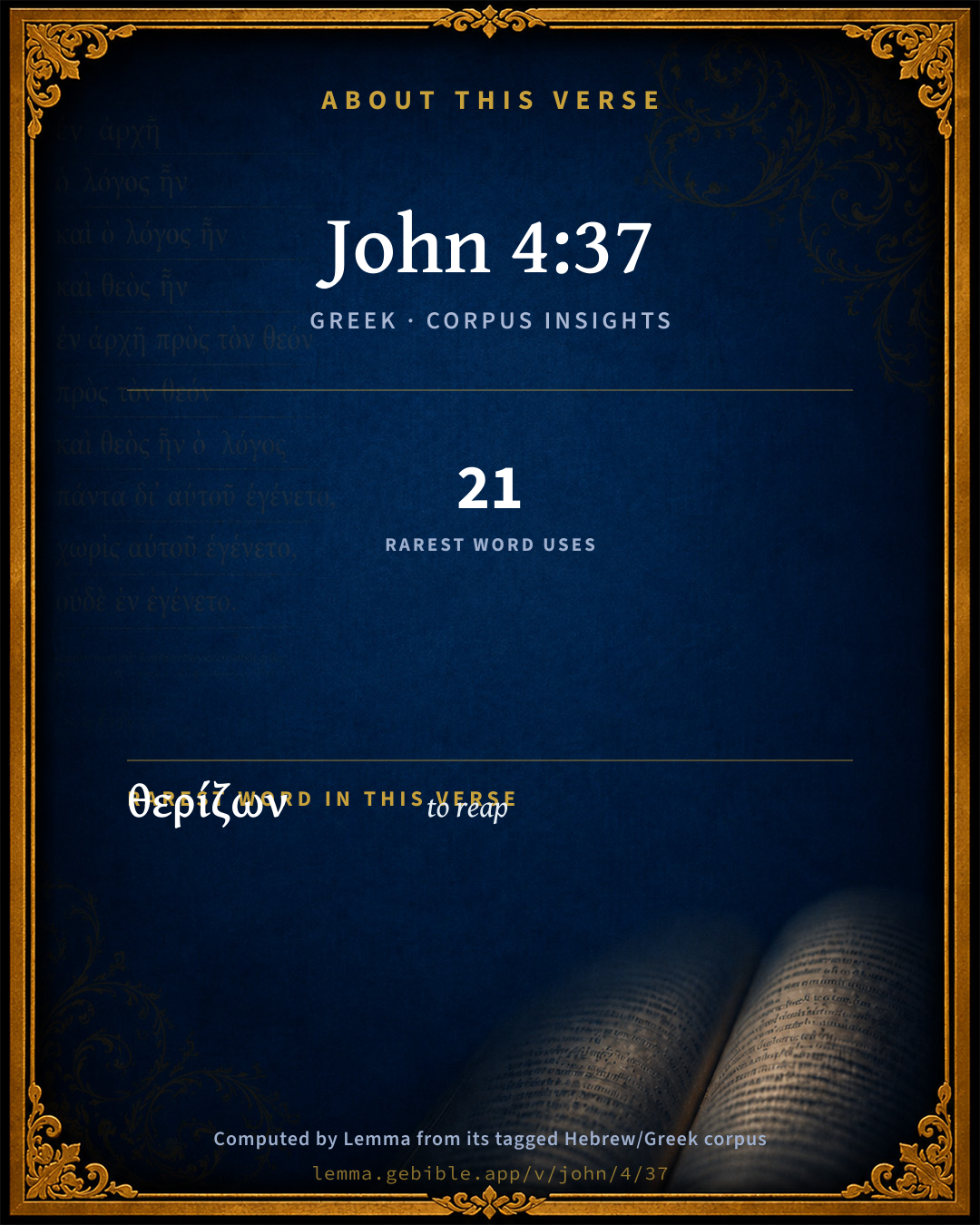
John 4:37

Greek (Tischendorf 8th ed.) John 4:37 appears in the Greek New Testament. The text above is from the Tischendorf 8th edition. Each word links to its Strong’s number and a concise gloss. Click any word for its full Thayer’s Greek Lexicon entry.

Download image
Cite this verse

John 4:37 (World English Bible). Public Domain. Lemma interlinear Bible study tool, https://lemma.gebible.app/v/john/4/37.

Show BibTeX & RIS
BibTeX
RIS
English Translation
For in this the saying is true, 'One sows, and another reaps.'
World English Bible · Public Domain
Download a study sheet

One document with this verse’s original text, its word-by-word gloss line, the meaning frame, cross-references with their text, attributed commentary, and full source and license credits — printable, and it pastes into notes with its structure intact.

This verse Autodidact and up

Study sheet (.html) Plain text (.txt)

A passage Seminary Student

Up to 50 verses in one chapter. A passage sheet keeps up to 6 commentary sources and 12 cross-references per verse, in the order this page ranks them, and says so on the sheet whenever that leaves anything out. Ask for a single verse and you get the Autodidact verse sheet above.

Everything on this page stays free to read, with no account — the sheet is a download of what is already on screen, not access to it.

Want to remove ads? Support Godless Engineer
Compare translations 3

The same verse in 3 English versions, stacked beneath the original-language interlinear above. Click any original word for its lexicon entry.

Each is an independent rendering of the whole verse — the interlinear is not word-aligned to these translations.

Highlighted words mark where these versions differ — a whole-verse word diff, not a word-by-word alignment.

  • World English Bible Public Domain
    For in this the saying is true, 'One sows, and another reaps.'
  • King James Version Public Domain
    And herein is that saying true, One soweth, and another reapeth.
  • unfoldingWord Literal Text CC BY-SA 4.0
    For in this the saying is true, ‘One is the one sowing, and another, the one harvesting.’

unfoldingWord Literal Text — © unfoldingWord, licensed CC BY-SA 4.0. Word-aligned USFM3 via Door43 (git.door43.org/unfoldingWord/en_ult).

Versions to compare (up to 4)

3 of 4 selected

Show all 19 translations

Every available English version of this verse, each an independent rendering of the whole verse.

  • World English Bible Public Domain
    For in this the saying is true, 'One sows, and another reaps.'
  • Berean Standard Bible Public Domain
    For in this case the saying ‘One sows and another reaps’ is true.
  • Majority Standard Bible Public Domain
    For in this case the saying ‘One sows and another reaps’ is true.
  • King James Version Public Domain
    And herein is that saying true, One soweth, and another reapeth.
  • American Standard Version (1901) Public Domain
    For herein is the saying true, One soweth, and another reapeth.
  • Revised Version (1885) Public Domain
    For herein is the saying true, One soweth, and another reapeth.
  • Geneva Bible (1599) Public Domain
    For herein is the saying true, that one soweth, and an other reapeth.
  • Douay-Rheims (1899) Public Domain
    For in this is the saying true: That it is one man that soweth, and it is another that reapeth.
  • Young's Literal Translation Public Domain
    for in this the saying is the true one, that one is the sower and another the reaper.
  • Literal Standard Version CC BY-SA 4.0
    for in this the saying is the true one, that one is the sower and another the reaper.
  • Unlocked Literal Bible CC BY-SA 4.0
    For in this the saying, 'One sows, and another harvests,' is true.
  • unfoldingWord Literal Text CC BY-SA 4.0
    For in this the saying is true, ‘One is the one sowing, and another, the one harvesting.’
  • Darby Bible Public Domain
    For in this is [verified] the true saying, It is one who sows and another who reaps.
  • World Messianic Bible Public Domain
    For in this the saying is true, ‘One sows, and another reaps.’
  • Webster's Bible Public Domain
    And herein is that saying true, One soweth, and another reapeth.
  • Free Bible Version CC BY-SA 4.0
    So the proverb ‘one sows, another reaps,’ is true.
  • Bible in Basic English Public Domain
    In this the saying is a true one, One does the planting, and another gets in the grain.
  • Text-Critical English NT CC BY 4.0
    For in this the true saying is verified: ‘One sows and another reaps.’
  • Tyndale New Testament (1534) Public Domain
    And herin is the sayinge true that one soweth and another repeth.

Literal Standard Version (2020), Covenant Press — licensed CC BY-SA 4.0. Text via the HelloAO Bible API (eBible.org). Unlocked Literal Bible (unfoldingWord) — licensed CC BY-SA 4.0. Text via the HelloAO Bible API (eBible.org). unfoldingWord Literal Text — © unfoldingWord, licensed CC BY-SA 4.0. Word-aligned USFM3 via Door43 (git.door43.org/unfoldingWord/en_ult). Free Bible Version, Dr. Jonathan Gallagher — licensed CC BY-SA 4.0. Text via the HelloAO Bible API (eBible.org).

Word by word

More ways to search: Search by grammar → Find every occurrence → Compare this word →

Practice this passage: Drill this verse → Learn its vocabulary →

θερίζων
therízō
G2325
“to reap”
Verb, Present, Active, Participle, Nominative, Singular, Masculine
Part of Speech
Verb
Tense
Present
Voice
Active
Mood
Participle
Case
Nominative
Number
Singular
Gender
Masculine
Full Thayer's Definition

Origin: from G2330 (in the sense of the crop)

TDNT: 05:12,3

1. to reap, harvest 2. proverbial expression for sowing and reaping 3. cut off, destroy a. as crops are cut down with a sickle
  1. ἐν en G1722 “in” Preposition
  2. γὰρ gár G1063 “for” Conjunction
  3. τούτῳ hoûtos G3778 “this” Demonstrative pronoun, Dative, Singular, Masculine
  4. ὁ ho G3588 “the” Article, Nominative, Singular, Masculine
  5. λόγος lógos G3056 “word” Noun, Nominative, Singular, Masculine
  6. ἐστὶν eimí G1510 “to be” Verb, Present, Active, Indicative, 3rd person, Singular
  7. ἀληθινός alēthinós G228 “genuine” Adjective, Nominative, Singular, Masculine
  8. ὅτι hóti G3754 “that” Conjunction
  9. ἄλλος állos G243 “another” Adjective, Nominative, Singular, Masculine
  10. ἐστὶν eimí G1510 “to be” Verb, Present, Active, Indicative, 3rd person, Singular
  11. ὁ ho G3588 “the” Article, Nominative, Singular, Masculine
  12. σπείρων speírō G4687 “to sow” Verb, Present, Active, Participle, Nominative, Singular, Masculine
  13. καὶ kaí G2532 “and” Conjunction
  14. ἄλλος állos G243 “another” Adjective, Nominative, Singular, Masculine
  15. ὁ ho G3588 “the” Article, Nominative, Singular, Masculine

About this verse

These counts appear in no published source. They are computed here, from the morphology-tagged text and Lemma’s own curated glosses. What Lemma adds →

16
words
12
distinct lemmas
Gospels
section

Notable vocabulary

The rarest word here is θερίζων to reap G2325 — appearing just 21 times in the whole Greek New Testament.

Shared distinctive vocabulary

θερίζων to reap G2325 occurs in 17 verses of the Greek New Testament. Also found in:

Repetition

Words recur within this verse:

  • ἐστὶν to be G1510 ×2
  • ἄλλος another G243 ×2
  • ὁ the G3588 ×3

Cross-references

4

Topical passages linked to John 4:37 in the Treasury of Scripture Knowledge — connected by theme and wording, ordered by reader-vote popularity; previews shown in the World English Bible.

  • Micah 6:15 You will sow, but won't reap. You will tread the olives, but won't anoint yourself with oil; And crush grapes, but won't drink the wine.
  • Job 31:8 Then let me sow, and let another eat; Yes, let the produce of my field be rooted out.
  • Judges 6:3 So it was, when Israel had sown, that the Midianites came up, and the Amalekites, and the children of the east; they came up against them;
  • Luke 19:21 for I feared you, because you are an exacting man. You take up that which you didn't lay down, and reap that which you didn't sow.'

Cross-references courtesy of OpenBible.info (CC BY 4.0).

Commentary

Notes on John 4:37 from classic Christian and Jewish commentators (each source and its license shown beneath its notes). The classic Christian expositions comment on the surrounding passage and are grouped to its opening verse, so a note may address several verses; the Jewish commentaries on the Tanakh (Rashi and others) are per-verse, so they appear only where the commentator wrote on this verse.

Lemma curates 59 commentaries, every one of them public domain or Creative Commons licensed, each selected and text-cleaned for this edition rather than reprinted as found. About our sources →

Joseph Benson's Commentary

Joh 4:37-38. Herein is that saying true — That common proverb; One soweth and another reapeth — He alludes to what often happens, namely, that after he has sown his field, a man dies before he gathers in the harvest, and so leaves it to another, who enjoys the advantage of his pains. But the application which our Lord makes of this proverb here, does not imply any discontent in the persons who sow without reaping, as it seems to do in common uses; for the sower and the reaper are represented as rejoicing together in the rewards of their spiritual husbandry. I sent you to reap that — The fruit of that; whereon ye bestowed no labour — No labour of tilling or sowing the ground. Other men laboured — Namely, the ancient prophets, in sowing the seeds of piety and virtue among the Jews, and thereby exposed themselves to great hardships, persecutions, and sufferings. And ye are entered into their labours — Ye are employed to reap the fruit of that seed which they with great difficulty sowed, for ye are gathering into the kingdom of God, into the gospel church here, and into the kingdom of glory hereafter, those who, by the writings of the prophets, having been endued with a sense of religion, are prepared for entering into it.

Joseph Benson's Commentary on the Old and New Testaments (1811–1818) — public domain. Text from a community e-Sword module.

Bengel's Gnomon

Johann Albrecht Bengel

Joh 4:37. Ὁ λόγος, the saying) The Subject is, The true saying: the Predicate, ἐστὶν, There is extant [or is apparent], A proverb which also was current among the Greeks.—ἄλλος, one) Most wisely a succession has been instituted in the Divine economy: sowing time in each case is [comes] first, in relation to the harvest that is to follow. Often the sower and reaper are one and the same person. But by reason of the period that intervenes, the same person becomes in some measure distinct from himself. Certainly each one is a sower in relation to his successors, and a reaper in relation to his predecessors; but the distinction chiefly referred to here is that between ministers of the Old and of the New Testament.—ἄλλος, another) Do not ask, why Messiah did not come sooner. The reply is ready at hand. The sowing time goes before by a long interval: the harvest quickly gathers [the fruit]. The Divine economy has its delays exactly answering the end contemplated. Comp. Rom 5:6,—“When we were yet without strength, in due time Christ died for the ungodly,”—notes.

Bengel's Gnomon of the New Testament — English translation (T&T Clark, Edinburgh, 1860) — public domain. Text from a community e-Sword module.

Meyer's Critical & Exegetical Commentary

Heinrich August Wilhelm Meyer

Joh_4:37-38. As well the sower as the reaper, I say, for in this case they are different persons.

ἐν γὰρ τούτῳ, κ.τ.λ.] for herein, in this relation of sowing and reaping, the saying (the proverb of ordinary life, τὸ λεγόμενον, Plato, Gorg. p. 447 A; Phaed. p. 101 D; Pol. x. p. 621 C; comp. ὁ παλαιὸς λόγος, Phaed. p. 240 C; Gorg. p. 499 C; Soph. Trach. i.) has its essential truth, i.e. its proper realization, setting forth its idea. Comp. Plat. Tim. p. 2 6 E: μὴ πλασθέντα μῦθον, ἀλλʼ ἀληθινὸν (i.e. a real) λόγον. The reference of the λόγος to the words of the servant, Mat_25:24, which Weizsäcker considers probable,[196] would be very far-fetched; the rendering of ἀληθινός, however, as equivalent to ἀληθής, 2Pe_2:22 (de Wette and many others), is quite opposed to the idiosyncrasy of John (so also Joh_19:35). The article before ἀληθ., which through want of attention might easily have been omitted (B. C.* K. L. T.b Δ. Or.), marks off the predicate with exclusive definiteness. Comp. Bernhardy, p. 322; Kühner, II. 140. With respect to other relations (not ἐν τουτῷ), the proverb does not express its proper idea.

As to the proverb itself, and its various applications, see Wetstein. The ἀληθινόν of it is explained in Joh_4:38.

ἐγώ] with emphasis: I, consequently the sower in the proverb.

The preterites ἀπέστειλα and εἰσεληλ. are not prophetic (de Wette, Tholuck), but the mission and calling of the disciples were already practically involved in their reception into the apostolate.[197] Comp. Joh_17:8.

ἄλλοι and αὐτῶν refer to Jesus (whom Olshausen, indeed, according to Mat_23:34, even excludes!), not to the prophets and the Baptist, nor to them together with Christ (so the Fathers and most of the early writers, also Lange, Luthardt, Ewald, and most others), nor in a general way to all who were instrumental in advancing the preparatory economy (Tholuck). They are plurals of category (see on Mat_2:20; Joh_3:11), representing the work of Christ, into which the disciples entered, as not theirs, but others work, i.e. a distinct and different labour. But the fact that Jesus was the labourer, while self-evident from the connection, is not directly expressed, but with intentional self-renunciation, half concealed beneath the plural ἄλλοι. He it was who introduced the conversion of mankind; the disciples were to complete it. He prepared and sowed the field; they were called upon to do what was still further necessary, and to reap. The great toil of the apostles in fulfilling their call is not denied; but, when compared with the work of Jesus Himself, it was the easier, because it was only the carrying on of that work, and was encouragingly represented under the cheerful image of harvesting (comp. Isa_9:3; Psa_126:6). If ἄλλοι is to be taken as referring to Philips work in converting the Samaritans, Act_8:25, upon which Peter and John entered (Baur), or to Pauls labour among the heathen, the fruit of which is to be attributed to the first apostles (Hilgenfeld), any and every exegetical impossibility may be with equal right allowed by a ὕστερον πρότερον of critical arbitrariness.

[196] Weizsäcker, in his harmony of the words of John with those of the Synoptics, in which the latter are dealt with very freely (p. 282 ff.), brings in general much that is far-fetched into parallelisms which cannot be demonstrated. The intellectual independence of personal recollection and reproduction in John raises him above any such search after supposed borrowings.

[197] According to Godet, ἀπέστ, is to be taken as referring to a summons, discovered by him in ver. 36, to the work of reaping among the approaching Sycharites. He then takes ἄλλοι κεκοπ. to refer to the labour of Jesus in His interview with the woman. The latter words are said to have been spoken to the disciples, who thought He had been resting during their absence, with a finesse quon oserait presque appeller légèrement malicieuse, and with an aimable sourire. Such weighty thoughts as ἀποστολή and κόπος represent are utterly incompatible with such side hints and passing references. And it is a pure invention to find in ver. 36 an invitation à prendre la faucille.

Meyer — Critical and Exegetical Commentary on the New Testament — English translation by Peter Christie, edited by Frederick Crombie (T&T Clark, 1880) — public domain. Text from a community e-Sword module.

Expositor's Greek Testament

ed. W. Robertson Nicoll

Joh 4:37 . ἐν γὰρ τούτῳ . For in this, i.e. , in the circumstances explained in the following verse, namely, that I have sent you to reap what others sowed, is the saying verified, “one soweth and another Lapeth”. ὁ λόγος , “the saying”; cf. 1Ti 1:15 ; 1Ti 3:1 , etc. ἀληθινός without the article is the predicate and scarcely expresses that the saying receives in the present circumstances its ideal fulfilment, rather that the saying is shown to be genuine; the saying is ἄλλος ἐστὶν ὁ σπείρων καὶ ἄλλος ὁ θερίζων , various forms of which are given by Wetstein; as, ἄλλοι μὲν σπείρουσιν , ἄλλοι δʼ αὖ ἀμήσονται , “sic vos non vobis”; cf. Job 31:8 ; Mic 6:15 ; Deu 6:11 . [“It was objected to Pompey that he came upon the victories of Lucullus and gathered those laurels which were due to the fortune and valour of another,” Plutarch.]

The Expositor's Greek Testament, edited by W. Robertson Nicoll (1897–1910) — public domain. Text from a community e-Sword module.

Godet's Commentaries

Frédéric Louis Godet

Vv. 37, 38. “For herein is the saying true: The sower is one and the reaper another. 38. I sent you to reap that whereon ye have not labored; other men labored, and ye are entered into their labor.”

According to Tholuck, Jesus is grieved at the thought that He is not Himself to be present at the conversion of the Gentiles, after having prepared the way for it, and to this point it is that the proverb refers. Astie appears to be of the same opinion. Westcott thinks that Jesus prepares the apostles for the future disappointments in the apostleship. They would then be the sowers who do not reap, while the whole context proves that only Jesus can be so. Weiss: In this region of the spiritual harvest it is not as in ordinary harvests, where the sower is often the same as the reaper. But then the origin of the common maxim which Jesus quotes is not explained, for it expresses just the contrary of what would most frequently be the case in life.

Then, this sense of ἐν τούτῳ, “in the spiritual domain,” is hardly natural. This form of expression has rather a logical sense: “In this,” that is, “in that you reap to-day what has been sown in your absence and without your knowledge” (Joh 4:36): thus is the common saying verified. For if this proverb is false in the sense which is ordinarily assigned to it, namely, that he who does the main part of the labor is rarely the one who gathers the fruit of it (an accusation against Providence), it is nevertheless true in this respect, that there is a distinction of persons between him who has the charge of sowing and him who has the mission of reaping. This distinction was at the foundation (for) of the saying in Joh 4:36, since the community of joy declared in that verse rests upon the duality of persons and offices affirmed by the proverb Joh 4:37 : “one...another....”— ᾿Αληθινός, not in the sense of ἀληθής, veritable, which says truth, but in the ordinary Johannean sense: which answers to the idea of the thing; thus: The or (without the ὁ) a saying which is the true maxim to be pronounced. This distinction, of which they have this day the evidence, between him who sows and him who reaps—on this it is that the whole activity to which Jesus has called them will rest: such is the idea of Joh 4:38.

Ver. 38. As preachers, the apostles will do nothing but reap that which has been painfully sown by others.These last are, undoubtedly, John the Baptist and Jesus Himself, those two servants who, after having painfully ploughed the furrow, have watered with their blood the seed which they had deposited in it. Only there is ordinarily a misapprehension of the allusion which Jesus makes to the particular fact which has given occasion to these words, and which is, as it were, an illustration of them. “That will happen in all your career which is occurring to-day.” I have sent you to reap: Jesus had done this by calling them to the apostleship (Joh 6:70; Luk 6:13).— That on which you have not labored: This harvest in Samaria—they have not prepared it, any more than they have prepared that which they will reap afterwards in preaching the Gospel. Others have labored: in the present case, Jesus and the Samaritan woman—the one by His word, the other by her eager hastening. What an enigma for the disciples—this population hastening to Jesus to surrender themselves to His divine influence,—and, what is more, Samaritans! What has taken place in their absence?

Who has prepared such a result? Who has sown this sterile ground? Jesus seems to rejoice in their surprise. And it is, no doubt, with a friendly smile that He throws out to them these mysterious words: Others labored. They may see here an example of what they will afterwards experience: In all their ministry nothing different will occur. Commentators discuss the question whether, by this word others, Jesus designates Himself alone (Lucke, Tholuck, de Wette, Meyer and Weiss), taking others as the plural of category; or Himself and the prophets, including John the Baptist (Keil); or all these personages except Jesus (Olshausen). Westcott applies this word others to all the servants of God in the Old Testament (perhaps with an allusion to Jos 24:13).

The disciples have entered into the work of their predecessors through their fruitful ministry in Judea (Joh 4:2). But to what end say all this precisely in Samaria? The two most curious explanations are certainly those of Baur and Hilgenfeld. According to the first, by the term others, Jesus designates the evangelist Philip (Acts 8), and by the reapers, the apostles, Peter and John, in the story in Act 8:15. To the view of the second, the term others designates St. Paul; and the reapers are the Twelve, who seek to appropriate to themselves the fruit of his labor among the Gentiles. On these conditions, one might wager that he could find anything in any text whatever. These forced meanings and the grave critical consequences which are drawn from them, arise in large measure from the fact that the wonderful appropriateness of these words of Jesus, as He applied them to the given situation, has not been apprehended.

Jesus is thinking undoubtedly on His own work and that of John, and the perfect: you are entered, is indeed that which is ordinarily understood by it, a prophetic anticipation; but this form can be well explained only by means of a present fact which suggests it. We discover here, with Gess, the contrast between the manner in which Jesus regarded His work and the idea which the forerunner had formed of it beforehand. “For the latter the time of the Messiah was the harvest; Jesus, on the contrary, here regards the days of His flesh as a mere time of sowing.” We can understand how it must have been more and more difficult for John to bring his thought into accord with the work of Jesus.

The heavenly joy which fills the Lord’s heart throughout this section has its counterpart only in the passage, Luk 10:17-24. Here it even assumes a character of gaiety. Is it John’s fault, if Renan finds in the Jesus of the fourth Gospel only a heavy metaphysician?

Frédéric Louis Godet — Commentaries on Luke, John, Romans, and 1 Corinthians — English translation (T&T Clark, Edinburgh, 1870s–1890s) — public domain. Text from a community e-Sword module.

Geneva Bible (1599)

Geneva Bible translators

That proverb.

Geneva Bible (1599) marginal notes — public domain. Text via Bolls.life.

Adam Clarke's Commentary

Verse 37. Herein is that saying true, One soweth, and another reapeth.] Or, One is the sower, and another is the reaper. In what respects you, of this business, this proverb is true-One is the sower, c., for I have sent you to reap, to preach my Gospel, and gain converts, where ye have not laboured-have not sown the first seeds of eternal life. Others have laboured-the patriarchs and prophets, and ye are entered into the fruits of their labours. They announced the Messiah who was to come, and the expectation of the people was excited, and they longed for his appearance but they were gathered to their fathers before they could see the fruit of their labour. You are come to tell the people that the kingdom of God is among them, and that God has visited his people.

The proverb which our Lord mentions above was taken from what ordinarily happens in the course of the Divine providence, where one takes a great deal of pains to procure that of which another reaps the benefit. See instances of this proverb, Le 26:16: Ye shall sow your seed in vain, for your enemies shall eat it. Mic 6:15: Thou shalt sow, but thou shalt not reap; thou shalt tread the olives, but not anoint thee with the oil. See also Ho 7:9. The Greeks had the same proverb: Αλλοι μεν σπερουσι, αλλοι δ'αν αμησονται. So had the Latins: Aliis leporem excitasti. You have beat the bush, and another has found the hare. See the famous verses of Virgil beginning with, Sic vos non vobis, in which the fowls, the sheep, the bees, and the oxen, are elegantly brought in as illustrations of the propriety of the proverb.

Sic vos non vobis nidificatis aves.

Sic vos non vobis vellera fertis oves.

Sic vos non vobis mellificatis apes.

Sic vos non vobis fertis aratra boves.

So you, ye birds, of wondrous skill possest,

Not for yourselves construct the curious nest.

So you, ye sheep, who roam the verdant field,

Not for yourselves your snowy fleeces yield,

So you, ye bees, who every flower explore,

Not for yourselves amass the honied store.

So you, ye patient kine, inured to toil,

Not for yourselves subdue the stubborn soil!

Bishop Pearce gives this text a remarkable turn. The verse he translates thus: I sent you away, that ye might reap that whereon ye bestowed no labour; i.e. I did not send you to the city (Joh 4:8) for this purpose only, that ye might buy meat; but I sent you away chiefly with this intent, that there might be a harvest for you to reap upon your return; though you sowed no seed, and bestowed no labour for that purpose. While you were gone, I sowed spiritual seed in the heart of a Samaritan woman; and she is gone, and is about to return with many of her city, whom she has brought to believe, (Joh 4:39-42.) These, and the many more which will believe upon hearing my doctrine, (Joh 4:41,) will all be a harvest arising out of the seed which I sowed in your absence, and on which, therefore, ye bestowed no labour. He farther adds, that the Greek θεριζειν, stands for του θεριζειν, and such expressions are often used to signify, not the end and design, but the event only. Pearce's Comment.

Adam Clarke's Commentary on the Bible (1810–1826) — public domain. Text from a community e-Sword/MySword module.

John Calvin's Commentaries

37. For in this is the saying true. This was a common proverb, by which he showed that many men frequently receive the fruit of the labor of others, though there was this difference, that he who has labored is displeased at seeing the fruit carried away by another, whereas the Apostles have the Prophets for the companions of their joy. And yet it cannot be inferred from this, that the Prophets themselves are witnesses, or are aware, of what is now going on in the Church; for Christ means nothing more than that the Prophets, so long as they lived, taught under the influence of such feelings, that they already rejoiced on account of the fruit which they were not permitted to gather. The comparison which Peter employs (1 Peter 1:12) is not unlike; except that he addresses his exhortation generally to all believers, but Christ here speaks to the disciples alone, and, in their person, to the ministers of the Gospel. By these words he enjoins them to throw their labors into a common stock, so that there may be no wicked envy among them; that those who are first sent to the work ought to be so attentive to the present cultivation as not to envy a greater blessing to those who are afterwards to follow them; and that they who are sent, as it were, to gather the ripe fruit, ought to be employed with equal cheerfulness in their office; for the comparison which is here made between the teachers of the Law and of the Gospel may likewise be applied to the latter, when viewed in reference to each other.

John Calvin's Commentaries (1540-1563) — public domain. Text from the Calvin Translation Society English edition (1840s-50s) via the Christian Classics Ethereal Library (ccel.org). Calvin's coverage is partial (roughly two-thirds of the Bible); uncommented books and verses are honest gaps, never fabricated. The 19th-century editor's footnotes and remarks are omitted so the notes are faithfully Calvin's own voice.

Ellicott's Commentary for English Readers

(37) Herein is that saying true—i.e., in the deeper sense of the word true (comp. Note on Joh_1:9)—has its realisation; is ideally true. The proverb itself was known both to the Greeks and to the Romans (sec examples in Schottgen and Lampe), but the reference is probably to the Old Testament Scriptures. Those who heard it would certainly think of such passages as Deu_6:11, or Isa_65:21-22. The saying expressed something of the bitterness of human disappointment, which in darker moments all men have felt. They have sown in hopes and plans and works, which have never sprung above the surface, or have been reaped in their results by other men; or they themselves have passed away before the harvest has come. This is as men see it, but this is not the ideal truth. The saying is realised in the relation between sower and reaper, which was true then, and holds true of every sower who really sows the good seed. He, too, has a daily work and a daily sustenance in the will of Him that sent him. In the inner consciousness of that work being done, and the hope of its completion, he has food no less real than that of him who reaps the harvest. That he stands alone is the result of his rising above his generation; that he is little understood, or rewarded, by those for whom he works, will be a disappointment to his friends, but, in his truest thoughts, not to himself. His satisfaction will be hard for men to understand. “Surely no one has brought him to eat!” “I have food to eat that ye know not of.” Men smile at this as sentiment or enthusiasm, but this food has been the strength of the best lives, and noblest deeds, of humanity.

A Bible Commentary for English Readers, edited by Charles John Ellicott (1878–1897) — public domain. Text from a community e-Sword module.

The Cambridge Bible for Schools and Colleges

gen. ed. J. J. S. Perowne

37. And herein is that saying true] Rather, For herein is the saying (proved) true, i.e. is shewn to be the genuine proverb capable of realisation, not a mere empty phrase. ‘True’ is opposed to ‘unreal’ not to ‘lying.’ See on Joh_4:23, Joh_1:9 and Joh_7:28. ‘Herein’ refers to what precedes: comp. Joh_15:8 and ‘by this’ which represents the same Greek in Joh_16:30.

The Cambridge Bible for Schools and Colleges (gen. ed. J. J. S. Perowne; Cambridge University Press, 1878–1918) — public domain. Text from a community e-Sword module.

John Gill's Exposition

And herein is that saying true,.... This verifies that proverbial expression so much in use, and which may be applied to different persons and cases:

one soweth, and another reapeth; the prophets sowed, and the apostles reaped.

John Gill's Exposition of the Whole Bible (1746–1763) — public domain (CC PDM 1.0). Text via the HelloAO Bible API.

Trapp's Complete Commentary

John Trapp

37 And herein is that saying true, One soweth, and another reapeth.

Ver. 37. That saying true, &c.] Camerdrius recites the Senary at large.

Αλλοι μεν σπειρους’, αλλοι δ αυ αμησονται.

John Trapp, A Commentary or Exposition upon All the Books of the Old and New Testament (1647–1656) — public domain. Text from a community e-Sword module.

Albert Barnes' Notes on the Bible

That saying - That proverb. This proverb is found in some of the Greek writers (Grotius). Similar proverbs were in use among the Jews. See Isa 65:21-22; Lev 26:16; Mic 6:15.

One soweth ... - One man may preach the gospel, and with little apparent effect; another, succeeding him, may be crowned with eminent success. The seed, long buried, may spring up in an abundant harvest.

Albert Barnes' Notes on the Bible (1834–1885) — public domain. Text from a community e-Sword/MySword module.

Matthew Poole's English Annotations

It was a proverbial expression, most commonly used with reference to those who unjustly invaded the rights and possessions of other men; but as applicable unto those who, by the disposing providence of God, rightly inherit the fruit of other men’s labours, as the Jews inherited the land of Canaan; A land for which ye did not labour, and cities which ye built not, Jos 24:13. This saying (saith our Saviour) is fulfilled in you.

Matthew Poole's English Annotations on the Holy Bible (1683–1685) — public domain. Text from a community e-Sword/MySword module.

Whedon's Commentary on the Bible

Daniel D. Whedon

37. One soweth—Many a sower does not see the harvest. Many a writer, preacher, advocate for truth, implants the doctrine, but never sees it spring up into glorious revival and salvation. Many a such revival has been prepared by a weeping and perhaps discouraged predecessor.

Daniel D. Whedon (gen. ed.), Commentary on the Old and New Testaments (1874–1909) — public domain. Text from a community e-Sword module.

The Pulpit Commentary

For herein in this harvest field, already whitening before your eyesis the word veritably realized it finds an ideal illustration of its meaningOne is the sower, and another is the reaper. It belongs to all common experience in such things; the first stone is laid by one, the topstone by another. The toil and tears of the sower with the precious seed are often the reason why another returns with joy, bringing his sheaves with him. It is an all-but universal law. Children inherit the toil of their fathers. We all stand where the shoulders of the mighty dead have lifted us. Still, though one be the sower and another is the reaper in this Samaritan field, yet, since "already" the reaper is busy with the sickle, the sower and reapers may rejoice together. The law will be established on a grander scale by and by, when the great Sower, who is the Lord of the harvest, shall send forth all his reapers to their great enterprise, and he and they will rejoice together.

The Pulpit Commentary (1880–1919), ed. H.D.M. Spence-Jones & Joseph S. Exell — public domain. Text from a community e-Sword module.

John Wesley's Explanatory Notes

That saying - A common proverb; One soweth - The prophets and Christ; another reapeth - The apostles and succeeding ministers.

John Wesley, Explanatory Notes Upon the Whole Bible (1754–1765) — public domain. Text via the GEBible commentary corpus.

The People's New Testament

B. W. Johnson

37. One soweth, and another reapeth. This was a common proverb, growing out of constant human experience, true of worldly and spiritual things. How often has the patient pastor sowed, and then the evangelist has reaped in a meeting the results!

B. W. Johnson's The People's New Testament with Notes (1889–1891) — public domain. Electronic text from the Christian Classics Ethereal Library (CCEL) ThML edition.

unfoldingWord translationNotes

Door43 World Missions Community

Connecting Statement:

Jesus continues speaking to his disciples.

One sows, and another harvests

The words "sows" and "harvests" are metaphors. The one who "sows" shares the message of Jesus. The one who "harvests" helps the people to receive the message of Jesus. AT: "One person plants the seeds, and another person harvests the crops" (See: Metaphor)

you have entered into their labor

"you are now joining in their work"

translationWords

true

harvest

labor

unfoldingWord translationNotes — © Distant Shores Media and the Door43 World Missions Community, licensed CC BY-SA 4.0. Source: git.door43.org/Door43/en_tn.

Cambridge Greek Testament for Schools and Colleges

37. ἐν γὰρ … ἀληθινός. For herein is the saying (proved) a true one, shewn by fulfilment to be a genuine proverb and not an empty phrase. See on Joh 4:23, Joh 7:28, Joh 19:35. Ἐν τούτῳ refers to what precedes (comp. Joh 15:8, Joh 16:30), in your reaping what others sowed (Joh 4:35-36).

Cambridge Greek Testament for Schools and Colleges (Cambridge University Press, 1896; 21 vols, various authors incl. Carr, Maclear, Plummer, Farrar, Lumby, Moule, M. R. James, Simcox) — public domain. Text from a community e-Sword module.

Alford’s Greek Testament

Henry Alford

37.] ὁ λόγ. ἐστιν [ὁ] ἀλ., i.e. has place,—applies = συμβέβηκεν in 2Pe 2:22. So Winer, Meyer (1), Stier, but contr. Lücke, De Wette, who question the propriety of the art. and take [ὁ] ἀληθινός for the predicate, and as = ἀληθής. John’s usage however is to join ὁ λόγ. ὁ ἀληθινός: see ch. 15:1. We may also take the words, without doing any violence to the art. before ἀληθινός, ‘Herein is that saying the true one.’ But I still prefer the other way. If we regard the bracketed article as omitted, the sense will of course be, ‘Herein is that saying true.’ Such however is not St. John’s usage: see above.

Henry Alford, The Greek Testament (1849–1861) — public domain. Text from a community e-Sword module.

International Critical Commentary

37. The rec. text has ὁ before ἀληθινός, but om. א BC*LNTbWΔ.

ἐν γὰρ τούτῳ κτλ., “Herein is the saying true (ἀληθινός, for which see on 1:9), One soweth, and another reapeth.” Another proverb is cited here, for which many parallels can be found. Wetstein quotes ἄλλοι μέν σπείρουσιν, ἄλλοι δʼ ἀμήσονται.

That the sower should not have the joy of reaping is regarded in the O.T. as a sad thing (Job 31:8), and is spoken of as a punishment for sin (Deu 28:30, Mic 6:15). Yet this often happens, not through sin but through the unselfishness of the sower or the inevitable conditions of his work. So here, Jesus was the Sower, but He permitted His disciples to reap. And the labourer in the field of the spirit must be ready to acknowledge that “One sows, another reaps,” may be a condition of his highest usefulness. “Sic uos, non uobis” is his Master’s challenge.

But more was involved here, and a greater paradox than is suggested by the reaper being a different person from the sower. That a man should reap where he had not sown is, indeed, ordinarily a matter for peculiar thankfulness on his part (Deu 6:11, Jos 24:13); but this privilege is the natural prerogative of the lord of the. fields, who sends his servants to sow, but takes the harvest for himself (Mat 25:26). Yet Jesus, who was here the Lord of the harvest, had Himself done the sowing, while He permitted His servants to gather the fruits.

Hence ἀληθινός means more than ἀληθής here. The proverb is not only accurate, if cynical, in regard to the physical harvest; but the highest illustration of its truth is seen in the spiritual region. Cf. Abbott, Diat. 1727i.

International Critical Commentary — older volumes (1896–1929), various authors — public domain. Text from a community e-Sword module.

Vincent's Word Studies in the New Testament

Marvin R. Vincent

Herein [εν τουτω] . Literally, in this. In this relation between sower and reaper.

Is that saying true [ο λογος εστιν ο αληθινος] . Rev., properly, the saying; the common proverb. True : not only says the truth, but the saying is completely fulfilled according to the ideal in the sowing and reaping of which Jesus speaks. The literal rendering of the Greek, as given above, is, "the saying is the true (saying);" but several high authorities omit the article before true.

Marvin R. Vincent, Word Studies in the New Testament (1887–1900) — public domain. Text from a community e-Sword/MySword module.

Lesson kit

Teaching starters — assembled from the data on this page, not authored interpretation. Every prompt links to the verse data it draws on. Edit before teaching.

John, in the Gospels, opens this verse with 16 words (12 distinct Greek lemmas). Its most distinctive word is therízō (“to reap”). A historical commentator’s framing appears above. Read the whole chapter for the surrounding context.

Discussion questions

  1. How does “to reap” (therízō) shape what this verse is saying?
  2. How does Matthew 6:26, which shares the word «to reap», read alongside this verse?
  3. What does the repetition of “to be” (2× in this one verse) do in this verse?
  4. The translations on this page render this verse differently — a whole-verse word diff, not a word-by-word alignment. What might account for the different wordings?
  5. Compare how Joseph Benson's Commentary and Bengel's Gnomon read this verse. Where do they agree or differ?

Things to notice

  • These translations choose different wording for 7 words in this verse.
  • “to be” occurs 2× in this single verse.
  • 12 distinct Greek lemmas span 16 words in this verse.

Reading settings

Reading text

Shown beneath each verse's original-language words.

Old Testament
Old Testament edition

Read the OT as the Masoretic Hebrew (MT) or the Greek Septuagint (LXX).

English shown for the Greek Septuagint (in the Hebrew ↔ Greek comparison).

Comparing translations? Open the Compare panel on any verse page to stack up to four side by side.