John 1:34

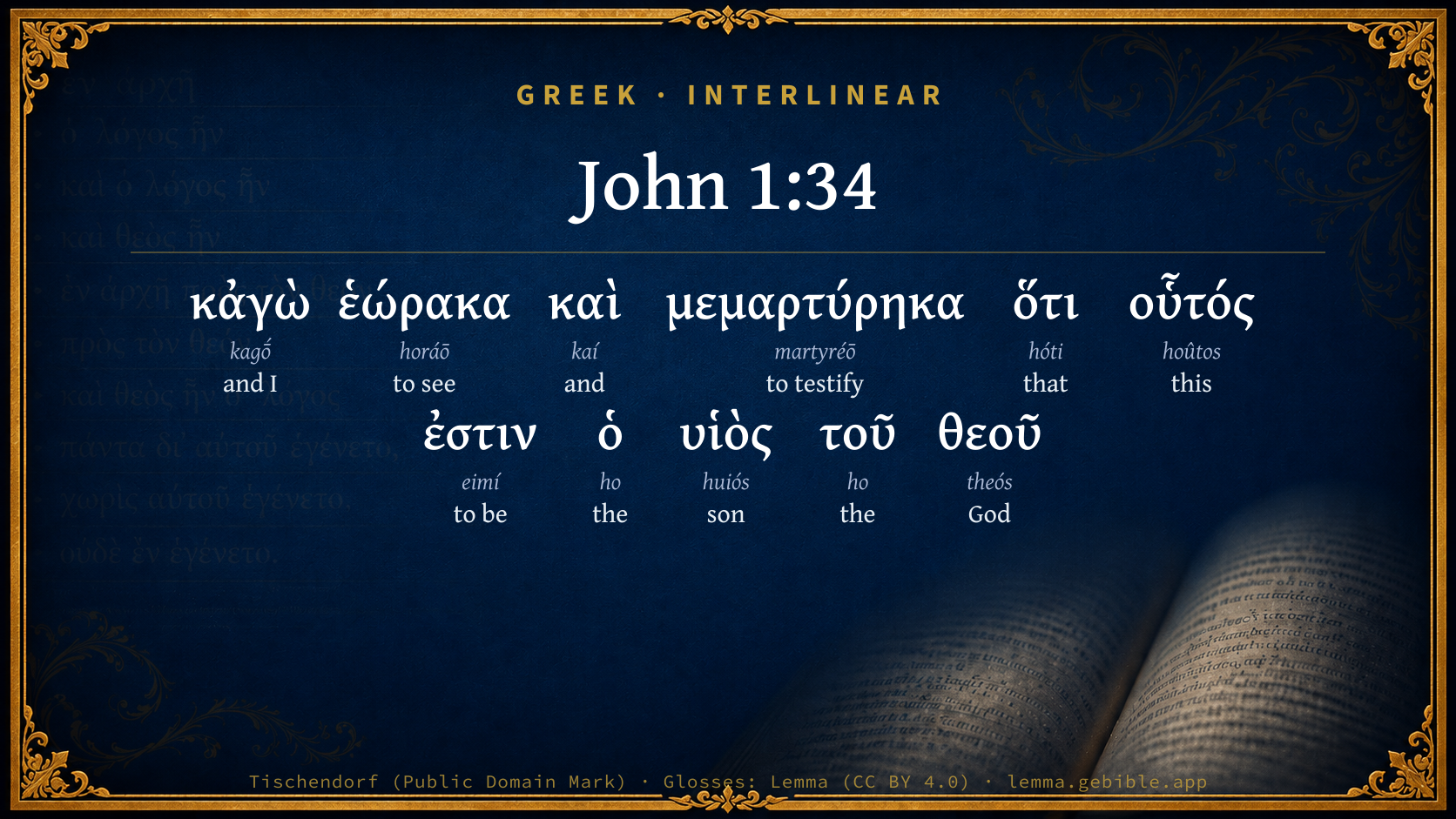
Greek (Tischendorf 8th ed.) John 1:34 appears in the Greek New Testament. The text above is from the Tischendorf 8th edition. Each word links to its Strong’s number and a concise gloss. Click any word for its full Thayer’s Greek Lexicon entry.
Download image
Cite this verse

John 1:34 (World English Bible). Public Domain. Lemma interlinear Bible study tool, https://lemma.gebible.app/v/john/1/34.

Show BibTeX & RIS
BibTeX
RIS
English Translation
I have seen, and have testified that this is the Son of God."
World English Bible · Public Domain
Download a study sheet

One document with this verse’s original text, its word-by-word gloss line, the meaning frame, cross-references with their text, attributed commentary, and full source and license credits — printable, and it pastes into notes with its structure intact.

This verse Autodidact and up

Study sheet (.html) Plain text (.txt)

A passage Seminary Student

Up to 50 verses in one chapter. A passage sheet keeps up to 6 commentary sources and 12 cross-references per verse, in the order this page ranks them, and says so on the sheet whenever that leaves anything out. Ask for a single verse and you get the Autodidact verse sheet above.

Everything on this page stays free to read, with no account — the sheet is a download of what is already on screen, not access to it.

Want to remove ads? Support Godless Engineer
Compare translations 3

The same verse in 3 English versions, stacked beneath the original-language interlinear above. Click any original word for its lexicon entry.

Each is an independent rendering of the whole verse — the interlinear is not word-aligned to these translations.

Highlighted words mark where these versions differ — a whole-verse word diff, not a word-by-word alignment.

  • World English Bible Public Domain
    I have seen, and have testified that this is the Son of God."
  • King James Version Public Domain
    And I saw, and bare record that this is the Son of God.
  • unfoldingWord Literal Text CC BY-SA 4.0
    And I have seen and have testified that this is the Son of God.”

unfoldingWord Literal Text — © unfoldingWord, licensed CC BY-SA 4.0. Word-aligned USFM3 via Door43 (git.door43.org/unfoldingWord/en_ult).

Versions to compare (up to 4)

3 of 4 selected

Show all 19 translations

Every available English version of this verse, each an independent rendering of the whole verse.

  • World English Bible Public Domain
    I have seen, and have testified that this is the Son of God."
  • Berean Standard Bible Public Domain
    I have seen and testified that this is the Son of God.”
  • Majority Standard Bible Public Domain
    I have seen and testified that this is the Son of God.”
  • King James Version Public Domain
    And I saw, and bare record that this is the Son of God.
  • American Standard Version (1901) Public Domain
    And I have seen, and have borne witness that this is the Son of God.
  • Revised Version (1885) Public Domain
    And I have seen, and have borne witness that this is the Son of God.
  • Geneva Bible (1599) Public Domain
    And I sawe, and bare record that this is that Sonne of God.
  • Douay-Rheims (1899) Public Domain
    And I saw, and I gave testimony, that this is the Son of God.
  • Young's Literal Translation Public Domain
    and I have seen, and have testified, that this is the Son of God.'
  • Literal Standard Version CC BY-SA 4.0
    and I have seen, and have testified, that this is the Son of God.”
  • Unlocked Literal Bible CC BY-SA 4.0
    I have both seen and testified that this is the Son of God.”
  • unfoldingWord Literal Text CC BY-SA 4.0
    And I have seen and have testified that this is the Son of God.”
  • Darby Bible Public Domain
    And I have seen and borne witness that this is the Son of God.
  • World Messianic Bible Public Domain
    I have seen and have testified that this is the Son of God.”
  • Webster's Bible Public Domain
    And I saw and bore testimony, that this is the Son of God.
  • Free Bible Version CC BY-SA 4.0
    I saw it happen and I declare that this is the Son of God.”
  • Bible in Basic English Public Domain
    This I saw myself and my witness is that he is the Son of God.
  • Text-Critical English NT CC BY 4.0
    And I have seen it and can testify that this is the Son of God.”
  • Tyndale New Testament (1534) Public Domain
    And I sawe and bare recorde that this is the sonne of God.

Literal Standard Version (2020), Covenant Press — licensed CC BY-SA 4.0. Text via the HelloAO Bible API (eBible.org). Unlocked Literal Bible (unfoldingWord) — licensed CC BY-SA 4.0. Text via the HelloAO Bible API (eBible.org). unfoldingWord Literal Text — © unfoldingWord, licensed CC BY-SA 4.0. Word-aligned USFM3 via Door43 (git.door43.org/unfoldingWord/en_ult). Free Bible Version, Dr. Jonathan Gallagher — licensed CC BY-SA 4.0. Text via the HelloAO Bible API (eBible.org).

Word by word

More ways to search: Search by grammar → Find every occurrence → Compare this word →

Practice this passage: Drill this verse → Learn its vocabulary →

μεμαρτύρηκα
martyréō
G3140
“to testify”
Verb, Perfect, Active, Indicative, 1st person, Singular
Part of Speech
Verb
Tense
Perfect
Voice
Active
Mood
Indicative
Person
1st person
Number
Singular
Full Thayer's Definition

Origin: from G3144

TDNT: 11:54,6

1. to be a witness, to bear witness, i.e. to affirm that one has seen or heard or experienced something, or that he knows it because taught by divine revelation or inspiration a. to give (not to keep back) testimony b. to utter honourable testimony, give a good report c. conjure, implore
  1. κἀγὼ kagṓ G2504 “and I” Personal pronoun, 1st person, Nominative, Singular, Aramaic form
  2. ἑώρακα horáō G3708 “to see” Verb, Perfect, Active, Indicative, 1st person, Singular, Attic form
  3. καὶ kaí G2532 “and” Conjunction
  4. ὅτι hóti G3754 “that” Conjunction
  5. οὗτός hoûtos G3778 “this” Demonstrative pronoun, Nominative, Singular, Masculine
  6. ἐστιν eimí G1510 “to be” Verb, Present, Active, Indicative, 3rd person, Singular
  7. ὁ ho G3588 “the” Article, Nominative, Singular, Masculine
  8. υἱὸς huiós G5207 “son” Noun, Nominative, Singular, Masculine
  9. τοῦ ho G3588 “the” Article, Genitive, Singular, Masculine
  10. θεοῦ theós G2316 “God” Noun, Genitive, Singular, Masculine

About this verse

These counts appear in no published source. They are computed here, from the morphology-tagged text and Lemma’s own curated glosses. What Lemma adds →

11
words
10
distinct lemmas
Gospels
section

Repetition

A word recurs within this verse:

Cross-references

42

Topical passages linked to John 1:34 in the Treasury of Scripture Knowledge — connected by theme and wording, ordered by reader-vote popularity; previews shown in the World English Bible.

  • Psalms 2:7 I will tell of the decree. Yahweh said to me, "You are my son. Today I have become your father.
  • John 1:49 Nathanael answered him, "Rabbi, you are the Son of God! You are King of Israel!"
  • Matthew 4:3 The tempter came and said to him, "If you are the Son of God, command that these stones become bread."
  • Psalms 89:26–27 He will call to me, 'You are my Father, My God, and the rock of my salvation!'
  • 1 John 5:20 We know that the Son of God has come, and has given us an understanding, that we know him who is true, and we are in him who is true, in his Son Jesus Christ. This is the true God, and eternal life.
  • John 20:31 but these are written, that you may believe that Jesus is the Christ, the Son of God, and that believing you may have life in his name.
  • Romans 1:4 who was declared to be the Son of God with power, according to the Spirit of holiness, by the resurrection from the dead, Jesus Christ our Lord,
  • Revelation 2:18 "To the angel of the assembly in Thyatira write: "The Son of God, who has his eyes like a flame of fire, and his feet are like burnished brass, says these things:
  • John 3:16–18 For God so loved the world, that he gave his one and only Son, that whoever believes in him should not perish, but have eternal life.
  • Matthew 17:5 While he was still speaking, behold, a bright cloud overshadowed them. Behold, a voice came out of the cloud, saying, "This is my beloved Son, in whom I am well pleased. Listen to him."
  • Matthew 26:63 But Jesus held his peace. The high priest answered him, "I adjure you by the living God, that you tell us whether you are the Christ, the Son of God."
  • Matthew 27:40 and saying, "You who destroy the temple, and build it in three days, save yourself! If you are the Son of God, come down from the cross!"
  • Matthew 27:43 He trusts in God. Let God deliver him now, if he wants him; for he said, 'I am the Son of God.'"
  • Matthew 27:54 Now the centurion, and those who were with him watching Jesus, when they saw the earthquake, and the things that were done, feared exceedingly, saying, "Truly this was the Son of God."
  • Mark 1:1 The beginning of the Gospel of Jesus Christ, the Son of God.
  • John 3:35–36 The Father loves the Son, and has given all things into his hand.
  • John 5:23–27 that all may honor the Son, even as they honor the Father. He who doesn't honor the Son doesn't honor the Father who sent him.
  • John 10:36 Do you say of him whom the Father sanctified and sent into the world, 'You blaspheme,' because I said, 'I am the Son of God?'
  • John 11:27 She said to him, "Yes, Lord. I have come to believe that you are the Christ, God's Son, he who comes into the world."
  • John 19:7 The Jews answered him, "We have a law, and by our law he ought to die, because he made himself the Son of God."
  • 2 Corinthians 1:19 For the Son of God, Jesus Christ, who was preached among you by us, by me, Silvanus, and Timothy, was not "Yes and no," but in him is "Yes."
  • Hebrews 1:1–2 God, having in the past spoken to the fathers through the prophets at many times and in various ways,
  • Hebrews 1:5–6 For to which of the angels did he say at any time, "You are my Son, Today have I become your father?" and again, "I will be to him a Father, And he will be to me a Son?"
  • 1 John 2:23 Whoever denies the Son, the same doesn't have the Father. He who confesses the Son has the Father also.
  • 1 John 3:8 He who sins is of the devil, for the devil has been sinning from the beginning. To this end the Son of God was revealed, that he might destroy the works of the devil.
  • 1 John 4:9 By this was God's love revealed in us, that God has sent his one and only Son into the world that we might live through him.
  • 1 John 4:14–15 We have seen and testify that the Father has sent the Son as the Savior of the world.
  • 1 John 5:9–13 If we receive the witness of men, the witness of God is greater; for this is God's testimony which he has testified concerning his Son.
  • Matthew 3:17 Behold, a voice out of the heavens said, "This is my beloved Son, with whom I am well pleased."
  • Matthew 4:6 and said to him, "If you are the Son of God, throw yourself down, for it is written, 'He will give his angels charge concerning you.' and, 'On their hands they will bear you up, So that you don't dash your foot against a stone.'"
  • Matthew 8:29 Behold, they cried out, saying, "What do we have to do with you, Jesus, Son of God? Have you come here to torment us before the time?"
  • Matthew 11:27 All things have been delivered to me by my Father. No one knows the Son, except the Father; neither does anyone know the Father, except the Son, and he to whom the Son desires to reveal him.
  • Matthew 16:16 Simon Peter answered, "You are the Christ, the Son of the living God."
  • Mark 1:11 A voice came out of the sky, "You are my beloved Son, in whom I am well pleased."
  • Luke 1:35 The angel answered her, "The Holy Spirit will come on you, and the power of the Most High will overshadow you. Therefore also the holy one who is born from you will be called the Son of God.
  • Luke 3:22 and the Holy Spirit descended in a bodily form as a dove on him; and a voice came out of the sky, saying "You are my beloved Son. In you I am well pleased."
  • Hebrews 7:3 without father, without mother, without genealogy, having neither beginning of days nor end of life, but made like the Son of God), remains a priest continually.
  • 2 John 1:9 Whoever transgresses and doesn't remain in the teaching of Christ, doesn't have God. He who remains in the teaching, the same has both the Father and the Son.
  • John 1:18 No one has seen God at any time. The one and only Son, who is in the bosom of the Father, he has declared him.
  • John 6:69 We have come to believe and know that you are the Christ, the Son of the living God."

Cross-references courtesy of OpenBible.info (CC BY 4.0).

Where the printed editions differ

1 variant

Places in this verse where the major printed Greek editions disagree on the wording in a way that affects the translation — a comparison of editions, not a manuscript-by-manuscript collation. The editions are the modern critical texts (Nestlé-Aland 28/27, SBL, Westcott-Hort, Tregelles, Tyndale House) and the traditional texts behind the KJV (the Textus Receptus and the Byzantine/Majority text). It is not a claim about which reading is original.

  1. Different wording
    υἱὸς

    “Son”

    In NA28NA27TynWHTregTRByz Not in SBL

    ἐκλεκτὸς (eklektos) 'chosen' occurs in a few manuscripts (SBL) instead of υἱὸς (huios) 'Son' in older manuscripts (NA28+NA27+Tyn+WH+Treg+TR+Byz)

Textual data: Translators Amalgamated Greek New Testament (STEPBible TAGNT) · CC BY 4.0.

Commentary

Notes on John 1:34 from classic Christian and Jewish commentators (each source and its license shown beneath its notes). The classic Christian expositions comment on the surrounding passage and are grouped to its opening verse, so a note may address several verses; the Jewish commentaries on the Tanakh (Rashi and others) are per-verse, so they appear only where the commentator wrote on this verse.

Lemma curates 59 commentaries, every one of them public domain or Creative Commons licensed, each selected and text-cleaned for this edition rather than reprinted as found. About our sources →

Tyndale Open Study Notes

Tyndale Open Resources

1:34 the Chosen One of God: See Isa 42:1.

Tyndale Open Study Notes — © Tyndale Open Resources, licensed CC BY-SA 4.0. Text via the HelloAO Bible API.

Bengel's Gnomon

Johann Albrecht Bengel

Joh 1:34. Ἑώρακα) I saw the Spirit descending.—καὶ) and thence [in consequence].—μεμαρτύρηκα) I became a witness [I bare record].—ὁ Ὑιὸς τοῦ Θεοῦ, the Son of God) And so the Messiah. The reference is to that which is stated: Mat 3:7. [Namely, how Jesus in His baptism, teas proclaimed the Son of GOD, and in His temptation asserted Himself to be the Son of GOD: thus this very truth, that He is the Son of GOD, is explained more at length in the first verses. Also these verses have a fitting place here, as intended to designate that Person, of whom John the Baptist bare record, by the mission divinely entrusted to him. The events which precede the entrance (the coming forward) of John the Baptist, namely, the nativity and baptism of Christ, etc., these the Evangelist has most dexterously interwoven with the rest.—Harm., p. 154.]

Bengel's Gnomon of the New Testament — English translation (T&T Clark, Edinburgh, 1860) — public domain. Text from a community e-Sword module.

Meyer's Critical & Exegetical Commentary

Heinrich August Wilhelm Meyer

Joh_1:34. A still more distinct and emphatic conclusion of what John had to adduce from Joh_1:31 onwards, in explanation of the οὗτός ἐστιν mentioned in Joh_1:30.

κἀγώ] and I on my part, answering triumphantly to the double κἀγώ in Joh_1:31; Joh_1:33.

ἑώρακα] i.e. as the divine declaration in Joh_1:33 had promised (ἴδῃς). This having seen is to the speaker, as he makes the declaration, an accomplished fact. Hence the Perfect, like τεθέαμαι in Joh_1:32. Nor can the μεμαρτύρηκα be differently understood unless by some arbitrary rendering; it does not mean: I shall have borne witness (De Wette, Tholuck, Maier), as the aorist is used in the classics (see on Joh_6:36); or, I have borne witness, and do so still (Grotius, Lücke), or testis sum factus (Bengel, comp. Bernhardy, p. 378 ff.); but, I have borne witness, that is, since I saw that sight; so that, accordingly, John, immediately after the baptism of Jesus, uttered the testimony which he here refers to as an accomplished fact, and by referring to which he ratifies and confirms what he now has testified (Joh_1:30). Comp. also Winer, p. 256 [E. T. p. 341].

ὅτι οὗτος, κ.τ.λ.] the subject-matter of the μεμαρτ.

ὁ υἱὸς τοῦ θεοῦ] the Messiah, whose divine Sonship, however, had already been apprehended by the Baptist in the metaphysical sense (against Beyschlag, p. 67), agreeably to the testimony borne to His pre-existence in Joh_1:30; Joh_1:15 : ὅττι θεοῦ γόνος οὗτος, ἀειζώοιο τοκῆος, Nonnus. The heavenly voice in Mat_3:17, in the synoptic account of the baptism, corresponds to this testimony. All the less on this account are the statements of the Baptist concerning Jesus to be regarded as unhistorical, and only as an echo of the position assigned to the former in the Prologue (Weizsäcker). The position of the Baptist in the Prologue is the result of the history itself. That the meaning attaching to υἱὸς τ. θεοῦ in the fourth Gospel generally is quite different from that which it has in the Synoptics (Baur), is a view which the passages Mat_11:27; Mat_28:19, should have prevented from being entertained.

Note.

On Joh_1:32-34 we may observe in general: (1.) The λόγος and the πνεῦμα ἁγιον are not to be regarded as identical in Johns view (against Baur, bibl. Theol. d. N. T. II. 268; J. E. Chr. Schmidt, in d. Bibl. f. Krit. u. Exeg. I. 3, p. 361 ff.; Eichhorn, Einl. II. 158 ff.; Winzer, Progr., Lps. 1819), against which the ὁ λόγος σὰρξ ἐγένετο in Joh_1:14 is itself conclusive, in view of which the πνεῦμα in our passage appears as an hypostasis distinct from the λόγος, an hypostasis of which the σὰρξ ἐγένετο could not have been predicated. The λόγος was the substratum of the divine side in Christ, which having become incarnate, entered upon a human development, in which the divine-human subject needed the power and incitement of the πνεῦμα. (2.) He was of necessity under this influence of the Spirit from the very outset of the development of His divine-human consciousness (comp. Luk_2:40; Luk_2:52, and the visit when twelve years old to the temple), and long before the moment of His baptism, so that the πνεῦμα was the awakening and mediating principle of the consciousness which Jesus possessed of His oneness with God; see on Joh_10:36. Accordingly, we are not to suppose that the Holy Ghost was given to Him now for the first time, and was added consciously to His divine-human life as a new and third element; the text speaks not of a receiving, but of a manifestation of the Spirit, as seen by John, which in this form visibly came down and remained over Him, in order to point Him out to the Baptist as the Messiah who, according to O. T. prophecy (Isa_11:2; Isa_42:1), was to possess the fulness of the Spirit. The purpose of this divine σημεῖον was not, therefore (as Matthew and Mark indeed represent it), to impart the Spirit to Jesus (which is not implied even in Joh_3:34), but simply for the sake of the Baptist, to divinely indicate to him who was to make Him known in Israel, that individuality who, as the incarnate Logos, must long before then have possessed the powers of the Spirit in all their fulness (comp. Joh_3:34). The πνεῦμα in the symbolic form of a dove hovered over Jesus, remained over Him for a while, and then again vanished (comp. Schleiermacher, L. J. p. 150). This the Baptist saw; and he now knows, through a previously received revelation made to him for the purpose who it is that he has to make known as the Messiah who baptizes with the Spirit. To find in this passage a special stimulus imparted through the Spirit to Jesus Himself, and perceived by the Baptist, tending to the development or opening up of His divinehuman consciousness and life (Lücke, Neander, Tholuck, Osiander, Ebrard, De Wette, Riggenbach, and others; comp. Lange, and Beyschlag, p. 103), or the equipment of the Logos for a coming forth out of a state of immanence (Frommann), or the communication of official power (Gess, Pers. Chr. p. 374; comp. Wörner, Verhältn. d. Geistes, p. 44), as the principle of which the Spirit was now given in order to render the σάρξ fit to become the instrument of His self-manifestation (Luthardt, after Kahnis, vom heiligen Geiste, p. 44; comp. also Hofmann, Schriftbew. I. 191, II. 1, 166; Godet; and Weisse, Lehrbegr. p. 268, who connects with Joh_1:51),as in a similar way B. Crusius already explained the communication of the Spirit as if the πνεῦμα (in distinction from the λόγος) were now received by Jesus, as that which was to be further communicated to mankind;these and all such theories find no justification from our Gospel at least, which simply records a manifestation made to the Baptist, not a communication to Jesus; and to it must be accorded decisive weight when brought face to face with those other diverging accounts. Thus, at the same time, this whole manifestation must not be regarded as an empty, objectless play of the imagination (Lücke): it was an objective and real σημεῖον divinely presented to the Baptists spiritual vision, the design of which (ἵνα φανερωθῇ τῷ Ἰσραήλ, Joh_1:31, that is, through the Baptists testimony) was sufficiently important as the γνώρισμα of the Messiah (Justin. c. Tryph. 88), and the result of which (Joh_1:34) corresponded to its design; whereas, upon the supposition that we have here a record of the receiving of the Spirit, there is imported into the exposition something quite foreign to the text. If this supposition be surrendered, then the opinion loses all support that the descent of the Spirit upon Jesus at His baptism is a mythical inference of Ebionitism (Strauss), as well as the assertion that here too our Gospel stands upon the boundary line of Gnosticism (Baur); while the boldness of view which goes still further, and (in the face of the βαπτίζων ἐν πνεύματι ἁγίῳ) takes the πνεῦμα to be, not the Holy Spirit, but the Logos (in spite of Joh_1:14), which as a heavenly Aeon was for the first time united at the baptism with Jesus the earthly man (so Hilgenfeld, following the Valentinian Gnosis), does not even retain its claim to be considered a later historical analogy. There remains, however, in any case, the great fact of which the Baptist witnessesthe true birth-hour of Christendom (Ewald): for, on the one hand, the divinely sent forerunner of the Messiah now received the divinely revealed certainty as to whom his work as Elias pointed; and, on the other hand, by the divinely assured testimony which he now bore to Jesus before the people, the Messianic consciousness of Jesus Himself received not only the consecration of a heavenly ratification, but the warrant of the Fathers will, that now the hour was come for the holy ἀρχή of His ministry in word and work. It was not that now for the first time the Messiahs resolve was formed; rather was it the entrance (comp. Act_13:23) upon His great work, the commencement of its realization, which was the great event in the worlds history that marked this hour, when the fulness of time was come for the accomplishment of the counsel of God.

Meyer — Critical and Exegetical Commentary on the New Testament — English translation by Peter Christie, edited by Frederick Crombie (T&T Clark, 1880) — public domain. Text from a community e-Sword module.

Expositor's Greek Testament

ed. W. Robertson Nicoll

Joh 1:34 . κἀγὼ ἑώρακα … ὁ υἱὸς τοῦ θεοῦ . “And I have seen and have testified that this is the Son of God.” The Synoptists tell us that a voice was heard at the baptism declaring “this is my beloved Son”; and in the Temptation Satan uses the title. Nathanael at the very beginning of the ministry, and the demoniacs very little later, use the same designation. This was in a rigidly monotheistic community and in a community in which the same title had been applied to the king, to designate a certain alliance and close relation between the human representative and the Divine Sovereign. Whether the Baptist in his peculiar circumstances had begun to suspect that a fuller meaning attached to the title, we do not know. Unquestionably the Baptist must have found his ideas of the Messianic office expanding under the influence of intercourse with Jesus, and must more than ever have seen that this was a unique title setting Jesus apart from all other men. The basis of the application of the title to the Messiah is to be found in 2Sa 7:14 , “I will be to him a Father and he will be to me a Son”. In the second and eighty-ninth Psalms the term is seen passing into a Messianic sense, and that it should appear in the N.T. as a title of the Messiah is inevitable.

The Expositor's Greek Testament, edited by W. Robertson Nicoll (1897–1910) — public domain. Text from a community e-Sword module.

Cambridge Greek Testament for Schools and Colleges

34. ἑώρακα. I have seen, in joyous contrast to ‘I knew Him not,’ Joh 1:31; Joh 1:33. See on Joh 1:18. The perfects indicate that the results of the seeing and of the testimony remain: comp. Joh 1:51, Joh 3:21; Joh 3:26; Joh 3:29.

μεμαρτύρηκα. have borne witness. Our translators have obscured S. John’s frequent use of μαρτυρεῖν, as of μένειν, by capriciously varying the rendering. This is all the more regrettable, because these words serve to connect together the Gospel, the First Epistle, and the Apocalypse. Μαρτυρεῖν is translated ‘bear witness,’ Joh 1:7; Joh 1:18; Joh 1:15, Joh 3:26; Joh 3:28, Joh 5:31-33; Joh 5:36-37, Joh 8:18, Joh 10:25, Joh 15:27, Joh 18:23; 1Jn 1:2; 1Jn 5:6; ‘bear record,’ Joh 1:32; Joh 1:34, Joh 8:13-14, Joh 12:17, Joh 19:35; 1Jn 5:7; Rev 1:2; ‘give record,’ 1Jn 5:10; ‘testify,’ Joh 2:25, Joh 3:11; Joh 3:32, Joh 4:39; Joh 4:44, Joh 5:39, Joh 7:7, Joh 13:21, Joh 15:26, Joh 21:24; 1Jn 4:14; 1Jn 5:9; Rev 22:16; Rev 22:18; Rev 22:20: in Joh 15:26-27 the translation is changed in the same sentence. Μαρτυρία is rendered ‘witness,’ Joh 1:7, Joh 3:11, Joh 5:31-33; Joh 5:36; 1Jn 5:9-10; Rev 20:4; ‘record,’ Joh 1:19, Joh 8:13-14, Joh 19:35, Joh 21:24; 1Jn 5:10-11; ‘testimony,’ Joh 3:32-33, Joh 5:34, Joh 8:17; Rev 1:2; Rev 1:9; Rev 6:9; Rev 11:7; Rev 12:11; Rev 12:17; Rev 19:10: in 1Jn 5:10 we have two different renderings in the same verse. Neither μαρτύριον nor μάρτυς, found in all three Synoptists, occurs in this Gospel.

ὁ υἱὸς τοῦ θεοῦ. The incarnate Λόγος, the Messiah (Joh 1:18). These words of the Baptist confirm the account of the voice from heaven (Mat 3:17). The whole passage (Joh 1:32-34) shews that S. John does not, as Philo does, identify the Logos with the Spirit.

Cambridge Greek Testament for Schools and Colleges (Cambridge University Press, 1896; 21 vols, various authors incl. Carr, Maclear, Plummer, Farrar, Lumby, Moule, M. R. James, Simcox) — public domain. Text from a community e-Sword module.

Geneva Bible (1599)

Geneva Bible translators

This word (That) pointeth out unto us some excellent thing, and maketh a difference between Christ and others, whom Moses and the Prophets commonly call the sons of God, or the sons of the most high.

Geneva Bible (1599) marginal notes — public domain. Text via Bolls.life.

John Calvin's Commentaries

34. I saw and testified. He means that what he declares is not doubtful; because God was pleased to make him fully and thoroughly acquainted with those things of which he was to be the witness to the world; and it is worthy of notice, that he testified that Christ was the Son of God, because he who gives the Holy Spirit must be the Christ, for to no other belongs the honor and the office of reconciling men to God.

John Calvin's Commentaries (1540-1563) — public domain. Text from the Calvin Translation Society English edition (1840s-50s) via the Christian Classics Ethereal Library (ccel.org). Calvin's coverage is partial (roughly two-thirds of the Bible); uncommented books and verses are honest gaps, never fabricated. The 19th-century editor's footnotes and remarks are omitted so the notes are faithfully Calvin's own voice.

Ellicott's Commentary for English Readers

(34) And I saw and bare record.—Better, and I have seen and have borne witness, as in Joh_1:32. The result of personal conviction was, that he forthwith testified to others, and continued to do so until the present. One of the sayings taught to his scholars was, “He was (existed) before me.” The revelation of the baptism and the voice heard from heaven (Mat_3:17) has given to this its true meaning. Teacher has now learnt, and learner is now taught, that Jesus is this pre-existent Being, the Messiah, the Son of God.

A Bible Commentary for English Readers, edited by Charles John Ellicott (1878–1897) — public domain. Text from a community e-Sword module.

The Cambridge Bible for Schools and Colleges

gen. ed. J. J. S. Perowne

34. And I saw, and bare record] Better, And I have seen and have borne witness. ‘I have seen’ is in joyous contrast to ‘I knew Him not,’ Joh_1:31; Joh_1:33. ‘Have borne witness’ is the same verb as in Joh_1:7-8; Joh_1:32 : hence ‘witness’ is preferable to ‘record’ both here and in Joh_1:32.

the Son of God] The Messiah. This declaration of the Baptist agrees with and confirms the account of the voice from heaven (Mat_3:17).

These verses, 32–34, prove that S. John does not, as Philo does, identify the Logos with the Spirit.

The Cambridge Bible for Schools and Colleges (gen. ed. J. J. S. Perowne; Cambridge University Press, 1878–1918) — public domain. Text from a community e-Sword module.

John Gill's Exposition

And I saw,.... The Spirit descending from heaven as a dove, and lighting upon Jesus, and remaining some time on him; this he saw with his bodily eyes:

and bore record; at the same time, before all the people that were with him, when he baptized Jesus:

that this is the Son of God; the natural, essential, and eternal Son of God; who being sent in the fulness of time, had assumed an human nature, in which he became subject to all ordinances, and had the Spirit without measure bestowed on him; and which was an evidence who he was, and of what he came about.

John Gill's Exposition of the Whole Bible (1746–1763) — public domain (CC PDM 1.0). Text via the HelloAO Bible API.

Trapp's Complete Commentary

John Trapp

34 And I saw, and bare record that this is the Son of God.

Ver. 34. Aud I saw and bare record] They that would persuade others, must be strongly persuaded themselves ("We believed, therefore have we spoken," 2Co 4:13; and "knowing therefore the terror of the Lord, we persuade men," 2Co 5:11); or at least they must seem so to be, as those odious apostates, Judas, Demas, Ecebolus, Speiser, Pendleton, Harding (Bishop Jewel’s adversary), who was one while a thundering preacher, wishing he could cry out against Popery as loud as the bells of Osney; and exhorting the people after this sort (as Mr Fox testifieth) a little before King Edward VI died, -that if trouble come, they should never shrink from the true doctrine of the gospel which they had received; but take it rather for a trial sent by God, to prove them, whether they would abide by it or no. All which to be true (saith mine author) they can testify that heard him, and be yet alive; who also foreseeing the plague to come, were then much confirmed by his words. (Acts and Mon.)

John Trapp, A Commentary or Exposition upon All the Books of the Old and New Testament (1647–1656) — public domain. Text from a community e-Sword module.

Matthew Poole's English Annotations

But when I saw that, I could not but believe, and also bear an open testimony to the world, that this man was not mere man, but the eternal Son of that God, who sent me to baptize with water; reserving still to himself the Divine power of blessing that holy sacrament, and conferring the Holy Ghost in regenerating habits, working like fire, in purging away the dross of souls, and like water, washing away the filth of sin, Mat 3:11; Joh 3:5.

Matthew Poole's English Annotations on the Holy Bible (1683–1685) — public domain. Text from a community e-Sword/MySword module.

Whedon's Commentary on the Bible

Daniel D. Whedon

34. This is the Son of God—At the baptism, God’s own voice attested to the Baptist’s ear, This is my beloved Son, marking him to view as the sole and single One among all the beings of the universe.

Daniel D. Whedon (gen. ed.), Commentary on the Old and New Testaments (1874–1909) — public domain. Text from a community e-Sword module.

The Pulpit Commentary

I for my part have seen and have borne testimony that this is the Son of God. The Old Testament standpoint which John occupied enabled him from the first to identify the Messiah with the "Son of God;" but surely this is the record of the first occasion when the Baptist recognized the token that One who sustained such relation with the Father stood before him. There is much in this Gospel and the synoptic narrative to show that the disciples (Mat_16:16, Mat_16:17) identified the Christ with the Son of God. The tempter and the demoniacs are familiar with the idea. (Mat_4:1-11 Mar_3:11 5:7) The high priest at the trial and the Roman centurion, (Mat_26:63 Mat_27:40 Mar_14:61) Nathanael, (Joh_1:49) Martha, (Joh_11:27) hail him as Son of God. Though the Lord for the most part preferred to speak of himself as "Son of man," yet in this Gospel (Joh_5:19-23 Joh 6:40 Joh_10:36) he frequently claims this lofty designation, Nor is it confined to this Gospel, Mat_11:25-27, we have practically the same confession. Now, the declaration of this verse is in intimate connection with what precedes. Neither the Baptist nor the evangelist implies that, by Christ"s baptism, and by that which John saw of the descent and abiding of the Spirit upon the Lord, he was there and then constituted "the Son of God." From this misapprehension of the Gospel arose the Gnostic-Ebionite view of the heavenly Soter descending on Christ, to depart from him at the Crucifixion. The main significance of the entire paragraph is the special revelation given to John, his consequent illumination and momentous testimony, one that sank into the soul of his most susceptible disciples, and thus made this declaration the true birth hour of Christendom" (Ewald, Meyer). The narrative does not imply that Christ"s own consciousness of Divine sonship then commenced. He knew who he was when he spoke, at twelve years of age, of "the business of my Father;" but it would be equally inadequate exegesis to suppose that no communication was titan made to the sacred humanity which had been fashioned by the Holy Spirit in the womb of the virgin, and by which he became from the first "the Son of God." The Lord"s humanity did become alive to the solemn and awful responsibilities of this public recognition. He knew that the hour was come for his Messianic activity, and the distinct admission of this was the basis of each of the diabolic temptations from which he immediately suffered. There was a unique glory in this sonship which differed from all other usage of the same phrase. Many an Oriental mystic and Egyptian pharaoh and even Roman emperor had thus described themselves; but the Baptist did not speak of himself in this or any other sense as "Son of God." There was flashed into his mind the light of a Divine relationship between Jesus and the Father which convinced him of the preexisting life of him who was chronologically coming after him. It was probably this momentous utterance which led to the deputation of the Sanhedrin, and induced them to ask for the explanation of a mystery transcending all that John had stud from the day of his showing unto Israel" (see my "John the Baptist," lect. 6. Many commentators here encounter the unquestionable difficulty of John the Baptist"s message from the prison. I prefer to discuss it at the close of ch. 3. (see my "John the Baptist," lect. 7: "The Ministry of the Prison"). Here it is sufficient to observe that the vivid intuition and revelation which John obtained touching the deep things of God in Christ, and the vast and far-reaching testimonies which he bore to the Son of God, to the Baptizer with the Holy Ghost, the pre-existent glory of him that came after him, and to "the Lamb of God which taketh away the sin of the world," were, nevertheless, in the evangelists mind historically coincident with the fact that John never did unite himself to the circle of Christ"s immediate followers. The "John" of the Fourth Gospel remained in an independent position friendly, rejoicing in the Bridegroom"s voice, but not one of his followers. The preparatory work with which he began his ministry he continued and pursued to the tragic end.

The Pulpit Commentary (1880–1919), ed. H.D.M. Spence-Jones & Joseph S. Exell — public domain. Text from a community e-Sword module.

John Wesley's Explanatory Notes

I saw it - That is, the Spirit so descending and abiding on him. And testified - From that time.

John Wesley, Explanatory Notes Upon the Whole Bible (1754–1765) — public domain. Text via the GEBible commentary corpus.

Alford’s Greek Testament

Henry Alford

34.] A solemn reiteration of his testimony, after the mention of the giving of this token by Him who sent him;—And I have seen (accordingly) &c.

The token must have been given to the Baptist by a special revelation, which also revealed to him his own errand and office; so Luk 3:2, ἐγένετο ῥῆμα θεοῦ ἐπὶ Ἰωάννην τὸν Ζαχ. υἱὸν ἐν τῇ ἐρήμῳ.

μεμαρτύρηκα is stronger than μαρτυρῶ—I have seen (on the perf. see above, ver. 32) and have borne testimony—it is a reference to his testimony at the time, as a thing on record in their memories, and as still continuing.

ὁ υἱ. τ. θεοῦ (see ver. 18) = the λόγος made flesh, the Messiah.

On the import of the descent of the Spirit on Jesus at His baptism, those who can do so should consult Lücke’s very able Excursus, i. 433-443. In this commentary, see notes on Luk 2:41-52.

I may just remark, that the Personal Logos, Who σὰρξ ἐγένετο in our Lord, and was subjected to all the laws of human development in infancy, childhood, youth,—evermore in an especial degree under the leading of the Holy Spirit, by whose agency the Incarnation had taken place,—was the Recipient (τὸ δεχόμενον) of this fulness of the indwelling of the Holy Ghost: and that herein consisted the real depth and propriety of this sign;—the abiding of the Spirit without measure (ch. 3:34) on Him indicated beyond doubt that He was the λόγος σὰρξ γεγονώς,—for no mere human intelligence could be thus receptive of the Holy Spirit of God;—we receive Him only as we can, only as far as our receptivity extends,—by measure; but He, into the very fulness and infinite capacities of His Divine Being.

Henry Alford, The Greek Testament (1849–1861) — public domain. Text from a community e-Sword module.

International Critical Commentary

34. κἀγὼ ἑώρακα, καὶ μεμαρτύρηκα. John’s testimony was that of an eye-witness. He had seen the sign of the dove, and he bears witness accordingly, the perfect μεμαρτύρηκα indicating that his testimony was continuous up to the time of speaking, that Jesus was the Son of God.

In Jn., ὁ υἱὸς τοῦ θεοῦ is a recognised title of Messiah, Nathanael (1:49) and Martha (11:27) employing it as the Baptist does here. With this the Synoptists agree (Mar 3:11, Mat 14:33, Mat 26:63, Mat 27:40, Luk 22:70); the title had a definite meaning to Jewish ears, and was applied in the sense of “Messiah.”1 In this sense it had its roots in the O.T.; cf., e.g., Psa 2:7, where the theocratic king is Yahweh’s Son, and Psa 89:27. The evidence for its use in Apocalyptic literature is scant, only one instance being found in Enoch (105:2) of Messiah being called “my Son”; cf. 2 Esd. 7:28, 13:32, 37, 52, 14:9.

Jn is the only evangelist who represents Jesus as using this title of Himself (5:25, 10:36, 11:4, where see notes). In these passages, if they stood alone, no higher meaning than “Messiah” need be ascribed to it; but when they are taken in connexion with the peculiar claims of sonship made by Jesus, in the Synoptists as well as in Jn. (see on 3:17), the phrase “the Son of God” seems intended by Jn. to have a deeper significance (cf. 3:18, 5:25, 19:7, 20:31).

For ὁ υἱὸς here there is a Western reading, ὁ ἐκλεκτός (א* e Syr. cur., probably supported by Pap. Oxy. 208). Cf. Mat 27:40 with Luk 23:35.

The First Disciples of Jesus (Vv. 35-39)

International Critical Commentary — older volumes (1896–1929), various authors — public domain. Text from a community e-Sword module.

Godet's Commentaries

Frédéric Louis Godet

Ver. 34. “And I have seen and have borne witness that this is the Son of God.”

The ἐγώ, I, in κἀγώ, distinguishes, as in Joh 1:31; Joh 1:33, him who alone was to see, and who also (καί) has seen, from all the others who were to believe on the ground of his testimony. The perfects: I have seen and I have testified indicate facts accomplished once for all and abiding for the future. The ὅτι, that, depends on the second verb only; the verb to see is without an object; it is the act which is of importance, as the condition of that of testifying. The term Son of God characterizes a being as a representative of the divinity in a particular function. It is applied in the Old Testament to angels, to judges, to kings, and, finally, to the Messiah: “Thou art my Son; to-day have I begotten thee” (Psa 2:7; Psa 2:12); but there is a difference in the mode of representation in each case. An ambassador represents his sovereign, but otherwise than does the son of the latter, for the son, while representing the sovereign, represents in him also his father. Joh 1:30 proves that John the Baptist takes the word Son here in the loftiest sense which can be attached to it; the being whose existence is united to that of God by an incomparable bond, and who comes to fulfill here on earth the function of Saviour.

Frédéric Louis Godet — Commentaries on Luke, John, Romans, and 1 Corinthians — English translation (T&T Clark, Edinburgh, 1870s–1890s) — public domain. Text from a community e-Sword module.

Lesson kit

Teaching starters — assembled from the data on this page, not authored interpretation. Every prompt links to the verse data it draws on. Edit before teaching.

John, in the Gospels, opens this verse with 11 words (10 distinct Greek lemmas). Its most distinctive word is martyréō (“to testify”). A historical commentator’s framing appears above. Read the whole chapter for the surrounding context.

Discussion questions

  1. How does “to testify” (martyréō) shape what this verse is saying?
  2. How does Psalms 2:7, which shares this passage’s theme, read alongside this verse?
  3. What does the repetition of “the” (2× in this one verse) do in this verse?
  4. The translations on this page render this verse differently — a whole-verse word diff, not a word-by-word alignment. What might account for the different wordings?
  5. Compare how Tyndale Open Study Notes and Bengel's Gnomon read this verse. Where do they agree or differ?

Things to notice

Reading settings

Reading text

Shown beneath each verse's original-language words.

Old Testament
Old Testament edition

Read the OT as the Masoretic Hebrew (MT) or the Greek Septuagint (LXX).

English shown for the Greek Septuagint (in the Hebrew ↔ Greek comparison).

Comparing translations? Open the Compare panel on any verse page to stack up to four side by side.