Genesis 1:24

Hebrew (Westminster Leningrad Codex) Genesis 1:24 appears in the Hebrew Old Testament. The text above is from the Westminster Leningrad Codex. Each word links to its Strong’s number, a concise gloss, and parsing drawn from the Open Scriptures Hebrew Bible morphology. Click any word for its full Brown-Driver-Briggs (BDB) entry.
Download image
Cite this verse

Genesis 1:24 (World English Bible). Public Domain. Lemma interlinear Bible study tool, https://lemma.gebible.app/v/genesis/1/24.

Show BibTeX & RIS
BibTeX
RIS
English Translation
God said, "Let the earth bring forth living creatures after their kind, cattle, creeping things, and animals of the earth after their kind," and it was so.
World English Bible · Public Domain
Highlights
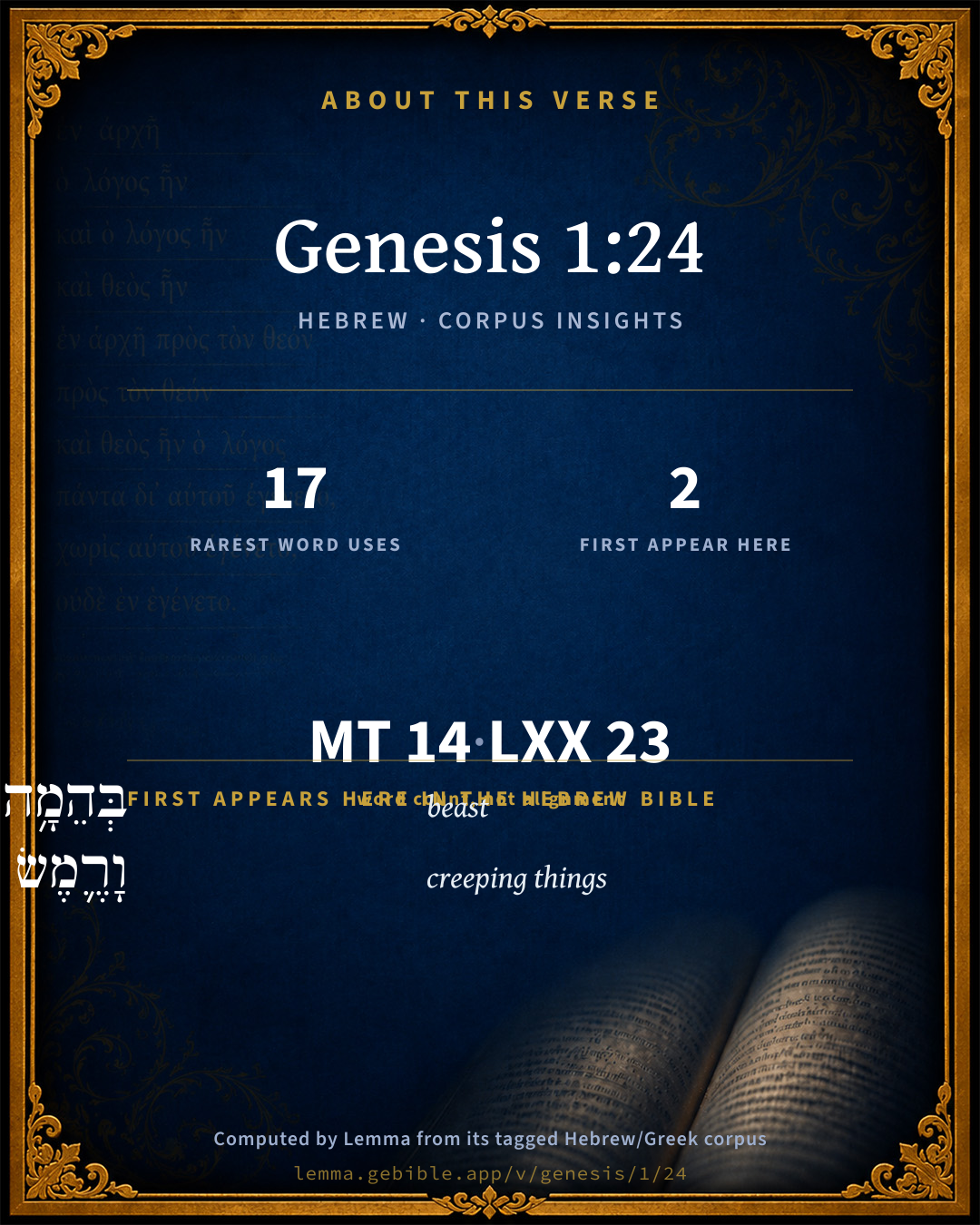
  • 2 first appearances in the Hebrew Bible
Full analysis ↓
Download a study sheet

One document with this verse’s original text, its word-by-word gloss line, the meaning frame, cross-references with their text, attributed commentary, and full source and license credits — printable, and it pastes into notes with its structure intact.

This verse Autodidact and up

Study sheet (.html) Plain text (.txt)

A passage Seminary Student

Up to 50 verses in one chapter. A passage sheet keeps up to 6 commentary sources and 12 cross-references per verse, in the order this page ranks them, and says so on the sheet whenever that leaves anything out. Ask for a single verse and you get the Autodidact verse sheet above.

Everything on this page stays free to read, with no account — the sheet is a download of what is already on screen, not access to it.

Want to remove ads? Support Godless Engineer
Compare translations 3

The same verse in 3 English versions, stacked beneath the original-language interlinear above. Click any original word for its lexicon entry.

Each is an independent rendering of the whole verse — the interlinear is not word-aligned to these translations.

Highlighted words mark where these versions differ — a whole-verse word diff, not a word-by-word alignment.

  • World English Bible Public Domain
    God said, "Let the earth bring forth living creatures after their kind, cattle, creeping things, and animals of the earth after their kind," and it was so.
  • King James Version Public Domain
    And God said, Let the earth bring forth the living creature after his kind, cattle, and creeping thing, and beast of the earth after his kind: and it was so.
  • unfoldingWord Literal Text CC BY-SA 4.0
    Then God said, “Let the land bring forth living creature according to its kind: livestock and crawling creature and living thing of the earth, according to its kind.” And it was so.

unfoldingWord Literal Text — © unfoldingWord, licensed CC BY-SA 4.0. Word-aligned USFM3 via Door43 (git.door43.org/unfoldingWord/en_ult).

Versions to compare (up to 4)

3 of 4 selected

Show all 18 translations

Every available English version of this verse, each an independent rendering of the whole verse.

  • World English Bible Public Domain
    God said, "Let the earth bring forth living creatures after their kind, cattle, creeping things, and animals of the earth after their kind," and it was so.
  • Berean Standard Bible Public Domain
    And God said, “Let the earth bring forth living creatures according to their kinds: livestock, land crawlers, and beasts of the earth according to their kinds.” And it was so.
  • Majority Standard Bible Public Domain
    And God said, “Let the earth bring forth living creatures according to their kinds: livestock, land crawlers, and beasts of the earth according to their kinds.” And it was so.
  • King James Version Public Domain
    And God said, Let the earth bring forth the living creature after his kind, cattle, and creeping thing, and beast of the earth after his kind: and it was so.
  • American Standard Version (1901) Public Domain
    And God said, Let the earth bring forth living creatures after their kind, cattle, and creeping things, and beasts of the earth after their kind: and it was so.
  • Revised Version (1885) Public Domain
    And God said, Let the earth bring forth the living creature after its kind, cattle, and creeping thing, and beast of the earth after its kind: and it was so.
  • Geneva Bible (1599) Public Domain
    Moreouer God said, Let the earth bring foorth the liuing thing according to his kinde, cattel, and that which creepeth, and the beast of the earth, according to his kinde. and it was so.
  • Douay-Rheims (1899) Public Domain
    And God said: Let the earth bring forth the living creature in its kind, cattle and creeping things, and beasts of the earth, according to their kinds. And it was so done.
  • Young's Literal Translation Public Domain
    And God saith, `Let the earth bring forth the living creature after its kind, cattle and creeping thing, and beast of the earth after its kind:' and it is so.
  • Literal Standard Version CC BY-SA 4.0
    And God says, “Let the earth bring forth the living creature after its kind, livestock and creeping thing, and beast of the earth after its kind”: and it is so.
  • Unlocked Literal Bible CC BY-SA 4.0
    God said, “Let the earth produce living creatures, each according to its own kind, livestock, creeping things, and beasts of the earth, each according to its own kind.” It was so.
  • unfoldingWord Literal Text CC BY-SA 4.0
    Then God said, “Let the land bring forth living creature according to its kind: livestock and crawling creature and living thing of the earth, according to its kind.” And it was so.
  • Darby Bible Public Domain
    And God said, Let the earth bring forth living souls after their kind, cattle, and creeping thing, and beast of the earth, after their kind. And it was so.
  • World Messianic Bible Public Domain
    God said, “Let the earth produce living creatures after their kind, livestock, creeping things, and animals of the earth after their kind;” and it was so.
  • Webster's Bible Public Domain
    And God said, Let the earth bring forth the living creature after his kind, cattle, and the creeping animal, and the beast of the earth after his kind: and it was so.
  • Free Bible Version CC BY-SA 4.0
    God said, “Let the land produce living creatures, each one according to its own kind—the livestock, the creatures that run along the ground, and the wild animals, each one according to its own kind.” And that's what happened.
  • Bible in Basic English Public Domain
    And God said, Let the earth give birth to all sorts of living things, cattle and all things moving on the earth, and beasts of the earth after their sort: and it was so.
  • JPS Tanakh (1917) Public Domain
    And God said: 'Let the earth bring forth the living creature after its kind, cattle, and creeping thing, and beast of the earth after its kind.' And it was so.

Literal Standard Version (2020), Covenant Press — licensed CC BY-SA 4.0. Text via the HelloAO Bible API (eBible.org). Unlocked Literal Bible (unfoldingWord) — licensed CC BY-SA 4.0. Text via the HelloAO Bible API (eBible.org). unfoldingWord Literal Text — © unfoldingWord, licensed CC BY-SA 4.0. Word-aligned USFM3 via Door43 (git.door43.org/unfoldingWord/en_ult). Free Bible Version, Dr. Jonathan Gallagher — licensed CC BY-SA 4.0. Text via the HelloAO Bible API (eBible.org).

Word by word

More ways to search: Search by grammar → Find every occurrence → Compare this word →

Practice this passage: Drill this verse → Learn its vocabulary →

וָרֶ֛מֶשׂ
remes
H7431
“and · creeping things”
Conjunction + Noun, Common, Masculine, Singular, Absolute
Part of Speech
Conjunction + Noun
Type
Common
Gender
Masculine
Number
Singular
State
Absolute
Full BDB Definition

Origin: from H7430

TWOT: 2177a

creeping things, moving things, creeping organism - creeping things - gliding things (of sea animals) - moving things (of all animals)
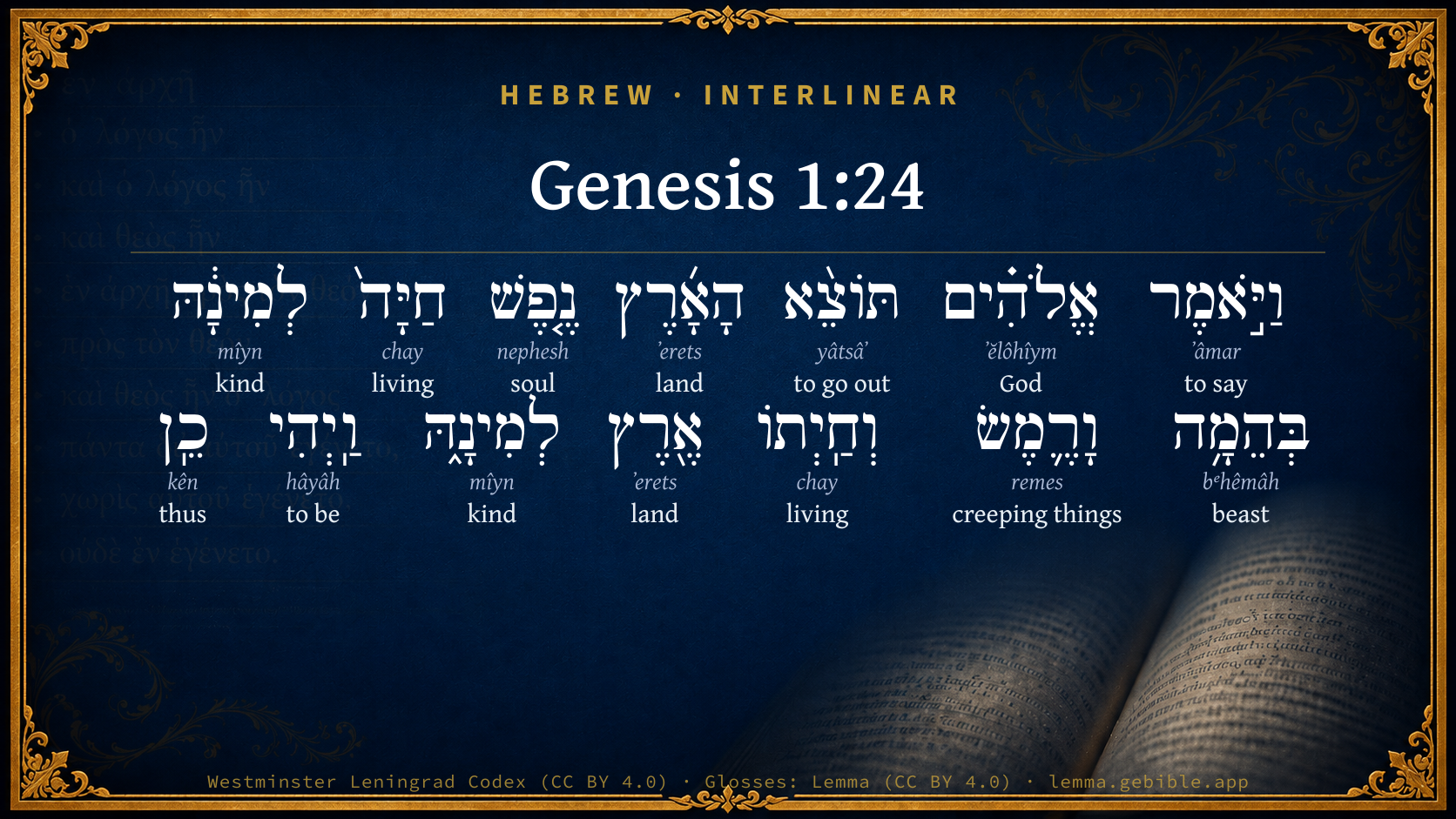
  1. וַיֹּ֣אמֶר ʼâmar H559 “and · to say” Conjunction + Verb, Qal, Sequential Imperfect, 3rd Person, Masculine, Singular
  2. אֱלֹהִ֗ים ʼĕlôhîym H430 “God(s)” Noun, Common, Masculine, Plural, Absolute
  3. תּוֹצֵ֨א yâtsâʼ H3318 “to go out” Verb, Hiphil, Jussive, 3rd Person, Feminine, Singular
  4. הָאָ֜רֶץ ʼerets H776 “the · land” Particle, Definite Article + Noun, Common, Both, Singular, Absolute
  5. נֶ֤פֶשׁ nephesh H5315 “soul” Noun, Common, Both, Singular, Absolute
  6. חַיָּה֙ chay H2416 “living” Adjective, Adjective, Feminine, Singular, Absolute
  7. לְמִינָ֔הּ mîyn H4327 “to/for · kind · her” Preposition + Noun, Common, Masculine, Singular, Construct + Suffix, Personal, 3rd Person, Feminine, Singular
  8. בְּהֵמָ֥ה bᵉhêmâh H929 “beast” Noun, Common, Feminine, Singular, Absolute
  9. וְחַֽיְתוֹ chay H2416 “and · living of” Conjunction + Noun, Common, Feminine, Singular, Construct
  10. אֶ֖רֶץ ʼerets H776 “land” Noun, Common, Both, Singular, Absolute
  11. לְמִינָ֑הּ mîyn H4327 “to/for · kind · her” Preposition + Noun, Common, Masculine, Singular, Construct + Suffix, Personal, 3rd Person, Feminine, Singular
  12. וַֽיְהִי hâyâh H1961 “and · to be” Conjunction + Verb, Qal, Sequential Imperfect, 3rd Person, Masculine, Singular
  13. כֵֽן kên H3651 “thus” Adverb

About this verse

These counts appear in no published source. They are computed here, from the morphology-tagged text and Lemma’s own curated glosses. What Lemma adds →

14
words
11
distinct lemmas
Pentateuch
section

Notable vocabulary

The rarest word here is וָרֶ֛מֶשׂ creeping things H7431 — appearing just 17 times in the whole Hebrew Bible.

First appearance in Scripture

These words make their first canonical appearance in the Hebrew Bible here:

  • בְּהֵמָ֥ה beast H929
  • וָרֶ֛מֶשׂ creeping things H7431

Shared distinctive vocabulary

וָרֶ֛מֶשׂ creeping things H7431 occurs in 17 verses of the Hebrew Bible. Also found in:

Grammatical profile

  • 3 verbs
  • 9 nouns
  • 1 adjective
  • 1 adverb

Verb forms

  • וַיֹּ֣אמֶר Qal · Sequential Imperfect
  • תּוֹצֵ֨א Hiphil · Jussive
  • וַֽיְהִי Qal · Sequential Imperfect

Repetition

Words recur within this verse — often emphatic in Hebrew:

  • הָאָ֜רֶץ land H776 ×2
  • חַיָּה֙ living H2416 ×2
  • לְמִינָ֔הּ kind H4327 ×2

Hebrew & Septuagint length

In English translation the verse runs 27 words from the Hebrew and 32 from the Septuagint (LXX English) — closely comparable.

A rough comparison of the two English renderings, which tokenize alike — not a word-level alignment.

Word counts can differ between the Hebrew and the Greek without any difference in meaning — e.g. the Hebrew direct-object marker אֵת has no separate Greek word, and Greek often adds the article ὁ.

In the original languages it is 14 Hebrew tokens and 23 Greek tokens — but the two are counted differently (Hebrew bundles its prefixes and suffixes into one token; the Greek is in lemma form), so that isn’t a like-for-like length.

Cross-references

11

Topical passages linked to Genesis 1:24 in the Treasury of Scripture Knowledge — connected by theme and wording, ordered by reader-vote popularity; previews shown in the World English Bible.

  • Psalms 50:9–10 I have no need for a bull from your stall, Nor male goats from your pens.
  • Genesis 6:20 Of the birds after their kind, of the cattle after their kind, of every creeping thing of the ground after its kind, two of every sort shall come to you, to keep them alive.
  • Genesis 8:19 Every animal, every creeping thing, and every bird, whatever moves on the earth, after their families, went forth out of the ark.
  • Job 40:15 "See now, behemoth, which I made as well as you. He eats grass as an ox.
  • Psalms 148:10 Wild animals and all cattle; Small creatures and flying birds;
  • Genesis 7:14 they, and every animal after its kind, all the cattle after their kind, every creeping thing that creeps on the earth after its kind, and every bird after its kind, every bird of every sort.
  • Job 39:5 "Who has set the wild donkey free? Or who has loosened the bonds of the swift donkey,
  • Job 38:39–40 "Can you hunt the prey for the lioness, Or satisfy the appetite of the young lions,
  • Job 39:19 "Have you given the horse might? Have you clothed his neck with a quivering mane?
  • Psalms 104:18 The high mountains are for the wild goats. The rocks are a refuge for the rock badgers.
  • Psalms 104:23 Man goes forth to his work, To his labor until the evening.

Cross-references courtesy of OpenBible.info (CC BY 4.0).

Hebrew and Greek witnesses Masoretic Hebrew ↔ Greek Septuagint

The same verse in the two great witnesses to the Old Testament, shown verse-for-verse.

These are two independent witnesses, not word-aligned to each other, and the Septuagint is shown in lemma (dictionary) form.

Hebrew Genesis 1:24 Masoretic · Westminster Leningrad Codex

וַיֹּ֣אמֶר אֱלֹהִ֗ים תּוֹצֵ֨א הָאָ֜רֶץ נֶ֤פֶשׁ חַיָּה֙ לְמִינָ֔הּ בְּהֵמָ֥ה וָרֶ֛מֶשׂ וְחַֽיְתוֹ אֶ֖רֶץ לְמִינָ֑הּ וַֽיְהִי כֵֽן

God said, "Let the earth bring forth living creatures after their kind, cattle, creeping things, and animals of the earth after their kind," and it was so.

World English Bible · Public Domain

Greek LXX Genesis 1:24 Septuagint · lemma form

καί εἶπον ὁ θεός ἐκἄγω ὁ γῆ ψυχή ζάω κατά γένος τετράποδος καί ἑρπετόν καί θηρίον ὁ γῆ κατά γένος καί γίγνομαι οὕτως

And God said, Let the earth bring forth the living creature according to its kind, quadrupeds and reptiles and wild beasts of the earth according to their kind, and it was so.

LXX2012 (modern English Septuagint) · Public Domain

On this verse, The Cambridge Bible for Schools and Colleges discusses the Septuagint’s reading. Read the note in Commentary ↓

Hebrew: Westminster Leningrad Codex (CC BY 4.0). Greek: Septuagint (public domain); English from LXX2012 (modern English Septuagint) (Public Domain). How the Septuagint differs from the Hebrew →

Targum (Aramaic paraphrase)

2

The Targum is the ancient Jewish Aramaic paraphrase of the Hebrew Scriptures — an interpretive translation, not the Hebrew text itself. Onkelos (literal) and Pseudo-Jonathan (expansive) render the Torah, and Jonathan the Prophets. Coverage is partial: where no permissively-licensed English translation exists for a verse, only the Aramaic is shown. This is verse-level text, not a word-by-word alignment to the Hebrew.

  1. Targum Onkelos Torah (Genesis–Deuteronomy)
    וַאֲמַר יְיָ תַּפֵּק אַרְעָא נַפְשָׁא חַיְתָא לִזְנַהּ בְּעִיר וּרְחֵשׁ וְחֵוַת אַרְעָא לִזְנַהּ וַהֲוָה כֵן

    (no public-domain English translation for this verse)

    Targum Onkelos — Aramaic: “Onkelos Genesis” (public domain); “Onkelos Exodus” (public domain); “Onkelos Leviticus” (public domain); “Onkelos Numbers” (public domain); “Onkelos Deuteronomy” (public domain). English: “Sefaria Community Translation” (CC0 1.0 (public-domain dedication)); “J.W. Etheridge. The Targums of Onkelos and Jonathan Ben Uzziel on the Pentateuch. London: Longmans, Green, 1862” (public domain). Text via Sefaria.

  2. Targum Pseudo-Jonathan Torah (Genesis–Deuteronomy)
    וַאֲמַר יְיָ תְּהַנְפֵּק גַרְגִישְׁתָּא דְאַרְעָא נַפְשַׁת בִּרְיָיתָא לִזְנֵיהּ זְנֵי דַכְיָין וּזְנֵי דְלָא דַכְיָין בְּעִירֵי וְרִחֲשֵׁי וּבַרְיַית אַרְעָא לִזְנֵיהּ וַהֲוָה כֵן

    And the Lord said, Let the soil of the earth bring forth the living creature according to his kind; the kind that is clean and the kind that is unclean; cattle, and creeping thing, and the creature of the earth, according to his kind. And it was so.

    Targum Pseudo-Jonathan — Aramaic: “Targum Jonathan on Genesis” (public domain); “Targum Jonathan on Exodus” (public domain); “Targum Jonathan on Leviticus” (public domain); “Targum Jonathan on Numbers” (public domain); “Targum Jonathan on Deuteronomy” (public domain). English: “The Targum of Jonathan ben Uzziel, trans. J. W. Etheridge, London, 1862” (public domain). Text via Sefaria.

Commentary

Notes on Genesis 1:24 from classic Christian and Jewish commentators (each source and its license shown beneath its notes). The classic Christian expositions comment on the surrounding passage and are grouped to its opening verse, so a note may address several verses; the Jewish commentaries on the Tanakh (Rashi and others) are per-verse, so they appear only where the commentator wrote on this verse.

Lemma curates 59 commentaries, every one of them public domain or Creative Commons licensed, each selected and text-cleaned for this edition rather than reprinted as found. About our sources →

Jamieson, Fausset & Brown

Robert Jamieson, A. R. Fausset & David Brown

SIXTH DAY. A farther advance was made by the creation of terrestrial animals, all the various species of which are included in three classes: (1) cattle, the herbivorous kind capable of labor or domestication. (Gen 1:24-31)

beasts of the earth--(2) wild animals, whose ravenous natures were then kept in check, and (3) all the various forms of

creeping things--from the huge reptiles to the insignificant caterpillars.

Jamieson, Fausset & Brown — Commentary Critical and Explanatory on the Whole Bible (1871) — public domain (CC PDM 1.0). Text via the HelloAO Bible API.

The Cambridge Bible for Schools and Colleges

gen. ed. J. J. S. Perowne

24. Let the earth, &c.] The work of the sixth, like that of the third, day is twofold. Furthermore, the creation of the land animals on the sixth day seems to correspond to the creation of the earth on the third day.

The creation of the land animals immediately precedes that of mankind. It is implied that they are closer both in structure and in intelligence to the human race than the animals of the water and air. On the other hand, the words “let the earth bring forth” (the same phrase as is used in Gen_1:11 of the creation of the vegetable world) emphasize the difference in origin between the land animals (“let the earth bring forth”) and mankind, who are described (Gen_1:26-27) as, in a special manner, “created” by God Himself.

the living creature] viz. “living soul,” as above (Gen_1:20-21). Here the words are used especially of the land animals. To speak of animals having “a soul” is strange to modern ears. But it was not so to the Israelites, who realized, perhaps better than we do, man’s kinship with the animal world, in virtue of that principle of nephesh, the mystery of life, which is shared by the animals and human beings.

after its kind] viz. the various species of the animals about to be mentioned.

cattle, and creeping thing, and beast of the earth] This is a rough threefold classification of the animals dwelling on the earth: (1) “the cattle” (Heb. behêmah, LXX τετράποδα (= “quadrupeds”), Lat. jumenta (= “cattle”)), under which head are here probably classed all the domestic animals, e.g. oxen, sheep, horses, asses, camels, as in Jon_4:11. Here it seems to be implied that the domestic animals were tame originally, and not through association with mankind. (2) “creeping things”; LXX ἑρπετά, Lat. reptilia. In this class seem to be included not only snakes and lizards, but also the smaller animals, generally, and the insect world. (3) “the beasts of the earth”; LXX θηρία τῆς γῆς, Lat. bestias terrae, viz. the wild beasts, strictly so called, as distinguished from the domestic animals.

24–31. Sixth Day:

(a) Creation of the Land Animals (Gen_1:24-25);

(b) Creation of Man (Gen_1:26-30);

(c) The End of the Creation (Gen_1:31),

The Cambridge Bible for Schools and Colleges (gen. ed. J. J. S. Perowne; Cambridge University Press, 1878–1918) — public domain. Text from a community e-Sword module.

Trapp's Complete Commentary

John Trapp

Gen 1:24 And God said, Let the earth bring forth the living creature after his kind, cattle, and creeping thing, and beast of the earth after his kind: and it was so.

Ver. 24, 25. Let the earth, &c.] Lo here the earth, in itself a dead element, brings forth, at God’s command, living creatures, tame, wild, and creeping. "Why then should it be thought a thing incredible," that the same earth, at God’s command, should bring forth again our dead bodies restored to life, at the last day? {Act 26:8} Surely if that speech of Christ, "Lazarus, Come forth," {Joh 11:43} had been directed to all the dead, they had all presently risen. If he speak to the rocks, they rend; if to the mountains, they melt; if to the earth, it opens; if to the sea, it yields up her dead; if to the whole host of heaven, they tremble and stand amazed, waiting his pleasure. And shall he not prevail by his mighty power, the same that he put forth in the raising of his Son Christ, {Eph 1:19} to raise us from the death of sin; and of carnal, to make us a people created again? {Psa 102:18} Doth he not "plant the heavens, and lay the foundations of the earth, that he may say to Zion, Thou art my people?" {Isa 51:16} "Empty man would be wise," saith Zophar, {Job 11:12} "though man be born like a wild ass-colt." Man’s heart is a mere emptiness, a very Tohu vabohu, as void of matter to make him a new creature of, as the hollow of a tree is of heart of oak. God, therefore, creates in his people clean hearts. {Psa 51:10} And, as in the first creation, {a} so in the new creature, the first day, as it were, God works light of knowledge; the second day, the firmament of faith; the third day seas and trees, that is, repentant tears, and worthy fruits; the fourth day, the sun, joining light and heat together, heat of zeal with light of knowledge; the fifth day, fishes to play, and fowls to fly, so to live and rejoice in a sea of troubles, and fly heavenward by prayer and contemplation; the sixth day God makes beasts and man, yea, of a wild ass-colt, a man in Christ, with whom "old things are past, all things are become new," {2Co 5:17} and to whom, besides that they are all taught of God {θεοδιδακτοι, 1Th 4:9} the very beasts {Isa 1:2} and birds {Jer 8:7} do read a divinity lecture. "Ask now the beasts, and they shall teach thee, and the fowls of the air, they shall tell thee". {Job 12:7} The whole world is nothing else, saith one, but {b} "God expressed," so that we cannot plead ignorance; for all are, or may be, book-learned in the creature. This is the shepherd’s calendar, the ploughman’s alphabet; we may run and read in this great book, which hath three leaves - heaven, earth, sea. "A brutish man knoweth not, neither doth a fool understand this". {Psa 92:6} They stand gazing and gaping on the outside of things only, but ask not who is their Father, their Creator; like little children, which when they find a picture in their book, they gaze and make sport with it, but never consider it. Either their minds are like a clock that is over-wound above the ordinary pitch, and so stands still; their thoughts are amazed for a time; they are like a block, thinking nothing at all, or else they think, atheistically, that all comes by nature; but "hast thou not known?" saith the prophet, "hast thou not heard, that the everlasting God, the Lord, the Creator?" &c. {Isa 40:28} Or, at best, as the common passenger looks only at the hand of the dial to see what of the clock it is, but takes no notice of the clockwork within, the wheels and poises and various turnings and windings in the work; so it is here with the man that is no more than a mere "natural." "But he that is spiritual discerneth all things"; {2Co 2:15} he entereth into the clock-house, as it were, and views every motion, beginning at the great wheel, and ending in the least and last that is moved. He studies the glory of God revealed in this great book of nature, and praiseth his power, wisdom, goodness, &c. And for that in these things "he cannot order his speech, because of darkness," {Job 37:19} he begs of God a larger heart, and better language, and cries out continually with David, "Blessed be the Lord God, the God of Israel, who only doeth wondrous things. And blessed be his glorious name for ever and ever: and let the whole earth be filled with his glory. Amen and Amen". {Psa 72:18-19}

{a} Lightf. Miscel.

{b} Anton. Eremita ap Aug. l. 3. De Doctr. Chris. Neceph. l. 8. c. 40. Clem. Alex.

John Trapp, A Commentary or Exposition upon All the Books of the Old and New Testament (1647–1656) — public domain. Text from a community e-Sword module.

Albert Barnes' Notes on the Bible

- VIII. The Sixth Day

24. בהמה behēmâh, “cattle; dumb, tame beasts.”

רמשׂ remeś, “creeping (small or low) animals.”

חוּה chayâh, “living thing; animal.”

חוּת־חארץ chayatô-chā'ārets, “wild beast.”

26. אדם 'ādām, “man, mankind;” “be red.” A collective noun, having no plural number, and therefore denoting either an individual of the kind, or the kind or race itself. It is connected in etymology with אדמה 'ădāmâh, “the red soil,” from which the human body was formed Gen 2:7. It therefore marks the earthly aspect of man.

צלם tselem, “shade, image,” in visible outline.

דמוּת demût, “likeness,” in any quality.

רדה rādâh “tread, rule.”

This day corresponds with the third. In both the land is the sphere of operation. In both are performed two acts of creative power. In the third the land was clothed with vegetation: in the sixth it is peopled with the animal kingdom. First, the lower animals are called into being, and then, to crown all, man.

Gen 1:24, Gen 1:25

This branch of the animal world is divided into three parts. “Living breathing thing” is the general head under which all these are comprised. “Cattle” denotes the animals that dwell with man, especially those that bear burdens. The same term in the original, when there is no contrast, when in the plural number or with the specification of “the land,” the “field,” is used of wild beasts. “Creeping things” evidently denote the smaller animals, from which the cattle are distinguished as the large. The quality of creeping is, however, applied sometimes to denote the motion of the lower animals with the body in a prostrate posture, in opposition to the erect posture of man Psa 104:20. The “beast of the land” or the field signifies the wild rapacious animal that lives apart from man. The word חוּה chayâh, “beast or animal,” is the general term employed in these verses for the whole animal kind. It signifies wild animal with certainty only when it is accompanied by the qualifying term “land” or “field,” or the epithet “evil” רעה rā‛âh. From this division it appears that animals that prey on others were included in this latest creation. This is an extension of that law by which the organic living substances of the vegetable kingdom form the sustenance of the animal species. The execution of the divine mandate is then recorded, and the result inspected and approved.

Gen 1:26, Gen 1:27

Here we evidently enter upon a higher scale of being. This is indicated by the counsel or common resolve to create, which is now for the first time introduced into the narrative. When the Creator says, “Let us make man,” he calls attention to the work as one of pre-eminent importance. At the same time he sets it before himself as a thing undertaken with deliberate purpose. Moreover, in the former mandates of creation his words had regard to the thing itself that was summoned into being; as, “Let there be light;” or to some preexistent object that was physically connected with the new creature; as, “Let the land bring forth grass.” But now the language of the fiat of creation ascends to the Creator himself: Let us make man. This intimates that the new being in its higher nature is associated not so much with any part of creation as with the Eternal Uncreated himself.

The plural form of the sentence raises the question, With whom took he counsel on this occasion? Was it with himself, and does he here simply use the plural of majesty? Such was not the usual style of monarchs in the ancient East. Pharaoh says, “I have dreamed a dream” Gen 41:15. Nebuchadnezzar, “I have dreamed” Dan 2:3. Darius the Mede, “I make a decree” Dan 6:26. Cyrus, “The Lord God of heaven hath given me all the kingdoms of the earth” Ezr 1:2. Darius, “I make a decree” Ezr 5:8. We have no ground, therefore, for transferring it to the style of the heavenly King. Was it with certain other intelligent beings in existence before man that he took counsel? This supposition cannot be admitted; because the expression “let us make” is an invitation to create, which is an incommunicable attribute of the Eternal One, and because the phrases, “our image, our likeness,” when transferred into the third person of narrative, become “his image, the image of God,” and thus limit the pronouns to God himself. Does the plurality, then, point to a plurality of attributes in the divine nature? This cannot be, because a plurality of qualities exists in everything, without at all leading to the application of the plural number to the individual, and because such a plurality does not warrant the expression, “let us make.” Only a plurality of persons can justify the phrase. Hence, we are forced to conclude that the plural pronoun indicates a plurality of persons or hypostases in the Divine Being.

Gen 1:26

Man. - Man is a new species, essentially different from all other kinds on earth. “In our image, after our likeness.” He is to be allied to heaven as no other creature on earth is. He is to be related to the Eternal Being himself. This relation, however, is to be not in matter, but in form; not in essence, but in semblance. This precludes all pantheistic notions of the origin of man. “Image” is a word taken from sensible things, and denotes likeness in outward form, while the material may be different. “Likeness” is a more general term, indicating resemblance in any quality, external or internal. It is here explanatory of image, and seems to show that this term is to be taken in a figurative sense, to denote not a material but a spiritual conformity to God. The Eternal Being is essentially self-manifesting. The appearance he presents to an eye suited to contemplate him is his image. The union of attributes which constitute his spiritual nature is his character or likeness.

We gather from the present chapter that God is a spirit Gen 1:2, that he thinks, speaks, wills, and acts (Gen 1:3-4, etc.). Here, then, are the great points of conformity to God in man, namely, reason, speech, will, and power. By reason we apprehend concrete things in perception and consciousness, and cognize abstract truth, both metaphysical and moral. By speech we make certain easy and sensible acts of our own the signs of the various objects of our contemplative faculties to ourselves and others. By will we choose, determine, and resolve upon what is to be done. By power we act, either in giving expression to our concepts in words, or effect to our determinations in deeds. In the reason is evolved the distinction of good and evil Gen 1:4, Gen 1:31, which is in itself the approval of the former and the disapproval of the latter. In the will is unfolded that freedom of action which chooses the good and refuses the evil. In the spiritual being that exercises reason and will resides the power to act, which presupposes both these faculties - the reason as informing the will, and the will as directing the power. This is that form of God in which he has created man, and condescends to communicate with him.

And let them rule. - The relation of man to the creature is now stated. It is that of sovereignty. Those capacities of right thinking, right willing, and right acting, or of knowledge, holiness, and righteousness, in which man resembles God, qualify him for dominion, and constitute him lord of all creatures that are destitute of intellectual and moral endowments. Hence, wherever man enters he makes his sway to be felt. He contemplates the objects around him, marks their qualities and relations, conceives and resolves upon the end to be attained, and endeavors to make all things within his reach work together for its accomplishment. This is to rule on a limited scale. The field of his dominion is “the fish of the sea, the fowl of the skies, the cattle, the whole land, and everything that creepeth on the land.” The order here is from the lowest to the highest. The fish, the fowl, are beneath the domestic cattle. These again are of less importance than the land, which man tills and renders fruitful in all that can gratify his appetite or his taste. The last and greatest victory of all is over the wild animals, which are included under the class of creepers that are prone in their posture, and move in a creeping attitude over the land. The primeval and prominent objects of human sway are here brought forward after the manner of Scripture. But there is not an object within the ken of man which he does not aim at making subservient to his purposes. He has made the sea his highway to the ends of the earth, the stars his pilots on the pathless ocean, the sun his bleacher and painter, the bowels of the earth the treasury from which he draws his precious and useful metals and much of his fuel, the steam his motive power, and the lightning his messenger. These are proofs of the evergrowing sway of man.

Gen 1:27

Created. - Man in his essential part, the image of God in him, was entirely a new creation. We discern here two stages in his creation. The general fact is stated in the first clause of the verse, and then the two particulars. “In the image of God created he him.” This is the primary act, in which his relation to his Maker is made prominent. In this his original state he is actually one, as God in whose image he is made is one. “Male and female created he them.” This is the second act or step in his formation. He is now no longer one, but two, - the male and the female. His adaptation to be the head of a race is hereby completed. This second stage in the existence of man is more circumstantially described hereafter Gen 2:21-25.

Gen 1:28

The divine blessing is now pronounced upon man. It differs from that of the lower animals chiefly in the element of supremacy. Power is presumed to belong to man’s nature, according to the counsel of the Maker’s will Gen 1:26. But without a special permission he cannot exercise any lawful authority. For the other creatures are as independent of him as he is of them. As creatures he and they are on an equal footing, and have no natural fight either over the other. Hence, it is necessary that he should receive from high heaven a formal charter of right over the things that were made for man. He is therefore authorized, by the word of the Creator, to exercise his power in subduing the earth and ruling over the animal kingdom. This is the meet sequel of his being created in the image of God. Being formed for dominion, the earth and its various products and inhabitants are assigned to him for the display of his powers. The subduing and ruling refer not to the mere supply of his natural needs, for which provision is made in the following verse, but to the accomplishment of his various purposes of science and beneficence, whether towards the inferior animals or his own race. It is the part of intellectual and moral reason to employ power for the ends of general no less than personal good. The sway of man ought to be beneficent.

Gen 1:29, Gen 1:30

Every herb bearing seed and tree bearing fruit is granted to man for his sustenance. With our habits it may seem a matter of course that each should at once appropriate what he needs of things at his hand. But in the beginning of existence it could not be so. Of two things proceeding from the same creative hand neither has any original or inherent right to interfere in any way whatever with the other. The absolute right to each lies in the Creator alone. The one, it is true, may need the other to support its life, as fruit is needful to man. And therefore the just Creator cannot make one creature dependent for subsistence on another without granting to it the use of that other. But this is a matter between Creator and creature, not by any means between creature and creature. Hence, it was necessary to the rightful adjustment of things, whenever a rational creature was ushered into the world, that the Creator should give an express permission to that creature to partake of the fruits of the earth. And in harmony with this view we shall hereafter find an exception made to this general grant Gen 2:17. Thus, we perceive, the necessity of this formal grant of the use of certain creatures to moral and responsible man lies deep in the nature of things. And the sacred writer here hands down to us from the mists of a hoary antiquity the primitive deed of conveyance, which lies at the foundation of the the common property of man in the earth, and all that it contains.

The whole vegetable world is assigned to the animals for food. In the terms of the original grant the herb bearing seed and the tree bearing fruit are especially allotted to man, because the grain and the fruit were edible by man without much preparation. As usual in Scripture the chief parts are put for the whole, and accordingly this specification of the ordinary and the obvious covers the general principle that whatever part of the vegetable kingdom is convertible into food by the ingenuity of man is free for his use. It is plain that a vegetable diet alone is expressly conceded to man in this original conveyance, and it is probable that this alone was designed for him in the state in which he was created. But we must bear in mind that he was constituted master of the animal as well as of the vegetable world; and we cannot positively affirm that his dominion did not involve the use of them for food.

Gen 1:30

The whole of the grasses and the green parts or leaves of the herbage are distributed among the inferior animals for food. Here, again, the common and prominent kind of sustenance only is specified. There are some animals that greedily devour the fruits of trees and the grain produced by the various herbs; and there are others that derive the most of their subsistence from preying on the smaller and weaker kinds of animals. Still, the main substance of the means of animal life, and the ultimate supply of the whole of it, are derived from the plant. Even this general statement is not to be received without exception, as there are certain lower descriptions of animals that derive sustenance even from the mineral world. But this brief narrative of things notes only the few palpable facts, leaving the details to the experience and judgment of the reader.

Gen 1:31

Here we have the general review and approval of everything God had made, at the close of the six days’ work of creation. Man, as well as other things, was very good when he came from his Maker’s hand; but good as yet untried, and therefore good in capacity rather than in victory over temptation. It remains yet to be seen whether he will be good in act and habit.

This completes, then, the restoration of that order and fullness the absence of which is described in the second verse. The account of the six days’ work, therefore, is the counterpart of that verse. The six days fall into two threes, corresponding to each other in the course of events. The first and fourth days refer principally to the darkness on the face of the deep; the second and fifth to the disorder and emptiness of the aerial and aqueous elements; and the third and sixth to the similar condition of the land. Again, the first three days refer to a lower, the second three to a higher order of things. On the first the darkness on the face of the earth is removed; on the fourth that on the face of the sky. On the second the water is distributed above and below the expanse; on the fifth the living natives of these regions are called into being. On the third the plants rooted in the soil are made; on the sixth the animals that move freely over it are brought into existence.

This chapter shows the folly and sin of the worship of light, of sun, moon, or star, of air or water, of plant, of fish or fowl, of earth, of cattle, creeping thing or wild beast, or, finally, of man himself; as all these are but the creatures of the one Eternal Spirit, who, as the Creator of all, is alone to be worshipped by his intelligent creatures.

This chapter is also to be read with wonder and adoration by man; as he finds himself to be constituted lord of the earth, next in rank under the Creator of all, formed in the image of his Maker, and therefore capable not only of studying the works of nature, but of contemplating and reverently communing with the Author of nature.

In closing the interpretation of this chapter, it is proper to refer to certain first principles of hermeneutical science. First, that interpretation only is valid which is true to the meaning of the author. The very first rule on which the interpreter is bound to proceed is to assign to each word the meaning it commonly bore in the time of the writer. This is the prime key to the works of every ancient author, if we can only discover it. The next is to give a consistent meaning to the whole of that which was composed at one time or in one place by the author. The presumption is that there was a reasonable consistency of thought in his mind during one effort of composition. A third rule is to employ faithfully and discreetly whatever we can learn concerning the time, place, and other circumstances of the author to the elucidation of his meaning.

And, in the second place, the interpretation now given claims acceptance on the ground of its internal and external consistency with truth. First, It exhibits the consistency of the whole narrative in itself. It acknowledges the narrative character of the first verse. It assigns an essential significance to the words, “the heavens,” in that verse. It attributes to the second verse a prominent place and function in the arrangement of the record. It places the special creative work of the six days in due subordination to the absolute creation recorded in the first verse. It gathers information from the primitive meanings of the names that are given to certain objects, and notices the subsequent development of these meanings. It accounts for the manifestation of light on the first day, and of the luminaries of heaven on the fourth, and traces the orderly steps of a majestic climax throughout the narrative. It is in harmony with the usage of speech as far as it can be known to us at the present day. It assigns to the words “heavens,” “earth,” “expanse,” “day,” no greater latitude of meaning than was then customary. It allows for the diversity of phraseology employed in describing the acts of creative power. It sedulously refrains from importing modern notions into the narrative.

Second, the narrative thus interpreted is in striking harmony with the dictates of reason and the axioms of philosophy concerning the essence of God and the nature of man. On this it is unnecessary to dwell.

Third, it is equally consistent with human science. It substantially accords with the present state of astronomical science. It recognizes, as far as can be expected, the relative importance of the heavens and the earth, the existence of the heavenly bodies from the beginning of time, the total and then the partial absence of light from the face of the deep, as the local result of physical causes. It allows, also, if it were necessary, between the original creation, recorded in the first verse, and the state of things described in the second, the interval of time required for the light of the most distant discoverable star to reach the earth. No such interval, however, could be absolutely necessary, as the Creator could as easily establish the luminous connection of the different orbs of heaven as summon into being the element of light itself.

Fourth, it is also in harmony with the elementary facts of geological knowledge. The land, as understood by the ancient author, may be limited to that portion of the earth’s surface which was known to antediluvian man. The elevation of an extensive tract of land, the subsidence of the overlying waters into the comparative hollows, the clarifying of the atmosphere, the creation of a fresh supply of plants and animals on the newly-formed continent, compose a series of changes which meet the geologist again and again in prosecuting his researches into the bowels of the earth. What part of the land was submerged when the new soil emerged from the waters, how far the shock of the plutonic or volcanic forces may have been felt, whether the alteration of level extended to the whole solid crust of the earth, or only to a certain region surrounding the cradle of mankind, the record before us does not determine. It merely describes in a few graphic touches, that are strikingly true to nature, the last of those geologic changes which our globe has undergone.

Fifth, it is in keeping, as far as it goes, with the facts of botany, zoology, and ethnology.

Sixth, it agrees with the cosmogonies of all nations, so far as these are founded upon a genuine tradition and not upon the mere conjectures of a lively fancy.

Finally, it has the singular and superlative merit of drawing the diurnal scenes of that creation to which our race owes its origin in the simple language of common life, and presenting each transcendent change as it would appear to an ordinary spectator standing on the earth. It was thus sufficiently intelligible to primeval man, and remains to this day intelligible to us, as soon as we divest ourselves of the narrowing preconceptions of our modern civilization.

Albert Barnes' Notes on the Bible (1834–1885) — public domain. Text from a community e-Sword/MySword module.

The Biblical Illustrator

Joseph S. Exell

Gen_1:24-25

God made the beast of the earth

The animal creation

I.

THAT THE ANIMAL WORLD WAS CREATED BY GOD.

1. We should regard the animal world with due appreciation. Man has too low an estimate of the animal world. We imagine that a tree has as much claim to our attention and regard as a horse. The latter has a spirit; is possessed of life; it is a nobler embodiment of Divine power; it is a nearer approach to the fulfilment of creation.

2. We should treat the animal world with humane consideration. Surely, we ought not to abuse anything on which God has bestowed a high degree of creative care, especially when it is intended for our welfare.

II. THAT THE ANIMAL WORLD WAS DESIGNED BY GOD FOR THE SERVICE OF MAN.

1. Useful for business. How much of the business of man is carried on by the aid of animals. They afford nearly the only method of transit by road and street. The commercial enterprise of our villages and towns would receive a serious check if the services of the animal creation were removed.

2. Needful for food. Each answers a distinct purpose toward the life of man; from them we get our varied articles of food, and also of clothing. These animals were intended to be the food of man, to impart strength to his body, and energy to his life. To kill them is no sacrilege. Their death is their highest ministry, and we ought to receive it as such; not for the purpose of gluttony, but of health. Thus is our food the gift of God.

III. THAT THE ANIMAL WORLD WAS AN ADVANCE IN THE PURPOSE OF CREATION. The chaos had been removed, and from it order and light had been evoked. The seas and the dry land had been made to appear. The sun, moon, and stars had been sent on their light-giving mission. The first touch of life had become visible in the occupants of the waters and the atmosphere, and now it breaks into larger expanse in the existence of the animal creation, awaiting only its final completion in the being of man.

IV. THAT THE ANIMAL WORLD WAS ENDOWED WITH THE POWER OF GROWTH AND CONTINUANCE, AND WAS GOOD IN THE SIGHT OF GOD.

1. The growth and continuance of the animal world was insured. Each animal was to produce its own kind, so that it should not become extinct; neither could one species pass into another by the operation of any physical law.

2. The animal world was good in the sight of God. It was free from pain. The stronger did not oppress, and kill the weaker. The instinct of each animal was in harmony with the general good of the rest. But animals have shared the fate of man, the shadow of sin rests upon them; hence their confusion and disorder, their pain, and the many problems they present to the moral philosopher. (J. S. Exell, M. A.)

The animals of the earth as fore runners of man

1. The first signs and pictures of human life.

2. Its most intimate assistants.

3. Its first conditions. (J. P. Lange, D. D.)

Reflections on the domestic animals

In domestic animals we recognize a very marked token of the paternal kindness of the Creator. Their value and importance to man cannot well be estimated. How much do they add to his strength in toil, to his ease and speed in travelling, and to his sustenance and gratification in food. Even the dog proffers to us a serious and profitable lesson. Man, said the poet Burns, is the god of the dog. He knows no other, he can understand no other. And see how he worships him. With what reverence he crouches at his feet, with what love he fawns upon him, with what dependence he looks up to him, and with what cheerful alacrity he obeys him! His whole soul is wrapped up in his god; all the powers and faculties of his nature are devoted to his service, and these powers and faculties are ennobled by the intercourse. Divines tell us that it ought to be just so with the Christian; but does not the dog often put the Christian to shame? The ox, also, is to us a living parable. As he slowly wends his way from the field of toil, at noon, or evening, toward home, how affecting the remonstrance his moving figure is made to utter--The ox knoweth his owner, and the ass his masters crib; but Israel doth not know, My people do not consider. And when he bows his submissive neck to receive the yoke and go forth to his labour again, how gracious the invitation symbolized by the willing act--Take My yoke upon you, and learn of Me; for I am meek and lowly in heart, and ye shall find rest unto your souls. For My yoke is easy, and My burden is light. The sheep, likewise, is a sacred emblem. Were this animal to repeat all the various truths committed by the Spirit to its symbolism, it would preach to us a new lesson with every change of situation in which we beheld it--following after the shepherd--enclosed in the fold--scattered on the mountain--lying down in green pastures--straying among wolves--borne on the shepherds shoulder--bound before the shearer--separating from the goats--in these various circumstances, sheep read to us the most solemn and important truths of the gospel of the Son of God. And the lamb--this is the central symbol of the Christian system. This innocent and gentle creature is preeminently the type of Him who was holy, harmless, and undefiled, the Lamb of God that was slain to take away the sins of the world, in whose blood the redeemed of heaven have washed their robes and made them white. The horse also is a chosen figure of inspiration. In the Book of Revelation--that wonderful portion of the sacred volume--the King of kings, and Lord of lords, is represented as riding on a white horse; and the armies of heaven as following Him upon white horses, clothed in fine linen, white and clean, to witness His victory over all the enemies of truth and righteousness, and to participate in the final triumphs of His grace. Such is the deeply interesting event, such the glorious consummation, of which the horse stands forever a symbol and a remembrancer before his rider. How wise the arrangement that has thus embodied Divine truth in living forms, that ever move before our view. How kind and gracious in God our Father thus to constitute sheep and oxen to be unto us as priests and prophets, holding forth the Word of life, and, though they see not the vision themselves, symbolizing the glorious things of Christ and of heaven, to inspire us with the comfort of the most blessed hope. (H. W. Morris, D. D.)

Beasts, or wild animals

The term beast in the history of this day, as has already been stated, is employed to designate wild animals, in contradistinction from the tame, included under the word cattle. Although these are not designed so immediately or so eminently for the service of man as domestic animals, yet many, if not most of them, contribute in one way or another to his welfare--some as game for his sustenance, some by their hides and fur for his clothing, and all as subjects of interesting and profitable study. It is stated in the Holy Scriptures concerning the various branches of the human family, that God before appointed the bounds of their respective habitations; this is equally true of the different tribes of animals, Wise design and kind adaptation stand forth conspicuously in the arrangement which has assigned to them their several localities. The hairless elephant, rhinoceros, and tapir are obviously made for the heat and luxuriance of the Torrid Zone; and it is there they are found. The camel and the dromedary have been fashioned and constituted with specific adaptations for the parched and sandy deserts of the tropics; and here, accordingly, they have been located. Advancing to the more temperate regions, we still find all creatures, both domestic and wild, admirably fitted to occupy the zone given to them for their inheritance. And as we proceed northward, we discover given to the various animals hardihood of constitution, together with warmth of covering, increasing with the increasing rigour of the climate, till we pass within the Arctic circle, and reach the polar bears. Voyagers in those latitudes tell us that these animals disport in the regions of ice, and revel in an intensity of cold, which, to man with every contrivance of art for protection, is almost past endurance, and produces in him diseases which shortly terminate his existence--that they sit for hours like statues upon icebergs, where, if we were to take up our position for one half hour, we should become statues indeed, and be frozen into the lasting rigidity of death--that they slide in frolic down slopes of snows, which if we were to touch with our bare hand, would instantly, like fire, destroy its vitality. Who that contemplates these shaggy creatures of the pole, so constituted as to find a congenial home amid eternal ice and snow, and to take their frolicsome pastime amid the bleak and dismal horrors of an arctic night, but must confess that every creature, by Divine appointment and adaptation, is suited for its place, and that every place is fitted for its given occupants? (H. W. Morris, D. D.)

The Biblical Illustrator, edited by Joseph S. Exell (c. 1880s–1900s) — public domain. Text from a community e-Sword module.

Joseph Benson's Commentary

Gen 1:24-25. Let the earth bring forth — He that of stones can raise children to Abraham, and who called forth the universe from nothing, could easily produce animals from the dull and sluggish earth, although inanimate. Cattle — Those tame beasts which do not shun the society of men, and are most useful to us for food, clothing, or various services. The beasts of the earth — The Hebrew word חית, chaiath, generally signifies the wild beast, which is evidently its meaning here.

Joseph Benson's Commentary on the Old and New Testaments (1811–1818) — public domain. Text from a community e-Sword module.

Whedon's Commentary on the Bible

Daniel D. Whedon

SIXTH DAY — ANIMALS AND MAN, Gen_1:24-31.

24. Cattle… creeping thing… beast — As the sacred writer distributes the growth of the vegetable kingdom into three classes, (see Gen_1:11-12,) so also he presents three classes of land animals: בהמה, cattle, that is, the domestic animals; רמשׂ, creepers, that is, reptiles and insects of the land, corresponding to the creeping things (שׁרצ) of the waters; and חיתו ארצ, beasts of the land, that is, wild animals as distinguished from domestic cattle.

Daniel D. Whedon (gen. ed.), Commentary on the Old and New Testaments (1874–1909) — public domain. Text from a community e-Sword module.

The Pulpit Commentary

CHAPTER 1:24-31

Day six. Like day three, this is distinguished by a double creative act, the production of the higher or land animals and the creation of man, of the latter of which it is perhaps permissible to see a mute prediction in the vegetation which closed the first half of the creative week.

And God said, Let the earth bring forth the living creature after his kind. In these words the land animals are generically characterized as nephesh chayyah, or animated beings; in the terms which follow they are subdivided into three well-defined species or classes. Cattle. Behemah; literally, the dumb animal, i.e. the larger grass-eating quadrupeds. And creeping thing. Remes; the moving animal, i.e. the smaller animals that move either without feet or with feet that are scarcely perceptible, such as worms, insects, reptiles. Here it is land-creepers that are meant, the remes of the sea having been created on the previous day. And beast of the earth (chayyah of the earth) after his kind. i.e. wild, roving, carnivorous beasts of the forest. In these three comprehensive orders was the earth commanded to produce its occupants; which, however, no more implied that the animals were to be developed from the soil than were the finny tribes generated by the sea. Simply in obedience to the Divine call, and as the product of creative energy, they were to spring from the plastic dust as being essentially earth-born creatures. And it was so. Modern evolutionists believe they can conceive they have never yet been able to demonstrate the modus operandi of the supreme Artificer in the execution of this part of the sixth day"s work. Revelation has not deemed it needful to do more than simply state that they were not, by an evolutionary process carried on through inconceivably long periods of time, developed from the creatures of the fifth day, but produced directly from the soil by the fiat of Elohim.

HOMILIES BY R.A. REDFORD

Vers. 24-31.

The sixth day.

We pass from the sea and air to the earth. We are being led to man. Notice

I THE PREPARATION IS COMPLETE. Before the earth receives the human being, it brings forth all the other creatures, and God sees that they are good good in his sight, good for man.

II THE PURPOSE OF THE WORK IS BENEVOLENT. Cattle, creeping thing, beast of the earth. So man would see them distinguished the wild from the domestic, the creeping from the roaming, the clean from the unclean. The division itself suggests the immense variety of the Divine provision for man"s wants.

III The incompleteness of the earth when filled with the lower creatures is A TESTIMONY TO THE GREATNESS OF MAN"S SPIRITUAL NATURE; for in comparison with the animal races he is in many respects inferior in strength, swiftness, and generally in the powers which we call instinct. Yet his appearance is the climax of the earth"s creation. "Man is one world, and hath another to attend him." Vegetable, marine, animal life generally, the whole earth filled with what God "saw to be good," waits for the rational and spiritual creature who shall be able to recognize their order and wield dominion over them. Steps and stages in creation lead up to the climax, the "paragon of animals," the god-like creature, made to be king on the earth. R.

The Pulpit Commentary (1880–1919), ed. H.D.M. Spence-Jones & Joseph S. Exell — public domain. Text from a community e-Sword module.

The Preacher's Complete Homiletical Commentary

Joseph S. Exell (gen. ed.)

MAIN HOMILETICS OF THE PARAGRAPH.—Gen_1:24-26

THE ANIMAL WORLD

I. That the Animal World was created by God. All the creeping things of the earth are created by God. The cattle upon a thousand hills were made by Him. There is not an insect in the universe, but is the outcome of Divine power. Life, in its very lowest form, is the gift of God. Science cannot obtain it; Art cannot evoke it; dexterity cannot conjure it: God is its only source. If the animal world is created by God:—

1. We should regard the animal world with due appreciation. Man has too low an estimate of the animal world. We are apt to think that there is very little difference between it, and the vegetable world. We imagine that a tree has as much claim to our attention and regard as a horse. This should not be the case. The latter has a spirit; is possessed of life; it is a nobler embodiment of Divine power; it is a nearer approach to the fulfilment of Creation. We ought therefore to place a higher estimate upon animal life than we do, as we are largely ignorant of its capabilities, and of the development and progress of which it is capable. A worm may teach the soul of man a lesson. We are not cognizant of its hidden power.

2. We should treat the animal world with humane cousideration. If all the animals of the universe, which are so useful to man, are the creation of God, then surely they ought to have the most kindly treatment of the human race. Surely, we ought not to abuse anything on which God has bestowed a high degree of creative care, especially when it is intended for our welfare. Also, these animals are dumb; this ought to make us attentive to their wants, as well as considerate in all our treatment of them. Men should never manifest an angry spirit toward them. The merciful man is merciful to his beast. True, the brute world was designed by God for the use of man, and it renders its highest service in the gift of its life for the sustentation of the human family.

II. That the Animal World was designed by God for the service of man.

1. Useful for business. How much of the business of man is carried on by the aid of animals. They afford nearly the only method of transit by road and street. Many men get their livelihood by trading in animals. The commercial enterprise of our villages and towns would receive a serious check if the services of the animal creation were removed.

2. Needful for food. Each answers a distinct purpose toward the life of man; from them we get our varied articles of food, and also of clothing. These animals were intended to be the food of man, to impart strength to his body, and energy to his life. To kill them is no sacrilege. Their death is their highest ministry, and we ought to receive it as such; not for the purpose of gluttony, but of health. Thus is our food the gift of God.

III. That the Animal World was an advance in the purpose of Creation. The chaos had been removed, and from it order and light had been evoked. The seas and the dry land had been made to appear. The sun, moon, and stars had been sent on their light-giving mission. The first touch of life had become visible in the occupants of the waters and the atmosphere, and now it breaks into larger expanse in the existence of the animal creation, awaiting only its final completion in the being of man.

IV. That the Animal World was endowed with the power of growth and continuance, and was good in the sight of God.

1. The growth and continuance of the animal world was insured. Each animal was to produce its own kind, so that it should not become extinct; neither could one species pass into another by the operation of any physical law.

2. The animal world was good in the sight of God. It was free from pain. The stronger did not oppress, and kill the weaker. The instinct of each animal was in harmony with the general good of the rest. But animals have shared the fate of man, the shadow of sin rests upon them; hence their confusion and disorder, their pain, and the many problems they present to the moral philosopher.

SUGGESTIVE COMMENTS ON THE VERSES

Gen_1:24-25. The beasts inferior to man:—

1. In nature.

2. In advancement.

3. In spiritual estate.

The difference between the creation of beasts and man cannot be passed over without special observation. Man’s body was indeed taken out of the earth, as well as the bodies of the beasts; but his soul was not from the earth, but from heaven. But in the creation of beasts, the body, and soul, or life, is wholly out of the earth; for the earth is commanded to bring forth the living creature—that is, the creature, with the life thereof. So that we find no original of the soul, or life of the beast, but from the earth only.

The beasts were created by God, and therefore are His:—

1. Let us ascribe all the store that we have unto God.

2. Let us regard them as the gift of God.

3. Let us serve and honour Him with all we possess.

By an almighty word God doth create all the brutes upon the earth.

The earth is the appointed place for beasts.

Not only individuals of creatures, but kinds, are made of God.

SUGGESTIVE ILLUSTRATIONS

Creatures of God! Gen_1:24. One day a boy was tormenting a kitten, whereupon his little sister—with her eyes suffused in tears—exclaimed, “Oh! do not hurt what is God’s kitten.” That word of the little girl was not lost; for a word fitly spoken—i.e., a word set on wheels—how good it is. The boy ceased to torment God’s creature, but he could not leave off thinking about what his sister had said. The next day, on his way to school, he met one of his companions most mischievously beating a poor, half-starved dog: “Don’t do that to God’s creature.” The boy looked ashamed, and tried to excuse himself by saying that the dog had stolen his dinner. But a poor drunkard passing heard the expression, and said within himself, “I, too, am God’s creature; I will arise, and go to my Father.” All are then God’s creatures!

“Here on the hills He feeds

His herds, His flocks on yonder plains;

His praise is warbled by the birds;

Oh! could we catch their strains.”—Montgomery.

All Things! Gen_1:25. Some men have the power of attending to several things at once. Napoleon the Great had the power of keeping six men engaged in writing letters for him at the same time, and this was thought a wonderful feat. It was remarkable, and very few men could do it; but it was nothing to what God does every day. Great and marvellous are Thy works, Lord God Almighty. He keeps all things in life:

“Lord, thou art great! In Nature’s every form;

Greater in none, simply most great in all;

In fears and terrors, sunshine, smile and storm,

And all that stirs the heart, is felt Thy call.—Seidel.

Man! Gen_1:25. There is a beautiful propriety in the Bible commencing with the creation of the heavens and the earth. The account of this magnificent scene serves as a portico to the august Temple of Truth. It is a kind of outer court, and the wonders which we here behold prepare us for the glories which beautify the inner temple. But in the hands of Moses this theme, mighty as it is, is only the introduction to others still mightier. He does not detain us in the outer court, but leads us straight to the gates of the Temple. By the Divine Word the world passed through all its various stages in its progress from chaos to the wondrous scene of order and beauty, when, in Gen_1:25, God saw that it was good. “How in the household,” writes Beecher, “are garments quilted and wrought, and curiously embroidered, and the softest things laid aside, and the cradle prepared to greet the little pilgrim of love when it comes from distant regions, we know not whence! Creation was God’s cradle for Adam—curiously carved and decorated, flower-strewn and star-curtained.” As Milton says: “There wanted yet the master-work, the end of all yet done: so God took

“Some handfuls of the dust, and moulded it

Within His plastic hands until it grew

Into an image like His own, like ours,

Of perfect symmetry, divinely fair,

But lifeless, till He stoop’d and breathed therein

The breath of life.”

Temple-Man! Gen_1:26. It has been carefully noted that our Lord was the first who applied to the human body a term previously employed to denote a building consecrated to God. His example was followed by St. Paul, with whom the expression was a familiar and favourite one. And yet, strange to say, this symbolism fell into abeyance during all the Christian centuries. The body was treated with neglect or contempt. It was regarded as the drag and prison house of the soul; so that even Trench writes:—

“Plumage which man shatters in his rage,

And with his prison doth vain war engage.

We represent it as the cause of all the moral failures and intellectual weaknesses of mankind. By the ascetic it has been mortified and tortured in every way. By the philosopher it has been ignored, so that Sir William Hamilton inscribed in golden letters upon the wall of his class-room the singular sentiment: “In man there’s nothing great but mind.” It is true that man’s body was formed out of the dust, and that thus it is the same as the forms of the mineral, vegetable, and animal creations. As Oken says, the whole animal world is repeated and represented in man, the animal kingdom is man broken up into fragments. But human nature is not, therefore, to be despised; for though the human body takes all nature into it, it does so to make it a temple for the worship and service of God. And that God designed such a view of the human frame is evident from the fact of the incarnation. Jesus entered the human body and purified it of his indwelling, making it a palace for the divine glory and a shrine for the divine worship.

The Preacher's Complete Homiletical Commentary (gen. ed. Joseph S. Exell; Funk & Wagnalls, c. 1892) — public domain (pre-1929). A full-Bible homiletical/sermon-outline anthology covering 65 of 66 books (2 John is absent from the source module). Text from a community e-Sword module.

Geneva Bible (1599)

Geneva Bible translators

Hebrew, soul of life.

Geneva Bible (1599) marginal notes — public domain. Text via Bolls.life.

Matthew Henry's Commentary

We have here the first part of the sixth day's work. The sea was, the day before, replenished with its fish, and the air with its fowl; and this day were made the beasts of the earth, the cattle, and the creeping things that pertain to the earth. Here, as before, 1. The Lord gave the word; he said, Let the earth bring forth, not as if the earth had any such prolific virtue as to produce these animals, or as if God resigned his creating power to it; but, "Let these creatures now come into being upon the earth, and out of it, in their respective kinds, conformable to the ideas of them in the divine counsels concerning their creation." 2. He also did the work; he made them all after their kind, not only of divers shapes, but of divers natures, manners, food, and fashions - some to be tame about the house, others to be wild in the fields - some living upon grass and herbs, others upon flesh - some harmless, and others ravenous - some bold, and others timorous - some for man's service, and not his sustenance, as the horse - others for his sustenance, and not his service, as the sheep - others for both, as the ox - and some for neither, as the wild beasts. In all this appears the manifold wisdom of the Creator.

Matthew Henry's Commentary on the Whole Bible (1708–1710) — public domain (CC PDM 1.0). Text via the HelloAO Bible API.

Adam Clarke's Commentary

Verse 24. Let the earth bring forth the living creature, c.] נפש חיה nephesh chaiyah a general term to express all creatures endued with animal life, in any of its infinitely varied gradations, from the half-reasoning elephant down to the stupid potto, or lower still, to the polype, which seems equally to share the vegetable and animal life. The word חיתו chaitho, in the latter part of the verse, seems to signify all wild animals, as lions, tigers, c., and especially such as are carnivorous, or live on flesh, in contradistinction from domestic animals, such as are graminivorous, or live on grass and other vegetables, and are capable of being tamed, and applied to domestic purposes. See Clarke on Ge 1:29. These latter are probably meant by בהמה behemah in the text, which we translate cattle, such as horses, kine, sheep, dogs, c. Creeping thing, רמש remes, all the different genera of serpents, worms, and such animals as have no feet. In beasts also God has shown his wondrous skill and power in the vast elephant, or still more colossal mammoth or mastodon, the whole race of which appears to be extinct, a few skeletons only remaining. This animal, an astonishing effect of God's power, he seems to have produced merely to show what he could do, and after suffering a few of them to propagate, he extinguished the race by a merciful providence, that they might not destroy both man and beast. The mammoth appears to have been a carnivorous animal, as the structure of the teeth proves, and of an immense size from a considerable part of a skeleton which I have seen, it is computed that the animal to which it belonged must have been nearly twenty-five feet high, and sixty in length! The bones of one toe are entire; the toe upwards of three feet in length. But this skeleton might have belonged to the megalonyx, a kind of sloth, or bradypus, hitherto unknown. Few elephants have ever been found to exceed eleven feet in height. How wondrous are the works of God! But his skill and power are not less seen in the beautiful chevrotin, or tragulus, a creature of the antelope kind, the smallest of all bifid or cloven-footed animals, whose delicate limbs are scarcely so large as an ordinary goose quill; and also in the shrew mouse, perhaps the smallest of the many-toed quadrupeds. In the reptile kind we see also the same skill and power, not only in the immense snake called boa constrictor, the mortal foe and conqueror of the royal tiger, but also in the cobra de manille, a venomous serpent, only a little larger than a common sewing needle.

Adam Clarke's Commentary on the Bible (1810–1826) — public domain. Text from a community e-Sword/MySword module.

John Calvin's Commentaries

24. Let the earth bring forth He descends to the sixth day, on which the animals were created, and then man. ‘Let the earth,’ he says, ‘bring forth living creatures.’ But whence has a dead element life? Therefore, there is in this respect a miracle as great as if God had begun to create out of nothing those things which he commanded to proceed from the earth. And he does not take his material from the earth, because he needed it, but that he might the better combine the separate parts of the world with the universe itself. Yet it may be inquired, why He does not here also add his benediction? I answer, that what Moses before expressed on a similar occasion is here also to be understood, although he does not repeat it word for word. I say, moreover, it is sufficient for the purpose of signifying the same thing, that Moses declares animals were created ‘according to their species:’ for this distribution carried with it something stable. It may even hence be inferred, that the offspring of animals was included. For to what purpose do distinct species exist, unless that individuals, by their several kinds, may be multiplied?

Cattle Some of the Hebrews thus distinguish between “cattle” and “beasts of the earth,” that the cattle feed on herbage, but that the beasts of the earth are they which eat flesh. But the Lord, a little while after, assigns herbs to both as their common food; and it may be observed, that in several parts of Scripture these two words are used indiscriminately. Indeed, I do not doubt that Moses, after he had named Behemoth, (cattle,) added the other, for the sake of fuller explanation. By ‘reptiles,’ in this place, understand those which are of an earthly nature.

John Calvin's Commentaries (1540-1563) — public domain. Text from the Calvin Translation Society English edition (1840s-50s) via the Christian Classics Ethereal Library (ccel.org). Calvin's coverage is partial (roughly two-thirds of the Bible); uncommented books and verses are honest gaps, never fabricated. The 19th-century editor's footnotes and remarks are omitted so the notes are faithfully Calvin's own voice.

Ellicott's Commentary for English Readers

(24) Let the earth bring forth.—Neither this, nor the corresponding phrase in Gen_1:20, necessarily imply spontaneous generation, though such is its literal meaning. It need mean no more than that land animals, produced on the dry ground, were now to follow upon those produced in the waters. However produced, we believe that the sole active power was the creative will of God, but of His modus operandi we know nothing.

On this sixth creative day there are four words of power. By the first, the higher animals are summoned into being; by the second, man; the third provides for the continuance and increase of the beings which God had created; the fourth assigns the vegetable world both to man and animals as food.

The creation of man is thus made a distinct act; for though created on the sixth day, because he is a land animal, yet it is in the latter part of the day, and after a pause of contemplation and counsel. The reason for this, we venture to affirm, is that in man’s creation we have a far greater advance in the work of the Almighty than at any previous stage. For up to this time all has been law, and the highest point reached was instinct; we have now freedom, reason, intellect, speech. The evolutionist may give us many an interesting theory about the upgrowth of man’s physical nature, but the introduction of this moral and mental freedom places as wide a chasm in his way as the first introduction of vegetable, and then of animal life.

The living creature, or rather, the creature that lives by breathing, is divided into three classes. The first is “behêmâh,” cattle: literally, the dumb brute, but especially used of the larger ruminants, which were soon domesticated, and became man’s speechless servants. Next comes the “creeping thing,” or rather, moving thing, from a verb translated moveth in Gen_1:21. It probably signifies the whole multitude of small animals, and not reptiles particularly. For strictly the word refers rather to their number than to their means of locomotion, and means a swarm. The third class is the “beast of the earth,” the wild animals that roam over a large extent of country, including the carnivora. But as a vegetable diet is expressly assigned in Gen_1:30 to the “beast of the earth,” while the evidence of the rocks proves that even on the fifth day the saurians fed upon fish and upon one another, the record seems to point out a closer relation between man and the graminivora than with these fierce denizens of the forest. The narrative of the flood proves conclusively that there were no carnivora in the ark; and immediately afterwards beasts that kill men were ordered to be destroyed (Gen_9:5-6). It is plain that from the first these beasts lay outside the covenant. But as early as the fourth century, Titus, Bishop of Bostra, in his treatise against the Manichees, showed, on other than geological grounds, that the carnivora existed before the fall, and that there was nothing inconsistent with God’s wisdom or love in their feeding upon other animals. In spite of their presence, all was good. The evidence of geology proves that in the age when the carnivora were most abundant, the graminivora were represented by species of enormous size, and that they flourished in multitudes far surpassing anything that exists in the present day.

A Bible Commentary for English Readers, edited by Charles John Ellicott (1878–1897) — public domain. Text from a community e-Sword module.

Matthew Poole's English Annotations

1. Those living creatures hereafter mentioned, whose original is from the earth, and whose habitation is in it.

2. Those tame beasts which are most familiar with and useful to men for food, clothing, or other service.

3. Creeping thing; to wit, of the earth, of a differing kind from those creeping things of the water, Gen 1:20.

4. The wild beast, as the Hebrew word commonly signifies, and as appears further, because they are distinguished from the tame beasts, here called cattle.

Matthew Poole's English Annotations on the Holy Bible (1683–1685) — public domain. Text from a community e-Sword/MySword module.

John Wesley's Explanatory Notes

We have here the first part of the sixth day's work. The sea was the day before replenished with fish, and the air with fowl; and this day are made the beasts of the earth, cattle, and the creeping things that pertain to the earth. Here, as before,

1. The Lord gave the word: he said, Let The earth bring forth - Let these creatures come into being upon the earth, and out of it, in their respective kinds.

2. He also did the work; he made them all after their kind - Not only of divers shapes, but of divers natures, manners, food, and fashions: In all which appears the manifold wisdom of the Creator. See note at "ver. 2"

John Wesley, Explanatory Notes Upon the Whole Bible (1754–1765) — public domain. Text via the GEBible commentary corpus.

Keil & Delitzsch

C. F. Keil & F. Delitzsch

The Sixth Day. - Sea and air are filled with living creatures; and the word of God now goes forth to the earth, to produce living beings after their kind. These are divided into three classes. בּהמה, cattle, from בהם, mutum, brutum esse, generally denotes the larger domesticated quadrupeds (e.g., Gen 47:18; Exo 13:12, etc.), but occasionally the larger land animals as a whole. רמשׂ (the creeping) embraces the smaller land animals, which move either without feet, or with feet that are scarcely perceptible, viz., reptiles, insects, and worms. In Gen 1:25 they are distinguished from the race of water reptiles by the term האדמה ארץ חיתו (the old form of the construct state, for הארץ חיּת), the beast of the earth, i.e., the freely roving wild animals.

"After its kind:" this refers to all three classes of living creatures, each of which had its peculiar species; consequently in Gen 1:25, where the word of God is fulfilled, it is repeated with every class. This act of creation, too, like all that precede it, is shown by the divine word "good" to be in accordance with the will of God. But the blessing pronounced is omitted, the author hastening to the account of the creation of man, in which the work of creation culminated. The creation of man does not take place through a word addressed by God to the earth, but as the result of the divine decree, "We will make man in Our image, after our likeness," which proclaims at the very outset the distinction and pre-eminence of man above all the other creatures of the earth. The plural "We" was regarded by the fathers and earlier theologians almost unanimously as indicative of the Trinity: modern commentators, on the contrary, regard it either as pluralis majestatis; or as an address by God to Himself, the subject and object being identical; or as communicative, an address to the spirits or angels who stand around the Deity and constitute His council. The last is Philo's explanation: διαλέγεται ὁ τῶν ὁ͂λων πατὴρ ταῖς ἑαυτο͂υ δυνάεσιν (δυνάμεις = angels). But although such passages as Kg1 22:19., Psa 89:8, and Dan 10, show that God, as King and Judge of the world, is surrounded by heavenly hosts, who stand around His throne and execute His commands, the last interpretation founders upon this rock: either it assumes without sufficient scriptural authority, and in fact in opposition to such distinct passages as Gen 2:7, Gen 2:22; Isa 40:13 seq., Gen 44:24, that the spirits took part in the creation of man; or it reduces the plural to an empty phrase, inasmuch as God is made to summon the angels to cooperate in the creation of man, and then, instead of employing them, is represented as carrying out the work alone. Moreover, this view is irreconcilable with the words "in our image, after our likeness;" since man was created in the image of God alone (Gen 1:27; Gen 5:1), and not in the image of either the angels, or God and the angels. A likeness to the angels cannot be inferred from Heb 2:7, or from Luk 20:36. Just as little ground is there for regarding the plural here and in other passages (Gen 3:22; Gen 11:7; Isa 6:8; Isa 41:22) as reflective, an appeal to self; since the singular is employed in such cases as these, even where God Himself is preparing for any particular work (cf. Gen 2:18; Psa 12:5; Isa 33:10). No other explanation is left, therefore, than to regard it as pluralis majestatis, - an interpretation which comprehends in its deepest and most intensive form (God speaking of Himself and with Himself in the plural number, not reverentiae causa, but with reference to the fullness of the divine powers and essences which He possesses) the truth that lies at the foundation of the trinitarian view, viz., that the potencies concentrated in the absolute Divine Being are something more than powers and attributes of God; that they are hypostases, which in the further course of the revelation of God in His kingdom appeared with more and more distinctness as persons of the Divine Being. On the words "in our image, after our likeness" modern commentators have correctly observed, that there is no foundation for the distinction drawn by the Greek, and after them by many of the Latin Fathers, between εἰκών (imago) and ὁμοίωσις (similitudo), the former of which they supposed to represent the physical aspect of the likeness to God, the latter the ethical; but that, on the contrary, the older Lutheran theologians were correct in stating that the two words are synonymous, and are merely combined to add intensity to the thought: "an image which is like Us" (Luther); since it is no more possible to discover a sharp or well-defined distinction in the ordinary use of the words between צלם and דּמוּת, than between בּ and כּ. צלם, from צל, lit., a shadow, hence sketch, outline, differs no more from דּמוּת, likeness, portrait, copy, than the German words Umriss or Abriss (outline or sketch) from Bild or Abbild (likeness, copy). בּ and כּ are also equally interchangeable, as we may see from a comparison of this verse with Gen 5:1 and Gen 5:3. (Compare also Lev 6:4 with Lev 27:12, and for the use of בּ to denote a norm, or sample, Exo 25:40; Exo 30:32, Exo 30:37, etc.) There is more difficulty in deciding in what the likeness to God consisted. Certainly not in the bodily form, the upright position, or commanding aspect of the man, since God has no bodily form, and the man's body was formed from the dust of the ground; nor in the dominion of man over nature, for this is unquestionably ascribed to man simply as the consequence or effluence of his likeness to God. Man is the image of God by virtue of his spiritual nature. of the breath of God by which the being, formed from the dust of the earth, became a living soul.

(Note: "The breath of God became the soul of man; the soul of man therefore is nothing but the breath of God. The rest of the world exists through the word of God; man through His own peculiar breath. This breath is the seal and pledge of our relation to God, of our godlike dignity; whereas the breath breathed into the animals is nothing but the common breath, the life-wind of nature, which is moving everywhere, and only appears in the animal fixed and bound into a certain independence and individuality, so that the animal soul is nothing but a nature-soul individualized into certain, though still material spirituality." - Ziegler.)

The image of God consists, therefore, in the spiritual personality of man, though not merely in unity of self-consciousness and self-determination, or in the fact that man was created a consciously free Ego; for personality is merely the basis and form of the divine likeness, not its real essence. This consists rather in the fact, that the man endowed with free self-conscious personality possesses, in his spiritual as well as corporeal nature, a creaturely copy of the holiness and blessedness of the divine life. This concrete essence of the divine likeness was shattered by sin; and it is only through Christ, the brightness of the glory of God and the expression of His essence (Heb 1:3), that our nature is transformed into the image of God again (Col 3:10; Eph 4:24).

"And they (אדם, a generic term for men) shall have dominion over the fish," etc. There is something striking in the introduction of the expression "and over all the earth," after the different races of animals have been mentioned, especially as the list of races appears to be proceeded with afterwards. If this appearance were actually the fact, it would be impossible to escape the conclusion that the text is faulty, and that חיּת has fallen out; so that the reading should be, "and over all the wild beasts of the earth," as the Syriac has it. But as the identity of "every creeping thing that creepeth upon the earth" (הארץ) with "every thing that creepeth upon the ground" (האדמה) in Gen 1:25 is not absolutely certain; on the contrary, the change in expression indicates a difference of meaning; and as the Masoretic text is supported by the oldest critical authorities (lxx, Sam., Onk.), the Syriac rendering must be dismissed as nothing more than a conjecture, and the Masoretic text be understood in the following manner. The author passes on from the cattle to the entire earth, and embraces all the animal creation in the expression, "every moving thing (כל־הרמשׂ) that moveth upon the earth," just as in Gen 1:28, "every living thing הרמשׂת upon the earth." According to this, God determined to give to the man about to be created in His likeness the supremacy, not only over the animal world, but over the earth itself; and this agrees with the blessing in Gen 1:28, where the newly created man is exhorted to replenish the earth and subdue it; whereas, according to the conjecture of the Syriac, the subjugation of the earth by man would be omitted from the divine decree. - Gen 1:27. In the account of the accomplishment of the divine purpose the words swell into a jubilant song, so that we meet here for the first time with a parallelismus membrorum, the creation of man being celebrated in three parallel clauses. The distinction drawn between אתו (in the image of God created He him) and אתם (as man and woman created He them) must not be overlooked. The word אתם, which indicates that God created the man and woman as two human beings, completely overthrows the idea that man was at first androgynous (cf. Gen 2:18.). By the blessing in Gen 1:28, God not only confers upon man the power to multiply and fill the earth, as upon the beasts in Gen 1:22, but also gives him dominion over the earth and every beast. In conclusion, the food of both man and beast is pointed out in Gen 1:29, Gen 1:30, exclusively from the vegetable kingdom. Man is to eat of "every seed-bearing herb on the face of all the earth, and every tree on which there are fruits containing seed," consequently of the productions of both field and tree, in other words, of corn and fruit; the animals are to eat of "every green herb," i.e., of vegetables or green plants, and grass.

From this it follows, that, according to the creative will of God, men were not to slaughter animals for food, nor were animals to prey upon one another; consequently, that the fact which now prevails universally in nature and the order of the world, the violent and often painful destruction of life, is not a primary law of nature, nor a divine institution founded in the creation itself, but entered the world along with death at the fall of man, and became a necessity of nature through the curse of sin. It was not till after the flood, that men received authority from God to employ the flesh of animals as well as the green herb as food (Gen 9:3); and the fact that, according to the biblical view, no carnivorous animals existed at the first, may be inferred from the prophetic announcements in Isa 11:6-8; Isa 65:25, where the cessation of sin and the complete transformation of the world into the kingdom of God are described as being accompanied by the cessation of slaughter and the eating of flesh, even in the case of the animal kingdom. With this the legends of the heathen world respecting the golden age of the past, and its return at the end of time, also correspond (cf. Gesenius on Isa 11:6-8). It is true that objections have been raised by natural historians to this testimony of Scripture, but without scientific ground. For although at the present time man is fitted by his teeth and alimentary canal for the combination of vegetable and animal food; and although the law of mutual destruction so thoroughly pervades the whole animal kingdom, that not only is the life of one sustained by the death of another, but "as the graminivorous animals check the overgrowth of the vegetable kingdom, so the excessive increase of the former is restricted by the beasts of prey, and of these again by the destructive implements of man;" and although, again, not only beasts of prey, but evident symptoms of disease are met with among the fossil remains of the aboriginal animals: all these facts furnish no proof that the human and animal races were originally constituted for death and destruction, or that disease and slaughter are older than the fall. For, to reply to the last objection first, geology has offered no conclusive evidence of its doctrine, that the fossil remains of beasts of prey and bones with marks of disease belong to a pre-Adamite period, but has merely inferred it from the hypothesis already mentioned of successive periods of creation. Again, as even in the present order of nature the excessive increase of the vegetable kingdom is restrained, not merely by the graminivorous animals, but also by the death of the plants themselves through the exhaustion of their vital powers; so the wisdom of the Creator could easily have set bounds to the excessive increase of the animal world, without requiring the help of huntsmen and beasts of prey, since many animals even now lose their lives by natural means, without being slain by men or eaten by beasts of prey. The teaching of Scripture, that death entered the world through sin, merely proves that the human race was created for eternal life, but by no means necessitates the assumption that the animals were also created for endless existence. As the earth produced them at the creative word of God, the different individuals and generations would also have passed away and returned to the bosom of the earth, without violent destruction by the claws of animals or the hand of man, as soon as they had fulfilled the purpose of their existence. The decay of animals is a law of nature established in the creation itself, and not a consequence of sin, or an effect of the death brought into the world by the sin of man. At the same time, it was so far involved in the effects of the fall, that the natural decay of the different animals was changed into a painful death or violent end. Although in the animal kingdom, as it at present exists, many varieties are so organized that they live exclusively upon the flesh of other animals, which they kill and devour; this by no means necessitates the conclusion, that the carnivorous beasts of prey were created after the fall, or the assumption that they were originally intended to feed upon flesh, and organized accordingly. If, in consequence of the curse pronounced upon the earth after the sin of man, who was appointed head and lord of nature, the whole creation was subjected to vanity and the bondage of corruption (Rom 8:20.); this subjection might have been accompanied by a change in the organization of the animals, though natural science, which is based upon the observation and combination of things empirically discovered, could neither demonstrate the fact nor explain the process. And if natural science cannot boast that in any one of its many branches it has discovered all the phenomena connected with the animal and human organism of the existing world, how could it pretend to determine or limit the changes through which this organism may have passed in the course of thousands of years?

The creation of man and his installation as ruler on the earth brought the creation of all earthly beings to a close (Gen 1:31). God saw His work, and behold it was all very good; i.e., everything perfect in its kind, so that every creature might reach the goal appointed by the Creator, and accomplish the purpose of its existence. By the application of the term "good" to everything that God made, and the repetition of the word with the emphasis "very" at the close of the whole creation, the existence of anything evil in the creation of God is absolutely denied, and the hypothesis entirely refuted, that the six days' work merely subdued and fettered an ungodly, evil principle, which had already forced its way into it. The sixth day, as being the last, is distinguished above all the rest by the article - השּׁשּׁי יום "a day, the sixth" (Gesenius, 111, 2a).

Keil & Delitzsch — Biblical Commentary on the Old Testament (1861–1891) — public domain (CC PDM 1.0). Text via the HelloAO Bible API. (Old Testament only.)

Scofield Reference Notes

C. I. Scofield

living creature

"Creature," Heb. nephesh, trans. soul in Gen 2:7 and usually. In itself nephesh, or soul, implies self-conscious life, as distinguished from plants, which have unconscious life. In the sense of self-conscious life animals also have "soul." See verses; Gen 1:26; Gen 1:27; Gen 2:7; Gen 2:21-23. (See Scofield "Gen 1:26").

The Scofield Reference Bible (1917 edition), notes by C. I. Scofield — public domain. Text from a community e-Sword module.

Kretzmann's Popular Commentary

Paul E. Kretzmann

The Creation of the Land Animals

v. 24. And God said, Let the earth bring forth the living creature after his kind, cattle, and creeping thing, and beast of the earth after his kind. And it was so. The seas and the air having been filled with living beings, the earth now received the command to bring forth, to permit to go forth, living beasts: animals such as were easily domesticated, reptiles and creeping beasts, and the game of prairie and forest. Without delay the order was carried into execution, the earth opening or unfolding, as it were, and presenting the animals fully grown.

v. 25. And God made the beast of the earth after his kind and cattle after their kind and every thing that creepeth upon the earth after his kind. And God saw that it was good. The making of these animals is represented as having received the special attention of the Lord in forming the game animals of the earth and the domestic animals, mammals, most of them, and the reptiles of the ground each one after its kind, and each one perfect in its own environment.

Paul E. Kretzmann, Popular Commentary of the Bible (1921–1924) — public domain. Text from a community e-Sword module.

unfoldingWord translationNotes

Door43 World Missions Community

Let the earth produce living creatures

"Let the earth produce living things" or "Let many living animals live on the earth." This is a command. By commanding that the earth should produce living creatures, God made the earth produce living creatures. (See: Imperatives - Other Uses)

each according to its own kind

"so that each kind of animal will produce more of its own kind"

livestock, creeping things, and beasts of the earth

This shows that God created all kinds of animals. If your language has another way of grouping all the animals, you can use that, or you can use these groups.

livestock

animals that people look after

creeping things

"small animals"

beasts of the earth

"wild animals" or "dangerous animals"

It was so

"It happened like that" or "That is what happened." What God commanded happened just as he said it should. This phrase appears throughout the chapter and has the same meaning. See how you translated this in Genesis 1:7.

God made the beasts

"In this way God made the beasts"

He saw that it was good

Here "it" refers to the living creatures on the earth. See how you translated this in Genesis 1:4.

translationWords

kind

unfoldingWord translationNotes — © Distant Shores Media and the Door43 World Missions Community, licensed CC BY-SA 4.0. Source: git.door43.org/Door43/en_tn.

Rashi

Rabbi Shlomo Yitzchaki (Rashi)

תוצא הארץ THE EARTH SHALL BRING FORTH — That is what I have explained (v. 14) that all things were created on the first day, and it was only necessary to bring them forth from the ground.

נפש חיה — that have vitality.

ורמש — It means creeping swarms that creep low upon the ground; they appear as though they are dragged along, for how they move is not discernible. What we call רמש and שרץ in our (Hebrew) language, they call in old French mouvoir; English to move.

Rashi on the Tanakh — English translations: “The Judaica Press complete Tanach with Rashi, translated by A. J. Rosenberg” (CC BY 4.0); “Pentateuch with Rashi's commentary by M. Rosenbaum and A.M. Silbermann, 1929-1934” (public domain); “The Metsudah Tanach series, Lakewood, N.J” (CC BY 4.0); and “The Book of Joshua, Metsudah Publications, 1997” (CC BY 4.0). Text via Sefaria.

Ramban (Nachmanides)

Rabbi Moshe ben Nachman (Ramban / Nachmanides)

CATTLE. These are the species that eat grass, whether domestic animals or those of the wilderness.

AND BEAST OF THE EARTH. Those which eat flesh are called chayoth (beasts), and they all seek and seize prey.

VAREMES’ (AND CREEPING THING). Rashi wrote: “These are creeping swarms that creep low upon the earth, appearing as though they are dragged along.” Now in this chapter we find: And over every animal ‘haromeseth’ (that creepeth) upon the earth; and it is further written, And all flesh ‘haromes’ (that moved) upon the earth perished, both fowl and cattle, and beasts, and every swarming thing that swarmeth upon the earth; also, Wherein all the beasts of the forest ‘tirmos’ (do creep forth). But the meaning of r’misah is as if it were written with the letter samech, as in The foot tirm’senah (shall tread it down), and other related expressions. He thus says of beasts and cattle, ‘romes’ (that tread) on the earth, and of creeping things that drag along, ‘remes’ (that creep) upon the ground, because they tread on the ground with their entire body.

Ramban (Nachmanides) on the Tanakh — English translation: “Commentary on the Torah by Ramban (Nachmanides). Translated and annotated by Charles B. Chavel. New York, Shilo Pub. House, 1971-1976” (CC BY 4.0). Text via Sefaria.

Radak

Rabbi David Kimhi (Radak)

ויאמר אלוקים תוצא הארץ נפש חיה, on the sixth day both the mammals and man were created, seeing both of them inhabit the dry land on the earth.

נפש חיה, the word נפש is a general rule, whereas the word חיה describes the detail.

בהמה ורמש וחיתו ארץ, compare Rash’bam

ויהי כן, earth complied with the directive by its Creator in producing these creatures

Radak on the Tanakh — English translations: “Sefaria Community Translation” (CC0 1.0 (public-domain dedication)); “Eliyahu Munk, HaChut Hameshulash” (CC BY 4.0); “Rabbi Mike Feuer, Jerusalem Anthology” (CC BY 4.0); and “R. David Kimhi on the first book of Psalms, Translated by R.G. Finch, London, 1919” (public domain). Text via Sefaria.

Lesson kit

Teaching starters — assembled from the data on this page, not authored interpretation. Every prompt links to the verse data it draws on. Edit before teaching.

Genesis, in the Pentateuch, opens this verse with 14 words (11 distinct Hebrew lemmas). Its most distinctive word is remes (“creeping things”). A historical commentator’s framing appears above. Read the whole chapter for the surrounding context.

Discussion questions

  1. How does “creeping things” (remes) shape what this verse is saying?
  2. 2 words make their first appearance in Scripture here. What does this debut establish?
  3. How does Genesis 1:25, which shares the word «creeping things», read alongside this verse?
  4. What does the repetition of “land” (2× in this one verse) do in this verse?
  5. These translations render this verse differently. What is at stake in choosing one wording over another?
  6. «וַיֹּ֣אמֶר» is a Qal Sequential Imperfect verb. How does that grammatical form shape the action described?
  7. Compare how Jamieson, Fausset & Brown and The Cambridge Bible for Schools and Colleges read this verse. Where do they agree or differ?

Things to notice

Reading settings

Reading text

Shown beneath each verse's original-language words.

Old Testament
Old Testament edition

Read the OT as the Masoretic Hebrew (MT) or the Greek Septuagint (LXX).

English shown for the Greek Septuagint (in the Hebrew ↔ Greek comparison).

Comparing translations? Open the Compare panel on any verse page to stack up to four side by side.