John 1:28

Greek (Tischendorf 8th ed.) John 1:28 appears in the Greek New Testament. The text above is from the Tischendorf 8th edition. Each word links to its Strong’s number and a concise gloss. Click any word for its full Thayer’s Greek Lexicon entry.
Download image
Cite this verse

John 1:28 (World English Bible). Public Domain. Lemma interlinear Bible study tool, https://lemma.gebible.app/v/john/1/28.

Show BibTeX & RIS
BibTeX
RIS
English Translation
These things were done in Bethany beyond the Jordan, where John was baptizing.
World English Bible · Public Domain
Download a study sheet

One document with this verse’s original text, its word-by-word gloss line, the meaning frame, cross-references with their text, attributed commentary, and full source and license credits — printable, and it pastes into notes with its structure intact.

This verse Autodidact and up

Study sheet (.html) Plain text (.txt)

A passage Seminary Student

Up to 50 verses in one chapter. A passage sheet keeps up to 6 commentary sources and 12 cross-references per verse, in the order this page ranks them, and says so on the sheet whenever that leaves anything out. Ask for a single verse and you get the Autodidact verse sheet above.

Everything on this page stays free to read, with no account — the sheet is a download of what is already on screen, not access to it.

Want to remove ads? Support Godless Engineer
Compare translations 3

The same verse in 3 English versions, stacked beneath the original-language interlinear above. Click any original word for its lexicon entry.

Each is an independent rendering of the whole verse — the interlinear is not word-aligned to these translations.

Highlighted words mark where these versions differ — a whole-verse word diff, not a word-by-word alignment.

  • World English Bible Public Domain
    These things were done in Bethany beyond the Jordan, where John was baptizing.
  • King James Version Public Domain
    These things were done in Bethabara beyond Jordan, where John was baptizing.
  • unfoldingWord Literal Text CC BY-SA 4.0
    These things came about in Bethany beyond the Jordan, where John was baptizing.

unfoldingWord Literal Text — © unfoldingWord, licensed CC BY-SA 4.0. Word-aligned USFM3 via Door43 (git.door43.org/unfoldingWord/en_ult).

Versions to compare (up to 4)

3 of 4 selected

Show all 19 translations

Every available English version of this verse, each an independent rendering of the whole verse.

  • World English Bible Public Domain
    These things were done in Bethany beyond the Jordan, where John was baptizing.
  • Berean Standard Bible Public Domain
    All this happened at Bethany beyond the Jordan, where John was baptizing.
  • Majority Standard Bible Public Domain
    All this happened at Bethany beyond the Jordan, where John was baptizing.
  • King James Version Public Domain
    These things were done in Bethabara beyond Jordan, where John was baptizing.
  • American Standard Version (1901) Public Domain
    These things were done in Bethany beyond the Jordan, where John was baptizing.
  • Revised Version (1885) Public Domain
    These things were done in Bethany beyond Jordan, where John was baptizing.
  • Geneva Bible (1599) Public Domain
    These things were done in Bethabara beyond Iordan, where Iohn did baptize.
  • Douay-Rheims (1899) Public Domain
    These things were done in Bethania, beyond the Jordan, where John was baptizing.
  • Young's Literal Translation Public Domain
    These things came to pass in Bethabara, beyond the Jordan, where John was baptizing,
  • Literal Standard Version CC BY-SA 4.0
    These things came to pass in Bethabara, beyond the Jordan, where John was immersing.
  • Unlocked Literal Bible CC BY-SA 4.0
    These things were done in Bethany on the other side of the Jordan, where John was baptizing.
  • unfoldingWord Literal Text CC BY-SA 4.0
    These things came about in Bethany beyond the Jordan, where John was baptizing.
  • Darby Bible Public Domain
    These things took place in Bethany, across the Jordan, where John was baptising.
  • World Messianic Bible Public Domain
    These things were done in Bethany beyond the Jordan, where Yochanan was immersing.
  • Webster's Bible Public Domain
    These things were done in Bethabara beyond Jordan, where John was baptizing.
  • Free Bible Version CC BY-SA 4.0
    This all happened in Bethany beyond the Jordan, where John was baptizing.
  • Bible in Basic English Public Domain
    These things took place at Bethany on the other side of the Jordan, where John was giving baptism.
  • Text-Critical English NT CC BY 4.0
    These things took place in Bethany beyond the Jordan, where John was baptizing.
  • Tyndale New Testament (1534) Public Domain
    These thinges were done in Bethabara beyonde Iordan where Iohn dyd baptyse.

Literal Standard Version (2020), Covenant Press — licensed CC BY-SA 4.0. Text via the HelloAO Bible API (eBible.org). Unlocked Literal Bible (unfoldingWord) — licensed CC BY-SA 4.0. Text via the HelloAO Bible API (eBible.org). unfoldingWord Literal Text — © unfoldingWord, licensed CC BY-SA 4.0. Word-aligned USFM3 via Door43 (git.door43.org/unfoldingWord/en_ult). Free Bible Version, Dr. Jonathan Gallagher — licensed CC BY-SA 4.0. Text via the HelloAO Bible API (eBible.org).

Word by word

More ways to search: Search by grammar → Find every occurrence → Compare this word →

Practice this passage: Drill this verse → Learn its vocabulary →

Βηθανίᾳ
Bēthanía
G963
“Bethany”
Noun, Dative, Singular, Feminine
Part of Speech
Noun
Case
Dative
Number
Singular
Gender
Feminine
Full Thayer's Definition

Origin: of Aramaic origin

TDNT: None

Bethany = "house of dates" or, "house of misery" 1. a village at the Mount of Olives, about two miles (3 km) from Jerusalem, on or near the normal road to Jericho 2. a town or village on the east bank of the Jordan, where John was baptising
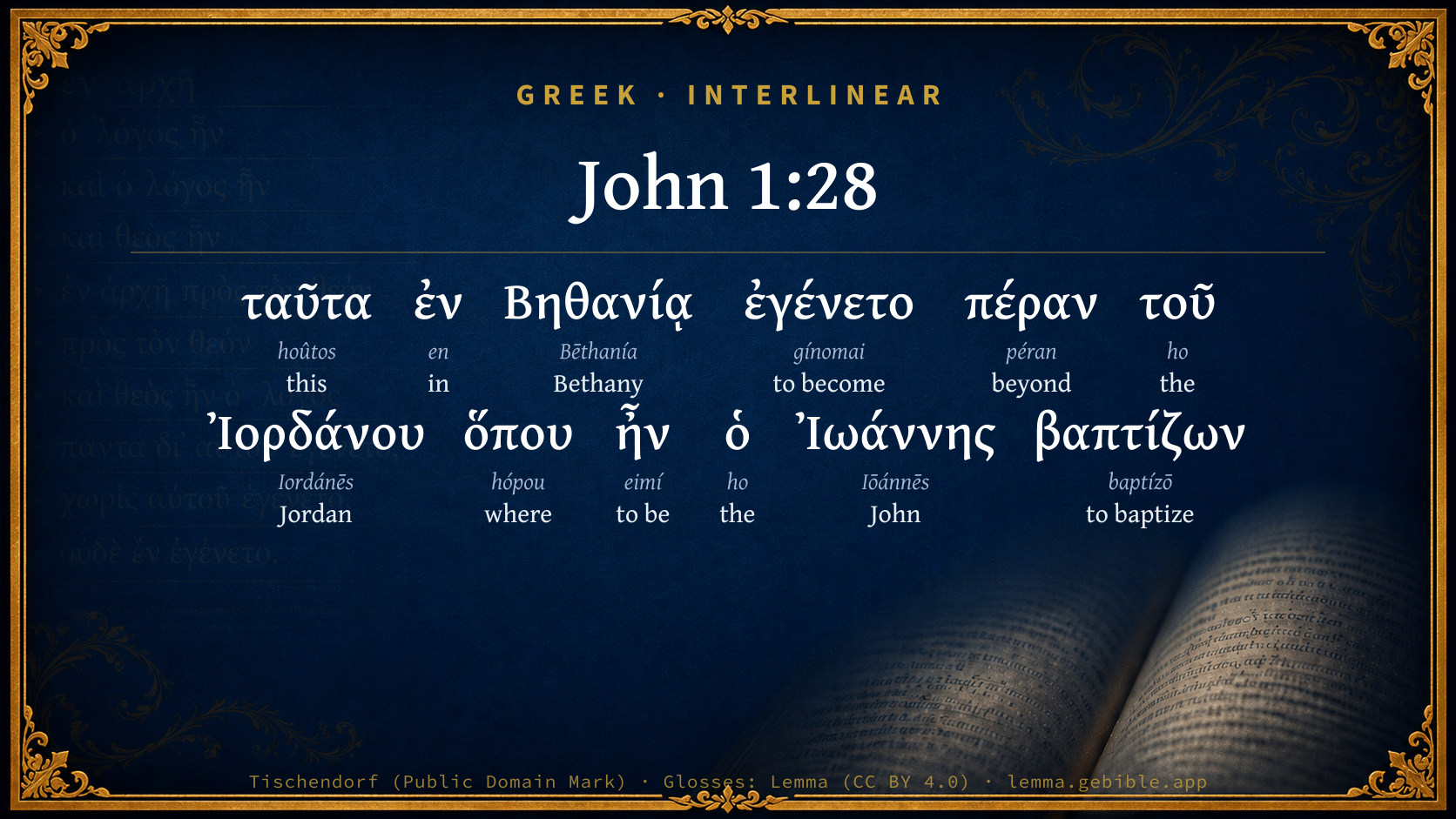
  1. ταῦτα hoûtos G3778 “this” Demonstrative pronoun, Nominative, Plural, Neuter
  2. ἐν en G1722 “in” Preposition
  3. ἐγένετο gínomai G1096 “to become” Verb, Aorist, Middle deponent, Indicative, 3rd person, Singular
  4. πέραν péran G4008 “beyond” Adverb
  5. τοῦ ho G3588 “the” Article, Genitive, Singular, Masculine
  6. Ἰορδάνου Iordánēs G2446 “Jordan” Noun, Genitive, Singular, Masculine
  7. ὅπου hópou G3699 “where” Adverb
  8. ἦν eimí G1510 “to be” Verb, Imperfect, Active, Indicative, 3rd person, Singular
  9. ὁ ho G3588 “the” Article, Nominative, Singular, Masculine
  10. Ἰωάννης Iōánnēs G2491 “John” Noun, Nominative, Singular, Masculine
  11. βαπτίζων baptízō G907 “to baptize” Verb, Present, Active, Participle, Nominative, Singular, Masculine

About this verse

These counts appear in no published source. They are computed here, from the morphology-tagged text and Lemma’s own curated glosses. What Lemma adds →

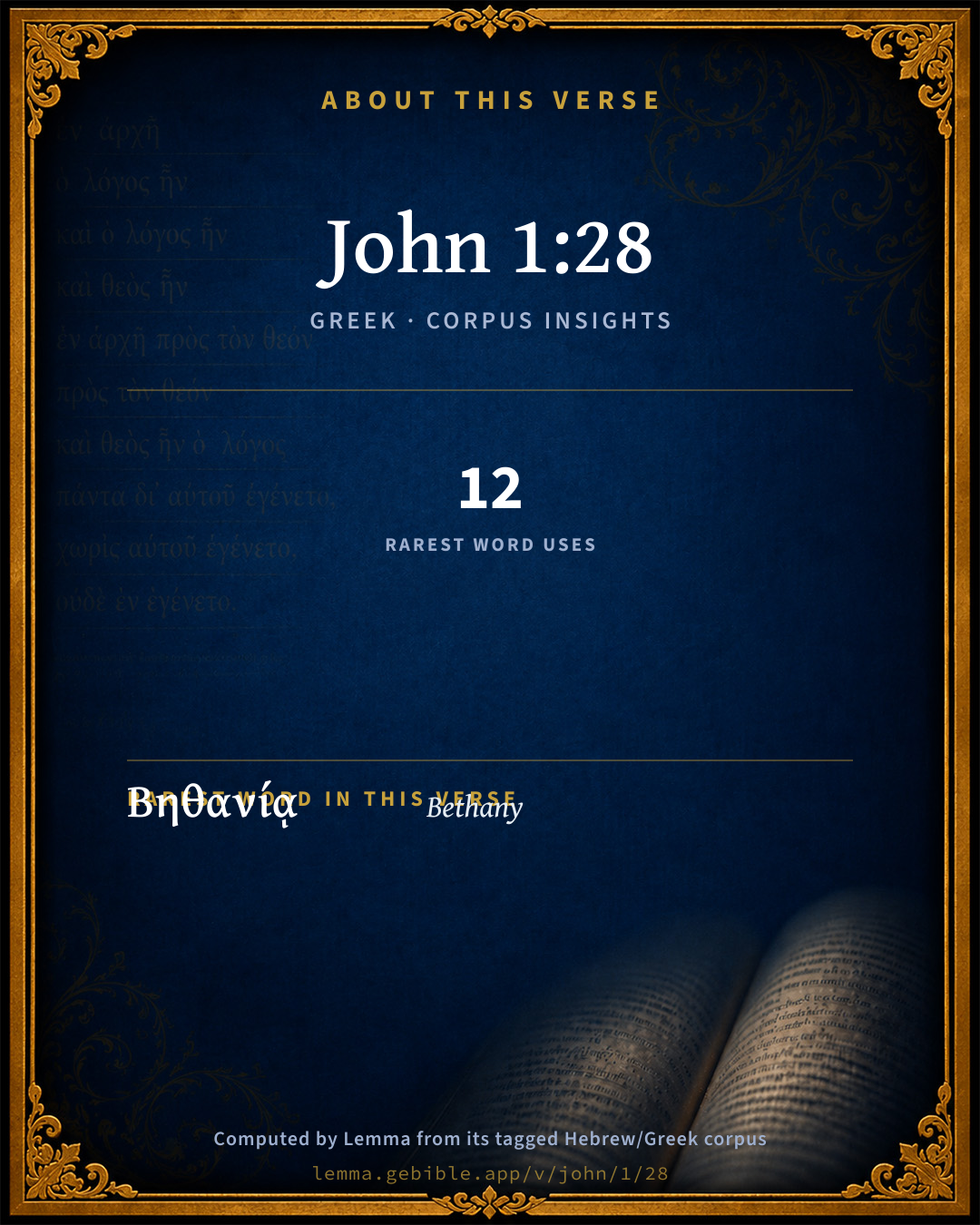
12
words
11
distinct lemmas
Gospels
section

Notable vocabulary

The rarest word here is Βηθανίᾳ Bethany G963 — appearing just 12 times in the whole Greek New Testament.

Shared distinctive vocabulary

Βηθανίᾳ Bethany G963 occurs in 12 verses of the Greek New Testament. Also found in:

Repetition

A word recurs within this verse:

Cross-references

4

Topical passages linked to John 1:28 in the Treasury of Scripture Knowledge — connected by theme and wording, ordered by reader-vote popularity; previews shown in the World English Bible.

  • John 10:40 He went away again beyond the Jordan into the place where John was baptizing at first, and there he stayed.
  • John 3:23 John also was baptizing in Enon near Salim, because there was much water there. They came, and were baptized.
  • Judges 7:24 Gideon sent messengers throughout all the hill-country of Ephraim, saying, Come down against Midian, and take before them the waters, as far as Beth Barah, even the Jordan. So all the men of Ephraim were gathered together, and took the waters as far as Beth Barah, even the Jordan.
  • John 3:26 They came to John, and said to him, "Rabbi, he who was with you beyond the Jordan, to whom you have testified, behold, the same baptizes, and everyone is coming to him."

Cross-references courtesy of OpenBible.info (CC BY 4.0).

Commentary

Notes on John 1:28 from classic Christian and Jewish commentators (each source and its license shown beneath its notes). The classic Christian expositions comment on the surrounding passage and are grouped to its opening verse, so a note may address several verses; the Jewish commentaries on the Tanakh (Rashi and others) are per-verse, so they appear only where the commentator wrote on this verse.

Lemma curates 59 commentaries, every one of them public domain or Creative Commons licensed, each selected and text-cleaned for this edition rather than reprinted as found. About our sources →

Bengel's Gnomon

Johann Albrecht Bengel

Joh 1:28. Ἐν βηθαβαρᾶ, in Bethabara) Therefore they had come a long way, Joh 1:19.—πέραν) beyond, in relation to Jerusalem.—ὁποῦ, where) Where he was wont to baptize. [Βηθανίᾳ is the reading of the mass of authorities, [31][32][33]*[34][35][36]. Βηθαβαρᾶ was a conjecture of Orige[37]. The Bethany here was one beyond Jordan, which had ceased to exist before Orige[38]’s time.]

[31] the Alexandrine MS.: in Brit. Museum: fifth century: publ. by Woide, 1786–1819: O. and N. Test. defective.

[32] the Vatican MS., 1209: in Vat. Iibr., Rome: fourth cent.: O. and N. Test. def.

[33] Ephræmi Rescriptus: Royal libr., Paris: fifth or sixth cent.: publ. by Tisch. 1843: O. and N. T. def.

[34] Cod. Reg., Paris, of the Gospels: the text akin to that of B: edited by Tisch.

[35] Cod. Monacensis, fragments of the Gospels.

[36] San Gallensis: in the libr. of St. Gall: the Greek and Latin of the four Gospels. It and G. Boernerianus of Paul’s Epp. are severed parts of the same book.

[37] rigen (born about 186 A.D., died 253 A.D., a Greek father: two-thirds of the N. Test. are quoted in his writings). Ed. Vinc. Delarue, Paris. 1733, 1740, 1759.

[38] rigen (born about 186 A.D., died 253 A.D., a Greek father: two-thirds of the N. Test. are quoted in his writings). Ed. Vinc. Delarue, Paris. 1733, 1740, 1759.

Bengel's Gnomon of the New Testament — English translation (T&T Clark, Edinburgh, 1860) — public domain. Text from a community e-Sword module.

Meyer's Critical & Exegetical Commentary

Heinrich August Wilhelm Meyer

Joh_1:28. On account of the importance of His public appearance, a definite statement of its locality is again given.

A place so exactly described by John himself (Joh_11:18), according to its situation, as Bethany on the Mount of Olives, cannot be meant here; there must also have been another Bethany situated in Peraea, probably only a village, of which nothing further is known from history. Origen, investigating both the locality and the text, did not find indeed any Bethany, but a Bethabara instead[114] (comp. Jdg_7:24?), which the legends of his day described as the place of baptism; the legend, however, misled him. For Bethany in Peraea could not have been situated at all in the same latitude with Jericho, as the tradition represents, but must have lain much farther north; for Jesus occupied about three days in travelling thence to the Judaean Bethany for the raising of Lazarus (see on Joh_11:17). Yet Paulus (following Bolten) understood the place to be Bethany on the Mount of Olives, and puts a period after ἐγένετο, in spite of the facts that τῇ ἐπαύριον (comp. Joh_1:35) must begin the new narration, and that ὅπου ἦν Ἰωάνν. βαπτ. must clearly refer to Joh_1:25 ff. Baur, however, makes the name, which according to Schenkel must be attributed to an error of a non-Jewish author, to have been invented, in order to represent Jesus (?) as beginning His public ministry at a Bethany, seeing that He came out of a Bethany at its close. Against the objection still taken to this name even by Weizsäcker (a name which a third person was certainly least of all likely to venture to insert, seeing that Bethany on the Mount of Olives was so well known), see Ewald, Jahrb. XII. p. 214 ff. As to the historic truth of the whole account in Joh_1:19-28, which, especially by the reality of the situation, by the idiosyncrasy of the questions and answers, and their appropriateness in relation to the characters and circumstances of the time, as well as by their connection with the reckoning of the day in the following verses, reveals the recollections and interest of an eye-witness, see Schweizer, p. 100 ff.; Bleek, Beitr. p. 256.

ὍΠΟΥ ἮΝ ἸΩΆΝΝ. ΒΑΠΤ.] where John was employed in baptizing.

[114] To suppose, with Possinus, Spicil. Evang. p. 32 (in the Catena in Marc. p. 382 f.), that both names have the same signification (בֵּית עֲבָרָה, domus transitus, ford-house; בֵּית אֲנִיָה, domus navis, ferry-house),a view to which even Lange inclines, L. J. II. 461,is all the more untenable, seeing that this etymology is not at all appropriate to the position of Bethany on the Mount of Olives. Origen himself explains the name Bethabara with an evident intention to allegorize: οἷχος χατασχευῆς (ברא). The derivation of the name Bethany (Lightfoot: בֵּית הינֵי, house of dates; Simon: בֵּית עֲנִיָּה, locus depressionis; others: בֵּיח עֲנִיָה domus miseri) is doubtful.

Note.(1.) Seeing that, according to Joh_1:26-27 (comp. especially ὃν ὑμεῖς οὐκ οἴδατε, which implies his own personal acquaintance), the Baptist already knows the Messiah, while according to Joh_1:31-33 he first learned to recognise Him at His baptism by means of a divine σημεῖον, it certainly follows that the occurrences related in Joh_1:19-28 took place after the baptism of Jesus; and consequently this baptism could not have occurred on the same or the following day (Hengstenberg), nor in the time between Joh_1:31-32 (Ewald). Wieseler, Ebrard, Luthardt, Godet, and most expositors, as already Lücke, Tholuck, De Wette, following the older expositors, rightly regard the events of Joh_1:19 ff. as subsequent to the baptism. It is futile to appeal, as against this (Brückner), to the indefiniteness of the words ὃν ὑμεῖς οὐκ οἴδατε, for there is really no indefiniteness in them; while to refer them to a merely preliminary knowledge, in opposition to the definite acquaintance which began at the baptism, is (against Hengstenberg) a mere subterfuge. That even after the baptism, which had already taken place, John could say, Ye know Him not, is sufficiently conceivable, if we adhere to the purely historical account of the baptism, as given in Joh_1:31-34. See on Matt. p. 111 ff. (2.) Although, according to Mat_3:14, John already knows Jesus as the Messiah when He came to be baptized of him, there is in this only an apparent discrepancy between the two evangelists, see on Joh_1:31. (3.) Mar_1:7-8, and Luk_3:16 ff., are not at variance with John; for those passages only speak of the Messiah as being in Himself near at hand, and do not already presuppose any personal acquaintance with Jesus as the Messiah. (4.) The testimonies borne by the Baptist, as recorded in the Synoptics, are, both as to time (before the baptism) and occasion, very different from that recorded in Joh_1:19 ff., which was given before a deputation from the high court; and therefore the historic truth of both accounts is to be retained side by side,[115] though in details John (against Weisse, who attributes the narrative in John to another hand; so Baur and others) must be taken as the standard. (5.) To deny any reference in Joh_1:19 ff. to the baptism of Jesus (Baur), is quite irreconcilable with Joh_1:31; Joh_1:33; for the evangelist could not but take it for granted that the baptism of Jesus (which indeed Weisse, upon the whole, questions) was a well-known fact. (6.) Definite as is the reference to the baptism of Jesus, there is not to be found any allusion whatever in Johns account to the history of the temptation with its forty days, which can be brought in only before Joh_1:19, and even then involving a contradiction with the Synoptics. The total absence of any mention of thisimportant as it would have been in connection with the baptism, and with Johns design generally in view of his idea of the Logos (against B. Crusius)does not certainly favour the reality of its historic truth as an actual and outward event. Comp. Schleiermacher, L. J. p. 154. If the baptism of Jesus be placed between tbe two testimonies of Joh_1:19 ff. and Joh_1:29 ff. (so Hilgenfeld and Brückner, following Olshausen, B. Crusius, and others), which would oblige us still to place it on the day of the first testimony (see Brückner), though Baumlein (in the Stud. u. Krit. 1846, p. 389) would leave this uncertain; then the history of the temptation is as good as expressly excluded by John, because it must find its place (Mar_1:12; Mat_4:1; Luk_4:1) immediately after the baptism. In opposition to this view, Hengstenberg puts it in the period after Joh_3:22, which is only an unavailing makeshift.

[115] Keim, Gesch. J. I. p. 522, sees in Johns account not so much an historical narrative, as rather (?) a very significant literary introduction to the Baptist, who to a certain extent (?) is officially declaring himself. According to Scholten, the Baptist, during his ministry, did not at all recognise Jesus as Messiah, and Mat_3:14-15 is said to be an addition to the text of Mark; while the fourth Gospel does not relate the baptism of Jesus, but only mentions the revelation from heaven then made, because to narrate the former would not be appropriate to the Gnosis of the Logos.

Meyer — Critical and Exegetical Commentary on the New Testament — English translation by Peter Christie, edited by Frederick Crombie (T&T Clark, 1880) — public domain. Text from a community e-Sword module.

Expositor's Greek Testament

ed. W. Robertson Nicoll

Joh 1:28 . ταῦτα ἐν Βηθανίᾳ … βαπτίζων . The place is mentioned on account of the importance of the testimony thus borne to Jesus, and because the evangelist himself in all probability was present and it was natural to him to name it. But where was it? There is no doubt that the reading Βηθανίᾳ is to be preferred. The addition πέραν τοῦ Ἰορδάνου confirms this reading; as the existence of Bethany near Jerusalem rendered the distinguishing designation necessary. Bethany = בֵּת אֲנִיָּה meaning “boat-house,” and Bethabara having the same meaning [ עֲבָרָה a ferry boat] is it not possible that the same place may have been called by both names indifferently? Henderson ( Palestine , p. 154) suggests that possibly the explanation of the doubtful reading is that the place referred to is Bethabara which led over into Bethania, that is, Bashan. Similarly Conder ( Handbook , p. 320) says Bethania beyond Jordan is evidently the province of Batanea, and the ford Abârah now discovered leads into Batanea. At this place “John was, baptising,” rather than “John was baptizing”.

The Expositor's Greek Testament, edited by W. Robertson Nicoll (1897–1910) — public domain. Text from a community e-Sword module.

Godet's Commentaries

Frédéric Louis Godet

Ver. 28. “These things were done at Bethany, beyond the Jordon, where John was baptizing.”

The notice of Joh 1:28 is certainly not suggested to John by a geographical interest; it is inspired by the solemnity of this whole scene, and by the extraordinary gravity of this official testimony given in presence of the representatives of the Sanhedrim as well as of the entire nation. It was, indeed, to this declaration that the expression of the Prologue applied: “in order that all might believe through him.” If the people had been ready for faith, this testimony coming from such lips, would have been enough to make the divine fire break forth in Israel.

As for the two readingsBethany and Bethabara, Origen relates that nearly all the ancient MSS. read Bethany, but that, having sought for a place of this name on the banks of the Jordan, he had not found it, while a place was pointed out called Bethabara (comp. Jdg 7:24), where tradition alleged that John had baptized. It is, therefore, certain that the readingBethabara was substituted for the primitive reading Bethany in a certain number of documents, and that it was under the influence of Origen; as the Roman war had caused a large number of ancient places to disappear even as to their names, we may easily understand the disappearance of Bethany at the time of Origen. We must, therefore, conclude from the text which is established by evidence, that there existed in the time of Jesus, in the vicinity of the Jordan, a place by the name of Bethany, which was consequently different from the city of this name near Jerusalem. As there were two Bethlehems, two Antiochs, two Ramas, two Canas, why should there not have been, also, two Bethanies? Perhaps this name had, in the two cases, different etymologies. Bethany may signify, indeed, either place of dates, or place of poverty, etc., a meaning which suits Bethany near Jerusalem; or place of the ferry-boat (Beth-Onijah), a meaning which would well suit the Bethany which is here in question.

Frédéric Louis Godet — Commentaries on Luke, John, Romans, and 1 Corinthians — English translation (T&T Clark, Edinburgh, 1870s–1890s) — public domain. Text from a community e-Sword module.

Jamieson, Fausset & Brown

Robert Jamieson, A. R. Fausset & David Brown

Bethabara--Rather, "Bethany" (according to nearly all the best and most ancient manuscripts); not the Bethany of Lazarus, but another of the same name, and distinguished from it as lying "beyond Jordan," on the east.

Jamieson, Fausset & Brown — Commentary Critical and Explanatory on the Whole Bible (1871) — public domain (CC PDM 1.0). Text via the HelloAO Bible API.

Adam Clarke's Commentary

Verse 28. These things were done in Bethabara] It is very probable that the word Bethany should be inserted here, instead of Bethabara. This reading, in the judgment of the best critics, is the genuine one. The following are the authorities by which it is supported: ABCEGHLMSX, BV, of Matthai, upwards of a hundred others, Syriac, Armenian, Persic, Coptic, Slavonic, Vulgate, Saxon, and all the Itala, with some of the most eminent of the primitive fathers, before the time of Origen, who is supposed to have first changed the reading. Bethabara signifies literally the house of passage, and is thought to be the place where the Israelites passed the river Jordan under Joshua. There was a place called Bethany, about two miles from Jerusalem, at the foot of the mount of Olives. But there was another of the same name, beyond Jordan, in the tribe of Reuben. It was probably of this that the evangelist speaks; and Origen, not knowing of this second Bethany, altered the reading to Bethabara. See Rosenmuller.

Adam Clarke's Commentary on the Bible (1810–1826) — public domain. Text from a community e-Sword/MySword module.

John Calvin's Commentaries

28. These things were done in Bethabara. The place is mentioned, not only to authenticate the narrative, but also to inform us that this answer was given amidst a numerous assembly of people; for there were many who flocked to John’s baptism, and this was his ordinary place for baptizing. It is likewise supposed by some to be a passage across Jordan, and, from this circumstance, they derive the name, for they interpret it the house of passage; unless, perhaps, some may prefer the opinion of those who refer to the memorable passage of the people, (Joshua 3:13,) when God opened up a way for them in the midst of the waters, under the direction of Joshua. Others say that it ought rather to be read Betharaba. Instead of Bethabara, some have inserted here the name Bethany, but this is a mistake; for we shall afterwards see how near Bethany was to Jerusalem. The situation of Bethabara, as laid down by those who have described the country, agrees best with the words of the Evangelist; though I have no wish to dispute about the pronunciation of the word.

John Calvin's Commentaries (1540-1563) — public domain. Text from the Calvin Translation Society English edition (1840s-50s) via the Christian Classics Ethereal Library (ccel.org). Calvin's coverage is partial (roughly two-thirds of the Bible); uncommented books and verses are honest gaps, never fabricated. The 19th-century editor's footnotes and remarks are omitted so the notes are faithfully Calvin's own voice.

Ellicott's Commentary for English Readers

(28) Bethabara beyond Jordan should be, Bethany beyond Jordan. Origen found “Bethany” in “almost all the copies,” but not being able to find the place, he came to the conclusion that it must be Bethabara which he heard of, with a local tradition that John had baptised there; and in this he is followed by the Fathers generally. In support of this the etymology of Bethabara (= “ford-house”) is compared with a possible meaning of Bethany (= “ship-house”), and the two are regarded as popular names of some well-known ford, one of which gradually ceased to be known as the name of this place, because it became appropriated as a name of the Bethany made prominent in the closing scenes of our Lord’s life. On the other hand, it is believed that this argument from etymology is at least precarious; that ignorance of the place after three hundred years—and these years of war and unsettlement—is not unnatural; that the tradition in favour of Bethabara, which was then a favourite place for baptism, is one likely to have grown with this fact; and that we are not justified in adopting the critical decision of Origen, who rejected the almost unanimous evidence of MSS. in favour of this tradition at second hand. We are, moreover, ignorant of the site of Bethabara, and the identification with either Beth-barah (Jdg_7:24), or Beth-nimrah (Num_32:36; Jos_13:27), which in some readings of the LXX. had taken the forms Bethabra and Betharaba, gives a position much too far to the south, for the writer is clearly speaking of a place within easy approach of Galilee (Joh_1:43 and Joh_2:1), and he is careful to note the succession of days and even hours. It is not inconsistent with this that the narrative in Mat_3:5 and Mar_1:5 seems to require a place of easy access from Jerusalem, for the positions are not necessarily the same, and the account there is of a general impression, while here we have the minute details of an eye-witness. Himself a disciple of John, he remembers the place where he was then dwelling and baptising, and he knows that this Bethany is “beyond Jordan,” just as he knows that the other is “the town of Mary and her sister Martha” (Joh_11:1), and that it “was nigh unto Jerusalem, about fifteen furlongs off (Joh_11:18). Dr. Caspari believes that a “Bethany” answering the demands of the context is to be found in the village Tellanîje or Tellanihje, which is in the Iolan to the north of the Sea of Galilee (comp. Joh_10:40). It is near a ford of the Jordan, with several brooks intervening. The identity of name depends upon the frequent substitution by the Arabs of “Tell” (= “hill”) for “Beth” (=“house”), so that the present word represents Beth-anîje, or Bethany. Dr. Caspari’s statement is now accessible to the English reader. Few, perhaps, will fully accept the author’s opinion, “With regard to the accuracy of our conclusion respecting the site, there can, therefore, be no doubt” (Chron. and Geogr., Introd., p. 93), but it is based upon a reading of which there can be no doubt, and is, at least, a probable interpretation.

We have in these verses also a note of time. John now knows the Messiah, though others do not. This inquiry of the legates from Jerusalem was, therefore,, after the baptism of our Lord (Joh_1:31; Joh_1:33), and if so, after the Temptation also. (See Note on Mat_4:1.)

A Bible Commentary for English Readers, edited by Charles John Ellicott (1878–1897) — public domain. Text from a community e-Sword module.

The Cambridge Bible for Schools and Colleges

gen. ed. J. J. S. Perowne

28. Bethabara] The true reading is Bethany, which was changed to Bethabara owing to the powerful influence of Origen, who could find no Bethany beyond Jordan known in his day. But in 200 years the very name of an obscure place might easily perish. Origen found ‘Bethany’ in almost all the MSS. The site of Bethabara or Bethany is lost now, but it must have been near Galilee: comp. Joh_1:29 with Joh_1:43, and see on the ‘four days,’ Joh_11:17. It is possible to reconcile the two readings. Bethabara has been identified with ’Abârah, one of the main Jordan fords about 14 miles south of the sea of Galilee: and ‘Bethania beyond Jordan’ has been identified with Bashan; Bethania or Batanea being the Aramaic form of the Hebrew Bashan, meaning ‘soft level ground.’ Thus Bethabara is the village or ford; Bethania, the district on the east side of the ford. See Conder, Handbook of the Bible, pp. 315, 320. But see Appendix D.

The Cambridge Bible for Schools and Colleges (gen. ed. J. J. S. Perowne; Cambridge University Press, 1878–1918) — public domain. Text from a community e-Sword module.

John Gill's Exposition

These things were done in Bethabara,.... That is, this testimony was bore by John; and this discourse passed between him and the Pharisees, at the place here mentioned; which was a passage over Jordan, where much people walked to go on the other side,

beyond Jordan; and

where also John was baptizing; which brought a great concourse of people together: so that this witness was bore in a very public manner, and before a large number; and it is to this that Christ refers, in Joh 1:33 for this was so well known, that there was no hiding or denying it: the place where this conversation passed, is in the Vulgate Latin, and all the eastern versions; and in the Alexandrian copy, and many other copies, and so in Nonnus, called Bethany; but as De Dieu observes, Bethany was not beyond Jordan, nor in the wilderness of Judea, but near to Jerusalem, about two miles distant from it; nor was it situated by waters convenient for baptizing, unless they went to the brook Kidron, which indeed was not far from it; but it is clear from the history, that John was not so near Jerusalem; nor did that brook which might be forded over, continues the same learned author, seem fit and proper enough, `"mergendis baptizandorum corporibus", for plunging the bodies of those that were to be baptized'; wherefore he rightly concludes, that either this reading is an error, or there was another Bethany near Jordan: Bethabara signifies "the house of passage", and is thought to be the place where the Israelites passed over Jordan, to go into the land of Canaan, Jos 3:16. And which, as it must be a very convenient place for the administration of baptism by immersion, used by John, so it was very significant of the use of this ordinance; which is, as it were, the passage, or entrance, into the Gospel church state; for persons ought first to be baptized, and then be admitted into a Gospel church, according to the example of the primitive Christians, Act 2:41 but whether there was a place of this name, where the Israelites went over Jordan, is not certain; and if there was, it does not seem so likely to be the place here designed, since that was right over against Jericho; whereas this seems to be rather further off, and over against Galilee: there were several passages of Jordan, Jdg 12:5. There was a bridge over it, between the lake of Samochon and Gennesaret, now called Jacob's bridge, where Jacob is supposed to have wrestled with the angel, and to have met with his brother Esau; and there was another over it at Chainmath, near Tiberias, and in other places: and it might be at one of these passages, by which they went over into Galilee, that John pitched upon to continue preaching and baptizing at; partly because of the number of people that went over, to whom he had the opportunity of preaching; and partly, for the sake of baptizing those who became proper subjects of that ordinance through his ministry. Some have thought, that this place is the same with Bethbarah, in Jdg 7:24, which was either in the tribe of Ephraim or of Manasseh, and not far from the parts where this place must be, but was on this side Jordan; and so Beza says the words should be rendered; and those who came to John at Jordan, are not said to pass over that river: others are of opinion, that Bethabara is the same with Betharabah, Jos 15:6, since this is called Bethabara by the Septuagint, in Jos 18:22. However, be it what place soever, and wheresoever, it was no doubt very proper for John's purpose; and therefore he chose it, and for a while continued at it: and here, says Jerom (a).

"to this day many of the brethren, that is, of the number of believers, desiring there to be born again, are baptized in the vital stream;

such veneration had they for the place where John first baptized: Origen says (b), that in his time it was said, that Bethabara was showed by the banks of Jordan, where they report John baptized,

(a) De Locis Hebraicis, fol. 89. L. (b) Comment in Joannemo, Tom. 8. p. 131.

John Gill's Exposition of the Whole Bible (1746–1763) — public domain (CC PDM 1.0). Text via the HelloAO Bible API.

Trapp's Complete Commentary

John Trapp

28 These things were done in Bethabara beyond Jordan, where John was baptizing.

Ver. 28. In Bethabara] That is, by interpretation, the place of passage, or traiectum, where Israel passed over Jordan. So the acts of Joshua and Jesus begin both at a place. Baptism also is first administered where it was of old foreshadowed. Christ is the true Bethabara, Eph 2:18; we sail to heaven on his bottom.

John Trapp, A Commentary or Exposition upon All the Books of the Old and New Testament (1647–1656) — public domain. Text from a community e-Sword module.

Albert Barnes' Notes on the Bible

In Bethabara - Almost all the ancient manuscripts and versions, instead of “Bethabara” here, have “Bethany,” and this is doubtless the true reading. There was a Bethany about 2 miles east of Jerusalem, but there is said also to have been another in the tribe of Reuben, on the east side of the river Jordan, and in this place, probably, John was baptizing. It is about 12 miles above Jericho. The word “Bethabara” means “house or place of a ford.” The reading “Bethabara,” instead of “Bethany,” seems to have arisen from the conjecture of Origen, who found in his day no such place as “Bethany,” but saw a town called “Bethabara,” where John was said to have baptized, and therefore took the liberty of changing the former reading - Robinson, Lexicon.

Beyond Jordan - On the east side of the Jordan River.

Albert Barnes' Notes on the Bible (1834–1885) — public domain. Text from a community e-Sword/MySword module.

Matthew Poole's English Annotations

The evangelist had before told us what was done, these words tell us where. Some ancient writers will have the place to have been Bethany; but they seem not to have so well considered Joh 11:18, where Bethany is said to have been but fifteen furlongs from Jerusalem, and consequently on this side Jordan; whereas the evangelist saith, that this place was περαν,

beyond Jordan, in the tribe of Reuben, in the country of Peraea, where John at this time was baptizing, and probably had been so for some time.

Matthew Poole's English Annotations on the Holy Bible (1683–1685) — public domain. Text from a community e-Sword/MySword module.

Whedon's Commentary on the Bible

Daniel D. Whedon

28. In Bethabara—Nearly all the ancient manuscripts read Bethany instead of Bethabara. The latter name was substituted for the former by Origen, because he knew a Bethabara but not a Bethany near the Jordan. Stanley, however, maintains that Bethabara is the right reading. If Bethany or Bethania is the true reading, it nevertheless may be in the Aramaic a different word, as well as a different place from the Bethany of Lazarus and his sisters on Mount Olivet. The former may be a word signifying the place of (ferry) boats; the latter the place of dates.

Perhaps this long-debated question has been rightly settled by a late very scholarly traveller in Palestine, Revelation Mr. Tristam, (1864,) who identifies Bethabara with Beth-Nimrah, a little north of the Bethabara on our map. It is probably the ford passed by the Baptist’s great type, Elijah the Tishbite, on his way to his ascension. Quarantania, the Mount of Temptation, is in sight. It is a place amply supplied with convenient waters. Its very name in the Septuagint, Baethanabra, is about half way between Bethany and Bethabara, and might be transformed either way or both ways. Num_32:36; Jos_13:27.

Daniel D. Whedon (gen. ed.), Commentary on the Old and New Testaments (1874–1909) — public domain. Text from a community e-Sword module.

The Pulpit Commentary

These things were clone in Bethany beyond the Jordan, where John was baptizing. The fact that John the Baptist, in the previous verses, recognizes the Messiah, and that in vers. 31-33 he declares that knowledge to have followed the baptism and the sign then given to him, makes it obvious that the baptism and the forty days of the temptation are now in the past. Every day is clearly marked from the day on which the deputation from the Sanhedrin approached him, till we find Jesus at Cana, on his way to Jerusalem. Consequently, the baptism of Christ, which was the occasion of the higher knowledge that John acquired concerning him, as well as the temptation, had been consummated. Of this last it would seem highly probable John had received, in subsequent conversation with the Lord, a full report. The Lord had passed through the fiery ordeal. He had accepted the position of the Servant of the Lord, who, in the way of privation, suffering, fierce antagonism from world, flesh, and devil, would win the crown of victory and prove himself to be the Life and Light of the world. This chronological hint appears to me to explain the sudden and surprising utterance of the next verse.

The Pulpit Commentary (1880–1919), ed. H.D.M. Spence-Jones & Joseph S. Exell — public domain. Text from a community e-Sword module.

John Wesley's Explanatory Notes

Where John was baptizing - That is, used to baptize.

John Wesley, Explanatory Notes Upon the Whole Bible (1754–1765) — public domain. Text via the GEBible commentary corpus.

The People's New Testament

B. W. Johnson

28. These things were done in Bethabara. The Revision says Bethany, a village whose site is now unknown, on the east bank of the Jordan. Bethabara means “the house of the ford.”

B. W. Johnson's The People's New Testament with Notes (1889–1891) — public domain. Electronic text from the Christian Classics Ethereal Library (CCEL) ThML edition.

Cambridge Greek Testament for Schools and Colleges

28. Βηθανίᾳ, with א1ABC1, for Βηθαβαρᾷ of T. R., supported (in spite of Origen’s defence of it) by only a small minority.

28. Βηθανίᾳ. This, which is the true reading, was altered to Βηθαβαρᾷ owing to the powerful influence of Origen, who could find no Bethany beyond Jordan in his day. In 200 years the very name of an obscure place might easily perish. Origen says that almost all the old MSS. had Βηθανίᾳ. This Bethany or Bethabara must have been near Galilee: comp. Joh 1:29, with Joh 1:43, and see on the ‘four days,’ Joh 11:17. It is possible to reconcile the two readings. Bethabara has been identified with ’Abârah, one of the main Jordan fords about 14 miles S. of the sea of Galilee: and ‘Bethania beyond Jordan’ has been identified with Bashan; Bethania or Batanea being the Aramaic form of the Hebrew Bashan, meaning ‘soft level ground.’ Bethabara is the village or ford; Bethania the district E. of the ford. Conder, Handbook of the Bible, pp. 315, 320. The Jordan had grand historical associations: to make men pass through its waters might seem to some a preparation for conquests like those of Joshua.

Cambridge Greek Testament for Schools and Colleges (Cambridge University Press, 1896; 21 vols, various authors incl. Carr, Maclear, Plummer, Farrar, Lumby, Moule, M. R. James, Simcox) — public domain. Text from a community e-Sword module.

Alford’s Greek Testament

Henry Alford

28.] The common reading, Βηθαβαρᾷ, is owing to a conjecture of Origen, the grounds of which he thus states:—ὅτι μὲν σχεδὸν ἐν πᾶσι τοῖς ἀντιγράφοις κεῖται “ταῦτα ἐν Βηθανίᾳ ἐγένετο” οὐκ ἀγνοοῦμεν, καὶ ἔοικε τοῦτο καὶ ἔτι πρότερον γεγονέναι· καὶ παρὰ Ἡρακλεωνι γοῦν Βηθανίαν ἀνέγνωμεν. ἐπείσθημεν δὲ μὴ δεῖν Βηθανίᾳ ἀναγινώσκειν, ἀλλὰ Βηθαβαρᾷ, γενόμενοι ἐν τοῖς τόποις ἐπὶ ἱστορίαν τῶν ἰχνῶν Ἰησοῦ καὶ τῶν μαθητῶν αὐτοῦ καὶ τῶν προφητῶν. Βηθανία γάρ, ὡς ὁ αὐτὸς εὐαγγελιστής φησι, ἡ πατρὶς Λαζάρου καὶ Μάρθας καὶ Μαρίας, ἀπέχει τῶν Ἱεροσολύμων σταδίους δέκα πέντε· ἧς πόῤῥω ἐστὶν ὁ Ιορδάνης ποταμός, ὡς ἀπὸ σταδίων πλατεῖ λόγῳ ρπʼ (180). ἀλλʼ οὐδὲ ὁμώνυμος τῇ Βηθανίᾳ τόπος ἐστὶν περὶ τὸν Ἰορδάνην· δείκνυσθαι δὲ λέγουσι παρὰ τῇ ὄχθῃ τοῦ Ἰορδάνου τὰ Βηθαβαρᾶ, ἔνθα ἱστοροῦσι τὸν Ἰωάννην βεβαπτικέναι (In Joan. 6:24, p. 140). He goes on to shew from the etymology of the names that it must have been Bethabara; an argument which modern criticism will not much esteem. It will be seen that his testimony is decisive for the universality and authority of Βηθανίᾳ, while for the other he only produces a tradition, and that only at second-hand; “they say that such a place is shewn.” That no Bethany beyond Jordan was known in his time proves but little;—for 300 eventful years had changed the face of Palestine since these events, and the names and sites of many obscure places may have been forgotten. I abstain from enumerating modern conjectures on the identity of the two, or the etymology of the names, as being indecisive and unprofitable. The objection of Paulus, that πέραν τοῦ Ἰορδάνου the Sanhedrim had no authority, appears not to be founded in fact: see Lücke’s Comm. i. 394 ff.

The question whether this testimony of the Baptist is identical with that given by the three other Evangelists, especially by Luke (3:16), is, after all that has been said on it (Lücke, De Wette, Olshausen, &c.), not of great importance. The whole series of transactions here recorded, from ver. 15 onwards, certainly happened after the baptism of our Lord;—for before that event John did not know Him as ὁ ἐρχόμενος: and μέσος ὑμῶν στήκει ver. 26 shews that he had so recognized Him (see below on τῇ ἐπαύρ.): whereas the testimony in Luk 3:16 and ║, is as certainly given before the baptism. But since the great end of John’s mission was to proclaim Him who was coming after him, it is not only probable, but absolutely necessary to suppose, that he should have delivered this testimony often, and under varying circumstances: before the baptism, in the form given by Luke, ἔρχεται ὁ ἰσχυρ. μου κ.τ.λ., and after it in this form, οὗτος ἦν ὃν εἶπον (ver. 15), where his former testimony is distinctly referred to. And among John’s disciples and the multitudes who frequented his baptism, many reports of such his sayings would naturally be current. So that there is neither a real nor even an apparent contradiction between John and the other Evangelists.

It is a far more important question, in what part of this narration the forty days’ Temptation is to be inserted. From ver. 19 to ch. 2:1 there is an unbroken sequence of days distinctly marked. Since then ver. 19 must be understood as happening after the baptism, it must have happened after the Temptation also. And in this supposition there is not the slightest difficulty. But when we have made it, it still remains to say whether at that time our Lord had returned from the Temptation or not. The general opinion of Harmonists has been, that the approach of Jesus to John in ver. 29 was His return after the Temptation. But this I think questionable, on account of the μέσος ὑμῶν στήκει, ver. 26; which I can only understand literally. I therefore believe that the return from the Temptation to Bethany beyond Jordan had taken place before the deputation arrived.

Henry Alford, The Greek Testament (1849–1861) — public domain. Text from a community e-Sword module.

International Critical Commentary

28. The situation of the place is uncertain, and the variety of reading perplexes the topographical problem still more.

Βηθανίᾳ is read by א*ABC*WNΘ and must be accepted, although a “Bethany beyond Jordan” is not mentioned elsewhere. The rec. reading Βηθαβαρᾷ was adopted by Origen on geographical grounds (Comm. vi. 40). The Sinai Syriac has Beth Abré, which Burkitt thinks must rest on local tradition similar to that followed by Origen.

Conder identified Bethabara with the ford called ’Abârah, N.E. of Bethshean.1 Jordan had many fords and ferries, and the name Bethabara would suit any place near a ford, its root being עבר “to cross”; but it is in favour of Conder’s identification that the name is not found elsewhere (cf. Beth-barah, Jdg 7:24). ’Abârah is barely 20 miles from Cana as the crow flies, but would be about 40 miles by road, so that it would be a possible site, if we take into account the time spent on the journey (2:1). It is, however, too far from Jerusalem to suit the Synoptic narrative (Mar 1:5, Mat 3:5), and the traditional site is much farther south, near Jericho.2

Beth-Nimrah, on the E. side of Jordan, N.E. of Jericho, will meet all the conditions of the problem. In Jos 13:27 (B) Beth-Nimrah becomes Βαιθαναβρά, and this form might be corrupted either into Bethany or Bethabara. We incline to accept this identification, which, made at the first by Sir George Grove, was accepted by Sir Charles Wilson,3 and favoured by Cheyne.

ὅπου ἧν Ἰωάνης βαπτίζων. This coupling of a participle with the verb εἶναι, where we should expect an imperfect (ἐβάπτιζε) denoting continued action, is common in Jn. We have the phrase ἦν Ἰωάνης βαπτίζων repeated 3:23, 10:40; cf. also 5:5, 11:1, 13:23. It is also found in the Synoptists (e.g. Luk 5:16, Mat 19:22). This may be an Aramaic constr., but it is also found in classical Greek.

Abbott notes (Diat. 2171) that ὅπου after the name of a place (a constr. which appears again 12:1, 19:18, and in Mk., Mt. occasionally) is not in accordance with classical usage. Milligan cites from a second-century papyrus, εἰς Λιβύην ὅπου Ἄμμων … χρησμῳδεῖ, an excellent parallel.

The Baptist’s Designation of Jesus as the Christ (Vv. 29-34)

International Critical Commentary — older volumes (1896–1929), various authors — public domain. Text from a community e-Sword module.

Lesson kit

Teaching starters — assembled from the data on this page, not authored interpretation. Every prompt links to the verse data it draws on. Edit before teaching.

John, in the Gospels, opens this verse with 12 words (11 distinct Greek lemmas). Its most distinctive word is Bēthanía (“Bethany”). A historical commentator’s framing appears above. Read the whole chapter for the surrounding context.

Discussion questions

  1. What does “Bethany” (Bēthanía) contribute to the verse as a whole?
  2. Matthew 21:17 shares the word «Bethany» with this verse. How do the two illuminate each other?
  3. “the” occurs 2× in this one verse. What is the effect of the repetition?
  4. These translations render this verse differently. What is at stake in choosing one wording over another?
  5. Reading how Bengel's Gnomon and Meyer's Critical & Exegetical Commentary read this verse, where do the two commentators agree and where do they part?

Things to notice

Reading settings

Reading text

Shown beneath each verse's original-language words.

Old Testament
Old Testament edition

Read the OT as the Masoretic Hebrew (MT) or the Greek Septuagint (LXX).

English shown for the Greek Septuagint (in the Hebrew ↔ Greek comparison).

Comparing translations? Open the Compare panel on any verse page to stack up to four side by side.