
John 3:10

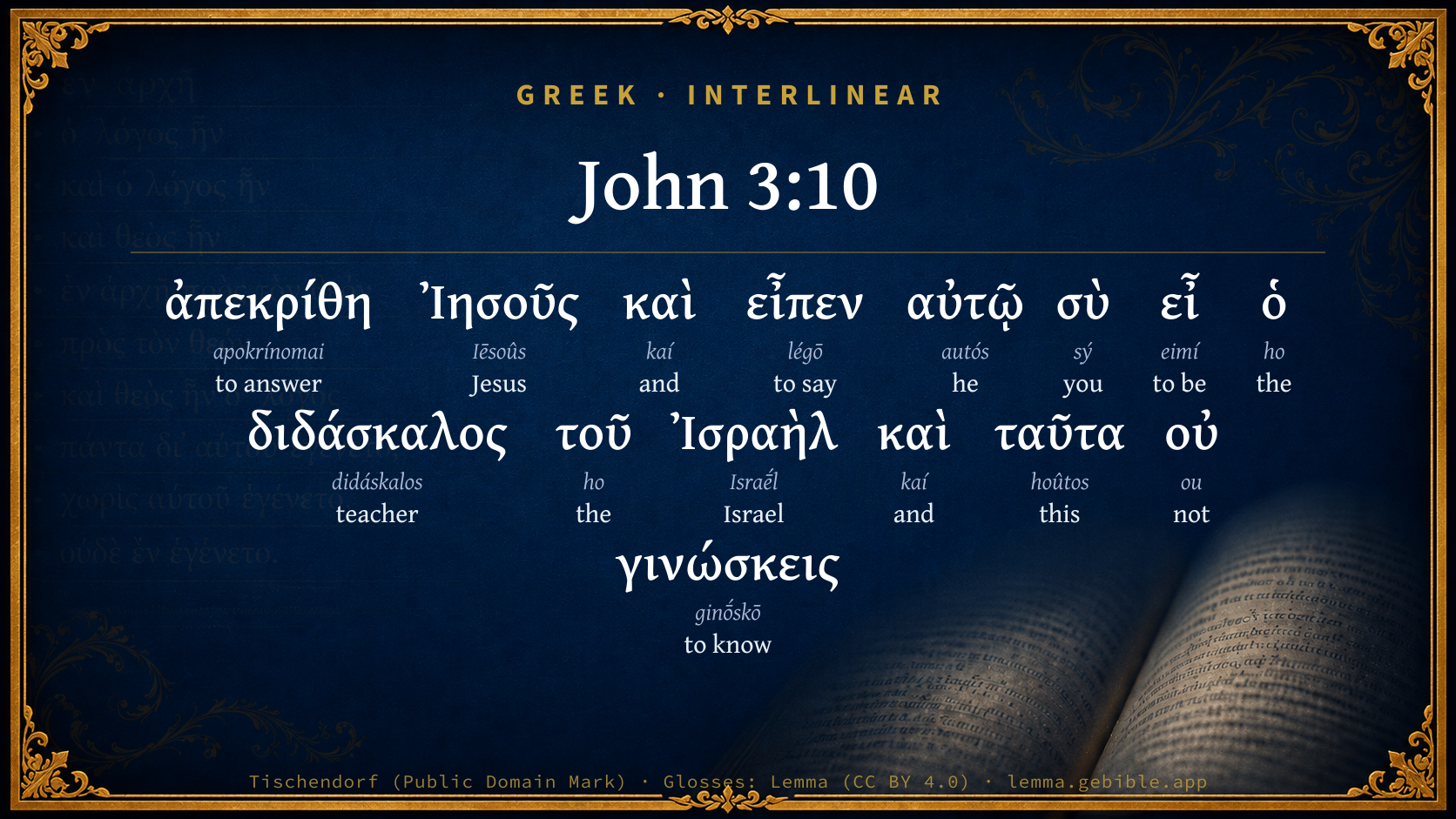
Greek (Tischendorf 8th ed.) John 3:10 appears in the Greek New Testament. The text above is from the Tischendorf 8th edition. Each word links to its Strong’s number and a concise gloss. Click any word for its full Thayer’s Greek Lexicon entry.
Download image
Cite this verse

John 3:10 (World English Bible). Public Domain. Lemma interlinear Bible study tool, https://lemma.gebible.app/v/john/3/10.

Show BibTeX & RIS
BibTeX
RIS
English Translation
Jesus answered him, "Are you the teacher of Israel, and don't understand these things?
World English Bible · Public Domain
Download a study sheet

One document with this verse’s original text, its word-by-word gloss line, the meaning frame, cross-references with their text, attributed commentary, and full source and license credits — printable, and it pastes into notes with its structure intact.

This verse Autodidact and up

Study sheet (.html) Plain text (.txt)

A passage Seminary Student

Up to 50 verses in one chapter. A passage sheet keeps up to 6 commentary sources and 12 cross-references per verse, in the order this page ranks them, and says so on the sheet whenever that leaves anything out. Ask for a single verse and you get the Autodidact verse sheet above.

Everything on this page stays free to read, with no account — the sheet is a download of what is already on screen, not access to it.

Want to remove ads? Support Godless Engineer
Compare translations 3

The same verse in 3 English versions, stacked beneath the original-language interlinear above. Click any original word for its lexicon entry.

Each is an independent rendering of the whole verse — the interlinear is not word-aligned to these translations.

Highlighted words mark where these versions differ — a whole-verse word diff, not a word-by-word alignment.

  • World English Bible Public Domain
    Jesus answered him, "Are you the teacher of Israel, and don't understand these things?
  • King James Version Public Domain
    Jesus answered and said unto him, Art thou a master of Israel, and knowest not these things?
  • unfoldingWord Literal Text CC BY-SA 4.0
    Jesus answered and said to him, “Are you the teacher of Israel and yet you do not understand these things?

unfoldingWord Literal Text — © unfoldingWord, licensed CC BY-SA 4.0. Word-aligned USFM3 via Door43 (git.door43.org/unfoldingWord/en_ult).

Versions to compare (up to 4)

3 of 4 selected

Show all 19 translations

Every available English version of this verse, each an independent rendering of the whole verse.

  • World English Bible Public Domain
    Jesus answered him, "Are you the teacher of Israel, and don't understand these things?
  • Berean Standard Bible Public Domain
    “You are Israel’s teacher,” said Jesus, “and you do not understand these things?
  • Majority Standard Bible Public Domain
    “You are Israel’s teacher,” said Jesus, “and you do not understand these things?
  • King James Version Public Domain
    Jesus answered and said unto him, Art thou a master of Israel, and knowest not these things?
  • American Standard Version (1901) Public Domain
    Jesus answered and said unto him, Art thou the teacher of Israel, and understandest not these things?
  • Revised Version (1885) Public Domain
    Jesus answered and said unto him, Art thou the teacher of Israel, and understandest not these things?
  • Geneva Bible (1599) Public Domain
    Iesus answered, and saide vnto him, Art thou a teacher of Israel, and knowest not these things?
  • Douay-Rheims (1899) Public Domain
    Jesus answered, and said to him: Art thou a master in Israel, and knowest not these things
  • Young's Literal Translation Public Domain
    Jesus answered and said to him, `Thou art the teacher of Israel -- and these things thou dost not know!
  • Literal Standard Version CC BY-SA 4.0
    Jesus answered and said to him, “You are the teacher of Israel and you do not know these things?
  • Unlocked Literal Bible CC BY-SA 4.0
    Jesus answered and said to him, “Are you a teacher of Israel, and yet you do not understand these things?
  • unfoldingWord Literal Text CC BY-SA 4.0
    Jesus answered and said to him, “Are you the teacher of Israel and yet you do not understand these things?
  • Darby Bible Public Domain
    Jesus answered and said to him, Thou art the teacher of Israel and knowest not these things!
  • World Messianic Bible Public Domain
    Yeshua answered him, “Are you the teacher of Israel, and don’t understand these things?
  • Webster's Bible Public Domain
    Jesus answered and said to him, Art thou a teacher of Israel, and knowest not these things?
  • Free Bible Version CC BY-SA 4.0
    “You're a famous teacher in Israel, and yet you don't understand such things?” Jesus replied.
  • Bible in Basic English Public Domain
    And Jesus, answering, said, Are you the teacher of Israel and have no knowledge of these things?
  • Text-Critical English NT CC BY 4.0
    Jesus answered him, “Yoʋ are the teacher of Israel, and yoʋ do not understand these things?
  • Tyndale New Testament (1534) Public Domain
    Iesus answered and sayde vnto him: arte thou a master in Israel and knowest not these thinges?

Literal Standard Version (2020), Covenant Press — licensed CC BY-SA 4.0. Text via the HelloAO Bible API (eBible.org). Unlocked Literal Bible (unfoldingWord) — licensed CC BY-SA 4.0. Text via the HelloAO Bible API (eBible.org). unfoldingWord Literal Text — © unfoldingWord, licensed CC BY-SA 4.0. Word-aligned USFM3 via Door43 (git.door43.org/unfoldingWord/en_ult). Free Bible Version, Dr. Jonathan Gallagher — licensed CC BY-SA 4.0. Text via the HelloAO Bible API (eBible.org).

Word by word

More ways to search: Search by grammar → Find every occurrence → Compare this word →

Practice this passage: Drill this verse → Learn its vocabulary →

διδάσκαλος
didáskalos
G1320
“teacher”
Noun, Nominative, Singular, Masculine
Part of Speech
Noun
Case
Nominative
Number
Singular
Gender
Masculine
Full Thayer's Definition

Origin: from G1321

TDNT: 04:28,2

1. a teacher 2. in the NT one who teaches concerning the things of God, and the duties of man a. one who is fitted to teach, or thinks himself so b. the teachers of the Jewish religion c. of those who by their great power as teachers draw crowds around them i.e. John the Baptist, Jesus d. by preeminence used of Jesus by himself, as one who showed men the way of salvation e. of the apostles, and of Paul f. of those who in the religious assemblies of the Christians, undertook the work of teaching, with the special assistance of the Holy Spirit g. of false teachers among Christians
  1. ἀπεκρίθη apokrínomai G611 “to answer” Verb, Aorist, Middle deponent, Indicative, 3rd person, Singular
  2. Ἰησοῦς Iēsoûs G2424 “Jesus” Noun, Nominative, Singular, Masculine
  3. καὶ kaí G2532 “and” Conjunction
  4. εἶπεν légō G3004 “to say” Verb, Aorist, Active, Indicative, 3rd person, Singular
  5. αὐτῷ autós G846 “he” Personal pronoun, Dative, Singular, Masculine
  6. σὺ sý G4771 “you” Personal pronoun, 2nd person, Nominative, Singular
  7. εἶ eimí G1510 “to be” Verb, Present, Active, Indicative, 2nd person, Singular
  8. ὁ ho G3588 “the” Article, Nominative, Singular, Masculine
  9. τοῦ ho G3588 “the” Article, Genitive, Singular, Masculine
  10. Ἰσραὴλ Israḗl G2474 “Israel” Noun, Proper, indeclinable
  11. καὶ kaí G2532 “and” Conjunction
  12. ταῦτα hoûtos G3778 “this” Demonstrative pronoun, Accusative, Plural, Neuter
  13. οὐ ou G3756 “not” Particle, Negative
  14. γινώσκεις ginṓskō G1097 “to know” Verb, Present, Active, Indicative, 2nd person, Singular

About this verse

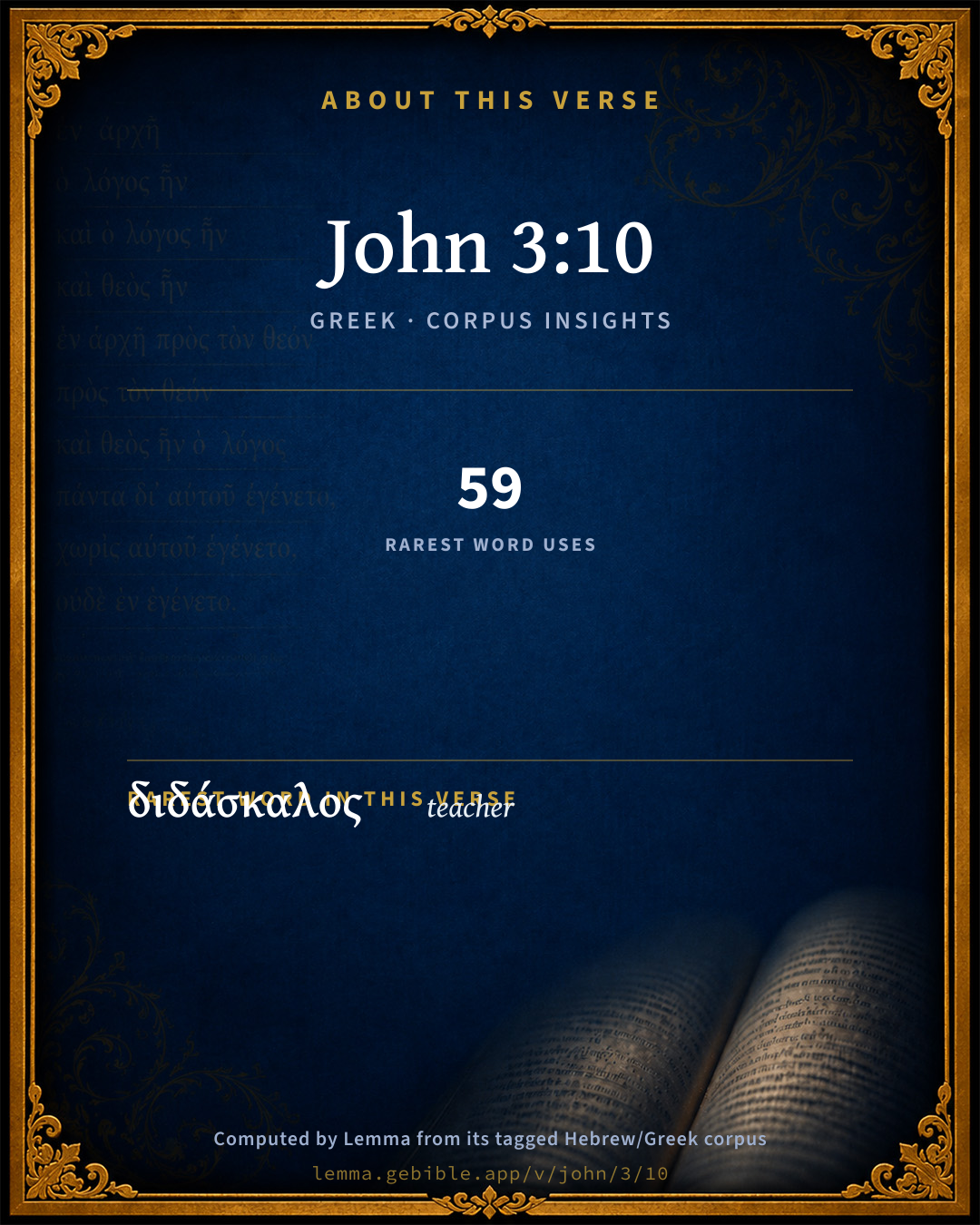
These counts appear in no published source. They are computed here, from the morphology-tagged text and Lemma’s own curated glosses. What Lemma adds →

15
words
13
distinct lemmas
Gospels
section

Shared distinctive vocabulary

διδάσκαλος teacher G1320 occurs in 58 verses of the Greek New Testament. Also found in:
Repetition

Words recur within this verse:

Cross-references

23

Topical passages linked to John 3:10 in the Treasury of Scripture Knowledge — connected by theme and wording, ordered by reader-vote popularity; previews shown in the World English Bible.

  • Matthew 22:29 But Jesus answered them, "You are mistaken, not knowing the Scriptures, nor the power of God.
  • Jeremiah 8:8–9 How do you say, We are wise, and the law of Yahweh is with us? But, behold, the false pen of the scribes has worked falsely.
  • Ezekiel 11:19 I will give them one heart, and I will put a new spirit within you; and I will take the stony heart out of their flesh, and will give them a heart of flesh;
  • Matthew 15:14 Leave them alone. They are blind guides of the blind. If the blind guide the blind, both will fall into a pit."
  • Psalms 51:6 Behold, you desire truth in the inward parts. You teach me wisdom in the inmost place.
  • Psalms 51:10 Create in me a clean heart, O God. Renew a right spirit within me.
  • Psalms 73:1 Surely God is good to Israel, To those who are pure in heart.
  • Ezekiel 36:25–27 I will sprinkle clean water on you, and you shall be clean: from all your filthiness, and from all your idols, will I cleanse you.
  • Deuteronomy 10:16 Circumcise therefore the foreskin of your heart, and be no more stiff-necked.
  • Deuteronomy 30:6 Yahweh your God will circumcise your heart, and the heart of your seed, to love Yahweh your God with all your heart, and with all your soul, that you may live.
  • 1 Chronicles 29:19 and give to Solomon my son a perfect heart, to keep your commandments, your testimonies, and your statutes, and to do all these things, and to build the palace, for which I have made provision.
  • Isaiah 9:16 For those who lead this people cause them to err; and those who are led of them are destroyed.
  • Isaiah 11:6–9 The wolf shall dwell with the lamb, and the leopard shall lie down with the kid; and the calf and the young lion and the fattened calf together; and a little child shall lead them.
  • Isaiah 29:10–12 For Yahweh has poured out on you the spirit of deep sleep, and has closed your eyes, the prophets; and your heads, the seers, has he covered.
  • Isaiah 56:10 His watchmen are blind, they are all without knowledge; they are all mute dogs, they can't bark; dreaming, lying down, loving to slumber.
  • Isaiah 66:7–9 Before she travailed, she brought forth; before her pain came, she was delivered of a man-child.
  • Jeremiah 31:33 But this is the covenant that I will make with the house of Israel after those days, says Yahweh: I will put my law in their inward parts, and in their heart will I write it; and I will be their God, and they shall be my people:
  • Jeremiah 32:39–40 and I will give them one heart and one way, that they may fear me forever, for the good of them, and of their children after them:
  • Ezekiel 18:31–32 Cast away from you all your transgressions, in which you have transgressed; and make you a new heart and a new spirit: for why will you die, house of Israel?
  • Ezekiel 37:23–24 neither shall they defile themselves any more with their idols, nor with their detestable things, nor with any of their transgressions; but I will save them out of all their dwelling-places, in which they have sinned, and will cleanse them: so shall they be my people, and I will be their God.
  • Matthew 11:25 At that time, Jesus answered, "I thank you, Father, Lord of heaven and earth, that you hid these things from the wise and understanding, and revealed them to infants.
  • Romans 2:28 For he is not a Jew who is one outwardly, neither is that circumcision which is outward in the flesh;
  • Philippians 3:3 For we are the circumcision, who worship God in the Spirit, and rejoice in Christ Jesus, and have no confidence in the flesh;

Cross-references courtesy of OpenBible.info (CC BY 4.0).

Commentary

Notes on John 3:10 from classic Christian and Jewish commentators (each source and its license shown beneath its notes). The classic Christian expositions comment on the surrounding passage and are grouped to its opening verse, so a note may address several verses; the Jewish commentaries on the Tanakh (Rashi and others) are per-verse, so they appear only where the commentator wrote on this verse.

Lemma curates 59 commentaries, every one of them public domain or Creative Commons licensed, each selected and text-cleaned for this edition rather than reprinted as found. About our sources →

The Biblical Illustrator

Joseph S. Exell

Joh_3:10

Art thou a master of Israel, and knowest not these things?

--The truths which Christ came to declare, He did but recall in great measure to minds which had lost the memory of what was from the first.

I. THE NEED OF SPIRITUAL CIRCUMCISION, CLEANSING OR RENEWAL OF THE HEART, WAS NO NEW DOCTRINE OF CHRIST (see Deu_10:16, 1Sa_10:9; Psa_51:10; Jer_31:33; Eze_11:19).

II. THE COMING OF THE HOLY SPIRIT AND HIS PRESENCE IN MANS HEART HAD BEEN FORETOLD BY THE PROPHETS (Eze_36:25-27).

III. HENCE THE IGNORANCE OF THIS DISTINGUISHED TEACHER WAS INEXCUSABLE. (W. Denton, M. A.)

The doctrine of the new birth was according to Jesus exhibited in the Old Testament.

I. THE DOCTRINE OF THE FALL IMPLIES IT, especially when viewed in connection with the Divine purity and holiness as the only moral standard for humanity (Gen_17:1; Exo_22:31; Lev_11:44; Psa_24:3-4; Isa_35:8).

II. CIRCUMCISION OF THE HEART WAS AN INDISPENSABLE QUALIFICATION for serving God (Deu_10:16; Deu_30:6), which was symbolized by circumcision (Rom_2:29) as it is now by baptism (1Pe_3:21).

III. It was PREFIGURED IN THE CHANGE OF HEART CONFERRED on Saul and 1Sa_10:9; 1Sa_16:13).

IV. It was RECOGNIZED IN DAVIDS PRAYER FOR PURITY (Psa_51:10).

V. It was EXPRESSLY PROMISED AS A MESSIANIC BLESSING (Eze_11:19; Eze_18:31; Eze_36:26; Jer_4:4; Jer_31:33).

VI. EVEN THE TERM REGENERATION WAS NOT UNKNOWN (Job_11:12; Psa_37:25).

The reasonableness of regeneration

What phraseology was more familiar with the infidel revolutionists of France than the regeneration of their country? And is the idea of a regenerated individual an extravagant one, to be sneered at, when that of a regenerated nation is one to be treated with respect? Yea, infidel speculators will discourse of a regenerated world, and yet make sport to themselves of our faith, as if it were fantastic and visionary, when we speak of the regeneration of a single man! How is it that, being such masters in philosophy and politics, they know not these things? (W. Anderson, D. D.)

The Biblical Illustrator, edited by Joseph S. Exell (c. 1880s–1900s) — public domain. Text from a community e-Sword module.

Bengel's Gnomon

Johann Albrecht Bengel

Joh 3:10. Ὁ διδάσκαλος, a master) a teacher of very many hearers, a veteran, and one somewhat better than the rest, who are altogether corrupt: ch. Joh 10:8, “All that ever came before Me were thieves and robbers,” notes. The article is emphatic. Nicodemus was the only one of all the teachers of Israel who had come to Jesus Christ, and who thus would be able to teach Israel the knowledge of Him; and indeed he afterwards acted the part of a teacher of Israel, defending the Just One, both by his opinion, ch. Joh 7:50, [at the consultation of the Pharisees against Jesus, Nicodemus said] “Doth our law judge any man before it hear him?” and by his act, ch. Joh 19:39, [he brought for the body of Jesus] “a mixture of myrrh and aloes, about an hundred pound weight:” in which two passages the Evangelist repeats the mention of this interview by night.—ταῦτα) these things, which make Israel [truly] divine.

Bengel's Gnomon of the New Testament — English translation (T&T Clark, Edinburgh, 1860) — public domain. Text from a community e-Sword module.

Expositor's Greek Testament

ed. W. Robertson Nicoll

Joh 3:10 . He opens with an exclamation of surprise, Σὺ εἶ ὁ διδάσκαλος τοῦ Ἰσραήλ καὶ ταῦτα οὐ γινώσκεις ; perhaps there is more of sadness than either of indignation or irony in the words. Is this the state of matters I have to confront? If the teacher is so obtuse what must the taught be? The presence of the article is usually taken as indicating that Nicodemus was recognised as a great teacher, perhaps held the official position of Chakam in the Sanhedrim. But Westcott is right: “the definite article marks the official relation of Nicodemus to the people generally”. It is used to bring out sharply, not the relation he held to other teachers, but the relation he held to the people. “Art thou the teacher of Israel and knowest not these things?” Bad enough for an Israelite to be blind to such things, but how much worse for one who teaches! But should a teacher of Israel have known these things? Westcott overleaps the difficulty by saying that γινώσκεις refers to the knowledge of perception, and that Jesus is surprised that Nicodemus should not have been able during this conversation to apprehend what was said.

The Expositor's Greek Testament, edited by W. Robertson Nicoll (1897–1910) — public domain. Text from a community e-Sword module.

Jamieson, Fausset & Brown

Robert Jamieson, A. R. Fausset & David Brown

master--"teacher." The question clearly implies that the doctrine of regeneration is so far disclosed in the Old Testament that Nicodemus was culpable in being ignorant of it. Nor is it merely as something that should be experienced under the Gospel that the Old Testament holds it forth--as many distinguished critics allege, denying that there was any such thing as regeneration before Christ. For our Lord's proposition is universal, that no fallen man is or can be spiritual without a regenerating operation of the Holy Ghost, and the necessity of a spiritual obedience under whatever name, in opposition to mere mechanical services, is proclaimed throughout all the Old Testament.

Jamieson, Fausset & Brown — Commentary Critical and Explanatory on the Whole Bible (1871) — public domain (CC PDM 1.0). Text via the HelloAO Bible API.

Adam Clarke's Commentary

Verse 10. Art thou a master of Israel, c.] Hast thou taken upon thee to guide the blind into the way of truth and yet knowest not that truth thyself? Dost thou command proselytes to be baptized with water, as an emblem of a new birth; and art thou unacquainted with the cause, necessity, nature, and effects of that new birth? How many masters are there still in Israel who are in this respect deplorably ignorant; and, strange to tell, publish their ignorance and folly in the sight of the sun, by writing and speaking against the thing itself! It is strange that such people cannot keep their own secret.

"But water baptism is this new birth." No. Jesus tells you, a man must be born of water and the Spirit; and the water, and its effects upon the body, differ as much from this Spirit, which it is intended to represent, and the effects produced in the soul, as real fire does from painted flame.

"But I am taught to believe that this baptism is regeneration." Then you are taught to believe a falsity. The Church of England, in which perhaps you are a teacher or a member, asks the following questions, and returns the subjoined answers.

"Q. How many sacraments hath Christ ordained in his Church?" "A. Two only, as generally necessary to salvation, that is to say, baptism and the supper of the Lord."

"Q. How many parts are there in a sacrament?" "A. Two. The outward visible sign, and the inward spiritual grace."

"Q. What is the outward visible sign, or form, in baptism?" "A. Water, wherein the person is baptized, In the name of the Father, and of the Son, and of the Holy Ghost."

"Q. What is the inward and spiritual grace?" "A. A death unto sin, and a new birth unto righteousness; for being by nature born in sin, and the children of wrath, we are hereby made the children of grace."

Now, I ask, Whereby are such persons made the children of grace? Not by the water, but by the death unto sin, and the new birth unto righteousness: i.e. through the agency of the Holy Ghost, sin is destroyed, and the soul filled with holiness.

Adam Clarke's Commentary on the Bible (1810–1826) — public domain. Text from a community e-Sword/MySword module.

John Calvin's Commentaries

10. Thou art a teacher of Israel. As Christ sees that he is spending his time and pains to no purpose in teaching so proud a man, he begins to reprove him sharply. And certainly such persons will never make any progress, until the wicked confidence, with which they are puffed up, be removed. This is, very properly, placed first in order; for in the very matter in which he chiefly plumes himself on his acuteness and sagacity, Christ censures his ignorance. He thought, that not to admit a thing to be possible would be considered a proof of gravity and intelligence, because that man is accounted foolishly credulous who assents to what is told him by another, before he has fully inquired into the reason. But still Nicodemus, with all his magisterial haughtiness, exposes himself to ridicule by more than childish hesitation about the first principles. Such hesitation, certainly, is base and shameful. For what religion have we, what knowledge of God, what rule of living well, what hope of eternal life, if we do not believe that man is renewed by the Spirit of God? There is an emphasis, therefore, in the word these; for since Scripture frequently repeats this part of doctrine, it ought not to be unknown even to the lowest class of beginners. It is utterly beyond endurance that any man should be ignorant and unskilled in it, who professes to be a teacher in the Church of God.

John Calvin's Commentaries (1540-1563) — public domain. Text from the Calvin Translation Society English edition (1840s-50s) via the Christian Classics Ethereal Library (ccel.org). Calvin's coverage is partial (roughly two-thirds of the Bible); uncommented books and verses are honest gaps, never fabricated. The 19th-century editor's footnotes and remarks are omitted so the notes are faithfully Calvin's own voice.

Ellicott's Commentary for English Readers

(10) Art thou a master of Israel?—Better, Art thou the teacher of Israel? The article is emphatic, and points to the position of Nicodemus as a teacher of repute—“the well-known teacher;” or possibly it is to be understood of the Sanhedrin as represented by him—“Is this the teaching of Israel?” There is something of just indignation here, as everywhere when the words of Jesus Christ are addressed to the hypocrisy of the Pharisees. “You who teach others, have you need to learn the very first lessons of true religion? You who claim to loose and bind men, and place heavy burdens on them which they cannot bear, are you without the simplest real knowledge of what God is, or of what man is? Do teachers of Israel know not these things when they lie beneath every page of the Old Testament Scriptures?”

A Bible Commentary for English Readers, edited by Charles John Ellicott (1878–1897) — public domain. Text from a community e-Sword module.

The Cambridge Bible for Schools and Colleges

gen. ed. J. J. S. Perowne

10. Art thou a master of Israel] Better, art thou the teacher of Israel, the well-known Rabbi, a representative of the supreme authority in the Church?

The Cambridge Bible for Schools and Colleges (gen. ed. J. J. S. Perowne; Cambridge University Press, 1878–1918) — public domain. Text from a community e-Sword module.

John Gill's Exposition

Verily, verily, I say unto thee, we speak that we do know,.... Meaning either himself, and John the Baptist his forerunner, who preached the same doctrine of regeneration, internal sanctification, and evangelical repentance, as well as outward reformation, as necessary to entrance into the kingdom of heaven, or the Gospel dispensation, he declared was just at hand; or his disciples with himself, who were now with him, and whom he had called to preach the same truths he himself did; or the prophets of the Old Testament, who agreed with him in these things; or the Father that was with him, and never left him alone, and the Holy Spirit that was upon him, by whom he was anointed to preach these things, and who spoke them in him; or else he may use the plural number of himself alone, as being one in authority, and speaking with it, as he sometimes did, Mar 4:30, and the rather this seems to be the sense, since he immediately, in the next verse, speaks in the singular number, "if I have told you earthly things", &c. Now Christ must needs thoroughly, and certainly know what he spoke, since he was not only the omniscient God, but, as Mediator, had all the treasures of wisdom and knowledge in him, and the spirit of wisdom and knowledge rested on him:

and testify that we have seen; and therefore ought to have been received as a credible witness, as he was a faithful one; since "seeing" and "knowing" are qualifications in a witness, Lev 5:1; and though these were eminently in Christ, the generality of the Jews gave no credit to his testimony:

and ye received not our witness; which was an aggravation of their sin and unbelief; see Joh 3:32.

John Gill's Exposition of the Whole Bible (1746–1763) — public domain (CC PDM 1.0). Text via the HelloAO Bible API.

Trapp's Complete Commentary

John Trapp

10 Jesus answered and said unto him, Art thou a master of Israel, and knowest not these things?

Ver. 10. Art thou a master, &c.] The Pharisees and philosophers, for their learning, are called "princes of this world," 1Co 2:8. And yet, had they known, they would never have crucified the Lord of glory. Indocti rapiunt coelum, &c. The poor are gospelized, {ευαγγελιζονται, Mat 11:5} not only receive it, but are changed by it. But Bellarmine cannot find in all the Bible where remission of sin is promised to such as confess their sins to God; Promissio de remittendis peccatis eis qui confitentur Deo non videtur ulla extare in divinis literis. (Bell. de Justif. i. 21.)

And knowest not these things] Carolostadius was eight years doctor when he began to read the Scriptures, whereof he had very little understanding; and yet at the taking of his degree he had been pronounced sufficientissimus.

John Trapp, A Commentary or Exposition upon All the Books of the Old and New Testament (1647–1656) — public domain. Text from a community e-Sword module.

Albert Barnes' Notes on the Bible

A master of Israel - A “teacher” of Israel; the same word that in the second verse is translated “teacher.” As such a teacher he ought to have understood this doctrine. It was not new,” but was clearly taught in the Old Testament. See particularly Psa 51:10, Psa 51:16-17; Eze 11:19; Eze 36:26. It may seem surprising that a man whose business it was to teach the people should be a stranger to so plain and important a doctrine; but when worldly-minded men are placed in offices of religion when they seek those offices for the sake of ease or reputation, it is no wonder that they are strangers to the plain truths of the Bible; and there have been many, and there are still, who are in the ministry itself, to whom the plainest doctrines of the gospel are obscure. No man can understand the Bible fully unless he is a humble Christian, and the easiest way to comprehend the truths of religion is to give the heart to God and live to his glory. A child thus may have more real knowledge of the way of salvation than many who are pretended masters and teachers of Israel, Joh 7:17; Mat 11:25; Psa 8:2, compared with Mat 21:16.

Of Israel - Of the Jews; of the Jewish nation.

Albert Barnes' Notes on the Bible (1834–1885) — public domain. Text from a community e-Sword/MySword module.

Haydock's Catholic Bible Commentary

And knoweth not these things. That is, of baptism given by in a visible manner, and you understand not, how will you comprehend greater and heavenly things, if I speak of them? (Witham) --- Many passages, both in the law and the prophets, implied this doctrine of regeneration; for what else can be the meaning of the circumcision of the heart, commanded by Moses; (Deuteronomy x. 16.) of the renewal of a clean and right spirit, prayed for by David; (Psalm 1.) of God’s giving his people a new heart and a new spirit. (Ezechiel xxxvi. 26, &c.) But the Pharisees, taken up with their rites and traditions, paid little attention to spiritual things of greater moment.

George Leo Haydock (1774–1849), Haydock's Catholic Family Bible and Commentary, 1859 edition — public domain. Excludes Psalms (Douay-Rheims chapter numbering differs from Protestant) and Deuterocanonical books (Catholic canon only).

Matthew Poole's English Annotations

Our Saviour doth not so much wonder at as upbraid the ignorance of Nicodemus, and all of his sect, who went for masters, or teachers, and that in Israel; who had the law and the prophets, and yet were ignorant of those things which were necessary to be known to every ordinary person’s salvation. Will any say, But where was there any thing spoken in the books of the law and the prophets about regeneration, or a being born again?

Answer. What other things could be meant by the circumcision of the heart, commanded by Moses, Deu 10:16, promised in Deu 30:6; by the new heart, and the new spirit, promised Eze 36:26; by the clean heart prayed for by David, Psa 51:10? A teacher in Israel should from hence have understood the necessity of a new and of a clean heart; but the whole sect of the Pharisees were so taken up with the trifles of the rites and traditions, and the works of the law, that as to these spiritual things of nearer and much higher concernment to people’s souls, they knew and spake little of them.

Matthew Poole's English Annotations on the Holy Bible (1683–1685) — public domain. Text from a community e-Sword/MySword module.

Whedon's Commentary on the Bible

Daniel D. Whedon

10. Knowest not these things?—Jesus here affirms all that rationalists claim; namely, that, both as a reader of the Old Testament and a rabbi, Nicodemus ought to have known better than to put a bodily construction on the Lord’s words. He implies such an inconsistency to be surprising, and yet strange to say, evangelical commentators, (as Alford, Tholuck, and Lange,) in compliment to their objectors, explain away Nicodemus’s inconsistency, and show that there is nothing surprising about it! That a man may be, in a period of religious declension, as ignorant as Nicodemus on this deep subject, even under a brighter dispensation, and with this third chapter of John to instruct him, may be illustrated by the following passage from the Life of Summerfield, p. 350: “During one of his illnesses he was visited by two highly respectable clergymen, one of whom inquired, ‘How old are you?’ The suffering saint replied, ‘I was born at Preston, in England, in 1798, and born again at Dublin, in Ireland, in 1817.’ The visitor expressed at once his surprise and curiosity at what, to him, was so strange a declaration. Mr. Summerfield rejoined, in the language of Jesus to Nicodemus, ‘Art thou a master in Israel, and knowest not these things?’ and then related to him the history of his own conversion.” The reverend gentleman, after departing, inquired of his clerical companion whether or not he knew anything about this strange doctrine; and finding that he too was the subject of the same happy change, sought and obtained the like blessing.

Daniel D. Whedon (gen. ed.), Commentary on the Old and New Testaments (1874–1909) — public domain. Text from a community e-Sword module.

The Pulpit Commentary

Jesus answered and said to him, Art thou the teacher of Israel, and perceivest thou not these things? The term "Israel" is used four times by John. (Joh_1:31, 49 12:13; and here) In each place the high dignity, calling, and glory of the nation chosen for the loftiest privilege and destiny are involved. Notice the article, "the Israel" of God. The article before didaskalov gives a high distinction to Nicodemus. Schottgen and Lucke suppose some special office to be here referred to, either the president of the Sanhedrin, or the hakim, or chakam, "the wise man," who sat on his left in the public sessions, or the "father of the house of judgment," who sat on his right; but it may simply mean the teacher of Israel, who has come to me in representative fashion, and who is reminded that he should have been more intimately acquainted with the teaching of his own sacred books (Farrar, "Life of Christ," p. 153). Without doubt, the fact of human corruption, and the power of the Spirit of God to renovate, to change utterly down to the very core and heart of human nature, is a great dogma of the Old Testament. (cf. Deu_10:16 Deu_30:6 1Sa_10:9, where God gave Saul another heart; 1Sa_16:13, the effect upon David; David"s own prayer, Psa_51:10; and the great promises of God by Eze_11:19 Eze_18:31 Eze_36:26 Jer_4:4 Jer_31:33) Nicodemus, an illustrious man, a teacher of ethers, presumably acquainted with the teaching of the Scriptures, need not have been in such doubt and amazement at the searching words of Jesus.

The Pulpit Commentary (1880–1919), ed. H.D.M. Spence-Jones & Joseph S. Exell — public domain. Text from a community e-Sword module.

Scofield Reference Notes

C. I. Scofield

a master

Lit. Art thou the teacher of Israel, etc.

The Scofield Reference Bible (1917 edition), notes by C. I. Scofield — public domain. Text from a community e-Sword module.

The People's New Testament

B. W. Johnson

10. Art thou a master of Israel, and knowest not these things? The question implies that Nicodemus was one of the doctors of the law. These made very arrogant claims of superior knowledge.

B. W. Johnson's The People's New Testament with Notes (1889–1891) — public domain. Electronic text from the Christian Classics Ethereal Library (CCEL) ThML edition.

Cambridge Greek Testament for Schools and Colleges

10. σὺ εἶ ὁ διδάσκ. Art thou the teacher, a representative of the highest knowledge and supreme authority in the Church? Jesus is astonished at the ignorance of Rabbis, just as He marvelled at the unbelief of His countrymen (Mar 6:6). Ἰσραήλ, frequent in Matt., Luke, and Acts, occurs only 4 times in S. John (Joh 1:31; Joh 1:50, Joh 13:13, and here): ‘the chosen people’ is the idea conveyed. Οὐ γινώσκεις. Perceivest not: this was knowledge which he might have acquired, had he made the effort. Winer, p. 143.

Cambridge Greek Testament for Schools and Colleges (Cambridge University Press, 1896; 21 vols, various authors incl. Carr, Maclear, Plummer, Farrar, Lumby, Moule, M. R. James, Simcox) — public domain. Text from a community e-Sword module.

Alford’s Greek Testament

Henry Alford

10.] I believe the E. V. is right in rendering ὁ διδ. a master; the article is inserted as required by τοῦ before Ἰσραήλ, which is expressed as giving a solemnity to Ἰσρ. as the people of God. Or is it possible that ὁ διδάσκαλος may merely be meant as one of οἱ διδάσκαλοι? I prefer either of these reasons for the presence of the article, to supposing it to have any emphatic meaning. Nicodemus was manifestly in no supereminent place among the ἄρχοντες: see ch. 7:50-52. Still less can I with Bp. Middleton, Gr. Art. pp. 242-3, believe any blame conveyed in the title. [Dean Alford afterwards preferred rendering ὁ διδάσκαλος the teacher; see N.T. for English Readers, and N.T. Authorized Version Revised.]

Henry Alford, The Greek Testament (1849–1861) — public domain. Text from a community e-Sword module.

International Critical Commentary

10. אN 69 read ὁ Ἰησοῦς, but om. ὁABLΔΘW.

ὁ διδάσκαλος τοῦ Ἰσραήλ. Both articles are significant: “Art thou the authorised (or, the well-known) teacher of the Israel of God?”

καῖ ταῦτα οὐ γινώσκεις; He might have been expected to recognise, when he was told it, the doctrine of the various manifestations of the Spirit in man’s life.

International Critical Commentary — older volumes (1896–1929), various authors — public domain. Text from a community e-Sword module.

Vincent's Word Studies in the New Testament

Marvin R. Vincent

Answered and said. See on 2 18.

Art thou a master of Israel [συ ει ο διδασκαλος του ισραηλ] . The su, thou, is emphatic. A master is more correctly rendered by Rev., the teacher. Not ironical, but the article marks Nicodemus ' official relation to the people, and gives additional force to the contrast in the following words. Similarly Plato : "Will you (su, emphatic), O professor of true virtue, pretend that you are justified in this?" (" Crito, "51). On" Israel, " see on 1 47. The word occurs four times in John's Gospel; here, Joh 1:31, Joh 1:17, Joh 1:49.

Knowest not [ου γινωσκεις] . See on 2 24. Nicodemus is not reproved for the want of previous knowledge, but for the want of perception or understanding when these truths are expounded to him. Rev., better, understandest not.

Marvin R. Vincent, Word Studies in the New Testament (1887–1900) — public domain. Text from a community e-Sword/MySword module.

Lesson kit

Teaching starters — assembled from the data on this page, not authored interpretation. Every prompt links to the verse data it draws on. Edit before teaching.

John, in the Gospels, opens this verse with 15 words (13 distinct Greek lemmas). Its most distinctive word is didáskalos (“teacher”). A historical commentator’s framing appears above. Read the whole chapter for the surrounding context.

Discussion questions

  1. What does “teacher” (didáskalos) contribute to the verse as a whole?
  2. How does Matthew 8:19, which shares the word «teacher», read alongside this verse?
  3. What does the repetition of “and” (2× in this one verse) do in this verse?
  4. The translations on this page render this verse differently — a whole-verse word diff, not a word-by-word alignment. What might account for the different wordings?
  5. Compare how The Biblical Illustrator and Bengel's Gnomon read this verse. Where do they agree or differ?

Things to notice

Reading settings

Reading text

Shown beneath each verse's original-language words.

Old Testament
Old Testament edition

Read the OT as the Masoretic Hebrew (MT) or the Greek Septuagint (LXX).

English shown for the Greek Septuagint (in the Hebrew ↔ Greek comparison).

Comparing translations? Open the Compare panel on any verse page to stack up to four side by side.