
John 3:20

Greek (Tischendorf 8th ed.) John 3:20 appears in the Greek New Testament. The text above is from the Tischendorf 8th edition. Each word links to its Strong’s number and a concise gloss. Click any word for its full Thayer’s Greek Lexicon entry.
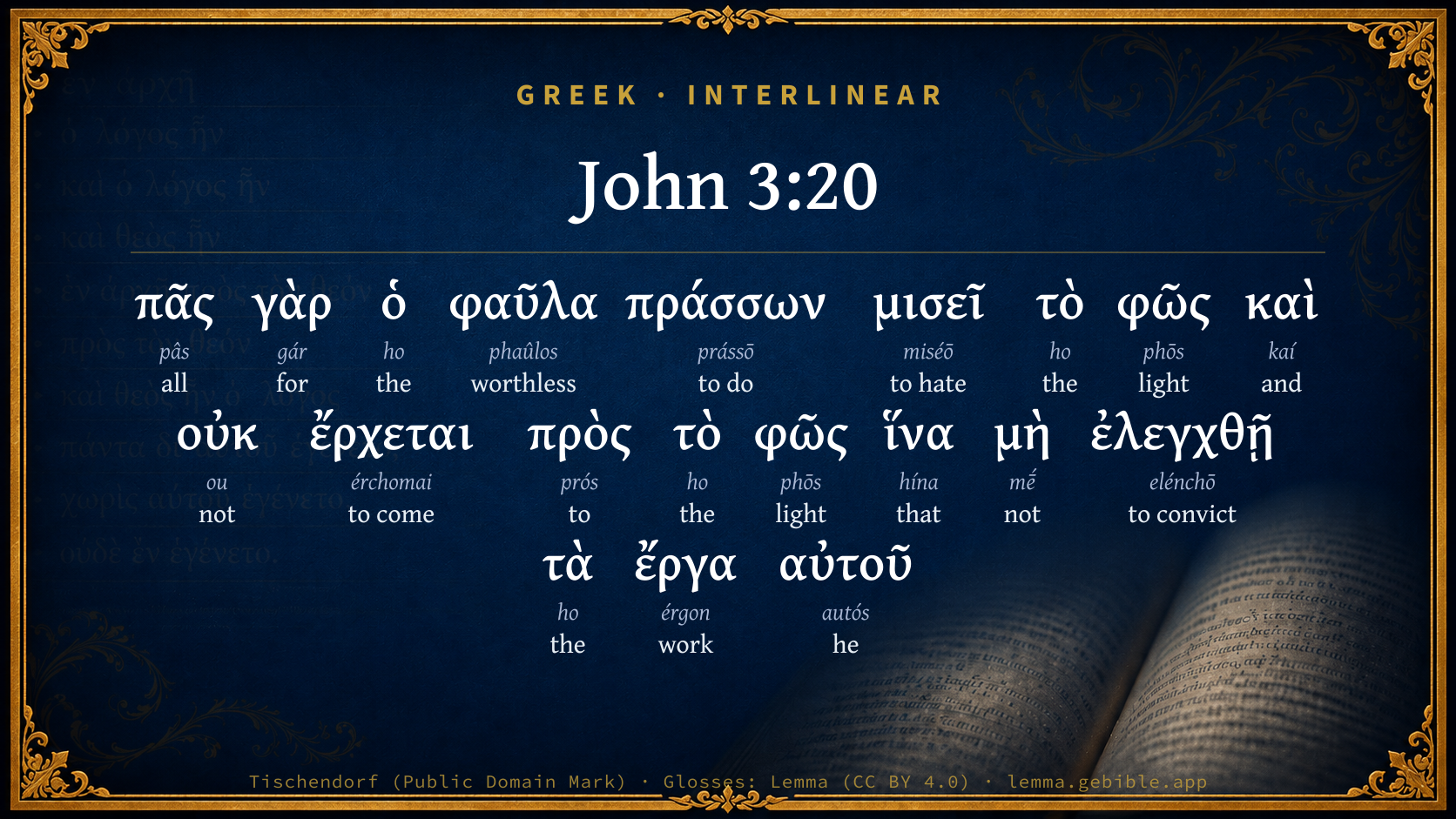
Download image
Cite this verse

John 3:20 (World English Bible). Public Domain. Lemma interlinear Bible study tool, https://lemma.gebible.app/v/john/3/20.

Show BibTeX & RIS
BibTeX
RIS
English Translation
For everyone who does evil hates the light, and doesn't come to the light, lest his works would be exposed.
World English Bible · Public Domain
Highlights
  • 1 first appearance in the Greek New Testament
Full analysis ↓
Download a study sheet

One document with this verse’s original text, its word-by-word gloss line, the meaning frame, cross-references with their text, attributed commentary, and full source and license credits — printable, and it pastes into notes with its structure intact.

This verse Autodidact and up

Study sheet (.html) Plain text (.txt)

A passage Seminary Student

Up to 50 verses in one chapter. A passage sheet keeps up to 6 commentary sources and 12 cross-references per verse, in the order this page ranks them, and says so on the sheet whenever that leaves anything out. Ask for a single verse and you get the Autodidact verse sheet above.

Everything on this page stays free to read, with no account — the sheet is a download of what is already on screen, not access to it.

Want to remove ads? Support Godless Engineer
Compare translations 3

The same verse in 3 English versions, stacked beneath the original-language interlinear above. Click any original word for its lexicon entry.

Each is an independent rendering of the whole verse — the interlinear is not word-aligned to these translations.

Highlighted words mark where these versions differ — a whole-verse word diff, not a word-by-word alignment.

  • World English Bible Public Domain
    For everyone who does evil hates the light, and doesn't come to the light, lest his works would be exposed.
  • King James Version Public Domain
    For every one that doeth evil hateth the light, neither cometh to the light, lest his deeds should be reproved.
  • unfoldingWord Literal Text CC BY-SA 4.0
    For everyone is doing evil hates the light and does not come to the light, so that his deeds might not be exposed.

unfoldingWord Literal Text — © unfoldingWord, licensed CC BY-SA 4.0. Word-aligned USFM3 via Door43 (git.door43.org/unfoldingWord/en_ult).

Versions to compare (up to 4)

3 of 4 selected

Show all 19 translations

Every available English version of this verse, each an independent rendering of the whole verse.

  • World English Bible Public Domain
    For everyone who does evil hates the light, and doesn't come to the light, lest his works would be exposed.
  • Berean Standard Bible Public Domain
    Everyone who does evil hates the Light, and does not come into the Light for fear that his deeds will be exposed.
  • Majority Standard Bible Public Domain
    Everyone who does evil hates the Light, and does not come into the Light for fear that his deeds will be exposed.
  • King James Version Public Domain
    For every one that doeth evil hateth the light, neither cometh to the light, lest his deeds should be reproved.
  • American Standard Version (1901) Public Domain
    For every one that doeth evil hateth the light, and cometh not to the light, lest his works should be reproved.
  • Revised Version (1885) Public Domain
    For every one that doeth ill hateth the light, and cometh not to the light, lest his works should be reproved.
  • Geneva Bible (1599) Public Domain
    For euery man that euill doeth, hateth the light, neither commeth to light, least his deedes should be reprooued.
  • Douay-Rheims (1899) Public Domain
    For every one that doth evil hateth the light, and cometh not to the light, that his works may not be reproved.
  • Young's Literal Translation Public Domain
    for every one who is doing wicked things hateth the light, and doth not come unto the light, that his works may not be detected;
  • Literal Standard Version CC BY-SA 4.0
    for everyone who is doing wicked things hates the light, and does not come into the light, that his works may not be detected;
  • Unlocked Literal Bible CC BY-SA 4.0
    For everyone who does evil hates the light, and does not come to the light, so that his deeds will not be exposed.
  • unfoldingWord Literal Text CC BY-SA 4.0
    For everyone is doing evil hates the light and does not come to the light, so that his deeds might not be exposed.
  • Darby Bible Public Domain
    For every one that does evil hates the light, and does not come to the light that his works may not be shewn as they are;
  • World Messianic Bible Public Domain
    For everyone who does evil hates the light and doesn’t come to the light, lest his works would be exposed.
  • Webster's Bible Public Domain
    For every one that doeth evil hateth the light, neither cometh to the light, lest his deeds should be reproved.
  • Free Bible Version CC BY-SA 4.0
    All those who do evil hate the light and don't come into the light, because they don't want their actions to be exposed.
  • Bible in Basic English Public Domain
    The light is hated by everyone whose acts are evil and he does not come to the light for fear that his acts will be seen.
  • Text-Critical English NT CC BY 4.0
    For whoever does evil hates the light and does not come to the light, so that his works may not be exposed.
  • Tyndale New Testament (1534) Public Domain
    For every man that evyll doeth hateth the light: nether commeth to light lest his dedes shuld be reproved.

Literal Standard Version (2020), Covenant Press — licensed CC BY-SA 4.0. Text via the HelloAO Bible API (eBible.org). Unlocked Literal Bible (unfoldingWord) — licensed CC BY-SA 4.0. Text via the HelloAO Bible API (eBible.org). unfoldingWord Literal Text — © unfoldingWord, licensed CC BY-SA 4.0. Word-aligned USFM3 via Door43 (git.door43.org/unfoldingWord/en_ult). Free Bible Version, Dr. Jonathan Gallagher — licensed CC BY-SA 4.0. Text via the HelloAO Bible API (eBible.org).

Word by word

More ways to search: Search by grammar → Find every occurrence → Compare this word →

Practice this passage: Drill this verse → Learn its vocabulary →

φαῦλα
phaûlos
G5337
“worthless”
Adjective, Accusative, Plural, Neuter
Part of Speech
Adjective
Case
Accusative
Number
Plural
Gender
Neuter
Full Thayer's Definition

Origin: apparently a primary word

TDNT: None

1. easy, slight, ordinary, mean, worthless, of no account 2. ethically, bad, base, wicked
  1. πᾶς pâs G3956 “all” Adjective, Nominative, Singular, Masculine
  2. γὰρ gár G1063 “for” Conjunction
  3. ὁ ho G3588 “the” Article, Nominative, Singular, Masculine
  4. πράσσων prássō G4238 “to do” Verb, Present, Active, Participle, Nominative, Singular, Masculine
  5. μισεῖ miséō G3404 “to hate” Verb, Present, Active, Indicative, 3rd person, Singular
  6. τὸ ho G3588 “the” Article, Accusative, Singular, Neuter
  7. φῶς phōs G5457 “light” Noun, Accusative, Singular, Neuter
  8. καὶ kaí G2532 “and” Conjunction
  9. οὐκ ou G3756 “not” Particle, Negative
  10. ἔρχεται érchomai G2064 “to come” Verb, Present, Middle or Passive deponent, Indicative, 3rd person, Singular
  11. πρὸς prós G4314 “to” Preposition
  12. τὸ ho G3588 “the” Article, Accusative, Singular, Neuter
  13. φῶς phōs G5457 “light” Noun, Accusative, Singular, Neuter
  14. ἵνα hína G2443 “that” Conjunction
  15. μὴ mḗ G3361 “not” Particle, Negative
  16. ἐλεγχθῇ elénchō G1651 “to convict” Verb, Aorist, Passive, Subjunctive, 3rd person, Singular
  17. τὰ ho G3588 “the” Article, Nominative, Plural, Neuter
  18. ἔργα érgon G2041 “work” Noun, Nominative, Plural, Neuter
  19. αὐτοῦ autós G846 “he” Personal pronoun, Genitive, Singular, Masculine

About this verse

These counts appear in no published source. They are computed here, from the morphology-tagged text and Lemma’s own curated glosses. What Lemma adds →

20
words
16
distinct lemmas
Gospels
section

Notable vocabulary

The rarest word here is φαῦλα worthless G5337 — appearing just 6 times in the whole Greek New Testament.

First appearance in Scripture

This word makes its first canonical appearance in the Greek New Testament here:

  • φαῦλα worthless G5337

Shared distinctive vocabulary

φαῦλα worthless G5337 occurs in 6 verses of the Greek New Testament. Also found in:
Repetition

Words recur within this verse:

Cross-references

12

Topical passages linked to John 3:20 in the Treasury of Scripture Knowledge — connected by theme and wording, ordered by reader-vote popularity; previews shown in the World English Bible.

  • Ephesians 5:11–13 Have no fellowship with the unfruitful works of darkness, but rather even reprove them.
  • John 7:7 The world can't hate you, but it hates me, because I testify about it, that its works are evil.
  • Job 24:13–17 "These are of those who rebel against the light; They don't know the ways of it, Nor abide in the paths of it.
  • Proverbs 1:29 Because they hated knowledge, And didn't choose the fear of Yahweh.
  • Proverbs 4:18 But the path of the righteous is like the dawning light, That shines more and more until the perfect day.
  • James 1:23–25 For if anyone is a hearer of the word and not a doer, he is like a man beholding his natural face in a mirror;
  • 1 Kings 22:8 The king of Israel said to Jehoshaphat, there is yet one man by whom we may inquire of Yahweh, Micaiah the son of Imlah: but I hate him; for he does not prophesy good concerning me, but evil. Jehoshaphat said, "Don't let the king say so."
  • Psalms 50:17 Seeing you hate instruction, And throw my words behind you?
  • Proverbs 5:12 And say, "How I have hated instruction, And my heart despised reproof;
  • Proverbs 15:12 A scoffer doesn't love to be reproved; He will not go to the wise.
  • Amos 5:10–11 They hate him who reproves in the gate, And they abhor him who speaks blamelessly.
  • Luke 11:45 One of the lawyers answered him, "Teacher, in saying this you insult us also."

Cross-references courtesy of OpenBible.info (CC BY 4.0).

Commentary

Notes on John 3:20 from classic Christian and Jewish commentators (each source and its license shown beneath its notes). The classic Christian expositions comment on the surrounding passage and are grouped to its opening verse, so a note may address several verses; the Jewish commentaries on the Tanakh (Rashi and others) are per-verse, so they appear only where the commentator wrote on this verse.

Lemma curates 59 commentaries, every one of them public domain or Creative Commons licensed, each selected and text-cleaned for this edition rather than reprinted as found. About our sources →

The Biblical Illustrator

Joseph S. Exell

Joh_3:20-21

For every one that doeth evil hateth the light … but he that doeth truth cometh to the light

The repelling and attractive influence of light

These words may have taken their form from the fact that Nicodemus came by night, and may have been a gentle rebuke, and a test for self examination.

One of the saddest things in a spiritual sense is that man shrinks from the light. With a nature and position before God such as his this ought not to be. One of the most blessed things is when men welcome the light, and have nothing about them that they wish to hide (Psa_139:23).

I. DOING EVIL AND THE HATRED OF LIGHT CONSEQUENT.

1. The word doeth, in relation to evil, πρασσώ, indicates

(1) The easy and natural way in which a thing is done. So we need no self-constraint or unusual exertion to do evil. We are too readily inclined to it. It required not much temptation to lead our first parents astray; and their children have followed them with easy steps.

(2) Habit. There is a tendency in what is easy and natural to become habitual. A thing once done is not difficult to repeat, and each repeated action makes us more accustomed to it. From the little men go on to the great, and so silence the inward monitor. Evil is fine as a gossamer web at first, but at last a man is bound with the cords of his sin.

(3) The transient and worthless result is in the word. So sins gratifications leave a sting behind, and are only for a season. How little satisfaction had Samson or Achan in their sin.

2. The evildoer hates the light. And no wonder if that which reveals his guilt and folly humiliates and disgraces him, and threatens punishment, is feared and hated. No wonder that Ahab hated Elijah and Michaiah, that Jehoiachin destroyed the prophets roll, that Herodias hated John, and the Pharisees Christ. Here is the explanation of every unhumbled mans distaste for the truth. The carnal mind is enmity against God. This shows the need and blessedness of the Gospel.

II. DOING THE TRUTH AND THE BLESSED RESULT.

1. The word doeth, here, ποιεω suggests.

(1) The exercise of resistance. The man who will do truth opposes the evil impulses of his nature. He will fight against wrong feelings. With noble superiority he contends against subtlety and deceit. See instances in Joseph, Daniel, the Three Children, and Cornelius.

(2) Decision of character. The man who does the truth has no vacillation or hesitation. He is steady, unmoved by caprice. He applies himself steadily to the course he adopts, like Moses, Samuel, Nehemiah, Nicodemus, Joseph of Arimathea.

(3) The permanent and satisfactory result. Good is not temporary or unstable in its results. What peace and joy it imparts!

2. Doers of truth love the light. They are neither ashamed nor fearful. Let the light shine, and it will justify them, and reveal the glory of God in their truth doing. Conclusion:

1. The sentiment of a man towards the truth is an index to his character.

2. The doing of truth in every man is of God. (G. McMichael, B. A.)

The ground of infidelity

Many men seem to proceed on the supposition that, though placed under the Gospel, they may accept or reject it, just as their inclinations dictate. But it is not left to every mans choice in a Christian land whether or not he will be subject to the Gospel. It is not a matter of option with a man who resides in a kingdom, whether he will be governed by the laws of the land. If he violate them it will avail him nothing to plead that he never intended to take them as his guide. No doubt a man may make something else than the Gospel the rule of his life: but the solemn fact remains that the Gospel, after all, continues to be the rule by which he will be tried. When he appears before the Judgment Seat the processes will have reference to the dispensation beneath which it pleased God to place him, and not that under which he has chosen to place himself. It will avail him as little to say, I acted up to the light of nature; I never professed to be led by any other light, as it would for an Englishman to plead in the courts, I acted up to the laws of Japan, which I professed to follow. The Gospel, then, will be the system by which we shall be judged, though it may not have been that under which we have lived. Here comes the question, Why is the Gospel rejected? If men are to be condemned for its rejection, it must follow that the rejection cannot be pleaded as unavoidable. Is there a man necessarily blameworthy for being an infidel? May he not have sat down with a calm and decided wish to investigate truth and to believe Christianity, and yet arise confirmed in his scepticism? The answer is this: that we dare not take the blame off men and throw it upon God. This may sound illiberal and uncharitable, but we cannot admit that God is the author of sin through placing any of His creatures under the invincible necessity of continuing in sin. In the text Christ charges mens unbelief in their immorality. The Scriptures conclude that where actions are evil faith cannot be genuine. The text states the converse of this, that practice influences faith. Men prefer darkness; therefore they hate light.

I. THIS WAS SO WITH THE JEWS. When Christ came, Judaea was over-run with profligacy. Christ rebuked it, and was consequently hated and crucified. Wherever the religion of our Lord is promulgated, it allows no truce to sin, but Christ came to save men from sin. Had He come to condemn men His contemporaries would have shrunk from Him equally. Their sensuality and pride had led them to expect a triumphing Messiah, who would give full scope for their licentiousness and arrogance; and when He preached His pure and spiritual kingdom, their habits of evil rose up in protest against Him and it. It was not that He was not armed with credentials; the exhibition of His greatest credential, the resurrection of Lazarus, sealed His doom.

II. IT IS THE SAME NOW. What produces infidelity is not weakness of evidence; it is the wish to prove the Bible a fable, and this goes more than half-way towards the result. If the Bible be true, evil deeds must be reproved, and hence some men have an interest in disproving its pretentions. In this desire lies the secret of open, also of practical infidelity. Selfish, lustful men would view conversion as a positive calamity. They know that they cannot have religion without renouncing much that they loved, and doing what they dislike. In conclusion

1. God has erected no barrier against the salvation of a single soul.

2. If any man is finally condemned, it will be by his own choice. (H. Melvell, B. D.)

The truth

I. God is to be honoured by the truth.

II. Men are to be benifited by the truth.

III. Opposition must be expected on account of the truth.

IV. For the truth we should wish to five.

V. For the truth we should be willing to die. (Prof. J. H. Godwin.)

The hatred of the wicked to the light of the Gospel

I. IT IS AN ACTUAL HATRED (Pro_1:22).

II. IT IS A PASSION OF THE HEART.

III. IT IS A PASSION WHEREBY THE HEART RISETH UP AGAINST A UNION WITH THE WORD. A wicked man hates not the Word so long as it keeps within itself; but if it begin to pluck sin from him and his pleasures from him, then he hates it. I put this union of the Word in opposition to four things.

1. Against general preaching. A wicked man may hear a thousand sermons and like them all, but let one of them come in particular to him and tell him this is thy sin, and thou must go to hell for it if thou repentest not, then he hates it. John the Baptist was heard by Herod gladly so long as he kept off his personal sin.

2. Against merciful preaching, which can never stick a sermon on to a profane heart. Ahab loved his 400 prophets well enough, but when Micaiah came, Oh, I hate him, for he never prophesieth good unto me!

3. Against preaching when the minister is dead. A wicked man can endure that, because there is none to urge a union of the Word with his conscience. He can read St. Paul, St. Peter, St. John, etc., and the books of dead ministers, but if they were alive to tell him if this be the Word of God then thou art a damned man, they would not be loved.

4. Against now and then preaching. The wicked can endure the word so long as it doth not stand digging in their conscience and galling their hearts day by day. Occasional rebukes they can stand, but to be convicted every Sunday for condemned men, this they hate.

IV. As it is an actual affection whereby the heart riseth up against a union, so IT IS AGAINST THAT WHICH IS DISSONANT AND REPUGNANT TO HIS LUST. Therefore wicked men may love three kinds of preaching.

1. Quaint preaching that savours more of humanity than of divinity. Dainty phrases, acute stories, eloquent allusions are heard well enough.

2. Impertinent preaching, when, though it be never so pertinent to some in the church, yet if it be not pertinent to him, he loves it. The drunkard does not cavil at a sermon against hypocrisy, nor the profligate at one against covetousness; but if the Word strikes his own particular corruption, he hates it.

3. So much preaching. A wicked mans conscience tells him that he must have some religion, and therefore so long as the minister calls only for some hearing, he responds. The vilest drunkard will be content to hear of calling on the Lord Jesus at his death; otherwise their consciences would not be quiet.

V. THUS YOU SEE THAT WICKED MEN HATE THE WORD OF GOD. They hate it because

1. They hate the truth, and being of the Word, a man hates the being of that which he hates, and he would destroy it. Now, though a wicked man cannot destroy the Bible from being in itself, yet he would destroy the Bible from being in his life.

2. They hate the nature of the Word (Rom_8:7).

3. This being the case, he hates the being of the Word in his understanding Job_21:14).

VI. USE IS TO REPROVE THE WICKED AND INVITE THEM TO REPENTANCE. (W. Fenner.)

The ground of bad mens enmity to the truth

I. THE ENMITY OF THE WICKED TO THE TRUTH. This enmity appears

1. In their opposition and resistance to it.

2. Their persecution of it (Joh_8:40).

II. THE CAUSES AND REASONS OF THIS ENMITY.

1. They are afraid the evil of their actions should be discovered to themselves, because that creates guilt and trouble.

(1) It robs them of that good opinion which they had of themselves before. Truth flatters no man; no wonder, therefore, that so many are offended at it.

(2) Truth carries great evidence along with it, and is very convincing, and gives a good deal of disturbance.

2. Bad men are enemies to the truth because it discovers the evil of their actions to others, which causeth shame.

III. INFERENCES.

1. We learn the true reason why men are so apt to reject the principles of natural and revealed religion; they are loath to be under the restraint of them.

2. This is a great vindication of our religion that it can bear the light, and is ready to submit to any impartial examination.

3. This is the reason why some are so careful to suppress the truth and to lock it up from the people in an unknown tongue, because their doctrines, dogmas, and deeds are evil. (Abp. Tillotson.)

Sinners hate the light

I. THE TRUTHS OF GOD WHICH RESPECT THE SINNER ARE, AS FAR AS THE NATURE AND CIRCUMSTANCES OF THEM ARE CONCERNED, AS EASILY FELT AND SEEN AS ANY OTHER.

II. THE MIND CANNOT TURN FROM DIVINE TRUTH WITHOUT CHOOSING TO DO IT.

III. MEN RESORT TO ARTIFICES TO HIDE THE TRUTH, TO TURN ITS FORCE AND RESIST ITS PRESSURE.

1. One is infidelity.

2. Another is found in the excuses offered for disobedience.

3. The indulgence of false hopes.

4. Reproaching religion and ministers.

IV. REMARKS;

1. The common complaint that sinners must wait for the Spirit of God before they can feel the importance of religion is unfounded and impious.

2. Ministers must not be afraid of alarming and distressing sinners. (N. W. Taylor, D. D.)

Light welcomed

At the first Methodist Conference it was asked, Should they be afraid of thoroughly debating every question that might arise? What are we afraid of? Of overturning our first principles? If they axe false, the sooner they are overturned the better. If they are true, they will bear the strictest examination. Let us pray for a willingness to receive light, to know every doctrine whether it be of God. (R. Stevens.)

Light detested

A sluttish housemaid, when scolded for the untidiness of the chambers, exclaimed, Im sure the rooms would be clean enough if it were not for the nasty sun, which is always showing the dirty corners. Thus do men revile the gospel because it reveals their own sin. Thus all agitations for reforms in Church and State are opposed, and all manner of mischief attributed to them as if they created the evils which they bring to light. The lover of the right courts anything which may manifest the wrong, but those who love evil have never a good word for those disturbing beams of truth which show up the filthy corners of their hearts and lives. (C. H.Spurgeon.)

Revelations of the light

What a difference it makes to have a street well lighted at night! The cheery beams of the street lamp and the dazzling brilliancy of the electric light are more of a protection to the traveller at night through city streets than the weapon of the policeman. The evil beings who haunt our streets at night shun the well-lighted thoroughfares, and skulk off into dark alleys and unlighted lanes, where their evil deeds are not likely to be discovered. And yet it is not the light alone that makes the difference. There are palaces of sin where riot and revelry go on unabashed beneath the glare of gilded lamps and crystal chandeliers; for the light of the physical lamp is of little moral avail unless it is made effective by that other light of which Christ spoke when he said, Ye are the light of the world. The powers of darkness fear the natural light only when it is accompanied by that better light; and the guilty creatures who showed their guilt, unashamed, in the brilliantly-lighted palaces of sin, would cower and shrink beneath the Christ-lighted eyes of true and pure men, if suddenly exposed to their searching gaze. There are anxious souls who seem to themselves never to have done anything for the Master, who might be comforted a little if they could only realize how important is this work of mere light-bearing. Many a neighbourhood, now forced to be outwardly respectable by the presence of a few God-fearing men and women in its midst, would break out into open and flagrant wickedness if that restraining and enlightening presence were to cease. But wherever Gods children are, the light shines, and the workers of iniquity are forced to hide their evil deeds. It is a deed worth doing to flood the streets at night with the electric light; but it is a deed far better worth doing to let ones Christian light so shine that evil men will fear to bring their evil deeds to the brightness of its shining; for the light of a little band of Christian men and women is worth more, to keep a community pure, than all the light of all the lamps ever invented (H. C. Trumbull.)

What the light reveals

Some time ago the use of the electric light in those theatres where it had been introduced was discontinued because its great brilliancy revealed the sham character of the furniture of the stage; it showed the paint on the faces of the actors, and the gewgaw and tinsel nature of their dresses and ornaments; so the dimmer light of the gas was substituted. Thus it is morally with men; they refuse to come into the bright light of the gospel lest it make manifest the shams of their lives. We have instances of this in those persons who frankly tell us that they cannot become religious because of the dishonest ways and methods of business to which, they plead, they are compelled to conform. (A. J. Parry.)

The different effect of the light on the good and the bad

That which scares the wicked from, draws the godly unto the Word. The owl flies from the morning light, which other birds welcome. (J. Dyke.)

Blindness

I. There is the blindness which is the result of passion, covering us, whilst we are under the dominion of passion, with the darkness of sin, and hiding from us the light of truth.

II. There is the deeper blindness which is caused by sinful habits, and by indulgence in continuous sin, until truth becomes odious to us.

III. There is the still blacker form of sin, which not only drives us away from the light, but which hurries us on until we trample upon and persecute the doers of righteousness. (Quesnel.)

Mans proper attitude towards the truth

There is all the difference in the world between battling for the truth because of ones love for the truth, and battling on the side of truth because of hostility to the opponents of truth. A man may be as intense and as violent in the one case as in the other; but if a man lacks a profound conviction of truth, and a devoted love for truth, he can never be inspired to a high courage, and held to an unwavering endurance, by any hatred of those who are over against him in his struggles. All real progress in any line of reform is made through the dead earnestness of men who love the right; not through the impulsive violence of men who are aroused, for a time, against the upholders of evil. He who loves his fellow-man, and therefore strives for his disenthralling, is worth more as a friend of liberty than he who hates oppressors, and therefore seeks their overthrow. So it is in every sphere of well-doing; love for the good is a more potent factor than hatred of evil--more potent even in the battle with evil. (H. C. Trumbull.)

Why men hate the truth

A gentleman once visiting an acquaintance of his, whose conduct was as irregular as his principles were erroneous, was astonished to see a large Bible in the hall chained fast to the floor. He ventured to inquire the reason. Sir, replied his infidel friend, I am obliged to chain down that book to prevent its flying in my face. Such persons hate the Bible, as Ahab did Micaiah, because it never speaks good concerning them, but evil. (Biblical Museum.)

Light reproves sin

The margin will show that our translators felt a difficulty about this word reproved. See Mat_18:15, where it is rendered tell him his fault, idea is exactly illustrated by the action of light, which makes manifest the wrong, and leads the conscience to see it and repent of it. It is through this chastening that the man passes from darkness to light. It is because men shrink from this chastening that they hate the light (comp. the remarkable parallel in Eph_5:11 et seq.). (H. W.Watkins, D. D.)

Light reveals sin and alarms sinners

Some persons accuse us poor preachers of disturbing the minds of our hearers, when persons are alarmed under the ministry of the gospel. The very purpose for which it was sent was to alarm mens minds; and it fails altogether when it does not alarm. When the ministry of the gospel alarms the sinner, he sees its workings going on in his bosom; it comes out before his friends and companions; they ask him why he should sacrifice himself to that sort of teaching which disturbs and agitates him? Why, my friends, we do not bring the things there that are discovered--it is the light that reveals them; they were all there before--it is the light that falls upon things--and then they appear in a very different manner; and the ministry of the gospel is designed and constituted to make the darkness light, to convince the sinner and to awaken the impenitent.

Light and crime

In 1807 Pall Mall was lighted with gas. The original Gas Company was first derided and then treated in Parliament as rapacious monopolists, intent upon the ruin of established industry. The adventurers in gaslight did more for the prevention of crime than the government had done since the days of Alfred. (Knights England. )

Christians love light

Light breaks in! light breaks in! Hallelujah! exclaimed one when dying. Sargeant, the biographer of Martyn, spoke of glory, glory, and of that bright light; and when asked, What light? answered, his face kindling into a holy fervour, The light of the Sun of Righteousness. A blind Hindoo boy, when dying, said joyfully, I see! now I have light. I see Him in His beauty. Tell the missionary that the blind see. I glory in Christ. Thomas Jewett, referring to the dying expression of the English infidel, I am going to take a leap in the dark, said to those at his bedside, I am going to take a leap in the light. While still another dying saint said, I am not afraid to plunge into eternity. A wounded soldier, when asked if he were prepared to depart, said, Oh yes; my Saviour, in whom I have long trusted, is with me now, and His smile lights up the dark valley for me. A dying minister said, It is just as I said it would be, There is no valley, emphatically repeating, Oh, no valley. It is all clear and bright--a kings highway. The light of an everlasting life seemed to dawn upon his heart; and touched with its glory, he went, already crowned, into the New Jerusalem. A Christian woman lay dying. Visions of heaven came to her. She was asked if she really saw heaven. Her answer was, I know I saw heaven; but one thing I did not see, the valley of the shadow of death. I saw the suburbs. A young man who had but lately found Jesus was laid upon his dying bed. A friend who stood over him asked, Is it dark? I shall never, said he, forget his reply. No, no, he exclaimed, it is all light! light! light! and thus triumphantly passed away. (American Messenger.)

But he that doeth truth

He that doeth truth cometh to the light

What is it, then, to do the truth? For that would seem to be the condition which brings us within the rays of the light of Him Who is the Spirit of Truth, the right disposition in which to keep Whitsuntide.

I. He that doeth truth. This would seem to mean, first of all, HE THAT BELIEVETH THE TRUTH. We can no more shut up the Book of Revelation than we can shut up the book of experience, and say it does not matter. Can we say, for instance, to any young man entering on the study of medicine, It does not matter the least what system you follow--homoeopathy, allopathy, or even herbalism; all are equally true or equally false, as long as you mean well. Or shall we tell him, if he wishes to become a soldier, that drill and tactics and the modern science of warfare may be taken up or let alone, provided that he is brave? or that engineering depends on mechanical skill, or botany on his love for flowers, or chemistry on a taste for analysis, or mathematics on skill in computation? No; we know that all these things have their Bibles, compendiums of exact truth; so that he who enters on the study of them, enters on it enriched with a heritage of precise fact wrested by the patient interrogation of phenomena. And so it is with religion. The truth as set forth in the Creed is that which is exactly adapted to the needs of mankind. What we should do if we were constructing a new religion is one thing, and what we ought to do when God has told us what will make us truly religious is another. And to do the truth, is faithfully to believe what God has spoken, as a duty which we owe to Him and to our fellow-men also.

II. He that doeth truth. This, perhaps, means, secondly, HE THAT LIVES THE TRUTH. A true life is no butterfly existence wasted in so-called pleasure and idleness, never serious, never earnest; where all experience is but as pictures on the wall, all talents merely ornamental for self-display; where grace is received in vain, as the water in the fabled penance of the Danaides, which flows away as fast as it enters in; where sin and want of seriousness have riven the soul so that it cannot contain grace. But the true life will be one which is faithful to all Gods influences and modes of approach, which says in its joy, My soul truly waiteth still upon God; towards Whom there is the aspiration of prayer; from Whom comes the message to the soul; at Whose coming the door is opened in Holy Communion, and all the approaches cleared by which God may enter into the soul To live the truth is to trust more to prayer and sacraments and holy things than to mere human culture, self-reliance, strength, or cleverness. Think of that description in the Book of Revelation Rev_10:1) of the servant of God. And as the angel is mighty, so the servant of God will be strong in firmness and fidelity, and in the knowledge of the truth. He is clothed with a cloud; there will be a seriousness about him, as of one who is still under the influence of the luminous cloud of Sinai, where he has been communing with God, or the half-sadness of one who is compassed about with the earth-drawn sorrow with which sympathy has enveloped him. A rainbow is upon his head; he has a brightness within him which lights up the rain-cloud of life, because God is shining upon it. His face is as it were the sun, because at each prayer-time, and frequently throughout the day, he drinks in light from that Sun to which he turns. His feet are as pillars of fire, for he is not easily shaken in his steadfastness; he is active, vigorous--yes, graceful as the image Of God who created him.

III. And then, thirdly, He that doeth truth means, obviously, HE THAT SPEAKETH THE TRUTH. Is it absolutely unknown, for instance, for people to screen themselves when they have done wrong by the easy lie? Dishonour, ruin, disgrace, stare the man in the face. Say you have not done it, says Satan; and the evil is put off, only to return with a tenfold aggravation of malignity as the net of deceit winds itself tighter and tighter round its hopelessly implicated victim. The old German legend is full of instruction. A huntsman to forward his own purposes seeks the devil, and together they cast seven bullets. Six of these are to strike wherever the caster wills, but the seventh is to be the devils, and is to recoil and strike the caster, who is never certain which of all of them he is putting into his rifle, and at last is struck down by his own shot. The fraudulent lie succeeds for a time, but at last comes the fatal one, which recoils upon him who uses it with shame and disaster. Do we scrupulously adhere to the disagreeable appointment, or the unpleasant duty, or the invitation which we have pledged ourselves to accept? Or are we always careful to avoid that exaggeration which piles up rumours and reports, which mixes truth with fiction, Which stays not to inquire whether a thing is correct or not, which aims, rather, at saying a new thing that is nut true, rather than a true thing which is not new? (W. C. E. Newbolt, M. A.)

He that doeth truth

It is observable, in the first place, that there are several places in the New Testament in which the truth is spoken of in ways not very much unlike to this; places, that is, in which it is spoken of, variously indeed, but in each of them as something real and solid,--not a mere object of apprehension by the intellectual powers of a man--not something external, merely viewed, seen, recognized, but something internal, something to be, and something to do--something full of blessing, a precious possession, a gift, an inward treasure (see Joh_8:31-36; Joh_14:5-6; Joh_17:17; Joh_18:37; 1Jn_3:19; 1Jn_5:6). Now it is plain that these statements of Holy Scripture--and there are a great many more like them, particularly in the inspired writings of St. John--make the truth (the Divine truth) to be something very sacred and very deep. Whatever it be in itself--and this is too hard and difficult a question for us to enter upon--it is plain that when possessed by a man, it is full of precious blessing to him. Possessed by a man, and possessing him, he is not what he was before. The truth has made him free who was a slave. The truth has made him who had no ears able to hear the words of Christ; the truth has sanctified him; the truth has made him Gods son. What relation then (it may be asked), does doctrine bear to the truth? for it is plain that it is not the same thing. If the truth be thus something mysterious and real, which, coming forth of God, and being Divine, taketh, possesseth, occupieth a man, what relation does it bear to doctrine, Divine doctrine, the true revealed declarations of God, His nature and His will, which He has been pleased to give us? for these are often called truths, or the truth, though plainly not in the high and mysterious sense of the truth which we have been considering. I suppose that it is quite beyond our power to answer exactly. It is only clear that they are very nearly and closely connected. It is certain that the truth cannot possess a man and bless him with all the great blessings which belong to it, unless doctrine be duly known, and received, and believed. Doctrine is, as it were, truth projected on some medium which the mind can see; a shadow of the invisible and blessed truth cast, as it were, upon a cloud; and this the mind must see, and know, and own, and believe, or else, such is the order of Gods will, a man cannot have the freedom indeed, the sonship, the sanctification, the open ears, the various great and precious blessings of the indwelling truth. Learn then from hence the sacred value of doctrine; its sacred, deep, unfathomable preciousness. If then we undervalue doctrine, who shall insure us against losing the truth? If we tamper with it, or lose our hold of it, who shall insure us of our freedom and sanctification, which we should derive from the indwelling truth? If we should allow others to seduce us from our simple, earnest, obedient subjection to it, who shall assure us that they have not robbed us of our precious estate of being in the truth? Thus far then we have regarded the truth as it is a real and precious thing, possessing which we are in an estate or condition of high blessing--the estate of being Christians; our text rather leads us to regard it in a further view, as being something practical, something to be done. Being in the truth (that is, our estate, or condition), we must do truth (that is, our duty). If we keep not His commandments, the truth is not in us. If we say that we have no sin, the truth is not in us. If we say that we have fellowship with Him, and walk in darkness, we do not the truth. The truth then, in which we are, is to be done; and keeping of the commandments of God, and walking in the light, and acknowledging our own sins, are doing the truth. Truth, then, means holiness. Being in the truth, we must do the truth; and we must do it, as the truth is in Jesus. And so our law of holiness is a law of holy truth. It is a straight and direct law: O that my ways were made so direct that I might keep Thy statutes. It admits not of deflection, or voluntary imperfection. As doctrine is the intellectual phase, if I may so speak, of essential Divine truth, so is obedience its practical one. To deviate into heresy, or to deviate into sin, are alike to depart from the influence of that sacred, central truth, in which we are sons, in which we are free, and in which we are holy. It is plain (as soon as we regard the law of God in this light, in which the Holy Scriptures so often present it to us) that the law of truth must needs be a very holy and righteous law. It is also plain that it is far higher, and holier, and more searching than it is often thought. How it cuts like a sword through all the easy living, the self-indulgence, and lazy half-service which characterize these later ages of the Church! If there be a truth of holy thoughts, surely there is much unlicensed and random thinking--much letting loose of the imagination on things trifling, and enervating, and unprofitable, which must partake in a great and serious degree of the nature of falsehood. If there be a sacred truth of holy words, there must be much idle and frivolous, and satirical, and bold talking, which must be very far below that high standard of truth, and so be really false. Above all, if there be a real sacred truth of duty and holy living, there must be a vast deal of practical and dangerous falsehood, in the waste of time, the imperfectness of service, the very easy and self-complacent way of life of very many baptized Christians. Indeed, we may readily see, that the ordinary rule of living, as we may judge of it from seeing how men live, is quite of another kind from the rule of truth. As long as they refrain from clear and notorious sins, and discharge certain clear and undoubted duties, men think themselves more or less at liberty to live in the rest of their behaviour as they like best. There are, as it were, certain buoys marking out particular shoals of sin, and these they must take care to steer clear of; but meanwhile, they have a free choice of navigating in a wide and easy channel, following their own fancy, and doing as much or as little therein as they please. And meanwhile, while practical truth is thus widely neglected among us, there is nothing which is more earnestly insisted upon as a virtue of the first necessity to the existence and well-being of society than veracity, or worded truth. Truth in words is held to be a virtue of such magnitude and necessity, that a clear breach of it ruins the character of a man amongst men more than almost any sin, however gross, which ordinary society knows. Worded truth, or veracity, precious as it is, is but as the outside, as the husk, of a more precious reality inside. Worded truth is the outside, and acted truth is the inner kernel. Oh, believe me, the essence of falsehood is deeper, deeper far than words! Believe me, it is a hollow philosophy which magnifies veracity, and lets the daily habits loose in self-indulgence and neglect: a miserable worldly code which exacts truth of words under the severest penalties, and makes it innocent and even honourable to depart, ever so far, from truth in deeds I No; the essence of truth is in duty, in heart-whole devotion of duty to the sacred law of Gods truth. (Bishop Moberly.)

The Biblical Illustrator, edited by Joseph S. Exell (c. 1880s–1900s) — public domain. Text from a community e-Sword module.

Joseph Benson's Commentary

Joh 3:20-21. For every one that doeth evil — That is conscious to himself that he lives in known sin, and is inclined to continue to do so; hateth the light — Which would detect and expose his evil practices, and thereby cause anguish and shame to his guilty mind; neither cometh to the light — But keeps aloof from it, being unwilling, not desirous, to know his true character, and the dangerous and miserable condition which he is in. Thus Christ, and his genuine gospel, is hated, because sin is loved. And sinners hate the light, because it discovers the evil and sinfulness of their ways unto them, and condemns them for them. But he that doeth the truth — That complies with the will of God, as far as he knows it; that sincerely and conscientiously endeavours to conform his conduct to the eternal law of righteousness; cometh to the light — With confidence and joy, brings his opinions and practices, his desires and designs, his affections, intentions, and resolutions, his tempers, words, and actions, to the test of God’s word; that his deeds may be made manifest — As in open day; that they are wrought in God — Are performed as in his sight, according to the direction of his word, with a single eye to his glory, and in consequence of that union of soul with him, which is the highest dignity and happiness of a rational creature. “Be it therefore known to you all,” as if our Lord had said, “that this gospel which I preach is the great touchstone of men’s true characters; and as nothing but a corruption of the heart can oppose it, so I faithfully warn you, that if you reject it, it is at the peril of your souls.” Observe, reader, we have in this passage the character of a good man: 1st, He is one that doeth την αληθειαν, not truth merely, but the truth, namely, that walks according to the truth, as it is in Jesus, and that uprightly and conscientiously. 2d, He is one that cometh to the light, that is ready and desirous to receive the truth, as far as it appears to him to be so, and discoveries of God’s mind concerning him, whatever uneasiness may be created to him thereby. He frequently tries himself, and desires that God would try him; being solicitous to know his will, and resolving to comply with it, however contrary to his own will and apparent interests. We have here, also, the character of a good work: it is wrought in God, in union with him by living faith, through the aid of his grace. Our works are then good, and will bear the test of God’s word, when the will of God is the rule of them, and the glory of God the end of them; when they are done in his strength and for his sake, to him and not to men: and if by the light of the gospel it be manifested to us that our works are thus wrought, then we have cause of rejoicing, Gal 6:4; 2Co 1:12. Such was the purport of our Lord’s discourse with Nicodemus; and it appears by some following circumstances of the story, that it made a deep and lasting impression on his mind; and that he afterward became a true disciple of Christ. See Joh 7:50; Joh 19:39.

Joseph Benson's Commentary on the Old and New Testaments (1811–1818) — public domain. Text from a community e-Sword module.

Bengel's Gnomon

Johann Albrecht Bengel

Joh 3:20. Πράσσων) ποιῶν, Joh 3:21.[54] Evil is restless: it is a something more given to working than truth is. Hence they are marked by different words, as ch. Joh 5:29.[55]—ἐλεγχθῇ) should be reproved, should be convicted of being such as they actually are: against the will of the evil-doer himself. The opposite to this is φανερωθῇ, may be made manifest, Joh 3:21: ἐλέγχω, a word suited to this passage, from ἓλη and ἔγχω [I bring to the sun-light]: for ὁ ἔλεγχος εἰς φῶς ἄγει τὰ πράγματα.[56]—τὰ ἔργα αὐτοῦ) Appositely, it is first said, the works of him [αὐτοῦ being put last], in the case of the man who flees from the light; then in Joh 3:21, αὐτοῦ τὰ ἔργα [the αὐτοῦ first], his works in the case of him who knows that he will not be put to shame.

[54] The former implies the continuous state of the evil-disposed, they practise evil; ποιῶν, the particular act or acts. Germ. thun and machen: Lat. agere and facere.—E. and T.

[55] And shall come forth, they that have done good, οἱ τὰ ἀγαθὰ ποιήσαντες, to the resurrection of life; and they that have done evil, etc., οἱ τὰ φαῦλα πράξαντες, they that have practised evil.—E. and T.

[56] Buttmann denies we can trace the affinities of ἐλέγχω: Lidd. and Scott connect it with λέγω.—E. and T.

Bengel's Gnomon of the New Testament — English translation (T&T Clark, Edinburgh, 1860) — public domain. Text from a community e-Sword module.

Meyer's Critical & Exegetical Commentary

Heinrich August Wilhelm Meyer

Joh_3:20. Γάρ] If by the previous γάρ the historical basis for the statement ἠγάπησαν οἱ ἄνθρωποι, κ.τ.λ., was laid, then this second γάρ is related to the same statement as explanatory thereof (see on Mat_6:32; Mat_18:11; Rom_8:6), introducing a general elucidation, and this from the psychological and perfectly natural relation of evil-doers to the light which was manifested (in Christ) (το͂ φῶς not different from Joh_3:19), which they hated as the principle opposed to them, and to which they would not come, because they wished to avoid the ἔλεγχος which they must experience from it. This coming to the light is the believing adherence to Jesus, which, however, would have to be brought about through the μετάνοια.[167]

ἵνα μὴ ἐλεγχθῇ] Intention. This ἔλεγχος is the chastening censure, which they shunned both on account of their being put to shame before the world, and because of the threatening feeling of repentance and sorrow in their self-consciousness. Comp. Luk_3:19; Joh_8:8; Eph_5:11; Eph_5:13. Gravis malae conscientiae lux est, Senec. ep. 122. 14. This dread is both moral pride and moral effeminacy. According to Luthardt (comp. B. Crusius), the ἐλέγχεσθαι refers only to the psychological fact of an inner condemnation. But against this is the parallel φανερωθῇ, Joh_3:21.

Observe, on the one hand, the participle present (for the πράξας might turn to the light), and, on the other, the distinction between πράσσων (he who presses on, agit, pursues as the goal of his activity) and ποιῶν, Joh_3:21 (he who does, facit, realizes as a fact). Comp. Xen. Mem. iii. 9. 4 : ἐπισταμένος μὲν ἃ δεῖ πράττειν, ποιοῦντες δὲ τἀναντία, also Joh_4:5. 4, al.; Rom_1:31; Rom_2:3; Rom_7:15; Rom_13:4. See generally, Franke, ad Dem. Ol. iii. 15.

[167] In opposition to Colani, who finds a circle in the reasoning of vv. 19, 20. See Godet.

Meyer — Critical and Exegetical Commentary on the New Testament — English translation by Peter Christie, edited by Frederick Crombie (T&T Clark, 1880) — public domain. Text from a community e-Sword module.

Expositor's Greek Testament

ed. W. Robertson Nicoll

Joh 3:20 . The principle is explained in this verse. Underlying the action of men towards Christ during His historical manifestation was a general law: a law which operates wherever men are similarly invited to walk in the light. The law which governs the acceptance or refusal of light is given in the words πᾶς γὰρ ὁ φαῦλα … ἔργα αὐτοῦ . φαῦλος , originally “poor,” “paltry,” “ugly”; οἱ φαῦλοι , “the vulgar,” “the common sort”. In Polybius, φαῦλα πλοία , πολιτεία φαῦλα , badly constructed; φαῦλος ἡγεμών , a foolish general, and in xvii. 15, 15 it is opposed to deliberate wickedness. Dull, senseless viciousness seems to be denoted. Here and in Joh 3:29 πράσσειν is used with φαῦλα , and ποιεῖν in the next verse with ἀλήθειαν , on which Bengel remarks: “Malitia est irrequieta; est quiddam operosius quam veritas. Hinc verbis diversis notantur”. Where a distinction is intended, πράσσειν expresses the reiterative putting forth of activities to bring something to pass, ποιεῖν the actual production of what is aimed at. Hence there is a slight hint of the busy fruitlessness of vice. Paul, as well as John, uses πράσσειν , in certain passages, of evil actions. The person thus defined μισεῖ τὸ φῶς , “hates the light,” instead of delighting in it, καὶ οὐκ ἔρχεται πρὸς τὸ φῶς , and does not bring himself within its radiance, does not seek to use it for his own enlightenment; ἵνα μὴ ἐλεγχθῇ τὰ ἔργα αὐτοῦ , “lest his works be convicted” and so put to shame. According to John there is moral obliquity at the root of all refusal of Christ. Obviously there is, if Christ be considered simply as “light”. To refuse the ideal he presents is to prefer darkness.

The Expositor's Greek Testament, edited by W. Robertson Nicoll (1897–1910) — public domain. Text from a community e-Sword module.

Vincent's Word Studies in the New Testament

Marvin R. Vincent

Doeth [πρασσων] . The present participle, indicating habit and general tendency.

Evil [φαυλα] . Rev., ill. A different word from that in the previous verse. Originally, light, paltry, trivial, and so worthless. Evil, therefore, considered on the side of worthlessness. See on Jas 3:16.

Lest his works should be reproved [ινα μη ελεγχθη τα εργα αυτου] . Rather, in order that his works may not be reproved. Elegcw, rendered reprove, has several phases of meaning. In earlier classical Greek it signifies to disgrace or put to shame. Thus Ulysses, having succeeded in the trial of the bow, says to Telemachus, "the stranger who sits in thy halls disgraces [ελεγχει] thee not" (" Odyssey, 21 424). Then, to cross - examine or question, for the purpose of convincing, convicting, or refuting; to censure, accuse. So Herodotus : "In his reply Alexander became confused, and diverged from the truth, whereon the slaves interposed, confuted his statements (hlegcon, cross - questioned and caught him in falsehood), and told the whole history of the crime" (i. 115). The messenger in the "Antigone" of Sophocles, describing the consternation of the watchmen at finding Polynices' body buried, says : "Evil words were bandied among them, guard accusing [ελεγχων] guard" (260). Of arguments, to bring to the proof; prove; prove by a chain of reasoning. It occurs in Pindar in the general sense of to conquer or surpass. "Having descended into the naked race they surpassed [ηλεγξαν] the Grecian band in speed (" Pythia," 11 75).

In the New Testament it is found in the sense of reprove (Luk 3:19; 1Ti 5:20, etc.). Convince of crime or fault (1Co 14:24; Jas 2:9). To bring to light or expose by conviction (Jas 3:20; Eph 5:11, 13; Joh 8:46; see on that passage). So of the exposure of false teachers, and their refutation (Tit 1:9, 13; Tit 2:15). To test and expose with a view to correction, and so, nearly equivalent to chasten (Heb 12:5). The different meanings unite in the word convict. Conviction is the result of examination, testing, argument. The test exposes and demonstrates the error, and refutes it, thus convincing, convicting, and rebuking the subject of it. This conviction issues in chastening, by which the error is corrected and the erring one purified. If the conviction is rejected, it carries with it condemnation and punishment. The man is thus convicted of sin, of right, and of judgment (Joh 16:8). In this passage the evil - doer is represented as avoiding the light which tests, that light which is the offspring of love (Rev 3:19) and the consequent exposure of his error. Compare Eph 5:13; Joh 1:9 - 11. This idea of loving darkness rather than light is graphically treated in Job 24 and runs through vv. 13 - 17.

Marvin R. Vincent, Word Studies in the New Testament (1887–1900) — public domain. Text from a community e-Sword/MySword module.

Godet's Commentaries

Frédéric Louis Godet

Ver. 20. “For, every one who practiseth evil hateth the light and doth not come to the light, that his works may not be condemned.”

Night was reigning at the moment when Jesus was speaking thus. How many evil-doers were taking advantage of the darkness, to pursue their criminal designs! And it was not accidental that they had chosen this hour. Such is the image of that which takes place in the moral world. The appearance of Jesus is for the world like the rising of the sun; it manifests the true character of human actions; whence it follows, that when any one does evil and wishes to persevere in it, he turns his back upon Jesus and His holiness. If his conscience came to be enlightened by this brightness, it would oblige him to renounce that which he wishes to keep. He denies therefore, and this negation is for him the night in which he can continue to sin: such is the genesis of unbelief. The expression ὁ φαῦλα πράσσων, he who does evil, denotes not only the tendency to which the man has hitherto surrendered himself, but also that in which he desires to persevere. This is what the present participle πράσσων (instead of the past πράξας) expresses. For the word πονηρά (perverse things) is substituted the word φαῦλα (things of nought) of Joh 3:19; the latter is taken from the estimate of Jesus himself, while the former referred to the intrinsic nature of the acts, to their fundamental depravity. We must also notice a difference between the two verbs πράττειν and ποιεῖν : the first indicates simply labor—the question is of works of nought—the second implies effective realization, in the good the product remains. But we need not believe that the term practise evil refers only to what we call immoral conduct. Jesus is certainly thinking, also, of a life externally honorable, but destitute of all serious moral reality, like that of the greater part of the rulers in Israel, and particularly of the Pharisees: the exaltation of the I and the pursuit of human glory, as well as gross immorality, belong to the φαῦλα πράττειν, “practise things of nought” in the sense in which Jesus understands it.— Μισεῖ,he hates, expresses the instinctive, immediate antipathy; οὐκ ἔρχεται, he comes not, denotes the deliberate resolution. The verb ἐλέγχειν (perhaps from πρὸς ἕλην κρίνειν, to hold to the light in order to judge) signifies: to bring to light the erroneous or evil nature of an idea or a deed.

The reason of unbelief, therefore, is not intellectual, but moral. The proof which Jesus gives, in Joh 3:20, of this so grave fact is perfectly lucid. All that Pascal has written most profoundly on the relation between the will and the understanding, the heart and the belief, is already in advance contained in this verse and the one which follows. But that which is true of unbelief is equally true of faith. It also strikes its roots into the moral life; here is the other side of the judgment:

Frédéric Louis Godet — Commentaries on Luke, John, Romans, and 1 Corinthians — English translation (T&T Clark, Edinburgh, 1870s–1890s) — public domain. Text from a community e-Sword module.

Jamieson, Fausset & Brown

Robert Jamieson, A. R. Fausset & David Brown

reproved--by detection.

Jamieson, Fausset & Brown — Commentary Critical and Explanatory on the Whole Bible (1871) — public domain (CC PDM 1.0). Text via the HelloAO Bible API.

Adam Clarke's Commentary

Verse 20. For every one that doeth evil hateth the light] He who doth vile or abominable things: alluding to the subject mentioned in the preceding verse.

The word φαυλος, evil or vile, is supposed by some to come from the Hebrew פלס phalas, to roll, and so cover oneself in dust or ashes, which was practised in token of humiliation and grief, not only by the more eastern nations, see Job 42:6, but also by the Greeks and Trojans, as appears from Homer, Iliad xviii. l. 26; xxii. l. 414; xxiv. l. 640; compare Virgil, AEn. x. l. 844; and Ovid, Metam. lib. viii. l. 528. From the above Hebrew word, it is likely that the Saxon ful, the English foul, the Latin vilis, and the English vile, are derived. See Parkhurst under φαυλος.

Lest his deeds should be reproved.] Or discovered. To manifest or discover, is one sense of the original word, ελεγχω, in the best Greek writers; and it is evidently its meaning in this place.

Adam Clarke's Commentary on the Bible (1810–1826) — public domain. Text from a community e-Sword/MySword module.

John Calvin's Commentaries

20. For whosoever doeth what is evil. The meaning is, that the light is hateful to them for no other reason than because they are wicked and desire to conceal their sins, as far as lies in their power. Hence it follows that, by rejecting the remedy, they may be said purposely to cherish the ground of their condemnation. We are greatly mistaken, therefore, if we suppose that they who are enraged against the Gospel are actuated by godly zeal, when, on the contrary, they abhor and shun the light, that they may more freely flatter themselves in darkness.

John Calvin's Commentaries (1540-1563) — public domain. Text from the Calvin Translation Society English edition (1840s-50s) via the Christian Classics Ethereal Library (ccel.org). Calvin's coverage is partial (roughly two-thirds of the Bible); uncommented books and verses are honest gaps, never fabricated. The 19th-century editor's footnotes and remarks are omitted so the notes are faithfully Calvin's own voice.

Ellicott's Commentary for English Readers

(20) For every one that doeth evil hateth the light.—In this and the next verse we have the explanation of the choice of the darkness and rejection of the light. The fact itself is first stated more strongly. Not only does the man that doeth evil love darkness rather than light, but he hates the light. (Comp. Note on Joh_7:7.) Its presence makes manifest and reproves his works, which he would hide even from himself. It illumines the dark and secret chambers of the heart, and reveals thoughts and deeds which conscience, seeing in this light, trembles at, and turns away to darkness that it may hide itself from its own gaze.

It has been often noted that the word “doeth,” in this and the following verse, represent different words in the original. Perhaps we may distinguish them in English by rendering this verse: “Every one that practiseth evil.” It is not less important to note that the word for evil here differs from the word so rendered’ in the last clause of the previous verse. Strictly, and the change of word seems to demand a strict interpretation (comp. Note on Joh_5:29), it is not that which is positively, but that which is negatively, evil—that which is trivial, poor, worthless. The man who practiseth such things misses the aim of life, and turns from the light that would point it out to him. He does many things, but forgets that one thing is needful, and spends a life-time in trifles without any permanent result. We are familiar with the thought that immorality shuns the light and warps the will, and thus darkens knowledge and weakens faith; but we remember too seldom the deadening effect of an unreal and aimless existence which is not truly a life.

Should be reproved.—The margin will show that our translators felt a difficulty about this word (see Notes on Mat_18:15), where it is rendered “tell him his fault,” and comp. the other instances in this Gospel, Joh_8:9; Joh_8:46 (“convince” in both), and especially Joh_16:8 (“reprove,” and margin “convince”). The moral idea is exactly illustrated by the action of light, which makes manifest the wrong, and leads the conscience to see it and repent of it. It is through this chastening that the man passes from darkness to light. It is because men shrink from this chastening that they hate the light. (Comp. Notes on the remarkable parallel in Eph_5:11 et seq.)

A Bible Commentary for English Readers, edited by Charles John Ellicott (1878–1897) — public domain. Text from a community e-Sword module.

The Cambridge Bible for Schools and Colleges

gen. ed. J. J. S. Perowne

20. doeth evil] The Greek word for ‘doeth’ is not the same as that in the next verse; but it is not quite certain that any distinction of meaning is intended, although Joh_5:29 inclines one to think so. There the words are paired in precisely the same way as here. On the other hand in Rom_7:15-20 these same two words are interchanged indifferently, each being used both of doing good and of doing evil. In order to make a distinction practiseth evil has been suggested. But ‘evil’ also requires re-translation, for in the Greek it differs from ‘evil’ in Joh_3:19. The meaning in this verse is rather ‘frivolous, good-for-nothing, worthless.’ He that practiseth worthless things (the aimless trifler), hateth the light, which would show him the true value of the inanities which fill up his existence.

lest his deeds should] Better, in order that his works may not.

reproved] The margin gives ‘discovered.’ In Joh_8:9 the same word is translated ‘convict,’ in Joh_8:46 ‘convince,’ and in Joh_16:8 ‘reprove’ with ‘convince’ in the margin. Of all these ‘convict’ is perhaps the best; in order that his works may not be convicted of being worthless, proved to be what they really are. See note on Mat_18:15.

The Cambridge Bible for Schools and Colleges (gen. ed. J. J. S. Perowne; Cambridge University Press, 1878–1918) — public domain. Text from a community e-Sword module.

John Gill's Exposition

But he that doth truth,.... That which is true, right and good: "he whose work is just", as the Ethiopic version renders it; or, "he that does that which is right", so the Persic; that which is according to the will of God, and from a principle of love to him, and with a view to his glory:

cometh to the light; to Christ, and to his word, and ordinances:

that his deeds may be made manifest; being brought to the light, to the test, and standard, whether they, are right, or wrong; and that it may appear,

that they are wrought in God; or "by God"; by his assistance, and gracious influence, without which men can do nothing; for it is God that works in them both to will and to do: or, "according to God", as others render it; according to the will of God, both for matter and manner: or "for God", as the Ethiopic version renders it; for the glory of God, which ought to be the aim, and end of every action. The Persic version reads the whole thus, "that the work which is between God and him may be known"; that such deeds may be discovered, which are only known to God and himself.

John Gill's Exposition of the Whole Bible (1746–1763) — public domain (CC PDM 1.0). Text via the HelloAO Bible API.

Trapp's Complete Commentary

John Trapp

20 For every one that doeth evil hateth the light, neither cometh to the light, lest his deeds should be reproved.

Ver. 20. For every one that doeth evil] As the Ethiopians are said to curse the sun for its bright and hot shining. (Herodot.) Christ came a light into the world; his gospel hath appeared as a beacon on a hill, or as the sun in heaven, {επεφανη, Tit 2:12} his saints shine as lamps, &c. Now when men hate these, as thieves do a torch in the night, and fly against the lights as bats do, this is condemnation.

John Trapp, A Commentary or Exposition upon All the Books of the Old and New Testament (1647–1656) — public domain. Text from a community e-Sword module.

Albert Barnes' Notes on the Bible

That doeth evil - Every wicked person.

Hateth the light - This is true of all wicked men. They choose to practice their deeds of wickedness in darkness. They are afraid of the light, because they could be easily detected. Hence, most crimes are committed in the night. So with the sinner against God. He hates the gospel, for it condemns his conduct, and his conscience would trouble him if it were enlightened.

His deeds should be reproved - To “reprove” here means not only to “detect” or make manifest, but also includes the idea of “condemnation” when his deeds are detected. The gospel would make his wickedness manifest, and his conscience would condemn him. We learn from this verse:

1.That one design of the gospel is “to reprove” men. It convicts them of sin in order that it may afford consolation.

2.That men by nature “hate” the gospel. No man who is a sinner loves it; and no man by nature is disposed to come to it, any more than an adulterer or thief is disposed to come to the daylight, and do his deeds of wickedness there.

The reason why the gospel, is hated is that men are sinners. “Christ is hated because sin is loved.” The sinner must be convicted or convinced of sin. If it be not in this world, it will be in the next. There is no escape for him; and the only way to avoid condemnation in the world to come is to come humbly and acknowledge sin here, and seek for pardon.

Albert Barnes' Notes on the Bible (1834–1885) — public domain. Text from a community e-Sword/MySword module.

Matthew Poole's English Annotations

He that makes a trade of sin, and doth evil presumptuously, loving and delighting in it, doth not love the light, nor, if he can avoid it, will come near it; for the light is that which makes things visible, and discovereth them. As it is of the nature of natural light to show things to others as they are; and therefore thieves, and adulterers, and drunkards, care not for the light, but choose the darkness for their deeds of darkness, and come as little abroad in the light as they can when they do them: so it is of the nature of Christ and his gospel to discover men’s errors, both as to the obtaining of justification and eternal salvation, and the errors also of men’s lives; and therefore men and women possessed of errors in their judgments, or delighting in a filthy conversation, hate Christ and his gospel; because that a discovering the right ways of God discovereth the crookedness of their ways, opposite to the truths and ways of God.

Matthew Poole's English Annotations on the Holy Bible (1683–1685) — public domain. Text from a community e-Sword/MySword module.

Whedon's Commentary on the Bible

Daniel D. Whedon

20. Lest his deeds should be reproved—The light and truth of the Gospel make sin odious; and those who love sin, whether of the flesh or of the spirit, dislike their approach.

Daniel D. Whedon (gen. ed.), Commentary on the Old and New Testaments (1874–1909) — public domain. Text from a community e-Sword module.

The Pulpit Commentary

This verse expounds and supplies a further and causal explanation of the relation of conduct to character. For every one that praetiseth bad things (prassein and poiein are contrasted, not only here, but in Rom_1:32 Rom_2:3 Rom_7:15, Rom_7:19, Rom_7:20. See Trench"s "Syn. N.T.," p. 340). The first suggests the repeated acts of a man"s conduct, his habits, his practice, and not unfrequently it has a bad sense attributed to it, while the second, poiein , refers to the full expression of an inward life, and is more appropriate to denote the higher deeds and grander principles). This practice of bad ways (faula) leads infallibly, by the just judgment of God, to a hatred of that which will reveal and confound the transgressor. Every one, etc., hateth the light (this shows that we cannot err in giving to mallon in ver. 19 the sense of potius), and the hardening process which is a judgment of God upon man, ever going on, becomes more conspicuous in this, that he cometh not to the light, in order that his works may not be convicted; i.e. lest his works should be revealed shown to him and to others in their true light. The night time, during which so many evil things, base things, unclean things, are practised, was darkening down over Jerusalem when our Lord was speaking, and would give fateful emphasis to these solemn words. This love of darkness proceeded from a hatred of the revealing power of the light. This rejection of the only begotten Son of God proceeded from a long habit of sin, showing more emphatically than before the need of radical spiritual regeneration a birth of water and of the Spirit. The rejection of the Christ"s claim to cleanse the temple a fact of which Nicodemus, as Sanhedrist, must have been fully aware was a striking illustration of his great argument. The "dread of the light is both moral pride and moral effeminacy" (Meyer). (See parallel in Eph_5:11, Eph_5:12)

The Pulpit Commentary (1880–1919), ed. H.D.M. Spence-Jones & Joseph S. Exell — public domain. Text from a community e-Sword module.

Burkitt's Expository Notes on the New Testament

William Burkitt

In these words our Saviour acquaints us with the different nature of sin and holiness. It is the nature of sin, and the property of sinners, to hate the light, because it discovers the evil and sinfulness of their ways unto them, and condemns them for them; as the Ethiopians are said to curse the sun for its bright and hot shining: whereas holy and gracious persons, that walk uprightly, do love the light; that is, they delight to have their thoughts, words, and actions, tried by the light of the word, because they are wrought in God; that is, performed as in the sight of God, according to the direction of the word of God, and with a single eye and sincere aim at the glory of God.

Learn hence, 1. That the word of God, or the gospel of Jesus Christ, has all the properties of a great and true light. It is of a pure and purifying nature, it is of a manifestive and discovering nature. It has a piercing power, and penetrating virtue; it enters the darkest recesses of the soul, and detects the errors of men’s judgments, as well as discovers the enormities of their lives.

Learn, 2. That nothing is so hateful to, and hated by, a wicked man, as the discovering and reproving light of the word of God; for at the same time that it discovers the sin, it condemns the sinner.

Learn, 3. That a truly gracious person, who acteth agreeably to the will of God, is not afraid to examine his actions by the word of God; but desires and delights that what he doth may be made manifest both to God and man. He that doeth truth, cometh to the light, and rejoiceth, that his deeds may be made manifest, because they are wrought in God.

William Burkitt's Expository Notes on the New Testament (1700–1703) — public domain. Text from a community e-Sword module.

Cambridge Greek Testament for Schools and Colleges

20. φαῦλα. Whereas πονηρός (Joh 3:19) expresses the malignity of evil, its power to cause suffering (πόνος), φαῦλος (perhaps akin to paulus) expresses the worthlessness of it. The one is positive, the other negative. Satan is ὁ πονηρός, the great author of mischief (Joh 17:15; 1Jn 2:13-14; 1Jn 3:12; 1Jn 5:18-19): πνεύματα πονηρά (Luk 7:21), ὀφθαλμὸς πον. (Mar 7:22), γενεὰ πον. (Mat 12:39), are mischief-working spirits, eye and generation. Φαῦλος is the exact opposite of σπουδαῖος: the one is ‘frivolous, good-for-nothing, naughty;’ the other is ‘serious, earnest, good.’

πράσσων. Is there any difference between πράσσειν and ποῖειν in these two verses? Joh 3:29 inclines one to think so, and the distinction drawn is that πράσσειν (agere) expresses mere activity, while ποιεῖν (facere) implies a permanent result. But in Rom 7:15-20; Rom 13:4 the two words are interchanged indifferently, each being used both of doing good and of doing evil. He that practiseth worthless things (the aimless trifler) hateth the light, which would shew the true value of the inanities which fill his existence. 1Ki 22:8.

οὐκ. ἔρχ. The hatred is instinctive, the not coming is deliberate.

ἵνα μὴ ἐλεγχθῇ. In order that his works may not be convicted of worthlessness, proved to be what they really are. The A.V. translates ἐλέγχειν here and Joh 16:8 ‘reprove,’ Joh 8:9 ‘convict,’ Joh 8:46, ‘convince;’ and here the margin has ‘discovered.’ see on Joh 16:8; Mat 18:15.

Cambridge Greek Testament for Schools and Colleges (Cambridge University Press, 1896; 21 vols, various authors incl. Carr, Maclear, Plummer, Farrar, Lumby, Moule, M. R. James, Simcox) — public domain. Text from a community e-Sword module.

Alford’s Greek Testament

Henry Alford

20.] This verse analyses the psychological grounds of the preceding. The φῶς is not here ‘the common light of day,’ nor light in general: but as before, the Light; i.e. the Lord Jesus, and His salvation: see ver. 21 fin.

There is here a difference between φαῦλα πράσσειν, and ποιεῖν τὴν ἀλήθειαν, which is too remarkable to be passed over,—especially as the same distinction is observed in ch. 5:29,—οἱ τὰ ἀγαθὰ ποιήσαντες εἰς ἀνάστασιν ζωῆς, οἱ δὲ τὰ φαῦλα πράξαντες εἰς ἀν. κρίσεως. Bengel, who noticed this, hardly I think gives the right reason for it: “malitia est irrequieta, est quiddam operosius quam veritas;” nor does Stier fully reach it, “that πράσ. signifies more a subordination, a being the servants of sin, ἐργάται ἀδικίας, Luk 13:27.” I think the distinction is rather perhaps this,—that πράσσειν is more the habit of action; so that we might say ‘he that practises evil;’ but ποιεῖν the true doing of good, good fruit, good that remains. He who πράσσει, has nothing but his πρᾶγμα, which is an event, a thing of the past, a source to him only of condemnation, for he has nothing to shew for it, for it is also φαῦλον, worthless; whereas he that ποιεῖ, has his ποίημα,—he has abiding fruit; his works do follow him. So that the expressions will not perhaps here admit of being interchanged. (See however Rom 7:15-20, where the two verbs are certainly interchanged more than once.) There may possibly be a hint [in the mention of σκότος ver. 19] at the coming by night of Nicodemus, but surely only by a distant implication. He might gather this from what was said, that it would have been better for him to make open confession of Jesus; but we can hardly say that our Lord reproves him for coming even as he did.

Henry Alford, The Greek Testament (1849–1861) — public domain. Text from a community e-Sword module.

International Critical Commentary

20. Jn. proceeds to explain the psychology of this shrinking of the world from Christ the Light.

πᾶς γὰρ ὁ φαῦλα πράσσων κτλ., “for every one who practises base things hates the Light.” Both in this passage and at 5:29 (the only two places where Jn. has the adj. φαῦλος or the verb πράσσειν), we have φαῦλα πράσσειν, but ἀγαθά (τὴν ἀλήθειαν, v. 21) ποιεῖν. πράσσειν does not carry with it the idea of anything accomplished, or abiding as the result of action, whereas ποιεῖν is to make as well as to do; and perhaps some such difference is intended by Jn., although in Rom 7:15, Rom 7:19 the verbs cannot be distinguished.

The base liver does not come to the Light, lest his works be reproved. We have ἐλέγχειν again 8:46, 16:8; cf. Eph 5:13 τὰ δὲ πάντα ἐλεγχόμενα ὑπὸ τοῦ φωτὸς φανεροῦται.

We should expect μήποτε for ἵνα μή, but μήποτε never occurs in Jn., who employs the constr. ἵνα μή 18 times. Burney points out1 that ἵνα μή corresponds exactly with the Aramaic דְּלָא.

International Critical Commentary — older volumes (1896–1929), various authors — public domain. Text from a community e-Sword module.

Lesson kit

Teaching starters — assembled from the data on this page, not authored interpretation. Every prompt links to the verse data it draws on. Edit before teaching.

John, in the Gospels, opens this verse with 20 words (16 distinct Greek lemmas). Its most distinctive word is phaûlos (“worthless”). A historical commentator’s framing appears above. Read the whole chapter for the surrounding context.

Discussion questions

  1. The word phaûlos carries the sense “worthless.” How does it shape the verse?
  2. The word “worthless” first appears here in Scripture. What is being introduced at this debut?
  3. John 5:29 shares the word «worthless» with this verse. How do the two illuminate each other?
  4. “light” occurs 2× in this one verse. What is the effect of the repetition?
  5. The translations on this page render this verse differently — a whole-verse word diff, not a word-by-word alignment. What might account for the different wordings?
  6. Reading how The Biblical Illustrator and Joseph Benson's Commentary read this verse, where do the two commentators agree and where do they part?

Things to notice

  • 1 word makes its first canonical appearance in Scripture here.
  • These translations choose different wording for 21 words in this verse.
  • “light” occurs 2× in this single verse.
  • 16 distinct Greek lemmas span 20 words in this verse.

Reading settings

Reading text

Shown beneath each verse's original-language words.

Old Testament
Old Testament edition

Read the OT as the Masoretic Hebrew (MT) or the Greek Septuagint (LXX).

English shown for the Greek Septuagint (in the Hebrew ↔ Greek comparison).

Comparing translations? Open the Compare panel on any verse page to stack up to four side by side.