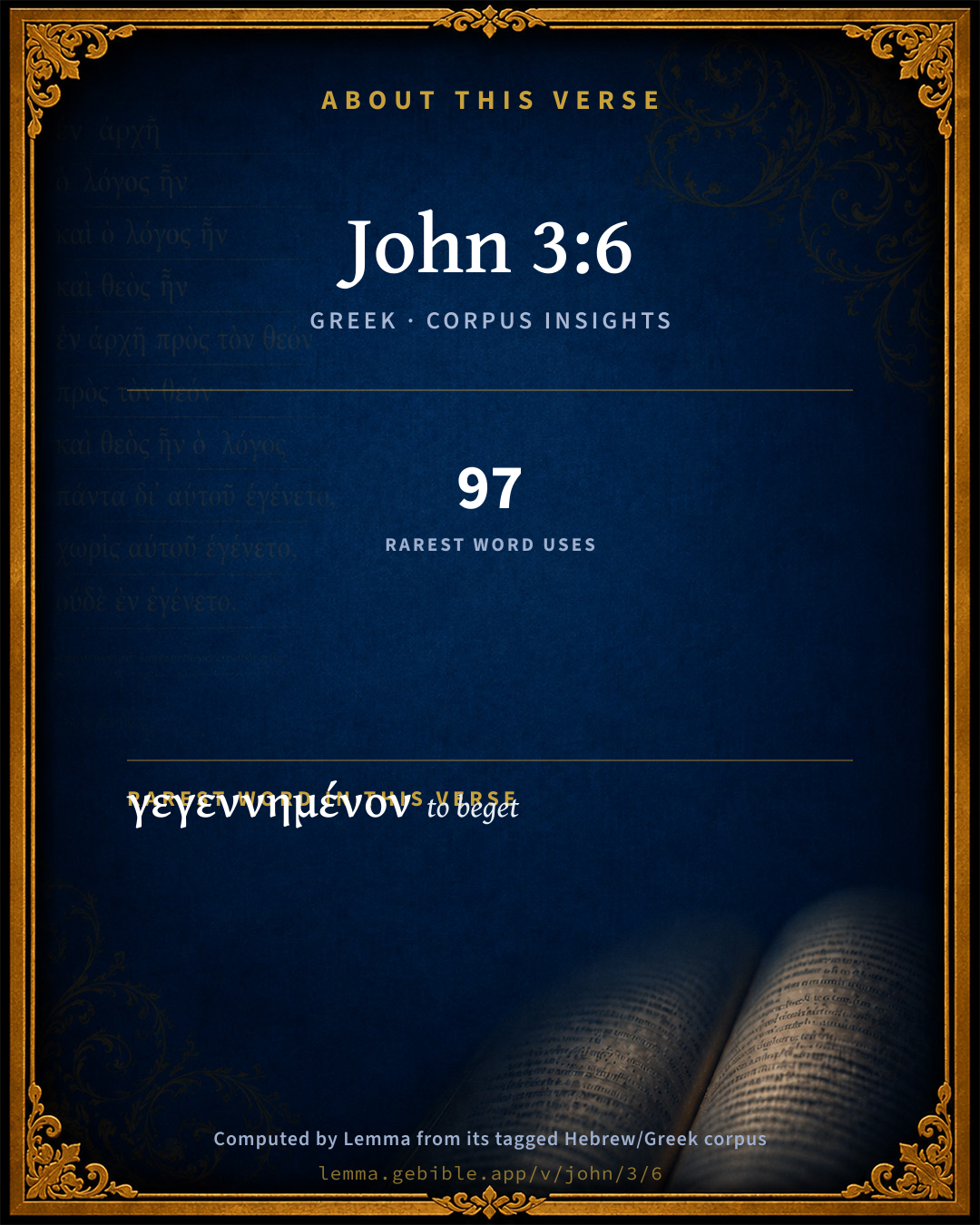
John 3:6

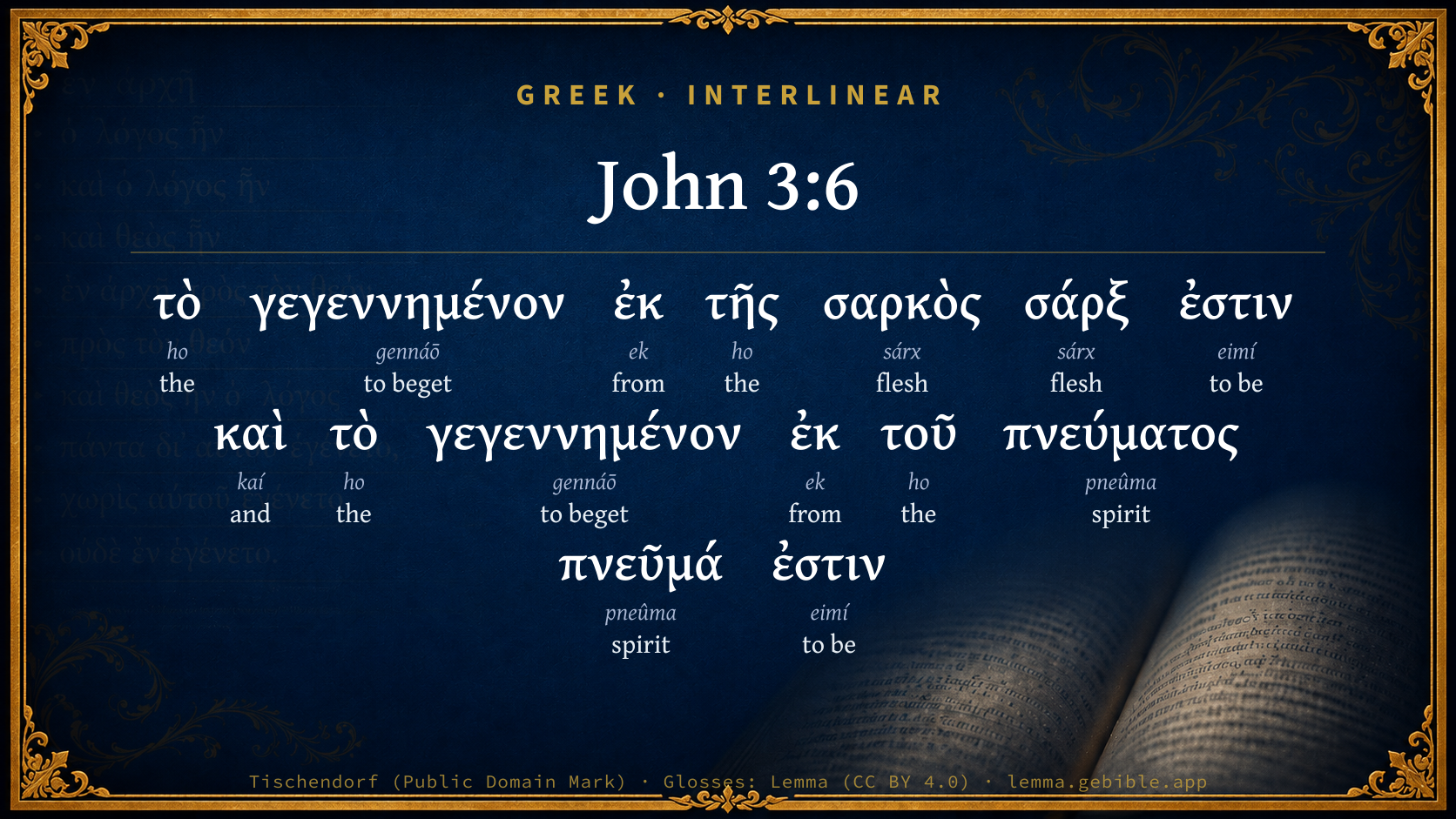
Greek (Tischendorf 8th ed.) John 3:6 appears in the Greek New Testament. The text above is from the Tischendorf 8th edition. Each word links to its Strong’s number and a concise gloss. Click any word for its full Thayer’s Greek Lexicon entry.
Download image
Cite this verse

John 3:6 (World English Bible). Public Domain. Lemma interlinear Bible study tool, https://lemma.gebible.app/v/john/3/6.

Show BibTeX & RIS
BibTeX
RIS
English Translation
That which is born of the flesh is flesh. That which is born of the Spirit is spirit.
World English Bible · Public Domain
Download a study sheet

One document with this verse’s original text, its word-by-word gloss line, the meaning frame, cross-references with their text, attributed commentary, and full source and license credits — printable, and it pastes into notes with its structure intact.

This verse Autodidact and up

Study sheet (.html) Plain text (.txt)

A passage Seminary Student

Up to 50 verses in one chapter. A passage sheet keeps up to 6 commentary sources and 12 cross-references per verse, in the order this page ranks them, and says so on the sheet whenever that leaves anything out. Ask for a single verse and you get the Autodidact verse sheet above.

Everything on this page stays free to read, with no account — the sheet is a download of what is already on screen, not access to it.

Want to remove ads? Support Godless Engineer
Compare translations 3

The same verse in 3 English versions, stacked beneath the original-language interlinear above. Click any original word for its lexicon entry.

Each is an independent rendering of the whole verse — the interlinear is not word-aligned to these translations.

Highlighted words mark where these versions differ — a whole-verse word diff, not a word-by-word alignment.

  • World English Bible Public Domain
    That which is born of the flesh is flesh. That which is born of the Spirit is spirit.
  • King James Version Public Domain
    That which is born of the flesh is flesh; and that which is born of the Spirit is spirit.
  • unfoldingWord Literal Text CC BY-SA 4.0
    has been born from the flesh is flesh, and has been born from the Spirit is spirit.

unfoldingWord Literal Text — © unfoldingWord, licensed CC BY-SA 4.0. Word-aligned USFM3 via Door43 (git.door43.org/unfoldingWord/en_ult).

Versions to compare (up to 4)

3 of 4 selected

Show all 19 translations

Every available English version of this verse, each an independent rendering of the whole verse.

  • World English Bible Public Domain
    That which is born of the flesh is flesh. That which is born of the Spirit is spirit.
  • Berean Standard Bible Public Domain
    Flesh is born of flesh, but spirit is born of the Spirit.
  • Majority Standard Bible Public Domain
    Flesh is born of flesh, but spirit is born of the Spirit.
  • King James Version Public Domain
    That which is born of the flesh is flesh; and that which is born of the Spirit is spirit.
  • American Standard Version (1901) Public Domain
    That which is born of the flesh is flesh; and that which is born of the Spirit is spirit.
  • Revised Version (1885) Public Domain
    That which is born of the flesh is flesh; and that which is born of the Spirit is spirit.
  • Geneva Bible (1599) Public Domain
    That which is borne of the flesh, is flesh: and that that is borne of the Spirit, is spirit.
  • Douay-Rheims (1899) Public Domain
    That which is born of the flesh, is flesh; and that which is born of the Spirit, is spirit.
  • Young's Literal Translation Public Domain
    that which hath been born of the flesh is flesh, and that which hath been born of the Spirit is spirit.
  • Literal Standard Version CC BY-SA 4.0
    that which has been born of the flesh is flesh, and that which has been born of the Spirit is spirit.
  • Unlocked Literal Bible CC BY-SA 4.0
    That which is born of the flesh is flesh, and that which is born of the Spirit is spirit.
  • unfoldingWord Literal Text CC BY-SA 4.0
    has been born from the flesh is flesh, and has been born from the Spirit is spirit.
  • Darby Bible Public Domain
    That which is born of the flesh is flesh; and that which is born of the Spirit is spirit.
  • World Messianic Bible Public Domain
    That which is born of the flesh is flesh. That which is born of the Spirit is spirit.
  • Webster's Bible Public Domain
    That which is born of the flesh, is flesh; and that which is born of the Spirit, is spirit.
  • Free Bible Version CC BY-SA 4.0
    “What's born of the body is body, and what's born of the Spirit is Spirit.
  • Bible in Basic English Public Domain
    That which has birth from the flesh is flesh, and that which has birth from the Spirit is spirit.
  • Text-Critical English NT CC BY 4.0
    That which is born of the flesh is flesh, and that which is born of the Spirit is spirit.
  • Tyndale New Testament (1534) Public Domain
    That which is boren of the flesshe is flesshe: and that which is boren of the sprete is sprete.

Literal Standard Version (2020), Covenant Press — licensed CC BY-SA 4.0. Text via the HelloAO Bible API (eBible.org). Unlocked Literal Bible (unfoldingWord) — licensed CC BY-SA 4.0. Text via the HelloAO Bible API (eBible.org). unfoldingWord Literal Text — © unfoldingWord, licensed CC BY-SA 4.0. Word-aligned USFM3 via Door43 (git.door43.org/unfoldingWord/en_ult). Free Bible Version, Dr. Jonathan Gallagher — licensed CC BY-SA 4.0. Text via the HelloAO Bible API (eBible.org).

Word by word

More ways to search: Search by grammar → Find every occurrence → Compare this word →

Practice this passage: Drill this verse → Learn its vocabulary →

γεγεννημένον
gennáō
G1080
“to beget”
Verb, Perfect, Passive, Participle, Nominative, Singular, Neuter
Part of Speech
Verb
Tense
Perfect
Voice
Passive
Mood
Participle
Case
Nominative
Number
Singular
Gender
Neuter
Full Thayer's Definition

Origin: from a variation of G1085

TDNT: 12:05,1

1. of men who fathered children a. to be born b. to be begotten 1. of women giving birth to children 2. metaph. a. to engender, cause to arise, excite b. in a Jewish sense, of one who brings others over to his way of life, to convert someone c. of God making Christ his son d. of God making men his sons through faith in Christ's work
  1. τὸ ho G3588 “the” Article, Nominative, Singular, Neuter
  2. ἐκ ek G1537 “from” Preposition
  3. τῆς ho G3588 “the” Article, Genitive, Singular, Feminine
  4. σαρκὸς sárx G4561 “flesh” Noun, Genitive, Singular, Feminine
  5. σάρξ sárx G4561 “flesh” Noun, Nominative, Singular, Feminine
  6. ἐστιν eimí G1510 “to be” Verb, Present, Active, Indicative, 3rd person, Singular
  7. καὶ kaí G2532 “and” Conjunction
  8. τὸ ho G3588 “the” Article, Nominative, Singular, Neuter
  9. γεγεννημένον gennáō G1080 “to beget” Verb, Perfect, Passive, Participle, Nominative, Singular, Neuter
  10. ἐκ ek G1537 “from” Preposition
  11. τοῦ ho G3588 “the” Article, Genitive, Singular, Neuter
  12. πνεύματος pneûma G4151 “spirit” Noun, Genitive, Singular, Neuter
  13. πνεῦμά pneûma G4151 “spirit” Noun, Nominative, Singular, Neuter
  14. ἐστιν eimí G1510 “to be” Verb, Present, Active, Indicative, 3rd person, Singular

About this verse

These counts appear in no published source. They are computed here, from the morphology-tagged text and Lemma’s own curated glosses. What Lemma adds →

15
words
7
distinct lemmas
Gospels
section

Repetition

Words recur within this verse:

  • γεγεννημένον to beget G1080 ×2
  • σαρκὸς flesh G4561 ×2
  • ἐστιν to be G1510 ×2
  • πνεύματος spirit G4151 ×2
  • τὸ the G3588 ×4
  • ἐκ from G1537 ×2

Cross-references

23

Topical passages linked to John 3:6 in the Treasury of Scripture Knowledge — connected by theme and wording, ordered by reader-vote popularity; previews shown in the World English Bible.

  • Galatians 5:16–21 But I say, walk by the Spirit, and you won't fulfill the lust of the flesh.
  • Ezekiel 36:26–27 A new heart also will I give you, and a new spirit will I put within you; and I will take away the stony heart out of your flesh, and I will give you a heart of flesh.
  • Romans 8:4–9 that the ordinance of the law might be fulfilled in us, who walk not after the flesh, but after the Spirit.
  • 2 Corinthians 5:17 Therefore if anyone is in Christ, he is a new creation. The old things have passed away. Behold, all things have become new.
  • 1 Corinthians 15:47–50 The first man is of the earth, made of dust. The second man is the Lord from heaven.
  • Romans 7:18 For I know that in me, that is, in my flesh, dwells no good thing. For desire is present with me, but I don't find it doing that which is good.
  • 1 Corinthians 6:17 But he who is joined to the Lord is one spirit.
  • 1 John 3:9 Whoever is born of God doesn't commit sin, because his seed remains in him; and he can't sin, because he is born of God.
  • Genesis 6:12 God saw the earth, and saw that it was corrupt, for all flesh had corrupted their way on the earth.
  • Romans 8:13 For if you live after the flesh, you must die; but if by the Spirit you put to death the deeds of the body, you will live.
  • Job 14:4 Who can bring a clean thing out of an unclean? Not one.
  • Psalms 51:10 Create in me a clean heart, O God. Renew a right spirit within me.
  • Job 25:4 How then can man be just with God? Or how can he who is born of a woman be clean?
  • Ezekiel 11:19–20 I will give them one heart, and I will put a new spirit within you; and I will take the stony heart out of their flesh, and will give them a heart of flesh;
  • Colossians 2:11 in whom you were also circumcised with a circumcision not made with hands, in the putting off of the body of the sins of the flesh, in the circumcision of Christ;
  • John 1:13 who were born not of blood, nor of the will of the flesh, nor of the will of man, but of God.
  • Galatians 5:24 Those who belong to Christ have crucified the flesh with its passions and lusts.
  • Ephesians 2:3 among whom we also all once lived in the lust of our flesh, doing the desires of the flesh and of the mind, and were by nature children of wrath, even as the rest.
  • Genesis 6:5 Yahweh saw that the wickedness of man was great in the earth, and that every imagination of the thoughts of his heart was only evil continually.
  • Romans 7:5 For when we were in the flesh, the sinful passions which were through the law, worked in our members to bring forth fruit to death.
  • Genesis 5:3 Adam lived one hundred thirty years, and became the father of a son in his own likeness, after his image, and named him Seth.
  • Job 15:14–16 What is man, that he should be clean? He who is born of a woman, that he should be righteous?
  • Romans 7:25–8:1 I thank God through Jesus Christ, our Lord! So then with the mind, I myself serve God's law, but with the flesh, the sin's law.

Cross-references courtesy of OpenBible.info (CC BY 4.0).

Commentary

Notes on John 3:6 from classic Christian and Jewish commentators (each source and its license shown beneath its notes). The classic Christian expositions comment on the surrounding passage and are grouped to its opening verse, so a note may address several verses; the Jewish commentaries on the Tanakh (Rashi and others) are per-verse, so they appear only where the commentator wrote on this verse.

Lemma curates 59 commentaries, every one of them public domain or Creative Commons licensed, each selected and text-cleaned for this edition rather than reprinted as found. About our sources →

Joseph Benson's Commentary

Joh 3:6-8. That which is born of the flesh is flesh — Only flesh, void of the Spirit: or is carnal and corrupt, and therefore at enmity with the Spirit. And that which is born of the Spirit is spirit — Is spiritual, heavenly, divine, like its author. As if our Lord had said to Nicodemus, Were it possible for a man to be born again in a literal sense, by entering a second time into his mother’s womb, such a second birth would do no more to qualify him for the kingdom of God than the first; for what proceeds, and is produced from parents that are sinful and corrupt, is sinful and corrupt as they are; but that which is born of the Spirit is formed to a resemblance of that blessed Spirit, whose office it is to communicate a divine nature to the soul, and to stamp it with the divine image. Marvel not, therefore, that I said unto thee — And have declared it as a truth that ye are all concerned in; that ye must be born again — Ye Jews, though descendants of Abraham; ye scribes, though learned in the law; ye Pharisees, though exact in the observance of its ceremonies, and the traditions of the elders; ye doctors of Israel and rulers of the people, notwithstanding your authority in matters civil and religious, must all be born again in this spiritual sense, since the degeneracy of the human nature is of so universal an extent as to be common to you all. The wind bloweth, &c. — As if he had said, Nor have you any cause to be surprised if there be some things in this doctrine of regeneration which are of an obscure and unsearchable nature, for even in the natural world many things are so: the wind, for instance, bloweth where it listeth — According to its own nature, not thy will, sometimes one way, and sometimes another, not being subject to the direction or command of man; and thou hearest the sound thereof — And feelest its sensible and powerful effects on thy body; but canst not tell whence it cometh — Canst not explain the particular manner of its acting, or where it begins, and where it ceases blowing; for whatever general principles may be laid down concerning it, when men come to account for its particular variations, the greatest philosophers often find themselves at a loss. So is every one that is born of the Spirit — The fact is plain, the manner of its operations is inexplicable. “It is worthy of remark,” says Dr. Campbell, “that as, in the Greek and in the Vulgate, the same word, in this passage, signifies both wind and spirit, the illustration is expressed with more energy than it is possible to give it in those languages which do not admit the same ambiguity.” But “I shall give what appears to me the purport of Joh 3:7-8. ‘Nor is there,’ as if he had said, ‘any thing in this either absurd or unintelligible. The wind, which in Hebrew is expressed by the same word as spirit, shall serve for an example. It is invisible; we hear the noise it makes, but cannot discover what occasions its rise or its fall. It is known to us solely by its effects. Just so it is with this second birth. The Spirit himself, the great agent, is invisible; his manner of operating is beyond our discovery; but the reality of his operation is perceived by the effects produced on the disposition and life of the regenerate.’”

Joseph Benson's Commentary on the Old and New Testaments (1811–1818) — public domain. Text from a community e-Sword module.

Bengel's Gnomon

Johann Albrecht Bengel

Joh 3:6. Σάρξ) True flesh: but also mere flesh, void of spirit, opposed to spirit, of an old generation.—τὸ γεγεννημένον, what is born) This being in the neuter, sounds more general, and denotes the very first stamina [groundwork] of new life: comp. Luk 1:35, “The Holy Ghost shall come upon thee, and the power of the Highest shall overshadow thee; therefore that holy thing, τὸ γεννώμενον,” etc.: or even the whole body of those born again: comp. Joh 6:37; Joh 6:39, “All that—πᾶν ὅ—the Father giveth Me, shall come to Me,” etc.: “This is the Father’s will, etc., that of all which—πᾶν ὅ—He hath given Me, I should lose nothing—ἐξ αὐτοῦ—but should raise it—αὐτό—up again at the last day.” Afterwards it is expressed in the masculine, ὁ γεγεννημένος, who is born, Joh 3:8; which signifies matured birth.—πνεῦμα, spirit) That which is born of the Spirit is spirit: he who is born of the Spirit is spiritual.

Bengel's Gnomon of the New Testament — English translation (T&T Clark, Edinburgh, 1860) — public domain. Text from a community e-Sword module.

Meyer's Critical & Exegetical Commentary

Heinrich August Wilhelm Meyer

Joh_3:6. A more minute antithetic definition of this birth, in order further to elucidate it.

We have not in what follows two originally different classes of persons designated (Hilgenfeld), for the new birth is needed by all (see Joh_3:7; comp. also Weiss, Lehrbegriff, p. 128), but two different and successive epochs of life.

τὸ γεγεννημ.] neuter, though designating persons, to give prominence to the statement as general and categorical. See Winer, p. 167 [E. T. p. 222].

ἐκ τῆς σαρκός] The σάρξ is that human nature, consisting of body and soul, which is alien and hostile to the divine, influenced morally by impulses springing from the power of sin, whose seat it is, living and operating with the principle of sensible life, the ψυχή. See on Rom_4:1. What is born of human nature thus sinfully constituted (and, therefore, not in the way of spiritual birth from God), is a being of the same sinfully conditioned nature,[154] without the higher spiritual moral life which springs only from the working of the divine Spirit. Comp. Joh_1:12-13. Destitute of this divine working, man is merely σαρκικός, ψυχικός (1Co_2:14), πεπραμένος ὑπὸ τὴν ἁμαρτίαν (Rom_7:14), and, despite his natural moral consciousness and will in the νοῦς, is wholly under the sway of the sinful power that is in the σάρξ (Rom_7:14-25). The σάρξ, as the moral antithesis of the πνεῦμα, stands in the same relation to the human πνεῦμα with the νοῦς, as the prevailingly sinful and morally powerless life of our lower nature does to the higher moral principle of life (Mat_26:41) with the will converted to God; while it stands in the same relation to the divine πνεῦμα, as that which is determinately opposed to God stands to that which determines the new life in obedience to God (Rom_8:1-3). In both relations, σάρξ and πνεῦμα are antitheses to each other, Mat_26:41; Gal_5:17 ff.; accordingly in the unregenerate we have the lucta carnis et MENTIS (Rom_7:14 ff.), in the regenerate we have the lucta carnis et SPIRITUS (Gal_5:17).

ἐκ τοῦ πνεύματος] that which is born of the Spirit, i.e. that whose moral nature and life have proceeded from the operation of the Holy Spirit,[155] is a being of a spiritual nature, free from the dominion of the σάρξ, and entirely filled and governed by a spiritual principle, namely by the Holy Spirit (Rom_8:2 ff.), walking ἐν καινότητι πνεύματος (Rom_7:6).

The general nature of the statement forbids its limitation to the Jews as descendants of Abraham according to the flesh (Kuinoel and others), but they are of course included in the general declaration; comp. Joh_3:7, ὑμᾶς.

In the apodoses the substantives σάρξ and πνεῦμα represent, though with stronger emphasis (comp. Joh_6:63, Joh_11:25, Joh_12:50; 1Jn_4:8; Rom_8:10), the adjectives σαρκικός and πνευματικός, and are to be taken qualitatively.

[154] The sinful constitution of the σάρξ in itself implies the necessity of a being born of the Spirit (vv. 3, 7); comp. 1Jn_2:16. The above exposition cannot therefore be considered as attributing to John a Pauline view which is strange to him. This is in answer to Weiss, according to whom Jesus here merely says, as the corporeal birth only produces the corporeal sensual part. Similarly J. Müller on Sin, vol. I. p. 449, II. 382. See on the other hand, Luthardt, v. freien Willen, p. 393.

[155] The ἐκ τοῦ ὕδατος, implying the ἐκ τοῦ πνεύματος (after ver. 5), and the meaning of which is clear in itself, is not repeated by Jesus, because His aim now is simply to let the contrast between the σάρξ and the πνεῦμα stand out clearly.

Meyer — Critical and Exegetical Commentary on the New Testament — English translation by Peter Christie, edited by Frederick Crombie (T&T Clark, 1880) — public domain. Text from a community e-Sword module.

Expositor's Greek Testament

ed. W. Robertson Nicoll

Joh 3:6 . The necessity of the new birth is further exhibited by a comparison of the first and second birth: τὸ γεγεννημένον ἐκ τὴς σαρκὸς σάρξ ἐστι · καὶ τὸ γεγεννημένον ἐκ τοῦ Πνεύματος , πνεῦμά ἐστι . The neuter is used because the speaker “wishes to make His statement altogether general” (Winer, 27, 5), whatever is born. The law is laid down in Aristotle (Eth. Maj., i., 10), “Every nature generates its own substance,” flesh, flesh; spirit, spirit.

The Expositor's Greek Testament, edited by W. Robertson Nicoll (1897–1910) — public domain. Text from a community e-Sword module.

Vincent's Word Studies in the New Testament

Marvin R. Vincent

That which is born [το γεγεννηενον] . Strictly, that which hath been born, and consequently is now before us as born. The aorist tense (3, 4, 5, 7), marks the fact of birth; the perfect (as here), the state of that which has been born (see on 1Jo 5:18, where both tenses occur); the neuter, that which, states the principle in the abstract. Compare ver. 8, where the statement is personal : everyone that is born. Compare 1Jo 5:4, and 1Jo 5:1, 18.

Of the flesh [εκ της σαρκος] . See on ver. 14. John uses the word sarx generally, to express humanity under the conditions of this life (i. 14; 1Jo 4:2, 3, 7; 2 John 7), with sometimes a more definite hint at the sinful and fallible nature of humanity (1Jo 2:16; Joh 8:15). Twice, as opposed to pneuma, Spirit (Joh 3:6; Joh 6:63).

Of the Spirit [εκ του πνευματος] . The Holy Spirit of God, or the principle of life which He imparts. The difference is slight, for the two ideas imply each other; but the latter perhaps is better here, because a little more abstract, and so contrasted with the flesh. Spirit and flesh are the distinguishing principles, the one of the heavenly, the other of the earthly economy.

Marvin R. Vincent, Word Studies in the New Testament (1887–1900) — public domain. Text from a community e-Sword/MySword module.

Godet's Commentaries

Frédéric Louis Godet

Ver. 6. “That which is born of the flesh is flesh, and that which is born of the Spirit is spirit.”

The logical transition from Joh 3:5 to Joh 3:6 is this understood idea: “The Kingdom of God can only be of a spiritual nature, as God is Himself.” In order to enter it, therefore, there must be, not flesh, as every man is by his first birth, but spirit, as he becomes by the new birth. The word flesh (see pp. 268-269), taken in itself, does not necessarily imply the notion of sin. But it certainly cannot be maintained, with Weiss, that the question here is simply of the insufficiency of the natural birth, even in the state of innocence, to render man fit for the divine kingdom. Nevertheless, we must not forget that the question here is of humanity in its present constitution, according to which sin is connected with the fact of birth more closely than with any other of the natural life (Psa 51:7).

The expression: the flesh, seems to me, therefore, to denote here humanity in its present state, in which the flesh rules the spirit. This state is transmitted from generation to generation in such a way that, without renewal, no man can come out of that fatal circle. And hence the necessity of regeneration. How does this transmission of the carnal state accord with individual culpability? The last words of this conversation will throw some light on this difficult question. According to this saying, it is impossible to suppose that Jesus regarded Himself as born in the same way as other men (Joh 3:7, you). The substantive flesh, as a predicate (is flesh), has a much more forcible meaning than that of the adjective (carnal) would be. The state has, in some sort, become nature. Hence, it follows that it is not enough to cleanse or adorn outwardly the natural man; a new nature must be substituted for the old, by means of a regenerating power. We might also see in the second clause a proof of the necessity of the new birth; it would be necessary, in that case, to give it the exclusive sense: “Nothing except what is born of the Spirit is spiritual (and can enjoy, in consequence, the Kingdom of the Spirit).” But the clause has rather a positive and affirmative sense: “That which is born of the Spirit is really spirit, and consequently cannot fail to enjoy the Kingdom of the Spirit.” The idea, therefore, is that of the reality of the new birth, and consequently, of its complete possibility.

This is the answer to the question: “How can a man?” Let the Spirit breathe, and the spiritual man exists! The word Spirit, as subject, denotes the Divine Spirit, and, as predicate, the new man. Here, again, the substantive (spirit), is used instead of the adjective (spiritual), to characterize the new essence. This word spirit, in the context here, includes not only the new principle of spiritual life, but also the soul and body, in subjection to the Spirit. The neuter, τὸ γεγεννημένον (that which is born), is substituted in the two clauses for the masculine (he who is born), for the purpose of designating thenature of the product, abstractedly from the individual; thus, the generality of the law is more clearly brought out.Hilgenfeld finds here the Gnostic distinction between two kinds of men, originally opposite.

Meyer well replies: “There is a distinction, not between two classes of men, but between two different phases in the life of the same individual.”

Jesus observes, that the astonishment of Nicodemus, instead of diminishing, goes on increasing. He penetrates the cause of this fact: Nicodemus has not yet given a place in his conception of divine things to the action of the Holy Spirit; this is the reason why he is always seeking to represent to himself the new birth as a fact apprehensible by the senses. Recognizing him, however, as a serious and sincere man, He wishes to remove from his path this stumbling-stone. Here is not a fact, He says to him, which one can picture to himself; it can be comprehended only as far as it is experienced.

Frédéric Louis Godet — Commentaries on Luke, John, Romans, and 1 Corinthians — English translation (T&T Clark, Edinburgh, 1870s–1890s) — public domain. Text from a community e-Sword module.

Geneva Bible (1599)

Geneva Bible translators

That is, fleshly, to wit, wholly unclean and under the wrath of God: and therefore this word (Flesh) signifieth the corrupt nature of man: contrary to which is the Spirit, that is, the man ingrafted into Christ through the grace of the holy Ghost, whose nature is everlasting and immortal, though the strife of the flesh remaineth.

Geneva Bible (1599) marginal notes — public domain. Text via Bolls.life.

Jamieson, Fausset & Brown

Robert Jamieson, A. R. Fausset & David Brown

That which is born, &c.--A great universal proposition; "That which is begotten carries within itself the nature of that which begat it" [OLSHAUSEN].

flesh--Not the mere material body, but all that comes into the world by birth, the entire man; yet not humanity simply, but in its corrupted, depraved condition, in complete subjection to the law of the fall (Rom 8:1-9). So that though a man "could enter a second time into his mother's womb and be born," he would be no nearer this "new birth" than before (Job 14:4; Psa 51:5).

is spirit--"partakes of and possesses His spiritual nature."

Jamieson, Fausset & Brown — Commentary Critical and Explanatory on the Whole Bible (1871) — public domain (CC PDM 1.0). Text via the HelloAO Bible API.

Adam Clarke's Commentary

Verse 6. That which is born of the flesh is flesh] This is the answer to the objection made by Nicodemus in Joh 3:4. Can a man enter the second time into his mother's womb and be born? Our Lord here intimates that, were even this possible, it would not answer the end; for the plant will ever be of the nature of the seed that produces it-like will beget its like. The kingdom of God is spiritual and holy; and that which is born of the Spirit resembles the Spirit; for as he is who begat, so is he who is begotten of him. Therefore, the spiritual regeneration is essentially necessary, to prepare the soul for a holy and spiritual kingdom.

Adam Clarke's Commentary on the Bible (1810–1826) — public domain. Text from a community e-Sword/MySword module.

John Calvin's Commentaries

6. That which is born of the flesh. By reasoning from contraries, he argues that the kingdom of God is shut against us, unless an entrance be opened to us by a new birth, (παλιγγενεσία ) For he takes for granted, that we cannot enter into the kingdom of God unless we are spiritual. But we bring nothing from the womb but a carnal nature. Therefore it follows, that we are naturally banished from the kingdom of God, and, having been deprived of the heavenly life, remain under the yoke of death. Besides, when Christ argues here, that men must be born again, because they are only flesh, he undoubtedly comprehends all mankind under the term flesh. By the flesh, therefore, is meant in this place not the body, but the soul also, and consequently every part of it. When the Popish divines restrict the word to that part which they call sensual, they do so in utter ignorance of its meaning; for Christ must in that case have used an inconclusive argument, that we need a second birth, because part of us is corrupt. But if the flesh is contrasted with the Spirit, as a corrupt thing is contrasted with what is uncorrupted, a crooked thing with what is straight, a polluted thing with what is holy, a contaminated thing with what is pure, we may readily conclude that the whole nature of man is condemned by a single word. Christ therefore declares that our understanding and reason is corrupted, because it is carnal, and that all the affections of the heart are wicked and reprobate, because they too are carnal.

But here it may be objected, that since the soul is not begotten by human generation, we are not born of the flesh, as to the chief part of our nature. This led many persons to imagine that not only our bodies, but our souls also, descend to us from our parents; for they thought it absurd that original sin, which has its peculiar habitation in the soul, should be conveyed from one man to all his posterity, unless all our souls proceeded from his soul as their source. And certainly, at first sight, the words of Christ appear to convey the idea, that we are flesh, because we are born of flesh. I answer, so far as relates to the words of Christ, they mean nothing else than that we are all carnal when we are born; and that as we come into this world mortal men, our nature relishes nothing but what is flesh. He simply distinguishes here between nature and the supernatural gift; for the corruption of all mankind in the person of Adam alone did not proceed from generation, but from the appointment of God, who in one man had adorned us all, and who has in him also deprived us of his gifts. Instead of saying, therefore, that each of us draws vice and corruption from his parents, it would be more correct to say that we are all alike corrupted in Adam alone, because immediately after his revolt God took away from human nature what He had bestowed upon it.

Here another question arises; for it is certain that in this degenerate and corrupted nature some remnant of the gifts of God still lingers; and hence it follows that we are not in every respect corrupted. The reply is easy. The gifts which God hath left to us since the fall, if they are judged by themselves, are indeed worthy of praise; but as the contagion of wickedness is spread through every part, there will be found in us nothing that is pure and free from every defilement. That we naturally possess some knowledge of God, that some distinction between good and evil is engraven on our conscience, that our faculties are sufficient for the maintenance of the present life, that — in short — we are in so many ways superior to the brute beasts, that is excellent in itself, so far as it proceeds from God; but in us all these things are completely polluted, in the same manner as the wine which has been wholly infected and corrupted by the offensive taste of the vessel loses the pleasantness of its good flavor, and acquires a bitter and pernicious taste. For such knowledge of God as now remains in men is nothing else than a frightful source of idolatry and of all superstitions; the judgment exercised in choosing and distinguishing things is partly blind and foolish, partly imperfect and confused; all the industry that we possess flows into vanity and trifles; and the will itself, with furious impetuosity, rushes headlong to what is evil. Thus in the whole of our nature there remains not a drop of uprightness. Hence it is evident that we must be formed by the second birth, that we may be fitted for the kingdom of God; and the meaning of Christ’s words is, that as a man is born only carnal from the womb of his mother; he must be formed anew by the Spirit, that he may begin to be spiritual.

The word Spirit is used here in two senses, namely, for grace, and the effect of grace. For in the first place, Christ informs us that the Spirit of God is the only Author of a pure and upright nature, and afterwards he states, that we are spiritual, because we have been renewed by his power.

John Calvin's Commentaries (1540-1563) — public domain. Text from the Calvin Translation Society English edition (1840s-50s) via the Christian Classics Ethereal Library (ccel.org). Calvin's coverage is partial (roughly two-thirds of the Bible); uncommented books and verses are honest gaps, never fabricated. The 19th-century editor's footnotes and remarks are omitted so the notes are faithfully Calvin's own voice.

Ellicott's Commentary for English Readers

(6) That which is born of the flesh is flesh.—The first step is to remind him of the law of likeness in natural generation. “Flesh,” as distinct from “spirit,” is human nature in so far as it is common with animal nature, consisting of the bodily frame and its animal life, feelings, and passions. “Flesh,” as opposed to “spirit,” is this nature as not under the guidance of the human spirit, which is itself the shrine of the Divine Spirit, and therefore it is sinful. (Comp. Gal_5:16 et seq.; Gal_6:8.) It is this nature in its material constitution, and subject to sin, which is transmitted from father to son. The physical life itself is dependent upon birth. That which is born of the flesh is flesh.

There is an analogous law of spiritual generation. Spirit as opposed to flesh is the differentia of man as distinct from all other creatures. It is the image of God in him, the seat of the capacity for the communion with God, which is the true principle of life. In the natural man this is crushed and dormant; in the spiritual man it has been quickened by the influence of the Holy Ghost. This is a new life in him, and the spiritual life, like the physical, is dependent upon birth. That which is born of the Spirit is spirit.

(6) The sense suggested for the last clause, “In this manner is every one born who is of the Spirit,” removes the necessity of finding something with which the work of the Spirit may be compared, and it is in this necessity that the received versions of the first clause really find their root.

These reasons are, it is thought, not an insufficient basis for the interpretation here adopted. It is adopted not without the knowledge that a consensus of authorities may be pleaded against it. For its details it may be that no authority can be pleaded, but the rendering of πνεῦμα here by “spirit” is not without the support of width of learning and depth of power, critical acumen and spiritual insight, for it rests on the names of Origen and Augustine, of Albrecht Bengel and Frederick Maurice.

A Bible Commentary for English Readers, edited by Charles John Ellicott (1878–1897) — public domain. Text from a community e-Sword module.

The Cambridge Bible for Schools and Colleges

gen. ed. J. J. S. Perowne

6. The meaning of ‘birth from above’ is still further explained by an analogy. What a man inherits from his parents is a body with animal life and passions; what he receives from above is a spiritual nature with heavenly aspirations and capabilities. What is born of sinful, human nature is sinful and human; what is born of the Holy Spirit is spiritual and divine.

The Cambridge Bible for Schools and Colleges (gen. ed. J. J. S. Perowne; Cambridge University Press, 1878–1918) — public domain. Text from a community e-Sword module.

John Gill's Exposition

Marvel not that I said unto thee,...., For Nicodemus was quite astonished, at this doctrine of the new birth; it was altogether new to him, and unheard of by him; nor could he understand, nor conceive in what manner it could be:

ye must be born again; in "four" of Beza's copies, it is read "we"; but as Christ was not begotten in a carnal way, or descended not from Adam in the ordinary way of generation, he was not carnal and corrupt, nor in the least tainted with sin; and so stood in no need of regeneration; wherefore such a reading must be rejected. There is a necessity of the regeneration of those, who are the chosen of God, and the redeemed of the Lamb; and of them only can the words be understood; for as for others, they neither can, nor will, nor must be born again: but the people of God "must"; partly because it is the will of God; it is his purpose and resolution, that they shall be regenerated; he has chosen them, through sanctification of the Spirit, unto salvation by Christ: this is the way and method of saving sinners he has fixed upon, namely, not to save them by works of righteousness, but by grace, and according to abundant mercy, through the washing of regeneration, and the renewing of the Holy Ghost: and partly, because of the case and condition of men, which requires it; for whereas the chosen people of God, are predestinated to the adoption of children, and are taken into the family of God, and are heirs to an inheritance, it is necessary they should have a nature, temper, and disposition of mind, suitable to the inheritance they are to enjoy; which they have not in their natural estate, and which is conveyed to them in regeneration: besides, their carnal minds are enmity to God, and it is necessary that they should be friendly to him, which cannot be without regeneration; nor can they, till they are born again, please God, or do those things which are pleasing to him: to which may be added, which Christ has before suggested, and which shows the necessity of it, that without it, no man can either see, or enter into the kingdom of God. To take off the surprise of Nicodemus, our Lord instances in a common natural case, and to which this affair of regeneration may be compared, and by it illustrated.

John Gill's Exposition of the Whole Bible (1746–1763) — public domain (CC PDM 1.0). Text via the HelloAO Bible API.

Trapp's Complete Commentary

John Trapp

6 That which is born of the flesh is flesh; and that which is born of the Spirit is spirit.

Ver. 6. That which is born of the flesh, &c.] Whole man is in evil, and whole evil in man. Quintilian saw not this, and therefore said, that it is more marvel that one man sinneth than that all men should live honestly; sin is so much against man’s nature. Many also of the most dangerous opinions of Popery (as justification by works, state of perfection, merit, supererogation, &c.) spring from hence; that they have slight conceits of concupiscence, as a condition of nature. Yet some of them (as Michael Bains, professor at Lovain, &c.) are sound in this point.

John Trapp, A Commentary or Exposition upon All the Books of the Old and New Testament (1647–1656) — public domain. Text from a community e-Sword module.

Albert Barnes' Notes on the Bible

That which is born of the flesh - To show the necessity of this change, the Saviour directs the attention of Nicodemus to the natural condition of man. By “that which is born of the flesh” he evidently intends man as he is by nature, in the circumstances of his natural birth. Perhaps, also, he alludes to the question asked by Nicodemus, whether a man could be born when he was old? Jesus tells him that if this could be, it would not answer any valuable purpose; he would still have the same propensities and passions. Another change was therefore indispensable.

Is flesh - Partakes of the nature of the parent. Compare Gen 5:3. As the parents are corrupt and sinful, so will be their descendants. See Job 14:4. And as the parents are wholly corrupt by nature, so their children will be the same. The word “flesh” here is used as meaning “corrupt, defiled, sinful.” The “flesh” in the Scriptures is often used to denote the sinful propensities and passions of our nature, as those propensities are supposed to have their seat in the animal nature. “The works of the flesh are manifest, which are these: adultery, fornication, uncleanness, lasciviousness,” etc., Gal 5:19-20. See also Eph 2:3; 1Pe 3:21; 1Pe 2:18; 1Jo 2:16; Rom 8:5.

Is born of the Spirit - Of the Spirit of God, or by the agency of the Holy Spirit.

Is spirit - Is spiritual, “like” the spirit, that is, holy, pure. Here we learn:

1.That all men are by nature sinful.

2.That none are renewed but by the Spirit of God. If man did the work himself, it would he still carnal and impure.

3.That the effect of the new birth is to make men holy.

4.And, that no man can have evidence that he is born again who is not holy, and just in proportion as he becomes pure in his life will be the evidence that he is born of the Spirit.

Albert Barnes' Notes on the Bible (1834–1885) — public domain. Text from a community e-Sword/MySword module.

Matthew Poole's English Annotations

That which is born of the flesh: that which is born of natural flesh; for flesh sometimes signifies the man. So the prophet saith, All flesh is grass, Isa 40:6. So Gen 6:12, All flesh, that is, all men, had corrupted their way. Or, that which is born of corruption, from vitiated and corrupted nature; so flesh is oft taken in Scripture, Rom 8:4,5,8, &c.

Is flesh; that is, it bringeth forth effects proportionable to the cause; a man purely natural brings forth natural operations. Man, as man, moveth, and eateth, and drinketh, and sleepeth. Corrupted man brings forth vicious and corrupt fruit, which often are called the works of the flesh, Gal 5:19.

Flesh here signifieth the whole man, whether considered abstractly from the adventitious corruption of his nature, or as fallen in Adam, vitiated and debauched through lust.

And that which is born of the Spirit is spirit: but that man or woman who is regenerated by the Spirit of grace is spiritual; he is after the Spirit, Rom 8:5; he is one spirit with God, 1Co 6:17; he is made partaker of the Divine nature, 2Pe 1:4; he doth not commit sin, 1Jo 3:9. Nothing in operation exceedeth the virtue of that cause which influences it; so as no man from a mere natural principle can perform a truly spiritual operation; and from hence it is absolutely necessary that man must be born of the Spirit, that he may be qualified for the kingdom of heaven.

Matthew Poole's English Annotations on the Holy Bible (1683–1685) — public domain. Text from a community e-Sword/MySword module.

Whedon's Commentary on the Bible

Daniel D. Whedon

6. Flesh… Spirit—Flesh is not synonymous with body. The word is used in the Old Testament to designate the entire transient, perishable, fallen, and corrupt nature of man, both in body and soul. Hence the meaning of the first clause of this first verse is: That which is generated of fallen and depraved humanity, is itself fallen and depraved humanity. Like produces like. Through all the productive, procreative kingdoms, whether animal or vegetable, no offspring is of a higher species than its parentage. On the other hand, Spirit here refers to the Holy Spirit as so operating upon the human spirit, and so changing its nature, as to be said to beget it anew. For as generation is a modifying of substance or being, imparting to it a new principle of life, conforming it, as living being, to the likeness of the generator, so regeneration is a modification of the human spirit by the Holy Spirit, conforming the temper of the human to the Holy.

Is spirit—As flesh signifies a depraved nature, so spirit in this verse signifies a pure nature.

For it is a pure and holy Spirit which is the generator, and it must be a pure and holy spirit which is generated. The whole text then is: As a depraved nature generates a depraved nature, so the holy nature generates a holy nature. And as we are first born of a depraved nature, and therefore depraved, so we must be born (or rather begotten) from a holy nature, and so be renewed.

Daniel D. Whedon (gen. ed.), Commentary on the Old and New Testaments (1874–1909) — public domain. Text from a community e-Sword module.

The Pulpit Commentary

That which hath been born of the flesh, is flesh. Sarx is not the physical as opposed to the spiritual or immaterial. nor is sarx necessarily sinful, as we see from Joh_1:14, but as it often appears in John"s writing and Paul"s, sarx is the constituent element of humanity as apart from grace humanity (body, intellect, heart, conscience, soul, spirit) viewed on its own side and merits and capacity, without the Divine life, or the Divine supernatural inbreathing. The being born of the flesh is the being born into this world, with all the privations and depravations, evil tendencies and passions of a fallen humanity. Birth into the theocracy, birth into national or ecclesiastical privilege, birth that has no higher quality than flesh, no better germ or graft upon it simply produces flesh, humanity over again. When the Logos "became flesh," something more than and different from ordinary traduction of humanity took place.

Destitute of any higher birth than the birth of flesh, man is fleshly, psychical, earthly, sarkikov qucikov coikov , (Rom_7:14-25) and, more than that, positively opposed to the will and grace of God, lashed with passions, defiled with debasing ideas, in enmity against God. Hence the birth "from the Spirit" is entirely antithetic to the birth from the flesh. That which hath been born of the Spirit, is spirit. There is a birth which supervenes on the flesh-be-gotten man, and it is supernaturally wrought by the Spirit of God. As in the first instance, at man"s creation, God breathed into man the breath of life, and by that operation man became a living soul; so now the new birth of man is wrought in him by the Spirit, and there is a new life, a new mode of being, a new bias and predomimating impulse. "A spiritual mind which is life and peace" has taken the place of the old carnal mind. He is "spiritual," no longer "psychical," or "carnal," but able to discern the things that are freely given to him. The eye of the spirit is opened, unsealed, the ta tou pneumatov are revealed to him. (1Co_2:12-16 1Co_3:1-5) The reference to "birth of water" is not repeated, because the birth from water is relatively unimportant, and of no value apart from the Spirit-change of which it may be a picture, or even a synonym. More than that, the Spirit-birth, the Divine operation, is the efficient cause of that which, under the form of a human experience, is called metanoia . The human metanoia, rather than the new birth, is the great burden of our Lord"s public address, as recorded in the synoptic Gospels. In both representations the same fact, the same condition and state of the human consciousness, is referred to. In "repentance," however, and in the moral characters which are the several preliminaries to the beatitudes of the Sermon on the Mount, a change is declared necessary for the constitution and inauguration of the kingdom of heaven. This change is there viewed from the standpoint of human experience, and urged in the form of a direct appeal to conscience. In this discourse to Nicodemus the same change is exhibited on its Divine side, and as one produced by the Spirit of God. In the Sermon on the Mount "meekness," "poverty of spirit," "mourning," "hunger after righteousness," "purity of heart," the spirit of forgiveness and long suffering, are the moral conditions of those minds and hearts which would become the city of God and the light of the world. (Mat_5:1-12) On this occasion, when addressing the learned rabbi, Christ sums all up in the demand for a birth from the Spirit a new and spiritual recommencement of life from the Spirit of God. The clause found in the Vetus Itala and the Syriac, quia Deus spiritus est, et de Deo natus est, is a gloss sustained by no Greek manuscript authority. Thorns here quotes two interesting passages from Philo, 1:533, 599, where the nouv is spoken of as given to man from above, and where the supremacy of the spiritual over the fleshly is made the only guarantee of admission into the world of spirit. But Philo obviously meant the intellectual rather than the moral element in human nature, and prized the ascetic process rather than the supernatural regeneration.

The Pulpit Commentary (1880–1919), ed. H.D.M. Spence-Jones & Joseph S. Exell — public domain. Text from a community e-Sword module.

John Wesley's Explanatory Notes

That which is born of the flesh is flesh - Mere flesh, void of the Spirit, yea, at enmity with it; And that which is born of the Spirit is spirit - Is spiritual, heavenly, divine, like its Author.

John Wesley, Explanatory Notes Upon the Whole Bible (1754–1765) — public domain. Text via the GEBible commentary corpus.

Burkitt's Expository Notes on the New Testament

William Burkitt

As if Christ had said, "As men generate men, and nature begets nature, so the Holy Spirit produceth holy inclinations, qualifications, and dispositions."

Learn hence, That as original corruption is conveyed by natural generation, so saving regeneration is the effect and product of the Holy Spirit’s operation.

William Burkitt's Expository Notes on the New Testament (1700–1703) — public domain. Text from a community e-Sword module.

Cambridge Greek Testament for Schools and Colleges

6. The meaning of γεννηθῆναι ἄνωθεν is still further explained by an analogy. What man inherits from his parents is a body with animal life and passions; what he receives from above is a spiritual nature with heavenly capabilities and aspirations: what is born of sinful human nature is human and sinful; what is born of the Holy Spirit is spiritual and divine.

There is an interesting interpolation here. The old Latin and old Syriac Versions insert quia Deus spiritus est et de Deo natus est. No Greek MS. contains the words, which are obviously a gloss. But S. Ambrose (De Spir. III. 59) charges the Arians with effacing quia Deus spiritus est from their MSS. see on Joh 1:13.

Cambridge Greek Testament for Schools and Colleges (Cambridge University Press, 1896; 21 vols, various authors incl. Carr, Maclear, Plummer, Farrar, Lumby, Moule, M. R. James, Simcox) — public domain. Text from a community e-Sword module.

Alford’s Greek Testament

Henry Alford

6.] The neuter denotes not only the universal application of this truth, but (see Luk 1:35) the very first beginnings of life in the embryo, before sex can be predicated. So Bengel: “notat ipsa prima stamina vitæ.”

The Lord here answers Nicodemus’s hypothetical question of ver. 4, by telling him that even could it be so, it would not accomplish the birth of which He speaks.

In this σάρξ is included every part of that which is born after the ordinary method of generation: even the spirit of man, which, receptive as it is of the Spirit of God, is yet in the natural birth dead, sunk in trespasses and sins, and in a state of wrath. Such ‘flesh and blood’ cannot inherit the Kingdom of God, 1Co 15:50. But when the man is born again of the Spirit (the water does not appear any more, being merely the outward form of reception,—the less included in the greater), then just as flesh generates flesh, so spirit generates spirit, after its own image, see 2Co 3:18 fin.; and since the Kingdom of God is a spiritual kingdom, such only who are so born can enter into it.

Henry Alford, The Greek Testament (1849–1861) — public domain. Text from a community e-Sword module.

International Critical Commentary

6. After σάρξ ἐστιν, 161 Syr. cur. and some O.L. texts add the explanatory gloss on ὅτι ἐκ τῆς σαρκὸς ἐγεννήθη. After πνεῦμά ἐστιν, a similar group with Syr. sin. add ὅτι ἐκ τοῦ πνεύματός ἐστιν.

Flesh and Spirit are distinct, and must not be confused. They are contrasted with each other in 6:63, where the property of “quickening” is ascribed to spirit, while flesh has no such quality, where eternal life is in question. Both are constituent elements of man’s nature, and so of the nature of Christ (Mar 14:38, 1Pe 3:18, 1Pe 4:6). They represent the two different orders of being, the lower and the higher, with which man is in touch. Flesh can only beget flesh, while spirit only can beget spirit.

International Critical Commentary — older volumes (1896–1929), various authors — public domain. Text from a community e-Sword module.

Lesson kit

Teaching starters — assembled from the data on this page, not authored interpretation. Every prompt links to the verse data it draws on. Edit before teaching.

John, in the Gospels, opens this verse with 15 words (7 distinct Greek lemmas). Its most distinctive word is gennáō (“to beget”). A historical commentator’s framing appears above. Read the whole chapter for the surrounding context.

Discussion questions

  1. How does “to beget” (gennáō) shape what this verse is saying?
  2. Galatians 5:16–21 shares this passage’s theme. How do the two illuminate each other?
  3. “to beget” occurs 2× in this one verse. What is the effect of the repetition?
  4. These translations render this verse differently. What is at stake in choosing one wording over another?
  5. Reading how Joseph Benson's Commentary and Bengel's Gnomon read this verse, where do the two commentators agree and where do they part?

Things to notice

  • These translations choose different wording for 3 words in this verse.
  • “to beget” occurs 2× in this single verse.
  • 7 distinct Greek lemmas span 15 words in this verse.

Reading settings

Reading text

Shown beneath each verse's original-language words.

Old Testament
Old Testament edition

Read the OT as the Masoretic Hebrew (MT) or the Greek Septuagint (LXX).

English shown for the Greek Septuagint (in the Hebrew ↔ Greek comparison).

Comparing translations? Open the Compare panel on any verse page to stack up to four side by side.