John 1:5

Greek (Tischendorf 8th ed.) John 1:5 appears in the Greek New Testament. The text above is from the Tischendorf 8th edition. Each word links to its Strong’s number and a concise gloss. Click any word for its full Thayer’s Greek Lexicon entry.
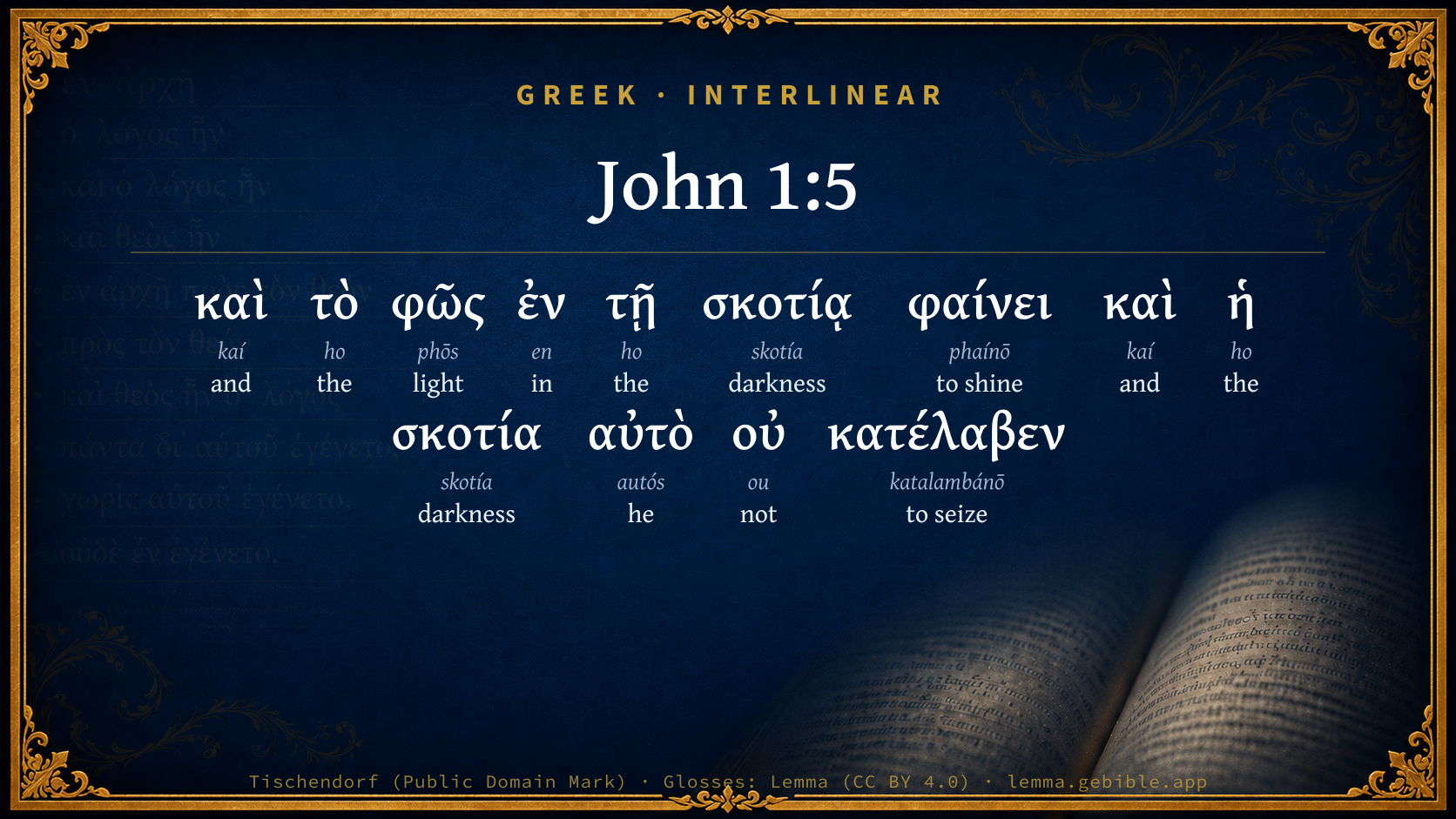
Download image
Cite this verse

John 1:5 (World English Bible). Public Domain. Lemma interlinear Bible study tool, https://lemma.gebible.app/v/john/1/5.

Show BibTeX & RIS
BibTeX
RIS
English Translation
The light shines in the darkness, and the darkness hasn't overcome it.
World English Bible · Public Domain
Download a study sheet

One document with this verse’s original text, its word-by-word gloss line, the meaning frame, cross-references with their text, attributed commentary, and full source and license credits — printable, and it pastes into notes with its structure intact.

This verse Autodidact and up

Study sheet (.html) Plain text (.txt)

A passage Seminary Student

Up to 50 verses in one chapter. A passage sheet keeps up to 6 commentary sources and 12 cross-references per verse, in the order this page ranks them, and says so on the sheet whenever that leaves anything out. Ask for a single verse and you get the Autodidact verse sheet above.

Everything on this page stays free to read, with no account — the sheet is a download of what is already on screen, not access to it.

Want to remove ads? Support Godless Engineer
Compare translations 3

The same verse in 3 English versions, stacked beneath the original-language interlinear above. Click any original word for its lexicon entry.

Each is an independent rendering of the whole verse — the interlinear is not word-aligned to these translations.

Highlighted words mark where these versions differ — a whole-verse word diff, not a word-by-word alignment.

  • World English Bible Public Domain
    The light shines in the darkness, and the darkness hasn't overcome it.
  • King James Version Public Domain
    And the light shineth in darkness; and the darkness comprehended it not.
  • unfoldingWord Literal Text CC BY-SA 4.0
    And the light shines in the darkness, and the darkness did not overcome it.

unfoldingWord Literal Text — © unfoldingWord, licensed CC BY-SA 4.0. Word-aligned USFM3 via Door43 (git.door43.org/unfoldingWord/en_ult).

Versions to compare (up to 4)

3 of 4 selected

Show all 19 translations

Every available English version of this verse, each an independent rendering of the whole verse.

  • World English Bible Public Domain
    The light shines in the darkness, and the darkness hasn't overcome it.
  • Berean Standard Bible Public Domain
    The Light shines in the darkness, and the darkness has not overcome it.
  • Majority Standard Bible Public Domain
    The Light shines in the darkness, and the darkness has not overcome it.
  • King James Version Public Domain
    And the light shineth in darkness; and the darkness comprehended it not.
  • American Standard Version (1901) Public Domain
    And the light shineth in the darkness; and the darkness apprehended it not.
  • Revised Version (1885) Public Domain
    And the light shineth in the darkness; and the darkness apprehended it not.
  • Geneva Bible (1599) Public Domain
    And that light shineth in the darkenesse, and the darkenesse comprehended it not.
  • Douay-Rheims (1899) Public Domain
    And the light shineth in darkness, and the darkness did not comprehend it.
  • Young's Literal Translation Public Domain
    and the light in the darkness did shine, and the darkness did not perceive it.
  • Literal Standard Version CC BY-SA 4.0
    and the light shined in the darkness, and the darkness did not perceive it.
  • Unlocked Literal Bible CC BY-SA 4.0
    The light shines in the darkness, and the darkness did not overcome it.
  • unfoldingWord Literal Text CC BY-SA 4.0
    And the light shines in the darkness, and the darkness did not overcome it.
  • Darby Bible Public Domain
    And the light appears in darkness, and the darkness apprehended it not.
  • World Messianic Bible Public Domain
    The light shines in the darkness, and the darkness hasn’t overcome it.
  • Webster's Bible Public Domain
    And the light shineth in darkness; and the darkness comprehended it not.
  • Free Bible Version CC BY-SA 4.0
    The light shines in the darkness, and the darkness has not extinguished it.
  • Bible in Basic English Public Domain
    And the light goes on shining in the dark; it is not overcome by the dark.
  • Text-Critical English NT CC BY 4.0
    The light shines in the darkness, and the darkness has not overcome it.
  • Tyndale New Testament (1534) Public Domain
    and the lyght shyneth in the darcknes but the darcknes comprehended it not.

Literal Standard Version (2020), Covenant Press — licensed CC BY-SA 4.0. Text via the HelloAO Bible API (eBible.org). Unlocked Literal Bible (unfoldingWord) — licensed CC BY-SA 4.0. Text via the HelloAO Bible API (eBible.org). unfoldingWord Literal Text — © unfoldingWord, licensed CC BY-SA 4.0. Word-aligned USFM3 via Door43 (git.door43.org/unfoldingWord/en_ult). Free Bible Version, Dr. Jonathan Gallagher — licensed CC BY-SA 4.0. Text via the HelloAO Bible API (eBible.org).

Word by word

More ways to search: Search by grammar → Find every occurrence → Compare this word →

Practice this passage: Drill this verse → Learn its vocabulary →

About this verse

These counts appear in no published source. They are computed here, from the morphology-tagged text and Lemma’s own curated glosses. What Lemma adds →

13
words
9
distinct lemmas
Gospels
section

Notable vocabulary

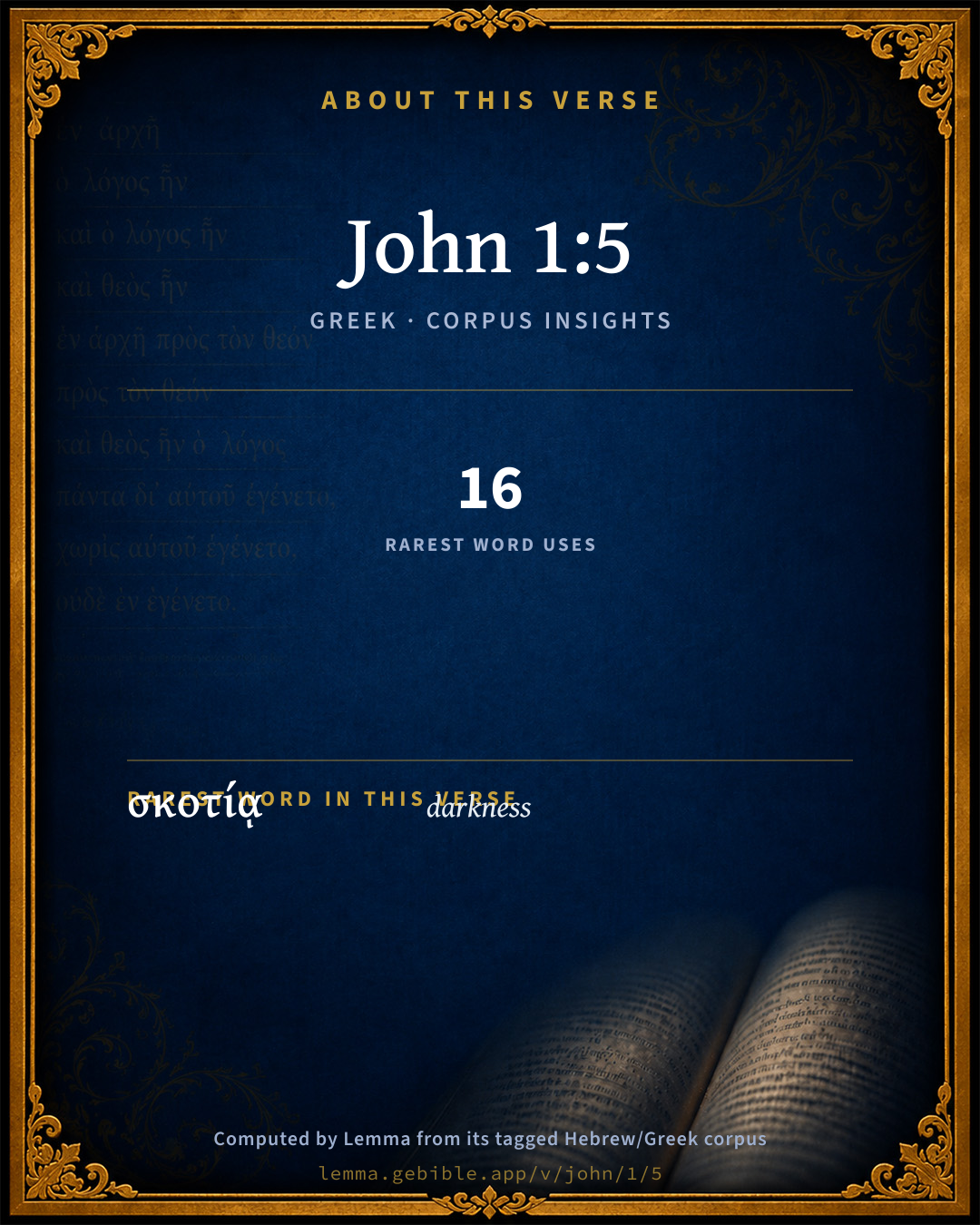
The rarest word here is σκοτίᾳ darkness G4653 — appearing just 16 times in the whole Greek New Testament.

Shared distinctive vocabulary

σκοτίᾳ darkness G4653 occurs in 12 verses of the Greek New Testament. Also found in:

Repetition

Words recur within this verse:

  • σκοτίᾳ darkness G4653 ×2
  • τὸ the G3588 ×3
  • καὶ and G2532 ×2

Cross-references

8

Topical passages linked to John 1:5 in the Treasury of Scripture Knowledge — connected by theme and wording, ordered by reader-vote popularity; previews shown in the World English Bible.

  • John 3:19–20 This is the judgment, that the light has come into the world, and men loved the darkness rather than the light; for their works were evil.
  • John 12:36–40 While you have the light, believe in the light, that you may become children of light." Jesus said these things, and he departed and hid himself from them.
  • 1 Corinthians 2:14 Now the natural man doesn't receive the things of God's Spirit, for they are foolishness to him, and he can't know them, because they are spiritually discerned.
  • Job 24:13–17 "These are of those who rebel against the light; They don't know the ways of it, Nor abide in the paths of it.
  • John 1:10 He was in the world, and the world was made through him, and the world didn't recognize him.
  • Romans 1:28 Even as they refused to have God in their knowledge, God gave them up to a reprobate mind, to do those things which are not fitting;
  • Proverbs 1:22 "How long, you simple ones, will you love simplicity? How long will mockers delight themselves in mockery, And fools hate knowledge?
  • Proverbs 1:29–30 Because they hated knowledge, And didn't choose the fear of Yahweh.

Cross-references courtesy of OpenBible.info (CC BY 4.0).

Commentary

Notes on John 1:5 from classic Christian and Jewish commentators (each source and its license shown beneath its notes). The classic Christian expositions comment on the surrounding passage and are grouped to its opening verse, so a note may address several verses; the Jewish commentaries on the Tanakh (Rashi and others) are per-verse, so they appear only where the commentator wrote on this verse.

Lemma curates 59 commentaries, every one of them public domain or Creative Commons licensed, each selected and text-cleaned for this edition rather than reprinted as found. About our sources →

The Cambridge Bible for Schools and Colleges

gen. ed. J. J. S. Perowne

5. shineth] Note the present tense; the only one in the section. It brings us down to the Apostle’s own day: now, as of old, the Light shines—in reason, in creation, in conscience,—and shines in vain. Note also the progress: in Joh_1:1-2 we have the period before Creation; in Joh_1:3, the Creation; Joh_1:4, man before the Fall; Joh_1:5, man after the Fall.

in darkness] Better, in the darkness. The Fall is presupposed.

and the darkness] Mark the strong connexion between the two halves of Joh_1:5 as also between Joh_1:4 and Joh_1:5, resulting in both cases from a portion of the predicate of one clause becoming the subject of the next clause. Such strong connexions are frequent in St John. Sometimes the whole of the predicate is taken; sometimes the subject or a portion of the subject is repeated.—By ‘the darkness’ is meant all that the Divine Revelation does not reach, whether by God’s decree or their own stubbornness, ignorant Gentile or unbelieving Jew. ‘Darkness’ in a metaphorical sense for spiritual and moral darkness is peculiar to S. Joh_8:12; Joh_12:35; Joh_12:46; 1Jn_1:5; 1Jn_2:8-9; 1Jn_2:11.

comprehended it not] Or, apprehended it not: very appropriate of that which requires mental and moral effort. Comp. Eph_3:18. The darkness remained apart, unyielding, and unpenetrated. The words ‘the darkness apprehendeth not the light’ are given by Tatian as a quotation (Orat. ad Graecos, xiii.). He flourished a.d. 150–170: so this is early testimony to the existence of the Gospel. This and the reference to Joh_1:3 (see note) are quite beyond reasonable dispute.

We have here an instance of what has been called the “tragic tone” in S. John. He frequently states a gracious fact, and in immediate connexion with it the very opposite of what might have been expected to result from it. The Light shines in Darkness, and (instead of yielding and dispersing) the darkness shut it out. Comp. Joh_1:10-11, (Joh_2:24,) Joh_3:11; Joh_3:19; Joh_3:32, Joh_5:39-40, Joh_6:36; Joh_6:43, Joh_8:45, &c. The word rendered ‘comprehended’ may also mean ‘overcame;’ and this makes good sense. Comp. Joh_12:35.

The Cambridge Bible for Schools and Colleges (gen. ed. J. J. S. Perowne; Cambridge University Press, 1878–1918) — public domain. Text from a community e-Sword module.

The Biblical Illustrator

Joseph S. Exell

Joh_1:5

The light shineth in darkness, and the darkness comprehendeth it not

How different men receive the light

1.

Some merely receive it to evidence their own darkness.

2. Some by outward profession merely.

3. Others receive and impart it as lights which are lighted by the true light. (W. Denton.)

Darkness and light

I. THE DARKNESS.

1. Of falsehood.

2. Of hatred.

3. Of death.

II. THE LIGHT IN CONTEST WITH THE DARKNESS; or, the progress of revelation in the sinful world.

1. The light shining in the darkness (the shaded, coloured light).

2. The light breaking through the darkness.

3. The meridian of gospel day. (Lange.)

Christs pre-incarnate activity

I. SHINING IN THE DARKNESS. Darkness points to the Fall. Had the union between man and the Loges continued, His life would have streamed in light around the souls of men, inspiring them with truth and arraying them in purity. But man severed the connection. Turning from the light, he chose a sphere of darkness. Nevertheless, the light continued to penetrate the dark atmosphere of ignorance and sin which thickened round man.

II. REJECTED BY THE DARKNESS. Though the light kept on shining through

(1) the teachings of nature;

(2) the intuitions of conscience;

(3) the Mosaic system and the prophets; yet men had not hold of the light, because

1. They did not fully understand it.

2. Because they did not see it.

3. Because they did not deserve it.

4. Because they hated it. (T. Whitelaw, D. D.)

The manifestations of the light of the Word in darkness

I. The light shone in the CONSCIENCES of men. A man without a conscience has never been born: never amidst the dreariness of heathenism--a faculty to distinguish right from wrong, to know that the SupremeBeing is pleased with righteousness and angered at wrong-doing, and that sin will be punished. But this light shone in darkness. Conscience persuades resistance of evil passions, but inclination quenches the light. Conscience warns respecting the future, but is silenced by the gratification of the present. Conscience reminds of allegiance owing to a Creator, but the inducements of other masters drown its voice.

II. CREATION glows with radiations of its Maker. But its illumination has to enter that darkest of spots, the human heart, where it is opposed by mists of passion, clouds of ignorance, the night of unwillingness to know God. Hence, in spite of the light, men abandoned themselves to every kind of unrighteousness and fell into most degrading superstitions.

III. THE PATRIARCHAL RELIGION was derived from immediate revelation. The Eternal Word shone upon man, as soon as he had transgressed, in the promises of deliverance and institutions of worship. But when men multiplied they forgot their ancestral religion while retaining some of its features, disguised and debased, but recognizable. Hence the universal prevalence of sacrifice and the hope of salvation. In every age and district of heathenism the light has thus shone, so that men, in the midst of their idolatries, are witnesses that a revelation has been vouchsafed. This light, too, preserved in the legends of paganism o! the Fall, Deluge, etc. Yet the slaves of superstition comprehended not the light.

IV. THE TYPES AND FIGURES OF THE LAW sent forth rays converging towards the Sun of Righteousness, which, in the fulness of time, was to cross mans horizon. Yet the understanding of the Jews was so cloudy, and their hearts so gross, that they substituted the type for the antitype.

V. What can be declared of those who are privileged with the full shining of THE GOSPEL? The theology of conscience, creation, tradition, type, fade away from the revelation of these last days. The true light now shineth. How? Men are insensible to it. By placing men under a variety of dispensations God would prove that no amount of light will suffice to illuminate fallen creatures unless the Holy Spirit purge the sight. The sun may be in the heavens, but if the light in us be darkness, we shall not be illumined by his beams. The Holy Spirit alone can remove that darkness. (H. Melvill, B. D.)

Darkness and blindness

If persons who can see are shut up together with others who are blind, in a perfectly dark room, the seeing and the blind are in the same situation; no object is perceived by any, no colours discerned; but if light is introduced into the room, there is then a wonderful difference. To those who are endowed with sight, every object appears in its true form and just colouring; but to the blind all things remain as they were; they are in darkness still; and this because the darkness is in themselves. So it is with the outward revelation of Divine truth: while it is withheld, all are in darkness, but it may shine not only on those who live, and are awake, and can see, but also on the dead, and on the sleeping, and on the blind. (J. Fawcett, M. A.)

Men in darkness

There are some vines that never actually come to the surface; they can scarcely be called vines--they are roots, rather, whose home is in the earth. They feed on the loam, and not on the sunshine. Grow as much as they may, they are never anything but a prolongation of fibres. They are earth-eaters; they live in the soil and they die in the soil. They add nothing to the beauty of the landscape; and among the higher orders of life and growth their names are never mentioned. So it is with some men; they are only human roots, that might become men. They live underground. All the fibres of their lives suck in earthiness. Their growth is all lateral. They spread out on all sides. They are never lifted up into moral and spiritual expression. They are of the earth, earthy. They die where they lived, and God alone knows what becomes of them. We only know that the Divine life is not in them, and, therefore, the Divine destiny cannot be. For there is no destiny that does not germinate here. (W. H. H. Murray.)

The dense darkness of the period when the true light appeared

At no time was it so universal or so deep. All the powers and principles of the world had been tried to the uttermost, and found utterly wanting. The religion of heathenism had stretched to that extent that, according to Varro, there were three hundred different gods in Rome alone. The Romans had consummated their idolatry by deifying their emperors and great men, and so had degraded themselves to the basest form of man-worship. The Greeks had speculated in religion till they had brought themselves to a conviction and acknowledgment of their ignorance, as testified in their altar inscribed at Athens, the very seat of religion (Act_17:22 διεσιδαμονεστερους) and learning, to the Unknown God. Their wisdom and philosophy had burnt itself out; and there was no longer any one of their successive schools of doctrine, however formerly dogmatic, which now had an ascendency even among themselves. The Eclectic school had selected something from each of them, and in so doing had condemned them all; and even thus it had not obtained a privilege for itself; for so each person was, of course, at liberty to make his own selection; and so every one in effect condemned every other, and no one gave to any other, or obtained for himself, any respect. The Powers of the world were also in their last stage, both of greatness and corruption. The Babylonian empire was represented by a golden head; the Persian by a breast of silver; the Grecian by thighs of brass: and now the Roman had swallowed up all other nations, and was become universal; but its substance was iron; it was the last of the worldly empires; it was tottering to its fall with its own weight and immensity; it was but feet and toes, base, divided, corrupted, and diseased, and was about to crumble into ruins. The religion of the Jews had also run its course, and had at this time fermented into a new separation. The general mass had corrupted itself. The law of ceremonies had lost its own small portion of life--vegetable life--and had become a more dead letter only, graven in stone, as obstinate and immovable--a withered and dry tree--yet still raising its barren and leafless branches with proud and pompous pride, and self-conceit, and defiance: but its barrenness had procured it disrespect and distrust, and men refused to shadow under its shadowless top, and even its own vitality was denied and disregarded by the Sadducees. At the same time a spiritual seed had been sown, not resting in the letter; not branching from the now spiritless trunk; but, though small, and lowly, and young, and tender, having yet the real principle of life within it, and meet for the digging, and pruning, and watering of the husbandman. At this time, in the fulness of preparation and unpreparedness, of superstition and infidelity, of ignorance and learning, of power and weakness, of evil and good, of hope and unbelief, Christ came in the flesh; the Sun of light and life was embodied, to convince and dispel the darkness, to lighten the ignorance, to overcome the power, to consume the dry tree, to vivify the green tree, to divide between day and night, between the good and evil, to rule over the one, to condemn and expel the other. (S. R. Bosanquet.)

Gods candles are and have been ever shining

This world has never been given over to the unchallenged reign of darkness: there have always been souls wherein the life has been kindled, and through whom it has shot its rays into the worlds gloom--Gods candles lighted and placed according to His own will. In this respect the Father of lights has never been left without witness. (J. Culross, D. D.)

The condition of receiving the light

It is a fact in physical nature that the sunlight passes through empty space, and neither warms nor lights it. Climb up to the top of the highest mountains at noonday, and the stars come out. The air is thin--it is therefore dark; we see only by as much light as is intercepted. So with your car. That alone is music which you hear. That is pleasure which you feel. That which your nerve does not report to you does not exist. It is precisely so in morals. There must be something to intercept the light, or that light itself is nothing. It was so with Christ. He was an infinite light. He sat there where there was no soul. They do not know He was God. It is so to-day. He sits among men. He is not God to those who only call Him God. You teach a man nothing if you only teach him to do that. The souls that intercept His rays, to them He is God. There is not one to whom all of God is revealed, because there is no soul that can intercept all there was in Jesus. The light still shineth in darkness, and the darkness comprehendeth it not. Have whatever soul we may, there is ever more soul to be gained. Even Paul said the one yearning of his soul was to apprehend that for which also he was apprehended. (Octavius Perinchief.)

The historical parallel to the truth of the text

This fact respecting Christ, that His light shone in darkness, and the darkness comprehended it not, hath its parallel in history respecting all truth. All the substances of nature, and all their laws, have been in being, certainly, ever since man has existed. Why did man not see them? Steam has been a fact ever since heat was first applied to water. How was it that man knew it not? The electric current has passed round this earth ever since the earth was made. How is it man but yesterday discovered it? Facts as plain as the daylight have been staring man in the face, sporting with him, and he sat there in his blindness and knew them not. To-day, endless facts, things we sadly need, are across our path; we are stumbling over them, and yet see them not. Coal lay in the earth, how many years? oil, how many centuries? Men needed them both. Why are they but now found to be serviceable? We say that things come just as man wants them. That is true. God must look in very pity upon us. Our misfortune is, we want not yet the tithe of what He is rich enough to give: The light shineth in the darkness, and the darkness comprehended it not. Men are everywhere hunting fortunes. Where are they hunting them? With the old muck-rake. Why not open the eye? Why not introduce ourselves to some of the wonders that are yearning to make themselves known to us? We think a man is crazy when he begins to see. (Octavius Perinchief.)

The light needed

Pythagoras admitted the necessity of Divine interposition to teach man his duty. Zenophanes died at the age of nearly one hundred years, and is said to have thus expressed himself: Oh, that mine were the deep mind, prudent and looking to both sides! Long, alas I have I strayed on the road of error, beguiled, and am now hoary of years, yet disposed to doubt and distraction of all kinds; for, wherever I turn to consider, I am lost in the One and All. Heraclitus, after all his researches, asserted that Vain man hath no accurate knowledge which is possessed alone by the God, but that man learns from the God as the boy does from the man. Socrates saw and confessed his ignorance, and deplored the want of a superior direction. Aristotles last prayer was, I entered the world corruptly, I have lived in it anxiously, I quit it in perturbation. Cicero confessed that no excellence could exist without a celestial afflation. Hierocles and Seneca tell us that but by the help of God no man can become either good or prosperous; so that he who would repudiate the necessity of a Divine revelation to lead him by the Holy Spirit into all truth arrogates a power which the greatest reasoners of ancient times disclaimed.

Without Christ--darkness

Varro, a Roman writer of the first century, B.C., states that, in his day, he had been at the pains to collect the various opinions on the question, What is the true object of human life? in other words, What is the supreme good? He had reckoned up as many as three hundred and twenty different answers. How needful is Divine revelation, and how essential to those who are starting in life, that a heavenly guide should teach them the true end and purpose of earthly existence!

The darkness of the natural mind

A good many years ago, in Washington, there were two Congressioners who met once every week to talk about the immortality of the soul; but they despised the Bible. They found no comfort. Their time expired, and they went home. Years passed along. They both visited Washington at the same time, and happened to meet at the presidents levee. They saw each other at a great distance across the room. They pressed their way through the crowd until they came to each other, and, after years of absence, the first thing that one said to the other was: John, any light? No light. Then this one accosted the other, and said: Henry, any light? No light. They said nothing more; they parted to meet at the judgment. Oh, are there any who have swung off from this grand old gospel of Jesus Christ, thinking to find rest for their soul? Have you found comfort, peace, joy, heaven? From a score of souls there comes up to me the cry to-night, No light! no light! (T. deWitt Talmage.)

Christ is full of light

Going into a village at night, with the lights gleaming on each side of the street, in some houses they will be in the basement and nowhere else, and in others in the attic and nowhere else, and in others in some middle chamber; but in no house will every window gleam from top to bottom. So is it with mens faculties. Most of them are in darkness. One shines here, and another there; but there is no man whose soul is luminous throughout. But Christ presented a perfect character. Every room in His soul was filled with light. He is light. (H. W. Beecher.)

An alternative rendering

The darkness overcame it not. Sin did not succeed in extinguishing the inner light. The spirit of man is the candle of the Lord--a candle lit by Gods own breath. When man fell the candle was sadly bruised, but it did not blow out. The great fundamental truths God planted in man continue to shine despite sin and its grievous consequences. Accordingly the darkness of the Fall was not complete--complete, I mean, in the sense that it could not be blacker; a little light was still continuing to glimmer--candle-light, if you like, but light all the same. Much talk is indulged in concerning original sin, though not quite as much as in former years; but we ought also to speak of original light, a light deeper and more primitive even than our sin. Do I not believe in the total depravity of the race? Yes, in the sense that every power is more or less tangled, that every faculty is more or less corrupt. No, in the sense that the derangement could not be greater, that the putridity could not be more advanced. The confusion and depravity here are great, but in hell they are considerably greater. So far a little light doubtless glimmers in the soul of every man on his coming into this world; the golden beams of the Sun of Righteousness are to be seen playing in the mental faculties of childhood. The light shineth in darkness--the darkness of our fall--and the darkness overcame it not; the light still burns. But if the darkness did not overcome the light, on the other hand the light did not overcome the darkness. In the other world, the world prior to the Incarnation, the light and the darkness confronted each other without making much impression one on the other. The darkness did not conquer the light, neither did the light conquer the darkness; and if the light is to win the victory, it must receive an ample increase, and this increase we find in the gospel of Jesus Christ. (J. Cynddylan Jones, D. D.)

The Biblical Illustrator, edited by Joseph S. Exell (c. 1880s–1900s) — public domain. Text from a community e-Sword module.

Tyndale Open Study Notes

Tyndale Open Resources

1:5 the darkness can never extinguish it: Or the darkness has not understood it; literally the darkness cannot grasp it. The Greek word katalambanō (“grasp”) can mean either “understand” or “be hostile”; in John’s Gospel, it means hostility. The darkness would try to destroy Jesus (the light), but it would fail. The light would successfully bring salvation to the world.

Tyndale Open Study Notes — © Tyndale Open Resources, licensed CC BY-SA 4.0. Text via the HelloAO Bible API.

Bengel's Gnomon

Johann Albrecht Bengel

Joh 1:5. Καὶ, and) From this verse the doctrine of evil and its rise, receives much light.—ἐ τῇ σκοτίᾳ, in darkness) This darkness is not said to be made. For it is a privation, which men have incurred [To wit, that state of the human race is expressed by this word, which has prevailed since Adams transgression down to the appearance of the true Light.—V. g.] It is in the darkness that the glory of the Light is the more conspicuously seen.—φαίνει, shines) The present time has the same force as in φωτίζει, Joh 1:9. It always φαίνει, shineth. The Light was always nigh at hand, even in the Old Testament, ready to apply a remedy to darkness and sin. The same word φαίνει, shineth, as regards the New Testament, 1Jn 2:8, “The darkness is past, and the true light now shineth.”—καὶ—οὐ, and—not) Similarly and—not, Joh 1:10-11.—ἡ σκοτία, the darkness) i.e. men wrapt in darkness.—αὐτὸ οὐ κατέλαβεν, [comprehended it not] did not attain to it) Men, it seems, were too much averse from the Light, as well as too deeply sunk in darkness. When they did not comprehend the λόγον ἄσαρκον, The Word unclothed in flesh, “He was made flesh,” Joh 1:14.

Bengel's Gnomon of the New Testament — English translation (T&T Clark, Edinburgh, 1860) — public domain. Text from a community e-Sword module.

Meyer's Critical & Exegetical Commentary

Heinrich August Wilhelm Meyer

Joh_1:5. Relation of the light to the darkness.

καὶ τὸ φῶς] and the light shineth;[78] not and thus, as the light, the Logos shineth (Lücke). The discourse steadily progresses link by link, so that the preceding predicate becomes the subject.

φαίνει] Present, i.e. uninterruptedly from the beginning until now; it embraces, therefore, the illuminating activity of the λόγος ἄσαρκος[79] and ἔνσαρκος. As it is arbitrary to supply the idea of still present (Weiss), so also is its limitation to the revelations by the prophets of the O. T., which would make φαίνει merely the descriptive praesens historicum (De Wette). For the assumption of this, however, in connection with pure preterites there is no warrant; comp. rather φωτίζωι, Joh_1:9. According to Ewald, Jahrb. V. 194 (see his Johann. Schr. I. 121), φαίνει represents as present the time in which the Light, which since the creation had enlightened men only from afar, had now suddenly come down into the world, which without it is darkness, and was shining in the midst of this darkness. An antithetic relation is thus assumed (only from afar,but now suddenly in the midst) which has no support in the present tense alone, without some more distinct intimation in the text. The stress, moreover, is not on φαίνει, but the (tragic) emphasis is laid on the ἐν τῇ σκοτίᾳ, which with this object precedes it. It is the continuation of the discourse, Joh_1:7 ff., which first leads specially to the action of the Incarnate One (this also against Hengstenb.).

The σκοτία is the negation and opposite of the φῶς, the condition and order of things in which man does not possess the divine ἀλήθεια, but has become the prey of folly, falsehood, and sin, as a godless ruling power, with all its misery. Here the abstract term darkness, as the element in which the light shines, denotes not the individual subject of darkness (Eph_5:8), but, as the context requires, that same totality which had been previously described by τῶν ἀνθρώπων, consequently mankind in general, in so far as in and for themselves they have since the fall been destitute of divine truth, and have become corrupt in understanding and will. Melancthon well says, genus humanum oppressum peccato vocat tenebras. Frommann is altogether mistaken in holding that σκοτία differs in the two clauses, and means (1) humanity so far as it yet lay beyond the influence of the light, and (2) humanity so far as it was opposed thereto. But Hilgenfeld is likewise in error, when, out of a different circle of ideas, he imports the notion that light and darkness are primeval opposites, which did not first originate with the fall; see on Joh_8:44.

οὐ κατέλαβεν] apprehended it not, look not possession of it; it was not appropriated by the darkness, so that thereby the latter might have become light, but remained aloof and alien to it. Comp. Php_3:12-13, 1Co_9:24, and especially Rom_9:30; also expressions like καταλαμβ. σοφίαν, Sir_15:1; Sir_15:7. The explanation apprehended, i.e. ἔγνω, Joh_1:10 (Eph_3:18; Act_10:34; Act_4:13; Plato, Phaedr. p. 250 D; Phil. p. 16 D; Polyb. viii. 4. 6), is on one side arbitrarily narrowing, on another anticipatory, since it foists in the individual subjects of the σκοτία, which is conceived of as a realm. It is erroneous to interpret, as Origen, Chrysostom, Theophylact, Euthymius Zigabenus, Bos., Schulthess, Hoelemann, p. 60, also Lange: The darkness did not hem it in, oppress it; it was invincible before it. Linguistically this is allowable (see Schweighaüser, Lex. Herod. II. p. 18), but it nowhere so occurs in the N. T., and is here opposed to the parallels, Joh_1:10-11.

Observe that οὐ κατέλαβεν, which presupposes no Gnostic absolutism, but freedom of moral self-determination (comp. Joh_1:11-12), reflects the phenomenon as a whole, and indeed as it presented itself to John in history and experience; hence the aorist. Comp. Joh_3:19.

[78] φαίνει, lucet, not interchangeable with φαίνεται, which means apparet. See on Php_2:15. Godets criticism of the distinction is erroneous.

[79] Godet thinks that the law written in the heart, the light of conscience, is meant (Rom_2:14), which the Logos makes use of; and this His relation to all mankind is essential and permanent. But this would be utterly inadequate to the fulness of meaning expressed by φῶς, especially in its antithesis to σκοτία. The φῶς shines as divine light before Christ (by revelation and prophecy), and after Him. It is supernatural, heavenly. Comp. 1Jn_2:8. There is no mention here of the λόγος σπερματικός.

Meyer — Critical and Exegetical Commentary on the New Testament — English translation by Peter Christie, edited by Frederick Crombie (T&T Clark, 1880) — public domain. Text from a community e-Sword module.

Expositor's Greek Testament

ed. W. Robertson Nicoll

Joh 1:5 . καὶ τὸ φῶς ἐν τῇ σκοτίᾳ φαίνει , “and the light shineth in the darkness”. Three interpretations are possible. The words may refer to the incarnate, or to the pre-incarnate experience of the Logos, or to both. Holtzmann and Weiss both consider the clause refers to the incarnate condition ( cf. 1Jn 2:8 ). De Wette refers it to the pre-incarnate operation of the Logos in the O. T. prophets. Meyer and others interpret φαίνει as meaning “present, i.e. , uninterruptedly from the beginning until now”. The use of the aorist κατέλαβεν seems to make the first interpretation impossible; while the second is obviously too restricted. What “shining” is meant? This also must not be limited to O. T. prophecy or revelation but to the light of conscience and reason ( cf. Joh 1:4 ). ἐν τῇ σκοτίᾳ , in the darkness which existed wherever the light of the Logos was not admitted. Darkness, σκότος or σκοτία , was the expression naturally used by secular Greek writers to describe the world’s condition. Thus Lucian: ἐν σκότῳ πλανωμένοις πάντες ἐοίκαμεν . Cf. Lucretius:

“Qualibus in tenebris vitae, quantisque periclis,

Degitur hoc aevi quodcunque est”.

καὶ ἡ σκοτία αὐτὸ οὐ κατέλαβεν . The A. V [23] renders this “and the darkness comprehended it not”; the R. V [24] has “apprehended” and in the margin “overcame”. The Greek interpreters understood the clause to mean that the darkness did not conquer the light. Thus Theophylact says: ἡ σκοτία … ἐδίωξε τὸ φῶς , ἀλλʼ εὗρεν ἀκαταμάχητον καὶ ἀήττητον . Some modern interpreters, and especially Westcott, adopt this rendering. “The whole phrase is indeed a startling paradox. The light does not banish the darkness: the darkness does not overpower the light.” This rendering is supposed to find support in chap. Joh 12:35 , where Christ says, “Walk while ye have the light,” ζνα μὴ σκοτία ὑμᾶς καταλὰβῃ ; and καταλαμβάνειν is the word commonly used to denote day or night overtaking any one (see Wetstein). But the radical meaning is “to seize,” “to take possession of,” “to lay hold of”; so in Rom 9:30 , 1Co 9:24 , Phi 3:12 . It is also used of mental perception, as in the Phaedrus , p. 250, D. See also Polybius, iii. 32, 4, and viii. 4, 6, δυσχερὲς καταλαβεῖν , difficult to understand. This sense is more congruous in this passage; especially when we compare Joh 1:10 ( ὁ κάσμος αὐτὸν οὐκ ἔγνω ) and Joh 1:11 ( οἱ ἴδιοι αὐτὸν οὐ παρέλαβον ).

[23] Authorised Version.

[24] Revised Version.

The Expositor's Greek Testament, edited by W. Robertson Nicoll (1897–1910) — public domain. Text from a community e-Sword module.

Cambridge Greek Testament for Schools and Colleges

5. φαίνει. The elementary distinction between φαίνειν, ‘to shine,’ and φαίνεσθαι, ‘to appear,’ is not always observed by our translators. In Act 27:20 φαίνειν is translated like φαίνεσθαι; in Mat 24:27 and Php 2:15 the converse mistake is made. Here note the present tense, the only one in the section. It brings us down to the Apostle’s own day: comp. ἤδη φαίνει (1Jn 2:8). Now, as of old, the Light shines, and shines in vain. In Joh 1:1-2 we have the period preceding Creation; in Joh 1:3 the Creation; Joh 1:4 man before the Fall; Joh 1:5 man after the Fall.

καὶ ἡ σκοτία. Note the strong connexion between Joh 1:4-5, as between the two halves of Joh 1:5, resulting in both cases from a portion of the predicate in one clause becoming the subject of the next clause. Such strong connexions are very frequent in S. John.

ἡ σκοτία. All that the Divine Revelation does not reach, whether by God’s appointment or their own stubbornness, ignorant Gentile and unbelieving Jew. Σκοτία in a metaphorical sense for moral and spiritual darkness is peculiar to S. Joh 8:12; Joh 12:35; Joh 12:46; 1Jn 1:5; 1Jn 2:8-9; 1Jn 2:11.

οὐ κατέλαβεν. Did not apprehend: very appropriate of that which requires mental and moral effort. Cf. Eph 3:18. The darkness remained apart, unyielding and unpenetrated. The words ‘the darkness apprehendeth not the light’ (ἡ σκοτία τὸ φῶς οὐ καταλαμβάνει) are given by Tatian as a quotation (Orat. ad Graecos, XIII.). As he flourished c. A.D. 150–170, this is early testimony to the existence of the Gospel. We have here an instance of what has been called the “tragic tone” in S. John: he frequently states a gracious fact, and in immediate connexion with it the very opposite of what might have been expected to result from it. ‘The Light shines in darkness, and (instead of yielding and dispersing) the darkness shut it out.’ Cf. Joh 1:10-11; Joh 3:11; Joh 3:19; Joh 3:32, Joh 5:39-40, Joh 6:36; Joh 6:43, &c. Καταλαμβάνειν sometimes = ‘to overcome,’ which makes good sense here, as in Joh 12:35.

Cambridge Greek Testament for Schools and Colleges (Cambridge University Press, 1896; 21 vols, various authors incl. Carr, Maclear, Plummer, Farrar, Lumby, Moule, M. R. James, Simcox) — public domain. Text from a community e-Sword module.

Godet's Commentaries

Frédéric Louis Godet

Second Section: Unbelief. 1:5-11.

This Logos, light of the world, appears in the world buried in the darkness of sin; He is not recognized and is rejected (Joh 1:5). And yet God had taken all precautions to prevent such a result (Joh 1:6-8). But the impossible is realized (Joh 1:9-11).

[See also the "General Considerations on the Prologue" in the comments of Joh 1:18.]

Vv. 5: “And the light shines in the darkness, and the darkness apprehended it not.”

What, then, is thisdarkness (σκοτία) which all at once fills the scene of the world created and enlightened by the Word? It is impossible, with some interpreters of Baur’s school, to think of eternal darkness, of a kingdom of evil co-eternal with that of good. Joh 1:3 is positively opposed to this: everything that is, without exception, is the work of the Logos. But John, as Joh 1:3-4 have proved, wrote for readers who were acquainted with the account in Genesis. We must also explain Joh 1:5 according to this account. The darkness of which the evangelist speaks is the subjection to sin and falsehood in which humanity lives in consequence of the fact of the fall, narrated in Genesis 3. As the Logos was the principle of life and light for the world, moral obscurity invaded it, as soon as humanity had ceased to live in Him(Joh 1:3); there was darkness. The Logos, however, none the less perseveres in His office of illuminator (Joh 1:4), and He ends by appearing Himself on this theatre which He has never ceased to enlighten. Formerly, I referred the present φαίνει, it shines, to the beneficent action of the Logos before His incarnation: this is the thought which I have just shown to be contained in the second clause of Joh 1:4. This view approaches the explanation of de Wette, who refers the φαίνει, shines, to the revelations of the O. T., and that of the interpreters who apply it to the moral light granted to the heathen by means of reason and conscience. Three reasons have made me give up this explanation:

1. The present φαίνει, shines, is only naturally explained, especially in contrast to the two past tenses of Joh 1:4, if we refer it to a present fact; now this fact contemporaneous with the moment when the evangelist writes can only be the earthly appearance of Christ and of the Gospel proclamation which perpetuates the glory of it here on earth.

2. The very striking parallel passage, 1Jn 2:8 : “Because the darkness is passing away, and the true light already shineth” (ἤδη φαίνει), can apply only, according to the context, to the Gospel era, and it thus determines the meaning of the same expression in the Prologue.

3. The truly decisive reason, to my view, is the significant asyndeton between Joh 1:5 and Joh 1:6. The absence of a logical particle most frequently indicates, in Greek, a more emphatic and more developed reaffirmation of the thought already expressed. Now, it does not appear to me possible to interpret otherwise this form of expression in this passage. The historical fact so abruptly introduced in Joh 1:6 by the words: “There appeared a man....,” can only be thus mentioned with the design of giving through history the proof of the thought declared in Joh 1:5; and as the development which opens at Joh 1:6 and closes in Joh 1:11 relates wholly to the rejection of Christ by Israel, it follows that the second part of Joh 1:5, the theme of this development, can only relate to this same fact. Thus the φαίνει, shines, is understood byEwald, Hengstenberg, Luthardt, Weiss. Some interpreters think that the act of shining can apply to the action of the Logos alike before and during His earthly life; so Olshausen, Meyer, Westcott,—the last writer extending the meaning of the present shines from the moment of the creation even to the consummation of things. But the two modes of illumination, internal and external, which would be thus attributed to the Logos here, are of too heterogeneous a nature to make it possible to unite them in the same term. We have, moreover, already seen that the present shines cannot naturally apply to the time which preceded the incarnation.

The καί, and, simply indicates the calm continuity of the work of the Logos throughout these different stages; the office which He accomplished in the depths of the human soul (Joh 1:4) has ended in that which He has just accomplished as Messiah in the midst of the Jewish people (Joh 1:5-11). Weiss and Gess object to this explanation, that it forces us to give to the word τὸ φῶς, the light, a different sense in Joh 1:4 and Joh 1:5 : there, the light as a gift of the Logos; here, the light as being the Logos Himself. But in Joh 1:4 the question is of a light emanating from the life, and consequently impersonal, while in Joh 1:5, John speaks of the light as visibly and personally present. This, then, is his meaning: that that moral good the ideal of which the Logos caused to shine in the human soul, He has come to realize in Himself here on earth, and thus to display it in all its brightness (Joh 1:5). John uses this notion of light with great freedom. We find the same two senses united in the same verse in Joh 8:12 : “Iam the light of the world”—this is the sense of the light in our Joh 1:5—and “He that followeth me shall have the light of life”—this is the sense of the word in Joh 1:4. The active form φαίνει, shines, is purposely employed rather than the middle φαίνεται, which would signify: appears, shows itself. John means, not that it has appeared, but that from this time forward it pours forth its brilliancy in the darkness of humanity, striving to dissipate the darkness.

The second part of Joh 1:5 is explained in two opposite ways, according to the two opposite meanings which are given to the verb, κατέλαβεν . This verb, which signifies to lay hands on, to seize, may denote a hostile act: to seize in order to restrain, to overcome, or a friendly act: to seize in order to appropriate to oneself, to possess. The first of these meanings is that which the ancient Greek interpreters (Origen, Chrysostom, etc.), adopt: for a long time abandoned, it is now again preferred by some modern writers (Lange, Weiss, Westcott); “And the darkness did not succeed in restraining, in extinguishing this light.” In favor of this meaning the expression in Joh 12:35 is cited: “Walk while you have the light, lest the darkness overtake you (καταλάβῃ in the hostile sense).” But even in that passage, the meaning of this verb is not overcome; Jesus speaks of the night, not as restraining the day, but as overtaking the traveler who started on his journey too late. This single example which is cited, therefore, is not really one. Besides, this meaning is excluded by the context when properly understood. We have seen that the asyndeton between Joh 1:5-6, implies a very close relation of thought between them. Now, this relation exists only as Joh 1:5 states a fact which already refers, like all that which follows, to the development of unbelief, not of faith. This it is which prevents us from translating: “and the darkness did not restrain it.” In order to find in what follows the evidence of a similar idea, we must pass beyond the entire development of Joh 1:6-11, and proceed to discover it in the fact mentioned in Joh 1:12-13 : “To all those who received him...;” which is, of course, impossible, and the more so as Joh 1:12 is connected with Joh 1:11 by the adversative particle δέ . Besides, if the apostle wished to express the idea which is attributed to him, he had for this purpose the very natural wordκατέχειν, to check, to repress: comp. Rom 1:18. It is fitting, therefore, to apply to the word here the other meaning which is the prevailing one throughout the whole New Testament. Comp. Php 3:12-13 (to attain the end); 1Co 9:24 (to lay hold of the prize); Rom 9:30 (to obtain the righteousness of faith). In the same sense it is also used in Sir 15:1-7 : καταλαμβάνειν σοφίαν (to attain to wisdom). I lay stress only on the passages where the verb is used, as it is here, in the active. The sense of comprehend in which it is taken in the middle (Act 4:13; Act 10:34; Eph 3:18) rests also on the meaning of the verb which we here adopt. John means, accordingly, that the darkness did not suffer itself to be penetrated by the light which was shining in order to dissipate it. To understand this somewhat strange figure, we must recall to mind the fact that the word darkness here denotes, not an abstract principle, but living and free beings, corrupted humanity. Understood in this sense, this second proposition is the summary statement which is developed in the following passage, Joh 1:6-11; it has its counterpart in the second proposition of Joh 1:11. The choice of the slightly different term παρέλαβεν received (Joh 1:11), in order to express nearly the same idea as κατέλαβεν of Joh 1:5, will be easily explained. The καί, and, which joins this proposition to the preceding one, takes the place, as is often the case, of a δέ, but. John presents the course of things, not from the point of view of the changing conduct of mankind towards God, but from that of the faithful and persevering conduct of the Logos towards mankind. The aorist κατέλαβεν stands out in relief on the general basis of the present φαίνει, as a particular and unique act, an attitude taken once for all. To the view of the evangelist, the refusal of the mass of mankind to allow themselves to be enlightened by the Gospel is already an accomplished fact. Comp. the saying of Jesus in Joh 3:19, which is, as it were, the text from which are derived the present words: “The light is come into the world, and men loved the darkness rather than the light, because their works were evil.” The apostle passes now to the account of the manner in which this decisive moral fact stated in Joh 1:5 was accomplished and how it was consummated in Israel. And that he may make the gravity of it thoroughly apprehended, he begins by calling to mind the extraordinary means which God adopted, in order, as it would seem, to render it impossible, Joh 1:6-8.

Frédéric Louis Godet — Commentaries on Luke, John, Romans, and 1 Corinthians — English translation (T&T Clark, Edinburgh, 1870s–1890s) — public domain. Text from a community e-Sword module.

Geneva Bible (1599)

Geneva Bible translators

They could not perceive nor reach unto it, to receive any light of it, no, they did not so much as acknowledge him.

The light of men is turned into darkness, but yet so that there is clearness enough to make them without excuse.

Geneva Bible (1599) marginal notes — public domain. Text via Bolls.life.

Jamieson, Fausset & Brown

Robert Jamieson, A. R. Fausset & David Brown

shineth in darkness, &c.--in this dark, fallen world, or in mankind "sitting in darkness and the shadow of death," with no ability to find the way either of truth or of holiness. In this thick darkness, and consequent intellectual and moral obliquity, "the light of the Word" shineth--by all the rays whether of natural or revealed teaching which men (apart from the Incarnation of the Word) are favored with.

the darkness comprehended it not--did not take it in, a brief summary of the effect of all the strivings of this unincarnate Word throughout this wide world from the beginning, and a hint of the necessity of His putting on flesh, if any recovery of men was to be effected (Co1 1:21).

Jamieson, Fausset & Brown — Commentary Critical and Explanatory on the Whole Bible (1871) — public domain (CC PDM 1.0). Text via the HelloAO Bible API.

Adam Clarke's Commentary

Verse 5. And the light shineth in darkness] By darkness here may be understood:

1. The heathen world, Eph 5:8.

2. The Jewish people.

3. The fallen spirit of man.

Comprehended it not.] αυτο ου κατελαβεν, Prevented it not-hindered it not, says Mr. Wakefield, who adds the following judicious note:-"Even in the midst of that darkness of ignorance and idolatry which overspread the world, this light of Divine wisdom was not totally eclipsed: the Jewish nation was a lamp perpetually shining to the surrounding nations; and many bright luminaries, among the heathen, were never wanting in just and worthy notions of the attributes and providence of God's wisdom; which enabled them to shine in some degree, though but as lights in a dark place, 2Pe 1:19. Compare Ac 14:17; Ac 17:28-29."

Adam Clarke's Commentary on the Bible (1810–1826) — public domain. Text from a community e-Sword/MySword module.

John Calvin's Commentaries

5. And the light shineth in darkness. It might be objected, that the passages of Scripture in which men are called blind are so numerous and that the blindness for which they are condemned is but too well known. For in all their reasoning faculties they miserably fail. How comes it that there are so many labyrinths of errors in the world, but because men, by their own guidance, are led only to vanity and lies? But if no light appears in men, that testimony of the divinity of Christ, which the Evangelist lately mentioned, is destroyed; for that is the third step, as I have said, that in the life of men there is something more excellent than motion and breathing. The Evangelist anticipates this question, and first of all lays down this caution, that the light which was originally bestowed on men must not be estimated by their present condition; because in this corrupted and degenerate nature light has been turned into darkness. And yet he affirms that the light of understanding is not wholly extinguished; for, amidst the thick darkness of the human mind, some remaining sparks of the brightness still shine.

My readers now understand that this sentence contains two clauses; for he says that men are now widely distant from that perfectly holy nature with which they were originally endued; because their understanding, which ought to have shed light in every direction, has been plunged in darkness, and is wretchedly blinded; and that thus the glory of Christ may be said to be darkened amidst this corruption of nature. But, on the other hand, the Evangelist maintains that, in the midst of the darkness:, there are still some remains of light, which show in some degree the divine power of Christ. The Evangelist admits, therefore, that the mind of man is blinded; so that it may justly be pronounced to be covered with darkness. For he might have used a milder term, and might have said that the light is dark or cloudy; but he chose to state more distinctly how wretched our condition has become since the fall of the first man. The statement that the light shineth in darkness is not at all intended for the commendation of depraved nature, but rather for taking away every excuse for ignorance.

And the darkness did not comprehend it. Although by that small measure of light which still remains in us, the Son of God has always invited men to himself, yet the Evangelist says that this was attended by no advantage, because seeing, they did not see, (Matthew 13:13.) For since man lost the favor of God, his mind is so completely overwhelmed by the thralldom of ignorance, that any portion of light which remains in it is quenched and useless. This is daily proved by experience; for all who are not regenerated by the Spirit of God possess some reason, and this is an undeniable proof that man was made not only to breathe, but to have understanding. But by that guidance of their reason they do not come to God, and do not even approach to him; so that all their understanding is nothing else than mere vanity. Hence it follows that there is no hope of the salvation of men, unless God grant new aid; for though the Son of God sheds his light upon them, they are so dull that they do not comprehend whence that light proceeds, but are carried away by foolish and wicked imaginations to absolute madness.

The light which still dwells in corrupt nature consists chiefly of two parts; for, first, all men naturally possess some seed of religion; and, secondly, the distinction between good and evil is engraven on their consciences. But what are the fruits that ultimately spring from it, except that religion degenerates into a thousand monsters of superstition, and conscience perverts every decision, so as to confound vice with virtue? In short, natural reason never will direct men to Christ; and as to their being endued with prudence for regulating their lives, or born to cultivate the liberal arts and sciences, all this passes away without yielding any advantage.

It ought to be understood that the Evangelist speaks of natural gifts only, and does not as yet say any thing about the grace of regeneration. For there are two distinct powers which belong to the Son of God: the first, which is manifested in the structure of the world and the order of nature; and the second, by which he renews and restores fallen nature. As he is the eternal Speech of God, by him the world was made; by his power all things continue to possess the life which they once received; man especially was endued with an extraordinary gift of understanding; and though by his revolt he lost the light of understanding, yet he still sees and understands, so that what he naturally possesses from the grace of the Son of God is not entirely destroyed. But since by his stupidity and perverseness he darkens the light which still dwells in him, it remains that a new office be undertaken by the Son of God, the office of Mediator, to renew, by the Spirit of regeneration, man who had been ruined. Those persons, therefore, reason absurdly and inconclusively, who refer this light, which the Evangelist mentions, to the gospel and the doctrine of salvation.

John Calvin's Commentaries (1540-1563) — public domain. Text from the Calvin Translation Society English edition (1840s-50s) via the Christian Classics Ethereal Library (ccel.org). Calvin's coverage is partial (roughly two-thirds of the Bible); uncommented books and verses are honest gaps, never fabricated. The 19th-century editor's footnotes and remarks are omitted so the notes are faithfully Calvin's own voice.

Ellicott's Commentary for English Readers

(5) And the light shineth in darkness.—The vision of brightness is present but for a moment, and passes away before the black reality of the history of mankind. The description of Paradise occupies but a few verses of the Old Testament. The outer darkness casts its gloom on every page. But in the moral chaos, too, God said, “Let there be light; and there was light.” The first struggle of light into and through darkness until the darkness received it, rolled back before it, passed away into it—the repeated comprehension of light by darkness, as in the dawn of every morning the night passes into day, and the earth now shrouded in blackness is now bathed in the clear white light of an Eastern sun—this has its counterpart in the moral world. There, too, the Sun of Righteousness has shone, is ever shining; but as the Apostle looks back on the history of the pre-Christian world, or, it may be, looks back on the earthly ministry of Christ Himself, he seeks in vain for the victory of truth, for the hearts of nations, or of men, penetrated through and through with heaven’s light, and he sums up the whole in one sad negation, “The darkness comprehended it not.” Yet in this very sadness there is firm and hopeful faith. The emphatic present declares that the light still, always, “shineth in darkness.” True are those words of patriarch, lawgiver, prophet, as they followed the voice which called, or received God’s law for men, or told forth the word which came to them from Him; true are they of every poet, thinker, statesman, who has grasped some higher truth, or chased some lurking doubt, or taught a nation noble deeds; true are they of every evangelist, martyr, philanthropist, who has carried the light of the gospel to the heart of men, who has in life or death witnessed to its truth, who has shown its power in deeds of mercy and of love; true are they of the humblest Christian who seeks to walk in the light, and from the sick-chamber of the lowliest home may be letting a light shine before men which leads them to glorify the Father which is in heaven. The Light is ever shining, ofttimes, indeed, coloured as it passes through the differing minds of different men, and meeting us across the space that separates continents, and the time that separates ages, in widely varying hues; but these shades pass into each other, and in the harmony of all is the pure light of truth.

Comprehended it not.—The meaning of this word differs from that rendered “knew not” in Joh_1:10. The thought here is that the darkness did not lay hold of, did not appropriate the light, so as itself to become light; the thought there is that individuals did not recognise it. Comp. Notes on Rom_9:30; 1Co_9:24; Php_3:12-13, where the same Greek word occurs. See also Eph_3:18, which is the only passage in the New Testament, besides the present one, where the word is rendered by “comprehend.”

A Bible Commentary for English Readers, edited by Charles John Ellicott (1878–1897) — public domain. Text from a community e-Sword module.

John Gill's Exposition

And the light shineth in darkness,.... Which, through sin, came upon the minds of men; who are naturally in the dark about the nature and perfections of God; about sin, and the consequences of it; about Christ, and salvation by him; about the Spirit of God, and his work upon the soul; and about the Scriptures of truth, and the doctrines of the Gospel. Man was created a knowing creature, but, not content with his knowledge, sins, and is banished from the presence of God, the fountain of light; which brought a darkness on him, and his posterity, and which is increased in them by personal iniquity, and in which Satan, the god of this world, has an hand; and sometimes they are left to judicial blindness, and which issues in worse darkness, if grace prevents not: now amidst this darkness there were some remains of the light of nature: with respect to the being of God, which shines in the works of creation and providence and to the worship of God, though very dimly; and to the knowledge of moral good and evil:

and the darkness comprehended it not; or "perceived it not"; as the Syriac version renders it. By the light of nature, and the remains of it, men could not come to any clear and distinct knowledge of the above things; and much less to any knowledge of the true way of salvation: unless, rather by the light should be meant, the light of the Messiah, or of the Gospel shining in the figures, types, and shadows of the law, and in the prophecies and promises of the Old Testament: and yet, such was the darkness upon the minds of men, that they could not very distinctly apprehend it, and much less fully comprehend it, so that there was need of a fresh and fuller revelation; an account of which follows;

John Gill's Exposition of the Whole Bible (1746–1763) — public domain (CC PDM 1.0). Text via the HelloAO Bible API.

Trapp's Complete Commentary

John Trapp

5 And the light shineth in darkness; and the darkness comprehended it not.

Ver. 5. And the light shineth] The light both of nature and of Scripture. The former is but a dim half-light, a rush candle, that will light a man but into utter darkness. The latter is a clear thorough light: the commandment is a lamp, et lex, lux, and the law is light, Pro 6:23. As for the gospel, it is set up as a beacon on a hill, Tit 2:11, επεφανη, or as the sun in the firmament, Luk 1:78-79, bringing "life and immortality to light," 2Ti 1:10; where God by his Holy Spirit enlighteneth organ and object, Act 26:18, and shineth on the heart, in the face of Jesus Christ, 2Co 4:6.

And the darkness comprehendeth it not] Nor will be comprehended by it, Php 3:12, but repels it, rebels against it, Job 24:13; imprisons it, as those wizards did, Rom 1:18; spurns at it (as Balaam the devil’s spelman did, Num 24:1-2, when he set his face toward the wilderness, and resolved to curse howsoever); execrates it, as the Ethiopians do the rising sun. (Herodot.) The morning is to such as the shadow of death, Job 24:17; for being born in hell, they seek no other heaven.

John Trapp, A Commentary or Exposition upon All the Books of the Old and New Testament (1647–1656) — public domain. Text from a community e-Sword module.

Albert Barnes' Notes on the Bible

The light shineth in darkness - Darkness, in the Bible, commonly denotes ignorance, guilt, or misery. See Isa 9:1-2; Mat 4:16; Act 26:18; Eph 5:8, Eph 5:11; Rom 13:12. It refers here to a wicked and ignorant people. When it is said that “the light shineth in darkness,” it is meant that the Lord Jesus came to teach an ignorant, benighted, and wicked world. This has always been the case. It was so when he sent his prophets; so during his own ministry; and so in every age since. His efforts to enlighten and save men have been like light struggling to penetrate a thick, dense cloud; and though a few rays may pierce the gloom, yet the great mass is still an impenetrable shade.

Comprehended it not - This word means “admitted” it not, or “received” it not. The word “comprehend,” with us, means to “understand.” This is not the meaning of the original. The darkness did not “receive” or “admit” the rays of light; the shades were so thick that the light could not penetrate them; or, to drop the figure, men were so ignorant, so guilty, so debased, that they did not appreciate the value of his instructions; they despised and rejected him. And so it is still. The great mass of men, sunk in sin, will not receive his teachings, and be enlightened and saved by him. Sin always blinds the mind to the beauty and excellency of the character of the Lord Jesus. It indisposes the mind to receive his instructions, just as “darkness” has no affinity for “light;” and if the one exists, the other must be displaced.

Albert Barnes' Notes on the Bible (1834–1885) — public domain. Text from a community e-Sword/MySword module.

Haydock's Catholic Bible Commentary

And the light shineth, or did shine, in darkness. Many understand this, that the light of reason, which God gave to every one, might have brought them to the knowledge of God by the visible effects of his Providence in this world: but the darkness did not comprehend it, because men, blinded by their passions, would not attend to the light of reason. Or we may again understand it, with Maldonatus, of the lights of grace, against which obstinate sinners wilfully shut their eyes. (Witham)

George Leo Haydock (1774–1849), Haydock's Catholic Family Bible and Commentary, 1859 edition — public domain. Excludes Psalms (Douay-Rheims chapter numbering differs from Protestant) and Deuterocanonical books (Catholic canon only).

Matthew Poole's English Annotations

The light shineth in darkness: he had said before, that life was in Christ, in him as in the fountain; and the life in him was the light of men, giving light to men. Now this light which was in him had its emanations (as light in the sun); and the darkness, that is, men of dark minds, (the abstract being put for the concrete),

comprehended (that is, received) it not. This was true concerning the Jews in former times, upon whom Christ the true Light had shined in many types and prophecies; it was also true concerning the Jews of that present age, to whom, through the favour of him who had undertaken the redemption of man, the means of grace were continued; through the blindness of their minds and hardness of their hearts, they wilfully rejected those means of illumination which God granted to them.

Matthew Poole's English Annotations on the Holy Bible (1683–1685) — public domain. Text from a community e-Sword/MySword module.

Whedon's Commentary on the Bible

Daniel D. Whedon

5. Light shineth in darkness—Not only was there from the Logos a moral consciousness created in man’s original nature; but when, nevertheless, the moral and spiritual consciousness of men through sin again became dark and inert, the Logos, Christ, shed the beams of truth and love into it, unappreciated and unaccepted. This shining and rejecting existed in all ages; but specially during the incarnation, of which John is about to write.

Daniel D. Whedon (gen. ed.), Commentary on the Old and New Testaments (1874–1909) — public domain. Text from a community e-Sword module.

The Pulpit Commentary

(3) The antagonism between light and darkness. The highest manifestation and proof of the following statement will be found in that great entrance of the Eternal Logos into human life which will shed the most complete ray of Divine light upon men; but before that great event, during its occurrence, and ever since, i.e. throughout all times and nations, the light shineth in the darkness. Many expositors, like Godet, after long wavering and pondering, resolve this expression into a distinct epitome of the effect of the Incarnation, the highest manifestation of the light in the theanthropic life, and hesitate to see any reference to the shining of the light upon the darkness of humanity or of the heathen world. They do this on the ground that there is no confirmation or illustration of this idea in John"s Gospel. However, let the following parallels and expositions of this thought be considered. Our Lord discriminates between those who "hate the light" and "those who do the truth and come to the light". (Joh_3:21) He delights in those whom the Father has given to him, and who come to him. (Joh_6:37) He speaks of "other sheep which are not of this fold, who hear his voice". (Joh_10:16) He tells Pilate that "every one who is of the truth heareth my voice". (Joh_18:37) In solitary address to the Father, (Joh_17:6) he says, "Thine they were, and thou gavest them me." In all these passages abundant hint is given of a direct treatment of souls antecedent to, or rather irrespective of, the special grace of Christ"s earthly manifestation. This passage, so far, in the wide embrace of its meaning, asserts that the light here taken as the effluence of the life itself, perpetually, forever, shineth (fainei , not; fwtizei) pours forth its radiance by its own essential necessity into the "darkness." "Darkness" and "light" are metaphors for moral conditions. Though there is a "light of men" which is the result of the meeting of man"s capacity with Divine revelation, yet, for the most part, there is a terrible antagonism, a fearful negative, a veritable opposition to the light, a blinding of the eye of the soul to the clearest beam of heavenly wisdom, righteousness, and truth. Light has a battle to fight, both with the circumstances and the faculties of men. The ancient light which broke over the childhood of humanity, the brighter beams which fell on consciences irradiated and educated by a thousand ministries, the light which was focused in the incarnate Logos and diffused in all the "entrance of the Divine Word" into the heart of men, have all and always this solemn contingency to encounter light shineth in the darkness." And the darkness apprehended it not. This word translated "apprehended" ( katelabe) has, in New Testament Greek, undoubtedly the sense of "laying hold with evil intent," "overtaking", (Joh_12:35 1Th_5:4 Mar_9:18) "suppressing" (Lunge), "overcoming" (Westcott and Moulton); and a fine sense would arise from this passage if it means that, while the light shone into the darkness, it did not scatter it, but, on the other hand, neither did the darkness suppress or absorb and neutralize the light. Certainly the darkness was disastrous, tragical, prolonged, but not triumphant, even m the gloomiest moments of the pre-Incarnation period, even in the darkest hour and place of savage persecution, even in the time of outrage, superstitious impenetrability, or moral collapse. There are, however, two classes of difficulty in this interpretation.

(1) Katalambanw is in LXX used for by rkl, and axm, and in many places in the New Testament has its ordinary classical sense, "lay hold of," "apprehend," "comprehend," "understand," "come to know," intelligo, and cognosco, (Eph_3:18) though in this latter sense it is mostly used in the middle voice.

(2) When the apostle, in greater detail and more immediate reference to the individual illustrations he gives of the relation of the darkness to the light, says in vers. 10, 11, O kosmov auto , and Oi idioi autolabon ; though slightly different words are used, yet the return upon the thought in these parallel sentences is too obvious to be overlooked. The non-susceptibility of the darkness, the positive resistance it makes to the action of light, finds its strongest illustration in the more defined regions and narrower sphere of the coming of the Logos to the world, and in his special mission to his own people. In this view Alford, Bengel, Schaff, Godet, Luthardt, Tholuck, Meyer, Ewald, coincide, though the suggestion of Origen and Chrysostom, and in later years of Schulthess, Westcott, etc., has been powerfully urged. The broad, general fact is stated, not excluding the exceptions on which the evangelist himself afterwards enlarges. If the darkness had "apprehended" the light, it would no more be darkness. The melancholy fact is that the corruption in the world has been, for the most part, impervious to the light alike of nature, of life, of conscience, and even of revelation. Hence, says Bengel, "the occasion for the Incarnation." This is exaggeration, because the whole record of the incarnate Word is a continuous story of the resistance of the darkness to the light.

The Pulpit Commentary (1880–1919), ed. H.D.M. Spence-Jones & Joseph S. Exell — public domain. Text from a community e-Sword module.

John Wesley's Explanatory Notes

And the light shineth in darkness - Shines even on fallen man; but the darkness - Dark, sinful man, perceiveth it not.

John Wesley, Explanatory Notes Upon the Whole Bible (1754–1765) — public domain. Text via the GEBible commentary corpus.

Scofield Reference Notes

C. I. Scofield

comprehended

Or, apprehended; lit. "laid not hold of it."

The Scofield Reference Bible (1917 edition), notes by C. I. Scofield — public domain. Text from a community e-Sword module.

Alford’s Greek Testament

Henry Alford

5.] As light and life are closely connected ideas, so are death and darkness. The whole world, lying in death and in darkness, is the σκοτία here spoken of:—not merely the ἐσκοτωμένοι (Eph 4:18; see ib. 5:7, 8), but the whole mass, with the sole exception (see below, ver. 12) of ὅσοι ἔλαβον αὐτόν (compare ch. 3:19: 1Jn 5:19).

This φαίνει is not merely the historical present, but describes the whole process of the light of life in the Eternal Word shining in this evil and dark world; both by the O.T. revelations, and (see ch. 10:16; 11:52) by all the scattered fragments of light glittering among the thick darkness of heathendom.

καὶ … κατέλ.] and the darkness comprehended (understood, apprehended) it not. That this is the meaning, will be clear from the context. John states here as a general fact, what he afterwards states of the appearance of the Incarnate Word to the chosen people, ver. 11. The sentences are strictly parallel. τὸ φ. ἐν τῇ σκ. φαίνει εἰς τὰ ἴδια ἦλθεν, and κ. ἡ σκ. αὐτὸ οὐ κατέλ. ║ καὶ οἱ ἴδιοι αὐτὸν οὐ παρέλαβον. In the first, he is speaking of the whole shining of this light over the world; in the second, of its historical manifestation to the Jews. In both cases, the Divine Word was rejected. παρέλαβον is used in the second case as expressing the personal assumption to oneself as a friend or companion: see reff.

Lücke observes (i. 313), that the almost tragic tone of this verse is prevalent through the Gospel of John and his First Epistle, see ch. 3:19; 12:37 ff. al.: and is occasionally found in Paul also, see Rom 1:18 ff.

The other interpretation of κατέλαβεν, ‘overtook,’ ‘came upon’ (for that of ‘overcame’ (, Theophyl., ) is not admissible, the word never importing this), is unobjectionable as far as the usage of the word is concerned (see ch. 12:35: Mar 9:18); but yields no sense in the context.

The connexion of the two members of our verse by καί is not, ‘The Light shineth in the darkness, and therefore (i.e. because darkness is the opposition to light, and they exclude one another) the darkness comprehended it not;’ but, ‘The Light shineth in the darkness, and yet (notwithstanding that the effect of light in darkness is so great and immediate in the physical world) the darkness comprehended it not:’ see καί below, ver. 11.

Henry Alford, The Greek Testament (1849–1861) — public domain. Text from a community e-Sword module.

International Critical Commentary

5. τὸ φῶς ἐν τῇ σκοτίᾳ φαίνει. The guiding thought is still the story of the creation of light, which dissipated the darkness of chaos. But this is a story which ever repeats itself in the spiritual world; Jn. does not say “the Light shone, ” but “the Light shines.” In 1Jn 2:8 he applies the thought directly to the passing of spiritual darkness because of the shining of Christ, the true light (ἡ σκοτία παράγεται καὶ τὸ φῶς τὸ άληθινὸν ἤδη φαίνει).

καὶ ἡ σκοτία αὐτὸ οὐ κατέλαβεν. καταλαμβάνειν generally means to “seize” or “apprehend,” whether physically (Num 21:32, Mar 9:18, [Jn.] 8:4), or intellectually (Act 10:34, Act 25:25, Eph 3:18, etc.). Thus we may translate “the darkness apprehended it not,” i.e. did not understand or appreciate it; and so the vulg. has tenebrae eam non comprehenderunt, the note of tragedy being struck at once, which appears again, vv. 10, 11 (where, however, the verb is παραλαμβάνειν); see on 3:19.

But καταλαμβάνειν often means also to “overtake” (Gen 31:23, Exo 15:9, Ecclus. 11:10, 1Th 5:4); Moulton-Milligan illustrate from the papyri this use of the verb, viz. of evil “overtaking” one. This is its meaning in the only other place where it occurs in in., viz. 12:35, ἵνα μὴ σκοτία ὑμᾶς καταλάβῃ, “lest darkness overtake you.”1 Origen (with other Greek interpreters) takes κατέλαβεν in this sense here, explaining that the thought is of darkness perpetually pursuing light, and never overtaking it.2 The meaning “overtake in pursuit” readily passes into “overcome”; e.g. 2 Macc. 8:18, where it is said that God is able “to overcome those who come upon us” (τοὺς ἐρχομένους ἐφʼ ἡμᾶς … καταλαβεῖν). A classical parallel is cited by Field from Herod. i. 87, ὡς ὥρα πάντα μὲν ἄνδρα σβεννύντα τὸ πῦρ, δυναμένους δε οὐκέτι καταλαβεῖν, i.e. “when he saw … that they were unable to overcome the fire.” That this is the meaning of the verb in the present verse is supported by the fact that the thought of Christ’s rejection does not appear, and could not fitly appear, until after the statement of His historical “coming into the world” (vv. 9, 10). We have not yet come to this, and it is the spiritual interpretation of the Creation narrative that is still in view. Thus in the Hymn of Wisdom (Wis. 7:29) we have: “Night succeeds the Light, but evil does not overcome wisdom” (σοφίας δὲ οὐκ ἀντισχύει κακία). The darkness did not overcome the light at the beginning, and the light still shines. This is not the note of tragedy, but the note of triumph. Good always conquers evil. “The darkness did not overcome the light” (so R.V. marg.).

Philo’s commentary on Gen 1:3 is in agreement with this interpretation. He says that τὸ νοητὸν φῶς is the image of θεῖος λόγος, which is the image of God. This may be called παναύγεια, “universal brightness” (cf. 8:12). On the first day of creation this light dispelled the darkness: ἐπειδὴ δὲ φῶς μὲν ἐγένετο, σκότος δὲ ὑπεξέστη καὶ ὑπεχώρησεν,3 i.e. “darkness yielded to it and retreated.” Jn. applies this thought to Christ as the Light of the world. There is never an eclipse of this Sun.

C. J. Ball suggested4 that behind κασέλαβεν lies a confusion of two Aramaic verbs, קַבּיל, “take, receive,” and אַקבּיל, “darken.” He holds that, both here and at 12:35, the original Aramaic (which he finds behind the Greek) was לא אקבליה, “obscured it not,” and that this was misread לא קבליה, “received it not.”1 This is ingenious, but, as we have seen, κατέλαβεν is good Greek for “overcome,” so that there is no need to suppose any corruption of the original text.

Explanatory Comment: John the Baptist Was Not the Light (Vv. 6-9)

A feature of the style of Jn. is his habit of pausing to comment on words which he has recorded (cf. Introd., p. xxiv). Here we have a parenthetical note to explain that the Light of which the Logos hymn sings is not John the Baptist. It has been suggested that this was inserted as necessary to combat the pretensions of some Christians who exalted the Baptist unduly (cf. Act 18:25, Act 19:3f.); but see on v. 20 below.

For Jn., as for Mk., the “gospel of Jesus Christ, the Son of God” (Mar 1:1), began with the preaching of the Baptist. Jn. does not stay to record stories of the Birth of Jesus, as Lk. and Mt. do. He opens his Gospel with a mystical hymn about the Logos, which reminds the reader that the true beginnings of the wonderful life are lost in the timeless and eternal Life of God. But in the Gospel Jn. is to describe the historical manifestation of the Word, and this was prepared for, and introduced by, the preaching of the Baptist. Upon this Jn. dwells more fully than any other evangelist, probably because his informant, the aged son of Zebedee, was himself one of the Baptist’s disciples. For the use made by Jn. of Mk., see Introd., pp. xcvi, c; and the correspondences between Mar_1 and Joh_1 in regard to what they tell about the Baptist and his sayings are remarkable.

Mar 1:2 introduces the Baptist by quoting Mal 3:1, “I send my messenger before my face”; Jn. introduces him as a man “sent from God.” Both Mar 1:2 and Joh 1:23 apply to him the prophecy of Isa 40:3.Mar 1:7 gives two utterances of the Baptist about Christ which reappear Joh 1:15, Joh 1:27, Joh 1:30. Mar 1:8 and Joh 1:26 both report the emphasis laid by the Baptist on his baptism being with water. And the allusions to the baptism of Jesus in Joh 1:33, Joh 1:34 are reminiscent of Mar 1:10, Mar 1:11.

International Critical Commentary — older volumes (1896–1929), various authors — public domain. Text from a community e-Sword module.

Lesson kit

Teaching starters — assembled from the data on this page, not authored interpretation. Every prompt links to the verse data it draws on. Edit before teaching.

John, in the Gospels, opens this verse with 13 words (9 distinct Greek lemmas). Its most distinctive word is skotía (“darkness”). A historical commentator’s framing appears above. Read the whole chapter for the surrounding context.

Discussion questions

  1. How does “darkness” (skotía) shape what this verse is saying?
  2. How does Matthew 10:27, which shares the word «darkness», read alongside this verse?
  3. What does the repetition of “darkness” (2× in this one verse) do in this verse?
  4. These translations render this verse differently. What is at stake in choosing one wording over another?
  5. Compare how The Cambridge Bible for Schools and Colleges and The Biblical Illustrator read this verse. Where do they agree or differ?

Things to notice

  • These translations choose different wording for 6 words in this verse.
  • “darkness” occurs 2× in this single verse.
  • 9 distinct Greek lemmas span 13 words in this verse.

Reading settings

Reading text

Shown beneath each verse's original-language words.

Old Testament
Old Testament edition

Read the OT as the Masoretic Hebrew (MT) or the Greek Septuagint (LXX).

English shown for the Greek Septuagint (in the Hebrew ↔ Greek comparison).

Comparing translations? Open the Compare panel on any verse page to stack up to four side by side.