John 7:3

Greek (Tischendorf 8th ed.) John 7:3 appears in the Greek New Testament. The text above is from the Tischendorf 8th edition. Each word links to its Strong’s number and a concise gloss. Click any word for its full Thayer’s Greek Lexicon entry.
Download image
Cite this verse

John 7:3 (World English Bible). Public Domain. Lemma interlinear Bible study tool, https://lemma.gebible.app/v/john/7/3.

Show BibTeX & RIS
BibTeX
RIS
English Translation
His brothers therefore said to him, "Depart from here, and go into Judea, that your disciples also may see your works which you do.
World English Bible · Public Domain
Download a study sheet

One document with this verse’s original text, its word-by-word gloss line, the meaning frame, cross-references with their text, attributed commentary, and full source and license credits — printable, and it pastes into notes with its structure intact.

This verse Autodidact and up

Study sheet (.html) Plain text (.txt)

A passage Seminary Student

Up to 50 verses in one chapter. A passage sheet keeps up to 6 commentary sources and 12 cross-references per verse, in the order this page ranks them, and says so on the sheet whenever that leaves anything out. Ask for a single verse and you get the Autodidact verse sheet above.

Everything on this page stays free to read, with no account — the sheet is a download of what is already on screen, not access to it.

Want to remove ads? Support Godless Engineer
Compare translations 3

The same verse in 3 English versions, stacked beneath the original-language interlinear above. Click any original word for its lexicon entry.

Each is an independent rendering of the whole verse — the interlinear is not word-aligned to these translations.

Highlighted words mark where these versions differ — a whole-verse word diff, not a word-by-word alignment.

  • World English Bible Public Domain
    His brothers therefore said to him, "Depart from here, and go into Judea, that your disciples also may see your works which you do.
  • King James Version Public Domain
    His brethren therefore said unto him, Depart hence, and go into Judaea, that thy disciples also may see the works that thou doest.
  • unfoldingWord Literal Text CC BY-SA 4.0
    Then his brothers said to him, “Leave this place and go to Judea, so that your disciples also will see your works that you do.

unfoldingWord Literal Text — © unfoldingWord, licensed CC BY-SA 4.0. Word-aligned USFM3 via Door43 (git.door43.org/unfoldingWord/en_ult).

Versions to compare (up to 4)

3 of 4 selected

Show all 19 translations

Every available English version of this verse, each an independent rendering of the whole verse.

  • World English Bible Public Domain
    His brothers therefore said to him, "Depart from here, and go into Judea, that your disciples also may see your works which you do.
  • Berean Standard Bible Public Domain
    So Jesus’ brothers said to Him, “Leave here and go to Judea, so that Your disciples there may see the works You are doing.
  • Majority Standard Bible Public Domain
    So Jesus’ brothers said to Him, “Leave here and go to Judea, so that Your disciples there may see the works You are doing.
  • King James Version Public Domain
    His brethren therefore said unto him, Depart hence, and go into Judaea, that thy disciples also may see the works that thou doest.
  • American Standard Version (1901) Public Domain
    His brethren therefore said unto him, Depart hence, and go into Judaea, that thy disciples also may behold thy works which thou doest.
  • Revised Version (1885) Public Domain
    His brethren therefore said unto him, Depart hence, and go into Judaea, that thy disciples also may behold thy works which thou doest.
  • Geneva Bible (1599) Public Domain
    His brethren therefore sayde vnto him, Depart hence, and goe into Iudea, that thy disciples may see thy woorkes that thou doest.
  • Douay-Rheims (1899) Public Domain
    And his brethren said to him: Pass from hence, and go into Judea; that thy disciples also may see thy works which thou dost.
  • Young's Literal Translation Public Domain
    his brethren, therefore, said unto him, `Remove hence, and go away to Judea, that thy disciples also may behold thy works that thou dost;
  • Literal Standard Version CC BY-SA 4.0
    His brothers, therefore, said to Him, “Depart from here, and go away to Judea, that Your disciples may also behold Your works that You do;
  • Unlocked Literal Bible CC BY-SA 4.0
    His brothers therefore said to him, “Leave this place and go to Judea, so that your disciples also may see the works that you do.
  • unfoldingWord Literal Text CC BY-SA 4.0
    Then his brothers said to him, “Leave this place and go to Judea, so that your disciples also will see your works that you do.
  • Darby Bible Public Domain
    His brethren therefore said to him, Remove hence and go into Judaea, that thy disciples also may see thy works which thou doest;
  • World Messianic Bible Public Domain
    His brothers therefore said to him, “Depart from here and go into Judea, that your disciples also may see your works which you do.
  • Webster's Bible Public Domain
    His brethren therefore said to him, Depart hence, and go into Judea, that thy disciples also may see the works that thou doest.
  • Free Bible Version CC BY-SA 4.0
    his brothers told him, “You ought to leave and go to Judea so your followers will be able to see what miracles you can do.
  • Bible in Basic English Public Domain
    So his brothers said to him, Go away from here into Judaea so that your disciples may see the works which you do.
  • Text-Critical English NT CC BY 4.0
    So Jesus' brothers said to him, “Leave here and go to Judea so that yoʋr disciples may see the works yoʋ are doing.
  • Tyndale New Testament (1534) Public Domain
    His brethren therfore sayde vnto him: get ye hence and go into Iewry that thy disciples maye se thy workes that thou doest.

Literal Standard Version (2020), Covenant Press — licensed CC BY-SA 4.0. Text via the HelloAO Bible API (eBible.org). Unlocked Literal Bible (unfoldingWord) — licensed CC BY-SA 4.0. Text via the HelloAO Bible API (eBible.org). unfoldingWord Literal Text — © unfoldingWord, licensed CC BY-SA 4.0. Word-aligned USFM3 via Door43 (git.door43.org/unfoldingWord/en_ult). Free Bible Version, Dr. Jonathan Gallagher — licensed CC BY-SA 4.0. Text via the HelloAO Bible API (eBible.org).

Word by word

More ways to search: Search by grammar → Find every occurrence → Compare this word →

Practice this passage: Drill this verse → Learn its vocabulary →

ἐντεῦθεν
enteûthen
G1782
“hence”
Adverb
Part of Speech
Adverb
Full Thayer's Definition

Origin: from the same as G1759

TDNT: None

1. from this place, hence 2. on the one side and on the other, on each side
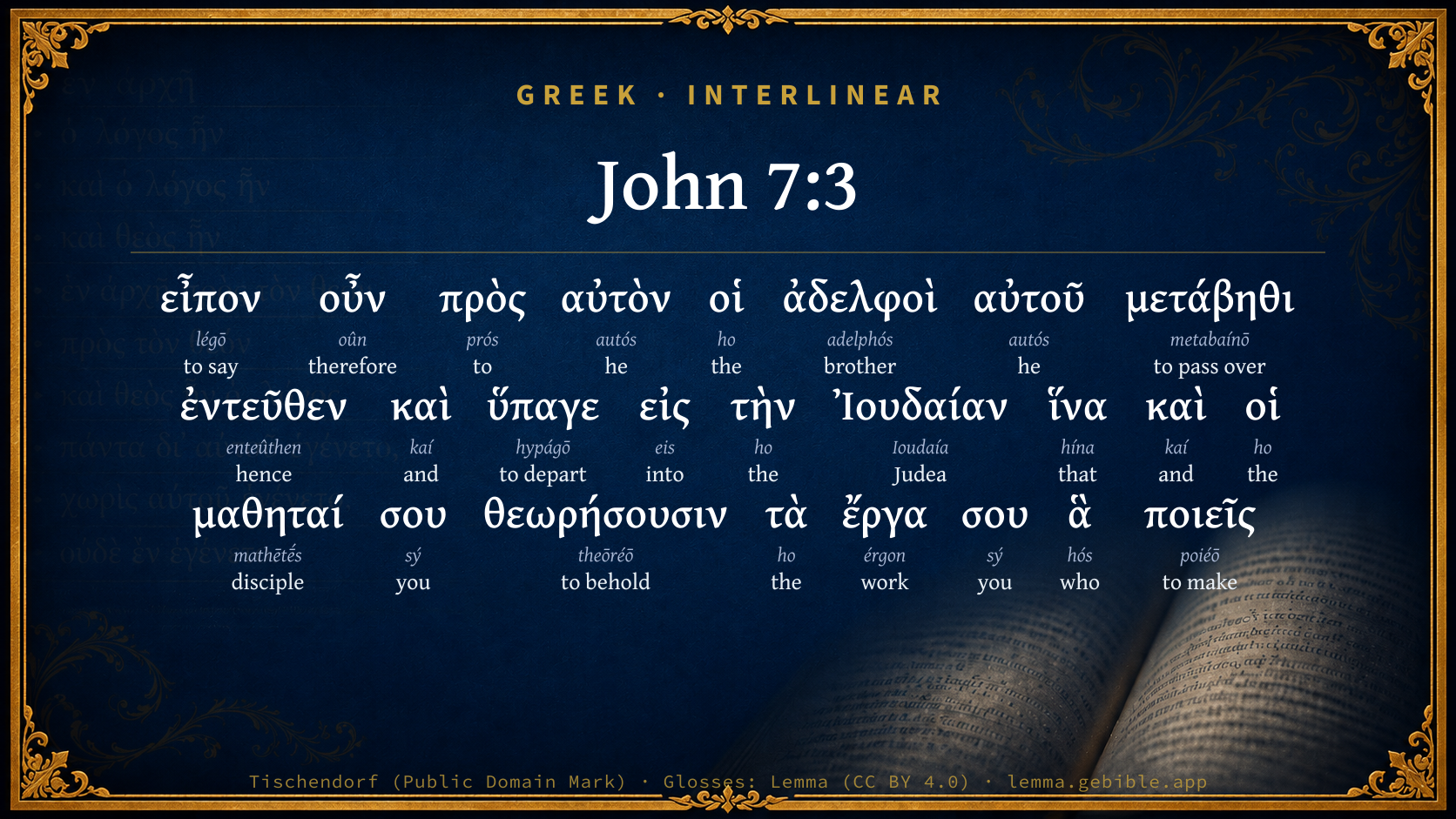
  1. εἶπον légō G3004 “to say” Verb, Aorist, Active, Indicative, 3rd person, Plural
  2. οὖν oûn G3767 “therefore” Conjunction
  3. πρὸς prós G4314 “to” Preposition
  4. αὐτὸν autós G846 “he” Personal pronoun, Accusative, Singular, Masculine
  5. οἱ ho G3588 “the” Article, Nominative, Plural, Masculine
  6. ἀδελφοὶ adelphós G80 “brother” Noun, Nominative, Plural, Masculine
  7. αὐτοῦ autós G846 “he” Personal pronoun, Genitive, Singular, Masculine
  8. μετάβηθι metabaínō G3327 “to pass over” Verb, Aorist, Active, Imperative, 2nd person, Singular
  9. καὶ kaí G2532 “and” Conjunction
  10. ὕπαγε hypágō G5217 “to depart” Verb, Present, Active, Imperative, 2nd person, Singular
  11. εἰς eis G1519 “into” Preposition
  12. τὴν ho G3588 “the” Article, Accusative, Singular, Feminine
  13. Ἰουδαίαν Ioudaía G2449 “Judea” Noun, Accusative, Singular, Feminine
  14. ἵνα hína G2443 “that” Conjunction
  15. καὶ kaí G2532 “and” Conjunction
  16. οἱ ho G3588 “the” Article, Nominative, Plural, Masculine
  17. μαθηταί mathētḗs G3101 “disciple” Noun, Nominative, Plural, Masculine
  18. σου sý G4771 “you” Personal pronoun, 2nd person, Genitive, Singular
  19. θεωρήσουσιν theōréō G2334 “to behold” Verb, Future, Active, Indicative, 3rd person, Plural
  20. τὰ ho G3588 “the” Article, Accusative, Plural, Neuter
  21. ἔργα érgon G2041 “work” Noun, Accusative, Plural, Neuter
  22. σου sý G4771 “you” Personal pronoun, 2nd person, Genitive, Singular
  23. ἃ hós G3739 “who” Relative pronoun, Accusative, Plural, Neuter
  24. ποιεῖς poiéō G4160 “to make” Verb, Present, Active, Indicative, 2nd person, Singular

About this verse

These counts appear in no published source. They are computed here, from the morphology-tagged text and Lemma’s own curated glosses. What Lemma adds →

25
words
19
distinct lemmas
Gospels
section

Notable vocabulary

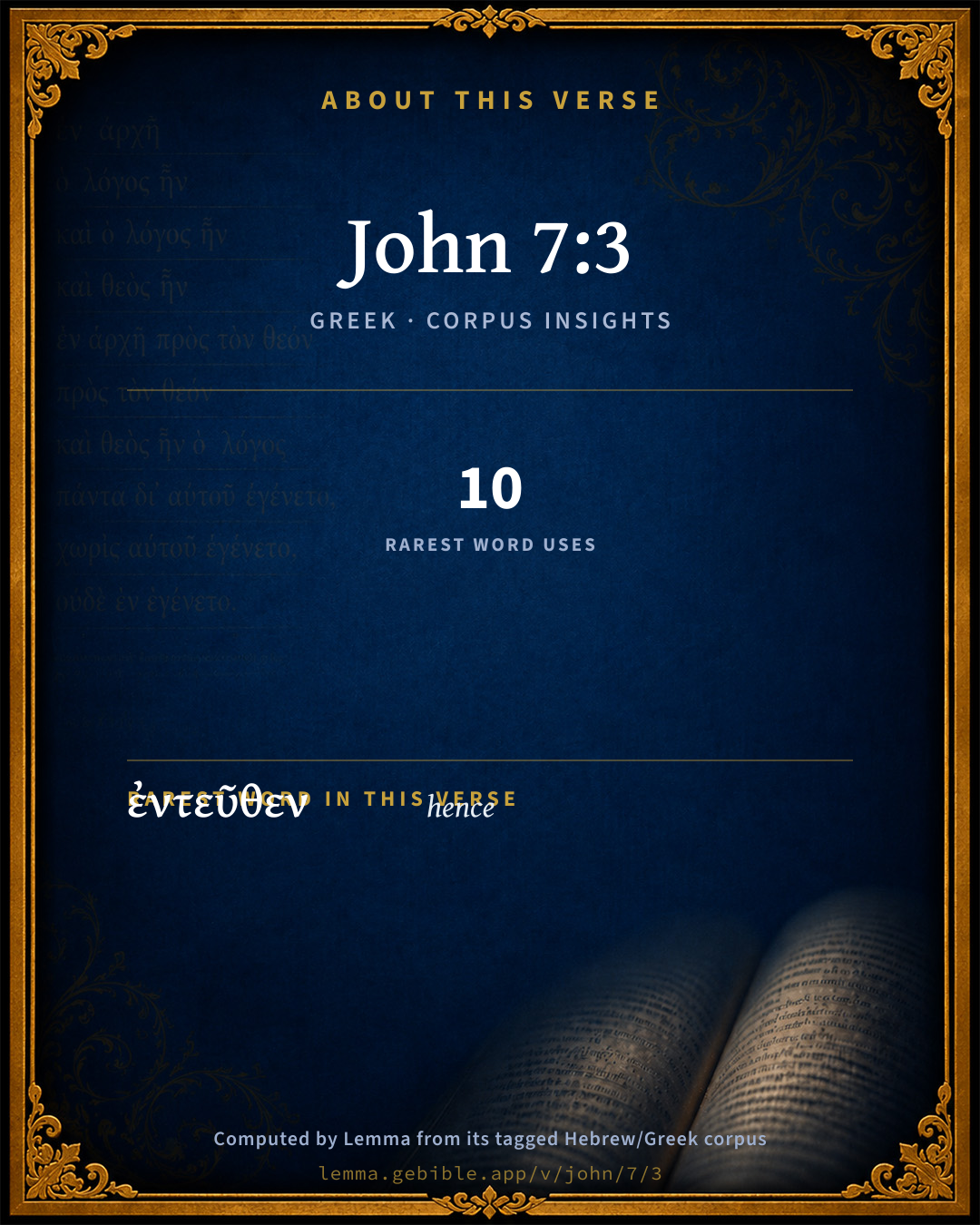
The rarest word here is ἐντεῦθεν hence G1782 — appearing just 10 times in the whole Greek New Testament.

Shared distinctive vocabulary

ἐντεῦθεν hence G1782 occurs in 9 verses of the Greek New Testament. Also found in:

Repetition

Words recur within this verse:

Cross-references

11

Topical passages linked to John 7:3 in the Treasury of Scripture Knowledge — connected by theme and wording, ordered by reader-vote popularity; previews shown in the World English Bible.

  • Matthew 12:46 While he was yet speaking to the multitudes, behold, his mother and his brothers stood outside, seeking to speak to him.
  • John 7:5 For even his brothers didn't believe in him.
  • Genesis 37:5–11 Joseph dreamed a dream, and he told it to his brothers, and they hated him all the more.
  • Genesis 37:20 Come now therefore, and let's kill him, and cast him into one of the pits, and we will say, 'An evil animal has devoured him.' We will see what will become of his dreams."
  • 1 Samuel 17:28 Eliab his eldest brother heard when he spoke to the men; and Eliab's anger was kindled against David, and he said, Why are you come down? and with whom have you left those few sheep in the wilderness? I know your pride, and the naughtiness of your heart; for you have come down that you might see the battle.
  • Jeremiah 12:6 For even your brothers, and the house of your father, even they have dealt treacherously with you; even they have cried aloud after you: don't believe them, though they speak beautiful words to you.
  • Matthew 22:16–17 They sent their disciples to him, along with the Herodians, saying, "Teacher, we know that you are honest, and teach the way of God in truth, no matter who you teach, for you aren't partial to anyone.
  • Mark 3:31 His mother and his brothers came, and standing outside, they sent to him, calling him.
  • Luke 8:19 His mother and brothers came to him, and they could not come near him for the crowd.
  • John 7:10 But when his brothers had gone up to the feast, then he also went up, not publicly, but as it were in secret.
  • Acts 2:14 But Peter, standing up with the eleven, lifted up his voice, and spoke out to them, "You men of Judea, and all you who dwell at Jerusalem, let this be known to you, and listen to my words.

Cross-references courtesy of OpenBible.info (CC BY 4.0).

Commentary

Notes on John 7:3 from classic Christian and Jewish commentators (each source and its license shown beneath its notes). The classic Christian expositions comment on the surrounding passage and are grouped to its opening verse, so a note may address several verses; the Jewish commentaries on the Tanakh (Rashi and others) are per-verse, so they appear only where the commentator wrote on this verse.

Lemma curates 59 commentaries, every one of them public domain or Creative Commons licensed, each selected and text-cleaned for this edition rather than reprinted as found. About our sources →

Tyndale Open Study Notes

Tyndale Open Resources

7:3-5 Jesus’ brothers (see also Mark 3:31) reminded him of his religious obligation to celebrate the festival. Their words were cynical because at this time they didn’t believe in him (John 7:5).

Tyndale Open Study Notes — © Tyndale Open Resources, licensed CC BY-SA 4.0. Text via the HelloAO Bible API.

Bengel's Gnomon

Johann Albrecht Bengel

Joh 7:3. Οἱ ἀδελφοί, His brethren) cousin-germans.—μετάβηθι, [depart] pass over) to sojourn there.—ἐντεῦθεν, hence) from this obscure place in Galilee.—εἰς τὴν Ιουδαίαν, into Judea) They send away the Messiah from Galilee to Judea; and then, from Judea to Galilee, Joh 7:52.[162]—ΚΑῚ ΟἹ ΜΑΘΗΤΑΊ ΣΟΥ, Thy disciples also) By this very expression they show, that they are not His disciples, Joh 7:5. There were many disciples of Jesus in Judea, especially at the feasts.—ζεωρήσωσι, may see) at the feast, in Jerusalem.

[162] “Out of Galilee ariseth no prophet.” Beng. means, that after first requiring Him to go from Galilee into Judea to prove His Messiahship, when He had gone there, they sent Him back to Galilee, rejecting His claims, just because He had come from Galilee.—E. and T.

Bengel's Gnomon of the New Testament — English translation (T&T Clark, Edinburgh, 1860) — public domain. Text from a community e-Sword module.

Meyer's Critical & Exegetical Commentary

Heinrich August Wilhelm Meyer

Joh_7:3. The brothers (Joh_2:12; their names are given, Mat_13:55, Mar_6:3) were still unbelievers (Joh_7:5), because biassed by the prevailing Messianic views;[257] yet, allowing to themselves, because of the miracles, the possibility of His being the Messiah, they are anxiouspartly, perhaps, for the sake of their own familyfor the decision of the matter, which they thought might most appropriately take place at the great joyous feast of the nation, and which certainly must occur, if at all, in Jerusalem, the seat of the theocracy. A malicious and treacherous intention (ἵνα ἀναιρεθῇ παρᾶ τῶν ζητούντων ἀποκτεῖναι αὐτόν, Euthymius Zigabenus, also Luther) is imputed to them without any foundation. They are of cold Jewish natures, and the higher nature belonging to their Brother is as yet hidden from them. The light of faith seems not to have dawned upon them until after His resurrection, and by means of that event (1Co_15:7; Act_1:14). This long-continued unbelief of His own earthly brothers (comp. Mar_3:21) is important in estimating the genuineness of the accounts given in Matthew and Luke of the miraculous birth and early childhood of Jesus.

καὶ οἱ μαθηταί σου] This expression entirely corresponds with the position of the brothers as outside the fellowship of Jesus. It does not say, thy disciples there also (so usually; even Baur, who takes it to refer to those who are first to be won over in Judaea), for the word there does not occur, nor thy disciples collectively, but simply, thy disciples also. They would be gathered together from all parts at the feast in Jerusalem, and He should let Himself and His works be seen by them also. It does not, indeed, clearly appear from this that coldness began to be exhibited towards Him within the circle of His disciples (Weizsäcker), but rather perhaps that Jesus had gone about in Galilee and worked miracles very much in secret, without attracting observation, and not attended by any great following, but perhaps only by the trusted twelve, which silent manner of working He was perhaps led to adopt by the lying in wait of the Jews (Joh_7:1). Comp. Joh_7:4 : ἐν κρυπτῷ. According to B. Crusius, the brothers speak as it nothing miraculous had been done by Him in Galilee. Contrary to the narrative; and therefore ἃ ποιεῖς cannot mean what you are reported to have done (B. Crusius), but what thou doest, i.e. during thy present sojourn in Galilee, although ἐν κρυπτῷ, Joh_7:4. According to Brückner (comp. Ebrard, and substantially also Godet), the brothers express themselves as if Jesus had made and retained no disciples in Galilee, and, indeed, with malicious and ironical allusion to the fact stated Joh_6:66, and to the report (Joh_4:1) which they did not believe. But, considering the long interval which elapsed between chap. 6 and Joh_7:2, such allusions, without more precise indication of them in the text, are all the less to be assumed. Luthardt attributes to the brothers the notion that in Galilee it was only the multitudes that followed Him, and that there was no such personal adherence to Him as had taken place in Judaea (in consequence of His baptizing). But it is incredible that they should entertain a notion so obviously erroneous, because the events which they were continually witnessing in Galilee, as well as those which they witnessed in Judaea on occasion of their journeys to the feast, must have been better known to them.

[257] Hengstenberg is not deterred even by this passage from recognising in these brothers of Jesus His cousins (the sons, he thinks, of Cleopas and Mary; but see on Joh_19:25), and from maintaining, with all the arbitrariness and violence of exegetical impossibilities, that three of them, James, Simon, and Judas, were apostles, in spite of vv. 3, 5, 7 (comp. Joh_15:19). Against every attempt to explain away the literal brothers and sisters of Jesus, see on Mat_1:25; Mat_12:46; 1Co_9:5; also Laurentius, N. T. Stud. p. 153 ff.; comp. Pressensé, Jesus Chr. p. 287.

Meyer — Critical and Exegetical Commentary on the New Testament — English translation by Peter Christie, edited by Frederick Crombie (T&T Clark, 1880) — public domain. Text from a community e-Sword module.

Expositor's Greek Testament

ed. W. Robertson Nicoll

Joh 7:3 . The desirableness of doing so is urged by His brothers. εἶπον … τῷ κόσμῳ . The reason they advanced was “that Thy disciples also may see Thy works which Thou doest”. καὶ οἱ μαθηταί σου seems to imply that since the Feeding of the Five Thousand in April, Jesus had been living in comparative retirement, perhaps at Nazareth. At Jerusalem, all who were attached to Him would be found at the Feast; and the brothers recognise that He would then have an opportunity of putting His claims to the proof. “No one,” they say, “who seeks public recognition confines his activities to a hidden and private corner.” ἐν παρρησίᾳ , as in Joh 11:54 , means “openly” or “in public,” and is in direct contrast to ἐν κρυπτῷ . Having laid down the general law, they then apply it to Him, “if (or ‘since,’ not expressing doubt) Thou doest these things, show Thyself to the world”. Lücke, following Euthymius, thinks doubt is implied in εἰ ; but this implies an ignorance on the part of the brothers which is inconceivable.

The Expositor's Greek Testament, edited by W. Robertson Nicoll (1897–1910) — public domain. Text from a community e-Sword module.

Godet's Commentaries

Frédéric Louis Godet

Vv. 3-5. “His brethren therefore said to him: Depart hence and go into Judea, that thy disciples also may behold the works which thou doest; 4 for no man does any work in secret, while seeking after fame; if thou really doest such works, manifest thyself to the world. 5. For even his brethren did not believe on him.”

We take the expression “Jesus’ brethren,” in the strict sense. Comp. on this question Vol. I., pp. 357-361. At the head of these brethren was undoubtedly James, who was afterwards the first director of the flock at Jerusalem (Act 12:17; Act 15:13; Act 21:18; Gal 1:19; Gal 2:9). The exhortation which they address to Jesus is inspired neither by a too impatient zeal for the glory of their brother (Hengstenberg, Lange) nor by the malignant desire of seeing Him fall into the hands of His enemies (Euthymius). They are, beyond doubt, neither so good nor so bad. They are perplexed with regard to the claims of Jesus; on the one hand, they cannot deny the extraordinary facts of which they are every day the witnesses; on the other, they cannot decide to regard as the Messiah this man whom they are accustomed to treat on terms of the most perfect familiarity. They desire, therefore, to see Him withdraw from the equivocal situation which He creates for Himself and in which He places them all by keeping Himself so persistently at a distance from Jerusalem. If He is truly the Messiah, why indeed should He fear to make His appearance before more competent judges than the ignorant Galileans. His place is at Jerusalem. Is not the capital the theatre on which the Messiah should play His part, and the place where the official recognition of His mission should be accomplished? The approaching feast, which seems to impose on Jesus an obligation to go to Jerusalem, appears to them the favorable moment for a decisive step. There is a certain analogy between this summons of the brethren and the request of Mary, chap. 2, as there will be also between the manner in which the Lord acts and His conduct at the wedding in Cana.

What do the brethren mean by the expression “thy disciples” (Joh 7:3)? It seems that they apply this name only to the adherents of Jesus in Judea. And this was indeed their thought, perhaps, in view of the fact that there only had Jesus properly founded a school similar to that of John the Baptist, by baptizing like him; comp. Joh 4:1 : “The Pharisees had heard that Jesus was making and baptizing more disciples than John the Baptist.” All this had been told and repeated in Galilee; a great stir had been made respecting these numerous adherents of Jesus in Judea and at Jerusalem, at whose head might even be found members of the Sanhedrim. His brethren remind Him of these earlier successes in Judea, and this with the more timeliness because, since the scene of chap. 6, the larger part of His disciples in Galilee had abandoned Him, and He was now surrounded only by a fluctuating multitude. They mean, therefore: “These Messianic works which thou dost lavish upon these crowds, without any result,—go then, at length, and do them in the places where it is said that thou hast formed a school, and where thou wilt have witnesses more worthy of such a spectacle and more capable of drawing a serious conclusion from it.” It is not necessary, therefore, to supply, with Lucke and others, ἐκεῖ : “thy disciples there,” or to explain, as Hengstenbergand Meyer do: “thy disciples in the entire nation, who will come to the feast.” John must certainly have added a word in order to indicate either the one or the other of these meanings. The term μαθηταί, disciples, is taken here by the brethren in a sense which is slightly emphatic and ironical.

Lucke has perfectly rendered the construction of Joh 7:4 by a Latin phrase: Nemo enim clam sua agit idemque cupit celeber esse. There exists no man who works in secret and at the same time aspires to make for himself a name. Αὐτός refers to this hypothetical subject of the verb ποιεῖ, does, whose real existence the word no oneafterwards denies. The copula καί, and, strongly sets forth the internal contradiction between such a claim and such conduct (comp. the καί of Joh 6:36). ᾿Εν παῤῥησίᾳ is used here, whatever Meyer may say, in the same sense as in Joh 11:54 and Col 2:15 : in public. From the idea of speaking boldly we easily pass to that of acting openly (Keil). The sense given by Meyer: “No one acts in secret and wishes at the same time to be a man of frankness,” is inadmissible. By saying εἰ, if, the brethren do not precisely call in question the reality of the miracles of Jesus. This εἰ is logical; it signifies if really. Only they ask for judges more competent than themselves to decide on the value of these works. And for this end it is necessary that he should advance or retreat. Certainly, speaking absolutely, they were right: the Messianic question could not be decided in Galilee. The choice of the time remained; this was the point which Jesus reserved for Himself. By κόσμος, the world, the brethren evidently mean the great theatre of human existence, such as they knew it, Jerusalem. The style of Joh 7:4 has a peculiarly Hebraic stamp: these are the words of the brethren of Jesus taken as if from their lips. Comp. the analogous construction in 1Sa 20:2.

Hengstenberg, Lange, Keil and Westcott endeavor to reconcile Joh 7:5 with the supposition that two or three of Jesus’ brothers were apostles. Hengstenberg remarks first that these words may refer to Joses, the fourth brother of Jesus, and then to the husbands of His sisters. Perceiving indeed the improbability of this understanding of the matter, the others weaken as far as possible the force of the words: They did not believe. It is only a partial and momentary want of faith, or, according to Westcott, an effect of the insufficient influence exerted by their faith on their thought and their conduct. But this relative unbelief, as they call it, does not account for the absolute expression: They did not believe on him; especially when strengthened, as it is, by the word neither, by which John brings the brethren of Jesus into the category of all the other unbelieving Galileans. The reading of D L: They did not believe (aorist), is certainly a correction, intended to facilitate an interpretation of this sort. Moreover, what follows excludes this weakened meaning. How could Jesus address to His brothers, being apostles, those severe words: “The world cannot hate you” (Joh 7:7), while in Joh 15:19 He says to the apostles: “If you were of the world, the world would love its own; but because you are not of the world..., therefore the world hates you. It certainly follows, therefore, from this remark, that even at this time, six months before the last Passover, Jesus’ own brothers did not acknowledge Him as the Messiah. But, divided between the impression which His miracles produced upon them and the insuperable doubts of their carnal minds, they eagerly desired to reach at length a solution. This attitude is very natural; it accords with the role which is ascribed to them in the Synoptical narrative; comp. Mark 3. The perfect sincerity of John’s story appears from the frankness with which he expresses himself respecting this fact which was so humbling to Jesus (see Tholuck). We may well remark also, with the same author, that these words of the brethren (Joh 7:3-4) contain the complete indirect confirmation of the entire representation of the Galilean ministry which is traced by the Synoptics.

Frédéric Louis Godet — Commentaries on Luke, John, Romans, and 1 Corinthians — English translation (T&T Clark, Edinburgh, 1870s–1890s) — public domain. Text from a community e-Sword module.

Geneva Bible (1599)

Geneva Bible translators

The grace of God cometh not by inheritance, but it is a gift that cometh other ways, whereby it cometh to pass, that oftentimes the children of God suffer more affliction by their own kinsfolk than by strangers.

Geneva Bible (1599) marginal notes — public domain. Text via Bolls.life.

Jamieson, Fausset & Brown

Robert Jamieson, A. R. Fausset & David Brown

His brethren said--(See on Mat 13:54-56).

Depart . . . into Judea, &c.--In Joh 7:5 this speech is ascribed to their unbelief. But as they were in the "upper room" among the one hundred and twenty disciples who waited for the descent of the Spirit after the Lord's ascension (Act 1:14), they seem to have had their prejudices removed, perhaps after His resurrection. Indeed here their language is more that of strong prejudice and suspicion (such as near relatives, even the best, too frequently show in such cases), than from unbelief. There was also, probably, a tincture of vanity in it. "Thou hast many disciples in Judea; here in Galilee they are fast dropping off; it is not like one who advances the claims Thou dost to linger so long here, away from the city of our solemnities, where surely 'the kingdom of our father David' is to be set up: 'seeking,' as Thou dost, 'to be known openly,' those miracles of Thine ought not to be confined to this distant corner, but submitted at headquarters to the inspection of 'the world.'" (See Psa 69:8, "I am become a stranger to my brethren, an alien unto my mother's children!")

Jamieson, Fausset & Brown — Commentary Critical and Explanatory on the Whole Bible (1871) — public domain (CC PDM 1.0). Text via the HelloAO Bible API.

Adam Clarke's Commentary

Verse 3. His brethren - said] It is generally supposed that these were the children of the sisters of his mother Mary; but some of the ancients have stated that Joseph had several children by a former wife. See the account of the evangelist prefixed to this Gospel. No solid proof can be alleged against this; nor can we pretend to say that these were not the children of Joseph and Mary. Our blessed Lord, it is true, was her first born, while she was yet a virgin; but no man can prove that he was her last. It is an article of faith, in the Popish Church, to believe in the perpetual virginity of Mary; and in this respect, without any reason, several Protestants seem to be Papists. However this may be, it is certain that the Hebrews gave the name of brethren to all the relatives of a particular family. See Ge 31:32; Ge 31:46.

That thy disciples also may see] That is, the disciples which he had made two years and six months before, at the Passover: Joh 2:23.

Adam Clarke's Commentary on the Bible (1810–1826) — public domain. Text from a community e-Sword/MySword module.

John Calvin's Commentaries

3. His brethren therefore said to him. Under the word brethren the Hebrews include all cousins and other relations, whatever may be the degree of affinity. He says that they mocked at Christ, because he shunned to be seen or known, and concealed himself in a mean and despised district of Judea. There is reason to doubt, however, if they were excited by ambition to desire that Christ should obtain celebrity. But granting this, still it is evident that they ridicule him, because they do not think that his conduct is rational and judicious; and they even upbraid him with folly, because, while he wishes to be something, he wants confidence in himself, and does not venture to appear openly before men. When they say, that thy disciples also may see, they mean not only his domestics, but all those whom he wished to procure out of the whole nation; for they add, “Thou wishest to be known by all, and yet thou concealest thyself.”

John Calvin's Commentaries (1540-1563) — public domain. Text from the Calvin Translation Society English edition (1840s-50s) via the Christian Classics Ethereal Library (ccel.org). Calvin's coverage is partial (roughly two-thirds of the Bible); uncommented books and verses are honest gaps, never fabricated. The 19th-century editor's footnotes and remarks are omitted so the notes are faithfully Calvin's own voice.

Ellicott's Commentary for English Readers

(3) His brethren . . .—Comp. Note on Mat_13:55. They are excluded here by their own words from the band of disciples, as they are by St. John’s from the believers (Joh_7:5), and inferentially (Joh_7:7) by the words of Christ Himself from the Twelve. (Comp. Joh_15:18.)

That thy disciples also may see . . .—The last time the word “disciples” was used, it was to mark the departure of many from Him (Joh_6:60; Joh_6:66). The months which have passed since have been a time of comparative retirement. He did not go to the Passover, where many would have expected to see Him (Joh_7:11), but within the narrowed circle continued His works and words. The prophet hath not honour in His own home, and His brethren, who have seen these works and do not believe, challenge Him to an open demonstration of them. There is another great feast at hand, and His disciples from all parts will be at Jerusalem, where the rulers will test His claims. If He is the Messiah, no conspiracy to kill Him can prevail; and if these works are really divine, let the great body of disciples see them, and amid the joyous feast, and in the royal city, proclaim Him king.

A Bible Commentary for English Readers, edited by Charles John Ellicott (1878–1897) — public domain. Text from a community e-Sword module.

The Cambridge Bible for Schools and Colleges

gen. ed. J. J. S. Perowne

3. His brethren] See on Joh_2:12.

Depart hence] The bluntness of this suggestion, given almost as a command, shews that they presumed upon their near relationship. It would be more natural in the mouths of men older than Christ, and therefore is in favour of their being sons of Joseph by a former marriage rather than sons of Joseph and Mary (comp. Mar_3:21; Mar_3:31). They shared the ordinary beliefs of the Jews about the Messiah, and therefore did not believe in their Brother. But His miracles perplexed them, and they wished the point brought to a decisive issue. There is no treachery in their suggestion; its object is not to put Him in the power of His enemies.

thy disciples also] His brethren seem to imply that they themselves are not His disciples even nominally.

The Cambridge Bible for Schools and Colleges (gen. ed. J. J. S. Perowne; Cambridge University Press, 1878–1918) — public domain. Text from a community e-Sword module.

John Gill's Exposition

That is, the brethren of Jesus, as the Syriac and Persic versions express it; who were not James and Joses, and Simon and Judas, the sons of Alphaeus, the brother of Joseph, the husband of Mary, so called, Mat 13:55, for some of these were of the number of the twelve; and all of them believers in Christ; whereas these his brethren were not. The Jew (l) therefore is mistaken, who supposed the above persons are here intended; and objects this their unbelief to Jesus, as if they knew him too well to give him any credit; whereas they did believe in him, and abode by him to the last; and some of them, if not all, suffered death for his sake. They therefore are to be understood of some distant relations of Mary or Joseph, that dwelt at Nazareth, or Capernaum, or in some of those parts; and the feast of tabernacles being at hand, they put him upon going up to it, being willing to be rid of him: saying,

depart hence: which is the language of carnal men, who desire not the company of Christ, nor the knowledge of his ways; and like the Gergesenes, who preferred their swine to Christ, and desired him to depart out of their coasts:

and go into Judea; among his most inveterate enemies, who sought to take away his life; and which doubtless they knew; which showed a quite different regard to him, from that of his true disciples, Joh 11:7, for which they give some plausible reasons:

that thy disciples also may see the works that thou doest: meaning not his twelve disciples, who were now with him, but the disciples he had made, and baptized in Judea, Joh 4:1. Or his disciples in the several parts of the land, who would all be at Jerusalem, at the feast of tabernacles; and so, should he go, would have an opportunity of seeing his miracles, and thereby be the more confirmed in the faith of him,

(l) R. Isaac Chizzuk Emuna, par. 2. c. 45. p. 434, 435.

John Gill's Exposition of the Whole Bible (1746–1763) — public domain (CC PDM 1.0). Text via the HelloAO Bible API.

Trapp's Complete Commentary

John Trapp

3 His brethren therefore said unto him, Depart hence, and go into Judaea, that thy disciples also may see the works that thou doest.

Ver. 3. Depart hence] Saucily enough, and sarcastically too; pricked on by ambition, likely, which ever rideth without reins, and cares not whose ruins it buildeth upon.

John Trapp, A Commentary or Exposition upon All the Books of the Old and New Testament (1647–1656) — public domain. Text from a community e-Sword module.

Albert Barnes' Notes on the Bible

His brethren - See the notes at Mat 12:47.

Thy disciples - The disciples which he had made when he was before in Judea, Joh 4:1-3.

The works - The miracles.

Albert Barnes' Notes on the Bible (1834–1885) — public domain. Text from a community e-Sword/MySword module.

Haydock's Catholic Bible Commentary

These brethren of Christ were the relatives of the blessed Virgin, not her children. For, as in the sepuchre, were the body of our Saviour was deposited, no other mortal lay either before or since; so neither did the womb of Mary ever either before or after bear any other body but that of her divine Son. (St. Augustine, tract. 28. in Joan.)

George Leo Haydock (1774–1849), Haydock's Catholic Family Bible and Commentary, 1859 edition — public domain. Excludes Psalms (Douay-Rheims chapter numbering differs from Protestant) and Deuterocanonical books (Catholic canon only).

Matthew Poole's English Annotations

His brethren; his friends and kindred; See Poole on "Mat 12:47". See Poole on "Mat 12:48"; either such as did believe in him, or such as did not believe; for, Joh 7:5, all of them did not believe in him; would have him leave Galilee, which was the far more obscure and ignoble part of the country, and go into Judea, which was the more noble and famous province; that those who in that province followed him, might also see the miracles which he wrought.

Matthew Poole's English Annotations on the Holy Bible (1683–1685) — public domain. Text from a community e-Sword/MySword module.

Whedon's Commentary on the Bible

Daniel D. Whedon

3. His brethren—His brothers. That these were the sons of Joseph and Mary would scarcely have been questioned but for doctrinal reasons. See note on Mat_10:3; Mat_13:55. Their names were James, Joseph, Simon, and Judas. As Jesus was the eldest, and but slightly over thirty, these must have been in their green young manhood. This must account for their ambitious half-belief and half-disbelief of the Messiahship of Jesus. They believed a miraculous basis for success to be in him if he will only show it out to the world; but he does not realize their idea of a divine, warlike, hero Messiah. After the sad yet wonderful events of the crucifixion and resurrection these brothers believed! They consented to accept as Messiah a Saviour of the world, instead of a Liberator of the Jews. This very James became “James the Just,” the author of the Epistle of James, the bishop of Jerusalem, and the martyr to the faith he here disowns. And this Judas is the Jude author of the Epistle bearing that name.

Depart hence—Leave this obscure provincial Galilee.

Go into Judea—Go to the headquarters of pure Judaism, to the great metropolis.

Thy disciples—Who will be assembled in their fullest force at the feast, whether they belong to Judea or Galilee. They were doubtless aware that in eastern Judea the preaching of John and Jesus both had won many disciples to Christ.

See the works—They believed that he could show works that might justify the faith of his disciples.

Daniel D. Whedon (gen. ed.), Commentary on the Old and New Testaments (1874–1909) — public domain. Text from a community e-Sword module.

The Pulpit Commentary

His brethren therefore (pointing to the high significance of this national and triumphant feast) said unto him. These brethren were (Mat_13:55) James, Joses, Simon, and Judas, and, without entering once more on the much-debated question of their actual relation to Jesus, (see Joh_2:12, and notes) it may be said that this passage in a very marked manner discriminates them from the apostles or disciples, and practically negatives the "cousin" theory derived from the supposed identification of Alphaeus with Cleophas, and consequently of the sons of Alphaeus (James, Judas, and Simon) with the apostles of the same names. The lack of sympathy shown by these men, and the positive assertion of their non-belief in Jesus, is incompatible with the great confession so recently made, (Joh_6:68, Joh_6:69) and cannot (with Hengstenberg and Lange) be diluted into imperfect appreciation of claims which they wished in a secular sense to press forward to full assertion. They appeared here to criticize their Brother"s prolonged absence from Jerusalem, and his abstention from the Passover and other national festivals. They would, perhaps sincerely, hurry forward his public demonstration, and compel him to say to the great world what he had been saying in Galilaean villages, in the borders of Tyre, and in the cities of Decapolis. Depart hence, and go into Judaea. "This is the time and place." Thoma sees in this advice the same idea which, on the mount of Transfiguration, was suggested by Moses and Elijah "concerning the departure which the Lord was to accomplish in Jerusalem." The Johannist has clothed the same material insinuation in a dialogue (dialogische Verhandlung). It has been said that this kind of advice is rather in favour of the hypothesis that these brethren were elder than Jesus, and possibly the children of Joseph by an earlier marriage, who thus took upon themselves the function of advisers. Such a hint, however (given by Westcott), seems very shadowy confirmation of the theory. Younger brothers would be just as likely to err in the same direction. In order that thy disciples also may behold thy works which thou doest. The words "thy disciples" may (Godet, Luthardt formerly) have had special reference to the fact that our Lord had made in Judaea "more disciples than had John", (Joh_4:1) that there were even members of the Sanhedrin who had to some extent looked favourably upon, (Joh_3:1) and needed confirmation of their faith. There may also have been tacit reference to the circumstance recorded in ch. 6. that his Galilaean disciples had deserted him; but it is more likely (Meyer) that the brethren took it for granted that those who in numerous places had received his word would be gathered together in Jerusalem, and would have an opportunity of seeing with their own eyes and in consociation with each other the works of healing and might which were being variously reported, canvassed, and disputed in the schools of Galilee. "Thy disciples" is a wide word, and may easily refer to all who, whether in Jerusalem or Galilee, went by his name. It is a designation which, however, does not include the speakers. "The works which thou art doing" is sufficiently illustrated from the group of remarkable events which had eternalized the previous twelve months of the Galilaean ministry (see on ver. 1).

The Pulpit Commentary (1880–1919), ed. H.D.M. Spence-Jones & Joseph S. Exell — public domain. Text from a community e-Sword module.

John Wesley's Explanatory Notes

His brethren -- so called according to the Jewish way of speaking. They were his cousins, the sons of his mother's sister. Depart hence - From this obscure place.

John Wesley, Explanatory Notes Upon the Whole Bible (1754–1765) — public domain. Text via the GEBible commentary corpus.

Burkitt's Expository Notes on the New Testament

William Burkitt

Observe here, 1. The advice which Christ’s brethren, that is, his kindness, gave him to render himself more famous and publicly known to the world: they advise him not to stay any longer in Galilee, an obscure place, but to go into the more noble and populous country of Judea, and work miracles there. But what high presumption was this in creatures to prescribe to Christ, and direct him whither to go, and what to do?

Observe, 2. The reason they offer for their advice; For no man that seeketh to be known openly, will do any thing in secret: that is, "If thou wilt be thought to be the Messias by thy working miracles, do them not in a corner; but up to Jerusalem with us at this next feast, that the great men may take notice of them." Such as hunt after reputation themselves, and are ambitious of vain-glory and commendation from men, measure others, even the most holy and religious, by their own inclinations and dispositions: and wonder that others do not follow their measures for gaining reputation and respect.

Thus did our Lord’s brethren here: but the wonder ceases, if we consider the following words; Neither did his brethren believe in him. It is no new thing for the holiest servants of God to meet with great trials from their graceless friends. Christ met with this before us: his kindred, according to the flesh, not believing in him, were a sore trial and temptation to him. Some martyrs have confessed, that the hardest works they have met withal, have been to withstand the temptations, the tears, and entreaties, of their dearest and nearest relations.

William Burkitt's Expository Notes on the New Testament (1700–1703) — public domain. Text from a community e-Sword module.

The People's New Testament

B. W. Johnson

3. His brethren said unto him. His brothers. John 2:12. Depart hence, and go into Judea. A long time had passed since he had been at Jerusalem, and these brethren wished him to show his mighty powers there.

B. W. Johnson's The People's New Testament with Notes (1889–1891) — public domain. Electronic text from the Christian Classics Ethereal Library (CCEL) ThML edition.

unfoldingWord translationNotes

Door43 World Missions Community

brothers

This refers to the actual younger brothers of Jesus, the sons of Mary and Joseph.

the works that you do

The word "works" refers to the miracles that Jesus had performed.

he himself

The word "himself" is a reflexive pronoun that emphasizes the word "he." (See: Reflexive Pronouns)

the world

Here "the world" is a metonym for all of the people in the world. AT: "all people" or "everyone" (See: Metonymy)

translationWords

brother

disciple

unfoldingWord translationNotes — © Distant Shores Media and the Door43 World Missions Community, licensed CC BY-SA 4.0. Source: git.door43.org/Door43/en_tn.

Cambridge Greek Testament for Schools and Colleges

3. οὖν. Because He had not attended the previous Passover.

οἱ ἀδελφοὶ αὐτοῦ. See on Joh 2:12. The bluntness of this suggestion, given almost as a command, shews that they presumed upon their near relationship. It would be more natural in the mouths of men older than Christ, and therefore is in favour of their being sons of Joseph by a former marriage rather than sons of Joseph and Mary (comp. Mar 3:21; Mar 3:31). They shared the ordinary beliefs of the Jews about the Messiah, and therefore did not believe in their Brother. But His miracles perplexed them, and they wished the point brought to a decisive issue. There is no treachery in their suggestion; its object is not to put Him in the power of His enemies. Comp. Joh 2:3-4, where His Mother’s suggestion and His treatment of it are somewhat similar to what we have here.

οἱ μαθηταί σου. Any of them, whether pilgrims to Jerusalem for the Feast or living there. His brethren seem to imply that they themselves are not disciples. Θεωρήσουσιν, not merely ‘see,’ but ‘contemplate;’ see on Joh 6:40.

Cambridge Greek Testament for Schools and Colleges (Cambridge University Press, 1896; 21 vols, various authors incl. Carr, Maclear, Plummer, Farrar, Lumby, Moule, M. R. James, Simcox) — public domain. Text from a community e-Sword module.

Alford’s Greek Testament

Henry Alford

3-5.] Respecting the brethren of the Lord, see note on Mat 13:55. They seem to have had at this time a kind of belief in the Messianic character of Jesus, but of the very lowest sort, not excluding the harsh and scoffing spirit visible in these words. They recognized his miracles, but despised his apparent want of prudence and consistency of purpose, in not shewing himself to the world. In the ἵνα καὶ οἱ μαθ. σου κ.τ.λ. there is perhaps a reference to the desertion of many of his disciples just before. Nay, more than this: the indication furnished by this verse of the practice of our Lord with regard to His miracles up to this point is very curious. He appears as yet to have made His circuits in Galilee, and to have wrought miracles there, in the presence of but a small circle of disciples properly so called: and there would seem to have been a larger number of disciples, in the wider sense, in Judæa, or to be gathered in Judæa by the feast, who yet wanted assuring, by open display, of the reality of His wonderful works.

In ver. 5 (as well as by οἱ μαθηταί σου, ver. 3), we have these brethren absolutely excluded from the number of the Twelve (see ch. 6:69); and it is impossible to modify the meaning of ἐπίστευον so as to suppose that they may have been of the Twelve, but not believers in the highest sense. This verse also excludes all of His brethren: it is inconceivable that John should have so written, if any among them believed at that time. The attempt to make the words mean, that some of his brethren did not believe on him, is in my view quite futile. In that case we should certainly have had some such expression as ἦσαν γὰρ καὶ ἐκ τῶν ἀδελφῶν αὐτοῦ, οἳ οὐκ ἐπίστευον εἰς αὐτόν. No such attempt would ever have been made by a Greek scholar,—except for the fiction which has been so long, and, strange to say, is still upheld with regard to our Lord’s brethren.

The emphatic expression, οὐδὲ γὰρ οἱ ἀδ., is a strong corroboration of the view that they were really and literally brethren: see also Psa 69:8.

Henry Alford, The Greek Testament (1849–1861) — public domain. Text from a community e-Sword module.

International Critical Commentary

3. For the “brethren of Jesus,” see on 2:12. They were older than He was, and this may explain their venturing to offer Him advice as to His conduct. The discussion between them and Him, which is reported vv. 3-8, could only have been known to one who was in intimate relations with the family; and there could be no motive for setting it down in narrative, if it had not actually taken place.

μετάβηθι ἐντεῦθεν, “depart hence”: μεταβαίνειν is used 13:1 of departing from this world, and metaphorically 5:24, 1Jn 3:14.

καὶ ὕπαγε (a favourite word with Jn.; see on v. 33) εἰς τὴν Ἰουδαίαν, ἵνα καὶ οἱ μαθηταί σου θεωρήσουσιν τὰ ἔργα σου ἅ ποιεῖς. The advice seems to have been ironical, for they go on to express doubts about His alleged “works,” saying εἰ ταῦτα ποιεῖς, “if you do such things.” The suggestion is that the rumour of these ἔργα was confined to Galilee, and that if He were to establish His reputation in Judæ, it would be desirable that His disciples there should have an opportunity of seeing what He could do.

We have already heard of many disciples in Judæa (2:23, 4:1); indeed, it was because their number excited the jealousy of the Pharisees that He had left Judæa on a former occasion (4:3). But there was little of miracle there on His last visit; the cure of the impotent man is not described as a “sign,” and it had attracted attention rather because it had been wrought on a Sabbath day, than because of its marvellousness (5:5f.; and cf. 7:21, where see note). The “works” to which the brethren of Jesus make reference here are those of Galilee, perhaps the Miracle of Cana (2:1f.) or the Healing of the Nobleman’s Son and other sick folk (4:46f., 6:2), or the Feeding of the Five Thousand (6:5f.), or more probably healings wrought between His departure from Jerusalem and His going up again for the Feast of Tabernacles (vv. 1, 14), i.e. during the summer of the year 28. Nothing is told about them by Jn., but the words τὰ ἔργα σου ἅ ποιεῖς, “the works which you are doing,” suggest that the reference is not to anything that He had done months before the date of the conversation, but to quite recent events. And, as has been suggested on v. 1, some of the Galilæan miracles recorded by the Synoptists may be placed at this period in the ministry as narrated by Jn.

The allusion to the μαθηταί here cannot be to the Twelve, for they had been witnesses of many of the wonderful things that Jesus had done, and were already convinced of the truth of His claims. Nor can the allusion be to the Galilæan disciples who were disheartened by the difficulty of His teaching and left Him on a former occasion (6:66), for they would not be in the way of seeing miracles wrought at Jerusalem, whither His brethren advised Him to transfer His activities. We conclude, then, that the μαθηταί whom His brethren suggested He should confirm in their allegiance by displays of His power, were those in Judæa and at Jerusalem. If, indeed, He was to succeed in the Mission for which He claimed the highest sanctions, He must convince Jerusalem. And His brethren were right in the view they took of this. They did not accept His claims, as yet at any rate (v. 5), but they understood clearly that it was at the Holy City that they must either be proved or disproved.

θεωρήσουσιν: So אcB*DLNW, although ἵνα with the future indic. is rare in Jn. (cf. 17:2). א* has θεωροῦσιν, and ΓΔΘ read θεωρήσωσιν.

B places σου before τὰ ἔργα, but om. א*D.

International Critical Commentary — older volumes (1896–1929), various authors — public domain. Text from a community e-Sword module.

Vincent's Word Studies in the New Testament

Marvin R. Vincent

Thy disciples. Both those who had been gained by former teaching in Judaea and Jerusalem, and others from other parts.

Marvin R. Vincent, Word Studies in the New Testament (1887–1900) — public domain. Text from a community e-Sword/MySword module.

Lesson kit

Teaching starters — assembled from the data on this page, not authored interpretation. Every prompt links to the verse data it draws on. Edit before teaching.

John, in the Gospels, opens this verse with 25 words (19 distinct Greek lemmas). Its most distinctive word is enteûthen (“hence”). A historical commentator’s framing appears above. Read the whole chapter for the surrounding context.

Discussion questions

  1. What does “hence” (enteûthen) contribute to the verse as a whole?
  2. How does Luke 4:9, which shares the word «hence», read alongside this verse?
  3. What does the repetition of “the” (4× in this one verse) do in this verse?
  4. The translations on this page render this verse differently — a whole-verse word diff, not a word-by-word alignment. What might account for the different wordings?
  5. Compare how Tyndale Open Study Notes and Bengel's Gnomon read this verse. Where do they agree or differ?

Things to notice

Reading settings

Reading text

Shown beneath each verse's original-language words.

Old Testament
Old Testament edition

Read the OT as the Masoretic Hebrew (MT) or the Greek Septuagint (LXX).

English shown for the Greek Septuagint (in the Hebrew ↔ Greek comparison).

Comparing translations? Open the Compare panel on any verse page to stack up to four side by side.