John 4:48

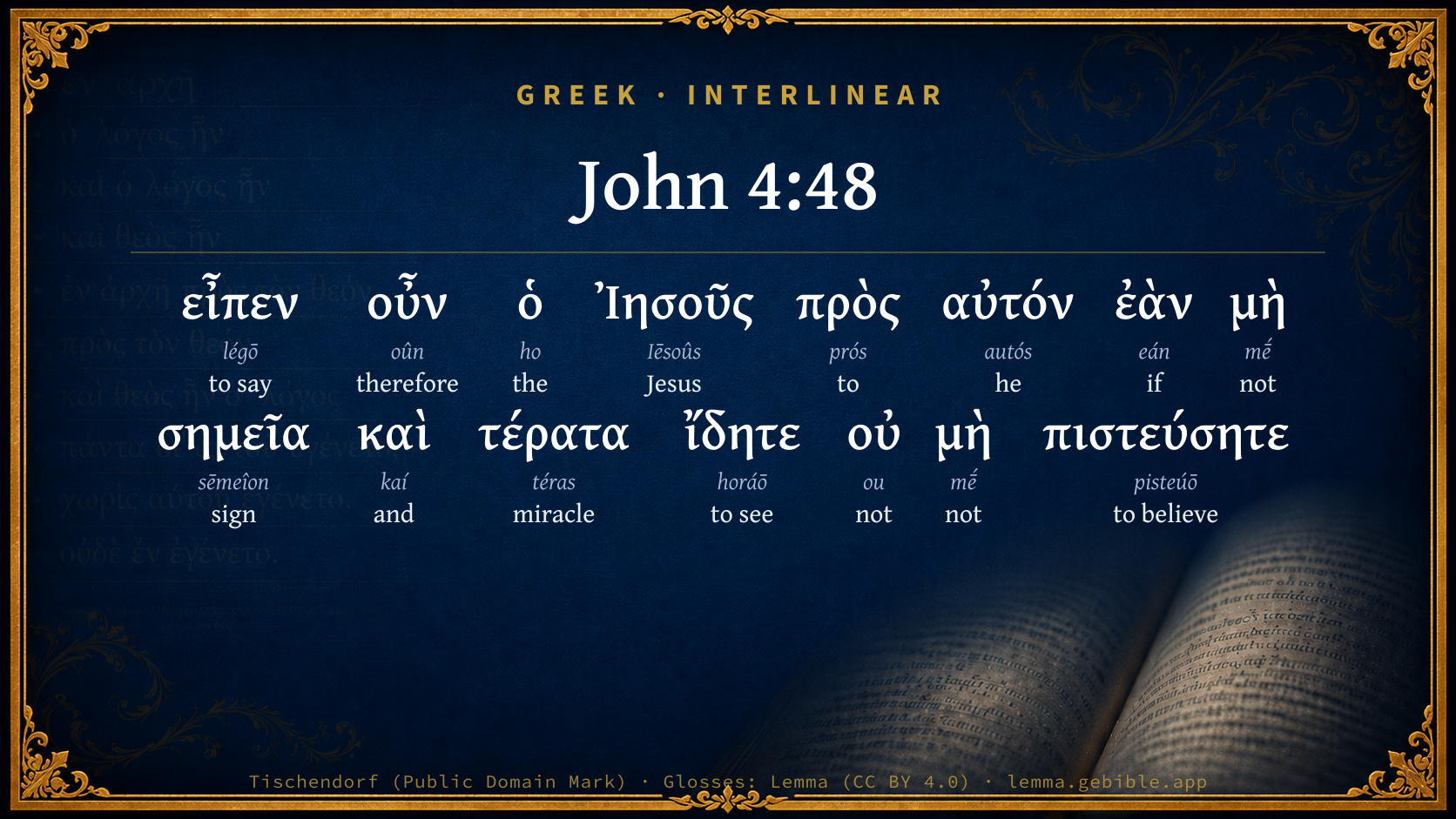
Greek (Tischendorf 8th ed.) John 4:48 appears in the Greek New Testament. The text above is from the Tischendorf 8th edition. Each word links to its Strong’s number and a concise gloss. Click any word for its full Thayer’s Greek Lexicon entry.
Download image
Cite this verse

John 4:48 (World English Bible). Public Domain. Lemma interlinear Bible study tool, https://lemma.gebible.app/v/john/4/48.

Show BibTeX & RIS
BibTeX
RIS
English Translation
Jesus therefore said to him, "Unless you see signs and wonders, you will in no way believe."
World English Bible · Public Domain
Download a study sheet

One document with this verse’s original text, its word-by-word gloss line, the meaning frame, cross-references with their text, attributed commentary, and full source and license credits — printable, and it pastes into notes with its structure intact.

This verse Autodidact and up

Study sheet (.html) Plain text (.txt)

A passage Seminary Student

Up to 50 verses in one chapter. A passage sheet keeps up to 6 commentary sources and 12 cross-references per verse, in the order this page ranks them, and says so on the sheet whenever that leaves anything out. Ask for a single verse and you get the Autodidact verse sheet above.

Everything on this page stays free to read, with no account — the sheet is a download of what is already on screen, not access to it.

Want to remove ads? Support Godless Engineer
Compare translations 3

The same verse in 3 English versions, stacked beneath the original-language interlinear above. Click any original word for its lexicon entry.

Each is an independent rendering of the whole verse — the interlinear is not word-aligned to these translations.

Highlighted words mark where these versions differ — a whole-verse word diff, not a word-by-word alignment.

  • World English Bible Public Domain
    Jesus therefore said to him, "Unless you see signs and wonders, you will in no way believe."
  • King James Version Public Domain
    Then said Jesus unto him, Except ye see signs and wonders, ye will not believe.
  • unfoldingWord Literal Text CC BY-SA 4.0
    Then Jesus said to him, “Unless you would see signs and wonders, you would certainly not believe.”

unfoldingWord Literal Text — © unfoldingWord, licensed CC BY-SA 4.0. Word-aligned USFM3 via Door43 (git.door43.org/unfoldingWord/en_ult).

Versions to compare (up to 4)

3 of 4 selected

Show all 19 translations

Every available English version of this verse, each an independent rendering of the whole verse.

  • World English Bible Public Domain
    Jesus therefore said to him, "Unless you see signs and wonders, you will in no way believe."
  • Berean Standard Bible Public Domain
    Jesus said to him, “Unless you people see signs and wonders, you will never believe.”
  • Majority Standard Bible Public Domain
    Jesus said to him, “Unless you people see signs and wonders, you will never believe.”
  • King James Version Public Domain
    Then said Jesus unto him, Except ye see signs and wonders, ye will not believe.
  • American Standard Version (1901) Public Domain
    Jesus therefore said unto him, Except ye see signs and wonders, ye will in no wise believe.
  • Revised Version (1885) Public Domain
    Jesus therefore said unto him, Except ye see signs and wonders, ye will in no wise believe.
  • Geneva Bible (1599) Public Domain
    Then saide Iesus vnto him, Except ye see signes and wonders, ye will not beleeue.
  • Douay-Rheims (1899) Public Domain
    Jesus therefore said to him: Unless you see signs and wonders, you believe not.
  • Young's Literal Translation Public Domain
    Jesus then said unto him, `If signs and wonders ye may not see, ye will not believe.'
  • Literal Standard Version CC BY-SA 4.0
    Jesus then said to him, “If you may not see signs and wonders, you will not believe.”
  • Unlocked Literal Bible CC BY-SA 4.0
    Jesus then said to him, “Unless you see signs and wonders, you will not believe.”
  • unfoldingWord Literal Text CC BY-SA 4.0
    Then Jesus said to him, “Unless you would see signs and wonders, you would certainly not believe.”
  • Darby Bible Public Domain
    Jesus therefore said to him, Unless ye see signs and wonders ye will not believe.
  • World Messianic Bible Public Domain
    Yeshua therefore said to him, “Unless you see signs and wonders, you will in no way believe.”
  • Webster's Bible Public Domain
    Then said Jesus to him, Except ye see signs and wonders, ye will not believe.
  • Free Bible Version CC BY-SA 4.0
    “Unless you see signs and wonders you people really won't trust me,” said Jesus.
  • Bible in Basic English Public Domain
    Then Jesus said to him, You will not have faith if you do not see signs and wonders.
  • Text-Critical English NT CC BY 4.0
    Then Jesus said to him, “Unless you see signs and wonders, you will certainly not believe.”
  • Tyndale New Testament (1534) Public Domain
    Then sayde Iesus vnto him: excepte ye se signes and wodres ye cannot beleve.

Literal Standard Version (2020), Covenant Press — licensed CC BY-SA 4.0. Text via the HelloAO Bible API (eBible.org). Unlocked Literal Bible (unfoldingWord) — licensed CC BY-SA 4.0. Text via the HelloAO Bible API (eBible.org). unfoldingWord Literal Text — © unfoldingWord, licensed CC BY-SA 4.0. Word-aligned USFM3 via Door43 (git.door43.org/unfoldingWord/en_ult). Free Bible Version, Dr. Jonathan Gallagher — licensed CC BY-SA 4.0. Text via the HelloAO Bible API (eBible.org).

Word by word

More ways to search: Search by grammar → Find every occurrence → Compare this word →

Practice this passage: Drill this verse → Learn its vocabulary →

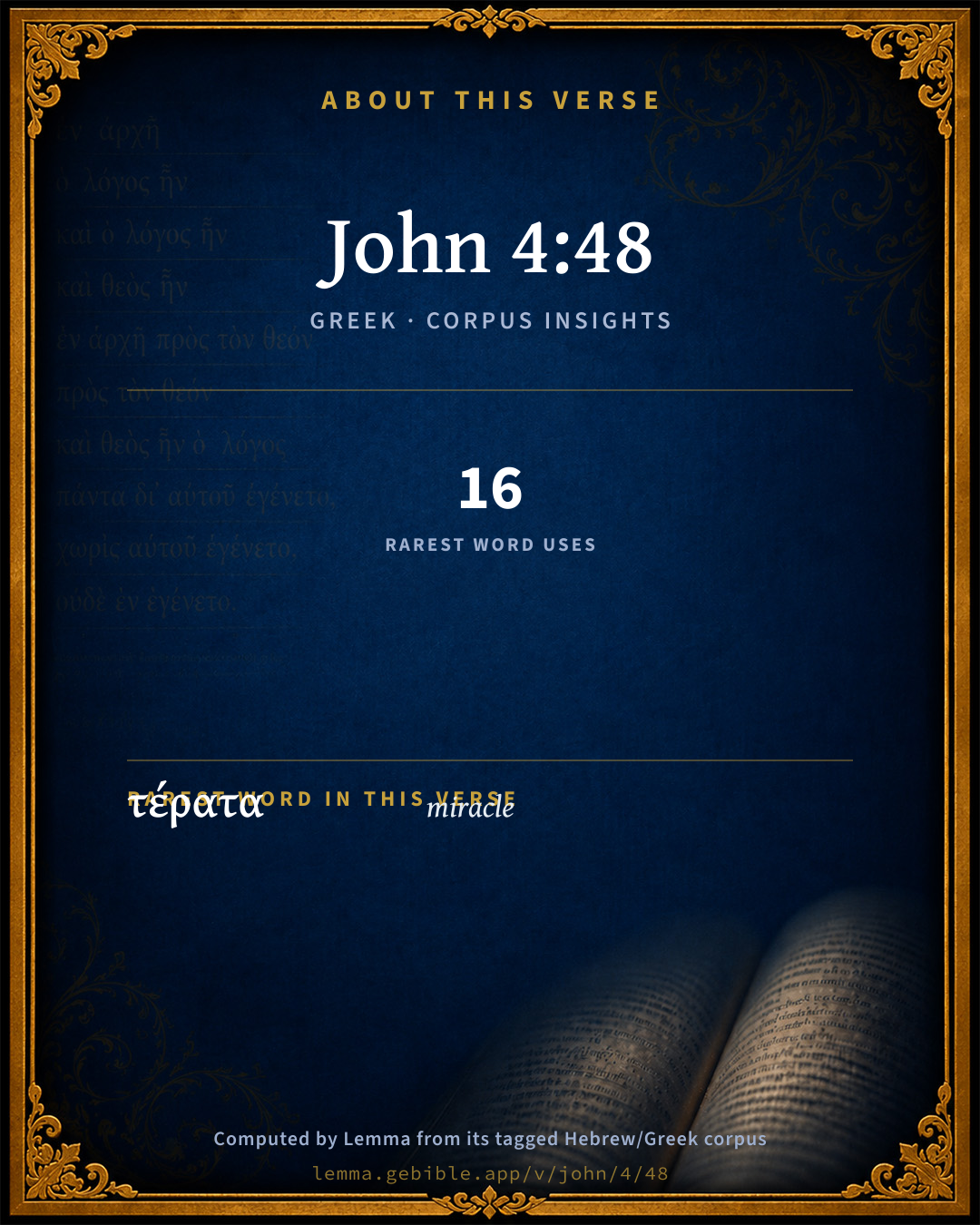
About this verse

These counts appear in no published source. They are computed here, from the morphology-tagged text and Lemma’s own curated glosses. What Lemma adds →

15
words
14
distinct lemmas
Gospels
section

Notable vocabulary

The rarest word here is τέρατα miracle G5059 — appearing just 16 times in the whole Greek New Testament.

Shared distinctive vocabulary

τέρατα miracle G5059 occurs in 16 verses of the Greek New Testament. Also found in:

Repetition

A word recurs within this verse:

Cross-references

28

Topical passages linked to John 4:48 in the Treasury of Scripture Knowledge — connected by theme and wording, ordered by reader-vote popularity; previews shown in the World English Bible.

  • John 20:29 Jesus said to him, "Because you have seen me, you have believed. Blessed are those who have not seen, and have believed."
  • 1 Corinthians 1:22 For Jews ask for signs, Greeks seek after wisdom,
  • Hebrews 2:4 God also bearing witness with them, both by signs and wonders, and by various works of power, and by gifts of the Holy Spirit, according to his own will?
  • Daniel 4:2 It has seemed good to me to show the signs and wonders that the Most High God has worked toward me.
  • John 12:37 But though he had done so many signs before them, yet they didn't believe in him,
  • Acts 2:22 "Men of Israel, hear these words! Jesus of Nazareth, a man approved by God to you by mighty works and wonders and signs which God did by him in the midst of you, even as you yourselves know,
  • Romans 15:19 in the power of signs and wonders, in the power of God's Spirit; so that from Jerusalem, and around as far as to Illyricum, I have fully preached the Gospel of Christ;
  • Matthew 24:24 For there will arise false christs, and false prophets, and they will show great signs and wonders, so as to lead astray, if possible, even the chosen ones.
  • Mark 13:22 For there will arise false christs and false prophets, and will show signs and wonders, that they may lead astray, if possible, even the chosen ones.
  • Luke 16:31 "He said to him, 'If they don't listen to Moses and the prophets, neither will they be persuaded if one rises from the dead.'"
  • Acts 14:3 Therefore they stayed there a long time, speaking boldly in the Lord, who testified to the word of his grace, granting signs and wonders to be done by their hands.
  • 2 Corinthians 12:12 Truly the signs of an apostle were worked among you in all patience, in signs and wonders and mighty works.
  • Numbers 14:11 Yahweh said to Moses, How long will this people despise me? and how long will they not believe in me, for all the signs which I have worked among them?
  • Luke 10:18 He said to them, "I saw Satan having fallen like lightning from heaven.
  • John 2:18 The Jews therefore answered him, "What sign do you show us, seeing that you do these things?"
  • John 4:41–42 Many more believed because of his word.
  • John 15:24 If I hadn't done among them the works which no one else did, they wouldn't have had sin. But now have they seen and also hated both me and my Father.
  • Acts 2:43 Fear came on every soul, and many wonders and signs were done through the apostles.
  • Acts 4:30 while you stretch out your hand to heal; and that signs and wonders may be done through the name of your holy Servant Jesus."
  • Acts 7:36 This man led them out, having worked wonders and signs in Egypt, in the Red Sea, and in the wilderness for forty years.
  • Daniel 6:27 He delivers and rescues, and he works signs and wonders in heaven and in earth, who has delivered Daniel from the power of the lions.
  • Matthew 16:1 The Pharisees and Sadducees came, and testing him, asked him to show them a sign from heaven.
  • Matthew 27:42 "He saved others, but he can't save himself. If he is the King of Israel, let him come down from the cross now, and we will believe in him.
  • Acts 2:19 I will show wonders in the sky above, And signs on the earth beneath; Blood, and fire, and billows of smoke.
  • Acts 5:12 By the hands of the apostles many signs and wonders were done among the people. They were all with one accord in Solomon's porch.
  • Acts 6:8 Stephen, full of faith and power, performed great wonders and signs among the people.
  • Acts 15:12 All the multitude kept silence, and they listened to Barnabas and Paul reporting what signs and wonders God had done among the Gentiles through them.
  • 2 Thessalonians 2:9 even he whose coming is according to the working of Satan with all power and signs and lying wonders,

Cross-references courtesy of OpenBible.info (CC BY 4.0).

Commentary

Notes on John 4:48 from classic Christian and Jewish commentators (each source and its license shown beneath its notes). The classic Christian expositions comment on the surrounding passage and are grouped to its opening verse, so a note may address several verses; the Jewish commentaries on the Tanakh (Rashi and others) are per-verse, so they appear only where the commentator wrote on this verse.

Lemma curates 59 commentaries, every one of them public domain or Creative Commons licensed, each selected and text-cleaned for this edition rather than reprinted as found. About our sources →

Tyndale Open Study Notes

Tyndale Open Resources

4:48 Jesus sharply criticized the Galileans who desired miraculous signs and wonders before they would believe (see 6:30).

Tyndale Open Study Notes — © Tyndale Open Resources, licensed CC BY-SA 4.0. Text via the HelloAO Bible API.

Bengel's Gnomon

Johann Albrecht Bengel

Joh 4:48. Ἐὰν μή, unless) Jesus implies, that He can give life to the nobleman’s son, even though the patient be absent: and He requires the nobleman to believe it, and not to require that Jesus should set out with him, as being himself about to see at the bedside of the sufferer the cure wrought on him.—ἴδητε, ye see) ch. Joh 20:29, [Jesus to Thomas] “Because thou hast seen Me, thou hast believed; blessed are they that have not seen, and yet have believed.”—οὐ μὴ πιστεύσητε, ye will not believe) i.e. A disease has fallen upon thy son, that an opportunity might be afforded Me for rendering miraculous aid, which, as ye have not seen, ye do not believe: comp. ch. Joh 11:4, [Jesus as to Lazarus] “This sickness is not unto death, but for the glory of God, that the Son of God might be glorified thereby,” wherein the address, ch. Joh 11:40, is given, somewhat in inverse order, as compared with that to the nobleman, [Jesus to Martha] “Said I not unto thee, that, if thou wouldest believe, thou shouldest see the glory of God?” There was something of the Judaic feeling, which was eagerly intent on miracles, in the nobleman, who seems to have been a Jew. This is marked by the use of the second person plural. But at the same time a miracle is promised, and faith is also first required on the nobleman’s part; and whilst it is being required, it is awakened by Jesus: comp. ch. Joh 10:37, “If I do not the works of My Father, believe Me not.” The reply, compounded of a kind of outward appearance of repulse, and a tacit promise of aid, is in consonance with the feeling of the suppliant, compounded as it was of faith and weakness.

Bengel's Gnomon of the New Testament — English translation (T&T Clark, Edinburgh, 1860) — public domain. Text from a community e-Sword module.

Jamieson, Fausset & Brown

Robert Jamieson, A. R. Fausset & David Brown

Except ye see signs, &c.--He did believe, both as his coming and his urgent entreaty show; but how imperfectly we shall see; and our Lord would deepen his faith by such a blunt and seemingly rough answer as He made to Nicodemus.

Jamieson, Fausset & Brown — Commentary Critical and Explanatory on the Whole Bible (1871) — public domain (CC PDM 1.0). Text via the HelloAO Bible API.

Adam Clarke's Commentary

Verse 48. Except ye see signs and wonders, c.] Our Lord does not tell this man that he had no faith, but that he had not enough. If he had had none, he would not have come from Capernaum to Cana, to beg him to heal his son. If he had had enough, he would have been contented with recommending his son to our Lord, without entreating him to go to Capernaum to heal him which intimates that he did not believe our Lord could do it at a distance. But the words are not addressed to the nobleman alone, but to all the Galilean Jews in general; for our Lord uses the plural number, which he never does when addressing an individual. These people differed widely from the people of Sychar: they had neither a love of the truth, nor simplicity of heart; and would not believe any thing from heaven, unless forced on their minds by the most striking miracles. They were favoured with the ministry of John Baptist; but, as that was not accompanied with miracles, it was not generally credited. They require the miracles of Christ, in order that they may credit the advent of the Messiah. There are many like these Galileans still in the world: they deny that God can have any influence among men; and as to the operations of the Holy Spirit, they, in the genuine Galilean spirit, boldly assert that they will not credit any man who professes to be made a partaker of them, unless he work a miracle in proof of his pretensions! These persons should know that the grace of working miracles was very different from that by which a man is saved; and that the former might exist, even in the most astonishing measure, where the latter did not. See 1Co 13:2.

Adam Clarke's Commentary on the Bible (1810–1826) — public domain. Text from a community e-Sword/MySword module.

Ellicott's Commentary for English Readers

(48) Signs and wonders.—See Note on Joh_2:11. The words are here addressed to Jews, for there is no reason to think that the nobleman himself was not one. They are spoken to him, but the ye extends them to others standing near and to the class of persons whom he represents. It had been so with the Jews in Jerusalem (Joh_2:18; Joh_2:23), and it was so with the Jews in Galilee. (Comp. 1Co_1:22.) How different from this faith, which demanded a miracle, and therefore was not faith, but sight, was the acceptance by the Samaritans without a miracle, who believed for the woman’s word, and more fully when they heard the word of Christ Himself.

Ye will not believe.—The negative is in its strongest form, Ye will by no means believe.

A Bible Commentary for English Readers, edited by Charles John Ellicott (1878–1897) — public domain. Text from a community e-Sword module.

The Cambridge Bible for Schools and Colleges

gen. ed. J. J. S. Perowne

48. signs and wonders] Christ’s miracles are never mere ‘wonders’ to excite astonishment; they are ‘signs’ of heavenly truths as well, and this is their primary characteristic. Where these two words are joined together ‘signs’ always precedes, excepting four passages in the Acts, where we nave ‘wonders and signs.’ This is the only passage in which S. John uses ‘wonders’ at all. In Joh_2:11 the word translated ‘miracles’ is the same as the one here translated ‘signs.’ See below, Joh_4:54.

ye will not believe] In marked contrast to the ready belief of the Samaritans. The form of negation in the Greek is of the strong kind; ye will in no wise believe. See note on 1Co_1:22. Faith based on miracles is of a low type comparatively, but Christ does not reject it. Comp. Joh_10:38, Joh_14:11, Joh_20:29. This man’s faith is strengthened by being put to test. The words are evidently addressed to him and those about him, and they imply that those addressed are Jews.

The Cambridge Bible for Schools and Colleges (gen. ed. J. J. S. Perowne; Cambridge University Press, 1878–1918) — public domain. Text from a community e-Sword module.

John Gill's Exposition

Then said Jesus unto him,.... With some degree of roughness in his speech, and severity in his countenance, in a way of reproof for his unbelief, as if he could not heal his son without going down to Capernaum along with him:

except ye see signs and wonders ye will not believe. This was the cast of the Jews every where, both in Judea and Galilee; they required signs and miracles to be wrought, in confirmation of Christ's being the Messiah, and which indeed was but right; and Christ did perform them for that purpose: but their sin of unbelief lay in this, that they wanted still more and more signs; they could not be contented with what they had seen, but required more, being sluggish and backward to believe. Our Lord seems to say this chiefly for the sake of the Galilaeans, that were about him; who, though they might be acquainted with his former miracles, when among them, of turning water into wine, and had seen his wondrous works at the feast at Jerusalem, yet were very desirous of seeing more, and perhaps very pressing for this cure.

John Gill's Exposition of the Whole Bible (1746–1763) — public domain (CC PDM 1.0). Text via the HelloAO Bible API.

Trapp's Complete Commentary

John Trapp

48 Then said Jesus unto him, Except ye see signs and wonders, ye will not believe.

Ver. 48. Except ye see signs, &c.] Our Saviour first chides him, and upon his well bearing of that, accommodates him. He saw the courtiers’ unbelief more dangerous to his soul than the disease could be to his son’s body.

John Trapp, A Commentary or Exposition upon All the Books of the Old and New Testament (1647–1656) — public domain. Text from a community e-Sword module.

Albert Barnes' Notes on the Bible

Except ye see signs ... - This was spoken not to the nobleman only, but to the Galileans generally. The Samaritans had believed without any miracle. The Galileans, he said, were less disposed to believe him than even they were; and though he had performed miracles enough to convince them, yet, unless they continually saw them, they would not believe.

Albert Barnes' Notes on the Bible (1834–1885) — public domain. Text from a community e-Sword/MySword module.

Matthew Poole's English Annotations

It may seem strange to such as do not well weigh all circumstances, that our Saviour, who at other times went without asking, showed himself so hard to be entreated by this courtier, and answereth him so roughly; but we must not take ourselves to be able to give a certain account of all Christ’s actions, and different dealings with persons, whose hearts he well enough knew. Thus much is certain, that our Saviour always preferred that faith which was given to his bare word, before that which waited for a miracle confirmative of that word, Joh 20:29. Our Saviour saw that this courtier came to him purely upon a natural account, for the recovery of his dying son, without a desire to be instructed in his heavenly doctrine; therefore (as it may be presumed) he checks this courtier; and not him alone, but the generality of the Jews, who were only struck with admiration of his works, and drawn from curiosity, or some temporal benefit, to follow him, without a due regard of his person, or the heavenly, saving truths preached by him.

Matthew Poole's English Annotations on the Holy Bible (1683–1685) — public domain. Text from a community e-Sword/MySword module.

Whedon's Commentary on the Bible

Daniel D. Whedon

48. See signs—How totally unlike the Samaritans, from whom our Lord had so freshly come; who embraced the divinity of his teachings without demanding wonders. This nobleman came, purely absorbed in his dying son, anxious for the bodily miracle, but thoughtless of the divine claims of the Saviour of sinners. It is this selfishness of spirit that Jesus now rebukes. The words of this verse are, as it were, an ejaculation, a thinking aloud of Jesus. He sees that to awaken this man he must more than heal his son; he must to that sign add an additional wonder. He must so heal him as to arouse the man to reflection, and then may come a true faith.

Daniel D. Whedon (gen. ed.), Commentary on the Old and New Testaments (1874–1909) — public domain. Text from a community e-Sword module.

The Pulpit Commentary

Then said Jesus to him as representing the whole class whose faith rested upon, and was nourished, by, the outward sign, with a certain amount of reproof if not of irony in the strength of his phraseExcept ye see (there is no special emphasis laid on the idhte , as distinct from the mere report or testimony of such things) signs and wonders, ye will by no means believe. This is the only occasion in John"s Gospel where these two terms are conjoined. They are frequently brought together in Acts, (Act_2:22, 43 4:30 5:12, etc.) and used in conjunction in Mat_24:24 Mar_13:22 Rom_15:19 2Co_12:12. John ordinarily uses (erga) "works" to denote those objective tangible facts which were "signs" (shmeia) of the Lord"s higher nature and claims. Here terata , a word meaning "portents," remarkable, inexplicable events out of the common order, accompanies "signs," to complete the notion. The craving for "signs and wonders" did absorb the higher life of Judaism. "The Jews require a sign", (1Co_1:22) and minds that are yet in the Jewish stage of partial discipline, for spiritual revelation, still do the same. There is still in many of us the weak faith which needs the stimulating diet of the "sign" before there is any full recognition of the Divine fulness of blessing. Christ does not condemn, though he mourns over, this spiritual babyhood; and while he says (Joh_10:38 Joh_14:11 Joh_15:24) that belief for the works" sake may lead up to true faith, yet the language addressed to Thomas, "Blessed are they that have not seen, and yet have believed," reveals his deepest thought of their comparative worth. The demand for "signs and wonders" in Galilee contrasts with the ready reception which the Samaritans had given to his word. Many of the difficulties of these narratives arise from the obvious fact that they are so closely compressed. Weiss has a hard task to make what he calls this "harsh answer" tally with Matthew"s account of the reception of the centurion, and of the "great faith" which in his case preceded the miracle. A single sentence in the urgent request of the nobleman, implying that at Capernaum they needed the same kind of proof that had been given at Jerusalem of the Lord"s prophetic claims, would account for all the emphasis laid upon the imperfect faith of the Galilaeans. He who "knew what was in man" knew in what way to rouse in this suppliant an adequate recognition of the Divine in himself.

The Pulpit Commentary (1880–1919), ed. H.D.M. Spence-Jones & Joseph S. Exell — public domain. Text from a community e-Sword module.

John Wesley's Explanatory Notes

Unless ye see signs and wonders - Although the Samaritans believed without them.

John Wesley, Explanatory Notes Upon the Whole Bible (1754–1765) — public domain. Text via the GEBible commentary corpus.

The People's New Testament

B. W. Johnson

48. Except ye see signs and wonders, ye will not believe. The nobleman, in his sore distress, had some faith, caused only by the fame of the “signs and wonders” wrought. His faith was still imperfect, far below the holy trust of the Samaritans. He is the type of a class whose belief depended on outward signs.

B. W. Johnson's The People's New Testament with Notes (1889–1891) — public domain. Electronic text from the Christian Classics Ethereal Library (CCEL) ThML edition.

unfoldingWord translationNotes

Door43 World Missions Community

Unless you see signs and wonders, you will not believe

"Unless ... not believe" here is a double negative. In some languages it is more natural to translate this statement in a positive form. AT: "Only if you see a miracle will you believe" (See: Double Negatives)

believed the word

Here "word" is a metonym that refers to the message that Jesus spoke. AT: "believed the message" (See: Metonymy)

translationWords

miracle

Jesus

believe

children

die

son

unfoldingWord translationNotes — © Distant Shores Media and the Door43 World Missions Community, licensed CC BY-SA 4.0. Source: git.door43.org/Door43/en_tn.

Cambridge Greek Testament for Schools and Colleges

48. σημεῖα κ. τέρατα. Christ’s miracles are never mere τέρατα, wonders to excite astonishment; they are ‘signs’ of heavenly truths as well, and this is their primary characteristic. Where the two words are combined σημεῖα always precedes, excepting Act 2:22; Act 2:43; Act 6:8; Act 7:36. S. John nowhere else uses τέρατα: his words for miracles are σημεῖα and ἔργα.

οὐ μὴ πιστεύσητε. Strongest negation (Joh 4:14). Ye will in no wise believe: or interrogatively; Will ye in no wise believe? Comp. οὐ μὴ πίω; Joh 18:11. The words are addressed to him (πρὸς αὐτόν), but as the representative of the many who demanded a sign before believing (see on 1Co 1:22). Faith of this low type is not rejected (Joh 10:38, Joh 14:11, Joh 20:29); it may grow into something better, as here, by being tested and braced (Joh 4:50). But it may also go back into sheer unbelief, as with most of those who were won over by His miracles. The verse tells of the depressing change which Christ experienced in returning from Samaria to the land of Israel.

Cambridge Greek Testament for Schools and Colleges (Cambridge University Press, 1896; 21 vols, various authors incl. Carr, Maclear, Plummer, Farrar, Lumby, Moule, M. R. James, Simcox) — public domain. Text from a community e-Sword module.

Alford’s Greek Testament

Henry Alford

48.] This miracle is a notable instance of our Lord ‘not quenching the smoking flax:’ just as His reproof of the Samaritan woman was of His ‘not breaking the bruised reed.’ The little spark of faith in the breast of this nobleman is by Him lit up into a clear and enduring flame for the light and comfort of himself and his house.

καταβῇ] See on ch. 2:12.

The charge brought against them, ἐὰν μὴ κ.τ.λ., does not imply, as some (Raphel and Storr) think, that they would not believe signs and wonders heard of, but required to see them (thus laying the stress on ἴδητε)—for in this case the expression would certainly have been fuller, ἴδητε τοῖς ὀφθαλμοῖς, or something similar;—and it would not accord with our Lord’s known low estimate of all mere miracle-faith, to find Him making so weighty a difference between faith from miracles seen and faith from miracles heard. The words imply the contrast between the Samaritans, who believed because of His word, and the Jews (the plural reckoning the βασιλικός among them), who would not believe but through signs and prodigies: see 1Co 1:22. And observe also that it is not implied that even when they had seen signs and wonders, they would believe:—the required these as a condition of their faith, but even these were rejected by them: see ch. 12:37.

But even with such inadequate conception and conditions of faith, our Lord receives the nobleman, and works the sign rather than dismiss him. It was otherwise in Mat 16:1 ff.

Henry Alford, The Greek Testament (1849–1861) — public domain. Text from a community e-Sword module.

International Critical Commentary

48. εἶπεν ὁ Ἰ. πρὸς αὐτόν. For the constr. of λέγειν here and at v. 49, see on 2:3.

The answer of Jesus was neither “Yes” nor “No.” It almost conveys a feeling of disappointment that the working of “signs” should be expected of Him. The Samaritan villagers had accepted Him because of His words alone, without any signs (4:41, 42).

The collocation σημεῖα καὶ τέρατα does not occur again in Jn., but it is frequent in the Greek Bible (Exo 7:3, Isa 8:18, Isa 20:3, Dan 4:2, Dan 4:3, Dan 4:6:27, Mat 24:24, Mar 13:22, Act 2:19, Act 2:22, Act 2:43, Act 2:4:30, Act 2:5:12, Act 2:6:8, Act 2:7:36, Act 2:14:3, Act 2:15:12, Rom 15:19, 2Co 12:12, 2Th 2:9, Heb 2:4). τέρας, “a prodigy,” never occurs in the N.T. except in conjunction with σημεῖον. No doubt a σημεῖον need not be miraculous, but the Jews, like all the peoples of early ages, were more ready to see the Divine power in what seemed to be “supernatural” than in the “natural” order; and it is not likely that they would have distinguished sharply a σημεῖον from a τέρας. Jn. is specially prone to use the word σημεῖον when speaking of the “works” of Jesus (see Introd., p. clxxvi, and also on 2:11, where the relation between faith and “signs” in the Fourth Gospel is considered).

οὐ μὴ πιστεύσητε. This might be interrogative: “Will you not believe without signs?” But more probably it is categorical: “You will not believe, etc.” That the Jews “seek signs” (1Co 1:22) was as true at Cana as in Jerusalem. The plural πιστεύσητε may indicate that the words, although addressed to an individual, include in their reference a whole class of people to which the nobleman belonged.

International Critical Commentary — older volumes (1896–1929), various authors — public domain. Text from a community e-Sword module.

Godet's Commentaries

Frédéric Louis Godet

Ver. 48. “Jesus therefore said to him: Unless ye see signs and wonders ye will in no wise believe.”

This reply of Jesus is perplexing; for it seems to suppose that this man asked for the miracle to the end of believing, which is certainly not the case. But the difficulty is explained by the plurals, ye see, ye will believe, which prove that this expression is not the reply to the father’s request, but a reflection which He makes on occasion of that request. It is true, He addresses the remark to the man who is the occasion of it (πρὸς αὐτόν), but He speaks thus, with reference to all the Galilean people, whose moral tendency this man represents, to His view, at this moment. Indeed, the disposition which Jesus thus meets at the moment when He sets foot again on Israelitish soil, is the tendency to see in Him only a thaumaturge (worker of miracles); and He is so much the more painfully affected since He has just passed two days in Samaria, in contact with an altogether opposite spirit. There, it was as the Saviour of souls that He was welcomed. Here, it is bodily cures which are immediately asked of Him. He seems to be fit for nothing but to heal. And He is obliged to confess—such is the true meaning of His word— that if He refuses to play this part, there is reason to fear that no one will believe, or rather, according to the slightly ironical turn of expression of which He makes use (οὐ μή), “that it is not to be feared that any one will believe.”

There is likewise the expression of a painful feeling in the accumulation of the two nearly synonymous terms σημεῖα and τέρατα, signs and wonders.The first designates the miracle as related to the fact of the invisible world which it manifests; the second characterizes it as related to external nature, whose laws it sets at defiance. The latter term, therefore, brings out with more force the sensible character of the supernatural manifestation. The meaning, therefore, is: “You must have signs; and you are not satisfied unless these signs have the character of wonders.” Some have found in ἴδητε, ye see, an allusion to the request which is addressed to Him to go personally to the sick person, which proves, it is said, that the father wishes to see the healing with his own eyes. But in that case ἴδητε ought to stand at the beginning; and the meaning is forced.

Frédéric Louis Godet — Commentaries on Luke, John, Romans, and 1 Corinthians — English translation (T&T Clark, Edinburgh, 1870s–1890s) — public domain. Text from a community e-Sword module.

Lesson kit

Teaching starters — assembled from the data on this page, not authored interpretation. Every prompt links to the verse data it draws on. Edit before teaching.

John, in the Gospels, opens this verse with 15 words (14 distinct Greek lemmas). Its most distinctive word is téras (“miracle”). A historical commentator’s framing appears above. Read the whole chapter for the surrounding context.

Discussion questions

  1. How does “miracle” (téras) shape what this verse is saying?
  2. How does Matthew 24:24, which shares the word «miracle», read alongside this verse?
  3. What does the repetition of “not” (2× in this one verse) do in this verse?
  4. These translations render this verse differently. What is at stake in choosing one wording over another?
  5. Compare how Tyndale Open Study Notes and Bengel's Gnomon read this verse. Where do they agree or differ?

Things to notice

Reading settings

Reading text

Shown beneath each verse's original-language words.

Old Testament
Old Testament edition

Read the OT as the Masoretic Hebrew (MT) or the Greek Septuagint (LXX).

English shown for the Greek Septuagint (in the Hebrew ↔ Greek comparison).

Comparing translations? Open the Compare panel on any verse page to stack up to four side by side.