

John 3:29
Greek (Tischendorf 8th ed.) John 3:29 appears in the Greek New Testament. The text above is from the Tischendorf 8th edition. Each word links to its Strong’s number and a concise gloss. Click any word for its full Thayer’s Greek Lexicon entry.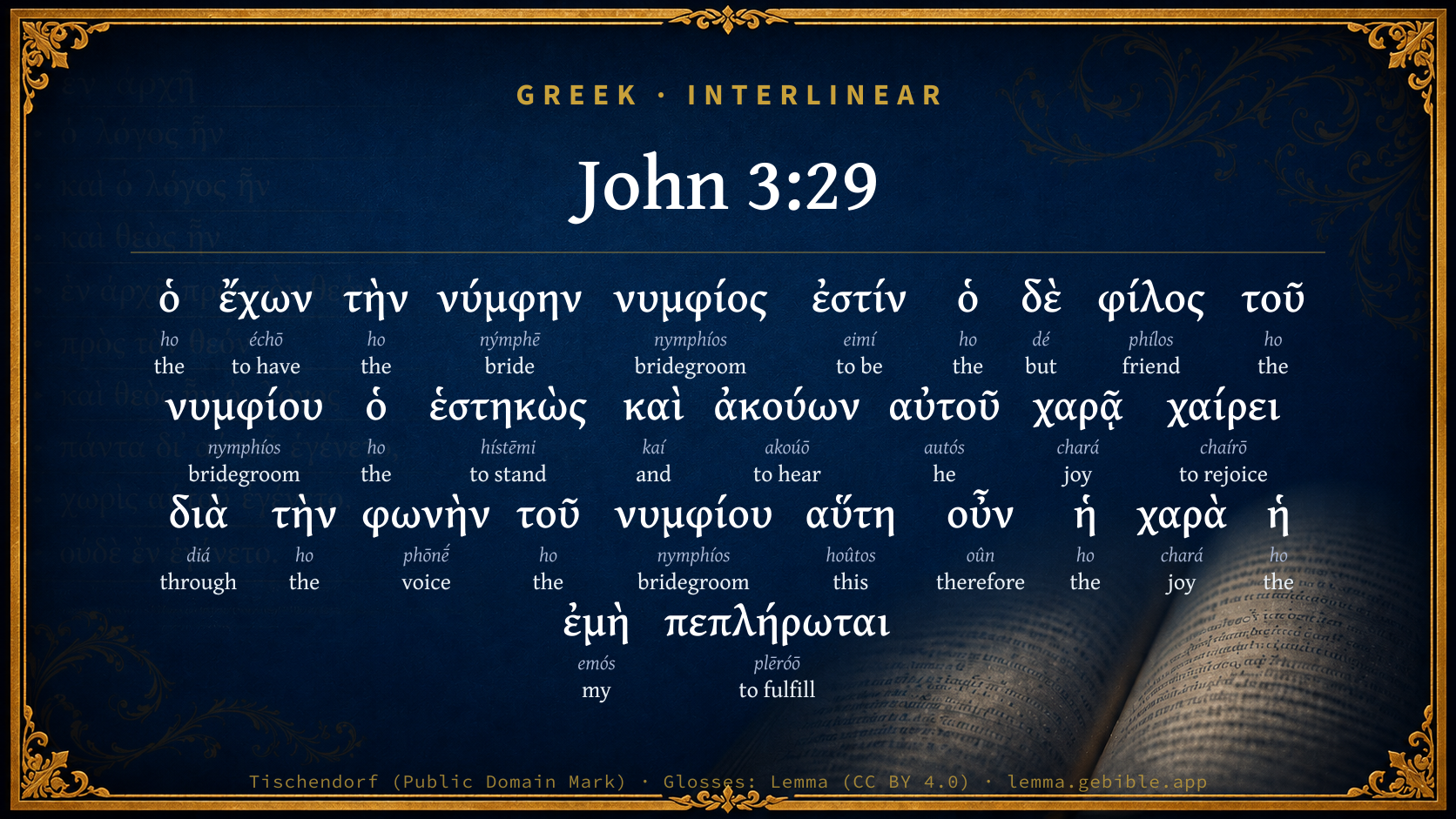
He who has the bride is the bridegroom; but the friend of the bridegroom, who stands and hears him, rejoices greatly because of the bridegroom's voice. This, my joy, therefore is made full.
Download a study sheet
One document with this verse’s original text, its word-by-word gloss line, the meaning frame, cross-references with their text, attributed commentary, and full source and license credits — printable, and it pastes into notes with its structure intact.
This verse Autodidact and up
A passage Seminary Student
Up to 50 verses in one chapter. A passage sheet keeps up to 6 commentary sources and 12 cross-references per verse, in the order this page ranks them, and says so on the sheet whenever that leaves anything out. Ask for a single verse and you get the Autodidact verse sheet above.
Everything on this page stays free to read, with no account — the sheet is a download of what is already on screen, not access to it.
Compare translations 3
The same verse in 3 English versions, stacked beneath the original-language interlinear above. Click any original word for its lexicon entry.
Each is an independent rendering of the whole verse — the interlinear is not word-aligned to these translations.
Highlighted words mark where these versions differ — a whole-verse word diff, not a word-by-word alignment.
-
World English Bible Public Domain
He who has the bride is the bridegroom; but the friend of the bridegroom, who stands and hears him, rejoices greatly because of the bridegroom's voice. This, my joy, therefore is made full.
-
King James Version Public Domain
He that hath the bride is the bridegroom: but the friend of the bridegroom, which standeth and heareth him, rejoiceth greatly because of the bridegroom's voice: this my joy therefore is fulfilled.
-
unfoldingWord Literal Text CC BY-SA 4.0
The one having the bride is the bridegroom. But the friend of the bridegroom, the one having stood and hearing him, rejoices with joy because of the voice of the bridegroom. Therefore, this my joy has been made complete.
unfoldingWord Literal Text — © unfoldingWord, licensed CC BY-SA 4.0. Word-aligned USFM3 via Door43 (git.door43.org/unfoldingWord/en_ult).
Show all 19 translations
Every available English version of this verse, each an independent rendering of the whole verse.
-
World English Bible Public Domain
He who has the bride is the bridegroom; but the friend of the bridegroom, who stands and hears him, rejoices greatly because of the bridegroom's voice. This, my joy, therefore is made full.
-
Berean Standard Bible Public Domain
The bride belongs to the bridegroom. The friend of the bridegroom stands and listens for him, and is overjoyed to hear the bridegroom’s voice. That joy is mine, and it is now complete.
-
Majority Standard Bible Public Domain
The bride belongs to the bridegroom. The friend of the bridegroom stands and listens for him, and is overjoyed to hear the bridegroom’s voice. That joy is mine, and it is now complete.
-
King James Version Public Domain
He that hath the bride is the bridegroom: but the friend of the bridegroom, which standeth and heareth him, rejoiceth greatly because of the bridegroom's voice: this my joy therefore is fulfilled.
-
American Standard Version (1901) Public Domain
He that hath the bride is the bridegroom: but the friend of the bridegroom, that standeth and heareth him, rejoiceth greatly because of the bridegroom's voice: this my joy therefore is made full.
-
Revised Version (1885) Public Domain
He that hath the bride is the bridegroom: but the friend of the bridegroom, which standeth and heareth him, rejoiceth greatly because of the bridegroom’s voice: this my joy therefore is fulfilled.
-
Geneva Bible (1599) Public Domain
He that hath the bride, is the bridegrome: but the friend of the bridegrome which standeth and heareth him, reioyceth greatly, because of the bridegromes voyce. This my ioy therefore is fulfilled.
-
Douay-Rheims (1899) Public Domain
He that hath the bride, is the bridegroom: but the friend of the bridegroom, who standeth and heareth him, rejoiceth with joy because of the bridegroom's voice. This my joy therefore is fulfilled.
-
Young's Literal Translation Public Domain
he who is having the bride is bridegroom, and the friend of the bridegroom, who is standing and hearing him, with joy doth rejoice because of the voice of the bridegroom; this, then, my joy hath been fulfilled.
-
Literal Standard Version CC BY-SA 4.0
He who is having the bride is bridegroom, and the friend of the bridegroom, who is standing and hearing Him, rejoices with joy because of the voice of the bridegroom; this, then, my joy has been fulfilled.
-
Unlocked Literal Bible CC BY-SA 4.0
The bride belongs to the bridegroom. Now the friend of the bridegroom, who stands and hears him, rejoices greatly because of the voice of the bridegroom. This, then, is my joy made complete.
-
unfoldingWord Literal Text CC BY-SA 4.0
The one having the bride is the bridegroom. But the friend of the bridegroom, the one having stood and hearing him, rejoices with joy because of the voice of the bridegroom. Therefore, this my joy has been made complete.
-
Darby Bible Public Domain
He that has the bride is the bridegroom; but the friend of the bridegroom, who stands and hears him, rejoices in heart because of the voice of the bridegroom: this my joy then is fulfilled.
-
World Messianic Bible Public Domain
He who has the bride is the bridegroom; but the friend of the bridegroom, who stands and hears him, rejoices greatly because of the bridegroom’s voice. Therefore my joy is made full.
-
Webster's Bible Public Domain
He that hath the bride, is the bridegroom: but the friend of the bridegroom, who standeth and heareth him, rejoiceth greatly, because of the bridegroom's voice: this my joy therefore is fulfilled.
-
Free Bible Version CC BY-SA 4.0
The bridegroom is the one who has the bride! The best man waits, listening for the bridegroom, and is so happy when he hears the bridegroom's voice—in the same way my happiness is now complete.
-
Bible in Basic English Public Domain
He who has the bride is the husband: but the husband's friend, whose place is by his side and whose ears are open to him, is full of joy because of the husband's voice: such is my joy, and it is complete.
-
Text-Critical English NT CC BY 4.0
He who has the bride is the bridegroom. But the friend of the bridegroom, who stands and listens for him, rejoices greatly at the bridegroom's voice. So this joy of mine has been made full.
-
Tyndale New Testament (1534) Public Domain
He that hath the bryde is the brydegrome. But the frende of the brydegrome which stondeth by and heareth him reioyseth greately of the brydgromes voyce. Tis my ioye is fulfilled.
Literal Standard Version (2020), Covenant Press — licensed CC BY-SA 4.0. Text via the HelloAO Bible API (eBible.org). Unlocked Literal Bible (unfoldingWord) — licensed CC BY-SA 4.0. Text via the HelloAO Bible API (eBible.org). unfoldingWord Literal Text — © unfoldingWord, licensed CC BY-SA 4.0. Word-aligned USFM3 via Door43 (git.door43.org/unfoldingWord/en_ult). Free Bible Version, Dr. Jonathan Gallagher — licensed CC BY-SA 4.0. Text via the HelloAO Bible API (eBible.org).
Word by word
More ways to search: Search by grammar → Find every occurrence → Compare this word →
Practice this passage: Drill this verse → Learn its vocabulary →
- Appears 8× in the Greek New Testament
- First appears at Matthew 10:35
- Part of Speech
- Noun
- Case
- Accusative
- Number
- Singular
- Gender
- Feminine
Full Thayer's Definition
- ὁ ho G3588 “the” Article, Nominative, Singular, Masculine
- ἔχων échō G2192 “to have” Verb, Present, Active, Participle, Nominative, Singular, Masculine
- τὴν ho G3588 “the” Article, Accusative, Singular, Feminine
- νύμφην nýmphē G3565 “bride” Noun, Accusative, Singular, Feminine
- νυμφίος nymphíos G3566 “bridegroom” Noun, Nominative, Singular, Masculine
- ἐστίν eimí G1510 “to be” Verb, Present, Active, Indicative, 3rd person, Singular
- ὁ ho G3588 “the” Article, Nominative, Singular, Masculine
- δὲ dé G1161 “but” Conjunction
- φίλος phílos G5384 “friend” Adjective, Nominative, Singular, Masculine
- τοῦ ho G3588 “the” Article, Genitive, Singular, Masculine
- νυμφίου nymphíos G3566 “bridegroom” Noun, Genitive, Singular, Masculine
- ὁ ho G3588 “the” Article, Nominative, Singular, Masculine
- ἑστηκὼς hístēmi G2476 “to stand” Verb, Perfect, Active, Participle, Nominative, Singular, Masculine
- καὶ kaí G2532 “and” Conjunction
- ἀκούων akoúō G191 “to hear” Verb, Present, Active, Participle, Nominative, Singular, Masculine
- αὐτοῦ autós G846 “he” Personal pronoun, Genitive, Singular, Masculine
- χαρᾷ chará G5479 “joy” Noun, Dative, Singular, Feminine
- χαίρει chaírō G5463 “to rejoice” Verb, Present, Active, Indicative, 3rd person, Singular
- διὰ diá G1223 “through” Preposition
- τὴν ho G3588 “the” Article, Accusative, Singular, Feminine
- φωνὴν phōnḗ G5456 “voice” Noun, Accusative, Singular, Feminine
- τοῦ ho G3588 “the” Article, Genitive, Singular, Masculine
- νυμφίου nymphíos G3566 “bridegroom” Noun, Genitive, Singular, Masculine
- αὕτη hoûtos G3778 “this” Demonstrative pronoun, Nominative, Singular, Feminine
- οὖν oûn G3767 “therefore” Conjunction
- ἡ ho G3588 “the” Article, Nominative, Singular, Feminine
- χαρὰ chará G5479 “joy” Noun, Nominative, Singular, Feminine
- ἡ ho G3588 “the” Article, Nominative, Singular, Feminine
- ἐμὴ emós G1699 “my” Possessive pronoun, 1st person, Nominative, Singular, Feminine
- πεπλήρωται plēróō G4137 “to fulfill” Verb, Perfect, Passive, Indicative, 3rd person, Singular
About this verse
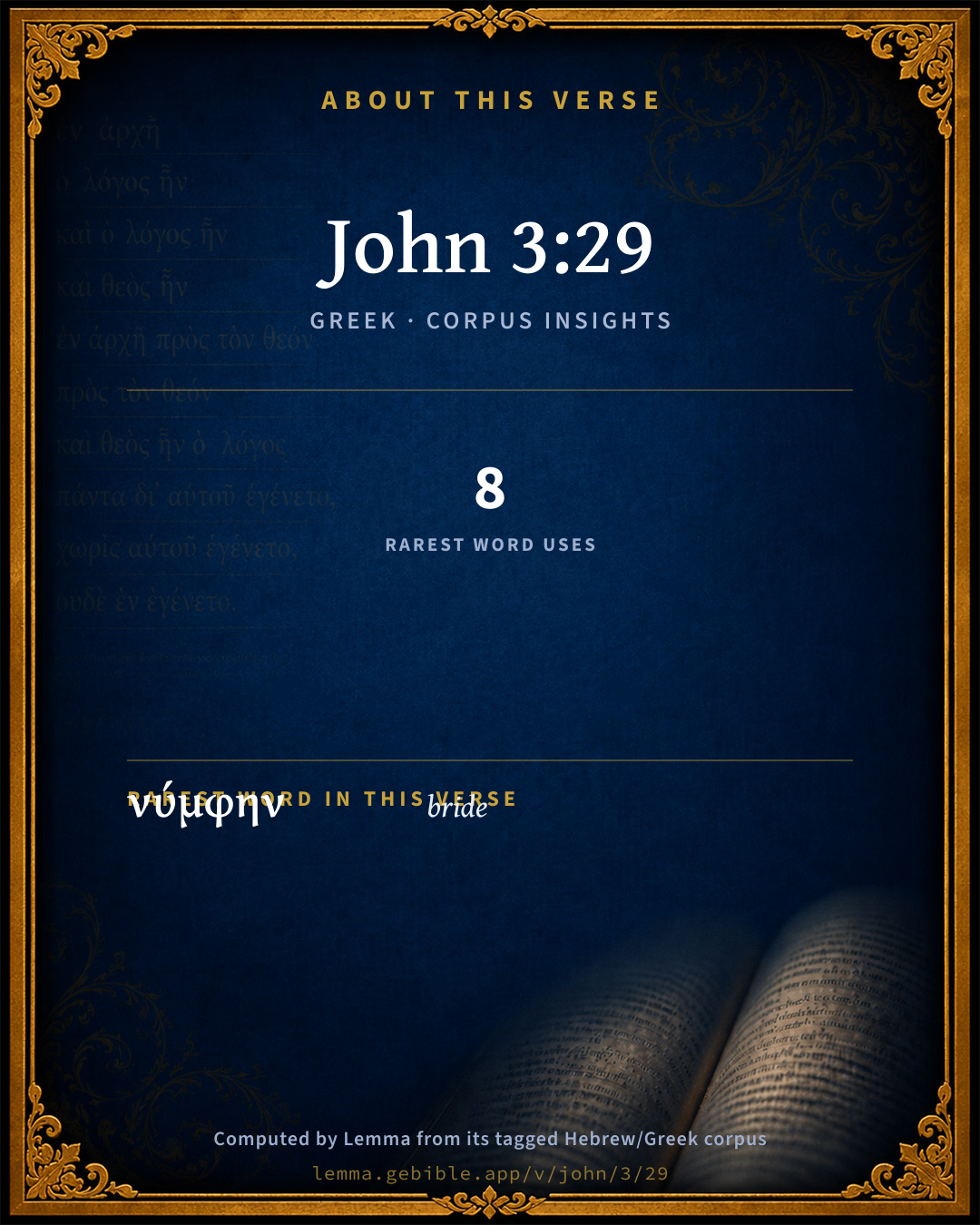
These counts appear in no published source. They are computed here, from the morphology-tagged text and Lemma’s own curated glosses. What Lemma adds →
- 30
- words
- 19
- distinct lemmas
- Gospels
- section
Cross-references
25Topical passages linked to John 3:29 in the Treasury of Scripture Knowledge — connected by theme and wording, ordered by reader-vote popularity; previews shown in the World English Bible.
- Hosea 2:19 I will betroth you to me forever. Yes, I will betroth you to me in righteousness, in justice, in loving kindness, and in compassion.
- Isaiah 54:5 For your Maker is your husband; Yahweh of Hosts is his name: and the Holy One of Israel is your Redeemer; the God of the whole earth shall he be called.
- Matthew 9:15 Jesus said to them, "Can the friends of the bridegroom mourn, as long as the bridegroom is with them? But the days will come when the bridegroom will be taken away from them, and then they will fast.
- Ephesians 5:25–27 Husbands, love your wives, even as Christ also loved the assembly, and gave himself up for it;
- Ezekiel 16:8 Now when I passed by you, and looked at you, behold, your time was the time of love; and I spread my skirt over you, and covered your nakedness: yes, I swore to you, and entered into a covenant with you, says the Lord Yahweh, and you became mine.
- Revelation 19:7–9 Let us rejoice and be exceedingly glad, and let us give the glory to him. For the marriage of the Lamb has come, and his wife has made herself ready."
- Revelation 21:9 One of the seven angels who had the seven bowls, who were loaded with the seven last plagues came, and he spoke with me, saying, "Come here. I will show you the wife, the Lamb's bride."
- Philippians 2:2 make my joy full, by being like-minded, having the same love, being of one accord, of one mind;
- John 16:24 Until now, you have asked nothing in my name. Ask, and you will receive, that your joy may be made full.
- 2 Corinthians 11:2 For I am jealous over you with a godly jealousy. For I married you to one husband, that I might present you as a pure virgin to Christ.
- Song of Solomon 5:1 I have come into my garden, my sister, my bride. I have gathered my myrrh with my spice; I have eaten my honeycomb with my honey; I have drunk my wine with my milk. Friends Eat, friends! Drink, yes, drink abundantly, beloved. Beloved
- Luke 15:6 When he comes home, he calls together his friends and his neighbors, saying to them, 'Rejoice with me, for I have found my sheep which was lost!'
- 1 John 1:4 And we write these things to you, that our joy may be fulfilled.
- Song of Solomon 4:8–12 Come with me from Lebanon, my bride, With me from Lebanon. Look from the top of Amana, From the top of Senir and Hermon, From the lions' dens, From the mountains of the leopards.
- Matthew 25:1 "Then the Kingdom of Heaven will be like ten virgins, who took their lamps, and went out to meet the bridegroom.
- Luke 2:10–14 The angel said to them, "Don't be afraid, for behold, I bring you good news of great joy which will be to all the people.
- Isaiah 62:4–5 You shall no more be termed Forsaken; neither shall your land any more be termed Desolate: but you shall be called Hephzibah, and your land Beulah; for Yahweh delights in you, and your land shall be married.
- Isaiah 66:11 that you may suck and be satisfied with the breasts of her consolations; that you may milk out, and be delighted with the abundance of her glory.
- Jeremiah 2:2 Go, and cry in the ears of Jerusalem, saying, Thus says Yahweh, I remember for you the kindness of your youth, the love of your weddings; how you went after me in the wilderness, in a land that was not sown.
- Judges 14:10–11 His father went down to the woman: and Samson made there a feast; for so used the young men to do.
- Song of Solomon 3:11 Go forth, you daughters of Zion, and see king Solomon, With the crown with which his mother has crowned him, In the day of his weddings, In the day of the gladness of his heart. Lover
- Matthew 22:2 "The Kingdom of Heaven is like a certain king, who made a marriage feast for his son,
- John 17:13 But now I come to you, and I say these things in the world, that they may have my joy made full in themselves.
- 2 John 1:12 Having many things to write to you, I don't want to do so with paper and ink, but I hope to come to you, and to speak face to face, that our joy may be made full.
- Psalms 45:9–17 Kings' daughters are among your honorable women. At your right hand the queen stands in gold of Ophir.
Cross-references courtesy of OpenBible.info (CC BY 4.0).
Lesson kit
Teaching starters — assembled from the data on this page, not authored interpretation. Every prompt links to the verse data it draws on. Edit before teaching.
John, in the Gospels, opens this verse with 30 words (19 distinct Greek lemmas). Its most distinctive word is nýmphē (“bride”). A historical commentator’s framing appears above. Read the whole chapter for the surrounding context.
Discussion questions
- What does “bride” (nýmphē) contribute to the verse as a whole?
- How does Matthew 10:35, which shares the word «bride», read alongside this verse?
- What does the repetition of “bridegroom” (3× in this one verse) do in this verse?
- The translations on this page render this verse differently — a whole-verse word diff, not a word-by-word alignment. What might account for the different wordings?
- Compare how The Biblical Illustrator and Tyndale Open Study Notes read this verse. Where do they agree or differ?
Things to notice
- These translations choose different wording for 20 words in this verse.
- “bridegroom” occurs 3× in this single verse.
- 19 distinct Greek lemmas span 30 words in this verse.
Commentary
Notes on John 3:29 from classic Christian and Jewish commentators (each source and its license shown beneath its notes). The classic Christian expositions comment on the surrounding passage and are grouped to its opening verse, so a note may address several verses; the Jewish commentaries on the Tanakh (Rashi and others) are per-verse, so they appear only where the commentator wrote on this verse.
Lemma curates 59 commentaries, every one of them public domain or Creative Commons licensed, each selected and text-cleaned for this edition rather than reprinted as found. About our sources →
The Biblical Illustrator
Joseph S. Exell
The Biblical Illustrator, edited by Joseph S. Exell (c. 1880s–1900s) — public domain. Text from a community e-Sword module.
Tyndale Open Study Notes
Tyndale Open Resources
Tyndale Open Study Notes — © Tyndale Open Resources, licensed CC BY-SA 4.0. Text via the HelloAO Bible API.
Bengel's Gnomon
Johann Albrecht Bengel
Bengel's Gnomon of the New Testament — English translation (T&T Clark, Edinburgh, 1860) — public domain. Text from a community e-Sword module.
Meyer's Critical & Exegetical Commentary
Heinrich August Wilhelm Meyer
Meyer — Critical and Exegetical Commentary on the New Testament — English translation by Peter Christie, edited by Frederick Crombie (T&T Clark, 1880) — public domain. Text from a community e-Sword module.
Expositor's Greek Testament
ed. W. Robertson Nicoll
The Expositor's Greek Testament, edited by W. Robertson Nicoll (1897–1910) — public domain. Text from a community e-Sword module.
Adam Clarke's Commentary
Adam Clarke's Commentary on the Bible (1810–1826) — public domain. Text from a community e-Sword/MySword module.
John Calvin's Commentaries
John Calvin's Commentaries (1540-1563) — public domain. Text from the Calvin Translation Society English edition (1840s-50s) via the Christian Classics Ethereal Library (ccel.org). Calvin's coverage is partial (roughly two-thirds of the Bible); uncommented books and verses are honest gaps, never fabricated. The 19th-century editor's footnotes and remarks are omitted so the notes are faithfully Calvin's own voice.
Ellicott's Commentary for English Readers
A Bible Commentary for English Readers, edited by Charles John Ellicott (1878–1897) — public domain. Text from a community e-Sword module.
The Cambridge Bible for Schools and Colleges
gen. ed. J. J. S. Perowne
The Cambridge Bible for Schools and Colleges (gen. ed. J. J. S. Perowne; Cambridge University Press, 1878–1918) — public domain. Text from a community e-Sword module.
John Gill's Exposition
John Gill's Exposition of the Whole Bible (1746–1763) — public domain (CC PDM 1.0). Text via the HelloAO Bible API.
Trapp's Complete Commentary
John Trapp
John Trapp, A Commentary or Exposition upon All the Books of the Old and New Testament (1647–1656) — public domain. Text from a community e-Sword module.
Albert Barnes' Notes on the Bible
Albert Barnes' Notes on the Bible (1834–1885) — public domain. Text from a community e-Sword/MySword module.
Haydock's Catholic Bible Commentary
George Leo Haydock (1774–1849), Haydock's Catholic Family Bible and Commentary, 1859 edition — public domain. Excludes Psalms (Douay-Rheims chapter numbering differs from Protestant) and Deuterocanonical books (Catholic canon only).
Matthew Poole's English Annotations
Matthew Poole's English Annotations on the Holy Bible (1683–1685) — public domain. Text from a community e-Sword/MySword module.
Whedon's Commentary on the Bible
Daniel D. Whedon
Daniel D. Whedon (gen. ed.), Commentary on the Old and New Testaments (1874–1909) — public domain. Text from a community e-Sword module.
The Pulpit Commentary
The Pulpit Commentary (1880–1919), ed. H.D.M. Spence-Jones & Joseph S. Exell — public domain. Text from a community e-Sword module.
John Wesley's Explanatory Notes
John Wesley, Explanatory Notes Upon the Whole Bible (1754–1765) — public domain. Text via the GEBible commentary corpus.
unfoldingWord translationNotes
Door43 World Missions Community
unfoldingWord translationNotes — © Distant Shores Media and the Door43 World Missions Community, licensed CC BY-SA 4.0. Source: git.door43.org/Door43/en_tn.
Cambridge Greek Testament for Schools and Colleges
Cambridge Greek Testament for Schools and Colleges (Cambridge University Press, 1896; 21 vols, various authors incl. Carr, Maclear, Plummer, Farrar, Lumby, Moule, M. R. James, Simcox) — public domain. Text from a community e-Sword module.
Alford’s Greek Testament
Henry Alford
Henry Alford, The Greek Testament (1849–1861) — public domain. Text from a community e-Sword module.
International Critical Commentary
International Critical Commentary — older volumes (1896–1929), various authors — public domain. Text from a community e-Sword module.
Vincent's Word Studies in the New Testament
Marvin R. Vincent
Marvin R. Vincent, Word Studies in the New Testament (1887–1900) — public domain. Text from a community e-Sword/MySword module.
Godet's Commentaries
Frédéric Louis Godet
Frédéric Louis Godet — Commentaries on Luke, John, Romans, and 1 Corinthians — English translation (T&T Clark, Edinburgh, 1870s–1890s) — public domain. Text from a community e-Sword module.