
John 4:14

Greek (Tischendorf 8th ed.) John 4:14 appears in the Greek New Testament. The text above is from the Tischendorf 8th edition. Each word links to its Strong’s number and a concise gloss. Click any word for its full Thayer’s Greek Lexicon entry.
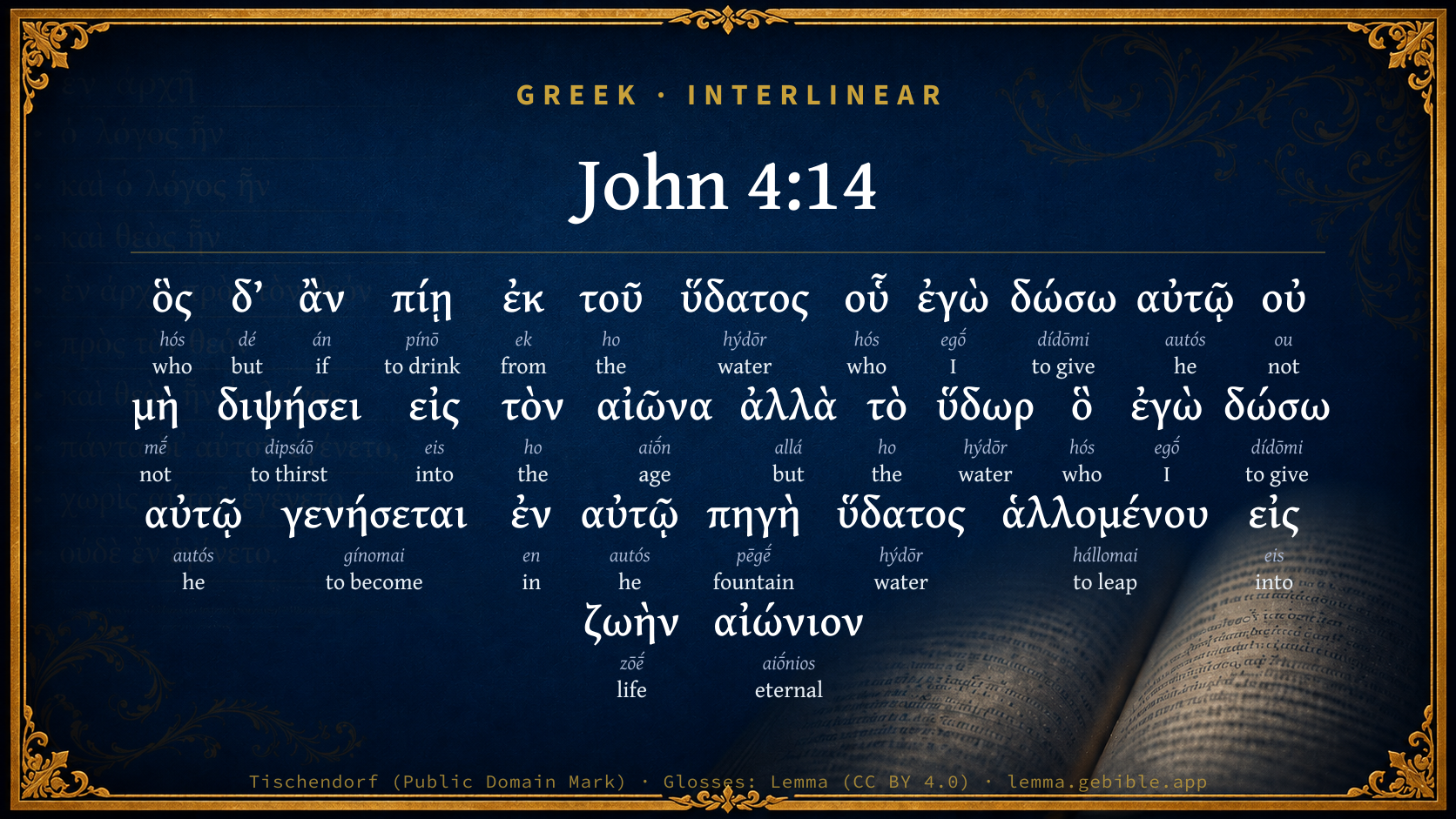
Download image
Cite this verse

John 4:14 (World English Bible). Public Domain. Lemma interlinear Bible study tool, https://lemma.gebible.app/v/john/4/14.

Show BibTeX & RIS
BibTeX
RIS
English Translation
but whoever drinks of the water that I will give him will never thirst again; but the water that I will give him will become in him a well of water springing up to eternal life."
World English Bible · Public Domain
Highlights
  • 1 first appearance in the Greek New Testament
Full analysis ↓
Download a study sheet

One document with this verse’s original text, its word-by-word gloss line, the meaning frame, cross-references with their text, attributed commentary, and full source and license credits — printable, and it pastes into notes with its structure intact.

This verse Autodidact and up

Study sheet (.html) Plain text (.txt)

A passage Seminary Student

Up to 50 verses in one chapter. A passage sheet keeps up to 6 commentary sources and 12 cross-references per verse, in the order this page ranks them, and says so on the sheet whenever that leaves anything out. Ask for a single verse and you get the Autodidact verse sheet above.

Everything on this page stays free to read, with no account — the sheet is a download of what is already on screen, not access to it.

Want to remove ads? Support Godless Engineer
Compare translations 3

The same verse in 3 English versions, stacked beneath the original-language interlinear above. Click any original word for its lexicon entry.

Each is an independent rendering of the whole verse — the interlinear is not word-aligned to these translations.

Highlighted words mark where these versions differ — a whole-verse word diff, not a word-by-word alignment.

  • World English Bible Public Domain
    but whoever drinks of the water that I will give him will never thirst again; but the water that I will give him will become in him a well of water springing up to eternal life."
  • King James Version Public Domain
    But whosoever drinketh of the water that I shall give him shall never thirst; but the water that I shall give him shall be in him a well of water springing up into everlasting life.
  • unfoldingWord Literal Text CC BY-SA 4.0
    but whoever drinks from the water that I will give him will never thirst into eternity. Instead, the water that I will give him will become a fountain of water in him, springing up to eternal life.”

unfoldingWord Literal Text — © unfoldingWord, licensed CC BY-SA 4.0. Word-aligned USFM3 via Door43 (git.door43.org/unfoldingWord/en_ult).

Versions to compare (up to 4)

3 of 4 selected

Show all 19 translations

Every available English version of this verse, each an independent rendering of the whole verse.

  • World English Bible Public Domain
    but whoever drinks of the water that I will give him will never thirst again; but the water that I will give him will become in him a well of water springing up to eternal life."
  • Berean Standard Bible Public Domain
    But whoever drinks the water I give him will never thirst. Indeed, the water I give him will become in him a fount of water springing up to eternal life.”
  • Majority Standard Bible Public Domain
    But whoever drinks the water I give him will never thirst. Indeed, the water I give him will become in him a fount of water springing up to eternal life.”
  • King James Version Public Domain
    But whosoever drinketh of the water that I shall give him shall never thirst; but the water that I shall give him shall be in him a well of water springing up into everlasting life.
  • American Standard Version (1901) Public Domain
    but whosoever drinketh of the water that I shall give him shall never thirst; but the water that I shall give him shall become in him a well of water springing up unto eternal life.
  • Revised Version (1885) Public Domain
    but whosoever drinketh of the water that I shall give him shall never thirst; but the water that I shall give him shall become in him a well of water springing up unto eternal life.
  • Geneva Bible (1599) Public Domain
    But whosoeuer drinketh of the water that I shall giue him, shall neuer be more a thirst: but the water that I shall giue him, shalbe in him a well of water, springing vp into euerlasting life.
  • Douay-Rheims (1899) Public Domain
    But the water that I will give him, shall become in him a fountain of water, springing up into life everlasting.
  • Young's Literal Translation Public Domain
    but whoever may drink of the water that I will give him, may not thirst -- to the age; and the water that I will give him shall become in him a well of water, springing up to life age-during.'
  • Literal Standard Version CC BY-SA 4.0
    but whoever may drink of the water that I will give him, may not thirst—throughout the age; and the water that I will give him will become in him a well of water, springing up to continuous life.”
  • Unlocked Literal Bible CC BY-SA 4.0
    but whoever drinks from the water that I will give him will never be thirsty again. Instead, the water that I will give him will become a fountain of water in him, springing up to eternal life.”
  • unfoldingWord Literal Text CC BY-SA 4.0
    but whoever drinks from the water that I will give him will never thirst into eternity. Instead, the water that I will give him will become a fountain of water in him, springing up to eternal life.”
  • Darby Bible Public Domain
    but whosoever drinks of the water which I shall give him shall never thirst for ever, but the water which I shall give him shall become in him a fountain of water, springing up into eternal life.
  • World Messianic Bible Public Domain
    but whoever drinks of the water that I will give him will never thirst again; but the water that I will give him will become in him a well of water springing up to eternal life.”
  • Webster's Bible Public Domain
    But whoever drinketh of the water that I shall give him, shall never thirst; but the water that I shall give him, shall be in him a well of water springing up into everlasting life.
  • Free Bible Version CC BY-SA 4.0
    But those who drink the water I give won't ever be thirsty again. The water I give becomes a bubbling spring of water inside them, bringing them eternal life.”
  • Bible in Basic English Public Domain
    But whoever takes the water I give him will never be in need of drink again; for the water I give him will become in him a fountain of eternal life.
  • Text-Critical English NT CC BY 4.0
    but whoever drinks the water I give him will certainly never thirst again. On the contrary, the water I give him will become in him a spring of water welling up to eternal life.”
  • Tyndale New Testament (1534) Public Domain
    But whosoever shall drinke of the water that I shall geve him shall never be more a thyrst: but the water that I shall geve him shalbe in him a well of water springinge vp in to everlastinge lyfe.

Literal Standard Version (2020), Covenant Press — licensed CC BY-SA 4.0. Text via the HelloAO Bible API (eBible.org). Unlocked Literal Bible (unfoldingWord) — licensed CC BY-SA 4.0. Text via the HelloAO Bible API (eBible.org). unfoldingWord Literal Text — © unfoldingWord, licensed CC BY-SA 4.0. Word-aligned USFM3 via Door43 (git.door43.org/unfoldingWord/en_ult). Free Bible Version, Dr. Jonathan Gallagher — licensed CC BY-SA 4.0. Text via the HelloAO Bible API (eBible.org).

Word by word

More ways to search: Search by grammar → Find every occurrence → Compare this word →

Practice this passage: Drill this verse → Learn its vocabulary →

ἁλλομένου
hállomai
G242
“to leap”
Verb, Present, Middle or Passive deponent, Participle, Genitive, Singular, Neuter
Part of Speech
Verb
Tense
Present
Voice
Middle or Passive deponent
Mood
Participle
Case
Genitive
Number
Singular
Gender
Neuter
Full Thayer's Definition

Origin: middle voice of apparently a primary verb

TDNT: None

1. to leap 2. to spring up, gush up: of water
  1. ὃς hós G3739 “who” Relative pronoun, Nominative, Singular, Masculine
  2. δ’ dé G1161 “but” Conjunction
  3. ἂν án G302 “if” Particle
  4. πίῃ pínō G4095 “to drink” Verb, Aorist, Active, Subjunctive, 3rd person, Singular
  5. ἐκ ek G1537 “from” Preposition
  6. τοῦ ho G3588 “the” Article, Genitive, Singular, Neuter
  7. ὕδατος hýdōr G5204 “water” Noun, Genitive, Singular, Neuter
  8. οὗ hós G3739 “who” Relative pronoun, Genitive, Singular, Neuter
  9. ἐγὼ egṓ G1473 “I” Personal pronoun, 1st person, Nominative, Singular
  10. δώσω dídōmi G1325 “to give” Verb, Future, Active, Indicative, 1st person, Singular
  11. αὐτῷ autós G846 “he” Personal pronoun, Dative, Singular, Masculine
  12. οὐ ou G3756 “not” Particle, Negative
  13. μὴ mḗ G3361 “not” Particle, Negative
  14. διψήσει dipsáō G1372 “to thirst” Verb, Future, Active, Indicative, 3rd person, Singular
  15. εἰς eis G1519 “into” Preposition
  16. τὸν ho G3588 “the” Article, Accusative, Singular, Masculine
  17. αἰῶνα aiṓn G165 “age” Noun, Accusative, Singular, Masculine
  18. ἀλλὰ allá G235 “but” Conjunction
  19. τὸ ho G3588 “the” Article, Nominative, Singular, Neuter
  20. ὕδωρ hýdōr G5204 “water” Noun, Nominative, Singular, Neuter
  21. ὃ hós G3739 “who” Relative pronoun, Accusative, Singular, Neuter
  22. ἐγὼ egṓ G1473 “I” Personal pronoun, 1st person, Nominative, Singular
  23. δώσω dídōmi G1325 “to give” Verb, Future, Active, Indicative, 1st person, Singular
  24. αὐτῷ autós G846 “he” Personal pronoun, Dative, Singular, Masculine
  25. γενήσεται gínomai G1096 “to become” Verb, Future, Middle deponent, Indicative, 3rd person, Singular
  26. ἐν en G1722 “in” Preposition
  27. αὐτῷ autós G846 “he” Personal pronoun, Dative, Singular, Masculine
  28. πηγὴ pēgḗ G4077 “fountain” Noun, Nominative, Singular, Feminine
  29. ὕδατος hýdōr G5204 “water” Noun, Genitive, Singular, Neuter
  30. εἰς eis G1519 “into” Preposition
  31. ζωὴν zōḗ G2222 “life” Noun, Accusative, Singular, Feminine
  32. αἰώνιον aiṓnios G166 “eternal” Adjective, Accusative, Singular, Feminine

About this verse

These counts appear in no published source. They are computed here, from the morphology-tagged text and Lemma’s own curated glosses. What Lemma adds →

33
words
22
distinct lemmas
Gospels
section

Notable vocabulary

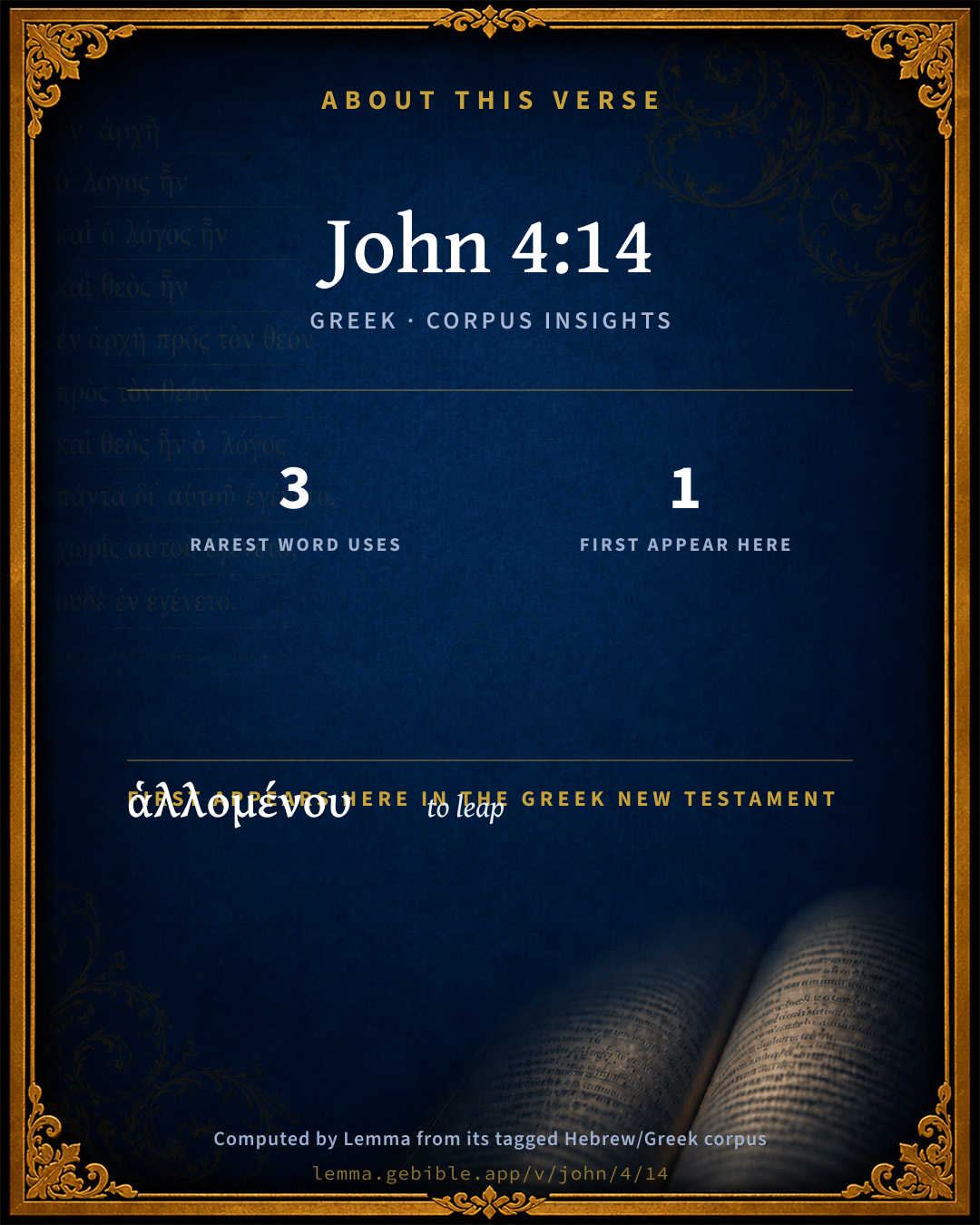
The rarest word here is ἁλλομένου to leap G242 — appearing just 3 times in the whole Greek New Testament.

First appearance in Scripture

This word makes its first canonical appearance in the Greek New Testament here:

  • ἁλλομένου to leap G242

Shared distinctive vocabulary

ἁλλομένου to leap G242 occurs in 3 verses of the Greek New Testament. Also found in:
Repetition

Words recur within this verse:

Cross-references

18

Topical passages linked to John 4:14 in the Treasury of Scripture Knowledge — connected by theme and wording, ordered by reader-vote popularity; previews shown in the World English Bible.

  • John 7:38–39 He who believes in me, as the Scripture has said, from within him will flow rivers of living water."
  • John 6:35 Jesus said to them, "I am the bread of life. He who comes to me will not be hungry, and he who believes in me will never be thirsty.
  • Isaiah 49:10 They shall not hunger nor thirst; neither shall the heat nor sun strike them: for he who has mercy on them will lead them, even by springs of water will he guide them.
  • Revelation 7:16 They will never be hungry, neither thirsty any more; neither will the sun beat on them, nor any heat;
  • Ephesians 1:13–14 in whom you also, having heard the word of the truth, the Gospel of your salvation,--in whom, having also believed, you were sealed with the Holy Spirit of promise,
  • John 11:26 Whoever lives and believes in me will never die. Do you believe this?"
  • John 6:58 This is the bread which came down out of heaven-- not as our fathers ate the manna, and died. He who eats this bread will live forever."
  • 1 John 5:20 We know that the Son of God has come, and has given us an understanding, that we know him who is true, and we are in him who is true, in his Son Jesus Christ. This is the true God, and eternal life.
  • 2 Corinthians 1:22 who also sealed us, and gave us the down payment of the Spirit in our hearts.
  • Romans 6:23 For the wages of sin is death, but the free gift of God is eternal life in Christ Jesus our Lord.
  • Romans 8:16–17 The Spirit himself testifies with our spirit that we are children of God;
  • John 10:10 The thief only comes to steal, kill, and destroy. I came that they may have life, and may have it abundantly.
  • John 17:2–3 even as you gave him authority over all flesh, he will give eternal life to all whom you have given him.
  • 1 Peter 1:22 Seeing you have purified your souls in your obedience to the truth through the Spirit in sincere brotherly affection, love one another from the heart fervently:
  • Matthew 25:46 These will go away into eternal punishment, but the righteous into eternal life."
  • John 14:16–19 I will pray to the Father, and he will give you another Counselor, that he may be with you forever,--
  • Romans 5:21 that as sin reigned in death, even so might grace reign through righteousness to eternal life through Jesus Christ our Lord.
  • Ephesians 4:30 Don't grieve the Holy Spirit of God, in whom you were sealed for the day of redemption.

Cross-references courtesy of OpenBible.info (CC BY 4.0).

Commentary

Notes on John 4:14 from classic Christian and Jewish commentators (each source and its license shown beneath its notes). The classic Christian expositions comment on the surrounding passage and are grouped to its opening verse, so a note may address several verses; the Jewish commentaries on the Tanakh (Rashi and others) are per-verse, so they appear only where the commentator wrote on this verse.

Lemma curates 59 commentaries, every one of them public domain or Creative Commons licensed, each selected and text-cleaned for this edition rather than reprinted as found. About our sources →

MacLaren's Expositions of Holy Scripture

Alexander MacLaren

John

THE SPRINGING FOUNTAIN

Joh 4:14.

There are two kinds of wells, one a simple reservoir, another containing the waters of a spring. It is the latter kind which is spoken about here, as is clear not only from the meaning of the word in the Greek, but also from the description of it as ‘springing up.’ That suggests at once the activity of a fountain. A fountain is the emblem of motion, not of rest. Its motion is derived from itself, not imparted to it from without. Its ‘silvery column’ rises ever heavenward, though gravitation is too strong for it, and drags it back again.

So Christ promises to this ignorant, sinful Samaritan woman that if she chose He would plant in her soul a gift which would thus well up, by its own inherent energy, and fill her spirit with music, and refreshment, and satisfaction.

What is that gift? The answer may be put in various ways which really all come to one. It is Himself, the unspeakable Gift, His own greatest gift; or it is the Spirit ‘which they that believe on Him should receive,’ and whereby He comes and dwells in men’s hearts; or it is the resulting life, kindred with the life bestowed, a consequence of the indwelling Christ and the present Spirit.

And so the promise is that they who believe in Him and rest upon His love shall receive into their spirits a new life principle which shall rise in their hearts like a fountain, ‘springing up into everlasting life.’

I think we shall best get the whole depth and magnitude of this great promise if, throwing aside all mere artificial order, we simply take the words as they stand here in the text, and think, first, of Christ’s gift as a fountain within; then as a fountain springing, leaping up, by its own power; and then as a fountain ‘springing into everlasting life.’

I. First, Christ’s gift is represented here as a fountain within.

Most men draw their supplies from without; they are rich, happy, strong, only when externals minister to them strength, happiness, riches. For the most of us, what we have is that which determines our felicity.

Take the lowest type of life, for instance, the men of whom the majority, alas! I suppose, in every time is composed, who live altogether on the low plane of the world, and for the world alone, whether their worldliness take the form of sensuous appetite, or of desire to acquire wealth and outward possessions. The thirst of the body is the type of the experience of all such people. It is satisfied and slaked for a moment, and then back comes the tyrannous appetite again. And, alas! the things that you drink to satisfy the thirst of your souls are too often like a publican’s adulterated beer, which has got salt in it, and chemicals, and all sorts of things to stir up, instead of slaking and quenching, the thirst. So ‘he that loveth silver shall not be satisfied with silver, nor he that loveth abundance with increase.’ The appetite grows by what it feeds on, and a little lust yielded to to-day is a bigger one to-morrow, and half a glass to-day grows to a bottle in a twelvemonth. As the old classical saying has it, he ‘who begins by carrying a calf, before long is able to carry an ox’; so the thirst in the soul needs and drinks down a constantly increasing draught.

And even if we rise up into a higher region and look at the experience of the men who have in some measure learned that ‘a man’s life consisteth not in the abundance of the things that he possesseth,’ nor in the abundance of the gratification that his animal nature gets, but that there must be an inward spring of satisfaction, if there is to be any satisfaction at all; if we take men who live for thought, and truth, and mental culture, and yield themselves up to the enthusiasm for some great cause, and are proud of saying, ‘My mind to me a kingdom is,’ though they present a far higher style of life than the former, yet even that higher type of man has so many of his roots in the external world that he is at the mercy of chances and changes, and he, too, has deep in his heart a thirst that nothing, no truth, no wisdom, no culture, nothing that addresses itself to one part of his nature, though it be the noblest and the loftiest, can ever satisfy and slake.

I am sure I have some such people in my audience, and to them this message comes. You may have, if you will, in your own hearts, a springing fountain of delight and of blessedness which will secure that no unsatisfied desires shall ever torment you. Christ in His fulness, His Spirit, the life that flows from both and is planted within our hearts, these are offered to us all; and if we have them we carry inclosed within ourselves all that is essential to our felicity; and we can say, ‘I have learned in whatsoever state I am therewith to be self-satisfying,’ not with the proud, stoical independence of a man who does not want either God or man to make him blessed, but with the humble independence of a man who can say ‘my sufficiency is of God.’

No independence of externals is possible, nor wholesome if it were possible, except that which comes from absolute dependence on Jesus Christ.

If you have Christ in your heart then life is possible, peace is possible, joy is possible, under all circumstances and in all places. Everything which the soul can desire, it possesses. You will be like the garrison of a beleaguered castle, in the courtyard of which is a sparkling spring, fed from some source high up in the mountains, and finding its way in there by underground channels which no besiegers can ever touch. Sorrows will come, and make you sad, but though there may be much darkness round about you, there will be light in the darkness. The trees may be bare and leafless, but the sap has gone down to the roots. The world may be all wintry and white with snow, but there will be a bright little fire burning on your own hearthstone. You will carry within yourselves all the essentials to blessedness. If you have ‘Christ in the vessel’ you can smile at the storm. They that drink from earth’s fountains ‘shall thirst again’; but they who have Christ in their hearts will have a fountain within which will not freeze in the bitterest cold, nor fail in the fiercest heat. ‘The water that I shall give him shall be in him a fountain.’

II. Christ’s gift is a springing fountain.

The emblem, of course, suggests motion by its own inherent impulse. Water may be stagnant, or it may yield to the force of gravity and slide down a descending river-bed, or it may be pumped up and lifted by external force applied to it, or it may roll as it does in the sea, drawn by the moon, driven by the winds, borne along by currents that owe their origin to outward heat or cold. But a fountain rises by an energy implanted within itself, and is the very emblem of joyous, free, self-dependent and self-regulated activity.

And so, says Christ, ‘The water that I shall give him shall be in him a springing fountain’; it shall not lie there stagnant, but leap like a living thing, up into the sunshine, and flash there, turned into diamonds, when the bright rays smile upon it.

So here is the promise of two things: the promise of activity, and of an activity which is its own law.

The promise of activity. There seems small blessing, in this overworked world, in a promise of more active exertion; but what an immense part of our nature lies dormant and torpid if we are not Christians! How much of the work that is done is dreary, wearisome, collar-work, against the grain. Do not the wheels of life often go slowly? Are you not often weary of the inexpressible monotony and fatigue? And do you not go to your work sometimes, though with a fierce feeling of ‘need-to-do-it,’ yet also with inward repugnance? And are there not great parts of your nature that have never woke into activity at all, and are ill at ease, because there is no field of action provided for them? The mind is like millstones; if you do not put the wheat into them to grind, they will grind each other’s faces. So some of us are fretting ourselves to pieces, or are sick of a vague disease, and are morbid and miserable because the highest and noblest parts of our nature have never been brought into exercise. Surely this promise of Christ’s should come as a true Gospel to such, offering, as it does, if we will trust ourselves to Him, a springing fountain of activity in our hearts that shall fill our whole being with joyous energy, and make it a delight to live and to work. It will bring to us new powers, new motives; it will set all the wheels of life going at double speed. We shall be quickened by the presence of that mighty power, even as a dim taper is brightened and flames up when plunged into a jar of oxygen. And life will be delightsome in its hardest toil, when it is toil for the sake of, and by the indwelling strength of, that great Lord and Master of our work.

And there is not only a promise of activity here, but of activity which is its own law and impulse. That is a blessed promise in two ways. In the first place, law will be changed into delight. We shall not be driven by a commandment standing over us with whip and lash, or coming behind us with spur and goad, but that which we ought to do we shall rejoice to do; and inclination and duty will coincide in all our lives when our life is Christ’s life in us.

That should be a blessing to some of you who have been fighting against evil and trying to do right with more or less success, more or less interruptedly and at intervals, and have felt the effort to be a burden and a wearisomeness. Here is a promise of emancipation from all that constraint and yoke of bondage which duty discerned and unloved ever lays upon a man’s shoulders. When we carry within us the gift of a life drawn from Jesus Christ, and are able to say like Him, ‘Lo, I come to do Thy will, and Thy law is within my heart,’ only then shall we have peace and joy in our lives. ‘The law of the Spirit of life in Christ Jesus makes us free from the law of sin and death.’

And then, in the second place, that same thought of an activity which is its own impulse and its own law, suggests another aspect of this blessedness, namely, that it sets us free from the tyranny of external circumstances which absolutely shape the lives of so many of us. The lives of all must be to a large extent moulded by these, but they need not, and should not be completely determined by them. It is a miserable thing to see men and women driven before the wind like thistledown. Circumstances must influence us, but they may either influence us to base compliance and passive reception of their stamp, or to brave resistance and sturdy nonconformity to their solicitations. So used, they will influence us to a firmer possession of the good which is most opposite to them, and we shall be the more unlike our surroundings, the more they abound in evil. You can make your choice whether, if I may so say, you shall be like balloons that are at the mercy of the gale and can only shape their course according as it comes upon them and blows them along, or like steamers that have an inward power that enables them to keep their course from whatever point the wind blows, or like some sharply built sailing-ship that, with a strong hand at the helm, and canvas rightly set, can sail almost in the teeth of the wind and compel it to bear her along in all but the opposite direction to that in which it would carry her if she lay like a log on the water.

I beseech you all, and especially you young people, not to let the world take and shape you, like a bit of soft clay put into a brick-mould, but to lay a masterful hand upon it, and compel it to help you, by God’s grace, to be nobler, and truer, and purer.

It is a shame for men to live the lives that so many amongst us live, as completely at the mercy of externals to determine the direction of their lives as the long weeds in a stream that yield to the flow of the current. It is of no use to preach high and brave maxims, telling men to assert their lordship over externals, unless we can tell them how to find the inward power that will enable them to do so. But we can preach such noble exhortations to some purpose when we can point to the great gift which Christ is ready to give, and exhort them to open their hearts to receive that indwelling power which shall make them free from the dominion of these tyrant circumstances and emancipate them into the ‘liberty of the sons of God.’ ‘The water that I shall give him shall be in him a leaping fountain.’

III. The last point here is that Christ’s gift is a fountain ‘springing up into everlasting life.’

The water of a fountain rises by its own impulse, but howsoever its silver column may climb it always falls back into its marble basin. But this fountain rises higher, and at each successive jet higher, tending towards, and finally touching, its goal, which is at the same time its course. The water seeks its own level, and the fountain climbs until it reaches Him from whom it comes, and the eternal life in which He lives. We might put that thought in two ways. First, the gift is eternal in its duration. The water with which the world quenches its thirst perishes. All supplies and resources dry up like winter torrents in summer heat. All created good is but for a time. As for some, it perishes in the use; as for other, it evaporates and passes away, or is ‘as water spilt upon the ground which cannot be gathered up’; as for all, we have to leave it behind when we go hence. But this gift springs into everlasting life, and when we go it goes with us. The Christian character is identical in both worlds, and however the forms and details of pursuits may vary, the essential principle remains one. So that the life of a Christian man on earth and his life in heaven are but one stream, as it were, which may, indeed, like some of those American rivers, run for a time through a deep, dark canyon, or in an underground passage, but comes out at the further end into broader, brighter plains and summer lands; where it flows with a quieter current and with the sunshine reflected on its untroubled surface, into the calm ocean. He has one gift and one life for earth and heaven-Christ and His Spirit, and the life that is consequent upon both.

And then the other side of this great thought is that the gift tends to, is directed towards, or aims at and reaches, everlasting life. The whole of the Christian experience on earth is a prophecy and an anticipation of heaven. The whole of the Christian experience of earth evidently aims towards that as its goal, and is interpreted by that as its end. What a contrast that is to the low and transient aims which so many of us have! The lives of many men go creeping along the surface when they might spring heavenwards. My friend! which is it to be with you? Is your life to be like one of those Northern Asiatic rivers that loses itself in the sands, or that flows into, or is sluggishly lost in, a bog; or is it going to tumble over a great precipice, and fall sounding away down into the blackness; or is it going to leap up ‘into everlasting life’? Which of the two aims is the wiser, is the nobler, is the better?

And a life that thus springs will reach what it springs towards. A fountain rises and falls, for the law of gravity takes it down; this fountain rises and reaches, for the law of pressure takes it up, and the water rises to the level of its source. Christ’s gift mocks no man, it sets in motion no hopes that it does not fulfil; it stimulates to no work that it does not crown with success. If you desire a life that reaches its goal, a life in which all your desires are satisfied, a life that is full of joyous energy, that of a free man emancipated from circumstances and from the tyranny of unwelcome law, and victorious over externals, open your hearts to the gift that Christ offers you; the gift of Himself, of His death and passion, of His sacrifice and atonement, of His indwelling and sanctifying Spirit.

He offered all the fulness of that grace to this Samaritan woman, in her ignorance, in her profligacy, in her flippancy. He offers it to you. His offer awoke an echo in her heart, will it kindle any response in yours? Oh! when He says to you, ‘The water that I shall give will be in you a fountain springing into everlasting life,’ I pray you to answer as she did-’Sir!-Lord-give me this water, that I thirst not; neither come to earth’s broken cisterns to draw.’

Alexander MacLaren, Expositions of Holy Scripture (1904–1910) — public domain. Text from a community e-Sword module.

Tyndale Open Study Notes

Tyndale Open Resources

4:14 The notion of a fresh, bubbling spring was a powerful image in the dry climate of Israel. Those who come to God will neither hunger nor thirst (see Isa 49:10; 55:1-3; Jer 2:13).

Tyndale Open Study Notes — © Tyndale Open Resources, licensed CC BY-SA 4.0. Text via the HelloAO Bible API.

Bengel's Gnomon

Johann Albrecht Bengel

Joh 4:14. Οὐ μὴ διψήσῃ εἰς τὸν αἰῶνα, to all eternity shall not thirst) Is then he, who once has drunk the water, which Christ gives, free from all thirst? Truly that water, as far as it depends on itself, has in it an everlasting virtue; and when thirst returns, the defect is on the part of the man, not of the water. But the drinking of elementary water is able to allay thirst subsequently, only for some hours.—ἀλλά, but) Comp. ch. Joh 6:27, “that meat, which endureth unto everlasting life.”—γενήσεται) from being water shall become a fountain, as a tree from a sucker. The fountain has no thirst.—πηγή, fountain) The antithesis to πηγή is φρέαρ [an antithesis lost by the Eng. Vers. translating both well] the well, Joh 4:11. In believers there is a spring: the Roman Pontiff is not that spring, from whom in particular is to be derived faith, holiness, blessedness, and the ratification [validity] of every function in the Church.—ὓδατος ἁλλομένου, of springing water) The abounding fruitfulness of believers. Ἅλλεσθαι, to spring up, said of water, a delightful expression.—εἰς, to) All things [come] from God, [and tend] to God—ζωήν, life) Life eternal (concerning which comp. Joh 4:36, “He that reapeth receiveth wages, and gathereth fruit unto life eternal,” the confluence of such fountains; nay, the ocean. May I attain unto it!

Bengel's Gnomon of the New Testament — English translation (T&T Clark, Edinburgh, 1860) — public domain. Text from a community e-Sword module.

Adam Clarke's Commentary

Verse 14. Springing up into everlasting life.] On this account he can never thirst:-for how can he lack water who has in himself a living, eternal spring? By this water our Lord means also his doctrine, explaining and promising the gifts and graces of the Holy Ghost, which proceed from Jesus Christ their fountain, dwelling in a believing heart. There is no eternal life without the Spirit; no Spirit without Christ; and no Christ to give the Spirit, without dwelling in the heart: this his whole doctrine proclaims.

Adam Clarke's Commentary on the Bible (1810–1826) — public domain. Text from a community e-Sword/MySword module.

Ellicott's Commentary for English Readers

(14) The water that I shall give him.—These words are emphatic as opposed to this water. It is not an external supply, which must be sought to meet the recurring physical want, but it is the inner never-failing source, the fountain of living water, which satisfies every want as it occurs. He who has it, therefore, can never thirst. Coming from the source of all life, it issues in eternal life. (Comp. Notes on Joh_7:37-38.)

A Bible Commentary for English Readers, edited by Charles John Ellicott (1878–1897) — public domain. Text from a community e-Sword module.

The Cambridge Bible for Schools and Colleges

gen. ed. J. J. S. Perowne

14. shall never thirst] Literally, will certainly not thirst for ever, for the craving is satisfied as soon as ever it recurs. See on Joh_8:51.

springing up into everlasting life] Not that eternal life is some future result to be realised hereafter; it is the immediate result. The soul in which the living water flows has eternal life. See on Joh_4:36 and Joh_3:16.

The Cambridge Bible for Schools and Colleges (gen. ed. J. J. S. Perowne; Cambridge University Press, 1878–1918) — public domain. Text from a community e-Sword module.

John Gill's Exposition

But whosoever drinketh of the water that I shall give him,.... Meaning, the Spirit and his grace; see Joh 7:38; and which he more than once speaks of, as his gift here, and in the context: of which, whoever truly partakes,

shall never thirst; either after sinful lusts and pleasures, and his former vicious way of living, which he now disrelishes: not but there are desires and lustings after carnal things in regenerate persons, as there were lustings in the Israelites, after the onions, garlic, and flesh pots in Egypt, when they were come out from thence; yet these are not so strong, prevalent, and predominant; they are checked and restrained by the grace of God; so that they do not hanker after sin as they did, nor drink up iniquity like water, or commit sin with greediness, as before: or else it means thirsting after the grace of God; thirsty persons are invited to take and drink of the water of life freely, and are pronounced blessed; and it is promised, that they shall be filled, or satisfied; yet not so in this life, that they shall never thirst or desire more; for as they need more grace, and it is promised them, they thirst after it, and desire it; and the more they taste and partake of it, the more they desire it: but the sense is, either as some read the words, "they shall not thirst for ever"; though they may for a time, and be in a distressed condition for want of a supply of it, yet they shall always; God will open rivers and fountains for them, and give drink to his people, his chosen; and the other state, they shall hunger and thirst no more; for the Lamb shall lead them to fountains of living waters: or rather, they shall never thirst, so as to be like the thirsty and parched earth, dried up, and have no moisture in them; for however this may seem sometimes to be their case, God will, and does, pour out water and floods upon them; yea, that grace which is infused into their souls, is an abundant and an abiding principle, which will preserve them from languishing, so as to perish:

but the water that I shall give him, shall be in him a well of water; which denotes the plenty of it; for the grace of God given at conversion is exceeding abundant, it superabounds all the aboundings of sin; it comes in large flows into the hearts of regenerate persons, and flows out of them, as rivers of living water: and which also abides, for it continues

springing up into everlasting life: it is a seed which remains, an immortal and never dying principle; it is inseparably connected with eternal life; it is the beginning of it, and it issues in it; whoever has grace, shall have glory; and whoever are called, sanctified, justified, and pardoned, shall be glorified: such is the nature, influence, and use of this living water, in Christ's gift: the words of the law are, in the Targum on Sol 4:15 compared to a well of living water.

John Gill's Exposition of the Whole Bible (1746–1763) — public domain (CC PDM 1.0). Text via the HelloAO Bible API.

Trapp's Complete Commentary

John Trapp

14 But whosoever drinketh of the water that I shall give him shall never thirst; but the water that I shall give him shall be in him a well of water springing up into everlasting life.

Ver. 14. Shall never thirst] His lips water not after homely provision, that hath lately tasted of delicate sustenance.

" Clitorio quicunque sitim de fonte levarit,

Vina fugit, gaudetque meris abstemius undis."

(Ovid, Metam. xv.)

John Trapp, A Commentary or Exposition upon All the Books of the Old and New Testament (1647–1656) — public domain. Text from a community e-Sword module.

Albert Barnes' Notes on the Bible

The water that I shall give him - Jesus here refers, without doubt, to his own teaching, his “grace,” his “spirit,” and to the benefits which come into the soul that embraces his gospel. It is a striking image, and especially in Eastern countries, where there are vast deserts, and often a great want of water. The soul by nature is like such a desert, or like a traveler wandering through such a desert. It is thirsting for happiness, and seeking it everywhere, and finds it not. It looks in all directions and tries all objects, but in vain. Nothing meets its desires. Though a sinner seeks for joy in wealth and pleasures, yet he is not satisfied. He still thirsts for more, and seeks still for happiness in some new enjoyment. To such a weary and unsatisfied sinner the grace of Christ is “as cold waters to a thirsty soul.”

Shall never thirst - He shall be “satisfied” with this, and will not have a sense of want, a distressing feeling that it is not adapted to him. He who drinks this will not wish to seek for happiness in other objects. “Satisfied” with the grace of Christ, he will not desire the pleasures and amusements of this world. And this will be forever - in this world and the world to come. “Whosoever” drinketh of this all who partake of the gospel - shall be “forever” satisfied with its pure and rich joys.

Shall be in him - The grace of Christ shall be in his heart; or the principles of religion shall abide with him.

A well of water - There shall be a constant supply, an unfailing fountain; or religion shall live constantly with him.

Springing up - This is a beautiful image, It shall bubble or spring up like a fountain. It is not like a stagnant pool - not like a deep well, but like an ever-living fountain, that flows at all seasons of the year, in heat and cold, and in all external circumstances of weather, whether foul or fair, wet or dry. So religion always lives; and, amid all changes of external circumstances - in heat and cold, hunger and thirst, prosperity and adversity, life, persecution, contempt, or death - it still lives on, and refreshes and cheers the soul.

Into everlasting life - It is not temporary, like the supply of our natural wants; it is not changing in its nature; it is not like a natural fountain or spring of water, to play a While and then die away, as all natural springs will at the end of the world. It is eternal in its nature and supply, and will continue to live on forever. We may learn here:

1.That the Christian has a never-failing source of consolation adapted to all times and circumstances.

2.That religion has its seat in the heart, and that it should constantly live there.

3.That it sheds its blessings on a world of sin, and is manifest by a continual life of piety, like a constant flowing spring.

4.That its end is everlasting life. It will continue forever; and “whosoever drinks of this shall never thirst, but his piety shall be in his heart a pure fountain “springing up to eternal joy.”

Albert Barnes' Notes on the Bible (1834–1885) — public domain. Text from a community e-Sword/MySword module.

Matthew Poole's English Annotations

But he who receiveth the Holy Spirit, and the grace thereof, though he will be daily saying, Give, give, and be continually desiring further supplies of grace, yet he shall never wholly want, never want any good thing that shall be necessary for him; the seed of God shall abide in him, and this water shall be in him a spring of water, supplying him until he come to heaven. But this text was excellently expounded by our Saviour, Joh 7:38,39, He that believeth on me, as the Scripture hath said, out of his belly shall flow rivers of living water. But this spake he of the Spirit, which they that believe on him should receive. From which it is plain, that our Saviour here by the living water he speaketh of understood the Holy Spirit.

Matthew Poole's English Annotations on the Holy Bible (1683–1685) — public domain. Text from a community e-Sword/MySword module.

Whedon's Commentary on the Bible

Daniel D. Whedon

14. Shall never thirst—Will never thirst; the simple future.

In him a well— The supply will not be, like the material water from an external and distant spring, but within. And while the well is there the ever-living water will incessantly spring up. The water can never die or dry; but the well may, by sin and apostacy, be removed. See notes on Joh_5:24; Joh_6:40. By eating of the Tree of Life our first parents were made deathless, and so God, separated it from them for sin, and they became mortal.

Springing up— Like a fountain jetting upwards.

Into everlasting life—It is a water of spiritual life, but it jets up into an immortal life; the water of spiritual life, as it ascends, crystallizes into an eternal life.

Daniel D. Whedon (gen. ed.), Commentary on the Old and New Testaments (1874–1909) — public domain. Text from a community e-Sword module.

The Pulpit Commentary

But whosoever shall have drunk of the water which I will give him (of which I am speaking) shall not (by any means, ou mh) thirst again forever. How different from the words of the son of Sirach (Ecc 24:21), "They who drink of me," says Wisdom, "shall thirst again"! They will experience neither continuity nor completeness of enjoyment, but periods of incessant and recurrent desire. Jesus speaks of a Divine and complete satisfaction. The spiritual thirst once slaked, the heavenly desire once realized by appropriating the gift of God, is fundamentally satisfied. The nature itself is changed. How closely this corresponds with the idea of birth into a new world! and how nearly akin to the promise of living water Joh_7:37, etc.! (see also the language of Joh_6:35) But the water that I shall give him shall become in him a fountain of water leaping up (welling, bubbling up and forth) into eternal life. This is the explanation of the full satisfaction of desire. I do not give a simple "drink of water," but I cause a spring, a perennial fountain, a river of Divine pleasure to issue and flow from that inward satisfaction which follows a reception of my gifts; and it is so abundant that it is enough for everlasting needs. The water that I give becomes a fountain, and the fountain swells into a river, and the river expands into and loses itself in the great ocean of eternity. The beauty of the image is lost if, with Luthardt and Moulton, we attach the eiv zwhnion to phgh rather than allomenou (allesyai is not elsewhere applied to water, and this use of it gives the metaphor all the more force). The imagery is not without its difficulty. We are tempted to conclude from it that the Divine life, once given, becomes consciously a self-dependent force within the soul; but this would not be justified by all the analogy of the Divine working in humanity, which, though abundant, efficacious, and satisfying, never repudiates its Divine source, but continually proclaims it. If the desire for what God alone can supply is eager and quenchless, and if God meet the craving, then the desire is absolutely satisfied. There is a superfluous fulness in the girt of God which will transcend all the needs of this life, and be enough for eternity.

The Pulpit Commentary (1880–1919), ed. H.D.M. Spence-Jones & Joseph S. Exell — public domain. Text from a community e-Sword module.

John Wesley's Explanatory Notes

Will never thirst - Will never (provided he continue to drink thereof) be miserable, dissatisfied, without refreshment. If ever that thirst returns, it will be the fault of the man, not the water. But the water that I shall give him - The spirit of faith working by love, shall become in him - An inward living principle, a fountain - Not barely a well, which is soon exhausted, springing up into everlasting life - Which is a confluence, or rather an ocean of streams arising from this fountain.

John Wesley, Explanatory Notes Upon the Whole Bible (1754–1765) — public domain. Text via the GEBible commentary corpus.

The People's New Testament

B. W. Johnson

14. Whosoever drinketh of the water that I shall give him shall never thirst. The water of which he speaks is a gift which he gives to humanity. It is not given to him, but is his own gift. His language is always that of the Son of God. He says, “I am the life;” “Come to me, ye that labor and are heavy laden, and I will give you rest;” “I am the bread of life;” “He that believeth on me shall never thirst.”

B. W. Johnson's The People's New Testament with Notes (1889–1891) — public domain. Electronic text from the Christian Classics Ethereal Library (CCEL) ThML edition.

Cambridge Greek Testament for Schools and Colleges

14. διψήσει for διψήσῃ (correction to the usual construction: comp. Joh 6:42, Joh 10:5, Luk 10:19).

14. οὐ μὴ διψ. εἰς τ. αἰ. Strongest negation (Joh 4:48), will certainly not thirst for ever (see on Joh 8:51), for it is the nature of the living water to reproduce itself perpetually, so that the thirst is quenched as soon as it recurs. And this inexhaustible fount not only satisfies the possessor but refreshes others also (Joh 7:38).

εἰς ζωὴν αἰών. This is the immediate result; the soul in which the living water flows has eternal life: see on Joh 4:36 and Joh 3:16; Joh 3:34. Comp. Joh 6:27, where the living bread is said to abide εἰς ζωὴν αἰώνιον.

Cambridge Greek Testament for Schools and Colleges (Cambridge University Press, 1896; 21 vols, various authors incl. Carr, Maclear, Plummer, Farrar, Lumby, Moule, M. R. James, Simcox) — public domain. Text from a community e-Sword module.

Alford’s Greek Testament

Henry Alford

14.] Our Lord, without noticing this, by His answer leaves it to be implied, that, assuming what she has stated, He is greater than Jacob: for his (Jacob’s) gift was of water which cannot satisfy: but the water which He should give has living power, and becomes an eternal fountain within. This however, ‘that He was greater than Jacob,’ lies only in the background: the water is the subject, as before.

The words apply to every similar quenching of desire by earthly means: the desire springs up again;—is not satisfied, but only postponed. The manna was as insufficient to satisfy hunger,—as this water, thirst, see ch. 6:49, 58: it is only the ὕδωρ ζῶν, and the ἄρτος τῆς ζωῆς, which can satisfy.

The ὁ πίνων sets forth the recurrence, the interrupted seasons, of the drinking of earthly water;—the ὃς δʼ ἂν πίῃ—the once having tasted, and ever continuing in the increasing power, and living forth-flowing, of that life-long draught.

οὐ μὴ διψήσει, shall never have to go away and be exhausted, and come again to be filled;—but shall have the spring at home, in his own breast,—so that he can “draw water with joy out of the wells of salvation” (Isa 12:3) at his pleasure. “Ubi sitis recurrit, hominis, non aquæ, defectus est.” Bengel.

γενήσεται πηγή] All earthly supplies have access only into those lower parts of our being where the desires work themselves out—are but local applications; but the heavenly gift of spiritual life which Jesus gives to those who believe on Him, enters into the very secret and highest place of their personal life, the source whence the desires spring out;—and, its nature being living and spiritual, it does not merely supply, but it lives and waxes onward, unto everlasting life, in duration, and also as producing and sustaining it.

It should not be overlooked, that this discourse had, besides its manifold and wonderful meaning for us all, an especial moral one as applied to the woman,—who, by successive draughts at the ‘broken cistern’ of carnal lust, had been vainly seeking solace:—and this consideration serves to bind on the following verses (ver. 16 ff.) to the preceding, by another link besides those noticed below.

Henry Alford, The Greek Testament (1849–1861) — public domain. Text from a community e-Sword module.

International Critical Commentary

14. “It shall become in him a fountain of water springing up unto eternal life.” In v. 10 the thought is of God as the Eternal Fountain; but it was also a Hebrew thought that the man who has assimilated the Divine Wisdom becomes himself, as it were, a fountain from which streams of the water of life proceed. Thus the promise of Isa 58:11 is, “Thou shalt be like a spring of water, whose waters fail not.” Schoettgen quotes an apposite saying from the Talmud: “Quando homo se convertit ad dominum suum, tanquam fons aquis uiuis impletur, et fluenta eius egrediuntur ad omnis generis homines et ad omnes tribus.” And similarly Wetstein quotes from Tanchuma, f. 17. 1: “Unde Abrahamus didicit legem? R. Simeon filius Jochai dixit: bini renes eius tanquam binae lagenae aquarum factae sunt, ex quibus lex promanavit.” See on 7:38 below.

The passage in Ecclus. 24:21-31 about the Divine Wisdom presents some parallels to these thoughts. The stream of the waters of Wisdom comes originally from God: “Her thoughts are filled from the sea, and her counsels from the great deep” (v. 29). Of the wise man increasing in wisdom it may be said, “My stream became a river, and my river became a sea” (v. 31); these waters of Wisdom lose themselves at last in the same eternal Ocean whence they sprang. Cf. Psa 36:9 παρὰ σοὶ πηγὴ ζωῆς. The water of life is, as Jesus says here, πηγὴ ὕδατος ἁλλομένου εἰς ζωὴν αἰώνιον, leaping forth to eternal life. C. Wesley puts it all in familiar words:

“Thou of life the Fountain art,

Freely let me take of Thee;

Spring Thou up within my heart,

Rise to all eternity.”

The verb ἅλλομαι does not seem to be applied elsewhere to the action of water. But water in this passage is symbolic of the Spirit (cf. 7:38f.); and “ἅλλομαι or ἐφάλλομαι in LXX is applied to the action of a ‘spirit of God,’ forcing its way or falling violently on Samson, Saul, and David.”1 It may be, therefore, as E. A. Abbott has suggested, that ἁλλομένου is used here with special reference to the action of the Holy Spirit, vehement like that of rushing waters. If that be so, εἰς ζωὴν αἰώνιον expresses the purpose of this spiritual torrent of grace; it is “with a view to eternal life.”

There seems to be a reminiscence of this passage in Ignatius, Rom_7, ὕδωρ δὲ ζῶν καὶ λαλοῦν† ἐν ἐμοί, where Lightfoot supposes the MS. reading to be a corruption of ὕδωρ δὲ ζῶν καὶ ἁλλόμενον. It is possible that there is also a trace of it in Justin (Tryph. 69). Commenting on Isa 35:7 he says: πηγὴ ὕδατος ζῶντος παρὰ θεοῦ … ἀνέβλυσεν (i.e. has gushed forth) οὗτος ὁ Χριστός. Cf. also Tryph. 114, and see on 7:38.

Verses 10 and 14 are quoted explicitly in Pistis Sophia, c.141.

In one important particular, at least, the promise of Jesus about the Living Water transcends what is said about the Water of Wisdom by the Son of Sirach. “They that drink me shall yet be thirsty” are the words of Ecclus. 24:21; the spiritual thirst is insatiable, so far as the Hebrew sage knew. But Jesus said: “Whosoever shall drink of the water that I shall give him shall never thirst” (cf. 6:35). To him who has appropriated the revelation of God in Christ, there is no sense of imperfection in the Divine gift, no dissatisfaction with it as insufficient. The Living Water is always quickening, always flowing in correspondence with human need. As Bengel puts it: “ubi sitis occurrit, hominis non aquae defectus est.” The promise of Jesus is that those who “thirst after righteousness shall be filled” (χορτασθήσονται, Mat 5:6).

With ἐκ τοῦ ὕδατος οὓ ἐγὼ δώσω αὐτῷ cf. ὁ ἄρτος ὃν ἐγὼ δώσω of 6:51. אDTbWN, with the Lat. and Syr. vss. generally, insert ἐγώ before the second δώσω; but om. ABCLΓΔΘ.

εἰς τὸν αἰῶνα, “for ever.” This is a common phrase in the LXX and occurs elsewhere in the N.T.; but it is especially frequent in Jn. (6:51, 58, 8:35, 51, 52, 10:28, 11:26, 12:34, 13:8, 14:16, 1Jn 2:17, 2Jn 1:2).

The phrase εἰς ζωὴν αἰώνιον first appears in 4 Macc. 15:3, where a mother prefers to the temporal safety of her sons τὴν εὐσέβειαν … τὴν σώζουσαν εἰς αἰώνιον ζωὴν κατὰ θεόν. It appears again in Joh 4:36, Joh 6:27, Joh 12:25, Rom 5:21, 1Ti 1:16, and Jud 1:21, and in each case the reference is to the future life, the life after death (see note on 3:15).

International Critical Commentary — older volumes (1896–1929), various authors — public domain. Text from a community e-Sword module.

Vincent's Word Studies in the New Testament

Marvin R. Vincent

Whosoever drinketh [ος δ αν πιη] . So Rev.. The A. V. renders the two expressions in the same way, but there is a difference in the pronouns, indicated, though very vaguely, by every one that and whosoever, besides a more striking difference in the verb drinketh. In the former case, the article with the participle indicates something habitual; every one that drinks repeatedly, as men ordinarily do on the recurrence of their thirst. In ver. 14 the definite aorist tense expresses a single act - something done once for all. Literally, he who may have drunk.

Shall never thirst [ου μη διψησει εις τον αιωνα] . The double negative, ouj mh, is a very strong mode of statement, equivalent to by no means, or in nowise. It must not be understood, however, that the reception of the divine life by a believer does away with all further desire. On the contrary, it generates new desires. The drinking of the living water is put as a single act, in order to indicate the divine principle of life as containing in itself alone the satisfaction of all holy desires as they successively arise; in contrast with human sources, which are soon exhausted, and drive one to other fountains. Holy desire, no matter how large or how varied it may become, will always seek and find its satisfaction in Christ, and in Christ only. Thirst is to be taken in the same sense in both clauses, as referring to that natural craving which the world cannot satisfy, and which is therefore ever restless. Drusius, a Flemish critic, cited by Trench (" Studies in the Gospels "), says : "He who drinks the water of wisdom thirsts and does not thirst. He thirsts, that is, he more and more desires that which he drinks. He does not thirst, because he is so filled that he desires no other drink." The strong contrast of this declaration of our Lord with pagan sentiment, is illustrated by the following passage from Plato :

" Socrates : Let me request you to consider how far you would accept this as an account of the two lives of the temperate and intemperate : There are two men, both of whom have a number of casks; the one man has his casks sound and full, one of wine, another of honey, and a third of milk, besides others filled with other liquids, and the streams which fill them are few and scanty, and he can only obtain them with a great deal of toil and difficulty; but when his casks are once filled he has no need to feed them any more, and has no further trouble with them, or care about them. The other, in like manner, can procure streams, though not without difficulty, but his vessels are leaky and unsound, and night and day he is compelled to be filling them, and if he pauses for a moment he is in an agony of pain. Such are their respective lives : And now would you say that the life of the intemperate is happier than that of the temperate? Do I not convince you that the opposite is the truth ?

" Callicles : You do not convince me, Socrates, for the one who has filled himself has no longer any pleasure left; and this, as I was just now saying, is the life of a stone; he has neither joy nor sorrow after he is once filled; but the life of pleasure is the pouring in of the stream.

" Socrates : And if the stream is always pouring in, must there not be a stream always running out, and holes large enough to admit of the discharge?

" Callicles : Certainly.

" Socrates : The life, then, of which you are now speaking is not that of a dead man, or of a stone, but of a cormorant; you mean that he is to be hungering and eating?

" Callicles : Yes.

" Socrates : And he is to be thirsting and drinking?

"Callicles : Yes, that is what I mean; he is to have all his desires about him, and to be able to live happily in the gratification of them" (" Gorgias, " 494). Compare Rev 7:16, 17.

Shall be [γενησεται] . Rev., better, shall become, expressing the ever - developing richness and fresh energy of the divine principle of life.

In Him. A supply having its fountain - head in the man's own being, and not in something outside himself.

A well [πηγη] . The Rev. retains well, where spring would have been more correct.

Springing up [αλλπμενου] . Leaping; thus agreeing with shall become. "The imperial philosopher of Rome uttered a great truth, but an imperfect one; saw much, but did not see all; did not see that this spring of water must be fed, and fed evermore, from the 'upper springs, ' if it is not presently to fail, when he wrote : 'Look within; within is the fountain of good, and ever able to gush forth if you are ever digging'" (Plutarch, " On Virtue and Vice ").

Unto everlasting life. Christ in a believer is life. This life ever tends toward its divine source, and issues in eternal life.

Come hither [ερχωμαι ενθαδε] . The best texts read die rcwmai, the preposition dia having the force of through the intervening plain.

Marvin R. Vincent, Word Studies in the New Testament (1887–1900) — public domain. Text from a community e-Sword/MySword module.

Lesson kit

Teaching starters — assembled from the data on this page, not authored interpretation. Every prompt links to the verse data it draws on. Edit before teaching.

John, in the Gospels, opens this verse with 33 words (22 distinct Greek lemmas). Its most distinctive word is hállomai (“to leap”). A historical commentator’s framing appears above. Read the whole chapter for the surrounding context.

Discussion questions

  1. How does “to leap” (hállomai) shape what this verse is saying?
  2. The word “to leap” first appears here in Scripture. What is being introduced at this debut?
  3. Acts 3:8 shares the word «to leap» with this verse. How do the two illuminate each other?
  4. “water” occurs 3× in this one verse. What is the effect of the repetition?
  5. The translations on this page render this verse differently — a whole-verse word diff, not a word-by-word alignment. What might account for the different wordings?
  6. Reading how MacLaren's Expositions of Holy Scripture and Tyndale Open Study Notes read this verse, where do the two commentators agree and where do they part?

Things to notice

  • 1 word makes its first canonical appearance in Scripture here.
  • These translations choose different wording for 15 words in this verse.
  • “water” occurs 3× in this single verse.
  • 22 distinct Greek lemmas span 33 words in this verse.

Reading settings

Reading text

Shown beneath each verse's original-language words.

Old Testament
Old Testament edition

Read the OT as the Masoretic Hebrew (MT) or the Greek Septuagint (LXX).

English shown for the Greek Septuagint (in the Hebrew ↔ Greek comparison).

Comparing translations? Open the Compare panel on any verse page to stack up to four side by side.