
Matthew 1:16

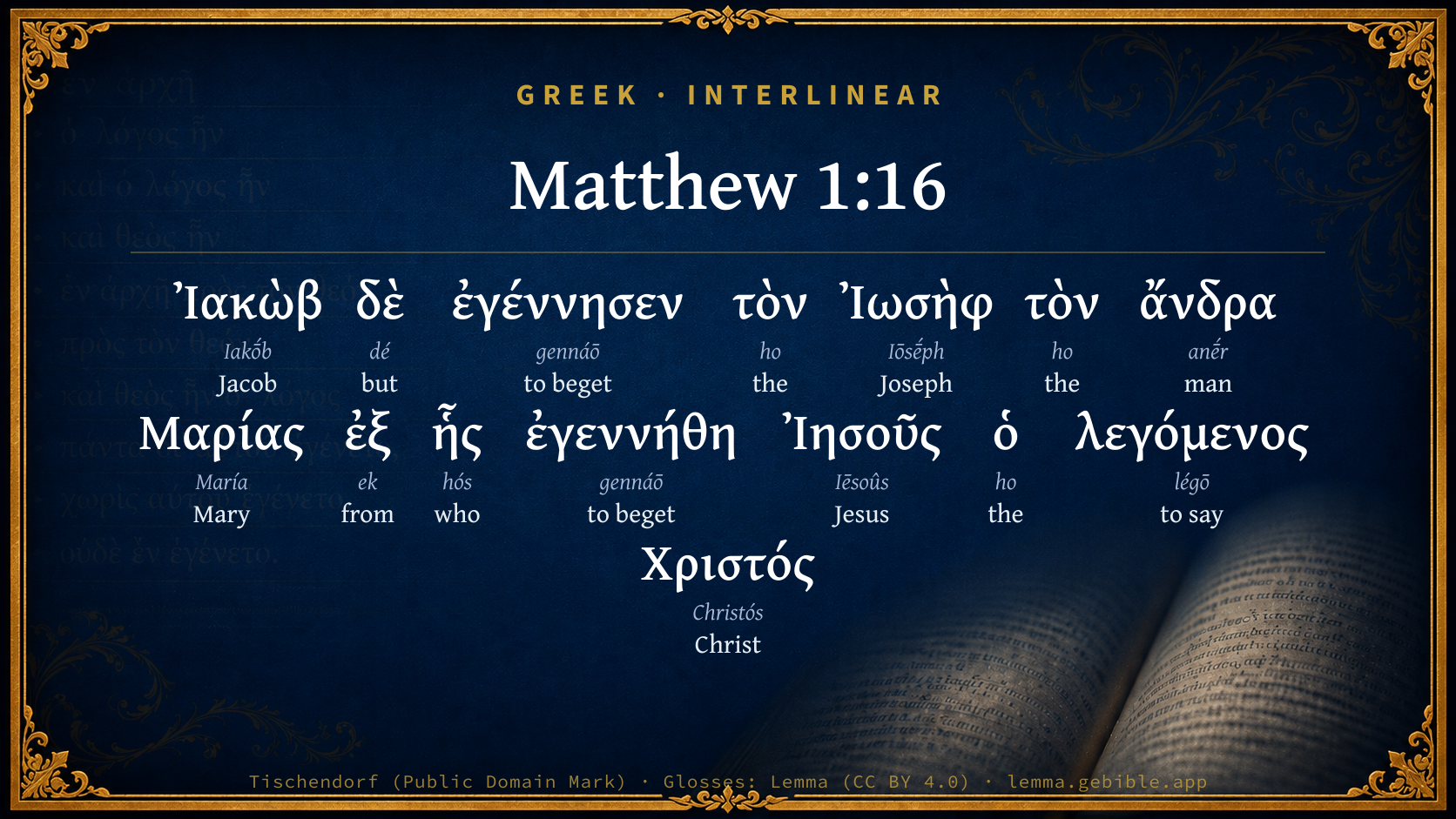
Greek (Tischendorf 8th ed.) Matthew 1:16 appears in the Greek New Testament. The text above is from the Tischendorf 8th edition. Each word links to its Strong’s number and a concise gloss. Click any word for its full Thayer’s Greek Lexicon entry.
Download image
Cite this verse

Matthew 1:16 (World English Bible). Public Domain. Lemma interlinear Bible study tool, https://lemma.gebible.app/v/matthew/1/16.

Show BibTeX & RIS
BibTeX
RIS
English Translation
Jacob became the father of Joseph, the husband of Mary, from whom was born Jesus, who is called Christ.
World English Bible · Public Domain
Highlights
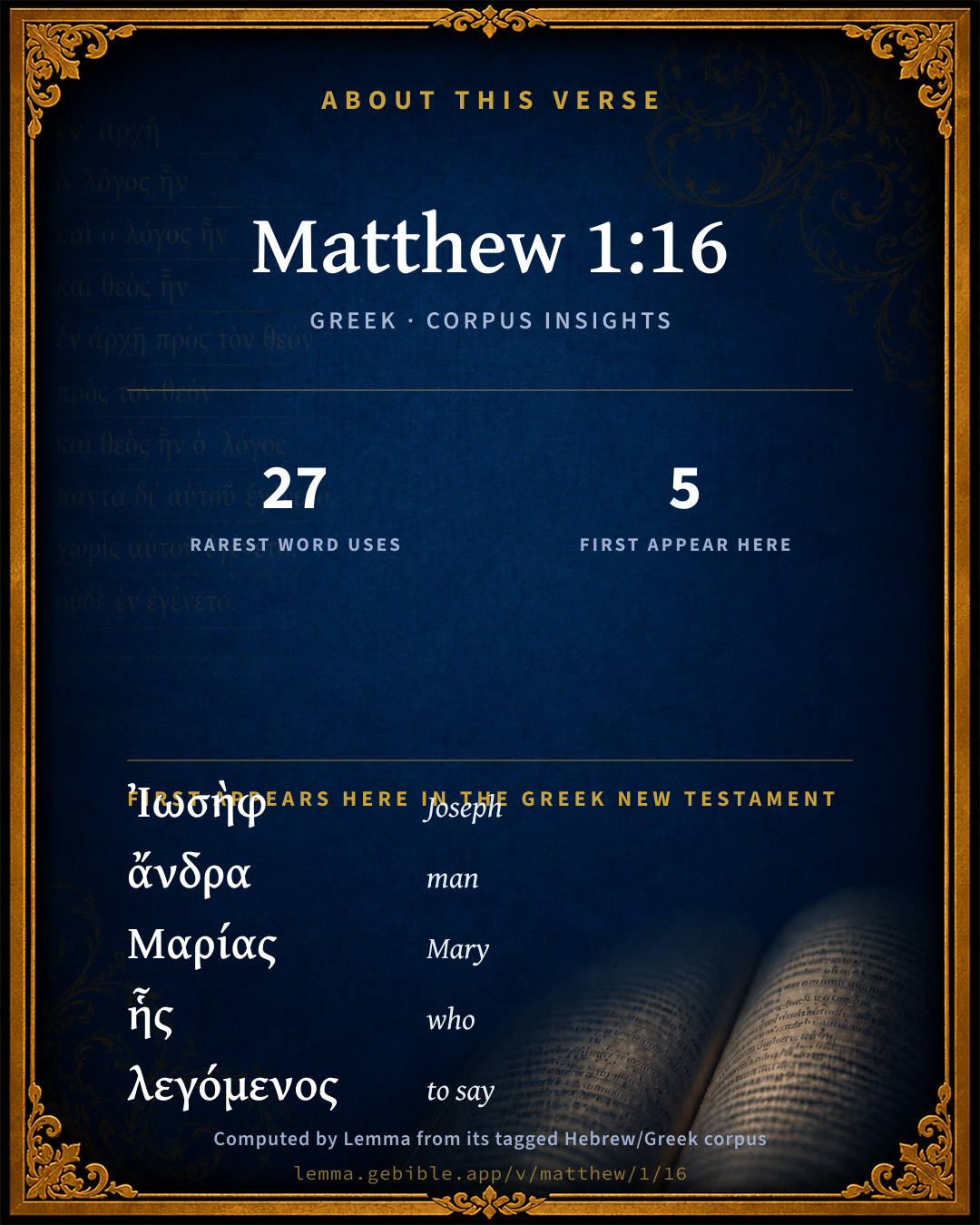
  • 5 first appearances in the Greek New Testament
Full analysis ↓
Download a study sheet

One document with this verse’s original text, its word-by-word gloss line, the meaning frame, cross-references with their text, attributed commentary, and full source and license credits — printable, and it pastes into notes with its structure intact.

This verse Autodidact and up

Study sheet (.html) Plain text (.txt)

A passage Seminary Student

Up to 50 verses in one chapter. A passage sheet keeps up to 6 commentary sources and 12 cross-references per verse, in the order this page ranks them, and says so on the sheet whenever that leaves anything out. Ask for a single verse and you get the Autodidact verse sheet above.

Everything on this page stays free to read, with no account — the sheet is a download of what is already on screen, not access to it.

Want to remove ads? Support Godless Engineer
Compare translations 3

The same verse in 3 English versions, stacked beneath the original-language interlinear above. Click any original word for its lexicon entry.

Each is an independent rendering of the whole verse — the interlinear is not word-aligned to these translations.

Highlighted words mark where these versions differ — a whole-verse word diff, not a word-by-word alignment.

  • World English Bible Public Domain
    Jacob became the father of Joseph, the husband of Mary, from whom was born Jesus, who is called Christ.
  • King James Version Public Domain
    And Jacob begat Joseph the husband of Mary, of whom was born Jesus, who is called Christ.
  • unfoldingWord Literal Text CC BY-SA 4.0
    and Jacob fathered Joseph the husband of Mary, by whom Jesus was born, the one called Christ.

unfoldingWord Literal Text — © unfoldingWord, licensed CC BY-SA 4.0. Word-aligned USFM3 via Door43 (git.door43.org/unfoldingWord/en_ult).

Versions to compare (up to 4)

3 of 4 selected

Show all 19 translations

Every available English version of this verse, each an independent rendering of the whole verse.

  • World English Bible Public Domain
    Jacob became the father of Joseph, the husband of Mary, from whom was born Jesus, who is called Christ.
  • Berean Standard Bible Public Domain
    and Jacob the father of Joseph, the husband of Mary, of whom was born Jesus, who is called Christ.
  • Majority Standard Bible Public Domain
    and Jacob the father of Joseph, the husband of Mary, of whom was born Jesus, who is called Christ.
  • King James Version Public Domain
    And Jacob begat Joseph the husband of Mary, of whom was born Jesus, who is called Christ.
  • American Standard Version (1901) Public Domain
    and Jacob begat Joseph the husband of Mary, of whom was born Jesus, who is called Christ.
  • Revised Version (1885) Public Domain
    and Jacob begat Joseph the husband of Mary, of whom was born Jesus, who is called Christ.
  • Geneva Bible (1599) Public Domain
    And Iacob begat Ioseph ye husband of Mary, of whom was borne Jesus, that is called Christ.
  • Douay-Rheims (1899) Public Domain
    And Jacob begot Joseph the husband of Mary, of whom was born Jesus, who is called Christ.
  • Young's Literal Translation Public Domain
    and Jacob begat Joseph, the husband of Mary, of whom was begotten Jesus, who is named Christ.
  • Literal Standard Version CC BY-SA 4.0
    and Jacob begot Joseph, the husband of Mary, of whom was begotten Jesus, who is named Christ.
  • Unlocked Literal Bible CC BY-SA 4.0
    Jacob was the father of Joseph the husband of Mary, by whom Jesus was born, who is called Christ.
  • unfoldingWord Literal Text CC BY-SA 4.0
    and Jacob fathered Joseph the husband of Mary, by whom Jesus was born, the one called Christ.
  • Darby Bible Public Domain
    and Jacob begat Joseph, the husband of Mary, of whom was born Jesus, who is called Christ.
  • World Messianic Bible Public Domain
    Jacob became the father of Joseph, the husband of Miriam, from whom was born Yeshua, who is called Messiah.
  • Webster's Bible Public Domain
    And Jacob begat Joseph the husband of Mary, of whom was born Jesus, who is called Christ.
  • Free Bible Version CC BY-SA 4.0
    and Jacob was the father of Joseph, who was the husband of Mary, to whom Jesus was born, the one who is called the Messiah.
  • Bible in Basic English Public Domain
    And the son of Jacob was Joseph the husband of Mary, who gave birth to Jesus, whose name is Christ.
  • Text-Critical English NT CC BY 4.0
    and Jacob was the father of Joseph the husband of Mary, of whom was born Jesus, who is called Christ.
  • Tyndale New Testament (1534) Public Domain
    Iacob begat Ioseph the husbande of Mary of which was boren that Iesus that is called Christ.

Literal Standard Version (2020), Covenant Press — licensed CC BY-SA 4.0. Text via the HelloAO Bible API (eBible.org). Unlocked Literal Bible (unfoldingWord) — licensed CC BY-SA 4.0. Text via the HelloAO Bible API (eBible.org). unfoldingWord Literal Text — © unfoldingWord, licensed CC BY-SA 4.0. Word-aligned USFM3 via Door43 (git.door43.org/unfoldingWord/en_ult). Free Bible Version, Dr. Jonathan Gallagher — licensed CC BY-SA 4.0. Text via the HelloAO Bible API (eBible.org).

Word by word

More ways to search: Search by grammar → Find every occurrence → Compare this word →

Practice this passage: Drill this verse → Learn its vocabulary →

Ἰακὼβ
Iakṓb
G2384
“Jacob”
Noun, Proper, indeclinable
Part of Speech
Noun · Proper, indeclinable
Full Thayer's Definition

Origin: of hebrew origin H3290

TDNT: *,344

Jacob = "heel-catcher or supplanter" 1. was the second son of Isaac 2. the father of Joseph, the husband of Mary
  1. δὲ dé G1161 “but” Conjunction
  2. ἐγέννησεν gennáō G1080 “to beget” Verb, Aorist, Active, Indicative, 3rd person, Singular
  3. τὸν ho G3588 “the” Article, Accusative, Singular, Masculine
  4. Ἰωσὴφ Iōsḗph G2501 “Joseph” Noun, Proper, indeclinable
  5. τὸν ho G3588 “the” Article, Accusative, Singular, Masculine
  6. ἄνδρα anḗr G435 “man” Noun, Accusative, Singular, Masculine
  7. Μαρίας María G3137 “Mary” Noun, Genitive, Singular, Feminine
  8. ἐξ ek G1537 “from” Preposition
  9. ἧς hós G3739 “who” Relative pronoun, Genitive, Singular, Feminine
  10. ἐγεννήθη gennáō G1080 “to beget” Verb, Aorist, Passive, Indicative, 3rd person, Singular
  11. Ἰησοῦς Iēsoûs G2424 “Jesus” Noun, Nominative, Singular, Masculine
  12. ὁ ho G3588 “the” Article, Nominative, Singular, Masculine
  13. λεγόμενος légō G3004 “to say” Verb, Present, Passive, Participle, Nominative, Singular, Masculine
  14. Χριστός Christós G5547 “Christ” Noun, Nominative, Singular, Masculine

About this verse

These counts appear in no published source. They are computed here, from the morphology-tagged text and Lemma’s own curated glosses. What Lemma adds →

15
words
12
distinct lemmas
Gospels
section

First appearance in Scripture

These words make their first canonical appearance in the Greek New Testament here:

Shared distinctive vocabulary

Ἰακὼβ Jacob G2384 occurs in 25 verses of the Greek New Testament. Also found in:
Repetition

Words recur within this verse:

  • ἐγέννησεν to beget G1080 ×2
  • τὸν the G3588 ×3

Cross-references

14

Topical passages linked to Matthew 1:16 in the Treasury of Scripture Knowledge — connected by theme and wording, ordered by reader-vote popularity; previews shown in the World English Bible.

  • Matthew 27:17 When therefore they were gathered together, Pilate said to them, "Whom do you want me to release to you? Barabbas, or Jesus, who is called Christ?"
  • Luke 3:23 Jesus himself, when he began to teach, was about thirty years old, being the son (as was supposed) of Joseph, the son of Heli,
  • John 4:25 The woman said to him, "I know that Messiah comes," (he who is called Christ). "When he has come, he will declare to us all things."
  • Matthew 27:22 Pilate said to them, "What then shall I do to Jesus, who is called Christ?" They all said to him, "Let him be crucified!"
  • Luke 1:31–35 Behold, you will conceive in your womb, and bring forth a son, and will call his name 'Jesus.'
  • Matthew 2:13 Now when they had departed, behold, an angel of the Lord appeared to Joseph in a dream, saying, "Arise and take the young child and his mother, and flee into Egypt, and stay there until I tell you, for Herod will seek the young child to destroy him."
  • Mark 6:3 Isn't this the carpenter, the son of Mary, and brother of James, Joses, Judas, and Simon? Aren't his sisters here with us?" They were offended at him.
  • Luke 1:27 to a virgin pledged to be married to a man whose name was Joseph, of the house of David. The virgin's name was Mary.
  • Luke 2:4–5 Joseph also went up from Galilee, out of the city of Nazareth, into Judea, to the city of David, which is called Bethlehem, because he was of the house and family of David;
  • Luke 2:7 She brought forth her firstborn son, and she wrapped him in bands of cloth, and laid him in a feeding trough, because there was no room for them in the inn.
  • Luke 2:10–11 The angel said to them, "Don't be afraid, for behold, I bring you good news of great joy which will be to all the people.
  • Luke 2:48 When they saw him, they were astonished, and his mother said to him, "Son, why have you treated us this way? Behold, your father and I were anxiously looking for you."
  • Luke 4:22 All testified about him, and wondered at the gracious words which proceeded out of his mouth, and they said, "Isn't this Joseph's son?"
  • Matthew 1:18–25 Now the birth of Jesus Christ was like this; for after his mother, Mary, was engaged to Joseph, before they came together, she was found pregnant by the Holy Spirit.

Cross-references courtesy of OpenBible.info (CC BY 4.0).

Commentary

Notes on Matthew 1:16 from classic Christian and Jewish commentators (each source and its license shown beneath its notes). The classic Christian expositions comment on the surrounding passage and are grouped to its opening verse, so a note may address several verses; the Jewish commentaries on the Tanakh (Rashi and others) are per-verse, so they appear only where the commentator wrote on this verse.

Lemma curates 59 commentaries, every one of them public domain or Creative Commons licensed, each selected and text-cleaned for this edition rather than reprinted as found. About our sources →

The Biblical Illustrator

Joseph S. Exell

Mat_1:16-17

Joseph the husband of Mary.

Jesus the seed of the woman

1. Jesus is the Christ.

2. He has a human ancestry.

3. He has a Jewish ancestry.

4. He has a Gentile ancestry.

5. He has a royal ancestry.

6. He has a lowly ancestry.

7. He has a holy ancestry.

8. He has an imperfect ancestry.

9. He has a mortal ancestry.

10. He has an immortal. (Dr. Bonar.)

Joseph and Mary were one thing by right of inheritance, another by present condition. They were successors to the kingdom of Israel, but were poor. Why does God permit the righteous to be deprived of their right and to be brought to poverty?

1. Because thus He will prove them.

2. Because worldly abundance is not so fit for them.

3. That He may crown them with future blessedness more abundantly.

4. That He may let us see how careful He is of us when we are in need.

5. How content were Joseph and Mary in their low estate.

6. The way to heaven is by adversity. (R. Ward.)

The Biblical Illustrator, edited by Joseph S. Exell (c. 1880s–1900s) — public domain. Text from a community e-Sword module.

Joseph Benson's Commentary

Mat 1:16. Jacob begat Joseph — It is evident that Joseph was properly the son of Jacob, and only the son-in-law of Eli: Luk 3:23. See note on Mat 1:2. Though Joseph was not the true father of Christ, yet Christ’s pedigree was reckoned by him, because he had no other father as man, and Joseph was his supposed father, being the husband of Mary, his mother; and the mother being transplanted into her husband’s family, the child must go for one of that family. And therefore Joseph’s family was to be set down, lest, if it had not been known, the Jews should have taken occasion to reject Christ on that account, for it was generally received among them that Jesus was the son of the carpenter, Mat 13:55; the son of Joseph, Joh 6:42. If, therefore, Joseph had not been acknowledged to have been of the tribe of Judah, and of the family of David, they would undoubtedly have considered this as a strong objection to Christ’s pretences of being the Messiah. Hence the Divine Wisdom was pleased to direct this apostle to remove that stumbling-block. Let it be observed, further, that “it was a received rule among the Jews, that the family of the mother is not called a family; all their pedigrees being reckoned and deduced from the father. This is the reason why Matthew has here set down the genealogy of Joseph; and thus Jesus Christ is the son of David, because Joseph’s marriage with Mary gave to Jesus a right to all the privileges which a child, that is born of strange parents, was entitled to by adoption, and which were granted by law to the posterity of a man who had married his brother’s widow. It is, moreover, very probable, that Mary was an only daughter, and an heiress, and consequently obliged to marry in her own family. See Num 36:7-9. So that by giving the genealogy of Joseph, Matthew gives at the same time that of Mary. He is called the husband of Mary; for the names of husband and wife were given by the Jews to persons who were only betrothed. See Gen 29:21; Deu 22:24. Some copies, however, read, Joseph, to whom the virgin Mary was betrothed.” Of whom was born Jesus — This is elegantly said, for he was the seed of the woman, not of the man. Who is called Christ — i.e., Who is known by that name, and is really the Christ, or, the anointed one. Matthew adds this that he may distinguish the Saviour from others, who, either then or before, might have been called Jesus. Among the Hebrews, those who were raised, by the singular providence of God, to eminent dignities, were termed משׂיהים, Messiahs, or, anointed persons, even though, strictly speaking, they had not been anointed with oil, as Abraham and Isaac, Psa 105:15; Cyrus, Isa 45:1; and the king of Tyre, Eze 28:14. Much more those who, by an unction, were consecrated to any particular office, as their prophets, high priests, and kings, had that appellation given them. In particular their kings, as long as royalty remained in the family of David, were called Christs, or, anointed ones. But after the destruction of the kingdom, this name, as appears from Dan 9:25-26, began to be referred to one Redeemer, whom the Jews, encouraged by the predictions of the prophets, and especially of the last named, Daniel, looked for from God, to be their chief ruler and teacher, Joh 4:25; and by whom a perfect reparation of the breach was expected to be made. That super-eminent and singular Christ, Jesus professed himself to be, and both he and his disciples assigned, as a reason of the appellation, that he was furnished with power manifestly extraordinary and unparalleled, as well for the declaring and confirming his heavenly doctrine, as for the executing of all his other offices. See Luk 4:18; Joh 3:34; Act 4:27; and Act 10:36; Act 10:38.

As all the offices mentioned above, the prophetic, the priestly, the kingly, were to meet in him, and to be sustained by him in an infinitely higher degree than they were by any persons under the Jewish dispensation, who were no more than types of him, so he is represented as anointed with the oil of gladness above his fellows, Heb 1:9. He is immeasurably filled with the Holy Ghost, even as to his human nature, and most completely qualified for sustaining every office and character in which we need him. Are we ignorant of God and of divine things? He is a teacher come from God, a prophet like, nay, superior to Moses, and him we are to hear on pain of eternal destruction. He is the truth, and wisdom, and word of God: yea, the light of the world, and they that believe in him shall not abide in darkness, but shall have the light of life. Have we sinned and come short of the glory of God? Are we guilty before God, and subject to his just judgment? He is the high priest of our profession, a priest for ever after the order of Melchisedek, a priest possessed of an unchangeable priesthood, and who, by one offering of himself, once made, hath perfected for ever them that are sanctified; having put away sin by the sacrifice of himself, and ever living to make intercession for us. Are we the servants of sin, and therefore the subjects of Satan, captivated by his power, and held under his dominion? Does this present world tyrannise over us, and the law in our members war against the law of our mind and lead us captive to the law of sin that is in our members? And are we subject also to the law of death, and in bondage to the fear of it? He is exalted a prince and a saviour; is a king set upon the holy hill of Zion; and as to this office, also, the Spirit of the Lord God is upon him, because the Lord hath anointed him to proclaim liberty to the captives, and the opening of the prison to them that are bound: to proclaim the acceptable year of the Lord; — to deliver us from this present evil world; — to make us free from the law of sin and death; — to destroy him that had the power of death, that is, the devil; — and to deliver them, who, through fear of death, were all their life long subject to bondage.

Joseph Benson's Commentary on the Old and New Testaments (1811–1818) — public domain. Text from a community e-Sword module.

Tyndale Open Study Notes

Tyndale Open Resources

1:16 This genealogy is traced through Joseph, who stands in David’s line (see also study note on Luke 3:23-38).

Tyndale Open Study Notes — © Tyndale Open Resources, licensed CC BY-SA 4.0. Text via the HelloAO Bible API.

Bengel's Gnomon

Johann Albrecht Bengel

Mat 1:16. Τὸν ἄνδρα Μαρίας, the husband of Mary) This turn of the genealogical line is evidently singular;[18] and in this place, therefore, I must advance and substantiate several important assertions.

[18] ‘Singularis.’ i.e., unique.—(I. B.)

I. Messias or Christ is the Son of David.

This is admitted by all.—See Mat 22:42, and Act 2:30.

II. Even in their genealogies both Matthew and Luke teach that Jesus is the Christ.

This is clear from Mat 1:16, and Luk 3:22.

III. At the time when Matthew and Luke wrote the descent of Jesus from David had been placed beyond doubt.

Both Matthew and Luke wrote before the destruction of the Temple of Jerusalem, when the full genealogy of the house of David, preserved in the public records, was easily accessible to all: and our Lord’s adversaries did not ever make any objection, when Jesus was so frequently hailed as the Son of David.

IV. The genealogy in St Matthew from Abraham, and that in St Luke from the creation of man, to Joseph the husband of Mary, is deduced, not through mothers but fathers, and those natural fathers.

This is evident in the case of all those ancestors, whose names St Matthew and St Luke repeat from the Old Testament. Wherefore it is not said, whether Ruth had been the wife of Mahlon or Chilion; but Obed is simply said to be the son of his real father Boaz by Ruth [though his legal father was Mahlon.—See Rth 4:10, etc.] From Abraham to David the same ancestors are evidently mentioned by both Matthew and Luke; so that there can be no doubt but that both Evangelists intend not mothers but fathers, and those, fathers by nature, from David to Joseph. Thus, in the books of Kings and Chronicles, as often soever as the mother of a king is mentioned alone, it is a sign that he whom her son is said to have immediately succeeded was his natural father.

V. The genealogy in Matthew from Solomon, and that in Luke from Nathan, is brought down to Joseph, not with the same, but with a different view [respectu, relation, regard.]

This is clear from the preceding section.

VI. Jesus Christ was the Son of Mary, but not of her husband Joseph.

This is evident from Mat 1:16.

VII. It was necessary that the genealogy of Mary should be drawn out.

Without the genealogy of Mary, the descent of Jesus from David could not be proved, as follows from what has just been said.

VIII. Joseph was for some time reputed to be the father of the Lord Jesus.

The mystery of the Redeemer’s birth from a virgin was not made known at once, but by degrees; and, in the meanwhile, the honourable title of marriage was required as a veil for that mystery. Jesus, therefore, was believed to be the Son of Joseph, for instance, after His baptism, by Philip (Joh 1:45); in the time of His public preaching, by the inhabitants of Nazareth (Luk 4:22; Mat 13:55), and only a year before His Passion by the Jews (Joh 6:42). Many still clung to this opinion even after our Lord’s Ascension, and up to the time, therefore, when, a few years subsequently to that event, St Matthew wrote his gospel.

IX. It was therefore necessary that the genealogy of Joseph also should in the meanwhile exist.

It was necessary that all those who believed Jesus to be the Son of Joseph, should be convinced that Joseph was descended from David. Otherwise they could not have acknowledged Jesus to be the Son of David, and consequently could not acknowledge Him to be the Christ. When therefore the angel first appeared to Joseph, and commanded him to take unto him his wife, he called him (Mat 1:20) the son of David: because, forsooth, the Son of Mary would for a time have to bear that name as if derived from Joseph. In like manner, not only was Jesus in truth the first-born (Luk 2:7; Luk 2:23) of His mother, but it behoved also that He should be reputed to be the first-born of Joseph: those, therefore, who are called the brethren of Jesus, were His first cousins, not His half-brothers. It is needless to attempt, as some have done, to prove the consanguinity of Joseph and Mary from their marriage: for even if David be their nearest common ancestor, St Matthew’s object is attained. St Matthew then has traced the genealogy of Joseph, but still so as to do no violence to truth: for he does not say that Jesus is the Son of Joseph, but he does say that He was the Son of Mary; and in this very sixteenth verse he intimates, that this genealogy of Joseph, which had its use for a time, would afterwards become obsolete. Mary’s descent from David was equally well known at that time, as appears from St Luke.

X. Either Matthew gives the genealogy of Mary, and Luke that of Joseph; or Matthew that of Joseph, and Luke that of Mary.

This clearly follows from the preceding sections.

XI. The genealogy in Matthew is that of Joseph; in Luke, that of Mary.

St Matthew traces the line of descent from Abraham to Jacob: he expressly states that Jacob begat Joseph, and expressly calls Joseph the husband of Mary. Joseph therefore is regarded throughout this genealogy as the descendant of those who are enumerated, not on Mary’s account, but on his own. Matthew, indeed, expressly contradistinguishes Joseph from Mary as the son of Jacob; but in St Luke, by a less strict mode of expression, Heli (Luk 3:23) is simply placed after Joseph. Since, then, Joseph is described in Matthew as actually the son of Jacob, St Luke cannot mean to represent him as actually the son of Heli. The only alternative which remains, therefore, is to conclude that he is the son of Heli, not in his own person, but by virtue of another, and that other his wife. Mary, then, is the daughter of Heli. The Jewish writers mention a certain מרים בת עלי, Mary, the daughter of Heli, whom they describe as suffering extreme torments in the infernal regions.—See Light-foot[19] on Luk 3:23, and Wolfius[20] on Mat 1:20. St Luke does not, however, name Mary in his genealogy; for it would have sounded ill, especially to Jewish ears, had he written “Jesus was the Son of Mary, the daughter of Heli, the son of Matthat,” etc.—on which account he names the husband of Mary, but that in such a manner that all may be able to understand (from the whole of his first and second chapters), that the name of Mary’s husband stands for that of Mary herself.

[19] John Lightfoot, D.D. Born in Staffordshire, 1602. Educated at Christ Church, Cambridge. One of the Assembly of Divines during the Commonwealth. In 1648 was made Master of Catherine Hall, Cambridge, and served the office of Vice-Chancellor: and died in 1675. He excelled in rabbinical learning.—(I. B.)

[20] John Christopher Wolfius, a learned Lutheran divine, pastor and Professor of Oriental Languages at Hamburgh. Born 1683. Died 1739. Author of Bibliotheca Hebrזa, Curז Philologicז et Criticז in Novum Testamentum.—(I. B.)

XII. That in St Luke is the primary, that in St Matthew the secondary genealogy.

When a genealogy is traced through female as well as male ancestors, any descent may be deduced in many ways from one root; whereas a pedigree, traced simply from father to son, must of necessity consist only of a single line. In the genealogy, however, of Jesus Christ, Mary, His mother, is reckoned with His male ancestors, by a claim of incomparable precedence. In an ordinary pedigree ancestors are far more important than ancestresses. Mary, however, enters this genealogy with a peculiar and unrivalled claim, above that of every ancestor whatever of the whole human race; for whatever Jesus derived from the stock of man—of Abraham, or of David—that He derived entirely from His mother. This is the One Seed of Woman without Man. Other children owe their birth partly to their father, partly to their mother. The genealogy of Mary, therefore, which is given in St Luke, is the primary one. Nor can that of Joseph, in St Matthew, be considered otherwise than secondary, and merely employed for the time, until all should become fully convinced, that Jesus was the Son of Mary, but not of Joseph. St Matthew mentions Jechoniah, although he is passed by in the primary genealogy.—See Jer 22:30; and cf. Luk 1:32-33.

XIII. Whatever difficulty yet remains regarding this whole matter, so far from weakening, should even confirm our faith.

The stock of David had, in the time of Jesus of Nazareth, dwindled down to so small a number (see Rev 22:16), that on this ground also the appellation “Son of David” was used by Antonomasia[21] for “The Messiah.” And that family consisted so exclusively of Jesus and His relatives, that any one who knew Him to belong to it could not fail, even without the light of faith, to acknowledge Him as the Messiah, since the period foretold by the prophets for His manifestation had already arrived, and none of our Lord’s relations could be compared with Himself. Our Lord’s descent, therefore, from the race of David, as well as His birth at Bethlehem, were less publicly known; nay, rather He was in some degree veiled, as it were, by the name of Nazarene, that faith might not lose its price.[22]—See Joh 7:27; Joh 7:41-42. And thus men, having been first induced on other grounds to believe that Jesus was the Messiah, concluded, on the same grounds, that He must be the Son of David.—See Mat 12:23. The necessary public documents, however, were in existence, whence it came to pass, that the chief priests, though employing every means against our Lord, never questioned His descent from David. Nay, even the Romans received much information concerning the Davidical descent of Jesus.—See Luk 2:4. Of old the facility with which His descent could be traced, showed Jesus to be the Son of David: now the very difficulty of so doing (caused as it is by the destruction of Jerusalem, and all the public records which it contained), affords a proof, against the Jews at least, that the Messiah must long since have come. Should they acknowledge any other as the Messiah, they must ascertain his descent from David in precisely the same manner that we do that of Jesus of Nazareth. As light, however, advanced, the aspect of the question has not a little changed. Jesus was called, on various occasions, “The Son of David,” by the multitude (ch. Mat 12:23, Mat 21:9), by children (Mat 21:15), by the blind men (Mat 9:27, Mat 20:30), by the woman of Canaan (Mat 15:22): but He never declared to His disciples that He was the Son of David, and they, in their professions of faith, called Him, not “The Son of David,” but “The Son of God;” He invited, also, those who called Him the Son of David, to advance further.—See Mat 21:42-43, and Mat 9:28. In the first instance our Lord’s descent from David was rather a ground of faith, afterwards it became rather an obstacle to faith. No difficulty can now be a hinderance to them that believe.—See 2Co 5:16. Jesus is the root and the offspring of David, and the bright and morning star.[23]

[21] The substitution of an appellative designation for a proper name.—ED. See explanation of technical terms in Appendix.—(I. B.)

[22] “Ut pretium fidei maneret.” Faith was allowed to remain attended with seeming difficulties, at the cost of surmounting which, men were appointed to attain to it.—ED.

[23] Rev 22:16.—(I. B.)

XIV. Matthew and Luke combine ulterior objects and advantages with the genealogy.

If the Evangelists had merely wished to show that Mary and also Joseph were descended from David, it would have been sufficient for their purpose, had they, taking the genealogies as they exist in the Old Testament for granted, commenced at the point where these conclude, namely, with Zorobabel, or at any rate with David himself, and traced the line through Nathan or Solomon down to Jesus Christ. St Matthew, however, begins further off, viz. with Abraham, and descends through David and Solomon. St Luke, on the other hand, ascends to Nathan and David, and thence beyond Abraham to the first origin of the human race. Each of them, therefore, must have had at the same time a further object in view.

St Luke, as is evident at first sight, makes a full recapitulation[24] and summary of the lineage of the whole human race, and exhibits with that lineage the Saviour’s consanguinity to all Gentiles, as well as Jews: St Matthew, writing to the Hebrews, begins with Abraham, thus reminding them of the promise which had been made to that Patriarch. Again, St Luke simply enumerates the whole series, through more than seventy steps, without addition or comment: whereas St Matthew, besides several remarkable observations which he introduces in particular cases concerning the wives and brothers of those whom he mentions, and the Babylonian Captivity, divides the whole series into three periods; and, as we shall presently consider, enumerates in each of these periods fourteen generations. And hence, also, we perceive the convenience of the descent in Matthew, and the ascent in Luke: for in this manner the former was enabled more conveniently to introduce those observations and divisions; the latter, to avoid the stricter word ἐγέννησε, begat, and take advantage of the formula ὡς ἐνομίζετο, as was supposed, and in an exquisite manner to conclude the whole series with God.—ὁ λεγόμενος Χριστός, who is called Christ) St Matthew is dealing with the Jewish reader, who is to be convinced that Jesus is the Christ, by such means as His genealogy. And accordingly he here and there [throughout his Gospel] expresses and establishes what the other Evangelists take for granted. The force of the name Christ recalls especially the promise given to David concerning the Kingdom of the Messiah: and the force of the name Jesus recalls especially the promise given to Abraham concerning the Blessing.[25]

[24] See explanation of technical terms in voc. ANAKEPHALAESOSIS. The word is used by Quintilian.—(I. B.)

[25] The Greek Χριστός, and the Hebrew משיח, means Anointed, i.e., King. Jesus is the proper name of our Lord: [the] Christ is a surname [cognomen], implying His office. The ancients were expecting the Christ, before the birth of Jesus: when Jesus had been born, a demonstrative proof was given that this very Jesus is the Christ; and when that demonstration of His being the Christ was subsequently made more widely known, the appellation, Jesus Christ, became the prevalent one.—Vers. Germ.

Bengel's Gnomon of the New Testament — English translation (T&T Clark, Edinburgh, 1860) — public domain. Text from a community e-Sword module.

Meyer's Critical & Exegetical Commentary

Heinrich August Wilhelm Meyer

Mat_1:16. Ἰακὼβ … Ἰωσήφ] In Luk_3:24, Joseph is called a son of Eli. This variation, also, cannot be set aside. As in the case of most great men who have sprung from an obscure origin, so also in the case of Jesus, the ancestors of no reputation were forgotten, and were given by tradition in varying form. The view, however (Epiphanius, Luther, Calovius in answer to Grotius, Bengel, Rosenmüller, Paulus, Gratz, Hofmann, Olshausen, Ebrard, Lange, Arnoldi, Bisping, Auberlen), that Luke gives the genealogy of Mary, and consequently that in Luk_3:24 Joseph is entered as son-in-law of Eli, or Eli as maternal grandfather of Jesus (Spanheim, Wieseler, Riggenbach in the Stud. u. Kritik. 1855, p. 585 ff., Krafft), is just as baseless and harmonistically forced an invention as that of Augustine, de consen. ev. ii. 3; or of Wetstein, Delitzsch, that Joseph was the adopted son of Eli; or that of Julius Africanus in Eusebius i. 7, that Matthew gives the proper father of Joseph, while Luke gives his legal father according to the law of Levirate marriage (Hug), or conversely (Schleiermacher after Ambrose and others). The contradictions which our genealogy presents to that of Luke are to be impartially recognised. See a more minute consideration of this in Luke after ch. 3.

It is well known that the Jews (the Talmud, and in Origen, c. Celsum, i. 32) call Jesus the son of Pandira[354] or Panthera. See Paulus, exeget. Handb. I. p. 290; Nitzsch in the Stud. u. Kritik. 1840, 1; Keim, Leben Jesu, I. p. 368; Ewald, Gesch. Christi, p. 187, ed. 3.

ἄνδρα] is to be rendered husband, and not (Olshausen, after Theophylact, Grotius) betrothed. For when the genealogist wrote, Joseph had been long ago the husband of Mary; and the signification of ἈΝΉΡ is never that of sponsus.

ἐξ ἧς] see on Gal_4:4.

ὁ λεγόμενος Χριστός] if the assumption of Storr (Zweck d. evangel. Gesch. u. d. Briefe Joh. p. 273), that this addition expresses the doubt of the genealogist, an unbelieving relative of Jesus, is a pure imagination, and completely opposed to the standpoint of the evangelist, who adopted the genealogy, still we are not to say, with Olshausen (comp. Gersdorf, and already Er. Schmidt), that λέγεσθαι here means to be called, and also actually to be. This would be to confuse it improperly with ΚΑΛΕῖΣΘΑΙ. See Winer, p. 571 [E. T. 769]. The genealogical source, which found a reception in our Matthew, narrates in a purely historical manner: who bears the name of Christ (Mat_4:18, Mat_10:2, Mat_27:17); for this name, which became His from the official designation, was the distinctive name of this Jesus. Comp., besides, Remark 3, after Mat_1:17.

[354] פַּנְדִירָא. Epiphanius, Haeres. 78. 7, thus (Πάνθηρ) terms the father of Joseph. John of Damascus, de fide Orthodox. iv. 15, removes this name still further back in the roll of ancestors. The Jewish book, Toledoth Jeschu, calls the father of Jesus, Joseph Pandira. See Eisenmenger, p. 105; Paulus, exeget. Handb. I. p. 156 f.; Thilo, Cod. apocr. I. p. 526 f.

Meyer — Critical and Exegetical Commentary on the New Testament — English translation by Peter Christie, edited by Frederick Crombie (T&T Clark, 1880) — public domain. Text from a community e-Sword module.

Expositor's Greek Testament

ed. W. Robertson Nicoll

Mat 1:16 . Ἰακὼβ … τὸν Ἰωσὴφ : the genealogy ends with Joseph . It is then presumably his, not Mary’s. But for apologetic or dogmatic considerations, no one would ever have thought of doubting this. What creates perplexity is that Joseph, while called the husband ( τὸν ἄνδρα ) of Mary, is not represented as the father of Jesus. There is no ἐγέννησε in this case, though some suppose that there was originally, as the genealogy came from the hand of some Jewish Christian, who regarded Jesus as the Son of Joseph (Holtzmann in H. C.). The Sinaitic Syriac Codex has “Joseph, to whom was betrothed Mary the Virgin, begat Jesus,” but it does not alter the story otherwise to correspond with Joseph’s paternity. Therefore Joseph can only have been the legal father of Jesus. But, it is argued, that is not enough to satisfy the presupposition of the whole N. T., viz. , that Jesus was the actual son of David ( κατὰ σάρκα , Rom 1:3 ); therefore the genealogy must be that of Mary (Nösgen). This conclusion can be reconciled with the other alternative by the assumption that Mary was of the same tribe and family as Joseph, so that the genealogy was common to both. This was the patristic view. The fact may have been so, but it is not indicated by the evangelist. His aim, undoubtedly, is to set forth Jesus as the legitimate son of Joseph, Mary’s husband, at His birth, and therefore the proper heir of David’s throne. ἐξ ἧς ἐγεννήθη Ἰ . The peculiar manner of expression is a hint that something out of the usual course had happened, and prepares for the following explanation: ὁ λεγόμενος Χριστός ; not implying doubt, but suggesting that the claim of Jesus to the title Christ was valid if He were a legitimate descendant of David, as the genealogy showed Him to be.

The Expositor's Greek Testament, edited by W. Robertson Nicoll (1897–1910) — public domain. Text from a community e-Sword module.

Jamieson, Fausset & Brown

Robert Jamieson, A. R. Fausset & David Brown

And Jacob begat Joseph, the husband of Mary, of whom was born Jesus--From this it is clear that the genealogy here given is not that of Mary, but of Joseph; nor has this ever been questioned. And yet it is here studiously proclaimed that Joseph was not the natural, but only the legal father of our Lord. His birth of a virgin was known only to a few; but the acknowledged descent of his legal father from David secured that the descent of Jesus Himself from David should never be questioned. See on Mat 1:20.

who is called Christ--signifying "anointed." It is applied in the Old Testament to the kings (Sa1 24:6, Sa1 24:10); to the priests (Lev 4:5, Lev 4:16, &c.); and to the prophets (Kg1 19:16) --these all being anointed will oil, the symbol of the needful spiritual gifts to consecrate them to their respective offices; and it was applied, in its most sublime and comprehensive sense, to the promised Deliverer, inasmuch as He was to be consecrated to an office embracing all three by the immeasurable anointing of the Holy Ghost (Isa 61:1; compare Joh 3:34).

Jamieson, Fausset & Brown — Commentary Critical and Explanatory on the Whole Bible (1871) — public domain (CC PDM 1.0). Text via the HelloAO Bible API.

Adam Clarke's Commentary

Verse 16. Jesus, who is called Christ.] As the word Χριστος Christ, signifies the anointed or anointer, from χριω, to anoint, it answers exactly to the Hebrew משיח mashiach, which we pronounce Messiah or Messias; this word comes from the root משח mashac, signifying the same thing. As the same person is intended by both the Hebrew and Greek appellation, it should be regularly translated The Messiah, or The Christ; whichever is preferred, the demonstrative article should never be omitted.

Priests, prophets, and kings, among the Jews, were anointed in order to the legitimate exercise of their respective offices. Hence the word Χριστος Christ, or משיח Mashiach, became a name of dignity, and often signified the same as king. See Isa 45:1; Ps 105:15; Le 4:3; Le 6:20; 1Sa 2:10. The words משיח Mashiach and מלך melec, Χριστος and βασιλευς, Christ and king, are frequently interchanged. 1Sa 2:10; Ps 2:2; Ps 2:6; Lu 23:2; and see the Scholia of Rosenmuller on this place. The reason of this may be seen in the following note, which I extract from the comment on Ex 29:7.

"It appears from Isa 61:1, that anointing with oil, in consecrating a person to any important office, whether civil or religious, was considered as an emblem of the communication of the gifts and graces of the Holy Spirit. This ceremony was used on three occasions, viz. the installation of prophets, priests, and kings, into their respective offices. But why should such an anointing be deemed necessary? Because the common sense of men taught them that all good, whether spiritual or secular, must come from God, its origin and cause. Hence it was taken for granted,

1. That no man could foretell events, unless inspired by the Spirit of God. And therefore the prophet was anointed, to signify the communication of the Spirit of wisdom and knowledge.

2. That no person could offer an acceptable sacrifice to God for the sins of men, or profitably minister in holy things, unless enlightened, influenced, and directed, by the Spirit of grace and holiness. Hence the priest was anointed, to signify his being divinely qualified for the due performance of his sacred functions.

3. That no man could enact just and equitable laws, which should have the prosperity of the community and the welfare of the individual continually in view, or could use the power confided to him only for the suppression of vice and the encouragement of virtue, but that man who was ever under the inspiration of the Almighty.

Hence kings were inaugurated by anointing with oil. Two of these offices only exist in all civilized nations, the sacerdotal and regal; and, in some countries, the priest and king are still consecrated by anointing. In the Hebrew language משח mashach signifies to anoint; and משיח mashiach, the anointed person. But as no man was ever dignified by holding the three offices, so no person ever had the title Mashiach, the anointed one, but Jesus, The CHRIST. He alone is King of kings, and Lord of lords: the king who governs the universe, and rules in the hearts of his followers; the prophet, to instruct men in the way wherein they should go; and the great high priest, to make atonement for their sins. Hence he is called the Messias, a corruption of the word המשיח ha-mashiach, THE anointed ONE, in Hebrew; which gave birth to ὁ Χριστος ho Christos, which has precisely the same signification in Greek: of him, Melchisedeck, Abraham, Aaron, David, and others, were illustrious types. But none of these had the title of THE MESSIAH, or THE ANOINTED OF GOD. This does, and ever will, belong exclusively to JESUS, The CHRIST."

Adam Clarke's Commentary on the Bible (1810–1826) — public domain. Text from a community e-Sword/MySword module.

The Cambridge Bible for Schools and Colleges

gen. ed. J. J. S. Perowne

16. Jacob begat Joseph] “Joseph which was the son of Heli” (Luke), see last note; probably Joseph was the son of Heli and the heir to Jacob. It is conjectured with much probability that Jacob was Mary’s father. In that case, although both genealogies show Joseph’s descent, they are in fact equally genealogies of Mary’s family.

The Cambridge Bible for Schools and Colleges (gen. ed. J. J. S. Perowne; Cambridge University Press, 1878–1918) — public domain. Text from a community e-Sword module.

John Gill's Exposition

And Jacob begat Joseph,.... According to an old tradition mentioned by (p) Epiphanins, this Jacob, the father of Joseph, was named Panther, and which name perhaps is originally Jewish; and it may be observed, that Joseph is sometimes called by the Jewish writers Pandera (q), and Jesus , the son of Pandira (r). It has created some difficulty with interpreters that Jacob should be here said to beget Joseph, when Joseph in Luke is said to be the son of Eli. Some have thought Joseph's father had two names, one was Jacob, and the other Eli; others take them to be two different persons, and suppose that Joseph was the natural son of the one, and the legal son of the other, either by marriage, or by adoption, or by the law of the brother's wife, Deu 25:5. But the truth of the matter is, that not Joseph, but Jesus, is by Luke called the son of Eli, as will be made to appear in its proper place. Joseph, who is here called the husband of Mary, because he not only espoused her, but, upon the advice and encouragement of the Angel, took her to be his wife, was, as is evident by this genealogy, of the house and lineage of David; though a mean and obscure person, and by trade a carpenter. Mary, which is the same name with Miriam in Hebrew, was a poor virgin that dwelt at Nazareth, a city of Galilee; yet also of the family of David, and belonged to the city of Bethlehem;

of whom was born Jesus who is called Christ, or Messiah; being that illustrious person, who was spoken of by the Prophets of the Old Testament under that name, and whom the Jews expected. We may learn from hence, what a low condition the family of David was in, when the true Messiah came; according to ancient prophecy, it was like a stump of a tree, or like to a tree cut down to the root, Isa 11:1 and Christ who sprung from it was like a root out of a dry ground, Isa 53:2. From the whole of this genealogy it appears, that Jesus was of the seed of Abraham, of the tribe of Judah, and of the family of David; whereby several ancient prophecies have their accomplishment, and therefore he ought to be acknowledged as the true Messiah: and also that he was of the blood royal, and had his descent from the kings of Judah, and was heir apparent to the throne and kingdom of his father David. The Talmudic Jews own that Jesus, or Jesu, as they call him, was put to death because he (s), "was nigh to the kingdom", or nearly related to it. Yea, even in that malicious book (t) they have written of his life, they represent him as akin to queen Helena, who they say, on that account, would have saved his life. And this was so clear a point, and their forefathers were so thoroughly convinced of this matter, that they would have took him by force and made him a king, Joh 6:15 but his kingdom was to be of another kind, a spiritual, and not a temporal one.

(p) Contra Haeres. l. 3. Haeres. 78. (q) Toldos Jesu, p. 3. (r) T. Hieros. Avoda Zara, fol. 40. 4. T. Bab. Sabbat, fol. 14. 2. & Midrash Kohelet, fol. 81. 1. (s) T. Bab. Sanhed. fol. 43. 1. (t) Toldos Jesu, p. 10.

John Gill's Exposition of the Whole Bible (1746–1763) — public domain (CC PDM 1.0). Text via the HelloAO Bible API.

Trapp's Complete Commentary

John Trapp

16 And Jacob begat Joseph the husband of Mary, of whom was born Jesus, who is called Christ.

Ver. 16. And Jacob begat Joseph] Whose genealogy is here recorded, and not Mary’s, it being not the custom of that people then to set forth the genealogies of women. As at this day, the Jews have an over-base conceit of that sex; saying that they have not so divine a soul as men, but are of a lower creation, &c., and therefore they suffer them not to enter the synagogue, but appoint them a gallery without. (Blount’s Voyage into the Levant.)

The husband of Mary, of whom was born Jesus] This is the sum of all the good news in the world, such as surpasseth the joy of conquest or of harvest, Isa 9:3; Isa 9:5-6, and should therefore swallow up all discontents whatsoever.

Who is called Christ] The name of Jesus is mel in ore, melos in aure, iubilium in corde (Bernard): as it was to St Paul, who therefore names it nine different times in the ten first verses of his First Epistle to the Corinthians, as loth to come off it. Yet is not the name Jesus alone half so sweet as when Christ is added to it, as here. For Jesus Christ betokeneth such a Saviour as is anointed and appointed thereunto by God, consecrated to the office according to his Godhead, and qualified for it according to his manhood. In both natures a Saviour, and that ex professo (as you would say) and by consent of all three persons; the Son being anointed by the Father, with the Holy Ghost: and as Samson when clothed with the spirit saved the people, so Christ much more.

John Trapp, A Commentary or Exposition upon All the Books of the Old and New Testament (1647–1656) — public domain. Text from a community e-Sword module.

Haydock's Catholic Bible Commentary

The husband of Mary. The evangelist gives us rather the pedigree of St. Joseph, than that of the blessed Virgin, to conform to the custom of the Hebrews, who in their genealogies took no notice of women: but as they near akin, the pedigree of the one sheweth that of the other. (Challoner) --- Joseph the husband of Mary.[3] So he is again called, ver. 19: but in ver. 18, we read, when Mary his mother was espoused to Joseph. These different expressions of being husband, and being espoused, have occasioned different interpretations. Some think that Joseph and the blessed Virgin were truly married at the time of Christ’s conception: others, that they were only then espoused, or engaged by a promise to marry afterwards. St. Jerome says, when you hear the name of husband, do not from thence imagine them to be married, but remember the custom of the Scriptures, according to which, they who are espoused only, are called husband and wives. (Witham) --- That Jesus, who is called Christ, was of the seed of David, is also evident, as St. Augustine affirms from various texts of the holy Scriptures, as in the epistle to the Romans, where St. Paul, (chap. i.) speaking of the Son of God, says, who was made to Him of the seed of David, according to the flesh. See also the promises made to David, 2 Kings vii. Psalms lxxxviii. and cxxxi. and spoken of Solomon, as a figure of Jesus Christ. (Estius)

===============================

[BIBLIOGRAPHY]

Joseph virum Mariæ, Greek: ton anera Marias. And Ver. 19, vir ejus, Greek: aner autes. But Ver. 18, Greek: mnesteutheises, desponsata, Greek: mnesteuomai, is not properly the same as Greek: gamein.

George Leo Haydock (1774–1849), Haydock's Catholic Family Bible and Commentary, 1859 edition — public domain. Excludes Psalms (Douay-Rheims chapter numbering differs from Protestant) and Deuterocanonical books (Catholic canon only).

Matthew Poole's English Annotations

How Luke cometh to make Joseph the son of Heli we shall inquire (if God please) when we come to his third chapter: but from this verse ariseth a very grave question, viz. How, or wherefore, the evangelist, in deriving the pedigree of Christ, bringeth the line down to Joseph, from whom our Saviour did not descend, being no flesh of his flesh. Christ being the promised Messias, the prophecy, Isa 7:14, must be and was fulfilled in him, A virgin shall conceive, and bear a Son, and shall call his name Immanuel. Now if Joseph were not the true, but only the legal or supposed, father of Christ, what had the evangelist to do with his genealogy? Many answers are given to this. Some think that the evangelist accommodates himself to the vulgar opinion; they took him generally for the true and natural son of Joseph; they said, Is not this the carpenter’s son? But then the Holy Spirit must have attempted to have proved a conclusion true from a medium that was false, which must by no means be allowed. Besides, neither could this be Matthew’s design, who afterwards relates the mystery of our Saviour’s incarnation plain enough; and tells us, Mat 1:18, that Mary was found with child before Joseph and she came together. Others therefore say that amongst the Jews the genealogies of women use not to be reckoned. How universally true that is I cannot tell; generally it is, (very probably), it being usual almost with all nations to reckon descents from the males. It is granted by most that Luke derives the descent of Mary. In the present case, it seemeth of high concern that the genealogy both of Joseph and Mary should be counted. Though our Saviour’s being the Messias could not have been proved from his being the Son of Joseph, for then he could not have been the Son of a virgin, yet (admitting the Jewish error in that case, not knowing the mystery of Christ’s incarnation) Christ, by their own confession, was confirmed to be the Son of David because Joseph was so. On the other side, Luke deriving Mary’s genealogy from David, and affirming Christ to be born of a virgin espoused, confirmed him to all the world to be both the Son of David, descending from Mary a virgin, that was a daughter to one who was the son of David, and also the true Messiah, in whom the prophecy was fulfilled, of a virgin’s conceiving and bearing a Son. So that by the reckoning of the generation of two persons, both of which were lineally descended from David, he was proved to be the Son of David, both to the generality of the Jews, who could not deny but Joseph was so, and to all believers, both Jews and Gentiles, to whom God should give to believe the mystery of the incarnation by the conception of the Holy Ghost. This to me seems a sufficient reason for the reckoning up our Saviour’s descent from David both by father and mother. Which is advantaged by considering that Joseph was not only the reputed father, but the legal father of Christ; and although his being not the natural but the legal father of Christ will not prove him the Son of David, further than to the Jews who would have him to be the natural son of Joseph, yet the genealogy reckoned from Abraham to Joseph will prove Joseph the son of David; (whom they judged Christ’s natural father), so as they had nothing to say against that and the other parts of this Gospel; and this chapter indeed, with the genealogy of Mary, will prove that he was both the Son of David, and the true Messias, as a Son born of a virgin. Whereas some say that Mary was of the tribe of Levi, and think to prove it by her being cousin to Elisabeth, who is expressly called a daughter of Aaron, Luk 1:5; besides that Luk 3:23-38 plainly proveth her of the tribe of Judah, and of the family of David, the proof is by no means sufficient; for although the law, Num 36:8,9, for the avoiding of a confusion of inheritances, commanded them to marry within their tribes, yet this law concerned not the daughters of the tribe of Levi, for that tribe had no inheritance as the rest. So as that kindred might easily be, though Mary was not of the tribe of Levi, but of Judah, as indeed she was. But leaving this question, let us come to the words of the verse. And Jacob begat Joseph, the husband of Mary; that is, the espoused husband of Mary. Espousals make a marriage before God: the angel afterward saith to Joseph, (but yet espoused), Fear not to take unto thee Mary thy wife. And he was soon after the legal, actual husband of Mary.

Of whom was born Jesus, who is called Christ; that person who was called Jesus is by the direction of the angel, as we shall by and by see, who was also called Christ, which, as we said, signifieth Anointed, and the same with Messiah. It is observed by some that the name Christ was given to kings of Judah (because of their anointing) before the captivity, but to none after, till he came who was the Christ; God by that providence (if the Jews would have understood it) pointing out to them, that the person was now come who was promised them under the notion of the Messiah, Dan 9:25,26, and whom they expected, as appeareth from Joh 1:41; 4:25, and no longer to be expected.

Matthew Poole's English Annotations on the Holy Bible (1683–1685) — public domain. Text from a community e-Sword/MySword module.

The Pulpit Commentary

And Jacob begat Joseph, the husband of Mary. St. Luke calls Joseph "the son of Heli." There are two ways in which these differing statements may be made to accord. The two sons of Matthan were Jacob the elder, and Heli the younger. It may be that Mary was the only child of Jacob, and Joseph the son of Heli. Then by marriage with his cousin, Joseph would become Jacob"s son as well as Heli"s. Or it may be that Jacob died without children, and Heli, marrying his widow according to the Jewish usage, became by her the father of Joseph, who hence would be called Jacob"s son, that the elder brother"s line might not die out. The points noticed above in respect of these varying pedigrees seem to be all those on which anything needs to be said with the view of comparing them. Their variety stands as a constant evidence of the independence of the two evangelists. Had either of them been conscious of the existence of the other"s work. it is inconceivable that he would have made no effort to adjust the pedigree, for which he would possess means now lost for ever. They both design to give us the descent of Joseph from David, this being what a Sew would most regard. The descent of Mary from David is nowhere definitely mentioned in the Gospels, but that Jesus was sprung from David on the mother"s side too we are warranted in concluding from the words of the angel to Mary, (Luk_1:32) "his father David" (cf. also Delitzsch, "Hess. Proph.," But though we ought not to spend vain labour in attempting to reconcile these two genealogies of Joseph, we can see, from what we know of Jewish customs, grounds enough for understanding how these variations came to exist. The same Jew, we find, was often known under two names; of this we have several examples in the lists of the twelve apostles. It is possible, therefore, that in these two pedigrees there may have been more points of union than we are able to detect. Then the rule, before alluded to, by which a man took the childless widow of his deceased brother for his wife and raised seed unto his brother, may also have led to much confusion of names, which we have now no means of unravelling. The evangelists drew each his own list from some authentic source, accessible to others beside themselves, and the record of which could be verified when the Gospels were set forth. This should satisfy us that those we have received were held by the Jews soon after Christ"s time to be truthful records, and that each established from a Jewish point of view the descent of the putative father of Jesus from King David. Of whom was born Jesus. This name, which, through Jeshua, is the Greek form of Joshua, (for which, indeed, it stands in the Authorized Version of Act_7:45 and Heb_4:8) signifies "Jehovah is help," and was not an uncommon name among the Jews, though given with marked significance at this time (see ver. 21). We find, according to the best texts, that in Luk_3:29 this name occurs in the pedigree of Joseph (where the Authorized Version has Jose), and the Revised Version has adopted that reading. (Of the way in which the name was augmented when given to the famous successor of Moses, see Num_13:16) Who is called Christ. The evangelist here alludes merely to the well-known fact that Jesus was called by this name. The significance of the word, which is a translation of the Hebrew Messiah, is "anointed," and in the Old Testament it is given to priests, (as Lev_4:3, Lev_4:5, Lev_4:16) to a king appointed by Jehovah, (1Sa_24:6, 10 2Sa_19:21) also to King Cyrus, (Isa_45:1) and to some unnamed representative of Jehovah. (1Sa_2:10) It was subsequently applied to Jesus both in the Greek form and in the Hebrew. (Joh_1:41 Joh_4:25) It must, however, be noticed (vide Bishop Westcott, Add. Note on 1Jn_5:1) that it was not a characteristic title of the promised Saviour in the Old Testament, and was not even specifically applied to him, unless, perhaps, in Dan_9:25, 26 a passage of which the interpretation is very doubtful.

The Pulpit Commentary (1880–1919), ed. H.D.M. Spence-Jones & Joseph S. Exell — public domain. Text from a community e-Sword module.

John Wesley's Explanatory Notes

The husband of Mary - Jesus was generally believed to be the son of Joseph. It was needful for all who believed this, to know, that Joseph was sprung from David. Otherwise they would not allow Jesus to be the Christ. Jesus, who is called Christ - The name Jesus respects chiefly the promise of blessing made to Abraham: the name Christ, the promise of the Messiah's kingdom, which was made to David. It may be further observed, that the word Christ in Greek, and Messiah in Hebrews, signify anointed, and imply the prophetic, priestly, and royal characters, which were to meet in the Messiah. Among the Jews, anointing was the ceremony whereby prophets, priests, and kings were initiated into those offices. And if we look into ourselves, we shall find a want of Christ in all these respects. We are by nature at a distance from God, alienated from him, and incapable of a free access to him. Hence we want a mediator, an intercessor, in a word, a Christ, in his priestly office. This regards our state with respect to God. And with respect to ourselves, we find a total darkness, blindness, ignorance of God, and the things of God. Now here we want Christ in his prophetic office, to enlighten our minds, and teach us the whole will of God. We find also within us a strange misrule of appetites and passions. For these we want Christ in his royal character, to reign in our hearts, and subdue all things to himself.

John Wesley, Explanatory Notes Upon the Whole Bible (1754–1765) — public domain. Text via the GEBible commentary corpus.

Scofield Reference Notes

C. I. Scofield

1 Six Marys 2 of whom was born 3 Christ

1 Six Marys

1 Six Marys are to be distinguished in the N.T.:

(1) the mother of Jesus; always clearly identified by the context.

(2) Mary Magdalene, a woman of Magdala, " out of whom went seven demons" Luk 8:2 She is never mentioned apart from the identifying word "Magdalene."

(3) The mother of James (called "the less," Mar 15:40) and Joses, the apostles. A comparison of; Joh 19:25; Mat 27:56; Mar 15:40 establishes the inference that this Mary, the mother of James the less, and of Joses was the wife of Alphaeus (called also Cleophas), Joh 19:25 and a sister of Mary the mother of Jesus. Except in; Mat 27:61; Mat 28:1 where she is called "the other Mary (i.e. "other" than her sister, Mary the Virgin); and Joh 19:25 where she is called "of Cleophas," she is mentioned only in connection with one or both of her sons.

(4) Mary of Bethany, sister of Martha and Lazarus, mentioned by name only in Luk 10:39-42; Joh 11:1; Joh 11:2; Joh 11:19; Joh 11:20; Joh 11:28; Joh 11:31; Joh 11:32; Joh 11:45; Joh 12:3 but referred to in; Mat 26:7; Mar 14:3-9.

(5) The mother of John Mark and sister of Barnabas Act 12:12.

(6) A helper of Paul in Rome Rom 16:6.

2 of whom was born

2 The changed expression here is important. It is no longer, "who begat," but, "Mary, of whom was born Jesus." Jesus was not begotten of natural generation.

3 Christ

3 Christ (Christos=anointed), the Greek form of the Hebrew "Messiah" Dan 9:25; Dan 9:26 is the official name of our Lord, as Jesus is his human name; Luk 1:31; Luk 2:21. The name, or title, "Christ" connects Him with the entire O.T. foreview (See Scofield "Zec 12:8") of a coming prophet Deu 18:15-19, Priest Psa 110:4 and king 2Sa 7:7-10. As these were typically anointed with oil; 1Ki 19:16; Exo 29:7; 1Sa 16:13 so Jesus was anointed with the Holy Spirit; Mat 3:16; Mar 1:10; Mar 1:11; Luk 3:21; Luk 3:22; Joh 1:32; Joh 1:33 thus becoming officially "the Christ."

The Scofield Reference Bible (1917 edition), notes by C. I. Scofield — public domain. Text from a community e-Sword module.

The People's New Testament

B. W. Johnson

16. Jacob begat Joseph. The descendant of a long line of kings was a poor carpenter of Nazareth. As the husband of Mary he was the legal father of Jesus, and Matthew gives his line of descent. A comparison of the table given by Luke will show that it differs in part from that of Matthew. Between David and Joseph the lists are widely different. Several views, all possible, have been presented, but the most probable explanation is that Matthew gives the line of Joseph, the legal line, and that Luke gives the line of Mary, the mother of our Lord. As the Jews regarded only male descent, unless Joseph, the supposed father, was a descendant of David they would not have recognized the genealogy as a fulfillment of the prophecies that Christ should be the Son of David; while Luke, himself a Gentile and writing for Gentiles, was more particular to give the line that shows that Jesus is really the Son of David. If Mary was the daughter of Heli, especially if an heiress, Joseph, by marriage, would become the “son of Heli.” That there is no contradiction between the two tables is shown by the fact that the Jews who best understood their genealogies never charged it. These tables were preserved with great care, for various reasons, until Christ was born, but it is asserted that Herod destroyed them. If this is incorrect, they did not survive the destruction of Jerusalem.

B. W. Johnson's The People's New Testament with Notes (1889–1891) — public domain. Electronic text from the Christian Classics Ethereal Library (CCEL) ThML edition.

Cambridge Greek Testament for Schools and Colleges

16. Ἰακὼβ δὲ ἐγέννησεν τὸν Ἰωσήφ. ‘Joseph which was the son of Heli’ (Luke), see last note; probably Joseph was the son of Heli and the heir to Jacob. It is conjectured with much probability that Jacob was Mary’s father. In that case, although both genealogies show Joseph’s descent, they are in fact equally genealogies of Mary’s family.

Cambridge Greek Testament for Schools and Colleges (Cambridge University Press, 1896; 21 vols, various authors incl. Carr, Maclear, Plummer, Farrar, Lumby, Moule, M. R. James, Simcox) — public domain. Text from a community e-Sword module.

International Critical Commentary

(E) 16. And Jacob begat Joseph. Joseph, to whom was espoused Mary a virgin, begat Jesus, who is called Christ.] Thus ends the third division of the genealogy. The family now regained in the Christ, the anointed King, the sovereignty which it had won in David and lost at the Captivity. There is no sufficient ground for supposing that the genealogy ever existed apart from the Gospel. The references to Tamar, Rahab, Ruth, Bathsheba, can only be explained as due to the editor of the Gospel, who saw in the life histories of these women a divine overruling of history from which a right understanding of Mary’s virginity might be drawn. Of course these references might have been inserted by the editor of the Gospel in a genealogy which he found ready made to his hand. But the artificial arrangement into three groups of fourteen names reminds us of the not infrequent predilection for arrangements in three which runs through the entire work. Cf. the following: three incidents of Christ’s childhood, ch. 2; three incidents prior to His ministry, 3-4:11; three temptations, 4:1-11; threefold interpretation of “do not commit murder,” v. 22; three illustrations of “righteousness,” 6:1-18; three prohibitions, 6:19-7:6; three injunctions, 7:7-27; three miracles of healing, 8:1-15; three miracles of power, 8:23-9:8; three complaints of His adversaries, 9:1-17; threefold answer to question about fasting, 9:14-17; three incidents illustrating the hostility of the Pharisees, 12; three parables of sowing, 13:1-32; three sayings about “little ones,” ch. 18; three parables of prophecy, 21:28-22:14; three parables of warning, 24:32-25:30. There is, further, no ground for the widespread belief that the genealogy is in itself a proof of a belief that Christ was the natural son of Joseph and Mary. This particular genealogy contains the condemnation of such a belief. The man who could compile it and place immediately after it 1:18-25, clearly did not believe that Christ was the son of Joseph. He inserted in the genealogy the references to the women and the relative clause “to whom was betrothed Mary a virgin,” in order to anticipate vv. 18-25. In other words, ἐγέννησε throughout the genealogy denotes legal, not physical descent. He had before him two traditional facts—(a) that Christ was born of a Virgin in a supernatural manner, (b) that He was the Messiah, i.e. the Son of David. How could a Jewish Christian, indeed how could anyone, reconcile these facts otherwise than by supposing that Mary’s husband was the legal father of Christ? So non-natural a sense of fatherhood may seem strange to us, but the fact of the supernatural birth which gave rise to it is stranger. Whatever we may think of it, this was the belief of the editor of the Gospel; so that there is no ground for the widespread opinion that the existence of a genealogy of Christ is proof of an underlying belief that He was the natural son of Joseph and Mary. If the editor simply tried to give expression to the two facts which had come down to him by tradition—the fact of Christ’s supernatural birth, and the fact that He was the Davidic Messiah, and did not attempt a logical synthesis of them, who shall blame him?

16. On the text, see the admirable note of Mr. Burkitt, Evangelion da Mepharreshe, ii. 258 ff. The reading of א B. al is: Ἰακὼβ δὲ έγέννησε τὸν Ἰωσὴφ τὸν ἄνδρα Μαρίας ὲξ ἧς ἐγεννήθη Ἱησοῦς ὁ λεγόμενος Χριστός. Besides this there is a second reading: Ἰακὼβ δέ ἐγέννησε τὸν Ἰωσὴφ ᾧ μνηστευθεισα παρθένος Μαριὰμ ἐλέννησε Ἰησοῦν τὸν λεγόμενον Χριστόν. This is the reading of the Ferrar group 346, 556, 826, 828. So S2 Jacob begat Joseph, him to whom was betrothed Mary the Virgin, she who bare Jesus the Messiah. So, too, the old latt a b c d g k q. So, too, the text which underlies the Armenian; cf. Robinson, Euthaliana, p. 82. Besides these two readings, S1 has a third. “Jacob begat Joseph. Joseph, to whom was betrothed Mary the Virgin, begat Jesus, called the Messiah.” Burkitt believes this to be a paraphrase of the reading of the Ferrar group, and thinks that S2 is derived from it. In this last point he is no doubt right. S2 is, as a whole, dependent on S1, and it is therefore probable that S1 has the earlier reading here. But it is questionable whether S1 does not represent a Greek text found nowhere else (not in the Dialogue of Timothy and Aquila; see Burkitt, p. 265), namely, Ἰακὼβ δὲ ἐγέννησε τὸν Ἰωσήφ. Ἰωσήφ δὲ ᾧ μνηστευθεῖσα ἥν Μαριάμ παρθένος ἐγέννησε Ἰησοῦν τὸν λεγόμενον Χριστόν.. Burkitt objects that “the practice of the writer is to interpose no words between the name and the verb ἐγέννησε, so that the clause ᾧ μνηστευθεῖσα παρθ. M. ought to follow the first mention of Joseph, not the second.” But the relative clause is clearly required in close connection with ἐγέννησε in order to qualify it, meaning “begat,” but “from a virgin,” i.e. not “literally,” but “legally.” It seems probable, therefore, that the text underlying S1 is the nearest approach now extant to the original Greek, and it must remain possible that even here the relative clause is an insertion. This earliest Greek form was gradually altered from a desire to avoid words which, though in the intention of the writer they expressed legal parentage, not paternity, in fact, might be misunderstood by thoughtless readers. The first step was perhaps the insertion of the relative clause. The second, the insertion as in S2 of a second relative, “she who,” as a subject to ἐγέννησε. The third, the substitution of τόν ἄνδρα Μαρίας for ᾧ μνηστευθεῖσα M. by assimilation to v. 19 ὁ ἀνὴρ αὐτῆς, ἀνήρ being used as there in the sense of “betrothed husband,” and the substitution of the passive for the active in the following clause.

1:18-25. His Supernatural Birth

(P) 1:18-25. And the birth of the Christ was in this manner: His mother Mary being betrothed to Joseph, before that they came together,. she was found with child of the Holy Spirit.] γένεσις here means birth, begetting, as in Gen 31:13, Rth 2:11, Luk 1:14; cf. also Hdt. 1204 669. Since γένεσις has been used in 1:1 in a different sense, and since γέννηις is the common term for birth, we should expect the latter here.—μνηστευσθείσης] Betrothal according to Jewish marriage law constituted a legal relationship which could only be dissolved by legal means. See Merx, Die vier Evangelien, ii. 1, 9 ff. The narrative in this respect rests on an accurate knowledge of Jewish civil law.—πνεύματος ἁγίου] For the omission of the article, cf. Blass, p. 149.—πρὶν ἤ] cf. Blass, p. 229.

International Critical Commentary — older volumes (1896–1929), various authors — public domain. Text from a community e-Sword module.

Lesson kit

Teaching starters — assembled from the data on this page, not authored interpretation. Every prompt links to the verse data it draws on. Edit before teaching.

Matthew, in the Gospels, opens this verse with 15 words (12 distinct Greek lemmas). Its most distinctive word is Iakṓb (“Jacob”). A historical commentator’s framing appears above. Read the whole chapter for the surrounding context.

Discussion questions

  1. What does “Jacob” (Iakṓb) contribute to the verse as a whole?
  2. 5 words here appear for the first time in Scripture. What is being introduced at this debut?
  3. Matthew 1:2 shares the word «Jacob» with this verse. How do the two illuminate each other?
  4. “to beget” occurs 2× in this one verse. What is the effect of the repetition?
  5. These translations render this verse differently. What is at stake in choosing one wording over another?
  6. Reading how The Biblical Illustrator and Joseph Benson's Commentary read this verse, where do the two commentators agree and where do they part?

Things to notice

  • 5 words make their first canonical appearance in Scripture here.
  • These translations choose different wording for 6 words in this verse.
  • “to beget” occurs 2× in this single verse.
  • 12 distinct Greek lemmas span 15 words in this verse.

Reading settings

Reading text

Shown beneath each verse's original-language words.

Old Testament
Old Testament edition

Read the OT as the Masoretic Hebrew (MT) or the Greek Septuagint (LXX).

English shown for the Greek Septuagint (in the Hebrew ↔ Greek comparison).

Comparing translations? Open the Compare panel on any verse page to stack up to four side by side.