
John 6:64

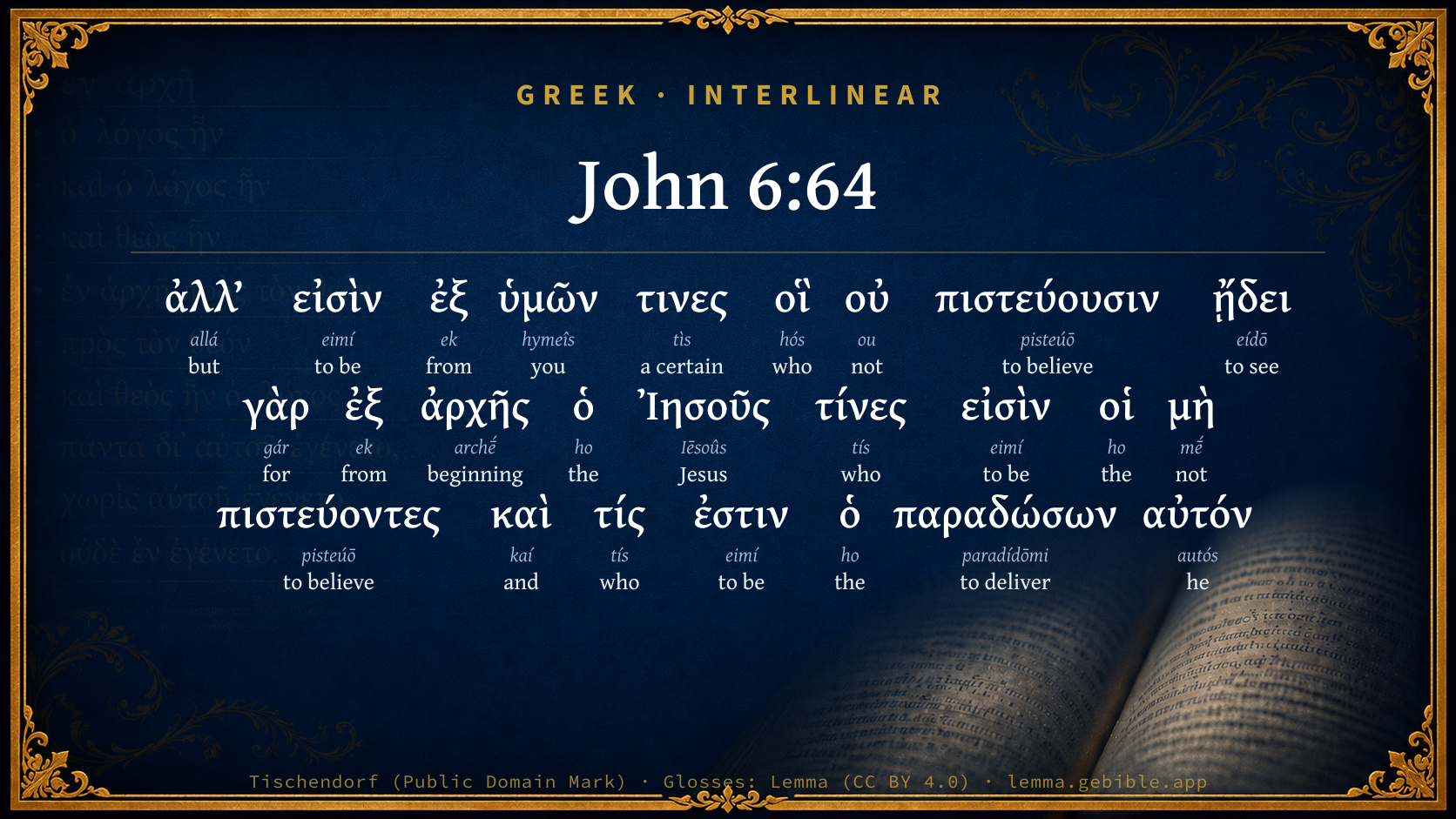
Greek (Tischendorf 8th ed.) John 6:64 appears in the Greek New Testament. The text above is from the Tischendorf 8th edition. Each word links to its Strong’s number and a concise gloss. Click any word for its full Thayer’s Greek Lexicon entry.
Download image
Cite this verse

John 6:64 (World English Bible). Public Domain. Lemma interlinear Bible study tool, https://lemma.gebible.app/v/john/6/64.

Show BibTeX & RIS
BibTeX
RIS
English Translation
But there are some of you who don't believe." For Jesus knew from the beginning who they were who didn't believe, and who it was who would betray him.
World English Bible · Public Domain
Download a study sheet

One document with this verse’s original text, its word-by-word gloss line, the meaning frame, cross-references with their text, attributed commentary, and full source and license credits — printable, and it pastes into notes with its structure intact.

This verse Autodidact and up

Study sheet (.html) Plain text (.txt)

A passage Seminary Student

Up to 50 verses in one chapter. A passage sheet keeps up to 6 commentary sources and 12 cross-references per verse, in the order this page ranks them, and says so on the sheet whenever that leaves anything out. Ask for a single verse and you get the Autodidact verse sheet above.

Everything on this page stays free to read, with no account — the sheet is a download of what is already on screen, not access to it.

Want to remove ads? Support Godless Engineer
Compare translations 3

The same verse in 3 English versions, stacked beneath the original-language interlinear above. Click any original word for its lexicon entry.

Each is an independent rendering of the whole verse — the interlinear is not word-aligned to these translations.

Highlighted words mark where these versions differ — a whole-verse word diff, not a word-by-word alignment.

  • World English Bible Public Domain
    But there are some of you who don't believe." For Jesus knew from the beginning who they were who didn't believe, and who it was who would betray him.
  • King James Version Public Domain
    But there are some of you that believe not. For Jesus knew from the beginning who they were that believed not, and who should betray him.
  • unfoldingWord Literal Text CC BY-SA 4.0
    But there are some of you who do not believe.” For Jesus knew from the beginning who are the ones not believing and who is the one that will be betraying him.

unfoldingWord Literal Text — © unfoldingWord, licensed CC BY-SA 4.0. Word-aligned USFM3 via Door43 (git.door43.org/unfoldingWord/en_ult).

Versions to compare (up to 4)

3 of 4 selected

Show all 19 translations

Every available English version of this verse, each an independent rendering of the whole verse.

  • World English Bible Public Domain
    But there are some of you who don't believe." For Jesus knew from the beginning who they were who didn't believe, and who it was who would betray him.
  • Berean Standard Bible Public Domain
    However, there are some of you who do not believe.” (For Jesus had known from the beginning which of them did not believe and who would betray Him.)
  • Majority Standard Bible Public Domain
    However, there are some of you who do not believe.” (For Jesus had known from the beginning which of them did not believe and who would betray Him.)
  • King James Version Public Domain
    But there are some of you that believe not. For Jesus knew from the beginning who they were that believed not, and who should betray him.
  • American Standard Version (1901) Public Domain
    But there are some of you that believe not. For Jesus knew from the beginning who they were that believed not, and who it was that should betray him.
  • Revised Version (1885) Public Domain
    But there are some of you that believe not. For Jesus knew from the beginning who they were that believed not, and who it was that should betray him.
  • Geneva Bible (1599) Public Domain
    But there are some of you that beleeue not: for Iesus knewe from the beginning, which they were that beleeued not, and who shoulde betray him.
  • Douay-Rheims (1899) Public Domain
    It is the spirit that quickeneth: the flesh profiteth nothing. The words that I have spoken to you, are spirit and life.
  • Young's Literal Translation Public Domain
    but there are certain of you who do not believe;' for Jesus had known from the beginning who they are who are not believing, and who is he who will deliver him up,
  • Literal Standard Version CC BY-SA 4.0
    but there are certain of you who do not believe”; for Jesus had known from the beginning who they are who are not believing, and who is he who will deliver Him up,
  • Unlocked Literal Bible CC BY-SA 4.0
    Yet there are some of you who do not believe.” For Jesus knew from the beginning who were the ones that would not believe and who it was who would betray him.
  • unfoldingWord Literal Text CC BY-SA 4.0
    But there are some of you who do not believe.” For Jesus knew from the beginning who are the ones not believing and who is the one that will be betraying him.
  • Darby Bible Public Domain
    But there are some of you who do not believe. For Jesus knew from the beginning who they were who did not believe, and who would deliver him up.
  • World Messianic Bible Public Domain
    But there are some of you who don’t believe.” For Yeshua knew from the beginning who they were who didn’t believe, and who it was who would betray him.
  • Webster's Bible Public Domain
    But there are some of you that believe not. For Jesus knew from the beginning who they were that believed not, and who he was that would betray him.
  • Free Bible Version CC BY-SA 4.0
    Yet there are some of you who don't trust me.” (Jesus had known from the very beginning who didn't trust him, and who would betray him.)
  • Bible in Basic English Public Domain
    But still some of you have no faith. For it was clear to Jesus from the first who they were who had no faith, and who it was who would be false to him.
  • Text-Critical English NT CC BY 4.0
    But there are some among you who do not believe.” (For Jesus knew from the beginning which of them did not believe and who it was that would betray him.)
  • Tyndale New Testament (1534) Public Domain
    But ther are some of you that beleve not. For Iesus knewe from the begynnynge which they were that beleved not and who shuld betraye him.

Literal Standard Version (2020), Covenant Press — licensed CC BY-SA 4.0. Text via the HelloAO Bible API (eBible.org). Unlocked Literal Bible (unfoldingWord) — licensed CC BY-SA 4.0. Text via the HelloAO Bible API (eBible.org). unfoldingWord Literal Text — © unfoldingWord, licensed CC BY-SA 4.0. Word-aligned USFM3 via Door43 (git.door43.org/unfoldingWord/en_ult). Free Bible Version, Dr. Jonathan Gallagher — licensed CC BY-SA 4.0. Text via the HelloAO Bible API (eBible.org).

Word by word

More ways to search: Search by grammar → Find every occurrence → Compare this word →

Practice this passage: Drill this verse → Learn its vocabulary →

ἀρχῆς
archḗ
G746
“beginning”
Noun, Genitive, Singular, Feminine
Part of Speech
Noun
Case
Genitive
Number
Singular
Gender
Feminine
Full Thayer's Definition

Origin: from G756

TDNT: 08:59,8

1. beginning, origin 2. the person or thing that commences, the first person or thing in a series, the leader 3. that by which anything begins to be, the origin, the active cause 4. the extremity of a thing a. of the corners of a sail 5. the first place, principality, rule, magistracy a. of angels and demons
  1. ἀλλ’ allá G235 “but” Conjunction
  2. εἰσὶν eimí G1510 “to be” Verb, Present, Active, Indicative, 3rd person, Plural
  3. ἐξ ek G1537 “from” Preposition
  4. ὑμῶν hymeîs G5210 “you” Personal pronoun, 2nd person, Genitive, Plural
  5. τινες tìs G5100 “a certain” Indefinite pronoun, Nominative, Plural, Masculine
  6. οἳ hós G3739 “who” Relative pronoun, Nominative, Plural, Masculine
  7. οὐ ou G3756 “not” Particle, Negative
  8. πιστεύουσιν pisteúō G4100 “to believe” Verb, Present, Active, Indicative, 3rd person, Plural
  9. ᾔδει eídō G1492 “to see” Verb, Pluperfect, Active, Indicative, 3rd person, Singular
  10. γὰρ gár G1063 “for” Conjunction
  11. ἐξ ek G1537 “from” Preposition
  12. ὁ ho G3588 “the” Article, Nominative, Singular, Masculine
  13. Ἰησοῦς Iēsoûs G2424 “Jesus” Noun, Nominative, Singular, Masculine
  14. τίνες tís G5101 “who” Interrogative pronoun, Nominative, Plural, Masculine
  15. εἰσὶν eimí G1510 “to be” Verb, Present, Active, Indicative, 3rd person, Plural
  16. οἱ ho G3588 “the” Article, Nominative, Plural, Masculine
  17. μὴ mḗ G3361 “not” Particle, Negative
  18. πιστεύοντες pisteúō G4100 “to believe” Verb, Present, Active, Participle, Nominative, Plural, Masculine
  19. καὶ kaí G2532 “and” Conjunction
  20. τίς tís G5101 “who” Interrogative pronoun, Nominative, Singular, Masculine
  21. ἐστιν eimí G1510 “to be” Verb, Present, Active, Indicative, 3rd person, Singular
  22. ὁ ho G3588 “the” Article, Nominative, Singular, Masculine
  23. παραδώσων paradídōmi G3860 “to deliver” Verb, Future, Active, Participle, Nominative, Singular, Masculine
  24. αὐτόν autós G846 “he” Personal pronoun, Accusative, Singular, Masculine

About this verse

These counts appear in no published source. They are computed here, from the morphology-tagged text and Lemma’s own curated glosses. What Lemma adds →

25
words
18
distinct lemmas
Gospels
section

Shared distinctive vocabulary

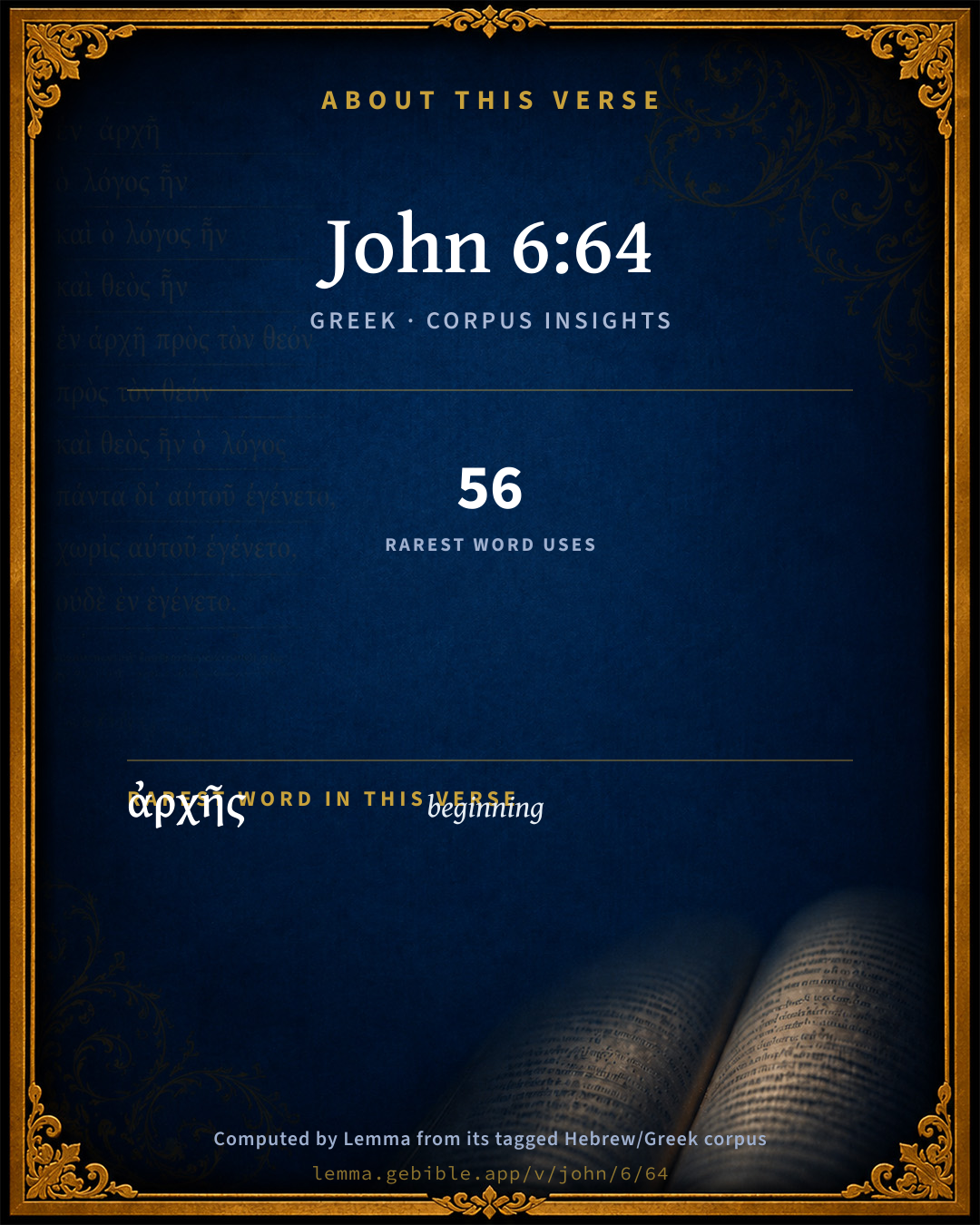
ἀρχῆς beginning G746 occurs in 55 verses of the Greek New Testament. Also found in:
Repetition

Words recur within this verse:

  • εἰσὶν to be G1510 ×3
  • πιστεύουσιν to believe G4100 ×2
  • ὁ the G3588 ×3
  • ἐξ from G1537 ×2
  • τίνες who G5101 ×2

Cross-references

17

Topical passages linked to John 6:64 in the Treasury of Scripture Knowledge — connected by theme and wording, ordered by reader-vote popularity; previews shown in the World English Bible.

  • John 10:26 But you don't believe, because you are not of my sheep, as I told you.
  • 2 Timothy 2:19 However God's firm foundation stands, having this seal, "The Lord knows those who are his," and, "Let every one who names the name of the Lord depart from unrighteousness."
  • Hebrews 4:13 There is no creature that is hidden from his sight, but all things are naked and laid open before the eyes of him with whom we have to do.
  • Psalms 139:2–4 You know my sitting down and my rising up. You perceive my thoughts from afar.
  • John 2:24–25 But Jesus didn't trust himself to them, because he knew everyone,
  • John 5:42 But I know you, that you don't have God's love in yourselves.
  • John 6:61 But Jesus knowing in himself that his disciples murmured at this, said to them, "Does this cause you to stumble?
  • John 6:70–71 Jesus answered them, "Didn't I choose you, the twelve, and one of you is a devil?"
  • John 13:10–11 Jesus said to him, "Someone who has bathed only needs to have his feet washed, but is completely clean. You are clean, but not all of you."
  • Romans 8:29 For whom he foreknew, he also predestined to be conformed to the image of his Son, that he might be the firstborn among many brothers.
  • John 6:36 But I told you that you have seen me, and yet you don't believe.
  • John 6:66 At this, many of his disciples went back, and walked no more with him.
  • John 13:18–21 I don't speak concerning all of you. I know whom I have chosen. But that the Scripture may be fulfilled, 'He who eats bread with me has lifted up his heel against me.'
  • Acts 15:18 All his works are known to God from eternity.'
  • John 8:23 He said to them, "You are from beneath. I am from above. You are of this world. I am not of this world.
  • John 8:38–47 I say the things which I have seen with my Father; and you also do the things which you have seen with your father."
  • John 8:55 You have not known him, but I know him. If I said, 'I don't know him,' I would be like you, a liar. But I know him, and keep his word.

Cross-references courtesy of OpenBible.info (CC BY 4.0).

Commentary

Notes on John 6:64 from classic Christian and Jewish commentators (each source and its license shown beneath its notes). The classic Christian expositions comment on the surrounding passage and are grouped to its opening verse, so a note may address several verses; the Jewish commentaries on the Tanakh (Rashi and others) are per-verse, so they appear only where the commentator wrote on this verse.

Lemma curates 59 commentaries, every one of them public domain or Creative Commons licensed, each selected and text-cleaned for this edition rather than reprinted as found. About our sources →

Bengel's Gnomon

Johann Albrecht Bengel

Joh 6:64. Ἀλλʼ εἰσίν, but there are) With yourselves rests the blame.—τινές, some) who also disturb the faith of others.—οὐ πιστεύουσιν, do not believe) and so therefore distort into a carnal sense what has been spoken in a spiritual sense.—ἐξ ἀρχῆς, from the beginning) The very time of this discourse is marked, although Jesus, even before that time, had always known what was about to be. This discourse was delivered a year before His passion; but the choice of the twelve apostles did not precede this discourse by a whole year. Therefore it was at that time a beginning.—τίνες, who in particular) out of the larger number of His disciples.—καὶ τίς, and who) out of the twelve disciples. Judas therefore was then already cherishing that unnatural feeling, from which subsequently his treachery took its rise. Even then he did not believe, and, along with many other disciples, took offence at the discourse of Jesus. The bad are soon bad; the good are soon good.[152] John has diligently marked the successive steps in the deadly wickedness of Judas, ch. Joh 12:4 [His covetous objection made to the pouring out of the ointment on the Lord by Mary]; Joh 13:2; Joh 13:27, “Satan entered into him;” Joh 14:22; and entertained an especial antipathy towards him.

[152] i.e. Good and evil soon develop themselves in their respective characters.—E. and T.

Bengel's Gnomon of the New Testament — English translation (T&T Clark, Edinburgh, 1860) — public domain. Text from a community e-Sword module.

Expositor's Greek Testament

ed. W. Robertson Nicoll

Joh 6:64 . But τινὲς οὐ πιστεύουσιν , and therefore do not receive the life. This Jesus said ἤδει γὰρ … αὐτόν , for Jesus knew from the first who they were that believed not, and who it was who should betray Him. “Hoc ideo addidit Evangelista, ne quis putet temere judicasse Christum de suis auditoribus,” Calvin. Euthymius says it illustrates His forbearance. ἐξ ἀρχῆς , from the beginning of His connection with individuals. Weiss supposes it means from the beginning of their not believing. He gave utterance to this knowledge in Joh 6:26 . He even knew who it was who should betray Him. This is said in anticipation of Joh 6:70-71 . This declaration raises the question, Why then did Jesus call Judas to the Apostolate? Holtzmann indeed supposes that this intimation is purely apologetic and intended to show that Jesus was not deceived in appointing Judas. It is unnecessary to increase the difficulty by supposing the ἐξ ἀρχῆς to refer to the time previous to his call. Jesus saw in Judas qualities fitting him to be an Apostle; but seeing him among the others He recognised that he was an unfaithful man. To suppose that He called him in the clear knowledge that he would betray Him is to introduce an unintelligible or artificial element into the action of Christ. [Neither Calvin nor Beza makes any remark on the clause. Bruce, Training of the Twelve ; and Reith, in loc. , should be consulted.] Jesus already recognised in what manner His death would be compassed: by treachery. The fact stated in Joh 6:64 , that some of His own disciples could yet not believe in Him, illustrates the truth of what He had said, Joh 6:44 , that no one can come to Him except the Father draw him.

The Expositor's Greek Testament, edited by W. Robertson Nicoll (1897–1910) — public domain. Text from a community e-Sword module.

Jamieson, Fausset & Brown

Robert Jamieson, A. R. Fausset & David Brown

But there are some, &c.--that is, "But it matters little to some of you in what sense I speak, for ye believe not." This was said, adds the Evangelist, not merely of the outer but of the inner circle of His disciples; for He knew the traitor, though it was not yet time to expose him.

Jamieson, Fausset & Brown — Commentary Critical and Explanatory on the Whole Bible (1871) — public domain (CC PDM 1.0). Text via the HelloAO Bible API.

Adam Clarke's Commentary

Verse 64. But there are some of you that believe not.] This is addressed to Judas, and to those disciples who left him: Joh 6:66.

And who should betray him] Or, who would deliver him up. Because he knew all things; he knew from the first, from Judas's call to the apostleship, and from eternity, (if the reader pleases,) who it was who would (not should) deliver him up into the hands of the Jews. Should, in the apprehension of most, implies necessity and compulsion; would implies that he was under the influence of his own free will, without necessity or constraint. The former takes away his guilt: for what a man is irresistibly compelled to do, by the supreme authority of God, he cannot avoid; and therefore to him no blame can attach: but Judas having acted through his own free will, abusing his power, and the grace he had received, he was guilty of the murder of an innocent man, and deserved the perdition to which he went.

Adam Clarke's Commentary on the Bible (1810–1826) — public domain. Text from a community e-Sword/MySword module.

John Calvin's Commentaries

64. But there are some of you who do not believe. He again imputes blame to them, because, being destitute of the Spirit, they wickedly corrupt and debase his doctrine, and thus turn it to their ruin. For otherwise they might have objected: “You boast, indeed, that what you speak is quickening, but we experience nothing of that nature.” He therefore says, that by themselves it is prevented; for unbelief, as it is always proud, will never understand any thing in the words of Christ which it despises and disdains. Wherefore, if we wish to profit at all under this Teacher, let us bring minds well disposed to listen to him; for if the entrance to his doctrine be not opened up by humility and reverence, our understandings are harder than stones, and will not receive any part of sound doctrine. And therefore, when in the present day we see so few people in the world profiting by the Gospel, we ought to remember that this arises from the depravity of men. For how many will you find who deny themselves, and truly submit to Christ? As to his saying only that there were some who did not believe, though almost all of them were liable to this charge, his reason for doing so appears to have been that, if there were any who were not yet beyond the possibility of cure, they might not cast down their minds in despair.

For Jesus knew from the beginning. The Evangelist added this, that none might think that Christ formed an opinion at random about his hearers. Many professed to belong to his flock, but a sudden apostacy exposed their hypocrisy. But the Evangelist says that their treachery, even while it was unknown to others, was well known to Christ. And this is stated, not so much on his account, as that we may learn not to form a judgment except on subjects which we have thoroughly investigated; for as to their being known to Christ from the beginning, this was peculiar to his Divinity. It is otherwise with us; for since we do not know the hearts, we ought to delay forming a judgment, until impiety be manifested by outward signs, and thus the tree be known by its fruits, (Matthew 7:16.)

John Calvin's Commentaries (1540-1563) — public domain. Text from the Calvin Translation Society English edition (1840s-50s) via the Christian Classics Ethereal Library (ccel.org). Calvin's coverage is partial (roughly two-thirds of the Bible); uncommented books and verses are honest gaps, never fabricated. The 19th-century editor's footnotes and remarks are omitted so the notes are faithfully Calvin's own voice.

Ellicott's Commentary for English Readers

(64) There are some of you that believe not.—Later, the word “disciple” became synonymous with the word “believer,” but there are those now following Him just as they would follow any Rabbi, and, regarding Him as a merely human teacher, they fall short of the faith which was the first qualification for true discipleship. They had heard, it may be, the Sermon on the Mount, and such teaching as that of Matthew 13. In part they could understand this, and therefore in part believed; but when faith was really needed, it was found not really to exist: for faith is accepting what is not demonstrable to the mere reason, and seeing what is invisible.

From the beginning.—This is a relative term, and is to be interpreted from the context. It means here the beginning of their discipleship. He saw in their hearts the varying kinds of ground on which the good seed fell, and in their acts and words the varying effects. There were hearts like the hardened wayside, but it may have been ploughed; like the stony places, but that shelving rock may have been broken through; like the thorns, but they may have been rooted up; and all may have become, as some were, like the good and fruit-bearing ground.

A Bible Commentary for English Readers, edited by Charles John Ellicott (1878–1897) — public domain. Text from a community e-Sword module.

The Cambridge Bible for Schools and Colleges

gen. ed. J. J. S. Perowne

64. some of you that believe not] There were some of those who followed Him and called themselves His disciples, who still did not believe on Him. The better order is, there are of you some.

knew from the beginning] It is impossible to fix the exact limits of this; the meaning of ‘the beginning’ must depend on the context (see on Joh_1:1). Here the most natural limit is ‘knew from the beginning of their discipleship,’ when they first became His followers. Comp. Joh_2:24-25.

who should betray him] Or, who it was that should betray Him. To ask, ‘Why then did Jesus choose Judas as an Apostle?’ is to ask in a special instance for an answer to the insoluble enigma ‘Why does Omniscience allow wicked persons to be born? Why does Omnipotence allow evil to exist?’ The tares once sown among the wheat, both must ‘grow together till the harvest,’ and share sunshine and rain alike.

The Cambridge Bible for Schools and Colleges (gen. ed. J. J. S. Perowne; Cambridge University Press, 1878–1918) — public domain. Text from a community e-Sword module.

John Gill's Exposition

From that time many of his disciples went back,.... Not any of the twelve apostles, for they are distinguished from these in the next verse; nor any of the seventy disciples, for their names were written in heaven, and could not apostatize totally and finally, as these did; but some of the multitude of the disciples, who followed Christ, heard him, and professed to believe in him, and were baptized in his name, but were not true disciples, only nominal ones: they had never heard and learned of the Father, otherwise they would have known what it was to come to Christ, as the Father's gift, and under the drawings of his grace; and would not have been offended at the words of our Lord, just now spoken by him, concerning that sort of coming to him: but from the time he spoke those words; "because of this word", as the Syriac, Arabic, and Persic versions render it; they withdrew themselves from his ministry, they dropped their profession of faith in him, and relinquished him as a Saviour and Redeemer: for finding that he would not be made king, nor set up for a temporal redeemer; and talking of himself as the bread of life, and of coming to him, in a sense they did not understand; they turned their backs on him; and as the words may be literally read, "returned to the things that were behind"; to the world, and to their old companions, to Satan and their own hearts lusts; like the dog to its vomit, and the swine to its wallowing in the mire: their true picture is drawn, in the parable of the unclean spirit going out of the man, and returning, Mat 12:43. And they returned to their quondam teachers, the Scribes and Pharisees, and to the law of works, and to seek for righteousness by it; setting up their own righteousness, and not submitting to the righteousness of Christ; and thus to look back and draw back, is a sad case indeed:

and walked no more with him; never returned to him more, or went with him from place to place as before: never more attended on his ministry, or had any intimacy and fellowship with him: and so it commonly is with apostates from the profession of Christ; they seldom or ever return, or are recovered; it is difficult, if not impossible, which is sometimes the case, to renew them again to repentance.

John Gill's Exposition of the Whole Bible (1746–1763) — public domain (CC PDM 1.0). Text via the HelloAO Bible API.

Trapp's Complete Commentary

John Trapp

64 But there are some of you that believe not. For Jesus knew from the beginning who they were that believed not, and who should betray him.

Ver. 64. But there are some of you that believe not] And hence it is that you so grossly mistake me, and that you find no more benefit by me and my words. Unbelief rejects the remedy, frustrates the means, holds a man in universal pollution, Heb 3:12, and leaves him under a double condemnation; one from the law wherein Christ found him, and another from the gospel for refusing the remedy, that blessed bath of Christ’s blood, Zec 13:1, whereunto even the princes of Sodom are invited, Isa 1:10, and for despising it, doomed, Eze 24:13, as a malefactor dead in law, and yet rejecteth the offer of a pardon. In Ket’s sedition, when King Edward VI’s pardon was offered the rebels by a herald, a lewd boy turned toward him his naked posteriors, and used words suitable to that gesture. One standing by discharged a harquebus {a} upon the boy, and struck him dead in the place. {b} How shall those escape that neglect so great salvation, which at first began to be spoken by the Lord? Heb 2:3.

{a} The early type of portable gun, varying in size from a small cannon to a musket, which on account of its weight was, when used in the field, supported upon a tripod, trestle, or other ‘carriage’, and afterwards upon a forked ‘rest’. The name in German and Flemish meant literally ‘hook-gun’, from the hook cast along with the piece, by which it was fastened to the ‘carriage’; but the name became generic for portable fire-arms generally in the 16th century, so that the type with the hook was subsequently distinguished as arquebuse à croc. According to Wendelin Boeheim, Handbuch der Waffenkunde (Leipzig 1890) 447, 455, the hook of the original hakenbühse was intended to hold on to a wall or other fixed object, partly to support the weight of the barrel and partly to diminish the recoil. Maximilian I (early 16th cent.) introduced the portable tripod which could be put together in the field. The forked rest came in about 1520, with the Spanish musket. ŒD

{b} Life of Edward VI, by Sir John Heywood.

John Trapp, A Commentary or Exposition upon All the Books of the Old and New Testament (1647–1656) — public domain. Text from a community e-Sword module.

Albert Barnes' Notes on the Bible

Jesus knew from the beginning ... - As this implied a knowledge of the heart, and of the secret principles and motives of men, it shows that he must have been omniscient.

Albert Barnes' Notes on the Bible (1834–1885) — public domain. Text from a community e-Sword/MySword module.

Haydock's Catholic Bible Commentary

The flesh profiteth nothing. Dead flesh, separated from the spirit, in the gross manner they supposed they were to eat his flesh, would profit nothing. Neither doth man’s flesh, that is to say, man’s natural and carnal apprehension, (which refuses to be subject to the spirit, and words of Christ) profit any thing. But it would be the height of blasphemy, to say the living flesh of Christ (which we receive in the blessed sacrament, with his spirit, that is, with his soul and divinity) profiteth nothing. For if Christ’s flesh had profited us nothing, he would never have taken flesh for us, nor died in the flesh for us. --- Are spirit and life. By proposing to you a heavenly sacrament, in which you shall receive, in a wonderful manner, spirit, grace and life. These words sufficiently correct the gross and carnal imagination of these Capharnaites, that he meant to them his body and blood to eat in a visible and bloody manner, as flesh, says St. Augustine, is sold in the market, and in the shambles;[3] but they do not imply a figurative or metaphorical presence only. The manner of Christ’s presence is spiritual and under the outward appearances of bread and wine; but yet he is there truly and really present, by a change of the substance of bread and wine into the substance of his body and blood, which truly and really become our spiritual food, and are truly and really received in the holy sacrament. --- The flesh[4] of itself profiteth nothing, not even the flesh of our Saviour Christ, were it not united to the divine person of Christ. But we must take care how we understand these words spoken by our Saviour: for it is certain, says St. Augustine, that the word made flesh, is the cause of all our happiness. (Witham) --- When I promise you life if you eat my flesh, I do not wish you to understand this of that gross and carnal manner, of cutting my members in pieces: such ideas are far from my mind: the flesh profiteth nothing. In the Scriptures, the word flesh is often put for the carnal manner of understanding any thing. If you with to enter into the spirit of my words, raise your hearts to a more elevated and spiritual way of understanding them. (Calmet) --- The reader may consult Des Mahis, p. 165, a convert from Protestantism, and who has proved the Catholic doctrine on the Eucharist in the most satisfactory manner, from the written word. Where he shows that Jesus Christ, speaking of his own body, never says the flesh, but my flesh: the former mode of expression is used to signify, as we have observed above, a carnal manner of understanding any thing.

===============================

[BIBLIOGRAPHY]

St. Augustine, 27. p. 503, carnem quippe intellexerunt, quomodo in cadavere dilaniatur, aut in macello venditur.

===============================

[BIBLIOGRAPHY]

St. Augustine, 27. p. 503, caro non prodest quicquam, sed caro sola ... nam si caro nihil prodesset, verbum caro non fieret.

====================

George Leo Haydock (1774–1849), Haydock's Catholic Family Bible and Commentary, 1859 edition — public domain. Excludes Psalms (Douay-Rheims chapter numbering differs from Protestant) and Deuterocanonical books (Catholic canon only).

Matthew Poole's English Annotations

I may say what I will to you; the Spirit quickeneth, but it doth not quicken all; it only quickeneth whomsoever it pleaseth. You understand not these things, but have most gross conceptions of sublime spiritual things; the reason is, because you believe not: though some of them, questionless, did truly believe, yet the most did not; for we read, Joh 6:66, that many of them went back, and walked no more with him. And though faith be an inward, secret act of the soul, yet Christ knew, and from the beginning, who were believers, and who were not; nay, he had a particular knowledge of that disciple who was to betray him.

Matthew Poole's English Annotations on the Holy Bible (1683–1685) — public domain. Text from a community e-Sword/MySword module.

Whedon's Commentary on the Bible

Daniel D. Whedon

64. Some… that believe not—They had no living faith. To them his reference to his ascension, (Joh_6:62,) and his thrilling words of the Spirit, would be but a continuance of the hard saying. Jesus knew—His very humanity, by its close contact with divinity, would be fringed with a supernatural intuition. See note on Joh_2:25.

Who should betray him—Who was going to betray him. It is a simple future participle, and expresses no fatalism or predestination.

Daniel D. Whedon (gen. ed.), Commentary on the Old and New Testaments (1874–1909) — public domain. Text from a community e-Sword module.

The Pulpit Commentary

But, he adds, there are some of you that believe not. "Some," not many, who were following him yet felt that they could not trust could not accept his greatest revelations, these Divine assumptions, this spiritual position of his. The Divine humanity, the offered life, the cruel death, of the Son of God, the victory over death, the return to the Father, when put into words or when taught in metaphors even, were grounds of offence. The evangelist adds: For (the gar introduces the explanatory clause of the disciple who testified of these things) Jesus knew (knew absolutely, rather than came to know) from the beginning referring to the commencement of his public ministry, when men began to close round him, (Joh_1:43, 48 2:24) not from the beginning of time, or the beginning of their unbelief (Kling); he knew by his Divine penetration into their character, by their manner and spirit, and the nakedness and openness of all hearts before himwho they were that believed not, and who it was that should betray him. Westcott here reminds us that the first indication of the sin of Judas occurs in close association with predictions of the approaching Passion. This foreknowledge of issues is no interference with free self-consciousness in itself. It may imply that the natures thus known contained in themselves the seeds of the future growth. He knew what would be, but he did not compel it. There was possibly some fresh manifestation of feeling, of failing sympathy, even of enmity, which led the evangelist to notice the manner and interpret the mind of the Lord.

The Pulpit Commentary (1880–1919), ed. H.D.M. Spence-Jones & Joseph S. Exell — public domain. Text from a community e-Sword module.

John Wesley's Explanatory Notes

But there are some of you who believe not - And so receive no life by them, because you take them in a gross literal sense. For Jesus knew from the beginning - Of his ministry: who would betray him - Therefore it is plain, God does foresee future contingencies:- "But his foreknowledge causes not the fault, Which had no less proved certain unforeknown."

John Wesley, Explanatory Notes Upon the Whole Bible (1754–1765) — public domain. Text via the GEBible commentary corpus.

Burkitt's Expository Notes on the New Testament

William Burkitt

Our blessed Saviour having thus cleared his doctrine, that he was the bread of life which came down from heaven, and that he is not to be carnally, but spiritually, fed upon: he plainly tells the Jews, That the true cause of their stumbling at his doctrine, was their ignorance and unbelief; There are some of you that believe not. Upon which plain dealing of our blessed Saviour’s, many unsound professors did wholly forsake him, and accompanied no longer with him.

Learn hence, That multitudes, who have long professed Christ and his holy religion, may draw back, and fall from their profession, and finally revolt from him.

2. That it is an evil heart of unbelief, which causes men to depart from Christ, and to make shipwreck of their profession.

William Burkitt's Expository Notes on the New Testament (1700–1703) — public domain. Text from a community e-Sword module.

unfoldingWord translationNotes

Door43 World Missions Community

Connecting Statement:

Jesus finishes speaking to the crowd.

For Jesus knew from the beginning who were the ones ... who it was who would betray him

Here John gives background information about what Jesus knew would happen. (See: Background Information)

no one can come to me unless it is granted to him by the Father

Whoever wants to believe must come to God through the Son. Only God the Father allows people to come to Jesus.

Father

This is an important title for God. (See: Translating Son and Father)

come to me

"follow me and receive eternal life"

translationWords

believe

Jesus

betray

unfoldingWord translationNotes — © Distant Shores Media and the Door43 World Missions Community, licensed CC BY-SA 4.0. Source: git.door43.org/Door43/en_tn.

Cambridge Greek Testament for Schools and Colleges

64. ἐξ ὑμῶν τινες. Of you some; for the order comp. ἐξ ὑμ. εἶς, Joh 6:70. Some followed Him without believing on Him.

ἐξ ἀρχῆς. The meaning of ἀρχή always depends on the context (see on Joh 1:1, Joh 15:27). Here the most natural limit is ‘from the begining of their discipleship.’ Comp. Joh 2:24-25. Οἳ οὐ πιστ. expresses a fact, οἳ μὴ π. a thought; ‘those, whoever they might be, who believed not:’ Joh 5:33, Joh 14:24, Joh 15:24.

τίς ἐστιν ὁ π. αὐ. Who it was that would betray Him. To ask, ‘Why then did Jesus choose Judas as an Apostle?’ is to ask in a special instance for an answer to the insoluble enigma ‘Why does Omniscience allow wicked persons to be born? Why does Omnipotence allow evil to exist?’ The tares once sown among the wheat, both ‘grow together till the harvest,’ and share sunshine and rain alike. Παραδίδοναι means to ‘hand over, deliver up;’ Joh 18:30; Joh 18:35, Joh 19:16.

Cambridge Greek Testament for Schools and Colleges (Cambridge University Press, 1896; 21 vols, various authors incl. Carr, Maclear, Plummer, Farrar, Lumby, Moule, M. R. James, Simcox) — public domain. Text from a community e-Sword module.

Alford’s Greek Testament

Henry Alford

64. ἀλλʼ εἰσὶν.…] ‘This accounts for your murmuring at what I said, that ye do not believe.’

ᾔδει γὰρ …] De Wette remarks, that the foreknowledge of our Lord with regard to Judas renders it impossible to apply the ordinary rules of moral treatment,—as ‘Why did He then continue him as an Apostle? Why did He give him the charge of the purse, knowing him to be a thief? &c.,’—to the case: and it is therefore better not to judge at all on the matter.

The fact is, we come here to a form of the problem of divine foreknowledge and human free-will, which, in any of its endless combinations of expression, it is equally impossible for us to solve.

ἐξ ἀρχῆς, from their first coming to Him;—the first beginning of their connexion with Him.

Henry Alford, The Greek Testament (1849–1861) — public domain. Text from a community e-Sword module.

International Critical Commentary

64. But although His words were words of life, they were life only to those who believed, and so Jesus adds ἀλλʼ εἰσὶν ἐξ ὑμῶν τινες οἳ οὐ πιστεύουσιν. πιστεύειν is used absolutely, as at vv. 36, 47 (see on 1:7).

Jn. is prone to comment on sayings or actions of Jesus that might not be easy for a reader to understand,2 and here he adds ᾔδει γάρ κτλ. (cf. 3:16), to emphasise the point that Jesus had not been speaking great words of mystery (vv. 62, 63) without realising that some among His hearers could not appropriate them.

ᾔδει γὰρ ἐξ ἀρχῆς ὁ Ἰη. ἐξ ἀρχῆς occurs in the N.T. only here and at 16:4, although it is found in the LXX (e.g. Isa 40:21, Isa 41:26, where it means “from the beginning of things”); but we have seen on v. 38 that ἀπό and ἐκ are not always distinguishable in Jn. He uses ἐξ ἀρχῆς as equivalent to ἀπʼ ἀρχῆς (א reads ἀπʼ ἀρχῆς), which occurs 15:27, 1Jn 2:7, 1Jn 2:24, 1Jn 2:3:11 (but cf. 1Jn 1:1) in the same sense as here, viz. “from the time when Jesus first drew disciples round Him.” From the moment when He began to observe their characters, He distinguished unerringly those who were faithful from those who were not (see 2:24). That Jn. means his readers to understand that from the moment of his call, Judas was known by Jesus to be the man who would betray Him is not certain. If that be his meaning, the passage provides a remarkable instance of Jn.’s doctrine of predestination (see on 2:4, and especially on 13:18). But we need not press ἐξ ἀρχῆς so far that we must suppose that Jesus chose Judas as one of the Twelve, being conscious at the time that he would be a traitor; that would make the choice difficult to explain, in connexion with the true humanity of Christ. If the knowledge that Judas was untrustworthy came as soon as Jesus had studied him at close quarters, then ἐξ ἀρχῆς is adequately interpreted. In any case, Jn. takes care, both here and in c. 13, to repudiate the idea that the treachery of Judas took Jesus by surprise.

τίς ἐστιν ὁ παραδώσων αὐτόν. Abbott notes (Diat. 2510) that ὁ παραδώσων (D has ὁ παραδίδους) is the only instance in Jn. of a future participle with the article.

The meaning of παραδιδόναι is often misunderstood, as Abbott (Paradosis passim) has shown at length. It means at “to deliver up,” but not necessarily “to betray.” Thus it is used of the Jews giving up Jesus to Pilate (18:30, 35, 36, 19:11), and of Pilate giving up Jesus to be crucified (19:16), and also of Jesus “giving up” His spirit, i.e. dying, on the cross (19:30). In none of these passages is treachery connoted or implied; and thus in the passages where παραδιδόναι is applied to the action of Judas (6:71, 12:4, 13:2, 11, 21, 18:2, 5, 21:20) we are not entitled to render it “betray.” προδιδόναι (a verb not found in the Gospels, although Luk 6:16 calls Judas προδότης, as he undoubtedly was) is “to betray,” but παραδιδόναι is simply “to deliver up,” and is a colourless word not conveying any suggestion of blame.

Jn. does not record any early predictions by Jesus that He would be “delivered up” to the Jews, as the Synoptists do (cf. Mar_9:3l, 10:33). In Jn. Jesus Himself does not use the word παραδιδόναι until 13:21.

International Critical Commentary — older volumes (1896–1929), various authors — public domain. Text from a community e-Sword module.

Vincent's Word Studies in the New Testament

Marvin R. Vincent

Should betray [παραδωσων] . See on Mt 4:12; Mr 4:29. Judas is once in the New Testament designated by the noun prodothv, traitor, Luk 6:16.

Marvin R. Vincent, Word Studies in the New Testament (1887–1900) — public domain. Text from a community e-Sword/MySword module.

Godet's Commentaries

Frédéric Louis Godet

Vv. 64, 65. “But there are among you some that believe not. For Jesus knew from the beginning who they were that believed not, and who it was that should betray him; 65 and he said: For this cause have I said unto you, that no man can come unto me, except it be given him by my Father.”

To the exclamation: This saying is a hard one, Jesus had replied: “It is hard only so far as you wrongly understand it.” And now He unveils the cause of this want of understanding. Even among them, His disciples, apparently believers, there is a large number who are not true believers.

The expression τινές does not so far limit the number of these false believers as the French [or English] word some; comp. Rom 3:3; Rom 11:17, and Heb 3:16, where this pronoun is applied to the whole mass of the disobedient and unbelieving Jewish nation. The word τινές designates any part whatever, whether great or small, of the whole. The evangelist by means of a fact gives the reason, in the second part of the verse, for the declaration pronounced in the first; this fact is that Jesus knows them even to the foundation, and this from the beginning. The word ἀπ᾿ ἀρχῆς, from the beginning, applies undoubtedly, as Lucke, Meyer, Westcott think, to the earliest times of Jesus’ ministry, when He set Himself to the work of grouping around Himself a circle of permanent disciples (Joh 15:27, Joh 16:4; Act 1:21-22), or, what amounts nearly to the same thing, to the beginning of the relation of Jesus to each one of them (Tholuck, Westcott, Keil); He discerned immediately the nature of the aspirations which brought them to Him (Joh 2:22-23). Lange and Weiss think that the term beginning designates the first appearance of the unbelief itself.Chrysostom and Bengel apply it to the moment when the hearers had begun to murmur on this very day. These last explanations are quite unnatural. Καί, and: and even, or: and in particular. The expression: who it was who should, is written, not from the standpoint of a fatalistic predestination, but simply from that of the accomplished fact (Joh 6:71).

It follows undoubtedly from this word of John that Jesus did not choose Judas without understanding that, if there was to be a traitor among His disciples, it would be he; but not that He had chosen him in order that he should betray Him. He might hope to gain the victory over the egoistic and earthly aspirations which brought this man, like so many others, to Him. The privileged place which He accorded to him might be a means of gaining him, as also it might end in a deeper fall, if he trampled this grace under foot. As Keil says, “God constantly puts men in positions where their sin, if it is not overcome, must necessarily reach maturity. And God uses it then to serve the accomplishment of His plan.” Still more, shall we not go so far as to say that the very fall in which this relation was to end might become the terrible means of finally breaking down the pride of this Titanic nature? The moment when Judas, receiving the fatal morsel from the hand of Jesus, must have felt all the greatness of his crime, might have become for him the moment of repentance and of salvation. “If,” says Riggenbach (Leben des Herrn Jesu, p. 366), “in that night of prayer when the choice of the Twelve was prepared for (Luk 6:12), the thoughts of the Lord Jesus were again and again brought back to this man, and if, while very clearly discerning his want of uprightness, He was obliged to recognize in this the signal from the Father, what shall we have to say? Literally the narrator says: “For He knew... who they are who do not believe and who is he who shall betray Him;” so far does he carry himself back with vividness to the moment when all this occurred.

The καὶ ἔλεγεν, and he said, leads us to suppose a moment of silence here, filled with the sorrowful reflection which the evangelist afterwards communicates to us. The διὰ τοῦτο, for this cause, refers to the expression: some who do not believe. “It is precisely to this that I wished to turn your attention when I said to you.” A man may declare and believe himself His disciple without truly believing, because he joins himself to Him under the sway of motives which do not proceed from the teaching of the Father (Joh 6:45).

Without this divine and inward preparation, even in the most favorable position faith remains impossible. The quotation is not literal, any more than in the other cases where Jesus quotes Himself (Joh 6:36). In Joh 6:37, it was the coming believer who was given to Jesus; here it is given to him to come. Westcott observes correctly that the two elements, divine and human, appear here, the first in the word is given, the second in the word come. This saying of Jesus was a farewell; those to whom it was addressed understood it. Even after the day when the popular enthusiasm had reached its culminating point, the Galilean work of Jesus seemed as if destroyed; it presented the aspect of a rich harvest on which a hail-storm has beaten.

Frédéric Louis Godet — Commentaries on Luke, John, Romans, and 1 Corinthians — English translation (T&T Clark, Edinburgh, 1870s–1890s) — public domain. Text from a community e-Sword module.

Lesson kit

Teaching starters — assembled from the data on this page, not authored interpretation. Every prompt links to the verse data it draws on. Edit before teaching.

John, in the Gospels, opens this verse with 25 words (18 distinct Greek lemmas). Its most distinctive word is archḗ (“beginning”). A historical commentator’s framing appears above. Read the whole chapter for the surrounding context.

Discussion questions

  1. The word archḗ carries the sense “beginning.” How does it shape the verse?
  2. How does Matthew 19:4, which shares the word «beginning», read alongside this verse?
  3. What does the repetition of “to be” (3× in this one verse) do in this verse?
  4. These translations render this verse differently. What is at stake in choosing one wording over another?
  5. Compare how Bengel's Gnomon and Expositor's Greek Testament read this verse. Where do they agree or differ?

Things to notice

Reading settings

Reading text

Shown beneath each verse's original-language words.

Old Testament
Old Testament edition

Read the OT as the Masoretic Hebrew (MT) or the Greek Septuagint (LXX).

English shown for the Greek Septuagint (in the Hebrew ↔ Greek comparison).

Comparing translations? Open the Compare panel on any verse page to stack up to four side by side.