
John 1:21

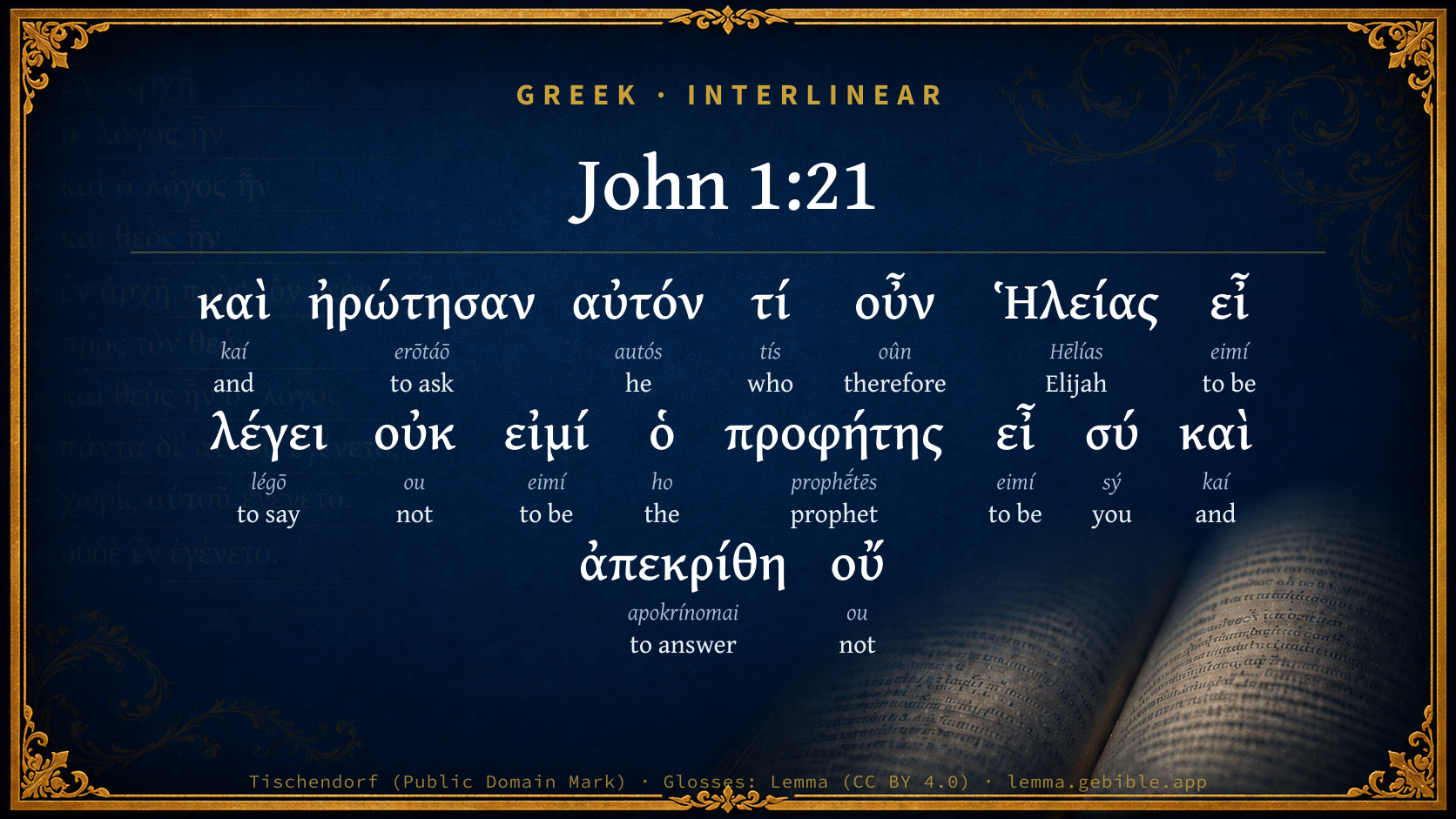
Greek (Tischendorf 8th ed.) John 1:21 appears in the Greek New Testament. The text above is from the Tischendorf 8th edition. Each word links to its Strong’s number and a concise gloss. Click any word for its full Thayer’s Greek Lexicon entry.
Download image
Cite this verse

John 1:21 (World English Bible). Public Domain. Lemma interlinear Bible study tool, https://lemma.gebible.app/v/john/1/21.

Show BibTeX & RIS
BibTeX
RIS
English Translation
They asked him, "What then? Are you Elijah?" He said, "I am not." "Are you the Prophet?" He answered, "No."
World English Bible · Public Domain
Download a study sheet

One document with this verse’s original text, its word-by-word gloss line, the meaning frame, cross-references with their text, attributed commentary, and full source and license credits — printable, and it pastes into notes with its structure intact.

This verse Autodidact and up

Study sheet (.html) Plain text (.txt)

A passage Seminary Student

Up to 50 verses in one chapter. A passage sheet keeps up to 6 commentary sources and 12 cross-references per verse, in the order this page ranks them, and says so on the sheet whenever that leaves anything out. Ask for a single verse and you get the Autodidact verse sheet above.

Everything on this page stays free to read, with no account — the sheet is a download of what is already on screen, not access to it.

Want to remove ads? Support Godless Engineer
Compare translations 3

The same verse in 3 English versions, stacked beneath the original-language interlinear above. Click any original word for its lexicon entry.

Each is an independent rendering of the whole verse — the interlinear is not word-aligned to these translations.

Highlighted words mark where these versions differ — a whole-verse word diff, not a word-by-word alignment.

  • World English Bible Public Domain
    They asked him, "What then? Are you Elijah?" He said, "I am not." "Are you the Prophet?" He answered, "No."
  • King James Version Public Domain
    And they asked him, What then? Art thou Elias? And he saith, I am not. Art thou that prophet? And he answered, No.
  • unfoldingWord Literal Text CC BY-SA 4.0
    And they asked him, “What then? Are you Elijah?” And he says, “I am not.” “Are you the Prophet?” And he answered, “No.”

unfoldingWord Literal Text — © unfoldingWord, licensed CC BY-SA 4.0. Word-aligned USFM3 via Door43 (git.door43.org/unfoldingWord/en_ult).

Versions to compare (up to 4)

3 of 4 selected

Show all 19 translations

Every available English version of this verse, each an independent rendering of the whole verse.

  • World English Bible Public Domain
    They asked him, "What then? Are you Elijah?" He said, "I am not." "Are you the Prophet?" He answered, "No."
  • Berean Standard Bible Public Domain
    “Then who are you?” they inquired. “Are you Elijah?” He said, “I am not.” “Are you the Prophet?” He answered, “No.”
  • Majority Standard Bible Public Domain
    “Then who are you?” they inquired. “Are you Elijah?” He said, “I am not.” “Are you the Prophet?” He answered, “No.”
  • King James Version Public Domain
    And they asked him, What then? Art thou Elias? And he saith, I am not. Art thou that prophet? And he answered, No.
  • American Standard Version (1901) Public Domain
    And they asked him, What then? Art thou Elijah? And he saith, I am not. Art thou the prophet? And he answered, No.
  • Revised Version (1885) Public Domain
    And they asked him, What then? Art thou Elijah? And he saith, I am not. Art thou the prophet? And he answered, No.
  • Geneva Bible (1599) Public Domain
    And they asked him, What then? Art thou Elias? And he said, I am not. Art thou that Prophet? And he answered, No.
  • Douay-Rheims (1899) Public Domain
    And they asked him: What then? Art thou Elias? And he said: I am not. Art thou the prophet? And he answered: No.
  • Young's Literal Translation Public Domain
    And they questioned him, `What then? Elijah art thou?' and he saith, `I am not.' -- `The prophet art thou?' and he answered, `No.'
  • Literal Standard Version CC BY-SA 4.0
    And they questioned him, “What then? Are you Elijah?” And he says, “I am not.” “Are you the prophet?” And he answered, “No.”
  • Unlocked Literal Bible CC BY-SA 4.0
    So they asked him, “What are you then? Are you Elijah?” He said, “I am not.” They said, “Are you the prophet?” He answered, “No.”
  • unfoldingWord Literal Text CC BY-SA 4.0
    And they asked him, “What then? Are you Elijah?” And he says, “I am not.” “Are you the Prophet?” And he answered, “No.”
  • Darby Bible Public Domain
    And they asked him, What then? Art thou Elias? And he says, I am not. Art thou the prophet? And he answered, No.
  • World Messianic Bible Public Domain
    They asked him, “What then? Are you Elijah?” He said, “I am not.” “Are you the prophet?” He answered, “No.”
  • Webster's Bible Public Domain
    And they asked him, What then? Art thou Elijah? and he saith, I am not. Art thou that prophet? And he answered, No.
  • Free Bible Version CC BY-SA 4.0
    “So then, who are you?” they asked. “Elijah?” “No, I'm not,” he answered. “Are you the Prophet?” “No,” he replied.
  • Bible in Basic English Public Domain
    And they said to him, What then? Are you Elijah? And he said, I am not. Are you the prophet? And his answer was, I am not.
  • Text-Critical English NT CC BY 4.0
    So they asked him, “What then? Are yoʋ Elijah?” He said, “I am not.” “Are yoʋ the Prophet?” He answered, “No.”
  • Tyndale New Testament (1534) Public Domain
    And they axed him: what then? arte thou Helyas? And he sayde: I am not. Arte thou a Prophete? And he answered no.

Literal Standard Version (2020), Covenant Press — licensed CC BY-SA 4.0. Text via the HelloAO Bible API (eBible.org). Unlocked Literal Bible (unfoldingWord) — licensed CC BY-SA 4.0. Text via the HelloAO Bible API (eBible.org). unfoldingWord Literal Text — © unfoldingWord, licensed CC BY-SA 4.0. Word-aligned USFM3 via Door43 (git.door43.org/unfoldingWord/en_ult). Free Bible Version, Dr. Jonathan Gallagher — licensed CC BY-SA 4.0. Text via the HelloAO Bible API (eBible.org).

Word by word

More ways to search: Search by grammar → Find every occurrence → Compare this word →

Practice this passage: Drill this verse → Learn its vocabulary →

Ἡλείας
Hēlías
G2243
“Elijah”
Noun, Nominative, Singular, Masculine
Part of Speech
Noun
Case
Nominative
Number
Singular
Gender
Masculine
Full Thayer's Definition

Origin: of hebrew origin H452

TDNT: 17:28,3

Elijah = "my God is Jehovah" 1. a prophet born at Thisbe, the unflinching champion of the theocracy in the reigns of the idolatrous kings Ahab and Ahaziah. He was taken up to heaven without dying, whence the Jews expected he would return just before the advent of the Messiah, whom he would prepare the minds of the Israelites to receive.
  1. καὶ kaí G2532 “and” Conjunction
  2. ἠρώτησαν erōtáō G2065 “to ask” Verb, Aorist, Active, Indicative, 3rd person, Plural
  3. αὐτόν autós G846 “he” Personal pronoun, Accusative, Singular, Masculine
  4. τί tís G5101 “who” Interrogative pronoun, Nominative, Singular, Neuter
  5. οὖν oûn G3767 “therefore” Conjunction
  6. εἶ eimí G1510 “to be” Verb, Present, Active, Indicative, 2nd person, Singular
  7. λέγει légō G3004 “to say” Verb, Present, Active, Indicative, 3rd person, Singular
  8. οὐκ ou G3756 “not” Particle, Negative
  9. εἰμί eimí G1510 “to be” Verb, Present, Active, Indicative, 1st person, Singular
  10. ὁ ho G3588 “the” Article, Nominative, Singular, Masculine
  11. προφήτης prophḗtēs G4396 “prophet” Noun, Nominative, Singular, Masculine
  12. εἶ eimí G1510 “to be” Verb, Present, Active, Indicative, 2nd person, Singular
  13. σύ sý G4771 “you” Personal pronoun, 2nd person, Nominative, Singular
  14. καὶ kaí G2532 “and” Conjunction
  15. ἀπεκρίθη apokrínomai G611 “to answer” Verb, Aorist, Middle deponent, Indicative, 3rd person, Singular
  16. οὔ ou G3756 “not” Particle, Negative

About this verse

These counts appear in no published source. They are computed here, from the morphology-tagged text and Lemma’s own curated glosses. What Lemma adds →

17
words
13
distinct lemmas
Gospels
section

Shared distinctive vocabulary

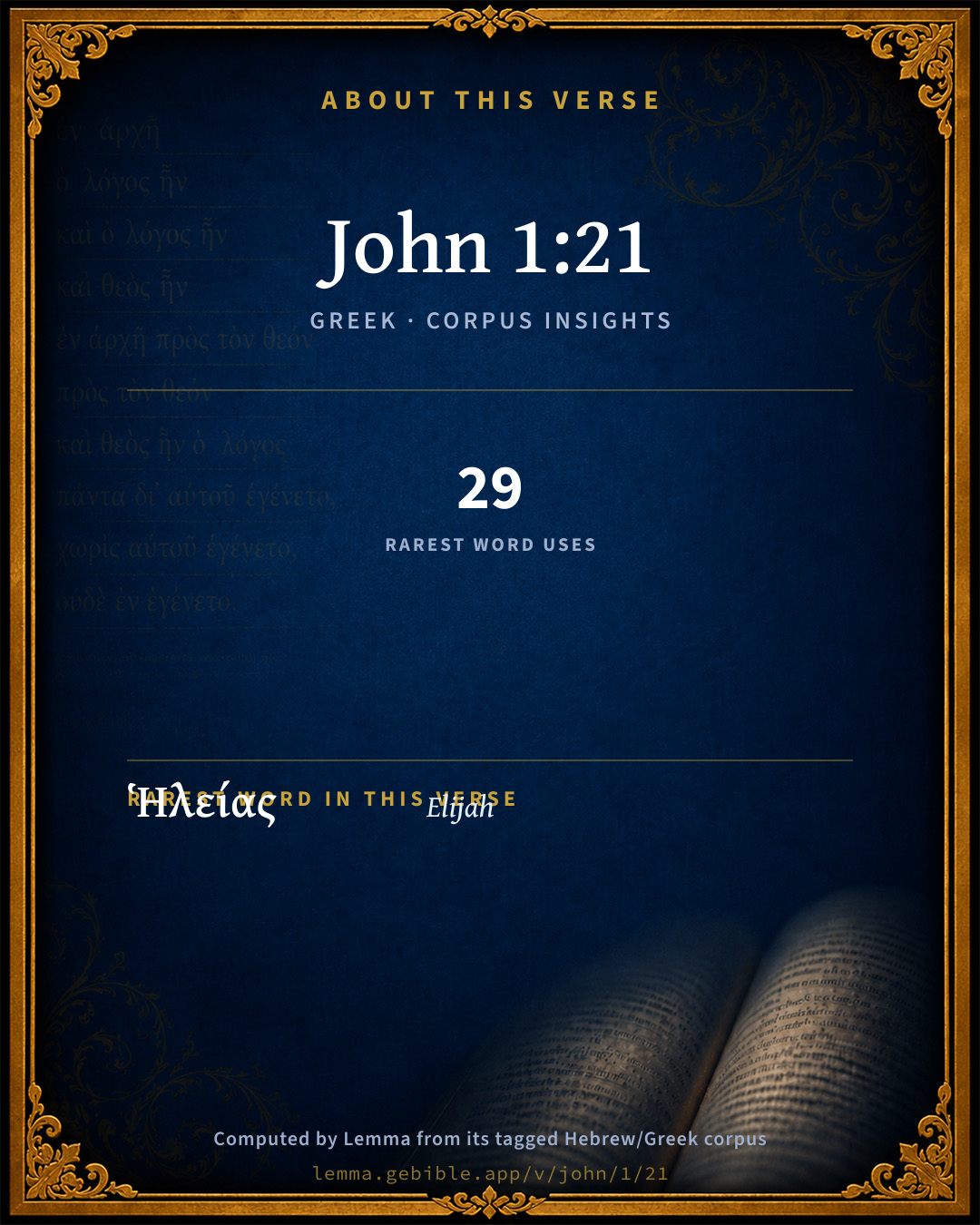
Ἡλείας Elijah G2243 occurs in 29 verses of the Greek New Testament. Also found in:
Repetition

Words recur within this verse:

Cross-references

9

Topical passages linked to John 1:21 in the Treasury of Scripture Knowledge — connected by theme and wording, ordered by reader-vote popularity; previews shown in the World English Bible.

  • Malachi 4:5 Behold, I will send you Elijah the prophet before the great and terrible day of Yahweh comes.
  • Deuteronomy 18:15–18 Yahweh your God will raise up to you a prophet from the midst of you, of your brothers, like me; to him you shall listen;
  • Matthew 11:14 If you are willing to receive it, this is Elijah, who is to come.
  • John 1:25 They asked him, "Why then do you baptize, if you are not the Christ, nor Elijah, nor the Prophet?"
  • Matthew 16:14 They said, "Some say John the Baptizer, some, Elijah, and others, Jeremiah, or one of the prophets."
  • Matthew 17:10–12 His disciples asked him, saying, "Then why do the scribes say that Elijah must come first?"
  • Luke 1:17 He will go before him in the spirit and power of Elijah, 'to turn the hearts of the fathers to the children,' and the disobedient to the wisdom of the just; to make ready a people prepared for the Lord."
  • Matthew 11:9–11 But why did you go out? To see a prophet? Yes, I tell you, and much more than a prophet.
  • John 7:40 Many of the multitude therefore, when they heard these words, said, "This is truly the prophet."

Cross-references courtesy of OpenBible.info (CC BY 4.0).

Commentary

Notes on John 1:21 from classic Christian and Jewish commentators (each source and its license shown beneath its notes). The classic Christian expositions comment on the surrounding passage and are grouped to its opening verse, so a note may address several verses; the Jewish commentaries on the Tanakh (Rashi and others) are per-verse, so they appear only where the commentator wrote on this verse.

Lemma curates 59 commentaries, every one of them public domain or Creative Commons licensed, each selected and text-cleaned for this edition rather than reprinted as found. About our sources →

Tyndale Open Study Notes

Tyndale Open Resources

1:21 Elijah was to be the Messiah’s forerunner (Mal 4:5). John the Baptist fulfilled the forerunner’s role, though he denied being the prophet Elijah (see Matt 11:14; Luke 1:17). • Are you the Prophet we are expecting? Cp. John 6:14; 7:40-41.

Tyndale Open Study Notes — © Tyndale Open Resources, licensed CC BY-SA 4.0. Text via the HelloAO Bible API.

Bengel's Gnomon

Johann Albrecht Bengel

Joh 1:21. Σύ, thou?) John had said, I am not the Christ. They persevere in asking about the subject: it would have been better for them to have asked about the prædicate, Who is the Christ? Where is He? But John presently leads on the conversation to this.—οὐκ εἰμί, I am not) He was a second Elijah; he was not the Tishbite himself, about whom their enquiry was. He rejects from himself all things [all the characters, which their conjectures attributed to him], in order that he may confess Christ, and bring the enquirers to Christ.—ὁ προφήτης, the Prophet) that one, of whom Deu 18:15; Deu 18:18, spake [The Lord thy God will raise up unto thee a Prophet from the midst of thee, of thy brethren, like unto me; unto him ye shall hearken, etc.] The article has reference to the promise of the prophet, who was about to teach all things, and to the expectation of the people. Yet they supposed Him not only to be distinct from Christ, but even inferior to Elias, as is evident from the gradually descending climax here, and in Joh 1:25 [Christ—Elias—that prophet]: although the people afterwards regarded the prophet as the same as Messiah the King, ch. Joh 6:14-15 [Then those men, when they had seen the miracle that Jesus did, said, This is of a truth that prophet that should come into the world; When Jesus therefore perceived that they would come and take Him by force, to make him a king, etc.]; and again, on the contrary, they looked on the prophet as a distinct person from the Christ, ch. Joh 7:40-41. [Many said, Of a truth this is the Prophet; others said, This is the Christ.]—εἶ σύ, art thou) they enumerate all those of whose coming prophecy had foretold.

Bengel's Gnomon of the New Testament — English translation (T&T Clark, Edinburgh, 1860) — public domain. Text from a community e-Sword module.

Meyer's Critical & Exegetical Commentary

Heinrich August Wilhelm Meyer

Joh_1:21. In consequence of this denial, the next point was to inquire whether he was the Elias who, according to Mal_4:5, was expected (back from heaven) as the immediate forerunner of the Messiah.

τί οὖν] not, quid ergo es (Beza et al.), but as τίς does not again occur (vers. 19, 22): what then is the case, if thou art not the Messiah? what is the real state of the matter?

Art thou Elias? So put, the question assumes it as certain that John must give himself out to be Elias, after he had denied that he was the Messiah.

οὐκ εἰμί] He could give this answer, notwithstanding what is said in Luk_1:17, Mat_11:14; Mat_17:10 (against Hilgenfeld), since he could only suppose his interrogators were thinking of the literal, not of the antitypical Elijah. Bengel well says: omnia a se amolitur, ut Christum confiteatur et ad Christum redigat quaerentes. He was conscious, nevertheless, according to Joh_1:23, in what sense he was Elias; but taking the question as literally meant, there was no occasion for him to go beyond that meaning, and to ascribe to himself in a special manner the character of an antitypical Elias, which would have been neither prudent nor profitable. The οὐκ εἶμι is too definite an answer to the definite question, to be taken as a denial in general of every externally defined position (Brückner); he would have had to answer evasively.

ὁ προφήτης εἶ σύ;] The absence of any connecting link in the narrative shows the rapid, hasty manner of the interrogation. ὁ προφήτης is marked out by the article as the well-known promised prophet, and considering the previous question Ἠλίας εἶ σύ, can only be a nameless one, and therefore not Jeremias, according to Mat_16:14 (Grotius, Kuinoel, Olshausen, Klee, Lange), but the one intended in Deu_18:15, the reference of whom to the Messiah Himself (Act_3:22; Act_7:37; Joh_1:46; Joh_6:14) was at least not universal (comp. Joh_7:40), and was not adopted by the interrogators here. Judging from the descending climax of the points of these questions, they must rather have thought of some one inferior to Elias, or, in general, of an individual undefined, owing to the fluctuation of view regarding Him who was expected as the prophet.[113] Nonnus well expresses the namelessness and yet eminence of this ὁ προφήτης: μὴ σύ μοι, ὃν καλέουσι, θεηγόρος ἐσσὶ προφήτης, ἄγγελος ἐσσομένων; Observe how the rigid denials become shortened at last to the bare οὔ. Here also we have a no on the Baptists lips, because in his view Jesus was the prophet of Deuteronomy 18.

[113] Luthardt thinks of the prophet in the second portion of Isaiah. Comp. Hofmann, Weissag u. Erf. II. p. 69. It would agree with this, that John immediately gives an answer taken from Isaiah 40. But if his interrogators had had in mind Isaiah 40 ff., they would probably have designated him whom they meant more characteristically, viz. as the servant of Jehovah.

Meyer — Critical and Exegetical Commentary on the New Testament — English translation by Peter Christie, edited by Frederick Crombie (T&T Clark, 1880) — public domain. Text from a community e-Sword module.

International Critical Commentary

21. καὶ ἠρώτησαν αὐτόν, Τί οὖν; The argumentative τί οὖν; quid ergo? appears in Rom 6:15, Rom 11:7.

The variants are puzzling. B has σὺ οὖν τί; which can hardly be right; אL om. σύ; C* 33 insert σύ before Ἠλείας; while AC3ΓΔΘ with the Latin vss. have Ἠλείας εἶ σύ. Perhaps σύ has been interpolated from the next clause; it is not necessary for the sense. We omit it, with Tischendorf, accordingly.

Ἠλείας εἶ; There was a general belief that Elijah would return to earth to prepare the way of the Messiah. This was founded on Mal 4:5. In Mar 9:11 it is mentioned, as commonly recognised, that “Elijah must first come” (cf. Mar 6:15, Mar 8:28 and parallels). His mission was to be the establishment of order (Mar 9:12), as is also explained in the Mishna.1 Justin quotes (Tryph. 8) Jewish doctrine to the effect that Messiah was to be hidden until pointed out and anointed by Elijah.

In a sense, John the Baptist was the Elijah of Jewish expectation, and so Jesus declared (Mat 11:14; cf. Luk 1:17), but in the sense in which the Jewish emissaries put the question, “Art thou Elijah?” the true answer was No; for, while the Baptist fulfilled the preliminary ministry of which Malachi had spoken, he was not Elijah returned to earth in bodily form.2

ὁ προφήτης εἶ σύ; This was another alternative. The Jews held that not only Elijah, but others of the great prophets, would return before Messiah’s appearance. Cf. 2 Ezr 2:17, “For thy help will I send my servants Isaiah and Jeremiah,” a passage which may be pre-Christian. One of the rumours about Jesus during His Galilæan ministry was that He was “Jeremiah or one of the prophets” (Mat 16:14; cf. Mar 8:28). See 9:17 below. But more specific than this expectation of the return of one of the older prophets was the expectation of one who was pre-eminently “the prophet,” whose coming was looked for on the ground of Deu 18:15. This idea is not in the Synoptists, but appears three times in Jn. (1:21, 6:14, 7:40). Christian exegesis from the beginning (Act 3:22, Act 7:37) found the fulfilment of Deu 18:15 in the Christ; but pre-Christian, i.e. Jewish, comment distinguished “the prophet like unto Moses” from the Messiah, as is clear from the present passage and from 7:40; see on 6:31. To the question, “Art thou the prophet?” the only answer was No, for the Jews were mistaken in distinguishing ὁ προφήτης ὁ ἐρχόμενος from the Christ, whose herald John was.

International Critical Commentary — older volumes (1896–1929), various authors — public domain. Text from a community e-Sword module.

Geneva Bible (1599)

Geneva Bible translators

The Jews thought that Elijah should come again before the days of Messiah, and they took the ground of that their opinion out of Mal. 4:5, which place is to be understood of John, Matt. 11:14. And yet John denieth that he is Elijah, answering them indeed according as they meant.

They inquire of some great Prophet, and not of Christ, for John denied before, that he is Christ, for they thought that some great Prophet should be sent like unto Moses, wresting to that purpose that place of Deut. 18:15, which is to be understood of all the company of the Prophets and ministers, which have been and shall be to the end, and especially of Christ, who is the head of all Prophets.

Geneva Bible (1599) marginal notes — public domain. Text via Bolls.life.

Jamieson, Fausset & Brown

Robert Jamieson, A. R. Fausset & David Brown

Elias--in His own proper person.

that prophet--announced in Deu 18:15, &c., about whom they seem not to have been agreed whether he were the same with the Messiah or no.

Jamieson, Fausset & Brown — Commentary Critical and Explanatory on the Whole Bible (1871) — public domain (CC PDM 1.0). Text via the HelloAO Bible API.

Adam Clarke's Commentary

Verse 21. Art thou Elias?] The scribes themselves had taught that Elijah was to come before the Messiah. See Mt 17:10; and this belief of theirs they supported by a literal construction of Mal 4:5.

Art thou that prophet?] the prophet spoken of by Moses, De 18:15, De 18:18. This text they had also misunderstood: for the prophet or teacher promised by Moses was no other than the Messiah himself. See Ac 3:22. But the Jews had a tradition that Jeremiah was to return to life, and restore the pot of manna, the ark of the covenant, c., which he had hidden that the Babylonians might not get them. Besides this, they had a general expectation that all the prophets should come to life in the days of the Messiah.

I am not.] I am not the prophet which you expect, nor Elijah: though he was the Elijah that was to come for in the spirit and power of that eminent prophet he came, proclaiming the necessity of reformation in Israel. See Mat 11:14; Mat 17:10-13.

Adam Clarke's Commentary on the Bible (1810–1826) — public domain. Text from a community e-Sword/MySword module.

John Calvin's Commentaries

21. Art thou Elijah? Why do they name Elijah rather than Moses? It was because they learned from the prediction of Malachi 4:2, 5, that when the Messiah, the Sun of Righteousness, should arise, Elijah would be the morning star to announce his approach. But the question is founded on a false opinion which they had long held; for, holding the opinion that the soul of a man departs out of one body into another, when the Prophet Malachi announced that Elijah would be sent, they imagined that the same Elijah, who lived under the reign of king Ahab, (1 Kings 17:1,) was to come. It is therefore a just and true reply which John makes, that he is not Elijah; for he speaks according to the opinion which they attached to the words; but Christ, giving the true interpretation of the Prophet, affirms that John is Elijah, (Matthew 11:14; Mark 9:13.)

Art thou a Prophet? Erasmus gives an inaccurate explanation of these words by limiting them to Christ; for the addition of the article (ὁ προφήτης, the prophet) carries no emphasis in this passage; and the messengers afterwards declare plainly enough, that they meant a different prophet from Christ; for they sum up the whole: by saying, (verse 25,) if thou art neither the Christ, nor Elijah, nor a Prophet. Thus we see that they intended to point out different persons. Others think that they inquired if he was one of the ancient prophets; but neither do I approve of that exposition. Rather do they by this term point out the office of John, and ask if God had appointed him to be a prophet. When he replies, I am not, he does not for the sake of modesty tell a lie, but honestly and sincerely detaches himself from the company of the prophets. And yet this reply is not inconsistent with the honorable attestation which Christ gives him. Christ bestows on John the designation of prophet, and even adds that he is more than a prophet, (Matthew 11:9;) but by these words he does nothing more than demand credit and authority for his doctrine, and at the same time describes, in lofty terms, the excellence of the office which had been conferred on him. But in this passage John has a different object in view, which is, to show that he has no special message, as was usually the case with the prophets, but that he was merely appointed to be the herald of Christ.

This will be made still more clear by a comparison. All ambassadors — even those who are not sent on matters of great importance — obtain the name and authority of ambassadors, because they hold special commissions. Such were all the Prophets who, having been enjoined to deliver certain predictions, discharged the prophetic office. But if some weighty matter come to be transacted, and if two ambassadors are sent, one of whom announces the speedy arrival of another who possesses full power to transact the whole matter, and if this latter has received injunctions to bring it to a conclusion, will not the former embassy be reckoned a part and appendage of the latter, which is the principal? Such was the case with John the Baptist, to whom God had given no other injunction than to prepare the Jews for listening to Christ, and becoming his disciples. That this is the meaning, will still more fully appear from the context; for we must investigate the opposite clause, which immediately follows. I am not a prophet, says he, but a voice crying in the wilderness. The distinction lies in this, that the voice crying, that a way may be prepared for the Lord, is not a prophet, but merely a subordinate minister, so to speak; and his doctrine is only a sort of preparation for listening to another Teacher. In this way John, though he is more excellent than all the prophets, still is not a prophet

John Calvin's Commentaries (1540-1563) — public domain. Text from the Calvin Translation Society English edition (1840s-50s) via the Christian Classics Ethereal Library (ccel.org). Calvin's coverage is partial (roughly two-thirds of the Bible); uncommented books and verses are honest gaps, never fabricated. The 19th-century editor's footnotes and remarks are omitted so the notes are faithfully Calvin's own voice.

Ellicott's Commentary for English Readers

(21) What then?—Not “What art thou then?” but expressing surprise at the answer, and passing on with impatience to the alternative, “Art thou Elias?” (Comp. on this and the following question, Deu_18:15; Deu_18:18; Isaiah 40 ff.; Mal_4:5; 2Ma_2:1-8; and Note on Mat_16:14). The angel had announced that “he shall go before Him in the spirit and power of Elias.” The Lord declared “Elias is come already” (Mat_18:12-13), and yet the Forerunner can assert that, in the literal sense in which they ask the question and would understand the answer, he is not Elias, still less “the prophet,” by which, whether thinking of the words of Moses or the fuller vision of Isaiah from which he immediately quotes, he would understand the Messiah himself,

A Bible Commentary for English Readers, edited by Charles John Ellicott (1878–1897) — public domain. Text from a community e-Sword module.

The Cambridge Bible for Schools and Colleges

gen. ed. J. J. S. Perowne

21. What then?] ‘What then are we to think?’ or, ‘What then art thou?’

Art thou Elias?] The Scribes taught that Elijah would come again before the coming of the Messiah (Mat_17:10), and this belief is repeatedly alluded to in the Talmud. Comp. Mal_4:5.

I am not] A forger would scarcely have ventured on this in the face of Mat_11:14, where Christ says that John is Elijah. But Christ is there speaking figuratively (comp. Luk_1:17); John is here speaking literally. He says he is not Elijah returned to the earth again.

that prophet] Rather, the Prophet, the well-known Prophet of Deu_18:15, who some thought would be a second Moses, others a second Elijah, others the Messiah. From Joh_7:40-41 we see that some distinguished ‘the Prophet’ from the Messiah; and from Mat_16:14 it appears that Jeremiah or other prophets were expected to return. Comp. 2Es_2:18; 1Ma_14:41. This verse alone is almost enough to prove that the writer is a Jew. Who but a Jew would know of these expectations? Or if a Gentile chanced to know them, would he not explain them to his readers? In Joh_1:25, Joh_6:14; Joh_6:48; Joh_6:69 our translators have repeated the error of translating the definite article by ‘that’ instead of ‘the.’

No] The Baptist knows that ‘the Prophet’ is the Messiah. His replies grow more and more abrupt; ‘I am not the Christ,’ ‘I am not,’ ‘No.’

The Cambridge Bible for Schools and Colleges (gen. ed. J. J. S. Perowne; Cambridge University Press, 1878–1918) — public domain. Text from a community e-Sword module.

John Gill's Exposition

And they asked him, what then? art thou Elias?.... Elijah, the prophet; the Tishbite, as Nonnus in his paraphrase expresses it; who was translated, soul and body, to heaven: the Jews had a notion that that prophet would come in person a little before the coming of the Messiah; See Gill on Mat 17:10 wherefore these messengers inquire, that since he had so fully satisfied them that he was not the Messiah, that he would as ingenuously answer to this question, if he was Elias, or not:

and he saith, I am not; that is, he was not Elijah the prophet that lived in Ahab's time, and was called the Tishbite; for John's answer is to the intention of their question, and their own meaning in it, and is no contradiction to what Christ says of him, Mat 11:14 that he was the Elias that was to come; for he was the person meant by him in Mal 4:5 though not in the sense the Jews understood it; nor is it any contradiction to what the angel said to Zacharias, Luk 1:17 for he does not say that John should come in the body, but in the power and spirit of Elias; See Gill on Mat 11:14.

Art thou that prophet? Jeremiah, whom some of the Jews (t) have thought to be the prophet Moses spoke of, in Deu 18:15 and expected that he would appear about the times of the Messiah; see Mat 16:14 or any one of the ancient prophets risen from the dead, which they also had a notion of, Luk 9:8 or, as it may be rendered, "art thou a prophet?" for prophecy had long ceased with them:

and he answered, no; he was not Jeremiah, nor any one of the old prophets risen from the dead, nor a prophet in the sense they meant: he was not like one of the prophets of the Old Testament; he was a prophet, and more than a prophet, as Christ says, Mat 11:9 yet not such a prophet as they were; his prophesying lay not so much in predicting future events, as in pointing out Christ, and preaching the doctrine of the remission of sins by him,

(t) Baal Hatturim in Deut. xviii. 15. Tzeror Hammor, fol. 127. 4. & 143. 4. Siphre in Jarchi in Jer. i. 5.

John Gill's Exposition of the Whole Bible (1746–1763) — public domain (CC PDM 1.0). Text via the HelloAO Bible API.

Trapp's Complete Commentary

John Trapp

21 And they asked him, What then? Art thou Elias? And he saith, I am not. Art thou that prophet? And he answered, No.

Ver. 21. Art thou Elias? And he saith, I am not] sc. That Elias that you imagine, Elias the Tishbite, by a transanimation (μετεμψυχωσις Pythagorica). As neither was he an angel, as some in Chrysostom’s time would gather out of Mal 3:1. They that wrest the Scriptures are blinded, as Papists, and other brain sick heretics.

John Trapp, A Commentary or Exposition upon All the Books of the Old and New Testament (1647–1656) — public domain. Text from a community e-Sword module.

Albert Barnes' Notes on the Bible

Art thou Elias? - This is the Greek way of writing Elijah. The Jews expected that Elijah would appear before the Messiah came. See the notes at Mat 11:14. They supposed that it would be the real Elijah returned from heaven. In this sense John denied that he was Elijah; but he did not deny that he was the Elias or Elijah which the prophet intended Mat 3:3, for he immediately proceeds to state Joh 1:23 that he was sent, as it was predicted that Elijah would be, to prepare the way of the Lord; so that, while he corrected their false notions about Elijah, he so clearly stated to them his true character that they might understand that he was really the one predicted as Elijah.

That prophet - It is possible that the Jews supposed that not only “Elijah” would reappear before the coming of the Messiah, but also “Jeremiah.” See the notes at Mat 16:14. Some have supposed, however, that this question has reference to the prediction of Moses in Deu 18:15.

Albert Barnes' Notes on the Bible (1834–1885) — public domain. Text from a community e-Sword/MySword module.

Matthew Poole's English Annotations

John was at Bethabara when these messengers came to him, Joh 1:28. They asked him if he were Elias. The Jews had not only an expectation of the Messias, but of Elias to come as a messenger before him, according to the prophecy, Mal 4:5; as appeareth, Mat 17:10; Mar 9:11; of which they had a gross conception here, that Elias should come out of heaven personally, or at least that his soul should come into another body, according to the Pythagorean opinion. Now the meaning of the prophecy was, that one should come like Elias; and this was fulfilled in John, Luk 1:17, as our Saviour tells us, Mat 17:12; Mar 9:13; but they asked the question according to that notion they had of Elias. To which John answereth, that he was not; neither that Elias that ascended in a fiery chariot to heaven; nor any body informed with Elias’s soul: and thus the words of our Saviour, Mat 17:12; Mar 9:12, are easily reconciled to this text. They go on, and ask him if he were

that prophet, or a prophet. Some think that they meant the Prophet promised, Deu 18:18; but that was no other than Christ himself, which he had before denied himself to be; nor doth it appear from any text of Scripture that the Jews had any expectation of any other particular prophet; but it is plain from Luk 9:8, that they had a notion that it was possible one of the old prophets might rise again from the dead, for so they guessed there concerning Christ. But others think that the article in the Greek here is not emphatical, and they only asked him if he were a prophet; for the Jews had a general notion, that the spirit of prophecy had left them ever since the times of Zechariah and Malachi; which they hoped was returned in John the Baptist, and about this they question him if he were a prophet. To which he answereth, No; neither that Prophet promised, Deu 18:18, nor yet any of the old prophets risen from the dead; nor yet one like the prophets of the Old Testament, who only prophesied of a Christ to come; but, as Christ calls him, Mat 11:9, more than a prophet, one who showed and declared to them a Christ already come; for the law and the prophets prophesied but until John; the law in its types foreshowing, the prophets in their sermons foretelling, a Messiah to come; John did more. His father indeed, Luk 1:76, called him the prophet of the Highest; but there prophet is to be understood not in a strict, but in a large sense, as the term prophecy is taken, Rom 12:6. And the term prophet often signifieth one that revealeth the will of God to men; in which large sense John was a prophet, and yet more than a prophet in the stricter notion of the term; and in that sense no prophet, that is, no mere prophet: so, Num 11:19, Moses tells the people they should not eat flesh one, or two, or five, or ten, or twenty days, because they should eat it a whole month together.

Matthew Poole's English Annotations on the Holy Bible (1683–1685) — public domain. Text from a community e-Sword/MySword module.

Whedon's Commentary on the Bible

Daniel D. Whedon

21. Art thou Elias?—John may have quoted the prophecy of Malachi as applicable to himself; and the Jews may have reported that he claimed to be the literal Elijah, risen from the dead. To this supposition, embraced in their question, he gives a prompt negative.

That Prophet—The prophet foretold by Moses as like unto himself; (Deu_18:15,) and which some Jews identified as being Jeremiah. There is perhaps here a descending scale of names, the Messiah, Elijah, Jeremiah. After exhausting all special names, they press John to a full self-description, that they may give answer to those who sent them.

Daniel D. Whedon (gen. ed.), Commentary on the Old and New Testaments (1874–1909) — public domain. Text from a community e-Sword module.

The Pulpit Commentary

And they asked him, What then? What is the state of the case? The very repudiation of Messiahship in this form seems to imply some association with the Messianic period of which they had so many conflicting ideas. Malachi (Mal_4:5) had predicted the coming again from heaven of Elijah the prophet, and the LXX, by translating the passage "Elijah the Tishbite," had strengthened the common mistake of a metempsychosis, or such an abnormal manifestation before the coming of Messiah. Schottgen ("De Messia," H.H., vol. 2, pp 226, 490, 533-537) quotes a variety of proofs of this anticipation, and that Elijah was expected three days before Messiah; that he would come in the mountains of Israel, weeping over the people, saying, "O land of Israel, how long will you remain arid and desolate! (cf. my "John the Baptist," 3. There was a true sense in which (as our Lord informed his disciples) John was the fulfilment of Malachi"s prediction and of the language of the angel to Zacharias, (Luk_1:17 Mat_11:14 Mat_17:12) and that John came veritably in the spirit and power of Elijah. In that sense "Elijah had come already," just as Christ their David had come, in fulfilment of Ezekiel"s vision, (Eze_37:24; cf. Jer_30:9 Hos_3:5) to rule over them. In the physical, superstitious sense, John the son of Zacharias was not the reincarnation of the Prophet Elijah, and so he boldly answered the inquiry, Art thou Elijah? with a categorical negative: I am not. They press their question once more. Art thou the Prophet? It is doubtful whether they here take up another popular expectation of the physical return of one of the old prophets, or whether, with an exegesis afterwards modified by the apostles, they point to Deu_18:15, and reveal the fact that they had not identified the prediction of "the prophet like unto Moses" with their Messiah. If they had identified these representations, they would not, of course, have pressed him with an identical question. It is highly probable that that prophecy had, with the predictions of Malachi and Isaiah, led to numerous expectations more or less identified with the Messianic cycle of coming events. In Joh_6:14 Joh_7:40 Mat_16:14, we see the prevalence of the expectation of a longing for an old prophet. They yearned for no upstart, but for one of the mighty brotherhood of departed men, in veritable flesh and blood. Now John and now Jesus was crudely suspected by some to be such a resuscitation. The Baptist, like the Samaritan woman, and subsequently St. Peter when full of the Holy Ghost, had sharply identified "the Prophet like unto Moses" with the Messiah himself; and therefore, on either hypothesis, he gives a curt reply to this inquiry, and he answered, No.

The Pulpit Commentary (1880–1919), ed. H.D.M. Spence-Jones & Joseph S. Exell — public domain. Text from a community e-Sword module.

John Wesley's Explanatory Notes

Art thou Elijah? - He was not that Elijah (the Tishbite) of whom they spoke. Art thou the prophet - Of whom Moses speaks, Deut. xviii, 15.

John Wesley, Explanatory Notes Upon the Whole Bible (1754–1765) — public domain. Text via the GEBible commentary corpus.

Cambridge Greek Testament for Schools and Colleges

21. τί οὖν; ‘What art thou then?’ or, ‘What then are we to think?’

Ἡλίας εἶ σύ; The Scribes taught that Elijah would return before the coming of the Messiah (Mat 17:10), and this belief is repeatedly alluded to in the Talmud. Cf. Mal 4:5.

οὐκ εἰμί. A forger would scarcely have written this in the face of Mat 11:14, where Christ says that John is Elijah (in a figurative sense). John here denies that he is Elijah in a literal sense; he is not Elijah returned to the earth.

ὁ προφήτης. ‘The (well-known) Prophet’ of Deu 18:15, who some thought would be a second Moses, others a second Elijah, others the Messiah. We see from Joh 7:40-41, that some distinguished ‘the Prophet’ from the Messiah; and from Mat 16:14, it appears that there was an impression that Jeremiah or other prophets might return. Here as in Joh 7:40, the translation should be ‘the Prophet’ not ‘that prophet.’ We have a similar error Joh 1:25; Joh 6:14; Joh 6:48; Joh 6:69.

This verse alone is almost enough to shew that the writer is a Jew. Who but a Jew would know of these expectations? If a Gentile knew them, would he not explain them?

Cambridge Greek Testament for Schools and Colleges (Cambridge University Press, 1896; 21 vols, various authors incl. Carr, Maclear, Plummer, Farrar, Lumby, Moule, M. R. James, Simcox) — public domain. Text from a community e-Sword module.

Alford’s Greek Testament

Henry Alford

21.] σὺ οὖν τί; equivalent to τί λέγεις περὶ σεαυτοῦ; ver. 22.

Ἡλίας εἶ;] The whole appearance of John reminded them of Elias:—see Mat 3:4, and compare 2Ki 1:8. Besides, his announcement that the Kingdom of God was at hand, naturally led them to the prophecy Mal 4:5, Lightfoot cites from the Rabbinical books testimonies that the Jews expected a general purification or baptism before the coming of the Messiah (from Eze 36:25, Eze 36:26, and Zec 13:1), and that it would be administered by Elias.

κ. λ. Οὐκ εἰμί] The right explanation of this answer seems to be the usual one,—that the deputation asked the question in a mistaken and superstitious sense, meaning Elias bodily come down from heaven, who was expected to forerun and anoint the Messias. (Our Lord seems to refer to the same extravagant notion in Mat 11:14, εἰ θέλετε δέξασθαι, αὐτός ἐστιν Ἡλ. ὁ μέλλων ἔρχεσθαι.) In this sense, John was not Elias; nor indeed in any other sense, was he Elias:—but only (Luk 1:17) ἐν πνεύματι καὶ δυνάμει Ἡλίου.

ὁ προφ. εἶ σύ;] From the prophecy of Moses, Deu 18:15, Deu 18:18, the Jews expected some particular prophet to arise,—distinct from the Messiah (this distinction however was not held by all, see ch. 6:14),—whose coming was, like that of Elias, intimately connected with that of the Messiah Himself: see ch. 7:40, 41. In Mat 16:14 we have ‘Jeremiah, or one of the prophets’ apparently = this expected prophet. There seem to have been various opinions about him;—all however agreeing in this, that he was to be one of the old prophets raised from the dead (see also 2 Macc. 2:1-8). This John was not: and he therefore answers this also in the negative.

Henry Alford, The Greek Testament (1849–1861) — public domain. Text from a community e-Sword module.

Godet's Commentaries

Frédéric Louis Godet

Ver. 21. “And they asked him: what then?Art thou Elijah? And he said I am not. Art thou the prophet? And he answered, No.”

Some interpreters understand the question τί οὖν (what then?) in the same or nearly the same sense as the preceding: “If thou art not the Christ, what art thou then?” But the two following questions: “Art thou Elias ...?” would imply τίς rather than τί in this sense. De Wette sees in these words an adverbial expression: “What then!” This sense is pointless. We must, rather, supply ἐστί, with Meyer: “What then is the case? What extraordinary thing, then, is happening?” This form of question betrays impatience. There was, indeed, in the unprecedented behavior of John the Baptist something which seemed to indicate an exceptional condition. Malachi had announced (Joh 4:5) the coming of Elijah as the one preparing for the great Messianic day, and we know from Justin’s Dialogue with Trypho the Jew, that, according to a popular opinion, the Messiah was to remain hidden until he had been pointed out and consecrated by this prophet. Several passages of the Gospels (Mat 16:14; Mar 6:15) prove that there was, besides this, an expectation of the reappearance of some other prophet of the ancient times, Jeremiah for example. Among these expected personages, there was one who was especially called the prophet.Some distinguished him from the Messiah (Joh 7:40-41); others confounded him with the Messiah (Joh 6:14). The question was, evidently, as to the personage announced by Moses (“a prophet like unto me”), in the promise in Deu 18:18. Of course, the people did not picture to themselves a second Elijah or a new Moses in the spiritual sense, as when the angel says of John the Baptist (Luk 1:17), “He shall go in the spirit and power of Elijah.” It was the person himself who was to reappear in flesh and bones. How could John the Baptist have affirmed, in this literal sense, his identity with the one or the other of these ancient personages? On the other hand, how could he enter into the domain of theological distinctions? Besides, this mode of discussion would be scarcely in accordance with his character. His reply, therefore, must be negative.

Frédéric Louis Godet — Commentaries on Luke, John, Romans, and 1 Corinthians — English translation (T&T Clark, Edinburgh, 1870s–1890s) — public domain. Text from a community e-Sword module.

Lesson kit

Teaching starters — assembled from the data on this page, not authored interpretation. Every prompt links to the verse data it draws on. Edit before teaching.

John, in the Gospels, opens this verse with 17 words (13 distinct Greek lemmas). Its most distinctive word is Hēlías (“Elijah”). A historical commentator’s framing appears above. Read the whole chapter for the surrounding context.

Discussion questions

  1. The word Hēlías carries the sense “Elijah.” How does it shape the verse?
  2. How does Matthew 11:14, which shares the word «Elijah», read alongside this verse?
  3. What does the repetition of “to be” (3× in this one verse) do in this verse?
  4. The translations on this page render this verse differently — a whole-verse word diff, not a word-by-word alignment. What might account for the different wordings?
  5. Compare how Tyndale Open Study Notes and Bengel's Gnomon read this verse. Where do they agree or differ?

Things to notice

  • These translations choose different wording for 5 words in this verse.
  • “to be” occurs 3× in this single verse.
  • 13 distinct Greek lemmas span 17 words in this verse.

Reading settings

Reading text

Shown beneath each verse's original-language words.

Old Testament
Old Testament edition

Read the OT as the Masoretic Hebrew (MT) or the Greek Septuagint (LXX).

English shown for the Greek Septuagint (in the Hebrew ↔ Greek comparison).

Comparing translations? Open the Compare panel on any verse page to stack up to four side by side.