
John 6:55

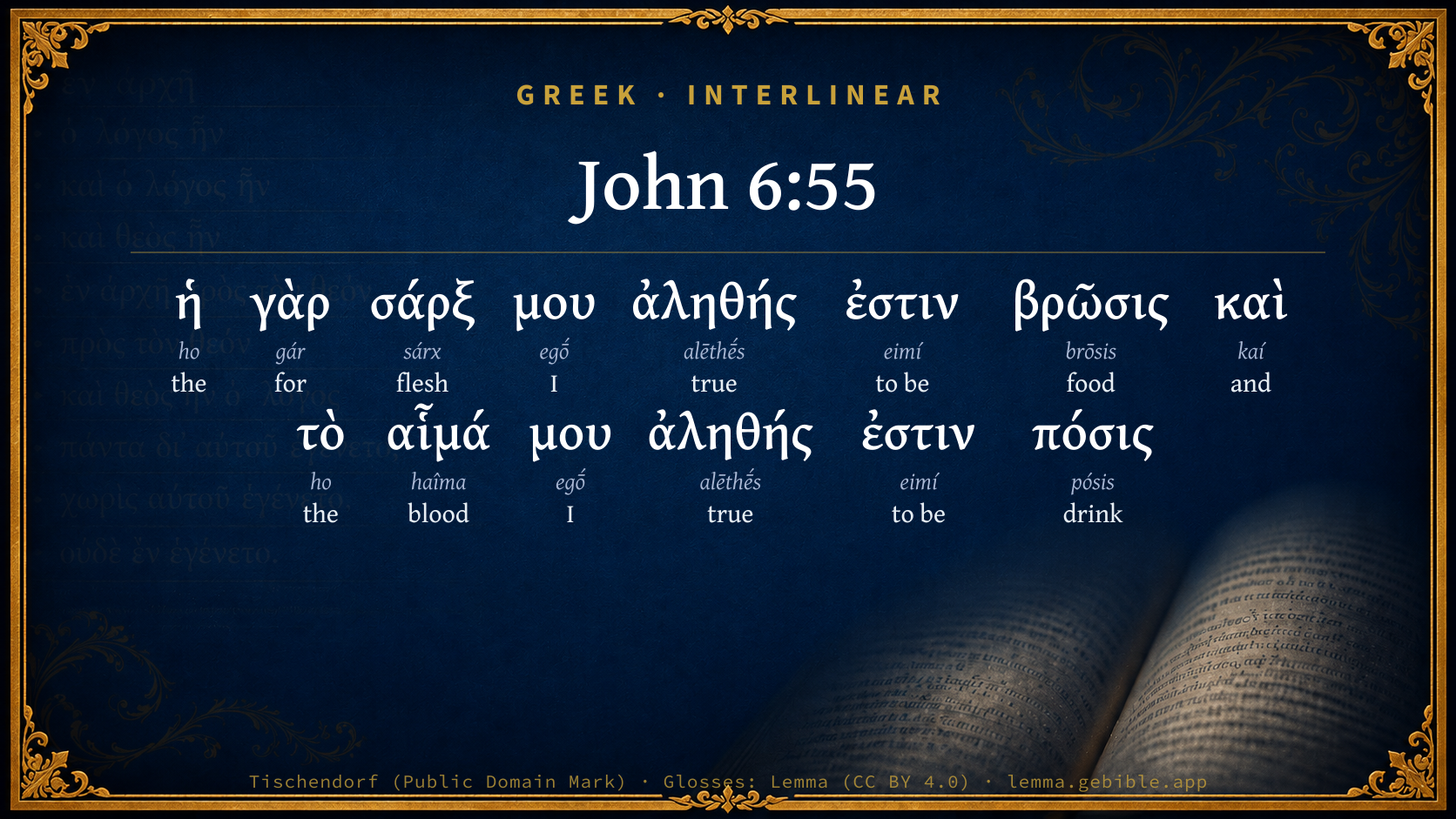
Greek (Tischendorf 8th ed.) John 6:55 appears in the Greek New Testament. The text above is from the Tischendorf 8th edition. Each word links to its Strong’s number and a concise gloss. Click any word for its full Thayer’s Greek Lexicon entry.
Download image
Cite this verse

John 6:55 (World English Bible). Public Domain. Lemma interlinear Bible study tool, https://lemma.gebible.app/v/john/6/55.

Show BibTeX & RIS
BibTeX
RIS
English Translation
For my flesh is food indeed, and my blood is drink indeed.
World English Bible · Public Domain
Highlights
  • 1 first appearance in the Greek New Testament
Full analysis ↓
Download a study sheet

One document with this verse’s original text, its word-by-word gloss line, the meaning frame, cross-references with their text, attributed commentary, and full source and license credits — printable, and it pastes into notes with its structure intact.

This verse Autodidact and up

Study sheet (.html) Plain text (.txt)

A passage Seminary Student

Up to 50 verses in one chapter. A passage sheet keeps up to 6 commentary sources and 12 cross-references per verse, in the order this page ranks them, and says so on the sheet whenever that leaves anything out. Ask for a single verse and you get the Autodidact verse sheet above.

Everything on this page stays free to read, with no account — the sheet is a download of what is already on screen, not access to it.

Want to remove ads? Support Godless Engineer
Compare translations 3

The same verse in 3 English versions, stacked beneath the original-language interlinear above. Click any original word for its lexicon entry.

Each is an independent rendering of the whole verse — the interlinear is not word-aligned to these translations.

Highlighted words mark where these versions differ — a whole-verse word diff, not a word-by-word alignment.

  • World English Bible Public Domain
    For my flesh is food indeed, and my blood is drink indeed.
  • King James Version Public Domain
    For my flesh is meat indeed, and my blood is drink indeed.
  • unfoldingWord Literal Text CC BY-SA 4.0
    For my flesh is true food, and my blood is true drink.

unfoldingWord Literal Text — © unfoldingWord, licensed CC BY-SA 4.0. Word-aligned USFM3 via Door43 (git.door43.org/unfoldingWord/en_ult).

Versions to compare (up to 4)

3 of 4 selected

Show all 19 translations

Every available English version of this verse, each an independent rendering of the whole verse.

  • World English Bible Public Domain
    For my flesh is food indeed, and my blood is drink indeed.
  • Berean Standard Bible Public Domain
    For My flesh is real food, and My blood is real drink.
  • Majority Standard Bible Public Domain
    For My flesh is truly food, and My blood is truly drink.
  • King James Version Public Domain
    For my flesh is meat indeed, and my blood is drink indeed.
  • American Standard Version (1901) Public Domain
    For my flesh is meat indeed, and my blood is drink indeed.
  • Revised Version (1885) Public Domain
    For my flesh is meat indeed, and my blood is drink indeed.
  • Geneva Bible (1599) Public Domain
    For my flesh is meat in deede, and my blood is drinke in deede.
  • Douay-Rheims (1899) Public Domain
    He that eateth my flesh, and drinketh my blood, hath everlasting life: and I will raise him up in the last day.
  • Young's Literal Translation Public Domain
    for my flesh truly is food, and my blood truly is drink;
  • Literal Standard Version CC BY-SA 4.0
    for My flesh is truly food, and My blood is truly drink;
  • Unlocked Literal Bible CC BY-SA 4.0
    For my flesh is true food, and my blood is true drink.
  • unfoldingWord Literal Text CC BY-SA 4.0
    For my flesh is true food, and my blood is true drink.
  • Darby Bible Public Domain
    for my flesh is truly food and my blood is truly drink.
  • World Messianic Bible Public Domain
    For my flesh is food indeed, and my blood is drink indeed.
  • Webster's Bible Public Domain
    For my flesh is food indeed, and my blood is drink indeed.
  • Free Bible Version CC BY-SA 4.0
    For my flesh is true food, and my blood is true drink.
  • Bible in Basic English Public Domain
    My flesh is true food and my blood is true drink.
  • Text-Critical English NT CC BY 4.0
    For my flesh is true food, and my blood is true drink.
  • Tyndale New Testament (1534) Public Domain
    For my flesshe is meate in dede: and my bloude is drynke in dede.

Literal Standard Version (2020), Covenant Press — licensed CC BY-SA 4.0. Text via the HelloAO Bible API (eBible.org). Unlocked Literal Bible (unfoldingWord) — licensed CC BY-SA 4.0. Text via the HelloAO Bible API (eBible.org). unfoldingWord Literal Text — © unfoldingWord, licensed CC BY-SA 4.0. Word-aligned USFM3 via Door43 (git.door43.org/unfoldingWord/en_ult). Free Bible Version, Dr. Jonathan Gallagher — licensed CC BY-SA 4.0. Text via the HelloAO Bible API (eBible.org).

Word by word

More ways to search: Search by grammar → Find every occurrence → Compare this word →

Practice this passage: Drill this verse → Learn its vocabulary →

About this verse

These counts appear in no published source. They are computed here, from the morphology-tagged text and Lemma’s own curated glosses. What Lemma adds →

14
words
10
distinct lemmas
Gospels
section

Notable vocabulary

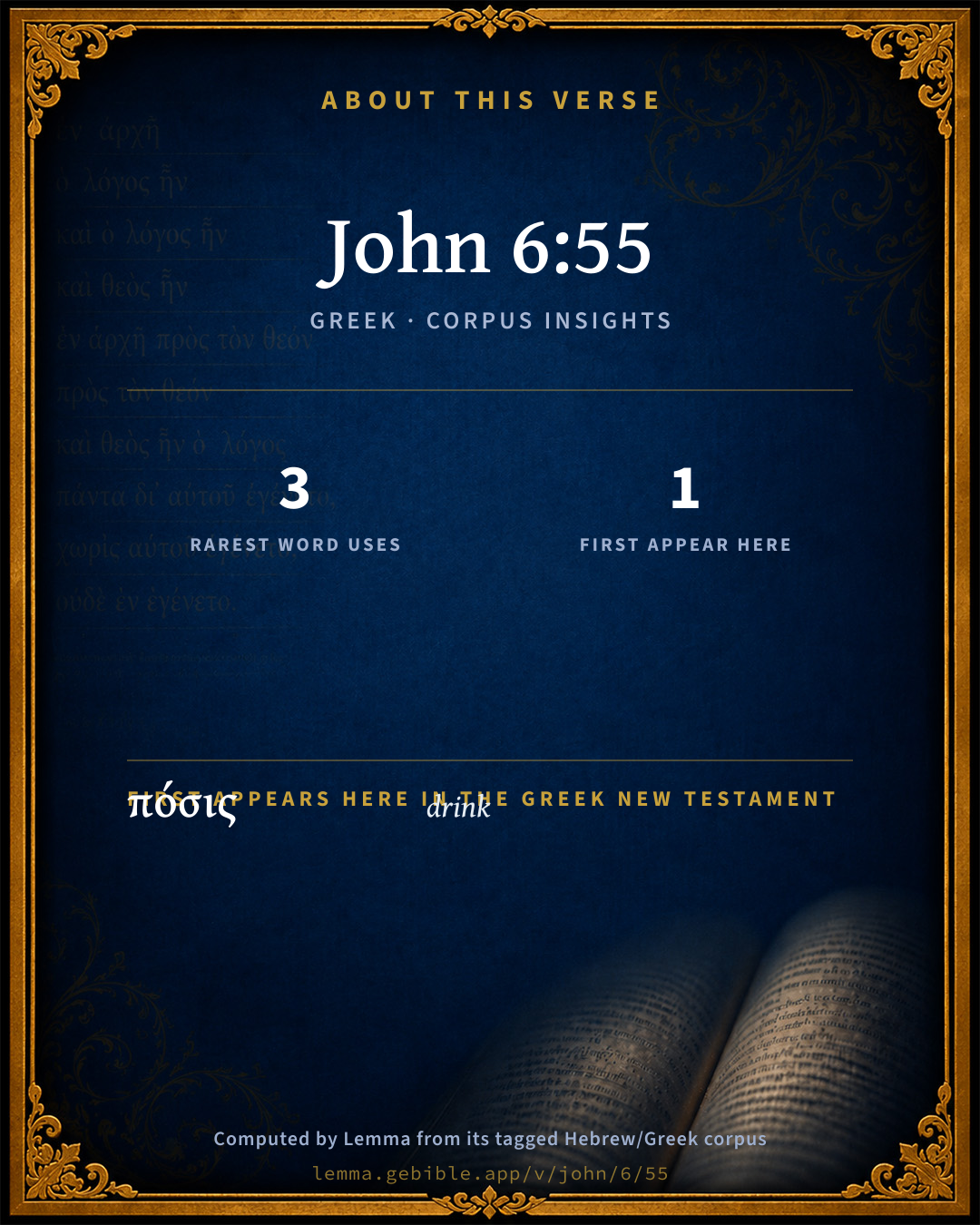
The rarest word here is πόσις drink G4213 — appearing just 3 times in the whole Greek New Testament.

First appearance in Scripture

This word makes its first canonical appearance in the Greek New Testament here:

Shared distinctive vocabulary

πόσις drink G4213 occurs in 3 verses of the Greek New Testament. Also found in:
Repetition

Words recur within this verse:

Cross-references

9

Topical passages linked to John 6:55 in the Treasury of Scripture Knowledge — connected by theme and wording, ordered by reader-vote popularity; previews shown in the World English Bible.

  • John 6:32 Jesus therefore said to them, "Most assuredly, I tell you, it wasn't Moses who gave you the bread out of heaven, but my Father gives you the true bread out of heaven.
  • John 8:31 Jesus therefore said to those Jews who had believed him, "If you remain in my word, then you are truly my disciples.
  • John 8:36 If therefore the Son makes you free, you will be free indeed.
  • John 15:1 "I am the true vine, and my Father is the farmer.
  • John 1:9 The true light that enlightens everyone was coming into the world.
  • Psalms 4:7 You have put gladness in my heart, More than when their grain and their new wine are increased.
  • John 1:47 Jesus saw Nathanael coming to him, and said about him, "Behold, an Israelite indeed, in whom is no deceit!"
  • Hebrews 8:2 a minister of the sanctuary, and of the true tabernacle, which the Lord pitched, not man.
  • 1 John 5:20 We know that the Son of God has come, and has given us an understanding, that we know him who is true, and we are in him who is true, in his Son Jesus Christ. This is the true God, and eternal life.

Cross-references courtesy of OpenBible.info (CC BY 4.0).

Commentary

Notes on John 6:55 from classic Christian and Jewish commentators (each source and its license shown beneath its notes). The classic Christian expositions comment on the surrounding passage and are grouped to its opening verse, so a note may address several verses; the Jewish commentaries on the Tanakh (Rashi and others) are per-verse, so they appear only where the commentator wrote on this verse.

Lemma curates 59 commentaries, every one of them public domain or Creative Commons licensed, each selected and text-cleaned for this edition rather than reprinted as found. About our sources →

Bengel's Gnomon

Johann Albrecht Bengel

Joh 6:55. Ἀληθῶς, truly) This affirmation is opposed to the doubt of the Jews.—βρῶσις· πόσις) Food, drink, by which the believer is as truly fed, as food and drink feed the bodies of men, Joh 6:56, at its close, “He that eateth My flesh, etc., dwelleth in Me, and I in him.”

Bengel's Gnomon of the New Testament — English translation (T&T Clark, Edinburgh, 1860) — public domain. Text from a community e-Sword module.

Expositor's Greek Testament

ed. W. Robertson Nicoll

Joh 6:55-56 . This is further shown in Joh 6:55-56 . ἡ γὰρ σάρξ μου ἀληθῶς [better ἀληθής ] ἐστι βρῶσις , “For my flesh is a genuine food and my blood is a genuine drink”; with an implied contrast to those things with which men ordinarily endeavour to satisfy themselves. The satisfying, genuine character of Christ as the bread consists especially in this, that ὁ τρώγων … ἐν ἐμοὶ μένει κἀγὼ ἐν αὐτῷ . He becomes as truly assimilated to the life of the individual as the nourishing elements in food enter into the substance of the body. The believer abides in Christ as finding his life in Him (Gal 2:20 ); and Christ abides in the believer, continually imparting to him what constitutes spiritual life. For in Christ man reaches the source of all life in the Father (Joh 6:57 ), καθὼς ἀπέστειλέ με ὁ ζῶν πατὴρ … διʼ ἐμέ . The living Father has sent Christ forth as the bearer of life. He lives διὰ τὸν πατέρα , not equivalent to διὰ τοῦ πατρός , through or by means of the Father, but “because of,” or “by reason of the Father”. The Father is the cause of my life; I live because the Father lives. [Beza quotes from the Plutus of Aristoph., 470, the declaration of Penia that μόνην Ἀγαθῶν ἁπάντων οὖσαν αἰτίαν ἐμὲ Ὑμῖν , διʼ ἐμέ τε ζῶντας ὑμᾶς .] The Father is the absolute source of life; the Son is the bearer of that life to the world; cf. Joh 5:26 , where the same dependence of the Son on the Father for life is expressed. The second member of the comparison, introduced by καί (see Winer, p. 548; and the Nic. Ethics, passim ), is not, as Chrys. and Euthymius suggest, κἀγὼ ζῶ , but καὶ ὁ τρώγων με , κἀκεῖνος ζήσεται (better ζῆσει ) διʼ ἐμέ . (For the form of the sentence cf. Joh 10:14 .) Every one that eateth Christ will by that connection participate in the life of God.

The Expositor's Greek Testament, edited by W. Robertson Nicoll (1897–1910) — public domain. Text from a community e-Sword module.

Adam Clarke's Commentary

Verse 55. My flesh is meat indeed, and my blood is drink indeed.] Or, rather, My flesh is the true meat, c. In both clauses of this verse, instead of αληθως, the adverb, I read αληθης, the adjective, agreeing with βρωσις. This reading is supported by BCKLT, and twenty-one others both the Arabic, Coptic, Sahidic, Armenian, two copies of the Itala, Clement, Origen, Cyril, Chrysostom, and Damascenus. Our Lord terms his flesh, the true meat, and his blood the true drink, because those who received the grace merited by his death would be really nourished and supported thereby unto eternal life. He calls himself the true vine, Joh 15:1, in exactly the same sense in which he calls himself the true bread, Joh 6:32, and the true meat and drink in this verse.

Adam Clarke's Commentary on the Bible (1810–1826) — public domain. Text from a community e-Sword/MySword module.

John Calvin's Commentaries

55. For my flesh is truly food. He confirms the same statement by other words, “As the body is weakened and consumed by the want of food, so the soul, if it be not fed with heavenly bread, will soon perish with hunger.” For when he declares that his flesh is truly food, he means that souls are famished, if they want that food. Then only wilt thou find life in Christ, when thou shalt seek the nourishment of life in his flesh. Thus we ought to boast, with Paul, that we reckon nothing to be excellent but Christ crucified; because, as soon as we have departed from the sacrifice of his death, we meet with nothing but death; nor is there any other road that conducts us to a perception of his Divine power than through his death and resurrection. Embrace Christ, therefore, as the Servant of the Father, (Isaiah 42:1,) that he may show himself to thee to be the Prince of life, (Acts 3:15.) For when he emptied himself, (Philippians 2:7,) in this manner we were enriched with abundance of all blessings; his humiliation and descent into hell raised us to heaven; and, by enduring the curse of his cross, he erected the banner of our righteousness as a splendid memorial of his victory. Consequently, they are false expounders of the mystery of the Lord’s Supper, who draw away souls from the flesh of Christ.

And my blood is truly drink. But why does Christ mention his blood separately, when it is included in the word flesh? I reply, he did so in condescension to our weakness. For when he expressly mentions food and drink, he declares that the life which he bestows is complete in every respect, that we may not imagine to ourselves a life which is only half or imperfect; as if he had said, that we shall want nothing that belongs to life, provided that we eat his flesh and drink his blood. Thus also in the Lord’s Supper, which corresponds to this doctrine, not satisfied with the symbol of the bread, he adds also the cup, that, having in him a twofold pledge, we may learn to be satisfied with him alone; for never will a man find a part of life in Christ, until he has entire and complete life in him.

John Calvin's Commentaries (1540-1563) — public domain. Text from the Calvin Translation Society English edition (1840s-50s) via the Christian Classics Ethereal Library (ccel.org). Calvin's coverage is partial (roughly two-thirds of the Bible); uncommented books and verses are honest gaps, never fabricated. The 19th-century editor's footnotes and remarks are omitted so the notes are faithfully Calvin's own voice.

Ellicott's Commentary for English Readers

(55) For my flesh is meat indeed.—Better, for My flesh is true food, and My blood is true drink. This verse further explains that he who eateth the flesh and drinketh the blood hath eternal life, for he has the true elements of life. It is an answer, too, to the question. How can this Man give us His flesh to eat? (Joh_6:52.)

A Bible Commentary for English Readers, edited by Charles John Ellicott (1878–1897) — public domain. Text from a community e-Sword module.

The Cambridge Bible for Schools and Colleges

gen. ed. J. J. S. Perowne

55. my flesh is meat indeed, &c.] According to the best reading; My Flesh is true food and My Blood is true drink; i.e. this is no misleading metaphor, but an actual fact.

The Cambridge Bible for Schools and Colleges (gen. ed. J. J. S. Perowne; Cambridge University Press, 1878–1918) — public domain. Text from a community e-Sword module.

John Gill's Exposition

As the living Father hath sent me,.... Into the world, to be the Saviour of it; not by local motion, but by assumption of human nature; and not against his will, or as having superiority over him; but by joint consent and agreement: the first person in the Godhead is here styled, "the living Father"; not because he is the Father of spirits, of angels, and the souls of men; and the Father of all men by creation, and of saints by adoption; and the Father, or author of all mercies, spiritual and temporal; but because he is the Father of our Lord Jesus Christ; and this character is peculiar to him: he is indeed the living God, and has life in himself, and is the fountain of life to others; but not in distinction from, and to the exclusion of the Son, or Spirit; but then none but he is the living Father, who ever did, and ever will, live as the Father of Christ:

and I live by the Father; which is to be understood of Christ, not as God, but as Mediator, and as man. As Mediator he was set up by his Father, as the head of life to the elect; and was intrusted by him with a fulness of life for them; and was sent to open the way of life unto them, and bestow it on them. As man, he had his human life from God, and was preserved and upheld in it by him; and he laid it down at his command, and at his death committed his soul or spirit to him; and which was restored unto him, and is continued with him. The Vulgate Latin, and all the Oriental versions, read, "for the Father", or "because of him"; and may design either that near union and conjunction of Christ with him, by virtue of which they live the same life; or else his living to the glory and honour of his Father, as he did, and does:

so he that eateth me; in a spiritual sense, by faith. The phrase of eating the Messiah was a familiar one, and well known to the Jews; though these Capernaites cavilled at it, and called it an hard saying.

"Says Rab, the Israelites shall "eat" the years of the Messiah: (the gloss on it is, the fulness which the Israelites shall have in those days:) says R. Joseph, it is certainly so; but who shall "eat him?" shall Chellek and Billek (two judges in Sodom) , "eat him?" contrary to the words of R. Hillell, who says, Israel shall have no Messiah, for "they ate him" in the days of Hezekiah (y);''

that is, they enjoyed him then; for he thought that Hezekiah was the Messiah; but that was the doctor's mistake. The Messiah now was, and to be enjoyed and eaten by faith in a spiritual sense, and everyone that does so,

even he shall live by me: such have their life from Christ; he is their food, on which they lived; and by him they are continued, upheld, and preserved in their spiritual life, and are by him brought to the life of glory: or they live "for", or "because of" him, as the above versions render it; they derive their life from him, and because he lives, they live also; and they live to his glory, and will do so to all eternity.

(y) T. Bab. Sanhedrin, fol. 98. 2. & 99. 1.

John Gill's Exposition of the Whole Bible (1746–1763) — public domain (CC PDM 1.0). Text via the HelloAO Bible API.

Trapp's Complete Commentary

John Trapp

55 For my flesh is meat indeed, and my blood is drink indeed.

Ver. 55. For my flesh is meat indeed] That that will do the deed. It is neither painted meat nor enchanted, but real and substantial; yet not corporal but spiritual. Our Richard II was starved at Pomfret Castle by being tantalized; for his diet being served in, and set before him in the wonted princely manner, he was not allowed either to taste or touch thereof. (Speed.) The great Caliph of Babylon was used in like manner by Haalen brother to Mango, great Khan of Tartary; saving that he had not meat set before him, but gold, silver, precious stones, whereof he was, by way of derision, willed to eat, and make no spare, &c. True believers meet with meat indeed, and by a Crapula Sacra, holy intoxication as Luther calleth it, feeding hard thereupon, they are nourished infallibly to eternal life.

John Trapp, A Commentary or Exposition upon All the Books of the Old and New Testament (1647–1656) — public domain. Text from a community e-Sword module.

Haydock's Catholic Bible Commentary

Jesus Christ, to confirm the notion his disciples had formed of a real eating of his body, and to remove all metaphorical interpretation of his words, immediately adds, "Unless you eat the flesh of the Son of man, and drink his blood, you shall not have life in you. ... For my flesh is meat indeed, and my blood is drink indeed;" which could not be so, if, as sectarists pretend, what he gives us in the blessed sacrament is noting but a bit of bread; and if a figure, certainly not so striking as the manna.

George Leo Haydock (1774–1849), Haydock's Catholic Family Bible and Commentary, 1859 edition — public domain. Excludes Psalms (Douay-Rheims chapter numbering differs from Protestant) and Deuterocanonical books (Catholic canon only).

Matthew Poole's English Annotations

I, as a Christ crucified, not merely considered as to my Divine nature, but as to both natures united in one person, and particularly with respect to my death and suffering, am indeed the food of souls; not a typical food, as manna was, but a true and real food, which nourisheth them to eternal life, and the most excellent food for them. In which sense Christ is called the true light, Joh 1:9, and the true vine, Joh 15:1.

Matthew Poole's English Annotations on the Holy Bible (1683–1685) — public domain. Text from a community e-Sword/MySword module.

Whedon's Commentary on the Bible

Daniel D. Whedon

55, 56. Flesh… blood—The emphatic reiteration of these words is made by our Lord: 1. In firmness against his immediate gainsayers, who will thereby be sifted from among his followers. 2. To imply the greatness of the truth they embody. 3. To so impress the mystery upon the memory of his disciples that it shall rise to their recollection at the time of consummation.

Daniel D. Whedon (gen. ed.), Commentary on the Old and New Testaments (1874–1909) — public domain. Text from a community e-Sword module.

The Pulpit Commentary

A new justification is given for this great statement: For my flesh is truefood, and my blood is truedrink. (The two active verbals are adopted, "eating," "drinking;" but brwsiv and posiv are used very frequently by the Attic writers for "food" and "drink," as well as for the processes of eating and drinking.) That is, Christ"s flesh and blood stand in the same relation to the true life of man that food and drink do to the physical life of earth; and so, unless we duly and fully assimilate Divine humanity, we have no life in us. If we cannot assimilate food, we die. It must become part of our life blood and permeate our system; so "the coming and believing" must mean such an acceptance of the Christ that the love of God penetrates our whole being, "even the joints and marrow of soul and spirit;" unless it does so, we have no life in us. Lange, even here, presses the idea of the flesh and blood of Christ as being true food, seeing that by believing historic contemplation we participate in the "historic form of his manifestation," and by spiritual contemplation and fervent faith we drink in the blood which is the life. The difference between alhyhv and alhywv is nearly that between alhyhv and alhyinov . The former is the antithesis of the merely apparent food; the latter would have meant genuine food answering to the ideal of food. "The true food" is the food for the inner man food in all reality. The Lord was speaking to them of a unique relation which he sustained to the human race, and which cannot be explained away into some mere euphemism for the blessedness and stimulating character of the gospel message. This is made still more evident by his next words

The Pulpit Commentary (1880–1919), ed. H.D.M. Spence-Jones & Joseph S. Exell — public domain. Text from a community e-Sword module.

John Wesley's Explanatory Notes

Meat - drink indeed - With which the soul of a believer is as truly fed, as his body with meat and drink.

John Wesley, Explanatory Notes Upon the Whole Bible (1754–1765) — public domain. Text via the GEBible commentary corpus.

Cambridge Greek Testament for Schools and Colleges

55. ἀληθής for ἀληθῶς twice: Origen substitutes ἀληθίνη.

55. ἀληθής. This reading has the highest authority; ἀληθῶς and ἀληθινή are corrections to make the passage easier. In Joh 4:37 we had ἀληθινός where we might have expected ἀληθής. The eating and drinking is no misleading metaphor, but a fact. see on Joh 1:9.

Cambridge Greek Testament for Schools and Colleges (Cambridge University Press, 1896; 21 vols, various authors incl. Carr, Maclear, Plummer, Farrar, Lumby, Moule, M. R. James, Simcox) — public domain. Text from a community e-Sword module.

Alford’s Greek Testament

Henry Alford

55.] ἀληθής is here not = ἡ ἀληθινή, nor is the sense, ‘My Flesh is the true meat &c.,’ but My flesh is true meat, i.e. really to be eaten, which they doubted. Thus ἀληθῶς is a gloss, which falls short of the depth of the adjective. This verse is decisive against all explaining away or metaphorizing the passage. Food and drink are not here mere metaphors;—rather are our common material food and drink mere shadows and imperfect types of this only real reception of refreshment and nourishment into the being.

Henry Alford, The Greek Testament (1849–1861) — public domain. Text from a community e-Sword module.

International Critical Commentary

55. ἀληθής. So אc BCLTW, but א*DΓΔΘ read ἀληθῶς.

ἡ γὰρ σάρξ μου (cf. v. 51) ἀληθής ἐστιν βρῶσις, “for my Flesh is true meat,” sc. it is really to be eaten, and it nourishes as meat ought to do. For βρῶσις of the thing eaten, see on 4:32.

καὶ τὸ αἷμά μου κτλ., “and my Blood is true drink.” The verse is a comment on, and corroboration of, the assurance of v. 54.

International Critical Commentary — older volumes (1896–1929), various authors — public domain. Text from a community e-Sword module.

Vincent's Word Studies in the New Testament

Marvin R. Vincent

Indeed [αληθως] . Literally, truly. The best texts read ajlhqhv, true : true meat, true drink.

Marvin R. Vincent, Word Studies in the New Testament (1887–1900) — public domain. Text from a community e-Sword/MySword module.

Lesson kit

Teaching starters — assembled from the data on this page, not authored interpretation. Every prompt links to the verse data it draws on. Edit before teaching.

John, in the Gospels, opens this verse with 14 words (10 distinct Greek lemmas). Its most distinctive word is pósis (“drink”). A historical commentator’s framing appears above. Read the whole chapter for the surrounding context.

Discussion questions

  1. How does “drink” (pósis) shape what this verse is saying?
  2. This is the first place “drink” appears in Scripture (first appears here). What does its debut here establish?
  3. How does Romans 14:17, which shares the word «drink», read alongside this verse?
  4. What does the repetition of “true” (2× in this one verse) do in this verse?
  5. The translations on this page render this verse differently — a whole-verse word diff, not a word-by-word alignment. What might account for the different wordings?
  6. Compare how Bengel's Gnomon and Expositor's Greek Testament read this verse. Where do they agree or differ?

Things to notice

  • 1 word makes its first canonical appearance in Scripture here.
  • These translations choose different wording for 4 words in this verse.
  • “true” occurs 2× in this single verse.
  • 10 distinct Greek lemmas span 14 words in this verse.

Reading settings

Reading text

Shown beneath each verse's original-language words.

Old Testament
Old Testament edition

Read the OT as the Masoretic Hebrew (MT) or the Greek Septuagint (LXX).

English shown for the Greek Septuagint (in the Hebrew ↔ Greek comparison).

Comparing translations? Open the Compare panel on any verse page to stack up to four side by side.