Genesis 1:27

Hebrew (Westminster Leningrad Codex) Genesis 1:27 appears in the Hebrew Old Testament. The text above is from the Westminster Leningrad Codex. Each word links to its Strong’s number, a concise gloss, and parsing drawn from the Open Scriptures Hebrew Bible morphology. Click any word for its full Brown-Driver-Briggs (BDB) entry.
Download image
Cite this verse

Genesis 1:27 (World English Bible). Public Domain. Lemma interlinear Bible study tool, https://lemma.gebible.app/v/genesis/1/27.

Show BibTeX & RIS
BibTeX
RIS
English Translation
God created man in his own image. In God's image he created him; male and female he created them.
World English Bible · Public Domain
Highlights
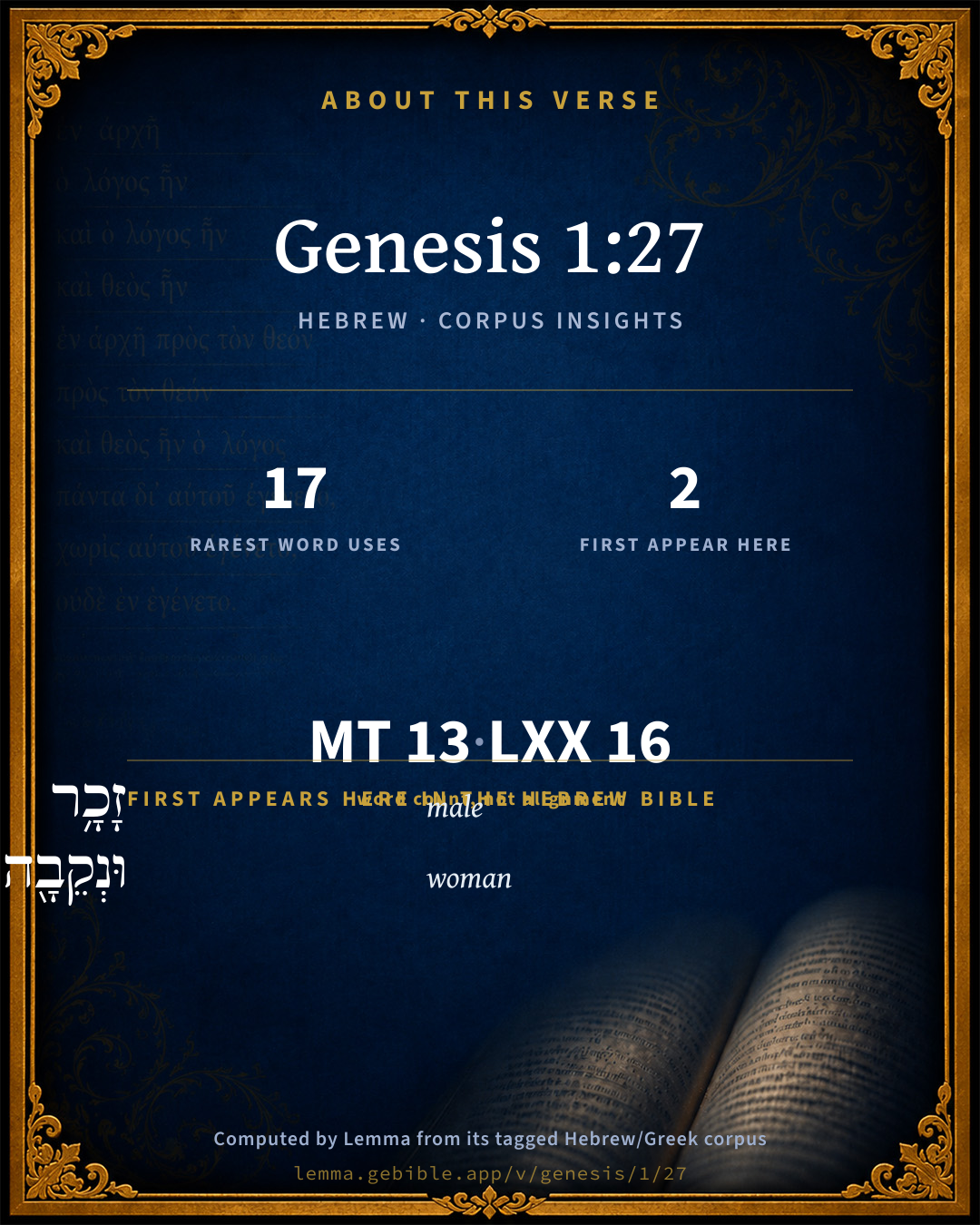
  • 2 first appearances in the Hebrew Bible
Full analysis ↓
Download a study sheet

One document with this verse’s original text, its word-by-word gloss line, the meaning frame, cross-references with their text, attributed commentary, and full source and license credits — printable, and it pastes into notes with its structure intact.

This verse Autodidact and up

Study sheet (.html) Plain text (.txt)

A passage Seminary Student

Up to 50 verses in one chapter. A passage sheet keeps up to 6 commentary sources and 12 cross-references per verse, in the order this page ranks them, and says so on the sheet whenever that leaves anything out. Ask for a single verse and you get the Autodidact verse sheet above.

Everything on this page stays free to read, with no account — the sheet is a download of what is already on screen, not access to it.

Want to remove ads? Support Godless Engineer
Compare translations 3

The same verse in 3 English versions, stacked beneath the original-language interlinear above. Click any original word for its lexicon entry.

Each is an independent rendering of the whole verse — the interlinear is not word-aligned to these translations.

Highlighted words mark where these versions differ — a whole-verse word diff, not a word-by-word alignment.

  • World English Bible Public Domain
    God created man in his own image. In God's image he created him; male and female he created them.
  • King James Version Public Domain
    So God created man in his own image, in the image of God created he him; male and female created he them.
  • unfoldingWord Literal Text CC BY-SA 4.0
    Then God created man in his image. In the image of God he created him; male and female he created them.

unfoldingWord Literal Text — © unfoldingWord, licensed CC BY-SA 4.0. Word-aligned USFM3 via Door43 (git.door43.org/unfoldingWord/en_ult).

Versions to compare (up to 4)

3 of 4 selected

Show all 18 translations

Every available English version of this verse, each an independent rendering of the whole verse.

  • World English Bible Public Domain
    God created man in his own image. In God's image he created him; male and female he created them.
  • Berean Standard Bible Public Domain
    So God created man in His own image; in the image of God He created him; male and female He created them.
  • Majority Standard Bible Public Domain
    So God created man in His own image; in the image of God He created him; male and female He created them.
  • King James Version Public Domain
    So God created man in his own image, in the image of God created he him; male and female created he them.
  • American Standard Version (1901) Public Domain
    And God created man in his own image, in the image of God created he him; male and female created he them.
  • Revised Version (1885) Public Domain
    And God created man in his own image, in the image of God created he him; male and female created he them.
  • Geneva Bible (1599) Public Domain
    Thus God created the man in his image: in the image of God created he him: he created them male and female.
  • Douay-Rheims (1899) Public Domain
    And God created man to his own image: to the image of God he created him: male and female he created them.
  • Young's Literal Translation Public Domain
    And God prepareth the man in His image; in the image of God He prepared him, a male and a female He prepared them.
  • Literal Standard Version CC BY-SA 4.0
    And God creates the man in His image; in the image of God He created him, a male and a female He created them.
  • Unlocked Literal Bible CC BY-SA 4.0
    God created man in his own image. In his own image he created him. Male and female he created them.
  • unfoldingWord Literal Text CC BY-SA 4.0
    Then God created man in his image. In the image of God he created him; male and female he created them.
  • Darby Bible Public Domain
    And God created Man in his image, in the image of God created he him; male and female created he them.
  • World Messianic Bible Public Domain
    God created man in his own image. In God’s image he created him; male and female he created them.
  • Webster's Bible Public Domain
    So God created man in his own image, in the image of God created he him; male and female created he them.
  • Free Bible Version CC BY-SA 4.0
    So God created human beings in his own image. He created them in the image of God. He created them male and female.
  • Bible in Basic English Public Domain
    And God made man in his image, in the image of God he made him: male and female he made them.
  • JPS Tanakh (1917) Public Domain
    And God created man in His own image, in the image of God created He him; male and female created He them.

Literal Standard Version (2020), Covenant Press — licensed CC BY-SA 4.0. Text via the HelloAO Bible API (eBible.org). Unlocked Literal Bible (unfoldingWord) — licensed CC BY-SA 4.0. Text via the HelloAO Bible API (eBible.org). unfoldingWord Literal Text — © unfoldingWord, licensed CC BY-SA 4.0. Word-aligned USFM3 via Door43 (git.door43.org/unfoldingWord/en_ult). Free Bible Version, Dr. Jonathan Gallagher — licensed CC BY-SA 4.0. Text via the HelloAO Bible API (eBible.org).

Word by word

More ways to search: Search by grammar → Find every occurrence → Compare this word →

Practice this passage: Drill this verse → Learn its vocabulary →

בְּצַלְמ֔וֹ
tselem
H6754
“in/at · image · his”
Preposition + Noun, Common, Masculine, Singular, Construct + Suffix, Personal, 3rd Person, Masculine, Singular
Part of Speech
Preposition + Noun
Type
Common
Gender
Masculine
Number
Singular
State
Construct
Full BDB Definition

Origin: from an unused root meaning to shade

TWOT: 1923a

image - images (of tumours, mice, heathen gods) - image, likeness (of resemblance) - mere, empty, image, semblance (figuratively)
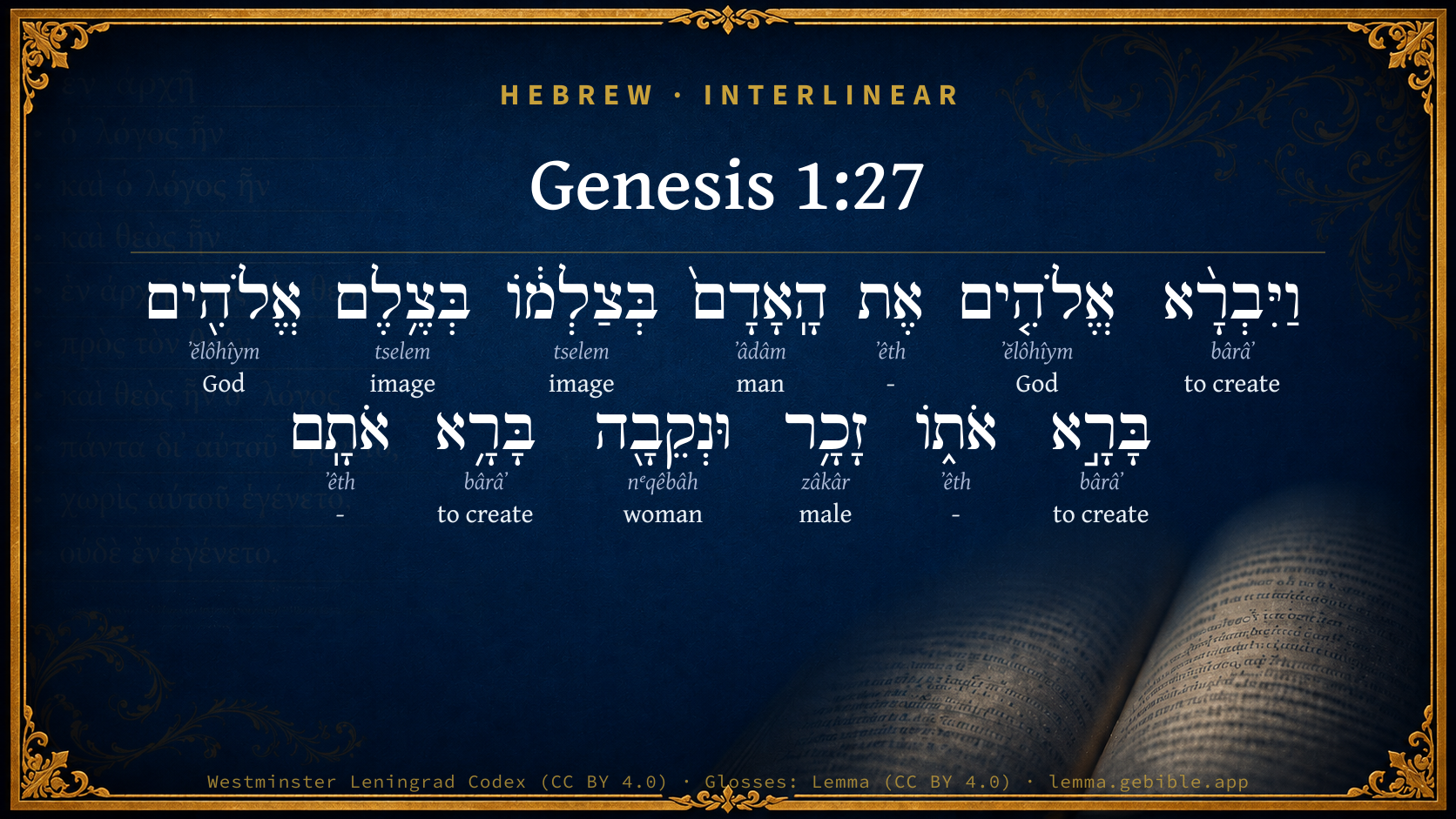
  1. וַיִּבְרָ֨א bârâʼ H1254 “and · to create” Conjunction + Verb, Qal, Sequential Imperfect, 3rd Person, Masculine, Singular
  2. אֱלֹהִ֤ים ʼĕlôhîym H430 “God(s)” Noun, Common, Masculine, Plural, Absolute
  3. אֶת ʼêth H853 “-” Particle, Direct Object
  4. הָֽאָדָם֙ ʼâdâm H120 “the · man” Particle, Definite Article + Noun, Common, Masculine, Singular, Absolute
  5. בְּצֶ֥לֶם tselem H6754 “in/at · image of” Preposition + Noun, Common, Masculine, Singular, Construct
  6. אֱלֹהִ֖ים ʼĕlôhîym H430 “God(s)” Noun, Common, Masculine, Plural, Absolute
  7. בָּרָ֣א bârâʼ H1254 “to create” Verb, Qal, Perfect, 3rd Person, Masculine, Singular
  8. אֹת֑וֹ ʼêth H853 “- · him” Particle, Direct Object + Suffix, Personal, 3rd Person, Masculine, Singular
  9. זָכָ֥ר zâkâr H2145 “male” Adjective, Adjective, Masculine, Singular, Absolute
  10. וּנְקֵבָ֖ה nᵉqêbâh H5347 “and · woman” Conjunction + Noun, Common, Feminine, Singular, Absolute
  11. בָּרָ֥א bârâʼ H1254 “to create” Verb, Qal, Perfect, 3rd Person, Masculine, Singular
  12. אֹתָֽם ʼêth H853 “- · them” Particle, Direct Object + Suffix, Personal, 3rd Person, Masculine, Plural

About this verse

These counts appear in no published source. They are computed here, from the morphology-tagged text and Lemma’s own curated glosses. What Lemma adds →

13
words
7
distinct lemmas
Pentateuch
section

Notable vocabulary

The rarest word here is בְּצַלְמ֔וֹ image H6754 — appearing just 17 times in the whole Hebrew Bible.

First appearance in Scripture

These words make their first canonical appearance in the Hebrew Bible here:

  • זָכָ֥ר male H2145
  • וּנְקֵבָ֖ה woman H5347

Shared distinctive vocabulary

בְּצַלְמ֔וֹ image H6754 occurs in 15 verses of the Hebrew Bible. Also found in:

Grammatical profile

  • 3 verbs
  • 6 nouns
  • 1 adjective
  • 3 particles

Verb forms

  • וַיִּבְרָ֨א Qal · Sequential Imperfect
  • בָּרָ֣א Qal · Perfect
  • בָּרָ֥א Qal · Perfect

Repetition

Words recur within this verse — often emphatic in Hebrew:

  • וַיִּבְרָ֨א to create H1254 ×3
  • אֱלֹהִ֤ים God H430 ×2
  • בְּצַלְמ֔וֹ image H6754 ×2

Hebrew & Septuagint length

In English translation the verse runs 19 words from the Hebrew and 19 from the Septuagint (LXX English) — the same length.

A rough comparison of the two English renderings, which tokenize alike — not a word-level alignment.

Word counts can differ between the Hebrew and the Greek without any difference in meaning — e.g. the Hebrew direct-object marker אֵת has no separate Greek word, and Greek often adds the article ὁ.

In the original languages it is 13 Hebrew tokens and 16 Greek tokens — but the two are counted differently (Hebrew bundles its prefixes and suffixes into one token; the Greek is in lemma form), so that isn’t a like-for-like length.

Cross-references

13

Topical passages linked to Genesis 1:27 in the Treasury of Scripture Knowledge — connected by theme and wording, ordered by reader-vote popularity; previews shown in the World English Bible.

  • Matthew 19:4 He answered, "Haven't you read that he who made them from the beginning made them male and female,
  • Genesis 5:1–2 This is the book of the generations of Adam. In the day that God created man, he made him in God's likeness.
  • Ephesians 2:10 For we are his workmanship, created in Christ Jesus for good works, which God prepared before that we would walk in them.
  • Mark 10:6 But from the beginning of the creation, 'God made them male and female.
  • Genesis 2:21–25 Yahweh God caused a deep sleep to fall on the man, and he slept; and he took one of his ribs, and closed up the flesh in its place.
  • Ephesians 4:24 and put on the new man, who in the likeness of God has been created in righteousness and holiness of truth.
  • Psalms 139:14 I will give thanks to you, For I am fearfully and wonderfully made. Your works are wonderful. My soul knows that very well.
  • Isaiah 43:7 everyone who is called by my name, and whom I have created for my glory, whom I have formed, yes, whom I have made.
  • Colossians 1:15 who is the image of the invisible God, the firstborn of all creation.
  • Genesis 2:18 Yahweh God said, "It is not good that the man should be alone; I will make him a helper suitable for him."
  • 1 Corinthians 11:7–9 For a man indeed ought not to have his head covered, because he is the image and glory of God, but the woman is the glory of the man.
  • Malachi 2:15 Did he not make one, although he had the residue of the Spirit? Why one? He sought a godly seed. Therefore take heed to your spirit, and let none deal treacherously against the wife of his youth.
  • Colossians 1:26 the mystery which has been hidden for ages and generations. But now it has been revealed to his saints,

Cross-references courtesy of OpenBible.info (CC BY 4.0).

Hebrew and Greek witnesses Masoretic Hebrew ↔ Greek Septuagint

The same verse in the two great witnesses to the Old Testament, shown verse-for-verse.

These are two independent witnesses, not word-aligned to each other, and the Septuagint is shown in lemma (dictionary) form.

Hebrew Genesis 1:27 Masoretic · Westminster Leningrad Codex

וַיִּבְרָ֨א אֱלֹהִ֤ים אֶת הָֽאָדָם֙ בְּצַלְמ֔וֹ בְּצֶ֥לֶם אֱלֹהִ֖ים בָּרָ֣א אֹת֑וֹ זָכָ֥ר וּנְקֵבָ֖ה בָּרָ֥א אֹתָֽם

God created man in his own image. In God's image he created him; male and female he created them.

World English Bible · Public Domain

Greek LXX Genesis 1:27 Septuagint · lemma form

καί ποιέω ὁ θεός ὁ ἄνθρωπος κατά εἰκών θεός ποιέω αὐτός ἄρσην καί θῆλυς ποιέω αὐτός

And God made man, according to the image of God he made him, male and female he made them.

LXX2012 (modern English Septuagint) · Public Domain

Hebrew: Westminster Leningrad Codex (CC BY 4.0). Greek: Septuagint (public domain); English from LXX2012 (modern English Septuagint) (Public Domain). How the Septuagint differs from the Hebrew →

Targum (Aramaic paraphrase)

2

The Targum is the ancient Jewish Aramaic paraphrase of the Hebrew Scriptures — an interpretive translation, not the Hebrew text itself. Onkelos (literal) and Pseudo-Jonathan (expansive) render the Torah, and Jonathan the Prophets. Coverage is partial: where no permissively-licensed English translation exists for a verse, only the Aramaic is shown. This is verse-level text, not a word-by-word alignment to the Hebrew.

  1. Targum Onkelos Torah (Genesis–Deuteronomy)
    וּבְרָא יְיָ יָת אָדָם בְּצַלְמֵהּ בְּצַלְמָא דַיְיָ בְּרָא יָתֵהּ דְּכַר וְנוּקְבָא בְּרָא יָתְהוֹן

    (no public-domain English translation for this verse)

    Targum Onkelos — Aramaic: “Onkelos Genesis” (public domain); “Onkelos Exodus” (public domain); “Onkelos Leviticus” (public domain); “Onkelos Numbers” (public domain); “Onkelos Deuteronomy” (public domain). English: “Sefaria Community Translation” (CC0 1.0 (public-domain dedication)); “J.W. Etheridge. The Targums of Onkelos and Jonathan Ben Uzziel on the Pentateuch. London: Longmans, Green, 1862” (public domain). Text via Sefaria.

  2. Targum Pseudo-Jonathan Torah (Genesis–Deuteronomy)
    וּבְרָא יְיָ יַת אָדָם בִּדְיוּקְנֵיהּ בְּצַלְמָא יְיָ בְּרָא יָתֵיהּ בְּמָאתָן וְאַרְבְּעִין וּתְמַנֵי אֵיבָרִין בִּתְלַת מְאָה וְשִׁיתִּין וְחַמְשָׁא גִידִין וּקְרַם עֲלוֹי מוֹשְׁכָא וּמְלֵי יָתֵיהּ בִּסְרָא וְאִידְמָא דְכַר וְנוּקְבָא בְגַוְהוֹן בְּרָא יַתְהוֹן

    And the Lord created man in His Likeness: In the image of the Lord He created him, with two hundred and forty and eight members, with three hundred and sixty and five nerves, and overlaid them with skin, and filled it with flesh and blood. Male and female in their bodies He created them.

    Targum Pseudo-Jonathan — Aramaic: “Targum Jonathan on Genesis” (public domain); “Targum Jonathan on Exodus” (public domain); “Targum Jonathan on Leviticus” (public domain); “Targum Jonathan on Numbers” (public domain); “Targum Jonathan on Deuteronomy” (public domain). English: “The Targum of Jonathan ben Uzziel, trans. J. W. Etheridge, London, 1862” (public domain). Text via Sefaria.

Commentary

Notes on Genesis 1:27 from classic Christian and Jewish commentators (each source and its license shown beneath its notes). The classic Christian expositions comment on the surrounding passage and are grouped to its opening verse, so a note may address several verses; the Jewish commentaries on the Tanakh (Rashi and others) are per-verse, so they appear only where the commentator wrote on this verse.

Lemma curates 59 commentaries, every one of them public domain or Creative Commons licensed, each selected and text-cleaned for this edition rather than reprinted as found. About our sources →

Trapp's Complete Commentary

John Trapp

Gen 1:27 So God created man in his [own] image, in the image of God created he him; male and female created he them.

Ver. 27. So God created man in his own image.] There is a double image of God in the soul. One in the substance of it, whereof I have spoken in the former verse. The other in the qualities and supernatural graces, of knowledge in the understanding, rightness or straitness in the will, and holiness in the affections. In all these, man, when he came first out of God’s mint, shone most gloriously. {O! quantum haec Niobe, &c.} But now, Oh, think of this burnt temple, and mourn, as they in Ezra {Ezr 3:12} {Ebur candidissimum, adhibito igne, nigrescit.}

John Trapp, A Commentary or Exposition upon All the Books of the Old and New Testament (1647–1656) — public domain. Text from a community e-Sword module.

Joseph Benson's Commentary

Gen 1:27. So God created man in his own image — In his natural, but especially in his moral image, with an habitual conformity of all his powers to the will of God, his understanding clearly discerning, his judgment entirely approving, his will readily choosing, and his affections cordially embracing his chief good; without error in his knowledge, disorder in his passions, or irregularity or inordinancy in his appetites; his senses also being all inlets to wisdom and enjoyment, and all his faculties of body and mind subservient to the glory of God and his own felicity! But man being in honour did not abide, but became like the beasts that perish! What cause we have for thankfulness that this image of God may be restored to our souls, and how earnestly ought we to pray for, and how diligently to seek this most important of all attainments! Male and female created he them — Not at once, or both together, as some have unscripturally taught, but first the man out of the earth, and then the woman out of the man.

They seem both, however, to have been made on the sixth day, as is here related, and as the following words, promising they should be fruitful, manifest: but the particular history of the woman’s creation is brought in afterward by way of further elucidation, and to introduce the account of the institution of marriage. God formed the woman from the man, and caused the whole race of mankind to descend from one original pair, that all the families and nations of men, being made of one blood, and proceeding from one common stock, might know themselves to be brethren, and might love and assist one another to the uttermost of their power: but, alas! what a sad reverse of this do we daily see exemplified before our eyes!

Joseph Benson's Commentary on the Old and New Testaments (1811–1818) — public domain. Text from a community e-Sword module.

Tyndale Open Study Notes

Tyndale Open Resources

1:27 The first poetry of Genesis reflectively celebrates God’s climactic feat in creating humankind. • human beings: This term (Hebrew ha-’adam, “the man”) is often used to denote humanity collectively (see 6:1, 5-7; 9:5-6). Though traditionally translated “man,” gender is not at issue here; both male and female are included.

Tyndale Open Study Notes — © Tyndale Open Resources, licensed CC BY-SA 4.0. Text via the HelloAO Bible API.

John Calvin's Commentaries

27. So God created man The reiterated mention of the image of God is not a vain repetition. For it is a remarkable instance of the Divine goodness which can never be sufficiently proclaimed. And, at the same time, he admonishes us from what excellence we have fallen, that he may excite in us the desire of its recovery. When he soon afterwards adds, that God created them male and female, he commends to us that conjugal bond by which the society of mankind is cherished. For this form of speaking, God created man, male and female created he them, is of the same force as if he had said, that the man himself was incomplete. Under these circumstances, the woman was added to him as a companion that they both might be one, as he more clearly expresses it in the second chapter. Malachi also means the same thing when he relates, (Genesis 2:15,) that one man was created by God, whilst, nevertheless, he possessed the fullness of the Spirit. For he there treats of conjugal fidelity, which the Jews were violating by their polygamy. For the purpose of correcting this fault, he calls that pair, consisting of man and woman, which God in the beginning had joined together, one man, in order that every one might learn to be content with his own wife.

John Calvin's Commentaries (1540-1563) — public domain. Text from the Calvin Translation Society English edition (1840s-50s) via the Christian Classics Ethereal Library (ccel.org). Calvin's coverage is partial (roughly two-thirds of the Bible); uncommented books and verses are honest gaps, never fabricated. The 19th-century editor's footnotes and remarks are omitted so the notes are faithfully Calvin's own voice.

Ellicott's Commentary for English Readers

(27) Created.—This significant verb is thrice repeated with reference to man. It indicates, first, that man has that in him which was not a development or evolution, but something new. He is, in fact, the most perfect work of the creative energy, and differs from the animals not only in degree, but in kind, though possessing, in common with them, an organised body. And next, it indicates the rejoicing of the Deity at the completion of His purpose.

A Bible Commentary for English Readers, edited by Charles John Ellicott (1878–1897) — public domain. Text from a community e-Sword module.

The Cambridge Bible for Schools and Colleges

gen. ed. J. J. S. Perowne

27. The reiteration of the principal words in the clauses of this verse has something of the rhythm of poetry. Repetition and love of detail are characteristics of the Priestly Code. “Created,” cf. Gen_1:1; Gen_1:21 (see notes).

male and female] The distinction of the sexes, which is here given, has been omitted, probably for brevity’s sake, in the mention of the animals.

When, in view of the discoveries of the science of Anthropology, the question is asked whether there was one original pair of human beings, or whether each of the different races, Caucasian, Mongolian, Negro, Red Indian, Australian, &c., originated from one pair, or from groups of pairs, we must answer that such questions do not come within the horizon of thought in our passage. They are to be solved not by Revelation in Holy Scripture, but by the exercise of the gifts of patient enquiry, accurate observation, and sound reasoning. The Hebrew writer has in view a population drawn from a single stock. His account of the origin of Man, applicable to one race, is symbolical of all, if a plurality of origin is to be assumed.

The Cambridge Bible for Schools and Colleges (gen. ed. J. J. S. Perowne; Cambridge University Press, 1878–1918) — public domain. Text from a community e-Sword module.

John Gill's Exposition

So God created man in his own image,.... Which consisted both in the form of his body, and the erect stature of it, different from all other creatures; in agreement with the idea of that body, prepared in covenant for the Son of God, and which it was therein agreed he should assume in the fulness of time; and in the immortality of his soul, and in his intellectual powers, and in that purity, holiness, and righteousness in which he was created; as well as in his dominion, power, and authority over the creatures, in which he was as God's viceregent, and resembled him. The Jerusalem Targum is,

the Word of the Lord created man in his likeness; even that Word that was in the beginning with God, and was God, and in time became incarnate, by whom all things were made, Joh 1:1.

in the image of God created he him; which is repeated for the certainty of it, and that it might be taken notice of, as showing man's superior glory and dignity to the rest of the creatures, Co1 11:7.

male and female created he them; not that man was created an hermaphrodite, or with two bodies, back to back united together, and afterwards cleaved asunder, as the Jews fabulously say; but first God made man, or the male, out of the dust of the earth, and infused a rational soul into him; and then out of one of his ribs made a female, or woman, who was presented to him as his wife, that so their species might be propagated; and only one male and one female were created, to show that hereafter a man was to have at a time no more wives than one; see Mal 2:15 for all that is said in the following chapter, concerning the formation of man out of the dust of the earth, and the making of woman out of his rib, and presenting her to him, and his taking her to be his wife, were all done on this sixth day, and at this time. It is a tradition among the Heathens, that man was made last of all the creatures; so says Plato (k); and this notion the Chinese also have (l). The Jews give these reasons why man was made on the evening of the sabbath, to show that he did not assist in the work of creation; and that if he was elated in his mind, it might be told him that a fly was created before him, and that he might immediately enter on the command, i.e. of the sabbath (m).

(k) Protagor. p. 320, 321. (l) Martin. Sinic. Hist. l. 1. p. 4. (m) T. Bab. Sanhedrin, fol. 38. 1.

John Gill's Exposition of the Whole Bible (1746–1763) — public domain (CC PDM 1.0). Text via the HelloAO Bible API.

Haydock's Catholic Bible Commentary

Male and female. Eve was taken from Adam’s side on this same day, though it be related in the following chapter. Adam was not an hermaphrodite as some have foolishly asserted. (Calmet) --- Adam means the likeness, or red earth, that in one word we may behold our nobility and meanness. (Haydock)

George Leo Haydock (1774–1849), Haydock's Catholic Family Bible and Commentary, 1859 edition — public domain. Excludes Psalms (Douay-Rheims chapter numbering differs from Protestant) and Deuterocanonical books (Catholic canon only).

Matthew Poole's English Annotations

Not both together, as some of the Jews have fabled, but successively, the woman after and out of the man, as is more particularly related, Gen 2:21, &c., which is here mentioned by anticipation. Albeit the woman also seems to have been made upon the sixth day, as is here related, and as the following blessing showeth, which is common to both of them, though the particular history of it is brought in afterwards, Gen 2:1-25, by way of recapitulation or repetition.

Matthew Poole's English Annotations on the Holy Bible (1683–1685) — public domain. Text from a community e-Sword/MySword module.

The Pulpit Commentary

So (or and) God created (bars, as in vers. 1, 21, q.v.) man (literally; the Adam referred to in ver. 26) in his own image, in the image of God created he him; male and female created he them. The threefold repetition of the term "created" should be observed as a significant negation of modern evolution theories as to the descent of man, and an emphatic proclamation of his Divine original. The threefold parallelism of the members of this verse is likewise suggestive, as Umbreit, Ewald, and Delitzsch remark, of the jubilation with which the writer contemplates the crowning work of Elohim"s creative word. Murphy notices two stages in man s creation, the general fact being stated in the first clause of this triumphal song, and the two particulars first his relation to his Maker, and second his sexual distinction in its other members. In the third clause Luther sees an intimation "that the woman also was created by God, and made a partaker of the Divine image, and of dominion over all.

Ver. 27.

The greatness of man.

I THE TIME OF HIS APPEARANCE. The latest of God s works, he was produced towards the close of the era that witnessed the introduction upon our globe of the higher animals. Taking either view of the length of the creative day, it may be supposed that in the evening the animals went forth "to roar after their prey, and seek their meat from God," and that in the morning man arose upon the variegated scene, "going forth to his work and to his labor until the evening". (Psa_104:20-23) In thin there was a special fitness, each being created at the time most appropriate to its nature. Man"s works are often mistimed; God"s never. Likewise in man"s being ushered last upon the scene there was peculiar significance; it was a virtual proclamation of his greatness.

II THE SOLEMNITY OF HIS MAKING, which was preceded by a Divine consultation: "Let us make man," &c. The language of;

1. Resolution. As if, in the production of the other creatures, the all-wise Artificer had been scarcely conscious of an effort, but must now bestir himself to the performance of his last and greatest work.

2. Forethought. As if his previous makings had been, in comparison with this, of so subordinate importance that they might be executed instantaneously and, as it were, without premeditation, whereas this required intelligent arrangement and wise consideration beforehand.

3. Solicitude. As if the insignificance of these other labors made no special call upon his personal, care and attention, whereas the vastness of the present undertaking demanded the utmost possible watchfulness and caution.

4. Delight. As if the fashioning and beautifying of the globe and its replenishing with sentient beings, unspeakably glorious as these achievements were afforded him no satisfaction in comparison with this which he contemplated, the creating of man in his own image. (cf. Pro_8:31)

III THE DIGNITY OF HIS NATURE. "Created after God"s image and likeness," suggesting ideas of

1. Affinity, or kinship. The resplendent universe, with its suns and systems, its aerial canopy and green-mantled ground, its Alps and Himalayas, its oceans, rivers, streams, was only as plastic clay in the hands of a skilful potter. Even the innumerable tribes of living creatures that had been let loose to swarm the deep, to cleave the sky, to roam the earth, were animated by a principle of being that had no closer connection with the Deity than that which effect has with cause; but the life which inspired man was a veritable outcome from the personality of God. (Gen_2:7) Hence man was something higher than a creature. As imago Dei he was God"s son (Mal_2:10; Act_17:28)

2. Resemblance. A distinct advance upon the previous thought, although implied in it. This likeness or similitude consisted in

(1) Personality. Light, air, land, sea, sun, moon, stars were "things." Plants, fishes, fowls, animals were "lives," although the first are never so characterized in Scripture. Man was a "person.

(2) Purity. The image of absolute holiness must itself be immaculate. In this sense Christ was "the express image of God"s person"; (Heb_1:3) and though man is not now a complete likeness of his Maker in the moral purity of his nature, when he came from the Creator"s hand he was. It is the object of Christ"s work to renew in man the image of his Maker. (Eph_4:24)

(3) Power. That man"s Creator was a God of power was implied in his name, ELOHIM, and demonstrated by his works. Even fallen man we can perceive to be possessed of many elements of power that are the shadows of that which resided in Elohim the power of self-government, and of lordship over the creatures, of language and of thought, of volition and of action, of originating, at least in a secondary sense, and of combining and arranging. In the first man they resided in perfection.

3. Representation. Man was created in God"s image that he might be a visible embodiment of the Supreme to surrounding creatures. "The material world, with its objects sublimely great or meanly little, as we judge them; its atoms of dust, its orbs of fire; the rock that stands by the seashore, the water that wears it away; the worm, a birth of yesterday, which we trample underfoot; the sheets of the constellations that gleam perennial overhead; the aspiring palm tree fixed to one spot, and the lions that are sent out free these incarnate and make visible all of God their natures will admit."Man in his nature was intended as the highest representation of God that was possible short of the incarnation of the Word himself.

IV THE GRANDEUR OF HIS DOMINION. Man was designed to be God"s image in respect of royalty and lordship; and as no one can play the monarch without a kingdom and without subjects, God gave him both an empire and a people.

1. An empire.

(1) Of wide extent. In the regal charter reaching to the utmost bounds of this terrestrial sphere (ver. 26).

(2) Of available character. Not a region that was practically unconquerable, but every square inch of it capable of subjugation and occupation.

(3) Of vast resources. Everything in heaven, earthy and sea was placed at his command.

(4) Of incalculable value. Nothing was absolutely useless, and many things were precious beyond compare.

(5) Of perfect security. God had given" it to him. The.. grant, was, absolute, the gift was sure.

2. A people.

(1) Numerous. "Every living thing was subjected to his sway.

(2) Varied. The fishes, fowls, and beasts were his servants

(3) Submissive. As yet they had not broken loose against their master.

(4) Given. They were not acquired by the sword, but donated by their Maker.

The Pulpit Commentary (1880–1919), ed. H.D.M. Spence-Jones & Joseph S. Exell — public domain. Text from a community e-Sword module.

Rashi

Rabbi Shlomo Yitzchaki (Rashi)

ויברא אלהים את האדם בצלמו SO GOD CREATED THE MAN IN HIS IMAGE —in the type that was specially made for him, for everything else was created by a creative fiat, whilst he was brought into existence by a creative act (literally, by hand), as it is said (Psalms 139:5) “And Thou hast laid thy hand upon me.” He was made by a seal as a coin that is made by a die that is called in old French coin. It is similarly said, (Job 38:14) “it is changed as clay under the seal” (Sanhedrin 38a).

בצלם אלהים ברא אותו IN THE IMAGE OF GOD CREATED HE HIM — It explains to you that the form prepared for him was the form of the image of his Creator.

זכר ונקבה ברא אותם MALE AND FEMALE CREATED HE THEM — And further on (Genesis 2:21) it is said: “and He took one of his ribs etc.” (The two passages appear to be contradictory.) But according to a Midrashic explanation, He created him at first with two faces, and afterwards He divided him. But the real sense of the verse is: here it tells you that both of them were created on the sixth day, but it does not explain to you how their creation took place; this it explains to you in another place (Genesis Rabbah 8:1 and see Eruvin 18a).

Rashi on the Tanakh — English translations: “The Judaica Press complete Tanach with Rashi, translated by A. J. Rosenberg” (CC BY 4.0); “Pentateuch with Rashi's commentary by M. Rosenbaum and A.M. Silbermann, 1929-1934” (public domain); “The Metsudah Tanach series, Lakewood, N.J” (CC BY 4.0); and “The Book of Joshua, Metsudah Publications, 1997” (CC BY 4.0). Text via Sefaria.

Radak

Rabbi David Kimhi (Radak)

ויברא אלוקים את האדם בצלמו, the expression ברא, i.e. a totally new creation, refers only to man’s soul, as indicated by the word בצלמו, in G’d’s image, something that had not yet been created. The Torah wanted to draw a line of distinction between the construction of man’s body and that of his soul. When describing the construction of man’s body, (chapter 2 verse 7), the wording is וייצר אלוקים את האדם עפר מן האדמה, “G’d fashioned man from dust of the earth, etc;” the expression יצר is not one that can be applied to something abstract such as the soul. However, the word עשה, מעשה, is applicable both to bodies and to abstract beings such as souls. As far as the verse (Zecharayh 12,1) ויוצר רוח אדם בקרבו, “He fashioned man’s spirit inside of him,” is concerned, the prophet referred to an instrument used by the body, something like the heart of the brain. These organs are instruments supporting the power of the spirit. The reason why, at this point the Torah (Moses) did not mention the making of man’s body, is because it is mentioned in the paragraph beginning with the words אלה תולדות השמים והארץ. (Genesis 2,4) In that paragraph some other details are mentioned which have been omitted at this point in order to refer to them in that passage in chapter 2. The whole story mentioned there also belongs to the report of what had transpired during these 6 days of creation.

בצלם אלוקים, a reference to an angel. Basically, whether we speak of “the image of G’d,” or of “an angel,” the common denominator is that we speak of disembodied spiritual beings. G’d is distinguished by the fact that none of the other disembodied intelligent beings (angels) amounts to anything at all, seeing none of them can understand their Creator’s essence. This is an axiom, seeing that G’d is the ultimate cause of their existence. He is the Creator, whereas they are merely creatures. This is why Moses added the word אלוקים, when mentioning צלם, to make sure that we get the point that if man is compared to something celestial, he is compared to a creature in the celestial regions, not to the Creator himself.

זכר ונקבה ברא אותם, in the following paragraph Moses explains how G’d created man as both male and female.

Radak on the Tanakh — English translations: “Sefaria Community Translation” (CC0 1.0 (public-domain dedication)); “Eliyahu Munk, HaChut Hameshulash” (CC BY 4.0); “Rabbi Mike Feuer, Jerusalem Anthology” (CC BY 4.0); and “R. David Kimhi on the first book of Psalms, Translated by R.G. Finch, London, 1919” (public domain). Text via Sefaria.

Lesson kit

Teaching starters — assembled from the data on this page, not authored interpretation. Every prompt links to the verse data it draws on. Edit before teaching.

Genesis, in the Pentateuch, opens this verse with 13 words (7 distinct Hebrew lemmas). Its most distinctive word is tselem (“image”). A historical commentator’s framing appears above. Read the whole chapter for the surrounding context.

Discussion questions

  1. How does “image” (tselem) shape what this verse is saying?
  2. 2 words here appear for the first time in Scripture. What is being introduced at this debut?
  3. Genesis 1:26 shares the word «image» with this verse. How do the two illuminate each other?
  4. “to create” occurs 3× in this one verse. What is the effect of the repetition?
  5. These translations render this verse differently. What is at stake in choosing one wording over another?
  6. The verb «וַיִּבְרָ֨א» is Qal Sequential Imperfect. How does its form color the action?
  7. Reading how Trapp's Complete Commentary and Joseph Benson's Commentary read this verse, where do the two commentators agree and where do they part?

Things to notice

Reading settings

Reading text

Shown beneath each verse's original-language words.

Old Testament
Old Testament edition

Read the OT as the Masoretic Hebrew (MT) or the Greek Septuagint (LXX).

English shown for the Greek Septuagint (in the Hebrew ↔ Greek comparison).

Comparing translations? Open the Compare panel on any verse page to stack up to four side by side.