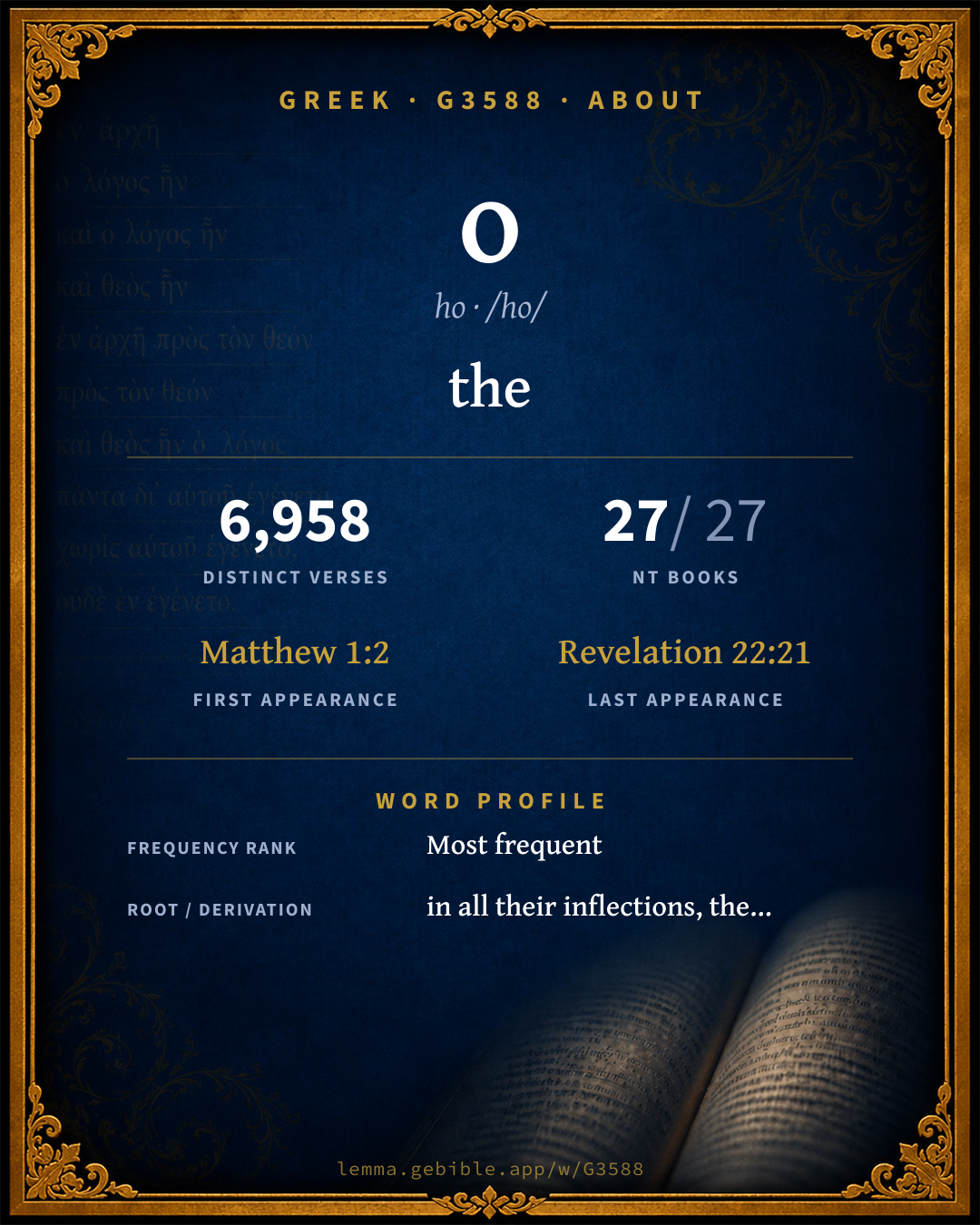
ο
the
Full lexicon entry — Thayer's Greek Lexicon
From Thayer's Greek Lexicon
Where this word appears
See every Nominative-case word in the Greek New Testament →
Grammar key — what these labels mean
Part of speech
- Article
- The Greek definite article (“the”), agreeing with its noun in case, number, and gender.
Case
- Nominative
- The case of the subject (and the predicate nominative).
- Genitive
- The case of source, possession, or “of” — answers “whose / from what.”
- Accusative
- The case of the direct object and of extent.
- Dative
- The case of the indirect object, means, or location — “to / for / with / in.”
Gender
- Masculine
- Grammatically masculine.
- Feminine
- Grammatically feminine.
- Neuter
- Grammatically neuter.
Number
- Singular
- One.
- Plural
- More than one.
Every verse where G3588 appears in the Book of James — 93 distinct verses. Click any verse to open its interlinear word-by-word view. Verse text shown in the World English Bible for context — . Each verse’s Greek form is shown with its reference; the English is not keyword-highlighted, since the data carries no word-level English alignment. Use “Compare translations” on any verse to read it across multiple English versions. This concordance covers the Greek New Testament; Septuagint (Greek Old Testament) occurrences of this word are not indexed here.
James
- James 1:1 ταῖς ταῖς τῇ art dat pl fem art dat pl fem art dat sg fem James, a servant of God and of the Lord Jesus Christ, to the twelve tribes which are in the Dispersion: Greetings.
- James 1:3 τὸ τῆς art nom sg neut art gen sg fem knowing that the testing of your faith produces endurance.
- James 1:4 ἡ art nom sg fem Let endurance have its perfect work, that you may be perfect and complete, lacking in nothing.
- James 1:5 τοῦ art gen sg masc But if any of you lacks wisdom, let him ask of God, who gives to all liberally and without reproach; and it will be given to him.
- James 1:6 ὁ art nom sg masc But let him ask in faith, without any doubting, for he who doubts is like a wave of the sea, driven by the wind and tossed.
- James 1:7 ὁ τοῦ art nom sg masc art gen sg masc For let that man not think that he will receive anything from the Lord.
- James 1:8 ταῖς art dat pl fem He is a double-minded man, unstable in all his ways.
- James 1:9 ὁ ὁ τῷ art nom sg masc art nom sg masc art dat sg neut But let the brother in humble circumstances glory in his high position;
- James 1:10 ὁ τῇ art nom sg masc art dat sg fem and the rich, in that he is made humble, because like the flower in the grass, he will pass away.
- James 1:11 ὁ τῷ τὸν τὸ ἡ τοῦ ὁ ταῖς art nom sg masc art dat sg masc art acc sg masc art nom sg neut art nom sg fem art gen sg neut art nom sg masc art dat pl fem For the sun arises with the scorching wind, and withers the grass, and the flower in it falls, and the beauty of its appearance perishes. So also will the rich man fade away in his pursuits.
- James 1:12 τὸν τῆς τοῖς art acc sg masc art gen sg fem art dat pl masc Blessed is the man who endures temptation, for when he has been approved, he will receive the crown of life, which the Lord promised to those who love him.
- James 1:13 ὁ art nom sg masc Let no man say when he is tempted, "I am tempted by God," for God can't be tempted by evil, and he himself tempts no one.
- James 1:14 τῆς art gen sg fem But each one is tempted, when he is drawn away by his own lust, and enticed.
- James 1:15 ἡ ἡ art nom sg fem art nom sg fem Then the lust, when it has conceived, bears sin; and the sin, when it is full grown, brings forth death.
- James 1:17 τοῦ τῶν art gen sg masc art gen pl neut Every good gift and every perfect gift is from above, coming down from the Father of lights, with whom can be no variation, nor turning shadow.
- James 1:18 τὸ τῶν art acc sg neut art gen pl neut Of his own will he brought us forth by the word of truth, that we should be a kind of first fruits of his creatures.
- James 1:19 τὸ τὸ art acc sg neut art acc sg neut So, then, my beloved brothers, let every man be swift to hear, slow to speak, and slow to anger;
- James 1:21 τὸν τὸν τὰς art acc sg masc art acc sg masc art acc pl fem Therefore, putting away all filthiness and overflowing of wickedness, receive with humility the implanted word, which is able to save your souls.
- James 1:23 τὸ τῆς art acc sg neut art gen sg fem For if anyone is a hearer of the word and not a doer, he is like a man beholding his natural face in a mirror;
- James 1:25 ὁ τὸν τῆς τῇ art nom sg masc art acc sg masc art gen sg fem art dat sg fem But he who looks into the perfect law, the law of freedom, and continues, not being a hearer who forgets but a doer of the work, this man will be blessed in what he does.
- James 1:26 ἡ art nom sg fem If anyone among you thinks himself to be religious while he doesn't bridle his tongue, but deceives his heart, this man's religion is worthless.
- James 1:27 τῇ τοῦ art dat sg fem art gen sg masc Pure religion and undefiled before our God and Father is this: to visit the fatherless and widows in their affliction, and to keep oneself unstained by the world.
- James 2:1 τὴν τοῦ τῆς art acc sg fem art gen sg masc art gen sg fem My brothers, don't hold the faith of our Lord Jesus Christ of glory with partiality.
- James 2:3 τὸν τὴν τὴν τῷ τὸ art acc sg masc art acc sg fem art acc sg fem art dat sg masc art acc sg neut and you pay special attention to him who wears the fine clothing, and say, "Sit here in a good place;" and you tell the poor man, "Stand there," or "Sit by my footstool;"
- James 2:5 ὁ τοὺς τῷ τῆς τοῖς art nom sg masc art acc pl masc art dat sg masc art gen sg fem art dat pl masc Listen, my beloved brothers. Didn't God choose those who are poor in this world to be rich in faith, and heirs of the Kingdom which he promised to those who love him?
- James 2:6 τὸν οἱ art acc sg masc art nom pl masc But you have dishonored the poor man. Don't the rich oppress you, and personally drag you before the courts?
- James 2:7 τὸ τὸ art acc sg neut art acc sg neut Don't they blaspheme the honorable name by which you are called?
- James 2:8 τὴν τὸν art acc sg fem art acc sg masc However, if you fulfill the royal law, according to the Scripture, "You shall love your neighbor as yourself," you do well.
- James 2:9 τοῦ art gen sg masc But if you show partiality, you commit sin, being convicted by the law as transgressors.
- James 2:10 τὸν art acc sg masc For whoever shall keep the whole law, and yet stumble in one point, he has become guilty of all.
- James 2:11 ὁ art nom sg masc For he who said, "Do not commit adultery," said also, "Do not commit murder." Now if you do not commit adultery, but murder, you have become a transgressor of the law.
- James 2:13 ἡ τῷ art nom sg fem art dat sg masc For judgment is without mercy to him who has shown no mercy. Mercy triumphs over judgment.
- James 2:14 τὸ ἡ art nom sg neut art nom sg fem What good is it, my brothers, if a man says he has faith, but has no works? Can faith save him?
- James 2:15 τῆς art gen sg fem And if a brother or sister is naked and in lack of daily food,
- James 2:16 τὰ τοῦ τὸ art acc pl neut art gen sg neut art nom sg neut and one of you tells them, "Go in peace, be warmed and filled;" and yet you didn't give them the things the body needs, what good is it?
- James 2:17 ἡ art nom sg fem Even so faith, if it has no works, is dead in itself.
- James 2:18 τὴν τῶν τῶν τὴν art acc sg fem art gen pl neut art gen pl neut art acc sg fem Yes, a man will say, "You have faith, and I have works." Show me your faith from your works, and I by my works will show you my faith.
- James 2:19 ὁ τὰ art nom sg masc art nom pl neut You believe that God is one. You do well. The demons also believe, and shudder.
- James 2:20 ἡ τῶν art nom sg fem art gen pl neut But do you want to know, vain man, that faith apart from works is dead?
- James 2:21 ὁ τὸν τὸ art nom sg masc art acc sg masc art acc sg neut Wasn't Abraham our father justified by works, in that he offered up Isaac his son on the altar?
- James 2:22 ἡ τοῖς τῶν ἡ art nom sg fem art dat pl neut art gen pl neut art nom sg fem You see that faith worked with his works, and by works faith was perfected;
- James 2:23 ἡ ἡ τῷ art nom sg fem art nom sg fem art dat sg masc and the Scripture was fulfilled which says, "Abraham believed God, and it was accounted to him as righteousness;" and he was called the friend of God.
- James 2:25 ἡ τοὺς art nom sg fem art acc pl masc In like manner wasn't Rahab the prostitute also justified by works, in that she received the messengers, and sent them out another way?
- James 2:26 τὸ ἡ art nom sg neut art nom sg fem For as the body apart from the spirit is dead, even so faith apart from works is dead.
- James 3:2 τὸ art acc sg neut For in many things we all stumble. If anyone doesn't stumble in word, the same is a perfect man, able to bridle the whole body also.
- James 3:3 τῶν τοὺς τὰ τὸ τὸ art gen pl masc art acc pl masc art acc pl neut art acc sg neut art acc sg neut Indeed, we put bits into the horses' mouths so that they may obey us, and we guide their whole body.
- James 3:4 τὰ ἡ τοῦ art nom pl neut art nom sg fem art gen sg masc Behold, the ships also, though they are so big and are driven by fierce winds, are yet guided by a very small rudder, wherever the pilot desires.
- James 3:5 ἡ art nom sg fem So the tongue is also a little member, and boasts great things. See how a small fire can spread to a large forest!
- James 3:6 ἡ ὁ τῆς ἡ τοῖς ἡ τὸ τὸν τῆς τῆς art nom sg fem art nom sg masc art gen sg fem art nom sg fem art dat pl neut art nom sg fem art acc sg neut art acc sg masc art gen sg fem art gen sg fem And the tongue is a fire. The world of iniquity among our members is the tongue, which defiles the whole body, and sets on fire the course of nature, and is set on fire by Gehenna.
- James 3:7 τῇ τῇ art dat sg fem art dat sg fem For every kind of animal, bird, creeping thing, and thing in the sea, is tamed, and has been tamed by mankind.
- James 3:8 τὴν art acc sg fem But nobody can tame the tongue. It is a restless evil, full of deadly poison.
- James 3:9 τὸν τοὺς τοὺς art acc sg masc art acc pl masc art acc pl masc With it we bless our God and Father, and with it we curse men, who are made in the image of God.
- James 3:10 τοῦ art gen sg neut Out of the same mouth comes forth blessing and cursing. My brothers, these things ought not to be so.
- James 3:11 ἡ τῆς τὸ τὸ art nom sg fem art gen sg fem art acc sg neut art acc sg neut Does a spring send out from the same opening fresh and bitter water?
- James 3:13 τῆς τὰ art gen sg fem art acc pl neut Who is wise and understanding among you? Let him show by his good conduct that his deeds are done in gentleness of wisdom.
- James 3:14 τῇ τῆς art dat sg fem art gen sg fem But if you have bitter jealousy and selfish ambition in your heart, don't boast and don't lie against the truth.
- James 3:15 ἡ art nom sg fem This wisdom is not that which comes down from above, but is earthly, sensual, and demonic.
- James 3:17 ἡ art nom sg fem But the wisdom that is from above is first pure, then peaceful, gentle, reasonable, full of mercy and good fruits, without partiality, and without hypocrisy.
- James 3:18 τοῖς art dat pl masc Now the fruit of righteousness is sown in peace by those who make peace.
- James 4:1 τῶν τῶν τοῖς art gen pl fem art gen pl fem art dat pl neut Where do wars and fightings among you come from? Don't they come from your pleasures that war in your members?
- James 4:2 τὸ art acc sg neut You lust, and don't have. You kill, covet, and can't obtain. You fight and make war. You don't have, because you don't ask.
- James 4:3 ταῖς art dat pl fem You ask, and don't receive, because you ask with wrong motives, so that you may spend it for your pleasures.
- James 4:4 ἡ τοῦ τῷ τοῦ τοῦ art nom sg fem art gen sg masc art dat sg masc art gen sg masc art gen sg masc You adulterers and adulteresses, don't you know that friendship with the world is enmity with God? Whoever therefore wants to be a friend of the world makes himself an enemy of God.
- James 4:5 ἡ τὸ art nom sg fem art nom sg neut Or do you think that the Scripture says in vain, "The Spirit who lives in us yearns jealously"?
- James 4:6 ὁ art nom sg masc But he gives more grace. Therefore it says, "God resists the proud, but gives grace to the humble."
- James 4:7 τῷ τῷ art dat sg masc art dat sg masc Be subject therefore to God. But resist the devil, and he will flee from you.
- James 4:8 τῷ art dat sg masc Draw near to God, and he will draw near to you. Cleanse your hands, you sinners; and purify your hearts, you double-minded.
- James 4:9 ὁ ἡ art nom sg masc art nom sg fem Lament, mourn, and weep. Let your laughter be turned to mourning, and your joy to gloom.
- James 4:11 ὁ τὸν art nom sg masc art acc sg masc Don't speak against one another, brothers. He who speaks against a brother and judges his brother, speaks against the law and judges the law. But if you judge the law, you are not a doer of the law, but a judge.
- James 4:12 ὁ ὁ ὁ τὸν art nom sg masc art nom sg masc art nom sg masc art acc sg masc Only one is the lawgiver, who is able to save and to destroy. But who are you to judge another?
- James 4:13 οἱ τὴν art nom pl masc art acc sg fem Come now, you who say, "Today or tomorrow let's go into this city, and spend a year there, trade, and make a profit."
- James 4:14 τὸ τῆς ἡ ἡ art acc sg neut art gen sg fem art nom sg fem art nom sg fem Whereas you don't know what your life will be like tomorrow. For what is your life? For you are a vapor, that appears for a little time, and then vanishes away.
- James 4:15 τοῦ ὁ art gen sg neut art nom sg masc For you ought to say, "If the Lord wills, we will both live, and do this or that."
- James 4:16 ταῖς art dat pl fem But now you glory in your boasting. All such boasting is evil.
- James 5:1 οἱ ταῖς ταῖς art nom pl masc art dat pl fem art dat pl fem Come now, you rich, weep and howl for your miseries that are coming on you.
- James 5:2 ὁ τὰ art nom sg masc art nom pl neut Your riches are corrupted and your garments are moth-eaten.
- James 5:3 ὁ ὁ ὁ τὰς art nom sg masc art nom sg masc art nom sg masc art acc pl fem Your gold and your silver are corroded, and their corrosion will be for a testimony against you, and will eat your flesh like fire. You have laid up your treasure in the last days.
- James 5:4 ὁ τῶν τῶν τὰς ὁ αἱ τῶν τὰ art nom sg masc art gen pl masc art gen pl masc art acc pl fem art nom sg masc art nom pl fem art gen pl masc art acc pl neut Behold, the wages of the laborers who mowed your fields, which you have kept back by fraud, cry out, and the cries of those who reaped have entered into the ears of the Lord of Hosts.
- James 5:5 τῆς τὰς art gen sg fem art acc pl fem You have lived delicately on the earth, and taken your pleasure. You have nourished your hearts as in a day of slaughter.
- James 5:6 τὸν art acc sg masc You have condemned, you have murdered the righteous one. He doesn't resist you.
- James 5:7 τῆς τοῦ ὁ τὸν τῆς art gen sg fem art gen sg masc art nom sg masc art acc sg masc art gen sg fem Be patient therefore, brothers, until the coming of the Lord. Behold, the farmer waits for the precious fruit of the earth, being patient over it, until it receives the early and late rain.
- James 5:8 τὰς ἡ τοῦ art acc pl fem art nom sg fem art gen sg masc You also be patient. Establish your hearts, for the coming of the Lord is at hand.
- James 5:9 ὁ τῶν art nom sg masc art gen pl fem Don't grumble, brothers, against one another, so that you won't be judged. Behold, the judge stands at the door.
- James 5:10 τῆς τῆς τοὺς τῷ art gen sg fem art gen sg fem art acc pl masc art dat sg neut Take, brothers, for an example of suffering and of patience, the prophets who spoke in the name of the Lord.
- James 5:11 τοὺς τὴν τὸ ὁ art acc pl masc art acc sg fem art acc sg neut art nom sg masc Behold, we call them blessed who endured. You have heard of the patience of Job, and have seen the Lord in the outcome, and how the Lord is full of compassion and mercy.
- James 5:12 τὸν τὴν τὸ τὸ art acc sg masc art acc sg fem art nom sg neut art nom sg neut But above all things, my brothers, don't swear, neither by heaven, nor by the earth, nor by any other oath; but let your "yes" be "yes," and your "no," "no;" so that you don't fall into hypocrisy.
- James 5:14 τοὺς τῆς τῷ τοῦ art acc pl masc art gen sg fem art dat sg neut art gen sg masc Is any among you sick? Let him call for the elders of the assembly, and let them pray over him, anointing him with oil in the name of the Lord,
- James 5:15 ἡ τῆς τὸν ὁ art nom sg fem art gen sg fem art acc sg masc art nom sg masc and the prayer of faith will heal him who is sick, and the Lord will raise him up. If he has committed sins, he will be forgiven.
- James 5:16 τὰς art acc pl fem Confess your offenses to one another, and pray one for another, that you may be healed. The effective, earnest prayer of a righteous man is powerfully effective.
- James 5:17 τοῦ τῆς art gen sg neut art gen sg fem Elijah was a man with a nature like ours, and he prayed earnestly that it might not rain, and it didn't rain on the earth for three years and six months.
- James 5:18 ὁ ἡ τὸν art nom sg masc art nom sg fem art acc sg masc He prayed again, and the sky gave rain, and the earth brought forth its fruit.
- James 5:19 τῆς art gen sg fem Brothers, if any among you wanders from the truth, and someone turns him back,
- James 5:20 ὁ art nom sg masc let him know that he who turns a sinner from the error of his way will save a soul from death, and will cover a multitude of sins.
About this entry
At a glance — auto-summarized from this page’s data, not written by a person. Every figure links to its source below. This summary describes the numbers; it doesn’t interpret them.
ο (ho) is a Greek word most often rendered “the.” Its English rendering has broadened — “which” classically, “the” (Berean Standard Bible) in modern versions; see the renderings breakdown. Spanning 6,958 verses in 27 books, it ranks among the most common words of the Greek New Testament. It first appears in Matthew 1:2. Related forms include τανυν, οδε and οιος. For the data behind this summary, explore the sense tree and the renderings breakdown below.
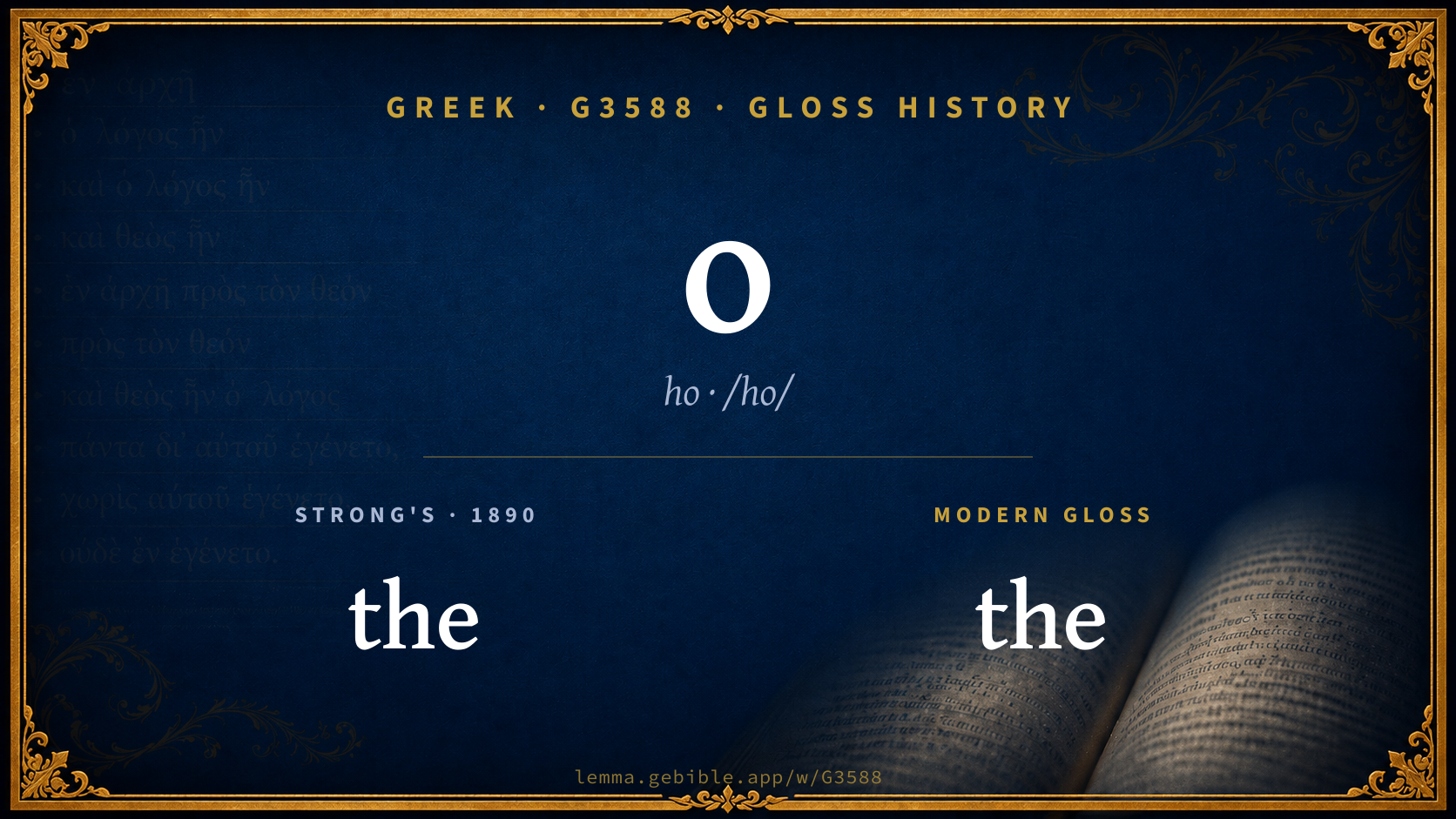
Gloss history
Strong's 1890 vs modern scholarship
About this word
Strong's G3588 catalogs a Greek word from the Greek New Testament.
These counts are not copied from any lexicon or concordance. They are computed here, from the morphology-tagged Greek New Testament. What Lemma adds →
- 6,958
- distinct verses
- The word appears in 6,958 distinct verses.
- 27 / 27
- NT books
- The word appears in 27 of 27 New Testament books.
- #1
- by frequency
- Most frequent Greek word — of 5,347 Greek words by occurrence.
View all 6,958 occurrences in the concordance →
By section of the New Testament
By traditional corpus
Conventional, traditional groupings — biblical authorship is debated, so this is a traditional corpus grouping, not an authorship claim. Some books belong to more than one corpus (Luke is in both the Gospels and the Lukan corpus, and so on), so these shares overlap and need not total 100%. Each figure is a share of the word’s 6,958 distinct verses.
- Gospels 3,366 verses · 48%
- Lukan (Luke–Acts) 1,951 verses · 28%
- Pauline corpus 1,635 verses · 23%
- Johannine 1,309 verses · 19%
- Revelation 386 verses · 6%
- General (Catholic) Epistles 371 verses · 5%
- Hebrews 263 verses · 4%
How translations render this word
Counts come from each version’s own published word-to-Strong’s tagging or interlinear alignment — an approximate guide to how each version renders this word, not a word-level alignment the data otherwise carries. Because each total is that version’s own tagged count, the per-version totals vary from one another and need not match the appearance or distinct-verse counts above. These counts may also differ from a printed concordance because Lemma counts each distinctly tagged rendering and does not collapse phrase taggings into a single head-word total. This is a fixed set of word-tagged versions (KJV, ASV, BSB, ULT) and does not change with the reading translation you choose elsewhere. Each version’s license is shown beside its name below (and on Sources).
- King James Version: Which 391×, Who 79×, Things 12×
- American Standard Version: That 206×, Who 79×, Which 73×
- Berean Standard Bible: The 7,625×, Who 563×, Of 346×
- unfoldingWord Literal Text: The 7,661×, God 966×, One 603×
King James Version Public Domain
Renders G3588 across 542 tagged occurrences — most commonly:
Plus other, less common renderings. Plus 22 renderings that appear only once — usually multi-word phrases or single function words the recovered tagging swept in, not distinct renderings. Not rendered by a distinct English word in 1 further occurrence.
American Standard Version Public Domain
Renders G3588 across 1,005 tagged occurrences — most commonly:
Plus other, less common renderings. Plus 68 renderings that appear only once — usually multi-word phrases or single function words the recovered tagging swept in, not distinct renderings. Not rendered by a distinct English word in 2 further occurrences.
Berean Standard Bible Public Domain
Renders G3588 across 9,912 tagged occurrences — most commonly:
Plus other, less common renderings. Plus 107 renderings that appear only once — usually multi-word phrases or single function words the recovered tagging swept in, not distinct renderings. Not rendered by a distinct English word in 9,622 further occurrences.
unfoldingWord Literal Text CC BY-SA 4.0
Renders G3588 across 20,796 tagged occurrences — most commonly:
Plus other, less common renderings. Plus 1,052 renderings that appear only once — usually multi-word phrases or single function words the recovered tagging swept in, not distinct renderings. Not rendered by a distinct English word in 3 further occurrences.
Senses in Thayer's
The 1 sense Thayer's distinguishes for this word, in lexicon order (not ranked by frequency or importance). The full entry — with sub-senses — is in the Lexicon Entry tab.
- this, that, these, etc.
Word origin
Origin: in all their inflections, the definite article
the masculine feminine (second) and neuter (third) forms in all their inflections; the definite article; the (sometimes to be supplied at others omitted in English idiom): - the this that one he she it etc.
— Strong’s Exhaustive Concordance (1890), public domain.
Forms in the corpus
The 42 distinct written forms G3588 takes in the Greek New Testament, most frequent first — each parse links to that case’s occurrences in the concordance.
Same root — word family
Other Thayer's entries built from the same root as G3588, grouped by Strong’s listed origin. These share a root / origin per the lexicon — not necessarily a shared meaning. Each links to that word’s own entry.
Derived from this word
- τανυν tanŷn G3569 present
- οδε hóde G3592 this
- οιος hoîos G3634 what sort of
- ος hós G3739 who
- ουτος hoûtos G3778 this
- σημερον sḗmeron G4594 this day
- ταυτα tautá G5024 thus
- τηλικουτος tēlikoûtos G5082 of such size
- τοι toí G5104 truly
- τοσουτος tosoûtos G5118 so great
- τοτε tóte G5119 then
- του toû G5120 his
- τουναντιον tounantíon G5121 on the contrary
- τουνομα toúnoma G5122 by name
Proper names from this root
People and places named from this root — a name, not an additional meaning of the word.
- θεος theós G2316 God
- ο ων και ο ην και ο ερχομενος ho ṑn kaí ho ēn kaí ho erchómenos G3801 He who is
Compare all same-root words → Showing 4 of 17 — not the complete family. 2 of the same-root words are proper names (people or places). They share a root, not necessarily a meaning.
Septuagint usage
The same Greek word ο appears 68,018 times in the Greek Old Testament (Septuagint), across 19,787 verses in 38 books.
- 68,018
- LXX occurrences
- Tagged occurrences of this Greek word in the Septuagint.
- 19,787
- verses
- Distinct Septuagint verses containing this word.
- 38 / 39
- OT books
- The word appears in 38 of the 39 Old Testament books.
Sample Septuagint occurrences
- Genesis 1:1 ὁ
- Exodus 1:1 ὁ
- Leviticus 1:1 ὁ
- Numbers 1:1 ὁ
- Deuteronomy 1:1 ὁ
- Joshua 1:1 ὁ
- Judges 1:1 ὁ
- Ruth 1:1 ὁ
- 1 Samuel 1:2 ὁ
- 2 Samuel 1:1 ὁ
- 1 Kings 1:1 ὁ
- 2 Kings 1:1 ὁ
Septuagint occurrences (same lexeme)
Every verse where the same Strong’s number (G3588) appears in the Greek Septuagint — showing the first 50 of 19,787. Verse text shown in the World English Bible for context; the Greek form is the matched word — the English is not keyword-highlighted.
- Genesis 1:1 ὁ In the beginning God created the heavens and the earth.
- Genesis 1:2 ὁ Now the earth was formless and empty. Darkness was on the surface of the deep. God's Spirit was hovering over the surface of the waters.
- Genesis 1:3 ὁ God said, "Let there be light," and there was light.
- Genesis 1:4 ὁ God saw the light, and saw that it was good. God divided the light from the darkness.
- Genesis 1:5 ὁ God called the light Day, and the darkness he called Night. There was evening and there was morning, one day.
- Genesis 1:6 ὁ God said, "Let there be an expanse in the midst of the waters, and let it divide the waters from the waters."
- Genesis 1:7 ὁ God made the expanse, and divided the waters which were under the expanse from the waters which were above the expanse, and it was so.
- Genesis 1:8 ὁ God called the expanse sky. There was evening and there was morning, a second day.
- Genesis 1:9 ὁ God said, "Let the waters under the sky be gathered together to one place, and let the dry land appear," and it was so.
- Genesis 1:10 ὁ God called the dry land Earth, and the gathering together of the waters he called Seas. God saw that it was good.
- Genesis 1:11 ὁ God said, "Let the earth put forth grass, herbs yielding seed, and fruit trees bearing fruit after their kind, with its seed in it, on the earth," and it was so.
- Genesis 1:12 ὁ The earth brought forth grass, herbs yielding seed after their kind, and trees bearing fruit, with its seed in it, after their kind: and God saw that it was good.
- Genesis 1:14 ὁ God said, "Let there be lights in the expanse of sky to divide the day from the night; and let them be for signs, and for seasons, and for days and years;
- Genesis 1:15 ὁ and let them be for lights in the expanse of sky to give light on the earth," and it was so.
- Genesis 1:16 ὁ God made the two great lights: the greater light to rule the day, and the lesser light to rule the night. He also made the stars.
- Genesis 1:17 ὁ God set them in the expanse of sky to give light to the earth,
- Genesis 1:18 ὁ and to rule over the day and over the night, and to divide the light from the darkness. God saw that it was good.
- Genesis 1:20 ὁ God said, "Let the waters swarm with swarms of living creatures, and let birds fly above the earth in the open expanse of sky."
- Genesis 1:21 ὁ God created the large sea creatures, and every living creature that moves, with which the waters swarmed, after their kind, and every winged bird after its kind. God saw that it was good.
- Genesis 1:22 ὁ God blessed them, saying, "Be fruitful, and multiply, and fill the waters in the seas, and let birds multiply on the earth."
- Genesis 1:24 ὁ God said, "Let the earth bring forth living creatures after their kind, cattle, creeping things, and animals of the earth after their kind," and it was so.
- Genesis 1:25 ὁ God made the animals of the earth after their kind, and the cattle after their kind, and everything that creeps on the ground after its kind. God saw that it was good.
- Genesis 1:26 ὁ God said, "Let us make man in our image, after our likeness: and let them have dominion over the fish of the sea, and over the birds of the sky, and over the cattle, and over all the earth, and over every creeping thing that creeps on the earth."
- Genesis 1:27 ὁ God created man in his own image. In God's image he created him; male and female he created them.
- Genesis 1:28 ὁ God blessed them. God said to them, "Be fruitful, multiply, fill the earth, and subdue it. Have dominion over the fish of the sea, over the birds of the sky, and over every living thing that moves on the earth."
- Genesis 1:29 ὁ God said, "Behold, I have given you every herb yielding seed, which is on the surface of all the earth, and every tree, which bears fruit yielding seed. It will be your food.
- Genesis 1:30 ὁ To every animal of the earth, and to every bird of the sky, and to everything that creeps on the earth, in which there is life, I have given every green herb for food." And it was so.
- Genesis 1:31 ὁ God saw everything that he had made, and, behold, it was very good. There was evening and there was morning, the sixth day.
- Genesis 2:1 ὁ The heavens and the earth were finished, and all the host of them.
- Genesis 2:2 ὁ On the seventh day God finished his work which he had made; and he rested on the seventh day from all his work which he had made.
- Genesis 2:3 ὁ God blessed the seventh day, and made it holy, because he rested in it from all his work which he had created and made.
- Genesis 2:4 ὁ This is the history of the generations of the heavens and of the earth when they were created, in the day that Yahweh God made earth and the heavens.
- Genesis 2:5 ὁ No plant of the field was yet in the earth, and no herb of the field had yet sprung up; for Yahweh God had not caused it to rain on the earth. There was not a man to till the ground,
- Genesis 2:6 ὁ but a mist went up from the earth, and watered the whole surface of the ground.
- Genesis 2:7 ὁ Yahweh God formed man from the dust of the ground, and breathed into his nostrils the breath of life; and man became a living soul.
- Genesis 2:8 ὁ Yahweh God planted a garden eastward, in Eden, and there he put the man whom he had formed.
- Genesis 2:9 ὁ Out of the ground Yahweh God made every tree to grow that is pleasant to the sight, and good for food; the tree of life also in the midst of the garden, and the tree of the knowledge of good and evil.
- Genesis 2:10 ὁ A river went out of Eden to water the garden; and from there it was parted, and became four heads.
- Genesis 2:11 ὁ The name of the first is Pishon: this is the one which flows through the whole land of Havilah, where there is gold;
- Genesis 2:12 ὁ and the gold of that land is good. There is aromatic resin and the onyx stone.
- Genesis 2:13 ὁ The name of the second river is Gihon: the same river that flows through the whole land of Cush.
- Genesis 2:14 ὁ The name of the third river is Hiddekel: this is the one which flows in front of Assyria. The fourth river is the Euphrates.
- Genesis 2:15 ὁ Yahweh God took the man, and put him into the garden of Eden to dress it and to keep it.
- Genesis 2:16 ὁ Yahweh God commanded the man, saying, "Of every tree of the garden you may freely eat:
- Genesis 2:17 ὁ but of the tree of the knowledge of good and evil, you shall not eat of it: for in the day that you eat of it you will surely die."
- Genesis 2:18 ὁ Yahweh God said, "It is not good that the man should be alone; I will make him a helper suitable for him."
- Genesis 2:19 ὁ Out of the ground Yahweh God formed every animal of the field, and every bird of the sky, and brought them to the man to see what he would call them. Whatever the man called every living creature, that was its name.
- Genesis 2:20 ὁ The man gave names to all cattle, and to the birds of the sky, and to every animal of the field; but for man there was not found a helper suitable for him.
- Genesis 2:21 ὁ Yahweh God caused a deep sleep to fall on the man, and he slept; and he took one of his ribs, and closed up the flesh in its place.
- Genesis 2:22 ὁ He made the rib, which Yahweh God had taken from the man, into a woman, and brought her to the man.
These are occurrences of the same Greek lexeme (G3588) in the Septuagint — not a translation of any one Hebrew word. The store carries no word-level Hebrew↔Greek alignment, so no Hebrew original is asserted here. Counts come from the recovered LXX Strong's tagging — high-frequency vocabulary is well covered, while rare or late forms may be untagged — so they reflect tagged occurrences and may slightly undercount.