
2 Corinthians 10:7

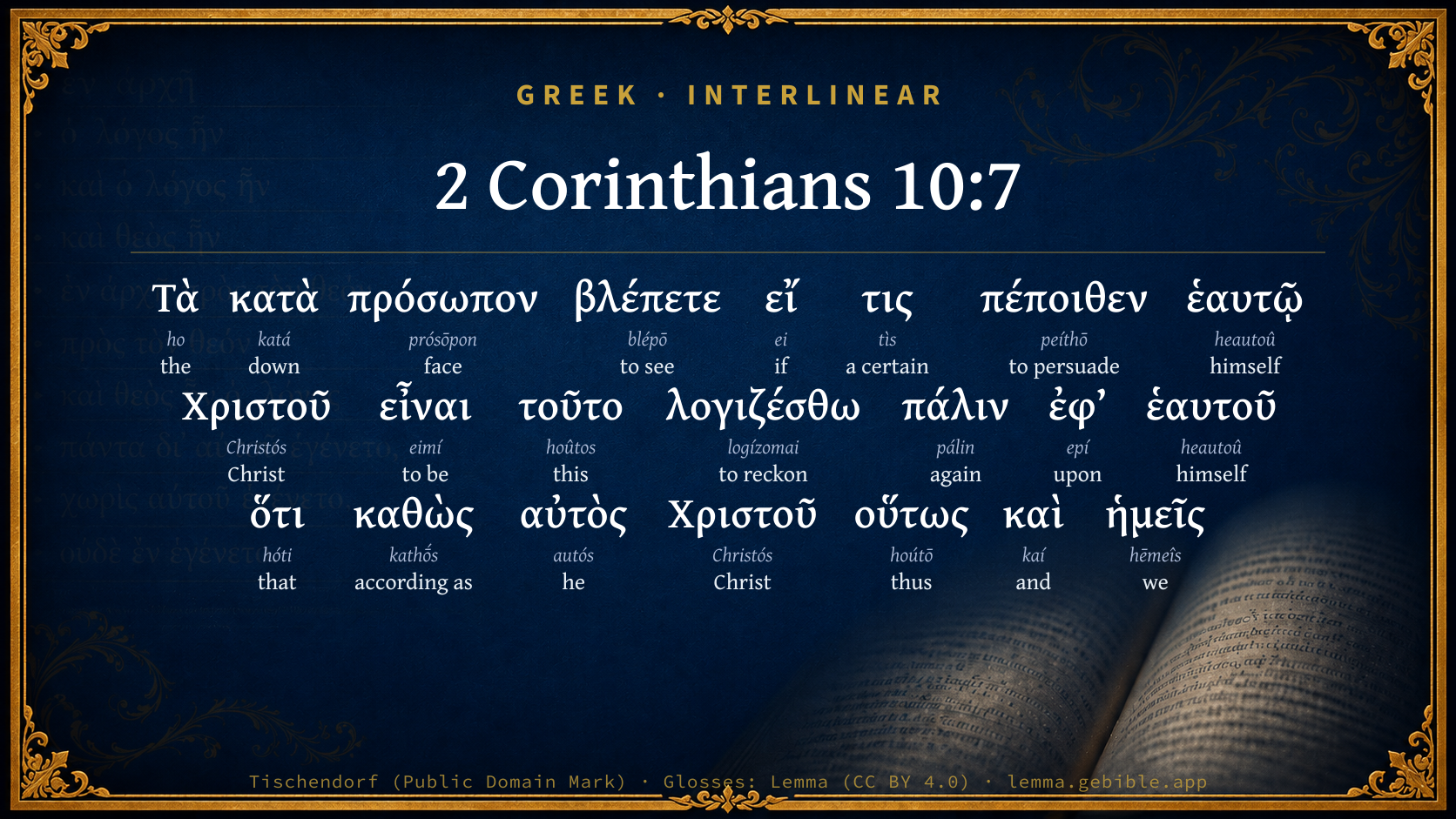
Greek (Tischendorf 8th ed.) 2 Corinthians 10:7 appears in the Greek New Testament. The text above is from the Tischendorf 8th edition. Each word links to its Strong’s number and a concise gloss. Click any word for its full Thayer’s Greek Lexicon entry.
Download image
Cite this verse

2 Corinthians 10:7 (World English Bible). Public Domain. Lemma interlinear Bible study tool, https://lemma.gebible.app/v/2-corinthians/10/7.

Show BibTeX & RIS
BibTeX
RIS
English Translation
Do you look at things only as they appear in front of your face? If anyone trusts in himself that he is Christ's, let him consider this again with himself, that, even as he is Christ's, so also we are Christ's.
World English Bible · Public Domain
Download a study sheet

One document with this verse’s original text, its word-by-word gloss line, the meaning frame, cross-references with their text, attributed commentary, and full source and license credits — printable, and it pastes into notes with its structure intact.

This verse Autodidact and up

Study sheet (.html) Plain text (.txt)

A passage Seminary Student

Up to 50 verses in one chapter. A passage sheet keeps up to 6 commentary sources and 12 cross-references per verse, in the order this page ranks them, and says so on the sheet whenever that leaves anything out. Ask for a single verse and you get the Autodidact verse sheet above.

Everything on this page stays free to read, with no account — the sheet is a download of what is already on screen, not access to it.

Want to remove ads? Support Godless Engineer
Compare translations 3

The same verse in 3 English versions, stacked beneath the original-language interlinear above. Click any original word for its lexicon entry.

Each is an independent rendering of the whole verse — the interlinear is not word-aligned to these translations.

Highlighted words mark where these versions differ — a whole-verse word diff, not a word-by-word alignment.

  • World English Bible Public Domain
    Do you look at things only as they appear in front of your face? If anyone trusts in himself that he is Christ's, let him consider this again with himself, that, even as he is Christ's, so also we are Christ's.
  • King James Version Public Domain
    Do ye look on things after the outward appearance? If any man trust to himself that he is Christ's, let him of himself think this again, that, as he is Christ's, even so are we Christ's.
  • unfoldingWord Literal Text CC BY-SA 4.0
    Look at the things according to appearance. If anyone is confident in himself that he is of Christ, let him consider this again concerning himself: that just as he of Christ, so also we.

unfoldingWord Literal Text — © unfoldingWord, licensed CC BY-SA 4.0. Word-aligned USFM3 via Door43 (git.door43.org/unfoldingWord/en_ult).

Versions to compare (up to 4)

3 of 4 selected

Show all 19 translations

Every available English version of this verse, each an independent rendering of the whole verse.

  • World English Bible Public Domain
    Do you look at things only as they appear in front of your face? If anyone trusts in himself that he is Christ's, let him consider this again with himself, that, even as he is Christ's, so also we are Christ's.
  • Berean Standard Bible Public Domain
    You are looking at outward appearances. If anyone is confident that he belongs to Christ, he should remind himself that we belong to Christ just as much as he does.
  • Majority Standard Bible Public Domain
    You are looking at outward appearances. If anyone is confident that he belongs to Christ, he should remind himself that we belong to Christ just as much as he belongs to Christ.
  • King James Version Public Domain
    Do ye look on things after the outward appearance? If any man trust to himself that he is Christ's, let him of himself think this again, that, as he is Christ's, even so are we Christ's.
  • American Standard Version (1901) Public Domain
    Ye look at the things that are before your face. If any man trusteth in himself that he is Christ's, let him consider this again with himself, that, even as he is Christ's, so also are we.
  • Revised Version (1885) Public Domain
    Ye look at the things that are before your face. If any man trusteth in himself that he is Christ’s, let him consider this again with himself, that, even as he is Christ’s, so also are we.
  • Geneva Bible (1599) Public Domain
    Looke yee on things after the appearance? If any man trust in himselfe that hee is Christes, let him consider this againe of himself, that as he is Christes, euen so are we Christes.
  • Douay-Rheims (1899) Public Domain
    See the things that are according to outward appearance. If any man trust to himself, that he is Christ's, let him think this again with himself, that as he is Christ's, so are we also.
  • Young's Literal Translation Public Domain
    The things in presence do ye see? if any one hath trusted in himself to be Christ's, this let him reckon again from himself, that according as he is Christ's, so also we `are' Christ's;
  • Literal Standard Version CC BY-SA 4.0
    You see the outward appearance. If anyone has trusted in himself to be Christ’s, let him reckon this again from himself, that according as he is Christ’s, so also we [are] Christ’s;
  • Unlocked Literal Bible CC BY-SA 4.0
    Look at what is clearly in front of you. If anyone is convinced that he is Christ's, let him remind himself that just as he is Christ's, so also are we.
  • unfoldingWord Literal Text CC BY-SA 4.0
    Look at the things according to appearance. If anyone is confident in himself that he is of Christ, let him consider this again concerning himself: that just as he of Christ, so also we.
  • Darby Bible Public Domain
    Do ye look at what concerns appearance? If any one has confidence in himself that he is of Christ, let him think this again in himself, that even as he [is] of Christ, so also [are] we.
  • World Messianic Bible Public Domain
    Do you look at things only as they appear in front of your face? If anyone trusts in himself that he is Messiah’s, let him consider this again with himself, that even as he is Messiah’s, so we also are Messiah’s.
  • Webster's Bible Public Domain
    Do ye look on things after the outward appearance? If any man trusteth to himself that he is Christ's, let him of himself think this again, that, as he is Christ's, even so are we Christ's.
  • Free Bible Version CC BY-SA 4.0
    Look at what's staring you in the face! Anyone who considers that they belong to Christ should think again—just as they belong to Christ, so do we!
  • Bible in Basic English Public Domain
    Give attention to the things which are before you. If any man seems to himself to be Christ's, let him keep in mind that we are as much Christ's as he is.
  • Text-Critical English NT CC BY 4.0
    Are you looking only at outward appearances? If anyone is confident that he belongs to Christ, he should remind himself that just as he belongs to Christ, so we also belong to Christ.
  • Tyndale New Testament (1534) Public Domain
    Loke ye on thynges after the vtter apparence? Yf eny man trust in him silfe that he is Christis let the same also considre of him silfe that as he is Christis even so are we Christes.

Literal Standard Version (2020), Covenant Press — licensed CC BY-SA 4.0. Text via the HelloAO Bible API (eBible.org). Unlocked Literal Bible (unfoldingWord) — licensed CC BY-SA 4.0. Text via the HelloAO Bible API (eBible.org). unfoldingWord Literal Text — © unfoldingWord, licensed CC BY-SA 4.0. Word-aligned USFM3 via Door43 (git.door43.org/unfoldingWord/en_ult). Free Bible Version, Dr. Jonathan Gallagher — licensed CC BY-SA 4.0. Text via the HelloAO Bible API (eBible.org).

Word by word

More ways to search: Search by grammar → Find every occurrence → Compare this word →

Practice this passage: Drill this verse → Learn its vocabulary →

λογιζέσθω
logízomai
G3049
“to reckon”
Verb, Present, Middle or Passive deponent, Imperative, 3rd person, Singular
Part of Speech
Verb
Tense
Present
Voice
Middle or Passive deponent
Mood
Imperative
Person
3rd person
Number
Singular
Full Thayer's Definition

Origin: middle voice from G3056

TDNT: 08:44,5

1. to reckon, count, compute, calculate, count over a. to take into account, to make an account of 1. metaph. to pass to one's account, to impute 2. a thing is reckoned as or to be something, i.e. as availing for or equivalent to something, as having the like force and weight b. to number among, reckon with c. to reckon or account 2. to reckon inward, count up or weigh the reasons, to deliberate 3. by reckoning up all the reasons, to gather or infer a. to consider, take into account, weigh, meditate on b. to suppose, deem, judge c. to determine, purpose, decide This word deals with reality. If I "logizomai" or reckon that my bank book has $25 in it, it has $25 in it. Otherwise I am deceiving myself. This word refers to facts not suppositions.
  1. Τὰ ho G3588 “the” Article, Accusative, Plural, Neuter
  2. κατὰ katá G2596 “down” Preposition
  3. πρόσωπον prósōpon G4383 “face” Noun, Accusative, Singular, Neuter
  4. βλέπετε blépō G991 “to see” Verb, Present, Active, Indicative, 2nd person, Plural
  5. εἴ ei G1487 “if” Conditional
  6. τις tìs G5100 “a certain” Indefinite pronoun, Nominative, Singular, Masculine
  7. πέποιθεν peíthō G3982 “to persuade” Verb, Perfect, Active, Indicative, 3rd person, Singular
  8. ἑαυτῷ heautoû G1438 “himself” Reflexive pronoun, 3rd person, Dative, Singular, Masculine
  9. Χριστοῦ Christós G5547 “Christ” Noun, Genitive, Singular, Masculine
  10. εἶναι eimí G1510 “to be” Verb, Present, Active, Infinitive
  11. τοῦτο hoûtos G3778 “this” Demonstrative pronoun, Accusative, Singular, Neuter
  12. πάλιν pálin G3825 “again” Adverb
  13. ἐφ’ epí G1909 “upon” Preposition
  14. ἑαυτοῦ heautoû G1438 “himself” Reflexive pronoun, 3rd person, Genitive, Singular, Masculine
  15. ὅτι hóti G3754 “that” Conjunction
  16. καθὼς kathṓs G2531 “according as” Adverb
  17. αὐτὸς autós G846 “he” Personal pronoun, Nominative, Singular, Masculine
  18. Χριστοῦ Christós G5547 “Christ” Noun, Genitive, Singular, Masculine
  19. οὕτως hoútō G3779 “thus” Adverb
  20. καὶ kaí G2532 “and” Conjunction
  21. ἡμεῖς hēmeîs G2249 “we” Personal pronoun, 1st person, Nominative, Plural

About this verse

These counts appear in no published source. They are computed here, from the morphology-tagged text and Lemma’s own curated glosses. What Lemma adds →

22
words
20
distinct lemmas
Pauline Epistles
section

Shared distinctive vocabulary

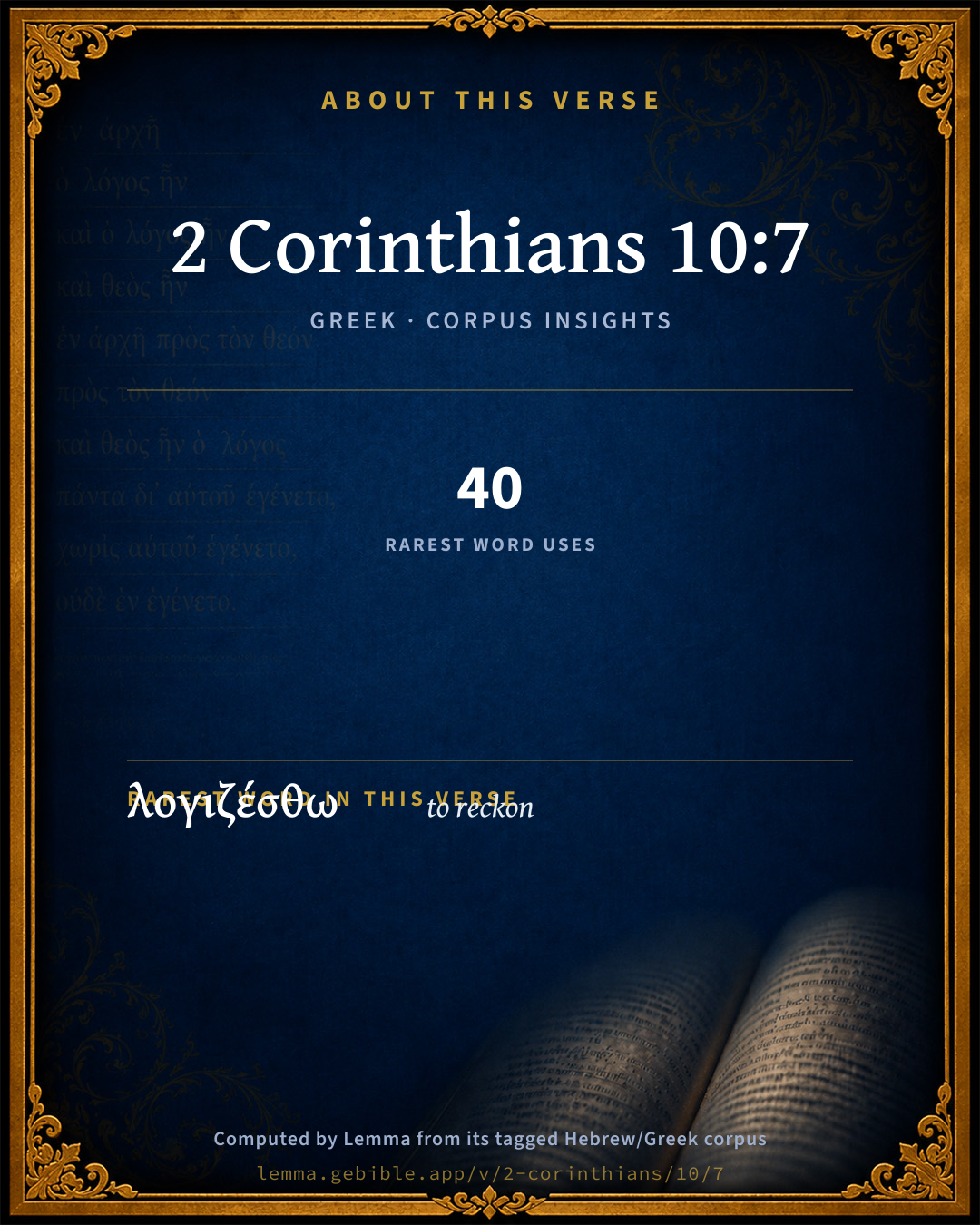
λογιζέσθω to reckon G3049 occurs in 39 verses of the Greek New Testament. Also found in:
Repetition

Words recur within this verse:

  • ἑαυτῷ himself G1438 ×2
  • Χριστοῦ Christ G5547 ×2

Cross-references

21

Topical passages linked to 2 Corinthians 10:7 in the Treasury of Scripture Knowledge — connected by theme and wording, ordered by reader-vote popularity; previews shown in the World English Bible.

  • John 7:24 Don't judge according to appearance, but judge righteous judgment."
  • 1 Corinthians 14:37 If any man thinks himself to be a prophet, or spiritual, let him recognize the things which I write to you, that they are the commandment of the Lord.
  • 2 Corinthians 5:12 For we are not commending ourselves to you again, but speak as giving you occasion of boasting on our behalf, that you may have something to answer those who boast in appearance, and not in heart.
  • 2 Corinthians 11:23 Are they servants of Christ? (I speak as one beside himself) I am more so; in labors more abundantly, in prisons more abundantly, in stripes above measure, in deaths often.
  • 1 Corinthians 3:23 and you are Christ's, and Christ is God's.
  • 1 Corinthians 9:1 Am I not free? Am I not an apostle? Haven't I seen Jesus Christ, our Lord? Aren't you my work in the Lord?
  • 1 John 4:6 We are of God. He who knows God listens to us. He who is not of God doesn't listen to us. By this we know the spirit of truth, and the spirit of error.
  • 1 Samuel 16:7 But Yahweh said to Samuel, "Don't look on his face, or on the height of his stature; because I have rejected him: for [Yahweh sees] not as man sees; for man looks at the outward appearance, but Yahweh looks at the heart."
  • 1 Corinthians 1:12 Now I mean this, that each one of you says, "I follow Paul," "I follow Apollos," "I follow Cephas," and, "I follow Christ."
  • 2 Corinthians 10:1 Now I Paul, myself, entreat you by the humility and gentleness of Christ; I who in your presence am lowly among you, but being absent am of good courage toward you.
  • Galatians 3:29 If you are Christ's, then you are Abraham's seed and heirs according to promise.
  • Matthew 23:5 But all their works they do to be seen by men. They make their phylacteries broad, enlarge the fringes of their garments,
  • Luke 16:15 He said to them, "You are those who justify yourselves in the sight of men, but God knows your hearts. For that which is exalted among men is an abomination in the sight of God.
  • Romans 2:28–29 For he is not a Jew who is one outwardly, neither is that circumcision which is outward in the flesh;
  • 1 Corinthians 15:23 But each in his own order: Christ the first fruits, then those who are Christ's, at his coming.
  • 2 Corinthians 11:4 For if he who comes preaches another Jesus, whom we did not preach, or if you receive a different spirit, which you did not receive, or a different gospel, which you did not accept, you put up with that well enough.
  • 2 Corinthians 11:18 Seeing that many boast after the flesh, I will also boast.
  • 2 Corinthians 12:11 I have become foolish in boasting. You compelled me, for I ought to have been commended by you, for in nothing was I inferior to the very best apostles, though I am nothing.
  • 2 Corinthians 13:3 seeing that you seek a proof of Christ who speaks in me; who toward you is not weak, but is powerful in you.
  • Galatians 1:11–13 But I make known to you, brothers, concerning the Gospel which was preached by me, that it is not according to man.
  • Galatians 2:5–9 to whom we gave no place in the way of subjection, not for an hour, that the truth of the Gospel might continue with you.

Cross-references courtesy of OpenBible.info (CC BY 4.0).

Commentary

Notes on 2 Corinthians 10:7 from classic Christian and Jewish commentators (each source and its license shown beneath its notes). The classic Christian expositions comment on the surrounding passage and are grouped to its opening verse, so a note may address several verses; the Jewish commentaries on the Tanakh (Rashi and others) are per-verse, so they appear only where the commentator wrote on this verse.

Lemma curates 59 commentaries, every one of them public domain or Creative Commons licensed, each selected and text-cleaned for this edition rather than reprinted as found. About our sources →

Matthew Henry's Commentary

In these verses the apostle proceeds to reason the case with the Corinthians, in opposition to those who despised him, judged him, and spoke hardly of him: "Do you," says he, "look on things after the outward appearance? Co2 10:7. Is this a fit measure or rule to make an estimate of things or persons by, and to judge between me and my adversaries?" In outward appearance, Paul was mean and despicable with some; he did not make a figure, as perhaps some of his competitors might do: but this was a false rule to make a judgment by. It should seem that some boasted mighty things of themselves, and made a fair show. But there are often false appearances. A man may seem to be learned who has not learned Christ, and appear virtuous when he has not a principle of grace in his heart. However, the apostle asserts two things of himself: -

I. His relation to Christ: If any man trust to himself that he is Christ's, even so are we Christ's, Co2 10:7. It would seem by this that Paul's adversaries boasted of their relation to Christ as his ministers and servants. Now the apostle reasons thus with the Corinthians: "Suppose it to be so, allowing what they say to be true (and let us observe that, in fair arguing, we should allow all that may be reasonably granted, and should not think it impossible but those who differ from us very much may yet belong to Christ, as well as we), allowing them," might the apostle say, "what they boast of, yet they ought also to allow this to us, that we also are Christ's." Note, 1. We must not, by the most charitable allowances we make to others who differ from us, cut ourselves off from Christ, nor deny our relation to him. For, 2. There is room in Christ for many; and those who differ much from one another may yet be one in him. It would help to heal the differences that are among us if we would remember that, how confident soever we may be that we belong to Christ, yet, at the same time, we must allow that those who differ from us may belong to Christ too, and therefore should be treated accordingly. We must not think that we are the people, and that none belong to Christ but ourselves. This we may plead for ourselves, against those who judge us and despise us that, how weak soever we are, yet, as they are Christ's, so are we: we profess the same faith, we walk by the same rule, we build upon the same foundation, and hope for the same inheritance.

II. His authority from Christ as an apostle. This he had mentioned before (Co2 10:6), and now he tells them that he might speak of it again, and that with some sort of boasting, seeing it was a truth, that the Lord had given it to him, and it was more than his adversaries could justly pretend to. It was certainly what he should not be ashamed of, Co2 10:8. Concerning this observe, 1. The nature of his authority: it was for edification, and not for destruction. This indeed is the end of all authority, civil and ecclesiastical, and was the end of that extraordinary authority which the apostles had, and of all church-discipline. 2. The caution with which he speaks of his authority, professing that his design was not to terrify them with big words, nor by angry letters, Co2 10:9. Thus he seems to obviate an objection that might have been formed against him, Co2 10:10. But the apostle declares he did not intend to frighten those who were obedient, nor did he write any thing in his letters that he was not able to make good by deeds against the disobedient; and he would have his adversaries know this (Co2 10:11), that he would, by the exercise of his apostolical power committed to him, make it appear to have a real efficacy.

Matthew Henry's Commentary on the Whole Bible (1708–1710) — public domain (CC PDM 1.0). Text via the HelloAO Bible API.

Joseph Benson's Commentary

2Co 10:7. Do ye look on the outward appearance of things — Judging of me by my outward person, and the infirmities of my body, (2Co 10:1-2,) and not from the power of Christ resting on me, and working by me? 2Co 12:9. If any man trust — Πεποιθεν εαυτω, be confident, in himself; that he is Christ’s minister — And claims authority on that account; let him think this again — Let him consider seriously; that as he is Christ’s, even so are we Christ’s — Nor can any one produce more convincing proofs of Christ’s calling him to the ministry, and approving his discharge of it, than myself. By speaking thus, the apostle did not intend to acknowledge the false teacher referred to to be a true and faithful minister of Christ. That teacher had taken on himself the work of the ministry, and was by profession a servant of Christ. This Paul acknowledged, without entering into the consideration of his integrity or faithfulness. “At the same time, as he pretended to great powers of reasoning, the apostle desired him to reason this from himself: That if he was a minister of Christ merely by professing to be one, the apostle, who, besides laying claim to that character, had exercised miraculous powers among the Corinthians, was thereby shown to be more truly a minister of Christ than he was, who did not possess that proof.” — Macknight. See 2Co 11:23.

Joseph Benson's Commentary on the Old and New Testaments (1811–1818) — public domain. Text from a community e-Sword module.

The Expositor's Bible

Chapter 23

COMPARISONS.- 2Co_10:7-18 (R.V)

THIS passage abounds with grammatical and textual difficulties, but the general import and the purpose of it are plain. The self-assertion of αυτος εγω Παυλος (2Co_10:1) receives its first interpretation and expansion here: we see what it is that Paul claims, and we begin to see the nature of the opposition against which his claim has to be made good. Leaving questions of grammatical construction aside, vv. 7 and 8 {2Co_10:7-8} define the situation; and it is convenient to take them as if they stood alone.

There was a person in Corinth-more than one indeed, but one in particular, as the τις in 2Co_10:7 and the singular φησιν in 2Co_10:10 suggest-who claimed to be Christs, or of Christ, in a sense which disparaged and was meant to disparage Paul. If we use the plural, to include them all, we must not suppose that they are identical with the party in the Church who are censured in the First Epistle for saying, "I am of Christ," just as others said, "I am of Paul," "I am of Apollos," "I am of Cephas." That party may have been dependent upon them, but the individuals here referred to are taxed with an exclusiveness and arrogance, and in the close of the chapter with a wanton trespassing on Pauls province, which show that they were not native to the Church, but intruders into it. They were confident that they were Christs in a sense which discredited Pauls apostleship, and entitled them, so to speak, to legitimate a Church which his labors had called into being. Everything compels us to recognize in them Jewish Christians, who had been connected with Christ in a way in which Paul had not; who had known Him in the flesh, or had brought recommendatory letters from the Mother Church at Jerusalem; and who on the Strength of these accidents, gave themselves airs of superiority in Pauline Churches, and corrupted the simplicity of the Pauline Gospel.

The first words in 2Co_10:7 -τα κατα προσωπον βλεπετε-are no doubt directed to this situation but they have been very variously rendered. Our Authorized Version has, "Do ye look on things after the outward appearance?" That is, "Are you really imposed upon by the pretensions of these men, by their national and carnal distinctions, as if these had anything to do with the Gospel?" This is a good Pauline idea, but it is doubtful whether τα κατα προσωπον can yield it. The natural sense of these words is, "What is before your face." The Revised Version accordingly renders, "Ye look at the things that are before your face": meaning, apparently, "You allow yourselves to be carried away by whatever is nearest to you-at present, by these interloping Jews, and the claims they flaunt before your eyes." It seems to me more natural, with many good scholars, to take βλεπετε, in spite its unemphatic position, as imperative: "Look at the things which are before your faces! The most obvious and palpable facts discredit these Judaists and accredit me. A claim to be Christs is not to be made out a priori by any carnal prerogatives, or any human recommendations; it is only made out by this-that Christ Himself attests it by giving him who makes it success as an evangelist. Look at what confronts you! There is not a single Christian thing you see which is not Christs own testimony that I am His; unless you are senseless and blind, my position and authority as an apostle can never be impugned among you." The argument is thus the same as that which he uses in 2Co_3:1-3, and in the First Epistle, 2Co_9:2.

At first Paul asserts only a bare equivalence to his Jewish opponent: "Let him consider this with himself, that, even as he is Christs, so also are we." The historical, outward connection with Christ, whatever it may have been, amounted in this relation to exactly nothing at all. Not what Christ was, but what He is, is the life and reality of the Christian religion. Not an accidental acquaintance with Him as He lived in Galilee or Jerusalem, but a spiritual fellowship with Him as He reigns in the heavenly places, makes a Christian. Not a letter written by human hands-though they should be the hands of Peter or James or John-legitimates a man in the apostolic career; but only the sovereign voice which says, "He is a chosen vessel unto Me, to bear My Name." Neither as Christian nor as apostle can one establish a monopoly by making his appeal to "the flesh." The application of this Christian truth has constantly to be made anew, for human nature loves a monopoly; it does not seem really to have a thing, unless its possession of it is exclusive. We are all too ready to unchurch, or unchristianise, others; to say, "We are Christs," with an emphasis which means that others are not. Churches with a strong organization are especially tempted to this unchristian narrowness and pride. Their members think almost instinctively of other Christians as outsiders and inferiors; they would like to take them in, to reordain their ministers, to reform their constitution, to give validity to their sacraments-in one word, to legitimate them as Christians and as Christian societies. All this is mere unintelligence and arrogance. Legitimacy is a convenient and respectable political fiction; but to make the constitution of any Christian body, which has developed under the pressure of historical exigencies, the law for the legitimation of Christian life, ministry, and worship everywhere, is to deny the essential character of the Christian religion. It is to play toward men whom Christ has legitimated by His Spirit, and by His blessing on their work, precisely the part which the Judaisers played toward Paul; and to compromise with it is to betray Christ, and to renounce the freedom of the Spirit.

But the Apostle does not stop short with claiming a bare equality with his rivals. "For though I should boast somewhat more abundantly concerning our authority I shall not be put to shame"-i.e., "The facts I have invited you to look at will bear me out." The key to this passage is to be found in 1Co_15:15, where he boasts that, though the least of the apostles, and not worthy to be called an apostle, he had, through the grace of God given to him, labored more abundantly than all the rest. If it came to comparison, then, of the attestation which Christ gave to their several labors, and so to their authority, by success in evangelizing, it would not be Paul who would have to hide his head. But he does not choose to boast any more of his authority at this point. He has no desire to clothe himself in terrors; on the contrary, he wishes to avoid the very appearance of scaring them out of their wits by his letters. {for ἐκφοβεῖν compare Mar_9:6; Heb_12:21} His authority has been given him, not for the pulling down, but for the building up, of the Church; it is not lordly, {2Co_1:24} but ministerial; and he would wish, not only to show it in kindly service, but also in a kindly aspect. "Not for casting down," in 2Co_10:8, is no contradiction of "mighty for casting down" in 2Co_10:4 : the object in the two cases is quite different. Many things in man must be cast down-many high thoughts, much pride, much willfulness, much presumption and self-sufficiency-but the casting down of these is the building up of souls.

At this point comes what is logically a parenthesis, and we hear in it the criticisms passed at Corinth on Paul, and his own reply to them. "His letters," they say (or, he says), "are weighty and strong; but his bodily presence weak, and his speech of no account." The last part of this criticism has been much misunderstood; it is really of moral import, but has been read in a physical sense. It does not say anything at all about the Apostles physique, or about his eloquence or want of eloquence; it tells us that (according to these critics), when he was actually present at Corinth, he was somehow or other ineffective; and when he spoke there, people simply disregarded him. An uncertain tradition no doubt represents Paul as an infirm and meager person, and it is easy to believe that to Greeks he must sometimes have seemed embarrassed and incoherent in speech to the last degree (what, for instance, could have seemed more formless to a Greek than vv. 12-18 of this chapter?) {2Co_10:12-18}: nevertheless, it is nothing like this which is in view here. The criticism is not of his physique, nor of his style, but of his personality-what is described is not his appearance nor his eloquence, but the effect which the man produced when he went to Corinth and spoke. It was nothing. As a man, bodily present, he could get nothing done: he talked, and nobody listened. It is implied that this criticism is false; and Paul bids any one who makes it consider that what he is in word by letters when he is absent, that he will also be in deed when he is present. The double role of potent pamphleteer and ineffective pastor is not for him.

The kind of criticism which was here passed on St. Paul is one to which every preacher is obnoxious. An epistle is, so to speak, the mans words without the man; and such is human weakness, that they are often stronger than the man speaking in bodily presence, that is, than the man and his words together. The character of the speaker, as it were, discounts all he says; and when he is there, and delivers his message in person, the message itself suffers an immense depreciation. This ought not so to be, and with a man who cultivates sincerity will not so be. He will be, himself, as good as his words; his effectiveness will be the same whether he writes or speaks. Nothing ultimately counts in the work of a Christian minister but what he can say and do and get done when in direct contact with living men. In many cases the modern sermon really answers to the epistle as it is referred to in this sarcastic comment; in the pulpit, people say, the minister is impressive and memorable; but in the ordinary intercourse of life, and even in the pastoral relation, where he has to meet people on an equal footing, his power quite disappears. He is an ineffective person, and his words have no weight. Where this is true, there is something very far wrong; and though it was not true in the case of Paul, there are cases in which it is. To bring the pastoral up to the level of the pulpit work-the care of individual souls and characters to the intensity and earnestness of study and preaching-would be the saving of many a minister and many a congregation.

But to return to the text. The Apostle is disinclined to pursue this line further: in defending himself against these obscure detractors, he can hardly avoid the appearance of self-commendation, which of all things he abhors. An acute observer has remarked that when war lasts long the opposing combatants borrow each others weapons and tactics: and it was this uninviting weapon that the policy of his opponents laid to the Apostles hand. With ironical recognition of their hardihood, he declines it: "We are not bold-have not the courage-to number ourselves among, or compare ourselves with, certain of them that commend themselves" - i.e., the Judaists who had introduced themselves to the Church. "Far be it from me," says the Apostle grimly, "to claim a place among, or near, such a distinguished company." But he is too much in earnest to prolong the ironical strain, and in the verses which follow, from 12 to 16 {2Co_10:12-16}, he states in good set terms the differences between himself and them.

(1) They measure themselves by themselves, and compare themselves among themselves, and in so doing are without understanding. They constitute a religious coterie, a sort of clique or ring in the Church, ignoring all but themselves, making themselves the only standard of what is Christian, and betraying, by that very proceeding, their want of sense. There is a fine liberality about this sharp saying, and it is as necessary now as in the first century. Men coalesce, within the limits of the Christian community, from affinities of various kinds-sympathy for a type or an aspect of doctrine, or liking for a form of polity; and as it is easy, so is it common, for those who have drifted like to like, to set up their own associations and preferences as the only law and model for all. They take the air of superior persons, and the penalty of the superior person is to be unintelligent. They are without understanding. The standard of the coterie - be it "evangelical," "high church," "broad church." or what you please-is not the standard of God: and to measure all things by it is not only sinful, but stupid. In contrast to this Judaistic clique, who saw no Christianity except under their own colors, Pauls standard is to be found in the actual working of God through the Gospel. He would have said with Ignatius, only with a deeper insight into every word, "Where Jesus Christ is, there is the Catholic Church."

(2) Another point of difference is this: Paul works independently as an evangelist; it has always been his rule to break new ground. God has assigned him a province to labor in, large enough to gratify the highest ambition: he is not going beyond it, nor exaggerating his authority, when he asserts his apostolic dignity in Corinth: the Corinthians know as well as he that he came all the way to them, and was the first to come, ministering the Gospel of Christ. Nay, it is only the weakness of their faith that keeps him from going farther: and he has hope that as their faith grows it will set him free to carry the Gospel beyond them to Italy and Spain; this would be the crown of his greatness as an evangelist, and it depends on them (ἐν ὑμῖν μεγαλυνθῆναι) whether he is to win it; in any case, the winning of it would be in harmony with his vocation, the carrying of it out in glorious fullness (κατὰ τὸν κανόνα εἰς περισσείαν); for, like John Wesley, he could say the whole world was his parish. If he boasts at all, it is not immeasurably; it is on the basis of the gift and calling of God, within the limits of what God has wrought by him and by no other; he never intrudes into anothers province and boasts of what he finds done to his hand. But this was what the Jews did. They did not propagate the Gospel with apostolic enthusiasm among the heathen; they waited till Paul had done the hard preliminary work, and formed Christian congregations everywhere, and then they slunk into them-in Galatia, in Macedonia, in Achaia-talking as if these Churches were their work, disparaging their real father in Christ, and claiming to complete and legitimate-which meant, in effect, to subvert-his work. No wonder Paul was scornful, and did not venture to put himself in a line with such heroes.

Two feelings are compounded all through this passage: an intense sympathy with the purpose of God that the Gospel should be preached to every creature-Pauls very soul melts into that; and an intense scorn for the spirit that sneaks and poaches on anothers ground, and is more anxious that some men should be good sectarians than that all men should be good disciples. This evil spirit Paul loathes, just as Christ loathed it; the temper of these verses is that in which the Master cried, "Woe unto you, scribes and Pharisees, hypocrites! for ye compass sea and land to make one proselyte; and when he is become so, ye make him twofold more a son of hell than yourselves." Of course the evil spirit must always be disguised, both from others and from itself: the proselytizer assumes the garb of the evangelist; but the proselytizer turned evangelist is the purest example in the world of Satan disguised as an angel of light. The show is divine, but the reality is diabolical. It does not matter what the special sectarianism is: the proselyting of a hierarchical Church, and the proselytizing of the Plymouth Brethren, are alike dishonorable and alike condemned. And the safeguard of the soul against this base spirit is an interest like Pauls in the Christianizing of those who do not know Christ at all. Why should churches compete? why should their agencies overlap? why should they steal from each others folds? why should they be anxious to seal all believers with their private seal, when the whole world lies in wickedness? That field is large enough for all the efforts of all evangelists, and till it has been sown with the good seed from end to end there can be nothing but reprobation for those who trespass on the province of others, and boast that they have made their own what they certainly did not make Christs.

At the close, to borrow Bengels expression, Paul sounds a retreat. He has liberated his mind about his adversaries-always a more or less dangerous process; and after the excitement and self-assertion are over, he composes it again in the presence of God. He checks himself, we feel, with that Old Testament word, "Now he that glorieth, let him glory in the Lord. I have always broken new ground; I have come as far as you, and wish to go farther, evangelizing; I never have boasted of another mans labors as if they were mine, or claimed the credit of what he had done; but all this is mine only as Gods gift. It is His grace bestowed on me, and not in vain. I would not boast except in Him; for not he who commends himself is approved, but only he whom the Lord commends." No character which is only self-certified can stand the test: no claim, to apostolic dignity and authority can be maintained which the Lord does not attest by granting apostolic success.

William Robertson Nicoll, ed., The Expositor's Bible (London: Hodder & Stoughton, 1887–1910) — public domain. 65 of 66 books (1 Corinthians is not separately keyed, as that volume carries no machine-parseable verse references); section-level commentary keyed to the opening verse. Introductory and overview sections not keyed to a specific passage are excluded.

Tyndale Open Study Notes

Tyndale Open Resources

10:7-11 The rival teachers were evidently claiming to be Christ’s representatives in some superior way that excluded Paul because of his weakness. Here he defines having true authority as distinct from being a domineering authoritarian. His authority was to build up God’s people, not to demolish them (see 13:10), yet he intended to deal firmly with these rivals when he came to Corinth (see 13:1).

Tyndale Open Study Notes — © Tyndale Open Resources, licensed CC BY-SA 4.0. Text via the HelloAO Bible API.

Bengel's Gnomon

Johann Albrecht Bengel

2Co 10:7. Τὰ κατὰ πρόσωπον βλώπετε, do you look on the things according to the face [outward appearance]) The error of the Corinthians is noticed and refuted generally, 2Co 10:7-9: then, having been specially detailed, it is specially refuted, 2Co 10:10-11. Therefore [2Co 10:7] let him think this [2Co 10:11], is repeated.—κατὰ πρόσωπον, after the face [outward appearance]) 2Co 10:1. In antithesis to, by letters, 2Co 10:9. He says, I can act with severity face to face [as well as by letters: πρόσωπον being opposed to ἐπιστολῶν].—εἴ τις) if any one of you.—πέποιθεν) πεποίθησις and πέποιθα, have been hitherto variously used by Paul in this epistle, 2Co 10:2, etc.—ἀφʼ ἑαυτοῦ, of himself) before he is in a more severe manner convinced of it by us. The Christian by his own feelings can measure his brother.—καθὼς, even as) The condescension of Paul, inasmuch as he merely demands an equal place with those, whom he had begotten by the Gospel; for he himself must previously have belonged to Christ, or been a Christian, by whom another was brought to belong to Christ. This was a cause [motive] for modesty [a modest feeling towards Paul] in the case of the Corinthians.—καὶ ἡμεῖς, we also) A fact which such a man [one that trusts he belongs to Christ] will be able to realize by experience.

Bengel's Gnomon of the New Testament — English translation (T&T Clark, Edinburgh, 1860) — public domain. Text from a community e-Sword module.

Meyer's Critical & Exegetical Commentary

Heinrich August Wilhelm Meyer

2Co_10:7. Paul feels that the ἐξουσία, just described in 2Co_10:3-6, is not conceded to him by his opponents and those misled by them in the church; they judge that he is evidently no right servant of Christ, and that he must come to shame with his boasting (comp. 2Co_10:8). He at once breaks into the midst of this course of thought on the part of his opponents with the disapproving question: Do you look on that which lies before the eyes? I do you judge according to the appearance? by which he means this, that they profess to have seen him weak and cowardly, when he was in Corinth personally (comp. 2Co_10:1). This does not involve any admission of the charge in 2Co_10:1, but, on the contrary, discloses the error, in accordance with which the charge was based on the apostles outward appearance, winch did not make a display of his boldness. The answer to the question is: If any one is confident that he belongs to Christ, let him judge this again of himself, that just as he belongs to Christ, so do we. The opposing teachers had certainly boasted: How utterly different people are we from this Paul, who is bold only at a distance, and makes a boast of belonging as an apostle to Christ! We are right servants of Christ!

τὰ κατὰ πρόσωπον βλέπετε] is taken interrogatively by Theodoret, Erasmus, Luther, Castalio, Cajetanus, Beza, Grotius, Calovius, Wolf, Hammond, Bengel, Heumann, Rosenmüller, Emmerling, Räbiger, Osiander, Klöpper, and others; along with which, however, many import into κατὰ πρόσωπον elements at variance with the text (see 2Co_10:1; 2Co_10:10), such as intercourse with Jesus when on earth and other matters. It is taken as not interrogative (Lachmann and Tischendorf), but also with βλέπετε as indicative, and the sentence, consequently, as a judgment of censure, by Chrysostom, Gennadius, Oecumenius, Theophylact, Calvin, Schulz, Flatt. Calvin says: Magni facitis alios, qui magnis ampullis turgent; me, quia ostentatione et jactantia careo, despicitis; while Flatt, following Storr, in spite of 2Co_10:1; 2Co_10:10, refers κατὰ πρόσωπον to the kinship of James with Christ, on which the Christine party had relied. In any case, however, it is more lively and forcible, and therefore more suitable, to take it as interrogative. Others, again, take βλέπετε as an imperative (Vulgate, Ambrosiaster, Anselm, Cornelius a Lapide, Billroth, Rückert, Olshausen, de Wette, Bisping, Hofmann): observe withal what lies so clearly before the eyes! In this view we should not have to explain it with Ewald: regard personal matters; so that Paul begins to point to the personal element which is now to be taken into consideration; but with Hofmann: the readers only needed to have their eyes open to what lay before them, in order to judge rightly. But against this it may be urged that κατὰ πρόσωπον could not but most naturally explain itself from 2Co_10:1, and that the meaning itself would have something tame and more calmly argumentative, than would be suited to the lively emotion of the passage. Besides, it is Pauls custom elsewhere to put βλέπετε first, when he summons to an intuemini. See 1Co_1:26; 1Co_10:18; Php_3:2.

εἴτις πέποιθεν ἑαυτῷ Χριστοῦ εἶναι] In this way is designated the confidence which his opponents (not a single peculiar false teacher, as Michaelis thinks) arrogantly cherished for themselves, but denied to Paul, that they were genuine Christ-people, genuine servants of Christ. The addition of δοῦλος to Χριστοῦ in D* E* F G, It. Ambrosiaster, is a correct gloss (comp. 2Co_11:23). For it is not the confiteor of the Christine party (1Co_1:12) that is meant here (Mosheim, Stolz, Flatt, comp. also Olshausen, Dähne, de Wette, Schenkel, Beyschlag, Hilgenfeld, Klöpper, and others; see against this, Neander, I. p. 393 ff., and also Hofmann), but the assertionto the exaltation of themselves and the exclusion of Paulof a true apostolic connection (through calling, gifts, etc.) with Christ[302] on the part of Judaistic pseudo-apostles (2Co_11:5, 2Co_13:12-13). Observe that the teachers here meant were not a party of the church, like the adherents of Christ designated in 1Co_1:12. The very οὕτω καὶ ἡμεῖς, compared with 2Co_10:8,to say nothing of the fact that there is no hint of any such special reference,precludes our explaining it of the continued immediate connection with Christ through visions and the like, of which the heads of the Christine party had probably boasted (de Wette, Dähne, Goldhorn, and others, following Schenkel).

πάλιν] not: on the contrary, or on the other hand, which it never means in the N. T. (see on Mat_4:7, and Fritzsche, ad Matt. p. 16 7), but again, denuo. It refers to ἐφʼ ἑαυτοῦ, which is correlative to the previous ἑαυτῷ. He is confident to himself; let him then consider once more for himself. In this view there was no need of the shift to which Fritzsche has recourse, that πεποιθέναι and λογίζεσθαι communem continent mente volvendi notionem. The verbs might be quite heterogeneous in point of the notion conveyed, since πάλιν is logically defined by the relation of ἑαυτῷ and ἑαυτοῦ.

The Recepta ἀφʼ ἑαυτοῦ, instead of which, however, ἐφʼ ἑαυτοῦ is to be read,[303] would mean proprio motu, Luk_12:57; Luk_21:30, 2Co_3:5, i.e. without any need for one first to say it to him. The text gives no warrant for ironical interpretation (from his own high estimate, Rückert).

ΟὝΤΩ ΚΑῚ ἩΜΕῖς] is a litotes from the apostles point of view. Οὐ γὰρ βούλεται ἐκ προοιμίων σφοδρὸς γίνεσθαι ἀλλὰ κατὰ μικρὸν αὔξεται καὶ κορυφοῦται, Chrysostom.

[302] Not with His disciples, and in particular with Peter, as Baur insinuates. See his Paulus, I. p. 306, ed. 2. It was in his view the original apostles as immediate disciples of the Lord (see also Holsten, z. Evang. des Paul. u. Petr. p. 24 ff.), from whose position the anti-Pauline party in Corinth had borrowed their watchword Χριστοῦ εἶναι. And in these his opponents Paul was at the same time combating the original apostles.

[303] The reading ἐφʼ ἑαυτοῦ (Lachm. ed. min.), supported by B L א 21, is not meaningless (Ewald), but is to be taken: with himself, in quietness for himselfa classic usage since Homer (Il. viii. 195, xix. 255; see Faesi on these passages) of very frequent occurrence; see Kühner, II. p. 296. The translation apud se in the Vulg. and It. also rests on this reading, which might easily enough be supplanted by the better known ἀφʼ ἑαυτοῦ, and hence deserves to be preferred. There lies in this ἐφʼ ἑαυτοῦ (secum solo reputet) a reproof putting more delicately to shame than in ἀφʼ ἑαυτοῦ.

Meyer — Critical and Exegetical Commentary on the New Testament — English translation by Peter Christie, edited by Frederick Crombie (T&T Clark, 1880) — public domain. Text from a community e-Sword module.

Expositor's Greek Testament

ed. W. Robertson Nicoll

2Co 10:7-18 . DESPITE ALL APPEARANCES, HIS APOSTOLICAL AUTHORITY IS WEIGHTY; HIS MISSION TO THE GREEKS IS A DIVINE TRUST.

2Co 10:7 . τὰ κατὰ προσ . κ . τ . λ .: ye look at the things which are before your face; i.e. , you pay too much attention to outward appearances ( cf. Rom 2:11 , Gal 2:6 , Eph 6:9 ), you lay too much stress on personal intimacy with Christ in the flesh (2Co 10:7 ), and on a man’s bodily presence and powers of speech (2Co 10:10 ), even on his own self-commendation (2Co 10:12 ). The rec. text places a note of interrogation after βλέπετε , but it seems preferable to treat the sentence as a simple categorical statement (see esp. on 2Co 10:12 , and cf. Joh 7:24 ). εἴ τις πέποιθεν κ . τ . λ .: if any man (this is his usual vague way of referring to opponents; cf. 2Co 11:4 ; 2Co 11:20 ) trusteth in himself that he is Christ’s , prides himself on specially belonging to what he regards as the “party” of Christ, which had unhappily grown up at Corinth (1Co 1:12 ), let him consider this again (he has often heard it before, but has forgotten it) with himself (or, reading ἀφʼ ἑαυτοῦ , “let him think this out for himself” it does not need any prompting from without), that even as he is Christ’s, so also are we (1Co 3:23 ).

The Expositor's Greek Testament, edited by W. Robertson Nicoll (1897–1910) — public domain. Text from a community e-Sword module.

Geneva Bible (1599)

Geneva Bible translators

Not being told of it by me.

He beateth into their heads that same matter, with great weight of words and sentences.

Do ye judge of things according to the outward show.

Geneva Bible (1599) marginal notes — public domain. Text via Bolls.life.

Jamieson, Fausset & Brown

Robert Jamieson, A. R. Fausset & David Brown

Do ye regard mere outward appearance (mere external recommendations, personal appearance, voice, manner, oratory of teachers present face to face, such as they admired in the false teachers to the disparagement of Paul, Co2 10:10; see on Co2 5:12)? Even in outward bearing when I shall be present with you (in contrast to "by letters," Co2 10:9) I will show that I am more really armed with the authority of Christ, than those who arrogate to themselves the title of being peculiarly "Christ's" (Co1 1:12). A Jewish emissary seems to have led this party.

let him of himself think this again--He may "of himself," without needing to be taught it in a more severe manner, by "thinking again," arrive at "this" conclusion, "that even as," &c. Paul modestly demands for himself only an equal place with those whom he had begotten in the Gospel [BENGEL].

Jamieson, Fausset & Brown — Commentary Critical and Explanatory on the Whole Bible (1871) — public domain (CC PDM 1.0). Text via the HelloAO Bible API.

Adam Clarke's Commentary

Verse 7. Do ye look on things after the outward appearance?] Do not be carried away with appearances; do not be satisfied with show and parade.

If any man trust to himself that he is Christ's] Here, as in several other places of this and the preceding epistle, the τις, any or certain, person, most evidently refers to the false apostle who made so much disturbance in the Church. And this man trusted to himself-assumed to himself that he was Christ's messenger: it would not do to attempt to subvert Christianity at once; it had got too strong a hold of Corinth to be easily dislodged; he therefore pretended to be on Christ's side, and to derive his authority from him.

Let him of himself] Without any authority, certainly, from God; but, as he arrogates to himself the character of a minister of Christ, let him acknowledge that even so we are Christ's ministers; and that I have, by my preaching, and the miracles which I have wrought, given the fullest proof that I am especially commissioned by him.

Adam Clarke's Commentary on the Bible (1810–1826) — public domain. Text from a community e-Sword/MySword module.

John Calvin's Commentaries

7. That are according to appearance. In the first place, the clause according to appearance, may be taken in two ways: either as meaning the reality itself, visible and manifest, or an outward mask, that deceives us. The sentence, too, may be read either interrogatively or affirmatively: nay more, the verb βλέπετε may be taken either in the imperative mood, or in the subjunctive. I am rather of opinion, however, that it is expressive of chiding, and that the Corinthians are reaproved, because they suffered their eyes to be dazzled with empty show. “You greatly esteem others who swell out with mighty airs of importance, while you look down upon me, because I have nothing of show and boasting.” For Christ himself contrasts the judgment that is according to appearance with righteous judgment. (John 7:24, and John 8:15.) Hence he reproves the Corinthians, because, contenting themselves with show, or appearance, they did not seriously consider, what kind of persons ought to be looked upon as the servants of Christ.

If any one trusteth in himself — an expression that is full of great confidence, for he takes it, as it were, for granted, that he is so certainly a minister of Christ, that this distinction cannot be taken from him. “Whoever,” says he, “is desirous to be looked upon as a minister of Christ, must necessarily count me in along with himself.” For what reason? “Let him,” says he. “think for himself, for whatever things he may have in himself, that make him worthy of such an honor, the same will he find in me.” By this he hinted to them, that whoever they might be that reviled him, ought not to be looked upon as the servants of Christ. It would not become all to speak thus confidently, for it might certainly happen — nay, it happens every day, that they same claim is haughtily advanced by persons, that are of no reputation, and are nothing else than a dishonor to Christ. Paul, however, affirmed nothing respecting himself but what he had openly given proof of by clear and sure evidences among the Corinthians. Now should any one, while destitute of all proof of the reality, recommend himself in a similar manner, what would he do but expose himself to ridicule? To trust in one’s self is equivalent to assuming to one’s self power and authority on the pretext that he serves Christ, while he is desirous to be held in estimation.

John Calvin's Commentaries (1540-1563) — public domain. Text from the Calvin Translation Society English edition (1840s-50s) via the Christian Classics Ethereal Library (ccel.org). Calvin's coverage is partial (roughly two-thirds of the Bible); uncommented books and verses are honest gaps, never fabricated. The 19th-century editor's footnotes and remarks are omitted so the notes are faithfully Calvin's own voice.

Ellicott's Commentary for English Readers

(7) Do ye look on things after the outward appearance?—The Greek sentence may be taken either as interrogative, imperative, or indicative. The latter “ye look on things . . .” gives the most satisfactory meaning, as pressing home the charge on which he proceeds to dwell. He has, of course, the party of resistance in his thoughts, but he writes to the whole community, as influenced—some more and some less—by the tendency to attach undue weight to the outward accidents of those who claimed their allegiance rather than to that which was of the essence of all true Apostolic ministry.

If any man trust to himself that he is Christ’s . . .—There cannot be the shadow of a doubt that the words refer to those whose watchword was “I am of Christ” (see Note on 1Co_1:12), who laid claim to some special connection with Him, either as having been His personal disciples, or, at least, as having seen and known Him. In answer to that claim, with a half-ironical emphasis on “let him think,” or “let him reckon” (comp. 2Co_10:2; 2Co_10:5), he asserts that he is as truly His—i.e., connected with Him, chosen by Him—as they were.

A Bible Commentary for English Readers, edited by Charles John Ellicott (1878–1897) — public domain. Text from a community e-Sword module.

The Cambridge Bible for Schools and Colleges

gen. ed. J. J. S. Perowne

7–18. Caution to those who judge by outward appearance

7. Do ye look on things after the outward appearance?] The words here translated outward appearance are translated when I am present in 2Co_10:2. They may be rendered in three ways, (1) as in the text, (2) ye look on things after the outward appearance, or (3) as some interpreters prefer to render, look at what lies plainly before your eyes, i.e. the genuineness of St Paul’s Apostolic mission. The Vulgate and Rhemish versions render thus. So also Wiclif, See ye the thingis that ben aftir the face. Either (1) or (2) is preferable to (3), which not only does not suit the context (cf. also 1Co_2:5; 1Co_3:21, and Joh_7:24, where however the Greek is not the same as here, and 2Co_8:15), but is contrary to the spirit of St Paul’s writings, which invariably glorify what does not lie on the surface, at the expense of what does so. The meaning of the last of the three renderings is that if the Corinthians regard their teachers from an exclusively fleshly point of view, St Paul has no need to shrink from the comparison. Cf. ch. 2Co_11:18-33.

as he is Christ’s, even so are we Christ’s] St Paul proceeds to give four proofs of this. He shews (1) that he was unquestionably the founder of the Corinthian Church (2Co_10:13-18, cf. 1Co_4:15; 1Co_9:2, and ch. 2Co_3:2-3); (2) that if he refused to be maintained by them, it was for no other reason than his desire for their benefit (ch. 2Co_11:1-15, cf. 1Co_9:12; 1Co_9:15; 1Co_9:18); (3) that his life was a sufficient proof of his sincerity (ch. 2Co_11:21-33); and (4) that the supernatural revelations vouchsafed to him were vouchers for his inspiration (ch. 2Co_12:1-6).

The Cambridge Bible for Schools and Colleges (gen. ed. J. J. S. Perowne; Cambridge University Press, 1878–1918) — public domain. Text from a community e-Sword module.

John Gill's Exposition

Do ye look on things after the outward appearance,.... Or "look upon things", ironically said; or "ye do look on things", a reproof for making judgment of persons and things, by the outward appearance of them; so many judged of Paul by the meanness of his person, the weakness of his body, the lowness of his voice, his outward circumstances of life, his poverty, afflictions, and persecutions; and despised him; whilst they looked upon the riches, eloquence, haughty airs, noisiness, and personable mien, of the false apostles, and admired them:

if a man trusts to himself that he is Christ's: is fully assured that he has an interest in his love and favour, is redeemed by his blood, is a partaker of his grace, and a believer in him; or rather, that he is a minister of the Gospel, and an apostle of Christ, one that is qualified and sent forth by him to preach the word:

let him, of himself, think this again, that as he is Christ's, even so are we Christ's; that is, he may, and ought of himself, without another's observing it to him, of his own accord, willingly reason and conclude, by the selfsame marks and evidences he would be thought to be a minister of Christ, that we are also. The sense is, that let a man be ever so confident of his being a true minister of the Gospel, he will not be able to point out one criterion or proof of his being so, but what he might discern in the Apostle Paul, and the rest of his fellow ministers, and therefore ought to conclude the same of them as of himself. In which may be observed the great modesty of the apostle, who does not go about to disprove others being Christ's, who so confidently boasted of it; nor bid them look to it to see if they were or not, since all that say so are not; only as if granting that they were, he would have them look upon him, and his fellow apostles as such also, who had at least equal pretensions to this character.

John Gill's Exposition of the Whole Bible (1746–1763) — public domain (CC PDM 1.0). Text via the HelloAO Bible API.

Trapp's Complete Commentary

John Trapp

7 Do ye look on things after the outward appearance? If any man trust to himself that he is Christ’s, let him of himself think this again, that, as he is Christ’s, even so are we Christ’s.

Ver. 7. Do ye look on things] q.d. Are ye so weak as to be deceived by an outside, to be carried away with shows and shadows of true worth? Do not many things glister besides gold? Every bird that hath a seemly feather, hath not the sweetest flesh; nor doth every tree that beareth a goodly leaf, bring good fruit. Glass giveth a clearer sound than silver, &c.

Even so are we Christ’s] The Rogation heretics would have made the world believe that they were the only Catholics. The Arians called the true Christians Ambrosians, Athanasians, Homousians, &c. The Donatists made themselves the only true Church, &c.

John Trapp, A Commentary or Exposition upon All the Books of the Old and New Testament (1647–1656) — public domain. Text from a community e-Sword module.

Albert Barnes' Notes on the Bible

Do ye look on things after the outward appearance? - This is addressed evidently to the members of the church, and with reference to the claims which had been set up by the false teachers. There can be no doubt that they valued themselves on their external advantages, and laid claim to special honor in the work of the ministry, because they were superior in personal appearance, in rank, manners, or eloquence to Paul. Paul reproves them for thus judging, and assures them that this was not a proper criterion by which to determine on qualifications for the apostolic office. Such things were highly valued among the Greeks, and a considerable part of the effort of Paul in these letters is to show that these things constitute no evidence that those who possessed them were sent from God.

If any man trust to himself ... - This refers to the false teachers who laid claims to be the followers of Christ by way of eminence. Whoever these teachers were, it is evident that they claimed to be on the side of Christ, and to be appointed by him. They were probably Jews, and they boasted of their talents and eloquence, and possibly that they had seen the Saviour. The phrase “trust to himself,” seems to imply that they relied on some special merit of their own, or some special advantage which they had - Bloomfield. It may have been that they were of the same tribe that he was, or that they had seen him, or that they. confided in their own talents or endowments as a proof that they had been sent by him. It is not an uncommon thing for people to have such confidence in their own gifts, and particularly in a power of fluent speaking, as to suppose that this is a sufficient evidence that they are sent to preach the gospel.

Let him of himself think this again - Since he relies so much on himself; since he has such confidence in his own powers, let him look at the evidence that I also am of Christ.

That as he is Christ’s, even so are we Christ’s - That I have given as much evidence that I am commissioned by Christ as they can produce. It may be of a different kind. It is not in eloquence. and rank, and the gift of a rapid and ready elocution, but it may be superior to what they are able to produce. Probably Paul refers here to the fact that he had seen the Lord Jesus, and that he had been directly commissioned by him. The sense is, that no one could produce more proofs of being called to the ministry than he could.

Albert Barnes' Notes on the Bible (1834–1885) — public domain. Text from a community e-Sword/MySword module.

Matthew Poole's English Annotations

Are ye so weak as to judge of persons and things merely from their faces, pretences, or outward appearances? And to magnify these false apostles and teachers, merely because they set forth and magnify themselves, or because they take up a great breadth in the world, and live in a little state and splendour? If any of them do judge that he is the servant or the minister of Christ, why should he not think the same of me? What hath he to say to prove his relation to Christ more than I have? What hath he to glory in upon that account more than I have?

Matthew Poole's English Annotations on the Holy Bible (1683–1685) — public domain. Text from a community e-Sword/MySword module.

Whedon's Commentary on the Bible

Daniel D. Whedon

7. Look on… outward appearance—St. Paul now reverts back to his starting point in 2Co_10:1, namely, the criticism of the Christines on his outward presence.

Appearance—Refers to the entire external display of the party, their rhetorical show, their Hebraism, their Jerusalemite commission, their claim of visible connexion with Christ. All these stand in contrast with the deep, pure, internal evangelism of St. Paul, which proved powerful and all conquering, in spite of his own want of showiness.

Christ’s—Whatever their relation to Christ, mine is, to say the least, just as close.

Daniel D. Whedon (gen. ed.), Commentary on the Old and New Testaments (1874–1909) — public domain. Text from a community e-Sword module.

The Pulpit Commentary

Do ye look on things after the outward appearance? Like many clauses in this section, the words are capable of different interpretations. They might mean,

(1) as in the Authorized Version, "Do you judge by mere externals?" or,

(2) "You judge by things which merely lie on the surface!" or,

(3) "Consider the personal aspect of the question." The Authorized Version is probably right. (comp. Joh_7:24) If any man. Perhaps alluding to some party ringleader. That he is Christ"s. If a man holds this in an exclusive and partisan sense. (1Co_1:12) Some manuscripts (D, E, F, G) read, "a slave of Christ." Of himself. The true reading is probably ejf, not ajf, but in either ease the meaning is, "by his own fair judgment." Even so are we Christ"s. In a true and real sense, not by external knowledge and connection (which he has already disclaimed), but by inward union. This he proceeds to prove by the fact that he was the founder of their Church (vers. 13-18); that he had always acted with absolute disinterestedness; (2Co_11:1-15) that he had lived a life of toil and suffering, (2Co_11:21-33) and that he had received special revelations from God. (2Co_12:1-6)

Paul"s special power.

ye look on things after the outward appearance?" These words point to two evils.

I JUDGING FROM ATTENDANTS. "Do ye look on things after the outward appearance?" or that "are before your face." The teachers at Corinth who were opposed to the apostle prided themselves on their external advantages, and regarded themselves as superior in appearance, rank, and manners to Paul. They judged from appearance, This judgment led them to regard Paul as their inferior. But was he inferior? Was he not, in all that is intrinsically excellent, in mental capacity, in spiritual knowledge, in Christly enthusiasm, and supernatural power, their superior, the very prince of the apostles? Men judged Christ by the "outward appearance," and how false, wicked, and pernicious their judgment turned out to be! The only true test is the fruit. "By their fruits ye shall know them;" fruits, not actions which often misrepresent the character of the soul but productions that are the natural, complete, and spontaneous outgrowth and expression of the leading moral principles of man"s life. Because men judge from "the outward appearance," wolves in society pass for sheep, paupers for princes, devils for saints, churls for philanthropists, etc.

II ARROGATING SUPERIOR CHRISTLINESS. "If any man trust to himself that he is Christ"s, let him of himself think this again, that, as he is Christ"s, even so are we Christ"s." Whilst there were those in the Corinthian Church who said some of them were of Paul, of Apollos, of Cephas, there were some who said they were of Christ. They wished to be regarded as superior to all, as knowing more of Christ, being more intimate with him, having a stronger claim upon him. It might be that some of the members of this party had (not like Paul) been with Christ while on earth, had talked with him, walked with him, feasted with him, and of this they would boast. But thousands could boast of this who had no vital fellowship with Christ. There always have been men in Churches who have arrogated superior piety. I have known not a few, not distinguished by any spiritual nobleness, who were accustomed to speak of him as "my Christ," "my Saviour." "my Redeemer," implying that he was more to them than to others.

Judging from appearances.

I A VERY EASY WAY OF JUDGING. A sound judgment often involves hard labour. Many jump to conclusions because the jump is so easy and so soon over. But a judgment lightly got may generally be lightly valued. Few things are more difficult than terming accurate judgments. The importance of correct judgment is, however, so all important that we should spare no pains to secure it.

II A VERY COMMON WAY OF JUDGING. Surface judgments are popular. Many people are fatally prejudiced by appearance, whether good or bad; of the former they will hear no blame, of the latter no praise. We need remember this when we estimate human judgments generally.

III A VERY PERILOUS WAY OF JUDGING. It leads to constant errors and evils. Note one or two.

1. Gentleness is mistaken for weakness. This was the case with the apostle. That which was kindest and best in him was esteemed a fault.

2. The physical and external are over estimated. The voice, manner, appearance, language of a preacher are unduly regarded. The "outward appearance" often goes for much more than the inward grace and power.

3. The flashy and dazzling are more esteemed than the solid and weighty. Sensational religion triumphs in the realm of shallow judgment,

4. The religious life suffers in comparison with the worldly. The deep, quiet, permanent joys of the former are unconsidered. The pleasures of the latter are thought to be as great as they seem: a fatal blunder.

5. Gods dealings with us are misunderstood. He is often kindest when he seems most unkind. God"s "No" is often a far greater good than God"s "Yes" could be; but a hasty superficial judgment does not perceive this. We often complain most when we have most cause to bless.

6. The more striking forms of Christian worship and work eclipse other and more important. The shallow judgments of Corinth were all for speaking with tongues. "Prophecy" was little accounted of. "Giving money" is often attractive when true charity is not. The grand choral service is more popular than quiet consistent living. To be a "great preacher" is the object of ambition rather than to be a real teacher of men.

7. Christ was rejected and is today by those who judge according to the outward appearance. He is "a root out of a dry ground" to such; they have no spiritual insight. The Gospels which speak of him are full of inconsistencies to those who will not examine them. Yea, the Bible itself, which is one revelation of him, must be rejected by these weak surface judges. But what said he? "Judge not according to appearance, but judge righteous judgment". H. (Joh_7:24)

Mistaken judgment by appearances.

ye look on things after the outward appearance?" In the mind of the apostle was, no doubt, the evident disposition of the community at Corinth to "attach undue weight to the outward accidents of those who claimed their allegiance rather than to that which was of the essence of all true apostolic ministry." Bold and forward men, who make great boasting and pretension, whose appearance and manners are taking, often do incomparable mischief in Christian Churches. So easily are people carried away with the "outward appearance." The Divine teaching on this subject is given in connection with Samuel"s visit to the house of Jesse, for the selection and anointing of Jehovah"s new king. Samuel looked on the stately figure of Eliab, Jesse"s firstborn, and said to himself, "Surely the Lord"s anointed is before him. But the Lord said unto Samuel, Look not on his countenance, or on the height of his stature; because I have refused him: for the Lord seeth not as man seeth; for man looketh on the outward appearance, but the Lord looketh on the heart." Plutarch says, "We ought to be candid enough to extol the merits of him Who speaks, but not suffer his address to lead into incaution; to regard his talents with pleasure, but investigate strictly the justness of his reasonings; not to be influenced by the authority of the speaker, but to scrutinize accurately the grounds of his argument; the orator"s subject should be considered rather than his eloquence admired.

I THE OUTWARD APPEARANCE OUGHT TO EXPRESS THE INWARD FACT. Outward and inward should be in perfect harmony. They should be related as are thought and word. A man"s words should clearly, precisely, worthily, express to men his thought. And so his outward appearance should exactly correspond with his inward condition. Only then can a man be "sincere." We speak of a man as being "always the same." He can only be so if he will let what be really is find due expression in his life. The consciously sincere man makes no show. Without restraint he lets the life speak freely what message it pleases. The life of the Lord Jesus Christ is so sublimely attractive, because we feel that it was through and through true; and whatever were its appearances they were but manifestations of his life.

II THE OUTWARD APPEARANCE IS OFTEN UNTRUE TO THE INWARD FACT. Of this the familiar illustration is taken from the usual description of the fruit grown near the Dead Sea, and called "apples of Sodom." Beautiful to all appearance, but dry and unpleasant to the taste. Hypocrisy is real "part acting," representing ourselves to be other than we are. It is a very subtle form of sin, especially in what are called "civilized times," when so much depends on "keeping up appearances." Illustrate in relation to house, dress, society; and show that it may even concern personal religion. The assumption and the show of piety are not always faithful transcripts of the heart"s love and devotion. But sometimes the outward appearance is untrue by being below the reality. This seems to have been the case with St. Paul. His insignificant appearance, and his modesty and considerateness of manner, gave little indication of the force that was in him, or the bold and valiant defence of the truth which he could give upon occasion. So the outward appearance may be unworthy of the inward, without being wrongfully so; unworthy by reason of infirmity, and not of hypocrisy.

III THEREFORE WE ARE ALWAYS BOUND TO TEST THE IMPRESSIONS MADE BY OUTWARD APPEARANCES. "Prove all things; hold fast that which is good." The testings can often be done

(1) by patient waiting;

(2) by observing the whole of a man"s conduct;

(3) by comparing our impressions with those made on others" minds;

(4) by the standards given us in Holy Scripture;

(5) by cultivating our own sensitiveness to that which is truly Christ-like.

In order to find unworthy men out, and in order to esteem aright good men, we must go beyond their form, feature, and outward show, and we must know them. St. Paul will bear thoroughly knowing. R.T.

The Pulpit Commentary (1880–1919), ed. H.D.M. Spence-Jones & Joseph S. Exell — public domain. Text from a community e-Sword module.

John Wesley's Explanatory Notes

Do ye look at the outward appearance of things - Does any of you judge of a minister of Christ by his person, or any outward circumstance? Let him again think this of himself - Let him learn it from his own reflection, before I convince him by a severer method.

John Wesley, Explanatory Notes Upon the Whole Bible (1754–1765) — public domain. Text via the GEBible commentary corpus.

Kretzmann's Popular Commentary

Paul E. Kretzmann

Paul’s authority is powerful:

v. 7. Do ye look on things after the outward appearance? If any man trust to himself that he is Christ’s, let him of himself think this again, that, as he is Christ’s, even so are we Christ’s.

v. 8. For though I should boast somewhat more of our authority, which the Lord hath given us for edification and not for your destruction, I should not be ashamed,

v. 9. that I may not seem as if I would terrify you by letters.

v. 10. For his letters, say they, are weighty and powerful, but his bodily presence is weak and his speech contemptible.

v. 11. Let such an one think this, that, such as we are in word by letters when we are absent, such will we be also in deed when we are present.

With this thought, that he will duly avenge all disobedience to his apostolic preaching, Paul returns to the thought of v. 1, since his slanderers had construed his leniency and patience as cowardice. He therefore addresses himself to such as listened to the calumniators: Do you look on the things before pour face? They were paying attention to, and judging by, outward appearances, thereby doing him a severe wrong. For it is not a commanding presence and the ability to insinuate oneself into people’s good graces that determine the apostle’s value, but the fact of authority derived from Christ. If there were any such in the congregation at Corinth, Paul wanted them to know that if anyone had the certainty, the confidence, that he belonged to Christ, either according to his person or in his office, he should consider the fact which he has been told before once more, he should reason it out within himself, that Paul and his fellow-teachers were just as definitely and certainly disciples and teachers of Christ. So much at least they ought to concede him (with another sarcastic thrust) that he be given a place by their side in the Church of Christ. It was a most effective way of asserting his apostolic authority.

Just as gently and effectively, however, he brings this out in the next sentence: For if I should indeed boast somewhat more abundantly of our authority, which the Lord gave us for edification and not for your destruction, I shall not be brought to shame, in order that I do not seem as if I would scare you by my letters. If his opponents should go so far as to deny him the right even to stand by the side of the Corinthian Christians as a fellow-disciple, this fact might cause him to do what he did not care to do, namely, to boast. But should he be indeed driven to that point, much to his disgust, that he must bring his person forward, that he must insist upon his authority, which, as he reminds his readers, has the object of serving for their building up in faith and knowledge and not for casting them down, he would be fully justified in his confident words. For his purpose in writing in such a severe tone is not to terrify or intimidate them, but to build them up. Even if the power to bind should be applied, its purpose would be the saving of souls, not the destruction and dispersal of the congregation. He was willing rather to bear the rumor that he was cowardly than to apply the authority granted him by the Lord in an unwarranted manner.

But the authority was his, nevertheless, as lie asserts with reference to the reports which were being spread by his enemies, who said that his letters were weighty and powerful, that he used expressions and made threats in his letters which were important, impressive, forcible. But they advised people not to be intimidated, because his bodily presence was weak and his speech contemptible. They implied that his bodily presence was not commanding, it lacked power, just as his oral instructions had been received with contempt. It seems that, although Paul was an able and effective speaker, his excessive humility in Corinth had not permitted these facts to appear in the proper nay, and the result was such as to make him appear all but ridiculous in the eyes of his enemies. But Paul’s answer to people of that character is: Let such a one reckon that, such as we arc in word by letters when absent, such are we also in deed when present. It would be an easy matter for him to lay aside his benevolent meekness and to come, in both appearance and speech, as the apostle of the Lord, vested with an authority whose power they would soon feel. He would show them the perfect harmony between his threats and the execution of his words; his personal influence would be found to be fully as important and energetic as that which he had shown in his writings.

Paul E. Kretzmann, Popular Commentary of the Bible (1921–1924) — public domain. Text from a community e-Sword module.

Burkitt's Expository Notes on the New Testament

William Burkitt

Because the false apostles had taught the Corinthians to despise St. Paul, upon the account of his mean appearance; he here expostulates with them, and desires to know whether they would judge of men by outward appearance, or by inward worth? As if he said, "Are ye so weak as to judge of me by my outward person, by my bodily presence, by the meanness of my garb, by the smallness of my stature, by my outward aspect and countenance? but if you will judge of me, and the pretended apostles, by ministerial gifts and authority received from Christ, surely I have as much to shew of these, as they can pretend to shew; for in nothing was I behind the very chiefest apostles." There is no judging of men, much less of ministers, by outward appearances: Much real worth sometimes lodges within, when nothing but what is despicable and contemptible appears without.

William Burkitt's Expository Notes on the New Testament (1700–1703) — public domain. Text from a community e-Sword module.

McGarvey & Pendleton's Commentaries

J. W. McGarvey

Ye look at the things that are before your face. If any man trusteth in himself that he is Christ's, let him consider this again with himself, that, even as he is Christ's, so also are we . [You false teachers who oppose me view things very shallowly and superficially, for ye deem yourselves to be Christ's because ye came from Judæa, or perhaps have seen him, or been present with him during a large part of his ministry ( Act_1:21-22 ); and ye make bold to reject us as his because we seem to have been denied these privileges, failing to notice that our claims to be the Lord's are (at the least!) equal to yours. If they were apostles merely because they had seen the Lord, so also was Paul, and in addition he had, what they did not, a direct, official appointment from Christ ( Act_9:15 ), a recognition from the twelve ( Act_15:25 ) and a compact or arrangement with them regarding the division of their work-- Gal_2:9 ]

J. W. McGarvey (with Philip Y. Pendleton), Commentaries on the New Testament (The Fourfold Gospel, 1914; Acts; and the epistles) — public domain. Text from a community e-Sword/MySword module.

The People's New Testament

B. W. Johnson

7–11. Do ye look on things after the outward appearance? The Revision omits the question. Perhaps his opposers claimed some external advantages, that they were from Judea, had been disciples of Christ on earth, etc. If such an one claimed to be Christ's on this, or any ground, Paul had equal claims.

B. W. Johnson's The People's New Testament with Notes (1889–1891) — public domain. Electronic text from the Christian Classics Ethereal Library (CCEL) ThML edition.

unfoldingWord translationNotes

Door43 World Missions Community

Look at what is clearly in front of you.

Possible meanings are 1) this is a command or 2) this is a statement, "You are looking only at what you can see with your eyes." Some think this is a rhetorical question that may also be written as a statement. AT: "Are you looking at what is clearly in front of you?" or "You seem unable to see what is clearly in front of you." (See: Rhetorical Question)

let him remind himself

"he needs to remember"

that just as he is Christ's, so also are we

"that we belong to Christ just as much as he does"

to build you up and not to destroy you

Paul speaks of helping the Corinthians to know Christ better as if he were constructing a building. AT: "to help you become better followers of Christ and not to discourage you so you stop following him" (See: Metaphor)

translationWords

Christ

boast

authority

lord

shame

unfoldingWord translationNotes — © Distant Shores Media and the Door43 World Missions Community, licensed CC BY-SA 4.0. Source: git.door43.org/Door43/en_tn.

Cambridge Greek Testament for Schools and Colleges

7. ἐφʼ ἑαυτοῦ (אBL 21, Latt.) rather than ἀφʼ ἑαυτοῦ (CDFGKP). After the first Χριστοῦ DFG, dfg add δοῦλος, which is correct as a gloss, and after καὶ ἡμεῖς D3KL, Copt add Χριστοῦ.

7. Τὰ κατὰ πρόσωπον βλέπετε. Here, as in Joh 5:39; Joh 14:1, we are in doubt whether the verb is indicative or imperative; and, as in 2Co 9:14, 2Co 12:5; 2Co 12:19; Joh 12:19; Joh 15:18; Joh 15:27; Rom 8:33-35, whether the sentence is interrogative or not. Either Ye look (R.V.), Look ye (Tyndale, Genevan; ‘see ye’ Wiclif), or Do ye look? (A.V., B.V. margin) may be right; but Look ye (imperat.), videte (Vulg.), is least probable. If imperative, βλέπετε would probably stand first: 1Co 1:26; 1Co 10:18; Php 3:2; Col 4:17. Chrysostom and Calvin seem to be right in regarding the words as an accusation: magni facitis alios, qui magnis ampullis turgent; me, quia ostentatione et jactantia careo, despicitis. Ye look on the things before your face (as in 2Co 10:1). They had said that to their face they had found him weak and cowardly, which was not their way, nor the way of an Apostle of Christ. Such surface-judgment, he intimates, is of little worth.

εἴ τις πέποιθεν ἑαυτῷ Χριστοῦ εἷναι, τοῦτο λογιζέσθω πάλιν ἐφʼ ἐαυτοῦ κ.τ.λ. See critical notes. If any man trusteth in himself that he is Christ’s, let him count (2Co 10:2) this again with himself, that even as he is Christ’s, so also are we. The πάλιν = vicissim (1Co 12:21) refers to ἐαυτῷ: ‘it is in himself that he is confident that he is Christ’s; with himself let him reckon that this is equally true of us.’ The τις does not point to any individual opponent; the Apostle is speaking of his critics generally. Comp. 2Co 10:10-11, 2Co 11:4; 2Co 11:20. There is probably no reference here to Ἐγώ δὲ Χριστοῦ (1Co 1:12).

Cambridge Greek Testament for Schools and Colleges (Cambridge University Press, 1896; 21 vols, various authors incl. Carr, Maclear, Plummer, Farrar, Lumby, Moule, M. R. James, Simcox) — public domain. Text from a community e-Sword module.

Alford’s Greek Testament

Henry Alford

7-12:21.] A digression, in which he vindicates his apostolic dignity, his fruitfulness in energy and in sufferings, and the honour put on him by the Lord in revelations made to him.

7-11.] He takes them on their own ground. They had looked on his outward appearance and designated it as mean. Well then, he says: ‘do ye regard outward appearance? even on that ground I will shew you that I am an Apostle—I will bear out the severity of my letters: I will demonstrate myself to be as much Christ’s, as those who vaunt themselves to be especially His.’ This rendering suits the context best, and keeps the sense of κατὰ πρόσωπον in ver. 1. The imperative rendering of Vulg., Ambrose, Theophyl., Billr., Rück., Olsh., De Wette, al.,—‘look at the things before your eyes,’ is objectionable (Meyer), (1) from altering the meaning of κατὰ πρόσωπον: (2) because it gives too tame a sense for the energy of the passage: (3) because βλέπετε generally in such sentences, in Paul’s style, comes first, see 1Co 1:26; 1Co 10:18; Php 3:2 (3ce); Col 4:17. Another way, is to take it as said without a question, but indicatively. So Chrys., Calvin, ‘Magni facitis alios qui magnis ampullis turgent,—me, quia ostentatione et jactantia careo, despicitis.’ But in that case, surely some further intimation would have been given of such a sentiment than merely these words,—the break after which, without any connecting particle, would thus be exceedingly harsh. Others again fancifully mix up with κατὰ πρόσωπ. the supposed characteristics of the (?) Christ-party, the having seen Christ in the flesh: the being headed by James the brother of the Lord, &c. &c.

εἴ τις.…] If any one believes himself to belong to Christ (lit. ‘trusts in himself to belong.’

From 1Co 1:12, it certainly was one line taken by the adversaries of the Apostle to boast of a nearer connexion with, a more direct obedience to, Christ, in contradistinction to Paul: and to this mind among them he here alludes), let him reckon this again out of his own mind (i.e. let him think afresh, and come to a conclusion obvious to any one’s common sense (ἀφʼ ἑαυτοῦ) and not requiring any extraneous help to arrive at it), that as he is Christ’s, so also are we (that whatever intimate connexion with or close service of Christ he professes, such, and no less, is mine).

Henry Alford, The Greek Testament (1849–1861) — public domain. Text from a community e-Sword module.

International Critical Commentary

7. Τὰ κατὰ πρόσωπον βλέπετε. It is impossible to decide with any certainty whether βλέπετε is imperative or indicative (cf. Joh 5:39, Joh 5:14:1; 1Jn 2:27, 1Jn 2:29, 1Jn 2:4:2), and, if we decide for the indicative, whether it is interrogative or categorical (cf. 12:5, 11:19; 1Co 6:4, 1Co 6:6, 1Co 6:7:18, 21, 27). All three renderings, ‘Ye look’ (RV), ‘Do ye look?’ (AV, RV. marg.), and ‘Look ye’ (Vulg. videte), make good sense. Wiclif, Tyndale, and the Genevan agree with the last, and commentators, both ancient and modern, are much divided. If βλέπετε were imperative, it would probably have come first; but this is not decisive. Let us follow RV. ‘It is at the things which lie before your face that you are looking.’ They ought to take a more comprehensive view, and also try to see a little below the surface. If self—commendation, plausibility, and adroitness suffice, then the Corinthians are quite right in accepting the Judaizers, but they ought to look to more solid things than that. One can get much the same meaning, if βλέπετε is imperative, ‘Look at the facts; not what these teachers say, but what you all can see. Das, was vor Augen liegt—ja das fasst ins Auge (Bachmann).

εἴ τις πέποιθεν ἑαυτῷ, ‘If any man trusteth in himself that he is Christ’s, let him count (v. 2) this again, with himself, that even as he is Christ’s, so also are we.’ It is ‘in himself,’ ‘in his own mind,’ that he has his confidence, and just there he ought also (πάλιν) to make his reckoning. The vague τις, like the vague τινας (v. 2), points to the Apostle’s opponents, but the sing. τις is no proof that he is now thinking of a particular individual. Cf. 11:4, 20. It is scarcely possible that Χριστοῦ εἶναι has any reference to the Christ party (1Co 1:12). St Paul would not use language which would almost inevitably be understood to mean that he was a member of the ‘Christ’ party. These parties seem to have died out; for there is no mention of them in 2 Cor., not even in 12:20, where he speaks of strifes and factions. We may conclude that the rebukes in 1 Cor. proved effectual. Χριστοῦ εἶναι here means being Christ’s man, servant, or minister. With πάλιν comp. 1Co 12:21, and with ἐθʼ ἑαυτοῦ, 1Co 6:1.

D * E* F G, d e f g add δοῦλος after the first Χριστοῦ ἐφʼ ἑαυτοῦ (א B L, Latt. intra se) rather than ἀφʼ ἑαυτοῦ (C D E G K P). Χριστοῦ after ἡμεῖς (D3 E K L, Copt.) is probably not genuine; א B C D* F G P, Latt. omit.

International Critical Commentary — older volumes (1896–1929), various authors — public domain. Text from a community e-Sword module.

Lesson kit

Teaching starters — assembled from the data on this page, not authored interpretation. Every prompt links to the verse data it draws on. Edit before teaching.

2 Corinthians, in the Pauline Epistles, opens this verse with 22 words (20 distinct Greek lemmas). Its most distinctive word is logízomai (“to reckon”). A historical commentator’s framing appears above. Read the whole chapter for the surrounding context.

Discussion questions

  1. The word logízomai carries the sense “to reckon.” How does it shape the verse?
  2. Luke 22:37 shares the word «to reckon» with this verse. How do the two illuminate each other?
  3. “himself” occurs 2× in this one verse. What is the effect of the repetition?
  4. These translations render this verse differently. What is at stake in choosing one wording over another?
  5. Reading how Matthew Henry's Commentary and Joseph Benson's Commentary read this verse, where do the two commentators agree and where do they part?

Things to notice

Reading settings

Reading text

Shown beneath each verse's original-language words.

Old Testament
Old Testament edition

Read the OT as the Masoretic Hebrew (MT) or the Greek Septuagint (LXX).

English shown for the Greek Septuagint (in the Hebrew ↔ Greek comparison).

Comparing translations? Open the Compare panel on any verse page to stack up to four side by side.