
John 1:42

Greek (Tischendorf 8th ed.) John 1:42 appears in the Greek New Testament. The text above is from the Tischendorf 8th edition. Each word links to its Strong’s number and a concise gloss. Click any word for its full Thayer’s Greek Lexicon entry.
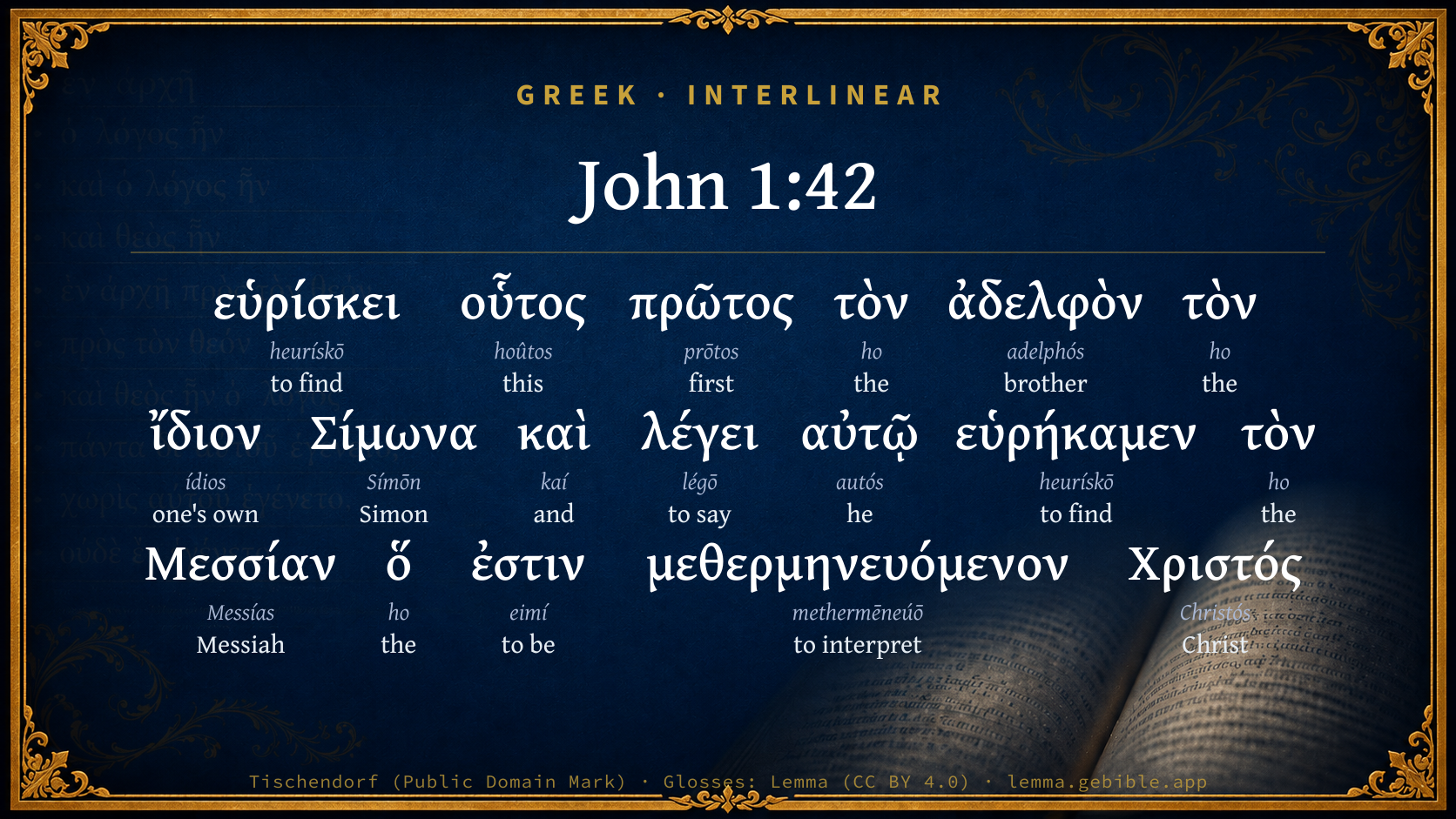
Download image
Cite this verse

John 1:42 (World English Bible). Public Domain. Lemma interlinear Bible study tool, https://lemma.gebible.app/v/john/1/42.

Show BibTeX & RIS
BibTeX
RIS
English Translation
He brought him to Jesus. Jesus looked at him, and said, "You are Simon the son of Jonah. You shall be called Cephas" (which is by interpretation, Peter).
World English Bible · Public Domain
Highlights
  • 1 first appearance in the Greek New Testament
Full analysis ↓
Download a study sheet

One document with this verse’s original text, its word-by-word gloss line, the meaning frame, cross-references with their text, attributed commentary, and full source and license credits — printable, and it pastes into notes with its structure intact.

This verse Autodidact and up

Study sheet (.html) Plain text (.txt)

A passage Seminary Student

Up to 50 verses in one chapter. A passage sheet keeps up to 6 commentary sources and 12 cross-references per verse, in the order this page ranks them, and says so on the sheet whenever that leaves anything out. Ask for a single verse and you get the Autodidact verse sheet above.

Everything on this page stays free to read, with no account — the sheet is a download of what is already on screen, not access to it.

Want to remove ads? Support Godless Engineer
Compare translations 3

The same verse in 3 English versions, stacked beneath the original-language interlinear above. Click any original word for its lexicon entry.

Each is an independent rendering of the whole verse — the interlinear is not word-aligned to these translations.

Highlighted words mark where these versions differ — a whole-verse word diff, not a word-by-word alignment.

  • World English Bible Public Domain
    He brought him to Jesus. Jesus looked at him, and said, "You are Simon the son of Jonah. You shall be called Cephas" (which is by interpretation, Peter).
  • King James Version Public Domain
    And he brought him to Jesus. And when Jesus beheld him, he said, Thou art Simon the son of Jona: thou shalt be called Cephas, which is by interpretation, A stone.
  • unfoldingWord Literal Text CC BY-SA 4.0
    He brought him to Jesus. Jesus, having looked at him, said, “You are Simon, the son of John. You will be called Cephas” (which is translated “Peter”).

unfoldingWord Literal Text — © unfoldingWord, licensed CC BY-SA 4.0. Word-aligned USFM3 via Door43 (git.door43.org/unfoldingWord/en_ult).

Versions to compare (up to 4)

3 of 4 selected

Show all 19 translations

Every available English version of this verse, each an independent rendering of the whole verse.

  • World English Bible Public Domain
    He brought him to Jesus. Jesus looked at him, and said, "You are Simon the son of Jonah. You shall be called Cephas" (which is by interpretation, Peter).
  • Berean Standard Bible Public Domain
    Andrew brought him to Jesus, who looked at him and said, “You are Simon son of John. You will be called Cephas” (which is translated as Peter).
  • Majority Standard Bible Public Domain
    Andrew brought him to Jesus, who looked at him and said, “You are Simon son of Jonah. You will be called Cephas” (which is translated as Peter).
  • King James Version Public Domain
    And he brought him to Jesus. And when Jesus beheld him, he said, Thou art Simon the son of Jona: thou shalt be called Cephas, which is by interpretation, A stone.
  • American Standard Version (1901) Public Domain
    He brought him unto Jesus. Jesus looked upon him, and said, Thou art Simon the son of John: thou shalt be called Cephas (which is by interpretation, Peter).
  • Revised Version (1885) Public Domain
    He brought him unto Jesus. Jesus looked upon him, and said, Thou art Simon the son of John: thou shalt be called Cephas (which is by interpretation, Peter).
  • Geneva Bible (1599) Public Domain
    And he brought him to Iesus. And Iesus behelde him, and saide, Thou art Simon the sonne of Iona: thou shalt be called Cephas, which is by interpretation, a stone.
  • Douay-Rheims (1899) Public Domain
    And he brought him to Jesus. And Jesus looking upon him, said: Thou art Simon the son of Jona: thou shalt be called Cephas, which is interpreted Peter.
  • Young's Literal Translation Public Domain
    and he brought him unto Jesus: and having looked upon him, Jesus saith, `Thou art Simon, the son of Jonas, thou shalt be called Cephas,' (which is interpreted, A rock.)
  • Literal Standard Version CC BY-SA 4.0
    and he brought him to Jesus: and having looked on him, Jesus says, “You are Simon, the son of Jonas, you will be called Cephas,” (which is interpreted, A rock).
  • Unlocked Literal Bible CC BY-SA 4.0
    He brought him to Jesus, and Jesus looked at him and said, “You are Simon son of John. You will be called Cephas” (which is translated Peter).
  • unfoldingWord Literal Text CC BY-SA 4.0
    He brought him to Jesus. Jesus, having looked at him, said, “You are Simon, the son of John. You will be called Cephas” (which is translated “Peter”).
  • Darby Bible Public Domain
    And he led him to Jesus. Jesus looking at him said, Thou art Simon, the son of Jonas; thou shalt be called Cephas (which interpreted is stone).
  • World Messianic Bible Public Domain
    He brought him to Yeshua. Yeshua looked at him and said, “You are Simon the son of Jonah. You shall be called Kefa” (which is by interpretation, Peter).
  • Webster's Bible Public Domain
    And he brought him to Jesus. And when Jesus beheld him, he said, Thou art Simon the son of Jona: thou shalt be called Cephas; which is, by interpretation, a stone.
  • Free Bible Version CC BY-SA 4.0
    He took him to Jesus. Looking directly at Simon, Jesus said, “You are Simon, son of John. But now you will be called Cephas,” (which means “Peter”).
  • Bible in Basic English Public Domain
    And he took him to Jesus. Looking at him fixedly Jesus said, You are Simon, the son of John; your name will be Cephas (which is to say, Peter).
  • Text-Critical English NT CC BY 4.0
    and he brought Simon to Jesus. Jesus looked at him and said, “Yoʋ are Simon the son of Jonah; yoʋ shall be called Cephas” (which means “Peter”).
  • Tyndale New Testament (1534) Public Domain
    and brought him to Iesus. And Iesus behelde him and sayde: thou arte Simon the sonne of Ionas thou shalt be called Cephas: which is by interpretacion a stone.

Literal Standard Version (2020), Covenant Press — licensed CC BY-SA 4.0. Text via the HelloAO Bible API (eBible.org). Unlocked Literal Bible (unfoldingWord) — licensed CC BY-SA 4.0. Text via the HelloAO Bible API (eBible.org). unfoldingWord Literal Text — © unfoldingWord, licensed CC BY-SA 4.0. Word-aligned USFM3 via Door43 (git.door43.org/unfoldingWord/en_ult). Free Bible Version, Dr. Jonathan Gallagher — licensed CC BY-SA 4.0. Text via the HelloAO Bible API (eBible.org).

Word by word

More ways to search: Search by grammar → Find every occurrence → Compare this word →

Practice this passage: Drill this verse → Learn its vocabulary →

Μεσσίαν
Messías
G3323
“Messiah”
Noun, Accusative, Singular, Masculine
Part of Speech
Noun
Case
Accusative
Number
Singular
Gender
Masculine
Full Thayer's Definition

Origin: of hebrew origin H4899 see G5547 christos

TDNT: 9:493, 1322

Messias = "anointed" 1. the Greek form of Messiah 2. a name of Christ
  1. εὑρίσκει heurískō G2147 “to find” Verb, Present, Active, Indicative, 3rd person, Singular
  2. οὗτος hoûtos G3778 “this” Demonstrative pronoun, Nominative, Singular, Masculine
  3. πρῶτος prōtos G4413 “first” Adjective, Nominative, Singular, Masculine, Superlative
  4. τὸν ho G3588 “the” Article, Accusative, Singular, Masculine
  5. ἀδελφὸν adelphós G80 “brother” Noun, Accusative, Singular, Masculine
  6. τὸν ho G3588 “the” Article, Accusative, Singular, Masculine
  7. ἴδιον ídios G2398 “one's own” Adjective, Accusative, Singular, Masculine
  8. Σίμωνα Símōn G4613 “Simon” Noun, Accusative, Singular, Masculine
  9. καὶ kaí G2532 “and” Conjunction
  10. λέγει légō G3004 “to say” Verb, Present, Active, Indicative, 3rd person, Singular
  11. αὐτῷ autós G846 “he” Personal pronoun, Dative, Singular, Masculine
  12. εὑρήκαμεν heurískō G2147 “to find” Verb, Perfect, Active, Indicative, 1st person, Plural
  13. τὸν ho G3588 “the” Article, Accusative, Singular, Masculine
  14. ὅ ho G3588 “the” Article, Nominative, Singular, Masculine
  15. ἐστιν eimí G1510 “to be” Verb, Present, Active, Indicative, 3rd person, Singular
  16. μεθερμηνευόμενον methermēneúō G3177 “to interpret” Verb, Present, Passive, Participle, Nominative, Singular, Neuter
  17. Χριστός Christós G5547 “Christ” Noun, Nominative, Singular, Masculine

About this verse

These counts appear in no published source. They are computed here, from the morphology-tagged text and Lemma’s own curated glosses. What Lemma adds →

18
words
14
distinct lemmas
Gospels
section

Notable vocabulary

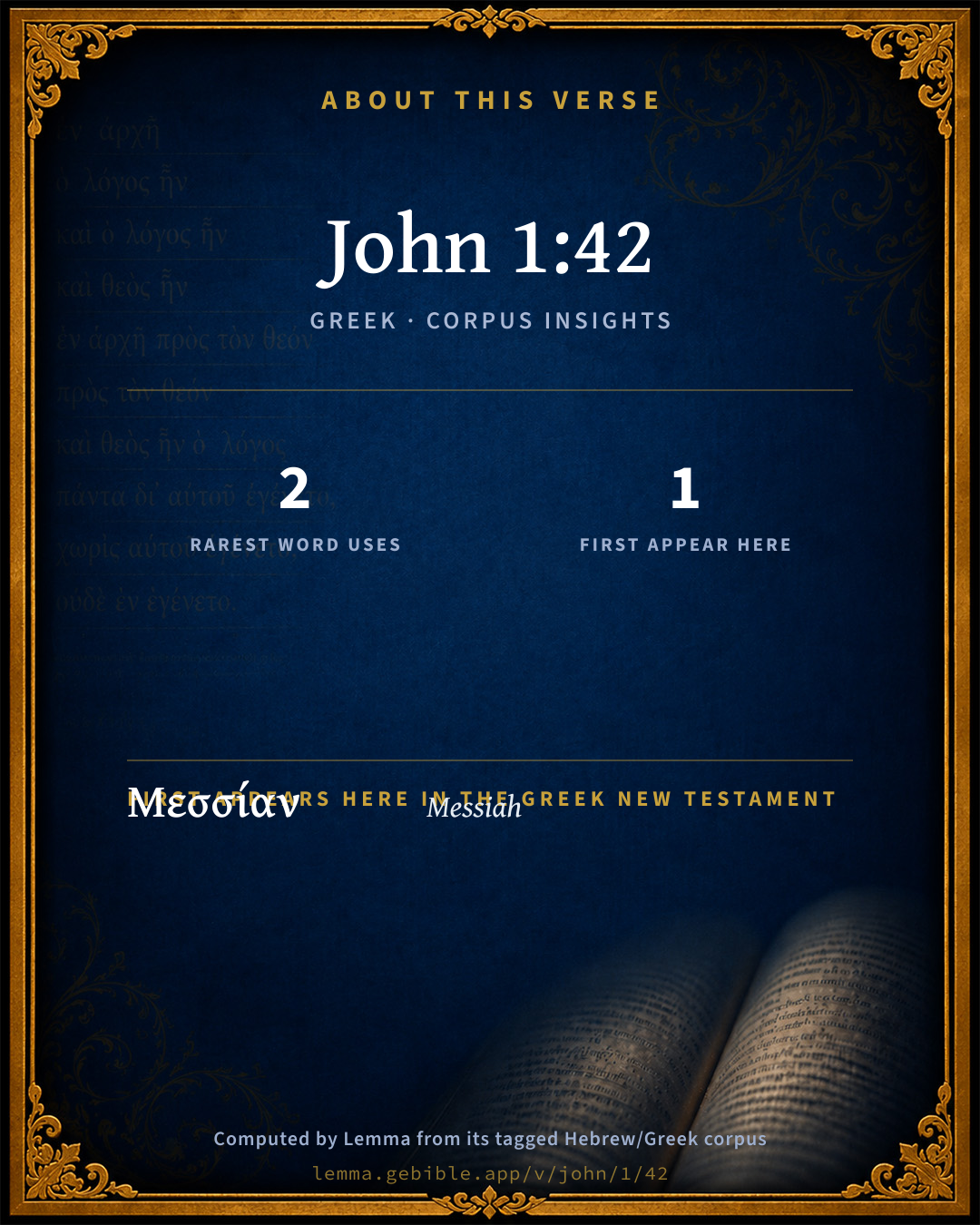
The rarest word here is Μεσσίαν Messiah G3323 — appearing just 2 times in the whole Greek New Testament.

First appearance in Scripture

This word makes its first canonical appearance in the Greek New Testament here:

  • Μεσσίαν Messiah G3323

Shared distinctive vocabulary

Μεσσίαν Messiah G3323 occurs in 2 verses of the Greek New Testament. Also found in:
Repetition

Words recur within this verse:

  • εὑρίσκει to find G2147 ×2
  • τὸν the G3588 ×4

Cross-references

16

Topical passages linked to John 1:42 in the Treasury of Scripture Knowledge — connected by theme and wording, ordered by reader-vote popularity; previews shown in the World English Bible.

  • John 21:15–17 So when they had eaten their breakfast, Jesus said to Simon Peter, "Simon, son of Jonah, do you love me more than these?" He said to him, "Yes, Lord; you know that I have affection for you." He said to him, "Feed my lambs."
  • 1 Corinthians 3:22 whether Paul, or Apollos, or Cephas, or the world, or life, or death, or things present, or things to come. All are yours,
  • 1 Corinthians 15:5 and that he appeared to Cephas, then to the twelve.
  • 1 Corinthians 1:12 Now I mean this, that each one of you says, "I follow Paul," "I follow Apollos," "I follow Cephas," and, "I follow Christ."
  • Matthew 10:2 Now the names of the twelve apostles are these. The first, Simon, who is called Peter; Andrew, his brother; James the son of Zebedee; John, his brother;
  • 1 Corinthians 9:5 Have we no right to take along a wife who is a believer, even as the rest of the apostles, and the brothers of the Lord, and Cephas?
  • Galatians 2:9 and when they perceived the grace that was given to me, James and Cephas and John, they who were reputed to be pillars, gave to me and Barnabas the right hand of fellowship, that we should go to the Gentiles, and they to the circumcision.
  • Matthew 16:17–18 Jesus answered him, "Blessed are you, Simon Bar Jonah, for flesh and blood has not revealed this to you, but my Father who is in heaven.
  • Luke 5:8 But Simon Peter, when he saw it, fell down at Jesus' knees, saying, "Depart from me, for I am a sinful man, Lord."
  • John 6:70–71 Jesus answered them, "Didn't I choose you, the twelve, and one of you is a devil?"
  • Mark 3:16 Simon, to whom he gave the name Peter;
  • John 1:47–48 Jesus saw Nathanael coming to him, and said about him, "Behold, an Israelite indeed, in whom is no deceit!"
  • John 21:2 Simon Peter, Thomas called Didymus, Nathanael of Cana in Galilee, and the sons of Zebedee, and two others of his disciples were together.
  • Luke 6:14 Simon, whom he also named Peter; Andrew, his brother; James; John; Philip; Bartholomew;
  • John 2:24–25 But Jesus didn't trust himself to them, because he knew everyone,
  • John 13:18 I don't speak concerning all of you. I know whom I have chosen. But that the Scripture may be fulfilled, 'He who eats bread with me has lifted up his heel against me.'

Cross-references courtesy of OpenBible.info (CC BY 4.0).

Where the printed editions differ

1 variant

Places in this verse where the major printed Greek editions disagree on the wording in a way that affects the translation — a comparison of editions, not a manuscript-by-manuscript collation. The editions are the modern critical texts (Nestlé-Aland 28/27, SBL, Westcott-Hort, Tregelles, Tyndale House) and the traditional texts behind the KJV (the Textus Receptus and the Byzantine/Majority text). It is not a claim about which reading is original.

  1. Different wording
    Ἰωάννου·

    “of John;”

    In NA28NA27TynSBLWHTreg Not in TRByz

    Ἰωνᾶ (Iōna) 'of Jonah' occurs in traditional manuscripts (TR+Byz) instead of Ἰωάννου· (Iōannou) 'of John;' in older manuscripts (NA28+NA27+Tyn+SBL+WH+Treg)

Textual data: Translators Amalgamated Greek New Testament (STEPBible TAGNT) · CC BY 4.0.

Commentary

Notes on John 1:42 from classic Christian and Jewish commentators (each source and its license shown beneath its notes). The classic Christian expositions comment on the surrounding passage and are grouped to its opening verse, so a note may address several verses; the Jewish commentaries on the Tanakh (Rashi and others) are per-verse, so they appear only where the commentator wrote on this verse.

Lemma curates 59 commentaries, every one of them public domain or Creative Commons licensed, each selected and text-cleaned for this edition rather than reprinted as found. About our sources →

The Biblical Illustrator

Joseph S. Exell

Joh_1:42

And he brought him to Jesus

Everyday usefulness

We are intensely desirous of a revival of religion, and we look for it through some extraordinary agency.

God works in this way sometimes; but while waiting for it we miss actual opportunities, Our proper course is to do what we can and God will be sure to bless it.

I. THE MISSIONARY DISCIPLE.

1. His character.

(1) He was a sincere follower of Jesus. Men who have not made Christs acquaintance experimentally are not fit to work for Him. An unconverted man in the pulpit is an impostor and exposes himself to extraordinary peril.

(2) He was a young convert. He beheld the Lamb of God one day and found out his brother the next. Those who have learned but their A B C let them tell that.

(3) He was a commonplace disciple, yet he became a useful minister. So servants of Christ must not excuse themselves because they are not greatly gifted.

2. His manner was

(1) Prompt,

(2) Persevering.

II. HIS GREAT OBJECT,

1. To bring Peter to Jesus. This should be our aim

(1) Not to a party. To recruit one regiment from another is no real strengthening of the army.

(2) Not to bring men to outward religiousness merely. To make the Sabbath breaker a Sabbath keeper and a Pharisee, to make the prayerless the heartless user of a form of prayer, you but take one poison from him to expose him to another.

(3) Many, alas I are satisfied if they get to the priest, church, sacraments.

2. We may bring men to Jesus

(1) By prayer.

(2) By putting them in the way of being informed about the Gospel.

(3) By our example.

(4) By occasionally, and as opportunity serves, giving a word of importunate entreaty.

III. HIS WISE METHODS.

1. Being zealous he was wise.

(1) He used what ability he had.

(2) He set great store by a single soul.

(3) He did not go far afield to do good. Many Christians do all the good they can five miles away, when the time taken up by going there and back might be well spent in their vineyard at home. Andrew goes to Cappadocia in his after life, but he begins with his brother.

2. How did Andrew persuade Peter?

(1) By narrating his own experience. What you have experienced tell to others.

(2) He put the good news before him in an earnest fashion.

IV. THE SWEET REWARD ANDREW HAD. He won his brothers soul. In your Sunday-school class or in your home there may be an unconverted Wesley or Whitefield. (C.H. Spurgeon.)

This highest voluntary influence

I. It was BENEFICENT. What a universe of good was involved in the simple act of bringing this man to Jesus!

1. What a service was rendered to Peter! His soul translated into a new world.

2. What a service to the disciples of Christ! The introduction of a frank, generous, bold, inspired nature.

3. What a service to the whole world! God alone knows the good Peter did from Pentecost onwards. All this service must be referred to the simple act of Andrew. From one little act may issue an influence for good that may go on widening and deepening for ages.

II. It was NATURAL. Andrew went to Peter, not as an official, but as a man, a brother. What is wanted to bring men to Christ is

1. Common sense, not learning, genius, culture.

2. Love to Christ. Andrews heart was touched and inspired with loving sympathies for Christ. What is wanted in this work is not the influence of the scholar, philosopher, or priest, but of the man. It is the man, not the preacher, who converts. When the man is lost in the preacher his power is gone.

III. It was HONOURABLE. To introduce a man to Christ is to introduce him to one who in philosophy is infinitely greater than Socrates, in wealth infinitely richer than Croesus, in royalty infinitely greater than a Caesar. The work of authors, sages, statesmen, warriors contemptible compared with that of bringing men to Christ.

IV. It was EXEMPLARY.

1. Andrews is an example that all can imitate.

2. An example that all should imitate: an universal duty, not binding on any particular class, but pressing on all relations, all social grades, all intellectual types. (D. Thomas, D. D.)

Thou art Simon,… thou shalt be called Cephas

Simon and Peter

Christ changed Simons name.

1. As a sign of His authority and of taking entire possession of him, as a king might alter the name of some man whom he had captured.

2. As a promise of transforming power.

3. As a prophecy of his future office and importance in the Church. The Aramaic Cephas is the equivalent of the Greek Peter, a stone. The alternation of these names afterwards is indicative of the following lessons.

I. THE DANGER OF THE NEW AND BETTER NATURE FALLING BACK TO THE OLD. Where Simon is employed in the Gospels it is suggestive of the apostles uninspired and unregenerate humanity.

1. Simon, Simon, Satan hath desired to have thee. There we see the exquisite delicacy with which Christ points the too presumptuous man away from his own fancied strength to the weakness of his humanity.

2. Simon, sleepest thou? Where is Peter? He would have kept awake.

3. The Lord hath appeared unto Simon. This was from the apostles--all the rest are from Christ--all knew about his fall, that he had ceased to be the rock, and that his precedence and influence were gone.

4. Simon, son of Jona (same as text), lovest thou Me? Christ puts the fallen apostle in his place, makes him go back to the very beginning. He must go through the wicket-gate again.

II. THE FORGIVING LOVE WHICH DISCERNS THE TRUE MAN BELOW ALL HIS SIN.

1. Simon, Simon, Satan hath desired … I tell thee, Peter, the cock shall not crow, etc. Here is Christs clear recognition of the better nature subsisting even whilst it appears to be smothered beneath the worse. Condemning the sinner, Christ would not break the bruised reed.

2. Go, tell the disciples and Peter--an incident recorded only by Mark, Peters mouthpiece. Tell Simon would have been a rebuke; tell Peter is a smile of forgiveness, and an outstretched hand to grasp the sad hand of the denier.

III. THE GRAND POSSIBILITY THAT THE NEW MAN MAY TRIUMPH. No more is heard of Simon, with two exceptions.

1. Cornelius is directed to send for Simon, who is called Peter, because outsiders would know him best by the one name, Christians by the other.

2. James, at the council of Jerusalem, calls him Simon, out of old and familiar friendship. Elsewhere it is always Peter. The transformation had now become complete. Effusive, impulsive daring is changed into steadfast, bridled courage. If once he was to be blamed, that showed that he was still a man, and not a faultless, impossible monster. The sand has been put into a hydraulic press and comes out sandstone, strong and tenacious. This transformation is inexplicable without the Resurrection, the Ascension, and Pentecost.

IV. THE WHOLESOME REMEMBRANCE BY THE MAN HIMSELF OF WHAT HE WAS, JOINED WITH THE THANKFUL RECOGNITION OF WHAT HE IS. In his Second Epistle he introduces himself as Simon Peter. Probably the long disused name had vanished from the memory of that generation;. but the old man reverts to it. Through the mist of long years he remembers what he was, and recalls his old un-sanctified self; but he is not afraid to call himself Peter. He is conscious of the higher life not his own which was promised him on the never-to-be-forgotten occasion mentioned in the text. (A. Maclaren, D. D.)

Personal influences

Whitfield made it his wont wherever he stayed to talk to the members of the household about their souls--with each one personally; but stopping at a certain house with a colonel, who was all that could be wished except a Christian, he was so pleased with the hospitality he received, and so charmed with the general character of the good colonel and his wife and daughters, that he did not like to speak to them about decision as he would have done if they had been less amiable characters. He had stopped with them a week, and during the last night the Spirit of God visited him so that he could not sleep. These people, said he, have been very kind to me, and I have not been faithful to them; I must do it before I go; I must tell them that whatever good thing they have, if they do not believe in Jesus they are lost. He arose and prayed. After praying he still felt contention in his spirit. His old nature said, I cannot do it, but the Holy Spirit seemed to say, Leave them not without warning. At last he thought of a device, and prayed God to accept it. He wrote upon a diamond-shaped pane of glass in the window with his ring these words, One thing thou lackest. He could not bring himself to speak to them, but went his way with many a prayer for their conversion. He had no sooner gone than the woman of the house, who was a great admirer of him, said, I will go up to his room; I like to look at the very place where the man of God has been: She went up and noticed on the window-pane those words, One thing thou lackest. It struck her with conviction in a moment. Ah! said she, I thought he did not care much about us, for I knew he always pleaded with those with whom he stopped, and when I found that he did not do so with us, I thought we had vexed him, but I see how it was; he was too tender in mind to speak to us. She called her daughters up. Look there, girls, said she, see what Mr. Whitfield has written on the window, One thing thou lackest. Call up your father. And the father came up and read that too. One thing thou lackest! and around the bed whereon the man of God had slept they all knelt down and sought that God would give them the one thing they lacked, and ere they left that chamber they had found that one thing, and the whole household rejoiced in Jesus. (C. H.Spurgeon.)

Personal effort

I recollect several persons joining the Church who traced their conversion to the ministry in the Surrey Music Hall, but who said it was not that alone, but another agency co-operating therewith. They were fresh from the country, and some good man, I knew him well, I think he is in heaven now, met two of them at the gate, spoke to them, said he hoped they had enjoyed what they had heard; heard their answer; asked them if they were coming in the evening; said he would be glad if they would drop into his house to tea; they did, and he had a word with them about the Master. The next Sunday it was the same, and at last, those whom the sermons had not much impressed were brought to hear with other ears, till by-and-by, through the good old mans persuasive words, and the good Lords gracious work, they were converted to God. (C. H.Spurgeon.)

One soul precious

Oh, says one, I have had so little success; I have had only one soul saved! That is more than you deserve. If I were to fish for a week, and only catch one fish, I should be sorry; but if that happened to be a sturgeon, a royal fish, I should feel that the quality made up for lack of quantity. When you win a soul it is a great prize. One soul brought to Christ--can you estimate its value? If one be saved, you should be grateful to your Lord, and persevere. (C. H. Spurgeon.)

The searching question

I shall now put a question which I daresay has passed through your minds before, but which I would like to tarry there. How many, my dear friend, were you ever the means of bringing to Jesus? You believe that they must perish everlastingly, unless they have faith in Christ. How many have you personally prayed for? How many did you ever break your heart about? How many have you ever talked to concerning Him who is the only Saviour? To how many have you borne your testimony of His kindness and His grace? Upon how many have you laid the tender hand to press them to follow after the Saviour? Ah! well, the questions sound so trite as I put them, and perhaps as they come to your ears you are weary with them as being so commonplace; but by the great day of the appearing of our Lord, when He shall require of you an account of your stewardship, I implore you answer those enquiries, even if they humble you in the very dust. If the answer be painful, seek for the future that your course be mended, and as servants of Christ yearn over souls. (C. H. Spurgeon.)

Rareness of personal effort for souls

In hundreds of cases I have vat the question pointedly, Do you know that you have been instrumental in leading one soul to Christ? only to hear the sad confession that there has been no effort made in that direction. (A. G. Pearson, D. D.)

Individual effort

Do not forget individual souls. There is a great rage nowadays for large congregations and for prominent work; but do not forget individual souls. I think it was Rowland Hill who used to say that if he had a number of bottles before him, and he were to dash water over them, a drop might go into this one and a drop into that; but he said, If I take one bottle and pour water in I fill it up to the brim. And so it is with individual souls. There is a personality in the application which cannot be estimated if we are speaking face to face in an honest, manly way. Is not this the best way to do Christian work? (W. P. Lockhart.)

How to win souls

I come from a house from which there is a considerable contingent attending this service this morning, and the question last night was how we should be awakened in time. They resolved to do it by detachments. One young fellow woke up the servant, and some others woke the young ladies, and they each had some one under their care, and knocked at the door until they were answered. It was best done by dividing it, and by giving to each one a special department in the work. And so we do cur work best by dealing with individual men. (W. P.Lockhart.)

The great secret of the success of Harlan Page was that he always aimed at the conversion of some individual; wrestling in prayer with God, and in affectionate entreaty with the sinner, till he saw his wishes realized. By following this plan, although he was in humble life, active work, and often in deep poverty, he lived to see more than a hundred brought to God as the fruit of his zeal and intercession.

Example brings men to Jesus

The Rev. J. A. James, the well-known minister of Birmingham, says, in one of his lectures: If the present lecturer has a right to consider himself a real Christian, if he has been of any service to his fellow-creatures, and has attained to any usefulness in the Church of Christ, he owes it, in the way of means and instrumentality, to the sight of a companion, who slept in the same room with him, bending his knees in prayer on retiring to rest. That scene so unostentatious, and yet so unconcealed, roused my slumbering conscience, and sent an arrow to my heart; for, though I had been religiously educated, I had restrained prayer, and cast off the fear of God. My conversion to God followed, and soon afterwards my entrance upon college studies for the work of the ministry. Nearly half a century has rolled away since then, with all its multitudinous events; but that little chamber, that humble couch, that praying youth, are still present to my imagination, and will never be forgotten, even amidst the splendour of heaven and through the ages of eternity.

The Biblical Illustrator, edited by Joseph S. Exell (c. 1880s–1900s) — public domain. Text from a community e-Sword module.

Bengel's Gnomon

Johann Albrecht Bengel

Joh 1:42. Ἐμβλέψας, having gazed earnestly at him [fixing His eye upon him] An effectual look.—Σίμων ὁ υἱὸς Ἰωνᾶ, Simon, son of Jona) These names no one had told the Saviour: and so by this address by name He took complete possession of Peter; comp. Joh 1:48 [His similarly winning Nathanael by showing His omniscience, “Before that Philip called thee, when thou wast under the fig-tree, I saw thee.”]—Κηφᾶς, Cephas) Peter was ever afterwards called by this name, which is a Syriac one, especially when he was staying in Syria.

Bengel's Gnomon of the New Testament — English translation (T&T Clark, Edinburgh, 1860) — public domain. Text from a community e-Sword module.

Expositor's Greek Testament

ed. W. Robertson Nicoll

Joh 1:42 . εὑρίσκει οὗτος πρῶτος . If with T. R. and Tischendorf we read πρῶτος , the meaning is that Andrew, before John , found his brother; if with W.H [32] we read πρῶτον the meaning is that before Andrew did anything else, and perhaps especially before the other men afterwards named were called, he first of all finds his own brother. Reading πρῶτον , we cannot gather that John went in search also of his brother, and as there is no mention of him at this time the probability is that he was not at hand. πρῶτον is the note of warning that this was but the beginning of a series of calls. εὑρήκαμεν τὸν Μεσσίαν . “We have found,” perhaps, as Weiss suggests, with reference to the expectations produced by the Baptist’s teaching. The result of their conversation with Jesus is summed up in these words. They were now convinced that He was the Christ. In Jewish lips “we have found the Messiah” was the most comprehensive of all Eurekas. That John gives the actual words, though he has immediately to translate one of them for his Greek readers, is not without significance in regard to his accuracy in reporting.

[32] Westcott and Hort.

The Expositor's Greek Testament, edited by W. Robertson Nicoll (1897–1910) — public domain. Text from a community e-Sword module.

Jamieson, Fausset & Brown

Robert Jamieson, A. R. Fausset & David Brown

brought him to Jesus--Happy brothers that thus do to each other!

beheld him--fixed his eyes on him, with significant gaze (as Joh 1:36).

Cephas . . . stone--(See on Mat 16:18).

Jamieson, Fausset & Brown — Commentary Critical and Explanatory on the Whole Bible (1871) — public domain (CC PDM 1.0). Text via the HelloAO Bible API.

Adam Clarke's Commentary

Verse 42. Cephas, which is by interpretation, A stone.] πετρος signifies a stone, or fragment of a rock. The reason why this name was given to Simon, who was ever afterwards called Peter, may be seen in the notes on Mat 16:18, Mat 16:19, and particularly in Luke, at the end of chap 9. See Clarke on Lu 9:62

Adam Clarke's Commentary on the Bible (1810–1826) — public domain. Text from a community e-Sword/MySword module.

John Calvin's Commentaries

42. Thou art Simon. Christ gives a name to Simon, not as men commonly do, from some past event, or from what is now perceived in them, but because he was to make him Peter, (a stone.) First, he says, Thou art Simon, the son of Jonah. He repeats the name of his father in an abridged form; which is common enough when names are translated into other languages; for it will plainly appear from the last chapter that he was the son of Johanna or John. But all this amounts to nothing more than that he will be a very different person from what he now is. For it is not For the sake of honor that he mentions his father; but as he was descended from a family which was obscure, and which was held in no estimation among men, Christ declares that this will not prevent him from making Simon a man of unshaken courage. The Evangelist, therefore, mentions this as a prediction, that Simon received a new name. I look upon it as a prediction, not only because Christ foresaw the future steadfastness of faith in Peter, but because he foretold what he would give to him. He now magnifies the grace which he determined afterwards to bestow upon him; and therefore he does not say that this is now his name, but delays it till a future time.

Thou shalt be called Cephas. All the godly, indeed, may justly be called Peters (stones,) which, having been Sounded on Christ, are fitted for building the temple of God; but he alone is so called on account of his singular excellence. Yet the Papists act a ridiculous part, when they substitute him in the place of Christ; so as to be the foundation of the Church, as if he too were not founded on Christ along with the rest of the disciples; and they are doubly ridiculous when out of a stone they make him a head. For among the rhapsodies of Gratian there is a foolish canon under the name of Anacletus, who, exchanging a Hebrew word for a Greek one, and not distinguishing the Greek word κεφαλὴ (kephale) from the Hebrew word Cephas, thinks that by this name Peter was appointed to be Head of the Church. Cephas is rather a Chaldaic than a Hebrew word; but that was the customary pronunciation of it after the Babylonish captivity. There is, then, no ambiguity in the words of Christ; for he promises what Peter had not at all expected, and thus magnifies his own grace to all ages, that his former condition may not lead us to think less highly of him, since this remarkable appellation informs us that he was made a new man.

John Calvin's Commentaries (1540-1563) — public domain. Text from the Calvin Translation Society English edition (1840s-50s) via the Christian Classics Ethereal Library (ccel.org). Calvin's coverage is partial (roughly two-thirds of the Bible); uncommented books and verses are honest gaps, never fabricated. The 19th-century editor's footnotes and remarks are omitted so the notes are faithfully Calvin's own voice.

Ellicott's Commentary for English Readers

(42) Beheld.—See Note on Joh_1:29.

A Stone.—Better, Peter, as in margin. The word means a stone, but the writer translated for Greek, not for English readers. The rule of the previous verse, which places the Greek word in the text and the English word in the margin, should be followed here.

Cephas.—The word occurs only in this place in the Gospels, elsewhere in the New Testament only in St. Paul (1 Cor. and Gal.). Remembering the general significance of Hebrew names, the changes in the Old Testament as of Abram, Sarai, and Jacob, and among these first disciples as of James and John (Mar_3:16; Mar_3:18), all these names of Peter seem meant to characterise the man,—“Thou art now Hearer, the Son of Jehovah’s Grace; thou shalt be called and be a Rock-man.” (Comp. Note on Mat_16:17.)

A Bible Commentary for English Readers, edited by Charles John Ellicott (1878–1897) — public domain. Text from a community e-Sword module.

The Cambridge Bible for Schools and Colleges

gen. ed. J. J. S. Perowne

42. beheld] Same word as in Joh_1:36, implying a fixed earnest look; what follows shews that Christ’s gaze penetrated to his heart and read his character.

Simon the son of Jona] The true reading here and Joh_21:15-17 is Simon the son of John. There is a tradition mat his mother’s name was Johanna. The Greek form Iônâ may represent two distinct Hebrew names, Jonah and Johanan = John. There is no need to make Christ’s knowledge of his name and parentage miraculous; Andrew in bringing Simon would naturally mention them.

A stone] The margin and text should change places, Peter, being in the text and ‘a stone’ in the margin, like ‘the Anointed’ in Joh_1:41. This new name is given with reference to the new relation into which the person named enters; comp. the cases of Abraham, Sarah, Israel. It points to the future office of Simon rather than to his present character. The form Cephas occurs nowhere else in the Gospels or Acts: but comp. 1Co_1:12; 1Co_3:22; 1Co_9:5; 1Co_15:5, Gal_1:18; Gal_2:9; Gal_2:11; Gal_2:14.

There is no discrepancy between this and Mat_16:18. Here Christ gives the name Peter; there he reminds S. Peter of it. It is quite clear from this that S. Peter was not first called among the Apostles, a point on which the Synoptists leave us in doubt.

The Cambridge Bible for Schools and Colleges (gen. ed. J. J. S. Perowne; Cambridge University Press, 1878–1918) — public domain. Text from a community e-Sword module.

John Gill's Exposition

And he brought him to Jesus,.... That is, Andrew brought his brother Simon to Jesus; he persuaded him to go along with him, and showed him where he was; which discovered great zeal for Christ, being desirous of, gaining souls unto him; and great affection to his brother, being heartily concerned that he might know Christ, as well as he; nor did he choose that he should take up with the bare account that he gave of him, but would have him go to him himself, that he might be personally acquainted with him, and instructed by him: and this also shows the readiness and willingness of Simon, to see and hear Christ himself, and not sit down contented with the bare relation his brother gave: no doubt he found his heart stirred up within him, and the desires of his soul going after Christ; and therefore he at once rose up and went with Andrew to him; and thus one person may be the means of bringing another to Christ: and it may be observed, that Peter was not the first of the apostles that was called by Christ, or first knew him; Andrew was before him, and the means of bringing him into an acquaintance with him; had it been the reverse, the Papists would have improved it in favour of Peter, as the prince of the apostles: this clause is omitted in the Persic version,

And when Jesus beheld him; as he was coming, or come to him: he had beheld him before in the glass of his Father's purposes and decrees; he had viewed him in his blood, and said unto him, live; and he now looked upon him with a look of love, of complacency, and delight:

he said, thou art Simon, the son of Jona; thy name is Simon, and thy father's name is Jona: he knew both their names, though he might have never seen their faces, nor heard of them: this he said to give Simon a testimony of his omniscience; and which, no doubt, must strike him at once. Simon, or Simeon, was a common name among the Jews, being the name of one of the twelve patriarchs; see Gill on Mat 10:2; and so likewise was Jona, being the name of a prophet of theirs; See Gill on Mat 16:17; and inasmuch as the prophet Jonah was of Gathhepher in Zebulun, which was in Galilee; see Gill on Joh 7:52; this might be a common name among the Galilaeans; so that there seems no reason why it should be thought to be the same with John, as the Ethiopic version reads it, and by way of interrogation, "art thou not Simon the son of John?"

Thou shall be called Cephas, which is, by interpretation, a stone; or Peter as it should rather be rendered; and as it is in the Vulgate Latin, and Ethiopic versions; and as "Cepha", or "Cephas", in the Syriac and Chaldee languages signifies a stone, or rock (k), so does "Peter" in Greek: hence, the Syriac version here gives no interpretation of the word. Christ not only calls Simon by his present name, at first sight of him, but tells him what his future name should be; and which imports, not only that he should be a lively stone in the spiritual building, the church, but should have a considerable hand in that work, and abide firm and steadfast to Christ, and his interest, notwithstanding his fall; and continue constant and immoveable until death, as he did. The Jews also, in their writings, call him Simeon Kepha (l),

(k) Vid. Targum in Psal. xl. 3. & Prov. xvii. 8. T. Bab. Ceritot, fol. 6. 1. & Gloss. in ib. Tzeror Hammor, fol. 63. 2. (l) Toldos Jesu, p. 20, 21, 22, 23.

John Gill's Exposition of the Whole Bible (1746–1763) — public domain (CC PDM 1.0). Text via the HelloAO Bible API.

Trapp's Complete Commentary

John Trapp

42 And he brought him to Jesus. And when Jesus beheld him, he said, Thou art Simon the son of Jona: thou shalt be called Cephas, which is by interpretation, A stone.

Ver. 42. Cephas, which is by interpretation a stone] Not a head, as some Popish buzzards would needs have it (not knowing a difference between Cephas and κεφαλη), and all to prove Peter head of the Church. Some of them have said that the damnation of us Protestants is so plainly set down in our own Bibles, that there needs no more for convincing us thereof, but that we have our eyes in our heads (when we open the book) and be able to read it. But he that first interpreted Cephas, a head (against this clear text calling it a stone) either had not his eyes in his head, or else must needs be as perfect a stranger to the Bible as that Bishop of Dunkelden, in Scotland, that thanked God he knew neither the Old Testament nor the New. Or as that other Dutch bishop, Albertus Vindelicorum Episcopus, of whom Luther writeth, that lighting upon a Bible, and being asked (after that he had read awhile in it) what book it was; "I know not," said he, "what book it is; but this I know, that there is nothing in it that I can find to make for our religion."

John Trapp, A Commentary or Exposition upon All the Books of the Old and New Testament (1647–1656) — public domain. Text from a community e-Sword module.

Albert Barnes' Notes on the Bible

Cephas - This is a Syriac word, meaning the same as the Greek word Peter, a stone. See the notes at Mat 16:17. The stone, or rock, is a symbol of firmness and steadiness of character - a trait in Peter’s character after the ascension of Jesus that was very remarkable. before the death of Jesus he was rash, headlong, variable; and it is one proof of the omniscience of Jesus that he saw that Peter “would” possess a character that would be expressed appropriately by the word “stone” or “rock.” The word “Jonas” is a Hebrew word, whose original signification is a “dove.” It may be that Jesus had respect to that when he gave Simon the name Peter. “You now bear a name emblematic of timidity and inconstancy. You shall be called by a name denoting firmness and constancy.”

Albert Barnes' Notes on the Bible (1834–1885) — public domain. Text from a community e-Sword/MySword module.

Haydock's Catholic Bible Commentary

Thou art Simon, the son of Jona, or of John. Jesus, who knew all things, knew his name, and at the first meeting told him he should hereafter be called Cephas, or Petrus, a rock, designing to make him the chief or head of his whole Church. See Matthew xvi. 18. (Witham) --- Cephas is a Syriac word, its import is the same as rock or stone. And St. Paul commonly calleth him by this name: whereas others, both Greeks and Latins, call him by the Greek appellation, Peter; which signifies exactly the same thing. Hence St. Cyril saith, that our Saviour, by foretelling that his name should be now no more Simon, but Peter, did by the word itself aptly signify, that on him, as on a rock most firm, he would build his Church. (Lib. ii. chap. 12. in Joan.)

George Leo Haydock (1774–1849), Haydock's Catholic Family Bible and Commentary, 1859 edition — public domain. Excludes Psalms (Douay-Rheims chapter numbering differs from Protestant) and Deuterocanonical books (Catholic canon only).

Matthew Poole's English Annotations

Andrew having found his brother Simon, conducts him to Jesus. Andrew, and Simon, and Philip were citizens of Bethsaida, Joh 1:44, which was a city of Galilee; how near to the place where John baptized, or Christ lodged, we cannot say. Probably Simon was one of John’s disciples, and came to attend his ministry; so as the disciples only sought him in the crowd, and came with him to Christ. When Christ beheld him, he said,

Thou art Simon; he knew him, and called him by name, and told him his father’s name,

Jonas, and giveth him a new name,

Cephas, which by interpretation doth not signify a head, (as the popish disputant at Berne urged, to prove him the head of the church, as if it had been a Greek word, and came from κεφαλη; or, as he pretended, ridiculously enough, from an old Greek word, κεφας), but a stone (as this text tells us); by which name we find him called, 1Co 1:12; 3:22; 9:5; 15:5; Gal 2:9; in other places Peter, which signifieth a stone also, or a rock. Cephas is a Syriac word, Peter a Greek word: Christ gave him the name. Both Cephas and Peter are by interpretation, a stone. Beza thinks that our Saviour did not here give him that name, but foretell that he should be so called. Casaubon thinks that the name was here given to him, and with it a new spirit; that whereas before he was (according to his father’s name Jonas, which signifies a dove) fearful and timorous, from this time forward he was as a rock, steady, firm, and full of courage and constancy: but it is a greater question how this text is to be reconciled with Mat 4:18-20, where Andrew and Peter are both said to be espied by Christ, walking by the sea of Galilee; and Luk 5:10, where Simon is reported to be called after they had taken a great draught of fish; and with Mar 3:13, and Luk 6:13, where all the apostles are named as called at one and the same time. Doubtless the calls were different. This in John seems rather to be a prophecy than a call. Those texts, Mat 4:18-20, and Luk 5:10, seem to be their calls to a discipleship. The other texts, Mar 3:13; Luk 6:13, respect their election to the apostleship, and the mission of them.

Matthew Poole's English Annotations on the Holy Bible (1683–1685) — public domain. Text from a community e-Sword/MySword module.

Whedon's Commentary on the Bible

Daniel D. Whedon

42. Jesus beheld him—A memorable glance to fervid Peter. For the first time he meets that Messiah foretold by prophets for ages, whose influence was to shape his future life, and give him a wonderful place in future history. Think of St. Peter’s Church, standing at this day in the ancient capital of imperial Rome, the most magnificent of human structures!

Thou art—Though it be the first time that Peter ever saw Jesus, it is not the first time that Jesus, in spirit at least, ever saw Peter. He knows his parentage, his name, and history.

A stone—Jesus gives him the new name now, not so much, perhaps, to describe what he already is, as to prophesy and assure him what he may yet become. He had the hardihood of stony material; he may yet acquire the firmness of the rock. When Peter made his memorable confession in Mat_16:18 our Lord recognized his title, as if the probation had been sufficiently passed to fix his claim, as a basis of his position in the new Church. Both passages are perfectly harmonious.

Daniel D. Whedon (gen. ed.), Commentary on the Old and New Testaments (1874–1909) — public domain. Text from a community e-Sword module.

The Pulpit Commentary

Hebrought (the past tense) him to Jesus; as one entirely sympathetic and as eagerly longing for the Christ, for the Lamb of God, for the King of Israel. Seeing that Simon was found so soon most probably on the evening of the memorable day we gather that Simon also must have been among the hearers of John. He too must have left his fishing to listen to the Baptist. The entire group must have been drawn away from their ordinary avocations by the trumpet call of the preacher in the wilderness. Jesus looked intently, with penetrating glanceupon him, and said, Thou art Simon, the Son of John that is the name by which thou hast been introduced to me; a time is coming for thee to receive a new nameThou shalt be called Cephas (which is interpreted, Peter). It is perfectly gratuitous of Baur and Hilgenfeld to imagine this to be a fictitious adaptation of the great scene recorded in Mt 16. The solemn assertions made there proceed upon the assumption of the previous conference of the name "Peter." There the Lord said, "Thou art Peter, and upon this rock," etc. On this earlier occasion Jesus said, "Thou art Simon, thou shalt be called Khfav ." The assumption of the Tubingen critics, that a desire to lower Peter from his primacy is conspicuous in this passage, cannot be sustained. Though Andrew and John precede Peter in their earliest relations with Jesus, yet Peter is undoubtedly the most conspicuous character, to whom the Lord from the first gives an honourable cognomen. (cf. also Joh_6:67-69 and Joh_21:15, etc.) (Compare here, for historic changes of name, Gen_17:5 Gen_32:28) Weiss ("Life of Christ," Eng. trans., 1:370) says admirably, "There is no ground for assuming that this is an anticipation of Mat_16:18. Simon was not to bear this name until he was deserving of it. Jesus never called him anything but Simon. (Mar_14:37 Mat_17:25 Luk_22:31Jo Luk_21:15-17) Paul calls him by the names Peter and Cephas....The evangelist is right when he beholds in this scene a more than human acumen. ... The history shows he was not deceived in Peter." This narrative cannot be a Johannine setting forth of the first call of the four disciples as given in the synoptists. If it be, it is a fictitious modification. Place, occasion, and immediate result are all profoundly different. The one narrative cannot be twisted into the ether. Are the anti-harmonists correct in saying that they are irreconcilable? Certainly not. There is no indication that before John was cast into prison, before Jesus commenced his public ministry in Galilee, he had called disciples away from their ordinary duties to be his apostles. Some of these four may have returned, as Jesus himself did, to his family and domestic surroundings. (Joh_2:12) John may have accompanied Jesus to Jerusalem and through Samaria. But there is much to make it probable that Simon, Andrew, and at least, were, during the whole of that period, on the lake pondering the future. Christ"s solemn, sudden call to them to become "fishers of men," after a manifestation to them of his supernatural powers, presupposes rather than excludes this earlier interview. Simon, on that occasion, by the exclamation recorded, (Luk_5:5) reveals an earlier acquaintance with and reverence for his epistathv (see an admirable vindication of this position in Weiss, "Life of Jesus," vol. 1.). The Lord, in this first interview, penetrates and denominates the character of the most illustrious of his followers. His rocklike fortitude, which, though sorely assailed and chafed by the storms of the great sea of opinion and prejudice, formed the central nucleus of that Church against which the gates of hell have not prevailed. Our Lord implied the strength of his nature, even when he predicted his great fall. (Luk_22:32)

Bringing men to Jesus.

Jesus asks Andrew, "What seek ye?" and the question soon shows fruit in Andrew seeking out his own brother Simon. The New Testament deals with spiritual things, but that does not prevent it from being full of natural touches. What Andrew did is just the very thing which in like circumstances we might have been expected to do. And surely it is the most reasonable of conjectures that Andrew, who began by bringing his own brother, must have been the bringer also of many who were mere strangers. Interest in natural kinsmen would soon be merged in the wider interest a Christian must feel in humanity at large. Peter was Andrew"s first gift to Jesus, and he may have been the easiest. To bring a human being into real, loving contact with Jesus is not an easy thing; but what a service, what a blessing and a joy, to every one concerned!

I Andrew was able to bring Peter to Jesus because HE HAD FIRST OF ALL BEEN BROUGHT HIMSELF. Andrew had first of all been himself the subject of spiritual illumination. God must have shined in his heart to give the light of the knowledge of the glory of God in the face of Jesus Christ. He had been brought to Jesus as the Christ, the Messiah. The acquaintance had been very short, but a great deal may be done in a short time when the human heart has been getting ready to meet with Christ, when there is perfect openness and simplicity of mind truth on one side and an eager seeker after it on the other. To get other people as far as Peter, we must first of all have got as far as Andrew ourselves. How should the blind lead the blind? We must not wait for an Andrew. God has his own agency for us. He may send some John the Baptist, saving, "Behold!" to us. We must consider well the obstacles in our way to Jesus, which none can remove but ourselves procrastination, bosom sins, spiritual indolence, neglect "of the Scriptures.

II CONSIDER WHO IT WAS THAT ANDREW BROUGHT. his own brother Simon. So natural brotherhood is distinguished from that spiritual brotherhood which afterwards sprang into existence as regenerated believers in Christ felt the strong tie binding them together. What brother ought not to be to brother, and yet what he may very easily become, is shown from Cain and Abel, and Joseph and his brethren. What brother ought to be to brother is shown in this seeking of Simon by Andrew. Great opportunities are given by natural brotherhood, mutually cherished. Give every good thing in nature a chance to become also a minister of grace.

III CONSIDER WHAT ANDREW SAID TO PETER. "We have found the Messiah." This is as much good news for us as it was for Peter. What Andrew said he said at first, after a very brief acquaintance; but he would go on saying it all the more as day after day opened up the riches of Messiah"s mission and power. Observe the plural form of the announcement. The other disciple agreed with Andrew in his judgment. Look out for those and listen to them who bear the same message as Andrew, though not in quite the same form. We have words and acts of Jesus constantly forced on our attention. If we cannot be brought to Jesus, Jesus is brought to us. All bringing of men to Jesus must be preceded, more or less, by bringing of Jesus to men. Andrew must have brought such a vivid and powerful account of his talk with Jesus as would amount practically tea bringing of Jesus. Y.

The Pulpit Commentary (1880–1919), ed. H.D.M. Spence-Jones & Joseph S. Exell — public domain. Text from a community e-Sword module.

John Wesley's Explanatory Notes

Jesus said, Thou art Simon, the son of Jonah - As none had told our Lord these names, this could not but strike Peter. Cephas, which is Peter - Moaning the same in Syriac which Peter does in Greek, namely, a rock.

John Wesley, Explanatory Notes Upon the Whole Bible (1754–1765) — public domain. Text via the GEBible commentary corpus.

The People's New Testament

B. W. Johnson

42. Thou shalt be called Cephas. A Hebrew word meaning stone. Peter is the Greek form.

B. W. Johnson's The People's New Testament with Notes (1889–1891) — public domain. Electronic text from the Christian Classics Ethereal Library (CCEL) ThML edition.

Cambridge Greek Testament for Schools and Colleges

42. οὗτος. Comp. Joh 1:2; Joh 1:7, Joh 3:2; Joh 3:26.

πρῶτον. The meaning of ‘first’ becomes almost certain when we remember S. John’s characteristic reserve about himself. Both disciples hurry to tell their own brothers the good tidings, that the Messiah has been found: Andrew finds his own brother first, and afterwards John finds his: but we are left to infer the latter point.

Andrew thrice brings others to Christ; Peter, the lad with the loaves (Joh 6:8), and certain Greeks (Joh 12:22); and, excepting Mar 13:3, we know scarcely anything else about him. Thus it would seem as if in these three incidents S. John had given us the key to his character. And here we have another characteristic of this Gospel—the lifelike way in which the less prominent figures are sketched. Besides Andrew we have Philip, Joh 1:44, Joh 6:5, Joh 12:21, Joh 14:8; Thomas, Joh 11:16, Joh 14:5; Joh 20:24-29; Nathanael, Joh 1:45-51; Nicodemus, Joh 3:1-12, Joh 7:50-52, Joh 19:39; Martha and Mary, 11, Joh 12:1-3.

Εὑρήκαμεν. Does not prove that S. John is still with him, only that they were together when their common desire was fulfilled.

τὸν Μεσσίαν. The Hebrew form of this name is used by S. John only, here and Joh 4:25. Elsewhere the LXX. translation, ὁ χριστός, is used; but here χριστός has no article, because S. John is merely interpreting the word, not the title. Comp. Joh 3:28, Joh 4:25; Joh 4:29, Joh 7:26; Joh 7:31; Joh 7:41, Joh 10:24, Joh 11:27, Joh 12:34, Joh 20:31.

Cambridge Greek Testament for Schools and Colleges (Cambridge University Press, 1896; 21 vols, various authors incl. Carr, Maclear, Plummer, Farrar, Lumby, Moule, M. R. James, Simcox) — public domain. Text from a community e-Sword module.

Alford’s Greek Testament

Henry Alford

42.] ἴδιον not merely “for the possessive pronoun” (according to Winer, § 22. 7), but referring to πρῶτον, and furnishing a reason for it.

μεσσίαν = מָשִׁיחַ = not ὁ χριστός, but χριστός: being the identification simply of the two words, not here of the two titles.

Henry Alford, The Greek Testament (1849–1861) — public domain. Text from a community e-Sword module.

International Critical Commentary

42. The rec. has Ἰωνᾶ (with AB3ΓΔ) for the better supported Ἰωάνου (אB*LW 33, etc.). A similar variation appears at 21:15-17.

ἐμβλέψας sc. “having looked intently on him.” This verb has already (v. 36) been used of the Baptist’s earnest look at Jesus; it is used by the Synoptists of the piercing, scrutinising gaze of Jesus (Mat 19:26, Mar 10:21, Mar 10:27, Luk 20:17), and of His “looking” upon Peter after his denial.

It is plain from this verse (cf. 21:15-17 and Mat 16:17 that Simon was known as “Simon, son of John,” to distinguish him from others bearing the common personal name “Simon.” By the Synoptists he is generally called “Peter,” but often simply “Simon”; in the lists of the apostles it being added that he was surnamed “Peter” (Mat 10:2, Mar 3:16, Luk 6:14), this addition being necessary to distinguish him from the other apostle called Simon. The designation “Simon Peter” marks a later date than “Simon” simply; and it is noteworthy that while in Jn. he is described as Σίμων Πέτρος 17 times (see further on 18:15), this double name appears in the Synoptists only at Mat 16:16 (a passage peculiar to Mt. and later than the Marcan tradition) and at Luk 5:8.Luk 5:2

Jn. states here that Jesus gave Simon the Aramaic name or nickname of Kephas, which became Πέτρος in Greek, when He saw him for the first time, discerning his strong character at a glance. Mk. (3:16) rather suggests (although he does not say expressly) that Simon was given the name of Peter when he was selected as one of the Twelve, much as John and James were called Boanerges or “sons of thunder.” This is not suggested, however, in the lists of the apostles in Lk. (6:14f.) and Mt. (10:2; Mt. has Σίμων ὁ λεγόμενος Πέτρος). It is obviously appropriate that Mt. should call the apostle “Simon Peter” (16:16) when relating his great confession, and that Jesus, addressing him on that occasion as “Simon, son of John,” should have reminded him of the name Kephas: σὺ εἶ Πέτρος, καὶ ἐπὶ ταύτῃ τῇ πέτρᾳ οἰκοδομήσω μου τὴν ἐκκλησίαν. Jn. may have ante-dated the giving of the new and significant name, but there is no proof of this.

To give a new name in the O.T. history sometimes marked the beginning of a new relation to God; e.g. Jacob was called Israel (Gen 32:28), and Abram became Abraham (Gen 17:5), after a spiritual crisis (cf. also Isa 62:2, Isa 65:15). When adult converts from heathenism are baptized, they are given a new name for a similar reason. But there is no evidence that it is in Jn.’s mind to suggest this when he recalls that Jesus called Simon, Kephas, “the rock man,”1 although such an inference might be drawn from Mat 16:16f. if it stood alone. Jn.’s narrative here is quite simple, and there is no subtlety in the telling. See, however, on 6:69.

The Aramaic name Kephas (perhaps the same as Kaiaphas) is familiar in Paul, who uses it to designate Simon always in 1 Cor. (1:12, 3:22, 9:5, 15:5) and generally in Gal. (1:18, 2:9, 11, 14; but cf. 2:7, 8). It appears in no other Gospel but Jn., and the retention of the Aramaic כיפא is a touch that could hardly have occurred to any one whose mother speech was not Aramaic (see on vv. 38, 41, and cf. p. lxxix). By the end of the first century Simon was best known as Πέτρος, and he has been generally called by this name ever since.

The Call of Philip and Nathanael (Vv. 43-51)

International Critical Commentary — older volumes (1896–1929), various authors — public domain. Text from a community e-Sword module.

Lesson kit

Teaching starters — assembled from the data on this page, not authored interpretation. Every prompt links to the verse data it draws on. Edit before teaching.

John, in the Gospels, opens this verse with 18 words (14 distinct Greek lemmas). Its most distinctive word is Messías (“Messiah”). A historical commentator’s framing appears above. Read the whole chapter for the surrounding context.

Discussion questions

  1. The word Messías carries the sense “Messiah.” How does it shape the verse?
  2. The word “Messiah” first appears here in Scripture. What is being introduced at this debut?
  3. John 4:25 shares the word «Messiah» with this verse. How do the two illuminate each other?
  4. “to find” occurs 2× in this one verse. What is the effect of the repetition?
  5. These translations render this verse differently. What is at stake in choosing one wording over another?
  6. Reading how The Biblical Illustrator and Bengel's Gnomon read this verse, where do the two commentators agree and where do they part?

Things to notice

  • 1 word makes its first canonical appearance in Scripture here.
  • These translations choose different wording for 14 words in this verse.
  • “to find” occurs 2× in this single verse.
  • 14 distinct Greek lemmas span 18 words in this verse.

Reading settings

Reading text

Shown beneath each verse's original-language words.

Old Testament
Old Testament edition

Read the OT as the Masoretic Hebrew (MT) or the Greek Septuagint (LXX).

English shown for the Greek Septuagint (in the Hebrew ↔ Greek comparison).

Comparing translations? Open the Compare panel on any verse page to stack up to four side by side.