John 3:21

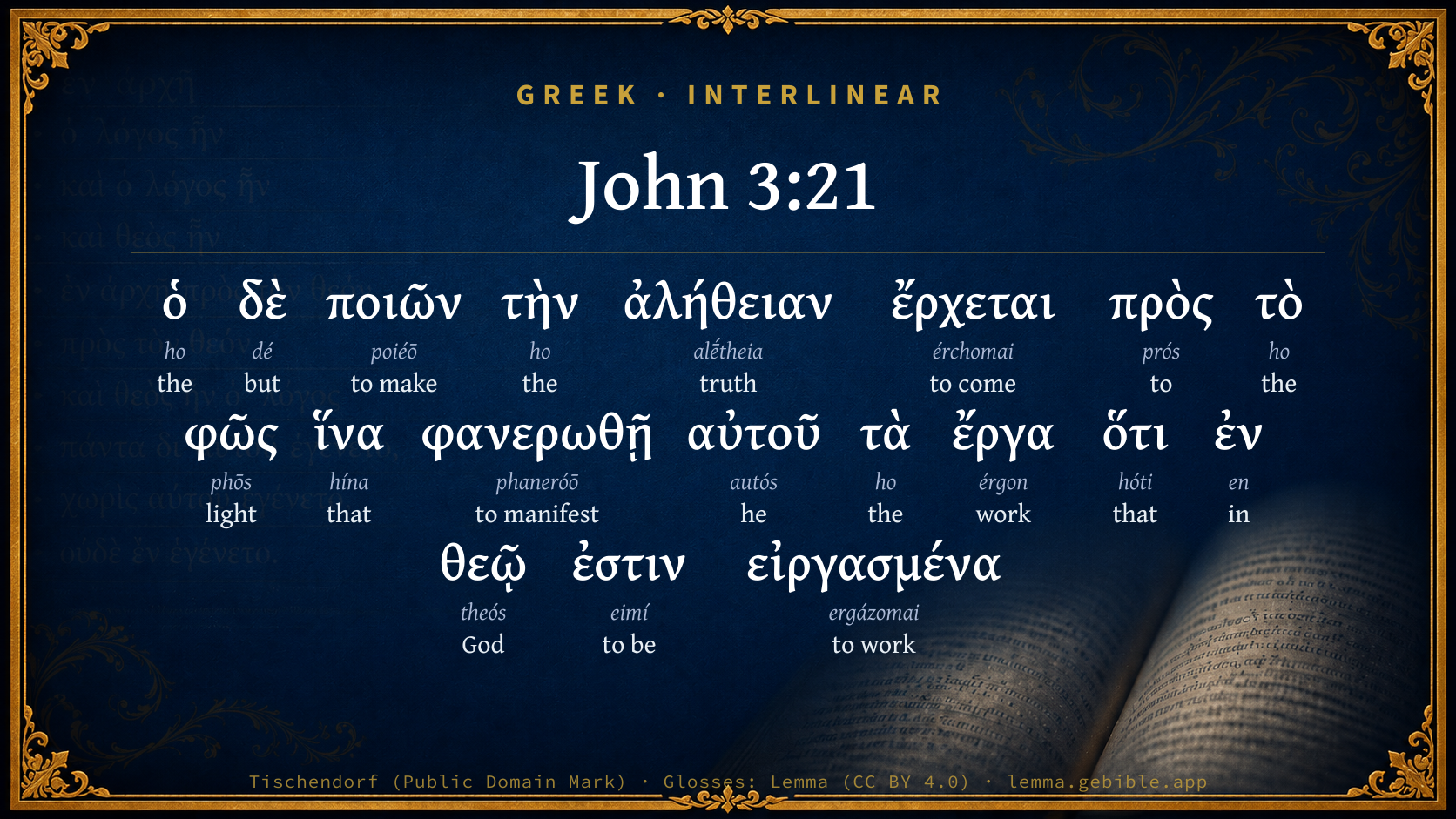
Greek (Tischendorf 8th ed.) John 3:21 appears in the Greek New Testament. The text above is from the Tischendorf 8th edition. Each word links to its Strong’s number and a concise gloss. Click any word for its full Thayer’s Greek Lexicon entry.
Download image
Cite this verse

John 3:21 (World English Bible). Public Domain. Lemma interlinear Bible study tool, https://lemma.gebible.app/v/john/3/21.

Show BibTeX & RIS
BibTeX
RIS
English Translation
But he who does the truth comes to the light, that his works may be revealed, that they have been done in God."
World English Bible · Public Domain
Download a study sheet

One document with this verse’s original text, its word-by-word gloss line, the meaning frame, cross-references with their text, attributed commentary, and full source and license credits — printable, and it pastes into notes with its structure intact.

This verse Autodidact and up

Study sheet (.html) Plain text (.txt)

A passage Seminary Student

Up to 50 verses in one chapter. A passage sheet keeps up to 6 commentary sources and 12 cross-references per verse, in the order this page ranks them, and says so on the sheet whenever that leaves anything out. Ask for a single verse and you get the Autodidact verse sheet above.

Everything on this page stays free to read, with no account — the sheet is a download of what is already on screen, not access to it.

Want to remove ads? Support Godless Engineer
Compare translations 3

The same verse in 3 English versions, stacked beneath the original-language interlinear above. Click any original word for its lexicon entry.

Each is an independent rendering of the whole verse — the interlinear is not word-aligned to these translations.

Highlighted words mark where these versions differ — a whole-verse word diff, not a word-by-word alignment.

  • World English Bible Public Domain
    But he who does the truth comes to the light, that his works may be revealed, that they have been done in God."
  • King James Version Public Domain
    But he that doeth truth cometh to the light, that his deeds may be made manifest, that they are wrought in God.
  • unfoldingWord Literal Text CC BY-SA 4.0
    But the one doing the truth comes to the light, so that his deeds might be revealed, that they have been worked in God.”

unfoldingWord Literal Text — © unfoldingWord, licensed CC BY-SA 4.0. Word-aligned USFM3 via Door43 (git.door43.org/unfoldingWord/en_ult).

Versions to compare (up to 4)

3 of 4 selected

Show all 19 translations

Every available English version of this verse, each an independent rendering of the whole verse.

  • World English Bible Public Domain
    But he who does the truth comes to the light, that his works may be revealed, that they have been done in God."
  • Berean Standard Bible Public Domain
    But whoever practices the truth comes into the Light, so that it may be seen clearly that what he has done has been accomplished in God.”
  • Majority Standard Bible Public Domain
    But whoever practices the truth comes into the Light, so that it may be seen clearly that what he has done has been accomplished in God.”
  • King James Version Public Domain
    But he that doeth truth cometh to the light, that his deeds may be made manifest, that they are wrought in God.
  • American Standard Version (1901) Public Domain
    But he that doeth the truth cometh to the light, that his works may be made manifest, that they have been wrought in God.
  • Revised Version (1885) Public Domain
    But he that doeth the truth cometh to the light, that his works may be made manifest, that they have been wrought in God.
  • Geneva Bible (1599) Public Domain
    But he that doeth trueth, commeth to the light, that his deedes might bee made manifest, that they are wrought according to God.
  • Douay-Rheims (1899) Public Domain
    But he that doth truth, cometh to the light, that his works may be made manifest, because they are done in God.
  • Young's Literal Translation Public Domain
    but he who is doing the truth doth come to the light, that his works may be manifested, that in God they are having been wrought.'
  • Literal Standard Version CC BY-SA 4.0
    but he who is doing the truth comes into the light, that his works may be revealed, that in God they are having been worked.”
  • Unlocked Literal Bible CC BY-SA 4.0
    However, he who practices the truth comes to the light so that it may be plainly seen that his deeds have been done in God.”
  • unfoldingWord Literal Text CC BY-SA 4.0
    But the one doing the truth comes to the light, so that his deeds might be revealed, that they have been worked in God.”
  • Darby Bible Public Domain
    but he that practises the truth comes to the light, that his works may be manifested that they have been wrought in God.
  • World Messianic Bible Public Domain
    But he who does the truth comes to the light, that his works may be revealed, that they have been done in God.”
  • Webster's Bible Public Domain
    But he that doeth truth, cometh to the light, that his deeds may be made manifest, that they are wrought in God.
  • Free Bible Version CC BY-SA 4.0
    But those who do good come into the light, so that what God accomplishes in them can be revealed.”
  • Bible in Basic English Public Domain
    But he whose life is true comes to the light, so that it may be clearly seen that his acts have been done by the help of God.
  • Text-Critical English NT CC BY 4.0
    But whoever lives by the truth comes to the light, so that it may be evident that his works have been done in obedience to God.”
  • Tyndale New Testament (1534) Public Domain
    But he that doth truth commeth to the light that his dedes might be knowen how that they are wrought in God.

Literal Standard Version (2020), Covenant Press — licensed CC BY-SA 4.0. Text via the HelloAO Bible API (eBible.org). Unlocked Literal Bible (unfoldingWord) — licensed CC BY-SA 4.0. Text via the HelloAO Bible API (eBible.org). unfoldingWord Literal Text — © unfoldingWord, licensed CC BY-SA 4.0. Word-aligned USFM3 via Door43 (git.door43.org/unfoldingWord/en_ult). Free Bible Version, Dr. Jonathan Gallagher — licensed CC BY-SA 4.0. Text via the HelloAO Bible API (eBible.org).

Word by word

More ways to search: Search by grammar → Find every occurrence → Compare this word →

Practice this passage: Drill this verse → Learn its vocabulary →

εἰργασμένα
ergázomai
G2038
“to work”
Verb, Perfect, Passive, Participle, Nominative, Plural, Neuter
Part of Speech
Verb
Tense
Perfect
Voice
Passive
Mood
Participle
Case
Nominative
Number
Plural
Gender
Neuter
Full Thayer's Definition

Origin: middle voice from G2041

TDNT: 12:35,3

1. to work, labour, do work 2. to trade, to make gains by trading, "do business" 3. to do, work out a. exercise, perform, commit b. to cause to exist, produce 4. to work for, earn by working, to acquire
  1. ὁ ho G3588 “the” Article, Nominative, Singular, Masculine
  2. δὲ dé G1161 “but” Conjunction
  3. ποιῶν poiéō G4160 “to make” Verb, Present, Active, Participle, Nominative, Singular, Masculine
  4. τὴν ho G3588 “the” Article, Accusative, Singular, Feminine
  5. ἀλήθειαν alḗtheia G225 “truth” Noun, Accusative, Singular, Feminine
  6. ἔρχεται érchomai G2064 “to come” Verb, Present, Middle or Passive deponent, Indicative, 3rd person, Singular
  7. πρὸς prós G4314 “to” Preposition
  8. τὸ ho G3588 “the” Article, Accusative, Singular, Neuter
  9. φῶς phōs G5457 “light” Noun, Accusative, Singular, Neuter
  10. ἵνα hína G2443 “that” Conjunction
  11. φανερωθῇ phaneróō G5319 “to manifest” Verb, Aorist, Passive, Subjunctive, 3rd person, Singular
  12. αὐτοῦ autós G846 “he” Personal pronoun, Genitive, Singular, Masculine
  13. τὰ ho G3588 “the” Article, Nominative, Plural, Neuter
  14. ἔργα érgon G2041 “work” Noun, Nominative, Plural, Neuter
  15. ὅτι hóti G3754 “that” Conjunction
  16. ἐν en G1722 “in” Preposition
  17. θεῷ theós G2316 “God” Noun, Dative, Singular, Masculine
  18. ἐστιν eimí G1510 “to be” Verb, Present, Active, Indicative, 3rd person, Singular

About this verse

These counts appear in no published source. They are computed here, from the morphology-tagged text and Lemma’s own curated glosses. What Lemma adds →

19
words
16
distinct lemmas
Gospels
section

Shared distinctive vocabulary

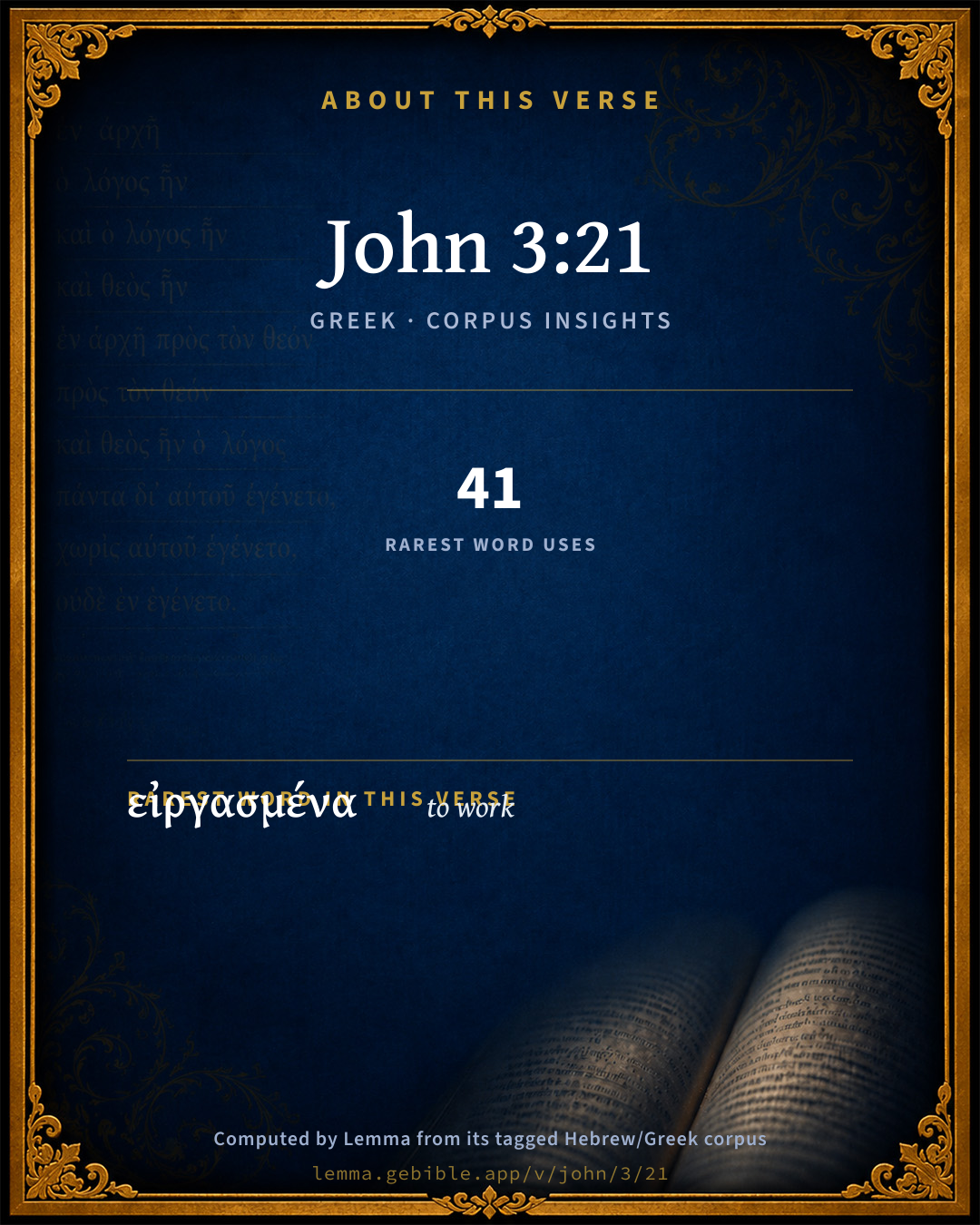
εἰργασμένα to work G2038 occurs in 39 verses of the Greek New Testament. Also found in:

Repetition

A word recurs within this verse:

Cross-references

29

Topical passages linked to John 3:21 in the Treasury of Scripture Knowledge — connected by theme and wording, ordered by reader-vote popularity; previews shown in the World English Bible.

  • 1 John 1:6 If we say that we have fellowship with him and walk in the darkness, we lie, and don't tell the truth.
  • Psalms 139:23–24 Search me, God, and know my heart. Try me, and know my thoughts.
  • 3 John 1:11 Beloved, don't imitate that which is evil, but that which is good. He who does good is of God. He who does evil hasn't seen God.
  • Ephesians 5:9 for the fruit of the Spirit is in all goodness and righteousness and truth,
  • Philippians 2:13 For it is God who works in you both to will and to work, for his good pleasure.
  • Psalms 119:105 Your word is a lamp to my feet, And a light for my path.
  • 1 John 4:15–16 Whoever confesses that Jesus is the Son of God, God remains in him, and he in God.
  • 1 John 2:27–29 As for you, the anointing which you received from him remains in you, and you don't need for anyone to teach you. But as his anointing teaches you concerning all things, and is true, and is no lie, and even as it taught you, you will remain in him.
  • Galatians 6:8 For he who sows to his own flesh will from the flesh reap corruption. But he who sows to the Spirit will from the Spirit reap eternal life.
  • Psalms 119:80 Let my heart be blameless toward your decrees, That I may not be disappointed.
  • John 1:47 Jesus saw Nathanael coming to him, and said about him, "Behold, an Israelite indeed, in whom is no deceit!"
  • Philippians 1:11 being filled with the fruits of righteousness, which are through Jesus Christ, to the glory and praise of God.
  • 1 Peter 1:22 Seeing you have purified your souls in your obedience to the truth through the Spirit in sincere brotherly affection, love one another from the heart fervently:
  • John 5:39 "You search the Scriptures, because you think that in them you have eternal life; and these are they which testify about me.
  • Galatians 5:22–23 But the fruit of the Spirit is love, joy, peace, patience, kindness, goodness, faithfulness,
  • Colossians 1:29 for which I also labor, striving according to his working, which works in me mightily.
  • Hebrews 13:21 make you complete in every good work to do his will, working in you that which is well pleasing in his sight, through Jesus Christ, to whom be the glory forever and ever. Amen.
  • 1 John 4:12–13 No one has seen God at any time. If we love one another, God remains in us, and his love has been perfected in us.
  • Isaiah 26:12 Yahweh, you will ordain peace for us; for you have also worked all our works for us.
  • John 15:4–5 Remain in me, and I in you. As the branch can't bear fruit by itself, unless it remains in the vine, so neither can you, unless you remain in me.
  • Acts 17:11–12 Now these were more noble than those in Thessalonica, in that they received the word with all readiness of the mind, examining the Scriptures daily to see whether these things were so.
  • 2 Corinthians 1:12 For our boasting is this: the testimony of our conscience, that in holiness and sincerity of God, not in fleshly wisdom but in the grace of God we behaved ourselves in the world, and more abundantly toward you.
  • Psalms 1:1–3 Blessed is the man who doesn't walk in the counsel of the wicked, Nor stand in the way of sinners, Nor sit in the seat of scoffers;
  • Hosea 14:8 Ephraim, what have I to do any more with idols? I answer, and will take care of him. I am like a green fir tree; From me your fruit is found."
  • 1 Corinthians 15:10 But by the grace of God I am what I am. His grace which was bestowed on me was not futile, but I worked more than all of them; yet not I, but the grace of God which was with me.
  • Isaiah 8:20 To the law and to the testimony! if they don't speak according to this word, surely there is no morning for them.
  • 2 Peter 1:5–10 Yes, and for this very cause adding on your part all diligence, in your faith supply moral excellence; and in moral excellence, knowledge;
  • Revelation 3:1–2 "And to the angel of the assembly in Sardis write: He who has the seven Spirits of God, and the seven stars says these things: "I know your works, that you have a reputation of being alive, but you are dead.
  • Revelation 3:15 "I know your works, that you are neither cold nor hot. I wish you were cold or hot.

Cross-references courtesy of OpenBible.info (CC BY 4.0).

Commentary

Notes on John 3:21 from classic Christian and Jewish commentators (each source and its license shown beneath its notes). The classic Christian expositions comment on the surrounding passage and are grouped to its opening verse, so a note may address several verses; the Jewish commentaries on the Tanakh (Rashi and others) are per-verse, so they appear only where the commentator wrote on this verse.

Lemma curates 59 commentaries, every one of them public domain or Creative Commons licensed, each selected and text-cleaned for this edition rather than reprinted as found. About our sources →

Bengel's Gnomon

Johann Albrecht Bengel

Joh 3:21. Ὁ ποιῶν, who does) Ποιεῖν is often used of continuous zeal; as with the Latins, mercaturam facere, etc.—φανερωθῇ, may be made manifest) Even Nicodemus subsequently acted more openly.—ἔργα—εἰργασμένα) Words akin [conjugate].—ἐν Θεῷ, in God) in the light, by the virtue [the power] and love of Him, from whom cometh all truth.

Bengel's Gnomon of the New Testament — English translation (T&T Clark, Edinburgh, 1860) — public domain. Text from a community e-Sword module.

Meyer's Critical & Exegetical Commentary

Heinrich August Wilhelm Meyer

Joh_3:21. Ὁ δὲ ποιῶν τὴν ἀλήθ.] The opposite of ὁ φαῦλα πράσσων, Joh_3:20, and therefore ἀλήθεια is to be taken in the ethical sense: he who does what is morally true, so that his conduct is in harmony with the divine moral standard. Comp. Isa_26:10; Psa_119:30; Neh_9:33; Job_4:6; Job_13:6; 1Jn_1:6; 1Co_5:8; Eph_5:9; Php_4:8. Moral truth was revealed before Christ, not only in the law (Weiss), but also (see Mat_5:17) in the prophets, and, outside Scripture, in creation and in conscience (Rom_1:19 ff; Rom_2:14 ff.). Comp. Groos, p. 255.

ἵνα φανερ. αὐτοῦ τὰ ἔργα] φανερ. is the opposite of the μὴ ἐλεγχθῇ Joh_3:20. While the wicked wishes his actions not to be reproved, but to remain in darkness, the good man wishes his actions to come to the light and to be made manifest, and he therefore ἔρχεται πρὸς τὸ φῶς; for Christ, as the personally manifested Light, the bearer of divine truth, cannot fail through His working to make these good deeds be recognised in this their true nature. The manifestation of true morality through Christ must necessarily throw the true light on the moral conduct of those who come to Him, and make it manifest and show it forth in its true nature and form. The purpose ἵνα φανερ., κ.τ.λ., does not spring from self-seeking, but arises from the requirements, originating in a moral necessity, of moral satisfaction in itself, and of the triumph of good over the world.

αὐτοῦ] thus put before, for emphasis sake, in opposition to the evil-doer, who has altogether a different design with reference to his acts.

ὅτι ἐν θεῷ, κ.τ.λ.] the reason of the before-named purpose. How should he not cherish this purpose, and desire the φανέρωσις, seeing that his works are wrought in God! Thus, so far from shunning, he has really to strive after the manifestation of them, as the revelation of all that is divine. We must take this ἐν θεῷ, like the frequent ἐν Χριστῷ, as denoting the element in which the ἐργάζεσθαι moves; not without and apart from God, but living and moving in Him, has the good man acted. Thus the κατὰ τὸ θέλημα τοῦ θεοῦ, 1Jn_5:14, and the κατὰ θεόν, Rom_8:27, 2Co_7:10, also the εἰς θεόν, Luk_12:21, constitute the necessary character of the ἐν θεῷ, but are not the ἐν θεῷ itself.

ἔργα εἰργασμένα] as in Joh_6:28, Joh_9:4, Mat_26:10, et al., and often in the classics.

Observe from Joh_3:21, that Christ, who here expresses Himself generally, yet conformably to experience, encountered, at the time of His entering upon His ministry of enlightenment, not only the φαῦλα πράσσοντες, but also those who practised what is right, and who were living in God. To this class belonged a Nathanael, and the disciples generally, certainly also many who repented at the preaching of the Baptist, together with other O. T. saints, and perhaps Nicodemus himself. They were drawn by the Father to come to Christ, and were given to Him (Joh_6:37); they were of God, and had ears to hear His word (Joh_8:47, comp. Joh_18:37); they were desirous to do the Fathers will (Joh_7:17); they were His (Joh_17:6). But according to Joh_3:19, these were exceptions only amid the multitude of the opposite kind, and even their piety needed purifying and transfiguring into true δικαιοσύνη, which could be attained only by fellowship with Christ; and hence even in their case the way of Christian penitence, by the φανέρωσις of their works wrought in God, brought about by the light of Christ, was not excluded, but was exhibited, and its commencement brought about, because, in view of this complete and highest light, the sincere Old Testament saint must first rightly feel the need of that repentance, and of the lack of moral satisfaction. Consequently the statement of Joh_3:3; Joh_3:5, still holds true.

Meyer — Critical and Exegetical Commentary on the New Testament — English translation by Peter Christie, edited by Frederick Crombie (T&T Clark, 1880) — public domain. Text from a community e-Sword module.

Expositor's Greek Testament

ed. W. Robertson Nicoll

Joh 3:21 . ὁ δὲ ποιῶν … “On the other hand, he who does the truth” … This is one of John’s comprehensive phrases which perhaps lose by definition. “To do the truth” is at any rate to live up to what one knows; to live an honest, conscientious life. John implies that men of this type are to be found where the light of Christ has not dawned: but when it dawns they hail it with joy. He that doeth the truth comes to the light that his deeds may be manifested, ὅτι ἐν θεῷ ἐστιν εἰργασμένα . Is ὅτι expressive of a fact or declarative of a reason? Must we translate “manifested, that they are,” etc., or “manifested, because they are,” etc.? The R.V [45] has “that” in the text, and “because” in the margin. Godet and Westcott prefer the former; Lücke, Meyer, Weiss and Weizsäcker the latter. It is not easy to decide between the two. On the whole, the latter interpretation is to be preferred. This clause gives the reason of the willingness shown by the man to have his deeds made manifest: and thus it balances the clause ἦν γὰρ πονηρὰ αὐτῶν τὰ ἔργα , which gives the reason for evil doers shunning the light. He who does the truth is not afraid of the light, but rather seeks increased light because his deeds have been done ἐν θεῷ ; that is, he has not been separated from God by them, but has done what he has done because he conceived that to be the will of God. Where such light as exists has been conscientiously used, more is sought, and welcomed when it comes. “Plato was like a man shut into a vault, running hither and thither, with his poor flickering Taper, agonizing to get forthe, and holding himself in readinesse to make a spring forward the moment a door should open. But it never did. ‘Not manie wise are called.’ He had clomb a Hill in the Darke, and stood calling to his companions below, ‘Come on, come on, this way lies the East: I am avised we shall see the sun rise anon’. But they never did. What a Christian he would have made. Ah! he is one now. He and Socrates, the veil long removed from their eyes, are sitting at Jesus’ feet. Sancte Socrates, ora pro nobis” (Erasmus to More in Sir T. More’s Household ). Holtzmann quotes from Hausrath: “As a magnet attracts the metal while the dead stone lies unmoved: so are the children of God drawn by the Logos and come to the Light”. Cf. chap. Joh 18:37 .

[45] Revised Version.

The Expositor's Greek Testament, edited by W. Robertson Nicoll (1897–1910) — public domain. Text from a community e-Sword module.

Vincent's Word Studies in the New Testament

Marvin R. Vincent

Doeth the truth [ποιων την αληθειαν] . The phrase occurs only here and in 1Jo 1:6. Note the contrasted phrase, doeth evil (ver. 20). There the plural is used : doeth evil things; evil being represented by a number of bad works. Here the singular, the truth, or truth; truth being regarded as one, and "including in a supreme unity all right deeds." There is also to be noted the different words for doing in these two verses : doeth evil [πρασσων] ; doeth truth [ποιων] . The latter verb contemplates the object and end of action; the former the means, with the idea of continuity and repetition. Prasswn is the practice, while poiwn may be the doing once for all. Thus poiein is to conclude a peace : prassein, to negotiate a peace. So Demosthenes : "He will do [πραξει] these things, and will accomplish them [ποιησει] ." In the New Testament a tendency is observable to use poiein in a good sense, and prasswin in an evil sense. Compare the kindred word praxiv, deed or work, which occurs six times, and in four out of the six of evil doing (Mt 16:27; Luk 23:51; Act 19:18; Rom 8:13; Rom 12:14; Col 3:9). With this passage compare especially Joh 5:29, where the two verbs are used with the two nouns as here. Also, Rom 7:15, 19. Bengel says : "Evil is restless : it is busier than truth." In Rom 1:32; Rom 2:3, both verbs are used of doing evil, but still with a distinction in that prassw is the more comprehensive term, designating the pursuit of evil as the aim of the activity.

Joh 3:21Cometh to. In contrast with hateth (ver. 20). His love of the light is shown by his seeking it.

In God. The element of holy action. Notice the perfect tense, have been wrought (as Rev.) and abide.

Marvin R. Vincent, Word Studies in the New Testament (1887–1900) — public domain. Text from a community e-Sword/MySword module.

Godet's Commentaries

Frédéric Louis Godet

Ver. 21. “But he that doeth the truth cometh to the light, that his works may be made manifest because they are wrought in God.”

Sincere love of moral good predisposes to faith; for Jesus is the good personified. There are in humanity, even before the appearance of Christ, men who, although like others affected by inborn evil, react against their evil inclinations, and pursue with a noble ardor the realization of the moral ideal which shines before them. Jesus here calls them those who do the truth. St. Paul, also in accord with St. John on this point, describes them as those who by persevering in well-doing seek for glory, honor and incorruption (Rom 2:7). This earnest aspiration after the good, which the theocratic discipline stimulates and protects in Israel, forms a contrast to the mummeries of the Pharisaic righteousness. It can be present in a penitent publican, no less than in an irreproachable Pharisee.

The same idea is found again in the expressions to be of God, to be of the truth (Joh 8:47, Joh 18:37). This disposition is the condition of all real faith in the Gospel. The adherence of the will to the preparatory revelation of God, whether in the law of conscience or in that of Moses, is the first condition of the adherence to the higher revelation of divine holiness in Jesus Christ. The expression to do the truth denotes the persevering effort to raise one’s conduct to the height of one’s moral consciousness, to realize the ideal of the good perceived by the conscience; comp. Romans 7. The soul which, it may be, in consequence of the bitter experience of sin, longs after holiness, recognizes in Jesus its realized ideal and that by which it will itself attain to the realization of it. The figurative expression to come to the light signifies to draw near to Jesus, to listen to Him with docility, to surrender oneself to Him; comp. Luk 15:1-2. Is there not, in the choice of this figure, a delicate allusion to the present course of Nicodemus? As truly as this night which reigns without is the figure of the unbelief in which the lovers of sin envelop themselves, so really is this light around which these few interlocutors meet, the emblem of the divine brightness which Nicodemus came to seek for. And so it will come to pass. It is the farewell of Jesus: Thou desirest the good; it is this which brings thee here. Take courage! Thou shalt find it!

If the upright hearts come to the light, it is because they do not, like those spoken of before, dread the manifestation of the true character of their conduct; on the contrary, they desire it: To the end, says Jesus, “that their works may be manifested because they are done in God.” I return thus to the ordinary translation of the close of this verse. I had previously preferred the following: That they may be manifested as being done in God; comp. for this Greek construction, Joh 4:35. But the first construction is more natural here. The truly righteous man seeks, as Nicodemus did, to come into contact with Christ, the living holiness, because he has within him nothing which impels him to withdraw himself from the light of God; on the contrary, the nature of his works is the cause of his being happy to find himself fully in that light.

The expression wrought in God seems very strong to characterize the works of the sincere man before he has found Christ. But let us not forget that, both in Israel and even beyond the theocratic sphere, it is from a divine impulse that everything good in human life proceeds. It is the Father who draws souls to the Son, and who gives them to Him (Joh 6:37; Joh 6:44). It is God who causes to resound in the sincere soul the signal for the strife, ineffectual though it be, against inborn evil (Romans 7). Wherever there is docility on the part of man towards this divine initiative, this expression works wrought in God is applicable, which comprehends as well the sighs of the humbled publican and the repentant believer as the noble aspirations of a John or a Nathanael. Such a man, conscious of his sincere desire for the good, does not fear to expose himself to the light and consequently to come to Christ. The more he acts in God, the more he desires to see clearly within himself, to the end of attaining a still more perfect obedience. In the previous editions, I had referred the in order that to the need of a holy approbation. Weisssees in it the desire to show that the good works accomplished are those of God and not those of the man. I think that the question is rather of a need of progress. Luthardt seems to me to have completely perverted the meaning of this verse and to have lost the very profound teaching which it contains, by explaining: “He who practices the moral truth manifested in Christ soon attaches himself to Christ by the religious bond of faith.” But does not the practice of the holiness revealed in Christ necessarily imply faith in Him? The saying of Jesus in Joh 7:17 has a striking analogy to this.

“In humanity anterior to Christ,” says Lucke rightly, “two kinds of men are mingled together. With the appearance of Jesus, the separating begins;” αὕτη ἡ κρίσις . “Under the trees of the same forest,” observes Lange, “all sorts of birds find shelter together during the night. But in the morning, as soon as the sun sheds forth his rays, some close their eyes and seek the darkest retreat, while others clap their wings and salute the sun with their songs. Thus the appearing of Christ separates the lovers of the day from those of the night, mingled together until then in the mass of mankind.” We must not, however, understand this idea in the sense which the Tubingen school ascribes to the evangelist: That there are two kinds of men opposite in their nature. All the expressions used by John: “They loved rather,” “to practise evil things,” “to do the truth,” are, much rather, borrowed from the domain of free choice and deliberate action. (Comp. Introd., pp. 132f.).

It is with this word of hope that Jesus takes leave of Nicodemus. And we can easily understand why, in contrast with John the Baptist’s course (Joh 3:36), Jesus spoke, in the first place, of those who reject the light (Joh 3:19-20), and, in the second place, of those who seek it (Joh 3:21). He wished to terminate the conversation with a word of encouragement addressed to His interlocutor. He had recognized in him one of those righteous souls who will one day believe and whom faith will lead to the baptism of water, and thereby to the baptism of the Spirit. Henceforth Jesus waits for him. Reuss deems the silence of John respecting his departure surprising. “We have, indeed, seen him come; but we do not see him go away. We are wholly ignorant of the result of this interview.” Then this scholar boldly draws therefrom a proof against the historical reality of the personage of Nicodemus and his conversation with Jesus. Is this objection serious? The evangelist should then have told us expressly, that Nicodemus, on leaving Jesus, returned to his own home and went to bed! Does not the effect produced upon him by the conversation appear plainly from the later history? Comp. Joh 7:50-51; Joh 19:39. John respects the mystery of the inner working which had just begun, and leaves the facts to speak. It is the revelation of Jesus to Nicodemus which is the subject of this narrative, and not the biography of this Pharisee. No more does Matthew mention the return of the Twelve after their first mission (chap. 10); does it follow from this that their mission is not historical? The narrative of our Gospels is wholly devoted to the religious end and does not entertain itself with empty details.

We are now in a condition to give a judgment respecting this interview. It seems to me that its historical character follows from the perfect appositeness, which we have established, in all the words of Jesus and in their exact appropriateness to the given situation. The statement of Joh 3:1, “A man of the Pharisees” is found to be the key of the whole passage. Every word of Jesus is like a shot fired at close quarters with such an interlocutor. He begins by bringing home to this man who approaches Him, as well assured of his participation in the divine kingdom as of his very existence, a sense of all that which he lacks, and by saying, although in other terms:

“Unless thy righteousness surpasses that of the Scribes and Pharisees, thou shalt not enter the kingdom of heaven.” After having thus made a void in this heart full of itself and its own righteousness, he endeavors to fill this void in the positive part of the conversation, in which He answers the questions which Nicodemus had proposed to present to Him. In this answer, He opposes, from the beginning to the end, programme to programme: first, Messiah to Messiah, then, salvation to salvation, finally, judgment to judgment, substituting with regard to each of these points the divine thought for the Pharisaic expectation. There is enough, as it seems to me, in this direct application, this constant fitness, and this unshaken steadiness of course in the conversation to guarantee its reality. An artificial composition of the second century would not have succeeded in adapting itself so perfectly to the given situation. In any case, the cohesion of all the parts of the conversation is too evident to allow of the distinction between the part belonging to Jesus and that belonging to the evangelist. Either the whole is a free composition of the latter, or the whole also must be regarded as the summary of a real conversation of Jesus. We say: the summary; for we certainly do not possess a complete report. The visit of Nicodemus, of course, continued longer than the few minutes necessary for reading the account of it. John has transmitted to us in a few salient words the quintessence of the communications of Jesus at this juncture. This is what the quite vague transitions by means of a simple and, καί, indicate. We have before us the principal mountain peaks, but not the whole of the chain (comp. Introd., p. 99).

Frédéric Louis Godet — Commentaries on Luke, John, Romans, and 1 Corinthians — English translation (T&T Clark, Edinburgh, 1870s–1890s) — public domain. Text from a community e-Sword module.

Geneva Bible (1599)

Geneva Bible translators

That is, he that leadeth an honest life, and void of all craft and deceit.

That is, with God, God as it were going before.

Geneva Bible (1599) marginal notes — public domain. Text via Bolls.life.

Jamieson, Fausset & Brown

Robert Jamieson, A. R. Fausset & David Brown

doeth truth--whose only object in life is to be and do what will bear the light. Therefore he loves and "comes to the light," that all he is and does, being thus thoroughly tested, may be seen to have nothing in it but what is divinely wrought and divinely approved. This is the "Israelite, indeed, in whom is no guile."

Jamieson, Fausset & Brown — Commentary Critical and Explanatory on the Whole Bible (1871) — public domain (CC PDM 1.0). Text via the HelloAO Bible API.

Adam Clarke's Commentary

Verse 21. Wrought in God.] In his presence, and through his assistance. This is the end of our Lord's discourse to Nicodemus; and though we are not informed here of any good effects produced by it, yet we learn from other scriptures that it had produced the most blessed effects in his mind, and that from this time he became a disciple of Christ. He publicly defended our Lord in the Sanhedrin, of which he was probably a member, Joh 7:50, and, with Joseph of Arimathea, gave him an honourable funeral, Joh 19:39, when all his bosom friends had deserted him. See Dodd.

Adam Clarke's Commentary on the Bible (1810–1826) — public domain. Text from a community e-Sword/MySword module.

John Calvin's Commentaries

21. But he who doeth truth This appears to be an improper and absurd statement, unless you choose to admit that some are upright and true, before they have been renewed by the Spirit of God, which does not at all agree with the uniform doctrine of Scripture; for we know that faith is the root from which the fruits of good works spring. To solve this difficulty, Augustine says, that to do truth means “to acknowledge that we are miserable and destitute of all power of doing good;” and, certainly, it is a true preparation for faith, when a conviction of our poverty compels us to flee to the grace of God. But all this is widely removed from Christ’s meaning, for he intended simply to say that those who act sincerely desire nothing more earnestly than light, that their works may be tried; because, when such a trial has been made, it becomes more evident that, in the sight of God, they speak the truth and are free from all deceit. Now it would be inconclusive reasoning, were we to infer from this, that men have a good conscience before they have faith; for Christ does not say that the elect believe, so as to deserve the praise of good works, but only what unbelievers would do, if they had not a bad conscience.

Christ employed the word truth, because, when we are deceived by the outward lustre of works, we do not consider what is concealed within. Accordingly, he says, that men who are upright and free from hypocrisy willingly go into the presence of God, who alone is the competent Judge of our works. For those works are said to be done in God or according to God, which are approved by Him, and which are good according to His rule. Hence let us learn that we must not judge of works in any other way than by bringing them to the light of the Gospel, because our reason is wholly blind.

John Calvin's Commentaries (1540-1563) — public domain. Text from the Calvin Translation Society English edition (1840s-50s) via the Christian Classics Ethereal Library (ccel.org). Calvin's coverage is partial (roughly two-thirds of the Bible); uncommented books and verses are honest gaps, never fabricated. The 19th-century editor's footnotes and remarks are omitted so the notes are faithfully Calvin's own voice.

Ellicott's Commentary for English Readers

(21) He that doeth truth is opposed to “him that practiseth evil.” With fixed purpose he doeth not that which is evil or worthless, but that which, when every veil by which it is hidden from himself or others is removed, remains morally true. Regarding truth as the work of life, he cometh to the light, and though for him too it will be a revelation of sins and errors, and deeds of shame, he hates them the moment he knows them, cuts them from his life at whatever cost, and carries his whole being to the light that it may become really true, and that its true works may be made manifest. He will hate the darkness, for he can have nothing to conceal in it. He will love the light, for everything which it reproves he reproves too, and every ray he can gather from it becomes part of the truth which is his life-work. For the remarkable expression “to do the truth,” which, with its opposite “to do a lie” (Joh_8:44; Rev_21:27; Rev_22:15), is common in Rabbinic writers, comp. Job_13:4, and 1Jn_1:6; and for “walking in truth,” comp. 2Jn_1:4, and 3Jn_1:3-4. In 1Co_13:6, “truth” is opposed to “iniquity.”

That they are wrought in God.—Perhaps better, because they are wrought in God. This is the reason of their being made manifest in the light revealed in the person of Christ. However full the light which had guided men’s steps had been, it was still part of the true Light which lighteth every man, and must lead to Him. Every work wrought in God had already bound them in union with Him, and prepared them to receive Him. That Light was in the world, in the Law and Prophets of the Old Testament Scriptures (Mat_5:17), in the witness of things invisible ever borne by the things that are made (Rom_1:20), in the law written upon the hearts of men (Rom_2:14-15). As before (Joh_3:19), these words are general, but we may not exclude from them a special meaning. He who spoke them warrants our applying them to characters, like the true Nathanael, in whom there is no guile (Joh_1:47); like the rock-man Peter (Joh_1:42); like the witness John (Mat_11:11). Some ground was good when the Sower went forth to sow.

Two thoughts are suggested to us at the close of this first discourse. One is, that the writer, with perfect naturalness, says nothing of the effect on Nicodemus, but leaves the after-glimpses to tell their own tale. (See Joh_7:50; Joh_19:39.) The other is, that we have come upon teaching distinct in style and matter from that of the earlier Gospels. On this see Excursus D: The Discourses in St. John’s Gospel.

A Bible Commentary for English Readers, edited by Charles John Ellicott (1878–1897) — public domain. Text from a community e-Sword module.

The Cambridge Bible for Schools and Colleges

gen. ed. J. J. S. Perowne

21. doeth truth] Or, as in 1Jn_1:6, doeth the truth, the opposite of ‘doing’ or ‘making a lie,’ Rev_21:27; Rev_22:15. It is moral rather than intellectual truth that is meant. To ‘do the truth’ is to do that which is true to the moral law (comp. Joh_8:32), that which has true moral worth, as opposed to ‘practising worthless things.’ In 1Co_13:6 we have a similar antithesis: ‘rejoicing with the truth’ is opposed to ‘rejoicing in iniquity.’

that his deeds may be made manifest] ‘His’ is emphatic, ‘his deeds’ as opposed to those of him that doeth evil. ‘Be made manifest’ balances ‘be reproved.’ The one fears to be convicted; the other courts the light, not for self-glorification, but as loving that to which he feels his works are akin. See on Joh_1:31.

wrought in God] Better, have been wrought in God. This is his reason for wishing them to be made manifest; it is a manifestation of something divine. The Greek for ‘that they are’ may mean ‘because they are.’

These three verses (19–21) shew that before the Incarnation there were two classes of men in the world; a majority of evil-doers, whose antecedents led them to shun the Messiah; and a small minority of righteous, whose antecedents led them to welcome the Messiah. They had been given to Him by the Father (Joh_6:37, Joh_17:6); they recognised His teaching as of God, because they desired to do God’s will (Joh_7:17). Such would be Simeon, Anna (Luk_2:25; Luk_2:36), Nathanael, the disciples, &c.

We have no means of knowing how Nicodemus was affected by this interview, beyond the incidental notices of him Joh_7:50-51, Joh_19:39, which being so incidental shew that he is no fiction.

The Cambridge Bible for Schools and Colleges (gen. ed. J. J. S. Perowne; Cambridge University Press, 1878–1918) — public domain. Text from a community e-Sword module.

John Gill's Exposition

After these things,.... After Christ's coming to Jerusalem, at the feast of the passover, with his disciples, and driving the buyers and sellers from the temple, and doing the miracles he did there, upon which many believed on him; and after the long discourse he had with Nicodemus, concerning regeneration, and other things:

came Jesus and his disciples, into the land of Judea; or "into Judea the country", having been in Jerusalem, the city part or chief city in Judea; so that the country is distinguished from, and opposed to the city. And thus, a countryman, and a Jerusalemite, or citizen of Jerusalem, are distinguished (l);

"if, "a countryman", (one that lives in the country any where in the land of Israel out of Jerusalem (m),) receives a field, "from a man of Jerusalem", the second tithes belong to the Jerusalemite; but the wise men say, the countryman may bring them up, and eat them at Jerusalem.''

Or, it may be, because that Jerusalem was part of it in the tribe of Benjamin, and the other in the tribe of Judah; therefore, when Christ, and his disciples, left Jerusalem, they might more properly be said to come into the land of Judea. Indeed, it is commonly said by the Jews (n), that Jerusalem was not divided among the tribes, and that it did not belong to any tribe; and if so, then with greater propriety still might Christ be said to come into the land of Judea, when he departed from Jerusalem; unless it should be thought, that he went into Galilee, and after that came into the land of Judea; so Nonnus:

and there he tarried with them: with his disciples, as Nonnus; and with the inhabitants of those parts: he made a longer stay here than at Jerusalem, having more work to do here, and being more delighted with the plainness and simplicity of the country people; or "he conversed" with them, as the Syriac version renders it; he exercised, and employed himself among them, as the Greek word used signifies: he went about from village to village, doing good, healing diseases, and preaching the Gospel which was made useful to many:

and baptized; not he himself, but his disciples, by his orders, and in his name; see Joh 4:2; whereby he gave fresh countenance and sanction to the ordinance of water baptism, administering it to others, as well as submitting to it himself.

(l) Misn. Demai, c. 6. sect. 4. (m) Maimon. Bartenora in ib. (n) T. Bab. Yoma, fol. 12. 1, & Megilla, fol. 26. 1.

John Gill's Exposition of the Whole Bible (1746–1763) — public domain (CC PDM 1.0). Text via the HelloAO Bible API.

Trapp's Complete Commentary

John Trapp

21 But he that doeth truth cometh to the light, that his deeds may be made manifest, that they are wrought in God.

Ver. 21. But he that doeth truth] Tenebriones Papistae male sibi conscii, aeternum atri, et tetri sunto, et habentor, gui non tam cute, quam corde Aethiopici, solem quo magis luceat, eo magis execrentur. But our hearts (as our climate) have mere light than heat. Sir Philip Sydney used to say of Chaucer, that he wondered how in those misty times he could see so clearly; and how we in these clearer times go on so stumblingly. "If any be ignorant, let him be ignorant," saith Paul, 1Co 14:38. And so much any one knows, as he does of God’s will, as the apostle intimates, when he tells us that "Christ knew no sin," that is, he did none, 2Co 5:21.

Wrought in God] Right. 1. Quoad fontem, a pure heart. 2. Quoad finem, the glory of God. Else they are but splendida peccata, sins in a silken suit. (Aug.)

John Trapp, A Commentary or Exposition upon All the Books of the Old and New Testament (1647–1656) — public domain. Text from a community e-Sword module.

Albert Barnes' Notes on the Bible

Are that doeth truth - He who does right, or he that obeys the truth. Truth here is opposed to error and to evil. The sinner acts from falsehood and error. The good man acts according to truth. The sinner believes a lie - that God will not punish, or that there is no God, or that there is no eternity and no hell. The Christian believes all these, and acts as if they were true. This is the difference between a Christian and a sinner.

Cometh to the light - Loves the truth, and seeks it more and more. By prayer and searching the Scriptures he endeavors to ascertain the truth, and yield his mind to it.

May be made manifest - May be made clear or plain; or that it may be made plain that his deeds are performed in God. He searches for truth and light that he may have evidence that his actions are right.

Wrought in God - That they are performed according to the will of God, or perhaps by the assistance of God, and are such as God will approve. The actions of good people are performed by the influence and aid of God, Phi 2:12. Of course, if they are performed by his aid, they are such as he will approve. Here is presented the character of a good man and a sincere Christian. We learn respecting that character:

He does truth. He loves it, seeks it, follows it. He comes to the light. He does not attempt to deceive himself or others. He is willing to know himself, and aims to do it. He desires to know the true state of his heart before God. A special object of his efforts is that his deeds may be “wrought in God.” He desires to be a good man; to receive continual aid from God, and to perform such actions as he will approve.

This is the close of our Lord’s discourse with Nicodemus - a discourse condensing the gospel, giving the most striking exhibition and illustration of truth, and representing especially the fundamental doctrine of regeneration and the evidence of the change. It is clear that the Saviour regarded this as lying at the foundation of religion. Without it we cannot possibly be saved. And now it becomes every reader, as in the presence of God, and in view of the judgment-seat of Christ, solemnly to ask himself whether he has experienced this change? whether he knows by experience what it is to be born of that Spirit? If he does he will be saved. If not, he is in the gall of bitterness and in the bond of iniquity, and should give no sleep to his eyes until he has made his peace with God.

Albert Barnes' Notes on the Bible (1834–1885) — public domain. Text from a community e-Sword/MySword module.

Matthew Poole's English Annotations

Truth here is put for true things. He who purposeth, designeth, and acteth nothing but what is just, and holy, and good, and what is consonant to the will of God; he is not afraid to bring his notions and actions to the test of the Divine rule, published by him who is the true Light. For he desires that what he doth may be made manifest, both to himself and others, that they are wrought in, with, or according to, by, or through God (for the particle εν, here used, is used in all these senses, 1Co 7:39; Rev 14:13). Those works are said to be wrought in, with, by, or through God, which tend to the honour and glory of God as their end, and flow from him as their cause, which are done with his strength and assistance, and for his honour and glory.

Matthew Poole's English Annotations on the Holy Bible (1683–1685) — public domain. Text from a community e-Sword/MySword module.

Whedon's Commentary on the Bible

Daniel D. Whedon

21. Doeth truth—A most expressive phrase. Right is truth, and wrong is falsehood. Infidels and sinners act a lie.

Cometh to the light—The man who desires to act truth, loves that truth should shine upon his actions. He desires that they may be brought to the test of Christ’s religion and God’s truth. He loves to feel that his heart and life are in unison with the heart of the Redeemer and the life of God. In all this is there not some delicate allusion to the timidity of Nicodemus in coming to Jesus in the darkness of night? Surely the great ruler, if conscious of right, should have come by the light of day. And does not our Saviour here close the interview with an admonition that a good conscience is the basis of true courage?

Twice does Nicodemus reappear in Gospel history. Joh_7:50; Joh_19:39.

In the first instance he manifests the same blending of conscientious feeling with caution; in the second he manifests, by the richness of his embalment, his value for Jesus. Perhaps he then understood what meant this lifting up of the Son of man. The first Passover of our Lord’s ministry is now closed, and he leaves the national capital.

Daniel D. Whedon (gen. ed.), Commentary on the Old and New Testaments (1874–1909) — public domain. Text from a community e-Sword module.

The Pulpit Commentary

But he that doeth the truth who is "of the truth," and "heareth his voice", (Joh_18:37) he who is "morally true," inwardly sincere, who would never shrink from a genuine self-revelationcometh to the light. This remarkable expression allies itself with many other words of Christ, and suggests that in the heart of Judaism and of mankind generally, amid and notwithstanding the darkness which prevailed, there were found elect souls, taught of the Spirit, longing for more light, yearning to know the truth about themselves, however humiliating it might prove to be. This is confirmed by St. Paul"s argument (Romans 1 and Ro 2), where some Gentiles who have not the Law are admitted to do by nature the things contained in the Law, and even to become a law unto themselves; and where, in contradistinction to the hopelessly rebellious, Paul assumes that there are some who "by patient continuance in well doing, seek for glory, honour, and immortality." These "do the truth, and have no pleasure in unrighteousness." They are "taught of God," they have "seen and heard from the Father" some of the great things of the Law. The Holy Spirit has opened their eyes to see great things in the Law, and they come to the light. They are not afraid of the revelation it will make. They may be humbled and pained by the disclosure, but there is a Divine luxury in such pain. The purpose of the coming to the light on the part of one who doeth the truth, is in order that his works may be made manifest. This is the precise contrary of the conduct of the man whose eye is scaled and whose heart is made fat by sin. Such a one dreads conviction, the outward affirmation or utterance of the inwardly known krisiv ; and therefore shrinks from conviction or any conduct which will promote it. He flees from the man of God, he disdains the revealing Word, he rejects the blessed Christ, he loves the darkness, this is his condemnation. On the other hand, the sincere man, who is honest with himself, is supremely anxious for the true light to bear down upon his "works." He is willing that they should be manifested. If he is deceiving himself with false hopes, he yearns that these should disappear before the shining of the true light. If his works will bear examination, then let him know the verdict which is unconsciously being given by the revelation of the light. It is a nice question to determine the meaning of the oti . The current interpretation is for, or because, they are wrought in God; i.e. the sincere man desires this self-manifestation, comes to the light because his works have been inwrought by Divine grace. He loves the light, he does the truth because God has wrought within him to will and to do. In other words, the work of grace is in every case the adequate explanation of such a contrast to the common condition of human nature. Godet suggests that oti here has the meaning of "that," and urges that the Greek usage in Joh_4:35 and other passages will justify the translation, he cometh... manifest, that they are wrought in God, as though this Divine revelation were the real end of his coming to the light. This appears to me to be incompatible with the fact. The man who doeth the truth may yet need very much instruction before he accepts the Divine Original of his own conduct, or desires the manifestation to others of the Divine Source of his humble search. The more current translation, "because," is in harmony with the facts of Christian and religious experience, and is in keeping with the biblical assurance, that all good, all holiness, sincerity, and upright striving, just such as Nicodemus was then displaying, is God"s own work, and is the result of his grace.

Nicodemus comes, asks questions, receives weighty answers, and retires. We do not know the immediate result of these most wonderful words upon him; but we do find him taking the part of Jesus before the Sanhedrin; (Joh_7:50, Joh_7:51) and from Joh_19:39 we learn that, though a secret disciple, he did not disdain to come out of his hiding place to honour the corpse of the Crucified. The death of Jesus, which had blasted the hopes of the apostles, had fired those of Nicodemus. Every word of this discourse is compatible with the position of the great Prophet at this early period of his ministry, is suited to the Pharisaic mind, and adapted to meet its difficulties and correct its prejudices. If a few expressions, such as "the only begotten Son," "this is the condemnation, that," "he that doeth the truth," are found in writings which are John"s undoubted composition, the circumstance may be explained that he borrowed them from Jesus. This is quite as rational (not to say legitimate and reverential) as to suppose, because of them, that John invented them, and betrayed their origin by placing them in the lips of Jesus.

We do not suppose that John has mechanically recited the whole of the words that were spoken on either side, but preserved those heads of discourse which rise like mountain peaks above the oceans of thought between them, and are linked together by the glory which they severally reflect from the sublime personality of the Son of man.

The Pulpit Commentary (1880–1919), ed. H.D.M. Spence-Jones & Joseph S. Exell — public domain. Text from a community e-Sword module.

John Wesley's Explanatory Notes

He that practiceth the truth (that is, true religion) cometh to the light - So even Nicodemus, afterward did. Are wrought in God - That is, in the light, power, and love of God.

John Wesley, Explanatory Notes Upon the Whole Bible (1754–1765) — public domain. Text via the GEBible commentary corpus.

The People's New Testament

B. W. Johnson

21. He that doeth truth. Truth has to be lived. He who lives it, lives an honest life sincerely desiring light, will come to the light.

B. W. Johnson's The People's New Testament with Notes (1889–1891) — public domain. Electronic text from the Christian Classics Ethereal Library (CCEL) ThML edition.

Cambridge Greek Testament for Schools and Colleges

21. ποιῶν τ. ἀλήθ. To do the truth (1Jn 1:6) is the opposite of ‘doing’ or ‘making a lie,’ ποιεῖν ψεῦδος (Rev 21:27; Rev 22:15). It is moral rather than intellectual truth that is meant, moral good recognised by the conscience (Joh 18:37). To ‘do the truth’ is to do that which has true moral worth, the opposite of ‘practising worthless things.’ In 1Co 13:6 we have a similar antithesis: ‘rejoicing with the truth’ is opposed to ‘rejoicing in iniquity.’ see on Joh 1:9.

αὐτοῦ τὰ ἔργα. Αὐτοῦ is emphatic; ‘his works’ as opposed to those of ὁ φαῦλα πράσσων. Φανερωθῇ (see on Joh 1:31) balances ἐλεγχθῇ: the one fears to be convicted; the other seeks the light, not for self-glorification, but as being drawn to that to which he feels that his works are akin. Ὅτι is better rendered ‘that’ than ‘because.’

ἐν θεῷ. Note the order and the tense; that it is in God that they have been wrought and still abide: the permanent result of a past act. ‘In God’ means in the presence and in the power of God.

These three verses (19–21) shew that before the Incarnation there were two classes of men in the world; a majority of evil-doers, whose antecedents led them to shun the Messiah; and a small minority of righteous, whose antecedents led them to welcome the Messiah. They had been given to Him by the Father (Joh 6:37, Joh 17:6); they recognised His teaching as of God, because they desired to do God’s will (Joh 7:17). Such would be Simeon, Anna (Luk 2:25; Luk 2:36), Nathanael, the disciples, &c.

We have no means of knowing how Nicodemus was affected by this interview, beyond the incidental notices of him Joh 7:50-51, Joh 19:39, which being so incidental shew that he is no fiction. The discourse exactly harmonizes with his case, teaching that the righteousness of the scribes and Pharisees is powerless to gain admission into the kingdom of heaven. One by one his Pharisaic ideas of the kingdom, the Messiah, salvation and judgment, are challenged: from mere wonder at miracles and interest in the Worker of them he is made to look within and consider his own moral sympathies and spiritual convictions. Again we ask could a writer of the second century throw himself back to this?

Cambridge Greek Testament for Schools and Colleges (Cambridge University Press, 1896; 21 vols, various authors incl. Carr, Maclear, Plummer, Farrar, Lumby, Moule, M. R. James, Simcox) — public domain. Text from a community e-Sword module.

Alford’s Greek Testament

Henry Alford

21.] Who is this ποιῶν τ. ἀλήθ.? the end of ch. 1 will best explain to us,—ἐν ᾧ δόλος οὐκ ἔστιν, see also Luk 8:15, and Psa_15. The πράσσων πονηρά is crooked and perverse; he has a light, which he does not follow; he knows the light, and avoids it; and so there is no truth, singleness, in him; he is a man at variance with himself. But the simple and single-minded is he who knowing and approving the light, comes to it; and comes that he may be carried onward in this spirit of truth and single-mindedness to higher degrees of communion with and likeness to God. “The good man seeks the light, and to place his works in the light, not from a vain love of praise, but from a desire for communion wherein he finds strength and security,” De Wette. But this is not all: the manifesting his works, that they are wrought in God, is and can be only by the candle of the Lord being kindled within him, and he himself born again in the Kingdom of God: see Psa 139:23, Psa 139:24.

We hear nothing of the effect produced on Nicodemus by this interview. It certainly did not alienate him from Jesus, see ch. 7:50; 19:39, also ch. 12:42. “It speaks for the simplicity and historic truthfulness of our Evangelist, that he adds nothing more, and even leaves untold the immediate result which the discourse had.” (Baumgarten-Crusius, in Stier, iv. 102, edn. 2.)

Henry Alford, The Greek Testament (1849–1861) — public domain. Text from a community e-Sword module.

International Critical Commentary

21. א* omits from ὁ δὲ ποιῶν to τὰ ἔργα, because of the homoioteleuton τὰ ἔργα αὐτοῦ v. 20 and v. 21 (as read in its exemplar, instead of αὐτοῦ τὰ ἔργα).

ὁ δὲ ποιῶν τὴν ἀλήθειαν (cf. 1Jn 1:6) ἔρχεται πρὸς τὸ φῶς This is a universal saying, not to be confined to those who are already believers in Christ. As Christ Himself said: πᾶς ὁ ὢν ἐκ τῆς ἀληθείας ἀκούει μου τῆς φωνῆς (18:37). Jn. states that every honest doer of the truth comes into the light, and (as Christ is the Light) he therefore approaches Christ; he does so “that his works may be made manifest” (cf. 9:3). See on 8:34.

ὅτι ἐν θεῷ ἐστιν εἰργασμένα. ὅτι may mean “because” or “that.” The latter rendering seems preferable. The honest man (“in whom is no guile,” 1:47) comes to the light that it may be made plain that his deeds have been done ἐν θεῷ, a remarkable expression for which there is no exact parallel; cf. κοπιώσας ἐν κυρίῳ (Rom 16:12). See Psa 139:23, Psa 139:24 for the prayer of the righteous man, who does not shrink from the closest scrutiny of his life.

The Evangelist’s Commentary Continued (Vv. 31-36)

International Critical Commentary — older volumes (1896–1929), various authors — public domain. Text from a community e-Sword module.

Lesson kit

Teaching starters — assembled from the data on this page, not authored interpretation. Every prompt links to the verse data it draws on. Edit before teaching.

John, in the Gospels, opens this verse with 19 words (16 distinct Greek lemmas). Its most distinctive word is ergázomai (“to work”). A historical commentator’s framing appears above. Read the whole chapter for the surrounding context.

Discussion questions

  1. How does “to work” (ergázomai) shape what this verse is saying?
  2. How does Matthew 7:23, which shares the word «to work», read alongside this verse?
  3. What does the repetition of “the” (4× in this one verse) do in this verse?
  4. The translations on this page render this verse differently — a whole-verse word diff, not a word-by-word alignment. What might account for the different wordings?
  5. Compare how Bengel's Gnomon and Meyer's Critical & Exegetical Commentary read this verse. Where do they agree or differ?

Things to notice

Reading settings

Reading text

Shown beneath each verse's original-language words.

Old Testament
Old Testament edition

Read the OT as the Masoretic Hebrew (MT) or the Greek Septuagint (LXX).

English shown for the Greek Septuagint (in the Hebrew ↔ Greek comparison).

Comparing translations? Open the Compare panel on any verse page to stack up to four side by side.