
John 2:13

Greek (Tischendorf 8th ed.) John 2:13 appears in the Greek New Testament. The text above is from the Tischendorf 8th edition. Each word links to its Strong’s number and a concise gloss. Click any word for its full Thayer’s Greek Lexicon entry.
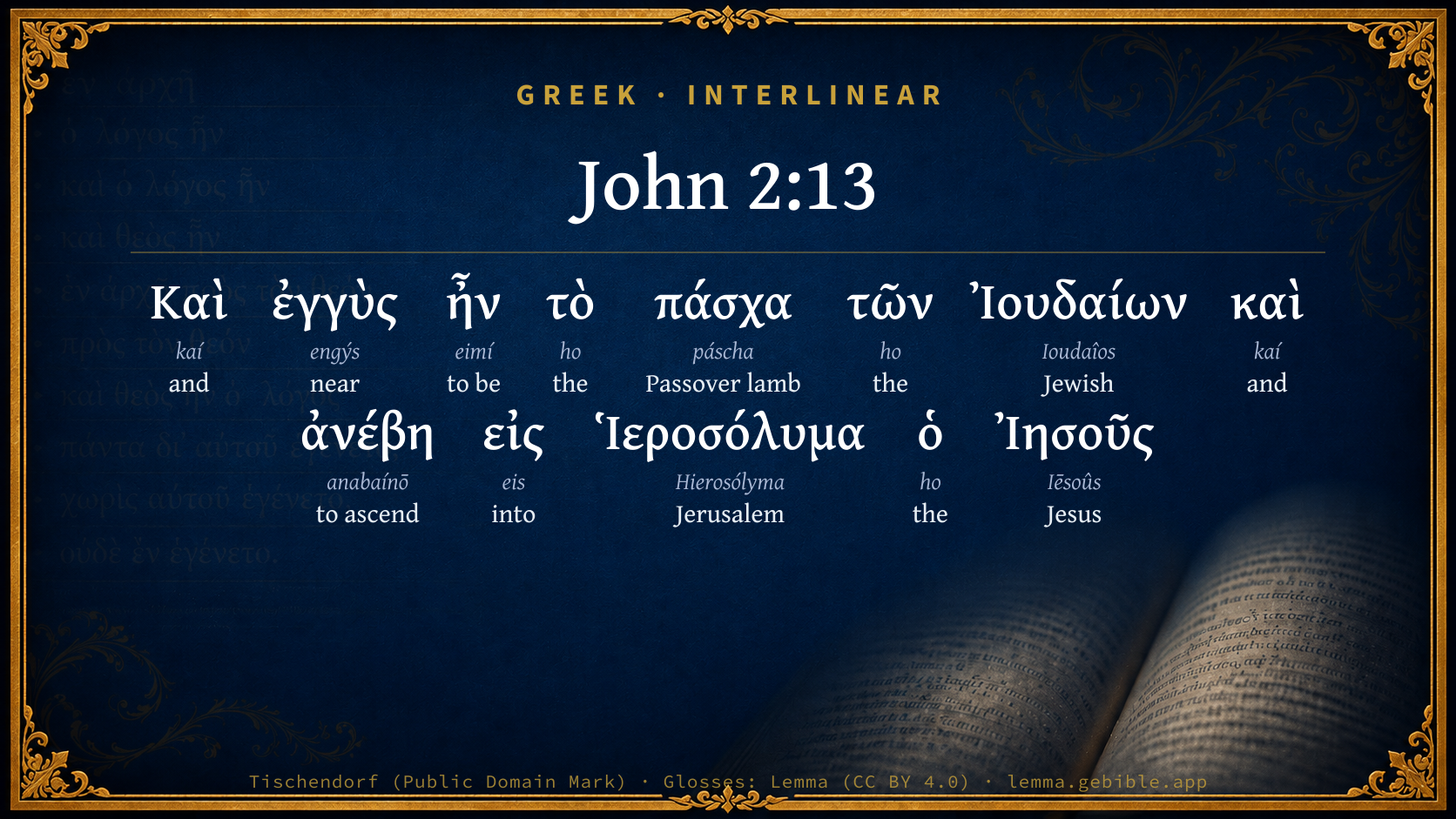
Download image
Cite this verse

John 2:13 (World English Bible). Public Domain. Lemma interlinear Bible study tool, https://lemma.gebible.app/v/john/2/13.

Show BibTeX & RIS
BibTeX
RIS
English Translation
The Passover of the Jews was at hand, and Jesus went up to Jerusalem.
World English Bible · Public Domain
Download a study sheet

One document with this verse’s original text, its word-by-word gloss line, the meaning frame, cross-references with their text, attributed commentary, and full source and license credits — printable, and it pastes into notes with its structure intact.

This verse Autodidact and up

Study sheet (.html) Plain text (.txt)

A passage Seminary Student

Up to 50 verses in one chapter. A passage sheet keeps up to 6 commentary sources and 12 cross-references per verse, in the order this page ranks them, and says so on the sheet whenever that leaves anything out. Ask for a single verse and you get the Autodidact verse sheet above.

Everything on this page stays free to read, with no account — the sheet is a download of what is already on screen, not access to it.

Want to remove ads? Support Godless Engineer
Compare translations 3

The same verse in 3 English versions, stacked beneath the original-language interlinear above. Click any original word for its lexicon entry.

Each is an independent rendering of the whole verse — the interlinear is not word-aligned to these translations.

Highlighted words mark where these versions differ — a whole-verse word diff, not a word-by-word alignment.

  • World English Bible Public Domain
    The Passover of the Jews was at hand, and Jesus went up to Jerusalem.
  • King James Version Public Domain
    And the Jews' passover was at hand, and Jesus went up to Jerusalem.
  • unfoldingWord Literal Text CC BY-SA 4.0
    And the Passover of the Jews was near, and Jesus went up to Jerusalem.

unfoldingWord Literal Text — © unfoldingWord, licensed CC BY-SA 4.0. Word-aligned USFM3 via Door43 (git.door43.org/unfoldingWord/en_ult).

Versions to compare (up to 4)

3 of 4 selected

Show all 19 translations

Every available English version of this verse, each an independent rendering of the whole verse.

  • World English Bible Public Domain
    The Passover of the Jews was at hand, and Jesus went up to Jerusalem.
  • Berean Standard Bible Public Domain
    When the Jewish Passover was near, Jesus went up to Jerusalem.
  • Majority Standard Bible Public Domain
    When the Jewish Passover was near, Jesus went up to Jerusalem.
  • King James Version Public Domain
    And the Jews' passover was at hand, and Jesus went up to Jerusalem.
  • American Standard Version (1901) Public Domain
    And the passover of the Jews was at hand, and Jesus went up to Jerusalem.
  • Revised Version (1885) Public Domain
    And the passover of the Jews was at hand, and Jesus went up to Jerusalem.
  • Geneva Bible (1599) Public Domain
    For the Iewes Passeouer was at hande. Therefore Iesus went vp to Hierusalem.
  • Douay-Rheims (1899) Public Domain
    And the pasch of the Jews was at hand, and Jesus went up to Jerusalem.
  • Young's Literal Translation Public Domain
    And the passover of the Jews was nigh, and Jesus went up to Jerusalem,
  • Literal Standard Version CC BY-SA 4.0
    And the Passover of the Jews was near, and Jesus went up to Jerusalem,
  • Unlocked Literal Bible CC BY-SA 4.0
    Now the Passover of the Jews was near, and Jesus went up to Jerusalem.
  • unfoldingWord Literal Text CC BY-SA 4.0
    And the Passover of the Jews was near, and Jesus went up to Jerusalem.
  • Darby Bible Public Domain
    And the passover of the Jews was near, and Jesus went up to Jerusalem.
  • World Messianic Bible Public Domain
    The Passover in Judea was at hand, and Yeshua went up to Jerusalem.
  • Webster's Bible Public Domain
    And the Jews' passover was at hand, and Jesus went up to Jerusalem,
  • Free Bible Version CC BY-SA 4.0
    Since it was almost time for the Jewish Passover, Jesus went on to Jerusalem.
  • Bible in Basic English Public Domain
    The time of the Passover of the Jews was near and Jesus went up to Jerusalem.
  • Text-Critical English NT CC BY 4.0
    Now the Passover of the Jews was near, so Jesus went up to Jerusalem.
  • Tyndale New Testament (1534) Public Domain
    And the Iewes ester was even at honde and Iesus went vp to Ierusalem

Literal Standard Version (2020), Covenant Press — licensed CC BY-SA 4.0. Text via the HelloAO Bible API (eBible.org). Unlocked Literal Bible (unfoldingWord) — licensed CC BY-SA 4.0. Text via the HelloAO Bible API (eBible.org). unfoldingWord Literal Text — © unfoldingWord, licensed CC BY-SA 4.0. Word-aligned USFM3 via Door43 (git.door43.org/unfoldingWord/en_ult). Free Bible Version, Dr. Jonathan Gallagher — licensed CC BY-SA 4.0. Text via the HelloAO Bible API (eBible.org).

Word by word

More ways to search: Search by grammar → Find every occurrence → Compare this word →

Practice this passage: Drill this verse → Learn its vocabulary →

πάσχα
páscha
G3957
“Passover lamb”
Aramaic transliteration
Part of Speech
Aramaic transliteration
Full Thayer's Definition

Origin: of Aramaic origin cf G6453

TDNT: 19:56,8

1. the paschal sacrifice (which was accustomed to be offered for the people's deliverance of old from Egypt) 2. the paschal lamb, i.e. the lamb the Israelites were accustomed to slay and eat on the fourteenth day of the month of Nisan (the first month of their year) in memory of the day on which their fathers, preparing to depart from Egypt, were bidden by God to slay and eat a lamb, and to sprinkle their door posts with its blood, that the destroying angel, seeing the blood, might pass over their dwellings; Christ crucified is likened to the slain paschal lamb 3. the paschal supper 4. the paschal feast, the feast of the Passover, extending from the 14th to the 20th day of the month Nisan
  1. Καὶ kaí G2532 “and” Conjunction
  2. ἐγγὺς engýs G1451 “near” Adverb
  3. ἦν eimí G1510 “to be” Verb, Imperfect, Active, Indicative, 3rd person, Singular
  4. τὸ ho G3588 “the” Article, Nominative, Singular, Neuter
  5. τῶν ho G3588 “the” Article, Genitive, Plural, Masculine
  6. Ἰουδαίων Ioudaîos G2453 “Jewish” Adjective, Genitive, Plural, Masculine
  7. καὶ kaí G2532 “and” Conjunction
  8. ἀνέβη anabaínō G305 “to ascend” Verb, Aorist, Active, Indicative, 3rd person, Singular
  9. εἰς eis G1519 “into” Preposition
  10. Ἱεροσόλυμα Hierosólyma G2414 “Jerusalem” Noun, Accusative, Singular, Feminine
  11. ὁ ho G3588 “the” Article, Nominative, Singular, Masculine
  12. Ἰησοῦς Iēsoûs G2424 “Jesus” Noun, Nominative, Singular, Masculine

About this verse

These counts appear in no published source. They are computed here, from the morphology-tagged text and Lemma’s own curated glosses. What Lemma adds →

13
words
10
distinct lemmas
Gospels
section

Shared distinctive vocabulary

πάσχα Passover lamb G3957 occurs in 27 verses of the Greek New Testament. Also found in:
Repetition

Words recur within this verse:

Cross-references

9

Topical passages linked to John 2:13 in the Treasury of Scripture Knowledge — connected by theme and wording, ordered by reader-vote popularity; previews shown in the World English Bible.

  • Luke 2:41 His parents went every year to Jerusalem at the feast of the Passover.
  • John 11:55 Now the Passover of the Jews was at hand. Many went up from the country to Jerusalem before the Passover, to purify themselves.
  • John 2:23 Now when he was in Jerusalem at the Passover, during the feast, many believed in his name, observing his signs which he did.
  • Exodus 12:6–14 and you shall keep it until the fourteenth day of the same month; and the whole assembly of the congregation of Israel shall kill it at evening.
  • Deuteronomy 16:1–8 Observe the month of Abib, and keep the Passover to Yahweh your God; for in the month of Abib Yahweh your God brought you forth out of Egypt by night.
  • John 5:1 After these things, there was a feast of the Jews, and Jesus went up to Jerusalem.
  • John 6:4 Now the Passover, the feast of the Jews, was at hand.
  • Numbers 28:16–25 In the first month, on the fourteenth day of the month, is Yahweh's Passover.
  • Deuteronomy 16:16 Three times in a year shall all your males appear before Yahweh your God in the place which he shall choose: in the feast of unleavened bread, and in the feast of weeks, and in the feast of tents; and they shall not appear before Yahweh empty:

Cross-references courtesy of OpenBible.info (CC BY 4.0).

Commentary

Notes on John 2:13 from classic Christian and Jewish commentators (each source and its license shown beneath its notes). The classic Christian expositions comment on the surrounding passage and are grouped to its opening verse, so a note may address several verses; the Jewish commentaries on the Tanakh (Rashi and others) are per-verse, so they appear only where the commentator wrote on this verse.

Lemma curates 59 commentaries, every one of them public domain or Creative Commons licensed, each selected and text-cleaned for this edition rather than reprinted as found. About our sources →

The Cambridge Bible for Schools and Colleges

gen. ed. J. J. S. Perowne

Joh_2:13 to Joh_3:36. The Work among Jews

13. And the Jews’ passover] Or, the Passover of the Jews. An indication that this Gospel was written outside Palestine: one writing in the country would hardly have added ‘of the Jews.’ It is perhaps also an indication that this Gospel was written after a Passover of the Christians had come into recognition. Passovers were active times in Christ’s ministry; and this is the first of them. It was possibly the nearness of the Passover which caused this traffic in the Temple Court. It existed for the convenience of strangers. Certainly the nearness of the Feast would add significance to Christ’s action. While the Jews were purifying themselves for the Passover He purified the Temple. S. John groups his narrative round the Jewish festivals: we have (1) Passover; (2) Purim (?), Joh_5:1; (3) Passover, Joh_6:4; (4) Tabernacles, Joh_7:2; (5) Dedication, Joh_10:22; (6) Passover, Joh_11:55.

Joh_2:13 to Joh_11:57. The Work

We here enter on the second portion of the first main division of the Gospel, thus subdivided:—The Work (1) among Jews, (2) among Samaritans, (3) among Galileans, (4) among mixed multitudes.

The Cambridge Bible for Schools and Colleges (gen. ed. J. J. S. Perowne; Cambridge University Press, 1878–1918) — public domain. Text from a community e-Sword module.

The Biblical Illustrator

Joseph S. Exell

Joh_2:13-17

The Jews passover was at hand, and Jesus went up to Jerusalem.

Christs first passover

I. HIS ATTENDANCE AT THE PASSOVER, One of the three great annual festivals which all males were required to attend. None excused but the sick and the disabled. God made the ordinance peremptory, to teach

(1) That His worship and service were the chief things.

(2) That Gods house was to be the centre of the moral universe, and that all nations would flow to it. Christs attendance showed

1. His fulfilling of all righteousness. He came not to destroy.

2. His communion with believers of the Old Testament. Partaking of their sacraments, He declared Himself of one body and spirit with them, just as by instituting sacraments for New Testament believers He declared Himself of one body and spirit with them. Thus Christ is the bond of both dispensations.

3. Himself and His mission to the nation. The promise was that He should come to His temple. Here the people could identify Him if they chose.

II. THE CONDITION IN WHICH HE FOUND THE TEMPLE, AND HIS INTERFERENCE THEREWITH. The market was going on in the outer courts of the Gentiles. The sheep, etc., were sold there to save the inconvenience of individual Jews bringing their offerings from a distance. The money-changers were there, to exchange foreign money for the half-shekel of the sanctuary. The abuse consisted in making Gods house a house of merchandise, in which the priests themselves profited. Christ interfered to show His official assumption and exercise of legitimate authority in His own house. The cattle were driven out, the money-tables overthrown; but the doves ordered to be taken away, so that they might not be harmed. Nothing harmful or cruel was done. In this interference we see His glory as the Son of God and His administrative authority as King of Israel. Unsupported Himself, all fled before Him.

III. THE CONVICTION WROUGHT IN THE MINDS OF SERVANTS (Joh_2:17).

1. We have here the love of Christ, and His earnestness for their salvation and Gods glory: typical of His whole work.

2. Christs example to us.

(1) Our zeal must begin with ourselves.

(2) Must concern itself with Gods honour and mans salvation.

(3) Must be actuated by love. (A. Beith, D. D.)

The temple market

I. THE MARKET.

1. Described. Jerusalem was in all its glory. Its inhabitants were astir in the early morning, enjoying the cool of the day and the excitement of the season. The streets were blocked by crowds from all parts, who had to make their way to the temple past flocks of sheep and droves of cattle. Sellers of all possible wares beset the pilgrim, for the feasts were the traders harvests. Inside the temple space the noise and pressure were, if possible, worse. The outer court was in part covered with pens for sheep and oxen. It was, in fact, the yearly fair of Jerusalem, and the crowds added to the din and tumult, till the services in the neighbouring courts were sadly disturbed.

2. Accounted for. It seems strange that the priests should have permitted it, but the explanation throws light on Christs conduct. The priests made pecuniary profit of it. The sale of doves was almost wholly in their hands, and the rent for the rest was very large. The money-changers were usurers and tricksters, and augmented the priests revenue out of their unlawful gains.

3. Christs indignation was, therefore, natural. He had come fresh from the manifestation of His glory, with all the enthusiasm natural to a Jewish prophet and inspired with His Divine mission, to testify to the nation as a whole where it could be best reached. Behold, then, His Fathers house invaded by a troop of mercenaries and hucksters!

II. THE EXHIBITION OF CHRISTS WONDROUS MORAL POWER. There was no physical power displayed, nor any exciting contention with the profaners of the temple. The scourge was only an emblem of power and chastisement, the sight of which was sufficient, and at which they all unresistingly fled. How could one man effect such a clearance, unknown, a Galilean, with no formal authority, priestly power, or following? It was perhaps due to the solar light of His countenance, behind which was the unspeakable power of perfect holiness (Mat_17:2), which made Him attractive to the virtuous and devout, but awful to mere money-grubbers. They were dumb and helpless, because conscience-stricken, in the presence of Incarnate Righteousness.

III. THE PROFOUND SIGNIFICANCE OF THIS ACT. Spiritual cleansing. The temple may be considered as a symbol

1. Of the heart defiled by selfishness and sin, to be cleansed by the expulsive power of Christs love.

2. Of society or the world, to be cleansed by Christs redeeming grace.

3. Of the Church, to be cleansed from superstition, and worldliness, and bigotry, by truth, purity, and charity. (J. E. Flower, M. A.)

The profaned temple

I. THE SIGN AND ITS APPLICABILITY. The temple a symbol of the temple of humanity, built of living stones. To cleanse this He entered on His ministry; and if He had a right to do the greater work, He had a right to do the lesser.

II. THOUGHTS SUGGESTED BY THE SIGN.

1. All men are created to form part of Gods temple. The Divine idea of humanity is an organic whole--Christ the centre, the shrine; human hearts grouped round Him forming the courts. Contrast the ideal with the actual. Yet in the midst of chaos God is working out His purpose, and will not rest till the idea is realized.

2. Men have misused the courts as markets. Commerce is good, but its place is outside the heart, not inside. It defiles when it intrudes on the sanctuary. Yet how hard even in the most sacred seasons to exclude their profane associations. Business for most is more absorbing than God and His will.

3. Christ has power and authority to cleanse the courts.

(1) With His scourge He may drive away the property which usurps His Fathers place.

(2) He may scatter the money-changers money, and leave him at leisure to reflect with out it.

(3) He may speak His orders to those who defile the sanctuary with lighter profanations through judgment and disease.

4. The time will come when the temple shall be purified. In the Revelation we see the design perfected. A city without a temple, because itself is a temple. There shall be gold there, and all the good things of the earth shall be sanctified to Divine uses. (C. A. Goodhart, M. A.)

The purging of the temple

I. APPROPRIATE to

1. The place: the metropolis, the centre of the Theocracy, the predicted theatre of Messiahs self-revelation (Zec_2:10-11; Zec_9:9).

2. The time: at the passover, when the paschal lamb, of which He was the antitype, was about to be offered, and when the vast crowd gathered afforded a favourably opportunity for impressing the national mind and conscience.

3. The condition of the temple: whose forecourt, reserved for the worship of proselytes, was transformed into a market and fair under the pretence of religion--a melancholy, because faithful, picture of the secularization of the Jewish religion by the Pharisees.

4. The character of Him who carried it through. The Fathers Son had a right to purge His Fathers house.

II. SUPERNATURAL. As much so as the turning of water into wine. The manifest insufficiency of the means places it in the same category as Joh_18:6. Its suddenness also surprised, and inward consciousness of guilt paralyzed, the traders. Natural and supernatural causes were thus combined.

III. SIGNIFICANT. Designed to be a revelation to the ecclesiastical authorities of His Messiahship (Psa_69:9; Mal_3:2-6).

IV. SUGGESTIVE. Recalling to the disciples the words of the Psalmist, it confirmed their recently formed convictions.

V. ALARMING. It startled the Sanhedrim, who recognized the Messianic character of the action, but wanted to know whether He was Messiah. Secretly they must have dreaded this. But because He was different from what they expected, they declined to receive Him. They trifled with their consciences by asking for a sign. They preferred the darkness, although the light had now conspicuously dawned. Lessons:

1. The duty and privileges of the ordinances of religion. Christ at the passover.

2. The need of purity and order in the sanctuary--Christ purging the temple court.

3. The danger of a worldly spirit intruding into the domain of religion--the traders in the sacred edifice.

4. The propriety of being zealously affected in Divine service--Christs example. (T. Whitelaw, M. A.)

Christs principles of action

Had Christ appeared as a teacher it would have been a great benevolence: but He would hardly have had so widespread an influence. Teaching was only one part of His task, the other was to ordain a fellowship. So He needed to appear as the reformer of religion. The temple was the centre of religious life: here then the reformation must begin. See then the principles of Christ as a religious reformer.

I. HE DID NOT COME TO DESTROY, BUT TO PURIFY AND FINISH. But why trouble Himself about an institution that was to pass away? (Joh_4:24). The answer is that Jesus did wish to erect the new on the ruins of the old, but since so much depended on the old, this, when reformed, should attach itself to that. We should be like Christ in this, not to destroy but to reform and build up.

II. THE ZEAL OF THE REDEEMER WAS INTENDED TO BANISH EVERYTHING THAT MIGHT ENTANGLE MEN AGAIN IN WORLDLY THOUGHTS AND ANXIETIES. The really devout and upright as well as the frivolous might see no evil nor distracting influence in these things. The temple was large enough. All these arrangements had to do with religious life. Was it not a matter of indifference whether they were carried on within or in the neighbourhood of the temple. Those whose thoughts would be disturbed by them would be disturbed without them. But human prudence is one thing; the judgment of Christ another. Whatever draws men to and keeps men near God must be kept pure and free from desecration. The weakness of the human heart forbids the worldly and the Divine mingling with one another. The germ of the Jewish corruption lay in the mixing of the two. Let then our church, life ordained by that Lord who here cleared the temple, be free from foreign admixture.

III. WHAT RIGHT HAD CHRIST TO ACT IS THIS WAY? Did He not overstep the bounds of His authority. No, according to the free customs of that people and age it was competent to any one to assail anything that was at variance with public law. There was ever scope for honest zeal. Christ found it so, and would have us find it so and lift our voices for what is right and good, to win public opinion to them. We Christians are a priestly people called to keep pure the temple of God upon earth. (Schleiermacher.)

Christ at Jerusalem

We see

I. HOW MUCH CHRIST DISAPPROVES OF IRREVERENT BEHAVIOUR IN THE HOUSE OF GOD. Are there none who bring to church their money, their lands, their cattle, etc.; who bring their bodies only to a place of worship and are almost in all evil, in the congregation (Pro_5:14).

II. HOW MEN MAY REMEMBER WORDS OF RELIGIOUS TRUTH LONG AFTER THEY ARE SPOKEN, and may one day see in them a meaning which they now do not see (Joh_2:19; Joh_2:22). Sermons preached to apparently heedless ears are not all lost and thrown away; nor are texts taught by teachers or parents to children. There is often a resurrection of the good seed sown after many 1Co_15:58; Ecc_11:1).

III. HOW PERFECT IS OUR LORDS KNOWLEDGE OF THE HUMAN HEART (verses 24-25). He saw beneath their superficial faith that they were not disciples indeed. This thought ought to make hypocrites and false professors tremble. They may deceive men but they cannot deceive Christ. But it is a word of encouragement to real Christians. (Bp. Ryle.)

Transition

It is impossible not to feel the change which at this point comes over the narrative.

I. There is A CHANGE.

1. Of place: Jerusalem and Cans.

2. Of occasion: the passover and the marriage feast.

3. Of manner of action: the stern Reformer and the sympathizing Guest.

II. THE SPIRITUAL LESSONS WHICH THE TWO SIGNS CONVEY ARE ALSO COMPLEMENTARY.

1. One represents the ennobling of common life and the other the purification of Divine worship.

2. One is a revelation of the Son of peace, the other a revelation of the Christ, the Fulfiller of the hope and purpose of Israel. (Bp. Westcott.)

The desecration of the living temple

Alas! that even in the restored and consecrated temple of mans soul, scenes are at times enacted, of which the sacrilege in the Jewish temple was but a feeble emblem. It is a desecration, Dot of a material building but of Gods spiritual house--the merchandise, not of sheep and oxen but of sins. The pollution is not in the outermost court of the Gentiles, but in the inmost sanctuary where God delights to dwell--in mans heart. Too often is there rebellion, even in the believers soul, against the authority of the Lord; and giving to Him a divided heart. Too often are the living temples thronged with carnal things, earthly affections and desires. Too often is the lowing of oxen and the bleating of sheep heard, and the tables of the money Changers planted, within the precincts of Gods house. Alas! how often is the silent and solemn devotion of the believers heart distracted by the noise of conflicting passions, and its purity defiled by low and grovelling affections. Holy thoughts and desires, like the poor, despised Gentiles, are turned out of their proper place, and thrust into a corner. Oh, this is monstrous incongruity. Have you not here a temple which you have sacrilegiously profaned; and has not your passion for sordid gain and worldly occupation so entirely engaged and absorbed you, that all your feelings and faculties seem to be expended on earthly vanities, and your affections settled down to the dust? You profane that which God has made holy--that which He has set apart for Himself, and where He would delight to dwell. My house shall be called a house of prayer, but ye have made it a den of thieves. (W. Chalmers, M. A.)

Money changers

in the temple are those who pursue secular interests in the church; and Gods house is made a house of merchandise, not only by those who seek to obtain money or praise, or honour by means of holy orders, but by those also who exercise the sacred ministry, or dispense sacred gifts, with a view to human rewards and not with simplicity of intention. (Bp. Wordsworth.)

The Biblical Illustrator, edited by Joseph S. Exell (c. 1880s–1900s) — public domain. Text from a community e-Sword module.

Whedon's Commentary on the Bible

Daniel D. Whedon

§ 20.—JESUS GOES TO JERUSALEM, AT PASSOVER, AND PURIFIES THE TEMPLE, Joh_2:13-25.

By his baptism Jesus was externally inaugurated in his office; by his temptation he proved his internal fitness; by his miracle at Cana he showed forth his glory to his own circle of disciples; and now he proceeds to make his announcement to the nation at the FIRST PASSOVER of his ministry. His method is to claim a Lordship over the temple of God, sustained by miracles, reserving his profounder teachings for the earnest inquirer awakened by his miracles. Joh_2:13 to Joh_3:21.

13. Jews—See note on Joh_1:19. It is universally agreed among evangelical commentators that there were two cleansings of the temple; one at the beginning, the other at the close of Christ’s ministry. In this first, given by John alone, (see note on Mat_21:11-13,) Jesus uses language less severe than in the second, but performs the act with an evident exertion of supernatural power, by a positive and overruling miracle. The reasons for supposing two cleansings are: First, The propriety of both opening and closing his ministry by such a symbolic act. Second, The clearness with which the first is related by John and the second by Mark. Third, The distinct and rational connections which each has with its own immediate surrounding circumstances.

Went up—Up to Jerusalem as down to Capernaum. (Joh_2:12.) The natural language of one familiar with the country. For the Passover see our notes on Mat_26:2; Mat_26:17-20.

Daniel D. Whedon (gen. ed.), Commentary on the Old and New Testaments (1874–1909) — public domain. Text from a community e-Sword module.

The Preacher's Complete Homiletical Commentary

Joseph S. Exell (gen. ed.)

EXPLANATORY AND CRITICAL NOTES

Joh_2:12. Capernaum.—Cod. א, B, read καφαρ ναούμ, i.e. the kaphar or village of Nahum. Two sites especially have been fixed upon as the best representatives of the ancient Capernaum. The ruins at Tell Hûm are now considered to have the best claim to represent the Saviour’s city. His brethren.—The controversies which have raged round this subject have centred on the question of the perpetual virginity of Mary. Setting aside the conjecture of Jerome, that these brethren were in reality first cousins, children of Mary (the wife of Cleophas, Joh_19:25), sister of our Lord’s mother, as incapable of being sufficiently proved, there are two positions which should be noted:

(1) that of Helvidius, that the brethren are actual brothers, the sons of Joseph and Mary; and

(2) that of Epiphanius, that these brethren were children of Joseph by a former marriage. But as the latter position rests for its proof only on the statement of an apocryphal gospel, those who do not feel it necessary to maintain the somewhat sentimental notion of Mary’s perpetual virginity will be shut up to accept the position of Helvidius. Indeed in this casual mention of our Lord’s brethren may be found an indirect confirmation of His recognition of the sanctity of lawful marriage. Dr. Reynolds well says: “Christ, who honoured marriage by His first display of miraculous power, and this at the suggestion of His own mother, and in the society of those who passed undoubtedly as His brothers, would not feel that the faintest shadow of a shade fell on the lofty purity of His mother by this hypothesis.” (But see Hom. Note on Joh_7:3.)

Joh_2:12-13. These verses furnish us, in connection with Joh_2:20-21, an important time-note (vide in loc.). It was the first year of our Lord’s public ministry, i.e., according to the best authorities, A.D. 28, and in that year the 15th Nisan fell on March 30th. Caspari gives the following dates: Baptism by John, February 1st (about); return to Bethania, forty days later (about March 12th); Cana, March 15th; Capernaum, March 17th; Jerusalem, March 29th (14th Nisan).

Joh_2:14-16. “The same or a similar fact is narrated by the Synoptists on the occasion of the last passover (Mat_21:12-16, etc.). Here, then, there are three cases possible: either the Lord performed the cleansing of the sanctuary twice, or He did so only once at the beginning of His ministry; or, finally, only once, but at the end of His ministry. No slight grounds may be adduced in favour of the repetition. The cleansing of the sanctuary was a symbolical act, by which our Lord represented that which He desired, and at which He aimed; it was thus entirely in place at the very outset of His public ministry, and equally so at the close of His labours.” Probably John and Andrew alone accompanied our Lord to Jerusalem on this occasion, the other disciples remaining in Galilee until their final call (Luk_6:13). Thus we can understand why John alone narrates this first cleansing, and the Synoptists only the second. A reason why John especially accompanied Him on this occasion may be found in Joh_18:15 (vide Introduction). At these great feasts a stock-market was held in the court of the Gentiles; and it may be that the moneychangers were driven even into the court of the people of Israel, which was held to be almost as sacred as the sanctuary. Changers of money, who exchanged current and foreign moneys for the sacred half-shekel, in which alone the customary annual temple tax required from every adult Israelite could be paid. A scourge of small cords.—σχοινίον = a cord made of bulrushes—from the litter scattered about the court. And He said to those who sold doves, etc.—Our Lord did not wish to cause the traders any loss. This traffic was necessary; but it was not to be carried on in His Father’s house. The reason why our Lord was not interfered with in this striking and bold action was the fact that all the pious, and even the ceremonial Israelites, secretly acknowledged that He was right. Temple here = ἱερόν, i.e. especially the outer courts, not ναός, the sanctuary.

Joh_2:17. “The zeal of Thine house shall eat Me up” (Psa_69:9).—Westcott points out here, “on the occasion of the first public act of Christ, as throughout St. John, the double effect of the act on those who already believed, and on those who were resolutely unbelieving.” It is written.—γεγραμμένον ἐστίν—instead of the simpler γέγραπται. Καταφάγεταί με—not in reference to Christ’s passion, but to His present burning, consuming desire for His Father’s honour, and the honour of His Father’s house.

MAIN HOMILETICS OF THE PARAGRAPH.—Joh_2:13-17

The cleansing of the temple.—The incident recorded in these verses occurred on the first visit of the Redeemer (during His public ministry) to Jerusalem at the passover feast. Hitherto His teaching had been confined to the rural district of Galilee. Among the quiet Galilean villages, or at most in some of the towns situated on the margin of the inland lake, He had preached the word of the kingdom gently and lovingly to those who had “ears to hear,” and had “manifested His glory” in miracle, so that the faith of His disciples was strengthened and confirmed. But the passover was nigh, and, in accordance with the customs of the law, Jesus went up to Jerusalem. And there in this incident He began to unfold the spiritual nature of His office and work, experiencing in consequence the first open symptoms of antagonism from the rulers of the Jewish people.

Consider, first, the incident itself, and then its general and individual lessons.

I. The incident.—On reaching the holy city the Saviour’s steps were soon directed to the temple; and there He found a state of things utterly intolerable. The temple area appears to have been divided into three enclosures or courts. In the inner enclosure lay the temple building itself, with the court of the priests surrounding it; beyond that was the court of the people; and then, divided off from that by what was known as the middle wall of partition, lay the court of the Gentiles. It was in the last of these enclosures that the traffic which led to this incident was carried on. It was no doubt meant for the convenience of the people. At the passovertide tens of thousands of Jews from every country almost in the then known world thronged the holy city. It was necessary for them to exchange their foreign moneys for current coin, etc.; hence the tables of the money-changers. Then, considering the immense number of sacrifices offered at the feast, in addition to those required for the daily and ordinary sacrifices, the necessity for a kind of stock market was undoubted. But it certainly showed how little real reverence the Jewish leaders had for the worship of God when they permitted all this to go on within the enclosures of the temple area. And it needs only a slight acquaintance with exchanges and cattle markets to conceive how every sight and sound, how the turmoil within the sacred precincts, must have hindered the worship of God’s house. Then all this was done in the court of the Gentiles—the nearest point to the temple the Gentiles could reach. Thus not only was their space curtailed, but what must have been the feeling of earnest men among them when they observed this buying and selling, chaffering and trading, in the courts of that house which was to be an house of prayer for all nations? The Gentiles were admitted to the court named after them so that they might become attracted to the religion and worship of Jehovah. But what was there in that clamouring, chaffering crowd, bleating of sheep, etc., to lift their thoughts heavenward? What likelihood was there that in that scene of traffic the prayer of Psalms 67. would be answered? We do not wonder, then, that Jesus, consumed with the zeal of His Father’s house, should have acted as He did. Making a scourge—probably of materials lying scattered about—He drove the animals out of the court, overturned the tables of the money-changers, producing silence and order where formerly noise and confusion had prevailed. Notice should be taken of the language used by the Saviour in doing this action. When a boy in that same temple, while sitting among the doctors, hearing, etc. (Luk_2:46), He had declared that He was about His Father’s business. In this incident He showed the source of His authority in asserting that the temple was His Father’s house. Here we have His distinct and clear claim from the beginning of His ministry to be the divine Son and the Messiah. The Jewish leaders well knew He meant to assert this claim. Hence their demand for a sign, some miraculous or extraordinary manifestation of the power He professed to wield. In this question we seem anew to detect Satan, the adversary, attacking Christ as he did before on the pinnacle of the temple: “If Thou be the Son of God,” etc. (Mat_4:6), give an evident sign of your divine Sonship, and the people will believe and follow. But in this very incident, had they not been blinded, those Jews might have found the sign they desired. The Messiah had suddenly appeared in His temple to be “as a refiner and purifier,” etc. (Mal_3:3). And the rejection by those men of such comings in mercy, etc., ushered in the day when His judgments were made manifest in the withdrawal of their privileges as a race.

II. The spiritual meaning of the incident.—The ministry of our Lord was not ended at His ascension. His work on earth was in a great measure the opening and typical prelude of His work as mediator in heaven. He still

‘Pursues in heaven His mighty plan,

The Saviour and the Friend of man.”

He still sits as a refiner and purifier of silver; still the prophetic promise holds good that He shall come suddenly to His temple to purge and purify. He has done so, and will do so until the end. See how true this is in the history of the Church. It was not long after His ascension that the warning voice again was heard. In the case of the Church at Laodicea, and others of the Churches in Roman Asia, we hear Him saying, “Take these things hence.” Then those who disregarded the warning voice had their light as Christian Churches quenched, just as the Jewish temple and worship were destroyed and the disobedient people scattered. Later in the Church’s history, when new empires had risen on fallen Rome’s broad foundations, there followed for the Church a long period of outward prosperity. But along with this much of evil was mingled. The world and the world’s traffic and pleasure penetrated even to the inner sanctuary, whilst the noise and clamour of it all drowned the voice of praise and prayer, crushed down the aspirations of devotion and worship. Therefore the great Purifier again appeared, and in the turmoil and overturning of the Reformation period He swept away much of the worldliness and materialism which was hindering the Church’s spiritual life, awakening men to a higher spiritual life and purer worship. He is ever watchful. He has the same zeal now for the purity of His Father’s spiritual temple. “His fan is in His hand,” etc. (Mat_3:12). When Churches become selfish, material, worldly, forgetting their true mission, let them beware! To-day outward success is greatly sought—increasing numbers, overflowing coffers. The world is stealing in on the Church in many ways. There is much danger of the spiritual life being neglected through men being engrossed in this material progress. Then the Lord may have to come in judgment to purify before He can come to bless.

III. Lessons of the incident.—This incident brings personal and individual lessons. “There is but one temple in the universe,” says Novalis, “and that is the body of man.” “Ye are the temple of God” (2Co_6:16), said St. Paul. In these bodies of ours, when our life has been yielded to Christ, God’s Holy Spirit dwells. Let Christian people beware lest they fall into the careless and irreverent conduct of the Jewish priests, and permit the sacred precincts to become a mart of business, a den of thieves, of sinful thoughts, feelings, etc., so that the noise of the world’s voices overpowers the accents of devotion. Into our churches—those places sacred to worship—no sounds of the world’s business, etc., should be permitted to come. So should it be with Christian people as with reverent hearts they bow in God’s holy house of prayer. Their public and private worship should be as far as possible free from the inroads of the business of life. Our Redeemer in this also gave us an example that we should follow in His steps (Joh_4:15; Mat_14:23, etc.). But how often is the worship of God’s house profaned with worldly thoughts, vain imaginations, etc., and prayer stifled in its very inception! And is not the heart—the temple of God for the individual—often so crowded with other things that the sounds of the world predominate, and the voice of God is unheard and unheeded in the multitudinous roar? There is no true holy of holies in such hearts. To those in such case spiritual worship is unknown. They are immersed in the traffic of the market-place, warehouse, etc. The sights and sounds of places of amusement are oftener before them than the sanctities of worship. Let Christian people be jealous for the honour of God’s spiritual house, the Church; and let that temple be not profaned which He hath chosen to dwell in—the temple of “a broken and contrite heart,” etc.

HOMILETIC NOTES

Joh_2:15. On the peace-breakers lies the burden of war.—

1. Shall we consider the superficial objection as to whether it was right or not to disturb the honest trade of those people, since animals for the temple sacrifices were indispensable, and to “pour out” the exchangers’ money without concern as to whether any of the pieces should be lost? Or shall we reply to the opinion that the indignation seen in Christ’s eye and the scourge in His hand seem to indicate the presence of passionateness?

2. If a breach of the peace took place, the blame lay on the shoulders of the temple authorities. If the order of the house was to be maintained, who could better carry out the doing of it than the Son in the Father’s name? Here certainly there is no passionateness, but on the contrary holiness, and a merciful, sympathetic heart for souls in danger. Here we find reformative action in the footsteps of Jeremiah the prophet (Jer_7:2-11). Here is the angel of the covenant foretold by Malachi (Mal_3:1-5). Here is the obedience that eighteen years previously had asked, “Must I not be about My Father’s business?” (Luk_2:49).—Dr. R. Kögel.

Joh_2:17. “The zeal of Thine house.”—The disciples who heard Jesus had also heard Him speak of the heavenly ladder—Himself—on which the angels of God should ascend and descend. They had been witnesses of the wondrous change of water into wine at His command. Thus so little were they perplexed at the action of our Lord, that they saw in it the fulfilment of the Psalmist’s words, “The zeal of Thine house,” etc. (Psa_69:9).

Joh_2:15-17. The distinction of this incident from the similar incident recorded in the Synoptists.—I. The Synoptists narrate a cleansing of the temple as having taken place on the day of the triumphal entry into Jerusalem before the last passover (Mat_21:12; Mar_11:15 ff.; Luk_19:45). Of such an incident there is no trace in St. John (Joh_12:12 ff.), and curiously the Synoptists have no trace of an earlier cleansing. It has been supposed that the event has been transposed in the synoptic narratives owing to the fact that they give no account of the Lord’s ministry at Jerusalem before the last journey; but a comparison of the two narratives is against the identification.

1. The exact connection of the event is in each case given in detail.

2. There is a significant difference in the words used to justify the acts (Joh_2:16; Mar_11:17).

3. In the record of the later incident there is no reference to the remarkable words (Joh_2:19) which give its colour to the narrative of St. John, though the Synoptists show that they were not unacquainted with those words (Mat_26:61; Mar_14:58).

II.

1. There is no improbability in the repetition of such an incident. Both were connected with the revelation of Jesus as Messiah—first when He claimed His royal power at the entrance of His work, and again at the close.

2. In the interval He had fulfilled the office of a simple prophet. In the first case, so to speak, the incident was doubtful; in the second it was decided. Hence the difference in details, e.g. the force of the addition “a house of prayer for allnations” in prospect of the Passion and His rejection by the Jews, which has no place in the first incident, when He enters as a son His Father’s house. Again, the words a house of merchandise are in the second incident represented by its last issue: “a den of thieves.” John records the incident which occurs at the beginning of Christ’s ministry, because it was the first crisis in the separation of faith and unbelief. The Synoptists, from the construction of their narratives, included the later incident; and as the latter was virtually included in the former, St. John does not give it.—A bridged from Westcott.

ILLUSTRATIONS

Joh_2:14-15. Christ cleansing His Church.—For us this cleansing of the temple is a sign. It is a sign that Christ really means to do thoroughly the great work He has taken in hand. Long ago had it been said, “Behold, the Lord, whom ye seek, shall suddenly come to His temple; and He shall sit as a refiner and purifier of silver.” He was to come to sift the true from the false, the worldly and greedy from the devoted and spiritual. He was not to make pretence of doing so, but actually to accomplish the separation. To reform abuses such as this marketing in the temple was no pleasant task. He had to meet the gaze and defy the vindictiveness of an exasperated mob; He had to make enemies of a powerful class in the community. But He does what is called for by the circumstances: and this is but a part and a sample of the work He does always. Always He makes thorough, real work. He does not blink the requirements of the case. We shrug our shoulders and pass by where matters are difficult to mend; we let the flood take its course rather than risk being carried away in attempting to stem it. Not so Christ. The temple was shortly to be destroyed, and it might seem to matter little what practices were allowed in it; but the sounds of bargaining and the greedy eye of trade could not be suffered by Him in His Father’s house: how much more shall He burn as a consuming fire when He cleanses that Church for which he gave Himself that it might be without spot or blemish? He will cleanse it. We may yield ourselves with gladness to His sanctifying power, or we may rebelliously question His authority; but cleansed the house of God must be.—Dr. Marcus Dods.

Joh_2:17. True zeal.—Let us take heed we do not sometimes call that zeal for God and His gospel which is nothing else but our own tempestuous and stormy passion. True zeal is a sweet, heavenly, and gentle flame, which maketh us active for God, but always within the sphere of love. It never calls for fire from heaven to consume those that differ a little from us in their apprehensions. It is like that kind of lightning (which the philosophers speak of) that melts the sword within, but singeth not the scabbard; it strives to save the soul, but hurteth not the body. True zeal is a loving thing, and makes us always active to edification, and not to destruction. If we keep the fire of zeal within the chimney, in its own proper place, it never doth any hurt—it only warmeth, quickeneth, and enliveneth us; but if once we let it break out, and catch hold of the thatch of our flesh, and kindle our corrupt nature, and set the house of our body on fire, it is no longer zeal, it is no heavenly fire—it is a most destructive and devouring thing. True zeal is an ignis lambens, a soft and gentle flame, that will not scorch one’s hand; it is no predatory or voracious thing: but carnal or fleshly zeal is like the spirit of gunpowder set on fire, that tears and blows up all that stands before it. True zeal is like the vital heat in us that we live upon, which we never feel to be angry or troublesome; but though it gently feeds upon the radial oil within us, that sweet balsam of our natural moisture, yet it lives lovingly with it, and maintains that by which it is fed; but that other furious and distempered zeal is nothing else but a fever in the soul.—R. Cudworth.

The Preacher's Complete Homiletical Commentary (gen. ed. Joseph S. Exell; Funk & Wagnalls, c. 1892) — public domain (pre-1929). A full-Bible homiletical/sermon-outline anthology covering 65 of 66 books (2 John is absent from the source module). Text from a community e-Sword module.

Godbey's Commentary on the New Testament

William B. Godbey

PURIFICATION 0F THE TEMPLE

Joh 2:13-25. “And the Passover of the Jews was nigh, and Jesus went up to Jerusalem.” The Passover began April 14th, through all the ages of Israel, celebrating the exodus out of Egypt, when the destroying angel slew the first-born in every Egyptian home, and passed over the houses of Israel because he saw the blood of the slain lamb — which vividly typified the blood of Christ shed on Calvary — sprinkled on the doorposts and lintels of their houses. As this great Passover festival, to which the myriads of Israel gathered annually and spent eight days, typified the atonement Christ came into the world to make, it plays a most conspicuous part in our Lord’s ministry, marking the inauguration and the conclusion; as our Savior’s ministry occupied three years, beginning at a Passover, and winding up at another, and including two in the interim. You will find the division of our Lord’s ministry by these four Passovers a great convenience in studying the Gospels. The prophets had predicted that Christ would come at once to the temple, and purify it at the very beginning of His ministry (Mal 3:2-3); as you remember, He told His mother at Cana that His time to preach and work miracles had not yet come, contemplating entering upon His ministry at the Passover, which speedily followed.

14. “And He found in the temple those selling oxen, sheep, and doves, and the money-changers sitting.” Many and magnificent buildings at that time stood on the great and beautiful Temple Campus, containing thirty-five acres, in order to accommodate the thousands of Israel assembling at their great periodical feasts. These pollutions were not in the temple proper, but in those other buildings which stood on the whole ground, and were consequently included in the dedication to God. The end in view was to keep on hand a supply of sacrificial animals, ready to sell to the pilgrims, who came from afar to worship the God of Israel, the more wealthy purchasing an ox; the middling class, a sheep; and the poor, a dove. As all these foreign pilgrims brought Greek and Roman money, or that of some other nation, they had to exchange it for the Jewish half-shekel, the temple offering prescribed in the law, foreign money being rejected.

“Having made a whip of rushes, He cast them all out of the temple, both sheep and oxen, and poured out the money of the exchangers, and overturned their tables, and said to those selling the doves, Take these away; do not make the house of My Father a house of merchandise.” The conclusion that He used the whip on the people is not sustained by the original. The long, nimble rushes were lying in quantities on the floor for the animals to lie down on. Taking some of these, He plaited them into a whip, and drove all the animals out, pouring out the money of the exchangers and turning over their tables. We see here a very obvious manifestation of His Divinity, as no other man in the world, ranking simply as a private volunteer, would have been permitted thus to interfere with all of those people in their business transactions. A Divine awe settling down on them held them, in a semi-paralytic suspense; astounded and lost in wonder, they are incompetent to interfere and prevent the expurgation which they see so strangely going on around them, through the intervention of this total stranger, their own acquiescence and non- intervention turning out to them even a greater surprise than the astounding invasion of the uninitiated Young Man, who is thus paradoxically exercising so much authority.

“His disciples remembered that it has been written, The zeal of Thine house doth eat me up.” (Psa 64:9.)

Oikos here means, not simply house, but family. Jesus is our Paragon. He was literally carried away and consumed with zeal for the promotion of God’s family in the earth. Lord, help us to walk in Thy footprints, sacrificing everything, “spending and being spent,” in the interest of God’s family and for the upbuilding of His kingdom in every nation!

“Then the Jews responded and said to Him, What sign do you show us, that You do these things? Jesus responded and said to them, Destroy this temple, and I will build it in three days.” The authority by which He was purifying the temple was simply the fact of His Christhood, as that temple did not belong to man, but to God alone. Therefore His Messiahship, identifying Him with very and eternal God, actually gave Him personal charge of God’s house. Now, in view of the fact that His Christhood was confirmed and demonstrated by His death and resurrection, He points them to these great salient facts of His ministry as a demonstrative proof of His right to control the temple. “Then the Jews said, Forty and six years was this temple being built, and dost Thou rear it up in three days? But He spoke concerning the temple of His body. Then when He was risen from the dead, His disciples remembered that He said this, and they believed the Scripture, and the word which Jesus said.” The Jews had even a superstitious veneration for the temple, running into idolatry in that way. Consequently they held this declaration against Him, clamoring over it ever and anon, and even founding on it a charge of blasphemy, for which, having hounded Him the three years of His ministry, on the day of His death they hideously howled for His blood; yet all this time having stupidly misapprehended His words, applying them to the temple edifice, while He meant the temple of His body, thus beautifully affirming His resurrection as the indubitable confirmation of His Messiahship. At that time, forty-six years had rolled away while building the beautiful and magnificent temple, under the patronage of King Herod, who ascended the throne sixty-eight years previously to that date, amid great political perturbations and much opposition, which, under Roman support, he, in a few years, exterminated in blood, thus centralizing and consolidating his kingdom, he devotes the balance of his thirty-eight years on the throne to rebuilding the temple in greater magnificence than any of his predecessors since Solomon. At the time of this record the temple was not yet entirely finished. So they continued the work, reaching its final completion A.D. 64. In A.D. 66, Gallus Cestius, the Roman general, laid siege to Jerusalem at the head of a great army, followed, in 68, by the Emperor Vespasian, who continued it two years, being succeeded by his son, the Emperor Titus, who consummated the destruction of the temple, the city, and the desolation of the land, in A.D. 73. As Jesus predicted that one stone would not be left on another, the Roman soldiers utterly demolished it, taking up the very foundation, hunting for the hidden treasures.

“And when He was in Jerusalem at the Passover, during the feast, many believed on His name, seeing His miracles which He was doing. But Jesus did not commit Himself unto them, because He knows all people, and He has no need that any one would witness concerning man; for He knew what was in man.” He is our only Exemplar. From His verdict and procedure here, we should learn a most important lesson; i.e., never to put confidence in a human being. They are all fallible, mutatious, and unreliable. More human woe, wreck, disappointment, and ruin come in that way than any other. We should have no faith in man, but all in God, who never disappoints. Here our Savior inculcates a glorious lesson on entire sanctification, which throws a total eclipse over all the world, so we wear it like a loose garment, ready to drop it off at a moment’s warning; meanwhile, the true and genuine experience of full salvation sinks us away into God.

William B. Godbey, Commentary on the New Testament (1896–1900) — public domain. Text from a community e-Sword module.

F. W. Grant's Numerical Bible

Subdivision 6. (Joh 2:13-22.)

The purging out of evil.

There follows, at Jerusalem, upon the occasion of the "Jews, passover," as John characteristically calls it, a first purging of the temple by Him, which He repeats, as we have seen in other Gospels, after His presentation to them openly as their King. It is given as one of the features of millennial blessing by the prophet Zechariah, that "there shall be no more a Canaanite" -or "trafficker" -"in the house of the Lord of hosts" (Zec 14:21). The profanation of that which, till he finally leaves it, He always calls His Father’s house stirs within Him the zeal for it which, as the psalmist is cited here as saying, consumed Him. How much did that house, God’s dwelling-place among men, mean for Him whose great work was to establish it! In His own Person God had come down, and in such a way as implied no mere temporary visitation. His Name Emmanuel had told that out. Wisdom’s delights were with the sons of men; yet with iniquity He could not dwell. The precious blood shed for their sins could only make their persistence in them after this more hideous and more hateful. Thus the house must be purged in which God is to dwell; and the glory of God and the blessing of man required its purgation.

As Son of God, therefore, Christ casts out the defilement, taking openly a place of authority which none dare openly dispute. The shadow of future judgment falls upon them and scatters them. The Jews ask what sign He can show that the authority He claims belongs to Him. He answers them with a challenge to "destroy this temple and in three days He would raise it up" -referring to His death and resurrection: a parable which they could not interpret, and applied falsely to Herod’s building, still unfinished; while even the disciples understood it only when it was fulfilled. The eyes of those held by externalism were not on Him; while as yet it held even those of true disciples. Thus the blow had to fall even upon the temple itself which left not even one stone upon another, and scattered its worshippers also far and wide over the earth; while the new temple of His humanity, glorified by the out-breaking of the glory that was within, becomes in heaven an open sanctuary, whence the divine Light shall irradiate the earth.

F. W. Grant, The Numerical Bible (4th ed., 1903) — public domain. Text from a community e-Sword module.

Tyndale Open Study Notes

Tyndale Open Resources

2:13 Passover, an annual spring festival, commemorated Israel’s rescue from slavery in Egypt (Exod 12). Jews traveled to Jerusalem to participate in the festival (Deut 16:1-16). Because John refers to three Passover festivals (John 2:13; 6:4; 11:55), many conclude that Jesus had a three-year public ministry.

Tyndale Open Study Notes — © Tyndale Open Resources, licensed CC BY-SA 4.0. Text via the HelloAO Bible API.

Bengel's Gnomon

Johann Albrecht Bengel

Joh 2:13. Τὸ πάσχα, the Passover) About the times of the Passover the office of Christ was in especially fruitful exercise.

Bengel's Gnomon of the New Testament — English translation (T&T Clark, Edinburgh, 1860) — public domain. Text from a community e-Sword module.

Meyer's Critical & Exegetical Commentary

Heinrich August Wilhelm Meyer

Joh_2:13-16. Καὶ] Simply the continuative and, i.e. during this short stay at Capernaum.

For Joh_2:14-16, see on Mat_21:12-13.

πάντας] refer not to the persons, but to the animals named immediately afterwards with the τὲ

καί, i.e. not only, but also (see Bäuml. in loc., and Partik. 225). Thus the unseemliness which some have found in the use of the scourge,certainly intimated by the connection of ποιήσας and ἐξέβαλεν,and along with it every typical explanation of the scourge (Grotius, Godet, and others regard it as the symbol of Gods wrath), disappear.

Ἐξέχεε] uncontracted form, to be taken as the aor. Lobeck, ad Phryn. p. 222.

τὸ κέρμα] coin, especially small coin. Mostly in the plural in Greek. The singular here is collective.

καὶ τοῖς τὰς περιστερὰς, κ.τ.λ.] He could not of course drive out the doves like the other animals, and He therefore says to those who sold them, ᾄρατε ταῦτα ἐντεῦθεν. John is here more minute than the Synoptics; but we must not regard the words as indicating greater mildness towards the sellers of the doves, because these were used by the poor (Rupertius, De Wette). The command μὴ ποιεῖτε, κ.τ.λ., addressed to them applied to all.

τοῦ πατρός μου] Admiranda auctoritas, Bengel; the full consciousness of the Son manifested itself already (as in Luk_2:49) in the temple.

οἶκ. ἐμπορίου] a house of, a place of, merchandise. The holy temple house had, in the Lords view, become this, while the temple court had been made a place of buying and marketing (ἐμπόριον, Thuc. i. 13. 3; Dem. 957, 27; Xen. de red. iii. 3; Herodian. viii. 2. 6; Eze_27:3; Isa_23:17, not the same as ἐμπορία). Possibly Zec_14:21 was in His thoughts.

Meyer — Critical and Exegetical Commentary on the New Testament — English translation by Peter Christie, edited by Frederick Crombie (T&T Clark, 1880) — public domain. Text from a community e-Sword module.

Godet's Commentaries

Frédéric Louis Godet

ADDITIONAL NOTES BY THE AMERICAN EDITOR.

XI.

Beginning with Joh 2:13, the account of the first visit of Jesus to Jerusalem is given. There can be little doubt that the five or six disciples were with Him in this visit. Joh 2:12 states that they went with Him from Cana to Capernaum, and that they (not He alone) remained there not many days. It is then said (Joh 2:13) that He went up to Jerusalem; and at the close of each story of what He did there (Joh 2:17; Joh 2:22), the relation of His words or actions to the thoughts of the disciples is referred to. When we add to this the evident design of the writer to set forth the growing faith of the disciples in their association with Jesus, the probability in the case rises almost to certainty.

There are four points of special interest connected with these verses (Joh 2:13-25):

1. As the miracle at Cana had by reason of the supernatural power exhibited in it confirmed their faith, two means of a different order are now employed for the same end. The driving out of the dealers is an exhibition of His prophetic zeal. It was the power of the prophet that awed and overcame those who had desecrated the sacred place. The impression made on the disciples was immediate and profound (Joh 2:17). The testimony comes to them in a new line. As related to the scene at Cana, however, it comes in the right order of proof. The miracle is the first σημεῖον, the prophet’s work is the second. The matter recorded in Joh 2:18 ff. is of another character. As we see by Joh 2:22, it was not fully understood at the time. The scene at Cana and the one with the dealers taught their lesson at once; the disciples believed (Joh 2:11), and they remembered and applied what was written (Joh 2:17). But this scene suggested a question which they could not answer. It was a question, however, to which their minds might naturally often turn, and it was one which would lead them to the thought of the wonderful element in His person and character. It worked as a proof by reason of the strangeness belonging to it. What could be the significance of those remarkable words? What a wonderful man must He be who could utter them of Himself! The different character of the signs, as the author brings them before us, may well arrest attention.

2. In respect to the last point (Joh 2:18 ff.), it is said that the disciples did not come to the right apprehension of the meaning of Jesus’ words until after He rose from the dead. In the following verses, persons are spoken of who were led by the signs to believe, but not to believe in such a way that Jesus could trust Himself to them. These statements show clearly that the author is marking in the progress of his narrative the development of faith. These indications, also, are of such a nature that they point us to an author contemporary with the facts as the one who gives them. They are of the simple, artless sort, which men removed from the actual scenes do not think of.

3. The signs referred to in Joh 2:23 are not described or related in the chapter. The inference which must be drawn is, that the writer purposely selects those things only which affected the disciples, and those even which moved them in a different way from the miracle, properly so-called, which they had witnessed at Cana.

4. We may add that, at this point, ch. 3 opens with a testimony which lies wholly within the sphere of words.

As to the questions arising in connection with these verses, which relate to the difference between this Gospel and the Synoptics, it may be said, in the first place, that both of the two things mentioned seem better suited to the beginning of the public life of Jesus than to its end. The demand for a sign, with the particular answer here given, is more easily accounted for as made on His first appearance, than at the period when, after three years of ministry, He comes to Jerusalem for the last time and enters it with a sort of triumphal procession. It will be noticed, indeed, that in the Synoptical account these words about the temple are only mentioned as what the false witnesses reported that they had heard, and that Mark says, apparently with reference to this matter (comp. Mar 14:59 with 58), that they did not agree with one another in their statements. This may most readily be explained, if the words of Jesus had been uttered two years before. As for the driving out of the traders, on the other hand, the act on the part of Jesus which is here related would seem to be just that which, in the first impulse of His mission, He would be not unlikely to do. It belongs in its character, as we might say, to first impulses, and not to the feelings of that later time when the deadly conflict with the Jewish authorities was at hand. It is, moreover, just such an act as— awakening astonishment by reason of its boldness and the prophetic impulse which characterized it—might naturally induce the leading Jews to ask the newly-appearing prophet what sign He had to show. The difficulty with respect to these points lies, therefore, not in the fact that this Gospel places the occurrences at the beginning of the history, but in the fact that the Synoptics (Matt. and Mk.) place them (or, rather, one of them) at the end. We may not be able to explain this difficulty, but the limitation of the Synoptic narratives may, in some way, have occasioned the representation which they give. Such questions belong, in large measure, with the comprehensive one, as to why the earliest writers confined themselves almost exclusively to the Galilean story.

Vv. 13-16.

It was at Jerusalem and in the temple, that the Messiah’s ministry must open. “The Lord whom ye seek,” Malachi had said (Joh 3:1-3), “shall enter into his temple .... he shall purify the sons of Levi...” That prophecy said to Israel that her King would announce Himself, not by a miracle of power, but by an act of holiness.

The moment of this inauguration was naturally indicated. The feast of the Passover, more than any other, assembled the whole people in the holy city and in the courts of the temple. This was the hour of Jesus (Joh 2:4). If the people had entered into the reformatory movement which He sought, at that time, to impress upon them, this entrance of Jesus into His temple would have become the signal of His Messianic coming.

The temple had three particularly holy courts: that of the priests, which enclosed the edifice of the temple properly so-called (ναός); more to the eastward, that of the men, and finally, to the east of the latter, that of thewomen. Around these courts a vast open space had been arranged, which was enclosed on four sides by colonnades, and which was called the court of the Gentiles, because it was the only part of the sacred place (ἱερόν) into which proselytes were permitted to enter. In this outermost court there were established, with the tacit consent of the temple authorities, a market and an exchange. Here were sold the different kinds of animals intended for the sacrifices; here Greek or Roman money, brought from foreign regions, was exchanged for the sacred money with which the capitation-tax determined by

Exo 30:13 for the support of the temple (the half-shekel or double-drachma = about 31 cents) was paid.

Until this day, Jesus had not risen up against this abuse. Present in the temple as a simple Jew, He did not have to judge the conduct of the authorities, still less to put himself in their place. Now, it is as the Son of Him to whom this house is consecrated, that He enters into the sanctuary. He brings to it, not merely new rites, but new duties. To keep silence in the presence of the profanation of which religion is the pretext, and at which His conscience as a Jew and His heart as the Son revolt, would be to belie, at the outset, His position as Messiah. The word of Malachi, which we have just quoted, traces His course for Him. It is to misconceive gravely the meaning of the act which is about to be related, to see in it, with Weiss, only a simple attempt at reform, such as any prophet might have allowed himself. The single expression: “My Father’s house” (Joh 2:16), shows that Jesus was here acting in the full consciousness of His Messianic dignity; comp. also Joh 2:19. Joh 2:19-21, make us appreciate the true bearing of this act; it is an appeal to the conscience of Israel, a demand addressed to its chiefs. If this appeal is heard, this act of purification will inaugurate the general reform of the theocracy, the condition of the Messianic kingdom. If the people remain indifferent, the consequences of this conduct are clear to the view of Jesus; all is over with the theocracy. The rejection of the Messiah, His death even; this is the fatal end of such conduct. Comp. an analogous ordeal at Nazareth, Luk 4:23-27. The power in virtue of which Jesus acted, was by no means, therefore, the alleged right of the zealots of which the act of Phineas (Numbers 25; Psa 106:30) is thought to have been the type, but which never really existed in Israel.

Ver. 13. “And the Passover of the Jews was near, and Jesus went up to Jerusalem.”

John says: of the Jews, with reference to his Gentile readers, with whom he identifies himself in the feeling of Christian communion.

Frédéric Louis Godet — Commentaries on Luke, John, Romans, and 1 Corinthians — English translation (T&T Clark, Edinburgh, 1870s–1890s) — public domain. Text from a community e-Sword module.

Geneva Bible (1599)

Geneva Bible translators

Christ being made subject to the Law for us, satisfieth the Law of the Passover.

Geneva Bible (1599) marginal notes — public domain. Text via Bolls.life.

Adam Clarke's Commentary

Verse 13. And the Jews' passover was at hand] This was the reason why he stayed but a few days at Capernaum, Joh 2:12, as he wished to be present at the celebration of this feast at Jerusalem.

This was the first passover after Christ's baptism. The second is mentioned, Lu 6:1. The third, Joh 6:4. And the fourth, which was that at which he was crucified, Joh 11:55. From which it appears,

1. That our blessed Lord continued his public ministry about three years and a half, according to the prophecy of Daniel, Da 9:27. And,

2. That, having been baptized about the beginning of his thirtieth year, he was crucified precisely in the middle of his thirty-third. See Martin.

Adam Clarke's Commentary on the Bible (1810–1826) — public domain. Text from a community e-Sword/MySword module.

John Calvin's Commentaries

13. And the passover of the Jews was at hand; therefore Jesus went up to Jerusalem. The Greek words καὶ ἀνέβη, may be literally rendered, and he went up; but the Evangelist has used the copulative and instead of therefore; for he means that Christ went up at that time, in order to celebrate the passover at Jerusalem. There were two reasons why he did so; for since the Son of God became subject to the Law on our account, he intended, by observing with exactness all the precepts of the Law, to present in his own person a pattern of entire subjection and obedience. Again, as he could do more good, when there was a multitude of people, he almost always availed himself of such an occasion. Whenever, therefore, we shall afterwards find it said that Christ came to Jerusalem at the feast, let the reader observe that he did so, first, that along with others he might observe the exercises of religion which God had appointed, and, next, that he might publish his doctrine amidst a larger concourse of people.

John Calvin's Commentaries (1540-1563) — public domain. Text from the Calvin Translation Society English edition (1840s-50s) via the Christian Classics Ethereal Library (ccel.org). Calvin's coverage is partial (roughly two-thirds of the Bible); uncommented books and verses are honest gaps, never fabricated. The 19th-century editor's footnotes and remarks are omitted so the notes are faithfully Calvin's own voice.

Ellicott's Commentary for English Readers

(13) And the Jews’ passover was at hand.—Here, again, we are on common ground with the earlier Gospels. They place a cleansing of the Temple at the close of our Lord’s ministry at the only Passover which comes within the scope of their narrative. The subject has been dealt with in Notes on Mat_21:12 et seq. (Comp. also Introduction: The Chronological Harmony of the Gospels, p. 35) The careful reader will not fail to observe the graphic touches peculiar to this narrative—the money-changers sitting, the sacrificial animals, the making of the scourge, the money poured out, the order to remove the doves which could not be driven out. We feel all through in the presence of an eye-witness. It is worth remembering that on the eve of the Passover the head of every family carefully collected all the leaven in the house, and there was a general cleansing. He was doing in His Father’s house, it may be, what was then being done in every house in Jerusalem. The remark will be seen to have an important bearing on the question of the repetition of the cleansing.

A Bible Commentary for English Readers, edited by Charles John Ellicott (1878–1897) — public domain. Text from a community e-Sword module.

John Gill's Exposition

And the Jews' passover was at hand,.... That feast which was kept on the fourteenth day of Nisan, in commemoration of the Lord's passing over, and by the houses of the Israelites, when he slew the firstborn in Egypt: and it is called the Jews' passover, because they only were obliged to keep it: nor was it obligatory upon the Gentiles; and, besides, was now abolished when John wrote this Gospel, though still retained by the Jews. And moreover, John was now among the Gentiles, and for whose sake he penned this Gospel; and therefore so distinguishes this feast, which was typical of the Christian passover, or of Christ our passover that is sacrificed for us. This was the first "passover" after Christ's baptism, which is generally thought to have been about half a year before; though so much time cannot be made out from the scriptural account; for from his baptism, to his return out of the wilderness to John, were forty days; and from thence, to his coming to Cana, four or, five days more; and perhaps he might be seven days in Cana; for so long a wedding was usually kept; and his stay at Capernaum was but a few days; all which do not amount to above eight or nine weeks at most: the second passover after this, is, by some, thought to be the feast mentioned in Joh 5:1, and the third in Joh 6:4, and the fourth and last, at which he suffered, in Joh 18:28. The Evangelist John is the only writer that gives an account of the passovers after Christ entered on his public ministry; by which is known the duration of it, which is generally thought to be about three years and a half. "Three years and a half", the Jews say (a), the Shekinah sat upon the Mount of Olives, expecting that the Israelites would repent, but they did not; and this seems to be the term of time for disciples to learn of their masters: it is said (b), one came from Athens to Jerusalem, and he served "three years and a half" to learn the doctrine of wisdom, and he learned it not.

And Jesus went up to Jerusalem; not alone, but his disciples with him, as appears from Joh 2:17, to keep the passover as he had been wont to do, and as the law required; and he being under the law, as a son of Abraham, and the surety of his people, it became him to fulfil all righteousness, ceremonial, as well as moral, and which he strictly observed. He is said to go up to Jerusalem, because that stood on higher ground than the low lands of Galilee, and was the only place where the passover might be kept; see Deu 16:2.

(a) Praefat. Echa Rabbati, fol. 40. 4. (b) Echa Rabbati, fol. 44. 4.

John Gill's Exposition of the Whole Bible (1746–1763) — public domain (CC PDM 1.0). Text via the HelloAO Bible API.

Trapp's Complete Commentary

John Trapp

13 And the Jews’ passover was at hand, and Jesus went up to Jerusalem,

Ver. 13. And Jesus went up to Jerusalem] In obedience to the law, and to preach the gospel in the great congregation.

John Trapp, A Commentary or Exposition upon All the Books of the Old and New Testament (1647–1656) — public domain. Text from a community e-Sword module.

Albert Barnes' Notes on the Bible

The Jews’ passover - The feast among the Jews called the Passover. See the notes at Mat. 26:2-17.

And Jesus went up to Jerusalem - Every male among the Jews was required to appear at this feast. Jesus, in obedience to the law, went up to observe it. This is the first Passover on which he attended after he entered on the work of the ministry. It is commonly supposed that he observed three others one recorded Luk 6:1; another Joh 6:4, and the last one on the night before he was crucified, Joh 11:55. As his baptism when he entered on his ministry had taken place some time before this - probably not far from six months - it follows that the period of his ministry was not far from three years and a half, agreeably to the prophecy in Dan 9:27.

Albert Barnes' Notes on the Bible (1834–1885) — public domain. Text from a community e-Sword/MySword module.

Matthew Poole's English Annotations

Concerning the Jewish passover we have once and again spoken in our notes on the other evangelists. The institution of it was Exo 12:1-51. It was to be solemnized yearly in the place which the Lord should choose, according to the law, Deu 16:6. Christ, though he was not naturally subject to the law, yet to fulfil all righteousness, and to redeem his people from the curse of the law, Gal 4:5, kept the passover yearly, taking also advantage from the conflux of the people to Jerusalem at that time, to make himself and his doctrine more known. None of the other evangelists make mention of more than one passover between the time of Christ’s baptism and death: John plainly mentions three, one here, another in Joh 6:4, the last, Joh 18:39; and some think that he mentions another, though more obscurely, Joh 5:1. Our Lord was at them all.

Matthew Poole's English Annotations on the Holy Bible (1683–1685) — public domain. Text from a community e-Sword/MySword module.

Kretzmann's Popular Commentary

Paul E. Kretzmann

The first purging of the Temple:

v. 13. And the Jews’ Passover was at hand, and Jesus went up to Jerusalem,

v. 14. and found in the Temple those that sold oxen and sheep and doves, and the changers of money sitting;

v. 15. and when He had made a scourge of small cords, He drove them all out of the Temple, and the sheep, and the oxen; and poured out the changers’ money, and overthrew the tables,

v. 16. and said unto them that sold doves, Take these thing hence: m’ My Fathers’ house an house of merchandise

v. 17. And His disciples remembered that it was written, The zeal of Thine house hath eaten Me up.

Jesus was a circumcised member of the Jewish Church, and He was very strict in observing its rules and laws. Since the male members of the nation were required to be present three times a year in Jerusalem, at Passover, at Pentecost, and at the Feast of Tabernacles, He was probably present at each celebration. At the Passover festival the deliverance from the bondage of Egypt was commemorated. But when Jesus came to Jerusalem, He was deeply grieved by the evidences of contempt of all holy things which was paraded before the eyes of all visitors. Since it was impossible for many Jews to bring their sacrificial animals to Jerusalem from their distant homes, the practice had been sanctioned of permitting them to buy the sheep and Iambs and bullocks and doves at Jerusalem. It was a profitable business, and one which brought the leaders of the Jews, who controlled the concessions, many a welcome piece of money. Instead, however, of keeping the market in the lower part of the city, it had been brought up to the gates of the Temple, and finally into the very courts of the sanctuary. There were the stalls of the oxen and sheep, there were the coops of the doves, there were also the tables of the bankers, where they made change. So a regular market was conducted in the courts and halls of the Temple, with all the accompanying noise, haggling of the venders and buyers, lowing of the cattle, bleating of the sheep, clinking of the coins, and shouting of children. Jesus was not satisfied with a mere protest, which might have been received with jeering and insults. He quickly braided a scourge out of reeds or cords that could easily be procured in such a busy mart, not to employ it as a whip, but to swing it as a symbol of power and to drive out the animals with it. Incidentally, He turned over the tables of the bankers, of the money changers, causing the small change to roll in every direction. And to the sellers of doves, who were equally guilty with the rest, He gave the command to carry all the paraphernalia of their business away from there; for the house of His Father should not be made a market house, where marketing, buying and selling, trading and bartering, was carried on. It was an exhibition of zeal for pure and uncontaminated service of God. See Psa 69:9. Christ was consumed with His zeal for the honor of His Father. And no man dared to withstand Him. They all gave way and went out of the court with their property. Some of the Lord’s divine glory and power must have been evident in His bearing, which caused them to shrink before the fire in His eye. Jesus wanted to show that He was the Messiah, the Lord, who must cleanse and purge His people of all abominations. And He showed also that such bartering and trading and marketing in the sanctuary is extremely distasteful to Him. In this He ought to be an example to all Christians, especially to pastors. "The more pious a pastor or preacher is, the more zealous he will be. " (Luther.) Every servant of Christ, every believer, should be zealous for the purity of the house of God, of the Christian congregation, in order that it may not be contaminated by great sins and offenses.

There are commentators who claim that John destroyed the chronology of the gospel-story altogether by inserting this story at this point, for they maintain that there was only one purging of the Temple. But the story of John follows chronological lines,. and there is no reason for not assuming two cleansings of the Temple. "But they are questions and remain questions which I do not want to solve; and nothing much depends upon it, only that there are many people that are so keen and sharp-witted and bring forth so many questions, desiring exact speech and answer upon them. But if we have the right understanding of Scriptures and the right articles of our faith, that Jesus Christ, the Son of God, suffered and died for us, then we do not miss much, even if we cannot answer every question that is otherwise asked. The evangelists do not observe the same order; what one has at the beginning, the other occasionally has at the end. It may very well be that the Lord did this more than once, and that John describes the first purging, Matthew the second. But be that as it may, whether it be first or last, whether it happened once or twice, it takes nothing away from our faith."

Paul E. Kretzmann, Popular Commentary of the Bible (1921–1924) — public domain. Text from a community e-Sword module.

McGarvey & Pendleton's Commentaries

J. W. McGarvey

J. W. McGarvey's The Fourfold Gospel [XXIV. A. Jesus Cleanses the Temple].

P A R T F O U R T H. FROM THE FIRST TO THE SECOND PASSOVER. (Time: One Year.)

XXIV. JESUS ATTENDS THE FIRST PASSOVER OF HIS MINISTRY. (Jerusalem, April 9, A. D. 27.) Subdivision A. JESUS CLEANSES THE TEMPLE. dJOHN II. 13-25.

d13 And the passover of the Jews was at hand [We get our information as to the length of our Lord's ministry from John's Gospel. He groups his narrative around six Jewish festivals: 1, He here mentions the first passover; 2, another feast, which we take to have been also a passover ( Joh_5:1); 3, another passover ( Joh_6:4); 4, the feast of tabernacles ( Joh_7:2); 5, dedication ( Joh_10:22); 6, passover ( Joh_11:55). This gives the entire length of our Lord's ministry as three years and a fraction], and Jesus went up to Jerusalem. [It was fitting that he should enter upon his full ministry in this city, as it was still the center of what was recognized as a heaven-revealed worship. The fitness of Jerusalem for such beginnings was afterwards recognized in the preaching of the gospel of the New or Christian dispensation-- Act_1:8.] 14 And he found in the temple [Our English word "temple" includes two Greek words; namely, 1. The naos, or [121] sanctuary--the small structure which contained the holy and most holy places, and which answered to the tabernacle used in the wilderness. 2. The heiron, or entire court space which surrounded the naos, and which included some nineteen acres. The heiron was divided into four courts, and as one entered toward the naos from the east, he passed successively through them, as follows: 1, Court of the Gentiles; 2, of the women; 3, of Israel; 4, of the priests. It was in this outer or Gentiles' court that the markets described in this section were held] Those that sold oxen and sheep and doves, and the changers of money sitting [This market in the temple was for the convenience of the people, and the nearness of the passover increased its size. Oxen and doves were constantly needed for sacrificial purposes, and as each family which ate the passover required a lamb, they would be in the market in great abundance. Josephus tells us it required about two hundred thousand lambs for the passover feast, but his exaggerations will stand a liberal discount]: 15 and he made a scourge of cords, and cast all [The rest of the verse shows that "all" does not refer to men, but to sheep and oxen. The scourge was used in driving them out] out of the temple, both the sheep and the oxen; and he poured out the changers' money, and overthrew their tables [The Jews were each required to pay, for the support of the temple service, one half-shekel annually ( Exo_30:13, Mat_17:24). These money-changers sat at small tables, on which their coins were piled and counted]; 16 and to them that sold the doves he said, Take these things hence [As the doves were in cages of wicker-work, they could not be driven out; hence Jesus called upon their owners to remove them. Though Jesus cleansed the house, he wrought no waste of property. The sheep and oxen were safe outside the temple, the scattered money could be gathered from the stone pavement, and the doves were not set free from their cages]; make not my Father's house a house of merchandise. [Jesus bases his peculiar authority over the temple on his peculiar relationship to Him for whom the temple was built. [122] As a Son, he purged the temple of his Father. In the beginning of his ministry he contested their right to thus appropriate his Father's house to their uses, but in the end of his ministry he spoke of the temple as "your house" ( Mat_23:38), thereby indicating that the people had taken unto themselves that which truly belonged to God, even as the wicked husbandmen appropriated the vineyard ( Luk_20:14, Luk_20:15). The rebuke of Jesus was addressed to the priests, for the market belonged to them, and the money-changers were their agents. Edersheim says that this traffic alone cleared the priests about three hundred thousand dollars a year. Though churches differ widely from the temple, they are still God's houses, and should not be profaned. Religion should not be mixed with traffic, for traffic tends toward sin. Phariseeism is its fruit--a wish to carry on profitable business, even with God. On this occasion Jesus objected to the use of the temple for trade without criticising the nature of the trade. When he purged the temple three years later, he branded the traders as robbers-- Mat_21:13.] 17 His disciples remembered that it was written [ Psa_69:9], Zeal for [loving concern for] thy house shall eat me up. 18 The Jews therefore answered and said unto him, What sign showest thou unto us, seeing that thou doest these things? [The Jews felt that only a divinely commissioned person could thus interfere with the ordering of God's house. They therefore called upon Jesus to give them a sign as an evidence that he possessed such divine commission. The manner in which he had cleansed the house of its trafficers was of itself a sign, if they had only had eyes to see it. Jesus could not have thus cleansed the temple unaided had he been a mere man. The power which he showed in the temple was much like that which he manifested in Gethsemane-- Joh_18:6.] 19 Jesus answered and said unto them, Destroy this temple, and in three days I will raise it up. [John here records this saying, and Matthew ( Mat_26:61) and Mark ( Mar_14:58) tells us how at the trial it was twisted into a charge against Christ; thus the Evangelists supplement each other. [123] For the temple in this sentence uses the word "naos," or sanctuary, the structure which was peculiarly the seat of God's presence. The sanctuary was a figure or symbol of the body of Christ, and the words of Jesus were a covert prediction that as they were desecrating the symbol so would they destroy his body, which it symbolized. They reverenced the Spirit of God neither as it dwelt in the sanctuary nor as it dwelt in the body of Christ. The body of Jesus was a temple ( Col_2:9), and Christians and the church are also temples ( 1Co_3:16, 1Co_3:17, 1Co_6:19, 2Co_5:1, 2Pe_1:13). God's temples can not be permanently destroyed. They are "raised up."] 20 The Jews therefore said, Forty and six years was this temple in building [The temple which then stood upon Mt. Moriah was the third structure which had occupied that site. The first temple, built by Solomon (B. C. 1012-1005), was destroyed by Nebuchadnezzar. The second temple, built by Zerubbabel and Jeshua (B. C. 520), had been torn down and rebuilt by Herod the Great, but in such a manner as not to interfere with the temple service. The sanctuary was completed in one year and a half, while the courts required eight years. Josephus says eighteen thousand workmen were employed in its erection. Additional outbuildings and other work had been carried on from that time, and the whole was not completed until A. D. 64], and wilt thou raise it up in three days? [To put before him the difficulty of what he apparently proposed to do, they merely mention one item--time. They say nothing of the army of workmen, nothing of a variety and cost of material, nothing of the skill required in the process of construction. How impossible seemed his offer! Yet by no means so impossible as that real offer which they misunderstood. A man might rear a temple in three days, but, apart from Christ Jesus, self-resurrection is unknown to history.] 21 But he spake of the temple of his body [John differs from the other three Evangelists, in that he frequently comments upon the facts which he records. Both history and commentary are inspired.] 22 When therefore he was raised from the dead, his [124] disciples remembered that he spake this [It was three years before they understood this saying. Thus truth often lies dormant for years before it springs up in the heart and bears fruit-- 1Co_15:58, Ecc_11:1]; and they believed the scripture [several passages foretell the resurrection-- Psa_16:9, Psa_16:10, Psa_68:18], and the word which Jesus had said. [They believed that Jesus had meant to predict that the Jews would kill him, and that he would rise again on the third day.] 23 Now when he was in Jerusalem at the passover, during the feast [the seven days' feast of unleavened bread-- Lev_23:5, Lev_23:6], many believed on his name, beholding his signs which he did. [We have no description of the miracles wrought at this time. See Joh_4:45, Joh_20:30.] 24 But Jesus did not trust himself unto them, for that he knew all men [The word here translated "trust" is the same as that translated "believe" in the Joh_2:23. They trusted him, but he did not trust them, for he knew them. He did not tell them anything of his plans and purposes, and the conversation with Nicodemus which follows is a sample of this reticence], 25 and because he needed not that any one should bear witness concerning man; for he himself knew what was in man. [John gives us many examples of this supernatural knowledge which Jesus possessed. See Joh_1:42, Joh_1:47, Joh_1:48, Joh_3:3, Joh_4:29, Joh_6:61, Joh_6:64, Joh_11:4, Joh_11:14, Joh_13:11, Joh_21:17. This chapter itself gives us a faithful picture of "what was in man." We find in it temple, profaners, money-makers, sign-seekers, opposers of reform, false and weak professors of faith, etc., but none to whom Jesus could trust himself.] [125]

[FFG 121-125]

J. W. McGarvey (with Philip Y. Pendleton), Commentaries on the New Testament (The Fourfold Gospel, 1914; Acts; and the epistles) — public domain. Text from a community e-Sword/MySword module.

The People's New Testament

B. W. Johnson

13. The Jews' passover was at hand. See Exodus, chapter 12, for institution of the passover. It was celebrated yearly at Jerusalem. This is the first that the Lord attended after he began his ministry, and of this attendance there is no mention in the other Gospels.

B. W. Johnson's The People's New Testament with Notes (1889–1891) — public domain. Electronic text from the Christian Classics Ethereal Library (CCEL) ThML edition.

unfoldingWord translationNotes

Door43 World Missions Community

General Information:

Jesus and his disciples go up to Jerusalem to the temple.

went up to Jerusalem

This indicates that he went from a lower place to a higher place. Jerusalem is built on a hill.

were sitting there

The next verse makes it clear that these people are in the temple courtyard. That area was intended for worship and not for commerce.

sellers of oxen and sheep and pigeons

People are buying animals in the temple courtyard to sacrifice them to God.

money changers

Jewish authorities required people who wanted to buy animals for sacrifices to exchange their money for special money from the "money changers."

translationWords

Passover

Jew

Jerusalem

ewe

dove

unfoldingWord translationNotes — © Distant Shores Media and the Door43 World Missions Community, licensed CC BY-SA 4.0. Source: git.door43.org/Door43/en_tn.

Cambridge Greek Testament for Schools and Colleges

13. τὸ πάσχα τ. Ἰ. The passover of the Jews. Perhaps an indication that this Gospel was written after a Passover of the Christians had come into recognition. Passovers were active times in Christ’s ministry; and this is the first of them. It was possibly the nearness of the Passover which caused this traffic in the Temple Court. It existed for the convenience of strangers. Certainly the nearness of the Feast would add significance to Christ’s action. While the Jews were purifying themselves for the Passover He purified the Temple. S. John groups his narrative round the Jewish festivals: we have (1) Passover; (2) Purim (?), Joh 5:1; (3) Passover, Joh 6:4; (4) Tabernacles, Joh 7:2; (5) Dedication, Joh 10:22; (6) Passover, Joh 11:55.

ἀνέβη. Up to the capital. The public ministry of the Messiah opens, as we should expect, in Jerusalem and in the Temple. The place is as appropriate as the time.

Cambridge Greek Testament for Schools and Colleges (Cambridge University Press, 1896; 21 vols, various authors incl. Carr, Maclear, Plummer, Farrar, Lumby, Moule, M. R. James, Simcox) — public domain. Text from a community e-Sword module.

Alford’s Greek Testament

Henry Alford

13-22.] The first official visit to Jerusalem, at a Passover: and cleansing of the Temple.

13.] No data are given to determine whether the reason of the short stay at Capernaum was the near approach of the Passover.

Nothing is said of those who accompanied Jesus: but at all events, His already called disciples would be with Him (see ver. 22, and ch. 3:22), and among them in all probability the Evangelist himself:—but not the rest of the Twelve, who were not yet called. Of this visit, the synoptic narrative records nothing.

Henry Alford, The Greek Testament (1849–1861) — public domain. Text from a community e-Sword module.

International Critical Commentary

13. ἐγγὺς ἦν τὸ πάσχα τῶν Ἰουδαίων. ἐγγύς is used again 6:4, 7:2, 11:55 of the approach of a feast; elsewhere in the Gospel it is used of proximity in space, not time.

τὸ πάσχα τῶν Ἰουδαίων. Jn. is accustomed to describe the Passover festivals which he mentions as “of the Jews” (cf. 5:1, 6:4, 11:55), and he speaks in the same way of the Feast of Tabernacles (7:2). The Synoptists never speak thus. Westcott suggested that the qualifying phrase “of the Jews” implies the existence at the time of writing of a recognised Christian Passover, from which Jn. wishes to distinguish those which he records. But this explanation will not cover the language of 7:2, for there was no Christian Feast of Tabernacles. It is simpler to say that Jn. is writing for Greek readers, and that the qualifying clause is explanatory for them (cf. v. 6 and 19:40). Paul. was proud of being a Jew, but he speaks nevertheless of Ἰουδαϊσμός (Gal 1:13) as something quite foreign to his present religious convictions; and so there is nothing in the addition “of the Jews” inconsistent with the nationality of John the son of Zebedee, even if we were to suppose that he wrote these words with his own hand, at the end of a long Christian life, lived for the most part out of Palestine, during which he had dissociated himself from his Jewish past.

ἀνέβη εἰς Ἱεροσόλυμα. ἀναβαίνειν is the verb regularly used of “going up” to Jerusalem for the feasts (5:1, 7:8, 11:55, 12:20). In this context it does not connote the idea of ascending from lower to higher ground (as in v. 12), but of journeying to the metropolis.

International Critical Commentary — older volumes (1896–1929), various authors — public domain. Text from a community e-Sword module.

Vincent's Word Studies in the New Testament

Marvin R. Vincent

The Jews ' passover. On John's use of the term Jews, see on 1 19. So it is used here with an under - reference to the national religion as consisting in mere ceremonies. The same hint underlies the words in ver. 6, "after the Jews ' manner of purifying." Only John mentions this earliest passover of Christ 's ministry. The Synoptists relate no incident of his ministry in Judaea, and but for the narrative of John, it could not be positively asserted that Jesus went up to Jerusalem during His public life until the time of His arrest and crucifixion.

Marvin R. Vincent, Word Studies in the New Testament (1887–1900) — public domain. Text from a community e-Sword/MySword module.

Lesson kit

Teaching starters — assembled from the data on this page, not authored interpretation. Every prompt links to the verse data it draws on. Edit before teaching.

John, in the Gospels, opens this verse with 13 words (10 distinct Greek lemmas). Its most distinctive word is páscha (“Passover lamb”). A historical commentator’s framing appears above. Read the whole chapter for the surrounding context.

Discussion questions

  1. What does “Passover lamb” (páscha) contribute to the verse as a whole?
  2. How does Matthew 26:2, which shares the word «Passover lamb», read alongside this verse?
  3. What does the repetition of “the” (3× in this one verse) do in this verse?
  4. These translations render this verse differently. What is at stake in choosing one wording over another?
  5. Compare how The Cambridge Bible for Schools and Colleges and The Biblical Illustrator read this verse. Where do they agree or differ?

Things to notice

Reading settings

Reading text

Shown beneath each verse's original-language words.

Old Testament
Old Testament edition

Read the OT as the Masoretic Hebrew (MT) or the Greek Septuagint (LXX).

English shown for the Greek Septuagint (in the Hebrew ↔ Greek comparison).

Comparing translations? Open the Compare panel on any verse page to stack up to four side by side.