John 5:35

Greek (Tischendorf 8th ed.) John 5:35 appears in the Greek New Testament. The text above is from the Tischendorf 8th edition. Each word links to its Strong’s number and a concise gloss. Click any word for its full Thayer’s Greek Lexicon entry.
Download image
Cite this verse

John 5:35 (World English Bible). Public Domain. Lemma interlinear Bible study tool, https://lemma.gebible.app/v/john/5/35.

Show BibTeX & RIS
BibTeX
RIS
English Translation
He was the burning and shining lamp, and you were willing to rejoice for a while in his light.
World English Bible · Public Domain
Download a study sheet

One document with this verse’s original text, its word-by-word gloss line, the meaning frame, cross-references with their text, attributed commentary, and full source and license credits — printable, and it pastes into notes with its structure intact.

This verse Autodidact and up

Study sheet (.html) Plain text (.txt)

A passage Seminary Student

Up to 50 verses in one chapter. A passage sheet keeps up to 6 commentary sources and 12 cross-references per verse, in the order this page ranks them, and says so on the sheet whenever that leaves anything out. Ask for a single verse and you get the Autodidact verse sheet above.

Everything on this page stays free to read, with no account — the sheet is a download of what is already on screen, not access to it.

Want to remove ads? Support Godless Engineer
Compare translations 3

The same verse in 3 English versions, stacked beneath the original-language interlinear above. Click any original word for its lexicon entry.

Each is an independent rendering of the whole verse — the interlinear is not word-aligned to these translations.

Highlighted words mark where these versions differ — a whole-verse word diff, not a word-by-word alignment.

  • World English Bible Public Domain
    He was the burning and shining lamp, and you were willing to rejoice for a while in his light.
  • King James Version Public Domain
    He was a burning and a shining light: and ye were willing for a season to rejoice in his light.
  • unfoldingWord Literal Text CC BY-SA 4.0
    That one was the lamp that was burning and shining, but you desired to exult in his light for an hour.

unfoldingWord Literal Text — © unfoldingWord, licensed CC BY-SA 4.0. Word-aligned USFM3 via Door43 (git.door43.org/unfoldingWord/en_ult).

Versions to compare (up to 4)

3 of 4 selected

Show all 19 translations

Every available English version of this verse, each an independent rendering of the whole verse.

  • World English Bible Public Domain
    He was the burning and shining lamp, and you were willing to rejoice for a while in his light.
  • Berean Standard Bible Public Domain
    John was a lamp that burned and gave light, and you were willing for a season to bask in his light.
  • Majority Standard Bible Public Domain
    John was a lamp that burned and gave light, and you were willing for a season to bask in his light.
  • King James Version Public Domain
    He was a burning and a shining light: and ye were willing for a season to rejoice in his light.
  • American Standard Version (1901) Public Domain
    He was the lamp that burneth and shineth; and ye were willing to rejoice for a season in his light.
  • Revised Version (1885) Public Domain
    He was the lamp that burneth and shineth: and ye were willing to rejoice for a season in his light.
  • Geneva Bible (1599) Public Domain
    He was a burning, and a shining candle: and ye would for a season haue reioyced in his light.
  • Douay-Rheims (1899) Public Domain
    He was a burning and a shining light: and you were willing for a time to rejoice in his light.
  • Young's Literal Translation Public Domain
    he was the burning and shining lamp, and ye did will to be glad, for an hour, in his light.
  • Literal Standard Version CC BY-SA 4.0
    he was the burning and shining lamp, and you willed to be glad, for an hour, in his light.
  • Unlocked Literal Bible CC BY-SA 4.0
    John was a lamp that was burning and shining, and you were willing to rejoice in his light for a while.
  • unfoldingWord Literal Text CC BY-SA 4.0
    That one was the lamp that was burning and shining, but you desired to exult in his light for an hour.
  • Darby Bible Public Domain
    *He* was the burning and shining lamp, and ye were willing for a season to rejoice in his light.
  • World Messianic Bible Public Domain
    He was the burning and shining lamp, and you were willing to rejoice for a while in his light.
  • Webster's Bible Public Domain
    He was a burning and a shining light: and ye were willing for a season to rejoice in his light.
  • Free Bible Version CC BY-SA 4.0
    John was like a brightly-burning light, and you were willing to enjoy his light for a while.
  • Bible in Basic English Public Domain
    He was a burning and shining light, and for a time you were ready to be happy in his light.
  • Text-Critical English NT CC BY 4.0
    John was a burning and shining lamp, and you were willing to rejoice for an hour in his light.
  • Tyndale New Testament (1534) Public Domain
    He was a burninge and a shyninge light and ye wolde for a season have reioysed in his light.

Literal Standard Version (2020), Covenant Press — licensed CC BY-SA 4.0. Text via the HelloAO Bible API (eBible.org). Unlocked Literal Bible (unfoldingWord) — licensed CC BY-SA 4.0. Text via the HelloAO Bible API (eBible.org). unfoldingWord Literal Text — © unfoldingWord, licensed CC BY-SA 4.0. Word-aligned USFM3 via Door43 (git.door43.org/unfoldingWord/en_ult). Free Bible Version, Dr. Jonathan Gallagher — licensed CC BY-SA 4.0. Text via the HelloAO Bible API (eBible.org).

Word by word

More ways to search: Search by grammar → Find every occurrence → Compare this word →

Practice this passage: Drill this verse → Learn its vocabulary →

ἀγαλλιαθῆναι
agalliáō
G21
“to rejoice greatly”
Verb, Aorist, Passive deponent, Infinitive
Part of Speech
Verb
Tense
Aorist
Voice
Passive deponent
Mood
Infinitive
Full Thayer's Definition

Origin: from agan (much) and G242

TDNT: 1:19, *

1. to exult, rejoice exceedingly, be exceeding glad
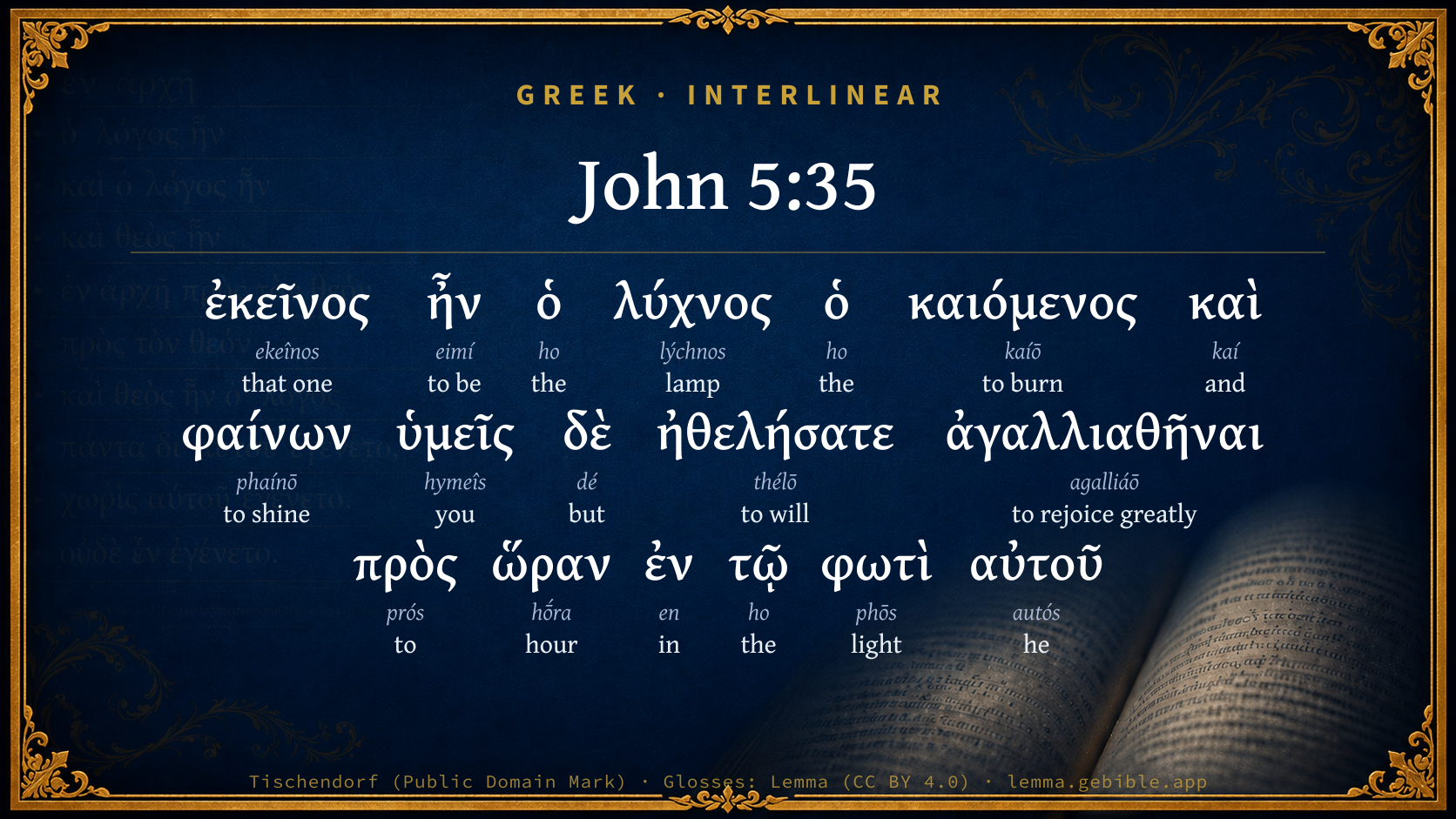
  1. ἐκεῖνος ekeînos G1565 “that one” Demonstrative pronoun, Nominative, Singular, Masculine
  2. ἦν eimí G1510 “to be” Verb, Imperfect, Active, Indicative, 3rd person, Singular
  3. ὁ ho G3588 “the” Article, Nominative, Singular, Masculine
  4. λύχνος lýchnos G3088 “lamp” Noun, Nominative, Singular, Masculine
  5. ὁ ho G3588 “the” Article, Nominative, Singular, Masculine
  6. καιόμενος kaíō G2545 “to burn” Verb, Present, Passive, Participle, Nominative, Singular, Masculine
  7. καὶ kaí G2532 “and” Conjunction
  8. φαίνων phaínō G5316 “to shine” Verb, Present, Active, Participle, Nominative, Singular, Masculine
  9. ὑμεῖς hymeîs G5210 “you” Personal pronoun, 2nd person, Nominative, Plural
  10. δὲ dé G1161 “but” Conjunction
  11. ἠθελήσατε thélō G2309 “to will” Verb, Aorist, Active, Indicative, 2nd person, Plural
  12. πρὸς prós G4314 “to” Preposition
  13. ὥραν hṓra G5610 “hour” Noun, Accusative, Singular, Feminine
  14. ἐν en G1722 “in” Preposition
  15. τῷ ho G3588 “the” Article, Dative, Singular, Neuter
  16. φωτὶ phōs G5457 “light” Noun, Dative, Singular, Neuter
  17. αὐτοῦ autós G846 “he” Personal pronoun, Genitive, Singular, Masculine

About this verse

These counts appear in no published source. They are computed here, from the morphology-tagged text and Lemma’s own curated glosses. What Lemma adds →

18
words
16
distinct lemmas
Gospels
section

Notable vocabulary

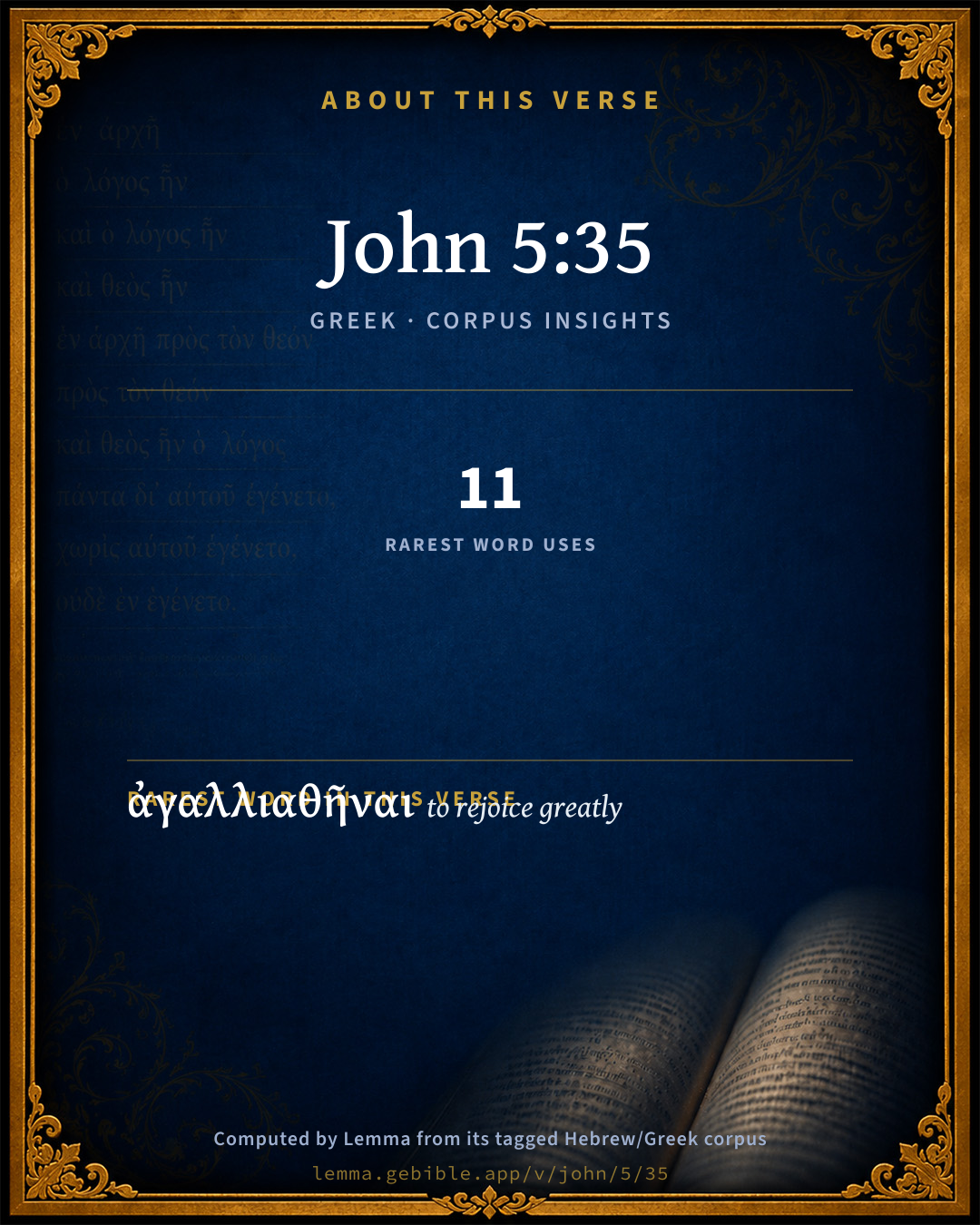
The rarest word here is ἀγαλλιαθῆναι to rejoice greatly G21 — appearing just 11 times in the whole Greek New Testament.

Shared distinctive vocabulary

ἀγαλλιαθῆναι to rejoice greatly G21 occurs in 11 verses of the Greek New Testament. Also found in:

Repetition

A word recurs within this verse:

Cross-references

14

Topical passages linked to John 5:35 in the Treasury of Scripture Knowledge — connected by theme and wording, ordered by reader-vote popularity; previews shown in the World English Bible.

  • 2 Peter 1:19 We have the more sure word of prophecy; whereunto you do well that you take heed, as to a lamp shining in a dark place, until the day dawns, and the day star arises in your hearts:
  • Matthew 11:11 Most assuredly I tell you, among those who are born of women there has not arisen anyone greater than John the Baptizer; yet he who is least in the Kingdom of Heaven is greater than he.
  • John 1:7–8 The same came as a witness, that he might testify about the light, that all might believe through him.
  • Matthew 3:5–7 Then people from Jerusalem, all of Judea, and all the region around the Jordan went out to him.
  • Luke 1:76–77 And you, child, will be called a prophet of the Most High, For you will go before the face of the Lord to make ready his ways,
  • Matthew 11:7–9 As these went their way, Jesus began to say to the multitudes concerning John, "What did you go out into the wilderness to see? A reed shaken by the wind?
  • Matthew 13:20–21 What was sown on the rocky places, this is he who hears the word, and immediately with joy receives it;
  • Matthew 21:26 But if we say, 'From men,' we fear the multitude, for all hold John as a prophet."
  • Mark 6:20 for Herod feared John, knowing that he was a righteous and holy man, and kept him safe. When he heard him, he did many things, and he heard him gladly.
  • Luke 1:15–17 For he will be great in the sight of the Lord, and he will drink no wine nor strong drink. He will be filled with the Holy Spirit, even from his mother's womb.
  • Luke 7:28 "For I tell you, among those who are born of women there is not a greater prophet than John the Baptizer, yet he who is least in the Kingdom of God is greater than he."
  • John 6:66 At this, many of his disciples went back, and walked no more with him.
  • Ezekiel 33:31 They come to you as the people comes, and they sit before you as my people, and they hear your words, but don't do them; for with their mouth they show much love, but their heart goes after their gain.
  • Galatians 4:15–16 What was the blessing you enjoyed? For I testify to you that, if possible, you would have plucked out your eyes and given them to me.

Cross-references courtesy of OpenBible.info (CC BY 4.0).

Commentary

Notes on John 5:35 from classic Christian and Jewish commentators (each source and its license shown beneath its notes). The classic Christian expositions comment on the surrounding passage and are grouped to its opening verse, so a note may address several verses; the Jewish commentaries on the Tanakh (Rashi and others) are per-verse, so they appear only where the commentator wrote on this verse.

Lemma curates 59 commentaries, every one of them public domain or Creative Commons licensed, each selected and text-cleaned for this edition rather than reprinted as found. About our sources →

MacLaren's Expositions of Holy Scripture

Alexander MacLaren

John

THE LIGHT AND THE LAMPS

Joh 1:8. - Joh 5:35.

My two texts both refer to John the Baptist. One of them is the Evangelist’s account of him, the other is our Lord’s eulogium upon him. The latter of my texts, as the Revised Version shows, would be more properly rendered, ‘He was a lamp’ rather than ‘He was a light,’ and the contrast between the two words, the ‘light’ and ‘the lamps,’ is my theme. I gather all that I would desire to say into three points: ‘that Light’ and its witnesses; the underived Light and the kindled lamps; the undying Light and the lamps that go out.

I. First of all, then, the contrast suggested to us is between ‘that Light’ and its witnesses.

John, in that profound prologue which is the deepest part of Scripture, and lays firm and broad in the depths the foundation-stones of a reasonable faith, draws the contrast between ‘that Light’ and them whose business it was to bear witness to it. As for the former, I cannot here venture to dilate upon the great, and to me absolutely satisfying and fundamental, thoughts that lie in these eighteen first verses of this Gospel. ‘The Word was with God,’ and that Word was the Agent of Creation, the Fountain of Life, the Source of the Light which is inseparable from all human life. John goes back, with the simplicity of a child’s speech, which yet is deeper than all philosophies, to a Beginning, far anterior to ‘the Beginning’ of which Genesis speaks, and declares that before creation that Light shone; and he looks out over the whole world, and declares, that before and beyond the limits of the historical manifestation of the Word in the flesh, its beams spread over the whole race of man. But they are all focussed, if I may so speak, and gathered to a point which burns as well as illuminates, in the historical manifestation of Jesus Christ in the flesh. ‘That was the true Light which lighteth every man that cometh into the world.’

Next, he turns to the highest honour and the most imperative duty laid, not only upon mighty men and officials, but upon all on whose happy eyeballs this Light has shone, and into whose darkened hearts the joy and peace and purity of it have flowed, and he says, ‘He was sent’-and they are sent-’to bear witness of that Light.’ It is the noblest function that a man can discharge. It is a function that is discharged by the very existence through the ages of a community which, generation after generation, subsists, and generation after generation manifests in varying degrees of brightness, and with various modifications of tint, the same light. There is the family character in all true Christians, with whatever diversities of idiosyncrasies, and national life or ecclesiastical distinctions. Whether it be Francis of Assisi or John Wesley, whether it be Thomas a Kempis or George Fox, the light is one that shines through these many-coloured panes of glass, and the living Church is the witness of a living Lord, not only before it, and behind it, and above it, but living in it. They are ‘light’ because they are irradiated by Him. They are ‘light’ because they are ‘in the Lord.’ But not only by the fact of the existence of such a community is the witness-bearing effected, but it comes as a personal obligation, with immense weight of pressure and immense possibilities of joy in the discharge of it, to every Christian man and woman.

What, then, is the witness that we all are bound to bear, and shall bear if we are true to our obligations and to our Lord? Mainly, dear brethren, the witness of experience. That a Christian man shall be able to stand up and say, ‘I know this because I live it, and I testify to Jesus Christ because I for myself have found Him to be the life of my life, the Light of all my seeing, the joy of my heart, my home, and my anchorage’-that is the witness that is impregnable. And there is no better sign of the trend of Christian thought to-day than the fact that the testimony of experience is more and more coming to be recognised by thoughtful men and writers as being the sovereign attestation of the reality of the Light. ‘I see’; that is the proof that light has touched my eyeballs. And when a man can contrast, as some of us can, our present vision with our erstwhile darkness, then the evidence, like that of the sturdy blind man in the Gospels, who had nothing to say in reply to the subtleties and Rabbinical traps and puzzles but only ‘I was blind; now I see’-his experience is likely to have the effect that it had in another miracle of healing: ‘Beholding the man which was healed standing amongst them, they could say nothing against it.’ I should think they could not.

But there is one thing that will always characterise the true witnesses to that Light, and that is self-suppression. Remember the beautiful, immovable humility of the Baptist about whom these texts were spoken: ‘What sayest thou of thyself?’ ‘I am a Voice,’ that is all. ‘Art thou that Prophet?’ ‘No!’ ‘Art thou the Christ?’ ‘No! I am nothing but a Voice.’ And remember how, when John’s disciples tried to light the infernal fires of jealousy in his quiet heart by saying, ‘He whom thou didst baptise, and to whom thou didst give witness’-He whom thou didst start on His career-’is baptising,’ poaching upon thy preserves, ‘and all men come unto Him,’ the only answer that he gave was, ‘The friend of the Bridegroom’-who stands by in a quiet, dark corner-’rejoices greatly because of the Bridegroom’s voice.’ Keep yourself out of sight, Christian teachers and preachers; put Christ in the front, and hide behind Him.

II. Now let me ask you to look at the other contrast that is suggested by our other text. The underived light and the kindled lamps.

It is possible to read the words of that second text thus-’He was a lamp kindled and {therefore} shining.’ But whether that be the meaning, or whether the usual rendering is correct, the emblem itself carries the same thought, for a lamp must be lit by contact with a light, and must be fed with oil, if its flame is to be sustained. And so the very metaphor-whatever the force of the ambiguous word-in its eloquent contrast between the Light and the lamp, suggests this thought, that the one is underived, self-fed, and therefore undying, and that the other owes all its flame to the touch of that uncreated Light, and burns brightly only on condition of its keeping up the contact with Him, and being fed continually from His stores of radiance.

I need not say more than a word with regard to the former member of that contrast suggested here. That unlit Light derives its brilliancy, according to the Scriptural teaching, from nothing but its divine union with the Father. So that long before there were eyes to see, there was the eradiation and outshining of the Father’s glory. I do not enter into these depths, but this I would say, that what is called the ‘originality’ of Jesus is only explained when we reverently see in that unique life the shining through a pure humanity, as through a sheet of alabaster, of that underived, divine Light. Jesus is an insoluble problem to men who will not see in Him the Eternal Light which ‘in the beginning was with God.’ You find in Him no trace of gradual acquisition of knowledge, or of arguing or feeling His way to His beliefs. You find in Him no trace of consciousness of a great horizon of darkness encompassing the region where He sees light. You find in Him no trace of a recognition of other sources from which He has drawn any portion of His light. You find in Him the distinct declaration that His relation to truth is not the relation of men who learn, and grow, and acquire, and know in part; for, says He, ‘I am the Truth.’ He stands apart from us all, and above us all, in that He owes His radiance to none, and can dispense it to every man. The question which the puzzled Jews asked about Him, ‘How knoweth this Man letters, having never learned?’ may be widened out to all the characteristics of His human life. To me the only answer is: ‘Thou art the King of glory, O Christ! Thou art the Everlasting Son of the Father.’

Dependent on Him are the little lights which He has lit, and in the midst of which He walks. Union with Jesus Christ-’that Light’-is the condition of all human light. That is true over all regions, as I believe. ‘The inspiration of the Almighty giveth understanding.’ The candle of the Lord shines in every man, and ‘that true Light lighteth every man that cometh into the world.’ Thinker, student, scientist, poet, author, practical man-all of them are lit from the uncreated Source, and all of them, if they understand their own nature, would say, ‘In Thy light do we see Light.’

But especially is this great thought true and exemplified within the limits of the Christian life. For the Christian to be touched with Christ’s Promethean finger is to flame into light. And the condition of continuing to shine is to continue the contact which first illuminated. A break in the contact, of a finger’s breadth, is as effectual as one of a mile. Let Christian men and women, if they would shine, remember, ‘Ye are light in the Lord’; and if we stray, and get without the circle of the Light, we pass into darkness, and ourselves cease to shine.

Brethren, it is threadbare truth, that the condition of Christian vitality and radiance is close and unbroken contact with Jesus Christ, the Source of all light. Threadbare; but if we lived as if we believed it, the Church would be revolutionised and the world illuminated; and many a smoking wick would flash up into a blazing torch. Let Christian people remember that the words of my text define no special privilege or duty of any official or man of special endowments, but that to all of us has been said, ‘Ye are My witnesses,’ and to all of us is offered the possibility of being ‘burning and shining lights’ if we keep ourselves close to that Light.

III. Lastly, the second of my texts suggests-the contrast between the Undying Light and the lamps that go out.

‘For a season ye were willing to rejoice in His light.’ There is nothing in the present condition of the civilised and educated world more remarkable and more difficult for some people to explain than the contrast between the relation which Jesus Christ bears to the present age, and the relation which all other great names in the past-philosophers, poets, guides of men-bear to it. There is nothing in the world the least like the vividness, the freshness, the closeness, of the personal relation which thousands and thousands of people, with common sense in their heads, bear to that Man who died nineteen hundred years ago. All others pass, sooner or later, into the darkness. Thickening mists of oblivion, fold by fold, gather round the brightest names. But here is Jesus Christ, whom all classes of thinkers and social reformers have to reckon with to-day, who is a living power amongst the trivialities of the passing moment, and in whose words and in the teaching of whose life serious men feel that there lie undeveloped yet, and certainly not yet put into practice, principles which are destined to revolutionise society and change the world. And how does that come?

I am not going to enter upon that question; I only ask you to think of the contrast between His position, in this generation, to communities and individuals, and the position of all other great names which lie in the past. Why, it does not take more than a lifetime such as mine, for instance, to remember how the great lights that shone seventy years ago in English thinking and in English literature, have for the most part gone out, and what we young men thought to be bright particular stars, this new generation pooh-poohs as mere exhalations from the marsh or twinkling and uncertain tapers, and you will find their books in the twopenny-box at the bookseller’s door. A cynical diplomatist, in one of our modern dramas, sums it up, after seeing the death of a revolutionary, ‘I have known eight leaders of revolts.’ And some of us could say, ‘We have known about as many guides of men who have been forgotten and passed away.’ ‘His Name shall endure for ever. His name shall continue as long as the sun, and men shall be blessed in Him; all generations shall call Him blessed.’ Even Shelley had the prophecy forced from him-

‘The moon of Mahomet

Arose and it shall set,

While blazoned as on heaven’s eternal noon,

The Cross leads generations on.’

We may sum up the contrast between the undying Light and the lamps that go out in the old words: ‘They truly were many, because they were not suffered to continue by reason of death, but this Man, because He continueth ever . . . is able to save unto the uttermost them that come unto God through Him.’

So, brethren, when lamps are quenched, let us look to the Light. When our own lives are darkened because our household light is taken from its candlestick, let us lift up our hearts and hopes to Him that abideth for ever. Do not let us fall into the folly, and commit the sin, of putting our heart’s affections, our spirit’s trust, upon any that can pass and that must change. We need a Person whom we can clasp, and who never will glide from our hold. We need a Light uncreated, self-fed, eternal. ‘Whilst ye have the Light, believe in the Light, that ye may be the children of light.’

Alexander MacLaren, Expositions of Holy Scripture (1904–1910) — public domain. Text from a community e-Sword module.

Bengel's Gnomon

Johann Albrecht Bengel

Joh 5:35. Ὁ λύχνος, lamp [light]) The article amplifies, and alludes to the prophecies in the Old Testament concerning John. Comp. Sir 48:1, καὶ ἀνέστη Ἡλίας ὁ προφήτης ὡς πῦρ, καὶ ὁ λόγος αὐτοῦ ὡς λαμπὰς ἐκαίετο [Elias—arose as fire, and his word burned as a torch]. Otherwise this appellation is a weak one, [to be applied] to the Christ Himself.—καιόμενος) blazing vehemently (comp. the passage quoted above concerning Elias), and quickly burning out.—καὶ φαίνων, and a shining) καί also denotes concomitancy: whilst the light blazed, it shone; no longer.—ἀγαλλιασθῆναι, to exult) without penitential mourning, and without making any approach towards Myself. A choice word to express the thought. They ought to have used, not enjoyed [made their chief joy], John. The Jews treated that which was but a mean, as if it were an end. They are grossly mistaken, who seek in the word and ministers of God only the gratification of their outward or inward senses, and not Christ Himself, [—who, when they are delighted with the gifts of ministers, seem to themselves religious and devoted, and yet do not follow their instruction.—V. g.]—ἠθελήσατε πρὸς ὥραν, ye were willing for a season) Your willingness was not of long continuance.—φωτί, in the light) Ye were attracted by the splendour, not by the blazing ardour of him.—αὐτοῦ, his) without proceeding forward to Me, the Light, the fountain of joy: ch. Joh 8:56, “Your Father Abraham rejoiced to see My day; and he saw it, and was glad:” ἠγαλλιάσατο.

Bengel's Gnomon of the New Testament — English translation (T&T Clark, Edinburgh, 1860) — public domain. Text from a community e-Sword module.

Meyer's Critical & Exegetical Commentary

Heinrich August Wilhelm Meyer

Joh_5:35. What a manifestation he was, yet how lightly ye esteemed him!

ἦν and ἠθελ. point to a manifestation already past.

ὁ λύχνος] not τὸ φῶς, Joh_1:8, but less; hence φῶς in the second clause is used only predicatively. The article denotes the appointed lamp which, according to O. T. promise, was to appear, and had appeared in John as the forerunner of the Messiah, whose vocation it was to inform the people of the Messianic salvation (Luk_1:76-77). The figure of the man who lights the way for the approaching bridegroom (Luthardt) is very remote. Comp. rather the similar image, though not referred to here, of the mission of Elias, Sir_48:1. The comparison with a lamp in similar references was very common (2Sa_21:17; Rev_21:23; 2Pe_1:19). Comp. also Strabo, xiv. p. 642, where Alexander the rhetorician bears the surname ὁ Λύχνος.

καιόμενος καὶ φαίνων] is not to be interpreted of two different properties (burning zeal and light-giving); in the nature of things they go together. A lamp burns and shines; this it does of necessity, and thus it is represented. Comp. Luk_12:35; Rev_4:5.

ὑμεῖς δὲ, κ.τ.λ.] striking description of the frivolous worldliness which would gratify its own short-lived excitement and pleasure in this new and grand manifestation, instead of making use of it to obtain saving knowledge, and allowing its full solemnity to operate upon them. The Jews flocked in great crowds to the Baptist (Mat_3:5; Mat_11:7 ff.), as to the messenger of the approaching glorious kingdom of the Messiah; but instead of finding what they desired (ἠθελήσ.), they found all the severity of the spirit of Elias calling to repentance, and how soon was the concourse over! In like manner, the Athenians hoped to find a new and passing divertissement when the Apostle Paul came among them. Johanne utendum erat, non fruendum, Bengel.

πρὸς ὥραν] τοῦ εὐκολίαν αὐτῶν δεικνύντος ἐστὶ καὶ ὅτι ταχέως αὐτοῦ ἀπεπήδησαν, Chrysostom. Comp. Gal_2:5; Phm_1:15. The main feature of the perverted desire does not lie in πρὸς ὥραν, which more accurately describes the ἀγαλλ. according to its frivolity, so soon changing into satiety and disgust, but in ἀγαλλ. itself, instead of which μετάνοια should have been the object of their pursuit.

ἐν τῷ φωτὶ αὐτοῦ] in, i.e. encompassed by his light, the radiance which shone forth from him. Comp. 1Pe_1:6; and for χαίρειν ἐν, see on Php_1:18.

Meyer — Critical and Exegetical Commentary on the New Testament — English translation by Peter Christie, edited by Frederick Crombie (T&T Clark, 1880) — public domain. Text from a community e-Sword module.

Expositor's Greek Testament

ed. W. Robertson Nicoll

Joh 5:35 . ἐκεῖνος ἦν ὁ λύχνος ὁ καιόμενος καὶ φαίνων , “He was (suggesting that now the Baptist was dead) the lamp that burneth and shineth”. ὁ λύχνος ; for the difference between λύχνος a lamp and λαμπάς a torch, see Trench, Synonyms , p. 154, and cf. λαμπαδηδρομία the Athenian torch -race. The article “simply marks the familiar piece of household furniture” (Westcott). “The article simply converts the image into a definition” (Godet). “The article points him out as the definite light which could have shown them the way to salvation, Joh 5:34 ” (Weiss). Others find a reference to Psa 132:17 , ἡτοίμασα λύχνον τῷ Χριστῷ σου . Grotius and Lücke think the reference is to Sir 48:1 , καὶ ἀνέστη Ἐλίας προφήτης ὡς πῦρ καὶ ὁ λόγος αὐτοῦ ὡς λαμπάς ἐκαίετο . In the mediæval Latin Hymns the Baptist is “non Lux iste, sed lucerna”. [Cicero, pro Milone , 21, and elsewhere, calls certain illustrious citizens “lumina,” but with a somewhat different significance.] ὁ καιόμενος , “burning and shining are not two different properties,” Meyer; a lamp must burn if it is to shine. ὑμεῖς δὲ ἠθελήσατε ἀγαλλιασθῆναι πρὸς ὥραν ἐν τῷ φωτὶ αὐτοῦ ; the expression seems intended to suggest the thoughtless and brief play of insects in the sunshine or round a lamp. [“Wie die Mücken im Sonnenschein spielen,” Hausrath in Holtzmann.] Like children following in a bridal procession, dancing in the torchlight: the type of sentimental religionists revelling in their own emotions.

The Expositor's Greek Testament, edited by W. Robertson Nicoll (1897–1910) — public domain. Text from a community e-Sword module.

Geneva Bible (1599)

Geneva Bible translators

A little while.

Geneva Bible (1599) marginal notes — public domain. Text via Bolls.life.

Jamieson, Fausset & Brown

Robert Jamieson, A. R. Fausset & David Brown

He was a burning and a shining light--literally, "the burning and shining lamp" (or torch):--that is, "the great light of his day." Christ is never called by the humble word here applied to John--a light-bearer--studiously used to distinguish him from his Master, but ever the Light in the most absolute sense. (See on Joh 1:6).

willing for a season--that is, till they saw that it pointed whither they were not prepared to go.

to rejoice in his light--There is a play of irony here, referring to the hollow delight with which his testimony tickled them.

Jamieson, Fausset & Brown — Commentary Critical and Explanatory on the Whole Bible (1871) — public domain (CC PDM 1.0). Text via the HelloAO Bible API.

Adam Clarke's Commentary

Verse 35. He was a burning and a shining light] Ην ὁ λυχνος ὁ καιομενος και φαινων, should be translated, He was a burning and a shining LAMP. He was not το φως του κοσμου, the light of the world, i.e. the sun; but he was ο λυχνος, a lamp, to give a clear and steady light till the sun should arise. It is supposed that John had been cast into prison about four months before this time. See Clarke on Joh 4:35. As his light continued no longer to shine, our Lord says he WAS.

The expression of lamp our Lord took from the ordinary custom of the Jews, who termed their eminent doctors the lamps of Israel. A lighted candle is a proper emblem of a minister of God; and, Alteri serviens consumor - "In serving others, I myself destroy:" - a proper motto. There are few who preach the Gospel faithfully that do not lose their lives by it. Burning may refer to the zeal with which John executed his message; and shining may refer to the clearness of the testimony which he bore concerning Christ. Only to shine is but vanity; and to burn without shining will never edify the Church of God. Some shine, and some burn, but few both shine and burn; and many there are who are denominated pastors, who neither shine nor burn. He who wishes to save souls must both burn and shine: the clear light of the knowledge of the sacred records must fill his understanding; and the holy flame of loving zeal must occupy his heart. Zeal without knowledge is continually blundering; and knowledge without zeal makes no converts to Christ.

For a season] The time between his beginning to preach and his being cast into prison.

To rejoice] αγαλλιασθηναι, To jump for joy, as we would express it. They were exceedingly rejoiced to hear that the Messiah was come, because they expected him to deliver them out of the hands of the Romans; but when a spiritual deliverance, of infinitely greater moment was preached to them, they rejected both it and the light which made it manifest.

Adam Clarke's Commentary on the Bible (1810–1826) — public domain. Text from a community e-Sword/MySword module.

John Calvin's Commentaries

35. He was a burning and shining lamp. When he calls John a burning lamp, this proves their ingratitude; for it follows that they are only blind, because they choose to be so, since God kindled a lamp before their eyes. The meaning of the words therefore is, “God did not intend that you should go astray; for he appointed John to be a lamp, that he might direct you by his brightness; and, therefore, when you do not acknowledge me to be the Son of God, this arises from voluntary error.” This is followed by another reproach, that not only did they shut their eyes, and thus obstruct the entrance of the light which was offered to them, but they intentionally abused it for the purpose of crushing Christ. For when they were ready to applaud John beyond what he justly deserved, this arose from a wicked and treacherous design not to give way to the Son of God.

And you were willing to amuse yourselves in his light. This wicked abuse of the heavenly light Christ elegantly compares to foolish mirth; as if the head of a family were to light a lamp for his servants by night, that they might perform the duties which he had enjoined on them, but they, instead of doing so, employed it for debauchery and every kind of licentiousness. By these words Christ accuses the Jews, and at the same time conveys to all of us a warning that, when God sends faithful teachers to guide us in the right way, we should take care not to abuse them by wandering in every direction. How useful this warning is, the experience of all ages shows. God undertakes to direct men, throughout the whole course of their life, to the final goal, and sends his prophets to be their guides. Yet such is the madness of the folly of men that, instead of walking, they prefer to indulge in wanton dancing, without making any progress; so light and unsteady are they that, despising and rejecting his continued guidance, they are hurried away by the sudden impulses of their passions.

For a time, or, for an hour. By this term he reproves them for their folly in thinking that wickedness of a transitory nature and short duration can extinguish the light of God. Thus in our own day all those faithful teachers whom God has given to his Church as burning lamps are applied by the Papists to a contrary purpose; as if their intention were, by looking at the light, to dazzle their eyes. And not only do they abuse the lamps for extinguishing the light of God, but they often indulge in foolish gaiety amidst the darkness, as when they rise against the pure doctrine of the Gospel, and glory in the foolish sayings of their noisy declaimers. But what Christ here asserts concerning John, Paul declares to be common to all believers, because, having the word of life, they ought to give light to the world, like torches. But Christ shows that it belongs strictly to the Apostles and ministers of the Gospel to go before others and hold out the torch to guide them; for though we are all blind, and in the midst of darkness, God shines upon us by the light of his word. But here he peculiarly adorns John the Baptist with this honorable designation, because by his ministry God shone on his Church with much greater brightness.

John Calvin's Commentaries (1540-1563) — public domain. Text from the Calvin Translation Society English edition (1840s-50s) via the Christian Classics Ethereal Library (ccel.org). Calvin's coverage is partial (roughly two-thirds of the Bible); uncommented books and verses are honest gaps, never fabricated. The 19th-century editor's footnotes and remarks are omitted so the notes are faithfully Calvin's own voice.

Ellicott's Commentary for English Readers

(35) He was a burning and a shining light.—Better, He was the lamp that is lighted and (then) giveth light. The statement of the Prologue, “He was not the Light, but came to bear witness of the Light” (Joh_1:8), shows how important this change is. The word rendered “light” occurs again in Mat_5:15; Mat_6:22; Mar_4:21; Luk_8:16; Luk_11:33-34; Luk_11:36; Luk_12:35; Luk_15:8; 2Pe_1:19; Rev_18:23; Rev_21:23; Rev_22:5. The reader who will take the trouble to com pare these passages, will see clearly the difference in the Greek words. It should be lamp in all these instances. The article in “the lamp” is to be explained from a reference to the one lamp of every home. (Comp. Notes on Mat_5:15 and Mar_4:21.) The term was in common use to denote a distinguished hero or teacher. The Rabbis were often called “Lamps of the Law,” and David was “The Lamp of Israel” (2Sa_21:17). Comp. the remarkable parallel spoken of the Baptist’s great prototype, “Then stood up Elias the prophet, as fire, and his word was kindled like a lamp” (Sir_48:1). Others explain the words here of the promised lamp which was to appear, or of the torchbearer who lights the bridegroom’s path.

Ye were willing . . .—John’s work came to them as light in darkness. It attracted them. They went to it. They were willing to find a source of joy in it. They sent to ask him questions, but they heeded not his answers. But the light came to them not to amuse them, but to lead them. He gave light because he had been kindled at the Source of all Light. He came to bear witness to them of the true Light, from which his was derived. (Comp. Note on Joh_1:23.) Their action with regard to John was part of the negatively evil, unreal character condemned in Joh_3:20. They professed to be men, and teachers of other men; but when speaking of this John, our Lord found a similitude of their generation in the changing moods of little children playing in the market-place (Mat_11:16).

A Bible Commentary for English Readers, edited by Charles John Ellicott (1878–1897) — public domain. Text from a community e-Sword module.

The Cambridge Bible for Schools and Colleges

gen. ed. J. J. S. Perowne

35. He was a burning and a shining light] A grievous mistranslation, ignoring the Greek article twice over, and also the meaning of the words; and thus obscuring the marked difference between the Baptist and the Messiah: better, he was the lamp which is kindled and (so) shineth. Christ is the Light; John is only the lamp kindled at the Light, and shining only after being so kindled, having no light but what is derived. The word here, and Mat_6:22, translated ‘light,’ is translated ‘candle’ Mat_5:15; Mar_4:21; Luk_8:16; Luk_11:33; Luk_11:36; Luk_15:8; Rev_18:23; Rev_22:5. ‘Lamp’ would be best in all places. No O.T. prophecy speaks of the Baptist under this figure. David is so called 2Sa_21:17 (see margin), and Elijah (Sir_48:1). The imperfects in this verse seem to imply that John’s career is closed; he is in prison, if not dead.

were willing for a season] Like children, they were glad to disport themselves in the blaze, instead of seriously considering its meaning. And even that only for a season: their pilgrimages to the banks of the Jordan had soon ended; when John began to preach repentance they left him, sated with the novelty and offended at his doctrine.—For another charge of frivolity and fickleness against them in reference to John comp. Mat_11:16-19.

The Cambridge Bible for Schools and Colleges (gen. ed. J. J. S. Perowne; Cambridge University Press, 1878–1918) — public domain. Text from a community e-Sword module.

John Gill's Exposition

He was a burning and a shining light,.... He was not that light, the famous light, the Messiah, the sun of righteousness; yet he was the "phosphorus", the forerunner of that light, and was himself a very great one: he had much light himself into the person and office of the Messiah; in the doctrines of faith in Christ, and repentance towards God; in the Gospel dispensation, and in the abolition of the Mosaic economy; and gave great light to others, in the business of salvation, and remission of sins, and was the means of guiding the feet of many in the way of peace. His light of pure doctrine, and of an holy and exemplary conversation, shone very visibly, and brightly before men; and he burned with strong love and affection for Christ, and the souls of men; and with flaming zeal for the honour of God, and true religion, and against all sin and profaneness, which he was a faithful reprover of, and for which he lost his life. It was common with the Jews to call their doctors, who were famous for their knowledge, and holiness of life, lights, burning lights, and shining lights; or in words which amount to the same. So R. Simeon ben Jochai is often called in the book of Zohar, , "the holy light"; and particularly it is said of him (m),

"R. Simeon, , is as "the lamp of light which burns above", and "burns" below; and by the light which burns below all the children of the world are enlightened: woe to the world, when the light below ascends to the light above.''

So R. Abhu is called , "the lamp of light" (n): and it is (o) said of Shuah, Judah's father-in-law, that he was , "the light of the place"; that is, where he lived. The gloss on the place says, he was a man of note in the city, and enlightened their eyes; and it is very frequent with them still, when they are praising any of their doctors, to say of him, he was , "a great light", who enlightened the eyes of Israel, and in whose light the people walked (p); so among the philosophers, Xenophon, and Plato, are called duo lumina (q), "two lights"; See Gill on Mat 5:14;

and ye were willing for a season, or "for an hour",

to rejoice in his light; or "to glory in it", or "boast of" it, as the Syriac and Persic versions render it. When John first appeared among them, they were fond, and even proud of him; they gloried in him, that a man of such uncommon endowments, and of such exemplary holiness, was raised up among them; and hoped that he was the Messiah, or Elias, that was to come before him; and pleased themselves, that times of great outward honour and prosperity were hastening: wherefore they flocked about him, and many of the Pharisees and Sadducees attended his ministry, and would have been baptized by him; but when they found that he was not the Messiah, nor Elias, nor that prophet, but bore a testimony to Jesus of Nazareth, that he was the Messiah; and ran counter to their notions of a temporal kingdom, and of birth privileges, and their own righteousness; and threatened them with ruin, and destruction, both in this world, and that which is to come, in case of their impenitence and unbelief; they grew sick of him, and said he had a devil, and rejected the counsel of God he declared, and despised his baptism. Such was their fickleness and inconstancy, which Christ here tacitly charges them with. They were like the stony ground hearers, and like some of the Apostle Paul's admirers among the Galatians, who at first could have plucked out their eyes for him, but afterwards became his enemies for telling them the truth.

(m) Zohar in Exod. fol. 79. 1. (n) T. Bab. Cetubot, fol. 17. 1. (o) Bereshit Rabba, sect. 85. fol. 74. 4. & Mattanot Cehunah in ib. (p) Vid. R. David Ganz Tzemach David, par. 1. fol. 38. 1. 41. 1. 44. 2. 45. 1. 46. 2. & 47. 1. (q) A. Gell. Noct. Attic. l. 14. c. 3.

John Gill's Exposition of the Whole Bible (1746–1763) — public domain (CC PDM 1.0). Text via the HelloAO Bible API.

Trapp's Complete Commentary

John Trapp

35 He was a burning and a shining light: and ye were willing for a season to rejoice in his light.

Ver. 35. He was a burning, &c.] Burning in himself, and shining to others; or as it was said of Basil, thundering in his doctrine and lightning in his life. (Nazianzen.) And of Rogers and Bradford, that it was hard to say whether there were more force of eloquence and utterance in preaching, or more holiness of life and conversation, to be found in them. Like Aaron, they bad pomegranates for savour, as well as bells for sound.

For a season to rejoice] {a} But he soon grew stale to them; so that they made no more reckoning of him than of "a reed shaken with the wind," Mat 11:7. Principes favebant Luthero, sed iam iterum videtis ingratitudinem mundi erga ministros, &c., said good Melancthon, in the year of grace 1559.

{a} αγαλλιασθηναι’ to dance a galliard. It was a formal joy, or jollity rather. John Manl.

John Trapp, A Commentary or Exposition upon All the Books of the Old and New Testament (1647–1656) — public domain. Text from a community e-Sword module.

Albert Barnes' Notes on the Bible

He was - It is probable that John had been cast into prison before this. Hence, his public ministry had ceased, and our Saviour says he was such a light.

Light - The word in the original properly means a “lamp,” and is not the same which in Joh 1:4-5 is translated “light.” That is a word commonly applied to the sun, the fountain of light; this means a lamp, or a light that is lit up or kindled artificially from oil or tallow. A teacher is often called a “light,” because he guides or illuminates the minds of others. Rom 2:19; “thou art confident that thou art a guide of the blind, a light of them that sit in darkness;” Joh 8:12; Joh 12:46; Mat 5:14.

A burning - A lamp lit up that burns with a steady luster.

Shining - Not dim, not indistinct. The expression means that he was an eminent teacher; that his doctrines were clear, distinct, consistent.

Ye were willing - You willed, or you chose; you went out voluntarily. This shows that some of those whom Jesus was now addressing were among the great multitudes of Pharisees that came unto John in the wilderness, Mat 3:7. As they had at one time admitted John to be a prophet, so Jesus might with great propriety adduce his testimony in his favor.

For a season - In the original, for an “hour” - denoting only a short time. They did it, as many others do, while he was popular, and it was the “fashion” to follow him.

To rejoice in his light - To rejoice in his doctrines, and in admitting that he was a distinguished prophet; perhaps, also, to rejoice that he professed to be sent to introduce the Messiah, until they found that he bore testimony to Jesus of Nazareth.

Albert Barnes' Notes on the Bible (1834–1885) — public domain. Text from a community e-Sword/MySword module.

Matthew Poole's English Annotations

I do not speak this to lessen John in any of your thoughts; he was a famous light, burning in the knowledge and love of the truth; shining both in his doctrine, in publishing the truth, and also in holiness of life and conversation.

He was not that light, Joh 1:8, but he was a light, not το φως το αληθινον, but λυχνος, Mat 5:14; Luk 8:16. And you for a small time pretended a great affection for John, and came with great zeal to hear him, Mat 3:5; 21:26; Mar 1:5, hoping that he was the Messias, or at least Elias, or that prophet in him revived again. But when they saw that John did only bear record to Christ, they grew cold in their affection, not liking either his doctrine, or the strictness of his life, or the tidings that he brought; looking for a far more splendid and glorious Messiah than Christ appeared to them to be.

Matthew Poole's English Annotations on the Holy Bible (1683–1685) — public domain. Text from a community e-Sword/MySword module.

Whedon's Commentary on the Bible

Daniel D. Whedon

35. He was a… light—Not that he would depreciate John; he will rather pronounce a beautiful eulogy on his martyred forerunner.

Burning… shining—Some lights are shining, but not burning John was both. Burning he was with the fire of holy zeal; burning, as consumed away in his Master’s service.

For a season to rejoice in his light—They could be pleased, like children, with his light; but they could not stand his burning. God’s testimony to Jesus through John they therefore rejected.

Daniel D. Whedon (gen. ed.), Commentary on the Old and New Testaments (1874–1909) — public domain. Text from a community e-Sword module.

The Pulpit Commentary

He was the lamp (lucnov , not fwv) that burneth and shineth. He was not the Light, but came to bear witness to the Light. (Joh_1:8) The glory of his appearance was a derived or kindled illumination. (cf. Mat_6:22 2Pe_1:19) (It is not against this inference that in Rev_21:23 the Lamb is the Lamp of the New Jerusalem.) The household lamp or torch, when kindled, burns with more or less brilliance, but burns itself out, exhausts itself. One may walk in the light of it, see the way one should take, discharge duties that would otherwise be impossible, avoid perils that might without the lamp prove disastrous or destructive; but the capacity of the torch is soon reduced to a minimum. Bengel, Stier, Alford, think that the celebrated passage in Ecc 48:1 may be referred to: "Then stood up Elijah the prophet like as a fire, and his word burned as a lamp." This is not impossible, though it would stand alone as a distinct reference in the Gospels to any apocryphal book. Lunge has given a long series of the lamp and fire symbols of the Old Testament; the group of events in which the Lord appeared in flames of fire and clouds of glory, from Ex 3 to Mal_3:2, affirming John to be "the flame signal of Messiah, the last Old Testament form of the pillar of fire and candlestick of the temple, therefore the lamp at once flaming and shining." More than this, and more to the point, we find that, under the figure of lamps of fire, the messengers of God, the activities of the Church, here repeatedly set forth. (cf. Mat_5:14-16 Mat_25:1-8 Php_2:15) John was the burning lamp, not the archetypal Light. Ye desired for a season to rejoice in his light. Many interpretations have been suggested, such as the exultation of a wedding party in the brief light of the torch bearer, announcing the approach of the bridegroom; or the dancing of ephemerides in the glitter of a lamp. The metaphor is lost in the solemn memory of the high gratification for a season which the populations of Judaea, Galilee, and the wilderness had manifested on the apparition of the great prophet. The universal acclaim soon subsided. The leaders of the people fell back when they heard John"s call to repentance. Publicans and harlots pressed into the kingdom before the scribes and Pharisees. "The generation of vipers" did to John "whatsoever they listed." The secular power hushed his voice and crushed the man. "For a season" only did they listen to his word or respond to his challenge. His great testimony, though given to him by God, and by no means proceeding from his mere human consciousness, had been in the main unheeded. Wunsche quotes from "Sota," fol. 21, a, "Rabbi Menahem said that Solomon (Pro_6:23) compares "prayer" with "lamp," and "teaching" with "light," because the one flashes for the twinkling of an eye, comforts in the moment during which it shines; while the other, like the shining of the sun, burns evermore, and leads to eternal rest."

The Pulpit Commentary (1880–1919), ed. H.D.M. Spence-Jones & Joseph S. Exell — public domain. Text from a community e-Sword module.

John Wesley's Explanatory Notes

He was a burning and a shining light - Inwardly burning with love and zeal, outwardly shining in all holiness. And even ye were willing for a season - A short time only.

John Wesley, Explanatory Notes Upon the Whole Bible (1754–1765) — public domain. Text via the GEBible commentary corpus.

Burkitt's Expository Notes on the New Testament

William Burkitt

Observe here, John’s character, and the people’s carriage.

1. John’s character; he was a light, a burning and a shining light: he had in him a light of knowledge, to enlighten, direct, and comfort others; and this his knowledge was accompanied with zeal: he was a burning light in his doctrine and a shining lamp in his conversation: he had the light of knowledge in his head, the warmth of zeal in his heart, and the influence of both in his life.

Learn hence, 1. That those whom God calls to the office and work of the ministry, he furnishes with abilities and endowments suitable to their great employment, he endows them with a light of knowledge, which is animated by the heat and warmth of zeal.

2. That ministerial gifts and abilities are not bestowed alike upon all, but dispensed variously. All are lights according to their measure, but all are not equally burning and shining lights for proportion and degree.

3. That the brightest burning and clearest shining lights in the church of Christ, have but their time in this world; they are subject, as well as other men, to the common condition of mortality, and the lamps of their lives burn out the faster, by lighting others to heaven. John was a burning and a shining light; but now is put out and gone.

Observe, 2. As John’s character, so the people’s carriage; Ye were willing for a season to rejoice in his light. Here is a three-fold gradation; they rejoiced, they rejoiced in his light, and they rejoiced for a season.

1. They rejoiced. The word signifies, they leaped for joy, and danced about him as children do about a bonfire, when he first began his ministry among them. O, how warm are the affections of a people, when a pious and zealous minister comes first among them.

2. They rejoiced in his light, not in his heat. Or, they rejoiced in John’s light, not in Christ’s; for when they found that John bare record to Christ, they soon grew cold in their affections towards John.

3. They rejoiced only for a season; for an hour, as the word signifies. For a short time John’s ministry was acceptable.

Learn hence, 1. That it has been an old practice among the professors, not to like their pastors long, though they have been ever such burning and shining lights. John was not ever such burning and shining lights. John was not changed, but his hearers were changed; he did burn and shine in the candlestick of the church with equal zeal and lustre to the last: but they had changed their thoughts of him, and lost their esteem for him.

Learn, 2. That as nothing in general is so mutable as the mind of man, so nothing in particular is so variable as the affections and opinions of people towards their ministers. The lamp of John’s ministry was always alike burning and shining, his oil did not waste, but his hearer’s zeal wasted, and their affection cooled: those whose gifts are not all abated, may yet find a great abatement in the acceptation of their gifts: therefore let no man live upon the breath of men; least of all let ministers live upon the popular air, or the speech of the people.

O, let us live upon the credit which we have with God, and rejoice chiefly in his esteem. If our performances find acceptance with God, we are safe and happy, though they fall under contempt with men.

William Burkitt's Expository Notes on the New Testament (1700–1703) — public domain. Text from a community e-Sword module.

Cambridge Greek Testament for Schools and Colleges

35. ἐκεῖνος κ.τ.λ. The A.V. is here grievously wrong, ignoring the Greek article twice over, and also the meaning of the words; and thus obscuring the marked difference between the Baptist and the Messiah: better, he was the lamp which is kindled and (so) shineth. Christ is the Light; John is only the lamp kindled at the Light, and shining only after being so kindled, having no light but what is derived. Λύχνος is again rendered ‘light’ Mat 6:22, but ‘candle’ Mat 5:15; Mar 4:21; Luk 8:16; Luk 11:33; Luk 11:36; Luk 15:8; Rev 18:23; Rev 22:5. ‘Lamp’ would be best in all places. No O.T. prophecy speaks of the Baptist under this figure. David is so called 2Sa 21:17 (see margin), and Elijah (Sir 48:1); and S. Augustine applies ἡτοίμασα τῷ Χριστῷ μου λύχνον, paravi lucernam Christo Meo (Psa 132:18), to the Baptist. The imperfects in this verse seem to imply that John’s career is closed; he is in prison, if not dead.

ἠθελ. ἀγαλλ. Like children, they were glad to disport themselves in the blaze, instead of seriously considering its meaning. And even that only for a season: their pilgrimages to the banks of the Jordan had soon ended; when John began to preach repentance they left him, sated with the novelty and offended at his doctrine.—For another charge of frivolity and fickleness against them in reference to John comp. Mat 11:16-19.

Cambridge Greek Testament for Schools and Colleges (Cambridge University Press, 1896; 21 vols, various authors incl. Carr, Maclear, Plummer, Farrar, Lumby, Moule, M. R. James, Simcox) — public domain. Text from a community e-Sword module.

Alford’s Greek Testament

Henry Alford

35.] This ἦν shews, as Stier rightly observes, that John was now cast into prison, if not executed.

ὁ λύχνος] The article has been taken by some (e.g. Bengel, Lücke, Stier) to point to the prophecies concerning John. But we have no passage in the O.T. which designates Elias in such terms. In ref. Sirach we read of him, ἀνέστη προφήτης ὡς πῦρ, καὶ ὁ λόγος αὐτοῦ ὡς λαμπὰς ἐκαίετο, which Stier thinks may be referred to here. We may, as indeed he also suggests, believe that those words represent or gave rise to a common way of speaking of Elias, as certain Rabbis were called ‘The candle of the Law,’ &c. (Lightf.) De Wette takes the article as meaning, ‘the lamp which was to lead you,’ &c.

καιόμενος, not καίων, as it is ὁ λύχνος, not τὸ φῶς: lumen illuminatum, not lumen illuminans: see note on Mat 5:14.

καὶ φαίνων (lit up), and shining. The description sets forth the derived, and transitory nature of John’s light.

ὑμεῖς δὲ.…] See Eze 33:30, Eze 33:32. ‘But you wished only to disport yourselves in his light for a time—came out to him in crowds at first,—and—like silly children who play with the fire till it burns and hurts them, and then shrink from and loathe it,—when he began to speak of deep repentance as the preparation for God’s Kingdom, and laid the axe to the root of the trees, you left him.’ No one cared, when he was imprisoned and put to death. And even those few who remained true to him, did not follow his direction to Christ. For the mass of the people, and their leaders, his mission was in vain (Lücke, ii. 75).

Henry Alford, The Greek Testament (1849–1861) — public domain. Text from a community e-Sword module.

International Critical Commentary

35. ἐκεῖνος (much used by Jn. to mark out the subject of a sentence; see on 1:8) ἦν (the use of the past tense shows that the ministry of John Baptist was over; see on v. 32) ὁ λύχνος ὁ καιόμενος καὶ φαίνων, “the Lamp that burns and shines.” The Baptist, as Jn. has said (1:8), was not the Light (τὸ φῶς), but he was a lamp whose shining illuminated the darkness. “Non Lux iste, sed lucerna,” as the Latin hymn has it. Cf. οἱ λύχνοι καιόμενοι (Luk 12:35), and especially 2Pe 1:19, where prophecy is compared to λύχνος φαίνων ἐν αὐχμηρῷ τόπῳ, ἕως οὗ ἡμέρα διαυγάσῃ. When the Light comes, the lamp is no longer needed.

A lamp not only burns as it gives light, but it burns away, and so it was with the Baptist, who decreased as His Master increased; but this is not necessarily implied here.

David is called the λύχνος of Israel (2Sa 21:17); but the sentence ἡτοίμασα λύχνον τῷ χριστῷ μου (Psa 132:17) came to be applied by the Fathers to John the Baptist, the metaphor of John as the Lamp being widely adopted. It is said in Ecclus. 48:1 that the word of Elijah was like a burning torch, ὡς λάμπας ἐκαίετο; and, if there were any evidence that Elijah was compared traditionally to a Lamp, we might suppose that the description in the text of John, the new Elijah, as λύχνος carried an allusion to this. But Ecclus. 48:1 does not provide sufficent foundation for such a theory.

ὑμεῖς δὲ ἠθελήσατε ἀγαλλιαθῆναι (so אABDΓΔΘN; but LW have ἀγαλλιασθῆναι) πρὸς ὥραν ἐν τῷ φωτὶ αὐτοῦ, “You were pleased to rejoice for a time in his light,” words which remind the Jews of how popular John Baptist had been (Mar 1:5, Mat 3:5, Mat 3:11:7, 21:26; and cf. Joh 1:19), and of the fickleness of those who had been attracted to him, like moths to a lighted candle.

ἀγαλλιάομαι occurs again 8:56.

International Critical Commentary — older volumes (1896–1929), various authors — public domain. Text from a community e-Sword module.

Vincent's Word Studies in the New Testament

Marvin R. Vincent

A burning and shining light [ο λυχνος ο καιομενος και φαινων] . Rev., correctly, the lamp that burneth and shineth. Lucnov, lamp, as contrasted with the light [φως] . See Joh 1:5, 7, 8, 9; and compare Joh 8:12; Joh 9:5; Joh 12:46. Wyc., lantern. The Baptist did not, like Jesus, shine by his own light. The definite article with lamp, points to it as a familiar household object. Burning hints at the fact that the lamp gives but a transitory light. In burning the oil is consumed.

Ye were willing. Again the emphatic uJmeiv, ye.

To rejoice [αγαλλιασθηναι] . The word signifies exultant, lively joy. See Mt 5:12; Luk 1:47; Luk 10:21; 1Pe 1:6. The interest in the Baptist was a frivolous, superficial, and short - lived excitement. Bengel says, "they were attracted by his brightness, not by his warmth."

Marvin R. Vincent, Word Studies in the New Testament (1887–1900) — public domain. Text from a community e-Sword/MySword module.

Lesson kit

Teaching starters — assembled from the data on this page, not authored interpretation. Every prompt links to the verse data it draws on. Edit before teaching.

John, in the Gospels, opens this verse with 18 words (16 distinct Greek lemmas). Its most distinctive word is agalliáō (“to rejoice greatly”). A historical commentator’s framing appears above. Read the whole chapter for the surrounding context.

Discussion questions

  1. The word agalliáō carries the sense “to rejoice greatly.” How does it shape the verse?
  2. Matthew 5:12 shares the word «to rejoice greatly» with this verse. How do the two illuminate each other?
  3. “the” occurs 3× in this one verse. What is the effect of the repetition?
  4. The translations on this page render this verse differently — a whole-verse word diff, not a word-by-word alignment. What might account for the different wordings?
  5. Reading how MacLaren's Expositions of Holy Scripture and Bengel's Gnomon read this verse, where do the two commentators agree and where do they part?

Things to notice

Reading settings

Reading text

Shown beneath each verse's original-language words.

Old Testament
Old Testament edition

Read the OT as the Masoretic Hebrew (MT) or the Greek Septuagint (LXX).

English shown for the Greek Septuagint (in the Hebrew ↔ Greek comparison).

Comparing translations? Open the Compare panel on any verse page to stack up to four side by side.