Genesis 2:11

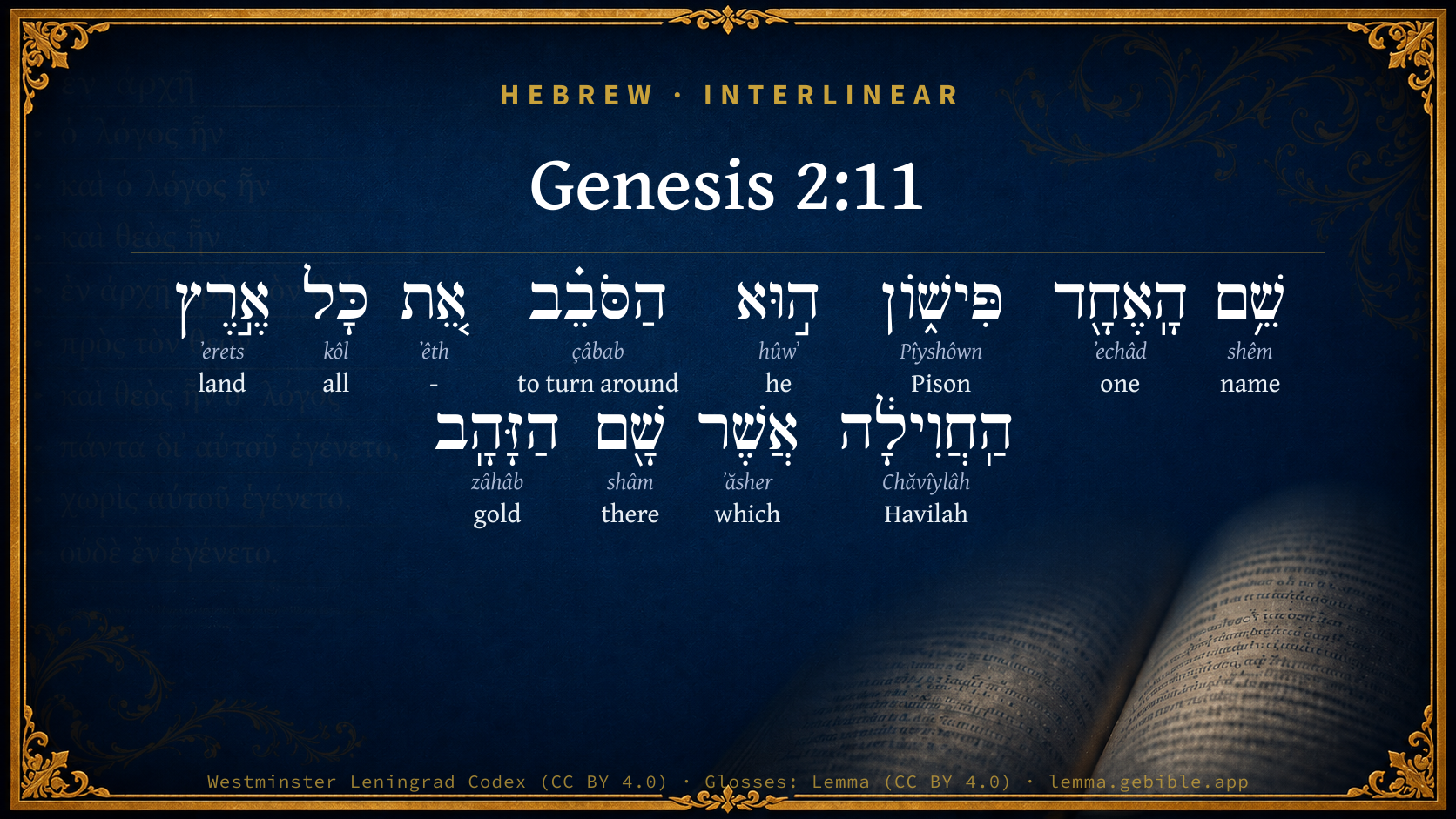
Hebrew (Westminster Leningrad Codex) Genesis 2:11 appears in the Hebrew Old Testament. The text above is from the Westminster Leningrad Codex. Each word links to its Strong’s number, a concise gloss, and parsing drawn from the Open Scriptures Hebrew Bible morphology. Click any word for its full Brown-Driver-Briggs (BDB) entry.
Download image
Cite this verse

Genesis 2:11 (World English Bible). Public Domain. Lemma interlinear Bible study tool, https://lemma.gebible.app/v/genesis/2/11.

Show BibTeX & RIS
BibTeX
RIS
English Translation
The name of the first is Pishon: this is the one which flows through the whole land of Havilah, where there is gold;
World English Bible · Public Domain
Highlights
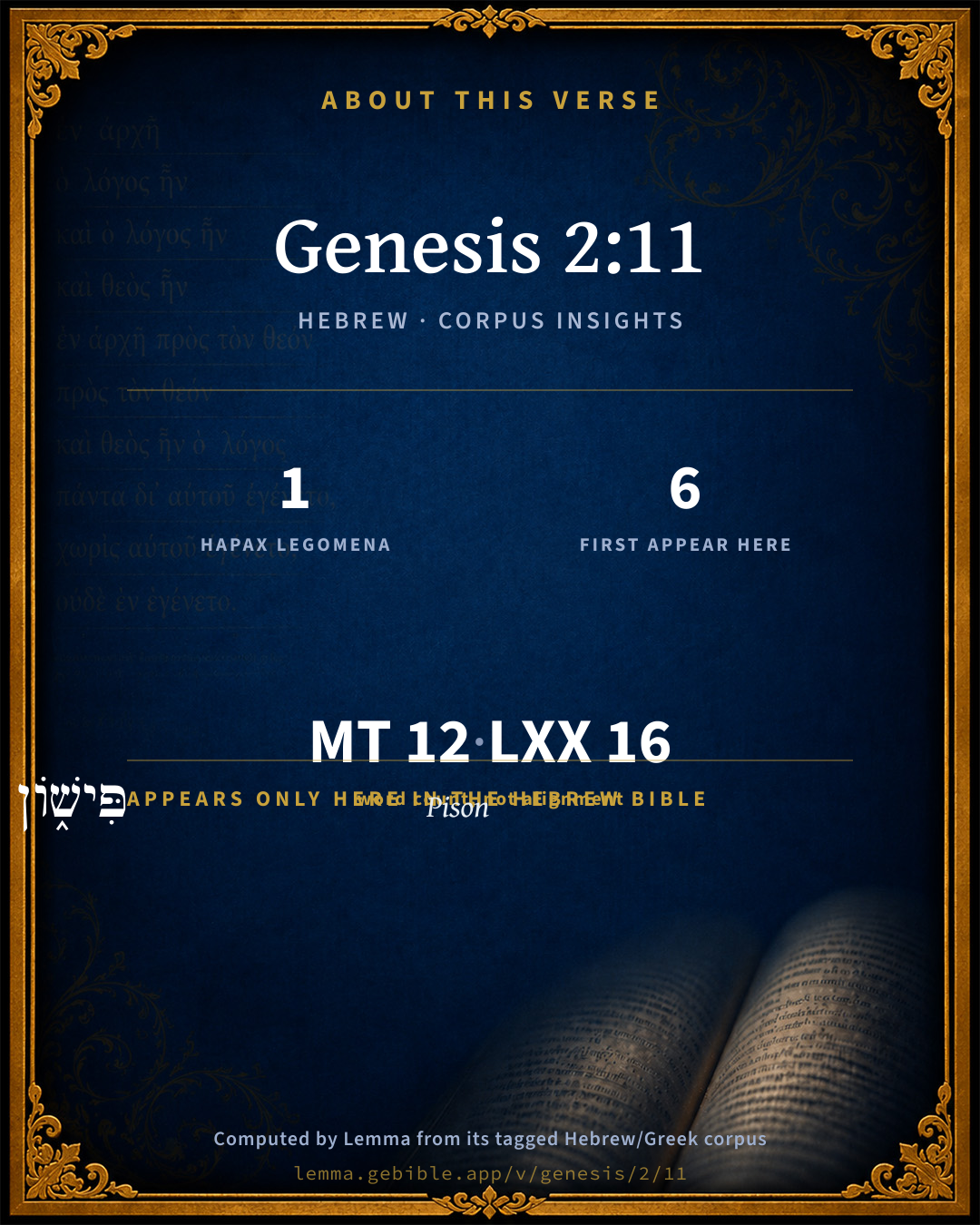
  • 1 hapax legomenon — only here in the Hebrew Bible
  • 6 first appearances in the Hebrew Bible
Full analysis ↓
Download a study sheet

One document with this verse’s original text, its word-by-word gloss line, the meaning frame, cross-references with their text, attributed commentary, and full source and license credits — printable, and it pastes into notes with its structure intact.

This verse Autodidact and up

Study sheet (.html) Plain text (.txt)

A passage Seminary Student

Up to 50 verses in one chapter. A passage sheet keeps up to 6 commentary sources and 12 cross-references per verse, in the order this page ranks them, and says so on the sheet whenever that leaves anything out. Ask for a single verse and you get the Autodidact verse sheet above.

Everything on this page stays free to read, with no account — the sheet is a download of what is already on screen, not access to it.

Want to remove ads? Support Godless Engineer
Compare translations 3

The same verse in 3 English versions, stacked beneath the original-language interlinear above. Click any original word for its lexicon entry.

Each is an independent rendering of the whole verse — the interlinear is not word-aligned to these translations.

Highlighted words mark where these versions differ — a whole-verse word diff, not a word-by-word alignment.

  • World English Bible Public Domain
    The name of the first is Pishon: this is the one which flows through the whole land of Havilah, where there is gold;
  • King James Version Public Domain
    The name of the first is Pison: that is it which compasseth the whole land of Havilah, where there is gold;
  • unfoldingWord Literal Text CC BY-SA 4.0
    The name of the first Pishon. It winds through all of the land of Havilah, where gold.

unfoldingWord Literal Text — © unfoldingWord, licensed CC BY-SA 4.0. Word-aligned USFM3 via Door43 (git.door43.org/unfoldingWord/en_ult).

Versions to compare (up to 4)

3 of 4 selected

Show all 18 translations

Every available English version of this verse, each an independent rendering of the whole verse.

  • World English Bible Public Domain
    The name of the first is Pishon: this is the one which flows through the whole land of Havilah, where there is gold;
  • Berean Standard Bible Public Domain
    The name of the first river is Pishon; it winds through the whole land of Havilah, where there is gold.
  • Majority Standard Bible Public Domain
    The name of the first river is the Pishon; it winds through the whole land of Havilah, where there is gold.
  • King James Version Public Domain
    The name of the first is Pison: that is it which compasseth the whole land of Havilah, where there is gold;
  • American Standard Version (1901) Public Domain
    The name of the first is Pishon: that is it which compasseth the whole land of Havilah, where there is gold;
  • Revised Version (1885) Public Domain
    The name of the first is Pishon: that is it which compasseth the whole land of Havilah, where there is gold;
  • Geneva Bible (1599) Public Domain
    The name of one is Pishon: the same compasseth the whole land of Hauilah, where is golde.
  • Douay-Rheims (1899) Public Domain
    The name of the one is Phison: that is it which compasseth all the land of Hevilath, where gold groweth.
  • Young's Literal Translation Public Domain
    the name of the one `is' Pison, it `is' that which is surrounding the whole land of the Havilah where the gold `is',
  • Literal Standard Version CC BY-SA 4.0
    the name of the first [is] Pison, it [is] that which is surrounding the whole land of Havilah where the gold [is],
  • Unlocked Literal Bible CC BY-SA 4.0
    The name of the first is Pishon. It is the one which flows throughout the whole land of Havilah, where there is gold.
  • unfoldingWord Literal Text CC BY-SA 4.0
    The name of the first Pishon. It winds through all of the land of Havilah, where gold.
  • Darby Bible Public Domain
    The name of the one is Pison: that is it which surrounds the whole land of Havilah, where the gold is.
  • World Messianic Bible Public Domain
    The name of the first is Pishon: it flows through the whole land of Havilah, where there is gold;
  • Webster's Bible Public Domain
    The name of the first is Pison, which compasseth the whole land of Havilah, where there is gold;
  • Free Bible Version CC BY-SA 4.0
    The first branch was called the Pishon and it flowed through the whole land of Havilah, where gold is found.
  • Bible in Basic English Public Domain
    The name of the first is Pishon, which goes round about all the land of Havilah where there is gold.
  • JPS Tanakh (1917) Public Domain
    The name of the first is Pishon; that is it which compasseth the whole land of Havilah, where there is gold;

Literal Standard Version (2020), Covenant Press — licensed CC BY-SA 4.0. Text via the HelloAO Bible API (eBible.org). Unlocked Literal Bible (unfoldingWord) — licensed CC BY-SA 4.0. Text via the HelloAO Bible API (eBible.org). unfoldingWord Literal Text — © unfoldingWord, licensed CC BY-SA 4.0. Word-aligned USFM3 via Door43 (git.door43.org/unfoldingWord/en_ult). Free Bible Version, Dr. Jonathan Gallagher — licensed CC BY-SA 4.0. Text via the HelloAO Bible API (eBible.org).

Word by word

More ways to search: Search by grammar → Find every occurrence → Compare this word →

Practice this passage: Drill this verse → Learn its vocabulary →

פִּישׁ֑וֹן
Pîyshôwn
H6376
“Pison”
Noun, Proper
Part of Speech
Noun
Type
Proper
Full BDB Definition

Origin: from H6335

TWOT: None

Pison = "increase" - one of the four rivers used to describe the location of the garden of Eden
  1. שֵׁ֥ם shêm H8034 “name of” Noun, Common, Masculine, Singular, Construct
  2. הָֽאֶחָ֖ד ʼechâd H259 “the · one” Particle, Definite Article + Adjective, Cardinal number, Masculine, Singular, Absolute
  3. ה֣וּא hûwʼ H1931 “he” Pronoun, Personal, 3rd Person, Masculine, Singular
  4. הַסֹּבֵ֗ב çâbab H5437 “the · turning around” Particle, Definite Article + Verb, Qal, Participle Active, Masculine, Singular, Absolute
  5. אֵ֚ת ʼêth H853 “-” Particle, Direct Object
  6. כָּל kôl H3605 “all of” Noun, Common, Masculine, Singular, Construct
  7. אֶ֣רֶץ ʼerets H776 “land of” Noun, Common, Both, Singular, Construct
  8. הַֽחֲוִילָ֔ה Chăvîylâh H2341 “the · Havilah” Particle, Definite Article + Noun, Proper
  9. אֲשֶׁר ʼăsher H834 “which” Particle, Relative
  10. שָׁ֖ם shâm H8033 “there” Adverb
  11. הַזָּהָֽב zâhâb H2091 “the · gold” Particle, Definite Article + Noun, Common, Masculine, Singular, Absolute

About this verse

These counts appear in no published source. They are computed here, from the morphology-tagged text and Lemma’s own curated glosses. What Lemma adds →

12
words
12
distinct lemmas
Pentateuch
section

Notable vocabulary

1 hapax legomenon — a word that appears only here in the entire Hebrew Bible:

  • פִּישׁ֑וֹן Pison H6376

First appearance in Scripture

These words make their first canonical appearance in the Hebrew Bible here:

  • שֵׁ֥ם name H8034
  • פִּישׁ֑וֹן Pison H6376
  • ה֣וּא he H1931
  • הַסֹּבֵ֗ב to turn around H5437
  • הַֽחֲוִילָ֔ה Havilah H2341
  • הַזָּהָֽב gold H2091

Shared distinctive vocabulary

הַֽחֲוִילָ֔ה Havilah H2341 occurs in 7 verses of the Hebrew Bible. Also found in:

Grammatical profile

  • 1 verb
  • 6 nouns
  • 1 adjective
  • 1 pronoun
  • 1 adverb
  • 2 particles

Verb forms

  • הַסֹּבֵ֗ב Qal · Participle Active

Hebrew & Septuagint length

In English translation the verse runs 23 words from the Hebrew and 20 from the Septuagint (LXX English) — closely comparable.

A rough comparison of the two English renderings, which tokenize alike — not a word-level alignment.

Word counts can differ between the Hebrew and the Greek without any difference in meaning — e.g. the Hebrew direct-object marker אֵת has no separate Greek word, and Greek often adds the article ὁ.

In the original languages it is 12 Hebrew tokens and 16 Greek tokens — but the two are counted differently (Hebrew bundles its prefixes and suffixes into one token; the Greek is in lemma form), so that isn’t a like-for-like length.

Cross-references

4

Topical passages linked to Genesis 2:11 in the Treasury of Scripture Knowledge — connected by theme and wording, ordered by reader-vote popularity; previews shown in the World English Bible.

  • Genesis 25:18 They lived from Havilah to Shur that is before Egypt, as you go toward Assyria. He lived opposite all his relatives.
  • Genesis 10:29 Ophir, Havilah, and Jobab. All these were the sons of Joktan.
  • 1 Samuel 15:7 Saul struck the Amalekites, from Havilah as you go to Shur, that is before Egypt.
  • Genesis 10:7 The sons of Cush: Seba, Havilah, Sabtah, Raamah, and Sabteca. The sons of Raamah: Sheba and Dedan.

Cross-references courtesy of OpenBible.info (CC BY 4.0).

Hebrew and Greek witnesses Masoretic Hebrew ↔ Greek Septuagint

The same verse in the two great witnesses to the Old Testament, shown verse-for-verse.

These are two independent witnesses, not word-aligned to each other, and the Septuagint is shown in lemma (dictionary) form.

Hebrew Genesis 2:11 Masoretic · Westminster Leningrad Codex

שֵׁ֥ם הָֽאֶחָ֖ד פִּישׁ֑וֹן ה֣וּא הַסֹּבֵ֗ב אֵ֚ת כָּל אֶ֣רֶץ הַֽחֲוִילָ֔ה אֲשֶׁר שָׁ֖ם הַזָּהָֽב

The name of the first is Pishon: this is the one which flows through the whole land of Havilah, where there is gold;

World English Bible · Public Domain

Greek LXX Genesis 2:11 Septuagint · lemma form

ὄνομα ὁ εἷς φισων οὗτος ὁ κυκλόω πᾶς ὁ γῆ ευιλατ ἐκεῖ ὅς εἰμί ὁ χρυσίον

The name of the one, Phisom, this it is which encircles the whole land of Evilat, where there is gold.

LXX2012 (modern English Septuagint) · Public Domain

On this verse, Ellicott's Commentary for English Readers discusses the Septuagint’s reading. Read the note in Commentary ↓

Hebrew: Westminster Leningrad Codex (CC BY 4.0). Greek: Septuagint (public domain); English from LXX2012 (modern English Septuagint) (Public Domain). How the Septuagint differs from the Hebrew →

Targum (Aramaic paraphrase)

2

The Targum is the ancient Jewish Aramaic paraphrase of the Hebrew Scriptures — an interpretive translation, not the Hebrew text itself. Onkelos (literal) and Pseudo-Jonathan (expansive) render the Torah, and Jonathan the Prophets. Coverage is partial: where no permissively-licensed English translation exists for a verse, only the Aramaic is shown. This is verse-level text, not a word-by-word alignment to the Hebrew.

  1. Targum Onkelos Torah (Genesis–Deuteronomy)
    שׁוּם חָד פִּישׁוֹן הוּא מַקִּיף יָת כָּל אֲרַע דַּחֲוִילָה דִּי תַמָּן דַּהֲבָא

    (no public-domain English translation for this verse)

    Targum Onkelos — Aramaic: “Onkelos Genesis” (public domain); “Onkelos Exodus” (public domain); “Onkelos Leviticus” (public domain); “Onkelos Numbers” (public domain); “Onkelos Deuteronomy” (public domain). English: “Sefaria Community Translation” (CC0 1.0 (public-domain dedication)); “J.W. Etheridge. The Targums of Onkelos and Jonathan Ben Uzziel on the Pentateuch. London: Longmans, Green, 1862” (public domain). Text via Sefaria.

  2. Targum Pseudo-Jonathan Torah (Genesis–Deuteronomy)
    שׁוּם חַד פִּישׁוֹן הוּא דְמַקִיף יַת כָּל אֲרַע הִינְדִקֵי דְתַמָן דַהֲבָא

    The name of the first is Phishon; that is it which compasseth all the land of Hindiki, where there is gold.

    Targum Pseudo-Jonathan — Aramaic: “Targum Jonathan on Genesis” (public domain); “Targum Jonathan on Exodus” (public domain); “Targum Jonathan on Leviticus” (public domain); “Targum Jonathan on Numbers” (public domain); “Targum Jonathan on Deuteronomy” (public domain). English: “The Targum of Jonathan ben Uzziel, trans. J. W. Etheridge, London, 1862” (public domain). Text via Sefaria.

Commentary

Notes on Genesis 2:11 from classic Christian and Jewish commentators (each source and its license shown beneath its notes). The classic Christian expositions comment on the surrounding passage and are grouped to its opening verse, so a note may address several verses; the Jewish commentaries on the Tanakh (Rashi and others) are per-verse, so they appear only where the commentator wrote on this verse.

Lemma curates 59 commentaries, every one of them public domain or Creative Commons licensed, each selected and text-cleaned for this edition rather than reprinted as found. About our sources →

The Cambridge Bible for Schools and Colleges

gen. ed. J. J. S. Perowne

11. Pishon] The name of this river does not occur elsewhere in the Bible except in Sir_24:25. What river was intended, we can only conjecture, (a) from the description of its course, and (b) from the names of the rivers with which it is classed, two being the Tigris and the Euphrates. It is described as “compassing,” that is, encircling, “the whole land of Havilah.” The identification of Havilah is much controverted. In the present day scholars are of opinion that the name probably denotes a region either in N.E., or in S., Arabia. It is mentioned again in Gen_10:7; Gen_10:29; Gen_25:18, passages in which Arabia seems to be indicated. Havilah is further called a land “where there is gold.” Arabia, in ancient times, was famous for its gold.

The river which would encircle Havilah is, therefore, quite probably rightly identified by P. Haupt, the Assyriologist, with the Persian Gulf and the sea that surrounded Arabia, on the east.

Josephus identifies it with the “Indus.”

NOTE ON THE RIVERS OF PARADISE

Gen_2:11-14

The mention of the four rivers of Paradise has given rise to many endeavours to localize the site. A famous pamphlet by Prof. F. Delitzsch, entitled Wo lag das Paradise? (= What was the site of Paradise?), 1881, gave an immense impulse to the enquiry.

1. Delitzsch himself ingeniously identifies Pishon with the Pallakopas, a canal on the W. bank of the Euphrates, flowing into the Persian Gulf, and Gihon with the modern Shaṭṭ-en-Nil, a canal from the E. bank of the Euphrates, near Babylon, and returning to the Euphrates over against Ur. Hiddekel and Euphrates will then be the lower portions of the Tigris and the Euphrates; Havilah part of the desert W. of the Euphrates; Cush the name for that region in Babylonia, which gave its name to the Kassite dynasty. According to this theory, Eden is the plain (edinu) between the Tigris and the Euphrates, and the river in Gen_2:10 is the Euphrates. It seems, however, fatal to this ingenious view that

(a) it identifies the river of Gen_2:11 with one of the four heads into which it divides itself:

(b) “the whole land of Havilah” must be intended to denote something much more extensive than the small district enclosed by the Pallakopas canal: while the canal Shaṭṭ-en-Nil could never be described as encircling the land of Cush:

(c) “in front of Assyria” is a description of the Tigris to the N. of Babylonia, and is unsuitable to the region near Babylon where the two rivers approach most closely to each other.

2. Sayce, in H. C. M. 95 ff., proposes that the garden of Eden is to be identified with the sacred garden of Ea at Eridu, once the seaport of Chaldaea on the Persian Gulf; and the river which waters it (Gen_2:11), with the Persian Gulf, while the four rivers are the Euphrates, the Tigris, the Pallakopas (= Pison), the Choaspes (modern Kerkha) = Gihon, their waters entering the Persian Gulf by separate mouths. The Persian Gulf was sometimes designated in the Babylonian language Nâr Marratum (“Bitter River”). It is an objection that the Biblical account makes the one river divide up into four, while this theory makes four rivers flow into one.

3. With this view should be associated that of Hommel (A.H.T. 314 ff.), who identifies Eden with the “garden” at Eridu, the river of Gen_2:11 with the Persian Gulf, and the three rivers Pishon, Gihon and Hiddekel with three wâdis in N. Arabia.

4. Haupt, quoted in Driver, supposes the common source of the four rivers to have been an imaginary lake in N. Mesopotamia. The Pishon is the Persian Gulf encircling Havilah, or Arabia; the Gihon is the Karun, supposed to flow eventually through Cush and become the Nile; while the Tigris and the Euphrates entered, by separate mouths, the marshes, beyond which was the Persian Gulf.

5. Skinner suggests (p. 64) that the Hebrew geographer, who was himself only acquainted with the two great Mesopotamian rivers, the Tigris and the Euphrates, added to them the names of two others, the Pishon and the Gihon, by which he intended the two mysterious rivers of the Indian world, the Indus and the Ganges.

Delitzsch and Dillmann identify the Pishon with the Indus, and the Gihon with the Nile. “But if the biblical narrator believed the Nile to rise with Euphrates and Tigris, it is extremely likely that he regarded its upper waters as the Indus, as Alexander the Great did in his time; and we might then fall back on the old identification of Pishon with the Ganges” (Skinner).

6. Two of the rivers are the Tigris and the Euphrates, which were known to flow from a remote Northern region into Mesopotamia. The tradition supposed this Northern region to contain also the sources of two other rivers which rivalled the Tigris and the Euphrates. One of them, according to the vague notions of ancient geography, somehow encircled Havilah (= Arabia), while the other watered the region of Cush (= Soudan).

7. The well-known names embodied in this strange piece of ancient geography make it very improbable that any mythological or astrological explanation can meet the requirements of the problem.

The Cambridge Bible for Schools and Colleges (gen. ed. J. J. S. Perowne; Cambridge University Press, 1878–1918) — public domain. Text from a community e-Sword module.

Trapp's Complete Commentary

John Trapp

Gen 2:11 The name of the first [is] Pison: that [is] it which compasseth the whole land of Havilah, where [there is] gold;

Ver. 11. Where there is gold.] Which, though never so much admired and studiously acquired, is but the guts and garbage of the earth. Gold is that which the basest element yields, the most savage Indians get, servile apprentices work, Midianitish camels carry, miserable muckworms adore, unthrifty ruffians spend. It is to be wondered that, treading upon these minerals, we cannot contemn them. They lie farthest from heaven, and the best of them in Havilah, farthest of all from the Church. Adam had them in the first paradise. In the second we shall not need them. Money is the monarch of this world, and answers all things; but in the matters of God, money bears no mastery, will fetch in no commodity {Job 28:15} Wise men esteemed it as the stones of the street. {2Ch 1:15} Children of wisdom might not possess it in their girdles. {Mat 10:9} Medes cared not for it; {Isa 13:17} and devils were sent to keep rich and pleasant palaces. {Isa 13:22} So subject these metals are to ensnare and defile us, that God made a law to have them purified, ere he would have them used, {Num 31:22-23} and appointed the snuffers and snuff-dishes {Exo 25:38} of the sanctuary to be made of pure gold, to teach us to make no account of what he put to so base offices, and is frequently given to so bad men. The Spaniard {a} found in the mines of America more gold than earth. Hasten we to that country where "God shall be our gold, and we shall have plenty of silver" {Job 22:25, margin}

{a} Heyl. Geog., p. 714.

John Trapp, A Commentary or Exposition upon All the Books of the Old and New Testament (1647–1656) — public domain. Text from a community e-Sword module.

Tyndale Open Study Notes

Tyndale Open Resources

2:11 The Pishon and the Gihon (2:13) cannot be identified with certainty. If the land of Havilah was in southeast Arabia or on the African coast, as some biblical data suggest (see 10:7; 25:18; 1 Sam 15:7), then the Pishon was possibly the Nile River. Josephus thought that Havilah and the Pishon were in India (Antiquities 1.1.3). Two other proposals suggest: (1) rivers in the mountains of eastern Turkey where the Tigris and Euphrates (Gen 2:14) also flow, and (2) the marshy delta near the Persian Gulf. Current geographical conditions make any theory impossible to prove conclusively.

Tyndale Open Study Notes — © Tyndale Open Resources, licensed CC BY-SA 4.0. Text via the HelloAO Bible API.

Geneva Bible (1599)

Geneva Bible translators

Which Havilah is a country joining to Persia Eastward, and inclineth toward the West.

Geneva Bible (1599) marginal notes — public domain. Text via Bolls.life.

Ellicott's Commentary for English Readers

(11, 12) The name of the first is Pison.—“The full-flowing” (Gesenius), or “free-streaming” (Fürst). Neither derivation has much authority for it in the Hebrew language, and we must wait for the true explanation till the cuneiform inscriptions have been more thoroughly examined. As two of the four rivers of Paradise rise in Armenia, so we must probably seek the other two there; but the conjectures of commentators have thus far suggested no probable identification of this stream.

Compasseth.—This word, without strictly meaning to go round, gives the idea of a devious course (comp. 1Sa_7:16; Son_3:3), as if the river had now reached a level plain.

Havilah may mean sandy land (Deutsch), or circuit region. There seems to have been more than one country of this name; but the most probable is that in South-Western Arabia, afterwards colonised by the Joktanites (Gen_10:29), which this river skirted rather than traversed. But we know of no such river, rising in Armenia or elsewhere, which answers to this description now. Besides gold of great purity, pronounced emphatically “good,” this land produced” bdellium,” a scented gum, to which manna is compared (Num_11:7), though the meaning even there is uncertain.

Instead of bedolach, bdellium, the Syriac reads berulchê, that is, the same word in the plural, but with d instead of r. These two letters being very similar, not merely in the square Hebrew alphabet now in use, but in the original Samaritan characters, are constantly interchanged in manuscripts; and as berulchê means pearls, the sense agrees better with the other productions of Havilah, gold and onyx stones. As bedolach is a quadriliteral, while Hebrew words have only three root letters, we must look to the Accadi an language for its true signification, if this be really the right reading.

The onyx stone.—Though there is considerable authority for this translation, yet probably the LXX., supported by most ancient authorities, are right in regarding this gem as the beryl of a light green colour (leek-stone, LXX.). The root signifies something pale, while the onyx has its name from its markings resembling those of the human nail.

A Bible Commentary for English Readers, edited by Charles John Ellicott (1878–1897) — public domain. Text from a community e-Sword module.

John Gill's Exposition

The name of the first is Pison,.... Not the river Nile in Egypt, as Jarchi, who thinks it is derived from "Pashah", which signifies to increase, expand, and diffuse, as that does at certain times, and spreads itself over the land of Egypt, or from "Pishten", linen, which grows there, Isa 19:9 nor the river Ganges in India, as Josephus (m), and others; for the country where it is afterwards said to run agrees with neither Egypt nor India: rather it seems to be the same river, which is the Phasis of Pliny (n), and Strabo (o), and the Physcus of Xenophon (p), and the Hyphasis of Philostorgius (q), a river in Armenia, and about Colchis; and which is sometimes called Pasitigris, being a branch of that river, and mixed with, or arising from channels, drawn from Tigris, Euphrates, and other waters (r).

that is it which compasseth the whole land of Havilah, where there is gold; this country had its name from Havilah, one of the sons of Cush, Gen 10:7 who very probably seated himself near his brother Seba, from whom came the Sabeans, who inhabited one part of Arabia; and Havilah, it is plain, was before Egypt, in the way to Assyria, and bordered upon the Ishmaelites, who inhabited Arabia Deserta, Gen 25:16. So that it seems to be a country in Arabia, near unto, or a part of Cush or Arabia Cusea, and near to Seba or Arabia Felix: and so Strabo, among the nations of the Arabians, and along with the Nabatheans, places the Chaulotaeans (s), who seem to be no other than the posterity of Havilah: according to the learned Reland (t), it is the same with Colchis, a part of Scythia, and Phasis is well known to be a river of Colchis; and which runs into Pontus, as appears from Pliny (u) and includes Scythia, as Justin (w) says; and then it must have its name from Havilah, the son of Joktan, Gen 10:29 and in either of these countries there was gold, and an abundance of it, and of the best, as follows:(After the global destruction of Noah's flood, it is doubtful that the location of these rivers could be determined with any degree of certainty today. Ed.)

(m) Antiqu. l. 1. c. 1. sect. 3. (n) Nat. Hist. l. 6. c. 4. 17. (o) Geograph. l. 11. p. 343, 345, 364. (p) Cyr. Minor. l. 2. (q) Hist. Ecclesiast. l. 3. c. 10. (r) Curtius, l. 5. c. 3. Strabo. Geograph. l. 15. p. 501. (s) Ib. p. 528. (t) De Paradiso, p. 16, &c. (u) Ut supra. (Nat. Hist. l. 6. c. 4. 17.) (w) E Trogo, l. 2. c. 2.

John Gill's Exposition of the Whole Bible (1746–1763) — public domain (CC PDM 1.0). Text via the HelloAO Bible API.

Matthew Poole's English Annotations

Pison, an eminent branch of the river Tigris, probably that called by others Pasi-tigris, or Piso-tigris.

That is it which compasseth, i.e. with many windings and turnings passed through; as this word is used, Jos 15:3; Mat 23:15.

This whole land of Havilah; either that which is in those parts of Arabia which is towards Mesopotamia, so called from Havilah the issue of Cham, Gen 10:7; or that which is nigh Persia, and in the borders of India, so called from another Havilah of the posterity of Shem, Gen 10:29. To either of these following the description agrees well.

Matthew Poole's English Annotations on the Holy Bible (1683–1685) — public domain. Text from a community e-Sword/MySword module.

Whedon's Commentary on the Bible

Daniel D. Whedon

11. Pison… Havilah — After the views above given as to the site of paradise and the land of Eden, it would be idle to enumerate the diverse speculations and conjectures touching the rivers and lands designated in this and the following verses. The name Pison occurs nowhere else; but Havilah appears in Gen_10:7, as the name of a son of Ham, and in Gen 2:29 as that of a son of Shem. Nothing would have been more natural than for the sons of Noah to transfer antediluvian names to their children. In Gen_25:18, and 1Sa_15:7, the name appears as that of a country south-east of Palestine — probably because settled by the descendants of a patriarch of this name.

Where there is gold — The land of Eden was rich in precious metals and other costly substances.

Daniel D. Whedon (gen. ed.), Commentary on the Old and New Testaments (1874–1909) — public domain. Text from a community e-Sword module.

The Pulpit Commentary

Vers. 11, 12. The name of the first (river is) Pishon, or "the full-flowing." This is the first of those marks by which the river, when discovered, must be identified. It was palpably a broad-bosomed stream. A second is derived from the region through which it flows. That is it which compasseth (not necessarily surrounding, but skirting in a circular or circuitous fashion (Num_21:4; Jud_1:11:8) the whole land of Havilah. Havilah itself is described by three of its productions. Where there is gold. Ie. it is a gold-producing country. And the gold of that land is good. Of the purest quality and largest quantity. There also is bdellium. Literally bedo-lach, which the manna was declared to resemble (Exo_17:14; Num_11:7) The LXX, supposing it to be a precious stone, translate it by anqrax in the present passage, and by krustallov in Num_11:7 a view supported by the Jewish Rabbis and Gesenius. The majority of modern interpreters espouse the opinion of Josephus, that it was an odorous and costly gum indigenous to India, Arabia, Babylonia, and Bactriana. The third production is the onyx (shoham, from a root signifying to be pale or delicate in color, like the finger-nails) variously conjectured to be the beryl, onyx, sardonyx, sardius, or emerald. From this description it appears that Havilah must be sought for among the gold-producing countries of Asia. Now among the sons of Joktan or primitive Arabs (Gen_10:29) dwelling was from Mesha, as thou goest, unto Sephar, a mount of the east are Ophir and Havilah, whence Gesenius concludes that India, including Arabia, is meant. Other countries have their advocates, such as Arabia Felix, Susiana, Colchis, &c.; and other rivers, such as the Ganges (Josephus, Eusebius), the Phasis (Reland, Jahn, Rosenm Winer), the Indus (Schulthess, Kalisch).

The Pulpit Commentary (1880–1919), ed. H.D.M. Spence-Jones & Joseph S. Exell — public domain. Text from a community e-Sword module.

unfoldingWord translationNotes

Door43 World Missions Community

Pishon

This is the only time this river is referred to in the Bible. (See: How to Translate Names)

the whole land of Havilah

"the whole land called Havilah." It was somewhere in the Arabian Desert. (See: How to Translate Names)

where there is gold

This phrase gives information about Havilah. Some languages would translate it as a separate sentence. AT: "There is gold in Havilah" (See: Distinguishing versus Informing or Reminding)

There are also bdellium and the onyx stone

The word "there" is placed first in the sentence for emphasis. AT: "This is also where people can find bdellium and onyx stones"

bdellium

This resin comes from a tree and smells nice. A resin is sticky stuff that comes out of some trees and can burn. (See: Translate Unknowns)

the onyx stone

"onyx stones." Onyx is a certain kind of beautiful stone. (See: Translate Unknowns)

unfoldingWord translationNotes — © Distant Shores Media and the Door43 World Missions Community, licensed CC BY-SA 4.0. Source: git.door43.org/Door43/en_tn.

Rashi

Rabbi Shlomo Yitzchaki (Rashi)

פישון PISHON — This is the Nile, the River of Egypt. Because its waters grow plentiful and rise and water the land, it is called Pishon, the name being of the same root as the verb in (Habakkuk 1:8) ופשו פרשיו “and their horsemen increased”; another interpretation of the name Pishon is: it is so called because it grows flax (פשתן) (Genesis Rabbah 16:2) for it is said with reference to Egypt (Isaiah 19:9) “Moreover they that work in combed flax, shall be ashamed.”

Rashi on the Tanakh — English translations: “The Judaica Press complete Tanach with Rashi, translated by A. J. Rosenberg” (CC BY 4.0); “Pentateuch with Rashi's commentary by M. Rosenbaum and A.M. Silbermann, 1929-1934” (public domain); “The Metsudah Tanach series, Lakewood, N.J” (CC BY 4.0); and “The Book of Joshua, Metsudah Publications, 1997” (CC BY 4.0). Text via Sefaria.

Ramban (Nachmanides)

Rabbi Moshe ben Nachman (Ramban / Nachmanides)

THE LAND OF HAVILAH, WHERE THERE IS GOLD. This is to explain that it is not the Havilah of Egypt, concerning which it is said, And they dwelt from Havilah unto Shur, that is before Egypt, for this one [referred to here] is in the extreme east. The verse mentions also, There is the bdellium, in praise of the river, that in the sand that is in it and on its bank there is found that good gold, the bdellium and the onyx stone. For these things are found in rivers; in some, silver can be found. Similarly, the bdellium and precious stones are found mostly in rivers.In the opinion of former scholars, Pishon is the Nile of Egypt; it compasses this entire land of Havilah, and comes from there and passes the whole land of Egypt until it falls into the great sea at Alexandria in Egypt.

Ramban (Nachmanides) on the Tanakh — English translation: “Commentary on the Torah by Ramban (Nachmanides). Translated and annotated by Charles B. Chavel. New York, Shilo Pub. House, 1971-1976” (CC BY 4.0). Text via Sefaria.

Radak

Rabbi David Kimhi (Radak)

שם האחד, it appears from the Torah’s report that the land called חוילה was situated in the immediate vicinity of Gan Eden, and that this is the reason that it is a land superior to other parts of the earth. Just as Gan Eden is superior to other parts of the globe due to its superior trees and their fruit, so this land חוילה has other advantages, as the Torah enumerates, i.e. that this is where gold is found. The reason the Torah prefaced the word זהב with the letter ה, as if speaking of a special kind of gold, is that although gold can be found in other countries also, it is more abundant in this land known as ארץ החוילה. The Torah itself states that the gold found there “is good,” suggesting that instead of quartz containing gold being found there, gold nuggets who are pure gold were there in abundance. Perhaps, being so close to Gan Eden was the reason why gold was found there in abundance and the Torah suggests that the Gan Eden which has been lost to mankind, did indeed exist, to wit that even a land only bordering on it, shows that it is superior to other countries on our globe. The shoham “jewels,” [type of gemstone, which according to Rabbeinu Bachya possessed therapeutic qualities for its wearer and was used later in the garment (ephod) of the High Priest, could also be found there. [Exodus page 1293 this editor’s translation of Rabbeinu Bachya’s commentary]

Radak on the Tanakh — English translations: “Sefaria Community Translation” (CC0 1.0 (public-domain dedication)); “Eliyahu Munk, HaChut Hameshulash” (CC BY 4.0); “Rabbi Mike Feuer, Jerusalem Anthology” (CC BY 4.0); and “R. David Kimhi on the first book of Psalms, Translated by R.G. Finch, London, 1919” (public domain). Text via Sefaria.

Lesson kit

Teaching starters — assembled from the data on this page, not authored interpretation. Every prompt links to the verse data it draws on. Edit before teaching.

Genesis, in the Pentateuch, opens this verse with 12 words (12 distinct Hebrew lemmas). Its most distinctive word is Pîyshôwn (“Pison”). A historical commentator’s framing appears above. Read the whole chapter for the surrounding context.

Discussion questions

  1. How does “Pison” (Pîyshôwn) shape what this verse is saying?
  2. This verse holds 1 word here found nowhere else in the Hebrew Bible. What might the rare word draw attention to?
  3. 6 words here appear for the first time in Scripture. What is being introduced at this debut?
  4. Genesis 10:7 shares the word «Havilah» with this verse. How do the two illuminate each other?
  5. These translations render this verse differently. What is at stake in choosing one wording over another?
  6. The verb «הַסֹּבֵ֗ב» is Qal Participle Active. How does its form color the action?
  7. Reading how The Cambridge Bible for Schools and Colleges and Trapp's Complete Commentary read this verse, where do the two commentators agree and where do they part?

Things to notice

Reading settings

Reading text

Shown beneath each verse's original-language words.

Old Testament
Old Testament edition

Read the OT as the Masoretic Hebrew (MT) or the Greek Septuagint (LXX).

English shown for the Greek Septuagint (in the Hebrew ↔ Greek comparison).

Comparing translations? Open the Compare panel on any verse page to stack up to four side by side.