John 4:13

Greek (Tischendorf 8th ed.) John 4:13 appears in the Greek New Testament. The text above is from the Tischendorf 8th edition. Each word links to its Strong’s number and a concise gloss. Click any word for its full Thayer’s Greek Lexicon entry.
Download image
Cite this verse

John 4:13 (World English Bible). Public Domain. Lemma interlinear Bible study tool, https://lemma.gebible.app/v/john/4/13.

Show BibTeX & RIS
BibTeX
RIS
English Translation
Jesus answered her, "Everyone who drinks of this water will thirst again,
World English Bible · Public Domain
Download a study sheet

One document with this verse’s original text, its word-by-word gloss line, the meaning frame, cross-references with their text, attributed commentary, and full source and license credits — printable, and it pastes into notes with its structure intact.

This verse Autodidact and up

Study sheet (.html) Plain text (.txt)

A passage Seminary Student

Up to 50 verses in one chapter. A passage sheet keeps up to 6 commentary sources and 12 cross-references per verse, in the order this page ranks them, and says so on the sheet whenever that leaves anything out. Ask for a single verse and you get the Autodidact verse sheet above.

Everything on this page stays free to read, with no account — the sheet is a download of what is already on screen, not access to it.

Want to remove ads? Support Godless Engineer
Compare translations 3

The same verse in 3 English versions, stacked beneath the original-language interlinear above. Click any original word for its lexicon entry.

Each is an independent rendering of the whole verse — the interlinear is not word-aligned to these translations.

Highlighted words mark where these versions differ — a whole-verse word diff, not a word-by-word alignment.

  • World English Bible Public Domain
    Jesus answered her, "Everyone who drinks of this water will thirst again,
  • King James Version Public Domain
    Jesus answered and said unto her, Whosoever drinketh of this water shall thirst again:
  • unfoldingWord Literal Text CC BY-SA 4.0
    Jesus answered and said to her, “Everyone drinking from this water will thirst again,

unfoldingWord Literal Text — © unfoldingWord, licensed CC BY-SA 4.0. Word-aligned USFM3 via Door43 (git.door43.org/unfoldingWord/en_ult).

Versions to compare (up to 4)

3 of 4 selected

Show all 19 translations

Every available English version of this verse, each an independent rendering of the whole verse.

  • World English Bible Public Domain
    Jesus answered her, "Everyone who drinks of this water will thirst again,
  • Berean Standard Bible Public Domain
    Jesus said to her, “Everyone who drinks this water will be thirsty again.
  • Majority Standard Bible Public Domain
    Jesus said to her, “Everyone who drinks this water will be thirsty again.
  • King James Version Public Domain
    Jesus answered and said unto her, Whosoever drinketh of this water shall thirst again:
  • American Standard Version (1901) Public Domain
    Jesus answered and said unto her, Every one that drinketh of this water shall thirst again:
  • Revised Version (1885) Public Domain
    Jesus answered and said unto her, Every one that drinketh of this water shall thirst again:
  • Geneva Bible (1599) Public Domain
    Iesus answered, and said vnto her, Whosoeuer drinketh of this water, shall thirst againe:
  • Douay-Rheims (1899) Public Domain
    Jesus answered, and said to her: Whosoever drinketh of this water, shall thirst again; but he that shall drink of the water that I will give him, shall not thirst for ever:
  • Young's Literal Translation Public Domain
    Jesus answered and said to her, `Every one who is drinking of this water shall thirst again;
  • Literal Standard Version CC BY-SA 4.0
    Jesus answered and said to her, “Everyone who is drinking of this water will thirst again;
  • Unlocked Literal Bible CC BY-SA 4.0
    Jesus replied and said to her, “Everyone who drinks from this water will be thirsty again,
  • unfoldingWord Literal Text CC BY-SA 4.0
    Jesus answered and said to her, “Everyone drinking from this water will thirst again,
  • Darby Bible Public Domain
    Jesus answered and said to her, Every one who drinks of this water shall thirst again;
  • World Messianic Bible Public Domain
    Yeshua answered her, “Everyone who drinks of this water will thirst again,
  • Webster's Bible Public Domain
    Jesus answered and said to her, Whoever drinketh of this water, shall thirst again:
  • Free Bible Version CC BY-SA 4.0
    Jesus answered, “Everyone who drinks water from this well will become thirsty again.
  • Bible in Basic English Public Domain
    Jesus said to her, Everyone who takes this water will be in need of it again:
  • Text-Critical English NT CC BY 4.0
    Jesus answered her, “Everyone who drinks this water will thirst again,
  • Tyndale New Testament (1534) Public Domain
    Iesus answered and sayde vnto hir: whosoever drinketh of this water shall thurst agayne.

Literal Standard Version (2020), Covenant Press — licensed CC BY-SA 4.0. Text via the HelloAO Bible API (eBible.org). Unlocked Literal Bible (unfoldingWord) — licensed CC BY-SA 4.0. Text via the HelloAO Bible API (eBible.org). unfoldingWord Literal Text — © unfoldingWord, licensed CC BY-SA 4.0. Word-aligned USFM3 via Door43 (git.door43.org/unfoldingWord/en_ult). Free Bible Version, Dr. Jonathan Gallagher — licensed CC BY-SA 4.0. Text via the HelloAO Bible API (eBible.org).

Word by word

More ways to search: Search by grammar → Find every occurrence → Compare this word →

Practice this passage: Drill this verse → Learn its vocabulary →

διψήσει
dipsáō
G1372
“to thirst”
Verb, Future, Active, Indicative, 3rd person, Singular
Part of Speech
Verb
Tense
Future
Voice
Active
Mood
Indicative
Person
3rd person
Number
Singular
Full Thayer's Definition

Origin: from a variation of G1373

TDNT: 05:46,2

1. to suffer thirst, suffer from thirst a. figuratively, those who are said to thirst who painfully feel their want of, and eagerly long for, those things by which the soul is refreshed, supported, strengthened
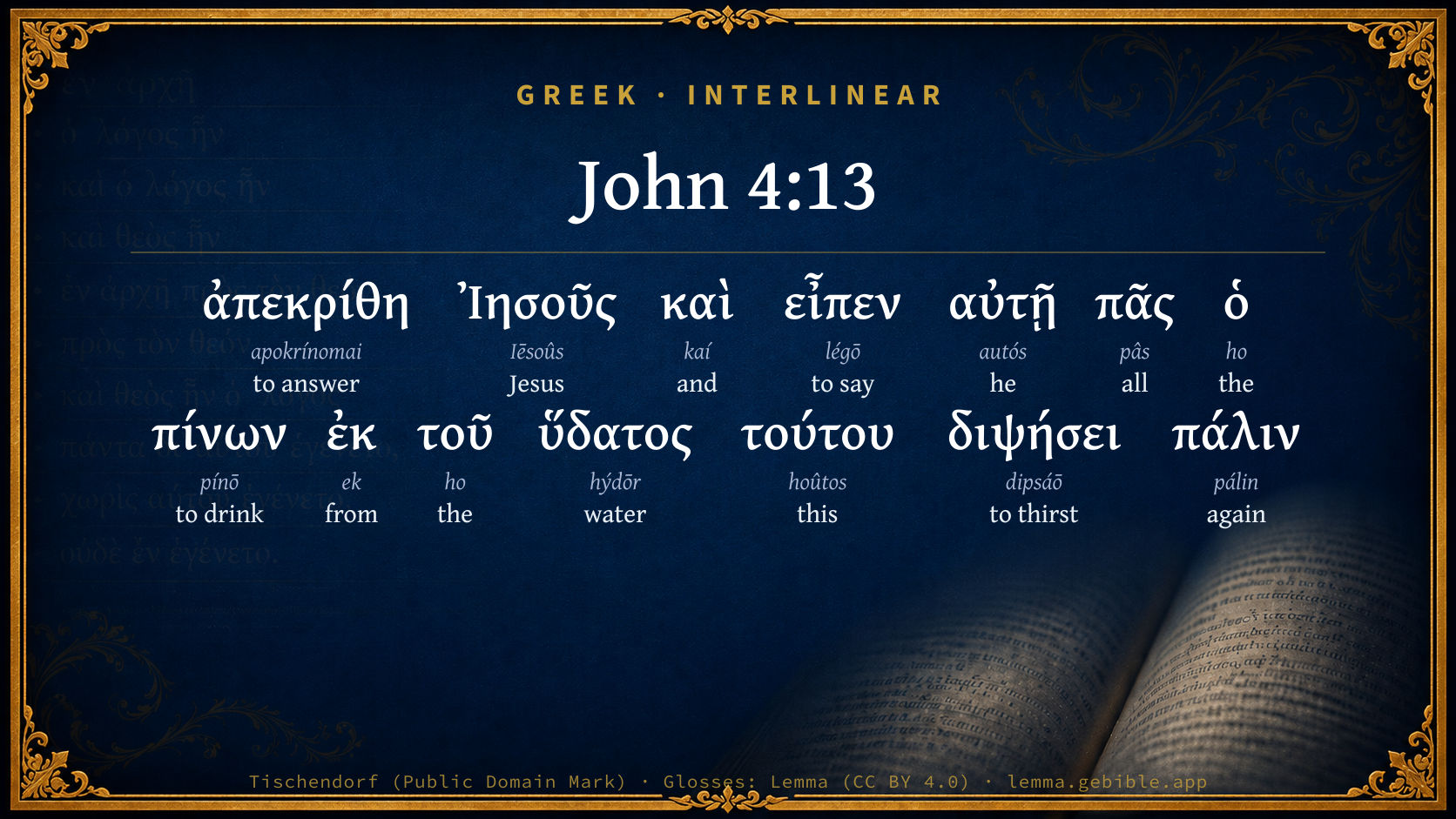
  1. ἀπεκρίθη apokrínomai G611 “to answer” Verb, Aorist, Middle deponent, Indicative, 3rd person, Singular
  2. Ἰησοῦς Iēsoûs G2424 “Jesus” Noun, Nominative, Singular, Masculine
  3. καὶ kaí G2532 “and” Conjunction
  4. εἶπεν légō G3004 “to say” Verb, Aorist, Active, Indicative, 3rd person, Singular
  5. αὐτῇ autós G846 “he” Personal pronoun, Dative, Singular, Feminine
  6. πᾶς pâs G3956 “all” Adjective, Nominative, Singular, Masculine
  7. ὁ ho G3588 “the” Article, Nominative, Singular, Masculine
  8. πίνων pínō G4095 “to drink” Verb, Present, Active, Participle, Nominative, Singular, Masculine
  9. ἐκ ek G1537 “from” Preposition
  10. τοῦ ho G3588 “the” Article, Genitive, Singular, Neuter
  11. ὕδατος hýdōr G5204 “water” Noun, Genitive, Singular, Neuter
  12. τούτου hoûtos G3778 “this” Demonstrative pronoun, Genitive, Singular, Neuter
  13. πάλιν pálin G3825 “again” Adverb

About this verse

These counts appear in no published source. They are computed here, from the morphology-tagged text and Lemma’s own curated glosses. What Lemma adds →

14
words
13
distinct lemmas
Gospels
section

Notable vocabulary

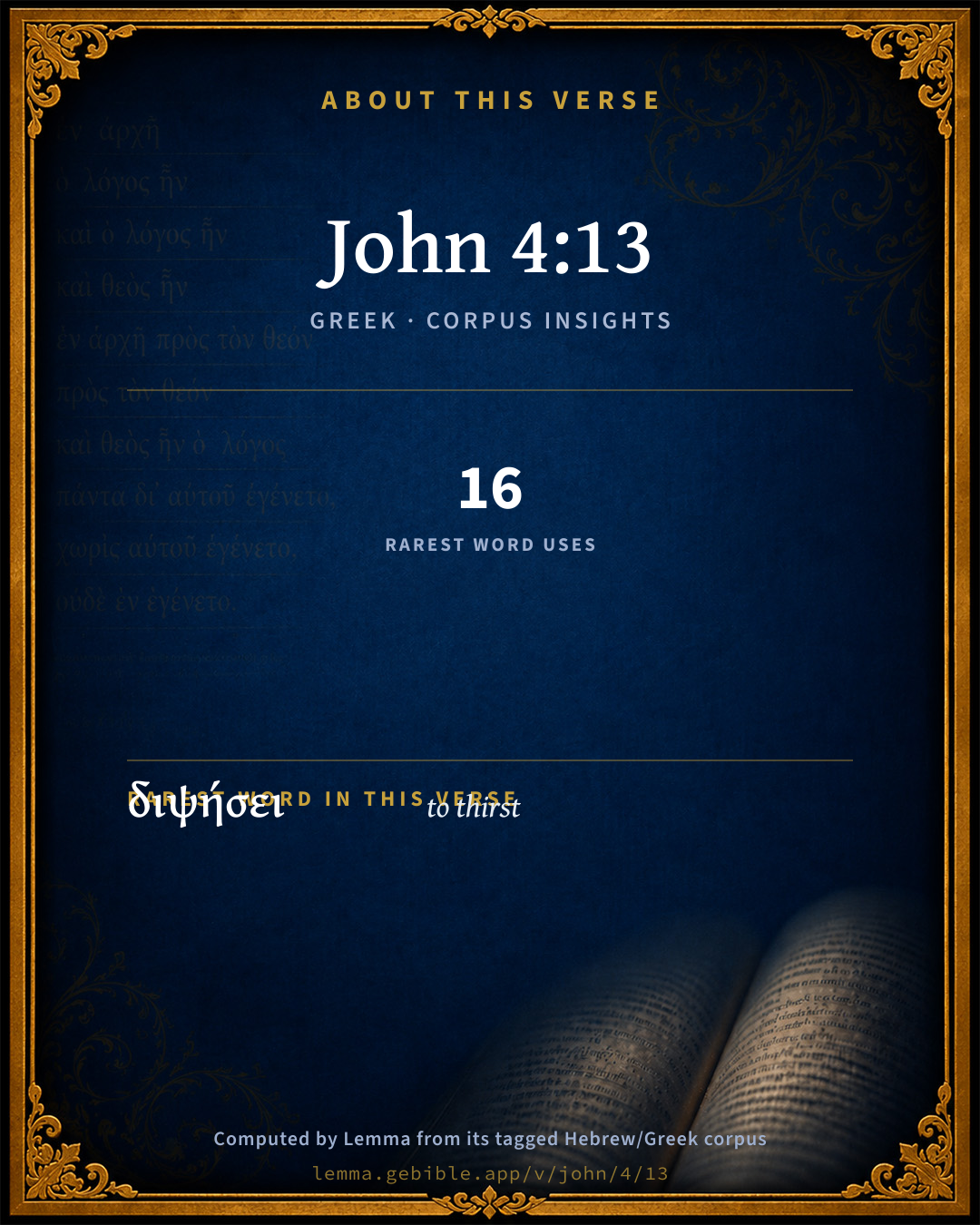
The rarest word here is διψήσει to thirst G1372 — appearing just 16 times in the whole Greek New Testament.

Shared distinctive vocabulary

διψήσει to thirst G1372 occurs in 16 verses of the Greek New Testament. Also found in:

Repetition

A word recurs within this verse:

Cross-references

3

Topical passages linked to John 4:13 in the Treasury of Scripture Knowledge — connected by theme and wording, ordered by reader-vote popularity; previews shown in the World English Bible.

  • John 6:27 Don't work for the food which perishes, but for the food which remains to eternal life, which the Son of Man will give to you. For God the Father has sealed him."
  • Isaiah 65:13–14 Therefore thus says the Lord Yahweh, Behold, my servants shall eat, but you shall be hungry; behold, my servants shall drink, but you shall be thirsty; behold, my servants shall rejoice, but you shall be disappointed;
  • Luke 16:24 He cried and said, 'Father Abraham, have mercy on me, and send Lazarus, that he may dip the tip of his finger in water, and cool my tongue! For I am in anguish in this flame.'

Cross-references courtesy of OpenBible.info (CC BY 4.0).

Commentary

Notes on John 4:13 from classic Christian and Jewish commentators (each source and its license shown beneath its notes). The classic Christian expositions comment on the surrounding passage and are grouped to its opening verse, so a note may address several verses; the Jewish commentaries on the Tanakh (Rashi and others) are per-verse, so they appear only where the commentator wrote on this verse.

Lemma curates 59 commentaries, every one of them public domain or Creative Commons licensed, each selected and text-cleaned for this edition rather than reprinted as found. About our sources →

Joseph Benson's Commentary

Joh 4:13-15. Jesus said, Whosoever drinketh of this water shall thirst again — How much soever this water may be esteemed, and though it may refresh the body, and allay its thirst for a little while, yet the appetite will soon return, even if it be drunk ever so plentifully. But whosoever drinketh of the water that I shall give him — Will find it so reviving and satisfying to his soul; that he will never thirst — Be without refreshment, dissatisfied, or unhappy; that is, provided he continue to drink thereof. If ever his thirst, or his dissatisfaction and uneasiness return, it will be the fault of the man, not of the water. But the water that I shall give him — The Spirit of faith and love, hope and joy, of holiness and happiness; shall be in him — An inward, living principle; a well of water — A fountain, as πηγη signifies. A well is soon exhausted. Springing — Αλλομενου, bubbling up, and flowing on into everlasting life, which is a continence, or rather an ocean of streams arising from this fountain. “Some would render the original expression, ου μη διψηση εις τον αιωνα, (instead of shall never thirst,) shall not thirst for ever: but not to urge how much this spoils the antithesis, the expression used, Joh 6:35, ου μη διψηση πωποτε, is not liable to any such ambiguity. The force and truth of our Lord’s assertion seems to lie in this, that the most impatient and restless desires of the soul being satisfied, when it is fixed on God as its supreme happiness, other thirst was not worth being mentioned.” — Doddridge. The woman — Still ignorant of our Lord’s meaning, and understanding him as speaking only of natural water; saith unto him, Sir, give me this water — Extraordinary as it is, according to thy declaration; that I thirst not — Any more for ever, and may be saved the trouble of coming every day so far for water. She seems to have had a mind to turn Christ’s words into ridicule. It therefore became necessary that he should open to her a new scene, and, by bringing her besetting sin to remembrance, touch her in a tender part, as he does in the next words.

Joseph Benson's Commentary on the Old and New Testaments (1811–1818) — public domain. Text from a community e-Sword module.

Meyer's Critical & Exegetical Commentary

Heinrich August Wilhelm Meyer

Joh_4:13-14. Not an explanation, but (comp. Joh_3:5) a carrying out of the metaphor, to lead the woman nearer to its higher import.

τούτου] referring to the well.

οὐ μὴ διψ. εἰς τ. αἰῶνα] will certainly not thirst for ever, antithesis to fleeting bodily refreshment, Joh_4:13. Comp. Joh_6:34. That heavenly grace and truth which Christ communicates, when received by faith into the inner life, for ever supplies what we need in order to salvation, so that the lack of this satisfaction is never felt, because the supply is always there. Bengel admirably remarks: Sane aqua illa, quantum in se est, perennem habet virtutem; et ubi sitis recurrit, hominis non aquae defectus est. The expression in Sir_24:20 : οἱ πίνοντές με (Wisdom) ἔτι διψήσουσι, rests upon a different view of the continuity of enjoyment, namely, that of the individual moments passing in the continual alternation of desire and satisfaction, and not of the unity which they make up, and of their condition as a whole.

γενήσεται ἐν αὐτῷ, κ.τ.λ.] the positive effect following the negative (and hence τὸ ὕδωρ ὃ δώσω αὐτῷ is emphatically repeated): divine grace and truth appropriated by faith will so energetically develope their life in him in inexhaustible fulness, that its full impelling power endures unto eternal Messianic life. Upon his entrance into the Messiahs kingdom (comp. Joh_3:3; Joh_3:5), the man takes along with him this inner living power of divine χάρις καὶ ἀλήθεια, Joh_6:27.

ἅλλεσθαι εἰς, to spring up into, often also in the classics (Hom. Il. a. 537; Xen. Mem. i. 3. 9), but with reference to water here only. A Greek would say προρεῖν εἰς; still the word in the text is stronger and more vivid. The ζωὴ αἰων. is conceived of locally, in keeping with the comparison of a widespreading spring; to render εἰς reaching to everlasting life (B. Crusius, Luthardt, Brückner, Ewald), arbitrarily lets go the concrete comparison, one of the main features in which is endless power of springing up. This description of the well springing up into everlasting life is the finishing touch of the picture. On εἰς ζ. αἰ., see Joh_4:36.

Meyer — Critical and Exegetical Commentary on the New Testament — English translation by Peter Christie, edited by Frederick Crombie (T&T Clark, 1880) — public domain. Text from a community e-Sword module.

Expositor's Greek Testament

ed. W. Robertson Nicoll

Joh 4:13-14 . Jesus in reply, though He does not quite break through the veil of figure, leads her on to think of a more satisfying gift than even Jacob had given in this well. πᾶς ὁ πίνων … ζωὴν αἰώνιον . He contrasts the water of the well with the water He can give; and the two characteristic qualities of His living water are suggested by this contrast. The water of Jacob’s well had two defects: it quenched thirst only for a time, and it lay outside the town a weary distance, and subject to various accidents. Christ offers water which will quench thirst lastingly, and which will be “in” the person drinking, ἐν αὐτῷ πηγὴ ὕδατος ἁλλομένου εἰς ζωὴν αἰώνιον . For this figure put to another though similar use, see Marcus Aurelius, vii. 59, and viii. 51, with Gataker’s notes. The living water lastingly quenches human cravings and is within the man, inseparable from him, and always energetically and afresh shooting up.

The Expositor's Greek Testament, edited by W. Robertson Nicoll (1897–1910) — public domain. Text from a community e-Sword module.

Godet's Commentaries

Frédéric Louis Godet

Vv. 13, 14. “Jesus answered and said to her: Whoever drinks of this water shall thirst again; but he that shall drink of the water that I shall give him, shall never thirst; but the water that I shall give him shall become in him a fountain of water springing up unto eternal life.”

It is to no purpose that the water of the well is spring-water; it is not that which Jesus means by living water; it has not the power of reproducing itself in him who drinks it; so, after a certain time, the want revives and the torment of thirst makes itself felt. “A beautiful inscription,” says Stier, “to be placed upon fountains.” Such water presents itself to the thought of Jesus as the emblem of all earthly satisfactions, after which the want reappears in the soul and puts it again in dependence upon external objects in order to its satisfaction.

Jesus defines in Joh 4:14 the nature of the true living water; it is that which, reproducing itself within by its own potentiality, quenches the soul’s want as it arises, so that the heart cannot suffer a single moment of inward torment of thirst. Man possesses in himself a satisfaction independent of earthly objects and conditions.— ᾿Εγώ; yes, I, (in opposition to Jacob).—With Reuss, I formerly referred the words εἰς ζωὴν αἰώνιον, unto eternal life, not to time, but to the effect produced, to the mode of appearance: in the form of eternal life. The parallel term, however, εἰς τὸν αἰῶνα for ever, favors rather the temporal sense, “even to the life without end.”

ADDITIONAL NOTES BY THE AMERICAN EDITOR.

6. The living water of which Jesus speaks in Joh 4:10 is supposed by Godet to be the eternal life, and he refers to Joh 4:13-14, as showing this to be the correct view. The words of those verses, however, speak of this water as being a well of water springing up into eternal life. We find also, in the sixth chapter, that the living bread and the bread of life are presented as that which is the means and support of life in the believer. It would seem more probable, therefore, that, in this expression, that which forms the basis and principle of the new life is referred to, than the new life itself. That which Jesus gives to the world—in one view, grace and truth, in another view, Himself as the source of life—may be understood as that to which He refers.

7. The word eternal life, in Joh 4:14, is placed in a parallelism with εἰς τὸν αἰῶνα, and, for this reason, it seems here to be carried forward in its meaning to the future. The thought in this place is of the future and final blessedness, as well as of the present inward life, and the former is thrown into prominence, as the contrast is intended to be between the passing away of the satisfaction coming from the earthly source and the never-ending blessing of the life in union with Him.

Frédéric Louis Godet — Commentaries on Luke, John, Romans, and 1 Corinthians — English translation (T&T Clark, Edinburgh, 1870s–1890s) — public domain. Text from a community e-Sword module.

Jamieson, Fausset & Brown

Robert Jamieson, A. R. Fausset & David Brown

thirst again . . . never thirst, &c.--The contrast here is fundamental and all comprehensive. "This water" plainly means "this natural water and all satisfactions of a like earthly and perishable nature." Coming to us from without, and reaching only the superficial parts of our nature, they are soon spent, and need to be anew supplied as much as if we had never experienced them before, while the deeper wants of our being are not reached by them at all; whereas the "water" that Christ gives--spiritual life--is struck out of the very depths of our being, making the soul not a cistern, for holding water poured into it from without, but a fountain (the word had been better so rendered, to distinguish it from the word rendered "well" in Joh 4:11), springing, gushing, bubbling up and flowing forth within us, ever fresh, ever living. The indwelling of the Holy Ghost as the Spirit of Christ is the secret of this life with all its enduring energies and satisfactions, as is expressly said (Joh 7:37-39). "Never thirsting," then, means simply that such souls have the supplies at home.

into everlasting life--carrying the thoughts up from the eternal freshness and vitality of these waters to the great ocean in which they have their confluence. "Thither may I arrive!" [BENGEL].

Jamieson, Fausset & Brown — Commentary Critical and Explanatory on the Whole Bible (1871) — public domain (CC PDM 1.0). Text via the HelloAO Bible API.

John Calvin's Commentaries

13. Every one that drinketh of this water. Though Christ perceives that he is doing little good, and even that his instruction is treated with mockery, he proceeds to explain more clearly what he had said. He distinguishes between the use of the two kinds of water; that the one serves the body, and only for a time, while the power of the other gives perpetual vigor to the soul. For, as the body is liable to decay, so the aids by which it is supported must be frail and transitory. That which quickens the soul cannot but be eternal. Again, the words of Christ are not at variance with the fact, that believers, to the very end of life, burn with desire of more abundant grace. For he does not say that, from the very first day, we drink so as to be fully satisfied, but only means that the Holy Spirit is a continually flowing fountain; and that, therefore, there is no danger that they who have been renewed by spiritual grace shall be dried up. And, therefore, although we thirst throughout our whole life, yet it is certain that we have not received the Holy Spirit for a single day, or for any short period, but as a perennial fountain, which will never fail us. Thus believers thirst, and keenly thirst, throughout their whole life; and yet they have abundance of quickening moisture; for however small may have been the measure of grace which they have received, it gives them perpetual vigor, so that they are never entirely dry. When, therefore, he says that they shall be satisfied, he contrasts not with Desire but only with Drought

Shall be a fountain of water springing up into eternal life. These words express still more clearly the preceding statement; for they denote a continual watering, which maintains in them a heavenly eternity during this mortal and perishing life. The grace of Christ, therefore, does not flow to us for a short time, but overflows into a blessed immortality; for it does not cease to flow until the incorruptible life which it commences be brought to perfection.,

John Calvin's Commentaries (1540-1563) — public domain. Text from the Calvin Translation Society English edition (1840s-50s) via the Christian Classics Ethereal Library (ccel.org). Calvin's coverage is partial (roughly two-thirds of the Bible); uncommented books and verses are honest gaps, never fabricated. The 19th-century editor's footnotes and remarks are omitted so the notes are faithfully Calvin's own voice.

Ellicott's Commentary for English Readers

(13, 14) Whosoever drinketh of this water.—Jesus does not answer her question, but asserts the universal recurrence of thirst, after even the water of Jacob’s well, to lead her to the thought that His “living water” is something widely different.

A Bible Commentary for English Readers, edited by Charles John Ellicott (1878–1897) — public domain. Text from a community e-Sword module.

The Cambridge Bible for Schools and Colleges

gen. ed. J. J. S. Perowne

13, 14. Christ leaves her question unanswered, like that of Nicodemus (Joh_3:4-5), and passes on to develop the metaphor rather than explain it, contrasting the literal with the figurative sense. Comp. Joh_3:6.

The Cambridge Bible for Schools and Colleges (gen. ed. J. J. S. Perowne; Cambridge University Press, 1878–1918) — public domain. Text from a community e-Sword module.

John Gill's Exposition

Jesus answered and said unto her,.... In a mild and gentle manner, patiently bearing all her scoffs and flouts, and continuing to instruct and inform her, concerning this living water, showing the preferableness of it to all others:

whosoever drinketh of this water; meaning in that well called Jacob's well, or any other common water:

shall thirst again; as this woman had often done, and would again, as she herself knew, Joh 4:15, and as Jesus did, who very likely afterwards drank of it, Joh 19:28. For though water allays heat, quenches thirst, and refreshes and revives the spirits for a while, yet in process of time, natural heat increases, and thirst returns, and there is a necessity of drinking water again.

John Gill's Exposition of the Whole Bible (1746–1763) — public domain (CC PDM 1.0). Text via the HelloAO Bible API.

Trapp's Complete Commentary

John Trapp

13 Jesus answered and said unto her, Whosoever drinketh of this water shall thirst again:

Ver. 13. Shall thirst again] So shall all they, quibus avaritiae aut ambitionis salsugo bibulam animare possidet. He that seeks to satisfy his lusts goes about an endless business. Give, give, is the horse’s leech language. The worldling hath enough to sink him, not to satisfy him.

John Trapp, A Commentary or Exposition upon All the Books of the Old and New Testament (1647–1656) — public domain. Text from a community e-Sword module.

Albert Barnes' Notes on the Bible

Shall thirst again - Jesus did not directly answer her question, or say that he was greater than Jacob, but he gave her an answer by which she might infer that he was. He did not despise or undervalue Jacob or his gifts; but, however great might be the value of that well, the water could not altogether remove thirst.

Albert Barnes' Notes on the Bible (1834–1885) — public domain. Text from a community e-Sword/MySword module.

Haydock's Catholic Bible Commentary

Shall thirst again. After any water, or any drink, a man naturally thirsts again; but Christ speaks of the spiritual water of grace in this life, and of glory in the next, which will perfectly satisfy the desires of man’s immortal soul for ever.

George Leo Haydock (1774–1849), Haydock's Catholic Family Bible and Commentary, 1859 edition — public domain. Excludes Psalms (Douay-Rheims chapter numbering differs from Protestant) and Deuterocanonical books (Catholic canon only).

Matthew Poole's English Annotations

Our Saviour in his reply justifieth the excellency of that living water, which he had before declared to be in his power to give, and his readiness to have given to this woman, if she had asked it of him, from the perishing virtue of the water of this well, and the continuing virtue of his grace, which he compared to this living water: no man so assuaged his thirst by drinking of the water of Jacob’s well, but he was subject to thirst again.

Matthew Poole's English Annotations on the Holy Bible (1683–1685) — public domain. Text from a community e-Sword/MySword module.

Whedon's Commentary on the Bible

Daniel D. Whedon

13. Whosoever drinketh—Jesus raises his words to their higher meaning. She has made the double supposition of the waters of this well or some transcendent water, and he finishes the parallel. This is but a temporal water; his is the perennial spring of eternal life. And he can furnish it, even though he is to be supposed, thereby, immeasurably greater than our father Jacob.

Daniel D. Whedon (gen. ed.), Commentary on the Old and New Testaments (1874–1909) — public domain. Text from a community e-Sword module.

The Pulpit Commentary

Jesus answered and said to her leaving the question of his superiority to "our father Jacob" to be settled when she should understand him betterEvery one who drinketh (is in the habit of drinking) from this water, or any similar fountain, will thirst again. Earthly desires obtain temporary satisfaction, and then resume their sway. Our whole life is made up of intermittent desires and partial satisfaction, of passion and satiation, of ennui and then of some new longing. This flow and ebb, ebb and flow, of desire belong to the very nature of human appetite. More than that, human desire is never really satiated. Our souls can never be at rest till they find rest in God. This water, even from the well of Jacob, is no exception to the rule.

The Pulpit Commentary (1880–1919), ed. H.D.M. Spence-Jones & Joseph S. Exell — public domain. Text from a community e-Sword module.

The People's New Testament

B. W. Johnson

13. Whoever drinketh of this water shall thirst again. Her own experience would confirm his words. Nothing earthly satisfies long.

B. W. Johnson's The People's New Testament with Notes (1889–1891) — public domain. Electronic text from the Christian Classics Ethereal Library (CCEL) ThML edition.

unfoldingWord translationNotes

Door43 World Missions Community

will be thirsty again

"will need to drink water again"

the water that I will give him will become a fountain of water in him

Here the word "fountain" is a metaphor for life-giving water. AT: "the water that I will give him will become like a spring of water in him" (See: Metaphor)

eternal life

Here "life" refers to the "spiritual life" that only God can give.

translationWords

Jesus

water

fountain

eternity

life

unfoldingWord translationNotes — © Distant Shores Media and the Door43 World Missions Community, licensed CC BY-SA 4.0. Source: git.door43.org/Door43/en_tn.

Cambridge Greek Testament for Schools and Colleges

13, 14. He leaves her question unanswered, like that of Nicodemus, and passes on to develope the metaphor rather than explain it, contrasting the literal with the figurative sense. Comp. Joh 3:6, Joh 6:35; Joh 6:48-58, Joh 10:7-9. Note the change from πᾶς ὁ πίνων, every one that drinketh (habitually) to ὃς ἂν πίῃ, whosoever hath drunk (once for all).

Cambridge Greek Testament for Schools and Colleges (Cambridge University Press, 1896; 21 vols, various authors incl. Carr, Maclear, Plummer, Farrar, Lumby, Moule, M. R. James, Simcox) — public domain. Text from a community e-Sword module.

International Critical Commentary

13, 14. Jesus explains to the puzzled woman that He does not speak of ordinary spring water. Those who drink of it will thirst again; but the Living Water satisfies eternally (οὐ μὴ διψήσει εἰς τὸν αἰῶνα: cf. 6:35). The parallels between this discourse and that of 6:26f. have been exhibited in the Introduction, p. cxi.

International Critical Commentary — older volumes (1896–1929), various authors — public domain. Text from a community e-Sword module.

Vincent's Word Studies in the New Testament

Marvin R. Vincent

Whosoever drinketh [πας ο πιη] . Literally, every one that drinketh. So Rev.

Marvin R. Vincent, Word Studies in the New Testament (1887–1900) — public domain. Text from a community e-Sword/MySword module.

Lesson kit

Teaching starters — assembled from the data on this page, not authored interpretation. Every prompt links to the verse data it draws on. Edit before teaching.

John, in the Gospels, opens this verse with 14 words (13 distinct Greek lemmas). Its most distinctive word is dipsáō (“to thirst”). A historical commentator’s framing appears above. Read the whole chapter for the surrounding context.

Discussion questions

  1. How does “to thirst” (dipsáō) shape what this verse is saying?
  2. How does Matthew 5:6, which shares the word «to thirst», read alongside this verse?
  3. What does the repetition of “the” (2× in this one verse) do in this verse?
  4. These translations render this verse differently; the difference is in the English rendering, not the original. What questions does that raise?
  5. Compare how Joseph Benson's Commentary and Meyer's Critical & Exegetical Commentary read this verse. Where do they agree or differ?

Things to notice

Reading settings

Reading text

Shown beneath each verse's original-language words.

Old Testament
Old Testament edition

Read the OT as the Masoretic Hebrew (MT) or the Greek Septuagint (LXX).

English shown for the Greek Septuagint (in the Hebrew ↔ Greek comparison).

Comparing translations? Open the Compare panel on any verse page to stack up to four side by side.