

Matthew 5:4
Greek (Tischendorf 8th ed.) Matthew 5:4 appears in the Greek New Testament. The text above is from the Tischendorf 8th edition. Each word links to its Strong’s number and a concise gloss. Click any word for its full Thayer’s Greek Lexicon entry.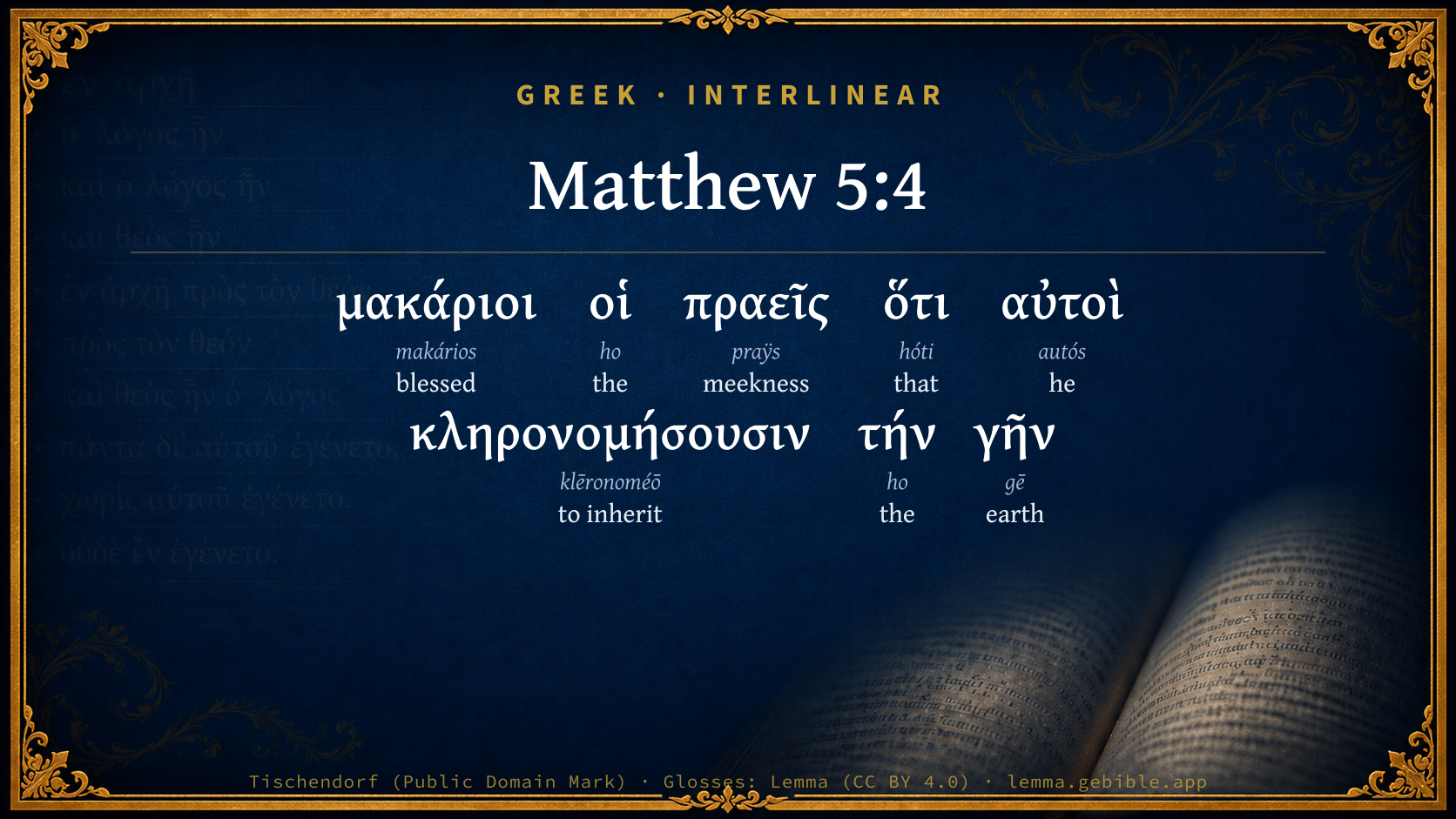
Blessed are those who mourn, For they shall be comforted.
Download a study sheet
One document with this verse’s original text, its word-by-word gloss line, the meaning frame, cross-references with their text, attributed commentary, and full source and license credits — printable, and it pastes into notes with its structure intact.
This verse Autodidact and up
A passage Seminary Student
Up to 50 verses in one chapter. A passage sheet keeps up to 6 commentary sources and 12 cross-references per verse, in the order this page ranks them, and says so on the sheet whenever that leaves anything out. Ask for a single verse and you get the Autodidact verse sheet above.
Everything on this page stays free to read, with no account — the sheet is a download of what is already on screen, not access to it.
Compare translations 3
The same verse in 3 English versions, stacked beneath the original-language interlinear above. Click any original word for its lexicon entry.
Each is an independent rendering of the whole verse — the interlinear is not word-aligned to these translations.
Highlighted words mark where these versions differ — a whole-verse word diff, not a word-by-word alignment.
-
World English Bible Public Domain
Blessed are those who mourn, For they shall be comforted.
-
King James Version Public Domain
Blessed are they that mourn: for they shall be comforted.
-
unfoldingWord Literal Text CC BY-SA 4.0
Blessed the ones mourning, for they will be comforted.
unfoldingWord Literal Text — © unfoldingWord, licensed CC BY-SA 4.0. Word-aligned USFM3 via Door43 (git.door43.org/unfoldingWord/en_ult).
Show all 19 translations
Every available English version of this verse, each an independent rendering of the whole verse.
-
World English Bible Public Domain
Blessed are those who mourn, For they shall be comforted.
-
Berean Standard Bible Public Domain
Blessed are those who mourn, for they will be comforted.
-
Majority Standard Bible Public Domain
Blessed are those who mourn, for they will be comforted.
-
King James Version Public Domain
Blessed are they that mourn: for they shall be comforted.
-
American Standard Version (1901) Public Domain
Blessed are they that mourn: for they shall be comforted.
-
Revised Version (1885) Public Domain
Blessed are they that mourn: for they shall be comforted.
-
Geneva Bible (1599) Public Domain
Blessed are they that mourne: for they shall be comforted.
-
Douay-Rheims (1899) Public Domain
Blessed are the meek: for they shall possess the land.
-
Young's Literal Translation Public Domain
`Happy the mourning -- because they shall be comforted.
-
Literal Standard Version CC BY-SA 4.0
Blessed the mourning—because they will be comforted.
-
Unlocked Literal Bible CC BY-SA 4.0
Blessed are those who mourn, for they will be comforted.
-
unfoldingWord Literal Text CC BY-SA 4.0
Blessed the ones mourning, for they will be comforted.
-
Darby Bible Public Domain
Blessed they that mourn, for *they* shall be comforted.
-
World Messianic Bible Public Domain
Blessed are those who mourn, for they shall be comforted.
-
Webster's Bible Public Domain
Blessed are they that mourn: for they shall be comforted.
-
Free Bible Version CC BY-SA 4.0
Blessed are those who mourn, for they shall be comforted.
-
Bible in Basic English Public Domain
Happy are those who are sad: for they will be comforted.
-
Text-Critical English NT CC BY 4.0
Blessed are those who mourn, for they will be comforted.
-
Tyndale New Testament (1534) Public Domain
Blessed are they that morne: for they shalbe conforted.
Literal Standard Version (2020), Covenant Press — licensed CC BY-SA 4.0. Text via the HelloAO Bible API (eBible.org). Unlocked Literal Bible (unfoldingWord) — licensed CC BY-SA 4.0. Text via the HelloAO Bible API (eBible.org). unfoldingWord Literal Text — © unfoldingWord, licensed CC BY-SA 4.0. Word-aligned USFM3 via Door43 (git.door43.org/unfoldingWord/en_ult). Free Bible Version, Dr. Jonathan Gallagher — licensed CC BY-SA 4.0. Text via the HelloAO Bible API (eBible.org).
Word by word
More ways to search: Search by grammar → Find every occurrence → Compare this word →
Practice this passage: Drill this verse → Learn its vocabulary →
- Appears 4× in the Greek New Testament
- First appears here
- Part of Speech
- Adjective
- Case
- Nominative
- Number
- Plural
- Gender
- Masculine
Full Thayer's Definition
- μακάριοι makários G3107 “blessed” Adjective, Nominative, Plural, Masculine
- οἱ ho G3588 “the” Article, Nominative, Plural, Masculine
- πραεῖς praÿs G4239 “meekness” Adjective, Nominative, Plural, Masculine
- ὅτι hóti G3754 “that” Conjunction
- αὐτοὶ autós G846 “he” Personal pronoun, Nominative, Plural, Masculine
- κληρονομήσουσιν klēronoméō G2816 “to inherit” Verb, Future, Active, Indicative, 3rd person, Plural
- τήν ho G3588 “the” Article, Accusative, Singular, Feminine
- γῆν gē G1093 “earth” Noun, Accusative, Singular, Feminine
About this verse
These counts appear in no published source. They are computed here, from the morphology-tagged text and Lemma’s own curated glosses. What Lemma adds →
- 8
- words
- 7
- distinct lemmas
- Gospels
- section
Notable vocabulary
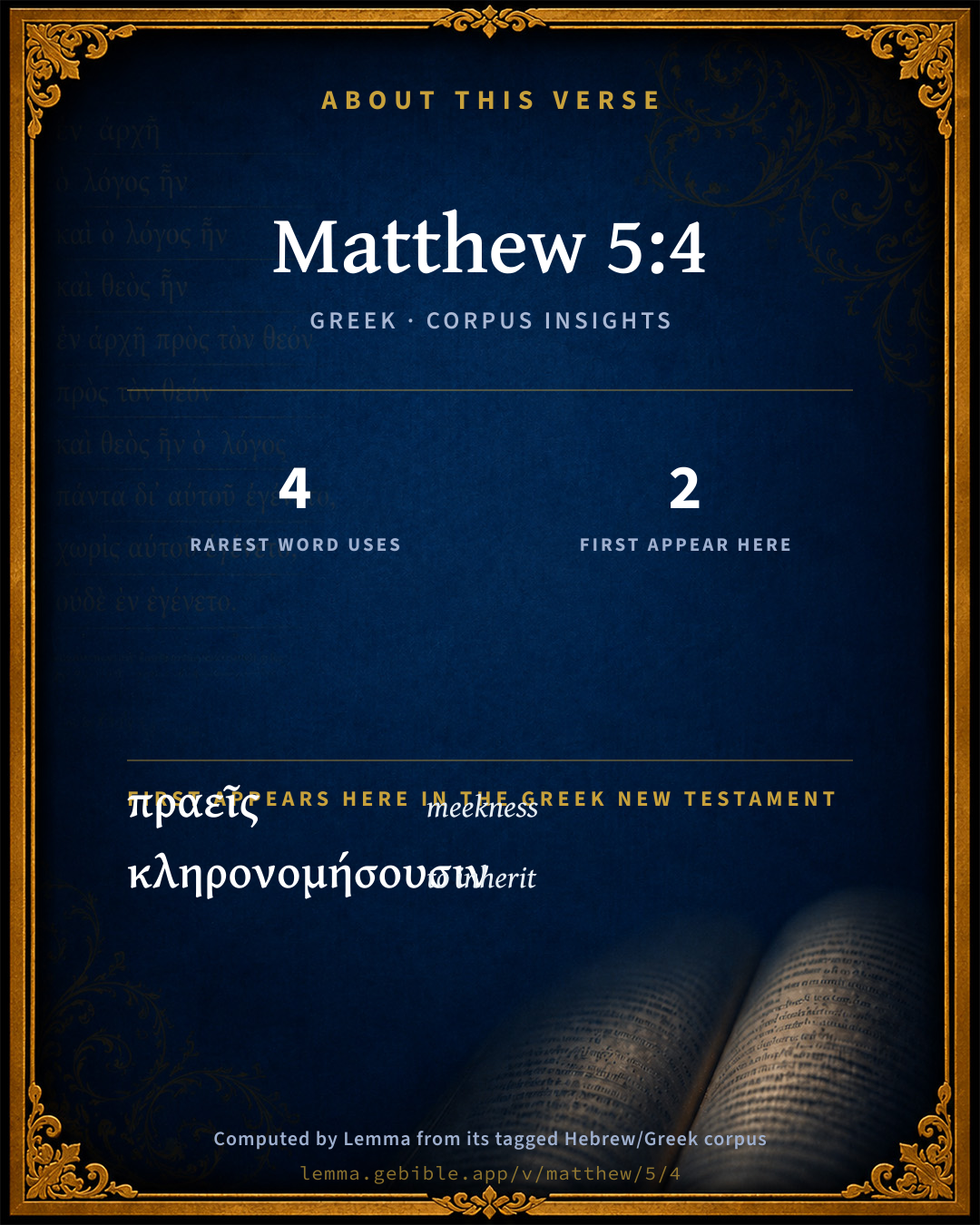
The rarest word here is πραεῖς meekness G4239 — appearing just 4 times in the whole Greek New Testament.
First appearance in Scripture
These words make their first canonical appearance in the Greek New Testament here:
Shared distinctive vocabulary
πραεῖς meekness G4239 occurs in 4 verses of the Greek New Testament. Also found in:
Repetition
A word recurs within this verse:
- οἱ the G3588 ×2
Cross-references
33Topical passages linked to Matthew 5:4 in the Treasury of Scripture Knowledge — connected by theme and wording, ordered by reader-vote popularity; previews shown in the World English Bible.
- Revelation 21:4 He will wipe away from them every tear from their eyes. Death will be no more; neither will there be mourning, nor crying, nor pain, any more. The first things have passed away."
- 2 Corinthians 7:9–10 I now rejoice, not that you were made sorry, but that you were made sorry to repentance. For you were made sorry in a godly way, that you might suffer loss by us in nothing.
- Isaiah 61:2–3 to proclaim the year of Yahweh's favor, and the day of vengeance of our God; to comfort all who mourn;
- John 16:20–22 Most assuredly I tell you, that you will weep and lament, but the world will rejoice. You will be sorrowful, but your sorrow will be turned into joy.
- Psalms 126:5–6 Those who sow in tears will reap in joy.
- Isaiah 57:18 I have seen his ways, and will heal him: I will lead him also, and restore comforts to him and to his mourners.
- Luke 6:21 Blessed are you who hunger now, For you will be filled. Blessed are you who weep now, For you will laugh.
- Revelation 7:14–17 I told him, "My lord, you know." He said to me, "These are those who came out of the great tribulation. They washed their robes, and made them white in the Lamb's blood.
- James 1:12 Blessed is the man who endures temptation, for when he has been approved, he will receive the crown of life, which the Lord promised to those who love him.
- Isaiah 51:11–12 The ransomed of Yahweh shall return, and come with singing to Zion; and everlasting joy shall be on their heads: they shall obtain gladness and joy; [and] sorrow and sighing shall flee away.
- 2 Corinthians 1:4–7 who comforts us in all our affliction, that we may be able to comfort those who are in any affliction, through the comfort with which we ourselves are comforted by God.
- Isaiah 25:8 He has swallowed up death forever; and the Lord Yahweh will wipe away tears from off all faces; and the reproach of his people will he take away from off all the earth: for Yahweh has spoken it.
- Isaiah 66:10 Rejoice you with Jerusalem, and be glad for her, all you who love her: rejoice for joy with her, all you who mourn over her;
- Psalms 30:7–11 You, Yahweh, when you favored me, made my mountain to stand strong. But when you hid your face, I was troubled.
- Ezekiel 9:4 Yahweh said to him, Go through the midst of the city, through the midst of Jerusalem, and set a mark on the foreheads of the men that sigh and that cry over all the abominations that are done in the midst of it.
- Isaiah 35:10 and the ransomed of Yahweh shall return, and come with singing to Zion; and everlasting joy shall be on their heads: they shall obtain gladness and joy, and sorrow and sighing shall flee away.
- Isaiah 30:19 For the people shall dwell in Zion at Jerusalem; you shall weep no more; he will surely be gracious to you at the voice of your cry; when he shall hear, he will answer you.
- Psalms 69:29–30 But I am in pain and distress. Let your salvation, God, protect me.
- Jeremiah 31:16–17 Thus says Yahweh: Refrain your voice from weeping, and your eyes from tears; for your work shall be rewarded, says Yahweh; and they shall come again from the land of the enemy.
- Psalms 40:1–3 I waited patiently for Yahweh. He turned to me, and heard my cry.
- Psalms 116:3–7 The cords of death surrounded me, The pains of Sheol got a hold of me. I found trouble and sorrow.
- Luke 16:25 "But Abraham said, 'Son, remember that you, in your lifetime, received your good things, and Lazarus, in like manner, bad things. But now here he is comforted and you are in anguish.
- Psalms 13:1–5 How long, Yahweh? Will you forget me forever? How long will you hide your face from me?
- Isaiah 12:1 In that day you will say, "I will give thanks to you, Yahweh; for though you were angry with me, your anger has turned away and you comfort me.
- Ezekiel 7:16 But those of those who escape shall escape, and shall be on the mountains like doves of the valleys, all of them moaning, every one in his iniquity.
- Psalms 6:1–9 Yahweh, don't rebuke me in your anger, Neither discipline me in your wrath.
- Psalms 32:3–7 When I kept silence, my bones wasted away through my groaning all day long.
- Luke 6:25 Woe to you, you who are full now! For you will be hungry. Woe to you who laugh now! For you will mourn and weep.
- Isaiah 38:14–19 Like a swallow [or] a crane, so did I chatter; I did moan as a dove; my eyes fail [with looking] upward: Lord, I am oppressed, be my collateral.
- Jeremiah 31:9–12 They shall come with weeping; and with petitions will I lead them: I will cause them to walk by rivers of waters, in a straight way in which they shall not stumble; for I am a father to Israel, and Ephraim is my firstborn.
- Zechariah 12:10–13:1 I will pour on the house of David, and on the inhabitants of Jerusalem, the spirit of grace and of supplication; and they will look to me whom they have pierced; and they shall mourn for him, as one mourns for his only son, and will grieve bitterly for him, as one grieves for his firstborn.
- Luke 7:50 He said to the woman, "Your faith has saved you. Go in peace."
- Luke 7:38 Standing behind at his feet weeping, she began to wet his feet with her tears, and she wiped them with the hair of her head, kissed his feet, and anointed them with the ointment.
Cross-references courtesy of OpenBible.info (CC BY 4.0).
Lesson kit
Teaching starters — assembled from the data on this page, not authored interpretation. Every prompt links to the verse data it draws on. Edit before teaching.
Matthew, in the Gospels, opens this verse with 8 words (7 distinct Greek lemmas). Its most distinctive word is praÿs (“meekness”). A historical commentator’s framing appears above. Read the whole chapter for the surrounding context.
Discussion questions
- The word praÿs carries the sense “meekness.” How does it shape the verse?
- 2 words make their first appearance in Scripture here. What does this debut establish?
- How does Matthew 11:29, which shares the word «meekness», read alongside this verse?
- What does the repetition of “the” (2× in this one verse) do in this verse?
- The translations on this page render this verse differently — a whole-verse word diff, not a word-by-word alignment. What might account for the different wordings?
- Compare how The Biblical Illustrator and Joseph Benson's Commentary read this verse. Where do they agree or differ?
Things to notice
- 2 words make their first canonical appearance in Scripture here.
- These translations choose different wording for 6 words in this verse.
- “the” occurs 2× in this single verse.
- 7 distinct Greek lemmas span 8 words in this verse.
Commentary
Notes on Matthew 5:4 from classic Christian and Jewish commentators (each source and its license shown beneath its notes). The classic Christian expositions comment on the surrounding passage and are grouped to its opening verse, so a note may address several verses; the Jewish commentaries on the Tanakh (Rashi and others) are per-verse, so they appear only where the commentator wrote on this verse.
Lemma curates 59 commentaries, every one of them public domain or Creative Commons licensed, each selected and text-cleaned for this edition rather than reprinted as found. About our sources →
The Biblical Illustrator
Joseph S. Exell
The Biblical Illustrator, edited by Joseph S. Exell (c. 1880s–1900s) — public domain. Text from a community e-Sword module.
Joseph Benson's Commentary
Joseph Benson's Commentary on the Old and New Testaments (1811–1818) — public domain. Text from a community e-Sword module.
Tyndale Open Study Notes
Tyndale Open Resources
Tyndale Open Study Notes — © Tyndale Open Resources, licensed CC BY-SA 4.0. Text via the HelloAO Bible API.
Bengel's Gnomon
Johann Albrecht Bengel
Bengel's Gnomon of the New Testament — English translation (T&T Clark, Edinburgh, 1860) — public domain. Text from a community e-Sword module.
Meyer's Critical & Exegetical Commentary
Heinrich August Wilhelm Meyer
Meyer — Critical and Exegetical Commentary on the New Testament — English translation by Peter Christie, edited by Frederick Crombie (T&T Clark, 1880) — public domain. Text from a community e-Sword module.
Expositor's Greek Testament
ed. W. Robertson Nicoll
The Expositor's Greek Testament, edited by W. Robertson Nicoll (1897–1910) — public domain. Text from a community e-Sword module.
Jamieson, Fausset & Brown
Robert Jamieson, A. R. Fausset & David Brown
Jamieson, Fausset & Brown — Commentary Critical and Explanatory on the Whole Bible (1871) — public domain (CC PDM 1.0). Text via the HelloAO Bible API.
Adam Clarke's Commentary
Adam Clarke's Commentary on the Bible (1810–1826) — public domain. Text from a community e-Sword/MySword module.
Ellicott's Commentary for English Readers
A Bible Commentary for English Readers, edited by Charles John Ellicott (1878–1897) — public domain. Text from a community e-Sword module.
The Cambridge Bible for Schools and Colleges
gen. ed. J. J. S. Perowne
The Cambridge Bible for Schools and Colleges (gen. ed. J. J. S. Perowne; Cambridge University Press, 1878–1918) — public domain. Text from a community e-Sword module.
John Gill's Exposition
John Gill's Exposition of the Whole Bible (1746–1763) — public domain (CC PDM 1.0). Text via the HelloAO Bible API.
Trapp's Complete Commentary
John Trapp
John Trapp, A Commentary or Exposition upon All the Books of the Old and New Testament (1647–1656) — public domain. Text from a community e-Sword module.
Albert Barnes' Notes on the Bible
Albert Barnes' Notes on the Bible (1834–1885) — public domain. Text from a community e-Sword/MySword module.
Haydock's Catholic Bible Commentary
George Leo Haydock (1774–1849), Haydock's Catholic Family Bible and Commentary, 1859 edition — public domain. Excludes Psalms (Douay-Rheims chapter numbering differs from Protestant) and Deuterocanonical books (Catholic canon only).
Matthew Poole's English Annotations
Matthew Poole's English Annotations on the Holy Bible (1683–1685) — public domain. Text from a community e-Sword/MySword module.
Whedon's Commentary on the Bible
Daniel D. Whedon
Daniel D. Whedon (gen. ed.), Commentary on the Old and New Testaments (1874–1909) — public domain. Text from a community e-Sword module.
The Pulpit Commentary
The Pulpit Commentary (1880–1919), ed. H.D.M. Spence-Jones & Joseph S. Exell — public domain. Text from a community e-Sword module.
John Wesley's Explanatory Notes
John Wesley, Explanatory Notes Upon the Whole Bible (1754–1765) — public domain. Text via the GEBible commentary corpus.
Kretzmann's Popular Commentary
Paul E. Kretzmann
Paul E. Kretzmann, Popular Commentary of the Bible (1921–1924) — public domain. Text from a community e-Sword module.
Burkitt's Expository Notes on the New Testament
William Burkitt
William Burkitt's Expository Notes on the New Testament (1700–1703) — public domain. Text from a community e-Sword module.
The People's New Testament
B. W. Johnson
B. W. Johnson's The People's New Testament with Notes (1889–1891) — public domain. Electronic text from the Christian Classics Ethereal Library (CCEL) ThML edition.
Cambridge Greek Testament for Schools and Colleges
Cambridge Greek Testament for Schools and Colleges (Cambridge University Press, 1896; 21 vols, various authors incl. Carr, Maclear, Plummer, Farrar, Lumby, Moule, M. R. James, Simcox) — public domain. Text from a community e-Sword module.
Alford’s Greek Testament
Henry Alford
Henry Alford, The Greek Testament (1849–1861) — public domain. Text from a community e-Sword module.
International Critical Commentary
International Critical Commentary — older volumes (1896–1929), various authors — public domain. Text from a community e-Sword module.
Vincent's Word Studies in the New Testament
Marvin R. Vincent
Marvin R. Vincent, Word Studies in the New Testament (1887–1900) — public domain. Text from a community e-Sword/MySword module.