
Matthew 1:21

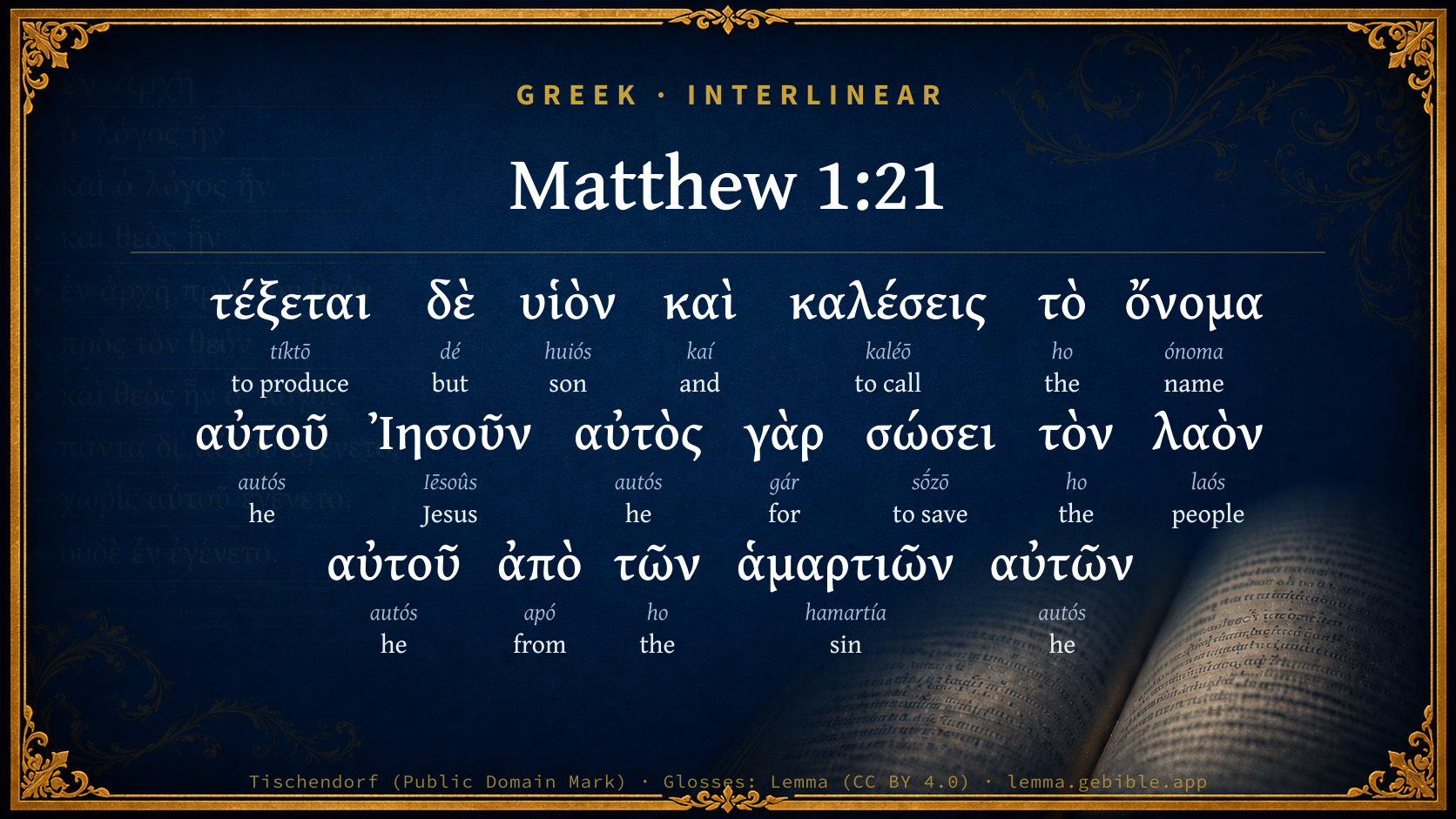
Greek (Tischendorf 8th ed.) Matthew 1:21 appears in the Greek New Testament. The text above is from the Tischendorf 8th edition. Each word links to its Strong’s number and a concise gloss. Click any word for its full Thayer’s Greek Lexicon entry.
Download image
Cite this verse

Matthew 1:21 (World English Bible). Public Domain. Lemma interlinear Bible study tool, https://lemma.gebible.app/v/matthew/1/21.

Show BibTeX & RIS
BibTeX
RIS
English Translation
She shall bring forth a son. You shall call his name Jesus, for it is he who shall save his people from their sins."
World English Bible · Public Domain
Highlights
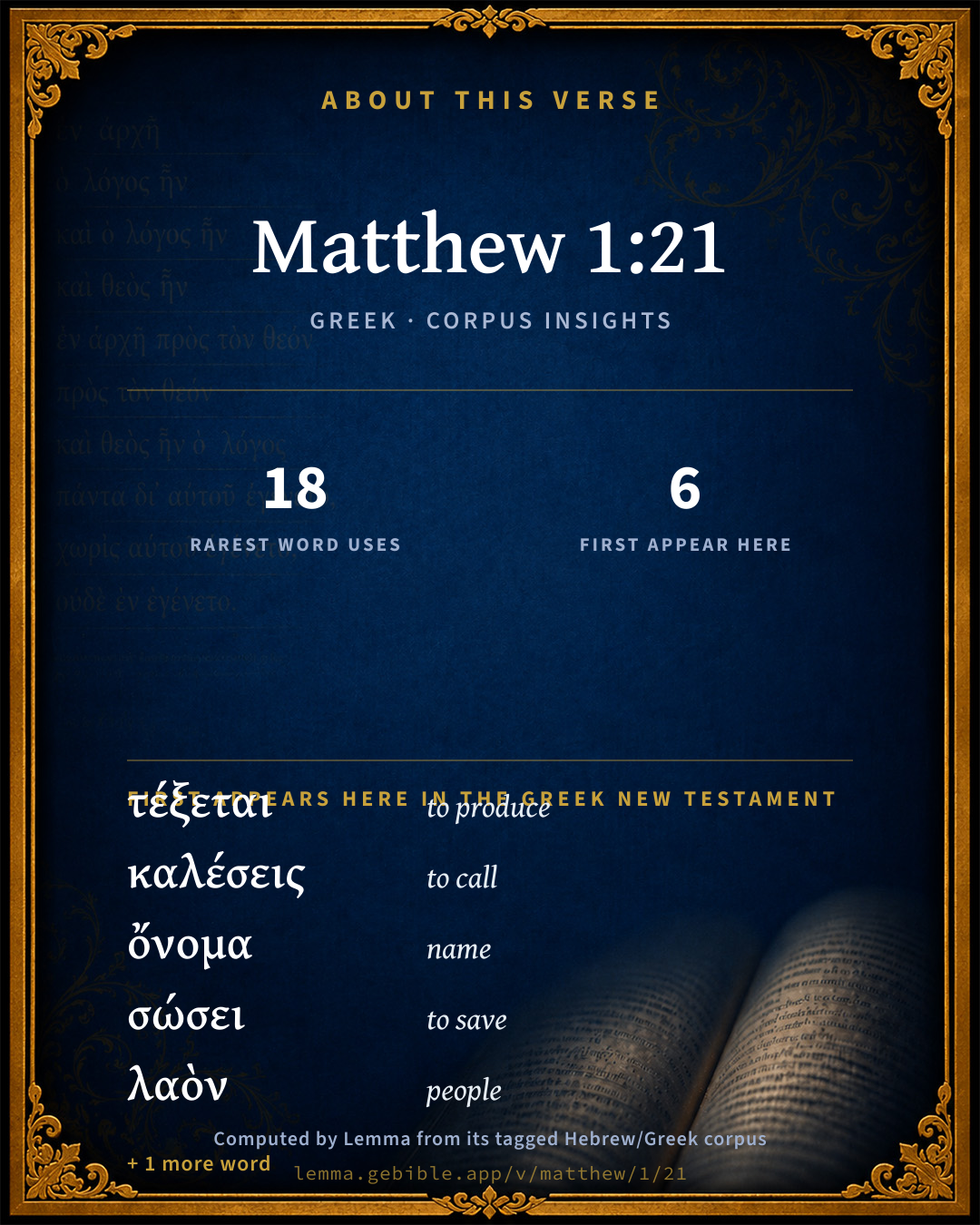
  • 6 first appearances in the Greek New Testament
Full analysis ↓
Download a study sheet

One document with this verse’s original text, its word-by-word gloss line, the meaning frame, cross-references with their text, attributed commentary, and full source and license credits — printable, and it pastes into notes with its structure intact.

This verse Autodidact and up

Study sheet (.html) Plain text (.txt)

A passage Seminary Student

Up to 50 verses in one chapter. A passage sheet keeps up to 6 commentary sources and 12 cross-references per verse, in the order this page ranks them, and says so on the sheet whenever that leaves anything out. Ask for a single verse and you get the Autodidact verse sheet above.

Everything on this page stays free to read, with no account — the sheet is a download of what is already on screen, not access to it.

Want to remove ads? Support Godless Engineer
Compare translations 3

The same verse in 3 English versions, stacked beneath the original-language interlinear above. Click any original word for its lexicon entry.

Each is an independent rendering of the whole verse — the interlinear is not word-aligned to these translations.

Highlighted words mark where these versions differ — a whole-verse word diff, not a word-by-word alignment.

  • World English Bible Public Domain
    She shall bring forth a son. You shall call his name Jesus, for it is he who shall save his people from their sins."
  • King James Version Public Domain
    And she shall bring forth a son, and thou shalt call his name JESUS: for he shall save his people from their sins.
  • unfoldingWord Literal Text CC BY-SA 4.0
    And she will bear a son, and you will call his name Jesus, for he will save his people from their sins.”

unfoldingWord Literal Text — © unfoldingWord, licensed CC BY-SA 4.0. Word-aligned USFM3 via Door43 (git.door43.org/unfoldingWord/en_ult).

Versions to compare (up to 4)

3 of 4 selected

Show all 19 translations

Every available English version of this verse, each an independent rendering of the whole verse.

  • World English Bible Public Domain
    She shall bring forth a son. You shall call his name Jesus, for it is he who shall save his people from their sins."
  • Berean Standard Bible Public Domain
    She will give birth to a Son, and you are to give Him the name Jesus, because He will save His people from their sins.”
  • Majority Standard Bible Public Domain
    She will give birth to a Son, and you are to give Him the name Jesus, because He will save His people from their sins.”
  • King James Version Public Domain
    And she shall bring forth a son, and thou shalt call his name JESUS: for he shall save his people from their sins.
  • American Standard Version (1901) Public Domain
    And she shall bring forth a son; and thou shalt call his name JESUS; for it is he that shall save his people from their sins.
  • Revised Version (1885) Public Domain
    And she shall bring forth a son; and thou shalt call his name JESUS; for it is he that shall save his people from their sins.
  • Geneva Bible (1599) Public Domain
    And she shall bring foorth a sonne, and thou shalt call his name JESUS: for hee shall saue his people from their sinnes.
  • Douay-Rheims (1899) Public Domain
    And she shall bring forth a son: and thou shalt call his name JESUS. For he shall save his people from their sins.
  • Young's Literal Translation Public Domain
    and she shall bring forth a son, and thou shalt call his name Jesus, for he shall save his people from their sins.'
  • Literal Standard Version CC BY-SA 4.0
    and she will bring forth a Son, and you will call His Name Jesus, for He will save His people from their sins.”
  • Unlocked Literal Bible CC BY-SA 4.0
    She will give birth to a son, and you will call his name Jesus, for he will save his people from their sins.”
  • unfoldingWord Literal Text CC BY-SA 4.0
    And she will bear a son, and you will call his name Jesus, for he will save his people from their sins.”
  • Darby Bible Public Domain
    And she shall bring forth a son, and thou shalt call his name Jesus, for *he* shall save his people from their sins.
  • World Messianic Bible Public Domain
    She shall give birth to a son. You shall name him Yeshua, for it is he who shall save his people from their sins.”
  • Webster's Bible Public Domain
    And she shall bring forth a son, and thou shalt call his name JESUS: for he shall save his people from their sins.
  • Free Bible Version CC BY-SA 4.0
    She will give birth to a son and you shall call him Jesus, for he will save people from their sins.”
  • Bible in Basic English Public Domain
    And she will give birth to a son; and you will give him the name Jesus; for he will give his people salvation from their sins.
  • Text-Critical English NT CC BY 4.0
    She will give birth to a son, and yoʋ shall name him Jesus, for he will save his people from their sins.”
  • Tyndale New Testament (1534) Public Domain
    She shall brynge forthe a sonne and thou shalt call his name Iesus. For he shall save his peple from their synnes.

Literal Standard Version (2020), Covenant Press — licensed CC BY-SA 4.0. Text via the HelloAO Bible API (eBible.org). Unlocked Literal Bible (unfoldingWord) — licensed CC BY-SA 4.0. Text via the HelloAO Bible API (eBible.org). unfoldingWord Literal Text — © unfoldingWord, licensed CC BY-SA 4.0. Word-aligned USFM3 via Door43 (git.door43.org/unfoldingWord/en_ult). Free Bible Version, Dr. Jonathan Gallagher — licensed CC BY-SA 4.0. Text via the HelloAO Bible API (eBible.org).

Word by word

More ways to search: Search by grammar → Find every occurrence → Compare this word →

Practice this passage: Drill this verse → Learn its vocabulary →

τέξεται
tíktō
G5088
“to produce”
Verb, Future, Middle deponent, Indicative, 3rd person, Singular
Part of Speech
Verb
Tense
Future
Voice
Middle deponent
Mood
Indicative
Person
3rd person
Number
Singular
Full Thayer's Definition

Origin: a strengthened form of a primary teko tek'-o (which is used only as alternate in certain tenses)

TDNT: None

1. to bring forth, bear, produce (fruit from the seed) a. of a woman giving birth b. of the earth bringing forth its fruits c. metaph. to bear, bring forth
  1. δὲ dé G1161 “but” Conjunction
  2. υἱὸν huiós G5207 “son” Noun, Accusative, Singular, Masculine
  3. καὶ kaí G2532 “and” Conjunction
  4. καλέσεις kaléō G2564 “to call” Verb, Future, Active, Indicative, 2nd person, Singular
  5. τὸ ho G3588 “the” Article, Accusative, Singular, Neuter
  6. ὄνομα ónoma G3686 “name” Noun, Accusative, Singular, Neuter
  7. αὐτοῦ autós G846 “he” Personal pronoun, Genitive, Singular, Masculine
  8. Ἰησοῦν Iēsoûs G2424 “Jesus” Noun, Accusative, Singular, Masculine
  9. αὐτὸς autós G846 “he” Personal pronoun, Nominative, Singular, Masculine
  10. γὰρ gár G1063 “for” Conjunction
  11. σώσει sṓzō G4982 “to save” Verb, Future, Active, Indicative, 3rd person, Singular
  12. τὸν ho G3588 “the” Article, Accusative, Singular, Masculine
  13. λαὸν laós G2992 “people” Noun, Accusative, Singular, Masculine
  14. αὐτοῦ autós G846 “he” Personal pronoun, Genitive, Singular, Masculine
  15. ἀπὸ apó G575 “from” Preposition
  16. τῶν ho G3588 “the” Article, Genitive, Plural, Feminine
  17. ἁμαρτιῶν hamartía G266 “sin” Noun, Genitive, Plural, Feminine
  18. αὐτῶν autós G846 “he” Personal pronoun, Genitive, Plural, Masculine

About this verse

These counts appear in no published source. They are computed here, from the morphology-tagged text and Lemma’s own curated glosses. What Lemma adds →

19
words
14
distinct lemmas
Gospels
section

Notable vocabulary

The rarest word here is τέξεται to produce G5088 — appearing just 18 times in the whole Greek New Testament.

First appearance in Scripture

These words make their first canonical appearance in the Greek New Testament here:

  • τέξεται to produce G5088
  • καλέσεις to call G2564
  • ὄνομα name G3686
  • σώσει to save G4982
  • λαὸν people G2992
  • ἁμαρτιῶν sin G266

Shared distinctive vocabulary

τέξεται to produce G5088 occurs in 17 verses of the Greek New Testament. Also found in:
Repetition

Words recur within this verse:

  • αὐτοῦ he G846 ×4
  • τὸ the G3588 ×3

Cross-references

33

Topical passages linked to Matthew 1:21 in the Treasury of Scripture Knowledge — connected by theme and wording, ordered by reader-vote popularity; previews shown in the World English Bible.

  • Acts 13:23 From this man's seed, God has brought salvation to Israel according to his promise,
  • Acts 4:12 There is salvation in none other, for neither is there any other name under heaven, that is given among men, by which we must be saved!"
  • John 1:29 The next day, he saw Jesus coming to him, and said, "Behold, the Lamb of God, who takes away the sin of the world!
  • 1 John 3:5 You know that he was revealed to take away our sins, and in him is no sin.
  • Colossians 1:20–23 and through him to reconcile all things to himself, by him, whether things on the earth, or things in the heavens, having made peace through the blood of his cross.
  • Luke 2:21 When eight days were fulfilled for the circumcision of the child, his name was called Jesus, which was given by the angel before he was conceived in the womb.
  • Acts 5:31 God exalted him with his right hand to be a Prince and a Savior, to give repentance to Israel, and remission of sins.
  • Luke 1:31 Behold, you will conceive in your womb, and bring forth a son, and will call his name 'Jesus.'
  • Titus 2:14 who gave himself for us, that he might redeem us from all iniquity, and purify for himself a people for his own possession, zealous for good works.
  • 1 John 2:1–2 My little children, I write these things to you so that you may not sin. If anyone sins, we have a Counselor with the Father, Jesus Christ, the righteous.
  • Zechariah 9:9 Rejoice greatly, daughter of Zion! Shout, daughter of Jerusalem! Behold, your king comes to you! He is righteous, and having salvation; Lowly, and riding on a donkey, Even on a colt, the foal of a donkey.
  • Luke 2:11 For there is born to you, this day, in the city of David, a Savior, who is Christ the Lord.
  • 1 John 1:7 But if we walk in the light, as he is in the light, we have fellowship with one another, and the blood of Jesus Christ, his Son, cleanses us from all sin.
  • Isaiah 45:21–22 Declare you, and bring [it] forth; yes, let them take counsel together: who has shown this from ancient time? who has declared it of old? Haven't I, Yahweh? and there is no God else besides me, a just God and a Savior; there is no one besides me.
  • Acts 3:26 God, having raised up his servant, Jesus, sent him to you first, to bless you, in turning away everyone of you from your wickedness."
  • Acts 13:38–39 Be it known to you therefore, brothers, that through this man is proclaimed to you remission of sins,
  • Psalms 130:7–8 Israel, hope in Yahweh, For with Yahweh there is loving kindness. With him is abundant redemption.
  • Jeremiah 23:6 In his days Judah shall be saved, and Israel shall dwell safely; and this is his name by which he shall be called: Yahweh our righteousness.
  • Luke 1:35–36 The angel answered her, "The Holy Spirit will come on you, and the power of the Most High will overshadow you. Therefore also the holy one who is born from you will be called the Son of God.
  • Ephesians 5:25–27 Husbands, love your wives, even as Christ also loved the assembly, and gave himself up for it;
  • Hebrews 7:25 Therefore he is also able to save to the uttermost those who draw near to God through him, seeing he ever lives to make intercession for them.
  • Daniel 9:24 Seventy weeks are decreed on your people and on your holy city, to finish disobedience, and to make an end of sins, and to make reconciliation for iniquity, and to bring in everlasting righteousness, and to seal up vision and prophecy, and to anoint the most holy.
  • Revelation 7:14 I told him, "My lord, you know." He said to me, "These are those who came out of the great tribulation. They washed their robes, and made them white in the Lamb's blood.
  • Jeremiah 33:16 In those days shall Judah be saved, and Jerusalem shall dwell safely; and this is [the name] by which she shall be called: Yahweh our righteousness.
  • Luke 1:13 But the angel said to him, "Don't be afraid, Zacharias, because your request has been heard, and your wife, Elizabeth, will bear you a son, and you shall call his name John.
  • Genesis 18:10 He said, "I will certainly return to you when the season comes round. Behold, Sarah your wife will have a son." Sarah heard in the tent door, which was behind him.
  • Ezekiel 36:25–29 I will sprinkle clean water on you, and you shall be clean: from all your filthiness, and from all your idols, will I cleanse you.
  • Revelation 1:5–6 and from Jesus Christ, the faithful witness, the firstborn of the dead, and the ruler of the kings of the earth. To him who loves us, and washed us from our sins by his blood;
  • Genesis 17:19 God said, "No, but Sarah, your wife, will bear you a son. You shall call his name Isaac. I will establish my covenant with him for an everlasting covenant for his seed after him.
  • Genesis 17:21 But my covenant I establish with Isaac, whom Sarah will bear to you at this set time in the next year."
  • 2 Kings 4:16–17 He said, At this season, when the time comes round, you shall embrace a son. She said, No, my lord, you man of God, do not lie to your handmaid.
  • Isaiah 12:1–2 In that day you will say, "I will give thanks to you, Yahweh; for though you were angry with me, your anger has turned away and you comfort me.
  • Judges 13:3 The angel of Yahweh appeared to the woman, and said to her, See now, you are barren, and don't bear; but you shall conceive, and bear a son.

Cross-references courtesy of OpenBible.info (CC BY 4.0).

Commentary

Notes on Matthew 1:21 from classic Christian and Jewish commentators (each source and its license shown beneath its notes). The classic Christian expositions comment on the surrounding passage and are grouped to its opening verse, so a note may address several verses; the Jewish commentaries on the Tanakh (Rashi and others) are per-verse, so they appear only where the commentator wrote on this verse.

Lemma curates 59 commentaries, every one of them public domain or Creative Commons licensed, each selected and text-cleaned for this edition rather than reprinted as found. About our sources →

The Biblical Illustrator

Joseph S. Exell

Mat_1:21-22

Jesus.

The design of our Saviours coming

I. Consider this as an enemy.

1. Behold sin with regard to God.

2. Behold sin in its names.

3. Behold the effects of sin.

4. That Christ derives from this work His highest title.

II. Consider in what manner he saves his people from their sins.

1. He redeems them by price.

2. He saves them by power.

3. He saves from the guilt of sin.

4. He saves from the love of sin. (W. Jay.)

In old times God was known by names of power, of nature, of majesty; but His name of mercy was reserved till now. (Bishop J. Taylor.)

The name and work of Jesus

I. His name.

II. His work.

1. Whom He saves-His people.

2. From what He saves-their sins.

3. How He saves. By His atonement He saves them virtually; by His spirit, vitally; by His grace, constantly; by His power, eternally. Remarks:

(1) Jesus as a suitable Saviour;

(2) a willing Saviour;

(3) an all-sufficient Saviour. (E. Oakes.)

Christ a Saviour

I. The work he is to accomplish is a most great, glorious, and blessed one. He shall save. Another Scripture says, He shall destroy. For this purpose the Son of God was manifested, that He might destroy the works of the devil. These characters are consistent. He demolishes the works of Satan because they stand in His way as Saviour.

1. He eaves His people from the penalty of their sins.

2. From the dominion and practice of sin.

3. In the end He saves from the very existence of sin.

4. And from the painful remembrance of their sins.

II. The name our Lord is to bear in consequence of this work of salvation. Learn from this-

1. The character in which God most delights to regard His Son.

2. It shows us that He would have us regard Him chiefly as a Saviour.

3. This name may have been given to Christ to endear Him the more to our hearts.

4. We see here beyond all dispute the real nature and design of Christs religion. (C. Bradley.)

The name of Jesus

I. The name of Jesus.

1. The signification of the name.

2. The appointment of the name. Not left to mens choice.

II. The reason for the name. Some would rather that He had come to save them from poverty, pains, death; not knowing that to save from sins is to save from all these. (J. Bennet, D. D.)

I. A work of most blessed purpose.

1. Sin is itself the greatest of all miseries. It is

(1) deeper;

(2) vaster;

(3) more abiding;

(4) the source of all other miseries.

II. A work of vast magnitude. Its magnitude realized by dwelling-

1. On the multitudes of the saved.

2. On the nature of the salvation.

3. On the fact that this salvation is wrought by Jesus personally. (U. R. Thomas.)

Jesus the Saviour

I. What the gospel shall, bring-Salvation from sins.

II. Jesus is the saviour and his work constitutes our salvation.

1. This word teaches us that salvation is Divine. Because Divine it is

(1) sufficient;

(2) unchangeable;

(3) infinite. It is illimitable, as the air to the bird.

2. He who gives this salvation stands in solitary grandeur-He. Nowhere else can we find salvation.

3. The name gives an immutable pledge that we shall be saved.

III. The text informs us of what this salvation consists. From their sins. Not from the wrath of God primarily.

1. From the guilt, curse, condemnation of sin.

2. From our love, habit, practice of sin.

3. It is not salvation from an abstraction, but from selfishness and self-will.

IV. The character of the people of God. His people; peculiar, chosen, royal. Are you saved from sins? (J. Donovan.)

Jesus the Saviour

I. Jesus is an omnipotent Saviour.

1. The presumption of the fact from the infinite wisdom and goodness of God, who never provides a cause unequal to the effect.

2. The declaration of the fact, He is able to save them to the uttermost, etc.

II. Jesus is a willing Saviour.

III. Jesus is a living Saviour.

IV. Jesus is a present Saviour.

V. Jesus is a personal Saviour.

VI. Jesus is a sympathizing Saviour. (G. H. Smyth.)

I. Let me call your attention to the Saviour. Jesus is Divine; He saves His people from their sins. Not the word, not the ordinances, but Jesus Himself saves.

II. Look at the salvation.

1. Jesus saves from sin by bestowing forgiveness-full forgiveness, free, immediate.

2. Jesus saves His people from the pollution of sin; not in their sins, but from their sins.

III. Let us look at the saved. He shall save His people. Who are His people? They must have been at one time in their sins. Therefore no one need despair. (W. M. Taylor, D. D.)

Jesus only worthy of trust as a Saviour.

A Christian Hindoo was dying, and his heathen comrades came around him and tried to comfort him by reading some of the pages of their theology; but he waved his hand, as much as to say, I dont want to hear it. Then they called in a heathen priest, and he said, If you will only recite the Numtra it will deliver you from hell. He waved his hand, as much as to say, I dont want to hear that. Then they said, Call on Juggernaut. He shook his head, as much as to say, I cant do that. Then they thought perhaps he was too weary to speak, and they said, Now if you cant say Juggernaut, think of that god. He shook his head again, as much as to say, No, no, no. Then they bent down to his pillow, and they said, In what will you trust? His face lighted up with the very glories of the celestial sphere as he cried out, rallying all his dying energies, Jesus!

The name of Jesus.-

This name Jesus, said St. Bernard, it is honey in the mouth, harmony in the ear, melody in the heart. This name Jesus, saith St. Anselm, it is a name of comfort to sinners when they call upon Him; therefore he himself saith, Jesus, be my Jesus. This name is above all names: first, for that it was consecrated from everlasting; secondly, for that it was given of God; thirdly, for that it was desired of the Patriarchs; fourthly, for that it was foretold of the Prophets; fifthly, for that it was accomplished in the time of grace, magnified in the Apostles, witnessed of Martyrs, acknowledged and honoured shall it be of all believers unto the worlds end. This name Jesus, it is compared to oil poured out; oil being kept close, it sendeth not forth such a savour, as it doth being poured out; and oil hath these properties, it suppleth, it cherisheth, it maketh look cheerfully; so doth this name of Jesus, it suppleth the hardness of our hearts, it cherisheth the weakness of our faith, enlighteneth the darkness of our soul, and maketh man look with a cheerful countenance towards the throne of grace. (Christopher Sutton.)

Salvation from sin

You must be saved from sin not in sin as some seem to imagine. The latter is like saving a man from drowning by keeping him under the water which is destroying him; or like recovering a man from sickness by leaving him under the malady which constitutes the complaint. (W. Jay.)

The Biblical Illustrator, edited by Joseph S. Exell (c. 1880s–1900s) — public domain. Text from a community e-Sword module.

Joseph Benson's Commentary

Mat 1:21. She shall bring forth a son — Hers, not thine, for he does not say to thee, Christ being απατωρ, without father, as man. And thou shalt call his name Jesus — It belonged to Joseph, as being reputed his father, and the person under whose protection Christ was placed during his infancy, to give him his name. “Six men,” says Rabbi Eliezer, “have been named before they were born; viz., Isaac, Ishmael, Moses our lawgiver, Solomon, Josiah, and King Messiah.” To these we may add, Cyrus and John the Baptist: and observe, that those persons to whom a name has been given by God before their birth, have always been remarkable persons. The name Jesus, in Greek, answers to Joshua, or rather, Jehoshuah, in Hebrew, which signifies Jehovah shall save; for Jah, or Jehovah, enters into the composition of the name, as Bishop Pearson has largely and clearly shown in his most learned and instructive Exposition of the Creed, pp. 69-71. So that Christ’s being called Jesus, was in effect an accomplishment of the prophecy that he should be called Emmanuel. It was not without reason that the successor of Moses was called by this name; for, by subduing the Canaanites, and putting the tribes of Israel in possession of the promised land, he showed himself to be, under God, the Saviour of his people. But this name agrees much better to our Jesus, who both delivers his followers from much more dangerous enemies, and divides unto them a much more glorious inheritance. Thus, in the next clause, he shall save his people from their sins — Joseph, by his people, could not understand any other than the Jewish nation, which is generally signified by that name in the Scriptures; and to them he was peculiarly sent, and them he will at length fully gather, save, and restore. We know, however, that all the true Israel of God, including even the Gentiles that should believe in him, are included. All these, it is here said, he should save from their sins, i.e, from the guilt, power, and pollution of them, by procuring, through his death, and receiving, in consequence of his ascension into heaven, an ample pardon for them, and the Holy Spirit to write that pardon on their hearts, and renew them after the divine image, that, in consequence of a life of holiness on earth, they might be raised to a state of complete perfection and felicity in heaven. How plain it is from hence that, although the gospel offers us salvation by faith, and not by works, yet it effectually secures the practice of holiness, since holiness is a part of that salvation wherewith Christ came to save sinners; for he came to save them from their sins. It is worth observing, on this occasion, what an excellent example of gentleness and prudence is here set us by Joseph! In an affair which appeared dubious, he chose, as we should always do, rather to err on the favourable than on the severe extreme. He is careful to avoid any precipitate steps; and, in the moment of deliberation, God interposes to guide and determine his resolves. Let us reflect, with what wonder and pleasure he would receive the important message from the angel, which not only assured him of the unstained virtue and eminent piety of her he loved, and confirmed his choice of her, as the partner of his future life, but brought him tidings of a divine Saviour, a Jesus, an Emmanuel, who should be God with men, and should save his people from their sins; and assured him, moreover, that the object of his affections, his beloved, espoused Mary, should, by a miraculous conception, be the happy mother of this heavenly offspring, and should therefore through all generations be entitled blessed. Let us also receive these glad tidings of great joy, designed for the consolation of all people, with suitable humility and gratitude, and seek unto this Jesus that he may answer his divine name in us, and save us, his people, from our sins. Let our souls bow to this Emmanuel, our incarnate God, and, while with holy wonder we survey the various scenes of his humiliation, let us remember, too, his native dignity and divine glory, and pay him the worship and service which are his undoubted due.

Joseph Benson's Commentary on the Old and New Testaments (1811–1818) — public domain. Text from a community e-Sword module.

Tyndale Open Study Notes

Tyndale Open Resources

1:21 Jesus is the Greek form of the Hebrew name Yeshua, which means “The Lord saves.” The name appropriately describes his role: he will save his people from their sins. • His people may refer either to Israel as a nation (2:6) or to the Messiah’s people, the church, which is comprised of both Jews and Gentiles (4:15-16; 16:18; 28:18-20).

Tyndale Open Study Notes — © Tyndale Open Resources, licensed CC BY-SA 4.0. Text via the HelloAO Bible API.

Bengel's Gnomon

Johann Albrecht Bengel

Mat 1:21. Τέξεται, shall bring forth) The word σοι (to thee), which is added (Luk 1:31) concerning Zachariah, is not introduced here;[58]—καλέσεις, thou shalt call) By the use of the second person singular, the duties and obligations of a father are committed to Joseph. St Matthew records more particulars than the other evangelists regarding him; afterwards, when men had become acquainted with the truth, the first place is given (in Luk 1:31) to Mary.—Ἰησοῦν, Jesus) Many names of the Messiah were announced in the Old Testament; but the proper name “JESUS” was not expressly announced. The meaning and force of it are, however, proclaimed everywhere, namely, SALVATION; and the name itself was divinely foretold in this passage before our Lord’s birth, and in Luk 1:31, even before His conception. The name יֵשוּעַ (Jeshua), which occurs in Neh 8:17, is the same as יְהוּשׁוּעַ or יֵהוֿשֻעַ (Jehoshua, commonly called Joshua): both of which are rendered Ἰησοῦς (Jesus) by the LXX. And in so far, learned men have been right in declaring that the name Jesus contains the Tetragrammaton, [יהוה] or ineffable name of God.—See Hiller’s Syntagmata Hermeneutica, p. 337, where the name of Jesus is thus interpreted, HE WHO IS is SALVATION: yea, the angel interprets it ΑΥΤΟΣ ΣΩΣΕΙ (He shall save), where ΑὐΤῸς (He) corresponds with the Divine Name.—Cf. Gnomon on Heb 1:12. Nor does the name Jehoshua differ from the original. Hoshea (See Num 13:16) in any thing else, except the addition of the Divine Name, which transforms the name from a prayer, Save (Salva), into an affirmation, Jehovah Salvation. And, since the name Emmanuel mentions GOD most expressly together with SALVATION, the name Jesus itself, the force of which, the Evangelist of the Old Testament, Isaiah (whose own name signifies the same thing) clearly indicates by the synonym Emmanuel, requires much more the mention of the Divine Name: for Emmanuel and Jesus are equivalent terms.—See notes on Mat 1:22-23. Nay, even if the é in ישוע be considered as merely the sign of the third person, still, as is frequently the case with Hebrew names, “GOD” must be understood, and here with especial force.—Αὐτὸς, He) The pronoun ΑὐΤῸς, in the nominative, is always emphatic; here it is peculiarly so. In the oblique case, it is frequently a mere relative.—ΣΏΣΕΙ, shall save) As often, therefore, as the words, “to save,” “Saviour,” “salvation,” “salutary,[59]” occur with reference to Christ, we ought to consider, that the name of JESUS is virtually mentioned.—τὸν λαὸν, Αὐτοῦ, His people) sc. Israel, and those who shall be added to the fold of Israel.[60]—Αὐτοῦ, His) and at the same time God’s.—Cf. ch. Mat 2:6.

[58] i.e. Because our Lord was not the child of Joseph.—(I. B.)

[59] Salutare—conducive to health, whether of body or soul: it is frequently difficult, sometimes impossible, to give at once the full and exact force of these words in an English translation.—(I. B.)

[60] The gathering in of the Gentiles to the Church was at that time a mystery even to the angels.—Vers. Germ.

Bengel's Gnomon of the New Testament — English translation (T&T Clark, Edinburgh, 1860) — public domain. Text from a community e-Sword module.

Meyer's Critical & Exegetical Commentary

Heinrich August Wilhelm Meyer

Mat_1:21. Τέξεται δέ] and she will bear. Non additur tibi, ut additur de Zacharia, Luk_1:13, Bengel.

Καλέσεις … Ἰησοῦν] literally: thou wilt call His name Jesus. Comp. LXX. Gen_17:19; 1Sa_1:20; Mat_1:23; Mat_1:25; Luk_1:13; Luk_1:31; Luk_2:21. Exactly so in Hebrew: קרא אֶת־שְׁמוֹ. The Greeks, however, would say: καλέσεις τὸ ὄνομα αὐτὸν (or also αὐτῷ) Ἰησοῦν; Matthiae, p. 935 [E. T., Kenrick, p. 675 ff.]; Heindorf, ad Plat. Phaedr. p. 238 A.

καλέσεις] the future serves in classical writers to denote the softened idea of the imperative. Bernhardy, p. 378; Kühner, II. 1, p. 149. In the LXX. and in the N. T. it is especially used of divine injunctions, and denotes thereby the imperative sense apodeictically, because it supposes the undoubted certainty of the result; comp. Winer, p. 296 [E. T. 396 f.]. So also here, where a divine command is issued. When Fritzsche would here retain the proper conception of the future, it becomes a mere prediction, less appropriate in the connection; for it is less in keeping with the design of the angelic annunciation, according to which the bestowal and interpretation of the name Jesus is referred to a divine causality, and consequently the genus of the name itself must, most naturally, appear as commanded.

αὐτός] He and no other.

τὸν λαὸν αὐτοῦ] The people of Israel: because for these first, and then also for the heathen, was the Messiah and His work intended, Joh_4:22; Rom_1:16; Gal_3:14. As certainly, moreover, as the manner and fashion in which the promised one was to accomplish the salvation, and by means of His redemptive work has accomplished it, is to be conceived as being present to the eye of God at the sending of this news, as certainly must Joseph be conceived as regarding it only in its national definiteness, consequently as referring to the theocratic liberation and prosperity of the people (comp. Luk_1:68 ff.), along with which, however, the religious and moral renewal also was regarded as necessary; which renewal must have presupposed the antecedent forgiveness of sin (Luk_1:77). ἁμαρτιῶν, therefore, is to be taken, not as punishment of sin, but, as always, simply as sins.

αὐτοῦ, not to be written αὑτοῦ (for the angel speaks of Him as a third person, and without any antithesis): His people, for they belong to the Messiah, comp. Joh_1:11; on the plural αὐτῶν, see Buttmann, neut. Gr. p. 114 [E. T. 130].

Meyer — Critical and Exegetical Commentary on the New Testament — English translation by Peter Christie, edited by Frederick Crombie (T&T Clark, 1880) — public domain. Text from a community e-Sword module.

Expositor's Greek Testament

ed. W. Robertson Nicoll

Mat 1:21 . τέξεται Ἰησοῦν : Mary is about to bear a son , and He is to bear the significant name of Jesus . The style is an echo of O. T. story, Gen 17:19 , Sept [3] , the birth of Isaac and that of Jesus being thereby placed side by side as similar in their preternatural character. καλέσεις : a command in form of a prediction. But there is encouragement as well as command in this future. It is meant to help Joseph out of his doubts into a mood of heroic, resolute action. Cease from brooding anxious thought, think of the child about to be born as destined to a great career. to be signalised by His name Jesus Jehovah the helper. αὐτὸς γὰρ … ἁμαρτιῶν αὐτῶν : interpretation of the name, still part of the angelic speech. αὐτὸς emphatic, he and no other. ἁμαρτ ., sins , implying a spiritual conception of Israel’s need.

[3] Septuagint.

The Expositor's Greek Testament, edited by W. Robertson Nicoll (1897–1910) — public domain. Text from a community e-Sword module.

Geneva Bible (1599)

Geneva Bible translators

Christ is born of the same Virgin which never knew man: and is called Jesus of God himself, by the Angel.

Deliver, and this showeth us the meaning of this name Jesus.

Geneva Bible (1599) marginal notes — public domain. Text via Bolls.life.

Jamieson, Fausset & Brown

Robert Jamieson, A. R. Fausset & David Brown

And she shall bring forth a son--Observe, it is not said, "she shall bear thee a son," as was said to Zacharias of his wife Elizabeth (Luk 1:13).

and thou--as his legal father.

shalt call his name JESUS--from the Hebrew meaning "Jehovah the Saviour"; in Greek JESUS--to the awakened and anxious sinner sweetest and most fragrant of all names, expressing so melodiously and briefly His whole saving office and work!

for he shall save--The "He" is here emphatic--He it is that shall save; He personally, and by personal acts (as WEBSTER and WILKINSON express it).

his people--the lost sheep of the house of Israel, in the first instance; for they were the only people He then had. But, on the breaking down of the middle wall of partition, the saved people embraced the "redeemed unto God by His blood out of every kindred and people and tongue and nation."

from their sins--in the most comprehensive sense of salvation from sin (Rev 1:5; Eph 5:25-27).

Jamieson, Fausset & Brown — Commentary Critical and Explanatory on the Whole Bible (1871) — public domain (CC PDM 1.0). Text via the HelloAO Bible API.

Adam Clarke's Commentary

Verse 21. JESUS] The same as Joshua, יהושע Yehoshua, from ישע yasha, he saved, delivered, put in a state of safety. See on Ex 13:9; Nu 13:16, and in the preface to Joshua.

He shall save his people from their sins.] This shall be his great business in the world: the great errand on which he is come, viz. to make an atonement for, and to destroy, sin: deliverance from all the power, guilt, and pollution of sin, is the privilege of every believer in Christ Jesus. Less than this is not spoken of in the Gospel; and less than this would be unbecoming the Gospel. The perfection of the Gospel system is not that it makes allowances for sin, but that it makes an atonement for it: not that it tolerates sin, but that it destroys it. In Mt 1:1, he is called Jesus Christ, on which Dr. Lightfoot properly remarks, "That the name of Jesus, so often added to the name of Christ in the New Testament, is not only that Christ might be thereby pointed out as the Saviour, but also that Jesus might be pointed out as the true Christ or Messiah, against the unbelief of the Jews." This observation will be of great use in numberless places of the New Testament. See Ac 2:36; Ac 8:35; 1Co 16:22; 1Jo 2:22; 1Jo 4:15, &c.

Adam Clarke's Commentary on the Bible (1810–1826) — public domain. Text from a community e-Sword/MySword module.

Ellicott's Commentary for English Readers

(21) Thou shalt call his name Jesus.—There is nothing strange in this being to Joseph the first knowledge of the name, which St. Luke tells us (Luk_1:31) had been previously imparted to Mary. The customs of the Jews were, as we have seen, against any communications between the bride and bridegroom during the period of betrothal, and the facts of the case (including Mary’s visit to Elizabeth) would make it more improbable than ever.

The name Jesus was one full of meaning, but it was not as yet a specially sacred name. In its Old Testament form of Jehoshua (Num_13:16), Joshua, or Jeshua (Num_14:6; Neh_8:17), it meant “Jehovah is salvation;” and the change of the name of the captain of Israel from Hoshea, which did not include the divine name, to the form which gave this full significance (Num_13:16) had made it the expression of the deepest faith of the people. After the return from Babylon it received a new prominence in connection with the high priest Joshua, the son of Josedech (Hag_1:1; Zec_3:1), and appears in its Greek form in Jesus the father, and again in the son, of Sirach. In the New Testament itself we find it borne by others (see Note on Mat_1:1). It had not been directly associated, however, with Messianic hopes, and the intimation that it was to be the name of the Christ gave a new character to men’s thoughts of the kingdom. Not conquest, but “salvation”—deliverance, not from human enemies only or chiefly, nor from the penalties of sin, but from the sins themselves. As spoken by the angel to the dreamer it was the answer to prayers and hopes, going beyond the hope, and purifying it from earthly thoughts. As recorded by the Evangelist it was a witness that he had been taught the true nature of the kingdom of the Christ.

A Bible Commentary for English Readers, edited by Charles John Ellicott (1878–1897) — public domain. Text from a community e-Sword module.

The Cambridge Bible for Schools and Colleges

gen. ed. J. J. S. Perowne

21. Jesus=Saviour] Jesus represents the Greek form, while Joshua represents the Hebrew form of the same name. The same Hebrew root occurs in the salutation Hosanna: see note, ch. Mat_21:9. Joshua who led the Israelites into the Promised Land, and Joshua or Jeshua, who was high priest at the time of the return from the Babylonish Captivity, are types of Jesus Christ in respect both of work and name.

save his people from their sins] An announcement of a Spiritual Kingdom. Contrary to the thought of many Jews the salvation which Jesus brought was not to be a saving from the Roman or Herodian rule, but a life protected from sin.

The Cambridge Bible for Schools and Colleges (gen. ed. J. J. S. Perowne; Cambridge University Press, 1878–1918) — public domain. Text from a community e-Sword module.

John Gill's Exposition

And she shall bring forth a son, and they shall call his name Jesus. For though she was with child, it could not be known any otherwise than by prediction or divine revelation, that she should have a son, whose name should be called Jesus; a name of the same signification with Joshua and Hosea, and may be interpreted a "Saviour", Act 13:23 for the word Jesus, comes from which signifies "to save." And to this agrees the reason of the name given by the Angel,

for he shall save his people from their sins. The salvation here ascribed to him, and for which he is every way fit, being God as well as man, and which he is the sole author of, is to be understood, not of a temporal, but of a spiritual and everlasting salvation; such as was prophesied of, Isa 45:17 and which old Jacob had in his view, when he said, "I have waited for thy salvation, O Lord", Gen 49:18 which by the Jewish (f) Targumist is paraphrased thus:

"Jacob said when he saw Gideon the son of Joash, and Samson the son of Manoah, that they would rise up to be saviours, not for the salvation of Gideon do I wait, nor for the salvation of Samson do I look, for their salvation is "a temporary salvation"; but for thy salvation, O Lord, do I wait and look, for thy salvation is "an everlasting salvation", or (according to another copy) but for the salvation of Messiah the son of David, who shall save the children of Israel, and bring them out of captivity, for thy salvation my soul waiteth.''

By "his people" whom he is said to save are meant, not all mankind, though they are his by creation and preservation, yet they are not, nor will they be all saved by him spiritually and eternally; nor also the people of the Jews, for though they were his nation, his kinsmen, and so his own people according to the flesh, yet they were not all saved by him; many of them died in their sins, and in the disbelief of him as the Messiah: but by them are meant all the elect of God, whether Jews or Gentiles, who were given to him by his Father, as a peculiar people, and who are made willing in the day of his power upon them, to be saved by him in his own way. And these he saves from "their sins", from all their sins, original and actual; from secret and open sins; from sins of heart, lip and life; from sins of omission and commission; from all that is in sin, and omission upon it; from the guilt, punishment, and damning power of it, by his sufferings and death; and from the tyrannical government of it by his Spirit and grace; and will at last save them from the being of it, though not in this life, yet hereafter, in the other world, when they shall be without spot or wrinkle, or any such thing.

(f) Targum Jon. Ben Uzziel in loc.

John Gill's Exposition of the Whole Bible (1746–1763) — public domain (CC PDM 1.0). Text via the HelloAO Bible API.

Trapp's Complete Commentary

John Trapp

21 And she shall bring forth a son, and thou shalt call his name JESUS: for he shall save his people from their sins.

Ver. 21. And she shall bring forth a Son] Shiloh, the son of her secundines: that Son, that Eve made account she had gotten when she had gotten Cain: for said she, "I have gotten a man from the Lord;" or, as others read it (and the original rather favours it), "I have gotten the man, the Lord." But how far she was deceived, the issue proved. Fallitur augurio spes bona saepe suo. Hope comes halting home many times.

And then shalt call his name Jesus] Not of ιαομαι, to heal, as some Hellenists would have it; although it be true that he is {Exo 15:26} the Lord the Physician, "by whose stripes we are healed," Isa 53:5; but of Jashang, whence Jehoshuah, Jesus. Two in the Old Testament had this name. The first when he was sent as a spy into Canaan, Num 13:16, had his name changed from Oshea, "Let God save," to Jehoshuah; "God shall save." Under the Law (which brings us, as it were, into the wilderness of Sin) we may wish there were a Saviour, but under the Gospel we are sure of salvation, since our Jehoshuah hath bound himself to fulfil all righteousness, and had therefore this name imposed upon him at his circumcision. For he assumed it not to himself (though, knowing the end of his coming and the fulness of his sufficiency, he might have done it), nor received it from men, but from God, and that with great solemnity, by the ministry of an angel, who talked with a woman about our salvation as Satan sometime had done about our destruction.

For he shall save his people from their sins] This is the notation and etymon, or reason for his name, Jesus, -a name above all names, Php 2:9. Σωτηρ, saith the heathen orator, {a} is a word so emphatic, that other tongues can hardly find a word fit to express it. Salvation properly notes the negative part of a Christian’s happiness, viz preservation from evil, chiefly from the evil of sin (which is the mother of all our misery); from the damning and domineering power thereof, by his merit and Spirit, by his value and virtue. Jesus therefore is a short Gospel, and should work in us strongest affections and egressions of soul after him who hath saved us from the wrath to come, 1Th 1:10. The Grecians, being set free but from bodily servitude, called their deliverer a saviour to them; and rang it out, Saviour, Saviour, {b} so that the fowls in the air fell down dead with the cry. Yea, they so pressed to come near him and touch his hand, that if he had not timely withdrawn himself, he might have beseemed to have lost his life. {c} The Egyptians preserved by Joseph, called him Abrech, or tender father. The daughters of Jerusalem met David returning from the slaughter of the Philistines with singing and dancing. When the Lord turned again the captivity of his people, they were like those who dream, Psa 126:1. And Peter enlarged, could scarcely believe his own eyes, with such an ecstasy of admiration was he rapt upon that deliverance. Oh, then, how should our hearts rejoice and our tongues be glad, Act 2:26; and how should we be vexed at the vile dulness and deadness of our naughty natures, that can be no more affected with these indelible ravishments! Jacob wept for joy at the good news that Joseph was yet alive. Joannes Mollius, whensoever he spake of the name of Jesus, his eyes dropped. And another reverend divine among us, being in a deep muse, after some discourse that passed of Jesus, and tears trickling abundantly from his eyes before he was aware, being urged for the cause thereof, confessed ingenuously, it was because he could not draw his dull heart to prize Christ aright. Mr. Fox never denied beggar that asked in that name; and good Bucer never disregarded any (though different in opinion from him) in whom he could discern aliquid Christi. "None but Christ," said that blessed martyr at the stake. And another in the flames, when judged already dead, suddenly, as waked out of sleep, moved his tongue and jaws, and was heard to pronounce this word, Jesus. (John Lambert, Julius Palmer. Acts and Mon.)

Here also we have an excellent argument of our Saviour’s Divinity and omnipotence; forasmuch as the angel ascribeth unto him that which the Psalmist affirmeth of Jehovah, that he shall "redeem Israel from all his iniquities," Psa 130:8; cf. Hos 13:4. λυτρωσεται. Christus autem, non Pater, factus est απολυτρωσις.

{a} Cicer. in Verrem.

{b} σωτηρ, σωτηρ. Plut. in Vita Flamin.

{c} Tyndale in his Annotat.

John Trapp, A Commentary or Exposition upon All the Books of the Old and New Testament (1647–1656) — public domain. Text from a community e-Sword module.

Albert Barnes' Notes on the Bible

His name Jesus - The name Jesus is the same as Saviour. It is derived from the verb signifying to save, In Hebrew it is the same as Joshua. In two places in the New Testament it is used where it means Joshua, the leader of the Jews into Canaan, and in our translation the name Joshua should have been retained, Act 7:45; Heb 4:8. It was a very common name among the Jews.

He shall save - This expresses the same as the name, and on this account the name was given to him. He saves people by dying to redeem them; by giving the Holy Spirit to renew them Joh 16:7-8; by His power in enabling them to overcome their spiritual enemies, in defending them from danger, in guiding them in the path of duty, in sustaining them in trials and in death; and He will raise them up at the last day, and exalt them to a world of purity and love.

His people - Those whom the Father has given to him. The Jews were called the people of God because he had chosen them to himself, and regarded them as His special and beloved people, separate from all the nations of the earth. Christians are called the people of Christ because it was the purpose of the Father to give them to him Isa 53:11; Joh 6:37; and because in due time he came to redeem them to himself, Tit 2:14; 1Pe 1:2.

From their sins - This was the great business of Jesus in coming and dying. It was not to save people in their sins, but from their sins. Sinners could not be happy in heaven. It would be a place of wretchedness to the guilty. The design of Jesus was, therefore, to save them from sin; and from this we may learn:

1. That Jesus had a design in coming into the world. He came to save his people; and that design will surely be accomplished. It is impossible that in any part of it he should fail.

2. We have no evidence that we are his people unless we are saved from the power and dominion of sin. A mere profession of being His people will not answer. Unless we give up our sins; unless we renounce the pride, pomp, and pleasure of the world, we have no evidence that we are the children of God. It is impossible that we should be Christians if we indulge in sin and live in the practice of any known iniquity. See 1Jo 3:7-8.

3. That all professing Christians should feel that there is no salvation unless it is from sin, and that they can never be admitted to a holy heaven hereafter unless they are made pure, by the blood of Jesus, here.

Albert Barnes' Notes on the Bible (1834–1885) — public domain. Text from a community e-Sword/MySword module.

Haydock's Catholic Bible Commentary

Jesus . . . he shall save, &c. The characteristic name of Saviour was peculiar to the Messias, by which he was distinguished, as well as by the adorable name of Jesus. The expectations of both Jew and Gentile looked forward to a saviour. St. Augustine, in the 18th book, 23d chapter, de Civitate Die, introduces a curious anecdote. He mentions there, that he received from the eloquent and learned Proconsul Flactianus, a book containing in Greek the verses of one of the Sybils, which related to the coming of Christ. The substance of them is much the same as occurs in the prophecies of Isaiah, from which Virgil has likewise copied into his Pollio, many of the sublime thoughts which we find in that beautiful eclogue. It is remarkable that of the initials of these verses, St. Augustine had formed an acrostic to the following import, Greek: Iesous Christos Deos huios soter; that is, Jesus Christ, the Son of God, Saviour. (Haydock)

George Leo Haydock (1774–1849), Haydock's Catholic Family Bible and Commentary, 1859 edition — public domain. Excludes Psalms (Douay-Rheims chapter numbering differs from Protestant) and Deuterocanonical books (Catholic canon only).

Matthew Poole's English Annotations

When the usual time of women is accomplished,

she shall bring forth a Son, and thou shalt call his name Jesus. He shall not be thy natural son, but he shall be her son, not begot by thee, but brought forth by her, so flesh of her flesh. His name shall be called Jesus by thee, or by his mother. It is the will of God thou shouldest give him that name.

For he shall save his people from their sins. It was the custom of the Jews (God’s ancient people) to give names to their children, either expressive of the mercy which God had showed them in giving them their children, or of the duty which their children did owe unto God. This name was given by God, expressing the mercy of God to his people in giving them this child;

for he shall save his people from their sins, saith the angel. Jesus comes from a Hebrew word, which signifies salvation. Joshua had his name from the same word, because he was to be a temporal saviour to save the Jews, the whole body of the Jews, from the Canaanites their enemies. This Jesus was to save his people, all that should believe in his name, whether Jews or Gentiles, from their sins. Hereby the angel hints the mistake of the Jews, in thinking the Messias should be a temporal saviour, who should save the Jews from their enemies, minding them that he was to save them, not from their bodily, but spiritual enemies, from their sins; the guilt of them, and the power of them, and from the eternal danger of them: and he alone should do it; There is none other name under heaven given among men, neither is there salvation in any other, Act 4:12.

Matthew Poole's English Annotations on the Holy Bible (1683–1685) — public domain. Text from a community e-Sword/MySword module.

Whedon's Commentary on the Bible

Daniel D. Whedon

21. Thou shalt call his name Jesus — We have already remarked, in our note on Mat_1:1, that the name JESUS is equivalent in Greek to the Hebrew name of JOSHUA, who was his type, as being the deliverer of Israel into the promised land. The original name of Joshua was Hoshea, and Moses (doubtless by divine inspiration) changed his name to Joshua, in order to make it signify the salvation of God. Num_13:16. Thus the name was given to indicate the reality of the thing. The reality was that Joshua should be God’s saviour of Israel from their enemies, and their establisher in Canaan. As antitype to this, the same name is given, by the same divine direction, to the Lord our Saviour, because he shall save his people from their sins. As Joshua is redeemer of Israel from their enemies, and their establisher in Canaan, so Jesus is the Redeemer of believers from their sins, and their establisher in the heavenly Canaan. Whence we have the typical parallels:

Redeemer. The Redeemed. The Evil. The Result.Joshua Israel Enemies Canaan.Jesus Believers Sins Heavenly Canaan.We here also see Scripture instances in which the name is divinely imposed to signify the reality of the thing. The name of Jesus signifies saviour, and is given because he IS Saviour; from which we shall in the proper place infer that he is called Emmanuel, (Mat_1:23,) signifying God with us, because he truly IS God manifest in the flesh. So that we may forcibly maintain against the doctrine of the mere humanity of Christ the sublime truth of the Incarnation.

For he shall save his people from their sins — From these words it is plain that however the Jews may have expected a political Messiah to save the nation from the Romans, the angel promised a Jesus, who should save his people from their sins. Modern neologists, who maintain that Jesus started at first with the purpose of forming a temporal kingdom, are contradicted by the very earliest declarations in the Gospels to the contrary.

Daniel D. Whedon (gen. ed.), Commentary on the Old and New Testaments (1874–1909) — public domain. Text from a community e-Sword module.

The Pulpit Commentary

The first half is almost verbally identical with the promise to Mary in Luk_1:31. It is, perhaps, hypercritical to see anything more than a coincidence when such common terms are used, but it was not unnatural that the communications of the angels to both Mary and Joseph should be purposely clothed in language similar to that used of Sarah, (Gen_17:19) and in measure to that used of Hannah. (1Sa_1:20; cf. Gretillat, "Theologie Systematique," p. 225; 1890) And she shall bring forth. Is the slight adversative force (de) to be seen in the contrast of the physical birth to the spiritual origin? A Son. In this, at least, thou shalt be able to test the accuracy of my statement. And thou shalt call. Taking the position of his father; the child being thus recognized by all as of David"s line (of Kubel). In Luke Mary is told to give the name, but presumably the formal naming would be by Joseph. His name JESUS (cf. Ecc 46:1, "Jesus the son of Nave... who, according to his name, was made great for the saving of the elect of God"). For he shall save; for it is he that shall save (Revised Version), equivalent to "He, and no other, is the expected Saviour." (For autov in this sense of excluding others, cf. especially Col_1:16-20) It may, however, here not be exclusive, but only intensive he being what he is. The connexion will then be the name Jesus will answer to the fact, for he himself, in his own Person, (1Jn_2:2) by virtue of what he is, (Joh_2:24, Joh_2:25) shall save, etc. Jesus, equivalent to Jeshua (ver. 16, note); he shall save, equivalent to Joshia. His people. Israel after the flesh, (cf. Joh_1:11 Luk_2:10; contrast Joh_1:29 Joh_4:42) for whom deliverance from sins must be the first step to restoration to rightful position, and yet the last stage of result from acceptance of Christ. Comparative salvation from sin, due to acceptance of Christ, must precede that restoration which Joseph then desired, and all true Jews still ardently pray for; full salvation from sin will be the final issue of that restoration. From their sins. With a greater salvation, therefore, than that which Manoah"s wife was told that her son should begin to accomplish. (Jud_1:13:5) Observe that this promise of Christ as Saviour is given to Joseph, who had deeper experience of sin (ver. 20, note), while to Mary, who is marked by promptness of personal devotion, is given the promise of Christ as King. (Luk_1:32, Luk_1:33) Sate... from (swsei ... apo), not merely "out of", (ek , Joh_12:27) but from all attacks of sin considered as coming born without (but see Mat_6:13, note).

The name "Jesus.

"Jesus" was the personal name of our Lord, the Greek equivalent of the old Jewish name "Joshua," and not unknown in Hebrew families. Therefore to his contemporaries it would not have the unique associations that it has for us. It would be merely the designation of an individual. But everything that Christ touches is elevated to a new value by his contact with it. Now that he has been named "Jesus," that name is to us precious "as ointment poured forth.

I THE MAIN MISSION OF CHRIST IS TO SAVE. His work may be regarded in many lights, fie is the great Teacher. His kingly throne is set up, and he has come to rule over us. In daily life he is the "Friend that sticketh closer than a brother." But before all he is the Saviour. This comes first, as the personal name "Jesus" comes before the official title "Christ." It is of his very nature to save. He cannot teach or rule or cheer us effectually until he has saved us. Now, this is the unique glory of Christ. Nature destroys the weak and cherishes the strong. Christ has pity on failure; he comes to rescue from ruin. Wherever there is distress or danger there he finds his peculiar sphere of activity.

II THE GREAT EVIL FROM WHICH CHRIST SAVES IS SIN. Other evils are also removed. But they are of but a secondary character, and are not worthy to be named in comparison with this dark and direful curse of mankind. When once sin is mastered and cast out, it will be an easy work to expel the secondary troubles of life. For the most part they are the consequences of this monstrous evil, and will depart with it. At all events, we shall be stronger to bear those that remain when the heart-paralysis of moral evil is cured. The last thing that many people want from Christ is to be saved from their sin. They would be glad to be delivered from its pains and penalties, but the thing itself they love and have no wish to abandon. For them there is no salvation. Christ aims at the sin first of all. He treats it as man"s deadly foe. For those who feel its weight, here is the very essence of the gospel What we cannot do for ourselves by resolution and effort he can do for us, if we will open our hearts and let him in. Take this literally. He can save us from our own sins our defects of character, evil habits, bad temper, vices.

III THIS SALVATION IS FOR CHRIST"S PEOPLE. Here is a limitation. It must not be forgotten that the Gospel of St. Matthew was written for Jews. Christ"s first mission was to "save the lost sheep of the house of Israel." Yet no one who reads the New Testament throughout can doubt that the limitation is not final. The Jew was only to have the first offer of salvation. He was to be invited in to the feast that he might afterwards go out and introduce others. Now the message is that Christ "is able to save to the uttermost them that draw near unto God through him". (Heb_7:25) Yet the specification of "his people" has still an important meaning. Christ is not only the Saviour at the entrance of the Christian life, but throughout its course. The people of God are not perfect; daily they commit new sins, and Christ is their daily Saviour. Not only at the moment of regeneration, but through the long and often sadly stained Christian life, we need Christ to save from sins that still beset us. W.F.A.

The "Name which is above every name.

In introduction dwell briefly on the thought of the Divine care, shown, first, in foreguarding Israel and, so to say, the world so early from mistake as to the character of their coming Saviour, Hope, King; and, secondly, in guiding Israel from the very first to understand that whatever breadth, height, scope, might belong to the salvation of the Saviour who was to be, it could in the first instance only be attained through men becoming extricated from sin. The keynote of the mission and of the very character of the Christ was ordained to be sounded in his Name. It is sounded in this name Jesus. It was announced before his appearance. It was wonderfully illustrated during some years preceding his disappearance from earth. And from that to this, the most significant of the world"s history has been a constantly accumulating testimony to the truthfulness of the Name. Notice now this Name under the following simple aspects.

I FOR THE LARGE PROFESSION THAT LIES IN IT IN CHALLENGING THE TEST OF WHAT IT WOULD PRACTICALLY DO. The Name challenges universal observation, but also universal judgment. And the facilities for exercising and pronouncing that judgment are great. They are ready to hand. The Name says that he who owns it wills to be judged by what he shall do.

II FOR THE LARGE PROFESSION THAT LIES IN IT IN RESPECT OF THE UNLIMITED ANNOUNCEMENT OF THE SAVING. The saving in question, whatever it be, does not save itself by any qualification of the direction, the extent, the length of time, in which its efficacy should be found good. "Thou shalt call his Name Jesus. " Although it is added, "for he shall save his people from their sins," we know that statement to be as broad, comprehensive, unlimited as the Name itself Savior.

III FOR THE LARGE PROFESSION THAT LIES IN IT OF UNSELFISHNESS. To save is to do something for others, at all events, as the word applies here. And to "spend and be spent" thus, unasking anything for self, is the essence of unselfishness.

IV FOR THE NOVELTY AND UNIQUENESS OF IT, THE ABOVE THREE THINGS BEING GRANTED. Nothing had approached it before in the world"s whole history.

V FOR THE CONSISTENT, UNDEVIATING, AND UNCEASING ILLUSTRATION GIVEN TO IT BY THE WHOLE EARTHLY LIFE OF CHRIST. All of it spoke the Saviour, and not least so certainly when it spoke the destroyer of destruction, the forerunning of the destruction of the destroyer.

VI FOR THE YET MORE WONDERFUL ILLUSTRATION GIVEN TO IT IN THE LONG, THE CALM, THE STILL-LASTING, THE EVERLASTING LEGACY OF THAT LIFE. That legacy is ever speaking:

1. Pre-eminently the Saviour, as compared with everything else either greater good. such as the Teacher, or the Example.

2. The Saviour, as distinguished from one who does, yet does but little.

3. The Saviour, as one all of whose workings are those of light, of advance, and of enduring good. B.

A mission revealed in a twofold Name.

The fact confronts us, and sets us upon earnest inquiry, that one name was prophesied for Messiah, and another name was given to him when he came. He was to be called "Immanuel," and he was called "Jesus." Now, are we to understand that these are two names, and that Messiah is to be known as "Immanuel-Jesus"? or are we to see in the name Jesus a full and sufficient embodiment of the idea contained in the name "Immanuel"? Jewish names, and especially prophetic names, carry definite and precise meanings; they embody facts or suggest missions.

I THE MESSIANIC NAMES TREATED AS TWO.

1. Take the prophetic name or "Emmanuel." The secondary reference of the prophecy in Isaiah is to the Messiah; the first reference is to some one who should deliver the nation from its immediate troubles. (see Commentary on Isa_7:14) The name carried the assurance God is with us." But that assurance involved more than the fact of Divine presence. If God is near, he is near to help. If God manifests himself, he manifests himself to deliver and to save. Christ, then, is "God with us," sensibly present, manifest in the flesh. With us he is active to help and save.

2. Take the angel-given name "Jesus." This is a common Jewish name. It is the Greek form of the familiar "Joshua;" but it has a significance and a history. It is really Hoshea, or Hoshua, the Helper," with the name of God added as a prefix, Je-hoshua, shortened to Joshua. So it means in full, "God our Helper. " But, in the dream, a very full translation of the name was given. It was said to declare Messiah"s mission to be "saving the people from their sins," and "from their sins" is designedly set in contrast with "from their troubles," so that the moral and spiritual character of the mission should be made quite plain.

II THE MESSIANIC NAMES TREATED AS ONE. Take the simple meaning of "Jesus," Je-hoshua; it is "God with us helping." But that is precisely the thought embodied in "Emmanuel," which is "God with us," and the connection declares that God is thought of as with us to help us. Then the same mission is declared in both names. It is the fact that our supreme need arises out of our sins that decides the sphere of the Divine helping. R.T.

The Pulpit Commentary (1880–1919), ed. H.D.M. Spence-Jones & Joseph S. Exell — public domain. Text from a community e-Sword module.

John Wesley's Explanatory Notes

Jesus - That is, a Saviour. It is the same name with Joshua (who was a type of him) which properly signifies, The Lord, Salvation. His people - Israel. And all the Israel of God.

John Wesley, Explanatory Notes Upon the Whole Bible (1754–1765) — public domain. Text via the GEBible commentary corpus.

Scofield Reference Notes

C. I. Scofield

save See note, Rom 1:16 (See Scofield "Rom 1:16")

sins See note, Rom 3:23 (See Scofield "Rom 3:23")

The Scofield Reference Bible (1917 edition), notes by C. I. Scofield — public domain. Text from a community e-Sword module.

Kretzmann's Popular Commentary

Paul E. Kretzmann

The climax of the angel’s message:

v. 21. And she shall bring forth, a son, and thou shall call His name Jesus; for He shall save His people from their sins.

It was thus ordained in God’s counsel: She will give birth to a son, she is to become a mother, not only by supernatural interposition, not merely by God’s giving new life to organs that were past the age of bearing, as was true in the case of Sarah and Elizabeth, Gen 18:10-14; Luk 1:7-18, but by a miraculous suspension of the usual process of nature, according to which men are born of the will of the flesh and of the will of man, both sexes being active. And this son of Mary he, Joseph, was to call Jesus. This is a command in the form of a prediction. By giving to the child His name, Joseph would publicly recognize and formally adopt Him as his legal son. Jesus is to be the child’s name, not indeed as a mere appellation to distinguish Him from other people, as in the case of the Hebrew synonym Joshua, Num 13:17; Zec 3:1, but as an expression of the very essence of the divine personality, through which the salvation of men would be gained. For the angel explains the name: He shall save His people from their sins That, in a sentence, is the end and object of His coming, that alone is His errand and mission: He, and no other. He alone, and He completely, saves. He brings full pardon, free salvation, complete deliverance, not only from the pollution and power, but also from the guilt of sin. To His people He brings this priceless boon, not merely to the members of His nation according to the flesh, to the Jewish people, but to all that are in need of a Savior, Mat 18:11. This is the Gospel-message, not that Jesus makes allowances for sin, but that He has made atonement for it; not that He tolerates sin, but that He destroys it.

Paul E. Kretzmann, Popular Commentary of the Bible (1921–1924) — public domain. Text from a community e-Sword module.

Burkitt's Expository Notes on the New Testament

William Burkitt

Observe here, 1. A prediction of our Savior’s birth; the virgin shall bring forth a son.

2. A precept for the imposition of his name; Thou shalt call his name Jesus, that is, a Savior.

3. The reason why that name was given him; because he should save his people, not temporarily, as Joshua did the Israelites from their enemies, but spiritually and externally from their sins; not in their sins but from them; that is, from the guilt and punishment, from the power and dominion, of them.

Observe, 4. The peculiar subjects of this privilege; his people: He shall save his people from their sins.

Learn, 1. That sin is the evil of evils; or that sin considered in itself, is comparatively the greatest and worst of evils.

2. That the great end of Christ’s coming into the world, was to be a Savior from this evil.

3. That Christ’s own people do want and stand in need of a Savior as well as others; if he does not save them from their sins, they must die in and for their sins, as well as others.

Therefore he saves them from sin in three ways;

1. By obtaining pardon for sin, and in reconciling us to God. 2. By weakening the reigning power of sin, and implanting a new principle of holiness in the heart. 3. By perfecting and accomplishing all these happy beginnings at the end of this life in heaven.

Dr. Hammond’s Pract. Catech.

William Burkitt's Expository Notes on the New Testament (1700–1703) — public domain. Text from a community e-Sword module.

The People's New Testament

B. W. Johnson

21. Thou shalt call his name Jesus. That is, Savior. The Hebrew form is Joshua; the full meaning is Jehovah's salvation. Shall save his people. Not the Jewish nation, as Joseph probably supposed, but all who accept and follow him. From their sins. Not a temporal salvation, but from the curse of sin, condemnation and banishment from God's favor and heaven.

B. W. Johnson's The People's New Testament with Notes (1889–1891) — public domain. Electronic text from the Christian Classics Ethereal Library (CCEL) ThML edition.

Cambridge Greek Testament for Schools and Colleges

21. καλέσεις τὸ ὄνομα αὐτοῦ Ἰησοῦν. Jesus represents the Greek form, while Joshua represents the Hebrew form of the same name. The same Hebrew root occurs in the salutation Hosanna: see note, ch. Mat 21:9. Joshua who led the Israelites into the Promised Land, and Joshua or Jeshua, who was high priest at the time of the return from the Babylonish Captivity, are types of Jesus Christ in respect both of work and name.

αὐτός, with some emphasis, he will not only preach σωτηρία, but will himself confer it.

σώσει τὸν λαὸν αὐτοῦ ἀπὸ τῶν ἁμαρτιῶν αὐτῶν. An announcement of a spiritual Kingdom. Contrary to the thought of many Jews the salvation which Jesus brought was not to be a saving from the Roman or Herodian rule, but a life protected from sin.

Cambridge Greek Testament for Schools and Colleges (Cambridge University Press, 1896; 21 vols, various authors incl. Carr, Maclear, Plummer, Farrar, Lumby, Moule, M. R. James, Simcox) — public domain. Text from a community e-Sword module.

Alford’s Greek Testament

Henry Alford

21. Ἰησοῦν] The same name as Joshua, the former deliverer of Israel. It is written יְהוֹשֻׁעַ in the Law and Prophets, but יֵשׁוּעַ in the Hagiographa. Philo says, Ἰησοῦς ἑρμηνεύεται, σωτηρία κυρίου. De mut. nom. § 21, vol. i. p. 597.

αὐτός] He, emphatically: He alone: best rendered, perhaps, ‘it is He that.’

τὸν λαὸν αὐτοῦ] (not αὑτοῦ, any where, except when a special emphasis is intended: and there is none here, no distinction between His people, and the people of any other, being made). In the primary sense, the Jews, of whom alone Joseph could have understood the words: but in the larger sense, all who believe on Him: an explanation which the tenor of prophecy (cf. Gen 22:18: Deu 32:21), and the subsequent admission of the Gentiles, warrant. Cf. a similar use of ‘Israel’ by St. Peter, Act 5:31.

ἀπὸ τῶν ἁμαρτιῶν] It is remarkable that in this early part of the evangelic history, in the midst of pedigrees, and the disturbances of thrones by the supposed temporal King of the Jews, we have so clear an indication of the spiritual nature of the office of Christ. One circumstance of this kind outweighs a thousand cavils against the historical reality of the narration. If I mistake not, this announcement reaches further into the deliverance to be wrought by Jesus, than any thing mentioned by the Evangelist subsequently. It thus bears the internal impress of a message from God, treasured up and related in its original formal terms.

Meyer understands the words of a political emancipation and prosperity of the Jewish people, and strangely enough refers to Luk 1:68 for confirmation of this idea; adding, however, that a religious and moral reformation was considered as intimately connected with such a change.

ἁμαρτία is not put for the punishment of sin, but is the sin itself—the practice of sin, in its most pregnant sense. ‘How suggestive it is,’ remarks Bishop Ellicott, ‘that while to the loftier spirit of Mary the name of Jesus is revealed with all the prophetic associations of more than David’s glories—to Joseph, perchance the aged Joseph, who might have long seen and realized his own spiritual needs, and the needs of those around him, it is specially said, Thou shalt call his name Jesus: for He shall save his people from their sins.’ Historical Lectures on the Life of our Lord, p. 56.

Henry Alford, The Greek Testament (1849–1861) — public domain. Text from a community e-Sword module.

International Critical Commentary

(P) 21. And she shalt bear a son, and thou shall call His name Jesus: for He shall save His people from their sins.] Ἰησοῦς is the Greek form of יְהוֹשׁוּעַ or יְשׁוּעַ, “Jehovah is salvation”; cf. Philo, De Mut. Nom. i. 597:Ἰησοῦς δὲ σωτηρία κυρίου, ἕξεως ὄνομα τῆς ἀρίστης.—αὐτὸς γὰρ σῶσει τὸν λαὸν αὐτοῦ ἀπὸ τῶν ἁμαρτιῶν αὐτῶν] cf. Psa 129:8 καὶ αὐτὸς λυτρώσεται τὸν Ἰσραὴλ ἐκ πασῶν τῶν ἀνομιῶν αὐτοῦ. For τέξεται δὲ υἱὸν καὶ καλέσεις τὸ ὄνομα αὐτοῦ. cf. Gen 17:9 τέξεταί σοι υἱὸν καὶ καλέσεις τὸ ὄνομα αὐτοῦ.

21. λαὸν αὐτοῦ] S2 has “the world”.—καλέσεις] S2 “shall be called.”

International Critical Commentary — older volumes (1896–1929), various authors — public domain. Text from a community e-Sword module.

Vincent's Word Studies in the New Testament

Marvin R. Vincent

Shalt call. Thus committing the office of a father to Joseph. The naming of the unborn Messiah would accord with popular notions. The Rabbis had a saying concerning the six whose names were given before their birth : "Isaac, Ishmael, Moses, Solomon, Josiah, and the name of the Messiah, whom may the Holy One, blessed by His name, bring quickly in our days."

Jesus [ιησουν] . The Greek form of a Hebrew name, which had been born by two illustrious individuals in former periods of the Jewish history - Joshua, the successor of Moses, and Jeshua, the high - priest, who with Zerubbabel took so active a part in the re - establishment of the civil and religious polity of the Jews on their return from Babylon. Its original and full form is Jehoshua, becoming by contraction Joshua or Jeshua. Joshua, the son of Nun, the successor of Moses, was originally name Hoshea (saving), which was altered by Moses into Jehoshua (Jehovah [ουρ] Salvation) (Num 13:16). The meaning of the name, therefore, finds expression in the title Savior, applied to our Lord (Luk 1:47, Luk 2:11; Joh 4:42).

Joshua, the son of Nun, is a type of Christ in his office of captain and deliverer of his people, in the military aspect of his saving work (Rev 19:11 - 16). As God 's revelation to Moses was in the character of a law - giver, his revelation to Joshua was in that of the Lord of Hosts (Jos 5:13, 14). Under Joshua the enemies of Israel were conquered, and the people established in the Promised Land. So Jesus leads his people in the fight with sin and temptation. He is the leader of the faith which overcomes the world (Heb 12:2). Following him, we enter into rest.

The priestly office of Jesus is foreshadowed in the high - priest Jeshua, who appears in the vision of Zechariah (ch. 3; compare Ezr 2:2) in court before God, under accusation of Satan, and clad in filthy garments. Jeshua stands not only for himself, but as the representative of sinning and suffering Israel. Satan is defeated. The Lord rebukes him, and declares that he will redeem and restore this erring people; and in token thereof he commands that the accused priest be clad in clean robes and crowned with the priestly mitre.

Thus in this priestly Jeshua we have a type of our "Great High - Priest, touched with the feeling of our infirmities, and in all points tempted and tried like as we are;" confronting Satan in the wilderness; trying conclusions with him upon the victims of his malice - the sick, the sinful, and the demon - ridden. His royal robes are left behind. He counts not "equality with God a thing to be grasped at," but "empties himself," taking the "form of a servant," humbling himself and becoming "obedient even unto death" (Phi 2:6, 7, Rev.). He assumes the stained garments of our humanity. He who "knew no sin" is "made to be sin on our behalf, that we might become the righteousness of God in him" (2Co 5:21). He is at once priest and victim. He pleads for sinful man before God 's throne. He will redeem him. He will rebuke the malice and cast down the power of Satan. He will behold him "as lightning fall from heaven" (Luk 10:18). He will raise and save and purify men of weak natures, rebellious wills, and furious passions - cowardly braggarts and deniers like Peter, persecutors like Saul of Tarsus, charred brands - and make them witnesses of his grace and preachers of his love and power. His kingdom shall be a kingdom of priests, and the song of his redeemed church shall be, "unto him that loveth us, and loosed us from our sins by his own blood, and made us to be a kingdom, to be priests unto his God and Father; to him be the glory and the dominion forever and ever. Amen" (Rev 1:5, 6, in Rev.).

It is no mere fancy which sees a suggestion and a foreshadowing of the prophetic work of Jesus in the economy of salvation, in a third name closely akin to the former. Hoshea, which we know in our English Bible as Hosea, was the original name of Joshua (compare Rom 9:25, Rev.) and means saving. He is, in a peculiar sense, the prophet of grace and salvation, placing his hope in God 's personal coming as the refuge and strength of humanity; in the purification of human life by its contact with the divine. The great truth which he has to teach is the love of Jehovah to Israel as expressed in the relation of husband, an idea which pervades his prophecy, and which is generated by his own sad domestic experience. He foreshadows Jesus in his pointed warnings against sin, his repeated offers of divine mercy, and his patient, forbearing love, as manifested in his dealing with an unfaithful and dissolute wife, whose soul he succeeded in rescuing from sin and death (Hos. i - iii). So long as he lived, he was one continual, living prophecy of the tenderness of God toward sinners; a picture of God 's live for us when alien from him, and with nothing in us to love. The faithfulness of the prophetic teacher thus blends in Hosea, as in our Lord, with the compassion and sympathy and sacrifice of the priest.

He [αυτος] . Emphatic; and so rightly in Rev., "For it is He that shall save his people."

Their sins [αμαρτιων] . Akin to aJmartanw, to miss a mark; as a warrior who throws his spear and fails to strike his adversary, or as a traveler who missed his way. 2 In this word, therefore, one of a large group which represent sin under different phases, sin is conceived as a failing and missing the true end and scope of our lives, which is God.

Marvin R. Vincent, Word Studies in the New Testament (1887–1900) — public domain. Text from a community e-Sword/MySword module.

Lesson kit

Teaching starters — assembled from the data on this page, not authored interpretation. Every prompt links to the verse data it draws on. Edit before teaching.

Matthew, in the Gospels, opens this verse with 19 words (14 distinct Greek lemmas). Its most distinctive word is tíktō (“to produce”). A historical commentator’s framing appears above. Read the whole chapter for the surrounding context.

Discussion questions

  1. What does “to produce” (tíktō) contribute to the verse as a whole?
  2. 6 words here appear for the first time in Scripture. What is being introduced at this debut?
  3. Matthew 1:23 shares the word «to produce» with this verse. How do the two illuminate each other?
  4. “he” occurs 4× in this one verse. What is the effect of the repetition?
  5. The translations on this page render this verse differently — a whole-verse word diff, not a word-by-word alignment. What might account for the different wordings?
  6. Reading how The Biblical Illustrator and Joseph Benson's Commentary read this verse, where do the two commentators agree and where do they part?

Things to notice

  • 6 words make their first canonical appearance in Scripture here.
  • These translations choose different wording for 7 words in this verse.
  • “he” occurs 4× in this single verse.
  • 14 distinct Greek lemmas span 19 words in this verse.

Reading settings

Reading text

Shown beneath each verse's original-language words.

Old Testament
Old Testament edition

Read the OT as the Masoretic Hebrew (MT) or the Greek Septuagint (LXX).

English shown for the Greek Septuagint (in the Hebrew ↔ Greek comparison).

Comparing translations? Open the Compare panel on any verse page to stack up to four side by side.