John 6:10

Greek (Tischendorf 8th ed.) John 6:10 appears in the Greek New Testament. The text above is from the Tischendorf 8th edition. Each word links to its Strong’s number and a concise gloss. Click any word for its full Thayer’s Greek Lexicon entry.
Download image
Cite this verse

John 6:10 (World English Bible). Public Domain. Lemma interlinear Bible study tool, https://lemma.gebible.app/v/john/6/10.

Show BibTeX & RIS
BibTeX
RIS
English Translation
Jesus said, "Have the people sit down." Now there was much grass in that place. So the men sat down, in number about five thousand.
World English Bible · Public Domain
Download a study sheet

One document with this verse’s original text, its word-by-word gloss line, the meaning frame, cross-references with their text, attributed commentary, and full source and license credits — printable, and it pastes into notes with its structure intact.

This verse Autodidact and up

Study sheet (.html) Plain text (.txt)

A passage Seminary Student

Up to 50 verses in one chapter. A passage sheet keeps up to 6 commentary sources and 12 cross-references per verse, in the order this page ranks them, and says so on the sheet whenever that leaves anything out. Ask for a single verse and you get the Autodidact verse sheet above.

Everything on this page stays free to read, with no account — the sheet is a download of what is already on screen, not access to it.

Want to remove ads? Support Godless Engineer
Compare translations 3

The same verse in 3 English versions, stacked beneath the original-language interlinear above. Click any original word for its lexicon entry.

Each is an independent rendering of the whole verse — the interlinear is not word-aligned to these translations.

Highlighted words mark where these versions differ — a whole-verse word diff, not a word-by-word alignment.

  • World English Bible Public Domain
    Jesus said, "Have the people sit down." Now there was much grass in that place. So the men sat down, in number about five thousand.
  • King James Version Public Domain
    And Jesus said, Make the men sit down. Now there was much grass in the place. So the men sat down, in number about five thousand.
  • unfoldingWord Literal Text CC BY-SA 4.0
    Jesus said, “Make the men sit down.” (Now there was a lot of grass in the place.) So the men sat down, about 5,000 in number.

unfoldingWord Literal Text — © unfoldingWord, licensed CC BY-SA 4.0. Word-aligned USFM3 via Door43 (git.door43.org/unfoldingWord/en_ult).

Versions to compare (up to 4)

3 of 4 selected

Show all 19 translations

Every available English version of this verse, each an independent rendering of the whole verse.

  • World English Bible Public Domain
    Jesus said, "Have the people sit down." Now there was much grass in that place. So the men sat down, in number about five thousand.
  • Berean Standard Bible Public Domain
    “Have the people sit down,” Jesus said. Now there was plenty of grass in that place, so the men sat down, about five thousand of them.
  • Majority Standard Bible Public Domain
    “Have the people sit down,” Jesus said. Now there was plenty of grass in that place, so the men sat down, about five thousand of them.
  • King James Version Public Domain
    And Jesus said, Make the men sit down. Now there was much grass in the place. So the men sat down, in number about five thousand.
  • American Standard Version (1901) Public Domain
    Jesus said, Make the people sit down. Now there was much grass in the place. So the men sat down, in number about five thousand.
  • Revised Version (1885) Public Domain
    Jesus said, Make the people sit down. Now there was much grass in the place. So the men sat down, in number about five thousand.
  • Geneva Bible (1599) Public Domain
    And Iesus saide, Make ye people sit downe. (Nowe there was much grasse in that place.) Then the men sate downe in nomber, about fiue thousande.
  • Douay-Rheims (1899) Public Domain
    Then Jesus said: Make the men sit down. Now there was much grass in the place. The men therefore sat down, in number about five thousand.
  • Young's Literal Translation Public Domain
    And Jesus said, `Make the men to sit down;' and there was much grass in the place, the men then sat down, in number, as it were, five thousand,
  • Literal Standard Version CC BY-SA 4.0
    And Jesus said, “Make the men to sit down”; and there was much grass in the place, the men then sat down, in number, as it were, five thousand,
  • Unlocked Literal Bible CC BY-SA 4.0
    Jesus said, “Make the people sit down.” (Now there was a lot of grass in the place.) So the men sat down, about five thousand in number.
  • unfoldingWord Literal Text CC BY-SA 4.0
    Jesus said, “Make the men sit down.” (Now there was a lot of grass in the place.) So the men sat down, about 5,000 in number.
  • Darby Bible Public Domain
    [And] Jesus said, Make the men sit down. Now there was much grass in the place: the men therefore sat down, in number about five thousand.
  • World Messianic Bible Public Domain
    Yeshua said, “Have the people sit down.” Now there was much grass in that place. So the men sat down, in number about five thousand.
  • Webster's Bible Public Domain
    And Jesus said, Make the men sit down. (Now there was much grass in the place.) So the men sat down in number about five thousand.
  • Free Bible Version CC BY-SA 4.0
    “Have everybody sit down,” Jesus said. There was plenty of grass there, so they all sat down, the men numbering around five thousand.
  • Bible in Basic English Public Domain
    Jesus said, Let the people be seated. Now there was much grass in that place. And those seated on the grass were about five thousand.
  • Text-Critical English NT CC BY 4.0
    Jesus said, “Have the people sit down.” (Now there was a lot of grass in that place.) So the men sat down, about five thousand in number.
  • Tyndale New Testament (1534) Public Domain
    And Iesus sayde. Make the people sit doune: Ther was moche grasse in the place. And the men sate doune in nombre about five thousande.

Literal Standard Version (2020), Covenant Press — licensed CC BY-SA 4.0. Text via the HelloAO Bible API (eBible.org). Unlocked Literal Bible (unfoldingWord) — licensed CC BY-SA 4.0. Text via the HelloAO Bible API (eBible.org). unfoldingWord Literal Text — © unfoldingWord, licensed CC BY-SA 4.0. Word-aligned USFM3 via Door43 (git.door43.org/unfoldingWord/en_ult). Free Bible Version, Dr. Jonathan Gallagher — licensed CC BY-SA 4.0. Text via the HelloAO Bible API (eBible.org).

Word by word

More ways to search: Search by grammar → Find every occurrence → Compare this word →

Practice this passage: Drill this verse → Learn its vocabulary →

πεντακισχίλιοι
pentakischílioi
G4000
“five thousand”
Adjective, Nominative, Plural, Masculine
Part of Speech
Adjective
Case
Nominative
Number
Plural
Gender
Masculine
Full Thayer's Definition

Origin: from G3999 and G5507

TDNT: None

1. five thousand
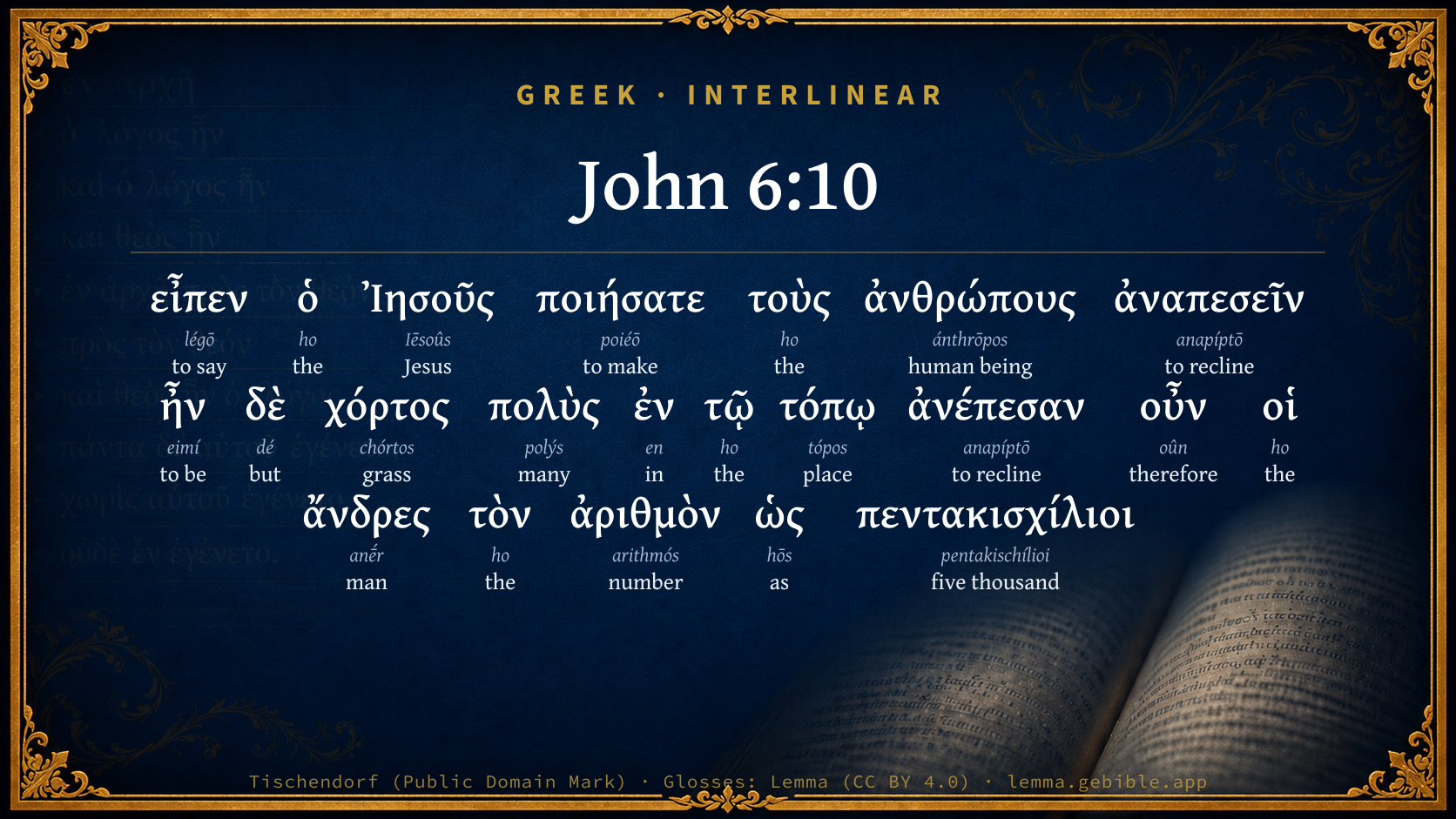
  1. εἶπεν légō G3004 “to say” Verb, Aorist, Active, Indicative, 3rd person, Singular
  2. ὁ ho G3588 “the” Article, Nominative, Singular, Masculine
  3. Ἰησοῦς Iēsoûs G2424 “Jesus” Noun, Nominative, Singular, Masculine
  4. ποιήσατε poiéō G4160 “to make” Verb, Aorist, Active, Imperative, 2nd person, Plural
  5. τοὺς ho G3588 “the” Article, Accusative, Plural, Masculine
  6. ἀνθρώπους ánthrōpos G444 “human being” Noun, Accusative, Plural, Masculine
  7. ἀναπεσεῖν anapíptō G377 “to recline” Verb, Aorist, Active, Infinitive
  8. ἦν eimí G1510 “to be” Verb, Imperfect, Active, Indicative, 3rd person, Singular
  9. δὲ dé G1161 “but” Conjunction
  10. χόρτος chórtos G5528 “grass” Noun, Nominative, Singular, Masculine
  11. πολὺς polýs G4183 “many” Adjective, Nominative, Singular, Masculine
  12. ἐν en G1722 “in” Preposition
  13. τῷ ho G3588 “the” Article, Dative, Singular, Masculine
  14. τόπῳ tópos G5117 “place” Noun, Dative, Singular, Masculine
  15. ἀνέπεσαν anapíptō G377 “to recline” Verb, Aorist, Active, Indicative, 3rd person, Plural
  16. οὖν oûn G3767 “therefore” Conjunction
  17. οἱ ho G3588 “the” Article, Nominative, Plural, Masculine
  18. ἄνδρες anḗr G435 “man” Noun, Nominative, Plural, Masculine
  19. τὸν ho G3588 “the” Article, Accusative, Singular, Masculine
  20. ἀριθμὸν arithmós G706 “number” Noun, Accusative, Singular, Masculine
  21. ὡς hōs G5613 “as” Adverb

About this verse

These counts appear in no published source. They are computed here, from the morphology-tagged text and Lemma’s own curated glosses. What Lemma adds →

22
words
17
distinct lemmas
Gospels
section

Notable vocabulary

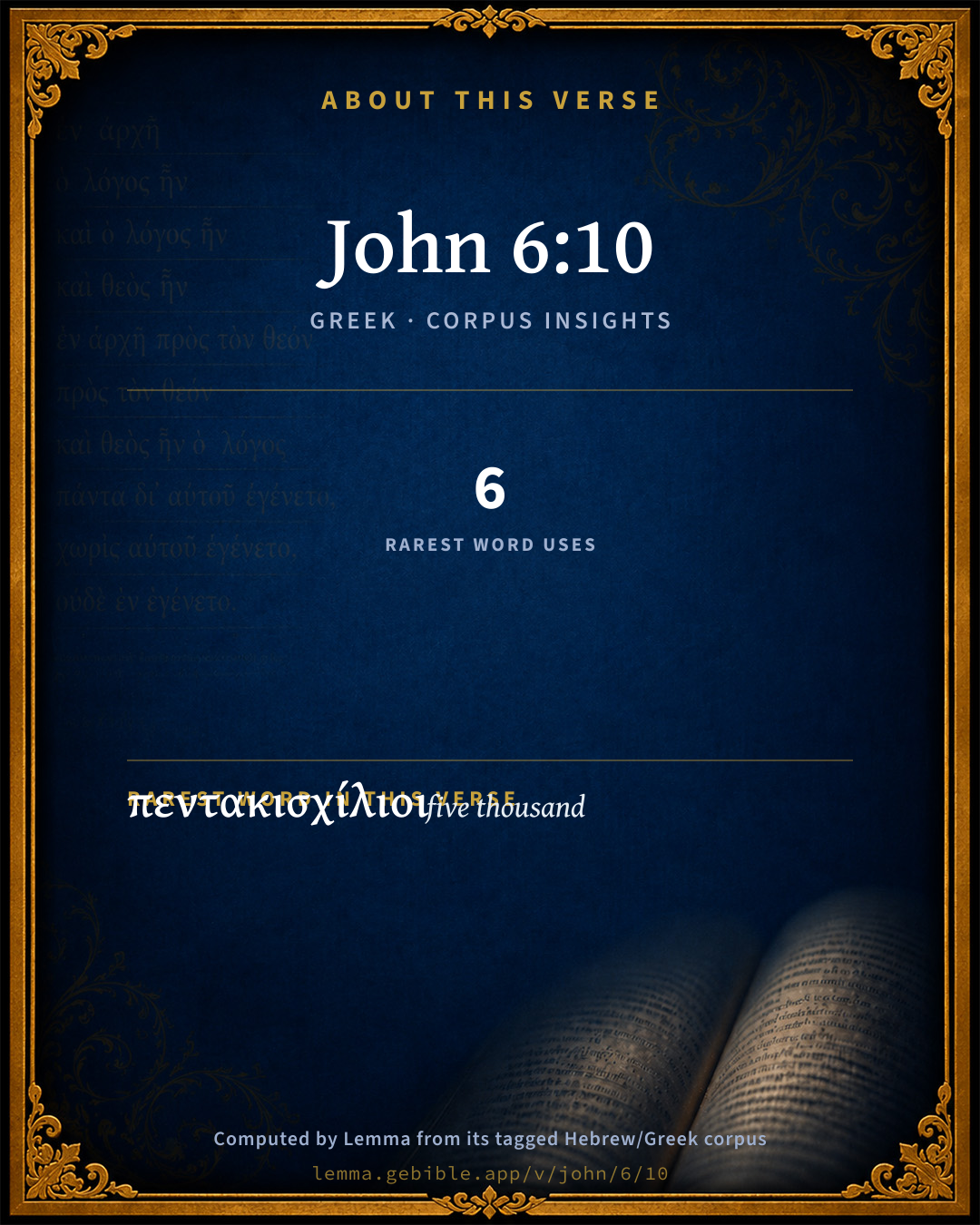
The rarest word here is πεντακισχίλιοι five thousand G4000 — appearing just 6 times in the whole Greek New Testament.

Shared distinctive vocabulary

πεντακισχίλιοι five thousand G4000 occurs in 6 verses of the Greek New Testament. Also found in:

Repetition

Words recur within this verse:

  • ἀναπεσεῖν to recline G377 ×2
  • ὁ the G3588 ×5

Cross-references

5

Topical passages linked to John 6:10 in the Treasury of Scripture Knowledge — connected by theme and wording, ordered by reader-vote popularity; previews shown in the World English Bible.

  • Luke 9:14–16 For they were about five thousand men. He said to his disciples, "Make them sit down in groups of about fifty each."
  • Matthew 14:18–19 He said, "Bring them here to me."
  • Mark 8:6–7 He commanded the multitude to sit down on the ground, and he took the seven loaves. Having given thanks, he broke them, and gave them to his disciples to serve, and they served the multitude.
  • Matthew 15:35–36 He commanded the multitude to sit down on the ground;
  • Mark 6:39–41 He commanded them that everyone should sit down in groups on the green grass.

Cross-references courtesy of OpenBible.info (CC BY 4.0).

Commentary

Notes on John 6:10 from classic Christian and Jewish commentators (each source and its license shown beneath its notes). The classic Christian expositions comment on the surrounding passage and are grouped to its opening verse, so a note may address several verses; the Jewish commentaries on the Tanakh (Rashi and others) are per-verse, so they appear only where the commentator wrote on this verse.

Lemma curates 59 commentaries, every one of them public domain or Creative Commons licensed, each selected and text-cleaned for this edition rather than reprinted as found. About our sources →

Tyndale Open Study Notes

Tyndale Open Resources

6:10 The headcount of about 5,000 reflected the men alone (Matt 14:21), as social custom dictated. With women and children included, the total number was far greater.

Tyndale Open Study Notes — © Tyndale Open Resources, licensed CC BY-SA 4.0. Text via the HelloAO Bible API.

Bengel's Gnomon

Johann Albrecht Bengel

Joh 6:10. Ποιήσατε ἀναπεσεῖν, make to sit down) The faith of the disciples and of the people is put to trial.—χόρτος, grass) A convenience for sitting down.—οἱ ἄνδρες, the men) The number of them was counted, without the women and children.—διέδωκε, distributed) by the hand of the disciples.—ὅσον, as much as) This refers to the loaves and to the fishes.—ἤθελον, they were wishing) Comp. Psa 145:16, “Thou openest Thine hand, and satisfiest the desire of every living thing.”

Bengel's Gnomon of the New Testament — English translation (T&T Clark, Edinburgh, 1860) — public domain. Text from a community e-Sword module.

Meyer's Critical & Exegetical Commentary

Heinrich August Wilhelm Meyer

Joh_6:10-13. οἱ ἄνδρες] They were men only who formally sat down to the meal, as may be explained from the subordinate position of the women and children; but the feeding of these latter, whose presence we must assume from Joh_6:4, is not, as taking place indirectly, excluded.

τὸν ἀριθμόν] Accusative of closer definition. See Lobeck, Paralip. p. 528.

Joh_6:11. εὐχαρ.] The grace before meat said by the host. See on Mat_14:19. There is no indication that it contained a special petition (that God would let this little portion feed so many, Luthardt, comp. Tholuck).

διέδωκε] He distributed the bread (by the disciples) collectively to those who were sitting; and of the fishes as much as they desired.[226]

Joh_6:12. It is not given as a command of Jesus in the synoptical account. As to the miracle itself,[227] and the methods of explaining it away, wholly or in part, see on Mat_14:20-21, note, and on Luk_9:17, and observe besides on Joh_6:13, that according to John the twelve baskets were filled with fragments of bread only (otherwise in Mar_6:43).

Luthardt, without any sanction from the text, assumes a typical reference in the baskets to the twelve tribes of Israel. Jesus will not have anything wasted, and each apostle fills his travelling wallet with the surplus. John indicates nothing further, not even that the Lord wished to provide ἵνα μὴ δόξῃ φαντασία τις τὸ γενόμενον (Euthymius Zigabenus, Erasmus, and most others).

[226] Luthers translation, as much as He would, rests upon an unsupported reading in Erasmus, edd. 1 and 2.

[227] By Ewald (Gesch. Chr. p. 442 sq. ed. 3) apprehended ideally, like the turning of the water into wine at Cana, as a legend, upon the formation of which great influence was excited by the holy feeling of higher satisfaction, which resulted from the participation in the bread of life partaken of by the disciples after Christs resurrection. This is incompatible with the personal recollection and testimony of John, whom Hase, indeed, supposes by some accident to have been absent from the scene. With equally laboured and mistaken logic, Schleiermacher (L. J. 234) endeavours to show that ver. 26 excludes this event from the category of σημεῖα. Weizsäcker leaves the fact, which is here the symbol of the blessing of Jesus, in perfect uncertainty; but the description by an eye-witness of the work effected in its miraculous character, which only leaves the how unexplained, does not admit of such an evasion.

Meyer — Critical and Exegetical Commentary on the New Testament — English translation by Peter Christie, edited by Frederick Crombie (T&T Clark, 1880) — public domain. Text from a community e-Sword module.

Expositor's Greek Testament

ed. W. Robertson Nicoll

Joh 6:10 . The moral ground for the miracle being thus prepared Jesus at once says, ποιήσατε τοὺς ἀνθρώπους ἀναπεσεῖν . [For the form of speech cf. Soph., Philoct. , 925, κλύειν … με … ποιεῖ .] This order was given for two reasons: (1) that there might be no unseemly crowding round Him and crushing out of the weaker; and (2) that they might understand they were to have a full meal, not a mere bite they could take in their hand in passing. Obedience to this request tested the faith of the crowd. They trusted Jesus. ἦν δὲ χόρτος πολὺς ἐν τῷ τόπῳ , “now there was much grass in the place,” contrasting with the corn-lands and olive-yards of the opposite shore, where the large crowd could not easily have found a place to lie down. Mark rather brings out the contrast between the colours of the dresses and the green grass (Joh 6:39 ): ἐπέταξεν αὐτοῖς ἀνακλῖναι πάντας συμπόσια συμπόσια ἐπὶ τῷ χλωρῷ χόρτῳ . καὶ ἀνέπεσαν πρασιαὶ πρασιαί , like beds of flowers. ἀνέπεσον [better ἀνέπεσαν ] οὖν οἱ ἄνδρες … the men reclined, not counting women and children ( χωρὶς γυναικῶν καὶ παιδίων , Mat 14:21 ), in number about five thousand; the women, though not specified, would take their places with the men. Some of the children might steal up to Jesus to receive from His own hand.

The Expositor's Greek Testament, edited by W. Robertson Nicoll (1897–1910) — public domain. Text from a community e-Sword module.

Adam Clarke's Commentary

Verse 10. There was much grass in the place.] Perhaps newly mown grass, or hay, is meant, (so the Vulgate faenum,) and this circumstance marks out more particularly that the passover was at hand. In Palestine the grass is ready for mowing in March; and this miracle seems to have been wrought only a few days before the commencement of that festival: see Joh 6:4.

Adam Clarke's Commentary on the Bible (1810–1826) — public domain. Text from a community e-Sword/MySword module.

John Calvin's Commentaries

10. Make the men sit down. That the disciples were not sooner prepared to cherish the hope which their Master held out, and did not remember to ascribe to his power all that was proper, was a degree of stupidity worthy of blame; but no small praise is due to their cheerful obedience in now complying with his injunction, though they know not what is his intention, or what advantage they will derive from what they are doing. The same readiness to obey is manifested by the people; for, while they are uncertain about the result, they all sit down as soon as a single word of command has been pronounced. And this is the trial of true faith, when God commands men to walk, as it were, in darkness. For this purpose let us learn not to be wise in ourselves, but, amidst great confusion, still to hope for a prosperous issue, when we follow the guidance of God, who never disappoints his own people.

John Calvin's Commentaries (1540-1563) — public domain. Text from the Calvin Translation Society English edition (1840s-50s) via the Christian Classics Ethereal Library (ccel.org). Calvin's coverage is partial (roughly two-thirds of the Bible); uncommented books and verses are honest gaps, never fabricated. The 19th-century editor's footnotes and remarks are omitted so the notes are faithfully Calvin's own voice.

Ellicott's Commentary for English Readers

(10) Much grass.—This is an addition in this account. St. Mark, who also represents the impression of an eye-witness, tells us that the grass was green (Joh_6:39). We know from Joh_6:4 that it was at the time of the Passover—i.e., about our April, when the hill-country on the west of the lake would naturally be clothed with verdure.

So the men sat down.—The word (ἄνδρες) means men as such, as distinct from women. (Comp. Note on Joh_1:51.) St. Matthew tells us there were five thousand men besides the women and children (Joh_14:21; see Note there).

A Bible Commentary for English Readers, edited by Charles John Ellicott (1878–1897) — public domain. Text from a community e-Sword module.

The Cambridge Bible for Schools and Colleges

gen. ed. J. J. S. Perowne

10. much grass] As we might expect early in April (Joh_6:4). S. Mark (Mar_6:39-40) mentions how they reclined in parterres, by hundreds and by fifties, on the green grass. This arrangement would make it easy to count them.

the men sat down] The women and children were probably apart by themselves. S. Matthew (Mat_14:21) tells us that the 5000 included the men only. Among those going up to the Passover there would not be many women or children.

The Cambridge Bible for Schools and Colleges (gen. ed. J. J. S. Perowne; Cambridge University Press, 1878–1918) — public domain. Text from a community e-Sword module.

John Gill's Exposition

Jesus said, make the men sit down,.... The Syriac version reads, "all the men"; and the Persic version, "all the people"; men, women, and children: Christ, without reproving his disciples for their unbelief, ordered them directly to place the people upon the ground, and seat them in rows by hundreds and by fifties, in a rank and company, as persons about to take a meal:

now there was much grass in the place; at the bottom of the mountain; and it was green, as one of the evangelists observes, it being the spring of the year, and was very commodious to sit down upon:

so the men sat down, in number about five thousand; besides women and children, Mat 14:21, so that there was but one loaf for more than a thousand persons.

John Gill's Exposition of the Whole Bible (1746–1763) — public domain (CC PDM 1.0). Text via the HelloAO Bible API.

Trapp's Complete Commentary

John Trapp

10 And Jesus said, Make the men sit down. Now there was much grass in the place. So the men sat down, in number about five thousand.

Ver. 10. Make the men sit down] And they did so, though they saw no sense for it. This kind of blind obedience is very acceptable: Clausis oculis Deum sequi debemus ducem. We must wink and put ourselves into God’s hand to be led whither he pleaseth.

John Trapp, A Commentary or Exposition upon All the Books of the Old and New Testament (1647–1656) — public domain. Text from a community e-Sword module.

Haydock's Catholic Bible Commentary

The text in St. Matthew adds: without counting the women and the children, who might possibly amount to an equal number.

George Leo Haydock (1774–1849), Haydock's Catholic Family Bible and Commentary, 1859 edition — public domain. Excludes Psalms (Douay-Rheims chapter numbering differs from Protestant) and Deuterocanonical books (Catholic canon only).

The Pulpit Commentary

Jesus said (the omission of de rather augments the vivid force of the statement), Make the people (anyrwpouv here. contrasted with the andrev of the next clause) recline. Now there was much grass in the place. As already said, this is in harmony with the note of time conveyed in ver. 4. The other evangelist (Mar_6:39) speaks of the people sitting down "upon the green grass a vivid touch this of an eyewitness; Matthew (Mat_14:19) also speaks of the grass; and Mark and Luke add another rememberable feature which John omits. The men (andrev were distinguished from anyrwpoi , which last term may have included the "women and children", (Mat_14:21) who in no great numbers probably formed, according to Eastern custom, a company by themselves). The men sat down (reclined), in number the matter of the "number" is here put into the "accusative of closer definition" (Meyer) about five thousand.

Luke says, "in groups of fifty." Mark first declares that Jesus ordered them to sit down (sumposia sumposia) in parties, and describes the result as having the appearance of garden beds (prasiai prasiai), of fifty or of a hundred each. The prasia is area, forus (Gartenbett; Homer, "Od.," 7:127; 24:247). Prasiai ," says Theophylact, "are the different divisions in gardens, in which different herbs are often planted." The image of the garden plots, with different divisions between them, forced itself on the eyewitness (see Trench, "Miracles," p. 205).

The Pulpit Commentary (1880–1919), ed. H.D.M. Spence-Jones & Joseph S. Exell — public domain. Text from a community e-Sword module.

Kretzmann's Popular Commentary

Paul E. Kretzmann

The miracle:

v. 10. And Jesus said, Make the men sit down. Now there was much grass in the place. So the men sat down, in number about five thousand.

v. 11. And Jesus took the loaves; and when He had given thanks, He distributed to the disciples, and the disciples to them that were set down; and likewise of the fishes as much as they would.

v. 12. When they were filled, He said unto His disciples, Gather up the fragments that remain that nothing be lost.

v. 13. Therefore they gathered them together, and filled twelve baskets with the fragments of the five barley loaves which remained over and above unto them that had eaten.

v. 14. Then those men, when they had seen the miracle that Jesus did, said, This is of a truth that prophet that should come into the world.

Jesus now assumed charge of affairs, He became master of ceremonies, governor of the feast. He ordered the disciples to have the people recline on the green grass, which grew in abundance at this place, in the lowlands near the mouth of the Jordan, and had attained its full growth at this time of year. Since the men reclined in groups, it was an easy matter to find their number, which was five thousand, without women and children. Before the entire vast assembly which was now seated in anxious expectation, Jesus next took the loaves and gave thanks; He dedicated them to God by His prayer. And He at the same time proved Himself the almighty God and Lord, for His blessing upon the bread caused the miracle. The few loaves did not grow into great stacks, but they multiplied under His almighty touch during the distribution. No matter how often the disciples returned to the Lord for further supplies, there was always enough on hand. They obtained not only of the bread all that they wished for, but they were also given of the fishes, as much as everyone desired. All the people were fully satisfied, they had all that they could eat. Here was a powerful proof of the almighty power of Christ. The simple Nazarene is the Creator and Preserver of all things, who gives food and sustenance to all creatures. The hand of the Lord is not shortened even now, but is able and willing to help in all emergencies, if we but place our trust in Him. It is our duty to use the means He has given us, to do the work of our calling faithfully; then His blessing will never fail us. Incidentally, Jesus taught proper food conservation. He commanded that the disciples should pick up the small pieces that remained, the fragments, that nothing might go to waste. And when they did so, they filled twelve large wicker baskets or hampers, such as are used in the orient and elsewhere by gardeners for carrying fruit and vegetables on the back. The evangelist emphasizes that these fragments remained over and above that which had been eaten by the multitude. There is a lesson for all times in this story, namely, that infinite resources do not justify waste. There is a far cry from being anxiously careful for the future and being careful of the gifts which God has given. But the people did not draw the right conclusion from the miracle. They merely thought that this was "the beginning of that reign of earthly abundance which the prophets were thought to have foretold. " Some of them may have believed that Jesus was truly the Messiah, but the majority voiced their opinion in the statement that this man was of a truth, beyond doubt, that prophet that should come into the world, for they understood the words of Moses, Deu 18:15, of a mere man, with the spirit and the power of Moses. Note: There are many people in the midst of Christendom whose ideas concerning Christ are just as hazy as were those of the Jews on this occasion. It is only by continual study of the Bible that a full and clear understanding of the person and office of Jesus may be gained.

Paul E. Kretzmann, Popular Commentary of the Bible (1921–1924) — public domain. Text from a community e-Sword module.

unfoldingWord translationNotes

Door43 World Missions Community

sit down

"lie down"

Now there was a lot of grass in the place

John briefly stops telling about the events in the story in order to give background information about the place where this event happens. (See: Background Information)

So the men sat down, about five thousand in number

While the crowd probably included women and children (John 6:4-5), here John is counting only the men.

giving thanks

Jesus prayed to God the Father and thanked him for the fish and the loaves.

he gave it

"he" here represents "Jesus and his disciples." AT: "Jesus and his disciples gave it" (See: Synecdoche)

translationWords

Jesus

disciple

unfoldingWord translationNotes — © Distant Shores Media and the Door43 World Missions Community, licensed CC BY-SA 4.0. Source: git.door43.org/Door43/en_tn.

Cambridge Greek Testament for Schools and Colleges

10. χόρτος πολύς. As we might expect early in April (Joh 6:4). S. Mark (Mar 6:39-40) mentions how they reclined in parterres (πρασιαὶ πρασιαί), by hundreds and by fifties, on the green grass. This arrangement would make it easy to count them.

οἱ ἄνδρες. The men, as distinct from the women and children, who would not be very numerous: τοὺς ἀνθρώπους, the people, includes all three. S. Matthew (Mat 14:21) says that the 5000 included the men only. Τὸν ἀριθμόν, accusative of closer definition; Winer, p. 288.

Cambridge Greek Testament for Schools and Colleges (Cambridge University Press, 1896; 21 vols, various authors incl. Carr, Maclear, Plummer, Farrar, Lumby, Moule, M. R. James, Simcox) — public domain. Text from a community e-Sword module.

Alford’s Greek Testament

Henry Alford

10.] χόρτος πολύς, in accordance with the time of year, the latter end of spring, after the rainy season.

On ἀναπεσεῖν see Mark and Luke, who describe the manner.

οἱ ἄμδρες] This is a particular touch of accuracy in the account of an eye-witness which has not I think been noticed. Why in the other accounts should mention be made only of the men in numbering them? Matt. has, it is true, χωρὶς γυν. κ. παιδ., leaving it to be inferred that there was some means of distinguishing;—the others merely give [ὡσεὶ] ἄνδρες πεντακισχ. without any explanation. But here we see how it came to be so—the men alone were arranged in companies, or alone arranged so that any account was taken of them: the women and children being served promiscuously; who indeed, if the multitude were a paschal caravan (?), or parts of many such, would not be likely to be very numerous;—and here again we have a point of minute truthfulness brought out.

Henry Alford, The Greek Testament (1849–1861) — public domain. Text from a community e-Sword module.

International Critical Commentary

10. ποιήσατε (for the aor. imper., see on 2:5) τοὺς ἀνθρώπους ἀναπεσεῖν … ἀνέπεσαν οὖν οἱ ἄνδρες. The R.V. distinguishes ἀνθρώπους from ἄνδρες: “make the people sit down … so the men sat down,” suggesting that the women (or children), if present, remained standing. But no such discrimination is indicated in the Synoptic accounts, and it would, in the circumstances, be improbable, despite the Oriental subordination of women: ἐπέταξεν αὐτοῖς ἀνακλιθῆναι πάντας is Mk’s statement. ἀνήρ is an infrequent word in Jn., occurring again only 1:13, 30 and 4:16, 17, 18 (of a husband); and it may be that its introduction here is due to a reminiscence of Mk.’s πεντασχίλιοι ἄνδρες, to which Mt. afterwards added the gloss χωρὶς γυναικῶν καὶ παιδίων, as he did also in the parallel narrative of the Feeding of the Four Thousand (Mat 14:21, Mat 15:38). Jn. returns to the word ἄνθρωποι at v. 14.

ἀναπίπτειν is “to lie back” or “recline,” whether on the sloping hillside (as here) or on a couch (as at the Last Supper, 13:12, 21:20). Mk. uses ἀναπίπτειν as well as ἀνακλίνειν in his parallel narrative; Mt. has ἀνακλίνειν only, and Lk. κατακλίνειν.

χόρτος πολύς, “there was much grass”—green grass, Mk. says—it being spring-time, after the rainy season, just before the Passover (v. 4). Jn. does not mention the greenness of the grass, nor does he say anything about the people being distributed into groups or companies.

International Critical Commentary — older volumes (1896–1929), various authors — public domain. Text from a community e-Sword module.

Vincent's Word Studies in the New Testament

Marvin R. Vincent

Sit down [αναπεσειν] . Literally, recline.

Grass [χορτος] . Originally an enclosure. Thus Homer speaks of Peleus offering a sacrifice, aujlhv ejn cortw, in the enclosure of the court (" Iliad, " 11, 774). Hence a feeding - place, and so grass, provender. The sense is merely that of our abstract pasture. Matthew and Mark mention the grass, Mark with the epithet green. Wyc., hay.

Marvin R. Vincent, Word Studies in the New Testament (1887–1900) — public domain. Text from a community e-Sword/MySword module.

Godet's Commentaries

Frédéric Louis Godet

Ver. 10. “But Jesus said: Make the people sit down. Now there was much grass in the place. The men sat down, therefore, in number about five thousand.”

In these scanty provisions Jesus has found that which He needs, the material on which omnipotence can work. Now, in His view, the banquet is prepared, the table spread: “Make the people sit down,” He says to His apostles. The mountain-plateaus which rise behind the site of Bethsaida Julias displayed, at that time, their spring-time verdure. Mark, as well as John, draws the picture of this grassy carpet on which the multitudes took their places (ἐπὶ τῷ χλώρῳ χόρτῳ Joh 6:39). He describes, likewise, the cheerful spectacle which was presented by these regular ranks (συμπόσια συμπόσια, πρασιαὶ πρασιαί) of hundreds and fifties.῞Ανδρες denotes the men in the restricted meaning of the word; if they alone are indicated, it is not, as Meyer alleges, because the women and children were not seated, but because they kept themselves apart and the men only werecounted. Women and children, in the East, always keep themselves at a respectful distance from the head of the family and his guests.

Frédéric Louis Godet — Commentaries on Luke, John, Romans, and 1 Corinthians — English translation (T&T Clark, Edinburgh, 1870s–1890s) — public domain. Text from a community e-Sword module.

Lesson kit

Teaching starters — assembled from the data on this page, not authored interpretation. Every prompt links to the verse data it draws on. Edit before teaching.

John, in the Gospels, opens this verse with 22 words (17 distinct Greek lemmas). Its most distinctive word is pentakischílioi (“five thousand”). A historical commentator’s framing appears above. Read the whole chapter for the surrounding context.

Discussion questions

  1. What does “five thousand” (pentakischílioi) contribute to the verse as a whole?
  2. Matthew 14:21 shares the word «five thousand» with this verse. How do the two illuminate each other?
  3. “to recline” occurs 2× in this one verse. What is the effect of the repetition?
  4. These translations render this verse differently. What is at stake in choosing one wording over another?
  5. Reading how Tyndale Open Study Notes and Bengel's Gnomon read this verse, where do the two commentators agree and where do they part?

Things to notice

  • These translations choose different wording for 8 words in this verse.
  • “to recline” occurs 2× in this single verse.
  • 17 distinct Greek lemmas span 22 words in this verse.

Reading settings

Reading text

Shown beneath each verse's original-language words.

Old Testament
Old Testament edition

Read the OT as the Masoretic Hebrew (MT) or the Greek Septuagint (LXX).

English shown for the Greek Septuagint (in the Hebrew ↔ Greek comparison).

Comparing translations? Open the Compare panel on any verse page to stack up to four side by side.