John 1:36

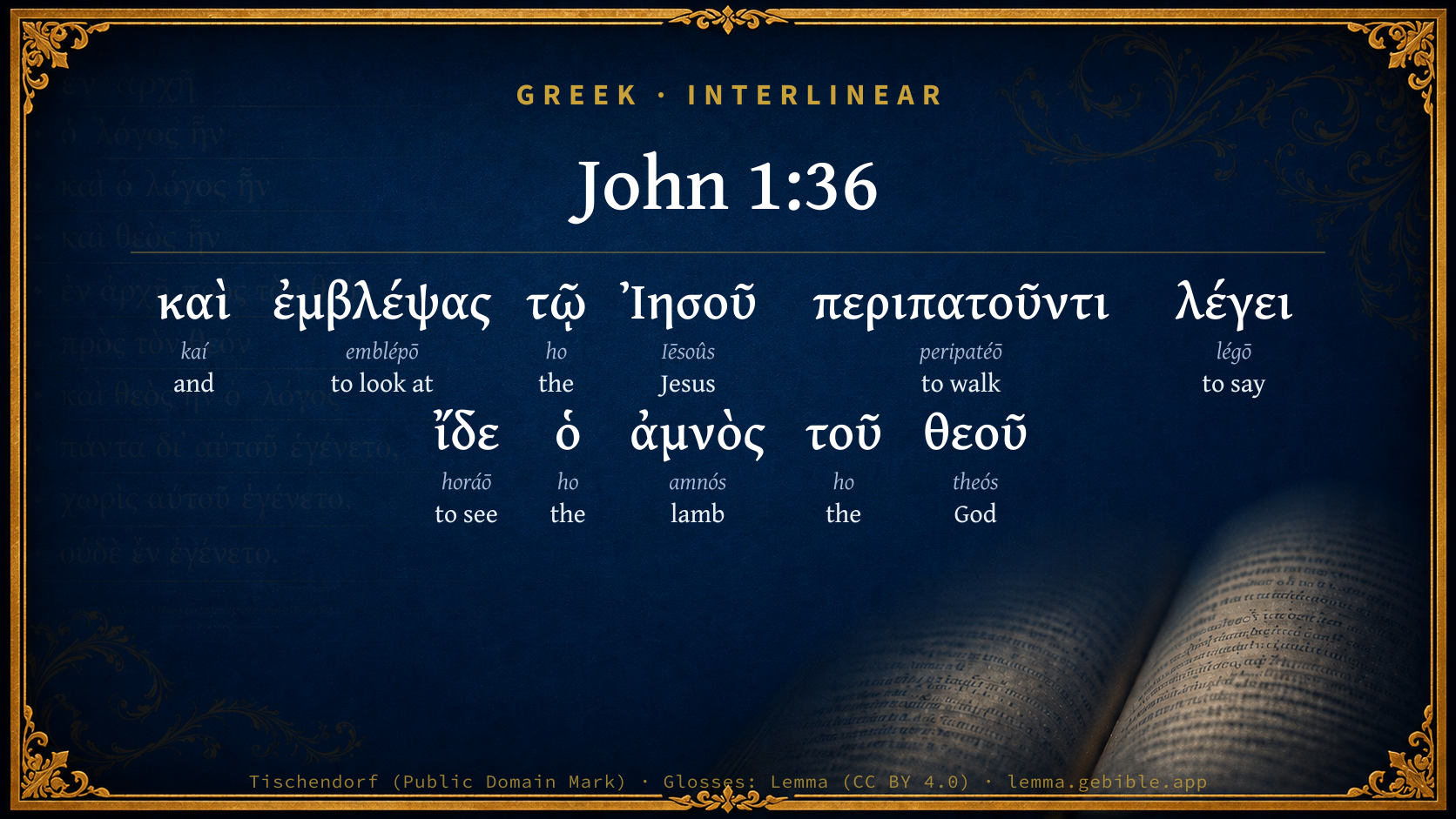
Greek (Tischendorf 8th ed.) John 1:36 appears in the Greek New Testament. The text above is from the Tischendorf 8th edition. Each word links to its Strong’s number and a concise gloss. Click any word for its full Thayer’s Greek Lexicon entry.
Download image
Cite this verse

John 1:36 (World English Bible). Public Domain. Lemma interlinear Bible study tool, https://lemma.gebible.app/v/john/1/36.

Show BibTeX & RIS
BibTeX
RIS
English Translation
and he looked at Jesus as he walked, and said, "Behold, the Lamb of God!"
World English Bible · Public Domain
Download a study sheet

One document with this verse’s original text, its word-by-word gloss line, the meaning frame, cross-references with their text, attributed commentary, and full source and license credits — printable, and it pastes into notes with its structure intact.

This verse Autodidact and up

Study sheet (.html) Plain text (.txt)

A passage Seminary Student

Up to 50 verses in one chapter. A passage sheet keeps up to 6 commentary sources and 12 cross-references per verse, in the order this page ranks them, and says so on the sheet whenever that leaves anything out. Ask for a single verse and you get the Autodidact verse sheet above.

Everything on this page stays free to read, with no account — the sheet is a download of what is already on screen, not access to it.

Want to remove ads? Support Godless Engineer
Compare translations 3

The same verse in 3 English versions, stacked beneath the original-language interlinear above. Click any original word for its lexicon entry.

Each is an independent rendering of the whole verse — the interlinear is not word-aligned to these translations.

Highlighted words mark where these versions differ — a whole-verse word diff, not a word-by-word alignment.

  • World English Bible Public Domain
    and he looked at Jesus as he walked, and said, "Behold, the Lamb of God!"
  • King James Version Public Domain
    And looking upon Jesus as he walked, he saith, Behold the Lamb of God!
  • unfoldingWord Literal Text CC BY-SA 4.0
    and having seen Jesus walking by, he says, “Behold, the Lamb of God!”

unfoldingWord Literal Text — © unfoldingWord, licensed CC BY-SA 4.0. Word-aligned USFM3 via Door43 (git.door43.org/unfoldingWord/en_ult).

Versions to compare (up to 4)

3 of 4 selected

Show all 19 translations

Every available English version of this verse, each an independent rendering of the whole verse.

  • World English Bible Public Domain
    and he looked at Jesus as he walked, and said, "Behold, the Lamb of God!"
  • Berean Standard Bible Public Domain
    When he saw Jesus walking by, he said, “Look, the Lamb of God!”
  • Majority Standard Bible Public Domain
    When he saw Jesus walking by, he said, “Look, the Lamb of God!”
  • King James Version Public Domain
    And looking upon Jesus as he walked, he saith, Behold the Lamb of God!
  • American Standard Version (1901) Public Domain
    and he looked upon Jesus as he walked, and saith, Behold, the Lamb of God!
  • Revised Version (1885) Public Domain
    and he looked upon Jesus as he walked, and saith, Behold, the Lamb of God!
  • Geneva Bible (1599) Public Domain
    And he behelde Iesus walking by, and said, Beholde that Lambe of God.
  • Douay-Rheims (1899) Public Domain
    And beholding Jesus walking, he saith: Behold the Lamb of God.
  • Young's Literal Translation Public Domain
    and having looked on Jesus walking, he saith, `Lo, the Lamb of God;'
  • Literal Standard Version CC BY-SA 4.0
    and having looked on Jesus walking, he says, “Behold, the Lamb of God”;
  • Unlocked Literal Bible CC BY-SA 4.0
    they saw Jesus walking by, and John said, “Look, the Lamb of God!”
  • unfoldingWord Literal Text CC BY-SA 4.0
    and having seen Jesus walking by, he says, “Behold, the Lamb of God!”
  • Darby Bible Public Domain
    And, looking at Jesus as he walked, he says, Behold the Lamb of God.
  • World Messianic Bible Public Domain
    and he looked at Yeshua as he walked, and said, “Behold, the Lamb of God!”
  • Webster's Bible Public Domain
    And looking upon Jesus as he walked, he saith, Behold the Lamb of God!
  • Free Bible Version CC BY-SA 4.0
    He saw Jesus passing by, and said, “Look! This is the Lamb of God!”
  • Bible in Basic English Public Domain
    And looking at Jesus while he was walking he said, See, there is the Lamb of God!
  • Text-Critical English NT CC BY 4.0
    As Jesus walked by, John looked at him and said, “Behold, the Lamb of God.”
  • Tyndale New Testament (1534) Public Domain
    And he behelde Iesus as he walked by and sayde: beholde the lambe of God.

Literal Standard Version (2020), Covenant Press — licensed CC BY-SA 4.0. Text via the HelloAO Bible API (eBible.org). Unlocked Literal Bible (unfoldingWord) — licensed CC BY-SA 4.0. Text via the HelloAO Bible API (eBible.org). unfoldingWord Literal Text — © unfoldingWord, licensed CC BY-SA 4.0. Word-aligned USFM3 via Door43 (git.door43.org/unfoldingWord/en_ult). Free Bible Version, Dr. Jonathan Gallagher — licensed CC BY-SA 4.0. Text via the HelloAO Bible API (eBible.org).

Word by word

More ways to search: Search by grammar → Find every occurrence → Compare this word →

Practice this passage: Drill this verse → Learn its vocabulary →

About this verse

These counts appear in no published source. They are computed here, from the morphology-tagged text and Lemma’s own curated glosses. What Lemma adds →

11
words
9
distinct lemmas
Gospels
section

Notable vocabulary

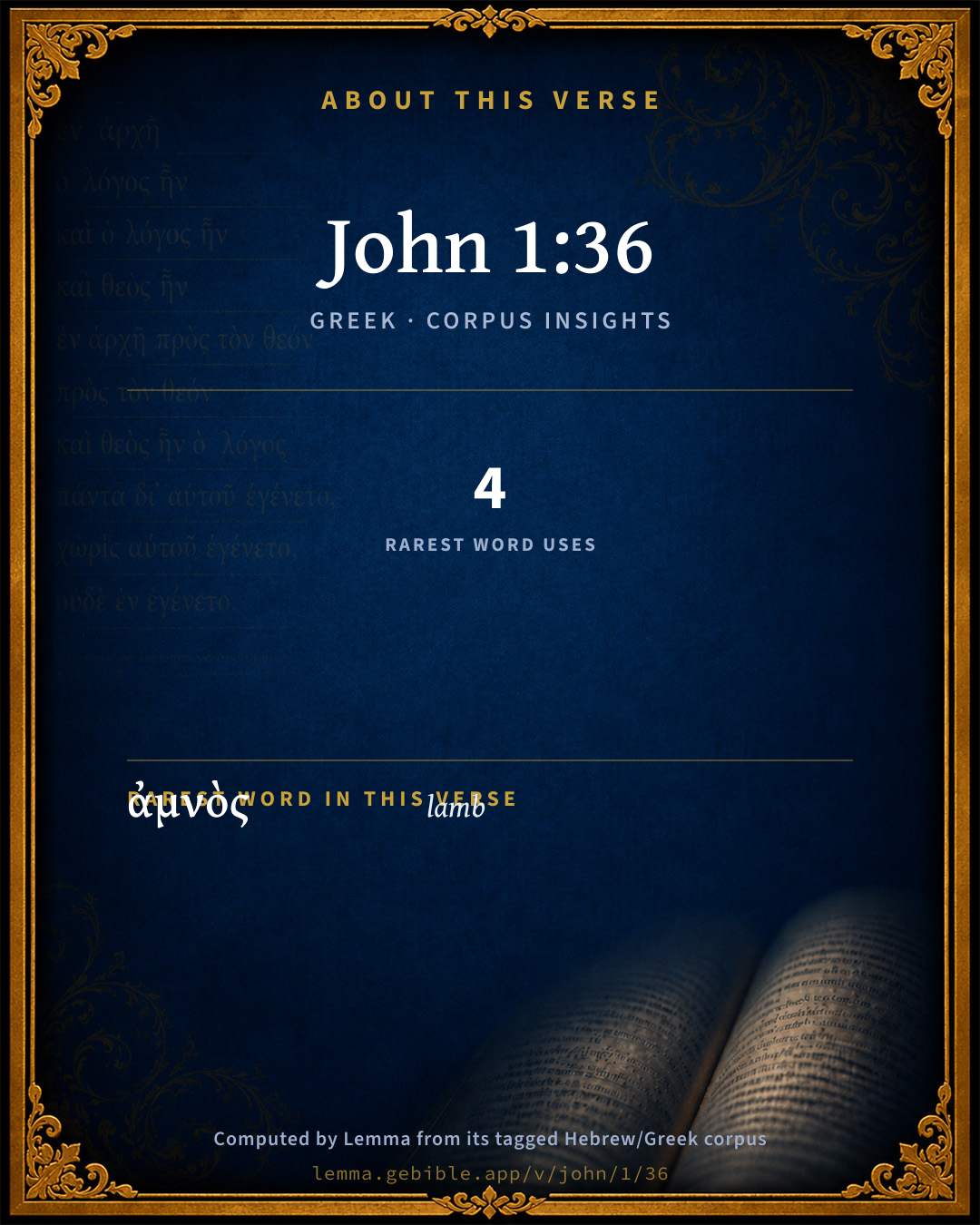
The rarest word here is ἀμνὸς lamb G286 — appearing just 4 times in the whole Greek New Testament.

Shared distinctive vocabulary

ἀμνὸς lamb G286 occurs in 4 verses of the Greek New Testament. Also found in:

Repetition

A word recurs within this verse:

Cross-references

5

Topical passages linked to John 1:36 in the Treasury of Scripture Knowledge — connected by theme and wording, ordered by reader-vote popularity; previews shown in the World English Bible.

  • John 1:29 The next day, he saw Jesus coming to him, and said, "Behold, the Lamb of God, who takes away the sin of the world!
  • 1 Peter 1:19–20 but with precious blood, as of a lamb without spot, the blood of Christ;
  • Isaiah 65:1–2 I am inquired of by those who didn't ask; I am found by those who didn't seek me: I said, See me, see me, to a nation that was not called by my name.
  • Hebrews 12:2 looking to Jesus, the author and perfecter of faith, who for the joy that was set before him endured the cross, despising shame, and has sat down at the right hand of the throne of God.
  • Isaiah 45:22 Look to me, and be you saved, all the ends of the earth; for I am God, and there is none else.

Cross-references courtesy of OpenBible.info (CC BY 4.0).

Commentary

Notes on John 1:36 from classic Christian and Jewish commentators (each source and its license shown beneath its notes). The classic Christian expositions comment on the surrounding passage and are grouped to its opening verse, so a note may address several verses; the Jewish commentaries on the Tanakh (Rashi and others) are per-verse, so they appear only where the commentator wrote on this verse.

Lemma curates 59 commentaries, every one of them public domain or Creative Commons licensed, each selected and text-cleaned for this edition rather than reprinted as found. About our sources →

The Biblical Illustrator

Joseph S. Exell

Joh_1:36

Behold the Lamb of God!--This is the main business of the preacher.

Had John been an eloquent declaimer of repentance merely, he would have missed his life-work. As the stars called the Pointers always point to the Pole Star, so must ministers point to the Redeemer. The Baptists eye was fastened on the Master, while he pointed to the Master. They preach Christ best who see Him best.

I. LEARN THAT CHRIST IS THE LAMB OF GOD.

1. He is the chief of all sacrifices, the term of God often signifying greatest, noblest.

(1) Because it contains all others.

(2) Because it does really and for ever what the others only typified.

2. He is the Lamb of Gods appointing;

3. Of Gods providing;

4. Of Gods offering;

5. Of Gods setting forth to the sons of men (Rom_3:25).

II. CONTEMPLATE JESUS UNDER THAT CHARACTER.

1. Christ, as the atoning sacrifice, ought to be the principal object of every believers thoughts

2. This is the grandest subject of thought in the universe. What are the sciences, the classics, poetry, in comparison?

3. No subject so well balances the soul as this. Other themes disturb the mental equilibrium, and overload one faculty at the expense of others.

4. This is the most needful subject of contemplation. Other things may be forgotten without serious damage.

III. GATHER INSTRUCTION FROM JESUS UNDER THAT ASPECT.

1. Doctrinal.

(1) The evil of sin.

(2) The magnitude of Gods love.

2. Experimental. Sin vanishes when Christ appears, and grief and fear.

IV. Behold the Lamb of God WITH REVERENCE, as do angels and glorified spirits. (C. H. Spurgeon.)

Beholding the Lamb of God

I. WHAT ARE WE TO SEE WHEN WE LOOK ON JESUS? With what eyes? Time was when men saw Him with their natural eyes, and He was an offence. Time will be when every eye shall see Him, and He will be to many a terror. In heaven He is seen with glorified eyes. To us now He may be seen with the eye of faith. Using this, not having seen Him, we love Him and receive life from Him. What is the sight?

1. The great Creator (Joh_1:1).

2. The great Creator manifested in the flesh.

3. The Divine fulness for the salvation of men.

(1) The full expiation of sin.

(2) All the grace to be communicated to His saints.

(3) Grace for grace.

(4) All supplies necessary for living and dying, obeying and suffering, endurance and triumph, progress and perfection.

II. FOR WHAT ENDS ARE WE TO CONTEMPLATE HIM.

1. That we may have tenderness of heart under sin. Here is a sight to soften stony hearts.

2. That we may have relief under conviction of sin. If He can take away the sin of the world, He can take away a world of sin in you.

3. That we may have courage and patience under all suffering. As He was in the world, so must we be.

4. That we may not stagger at the promises through unbelief. The Messianic prophecies were fulfilled in Him. Shall we, then, disbelieve that those which concern us will bebroken. (A. Beith, D. D.)

The Lamb of God

I. SEEN.

1. By whom? By the Forerunner, who had been preparing His way; as all will--first here in spirit, afterwards in body; first by faith, and afterwards by sight; who by humility, faith, and desire, make themselves ready for His coming (Mat_5:8; Joh_16:16; 1Jn_3:2).

2. When? On the day after the preceding vision. Christ seldom puts His followers off with one sight of Himself: view follows upon view, according to growth in seeing and desiring.

3. Where? On the rivers bank, as He was separating Himself from the Baptist to commence His own work. Christ is best seen at a distance from His servants.

4. Why? To be pointed out. For this same reason Christ appears to His servants now.

II. POINTED OUT.

1. In what character? As the Lamb of God. Suggestive of

(1) Personal innocence or sinlessness.

(2) The meek and unresisting patience with which he should carry on His work.

(3) The propitiatory character of His mission:--the three main themes of the gospel ministry.

2. In what manner? With a Behold: to indicate

(1) The importance of the announcement.

(2) The earnestness of the herald.

(3) The liveliness of mind with which the announcement should be welcomed.

3. With what intention? To send men to Christ.

4. With what result? Two of his disciples follow Christ (Isaiah Iv. 11).

III. Followed.

1. Promptly. Delay imprudent and dangerous. If Christ be what the Baptist says, there is no time to be lost.

2. Inquiringly. This is all that Christ desires at first. The chief complaint is that men reject Him without examining His credentials.

3. Finally. So will all who seek Him with the whole heart.

4. Exemplarily. They led the way to a larger movement.

Lessons:

1. The proper business of the Christian ministry: to point out Christ to the world, and to point the world to Christ.

2. The necessary qualification of the ministry: to behold Christ, and have a personal insight into the character and work of the Saviour.

3. The encouraging reward of the ministry: to behold disciples going over to and following the Saviour. (T. Whitelaw, D. D.)

The Lamb of God

I. THE IMPORT OF THE APPELLATION.

1. It had respect to the personal character of Christ. He was a perfect pattern of

(1) innocence, and

(2) patience. It was thus that He illustrated, in His own example, the nature and genius of the gospel dispensation, as superior to every other.

2. It had a distinct reference to the great design of His appearance and death. It marks out His sacrificial character, prefigured by the legal offerings, more particularly the paschal lamb, the most ancient and important.

(1) The passover commemorated a great deliverance, and prefigured a greater.

(2) The passover averted an inevitable destruction; so did the sacrifice of Christ.

(3) In both cases there is no natural connection between the means and the end; the benefit is moral, not physical. The sprinkling blood was simply of Divine appointment, as a sign to arrest the progress of the destroying angel. So between the sacrifice of Christ and the expiation of guilt the relation is moral, resulting from the will of God.

(4) The personal qualities in the two victims are similar. The lamb was to be without spot or blemish; so was Christ.

(5) The blood of the one had to be sprinkled, so that of the Other must be applied.

(6) While many of the legal sacrifices were offered by individuals, the paschal lamb was required to be slain and offered by the whole congregation of Israel, it being understood that he who neglected this important sacrifice, would lose its benefit--would be cut off from the congregation. Behold [here] the Lamb of God that taketh away the sin of the world!

(7) The time of slaying in both eases was the evening.

(8) Not a bone was broken in either.

(9) The paschal lamb was prepared by fire, signifying the agonies of the Lamb of God. How strangely mistaken, therefore, those who represent Christs death as an example or a martyrdom for truth.

II. THE SPIRIT AND DESIGN OF THE EXCLAMATION. It expresses the claim of Christ to attention from beings of every order.

1. Those who remain, as sinners, in their original character and state. There are three qualities which entitle an object to our regard:

(1) Intrinsic greatness--e.g., the wonders of the material world; those of the intellectual and moral universe; but here is something incomparably greater--Incarnate Deity.

(2) Novelty. What so original as the Invisible Creator clothed in mortal flesh; the Ancient of Days cradled as an Infant; He who upholdeth all things sinking under a weight of suffering; the Lord of Glory expiring on the cross; the Light of the world sustaining an awful eclipse; the Sun of Righteousness immerged in the shadow of death?

(3) Usefulness. The Lamb of God is the only Saviour.

2. Those who have repented and believed. The efficacy of this sacrifice covers all the needs of the spiritual life.

3. The redeemed in the world of glory. They owe their position and their continuance in it to the Lamb of God.

4. The holy angels, who may probably be secured in that felicity to which saints are promoted, by the mediation of Jesus Christ.

5. God Himself. To Him the Redeemer is an object of complacency and satisfaction. (Robert Hall.)

Christs whole character must be studied

If you wish to look at a portrait of Raphaels, what would you think to see only the forehead uncovered, and then only the eyes, and so on, until all the features had been separately seen? Could you gain a true idea of the picture as a whole? Yet this is the way men look at the picture of Christ in the gospels, reading a few verses and mottoes here and there, and never considering the life in its wholeness and harmony. (H. W. Beecher.)

A two-fold use of the eyes

It is a beautiful remark of an old divine, that eyes are made for two things at least; first, to look with, and next, to weep with. The eye which looks to the pierced One is the eye which weeps for Him. Oh soul, when thou comest to look where all eyes should look, even to Him who was pierced, then thine eye begins to weep for that for which all eyes should weep, even the sin which slew thy Saviour! There is no saving repentance except within sight of the cross.

The Biblical Illustrator, edited by Joseph S. Exell (c. 1880s–1900s) — public domain. Text from a community e-Sword module.

Bengel's Gnomon

Johann Albrecht Bengel

Joh 1:36. Περιπατοῦντι, as He walked) He was not now coming to John, as He was, Joh 1:29: for [to have come] oftener, would not have been becoming. To have done so once was condescension enough.

Bengel's Gnomon of the New Testament — English translation (T&T Clark, Edinburgh, 1860) — public domain. Text from a community e-Sword module.

Expositor's Greek Testament

ed. W. Robertson Nicoll

Joh 1:36 . The Baptist, ἐμβλέψας τῷ Ἰησοῦ , having gazed at, or contemplated (see Mat 6:26 , ἐμβλέψατε εἰς τὰ πετεινά , and especially Mar 14:67 , καὶ ἰδοῦσα τὸν Πέτρον … ἐμβλέψασα ) Jesus as He walked, evidently not towards John as on the previous day, but away from him. λέγει Ἴδε ὁ ἀμνὸς τοῦ θεοῦ without the added clause of Joh 1:29 .

The Expositor's Greek Testament, edited by W. Robertson Nicoll (1897–1910) — public domain. Text from a community e-Sword module.

Geneva Bible (1599)

Geneva Bible translators

Christ is set before us to follow not as a vain shadow, but as our Mediator.

Geneva Bible (1599) marginal notes — public domain. Text via Bolls.life.

Jamieson, Fausset & Brown

Robert Jamieson, A. R. Fausset & David Brown

looking--having fixed his eyes, with significant gaze, on Jesus.

as he walked--but not now to him. To have done this once (see on Joh 1:29) was humility enough [BENGEL].

Behold, &c.--The repetition of that wonderful proclamation, in identical terms and without another word, could only have been meant as a gentle hint to go after Him--as they did.

Jamieson, Fausset & Brown — Commentary Critical and Explanatory on the Whole Bible (1871) — public domain (CC PDM 1.0). Text via the HelloAO Bible API.

Adam Clarke's Commentary

Verse 36. And looking upon Jesus] Attentively beholding, εμβλεψας, from εν, into, and βλεπω, to look - to view with steadfastness and attention. He who desires to discover the glories and excellencies of this Lamb of God, must thus look on him. At first sight, he appears only as a man among men, and as dying in testimony to the truth, as many others have died. But, on a more attentive consideration, he appears to be no less than God manifest in the flesh, and, by his death, making an atonement for the sin of the world.

Behold the Lamb of God!] By this the Baptist designed to direct the attention of his own disciples to Jesus, not only as the great sacrifice for the sin of the world, but also as the complete teacher of heavenly truth.

Adam Clarke's Commentary on the Bible (1810–1826) — public domain. Text from a community e-Sword/MySword module.

John Calvin's Commentaries

36. Behold the Lamb of God! Hence appears more clearly what I have already stated, that when John perceived that he was approaching the end of his course, he labored incessantly to resign his office to Christ. His firmness too gives greater credit to his testimony. But by insisting so earnestly, during many successive days, in repeating the commendation of Christ, he shows that his own course was nearly finished. Here we see also how small and low the beginning of the Church was. John, indeed, prepared disciples for Christ, but it is only now that Christ begins to collect a Church. He has no more than two men who are mean and unknown, but this even contributes to illustrate his glory, that within a short period, without human aid, and without a strong hand, he spreads his kingdom in a wonderful and incredible manner. We ought also to observe what is the chief object to which John directs the attention of men; it is, to find in Christ the forgiveness of sins. And as Christ had presented himself to the disciples for the express purpose that they might come to him, so now when they come, he gently encourages and exhorts them; for he does not wait until they first address him, but asks, What do you seek? This kind and gracious invitation, which was once made to two persons, now belongs to all. We ought not therefore to fear that Christ will withdraw from us or refuse to us easy access, provided that he sees us desirous to come to him; but, on the contrary, he will stretch out his hand to assist our endeavors. And how will not he meet those who come to him, who seeks at a distance those who are wandering and astray, that he may bring them back to the right road?

John Calvin's Commentaries (1540-1563) — public domain. Text from the Calvin Translation Society English edition (1840s-50s) via the Christian Classics Ethereal Library (ccel.org). Calvin's coverage is partial (roughly two-thirds of the Bible); uncommented books and verses are honest gaps, never fabricated. The 19th-century editor's footnotes and remarks are omitted so the notes are faithfully Calvin's own voice.

Ellicott's Commentary for English Readers

(36) And looking upon.—Better, and he looked upon Jesus as He was walking, and saith. The word “looked upon” expresses a fixed, earnest gaze. (Comp. Joh_1:42; Mat_19:26; Mar_10:21; Mar_10:27; &c.) At this look, all the old thoughts in their fulness come crowding back. Yes. It is He. “Behold the Lamb of God!”

A Bible Commentary for English Readers, edited by Charles John Ellicott (1878–1897) — public domain. Text from a community e-Sword module.

The Cambridge Bible for Schools and Colleges

gen. ed. J. J. S. Perowne

36. looking upon] having looked on with a fixed penetrating gaze. Comp. Joh_1:42; Mar_10:21; Mar_10:27; Luk_20:17; Luk_22:61.

Behold the Lamb of God] This seems to shew that these disciples were present the previous day (Joh_1:19): hence there was no need to say more than this. This appears to have been the last meeting between the Baptist and Christ.

The Cambridge Bible for Schools and Colleges (gen. ed. J. J. S. Perowne; Cambridge University Press, 1878–1918) — public domain. Text from a community e-Sword module.

John Gill's Exposition

And looking upon Jesus as he walked,.... Either by them; or as he was going from them to his lodgings; it being toward the close of the day, when John had finished his work for that day, and the people were departing home: John fixed his eyes intently on Christ, with great pleasure and delight, and pointing at him,

he saith, behold the Lamb of God; as in Joh 1:29, where it is added, "which taketh away the sin of the world"; and which the Ethiopic version subjoins here.

John Gill's Exposition of the Whole Bible (1746–1763) — public domain (CC PDM 1.0). Text via the HelloAO Bible API.

Trapp's Complete Commentary

John Trapp

36 And looking upon Jesus as he walked, he saith, Behold the Lamb of God!

Ver. 36. Behold the Lamb of God] Eximius ille agnus et singularis, that notable Lamb, typed out by the paschal lamb, and by that lamb that was the daily morning and evening sacrifice in the temple; that Lamb without blemish of original corruption, and without spot of actual transgression, 1Pe 1:19. A lamb in his passion, but a lion in his resurrection, Rev 5:5, to whom every man is bound to send a lamb (in token of homage) as unto "the Ruler of the whole earth," Isa 16:1.

John Trapp, A Commentary or Exposition upon All the Books of the Old and New Testament (1647–1656) — public domain. Text from a community e-Sword module.

Albert Barnes' Notes on the Bible

Looking upon Jesus ... - Fixing his eyes intently upon him. Singling him out and regarding him with special attention. Contemplating him as the long-expected Messiah and Deliverer of the world. In this way all ministers should fix the eye upon the Son of God, and direct all others to him.

As he walked - While Jesus was walking.

Albert Barnes' Notes on the Bible (1834–1885) — public domain. Text from a community e-Sword/MySword module.

Whedon's Commentary on the Bible

Daniel D. Whedon

36. As he walked—Yesterday Jesus was coming fresh from his victory in the Temptation unto John; as if to signify, though silently, that the time to be attested had now come; and nobly did the Baptist then answer it. Jesus is to-day passing, as if in contemplative silence; and the Baptist points his two disciples to the Lamb. For so doing he will lose willingly, though perhaps sadly, his two disciples.

Daniel D. Whedon (gen. ed.), Commentary on the Old and New Testaments (1874–1909) — public domain. Text from a community e-Sword module.

The Pulpit Commentary

And steadfastly regarding (see Mar_10:21, 27 Luk_20:17 Luk_22:61) with eager and penetrating glance, as though something might be learned from his slightest movementsJesus as he walked; "walked," not towards John, as on the previous day, But in some opposite direction. This implies that theft relative functions were not identical, and not to be confounded. This is the last time when the Baptist and the Christ were together, and the sublime meekness of John, and his surrender of all primary claims to deference, throw light on the unspeakable and gentle dignity of Jesus. He saith, Behold the Lamb of God. The simple phrase, without further exposition, implies that he was recalling to their minds the mighty appellation which he had bestowed upon the Saviour on the previous day, with all the additional interpretation of the term with which it had then been accompanied. The brevity of the cry here marks the emphasis which it bore, and the rich associations it already conveyed. The testimony to the method by which John had, at least in part, arrived at the conclusion is very remarkable. Jesus would not have fulfilled in John"s mind the prophetic oracle of the Divine Lamb, or the sacrificial offering for the sin of the world, if steps had not been taken to convince John that he was the veritable Son of God. No mere human nature, but only that humanity which was an incarnation of the Eternal Logos, and filled with the abiding of the Holy Spirit, could be God"s Lamb. Cf. here the remarkable fact that it was when the disciples had learned more clearly and grasped more firmly the idea of his Divine sonship that the Lord repeatedly proceeded to explain to them the approach of his sacrificial sufferings and death. As Son of God, he must die for man. (Mat_16:21 Luk_9:22, Luk_9:43, 44 Joh_16:29-32)

The Pulpit Commentary (1880–1919), ed. H.D.M. Spence-Jones & Joseph S. Exell — public domain. Text from a community e-Sword module.

The People's New Testament

B. W. Johnson

36. Behold the Lamb of God! On the preceding day John had recognized Jesus in a public discourse as “the Lamb of God that taketh away the sin of the world.” Now he personally points the disciples to him.

B. W. Johnson's The People's New Testament with Notes (1889–1891) — public domain. Electronic text from the Christian Classics Ethereal Library (CCEL) ThML edition.

Cambridge Greek Testament for Schools and Colleges

36. ἐμβλέψας. Indicates a fixed, penetrating gaze. Comp. Joh 1:42; Mar 10:21; Mar 10:27; Luk 20:17; Luk 22:61.

ἴδε κ.τ.λ. See on Joh 1:28. These disciples were probably present the previous day. Hence there is no need to say more. This is the last recorded meeting between the Baptist and the Christ.

Cambridge Greek Testament for Schools and Colleges (Cambridge University Press, 1896; 21 vols, various authors incl. Carr, Maclear, Plummer, Farrar, Lumby, Moule, M. R. James, Simcox) — public domain. Text from a community e-Sword module.

International Critical Commentary

36. καὶ ἐμβλέψας. The verb (only again in Jn. at v. 42) signifies an intent, earnest gazing; cf. Mar 10:21, Mar 14:67.

Jesus was not coming towards the Baptist (cf. v. 29) on this occasion, but moving away. John again designates him as “the Lamb of God” or the Christ, in the hearing of the two disciples who were in his company.

International Critical Commentary — older volumes (1896–1929), various authors — public domain. Text from a community e-Sword module.

Lesson kit

Teaching starters — assembled from the data on this page, not authored interpretation. Every prompt links to the verse data it draws on. Edit before teaching.

John, in the Gospels, opens this verse with 11 words (9 distinct Greek lemmas). Its most distinctive word is amnós (“lamb”). A historical commentator’s framing appears above. Read the whole chapter for the surrounding context.

Discussion questions

  1. What does “lamb” (amnós) contribute to the verse as a whole?
  2. How does John 1:29, which shares the word «lamb», read alongside this verse?
  3. What does the repetition of “the” (3× in this one verse) do in this verse?
  4. These translations render this verse differently. What is at stake in choosing one wording over another?
  5. Compare how The Biblical Illustrator and Bengel's Gnomon read this verse. Where do they agree or differ?

Things to notice

  • These translations choose different wording for 9 words in this verse.
  • “the” occurs 3× in this single verse.
  • 9 distinct Greek lemmas span 11 words in this verse.

Reading settings

Reading text

Shown beneath each verse's original-language words.

Old Testament
Old Testament edition

Read the OT as the Masoretic Hebrew (MT) or the Greek Septuagint (LXX).

English shown for the Greek Septuagint (in the Hebrew ↔ Greek comparison).

Comparing translations? Open the Compare panel on any verse page to stack up to four side by side.