Revelation 22:21

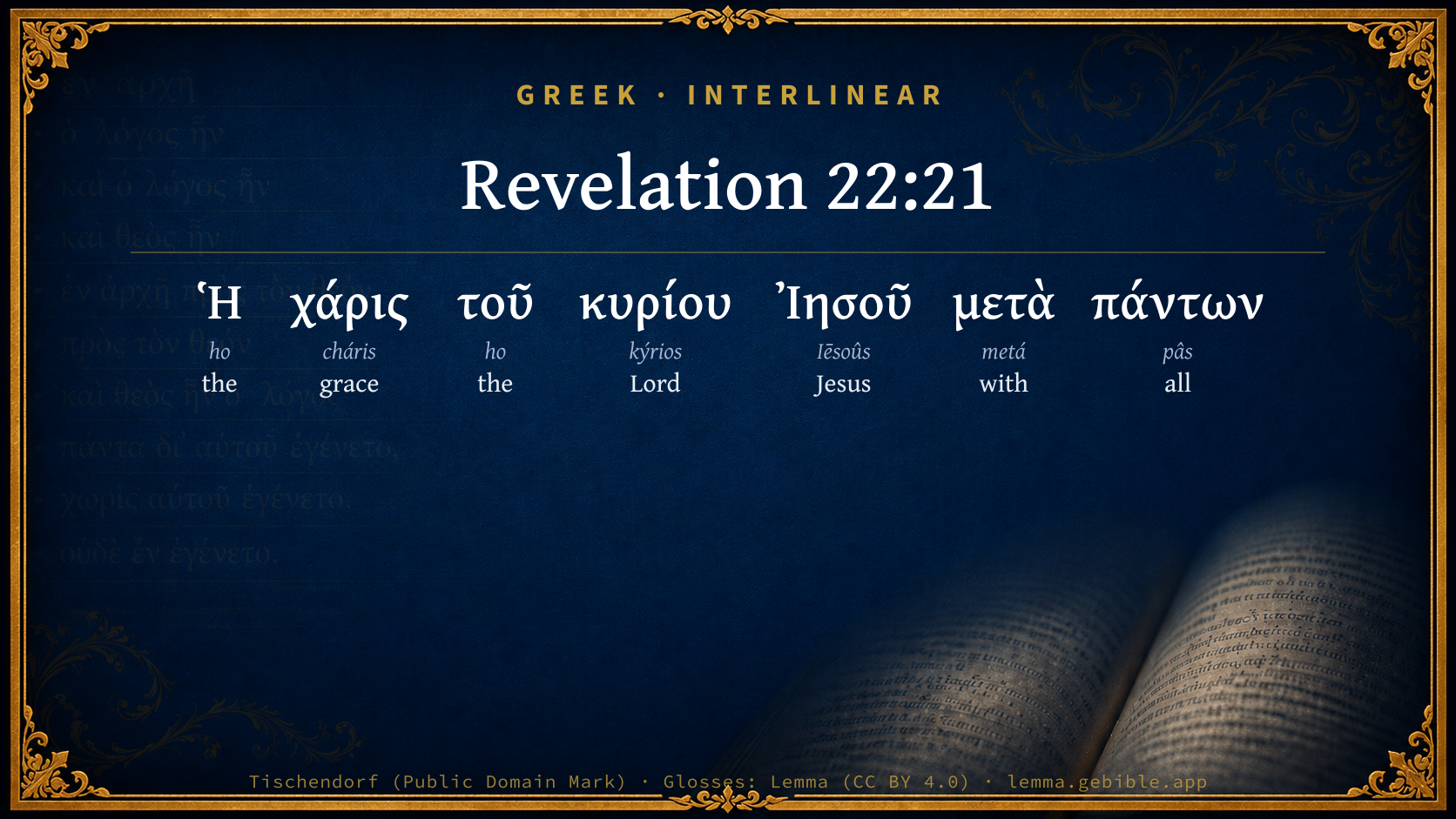
Greek (Tischendorf 8th ed.) Revelation 22:21 appears in the Greek New Testament. The text above is from the Tischendorf 8th edition. Each word links to its Strong’s number and a concise gloss. Click any word for its full Thayer’s Greek Lexicon entry.
Download image
Cite this verse

Revelation 22:21 (World English Bible). Public Domain. Lemma interlinear Bible study tool, https://lemma.gebible.app/v/revelation/22/21.

Show BibTeX & RIS
BibTeX
RIS
English Translation
The grace of the Lord Jesus Christ be with all the saints. Amen.
World English Bible · Public Domain
Download a study sheet

One document with this verse’s original text, its word-by-word gloss line, the meaning frame, cross-references with their text, attributed commentary, and full source and license credits — printable, and it pastes into notes with its structure intact.

This verse Autodidact and up

Study sheet (.html) Plain text (.txt)

A passage Seminary Student

Up to 50 verses in one chapter. A passage sheet keeps up to 6 commentary sources and 12 cross-references per verse, in the order this page ranks them, and says so on the sheet whenever that leaves anything out. Ask for a single verse and you get the Autodidact verse sheet above.

Everything on this page stays free to read, with no account — the sheet is a download of what is already on screen, not access to it.

Want to remove ads? Support Godless Engineer
Compare translations 3

The same verse in 3 English versions, stacked beneath the original-language interlinear above. Click any original word for its lexicon entry.

Each is an independent rendering of the whole verse — the interlinear is not word-aligned to these translations.

Highlighted words mark where these versions differ — a whole-verse word diff, not a word-by-word alignment.

  • World English Bible Public Domain
    The grace of the Lord Jesus Christ be with all the saints. Amen.
  • King James Version Public Domain
    The grace of our Lord Jesus Christ be with you all. Amen.
  • unfoldingWord Literal Text CC BY-SA 4.0
    The grace of the Lord Jesus with the saints. Amen.

unfoldingWord Literal Text — © unfoldingWord, licensed CC BY-SA 4.0. Word-aligned USFM3 via Door43 (git.door43.org/unfoldingWord/en_ult).

Versions to compare (up to 4)

3 of 4 selected

Show all 19 translations

Every available English version of this verse, each an independent rendering of the whole verse.

  • World English Bible Public Domain
    The grace of the Lord Jesus Christ be with all the saints. Amen.
  • Berean Standard Bible Public Domain
    The grace of the Lord Jesus be with all the saints. Amen.
  • Majority Standard Bible Public Domain
    The grace of the Lord Jesus Christ be with all the saints. Amen.
  • King James Version Public Domain
    The grace of our Lord Jesus Christ be with you all. Amen.
  • American Standard Version (1901) Public Domain
    The grace of the Lord Jesus be with the saints. Amen.
  • Revised Version (1885) Public Domain
    The grace of the Lord Jesus be with the saints. Amen.
  • Geneva Bible (1599) Public Domain
    The grace of our Lord Iesus Christ be with you all, AMEN.
  • Douay-Rheims (1899) Public Domain
    The grace of our Lord Jesus Christ be with you all. Amen.
  • Young's Literal Translation Public Domain
    The grace of our Lord Jesus Christ `is' with you all. Amen.
  • Literal Standard Version CC BY-SA 4.0
    The grace of our Lord Jesus Christ [is] with all [[the holy ones. Amen.]]
  • Unlocked Literal Bible CC BY-SA 4.0
    May the grace of the Lord Jesus be with everyone. Amen.
  • unfoldingWord Literal Text CC BY-SA 4.0
    The grace of the Lord Jesus with the saints. Amen.
  • Darby Bible Public Domain
    The grace of the Lord Jesus Christ [be] with all the saints.
  • World Messianic Bible Public Domain
    The grace of the Lord Yeshua the Messiah be with all the holy ones. Amen.
  • Webster's Bible Public Domain
    The grace of our Lord Jesus Christ be with you all. Amen.
  • Free Bible Version CC BY-SA 4.0
    May the grace of the Lord Jesus be with the believers. Amen.
  • Bible in Basic English Public Domain
    The grace of the Lord Jesus be with the saints. So be it.
  • Text-Critical English NT CC BY 4.0
    The grace of the Lord Jesus Christ be with all the saints. Amen.
  • Tyndale New Testament (1534) Public Domain
    The grace of oure lorde Iesu Christ be with you all. Amen.

Literal Standard Version (2020), Covenant Press — licensed CC BY-SA 4.0. Text via the HelloAO Bible API (eBible.org). Unlocked Literal Bible (unfoldingWord) — licensed CC BY-SA 4.0. Text via the HelloAO Bible API (eBible.org). unfoldingWord Literal Text — © unfoldingWord, licensed CC BY-SA 4.0. Word-aligned USFM3 via Door43 (git.door43.org/unfoldingWord/en_ult). Free Bible Version, Dr. Jonathan Gallagher — licensed CC BY-SA 4.0. Text via the HelloAO Bible API (eBible.org).

Word by word

More ways to search: Search by grammar → Find every occurrence → Compare this word →

Practice this passage: Drill this verse → Learn its vocabulary →

χάρις
cháris
G5485
“grace”
Noun, Nominative, Singular, Feminine
Part of Speech
Noun
Case
Nominative
Number
Singular
Gender
Feminine
Full Thayer's Definition

Origin: from G5463

TDNT: 15:12,1

1. grace a. that which affords joy, pleasure, delight, sweetness, charm, loveliness: grace of speech 2. good will, loving-kindness, favour a. of the merciful kindness by which God, exerting his holy influence upon souls, turns them to Christ, keeps, strengthens, increases them in Christian faith, knowledge, affection, and kindles them to the exercise of the Christian virtues 3. what is due to grace a. the spiritual condition of one governed by the power of divine grace b. the token or proof of grace, benefit 1. a gift of grace 2. benefit, bounty 4. thanks, (for benefits, services, favours), recompense, reward
  1. Ἡ ho G3588 “the” Article, Nominative, Singular, Feminine
  2. τοῦ ho G3588 “the” Article, Genitive, Singular, Masculine
  3. κυρίου kýrios G2962 “Lord” Noun, Genitive, Singular, Masculine
  4. Ἰησοῦ Iēsoûs G2424 “Jesus” Noun, Genitive, Singular, Masculine
  5. μετὰ metá G3326 “with” Preposition
  6. πάντων pâs G3956 “all” Adjective, Genitive, Plural, Masculine

About this verse

These counts appear in no published source. They are computed here, from the morphology-tagged text and Lemma’s own curated glosses. What Lemma adds →

7
words
6
distinct lemmas
Revelation
section

Repetition

A word recurs within this verse:

Cross-references

5

Topical passages linked to Revelation 22:21 in the Treasury of Scripture Knowledge — connected by theme and wording, ordered by reader-vote popularity; previews shown in the World English Bible.

  • 2 Thessalonians 3:18 The grace of our Lord Jesus Christ be with you all. Amen.
  • Romans 16:20 And the God of peace will quickly crush Satan under your feet. The grace of our Lord Jesus Christ be with you.
  • 2 Corinthians 13:14 The grace of the Lord Jesus Christ, the love of God, and the communion of the Holy Spirit, be with you all. Amen.
  • Ephesians 6:23–24 Peace be to the brothers, and love with faith, from God the Father and the Lord Jesus Christ.
  • Revelation 1:4 John, to the seven assemblies that are in Asia: Grace to you and peace, from God, who is and who was and who is to come; and from the seven Spirits who are before his throne;

Cross-references courtesy of OpenBible.info (CC BY 4.0).

Where the printed editions differ

4 variants

Places in this verse where the major printed Greek editions disagree on the wording in a way that affects the translation — a comparison of editions, not a manuscript-by-manuscript collation. The editions are the modern critical texts (Nestlé-Aland 28/27, SBL, Westcott-Hort, Tregelles, Tyndale House) and the traditional texts behind the KJV (the Textus Receptus and the Byzantine/Majority text). It is not a claim about which reading is original.

  1. Extra text
    ημῶν

    “of us”

    In TR Not in NA28NA27TynSBLWHTregByz

    ημῶν (ēmōn) 'of us' is only in traditional manuscripts (TR)

  2. Extra text
    Χριστοῦ

    “Christ”

    In WHTRByz Not in NA28NA27TynSBLTreg

    Χριστοῦ (Christou) 'Christ' is only in traditional manuscripts (WH+TR+Byz)

  3. Extra text
    ὑμῶν.

    “of you”

    In TR Not in NA28NA27TynSBLWHTregByz
  4. Extra text
    ἀμήν.

    “Amen.”

    In TynTRByz Not in NA28NA27SBLWHTreg

    ὑμῶν. ἀμήν. (humōn amēn) 'of you Amen.' is only in traditional manuscripts (Tyn+TR+Byz)

Textual data: Translators Amalgamated Greek New Testament (STEPBible TAGNT) · CC BY 4.0.

Commentary

Notes on Revelation 22:21 from classic Christian and Jewish commentators (each source and its license shown beneath its notes). The classic Christian expositions comment on the surrounding passage and are grouped to its opening verse, so a note may address several verses; the Jewish commentaries on the Tanakh (Rashi and others) are per-verse, so they appear only where the commentator wrote on this verse.

Lemma curates 59 commentaries, every one of them public domain or Creative Commons licensed, each selected and text-cleaned for this edition rather than reprinted as found. About our sources →

The Biblical Illustrator

Joseph S. Exell

Rev_22:21

The grace of our Lord Jesus Christ be with you all

The grace of Jesus Christ

It is the last text in the Bible and it fits well the last day of the year.

It is well we should take a blessing to ourselves, or at least try to fancy that it may be ours, for we need it sorely on this day. Dwell as we will on the brighter side of things, life is very hard, and men and women are hard on one another, and we ourselves are growing hard, and that is the worst of all. We need something to soften, in no enfeebling way, the hardness of life, and of men, and of our own heart. And most of the blessings we seek of our own will, weaken our souls, and in the weakening make us harder in the future. But the grace of our Lord Jesus Christ, if we could win it and take it, softens all things by making us stronger towards goodness and truth and righteousness and love. What is it? What is His grace? Whatever it is, it does not come from one who is ignorant of all we need. He has known to the full the weight of human suffering, and the blessing of His grace that is with us is brought home to us by that knowledge. Christ can give inspiration, can bless, and give of His power because He mastered the evil forces of life. None have ever done that so completely, but many can do it in His spirit. And those who do, can help and bless their fellows in proportion to their victory. Remember that this day, you who are in warfare with pain or guilt. You will be able to bring grace and blessing to others in the future, whatever your pain be now, if you conquer it. And, in order to conquer, win His grace who has conquered, and who will give it to you. That grace is, first, kindness, the goodwill of love. It is the showing forth of all those sweet and beautiful qualities which make home and social life so dear, and the showing forth of them in perfection. It is the filial tenderness which laid down the consciousness of genius and all its impulses for thirty years at the feet of His mother in a quiet and silent life and which won her pondering and passionate love. It is the penetrating love which saw into the character of His friends and made them believe in their own capacity for greatness, which led men like Peter and John and James to find out and love one another, which bound His followers together in a love that outlasted death. It is the tender insight which saw into the publicans heart, which when the sinner drew near in tears, believed in her repentance and exalted her into a saint, which had compassion on the multitude and on the weariness of a few, which wept over Jerusalem, which in all human life and the movement of its passions and hopes and faiths did, said, and thought the loving and just thing at the right moment, without doing or saying the weak thing. Think of it all, you who know the story, and an image of the grace of Christ as loving-kindness will grow before your soul. And it will be strange if you do not, ravished with the sight, say, Let that blessed power be mine in life. May the grace of the Lord Jesus be with me. But there is more in it than this. Human love, left alone, spends itself only on those near to us, or on those that love us in return, and, in its form of kindness and pity, on those whom we compassionate. Kept within a narrow circle, it tends to have family or a social selfishness. Given only to those who suffer, it tends to become self-satisfied. To be perfect, it ought to reach, through frank forgiveness, those who injure us; through interest in the interests, ideas, and movements of human progress, those who are beyond our own circle, in our nation, nay, even in the world; and finally all men, those even who are our bitterest foes, through desire that they should have good and be good. It was the very glory of the grace of Christ, as love, that it rose into this wonderful height and universality. All men were infinitely precious and divine in Christs sight, for He saw them all consciously and unconsciously going into the outstretched arms of God. Therefore He could not help loving them all. That is the grace of Christ--the loving-kindness of Jesus--the human love raised into the Divine without losing one touch of its humanity, save only as light is lost in greater light. I pray that this grace of Christ be with you all; the grace of natural love lifted into Divine and universal love through faith in the Fatherhood of God. It is Christs to give because He had it, and when we have it we can give it also. Gain it and give it, and you will be blessed and a blessing. Secondly, grace has another meaning other than loving-kindness. It means the kind of beauty we express by the word charm; and in this sense we may translate the text, The beautiful charm of Christ be with you all. Do you remember how, when the world-worn Pharisee expressed his scorn of the sinful woman, Christ felt her boundless love, and said, Her sins, which are many, are forgiven; for she loved much; how, when Mary sat at His feet and was blamed by Martha, He alone saw love and rightness of choice in her silence; how, when the rude utilitarian saw waste in the extravagant love which lavished on Him the precious spikenard, He accepted it, not for its extravagance, but for its passion; how when Peter had sinned by a threefold treachery, He believed in the repentance, and only gave one look of sore and loving reproach; how, when He was dying, He provided for His friend a mother, and for His mother a son? What charm, what grace in them all! And their beauty could not stand alone. That kind of exquisite sensitiveness flowered through the whole of His life with men. It was His grace, and all felt its charm. Nor is it less seen in His speech than in His act. In directness, in temperance, in a certain sweet wisdom and ordered humanity, and in the beauty that results from these, there is nothing in the loveliest Greek work which matches the parables of Christ, or such sayings as Consider the lilies of the field, how they grow; they toil not, neither do they spin; and yet I say unto you, that even Solomon in all his glory was not arrayed like one of these; or Come unto me, all ye that labour, etc. In thinking of Him as the Man of Sorrows, in having imposed on us by the ascetic that He had no form or comeliness, we forget what must have been His irresistible charm. In the reaction which Christendom felt from that heathen worship of beauty which ended in moral deformity, nay, linked beauty to sensualism, the loveliness of Christ was too long hidden from us; we lost the sense of His grace in the meaning which the nobler Greek would have given to the term. Do not you forget it. Seek the blessing of the charm that comes of sensitiveness to the feelings of others, of sensitiveness to all that is beautiful, of an inward harmony of nature, and of the expression of that harmony in beautiful act and speech. Say to yourselves in this sense also, The grace of the Lord Jesus be with me and all. And if we are worthy of it and see it, He will give it to us. It is given, indeed, through our seeing it. The moment we see loveliness we cannot help desiring it, and the moment we desire it we begin our effort after it. It is by being beautiful that Christ gives us of His beauty, and makes us into His image. It is in quite a natural, and not a supernatural manner that we are changed into the same image from glory to glory. Once more, His grace and His love of doing and being the Beautiful was not apart from, or greater than, His love of, and doing of moral things, but coincident with them. Nothing which was false or impure or unjust was, in itself, beautiful to Christ, and the first glory of His grace and charm was its harmony with righteousness. We look at it, then, not only with tenderness, such as we feel for loving-kindness, not only with delight, such as we feel for beauty, but also with all that earnest approval and grave enthusiasm which we give to things and persons who are good. Christs charm has its root in love, and is identical with truth and justice and purity and courage. It grasps the hand of the Platonist and the Stoic alike, without the vagueness of the one and the rigour of the other. And while it holds to the Epicurean so far as the early Epicureans said that pleasure was the highest good because goodness was identical with pleasure, it turns aside from the later Epicureans and from those of our day who put pleasure in beauty first, to the loss or lessening of moral goodness. Guarded thus on all sides, yet taking in all that is noble in all efforts to find the highest good, it was in truth grace in its sense of beauty that Christ possessed. That grace, so guarded, so complete, pray that it may be with you all in the year. It will bless your lives and it will make of you a blessing. It will make you at one with all that is tender, pitiful, dear, and sweet in human loving-kindness. It will make you at one with all that is sensitive and delicate and graceful in manner and speech, and create in you an harmonious soul. Men will think your life beautiful, and inspiration and effort will flow from it. It will make you at one with moral good, just and true and pure. And it will take all that is loving in humanity, and all that is fair, and all that is moral, and link them to and complete them by uniting them to the love of God, and to Gods love for all men; so that to human love and moral love and imaginative love will be added the spiritual love which gathers them all into perfection. (S. A. Brooke, M. A.)

The last words of the Old and New Testaments

(see Mat_4:6):--Just as Christ, in His ascension, was taken from them whilst His hands were lifted up in the act of blessing, so it is fitting that the revelation of which He is the centre and the theme should part from us as He did, shedding with its final words the dew of benediction on our upturned heads.

I. The apparent contrast and the real harmony and unity of these two texts. Lest I come and smite the land with a curse. If instead of the word curse we were to substitute the word destruction, we should get the true idea of the passage. And the thought that I want to insist upon is this, that here we have distinctly gathered up the whole spirit of milleniums of Divine revelation, all of which declare this one thing, that as certainly as there is a God, every transgression and disobedience receives, and must receive, its just recompense of reward. That is the spirit of law, for law has nothing to say, except, Do this, and thou shalt live; do not this, and thou shalt die. And then turn to the other. The grace of our Lord Jesus Christ be with you all. What has become of the thunder? All melted into dewy rain of love and pity and compassion. Grace is love that stoops; grace is love that foregoes its claims, and forgives sins against itself. Grace is love that imparts, and this grace, thus stooping, thus pardoning, thus bestowing, is a universal gift. So there is a very real and significant contrast. I come and smite the earth with a curse sounds strangely unlike the grace of our Lord Jesus Christ be with you all. So I want you to notice that beneath this apparent contrast there is a real harmony, and that these two utterances, though they seem to be so diverse, are quite consistent at bottom, and must both be taken into account if we would grasp the whole truth. For, as a matter of fact, nowhere are there more tender utterances and sweeter revelations of a Divine mercy than in that ancient law with its attendant prophets. And, as a matter of fact, nowhere, through all the thunderings and lightnings of Sinai, are there such solemn words of retribution as dropped from the lips of the Incarnate Love. There is nothing anywhere so dreadful as Christs own words about what comes, and must come, to sinful men.

II. The relation of the grace to the punishment. Is it not love which proclaims judgment? Are not the words of my first text, if you take them all, merciful, however they wear a surface of threatening? Lest I come. Then He speaks that He may not come, and declares the issue of sin in order that that issue may never need to be experienced by us that listen to Him. It is love that threatens; it is mercy to tell us that the wrath will come. And just as one relation between the grace and the retribution is that the proclamation of the retribution is the work of the grace, so there is another relation--the grace is manifested in bearing the punishment, and in bearing it away by bearing it. He has come between every one of us, if we will, and that certain incidence of retribution for our evil, taking upon Himself the whole burden of our sin and of our guilt, and bearing that awful death which consists not in the mere dissolution of the tie between soul and body, but in the separation of the conscious spirit from God, in order that we may stand peaceful, serene, untouched, when the hail and the fire of the Divine judgment are falling from the heavens and running along the earth. The grace depends for all our conceptions of its glory, its tenderness, and its depth on our estimate of the wrath from which it delivers.

III. The alternative which these texts open for us. You must have either the destruction or the grace. And, more wonderful still, the same coming of the same Lord will be to one man the destruction, and to another the manifestation and reception of His perfect grace. As it was in the Lords first coming, He is set for the rise and the fall of many in Israel. The same heat softens some substances and bakes others into hardness. The same gospel is a savour of life unto life, or of death unto death, by the giving forth of the same influences killing the one and reviving the other; the same Christ is a Stone to build upon or a Stone of stumbling; and when He cometh at the last, Prince, King, Judge, to you and me, His coming shall be prepared as the morning; and ye shall have a song as in the night as when one cometh with a pipe to the mountain of the Lord; or else it shall be a day of darkness and not of light. (A. Maclaren, D. D.)

The grace of our Lord Jesus Christ

These are the last words of the second volume of God to man. The last word that God has to give to man in His holy book is a blessing upon man. Could any one wish you more or better than that the grace of our Lord Jesus Christ be yours, be mine? Now, look first at what the grace of the Lord Jesus is. The word grace is used in the New Testament in two distinct senses:--First, it is the grace that belongs to Christ Himself; the grace or graces of Christ. Second, it is the grace, or great grace, or great gift that Christ gives to men. Now, look, first, at the grace of Christ--the personal grace. Christ seemingly was the most attractive of men in His personality. He exercised over the men and women of His time a strong personal fascination. It is rather strange that there is no real portrait or picture of Christ in His human form. But I think it is a great advantage rather than otherwise that we have no picture of His person. For myself, I always picture the Lord Jesus as a man of great attractiveness personally, of winning demeanour, and His whole personality one such as to attract and win to Himself. I will give you three simple reasons for this. Notice, first, that Christ was come of a kingly race--of the house of David. Now, David himself was a man famed for his physical beauty; so were his sons--two, at least--men of great physical beauty and attractiveness; and, if there is one great lesson that modern science has taught us, it is the lesson of heredity; and I do not press it too far if I say that Christ had the grace and beauty of His predecessors. In the second place, if you will study Christs life, you will find there are particular occasions when the majesty of His person impressed all around Him, and especially His disciples. Third, He seems to have had a great attraction for children. Now, no one who is not attractive in his personality, and has not sweetness of countenance, has that subtle attraction for children which will draw them to him. It is well to strive to have the graces of Christ. Let us strive, each according to our endowments from the Most High, to exercise this sweet attractiveness of personality--to become not only good and strong men as Christians, but to become attractive and winning; I would venture to say, have the winsomeness of Christ. This seems to me to he the first great personal grace of Christ, winsomeness; but there are deeper and richer graces than this that Christ had, and which we may all have. I would ask you to notice three great graces in addition to His personality--the graces of character, the great root graces. He had that most beautiful of graces--the grace of humility. I have noticed in life that the greater a mans position is, the greater is his power; the higher his position, mentally or worldly, the more he is admired, if he be a humble man; that seemingly the admiration for his humility increases in the ratio of his worldly greatness. Now this is just the wonderful quality about Christ. We speak of the good ones and the great ones of the earth, but there is no one who can compare in the least with Christ, the Son of God, for greatness, power, might, intellect: for every quality that man recognises as great. Christ is the great revelation of God--not merely man but God Himself of very God. And the great and wonderful thing about His humility is that He emptied Himself, as Paul says, of this Divine majesty and power, and came down to this world, became of no repute, humble as the humblest, born in a manger, living and working at the carpenters bench. That is somewhat of the humility of Christ. It is a great virtue. It is a temptation for us all at times, not to feel humble, but to become self-confident. Having put before you the infinite grace and humility of our Lord Jesus Christ, I pray for you and for myself that the grace of our Lord Jesus Christ--the grace of Divine humility--may he yours, may be mine. His humility was His second great grace; and His third was His unselfishness. Christ, I think, is most wonderful of all for His unselfishness. Christ, the Son of God, endowed with every quality that would make a man a success in the world--endowed with the richest intellectual and spiritual gifts--laid them all aside, or only used them for the sake of others. Pray that the grace of the unselfishness of our Lord Jesus Christ may be ours. And then just a few words upon another grace. I have spoken of His personal attractiveness, His humility, His unselfishness; greater than these gifts and graces is the last--love, love. The measure of a mans greatness, whether he be great in the world or little, the true measure of a mans greatness is his power for love. That is the greatest power for men and women--their capacity for love, Divine love, human love. In Christ you have the most perfect example of it, His Divine love for God His Father, was absolutely perfect. What shall I say of His love to man? We cannot grasp it; a finite mind like yours and mine cannot adequately realise the greatness of the love of God: we can only adore it. Love that led Him to live, to die, to sacrifice everything for men and women like you and me. Above all the graces you can have, get love--love that brightens, love that deepens, love that purifies mens natures. These were simply some of Christs own graces or gifts. What is the great grace or gift that He has to give to men? It is simply the forgiveness of our sins. Is that a little thing? Men seem to think that it is. If you would take a deeper view of yourself and human nature, you would see what a great thing it really is. Sin that caused the death of Gods Son is a dreadful thing; it ruins, and mars, and corrupts your nature and mine. The greatest gift that could be made to men, is the forgiveness of their sins. I have tried to show you the graces of Christs person, His attractiveness, His unselfishness, His humility, and His love; all these gifts are in vain unless you get the great gift of forgiveness of sins from Christ, the foundation of every grace and virtue possible to man. This gift may be had by all here, young and old. It is a gift that is not limited to the young, to little children, to men in the prime of their days, or to old men. It is a great gift for all. If you and I could get first the grace of forgiveness, then those of personal attractiveness, humility, unselfishness, and greatest of all graces and gifts, the love of Christ--love like Christs--earth were heaven now. Men speak of a golden age that shall come; saints and sages have spoken of it; there is an instinctive craving of the human heart after a golden age that shall dawn; could the grace of our Lord Jesus Christ really be with you and me, now were the golden age, not in the time to come, but now, in this daffy life of ours. One day we shall not have to say the grace of our Lord Jesus Christ be with you all , but we shall say the grace of our Lord Jesus Christ is with us all. (Wm. Souper, M. A.)

The free love of Christ

Thus the Bible closes with blessing. In this prayer we have the summing-up of all the blessings which the Word of God has uttered. Man is simply the receiver and the enjoyer of a love as boundless as it is unbought.

I. What is this grace of the Lord Jesus Christ? Free love! Divine favour, unbought, unsolicited, and undeserved! Return to your Fathers house, and be blest! Come, and be forgiven! Look, and be saved! Touch, and be healed! Ask, and it shall be given!

II. How it has been shown. In many ways, but chiefly in the Cross. The words of Christ were grace; the doings of Christ were grace; but at the Cross it came forth most fully. The it is finished of Golgotha was the throwing down of the barriers that stood between the sinner and the grace. The grace itself was uncreated and eternal; it did not originate in the purpose, but in the nature of God. Still its outflow to sinners was hemmed in by righteousness; and until this was satisfied at the Cross the grace was like forbidden fruit to man. Divine displeasure against sin and Divine love of holiness found their complete satisfaction at the altar, where the consuming fire devoured the great burnt-offering, and gave full vent to the pent-up stores of grace.

III. How we get it. Simply by taking it as it is, and as we are; by letting it flow into us; by believing Gods testimony con-earning it. Grace supposes no preparation whatsoever in him who receives it, save that of worthlessness and guilt, whether these be felt or unfelt. The dryness of the ground is that which fits it for the rain; the poverty of the beggar is that which fits him for the aims; so the sin of the sinner is that which fits him for the grace of Christ. If anything else were needed, grace would be no more grace, but would become work or merit. Where sin abounds there it is that grace much more abounds.

IV. What it does for us.

1. It pardons.

2. It pacifies.

3. It liberates.

4. It enlightens.

5. It strengthens.

6. It purifies.

V. How long it lasts: For ever. (H. Bonar, D. D.)

Till we meet again

This is an expression suitable to the most gracious heart, a prayer wherewith the believer may vent his best wishes and express his most devout desires.

I. Consider this benediction.

1. What is this which John desires? The word is charis. It has for its root joy. There is joy at the bottom of charis, or grace. It also signifieth favour, kindliness, and especially love. Jesus Christ Himself is generally mentioned in our benedictions as having grace, and the Father as having love; and our usual benediction begins with the grace of our Lord Jesus Christ and the love of God. Is that the proper order? The order is correct to our experience, and in an instructive benediction the Holy Spirit intendeth this for our learning. The Fathers love is, as it were, the secret, mysterious germ of everything. That same love in Jesus Christ is grace; His is love in its active form, love descending to earth, love wearing human nature, love paying the great ransom price, love ascending, love sitting and waiting, love pleading, love soon to come with power and glory. This grace of our Lord Jesus Christ is therefore the grace of a Divine person. We wish you, as we for ourselves, the grace of God Himself, rich, boundless, unfathomable, immutable, Divine; no temporary grace such as some speak of, which keepeth not its own, but suffereth even the sheep of its own pasture to go astray and perish; but the grace of our Lord Jesus Christ, of whom it is written, Having loved His Own which were in the world, He loved them unto the end; that grace most potent which said, None shall pluck them out of My hand. This is no small treasure--this grace of a Divine Person. Yet is our Lord Jesus also human, as truly human as He is Divine, and, believing in Him, you have the grace of Jesus Christ the Man to be with you all. May you feel His tenderness, His brotherliness, His grace. He is your Kinsman, and He graciously favours His own kinsfolk. Read the text again, and pause a while in the middle to enjoy The grace of our Lord. The grace that cometh from His Majesty, the grace that cometh from His Headship, the grace that cometh from His Divinely human supremacy over His Church, which is His body--this is the grace which we desire for you all. Read the next word: The grace of our Lord Jesus. May that be with you; that is to say, the grace of our Saviour, for that is the meaning of the word Jesus. All His saving grace, all that which redeems from guilt, from sin, from trouble, all that which saves us with an everlasting salvation--may that be yours to the full. Then comes the other word, The grace of our Lord Jesus Christ be with you; may He, as the Anointed One, visit you. May you have that anointing from the Holy One which shall make you know all things.

2. Our next division is, How? May the grace of our Lord Jesus Christ be with you all. What meaneth this? Our first answer is the wish that the grace of our Lord may rest upon you as a matter of fact--that He may love you truly and intensely; love you, not only as He loves the world, but as He loved His own which were in the world. Next, may you believe that grace, may you trust that grace, may it be with you because your faith has closed in with it, and you are relying upon it. Still further, may His grace be with you as the object of faith, so that your belief comes to be full assurance, till you know the love which Christ hath towards you, and no more doubt it than you doubt the love of the dearest friend you have on earth. And may His grace be with you, next, as to the favours which flow out of it. May you enjoy all the blessings which the grace of Christ can yield, the grace of a peaceful conscience, the grace of a cleansed walk, the grace of access to God, the grace of fervent love, the grace of holy expectancy, the grace of self-denial, the grace of perfect consecration, and the grace of final perseverance. And may grace be with us, next, so as to produce constant communion between us and Christ, His favour flowing into our heart, and our hearts returning their gratitude. Oh, to come to this pass, that our Well-beloved is with us, and we enjoy sweet mutual intercourse: this is to have the love, or grace, of Jesus with us. May our Lord Jesus Christ thus in His grace be with us, and may He work for us all that He can work. What better benediction could John Himself utter?

3. But, now, the third part of our discourse comes under the head of to whom. The grace of our Lord Jesus Christ be with you all. Every now and then you come across a book written by one who is a long way off from understanding all the truth, yet he knows Jesus Christ, and as you read the sweet words that come from His pen concerning the Master you feel your heart knit to Him. If a man knows Christ he knows the most important of matters, and is possessed of secret quite as precious as any in our own keeping, for what know we more than Christ, and what hope have we but in Christ? There is a life which is the same in all that have it, however diverse they may happen to be upon opinion or outward ceremony. There is a life eternal, and that life is Christ Jesus, and to all that have that life we do with intensity of heart say, The grace of our Lord Jesus Christ be with you all.

II. The position of this benediction. First, I draw what I have to say from the fact that it is the last word of Scripture. I regard it, therefore, as being the apostles last and highest wish. We cannot do with less than this, and we do not want more than this. If we get grace from Jesus we shall have glory with Jesus, but without it we are without hope. Standing at the end of the Book of Revelation as this does, I next regard its position as indicating what we shall want till the end comes; that is, from now till the descent of our Lord in His second advent. This is the one thing we require, The grace of our Lord Jesus Christ be with you all. May it be with us daily, hourly! May it be with us, instructing us as to our behaviour in each generation! Placed as this blessing is at the end of the book there is but this one more thought--this is what we shall wish for when the end cometh. We shall come to the end of life, as we come to the end of our Bibles. And oh, aged friend, may thy failing eyes be cheered with the sight of the grace of our Lord Jesus Christ, on the last page of life, as thou wilt find it on the last page of thy well-thumbed Bible. Peradventure some of you may come to the last page of life before you get grace: I pray that there you may find it. The grace of our Lord Jesus Christ be with you. Or, suppose we should not die; suppose the Lord should suddenly come in His temple. Oh, then may we have grace to meet Him. (C. H. Spurgeon.)

A faithful ministers parting blessing

First, His restraining grace. Why, if it were not for this, Gods people would be just as weak and wicked as other folks are. Secondly, there is convicting grace, which from the Lord Jesus Christ acts every day and hour. A man may speak to the ear, but it is the Spirit of God alone can speak to the heart. What does Jesus Christ do in temptations, trials, and afflictions? He fetches His people home, and convinces them that they have done amiss. Thirdly, there is the converting grace of our Lord Jesus Christ. That is a most excellent prayer in our commination office, Turn us, O good Lord, and we shall be turned. We can no more turn our hearts than we can turn the world upside down; it is the Redeemer, by His Spirit, must take away the heart of stone, and by the influence of the Holy Spirit give us a heart of flesh. Then there is establishing grace. David prays, Create in me a new heart, and renew a right spirit within me. In the margin it is constant spirit; and you hear of some that are rooted and grounded in the love of God, and the apostle prays that they may always abound in the work of the Lord. Again, it is good to have the heart established with grace. There is a good many people have some religion in them, but they are not established. Hence they are mere weather-cocks, turned about by every wind of doctrine. What think you of the Redeemers comforting grace? Oh, what can you do without it? In the multitude of my thoughts within me, says the psalmist, Thy comforts have refreshed my soul. And there are so many afflictions and trials, that if it were not for the Lord Jesus Christs comfortings, no flesh could bear them. In a word, what think you of the quickening grace of our Lord Jesus Christ? Remember David says, Quicken me according to Thy word, quicken me in Thy way, quicken me in Thy righteousness. Gods people want quickening every day; this is trimming our lamps, girding up the loins of our minds, stirring up the gift of God that is in us. It is just with a soul as it is with the plants and trees; how would it be with them if the Lord did not command quickening life to them after the winter? The grace of our Lord Jesus Christ is with His people in prayer. Who can pray without grace? The grace of God is with His people in His providence. Oh, says Bishop Hall, a little aid is not enough for me. My going on the waters puts me in mind of what I have seen many times. If the sailors perceive a storm coming, they do not choose to speak to the passengers for fear of frightening them; they will go quietly on deck, and give orders for proper care to be taken; and if a sailor can tell of storms approaching by the clouds, why cannot Gods people tell why God does so and so with them? The people of God eye Him in His providence; the very hairs of their heads are all numbered, and the grace of God is with them in the common business of life. The grace of the Lord Jesus Christ is with His people when sick and when dying. Oh, what shall we do when death comes? What a mercy it is that we have got a good Master to carry us through that time! (G. Whitefield, M. A.)

Amen.

The Churchs Amen

I. The last testimony. The whole Bible is the testimony; for in it Christ is both the Teacher and the Lesson, the Witness and the Testimony. But the Revelation is His last testimony; and the marvellous words of the latter part of this chapter are more especially so. Let the Church listen; let the world give heed.

II. The last prophecy. Surely I come quickly. Brief but distinct is this announcement; and it comes from His own lips. He heralds Himself and His kingdom. He puts the trumpet to His own mouth to sound abroad this last message, I come! I who came, and departed, am coming again. I come quickly. Here is something more. He will lose no time; nor delay a moment longer than is absolutely necessary. He will not be slack concerning His promise (2Pe_3:9); He will come and not tarry (Heb_10:37). Surely I come quickly. Appearances may indicate no such thing; the worlds sky may be cloudless, and its sea smooth; men may have assured themselves of prosperous days, and be saying, Peace and safety; yet surely He cometh! As a snare, as a thief, as lightning, He cometh. He, the very Christ, the risen Saviour, Jesus of Nazareth--He cometh! In His own glory, in His Fathers glory, with His mighty angels, in the clouds of heaven, King and Judge, Conqueror and Avenger, Redresser of wrongs, Opener of prison-doors, Binder of Satan, Renewer of creation, Bridegroom of His Church, Star of Jacob, Sun of Righteousness, Owner of the golden sceptre, Wielder of the iron rod, Wearer of the crowns of earth--He cometh!

III. The last prayer--Amen. Even so come, Lord Jesus; or more literally, Yes, surely, come, Lord Jesus; for the words the apostle here uses, in his response, are the same as those used by Christ in His announcement; as if he caught up the Masters words and echoed them. Thus gladly and fervently does the Church respond to the promise; as one who felt the blank created by the Lords absence, and welcomed with her whole heart the intimation of His return. This is the summing-up of her petitions, as was the seventy-second Psalm the filling up of all Davids prayers (Psa_72:20). Are our hearts, like hers, thus beating toward the Beloved One? Is this the burden of our prayers?

IV. The last blessing. The grace of our Lord Jesus Christ be with you all. Earthly, human love, is of all things here the most fitted to gladden; how much more, then, that which is heavenly and Divine!

V. The last amen. This is not an amen to this chapter only, or this book only; but to the whole Bible, of which the burden, from Genesis to Revelation, is Jesus Christ, the seed of the woman. It is an amen to the prayer for the grace of Christ; it is an amen to the sigh for the Lords appearing. It is an amen to the prophetic announcement of all the glorious and all the terrible things written in this book. It is the concentrated utterance of the Churchs longings; her glad response to all that God has spoken; the subscription of her name to her belief in all that the Holy Spirit has written; the summing-up of her unutterable groan. How much does this amen comprise! Faith, hope, and love are in it; and, with these, such a boundless satisfaction of spirit as can only get vent to itself in that one brief word, which sums up all the aspirations of its joy, Amen and amen! (H. Bonar, D. D.)

The last amen

Amen is a Hebrew word, signifying truth and certainty in the first place; and then our affirmation of something as a certainty, or our desire that it should be so. It comes also to signify faithfulness and stedfastness in a person, so that that person is himself regarded as truth personified--the truth, the Amen. Hence it is that Christ takes to Himself the designation of the Truth, and the Amen--the faithful and true Witness. Further, it has come to signify faith and confidence--specially faith and confidence in God. It is the word used in reference to Abraham, He believed God, and to Israel, They believed the Lord. But it is with the common use of it that we have now to do--that use of it which we make daily when we conclude even our shortest prayer. Amen; that is, so let it be; let it be according to our request, and according to Thy promise. Used in this way it means much. There are, however, different ways of using it; different feelings with which it is uttered: and it is to these that we would now attend.

I. There is the amen of ignorance. Simple and common as the word is, thousands use it without knowing what it means, or what they themselves intend. It is to them a word, no more; a concluding word or sound, where the voice ceases, and after which the eyes are opened, and the hands unclasped! Are your Amens of this kind? or are they uttered with the understanding--the full realisation of the large and solemn meaning which they contain?

II. The amen of habit. All are not ignorant of its significance. Ask many what they intend by affixing it to their prayers, and at once they will tell you. Yet mark them, and you will find the word slipping from their tongue without any corresponding thought as to its sense. Are your Amens those of habit--pieces of ornament, the useless appendages of useless devotion--or is your soul thrown into them? Are they the essence of your previous petitions-the concentration and summing-up of all your desires?

III. The amen of unbelief. It seems strange that a word like this should ever be uttered in unbelief; yet such is the case. Nay, sometimes it would seem as if the most unbelieving part of our prayer is that which should be the most believing--the Amen. We may well wonder how it should be so. It seems almost incredible that a word like this, meant to be associated with faithfulness, and truth, and certainty, should be connected with unbelief, nay, should be the utterance of unbelief--the frequent, the daily utterance of unbelief; yet so it is. Our unbelieving Amens are about the most melancholy parts of our prayers--the worst indications of distrust in- God.

IV. The amen of faith. This is the true Amen; the Amen of souls who have heard the gracious words of Him who cannot lie, and who act upon these. But why should Amen be thus linked with faith? Because that which calls it forth is not simply a desirable thing, but a truth and a certainty. It has to do with such things as the following:

1. The free love of God. In every prayer we keep our eye on this; for without the recognition of this grace, this abundant grace, what would prayer be?

2. The truthfulness of God. God is true--truthful, faithful; we will not make Him a liar in any one thing, in any of our communications with Him-least of all in our prayers.

3. The power of God. What He has promised He is able also to perform. He is able to do for us exceeding abundantly, above all we ask. In addition to these things, to which the faith of our Amens attaches itself, we would only further say that it specially leans upon the Cross of Christ in connection with these three. It is round that Cross that this faith flings its arms; if is here that it sits down in quiet satisfaction.

V. The amen of hope. We say, Hallowed be Thy name, and we add the Amen of hope; Thy kingdom come, and we add the Amen of hope; Thy will be done on earth, as it is in heaven, and we add the Amen of hope. We hear the Lords own voice from heaven saying, Surely I come quickly, and we add with the apostle: Even so, come, Lord Jesus. Amen! Each time we utter the Amen in connection with these blessed futurities, does our hope kindle up anew--the hope calling up the Amen, and the Amen making the hope to shine out with fresh brightness? In anticipating such a future, how can we utter a cold, heartless, passive, or despairing Amen?

VI. The amen of joy. It is the joy of conscious pardon; the joy of friendship with God; the joy of adoption and heirship; the joy of our whole new created being; the joy because of the blessedness in prospect. Past, present, and future--all furnish us with materials for joy. And in our thanksgivings for the past, we breathe out an Amen of joy; in our consciousness of present peace and heavenly favour, we repeat our Amen of joy; in our pleadings for larger blessing to ourselves and to our world, we say Amen with gladness; and in our pressing forward to the mark for the prize of our high calling, looking for and hastening to the coming of the day of God, we say Amen and Amen with ever-deepening joy of heart. (H. Bonar, D. D.)

The Biblical Illustrator, edited by Joseph S. Exell (c. 1880s–1900s) — public domain. Text from a community e-Sword module.

Joseph Benson's Commentary

Rev 22:21. The grace — The free love; of our Lord Jesus Christ — And all its fruits; be with you all — Who thus long for his appearing, and with all true Christians. The conclusion, as Bishop Newton says, is truly excellent, as well as all other parts of this book; and nothing could be contrived to leave these things with a stronger impression upon the mind of the reader. In the whole, from first to last, appears the majesty of the divine revealer — The Alpha and Omega, the beginning and the end, the Author and Finisher of every good work, and of this more especially. This is the sure word of prophecy, whereunto Christians, as St. Peter saith, do well to take heed, and attend, 2Pe 1:16. Attention, then, to this book is recommended to us upon the authority of St. Peter, as well as of the writer, St. John: a double blessing, as we have seen in the book itself, is pronounced upon those who shall study and observe it; first in Rev 1:3, and here again Rev 22:7. Imboldened by which blessings, with Nehemiah, we would pray, Remember us, O my God, concerning this also, and spare us, according to the greatness of thy mercy, Neh 13:22.

And now, to use the words of the pious and excellent Dr. Doddridge, “How sweetly and delightfully the canon of Scripture concludes, leaving, as it were, the music of heaven upon the attentive ear! O thou blessed root and offspring of David! O thou bright and morning star, impress on all our hearts these thy gracious words, which thou hast condescended to speak from the throne of thy glory; thereby, as it were, to aid the weakness of our faith in those which thou didst deliver while dwelling in mortal flesh! Then did the compassionate Saviour proclaim, from an eminence in the temple, to a crowded assembly, on a day of peculiar solemnity, If any man thirst, let him come unto me and drink, Joh 7:37. And now, behold, he makes the same proclamation from the celestial temple: he points as it were, to the fountain-head of happiness, to the springs of the water of life, near the throne of God; and says, Whoever will, let him come, let him take, let him freely take, of this living water, Rev 22:17. Yea, and not content with speaking this language by his Spirit only, he calls on his bride to lift up her melodious voice, to publish this kind invitation. He calls on every one who hears it to echo it back, as if the excess of his goodness overcame him; as if it were necessary to his happiness that men should accept of their own salvation!

“With what sacred observance should these books be guarded, which contain a message of such infinite importance! of what dreadful curses are they worthy who presume to add to what is already perfect, or to take away, from that which is in every part divine! Rev 22:18. God forbid that any of us should ever presumptuously attempt to do it! And may we be preserved from those mistaken interpretations, in consequence of which we should teach the world, as by his authority, any thing which he has not dictated, or deny any thing which carries along with it the stamp of such an authority! Have pity, O Lord, upon our weakness! Impute not prejudices which thou knowest we do not allow; and give us a greater penetration of mind to understand the true sense of thy word; a simplicity of heart to receive it; an integrity, so far as the duty of our station requires, to declare it; and a zeal to inculcate and defend it.

“While we are thus employed, — or employed in any other services which Providence may assign us; — whatever labours may exercise us, whatever difficulties may surround us, whatever sorrows may depress us, let us with pleasure hear our Lord proclaiming, Behold, I come quickly: I come to put a period to the labour and suffering of my servants; I come, and my reward of grace is with me; to recompense, with royal bounty, every work of faith and labour of love. I come to receive my faithful, persevering people to myself, to dwell for ever in that blissful world where the sacred volume, which contains the important discoveries of my will, shall be no more necessary; but knowledge, and holiness, and joy, shall be poured in upon their souls, in a more immediate, a more noble, and a more effectual manner. Amen! even so, come, Lord Jesus! Hasten the blessed hour to us, and to all the churches, so far as it may consist with thy wise and holy counsels. And, in the mean time, may thy grace be with us, to keep alive the remembrance of thy love, and the expectation of thy coming, in our hearts; and to animate us to a temper and conduct which may suit the blessings we have already received, and the nobler felicity after which thou hast taught us to aspire! Amen and Amen!”

Joseph Benson's Commentary on the Old and New Testaments (1811–1818) — public domain. Text from a community e-Sword module.

MacLaren's Expositions of Holy Scripture

Alexander MacLaren

Malachi

THE LAST WORDS OF THE OLD AND NEW TESTAMENTS

Mal 4:6. - Rev 22:21.

It is of course only an accident that these words close the Old and the New Testaments. In the Hebrew Bible Malachi’s prophecies do not stand at the end; but he was the last of the Old Testament prophets, and after him there were ‘four centuries of silence.’ We seem to hear in his words the dying echoes of the rolling thunders of Sinai. They gather up the whole burden of the Law and of the prophets; of the former in their declaration of a coming retribution, of the latter in the hope that that retribution may be averted.

Then, in regard to John’s words, of course as they stand they are simply the parting benediction with which he takes leave of his readers; but it is fitting that the Book of which they are the close should seal up the canon, because it stands as the one prophetic book of the New Testament, and so reaches forward into the coming ages, even to the consummation of all things. And just as Christ in His Ascension was taken from them whilst His hands were lifted up in the act of blessing, so it is fitting that the revelation of which He is the centre and the theme should part from us as He did, shedding with its final words the dew of benediction on our upturned heads.

I venture, then, to look at these significant closing words of the two Testaments as conveying the spirit of each, and suggesting some thoughts about the contrast and the harmony and the order that subsist between them.

I. I ask you, first, to notice the apparent contrast and the real harmony and unity of these two texts.

‘Lest I come and smite the land with a curse.’ That last awful word does not convey, in the original, quite the idea of our English word ‘curse.’ It refers to a somewhat singular institution in the Mosaic Law according to which things devoted, in a certain sense, to God were deprived of life. And the reference historically is to the judgments that were inflicted upon the nations that occupied the land before the Israelitish invasion, those Canaanites and others who were put under ‘the ban’ and devoted to utter destruction. So, says my text, Israel, which has stepped into their places, may bring down upon its head the same devastation; and as they were swept off the face of the land that they had polluted with their iniquities, so an apostate and God-forgetting Judah may again experience the same utter destruction falling upon them. If instead of the word ‘curse’ we were to substitute the word ‘destruction,’ we should get the true idea of the passage.

And the thought that I want to insist upon is this, that here we have distinctly gathered up the whole spirit of millenniums of divine revelation, all of which declare this one thing, that as certainly as there is a God, every transgression and disobedience receives, and must receive, its just recompense of reward.

That is the spirit of law, for law has nothing to say, except, ‘Do this, and thou shalt live; do not this, and thou shalt die.’

And then turn to the other. ‘The grace of our Lord Jesus Christ be with you all.’ What has become of the thunder? All melted into dewy rain of love and pity and compassion. Grace is love that stoops; grace is love that foregoes its claims, and forgives sins against itself. Grace is love that imparts, and this grace, thus stooping, thus pardoning, thus bestowing, is a universal gift. The Apostolic benediction is the declaration of the divine purpose, and the inmost heart and loftiest meaning of all the words which from the beginning God hath spoken is that His condescending, pardoning, self-bestowing mercy may fall upon all hearts, and gladden every soul.

So there seems to emerge, and there is, a very real and a very significant contrast. ‘I come and smite the earth with a curse’ sounds strangely unlike ‘The grace of our Lord Jesus Christ be with you all.’ And, of course, in this generation there is a strong tendency to dwell upon that contrast and to exaggerate it, and to assert that the more recent has antiquated the more ancient, and that now the day when we have to think of and to dread the curse that smites the earth is past, ‘because the true Light now shineth.’

So I ask you to notice that beneath this apparent contrast there is a real harmony, and that these two utterances, though they seem to be so diverse, are quite consistent at bottom, and must both be taken into account if we would grasp the whole truth. For, as a matter of fact, nowhere are there more tender utterances and sweeter revelations of a divine mercy than in that ancient law with its attendant prophets. And as a matter of fact, nowhere, through all the thunderings and lightnings of Sinai, are there such solemn words of retribution as dropped from the lips of the Incarnate Love. There is nothing anywhere so dreadful as Christ’s own words about what comes, and must come, to sinful men. Is there any depth of darkness in the Old Testament teaching of retribution half as deep, half as black, and as terrible, as the gulf that Christ opens at your feet and mine? Is there anything so awful as the threatenings of Infinite Love?

And the same blending of the widest proclamation of, and the most perfect rejoicing confidence in, the universal and all-forgiving love of God, with the teaching of the sharpest retribution, lies in the writings of this very Apostle about whose words I am speaking. There are nowhere in Scripture more solemn pictures than those in that book of the Apocalypse, of the inevitable consequences of departure from the love and the faith of God, and John, the Apostle of love, is the preacher of judgment as none of the other writers of the New Testament are.

Such is the fact, and there is a necessity for it. There must be this blending; for if you take away from your conception of God the absolute holiness which hates sin, and the rigid righteousness which apportions to all evil its bitter fruits, you have left a maimed God that has not power to love but is nothing but weak, good-natured indulgence. Impunity is not mercy, and punishment is never the negation of perfect love, but rather, if you destroy the one you hopelessly maim the other. The two halves are needed in order to give full emphasis to either. Each note alone is untrue; blended, they make the perfect chord.

II. And now, let me ask you to look with me at another point, and that is, the relation of the grace to the punishment.

Is it not love which proclaims judgment? Are not the words of my first text, if you take them all, merciful, however they wear a surface of threatening? ‘Lest I come.’ Then He speaks that He may not come, and declares the issue of sin in order that that issue may never need to be experienced by us that listen to Him. Brethren! both in regard to the Bible and in regard to human ministrations of the Gospel, it is all-important, as it seems to me at present, to insist that it is the cruellest kindness to keep back the threatenings for fear of darkening the grace; and that, on the other hand, it is the truest tenderness to warn and to proclaim them. It is love that threatens; ‘tis mercy to tell us that the wrath will come.

And just as one relation between the grace and the retribution is that the proclamation of the retribution is the work of the grace, so there is another relation-the grace is manifested in bearing the punishment, and in bearing it away by bearing it. Oh! there is no adequate measure of what the grace of the Lord Jesus Christ is except the measure of the smiting destruction from which He frees us. It is because every transgression receives its just recompense of reward, because the wages of sin is death, because God cannot but hate and punish the evil, that we get our truest standard of what Christ’s love is to every soul of us. For on Him have met all the converging rays of the divine retribution, and burnt the penal fire into His very heart. He has come between every one of us, if we will, and that certain incidence of retribution for our evil, taking upon Himself the whole burden of our sin and of our guilt, and bearing that awful death which consists not in the mere dissolution of the tie between soul and body, but in the separation of the conscious spirit from God, in order that we may stand peaceful, serene, untouched, when the hail and the fire of the divine judgment are falling from the heavens and running along the earth. The grace depends for all our conceptions of its glory, its tenderness, and its depth, on our estimate of the wrath from which it delivers.

So, dear brethren, remember, if you tamper with the one you destroy the other; if there be no fearful judgment from which men need to be delivered, Christ has borne nothing for us that entitles Him to demand our hearts; and all the ascriptions of praise and adoration to Him, and all the surrender of loving hearts, in utter self-abandonment, to Him that has borne the curse for us, fade and are silent. If you strike out the truth of Christ’s bearing the results of sin from your theology, you do not thereby exalt, but you fatally lower the love; and in the interests of the loftiest conceptions of a divine loving-kindness and mercy that ever have blessed the world, I beseech you, be on your guard against all teachings that diminish the sinfulness of sin, and that ask again the question which first of all came from lips that do not commend it to us-’Hath God said?’ or advance to the assertion-’Ye shall not surely die.’ If ‘I come to smite the earth with a curse’ ceases to be a truth to you, ‘the grace of our Lord Jesus Christ’ will fade away for you likewise.

III. Now, still further, let me ask you to consider, lastly, the alternative which these texts open for us.

I believe that the order in which they stand in Scripture is the order in which men generally come to believe them, and to feel them. I am old-fashioned enough and narrow enough to believe in conversion; and to believe further that, as a rule, the course through which the soul passes from darkness into light is the course which divine revelation took: first, the unveiling of sin and its issues, and then the glad leaping up of the trustful heart to the conception of redeeming grace.

But what I seek briefly to suggest now is, not only the order of manifestation as brought out in these words, but also the alternative which they present to us, one branch or other of which every soul of you will have to experience. You must have either the destruction or the grace. And, more wonderful still, the same coming of the same Lord will be to one man the destruction, and to another the manifestation and reception of His perfect grace. As it was in the Lord’s first coming, ‘He is set for the rise and the fall of many in Israel.’ The same heat softens some substances and bakes others into hardness. A bit of wax and a bit of clay put into the same fire-one becomes liquefied and the other solidified. The same light is joy to one eye and torture to another. The same pillar of cloud was light to the hosts of Israel, and darkness and dismay to the armies of Egypt. The same Gospel is ‘a savour of life unto life, or of death unto death,’ by the giving forth of the same influences killing the one and reviving the other; the same Christ is a Stone to build upon or a Stone of stumbling; and when He cometh at the last, Prince, King, Judge, to you and me, His coming shall be prepared as the morning; and ye ‘shall have a song as when one cometh with a pipe to the mountain of the Lord’; or else it shall be a day of darkness and not of light. He comes to me, to you; He comes to smite or He comes to glorify.

Oh, brethren! do not believe that God’s threatenings are wind and words; do not let teachings that sap the very foundations of morality and eat all the power out of the Gospel persuade you that the solemn words, ‘The soul that sinneth it shall die,’ are not simple verity.

And then, my brethren, oh! then, do you turn yourselves to that dear Lord whose grace is magnified in this most chiefly, that ‘He hath borne our sins and carried our sorrows’; and taking Him for your Saviour, your King, your Shield, your All, when He cometh it will be life to you; and the grace that He imparts will be heaven for ever more.

Alexander MacLaren, Expositions of Holy Scripture (1904–1910) — public domain. Text from a community e-Sword module.

Tyndale Open Study Notes

Tyndale Open Resources

22:21 Revelation closes with a benediction similar to those in Paul’s letters (e.g., Rom 15:33; 1 Cor 16:23-24). • The fitting final sentence invokes the grace of the Lord Jesus, the foundation of our forgiveness and the basis of our eternal hope.

Tyndale Open Study Notes — © Tyndale Open Resources, licensed CC BY-SA 4.0. Text via the HelloAO Bible API.

Bengel's Gnomon

Johann Albrecht Bengel

Rev 22:21. [252] ΠΆΝΤΩΝ) Some add, ὙΜῶΝ and ἈΜΉΝ.[253] Wolf will not have the last word ἀμὴν, which is found in many manuscripts, and in all the published editions, omitted. How ready the copyists were to insert the particle Amen in Doxologies and clauses containing a prayer, since it is usually found in such situations, appears from almost all the books of the New Testament, at the close, and from the annotation of Wolf on App. Rev 1:18, where almost all the copyists have absurdly inserted ἀμήν. One copyist who omits it, is of more value than ten who add it at their own pleasure. See App. Crit. Ed. ii. on this passage [where the relation in which Wolf stood to Bengel is distinctly set forth at large]. Now, if any one should write out at full length such a text, for instance of the Apocalypse, as many persons prefer at the present day, he will have a reading which is full, intelligible, tinged with parallelism, that is, interpolated, and almost everywhere made up of the fewest and most recent authorities, which, when compared with the editions, would not much differ from the text published by H. Stephens and the Elzevirs. My recension also, in the margin, indeed, is sometimes deprived of the greater number of authorities; but this happens in those places which were less frequently quoted by the Fathers: nor, however, is it without the support of competent authorities, whose antiquity, together with the exegetical arguments natural to the text itself, makes up for the deficiency in number. With the exception of such passages (for they are to be treated for a while by way of exception), my text in its whole tenor approaches the copies which are by far the most numerous, spread out from the times of John to all ages and countries, whether you look to the Greek manuscripts, or the versions, and especially to the noted Italian Version, or to the fathers, Irenæu[254], Hippolytus, Orige[255], Athanasius, Andreas, Tertullian, Cypria[256], Jerome, Primasius, etc.: bound to follow no edition entirely, and yet seldom compelled to betake itself to manuscripts only. The reading is for the most part brief; and where there was a manifold variety, it takes a middle course: it everywhere retains its ancient and austere, that is, its natural character. Of what kind this was, Wolf has discovered, as I think, in the Supplements to his Curæ (if he has advanced to this point), and has yielded to the truth more plainly ascertained. He has always been mindful of his own moderation towards me; and all, as I hope, will understand that I also have accurately preserved the laws of moderation. The Exegesis, of which by far the better portion is contained here, proceeds on the same plan. Wherever I have not been able to exchange my own sentiments with the opinion of others, competent judges will, as I hope, recognise not obstinacy (for a sentiment which has been already carefully weighed, through many doubts and considerations, is less liable to change), but love of the truth. And the same persons, when they shall have considered what foundations I first laid, and when they shall have duly weighed what I have replied to doubts put forward from various quarters, will perhaps determine that a suitable defence[257] of other passages also, which no one hitherto has censured, if they shall be censured, will be in readiness for me to make, or will suggest itself to my readers, if I am silent or dead.[258]

[252] 20. ἔρχομαι ταχὺ, I come quickly) Thus Jesus speaks; John, both afterwards and before, says, Come. These coincide at the one moment. So Psa 27:8, My heart says, (seek ye my face:) Thy face do I seek.—V. g.

[253] So A. Amiat. MS. of Vulg. omits ὑμῶν, but adds the Ἀμήν. B adds τῶν ἁγίων, and the Ἀμήν; Rec. Text, ὑμῶν. ἀμήν.—E.

[254] renæus (of Lyons, in Gaul: born about 130 A.D., and died about the end of the second century). The Editio Renati Massueti, Parisinæ, a. 1710.

[255] rigen (born about 186 A.D., died 253 A.D., a Greek father: two-thirds of the N. Test. are quoted in his writings). Ed. Vinc. Delarue, Paris. 1733, 1740, 1759.

[256] yprian (in the beginning and middle of the third century: a Latin father). Ed. Steph. Baluzii, Paris. 1726.

[257] The departed has not been disappointed in his expectation. After his death he has obtained many defenders, most distinguished both for the fame of their learning, and for uprightness of mind; some, indeed, of whom, have either understood or expressed the mind of Bengel more or less accurately than others. There occur to me at present as worthy of mention, for example, C. A. Crusius, a divine of the first rank at Leipsic, in the Vorrede zu Hn. Past. Fehrens Anleitung zum rechten Verstand und Gebrauch der Offenb. Joh. 1760: s. t. fassliche Vorstellung von dem ganzen Buche der Offenb. J. C., wie man es mit oder ohne Berechnung der geheimen Zeiten nutzen soll, republished at Leipsic, 1766: in his Memoranda on the Theology of Prophecy, T. I. Lips. 1764: in the Vorrede zu Hn. Past. Michaëlis erläutertem N. T. Leipz. 1769, and everywhere: J. F. Burscher, in the Versuch einer kurzen Erläuterung des propheten Jeremiæ, Leipz. 1756: S. B. Fehre, in the Anleitung zum rechten Verstand und Gebrauch der Offenb. Joh., Altenburg, 1760: W. B. Christlieb, in the Grundfeste der Bengelischen Erklärung der Offenbarung J. C. etc., Frkf. und Leipz. 1760: C. F. Schmid, in the allgem. Vorbereitung zu seiner kritischen Untersuchung, Ob die Offenb. Joh. ein ächtes göttliches Buch ist? Leipz. 1771: M. F. Roos, in his Auslegung der Weissagungen Daniels, die in die Zeit des N. T. hineit reichen, nebst ihrer Vergleichung mit der Offenb. Joh. nach der Bengelischen Erklärung derselben, Leipz. 1771: J. F. Frisch, in his apocalyptischen Catechismus, oder catechetischen Erklärung der Offenb. Johannis, auf eine deutlich und fassliche Art vor die gemeine Christenheit abgefasset, Leipz. 1773. And to these deserve to be added the anonymous writer in the schriftmässigen Anmerkungen über die in des D. Ernesti theologischen Bibliothek, B. VI., James 4, befindliche Recension, des Hn. D. Crusii Hypomnemata ad Theol. Proph. betreffend, Frkf. und Leipz. 1766 (in which treatise much strength of interpretation is put forth with remarkable facility, and in particular the memorable passage of Habakkuk, concerning the middle of the years, is manfully vindicated according to the sense of Bengel); and especially J. G. Böhmer, in his erläuternden Anmerkungen zu dem—von ihme übersetzten Bengelischen Cyclus oder Betrachtung über das grosse Weltjahr, Leipz 1773 (where the agreement of the Chronology of Bengel with the observations of Astronomers is proved, as I hope, by no ordinary arguments). In which matter I wish the readers ever to bear in mind, that Bengel, in his Vorrede zur Erkl. Offenb. § XIII., wished every one to be questioned in these words: “Was in dieser Erklärung enthalten ist, und aus derselben durch eine rechtmässige Folge fleusst, das gilt: hingegen wolle sich niemand bereden lassen, dass ich irgendwo etwas, das doch mit dieser Erklärung keine Verwandtschaft hat, ausgesagt und veranlasset hätte,” etc. But if any one is anxious to know the rest of the more recent interpreters who adopt altogether different opinions, he must notice J. C. Harenberg, in the Erklärten Offenbarung Johannis, Braunschw. 1759: an anonymous writer in the Apocalypse revealed, in which are brought to light secret things which are there foretold, and have hitherto been concealed, Amst. 1766 (concerning which comp. my Beleuchtung, etc., § 16, p. 70, etc.): Ph. F. Hane, in his Entwurf der Kirchengeschichte N. T. wie solche in den erfüllten Weissagungen der göttlichen Offenb. Joh. enthalten sind, etc., Leipz. 1768, 1769, 1772: J. S. Semler, in the freyen Untersuchung über die sogenannte Offenbarung Johannis, aus der Handschrift eines Fränkischen Gelehrten (D. Oeders) herausgegeben, mit eignen Anmerkungen, Halle, 1769 (—which book, though it does not contain a continuous exegesis, but rather a spirited rejection of the Apocalypse, was not, however, to be concealed by me here): Jac. Brucker, in his Anmerkungen zum Englischen Bibelwerk, XIX. Th., oder des N. T. VIII. B. Leipz. 1770: an anonymous writer, s. t. die Offenbarung des heil. Johannis, erläutert, I. and II. Abschn. Halle, 1769, 1772: but especially Ernesti, in his neuen und neuesten Theol. Bibl. 1760–72, and Michaelis, in his Einleitung in die göttliche Schriften des N. B., 1766, everywhere show themselves keen censors of Bengel, as far as it respects their suffrages on the Apocalypse, although they rather confine themselves to general judgments, than descend to the stronghold of the cause by arguments betraying mature investigation. And here, indeed, we may repeat, by way of conclusion, the words of Hellwage (Pref. to new Ed. Ord. Temp. § XI.): “Let those who are alarmed at the present commotions, review and more closely examine what (Bengel) has said or written. Let those who can, profit by the kind favour of Bengel, in knowing and bearing witness to the truth which he taught; and, by the gift of GOD, let them surpass Bengel, who would wish that very thing, and congratulate us:” (comp. altogether die Erkl. Offenb. on ch. xvii. 9,)—εἰδότες, ὅτι ὁ κόπος ὑμῶν οὐκ ἔστι κενὸς ἐν Κυρίῳ.

[258] Bengel, J. A. (1866). Vol. 5: Gnomon of the New Testament (M. E. Bengel & J. C. F. Steudel, Ed.) (W. Fletcher, Trans.) (329–388). Edinburgh: T&T Clark.

Bengel's Gnomon of the New Testament — English translation (T&T Clark, Edinburgh, 1860) — public domain. Text from a community e-Sword module.

Expositor's Greek Testament

ed. W. Robertson Nicoll

Rev 22:21 . A benediction at the close of the reading (Rev 1:3 , Rev 22:7 ) before the congregation, rather than an epistolary epilogue to the Apocalypse. The epistolary form in which apocalypses, like historical and homiletical writings of the age, were occasionally cast, was connected with their use in Christian worship. Such open letters of pastoral counsel were circulated by means of public reading, and were indeed designed for that end. They were not to be rejected as merely local ( cf. Rev 2:7 ; Rev 2:23 , Rev 22:7-21 ; Mar 13:14 ; Mar 13:37 ), any more than their contents were to be arbitrarily treated by individuals (Rev 22:18 ; Rev 22:1 ) in accordance with their own predilections.

The Expositor's Greek Testament, edited by W. Robertson Nicoll (1897–1910) — public domain. Text from a community e-Sword module.

Geneva Bible (1599)

Geneva Bible translators

The salutation Apostolical, which is the other place of the conclusion, as I said, verse 6, and is the end of almost every Epistle: which we wish unto the Church, and to all the holy and elect members thereof in Christ Jesus our Lord, until his coming to judgment, Come Lord Jesus, and do it. Amen, again, Amen.

Geneva Bible (1599) marginal notes — public domain. Text via Bolls.life.

Jamieson, Fausset & Brown

Robert Jamieson, A. R. Fausset & David Brown

our--so Vulgate, Syriac, and Coptic. But A, B, and Aleph omit.

Christ--so B, Vulgate, Syriac, Coptic, and ANDREAS. But A and Aleph omit.

with you all--so none of our manuscripts. B has, "with all the saints." A and Vulgate have, "with all." Aleph has, "with the saints." This closing benediction, Paul's mark in his Epistles, was after Paul's death taken up by John. The Old Testament ended with a "curse" in connection with the law; the New Testament ends with a blessing in union with the Lord Jesus.

Amen--so B, Aleph, and ANDREAS. A and Vulgate Fuldensis omit it.

May the Blessed Lord who has caused all holy Scriptures to be written for our learning, bless this humble effort to make Scripture expound itself, and make it an instrument towards the conversion of sinners and the edification of saints, to the glory of His great name and the hastening of His kingdom! Amen.

Jamieson, Fausset & Brown — Commentary Critical and Explanatory on the Whole Bible (1871) — public domain (CC PDM 1.0). Text via the HelloAO Bible API.

Adam Clarke's Commentary

Verse 21. The grace of our Lord Jesus Christ] May the favour and powerful influence of Jesus Christ be with you all; you of the seven Churches, and the whole Church of Christ in every part of the earth, and through all the periods of time.

Instead of παντων υμων, you all, the most excellent MSS. and versions have παντων των αγιων, all the saints. This reading Griesbach has received into the text as indisputably genuine.

Amen.] So be it! and so shall it be for ever and ever. The opinion of Dr. Priestley, concerning the authenticity of this book, and the manner in which it is written, should not be withheld from either the learned or pious reader. "I think it impossible for any intelligent and candid person to peruse this book without being struck in the most forcible manner with the peculiar dignity and sublimity of its composition, superior to that of any other writing whatever; so as to be convinced that, considering the age in which it appeared, none but a person divinely inspired could have written it. These prophecies are also written in such a manner as to satisfy us that the events announced to us were really foreseen, being described in such a manner as no person writing without that knowledge could have done. This requires such a mixture of clearness and obscurity as has never yet been imitated by any forgers of prophecy whatever. Forgeries, written of course after the events, have always been too plain. It is only in the Scriptures, and especially in the book of Daniel, and this of the Revelation, that we find this happy mixture of clearness and obscurity in the accounts of future events." - Notes on Revelation.

The Subscriptions to this book are both few and unimportant: -

The CODEX ALEXANDRINUS has simply-The Revelation of John.

The SYRIAC doubles the Amen.

The AETHIOPIC. - Here is ended the vision of John, the Apocalypse; Amen: this is, as one might say, the vision which he saw in his life; and it was written by the blessed John, the evangelist of God.

VULGATE and COPTIC nothing.

ANCIENT ARABIC.-By the assistance of our Lord Jesus Christ, the vision of John, the apostle and evangelist, the beloved of the Lord, is finished: this is the Apocalypse which the Lord revealed to him for the service of men. To Him be glory for ever and ever.

HAVING now brought my short notes on this very obscure book to a conclusion, it may be expected that, although I do not adopt any of the theories which have been delivered concerning it, yet I should give the most plausible scheme of the ancients or moderns which has come to my knowledge. This I would gladly do if I had any scheme to which I could give a decided preference. However, as I have given in the preface the scheme of Professor Wetstein, it is right that I should, at the conclusion, give the scheme of Mr. Lowman, which is nearly the same with that of Bishop Newton, and which, as far as I can learn, is considered by the most rational divines as being the most consistent and probable.

The scheme of the learned and pious Bengel may be found in the late Rev. John Wesley's notes on this book; that of Mr. Lowman, which now follows, may he found at the end of Dr. Dodd's notes.

Among other objections to this and all such schemes, I have this, which to me appears of vital consequence; its dates are too late. I think the book was written before the destruction of Jerusalem, and not in 95 or 96, the date which I follow in the margin; which date I give, not as my own opinion, but the opinion of others.

Adam Clarke's Commentary on the Bible (1810–1826) — public domain. Text from a community e-Sword/MySword module.

Ellicott's Commentary for English Readers

(21) The grace of our Lord Jesus Christ . . .—There is some variety of reading among the MSS. We ought probably to read, The grace of the Lord Jesus Christ be with all (or else, following the Sinaitic MS., be with the saints). Amen. In any case, it is the grace or free pardon of the Lord Jesus which is the last word left in our ears. It reminds us that whatever be the dangers or difficulties, the afflictions or persecutions which have been pictured in the book, there is strength and love in the Lord; it reminds us that whether we are readers or interpreters of this book, or whether we are trying to carry out its teachings practically in daily life, our power and wisdom must come from Him. The testimony of Jesus is the spirit of prophecy. Without Him it had not been written; without Him it cannot be understood; without Him it cannot be obeyed. This grace of Christ our Lord, for mind and heart and life, the writer prays may rest with those who read this Commentary, that they may be led into deeper knowledge of Him who is our life. The writer asks the reader to pray that this grace of Christ may rest in forgiveness and love upon him who has now finished his task of commenting on this book, whose hidden meanings must far transcend our knowledge and our expectations. May He (He alone can) open our eyes to see the shining towers of the Heavenly Jerusalem; may He unseal our ears to hear the heavenly music to which it is being built; may He bind us by His love to that sweet service and citizenship which is perfect freedom, and bring us to that spiritual city which is full of divine enchantments—

“For there is nothing in it as it seems

Saving the King; though some there be that hold

The King a shadow, and the city real;

Yet take thou heed of Him, for, so thou pass

Beneath this archway, then wilt thou become

A thrall to His enchantments, for the King

Will bind thee by such vows as is a shame

A man should not be bound by, yet the which

No man can keep; but so thou dread to swear,

Pass not beneath this gateway, but abide

Without among the cattle of the field.

For, an ye heard a music, like enow

They are building still, seeing the city is built

To music, therefore never built at all,

And therefore built for ever.”

A Bible Commentary for English Readers, edited by Charles John Ellicott (1878–1897) — public domain. Text from a community e-Sword module.

The Cambridge Bible for Schools and Colleges

gen. ed. J. J. S. Perowne

21. our Lord Jesus Christ] Read only, the Lord Jesus.

with you all] We should read either only with all, or more probably with the saints. Many authorities omit “Amen” here, as after the benedictions ending many of St Paul’s Epistles.

The Cambridge Bible for Schools and Colleges (gen. ed. J. J. S. Perowne; Cambridge University Press, 1878–1918) — public domain. Text from a community e-Sword module.

John Gill's Exposition

The grace of our Lord Jesus Christ be with you all. Amen. That is, let a sense of the love of Christ, shown in all his regards to his church and people, which is always the same in itself, though the saints have not always the same perception of it, abide upon you: may you see your interest in the redeeming grace of Christ, in all its branches, and in his justifying, pardoning, sanctifying, and persevering grace; let the fulness of grace in Christ be the object of your trust and confidence; may you have a supply from it to enable you to overcome every temptation, to exercise every grace, and discharge every duty. This shows this book was written in the form of an epistle, and sent to the seven churches of Asia, Rev 1:11 and through them to the churches in all ages. It begins with a salutation of them, Rev 1:4 and ends with one commonly used by the Apostle Paul in all his epistles, Th2 3:17. The Arabic version, instead of "you", reads "us"; and the Complutensian edition and the Syriac version read, "with all the saints".

John Gill's Exposition of the Whole Bible (1746–1763) — public domain (CC PDM 1.0). Text via the HelloAO Bible API.

Trapp's Complete Commentary

John Trapp

21 The grace of our Lord Jesus Christ be with you all. Amen.

Ver. 21. The grace of our Lord] An epistolary conclusion. The Revelation is rather to be counted an epistle than a book. Read it as sent us from heaven, and ruminate what ye read.

Deo soli Gloria.

John Trapp, A Commentary or Exposition upon All the Books of the Old and New Testament (1647–1656) — public domain. Text from a community e-Sword module.

Albert Barnes' Notes on the Bible

The grace of our Lord Jesus Christ be with you all. Amen - The usual benediction of the sacred writers. See the notes on Rom 16:20.

Albert Barnes' Notes on the Bible (1834–1885) — public domain. Text from a community e-Sword/MySword module.

Whedon's Commentary on the Bible

Daniel D. Whedon

21. Be with you all—The true reading more comprehensively is, with all the saints. And so our seer, whose unspeakable honour it was to close the sacred canon, dismisses the whole Church of all the then coming ages with the apostolic benediction. To which, at this, the solemn close of his own labour, the humble commentator adds his own deep AMEN.

Daniel D. Whedon (gen. ed.), Commentary on the Old and New Testaments (1874–1909) — public domain. Text from a community e-Sword module.

The Pulpit Commentary

The grace of our Lord Jesus Christ be with you all. Amen; the grace of the Lord Jesus be with the saints. Amen. So the delivery of the message was commenced. (cf Rev_1:4; cf. the form in 1Th_5:28) Bearing in mind that the theme of the book is the conflict between good and evil, we may well conclude our study of it by joining in the prayer of the author, that the help of the Lord Jesus may be on the side of his saints to enable them to overcome, and then receive their reward.

The closing benediction.

The Revised Version reads, "The grace of the Lord Jesus be with the saints." Pleasant is it to find the seer of Patmos, ere he lays down his pen, breathing out to the saints this pious and holy wish. No conclusion to the holy volume could be more suitable in itself or more grateful to the feelings of the believer. It will form an appropriate close to our homiletic expositions if we look at this final benediction from a triple point of view the historic, the dogmatic, the practical.

I THE BENEDICTION HAS A RICH HISTORIC INTEREST. We may regard it either as being an apostolic wish in his own name, or in the name of all believers. Supposing it to be the former (and, anyway, it is certainly that), it has all the weight and worth that an apostolic utterance can carry with it. Supposing it to be also the latter, then it is a new, a Christian form of brotherly well wishing, which within about sixty years before the time that the apostle wrote, had been newly created. It was, in fact, a totally new expression of sacred friendship; it was a new birth; it was an indication of a new love uniting believers in one Being, whom before his advent earth had never known. The old formula, "Peace be with you," is now supplemented by "The grace of the Lord Jesus be with you." This is a historic fact of no small interest and importance. It is one of those "evidences of Christianity" which can never be questioned by those who understand the matter, showing us that a new tidal wave of love swept over mankind when Jesus came. It is well known that Christian tourists in Rome can discern in the differences between the epitaphs and epithets on pagan and Christian tombstones, the evidences of a new life and love in the latter marking them off from the former. So here, in the indication which these words furnish of a newly living friendship and brotherhood in Christ, is a proof of the new fraternity in himself which he alone created, and which, apart from him, had never been. Historically, the benediction before us serves another purpose. It was written by the Apostle John. Even unbelief allows this, albeit it makes the allowance with a questionable purpose. Still, it is allowed, and we have no need to argue it. The Apostle John wrote these words when he was an exile in Patmos, under Domitian, about the year A.D. 96. This brings the writing of the text well within the lines of the first century, and also as written by one who had held and taught the same faith about Jesus Christ for more than half a century. What that faith was we have yet to see. It is enough just now to observe only how far we get historically in the survey of this parting blessing. Even thus far that we know, as a matter of historic fact, that within the first century, faith in Jesus Christ was so far rooted, established, and ramified, as to have produced a brotherhood welded together in him, on which the invocation of his grace and blessing was felt to be a suitable and adequate outpouring of the wishes of the Christian heart. Now, it is of some moment to remember this, and to inform others of it. For there are not wanting those albeit they are not found in the circles of the ripest and devoutest scholars who have maintained, and do maintain, that nothing certain can be laid hold of about Jesus Christ till from sixty, seventy, or even a hundred and twenty years after his death. This benediction alone refutes that assertion; and whoever makes it is either dishonest or incompetent which, we do not care to decide.

II THE BENEDICTION HAS AN EQUAL DOCTRINAL VALUE. If we come closely to examine it, we shall perhaps be surprised to find how much can be gathered from it. It is said that if a bone be put into the hands of a skilled anatomist, he can judge therefrom what was the form of the entire bodily framework of which it was a part. So, give this text to a Christian theologian, and he can construct therefrom the outlines of a fairly complete theology. Let us, then, see what the words involve.

1. Certainly they assume the actual existence of the Lord Jesus Christ, although at the time they were written, some sixty years had passed since his ascension. The Lord Jesus is evidently regarded as still living, as having overcome "the sharpness of death." For surely the "grace" of a dead Christ is altogether inconceivable.

2. The words assume the existence of "grace" in Jesus Christ; i.e. of mercy, favour, and of the fulness thereof in him. It is the same term as is applied to God. "The grace of God that bringeth salvation hath appeared," etc. So the like term is applied to Christ in a sense in which it never can be applied to any mere creature. Our Lord said to Paul, "My grace is sufficient for thee." As "grace" resides in him, it is virtue, power; as it comes to us it is blessing, various as the need; coming to us as sinful beings it is mercy, pity. And, as such, the words assume its existence in our Lord Jesus Christ.

3. They also imply the close relationship between the Lord Jesus in heaven and his saints on earth, and the communicableness of the grace which is in him to them. Otherwise the words are unintelligible. If he could not communicate his grace, it could not be with us.

4. They involve also the truth that the disposal of this grace is according to the will of the Saviour. They assume that he will be as ready to grant it, as believers are to wish it for each other.

5. The words are such as would be uttered by one who felt it to be appropriate to breathe out a pious wish, mentioning only the Lord Jesus Christ, without specifying either the Father or the Spirit. As if it were felt that his grace is from the Father, and that he gives it by the bestowment of the Spirit. It is even so. Thus invoking the grace of the Lord Jesus Christ is to invoke that of the Holy and Blessed Three in One. It is no fragmentary or broken wish, it is no half prayer that is breathed, when we say, "The grace of Christ be with you." It is equivalent to saying, "May you be filled up to all the fulness of God.

6. Yea, more, we gather also that for an apostle or for a Church to wish for believers that the grace of Christ might be with them was deemed an adequate expression of their feelings of yearning desire. For consider the wide range over which the expression, "the saints," extends; think of the diversity of condition and requirement which it comprehends; think of the long vista of time into which it peers; and when we fairly weigh each one of these three considerations, we shall begin to feel what a conviction of infinite variety and adaptedness in the Saviour"s grace these words imply. Yet more:

7. They involve the truth of the omnipresence of the Saviour. Surely the words did not contemplate the grace of Christ being now here and now there, filling some while others were pining, enriching the saints at Ephesus and leaving those at Smyrna to starve! We may be quite sure of this. But, then, this benediction involves a faith in and conviction of the glory of an omniscient, an omnipresent, an ever living Saviour, who can supply all saints with all grace, through all time, even to the end of the age. Thus we can gather, from this holy breathing of Christian love, what was the believer"s faith in our Lord Jesus within the first century; yea, from the time of his ascension to heaven. The Church had a book before it had a human creed; it had a faith even before it had the New Testament. Just as millions chivy the light by the action of life, who have never defined it by an intellectual formula, so the believers of old. rejoiced in and lived on their living Lord from the first. Their formulation of the faith was not till long afterwards. We see, moreover, that it is only the evangelical faith in the Divine glory of our Lord that harmonizes with this first faith of the Church. Yea, here, in this faith in him, Catholic, Anglican, Protestant, are one. We know that our Lord has grace enough for rich and poor; for the prisoners in the dungeon and the martyrs at the stake. When we are weary, we have rest; when hungry, food; when thirsty, living water; when in darkness, light; when in weakness, strength; when dying, life; and all in him! Such a Saviour is to us no less than the true God and eternal life.

III THIS BENEDICTION SHOULD HAVE GREAT PRACTICAL POWER. For it indicates lines of life equally with those of doctrine. It shows us:

1. That Christian, love has its root in Christian faith. The wishes and prayers of the saints for each other have their peculiar direction and intensity because of their living faith in that Saviour in whom they are one. Many can admire a tree and pure Christian love. Few would wish it weakened in its firmness or fervour. But it may be, sometimes is, forgotten, that true Christian love is nothing less than one of the fruits of the Spirit. It is a growth from life in Christ. That life is through faith in him. Weaken the faith, and you cool the love. Let the one cease, the other will pine away from the lack of nutriment. But this benediction shows us also:

2. That Christian faith is a living growth which blossoms into love. As there can be no love without faith as its root, so there is no genuine faith without love as its fruit. When men are "in Christ," they have a bond of undying attachment for each other, in a fellowship which can never be destroyed, but which is destined to ripen until in the Father"s house it shall be perfected.

3. What an unspeakable comfort it is that Christians can express their most fervid longings for each other"s weal in one petition that covers all possible ground of every need of every believer for all time! We know very little of each other"s wants. Owing to distance, differences of clime, of custom, of modes of thought and life, variations in constitution and circumstances, no one can even approximately guess the wants of the rest. But when we say, "The grace of the Lord Jesus be with them that meets every case. It is, indeed, a prayer sent up for them to heaven a prayer which will be answered, not according to our imperfect knowledge and thinking, but according "to the riches of his grace.

4. Hence it is an infinite privilege to be numbered among "the saints," so as to have a perpetual interest in their prayers. For let us consider over what a vast extent the prayer of our text now doth spread. It goes up from millions on millions of hearts the wide world over; from private and family altars, from many a Church and congregation. Surely it is a privilege of no mean order to have a share in petitions which span the globe, speed to heaven, and find their way to the heart of Jesus.

5. For, although it may be and is impossible for us to say along what lines such and such an answer may come to such and such a prayer, yet we are perfectly sure that he who has taught his own thus to pray for each other, has done so in fulfilment of his own law and in the working out of his own plan; and that, however eagerly any believers may send up the prayer, with far more eagerness does Jesus send down the answer. Certainly, believers owe much of their now advancing unity to the fulfilment of each other"s prayers. Finally, this fervent wish with which the apostle closes the canon of inspiration is surely not an unsuitable one for believers at any moment. Nor can the writer refrain, in writing his last words for this commentary, from saying, "Grace be with all the saints!" not forgetting those into whose hand this book may fall. May his grace be with those who shall study this book in private devotion, and with those who shall read it to gain help in speaking to others! May his grace be with all the saints, of every name, of every land, under every circumstance of life, through every age, until we all meet in the Father"s house, having washed our robes, and having entered in through the gates into the city! "Now unto him that is able to keep us from. falling, and to present us faultless before the presence of his glory with exceeding joy, to the only wise God our Saviour, be glory and majesty, dominion and power, both now and ever. Amen.

"The grace of our Lord Jesus Christ.

The Lord"s ministry on earth ended with benediction. It is fitting that this revelation, which he gave by his servant St. John, should end in like manner.

I THE MEANING OF THESE WORDS.

1. To the careless they are but as the playground bell to the schoolboy, which tells him that he may cease from his drudgery and go to his games again. So, because these words generally form part of the sacred formula with which our Christian worship is wont to end, they are to the careless who may be present scarce any more than the welcome signal that at last the dreary service is all done. and they may go back to the world again.

2. To the many amongst Christian worshippers. These have no precise, definite meaning attached to the constantly heard words, but they know they mean blessing, and blessing from the Lord Jesus Christ, and therefore they delight in them and their heart answers "Amen" to them.

3. Their real meaning. No doubt they have primary reference to that "grace of God which," through the Lord Jesus Christ, "bringeth salvation" to us and to all men. But this is not their exclusive meaning. Yet they tell of blessing in which all can share, which may be asked for and pronounced upon all. Hence, blessings which only some need, such as temporal relief from poverty, perplexity, persecution, and the like; or even spiritual good, such as conversion, or deliverance from some special temptation, or the bestowment of some particular form of Christian excellence and character, not even these, or any one good of any kind, are what is comprised in this much meaning word "grace." But if we go back to the root meaning of the word, we find it denotes that which causes joy; that is grace. All the uses and forms of the word spring from this root. Therefore "the grace of our Lord Jesus Christ" is that gift from him, whatever it be, that will minister joy to us. Hence it may be one thing to one person, and another to another, and something still different to yet others. Therefore note

II ITS APPLICATION. Consider this:

1. In reference to those to whom St. John wrote, the Churches of Christ in Asia. Amongst them there were those who needed temporal relief because of their poverty; others, to be thoroughly converted to Christ; others, to be endued with a holy courage; all, a higher degree of Christian life. Now, according to the need of each would be the grace of the Lord Jesus Christ to them.

2. To ourselves. Varied are our wants, none needing exactly the same gift, none finding the grace of the Lord Jesus Christ in what is so to another. Whether it be Christ"s ministry to our present temporal need, or to our spiritual condition. One needs one thing, another another. And this benediction is for each according to the want of each. That from Christ which will truly gladden and give joy to each one is the grace of the Lord Jesus Christ to that one.

III ITS APPARENT CONTRADICTIONS. For though "grace" means that which brings joy, it does not always appear so. At the time it may seem not at all "joyous, but grievous." It is often disguised so that we do not know it. Christ"s grace in the form of earthly good comes to us frequently by strange ways, and in strange and often repelling aspect. And yet more in regard to spiritual good. Newton, in one of his hymns, say"I asked the Lord that I might grow In faith and love and every grace; Might more of his salvation know, And seek more earnestly his face. "I hoped that in some favoured hour, At once he"d answer my request. "Instead of this, he made me feel The hidden evils of my heart; And let the angry powers of hell Assault my soul in every part "Lord, why is this?" I trembling cried. "Tis in this way," the Lord replied, "I answer prayer for grace and faith.

As from the miry, foul soil the fairest flowers spring; as the mother"s travail precedes her joy; as our Lord"s own bitter sorrows and death went before, and were needful to, "the joy set before him, so is it that grace must often come out of, pass through, and for a time assume the form of, grief.

IV ITS BENEDICTION. The blessed Scriptures, and the holy apostle who wrote this closing book, bid us farewell with this blessing pronounced upon us. Are we willing to receive it? Do we not need it: you, yet unsaved; you, weak, feeble, halting in the Christian way; you, tempted and sore beset; you, drawing near to death; you, weighed down with sorrow and care? Yes, you do need it; nothing can compensate for it, though the world and sin and the wicked one are busy with their suggestions that you can do without it. And it waits for you. The apostles who first uttered it invoke it on us now. Let our hearts respond, "Amen. S.C.

Supreme benediction.

"The grace of our Lord Jesus be with the saints. Amen." What an inexpressible blessing is here anxiously desired for all mankind! A higher wish for the whole human race cannot be imagined.

I THE CHIEF GOOD. It is "grace." Maurice takes the expression to mean "gracefulness of character gracefulness of Jesus Christ." This means, I think, something more than favour. Even the favour of God conferred on one who lacks a graceful disposition is not likely to be rightly received or appreciated. However valuable in itself, the gift bestowed, if it is not bestowed freely and unrestrained, can never be appreciated. But a graciousness of nature or character is in itself a boon. Great favours are often bestowed in an ungracious manner; therefore, if received at all, it is with reluctance and pain. The grace of a Christly character is delicately and tenderly alive to all that is beautiful in form, and tender and courteous in our intercourse with men. Indeed, all nature is graceful. How graceful are the movements of every form of life, etc.! And all art struggles to shape itself into the gracious.

II THE CHIEF GOOD FROM THE HIGHEST. From all beings that have ever entered this circle of humanity, Christ in goodness transcends them all. "He is our Lord" our Master, "King of kings, and Lord of lords," exalted above all principalities and powers, etc. He is Jesus, "Lord Jesus," Saviour of mankind, Christ anointed of the Father, consecrated to the highest functions under God, having in all things the preeminence.

III THE CHIEF GOOD FROM THE HIGHEST TO ALL. "Be with you all." Not only all the Churches in Asia Minor, but all mankind everywhere. He is good to all, and "his tender mercies are over all the works of his hand." St. Paul told the savages of Lycaonia that God was sending the rain from heaven for a fruitful season. Real gracefulness is not artificial, but natural. Take trees of the same order let it be the oak, the elm, or any other. From the one the vital sap has departed and life is extinct. It is cut into artistic forms, stained with beautiful hues; to the eye it has a charm of special beauty. The other tree, of precisely the same order, grows on the same soil from which its young roots sprang up at first. It has reached maturity; the vital sap streams through all its veins, its green and leafy branches bow down in circling forms to the mother soil. It shivers in the strong breeze, but gently moves in the zephyr. It is perpetually changing in shade, shape, and size. And then a delicious aroma pervades the whole, and scents the air with fragrance. Which of these trees, say you, is the more graceful? Not the former, however exquisitely artistic. From year to year it stands, bearing the same aspect. It wakens within you no fresh inspiration. But the latter is all gracefulness; it is graceful in all its lines, curves, and shades; graceful in all its motions, whether it bends violently to the hurricane or poses peacefully on the silent air. It is somewhat thus with men. This is the made gentleman, shaped according to all the niceties of conventional etiquette, like the aesthetic timber, without heart; and there is the true gentleman, born of all that is truly graceful in sentiment and sympathy. The snobs and flunkeys are at best but highly ornamental furniture, utterly destitute of that inner graciousness which touches all unsophisticated natures into a blessed kindredship of heart.

CONCLUSION. What can we desire more than this gracefulness of Christ? This gracefulness of Christly character pervades his whole history, character, life, and death. His spirit is the quintessence of the gospel. D.T.

In conclusion, I would heartily recommend readers carefully to peruse the Bishop of Ripon"s Excursus on the whole of this book as given below.

EXCURSUS A. The angels of the Churches. The most usual interpretation regards the angels of the Churches as the chief ministers or presiding elders of the congregation. This interpretation is so very widely adopted that it has been mentioned in the notes; but the reader will have perceived that it is not a view which can be considered altogether satisfactory. In the first place, whatever date we accept for the Apocalypse, it is at least strange to find the titles "elders" or "bishops," which were in common use, exchanged for the doubtful one of "angel." A common explanation is that the term is derived from the synagogue staff, where the messenger, or "angel of the synagogue," was a recognized officer; but the transference of such a title to any office in the Christian Church is at least doubtful, and as the officer so styled was only a subordinate in the synagogue, a "clerk" or "precentor" to conduct the devotions of the worshippers, it becomes very improbable that such a term or title would have been employed to describe the presiding cider of a Christian Church. Turning to the Old Testament, it is true that the word "angel" is used in a higher sense, (Hag_1:13 Mal_2:7) being employed to describe the messengers of God; but the usage here is different. "It is conceivable, indeed, that a bishop or chief pastor should be called an angel, or messenger of God, or of Christ, but he would hardly be styled an angel of the Church over which he presides" (Lightfoot, "Epistle to the Philippians," p. 197). Thus the interpretation under consideration appears scarcely satisfactory. Others have thought the word "angel" is not to be applied to the individual presiding elder, but to the whole ministry of the Church treated as one. This view, though in some senses approaching nearer to the truth, can hardly be sustained without considerable modification. Others, again, fall back upon Jewish authorities, and see in the angels the guardian angels of the Churches. "In Daniel every nation has its ruling angel; and, according to the rabbins, an angel is placed over every people." The angel, then, would be a literal real angel, who has the guardianship of the Church in question. In popular thought, then, the angel would be one of the good angelic beings whose special duty it was to bear up the Church under its trials, by such providential ministries as were needed and ordered. There are some difficulties in accepting this interpretation. In particular, the language of rebuke which is addressed directly to the angel himself the threatening to remove his candlestick, for example sounds meaningless. But here it is that we may inquire whether the angel of a particular community, nation, or people is to be understood always of a good and powerful being sent forth by the Almighty to love and watch over it. It is believed that this view does not satisfy the case. It is certain that Daniel represents the guardian angels of nations as opposed to each other, and not cooperating always for the same great and good end. "The prince guardian angel of the kingdom of Persia withstood me," is the language addressed to Daniel by him whose face was like lightning. (Dan_10:13) Such passages seem to suggest that the "angels" are the powers in the spiritual sphere corresponding to the peoples or communities in the earthly. If the Church at Ephesus has left its first love, the angel is spoken of as sharing the same fault. The influences seen on the spiritual side correspond with those at work in the actual earthly community. The angel of the Church or of the individual thus becomes their manifestation in the heavenly sphere. For all our life is thus double; our actions have an earthly meaning, and also a heavenly; what they touch of worldly interests gives them their earthly meaning, what they touch of spiritual welfare is their heavenly meaning. Like the planets, we lie half in shadow and half in light. From the earthly side the world meaning of our actions lies in the light, and their spiritual value or force is only dimly seen as it lies in at least partial shadow; but, seen from the heavenly side, the position is reversed, the worldly significance of human action is cast into comparative shade, the actual spiritual influences of them are brought into clear light, and it is the spiritual significance of our actions which reveals what we arc; in this is concentrated the true force which we are exerting. Seen from the heavenly side, the angel of our life mingles in the great spiritual war, and takes its part as a combatant there; while on the earthly side we are seen carrying on our daily occupations. Measured on the earthly side, the balance is not struck; there is inconsistency in us; we are partly good and partly bad, sometimes helping, sometimes hindering the work of God on earth, as we judge; but the actual resultant of these inconsistent powers is seen in the heavenly sphere, either helping or thwarting the cause of good. Thus we are double combatants in the world, for our livelihood, for our ease, for our advancement; in the heavenly, for good or for evil. And it is on the spiritual side that we lie open to spiritual influences; here, where our true self is seen more clearly than anywhere else, are the appeals to our better nature, as we say, most powerful; here he who holds the stars in his right hand makes his voice to be heard when he addresses, not merely the Church or the individual, but the angel of the Church; here he calls them to see that there is a war in heaven, in which all are combatants, but in which he is the Captain of our salvation. Here too, on the heavenly side, are the wounds of the spiritual and better nature more plainly seen; the offence or blow given to the little one of Christ is not noticed on the earthly side, but the inner nature is wounded, and the wound is seen in its real dimensions in the presence of God, for the angel nature beholds God"s face. It is this thought which gives force and solemnity to our Lord"s warning. (Mat_18:10) The angel of the Church, then, would be the spiritual personification of the Church; but it must not be concluded from this, as Lillig does, that these angels are in "the mind of the poet himself nothing more than imaginary existences," or reduce the angel "to be just the community or Church itself." It is no more the Church itself than the "star" is the same as the candlestick. "The star is the suprasensual counterpart, the heavenly representative; the lamp, the earthly realization, the outward embodiment." The angel is the Church seen in its heavenly representative, and seen, therefore, in the light of those splendid possibilities which are hers if she holds fast by him who holds fast the seven stars. Space forbids any treatment of the wider questions on the ministry of angels, or the nature of angelic beings. That such are recognized in Scripture there can be no doubt, and nothing written above is designed to militate against such a belief; but it seems well to remember that where we are dealing with a symbolical book it is more in harmony with its character to treat symbols as symbols. The forces of nature are God"s messengers, and we may regard them as truly such, and feel that the expressions, "the angel of the waters," "the angel of fire," "the angel of the abyss," and so forth, are designed to remind us that all things serve him, and are the ministers of him, to do his pleasure; we may even believe that the various forces of nature, so little really understood by us, are under the guardianship of special personal messengers of God; but there is nothing in the imagery of the book which necessarily demands such a belief. It is, moreover, surely not inappropriate in our own day to reassert with some pertinacity the lofty thoughts of ancient belief, that winds and storms, ocean and fire, do in truth belong to him round whom are the clouds and darkness, whose is the sea, and whose hands prepared the dry land.

On the literature of this subject, see Godet"s "Studies on the New Testament;" Schaff, "History of the Apostolic Church;" Lightfoot"s article on "The Christian Ministry," in the "Epistle to the Philippians," pp. 193-199; Hengstenberg"s lengthy note on Rev_1:20; Professor Milligan"s article, "The Candlestick and the Star," in the Expositor of September, 1878; Gebhardt, "Der Lehrbegriff der Apokalypse," article "Die Engel," p. 37, or p. 36 in the English translation ("The Doctrine of the Apocalypse"), published by Messrs. Clark, in the Foreign Theological Library. Also "Excursus on Angelology" in the "Speaker"s Commentary" on Daniel, p. 348; article "Angel," in Smith"s "Bible Dictionary.

EXCURSUS B. The wild beast. It is to be noticed that the interpretation of the whole Apocalypse is coloured by the interpretation given to the wild beast. The book, as we have seen (see "Introduction"), is one of hope, but it is also one of warning; not without a struggle would the foe be driven from the earth where he had usurped power for so long. The devil is cast down; in the higher, the heavenly sphere, he is regarded as a fallen and defeated enemy; but this conflict has its counterpart on the arena of the world. The Apocalypse gives us in symbol some features of this conflict. It shows four powers of evil the dragon, the first and second wild beasts, and Babylon the harlot. It is with the beast that we are now concerned, but one or two remarks on this family of evil will not be out of place.

I THE FAMILY OF EVIL.

1. The four antagonists of good are related to one another. The resemblance between the dragon and the wild beast (comp. Rev_12:3 Rev_13:1 Rev_17:3, Rev_17:7, Rev_17:10) is too obvious to be passed over; it seems designed to show us that the same principle and spirit of evil is at work in both. Again, the way in which the first wild beast gives place to the second wild beast, or false prophet, (comp. Rev_13:11, 12 16:13 19:20 20:10) and yet retains its ascendency, (comp. Rev_13:14-17) makes plain the close connection between them; and lastly, the appearance of the harlot, riding on the scarlet-coloured beast, (Rev_17:3) completes the chain of association between them. The same principles and spirit of evil make themselves manifest in different spheres.

2. The four antagonists of good are arrayed to meet the four corresponding manifestations of good. For every power of good we have the three Persons of the blessed Trinity the Throned One, the Lamb, and the Holy Spirit besides the Church, the bride, the Lamb"s wife, the heavenly Jerusalem; we have on the side of evil, the dragon, the beast, the false prophet, as a sort of trinity of evil, besides the harlot Babylon. The dragon being a kind of anti-God, the wild beast an anti-Christ, the false prophet an anti-Spirit, the Babylon an anti-Church. The minor features in the same way correspond; the true Christ died and rose again; the anti-Christ, the wild beast, was wounded unto death, but his deadly wound was healed. The crucified Christ was exalted to be Prince and Saviour, and the outpoured Spirit upon the Church glorified him by taking of the things of Christ and showing them to the disciples, and by convincing the world of sin because Christ went to the Father; the second beast, or false prophet, works wonders, causes an image of the first wild beast to be made and worshipped. The followers of the Lamb are sealed with the Holy Spirit of promise; the worshippers of the wild beast receive from the false prophet the mark of the beast (see Revelation 13. throughout). It is desirable to keep those lines of parody and correspondent antagonism in mind.

II THE WILD BEAST, OR ANTI-CHRIST. It is with the wild beast that we are concerned in this Excursus; but we cannot altogether dissociate the first beast from the second, though their work is diverse.

1. The first wild beast is clearly to be connected with the vision of Dan_7:2-7. The identification of the beast described by Daniel with four great empires is unquestionable; it is hardly our purpose to inquire whether the four empires are Babylonia, Medo-Persia, Macedonia, and Rome; or Babylonia, Media, Persia, and Greece. The former, which is the more ancient opinion, appears the more probable; but it is enough to remember that these four beasts represent four great world powers. St. John saw rising out of the sea (comp. Dan_7:2) not seven diverse beasts, but one seven-headed beast. Now, it is perfectly true that to the early Christians pagan and imperial Rome was the one great world power whose shadow darkened the earth, and that a seven-headed monster might well depict this pagan Rome, as a four-headed beast had represented to Daniel an earlier empire (Greece or Persia); and the wild beast of Re 13 from one aspect undoubtedly represents this great tyrant power; but it seems to the present writer that the genius of the Apocalypse is concentration that which to earlier prophets was seen in detail is to the Christian seer grouped. Daniel saw four beasts rising one after another; St. John saw one wild beast uniting in himself all the early, present, and future manifestations of that world empire which has ever been hostile to the spiritual kingdom. Two reasons may be noticed one from the Book of Daniel, and the other from Revelation. This concentration of different world powers into one representative body was not foreign to the thought of the earlier prophet. Daniel relates the vision in which the diverse monarchies of the world were represented as one huge human figure cast out of gold, silver, brass, and iron; (Dan_2:31-49) the diverse rowers were thus seen as one, and the little stone, which represented the true spiritual kingdom, in smiting upon one, caused the whole image to fall. The world kingdoms were thus seen in prophetic vision as one great age long world power, which must be smitten by Christ"s kingdom. The Book of Revelation also gives us a hint that the sevenfold aspect of the wild beast must not be given too limited or too local an interpretation. The wild beast, with seven heads and ten crowns, is in these features reproducing the appearance of the red dragon, who is also represented as having seven heads and ten crowns. (comp. Rev_12:3 Rev_13:1) Now, the dragon is surely the type of the great arch enemy, the devil, the anti-God; the seven heads and ten crowns denote that he is the prince of this world, who has more or less animated the successive great world powers by hostility to righteousness; the empires of the world have been his in so far as they have been founded on force or fraud, oppression or unholiness. When, then, the seven-headed wild beast rises from the sea, must we not see in the seven heads the counterpart of those which the dragon bore? The dragon carries those seven heads, as he is the great spiritual.prince of this world, the one who is practically worshipped in all mere world made empires. The wild beast carries these seven heads because he is the great representative of all these world powers them selves; and what may give almost certainty to this interpretation is the fact that the wild beast unites in himself the appearances of leopard, bear, and lion, which were the emblems employed by Daniel to represent earlier monarchies. Actually at the moment St. John saw the vision, the wild beast was to him Rome, because through Rome the great world empire was then working. The seven heads might also look like types of successive emperors; but the more important, because age long, reading of the vision sets before us the concentration in one great monstrous wild beast of all these powers. Powers which were diverse and even politically hostile were yet ethically one power opposed to the fundamental principles of righteousness and peace, of purity and true,godliness. The first wild beast, then, becomes the symbol of confederated and age long world powers.

2. The second wild beast as allied with the first. His origin is not of God; he is of the earth. He is more peaceable in his appearance than the first beast, but his speech betrays him; the dragon voice is his, and he revives the worship of the first wild beast. In him, therefore, are combined the powers of the dragon and the first wild beast. Yet he yields homage to existing order; unlike the first wild boast, which rises out of our ocean of disorder and tumult, he springs out of the earth. He assumes in part, also, a Christian appearance; he is as a lamb. These features would lead us to expect a power not wholly irreligious indeed, in some features Christian, yet practically pagan; observing order, yet arrogant; a second power resembling the first, yet possessing a more specious appearance to mankind. It is on this second wild beast that the seer bids us fasten our marked attention. It is this second wild beast who deceives by false wonders and false worship, and introduces a great and grinding tyranny. It is this second wild beast to whom is attributed the mysterious number 666. It is well now to turn back to earlier writings. In Daniel 7 we read of a "little horn," and in the description there we find much that is parallel with the description here. (comp. Dan_7:8 with Rev_13:5 Dan_7:21 with Rev_13:7) This "little horn" of Daniel has been identified (comp. Excursus on Interpretation of 2Th_2:3-12) with the "man of sin" spoken of by St. Paul. (2Th_2:3) Some think that the little horn of Da 7 is identical with the horn of Revelation 8. Into this question we not have space to enter; it will be enough here to keep in mind that St. Paul looked for the manifestation of an antichrist, a man of sin, whose type in all likelihood he found in the little horn of Da 7; and that the picture of the antichrist painted by St. Paul is that of a power not professedly irreligious, but yet claiming from mankind the homage due to God. (2Th_2:4) This seems quite in harmony with the characteristics of the second wild beast, who, it is to be remembered, is described (Rev_16:13 Rev_19:20 Rev_20:10) as the "false prophet." We may, then, take the second wild beast as the picture of a power, cultured, quasi-religious, borrowing much from Christianity, yet built upon anti-Christian principles, and animated by an anti-Christian spirit.

3. The identification of the wild beast, false prophet, or antichrist. "Ye have heard that antichrist shall come". (1Jn_2:18) This is St. John"s acknowledgment of the widespread belief that a great falling away shall precede the second coming of Christ. Here he is at one with St. Paul, but it is consistent with the spirit of St. John"s thought that he should remind his hearers that the spirit of antichrist was abroad already, and that in a present antagonism to this spirit lay true Christian duty; accordingly he indicates in more than one place what were some features of the antichristian spirit. (1Jn_2:22 1Jn_4:1-3) It is also significant that he uses the phrase, "false prophet," reminding us of the Apocalypse, which identifies, as we have seen, the wild beast, or antichrist, with the false prophet. St. John thus appears to regard the spirits and false prophets abroad in his day as at least anticipations of the great future antichrist and false prophet. Actually there were antichrists then in the world; but the prophetic ideal of all these was as one great antichrist. In the Apocalyptic vision the scattered spirits grew into one great representative opponent the wild beast, the false prophet. Is there, then, no personal antichrist? It has been ably argued (see Excursus on Prophecy of 2Th_2:1) that the man of sin must be an individual. There are certain expressions which seem to point to a single person, notably the remarkable use of the masculine gender when the wild beast is referred to; (see Rev_13:5) but it seems more consonant with the symbolism of the Apocalypse to regard the wild beast as the figurative embodiment of the false, seductive, anti-Christian principle and spirit, which belongs to more ages than one, which reveals itself in diverse aspects, and yet always manifests the same hostility to the Divine Spirit. It must not, however, be supposed that this view denies a personal antichrist. On the contrary, it is perfectly in harmony with this view to note that the wild beast spirit has often culminated in an individual; the typical forecasts of antichrist have often been individuals. Antiochus Epiphanes, Herod, Nero, might fairly be regarded as the incarnation of the ungodly spirit. Similarly, in later ages, it is not to be wondered at that holy, Christ taught men, groaning for the sorrows of the world and the corruptions of Christianity, saw in many who occupied the papal chair the very representatives of the false prophet, the antichrist. Not more need it surprise us to find the same thought passing through men"s minds when pretensions which would be ridiculous if they were not blasphemous have been advanced on behalf of the Roman pontiff, till the Church becomes a parody rather than a witness of Divine truths. It follows that the view here maintained does not exclude the possibility of a future personal antichrist, in whom the typical features shall yet find clearer and fuller manifestation than in any previous age. But though all this may be, and though godly men tell us that all these things must be, it appears to the writer infinitely more important to notice the principles which may constitute the antichrist in every age the denial of the Father and the Son; (1Jn_2:22) the denial of the Mediator and incarnate God; (1Jn_4:2, 1Jn_4:3) the arrogant claim of Divine honours, the specious resemblance to him who is the Lamb of God, the disregard of sacred ties; (2Th_2:10 1Ti_4:3) the possession of wonderful power and culture. (Rev_13:11-14) The spirit which is depicted is one which might well develop one of the elements around us. It would not be impossible to imagine the rankest materialism allying itself with a gorgeous ritual, to see the high priests of science acquiescing in the most elaborate of ecclesiasticisms, and the agnostic in creed becoming so ceremonialist in worship, till the satire should be only too sadly true, "I found plenty of worshippers, but no God." We should then have every element in human nature allowed its nutriment for the mind, science; for the emotions, worship; for the conduct, direction. The tripartite nature of man would be thus provided for; but the unity of his manhood would be at an end, for the worship would be unintelligent, the moral tone lifeless, because deprived of the vital sense of personal responsibility, and the intellect uninspired, because godless. Such an age would be the reign of that climax of antichristian spirit which is the perfection of man"s powers without God, foreshadowed by the mysterious number 666, which is seeming exaltation of all human powers, but which is, in truth, their degradation and their discord.

III THE NUMBER OF THE BEAST. It would serve but little purpose to recapitulateThe grace of our Lord Jesus Christ be with you all. Amen; the grace of the Lord Jesus be with the saints. Amen. So the delivery of the message was commenced. (cf Rev_1:4; cf. the form in 1Th_5:28) Bearing in mind that the theme of the book is the conflict between good and evil, we may well conclude our study of it by joining in the prayer of the author, that the help of the Lord Jesus may be on the side of his saints to enable them to overcome, and then receive their reward.

The closing benediction.

The Revised Version reads, "The grace of the Lord Jesus be with the saints." Pleasant is it to find the seer of Patmos, ere he lays down his pen, breathing out to the saints this pious and holy wish. No conclusion to the holy volume could be more suitable in itself or more grateful to the feelings of the believer. It will form an appropriate close to our homiletic expositions if we look at this final benediction from a triple point of view the historic, the dogmatic, the practical.

I THE BENEDICTION HAS A RICH HISTORIC INTEREST. We may regard it either as being an apostolic wish in his own name, or in the name of all believers. Supposing it to be the former (and, anyway, it is certainly that), it has all the weight and worth that an apostolic utterance can carry with it. Supposing it to be also the latter, then it is a new, a Christian form of brotherly well wishing, which within about sixty years before the time that the apostle wrote, had been newly created. It was, in fact, a totally new expression of sacred friendship; it was a new birth; it was an indication of a new love uniting believers in one Being, whom before his advent earth had never known. The old formula, "Peace be with you," is now supplemented by "The grace of the Lord Jesus be with you." This is a historic fact of no small interest and importance. It is one of those "evidences of Christianity" which can never be questioned by those who understand the matter, showing us that a new tidal wave of love swept over mankind when Jesus came. It is well known that Christian tourists in Rome can discern in the differences between the epitaphs and epithets on pagan and Christian tombstones, the evidences of a new life and love in the latter marking them off from the former. So here, in the indication which these words furnish of a newly living friendship and brotherhood in Christ, is a proof of the new fraternity in himself which he alone created, and which, apart from him, had never been. Historically, the benediction before us serves another purpose. It was written by the Apostle John. Even unbelief allows this, albeit it makes the allowance with a questionable purpose. Still, it is allowed, and we have no need to argue it. The Apostle John wrote these words when he was an exile in Patmos, under Domitian, about the year A.D. 96. This brings the writing of the text well within the lines of the first century, and also as written by one who had held and taught the same faith about Jesus Christ for more than half a century. What that faith was we have yet to see. It is enough just now to observe only how far we get historically in the survey of this parting blessing. Even thus far that we know, as a matter of historic fact, that within the first century, faith in Jesus Christ was so far rooted, established, and ramified, as to have produced a brotherhood welded together in him, on which the invocation of his grace and blessing was felt to be a suitable and adequate outpouring of the wishes of the Christian heart. Now, it is of some moment to remember this, and to inform others of it. For there are not wanting those albeit they are not found in the circles of the ripest and devoutest scholars who have maintained, and do maintain, that nothing certain can be laid hold of about Jesus Christ till from sixty, seventy, or even a hundred and twenty years after his death. This benediction alone refutes that assertion; and whoever makes it is either dishonest or incompetent which, we do not care to decide.

II THE BENEDICTION HAS AN EQUAL DOCTRINAL VALUE. If we come closely to examine it, we shall perhaps be surprised to find how much can be gathered from it. It is said that if a bone be put into the hands of a skilled anatomist, he can judge therefrom what was the form of the entire bodily framework of which it was a part. So, give this text to a Christian theologian, and he can construct therefrom the outlines of a fairly complete theology. Let us, then, see what the words involve.

1. Certainly they assume the actual existence of the Lord Jesus Christ, although at the time they were written, some sixty years had passed since his ascension. The Lord Jesus is evidently regarded as still living, as having overcome "the sharpness of death." For surely the "grace" of a dead Christ is altogether inconceivable.

2. The words assume the existence of "grace" in Jesus Christ; i.e. of mercy, favour, and of the fulness thereof in him. It is the same term as is applied to God. "The grace of God that bringeth salvation hath appeared," etc. So the like term is applied to Christ in a sense in which it never can be applied to any mere creature. Our Lord said to Paul, "My grace is sufficient for thee." As "grace" resides in him, it is virtue, power; as it comes to us it is blessing, various as the need; coming to us as sinful beings it is mercy, pity. And, as such, the words assume its existence in our Lord Jesus Christ.

3. They also imply the close relationship between the Lord Jesus in heaven and his saints on earth, and the communicableness of the grace which is in him to them. Otherwise the words are unintelligible. If he could not communicate his grace, it could not be with us.

4. They involve also the truth that the disposal of this grace is according to the will of the Saviour. They assume that he will be as ready to grant it, as believers are to wish it for each other.

5. The words are such as would be uttered by one who felt it to be appropriate to breathe out a pious wish, mentioning only the Lord Jesus Christ, without specifying either the Father or the Spirit. As if it were felt that his grace is from the Father, and that he gives it by the bestowment of the Spirit. It is even so. Thus invoking the grace of the Lord Jesus Christ is to invoke that of the Holy and Blessed Three in One. It is no fragmentary or broken wish, it is no half prayer that is breathed, when we say, "The grace of Christ be with you." It is equivalent to saying, "May you be filled up to all the fulness of God.

6. Yea, more, we gather also that for an apostle or for a Church to wish for believers that the grace of Christ might be with them was deemed an adequate expression of their feelings of yearning desire. For consider the wide range over which the expression, "the saints," extends; think of the diversity of condition and requirement which it comprehends; think of the long vista of time into which it peers; and when we fairly weigh each one of these three considerations, we shall begin to feel what a conviction of infinite variety and adaptedness in the Saviour"s grace these words imply. Yet more:

7. They involve the truth of the omnipresence of the Saviour. Surely the words did not contemplate the grace of Christ being now here and now there, filling some while others were pining, enriching the saints at Ephesus and leaving those at Smyrna to starve! We may be quite sure of this. But, then, this benediction involves a faith in and conviction of the glory of an omniscient, an omnipresent, an ever living Saviour, who can supply all saints with all grace, through all time, even to the end of the age. Thus we can gather, from this holy breathing of Christian love, what was the believer"s faith in our Lord Jesus within the first century; yea, from the time of his ascension to heaven. The Church had a book before it had a human creed; it had a faith even before it had the New Testament. Just as millions chivy the light by the action of life, who have never defined it by an intellectual formula, so the believers of old. rejoiced in and lived on their living Lord from the first. Their formulation of the faith was not till long afterwards. We see, moreover, that it is only the evangelical faith in the Divine glory of our Lord that harmonizes with this first faith of the Church. Yea, here, in this faith in him, Catholic, Anglican, Protestant, are one. We know that our Lord has grace enough for rich and poor; for the prisoners in the dungeon and the martyrs at the stake. When we are weary, we have rest; when hungry, food; when thirsty, living water; when in darkness, light; when in weakness, strength; when dying, life; and all in him! Such a Saviour is to us no less than the true God and eternal life.

III THIS BENEDICTION SHOULD HAVE GREAT PRACTICAL POWER. For it indicates lines of life equally with those of doctrine. It shows us:

1. That Christian, love has its root in Christian faith. The wishes and prayers of the saints for each other have their peculiar direction and intensity because of their living faith in that Saviour in whom they are one. Many can admire a tree and pure Christian love. Few would wish it weakened in its firmness or fervour. But it may be, sometimes is, forgotten, that true Christian love is nothing less than one of the fruits of the Spirit. It is a growth from life in Christ. That life is through faith in him. Weaken the faith, and you cool the love. Let the one cease, the other will pine away from the lack of nutriment. But this benediction shows us also:

2. That Christian faith is a living growth which blossoms into love. As there can be no love without faith as its root, so there is no genuine faith without love as its fruit. When men are "in Christ," they have a bond of undying attachment for each other, in a fellowship which can never be destroyed, but which is destined to ripen until in the Father"s house it shall be perfected.

3. What an unspeakable comfort it is that Christians can express their most fervid longings for each other"s weal in one petition that covers all possible ground of every need of every believer for all time! We know very little of each other"s wants. Owing to distance, differences of clime, of custom, of modes of thought and life, variations in constitution and circumstances, no one can even approximately guess the wants of the rest. But when we say, "The grace of the Lord Jesus be with them that meets every case. It is, indeed, a prayer sent up for them to heaven a prayer which will be answered, not according to our imperfect knowledge and thinking, but according "to the riches of his grace.

4. Hence it is an infinite privilege to be numbered among "the saints," so as to have a perpetual interest in their prayers. For let us consider over what a vast extent the prayer of our text now doth spread. It goes up from millions on millions of hearts the wide world over; from private and family altars, from many a Church and congregation. Surely it is a privilege of no mean order to have a share in petitions which span the globe, speed to heaven, and find their way to the heart of Jesus.

5. For, although it may be and is impossible for us to say along what lines such and such an answer may come to such and such a prayer, yet we are perfectly sure that he who has taught his own thus to pray for each other, has done so in fulfilment of his own law and in the working out of his own plan; and that, however eagerly any believers may send up the prayer, with far more eagerness does Jesus send down the answer. Certainly, believers owe much of their now advancing unity to the fulfilment of each other"s prayers. Finally, this fervent wish with which the apostle closes the canon of inspiration is surely not an unsuitable one for believers at any moment. Nor can the writer refrain, in writing his last words for this commentary, from saying, "Grace be with all the saints!" not forgetting those into whose hand this book may fall. May his grace be with those who shall study this book in private devotion, and with those who shall read it to gain help in speaking to others! May his grace be with all the saints, of every name, of every land, under every circumstance of life, through every age, until we all meet in the Father"s house, having washed our robes, and having entered in through the gates into the city! "Now unto him that is able to keep us from. falling, and to present us faultless before the presence of his glory with exceeding joy, to the only wise God our Saviour, be glory and majesty, dominion and power, both now and ever. Amen.

"The grace of our Lord Jesus Christ.

The Lord"s ministry on earth ended with benediction. It is fitting that this revelation, which he gave by his servant St. John, should end in like manner.

I THE MEANING OF THESE WORDS.

1. To the careless they are but as the playground bell to the schoolboy, which tells him that he may cease from his drudgery and go to his games again. So, because these words generally form part of the sacred formula with which our Christian worship is wont to end, they are to the careless who may be present scarce any more than the welcome signal that at last the dreary service is all done. and they may go back to the world again.

2. To the many amongst Christian worshippers. These have no precise, definite meaning attached to the constantly heard words, but they know they mean blessing, and blessing from the Lord Jesus Christ, and therefore they delight in them and their heart answers "Amen" to them.

3. Their real meaning. No doubt they have primary reference to that "grace of God which," through the Lord Jesus Christ, "bringeth salvation" to us and to all men. But this is not their exclusive meaning. Yet they tell of blessing in which all can share, which may be asked for and pronounced upon all. Hence, blessings which only some need, such as temporal relief from poverty, perplexity, persecution, and the like; or even spiritual good, such as conversion, or deliverance from some special temptation, or the bestowment of some particular form of Christian excellence and character, not even these, or any one good of any kind, are what is comprised in this much meaning word "grace." But if we go back to the root meaning of the word, we find it denotes that which causes joy; that is grace. All the uses and forms of the word spring from this root. Therefore "the grace of our Lord Jesus Christ" is that gift from him, whatever it be, that will minister joy to us. Hence it may be one thing to one person, and another to another, and something still different to yet others. Therefore note

II ITS APPLICATION. Consider this:

1. In reference to those to whom St. John wrote, the Churches of Christ in Asia. Amongst them there were those who needed temporal relief because of their poverty; others, to be thoroughly converted to Christ; others, to be endued with a holy courage; all, a higher degree of Christian life. Now, according to the need of each would be the grace of the Lord Jesus Christ to them.

2. To ourselves. Varied are our wants, none needing exactly the same gift, none finding the grace of the Lord Jesus Christ in what is so to another. Whether it be Christ"s ministry to our present temporal need, or to our spiritual condition. One needs one thing, another another. And this benediction is for each according to the want of each. That from Christ which will truly gladden and give joy to each one is the grace of the Lord Jesus Christ to that one.

III ITS APPARENT CONTRADICTIONS. For though "grace" means that which brings joy, it does not always appear so. At the time it may seem not at all "joyous, but grievous." It is often disguised so that we do not know it. Christ"s grace in the form of earthly good comes to us frequently by strange ways, and in strange and often repelling aspect. And yet more in regard to spiritual good. Newton, in one of his hymns, say"I asked the Lord that I might grow In faith and love and every grace; Might more of his salvation know, And seek more earnestly his face. "I hoped that in some favoured hour, At once he"d answer my request. "Instead of this, he made me feel The hidden evils of my heart; And let the angry powers of hell Assault my soul in every part "Lord, why is this?" I trembling cried. "Tis in this way," the Lord replied, "I answer prayer for grace and faith.

As from the miry, foul soil the fairest flowers spring; as the mother"s travail precedes her joy; as our Lord"s own bitter sorrows and death went before, and were needful to, "the joy set before him, so is it that grace must often come out of, pass through, and for a time assume the form of, grief.

IV ITS BENEDICTION. The blessed Scriptures, and the holy apostle who wrote this closing book, bid us farewell with this blessing pronounced upon us. Are we willing to receive it? Do we not need it: you, yet unsaved; you, weak, feeble, halting in the Christian way; you, tempted and sore beset; you, drawing near to death; you, weighed down with sorrow and care? Yes, you do need it; nothing can compensate for it, though the world and sin and the wicked one are busy with their suggestions that you can do without it. And it waits for you. The apostles who first uttered it invoke it on us now. Let our hearts respond, "Amen. S.C.

Supreme benediction.

"The grace of our Lord Jesus be with the saints. Amen." What an inexpressible blessing is here anxiously desired for all mankind! A higher wish for the whole human race cannot be imagined.

I THE CHIEF GOOD. It is "grace." Maurice takes the expression to mean "gracefulness of character gracefulness of Jesus Christ." This means, I think, something more than favour. Even the favour of God conferred on one who lacks a graceful disposition is not likely to be rightly received or appreciated. However valuable in itself, the gift bestowed, if it is not bestowed freely and unrestrained, can never be appreciated. But a graciousness of nature or character is in itself a boon. Great favours are often bestowed in an ungracious manner; therefore, if received at all, it is with reluctance and pain. The grace of a Christly character is delicately and tenderly alive to all that is beautiful in form, and tender and courteous in our intercourse with men. Indeed, all nature is graceful. How graceful are the movements of every form of life, etc.! And all art struggles to shape itself into the gracious.

II THE CHIEF GOOD FROM THE HIGHEST. From all beings that have ever entered this circle of humanity, Christ in goodness transcends them all. "He is our Lord" our Master, "King of kings, and Lord of lords," exalted above all principalities and powers, etc. He is Jesus, "Lord Jesus," Saviour of mankind, Christ anointed of the Father, consecrated to the highest functions under God, having in all things the preeminence.

III THE CHIEF GOOD FROM THE HIGHEST TO ALL. "Be with you all." Not only all the Churches in Asia Minor, but all mankind everywhere. He is good to all, and "his tender mercies are over all the works of his hand." St. Paul told the savages of Lycaonia that God was sending the rain from heaven for a fruitful season. Real gracefulness is not artificial, but natural. Take trees of the same order let it be the oak, the elm, or any other. From the one the vital sap has departed and life is extinct. It is cut into artistic forms, stained with beautiful hues; to the eye it has a charm of special beauty. The other tree, of precisely the same order, grows on the same soil from which its young roots sprang up at first. It has reached maturity; the vital sap streams through all its veins, its green and leafy branches bow down in circling forms to the mother soil. It shivers in the strong breeze, but gently moves in the zephyr. It is perpetually changing in shade, shape, and size. And then a delicious aroma pervades the whole, and scents the air with fragrance. Which of these trees, say you, is the more graceful? Not the former, however exquisitely artistic. From year to year it stands, bearing the same aspect. It wakens within you no fresh inspiration. But the latter is all gracefulness; it is graceful in all its lines, curves, and shades; graceful in all its motions, whether it bends violently to the hurricane or poses peacefully on the silent air. It is somewhat thus with men. This is the made gentleman, shaped according to all the niceties of conventional etiquette, like the aesthetic timber, without heart; and there is the true gentleman, born of all that is truly graceful in sentiment and sympathy. The snobs and flunkeys are at best but highly ornamental furniture, utterly destitute of that inner graciousness which touches all unsophisticated natures into a blessed kindredship of heart.

CONCLUSION. What can we desire more than this gracefulness of Christ? This gracefulness of Christly character pervades his whole history, character, life, and death. His spirit is the quintessence of the gospel. D.T.

In conclusion, I would heartily recommend readers carefully to peruse the Bishop of Ripon"s Excursus on the whole of this book as given below.

EXCURSUS A. The angels of the Churches. The most usual interpretation regards the angels of the Churches as the chief ministers or presiding elders of the congregation. This interpretation is so very widely adopted that it has been mentioned in the notes; but the reader will have perceived that it is not a view which can be considered altogether satisfactory. In the first place, whatever date we accept for the Apocalypse, it is at least strange to find the titles "elders" or "bishops," which were in common use, exchanged for the doubtful one of "angel." A common explanation is that the term is derived from the synagogue staff, where the messenger, or "angel of the synagogue," was a recognized officer; but the transference of such a title to any office in the Christian Church is at least doubtful, and as the officer so styled was only a subordinate in the synagogue, a "clerk" or "precentor" to conduct the devotions of the worshippers, it becomes very improbable that such a term or title would have been employed to describe the presiding cider of a Christian Church. Turning to the Old Testament, it is true that the word "angel" is used in a higher sense, (Hag_1:13 Mal_2:7) being employed to describe the messengers of God; but the usage here is different. "It is conceivable, indeed, that a bishop or chief pastor should be called an angel, or messenger of God, or of Christ, but he would hardly be styled an angel of the Church over which he presides" (Lightfoot, "Epistle to the Philippians," p. 197). Thus the interpretation under consideration appears scarcely satisfactory. Others have thought the word "angel" is not to be applied to the individual presiding elder, but to the whole ministry of the Church treated as one. This view, though in some senses approaching nearer to the truth, can hardly be sustained without considerable modification. Others, again, fall back upon Jewish authorities, and see in the angels the guardian angels of the Churches. "In Daniel every nation has its ruling angel; and, according to the rabbins, an angel is placed over every people." The angel, then, would be a literal real angel, who has the guardianship of the Church in question. In popular thought, then, the angel would be one of the good angelic beings whose special duty it was to bear up the Church under its trials, by such providential ministries as were needed and ordered. There are some difficulties in accepting this interpretation. In particular, the language of rebuke which is addressed directly to the angel himself the threatening to remove his candlestick, for example sounds meaningless. But here it is that we may inquire whether the angel of a particular community, nation, or people is to be understood always of a good and powerful being sent forth by the Almighty to love and watch over it. It is believed that this view does not satisfy the case. It is certain that Daniel represents the guardian angels of nations as opposed to each other, and not cooperating always for the same great and good end. "The prince guardian angel of the kingdom of Persia withstood me," is the language addressed to Daniel by him whose face was like lightning. (Dan_10:13) Such passages seem to suggest that the "angels" are the powers in the spiritual sphere corresponding to the peoples or communities in the earthly. If the Church at Ephesus has left its first love, the angel is spoken of as sharing the same fault. The influences seen on the spiritual side correspond with those at work in the actual earthly community. The angel of the Church or of the individual thus becomes their manifestation in the heavenly sphere. For all our life is thus double; our actions have an earthly meaning, and also a heavenly; what they touch of worldly interests gives them their earthly meaning, what they touch of spiritual welfare is their heavenly meaning. Like the planets, we lie half in shadow and half in light. From the earthly side the world meaning of our actions lies in the light, and their spiritual value or force is only dimly seen as it lies in at least partial shadow; but, seen from the heavenly side, the position is reversed, the worldly significance of human action is cast into comparative shade, the actual spiritual influences of them are brought into clear light, and it is the spiritual significance of our actions which reveals what we arc; in this is concentrated the true force which we are exerting. Seen from the heavenly side, the angel of our life mingles in the great spiritual war, and takes its part as a combatant there; while on the earthly side we are seen carrying on our daily occupations. Measured on the earthly side, the balance is not struck; there is inconsistency in us; we are partly good and partly bad, sometimes helping, sometimes hindering the work of God on earth, as we judge; but the actual resultant of these inconsistent powers is seen in the heavenly sphere, either helping or thwarting the cause of good. Thus we are double combatants in the world, for our livelihood, for our ease, for our advancement; in the heavenly, for good or for evil. And it is on the spiritual side that we lie open to spiritual influences; here, where our true self is seen more clearly than anywhere else, are the appeals to our better nature, as we say, most powerful; here he who holds the stars in his right hand makes his voice to be heard when he addresses, not merely the Church or the individual, but the angel of the Church; here he calls them to see that there is a war in heaven, in which all are combatants, but in which he is the Captain of our salvation. Here too, on the heavenly side, are the wounds of the spiritual and better nature more plainly seen; the offence or blow given to the little one of Christ is not noticed on the earthly side, but the inner nature is wounded, and the wound is seen in its real dimensions in the presence of God, for the angel nature beholds God"s face. It is this thought which gives force and solemnity to our Lord"s warning. (Mat_18:10) The angel of the Church, then, would be the spiritual personification of the Church; but it must not be concluded from this, as Lillig does, that these angels are in "the mind of the poet himself nothing more than imaginary existences," or reduce the angel "to be just the community or Church itself." It is no more the Church itself than the "star" is the same as the candlestick. "The star is the suprasensual counterpart, the heavenly representative; the lamp, the earthly realization, the outward embodiment." The angel is the Church seen in its heavenly representative, and seen, therefore, in the light of those splendid possibilities which are hers if she holds fast by him who holds fast the seven stars. Space forbids any treatment of the wider questions on the ministry of angels, or the nature of angelic beings. That such are recognized in Scripture there can be no doubt, and nothing written above is designed to militate against such a belief; but it seems well to remember that where we are dealing with a symbolical book it is more in harmony with its character to treat symbols as symbols. The forces of nature are God"s messengers, and we may regard them as truly such, and feel that the expressions, "the angel of the waters," "the angel of fire," "the angel of the abyss," and so forth, are designed to remind us that all things serve him, and are the ministers of him, to do his pleasure; we may even believe that the various forces of nature, so little really understood by us, are under the guardianship of special personal messengers of God; but there is nothing in the imagery of the book which necessarily demands such a belief. It is, moreover, surely not inappropriate in our own day to reassert with some pertinacity the lofty thoughts of ancient belief, that winds and storms, ocean and fire, do in truth belong to him round whom are the clouds and darkness, whose is the sea, and whose hands prepared the dry land.

On the literature of this subject, see Godet"s "Studies on the New Testament;" Schaff, "History of the Apostolic Church;" Lightfoot"s article on "The Christian Ministry," in the "Epistle to the Philippians," pp. 193-199; Hengstenberg"s lengthy note on Rev_1:20; Professor Milligan"s article, "The Candlestick and the Star," in the Expositor of September, 1878; Gebhardt, "Der Lehrbegriff der Apokalypse," article "Die Engel," p. 37, or p. 36 in the English translation ("The Doctrine of the Apocalypse"), published by Messrs. Clark, in the Foreign Theological Library. Also "Excursus on Angelology" in the "Speaker"s Commentary" on Daniel, p. 348; article "Angel," in Smith"s "Bible Dictionary.

EXCURSUS B. The wild beast. It is to be noticed that the interpretation of the whole Apocalypse is coloured by the interpretation given to the wild beast. The book, as we have seen (see "Introduction"), is one of hope, but it is also one of warning; not without a struggle would the foe be driven from the earth where he had usurped power for so long. The devil is cast down; in the higher, the heavenly sphere, he is regarded as a fallen and defeated enemy; but this conflict has its counterpart on the arena of the world. The Apocalypse gives us in symbol some features of this conflict. It shows four powers of evil the dragon, the first and second wild beasts, and Babylon the harlot. It is with the beast that we are now concerned, but one or two remarks on this family of evil will not be out of place.

I THE FAMILY OF EVIL.

1. The four antagonists of good are related to one another. The resemblance between the dragon and the wild beast (comp. Rev_12:3 Rev_13:1 Rev_17:3, Rev_17:7, Rev_17:10) is too obvious to be passed over; it seems designed to show us that the same principle and spirit of evil is at work in both. Again, the way in which the first wild beast gives place to the second wild beast, or false prophet, (comp. Rev_13:11, 12 16:13 19:20 20:10) and yet retains its ascendency, (comp. Rev_13:14-17) makes plain the close connection between them; and lastly, the appearance of the harlot, riding on the scarlet-coloured beast, (Rev_17:3) completes the chain of association between them. The same principles and spirit of evil make themselves manifest in different spheres.

2. The four antagonists of good are arrayed to meet the four corresponding manifestations of good. For every power of good we have the three Persons of the blessed Trinity the Throned One, the Lamb, and the Holy Spirit besides the Church, the bride, the Lamb"s wife, the heavenly Jerusalem; we have on the side of evil, the dragon, the beast, the false prophet, as a sort of trinity of evil, besides the harlot Babylon. The dragon being a kind of anti-God, the wild beast an anti-Christ, the false prophet an anti-Spirit, the Babylon an anti-Church. The minor features in the same way correspond; the true Christ died and rose again; the anti-Christ, the wild beast, was wounded unto death, but his deadly wound was healed. The crucified Christ was exalted to be Prince and Saviour, and the outpoured Spirit upon the Church glorified him by taking of the things of Christ and showing them to the disciples, and by convincing the world of sin because Christ went to the Father; the second beast, or false prophet, works wonders, causes an image of the first wild beast to be made and worshipped. The followers of the Lamb are sealed with the Holy Spirit of promise; the worshippers of the wild beast receive from the false prophet the mark of the beast (see Revelation 13. throughout). It is desirable to keep those lines of parody and correspondent antagonism in mind.

II THE WILD BEAST, OR ANTI-CHRIST. It is with the wild beast that we are concerned in this Excursus; but we cannot altogether dissociate the first beast from the second, though their work is diverse.

1. The first wild beast is clearly to be connected with the vision of Dan_7:2-7. The identification of the beast described by Daniel with four great empires is unquestionable; it is hardly our purpose to inquire whether the four empires are Babylonia, Medo-Persia, Macedonia, and Rome; or Babylonia, Media, Persia, and Greece. The former, which is the more ancient opinion, appears the more probable; but it is enough to remember that these four beasts represent four great world powers. St. John saw rising out of the sea (comp. Dan_7:2) not seven diverse beasts, but one seven-headed beast. Now, it is perfectly true that to the early Christians pagan and imperial Rome was the one great world power whose shadow darkened the earth, and that a seven-headed monster might well depict this pagan Rome, as a four-headed beast had represented to Daniel an earlier empire (Greece or Persia); and the wild beast of Re 13 from one aspect undoubtedly represents this great tyrant power; but it seems to the present writer that the genius of the Apocalypse is concentration that which to earlier prophets was seen in detail is to the Christian seer grouped. Daniel saw four beasts rising one after another; St. John saw one wild beast uniting in himself all the early, present, and future manifestations of that world empire which has ever been hostile to the spiritual kingdom. Two reasons may be noticed one from the Book of Daniel, and the other from Revelation. This concentration of different world powers into one representative body was not foreign to the thought of the earlier prophet. Daniel relates the vision in which the diverse monarchies of the world were represented as one huge human figure cast out of gold, silver, brass, and iron; (Dan_2:31-49) the diverse rowers were thus seen as one, and the little stone, which represented the true spiritual kingdom, in smiting upon one, caused the whole image to fall. The world kingdoms were thus seen in prophetic vision as one great age long world power, which must be smitten by Christ"s kingdom. The Book of Revelation also gives us a hint that the sevenfold aspect of the wild beast must not be given too limited or too local an interpretation. The wild beast, with seven heads and ten crowns, is in these features reproducing the appearance of the red dragon, who is also represented as having seven heads and ten crowns. (comp. Rev_12:3 Rev_13:1) Now, the dragon is surely the type of the great arch enemy, the devil, the anti-God; the seven heads and ten crowns denote that he is the prince of this world, who has more or less animated the successive great world powers by hostility to righteousness; the empires of the world have been his in so far as they have been founded on force or fraud, oppression or unholiness. When, then, the seven-headed wild beast rises from the sea, must we not see in the seven heads the counterpart of those which the dragon bore? The dragon carries those seven heads, as he is the great spiritual.prince of this world, the one who is practically worshipped in all mere world made empires. The wild beast carries these seven heads because he is the great representative of all these world powers them selves; and what may give almost certainty to this interpretation is the fact that the wild beast unites in himself the appearances of leopard, bear, and lion, which were the emblems employed by Daniel to represent earlier monarchies. Actually at the moment St. John saw the vision, the wild beast was to him Rome, because through Rome the great world empire was then working. The seven heads might also look like types of successive emperors; but the more important, because age long, reading of the vision sets before us the concentration in one great monstrous wild beast of all these powers. Powers which were diverse and even politically hostile were yet ethically one power opposed to the fundamental principles of righteousness and peace, of purity and true,godliness. The first wild beast, then, becomes the symbol of confederated and age long world powers.

2. The second wild beast as allied with the first. His origin is not of God; he is of the earth. He is more peaceable in his appearance than the first beast, but his speech betrays him; the dragon voice is his, and he revives the worship of the first wild beast. In him, therefore, are combined the powers of the dragon and the first wild beast. Yet he yields homage to existing order; unlike the first wild boast, which rises out of our ocean of disorder and tumult, he springs out of the earth. He assumes in part, also, a Christian appearance; he is as a lamb. These features would lead us to expect a power not wholly irreligious indeed, in some features Christian, yet practically pagan; observing order, yet arrogant; a second power resembling the first, yet possessing a more specious appearance to mankind. It is on this second wild beast that the seer bids us fasten our marked attention. It is this second wild beast who deceives by false wonders and false worship, and introduces a great and grinding tyranny. It is this second wild beast to whom is attributed the mysterious number 666. It is well now to turn back to earlier writings. In Daniel 7 we read of a "little horn," and in the description there we find much that is parallel with the description here. (comp. Dan_7:8 with Rev_13:5 Dan_7:21 with Rev_13:7) This "little horn" of Daniel has been identified (comp. Excursus on Interpretation of 2Th_2:3-12) with the "man of sin" spoken of by St. Paul. (2Th_2:3) Some think that the little horn of Da 7 is identical with the horn of Revelation 8. Into this question we not have space to enter; it will be enough here to keep in mind that St. Paul looked for the manifestation of an antichrist, a man of sin, whose type in all likelihood he found in the little horn of Da 7; and that the picture of the antichrist painted by St. Paul is that of a power not professedly irreligious, but yet claiming from mankind the homage due to God. (2Th_2:4) This seems quite in harmony with the characteristics of the second wild beast, who, it is to be remembered, is described (Rev_16:13 Rev_19:20 Rev_20:10) as the "false prophet." We may, then, take the second wild beast as the picture of a power, cultured, quasi-religious, borrowing much from Christianity, yet built upon anti-Christian principles, and animated by an anti-Christian spirit.

3. The identification of the wild beast, false prophet, or antichrist. "Ye have heard that antichrist shall come". (1Jn_2:18) This is St. John"s acknowledgment of the widespread belief that a great falling away shall precede the second coming of Christ. Here he is at one with St. Paul, but it is consistent with the spirit of St. John"s thought that he should remind his hearers that the spirit of antichrist was abroad already, and that in a present antagonism to this spirit lay true Christian duty; accordingly he indicates in more than one place what were some features of the antichristian spirit. (1Jn_2:22 1Jn_4:1-3) It is also significant that he uses the phrase, "false prophet," reminding us of the Apocalypse, which identifies, as we have seen, the wild beast, or antichrist, with the false prophet. St. John thus appears to regard the spirits and false prophets abroad in his day as at least anticipations of the great future antichrist and false prophet. Actually there were antichrists then in the world; but the prophetic ideal of all these was as one great antichrist. In the Apocalyptic vision the scattered spirits grew into one great representative opponent the wild beast, the false prophet. Is there, then, no personal antichrist? It has been ably argued (see Excursus on Prophecy of 2Th_2:1) that the man of sin must be an individual. There are certain expressions which seem to point to a single person, notably the remarkable use of the masculine gender when the wild beast is referred to; (see Rev_13:5) but it seems more consonant with the symbolism of the Apocalypse to regard the wild beast as the figurative embodiment of the false, seductive, anti-Christian principle and spirit, which belongs to more ages than one, which reveals itself in diverse aspects, and yet always manifests the same hostility to the Divine Spirit. It must not, however, be supposed that this view denies a personal antichrist. On the contrary, it is perfectly in harmony with this view to note that the wild beast spirit has often culminated in an individual; the typical forecasts of antichrist have often been individuals. Antiochus Epiphanes, Herod, Nero, might fairly be regarded as the incarnation of the ungodly spirit. Similarly, in later ages, it is not to be wondered at that holy, Christ taught men, groaning for the sorrows of the world and the corruptions of Christianity, saw in many who occupied the papal chair the very representatives of the false prophet, the antichrist. Not more need it surprise us to find the same thought passing through men"s minds when pretensions which would be ridiculous if they were not blasphemous have been advanced on behalf of the Roman pontiff, till the Church becomes a parody rather than a witness of Divine truths. It follows that the view here maintained does not exclude the possibility of a future personal antichrist, in whom the typical features shall yet find clearer and fuller manifestation than in any previous age. But though all this may be, and though godly men tell us that all these things must be, it appears to the writer infinitely more important to notice the principles which may constitute the antichrist in every age the denial of the Father and the Son; (1Jn_2:22) the denial of the Mediator and incarnate God; (1Jn_4:2, 1Jn_4:3) the arrogant claim of Divine honours, the specious resemblance to him who is the Lamb of God, the disregard of sacred ties; (2Th_2:10 1Ti_4:3) the possession of wonderful power and culture. (Rev_13:11-14) The spirit which is depicted is one which might well develop one of the elements around us. It would not be impossible to imagine the rankest materialism allying itself with a gorgeous ritual, to see the high priests of science acquiescing in the most elaborate of ecclesiasticisms, and the agnostic in creed becoming so ceremonialist in worship, till the satire should be only too sadly true, "I found plenty of worshippers, but no God." We should then have every element in human nature allowed its nutriment for the mind, science; for the emotions, worship; for the conduct, direction. The tripartite nature of man would be thus provided for; but the unity of his manhood would be at an end, for the worship would be unintelligent, the moral tone lifeless, because deprived of the vital sense of personal responsibility, and the intellect uninspired, because godless. Such an age would be the reign of that climax of antichristian spirit which is the perfection of man"s powers without God, foreshadowed by the mysterious number 666, which is seeming exaltation of all human powers, but which is, in truth, their degradation and their discord.

III THE NUMBER OF THE BEAST. It would serve but little purpose to recapitulate the various solutions of the number of the beast. An account of them will be found in Elliott (vol. 3). The most ancient, and perhaps most general, solution sees in the number the equivalent of Latenios. Others see in it the numerical equivalent of one of the Roman emperors. Nero, advocated by Renan; Otho, advocated by an Italian writer, who accounts for the reading "616" instead of "666" by the alteration made by the copyist to suit the name of another emperor, Caligula; Gaiov Kaisar , 616. None of these numerical solutions appears to the writer adequate to the whole depth of the seer"s meaning, though they may be included in the significance of the symbol. D.T. the various solutions of the number of the beast. An account of them will be found in Elliott (vol. 3). The most ancient, and perhaps most general, solution sees in the number the equivalent of Latenios. Others see in it the numerical equivalent of one of the Roman emperors. Nero, advocated by Renan; Otho, advocated by an Italian writer, who accounts for the reading "616" instead of "666" by the alteration made by the copyist to suit the name of another emperor, Caligula; Gaiov Kaisar , 616. None of these numerical solutions appears to the writer adequate to the whole depth of the seer"s meaning, though they may be included in the significance of the symbol. D.T.

The Pulpit Commentary (1880–1919), ed. H.D.M. Spence-Jones & Joseph S. Exell — public domain. Text from a community e-Sword module.

John Wesley's Explanatory Notes

The grace - The free love. Of the Lord Jesus - And all its fruits. Be with all - Who thus long for his appearing! It may be proper to subjoin here a short view of the whole contents of this book. In the year of the world, 3940. Jesus Christ is born, three years before the common computation. In that which is vulgarly called, the thirtieth year of our Lord, Jesus Christ dies; rises; ascends. Year (A.D.) Event As Described In Revelation Chapter/Verse 96 The Revelation is given; the coming of our Lord is declared to the seven churches in Asia, and their angels, Rev i., ii., iii. 97, 98 The seven seals are opened, and under the fifth the chronos is declared, iv.-vi. Seven trumpets are given to the seven angels, vii. viii. Century, 2d, 3d, 4th, 5th, the trumpet of the 1st, 2d, 3d, 4th angel, viii.

510-589 The first woe, \...............

589-634 The interval after the first woe} ix......

634-840 The second woe, /...............

800 The beginning of the non-chronos \............... many kings, } ix., x.

840-947 The interval after the second woe, /...............

847-1521 The twelve hundred and sixty days of the woman, after she hath brought forth the man child, C xii. 6

947-1836 The third woe, 12

1058-1836 The time, times, and half a time, and \................... within that period, the beast, his forty}to xiii. 5 two months, his number 666, /...................

1209 War with the saints: the end of the chronos, 7

1614 An everlasting gospel promulged, xiv. 6

1810 The end of the forty-two months of the beast; after which, and the pouring out of the phials, he is not, and Babylon reigns queen, xv., xvi.

1832 The beast ascends from the bottomless pit, xvii., xviii.

1836 The end of the non-chronos, and of the many kings; the fulfilling of the word, and of the mystery of God; the repentance of the survivors in the great city; the end of the "little time," and of the three times and a half; the destruction of the east; the imprisonment of Satan, xix., xx. Afterward The loosing of Satan for a small time; the beginning of the thousand years' reign of the saints; the end of the small time, xx. The end of the world; all things new, xx., xxii. The several ages, from the time of St. John's being in Patmos, down to the present time, may, according to the chief incidents mentioned in the Revelation, be distinguished thus: Age Event As Described In Revelation Chapter/Verse

II. The destruction of the Jews by Adrian, C viii. 7

III. The inroads of the barbarous nations, 8

IV. The Arian bitterness, 10

V. The end of the western empire. 12

VI. The Jews tormented in Persia, ix. 1

VII. The Saracen cavalry. 13

VIII. Many kings, x. 11

IX. The ruler of the nations born, xii. 5

X. The third woe, 12

XI. The ascent of the beast out of the pen, xiii. 1

XII. Power given to the beast, 5

XIII. War with the saints, 7

XIV. The middle of the third woe,

XV. The beast in the midst of his strength,

XVI. The Reformation; the woman better fed, 9

XVII. An everlasting gospel promulged, xiv. 6

XVIII. The worship of the beast and of his image, 9

O God, whatsoever stands or falls, stands or falls by thy judgment. Defend thy own truth!Have mercy on me and my readers! To thee be glory forever!

John Wesley, Explanatory Notes Upon the Whole Bible (1754–1765) — public domain. Text via the GEBible commentary corpus.

Burkitt's Expository Notes on the New Testament

William Burkitt

This is an epistolary conclusion, used almost in all the epistles of the New Testament, and so here, because this prophecy was in the manner of an epistle directed to the churches.

St. John began this epistle with this salutation, Rev 1:4 and so ends with it here; he knew there would be a long tract of time intervening between the giving of the promise and the fulfilling of it, between the bride’s making herself ready, and the day wherein the marriage was to be solemnized; he well knew that before the consummation of all things, there were many sad dispensations which the churches would certainly meet with, many false doctrines would be spread, many duties to be performed, many afflictions to be endured, all which would require an extraordinary assistance and special grace; therefore he prays that the grace of our Lord Jesus Christ may be with them all; teaching us incessantly to desire for ourselves, and to crave for others the auxiliary aids of divine grace, to enable to the acceptable performance of every duty, and to the patient enduring of every trial.

The greatest mercy that can be wished to any, or that any can wish for themselves is the grace of God, to excite and quicken us to our duty, and to assist and help us in the performance of it; and accordingly St. John shuts up this book, and therewith the canon of the whole scripture, in these words, The grace of our Lord Jesus Christ be with you all. Amen.

William Burkitt's Expository Notes on the New Testament (1700–1703) — public domain. Text from a community e-Sword module.

The People's New Testament

B. W. Johnson

21. The grace of our Lord. The usual apostolical benediction.

B. W. Johnson's The People's New Testament with Notes (1889–1891) — public domain. Electronic text from the Christian Classics Ethereal Library (CCEL) ThML edition.

Cambridge Greek Testament for Schools and Colleges

21. Primas[892] omits. For πάντων א substitutes, B2 adds, τῶν ἁγίων.

[892] Primasius, edited by Haussleiter.

21. μετὰ πάντων. See crit. note. This does not seem so much in the spirit of the Book as the alternative reading τῶν ἁγίων.

APPENDIX

EXCURSUS I

THE ANGELS OF THE CHURCHES: ELEMENTAL ANGELS: THE LIVING CREATURES

THERE are two views of the angels of the Churches. According to one they are simply the bishops of the Churches; according to the other they are superhuman beings standing in some intimate relation to the Churches, more intimate than the relation to Nature of the angels who hold the four winds, Rev 7:1, the angel who hath power over the fire, Rev 14:18, and presumably the angel of the waters, Rev 16:5. The first view, which at present is perhaps the most widely received, rests upon the following considerations. In Hag 1:13 the prophet, in Mal 2:7 the priest is ‘the angel of “THE LORD,” ’ and it is generally agreed (see note in Cambridge Bible for Schools, ad loc.) that ‘the angel,’ Ecc 5:6, means simply the priest. Hence as in St Ignatius the bishop is always the chief minister of the Christian Sacrifice it might seem that he is a priest and mystically an ‘angel.’ Again, as Westcott and Hort, ad loc. Greek Testament, ii. 137, point out, there is an analogy between what we may call the ‘style and title’ of the ‘angels’ and the style and title of the pagan high-priests of Asia. Moreover, if Jezebel be the wife of the ‘angel’ in Thyatira he must be a man, as she is a woman. No inference can be drawn from the name, which in Greek would be the same as ‘angel,’ of an officer in the synagogue who may have been established in St John’s time: for he was in no sense a ruler; in the Christian hierarchy he corresponded to an acolyte, not to a bishop.

The great difficulty in the way of this view is that the ‘angels’ seem to be more completely identified with the Churches than human bishops can be: take for instance the messages to Sardis or Laodicea, can we suppose that the Church had all the faults of the bishop or the bishop all the faults of the Church? Take even the message to Ephesus: can we suppose that the fervour of the Church and the bishop has been declining pari passu for exactly the same time? Nor can we infer from the way in which Old Testament saints from Jeremiah to Nehemiah confess the sins of their people as if they were their own, nor even from Isa 53:6 that the Lord lays the iniquity of the Church upon the bishop as a matter of course. Again, the seven candlesticks are the seven Churches, the seven stars are the ‘angels.’ One would expect an impenitent bishop to perish with his Church, yet the threat to the ‘angel’ at Ephesus is ‘except thou repent I will take away thy candlestick,’ not ‘I will cast thee out of My hand.’ This cannot be pressed: both the threat and the counsel to the ‘angel’ at Laodicea suggest a human rather than a superhuman recipient, though the former at least must be metaphorical. It is rather an evasion than a solution to regard the ‘angels’ as mere personifications of the prevailing spirit of the Churches: such a view would be at bottom unreal and unmeaning, but on the surface it has fewer difficulties than either the view that the ‘angels’ are human bishops, or that they are perfect, blessed, faultless spirits charged with the oversight of communities which may be imperfect, faulty, miserable. This view indeed depends entirely upon a doctrine of angels which perhaps would only be found in Holy Scripture by readers who bring it there with them. Those who were praying in the house of Mary the mother of John, whose surname was Mark, clearly believed that Peter’s angel would speak with Peter’s voice: did they believe that he was, so to speak, a heavenly double of Peter who came into the world with him? It is important to remember that they were familiar with the whole body of thought at which we have to guess mainly from the incidental notices and hints of sacred writers who appear in some measure to share, and therefore to sanction, the beliefs of their own day. While the ‘little ones’ keep their innocency their ‘angels’ see the Father’s face. When they seek out many inventions it may be that their ‘angels’ are charged ‘with folly’ because they too have failed to keep ‘the first estate.’ Again in Eze 28:11-19, we seem to have a prophecy against the superhuman ‘king of Tyrus,’ parallel to the prophecy in Eze 28:1-10 against the human prince who thinks himself God. If so, the ‘king of Tyrus,’ who for all his superhuman attributes is to perish with the city with which he has been created, must be something like the ‘spiritual form’ of the city, a spirit with a personality of his own, yet wise with its wisdom, rich with its wealth, proud with its pride. The book of Daniel gives us no reason to think that the ‘princes’ of Persia and of Grecia belong to a higher order. If there be such spirits of nations, certainly it is simplest to think that the ‘angels’ stand in the same relation to ‘Churches,’ in the eternal order of grace and glory, as that in which ‘princes’ stand to nations, in the temporal order of secular providence. But since the time of St Victorinus no interpreter has ventured to maintain that elect angels can have real need of repentance as the ‘angels’ of the churches certainly have.

In the Old Testament angels seem to be identified in some sense with stars, e.g. Job 4:18; Job 25:3; Job 25:5; and with fire and wind, Psa 104:4; and Longfellow’s lines,

‘The angels of wind and of fire

Breathe each but one song and expire,’

are true to one aspect of Rabbinical speculation in which angels seem to forestall the ‘metaphysical’ conception of ‘forces.’ There is no trace that either line of thought influenced the Seer of Patmos. The elemental angels, so to call them, are apparently pure spirits, who neither impart their characters to what they act upon nor are influenced in their own character by the sphere of their action. The angel of the waters no more suffers loss when they who are worthy have blood given them to drink than the angels who withhold the four winds from blowing. Still the energy of the material universe seems like the giving of the law to be committed to the disposition of angels. So far as this goes we might suppose that even the Angel of the Bottomless Pit was like the evil angels of Psa 78:49, a not unwilling minister of God’s anger, but unless he is the same as the fallen star he is himself a prisoner in the Pit with those over whom he rules; in this he is like the four angels bound in the river Euphrates, who also are held ready to execute a work of vengeance at a time appointed. It may be added that though the writer of the Ascent of Isa 10:8, who seems to imitate this passage, distinguishes the ‘angel who is in hell’ from ‘Destruction,’ i.e. ‘Abaddon,’ he clearly assumes that hell is the permanent dwelling of the angel.

The four living creatures certainly correspond to the cherubim in Ezekiel. The resemblances outweigh the differences, and it is to be supposed that St John, like Ezekiel, could only see the ‘appearance’ of spiritual forms. The throne in his vision is immoveable: it reminds us not of Him Who bowed the heavens and came down, but of the Father of Lights without variableness or shadow of turning. Instead of wheels full of eyes the living creatures are full of eyes themselves. If the eyes are stars, we might say that if the cherubim in Ezekiel are spirits in a sense, of the storm, the living creatures are spirits of constellations, the true power behind the starry shapes that men have traced in the sky. The two do not exclude each other. Heavenly princes of the east, of the west, of the north, of the south, might be manifested in vision under either shape.

The four riders who appear one by one as each of the first four seals is opened recall not only sword famine and pestilence among the four sore judgements in Ezekiel, but the four chariots in Zechariah, which seem expressly identified with the four winds. This makes it more remarkable that the four living creatures cry ‘Come,’ one by one, before the riders appear. The riders come (? from the four ends of heaven) in answer to this cry, even if we suppose that in its deepest meaning the cry is for the coming of the Judge Himself, Whose heralds all judgements are.

In Daniel the four beasts who symbolise the four kingdoms are raised up by the strife of the four winds upon the great deep, as if the first thing shewed to the prophet was four world-wide kingdoms, each arising from one of the four ends of the earth. As all four are in rebellion against the Ancient of Days, Who allows no dominion but the fifth monarchy of one like unto the Son of Man, we cannot follow the Jewish speculation which finds an anticipation of Daniel in Ezekiel, and identifies his living creatures with the four empires, the Persian having the face of a man because it dealt favourably with Israel. Both in Ezekiel and in the Revelation we must assume that the living creatures are perfectly pure and holy.

Assuming the living creatures to be personal creatures and servants of God, the highest of His creatures, the most honoured of His servants, it becomes less important to determine what is meant by their several forms, though it be admitted that they are symbolical. We need frame no exclusive theory of what suggested them or of what they were intended to suggest.Certainly the view that they represent creation will not bear pressing, even in the sense that they are manifested in forms borrowed from all creation, to shew that they act not only for themselves, but for all living creatures upon earth. It is not convincing in itself: the classification of creatures into men, wild beasts, tame beasts and birds, looks arbitrary not to say false, whether judged logically, zoologically, or in reference to the Biblical account of creation: if it were certain that the Jewish explanation of Ezekiel represented a settled tradition older than St John, it would of course tell in favour of applying it with most modern critics to the Revelation, but it does not seem to be older than the conjecture (quite inapplicable to the Revelation) that the four living creatures correspond to the standards of the fourfold host of Israel in the wilderness.

On the other hand there is no doubt that the view which regards the living creatures as symbolical of the Gospels is traditional in the best sense. It is at least as old as St Irenaeus, and it has been handed down ever since. It is true that there is no traditional agreement as to which living creature represents which Gospel. The tradition which ruled medieval and modern art does not go back beyond St Victorinus. According to him St Mark who begins with the voice crying in the wilderness is the roaring lion, St Matthew who begins with the descent of the Lord after the flesh is the man, St Luke who begins with the sacrifice of Zacharias is the ox, St John is the high flying eagle. St Augustin (who does not seem to know the view of St Victorinus), without committing himself to either thinks those more likely to be right who make Matthew the lion, Mark the man, Luke the calf, John the eagle, than those who make Matthew the man, Mark the eagle, and John the lion. This last is the arrangement of St Irenaeus, who like St Victorinus argues from the opening words (instead of as St Augustin thought better from the whole idea of the Gospel[900]); but instead of finding the lion’s voice in the opening of St Mark he finds the wings of prophecy, in St John he finds the royalty of the only Begotten of the Father. No one seems to have questioned that the sacrificial calf is the symbol of St Luke (though guessing a priori the third of the living creatures seems to symbolise the third evangelist at least as well), and this suggests that the identification rests on a real tradition. The assignment of the eagle to St John is certainly appropriate[901], if we could be sure that his gospel was written when he saw his vision; and that, if it were, the Four Gospels were as familiar to him as the Twelve Apostles of the Lamb. It might be safer to say that the four forms represent four elements of the highest excellence, which are embodied in Christ’s Kingdom, and His Sacrifice, His Humanity and His Union with the Father: if we will we may see in their number a hint at the reason why God’s Providence caused His Gospel to be transmitted to us just in four forms respectively devoted to the setting forth of each of these doctrines. As St Irenaeus says, Adn. Haer. III. xii., ‘the faces of the Cherubim are images of the operation of the Son of God: for the first living creature is like a lion signifying His energy and rule and royalty, the second like a calf manifesting His sacrificial and priestly ministry, the third having a face of a man most clearly describing His coming as Man, the fourth like a flying eagle declaring the gift of the Spirit lighting upon the Church.’ The next words are ambiguous; it is not clear whether it is the living creatures or the Gospels, whose voice accords with their nature, that are the throne of Christ. St Jerome is clearer. In his letter to Paullinus he calls the Gospels the chariot of the Lord and the true cherubim. He cannot be said to go too far. Before the Father was revealed in the Son, He made darkness His secret place and shewed Himself to prophets and psalmists wrapt in clouds and riding upon the wings of the wind: it is given to Christians to behold with open face in the fourfold Gospel the Throne of God and the Lamb, Who rides through the world, as St Augustin says, to subdue the nations to His easy yoke and His light burden.

[900] Hence St Matthew is the lion, because his is the Gospel of the Kingdom of the Lion of the tribe of Judah.

[901] See Keble’s ‘Hymn for St John’s Day,’ in Salisbury Hymnal, reprinted in Poems:

Word supreme before creation,

Born of God eternally,

Who didst will for our salvation

To be born on earth, and die;

Well Thy saints have kept their station,

Watching till Thine hour drew nigh.

Now ’tis come, and faith espies Thee,

Like an eaglet in the morn,

One in steadfast worship eyes Thee,

Thy belov’d, Thy latest born:

In Thy glory he descries Thee

Reigning- from the tree of scorn.

EXCURSUS II

ON THE HERESIES CONTROVERTED IN THE REVELATION

THE traditions about St John’s life in Asia Minor are unanimous, and the oldest and best authenticated traditions are not least clear or detailed, in the statement that the Apostle was engaged, not only in ordering the Church peaceably, in its internal constitution, but in controversy with heretics, who divided the Church’s unity and denied the faith which is its foundation. And in fact, in all St John’s Epistles (I. Rev 2:18-24, Rev 4:1-6, II. 7, 10, III. 9, 10) we have direct allusions to heretical or schismatical teachers, and St John’s own doctrine stated in a more or less controversial form: while large portions of the First Epistle, and some even of the Gospel (e.g. the introduction), become more intelligible if we see in them a tacit reference to the heresies which either denied or perverted the doctrines there stated.

Tradition and internal probability alike lead us to understand these controversies to be particularly concerned with the heresy of the Judaising Gnostic Cerinthus; which, in all probability, did not arise till near the close of St John’s life. Not the least of the arguments for referring the Revelation to an earlier date is this, that, while the controversial element in it is at least as large, the doctrines controverted are of a different and, apparently, of an earlier type.

The only sect mentioned by name is the Nicolaitan: and for the characteristics of this, the Apocalypse itself is our only quite unimpeachable authority. The Nicolaitans are indeed mentioned by St Irenaeus, and by later writers against heretics who used his works, apparently as still existing: but there is always some uncertainty in statements about the doctrines and practices of these secret and discreditable societies, and we cannot be sure how far St Irenaeus’ statements rest on independent evidence, how far on mere inference or conjecture from what is said of them in this Book.

In fact, he says little more than this Book does make plain—that they were one of the Antinomian sects that arose in or beside the early Church, who claimed licence for sensual sin. There are two conceivable grounds on which they may have done so, neither directly supported by the evidence of the Apocalypse, but both intelligible historically, and traceable to causes that were really at work. They may, like the so-called Antinomians of modern times, have pressed St Paul’s doctrine of the freedom of Christians from the Law into an assertion of the indifference, to the spiritual, of all outward actions: or they may have argued from the false spiritualism which regarded the flesh as essentially evil, and rejected the attempt to sanctify it.

What traditional evidence we have supports rather the latter view. St Clement of Alexandria—a writer somewhat later than St Irenaeus, and less directly acquainted with the main stream of Johannine tradition in Asia Minor, but early enough to have received genuine traditions, and educated enough to know the difference between tradition and conjecture—describes the sect as deriving their name from Nicolaus or Nicolas the Deacon (Act 6:5). He adds, that Nicolas was not really responsible for their excesses, but that they abused in a sensual sense language which he used in an ascetic. Moreover he tells stories of Nicolas’ personal life, which do not sound like inventions, but rather like features of a real human character—a man of strong passions and strong principles, willing, in his own words, “to do violence to the flesh,” but unable to conceive the higher ideal of “the flesh being subdued to the Spirit.”

In fact, there seems no doubt that this representation of the relation of Nicolas and the Nicolaitans is at least ideally true. There were in the later apostolic age—at least as early as the Epistle to the Colossians—ascetic teachers, who preached bodily mortification as the one and the indispensable condition of holiness and spiritual progress, and regarded the indulgence of any bodily appetite as almost necessarily sinful. The characters of such men are often as austere as their theories, and command a half-reluctant respect, which not infrequently commends the theories to aspirants after purity, better than a more willing assent might do. On the other hand, not infrequently even the leaders and teachers, however sincere in their theories and professions, break down in the attempt

“to wind themselves too high

For sinful man beneath the sky,”

and fall into the very carnal sins, for fear of which they have condemned the most innocent carnal indulgences. And if this is not the case with the leaders, it is almost always with their followers, sooner or later. Either their austere theories and practice provoke a reaction, and men boldly assert everything, and do everything, that is most opposed to what they have taught and done: or their followers deduce from their principles (as it is said happened with Nicolas) an indifference to all moral rules. It is said that it is necessarily sinful to indulge the flesh: now human life cannot be sustained without some indulgence of the flesh, at least in food and drink. It follows, that fleshly sin is inevitable: if then spiritual perfection is attainable, it must be because fleshly sin is no obstacle to it. Consequently, it ceases to be worth while to minimise fleshly sin, as the ascetics did: the true conclusion (certainly the most agreeable to corrupt human nature) will be, to let the flesh go its own sinful way, while the spirit pursues its own path to what is regarded as perfection.

It thus seems likely enough that the traditions describing the Nicolaitans as teaching the moral indifference of carnal acts are to be trusted; and that the sect grew up without any direct connexion with the controversy about the obligation of the Law upon the consciences of Christians. No doubt, as the Epistle to the Colossians shews, the mystical and ascetic theory of life had an affinity to one side of Judaism, and there were Jewish sects or schools that held it: but it does not appear that St John’s controversy with the Nicolaitans was directly connected with the controversies which we hear of in the life of St Paul. It must be remembered that Nicolas the Deacon, if he were in any sense the founder of the sect, was not a Jew by birth. But we seem, in the early chapters of the Apocalypse, to find traces of another controversy, perhaps less vital in its issues, perhaps one of which the danger was over at the date of the vision, which may more probably be identified with that between St Paul and the Judaizers. At Ephesus we hear of them “who say that they are Apostles and are not,” and at Smyrna and Philadelphia of “them who say that they are Jews, and are not:” and these designations certainly suggest to our minds men like St Paul’s Jewish opponents, “false Apostles,” in his own words, “transforming themselves into the Apostles of Christ.” And the developement of this party, or some party like them, in the district round Ephesus is foretold by St Paul in Act 20:29, and mentioned historically in 2Ti 1:15: now if the Apocalypse was written only five or six years after the last, it is likely enough that in the Church of Ephesus, particularly, their memory would be fresh, yet the immediate danger from them be over, in the way implied in the Apocalypse.

And no doubt, what is said of the false Jews at Philadelphia, and perhaps at Smyrna, does suggest that the contrast is between the true Jews who saw the Law fulfilled in the Gospel, and owned all believers in the Gospel as brethren, and those who lost their right to the name of Jews by insisting on the exclusive rights of the old Judaism. So far, St John (or He Whose words he reports) condemns the same spirit as St Paul, though it is doubful how far the controversy is with Judaism as something external to Christianity, how far with Jewish pretensions within the Christian Church. But while the false Apostles at Ephesus were plainly professing Christians, we learn nothing as to the nature of their false teaching or the ground of their false claims. They may just as well have been antinomians as Judaizers: and, as they seem plainly distinguished from the Nicolaitans, their antinomianism may have rested on ultra-Pauline rather than on dualistic reasoning.

This possibility is the utmost that can reasonably be conceded towards the view propounded by Baur and his school, and retained and popularized by Renan, that most of the controversy in the Apocalypse is directed against St Paul himself. Not only is he himself the false Apostle whom the Church at Ephesus is praised for rejecting, but his followers are identified at once with the false Jews and with the Nicolaitans, and he or his doctrine or his school with the Jezebel of Thyatira. Arbitrary as this theory is, no less than shocking to our feelings of Christian reverence, it seems necessary to refute what has been advocated with such confidence, and by writers of such reputation. The one point common to St Paul with “Jezebel” and the Nicolaitans is, that while they “taught and seduced Christ’s servants to eat things offered to idols, and to commit fornication,” St Paul did not teach that it was absolutely and in all cases unlawful to eat meat that might possibly have formed part of an idol sacrifice: and that he regarded marriages between a Christian and a heathen as lawful, at least in some cases. Now it is quite possible, that some Christian teachers in St Paul’s day might (on the former point at least) have held more rigorous views than his: in fact, more rigorous views did practically prevail in the Church after the Apostolic age: but it is absurd to imagine that any one could charge him with extreme laxity on either point. On the former, he not only taught that the liberty secured by the knowledge “that an idol is nothing in the world,” and “that nothing is unclean in itself,” was not to be exercised without regard to the prejudices or scruples of others (1Co 8:9-13; 1Co 10:28 sq.; Rom 14:14 &c.); but also, that to “sit at meat in the idol’s temple,” at the actual sacrificial feast, was a real act of “communion with devils” (1Co 8:10; 1Co 10:14-22). It might be superstition to think that an idol was a real devil: but the “weak brother” who thought so was right on the practical point, that idol-worship was devil-worship, and that sharing in a sacrificial feast was an act of worship, whether the feast and the worship were Jewish, Christian, or heathen. Moreover, in his discussion of the question he refers (1Co 10:8), as St John does, to the sin into which Israel was led by Balaam.

And if on this point it might be thought that some would have desired a more categorical prohibition than St Paul gave, as to fornication no one could desiderate more definite language than his. And it is absurd to suppose that the word is used in different senses. When the thing itself was so common as everyone knows it to have been in that age—when it was so hard as St Paul found it to keep the infant Church pure from it—it is incredible that St John, or the Church of Jerusalem (Act 15:20; Act 15:29), should have wasted their indignation on lawful and honourable marriages, even if not such as they altogether approved. St Paul himself, while recognising marriage with a heathen as valid and sacred, when already contracted before the conversion of one party (1Co 7:13-14), and as binding on the Christian so long as respected by the other, did not approve of a Christian contracting a fresh one (ib. 39, 2Co 6:14).

Unlike as the Apocalypse is to St Paul’s writings in style and manner, we shall find in it not infrequent occurrence of ideas supposed to be characteristically Pauline, and one or two probable references (see notes on Rev 18:20, Rev 20:4) to St Paul himself. These are worthy of study, not for controversial purposes only. But to the school of critics who suppose St Paul’s dispute with St Peter (Gal 2:11 sqq.) to have been bitter and lifelong, and the former to have been repudiated by the Twelve and by the main body of the Church, it is a sufficient reply to ask, “If Christ were divided against Himself, how did His Kingdom stand?”

EXCURSUS III

ON THE SUPPOSED JEWISH ORIGIN OF THE REVELATION OF ST JOHN

PERHAPS it is most candid to begin with the confession, that I approached the study of Vischer’s theory of the origin of the Apocalypse with a strong prejudice against it, and a conscious reluctance to admit its truth. Such a prejudice, in fact, is likely to be very general, for two reasons. Professor Harnack confesses, that he himself felt one—that, when commentators have laboured over a book for 17 centuries, it is a priori unlikely that their labours will be superseded, and the whole subject cleared up, by a single hint throwing a new light on the problem: and, to state the same thing from a lower point of view, when a man has himself laboured for years or decades on the subject, he is not willing to suppose all that labour to be superseded by the happy intuition of a young divinity student.

But there is another ground for reluctance to accept the theory, which one may feel more hesitation in sweeping aside as unworthy. The Revelation of St John as it stands is a sublime work, a work of high inspiration, whether its inspiration be understood in the strictly Christian or supernatural sense, or in the lax sense in which we apply the term to works of human genius. On purely literary grounds, we have the same prejudice against supposing that such a work can have grown by progressive additions and interpolations, that we have to the theory that the Iliad was made “by mere fortuitous concourse of old songs:” and the literary prejudice may very well be reinforced by a theological one, if we believe that the writer was not simply a writer of genius, but was, or at all events believed himself to be, a seer, the recipient of a God-given revelation of Jesus Christ.

And just as Mr Gladstone, or any other “conservative” writer on the Homeric question, is able to put his prejudice into the form of an argument, and shew, more or less convincingly, that the traditional view accounts for phenomena which are incredible on the revolutionary view, so here it would be easy to start from this prejudice as a basis for argument: to shew various characteristics that mark the Revelation as a real vision, not a free composition, or to argue that the differences of tone between various parts of it are due, not to differences in the human temper of the author or authors, but to the divine many-sidedness that comprehends at once all the aspects of everything.

I do not say that such an argument would be worthless: but it would be difficult to appreciate its value. What lies at the base of it is what those who share it will call an instinct, and those who do not a prejudice: the arguments that grow out of this will seem convincing to those who use them, even though they prove unconvincing to those to whom they are addressed. Their main strength lies, not in that which can be put in the shape of a formal argument, but in what cannot: and though there may be clear cases, where the instinct is so plainly sound that the statement of its verdict is convincing, I do not venture to think that the case of the Apocalypse is thus clear.

The real evidence in favour of Vischer’s view is this, that there are large sections of the Apocalypse where no distinctively Christian elements appear: that some of these, while in harmony with non-Christian Jewish opinions and hopes, are difficult to adjust with a Christian point of view: that the visions, as they stand in the present form of the book, do not present a continuously progressive story: and that a considerable number, both of the visions and of the isolated expressions which interrupt the narrative, are just the passages (sometimes the only passages in their neighbourhood) which are distinctively Christian. This last argument is one that Vischer seems to press rather too universally and rigorously: but there are at least a remarkable number of coincidences between the passages which the theory is obliged to mark as interpolations because they are Christian, and those which might independently be guessed to be so as out of harmony with their context. I do not, however, give very much weight to this last argument. If we suppose the whole Revelation to be a record of a vision really seen in ecstasy—possibly written, in part at least[902], during the ecstasy—it is quite credible that the seer should have written a sentence like Rev 16:15 when he heard or seemed to hear the words, though their connexion with what he is describing be remote and subjective: it is really harder to imagine a transcriber or translator interpolating them in the course of his narrative, even if he believed them to be a revelation made to him.

[902] This is implied, or at least suggested, in Rev 10:4 as well as Rev 14:13 and other passages ascribed by Vischer to the Christian redactor.

But it will really be best, in judging what weight is to be given to these considerations, or what conclusions are to be drawn from them, to examine the structure of the Revelation itself; not attending to the arguments of Vischer or any other theorist in detail or for their own sake, but using them when they throw any light on the possible source or structure of the work, and accepting or rejecting them if the work in its turn throws a decisive light on their true worth and character.

The first three chapters, it is admitted on all hands, are in some sense separable from the rest, though not really independent of them. On the one hand, the work as we have it is the production of one writer: the peculiar style, language never wanting in vigour, subject to laws of its own, but those utterly different from the laws of ordinary Greek grammar, even in its most Hellenistic modification, are decisive proofs of this. But though the book is the work of one person, and forms a more or less harmonious work of art, there are parts of it that can be separated from the rest, and form in a sense wholes apart from the rest: and this is eminently the case with these chapters. They, it may be said, form a frame for the picture: the picture and the frame suit each other, and we have to decide, substantially, whether this is because the frame was designed by the original artist for the picture, or because the picture has been retouched to harmonise with the frame. The way to determine this will be, to confine our attention to the picture, and see if it shews signs of retouching.

Thus it will suffice for us to begin our examination of the book with the fourth chapter. From this point onwards, we have a series of visions prima facie successive, and symbolic of a series of events in chronological succession. We shall see whether this prima facie view is tenable: and if not, whether it breaks down in consequence of the various visions being independent of one another, or because they are designed to represent parallel and not successive series of events.

The introduction to this series of visions occupies the fourth and fifth chapters: and this introduction, the sublimest part of the whole book, and the most familiar to the Christian mind, seems to me absolutely to resist the disintegrating forces applied to it by Harnack and Vischer. Like Micaiah, Isaiah, Ezekiel, and the author of the seventh chapter of Daniel, the Seer sees the Lord sitting on His Throne: as in Ezekiel’s vision, the throne is supported and surrounded[903] by four living creatures, each one having six wings like Isaiah’s Seraphim, and like them repeating incessantly the Trisagion in praise of the Everlasting Lord of the Ineffable Name. Of course, this is all Old Testament imagery, and does not go beyond the range of Jewish ideas: but why should it? No Christian before Gnosticism had made some progress ever doubted that the Father of his Lord Jesus Christ was the eternal Lord God of Israel. Who had revealed Himself to Moses and the Prophets.

[903] So I understand ἐν μέσῳ τοῦ θρόνου καὶ κύκλῳ τοῦ θρόνου. Their hinder parts are under the throne, reaching to its centre: their faces appear outside and beyond it—probably at the four corners. The Lamb, when He appears, is ἐν μέσῳ τοῦ θρόνου καὶ τῶν τεσσάρων ζῴων—i.e. proceeding from between the feet of Him That sitteth upon the throne, in the midst of the front of it. ἐν μέσῳ τῶν πρεσβυτέρων, in the centre of the circle (or semicircle) of the elders, is coordinate with this clause, not with either of its two members.

But in the next chapter we have distinctive Christian doctrine, indicated by imagery from which it is really impossible to eliminate the Christian element. Vischer admits that here (and, he says, here only) it is impossible to strike out a single sentence or paragraph, and leave the remaining passage to stand in continuous integrity when freed from interpolation. I go further, and venture to say that it is as arbitrary to attempt to eliminate the figure of the Lamb as it is impossible to exclude His action in the next chapter. Vischer and Harnack agree that, if this work be Jewish, “a Lamb standing as it had been slain,” can have had no original place in it: it can symbolise nothing or no one except “Him that liveth and was dead.” But they say it is impossible to do more than guess what stood originally in the Lamb’s place: they offer two guesses, but do not pretend that either is convincing. To me it seems absurd that either a lion or a human figure should be introduced with the attributes that the Lamb has here. The seven eyes are of course, like the rest of the imagery, taken from the Old Testament.—from the seven “eyes of the Lord” mentioned in Zechariah: and I admit that it would take a skilful artist so to represent them as not to be grotesque. But they can be imagined without a shock to reverence: and I do not think a lion—still less a man—with seven horns can. Of course the Beast with seven heads and ten horns is grotesque enough, but no reverence is due to him. Our author—be he Prophet, visionary, or compiler—has too sound instincts, both literary and religious, to set a monster like either of these in the midst of the Throne of God.

A further question that appears worth asking is, what, on the view that we have here a work of Jewish origin, does the Opener of the seals symbolise? Apparently, still the Messiah: but what Messiah? The divinely sent but human Son of David is not yet born: if, therefore, the visions symbolise events in their chronological order (and on this assumption the theory largely rests), He Who opens the seals must be the pre-existent Messiah—who thereby comes very near to the Messiah of Christian, even of Johannine or catholic, belief. I do not say that there is no possibility of explaining the figure by some conception within the range of Jewish thought. I am not prepared to say that no non-Christian Jew ever conceived the Messiah as pre-existing before His manifestation on earth. Still less do I know—I am not sure if it can be known—whether the conception of the Metatron, whose name is readily suggested by the description of “the Lamb in the midst of the Throne”—was a conception already formulated in a Jewish school within the first century of the Christian era. We must leave these questions to specialists: only it must be said that these ideas, if they ever were entertained by Jews uninfluenced by Christianity, are ideas common to them with Christians. He Who opens the Book that lay in the hand of God is, substantially, identical with the eternal Son of God of Christian belief: the only Christian doctrine which can be blotted out of the picture without destroying it altogether is, that this eternal Son of God is the slain yet living Redeemer of mankind. And the doctrine of His Redemption is even harder to eliminate than that of His Death. We might cut out the two words ὡς ἐσφαγμένον, though there is no reason that the Lion of the Tribe of Judah should appear as a Lamb, except for the purpose of suffering a sacrificial, perhaps distinctively a paschal, death: but how are we to cut out the hymns that form the climax of the chapter? Before He has done anything that it will be news to the readers of this Apocalypse to hear of, He Who is in the midst of the Throne has already proved Himself “worthy” to do what He now does: He is already adorable, and adored by them that have their tabernacle in heaven. For if not, what? Here we have the climax of this inspired and inspiring work of art (to call it nothing higher): is it credible that the crowning stroke, the central feature, was put to it by the after-thought of an interpolator, in pursuance of a dogmatic purpose? I have tried to avoid treating the matter on mere grounds of taste or feeling: but it is impossible to believe the incredible. I can believe that the Iliad once ended without the burial of Hector, and once did not end with it: but I cannot believe that the Seer who described the hymn of the Living Creatures and the Elders to the Creator left it for a successor, and found a successor, to describe the hymn wherein the Redeemer and Revealer appears as coequal with Him. At least if it was so, St John’s inspiration was indeed miraculous.

Here we have the sublimest moment of the vision, its highest point as a mere work of art: but here we have not, evidently, its designed or even possible end. The exalted Lamb must now proceed to do the work which He has undertaken, “to open the book and the seven seals thereof:” the sixth chapter, and something like or in the place of the seventh, are necessary as a sequel to the fourth and fifth. And the sixth chapter is, as has often been pointed out, closely parallel to the Prophecy ascribed by all the Synoptic Gospels to the Lord Jesus, three days before He suffered. Since Vischer, and apparently Harnack, adopt the theory—surely a very paradoxical one—that this is itself a Jewish Apocalypse embodied in Christian tradition, the parallelism is no argument against their view: still it is at least as easily explained on the other. We have no need to explain the details of the vision—to enquire whether the Rider on the white horse is the same Person as He Who has the same attributes in ch. 19, or what meaning the Seer may have attached to the passage in Zechariah which suggested the imagery to him. Neither need we discuss whether the Martyrs whose souls are poured out under the Altar are Jewish or Christian martyrs; the former view has been held by Christian interpreters, and if this proves that Vischer’s arguments are not without force, it also proves that their force may be felt without necessitating his conclusion. But when we come to the sixth seal, we have—all admit—an image of the state of things expected just before the consummation of all things, and the Advent of the Messiah to judgement. It may be that here we are still within the range of ideas common to Jews and Christians, it may be that the Seer, if called on to interpret his own vision, would have called the things symbolised “the birth-pangs of the Messiah” rather than “the signs of the Coming” or “of the Appearing of the Lord:” all we need say is, that they fit in exactly with Christian belief, and cannot fit more exactly with Jewish.

But when six seals are opened, we have, on any hypothesis, a break in the progress of the narrative. As each of the first four was opened, something happened, and the Lamb went on to the next: the cry “Come!” was heard, and some one came—came forth, apparently, from Heaven, and went out over the earth. With the opening of the next two seals, there follow signs in Heaven, the former anticipating, and the latter producing, certain events on earth: so far, though not closely grouped with the first four seals, the effects of these two are analogous with theirs. But now there is a pause: that is in itself something new.

But the first of the events that fills the pause fits naturally enough into its place. War, scarcity, pestilence, convulsions of nature, have already fallen upon the earth: all men are looking in terror for the revelation of the wrath of God: we are now told, that before it is revealed, the elect remnant of God’s own people are to be marked as His, presumably in order to shelter them from that wrath in the day of its revelation. I say presumably, for this object of the sealing is not stated: still it is implied both by the context and by the parallel passage in Ezekiel.

But when the servants of God have been sealed in their foreheads, and we expect the wrath of God to break forth upon the rest of the world, we have instead a vision of God’s servants already triumphant: not of “the great tribulation” but of those who come out of it. We need not discuss whether other discrepancies can be reconciled:—whether it is possible that “a great multitude which no man could number, out of all nations and kindreds and people and tongues,” can be the same as “144,000 sealed of every tribe of the children of Israel,” only regarded from another point of view; or whether, as seems more credible, they be coordinate, and there be among the Elect “of the tribes of Israel a certain number, of all other nations an innumerable multitude.” The latter view, I think, would hold well enough if the two visions came later on: but as they stand here, one seems so decidedly to come before and one after the end, that the temptation felt by Vischer to regard the second as an interpolation is very strong. On the other hand, it is very difficult to conceive the second vision as not proceeding from the author of the fourth and fifth chapters: the picture of the white-robed multitude, the words of their hymn, the paradox of the Lamb Who is the Shepherd, as there He was the Lion—all these seem to shew that the thought, as well as the expression, is that of the original author.

But let us pass over these nine verses. They can be omitted altogether as an interpolation: we may, perhaps more plausibly, because a test is harder to apply, regard them not as an interpolation but as themselves interpolated: but in no case are they either more or less than an interruption to the course of the main action. After them, the Lamb who had opened the sixth seal opens the seventh; the main action is resumed just where it had left off—and, I would observe, the fact that the name of the Lamb is not repeated, but that the verb stands without a subject, is some presumption that the parenthesis had not been very long: cf. Rev 16:17, true text, and contrast Rev 9:1; Rev 9:13, Rev 11:15.

But nowhere have we yet had the winds blowing, as we expected, on the earth, the sea, and the trees: the four angels who appeared at the beginning of ch. 7 are heard of no more. “When He had opened the seventh seal”—when either the expected wrath of God should break forth, or the indignation should have ceased, and His anger, in their destruction,—instead of God’s anger appearing either before or after the opening, “there was silence in Heaven about the space of half an hour.” Everything has worked up to a climax: and nothing comes of it. Can this be the consummation intended by the original author? It is conceivable, no doubt, that the preceding episode, which we felt to be out of place, has displaced what we feel to be wanting—that when God’s servants had been sealed, the earth and sea were smitten, and that then, and then only, there followed the initium quietis aeternae. But if this be so, still all difficulty does not vanish. The seven seals of the book are now unloosed: why do we not hear of its being opened, perhaps read? Why is not that done, which the Seer “wept much” to think that none could do?

I can think of no answer, if the Apocalypse be regarded as a self-conscious work of art, deliberately conceived: but if we regard it as a bona fide vision, the phenomenon seems natural enough. None of us, probably, have experience of visions which we could by the wildest enthusiasm regard as divine revelations, even in a lower degree than this Book claims to be: but our experience of ordinary dreams, or possibly of delirium, may suggest analogies to the psychological processes at work here, though not to their subject-matter. The seer has much more self-control and self-possession than an ordinary dreamer; he knows as a rule what to look for and what to look at, and sees what is shewn to him: but every now and then there is a transition: “a change comes o’er the spirit of his dream,” and he loses the thread of the story that he has been telling.—One point in which there seems a constant uncertainty, is this: is his point of view from earth or heaven? More will depend on this when we come to the twelfth chapter. Here it is enough to say, that the Lamb’s opening of the book looks like a magnificent torso, with the limbs perfect, and the head wanting. Under these circumstances it is a priori unlikely that the shoulders should have undergone restoration. On the other hand, the thread of narrative that is once lost is, always or almost always, resumed again sooner or later. We hear nothing here of the Lamb opening the book of which He has opened the seals: but further on we hear again and again of the Lamb having a book, the Book of Life: and at last in ch. 20 a book is opened, “which is the Book of Life:” and this, I believe, is the book whose seals have been opened in this portion of the vision. I have failed to find authority among commentators for this view, and therefore submit it with all diffidence; but it seems to me less arbitrary, with more support in the Revelation itself, than any of the many theories that have been advanced as to what this book can be.

And again without going into matter so remote or so disputable, though we do not hear of the four angels letting loose the four winds upon the earth before the seventh seal or immediately after it, we do, very soon after it[904], hear of four angels by whose ministry the earth, the sea, and the trees are hurt (viz. those who sound the first four trumpets): and then of a woe on those who have not the seal of God in their foreheads. The vision of the seven seals has, it seems, ended without an end: but if it had received its only adequate ending, how could anything more have followed? As it is, the seven trumpets do follow, and partly, though only partly, supply what seems wanting to the seven seals. The new series is not independent of the former—it arises out of it.

[904] We need not pause over the incense-offering angel who is interposed between the seals and the trumpets, nor enquire if “the seven angels who stand before God” have anything to do with “the seven spirits that are before His Throne.”

In fact, we have here a characteristic of the book, which has I think been more clearly insisted on by Renan than by most other commentators. We have a series of events which lead us to expect the end of all things: but instead of an end, we find the beginning of a new series. But every series, or nearly every one, refers backward if not forward to another, and proves that it belongs in its actual place. The phenomenon seems to admit of only two explanations. Either those commentators are right who, from St Victorinus to Alford, have held the different series of visions to be successive only in appearance, and events signified to be not successive but parallel: or else we have one point in which the “continuous historical scheme” of interpretation actually holds good. Again and again, from the Apostles’ time to our own, the predicted signs of the Lord’s coming have multiplied: men have looked, in hope or fear, for the end of the world: but the world has not come to an end, it has taken a fresh lease of life, and gone on just as before, with judgement and salvation as remote or as imperfect as ever.

We need not discuss what happens on the blowing of the first six trumpets, as here we plainly have no break in the sequence of the narrative, no doubt of its original unity. I should only like to point out, that in the 9th chapter we have one of the dream-like inconsequences, closely resembling that already noted in ch. 7. Again we hear of four angels being let loose, apparently for a work of vengeance: but instead of vengeance being executed by four angels, there appears a countless army of terrible horsemen. And just as, after the sixth seal was opened, instead of the dreaded revelation of the great day of God’s wrath, there came the pause and the gathering of the Elect, so after the sixth trumpet—before even “the second woe is past”—there is a pause in which a mighty angel descends, and the Seer receives a new commission.

And here follows the passage whereon Vischer’s theory originally rests. “There was given to” the Seer “a reed like unto a staff, saying”—who says it? does the reed itself speak? probably the unnamed, perhaps unseen, giver of it says,—“Arise, and measure the Temple [Sanctuary] of God, and the Altar, and them that worship therein. And the court that is without the Temple cast outward, and measure it not, because it was given to the Gentiles, and the Holy City they shall trample 42 months.” It is assumed that this means, that the Gentiles, who at the time of the vision are besieging the Holy City, will capture it, trample it under foot as far as the outer Court of the Temple, perhaps even as far as the Court of Israel: but the Altar and the Sanctuary, the Temple in the narrowest sense, will remain inviolable, and those worshippers who are found in this sacred refuge will be secure. This, I say, is assumed to be the meaning: I cannot think that it is proved. The Seer is bidden to measure the Temple and Altar, and not to measure the outer court: but by what token does that mean that the one is to be destroyed or at least profaned, and the other not? In one passage of Zechariah, the command not to measure Jerusalem means that she shall grow to immeasurable greatness; in Old Testament imagery generally, to measure may be for destruction as well as for preservation. No doubt, here a contrast is intended between the fate of the Sanctuary and of the outer court: but it is not clear what the contrast is, nor which fate is the better. The outer court was, we are told, given to the Gentiles: when and by whom was it so given? Perhaps by Titus: but it is at least as easy to say, by Herod or Zerubbabel whichever built it: he may, designedly or otherwise, have enlarged Solomon’s Temple to be, as Isaiah said it should be, “a house of prayer for all nations.” I do not say that this is the seer’s meaning, but it is a quite possible one,—that the outer court of the Lord’s Temple only realised its destiny when it was occupied by Gentiles, who used it for prayer, not by Jews who regarded “the mountain of the House” as only useful for “a house of merchandise” or even “a den of thieves;” and that when the “line of confusion and the stones of emptiness” shall pass over the site of the Temple, this outer court shall remain a holy place, a world wide not a national sanctuary. A Christian of the first century might possibly anticipate this; certainly a Christian of the fifth, perhaps a very tolerant theist of the 19th, might say that it has actually been fulfilled.

I do not myself believe this to be certainly—hardly probably—the true interpretation; I only say that it is one suggested by the words of the text, and that it ascribes no absurdity to the seer’s conception. The Judaic meaning ascribed to him is, I venture to think, utterly absurd. It would be credible to a devout Jew, that the Lord would defend His Holy City as in Hezekiah’s day—that though the Land of Israel might be overrun by the heathen, City and Temple should be safe. It would be credible even, at least to a fanatical Jew, that when the City was taken, when even the outer court of the Temple was stormed, the Lord would at last arise and break forth upon His enemies, or would be a wall of fire round about His Sanctuary. Such was, we are told, the actual hope of the fanatic defenders of the Temple, at the last moment before its fall. But could the craziest fanatic suppose, that the Lord would maintain a purely passive defence in His last Citadel? that He would allow the hitherto victorious enemy to hold, for three and a half years, everything up to the Temple wall, while the Temple-worship should go on undisturbed and unprofaned, in their midst but out of their reach or sight? What the worshippers are to live on—how sacrifices are to be provided for the Altar—is unexplained. This, if I understand it, is the popular rationalistic view of what the seer meant: the seer was no rationalist, but I do not think he was so irrational as that.

Perhaps the most reasonable view of the meaning of the passage is, that “the Temple” spoken of is not that in the earthly Jerusalem, but its heavenly Archetype, of which we unquestionably read in Rev 11:19, Rev 15:5, &c. What then is meant by the different fortune of the Temple proper and the outer court, what by the measuring of one and non-measuring of the other, seems very obscure. Timidly I would ask, can the earthly Temple be regarded as the outer-court of the heavenly; but, if this will not stand, to give no explanation seems better than to give an absurd one. The purely Judaic interpretation of this passage is, I venture to say, utterly absurd; one is tempted to say that any other will be better than this; but it will be enough to say that this has no right to be assumed as an axiom, whereon the true theory of the book’s origin or meaning is to be founded.

To proceed to the prediction, rather than vision, that follows: that the two Witnesses are Moses, or a Prophet like unto Moses, and Elias is, I think, almost certain. Their coming as precursors of the Messiah is no doubt quite in harmony with Jewish doctrine, as represented to us at least by the Fourth Gospel. Only as it has (with or without the substitution of Enoch for Moses) been the ordinary belief of Christendom, we cannot deny that it harmonises with Christian doctrine quite as well. That they smite their enemies with plagues after the manner of the historic Moses and Elias, instead of suffering meekly like those who know that they are of another manner of spirit, is hardly a fatal objection to the Christian origin of the passage. It may give a sort of presumption that the tone of the prophecy is not above that of the Old Testament: but when two Christian Apostles delivered offenders to Satan for the destruction of the flesh, it would need a high spiritual discernment to be sure of it. We are on more certain ground, when we note the inconsequent character of the narrative here. The seer does not, in the first instance, see the two Witnesses: the same voice, whosesoever it be, that bade him measure the Temple, tells him what they will do, during 1260 days, presumably the same period as the 42 months of the Gentiles trampling the Holy City. But by degrees the hearing of the description passes into vision—the futures gradually give place, first to presents and then to aorists, just as happens, on a smaller scale, in Rev 20:7-9. Here, from Rev 22:11 or 12 onwards, we are back in the ordinary course of vision. At last, the series of the seven trumpets is resumed: we are told that the second woe is past—did it include the plagues inflicted by the two Witnesses, as well as that of the terrible horsemen of ch. 10?—and the seventh trumpet sounds.

And its sounding is not so purely negative, or at least undefined, in its effect as the opening of the seventh seal. It is declared that the Kingdom of the world has passed into the hands of God and His Anointed: it seems that the promise of the mighty angel is fulfilled, and the mystery of God finished. But its completion is not seen. The divine Kingdom is proclaimed, the Lord Who is and was is no longer spoken of as “to come” (though I doubt if this be significant), and is praised for His assumption of power and execution of judgement: but no judgement is visibly executed. Instead of the consummation of all things, we have again a new beginning, a new series of visions, whose developement extends, with certain interruptions, throughout the remainder of the book.

One commentator has tried to make this series of visions more closely parallel with the others, by representing it as consisting of “seven mystical figures”—meaning, I suppose (he did not make it quite clear), the Woman, the Man Child, the Dragon, the two Beasts, the Lamb, and the Son of Man upon the cloud. But when the seer himself says nothing of this enumeration, it is hardly likely that he was conscious of it: and if not, no light is thrown by it upon the genesis of the work. The symmetry would only be important, if we could use it to prove that this series of visions belongs to its place—that it is not an originally independent apocalypse, embodied with other elements in the work that we have. We are not yet in a position to discuss whether this is so: we will pursue our examination of the sequence of the visions as we find them.

First of all, there appears another great sign in Heaven: the Daughter of Zion, whom Micah described as in travail, now brings forth her Son: Who is, unquestionably, the Messiah, the Hope of Israel. That here the point of view is Judaic need not be questioned: to concede this does not involve the concession of Vischer’s theory. Christians have never felt any difficulty in understanding the description here given as applying to the birth of their Christ; though their anti-Judaic feelings have led them to miss the identification of His ideal Mother. They have, as a rule, conceived her as “the Church;” and then there is a little confusion in the image, when afterwards the Church appears as “the Bride, the Lamb’s Wife.” Regard the vision as that of a Jewish Christian, or at all events a Christian of the days before Jewish and Christian sentiments were hopelessly embittered against one another, and all is clear. Christ is conceived as the Son of the Church of the Old Covenant, the Bridegroom of the Church of the New: we may add, that the Jewish Christian Seer need not have been surprised, though he would have been disappointed, to learn what became plain in the course of the next century, that the Bridegroom had to forsake His Mother, in order to cleave to His Wife.

But while I admit that the crown of twelve stars, and still more the reminiscences of Micah, mark the travailing Woman as being the Daughter of Zion, I do not deny that in other aspects her figure may have other meanings. It seems by no means arbitrary to parallel this passage with the so-called Protevangelium of Genesis 3—with the legitimacy of which as exegesis, of course, we are not concerned. Here as there, we have the Woman, the Seed of the Woman, and the Serpent—“the old Serpent” is a manifest reference to his action in Eden: here the enmity between the Serpent and the Woman and her Seed is seen at work: and the victory of her Seed over him, though not described under the exact figure of bruising the head, is the main subject of the remainder of the book.

The Woman is then conceived quite as much as being a second Eve, as she is as being the Daughter of Zion. Is she also, in any sense, to be identified with the historical Mother of Jesus? I believe that she is: the language of the Martyrs of Lyons about “the Virgin Mother,” and some other fragments of what seem to be pure Johannine traditions, appear to suggest, not perhaps an exaltation of the personal Mary to a position such as that of the Woman here, but a recognition of an ideal Mother of Christ, into whose glory the historical Mary was admitted, and in whom her personality was lost sight of. But this is rather a theological question than an exegetical; at any rate, it is one which criticism cannot touch and may safely pass by.

The pictures given us in this twelfth chapter are grander than any that we have met with since the seventh, perhaps even since the fifth: yet there is a certain vagueness about them—they seem to shift like a dissolving view. The Woman and the Dragon each appear, in the first instance, “in Heaven;” and there is nothing inconsistent with this in the Child being “caught”—it is not said “caught up”—“to God and to His Throne,” for the Throne of God is only seen in one definite place, in the midst of Heaven. But, even before the Dragon is cast into the earth, “the Woman fled into the wilderness”—surely there are no wildernesses in Heaven: and when he is cast down, he finds her on earth within seeming reach of his persecution. She flees, we are again told, into the wilderness, and now at least we cannot doubt an earthly one: the earth itself interposes, to protect her flight. And now we find that she who has brought forth one glorious Son—surely, one would think, her First-born—has on earth others of her seed, against whom the Dragon can make war. These are they “who keep the commandments of God, and have the testimony of Jesus.” It is utterly arbitrary to excise the last word; even if it were possible to restore the rhythm by substituting a neutral phrase like that in Rev 6:9, we still could hardly make the doctrine of the passage agree as well with Jewish notions as it now does with Christian, and especially Johannine. “The Firstborn among many brethren”—“I ascend to My Father and your Father”—sayings like these make plain the relations here presupposed: there is nothing inconsistent even with developements like that which St Augustine adopted from Tyconius about the Head and the Members, or even like that of a modern Catholic sermon on “Behold thy Mother.”

Vischer’s theory seems therefore to pass over the real difficulty of the chapter—the transition from heaven to earth as the scene of action—while he brings forward another, to which this transition affords some sort of explanation. When we read “The Accuser of our brethren is cast down, which accuseth them before our God day and night: and they overcame him”—we surely naturally think of a victory not military (such as was, apparently, gained by Michael and his angels just before), but forensic; and the contradiction between Rev 22:7; Rev 22:11 vanishes. We therefore have no need to expunge from the latter the words that tell us how or why the victory was gained. (I say how or why: for one cannot be sure that this writer knew as well as the author of the Epistle to the Hebrews the classical or philosophical distinction between τὸ δι ̓ οὖ and τὸ δι ὅ.) Still, Rev 22:11 does rather break the continuity of the sense; it is difficult to see how the Saints on earth, who suffered even to death in the contest with the Dragon, can be said to have already gained over him even a forensic victory. But we see that in Rev 22:6 we have had a proleptic mention of the flight of the Woman, the detailed explanation of which did not come till Rev 22:14: it seems therefore possible that the strife between the Dragon and the Saints on earth mentioned in Rev 22:17 is that whose end in the victory of the Saints is celebrated proleptically in Rev 22:11.

In fact, the “war” of the Dragon against the Saints on earth, the Seed of the Woman, is not carried on by open force, such as Merodach or perhaps even Michael may have used. The Dragon keeps himself out of sight, and enthrones the Beast, as we are told in ch. 13, as his regent and champion. Of this Beast we have heard already in ch. 11, and we can hardly doubt that the “war” that he then waged against the two Witnesses is identical with this against the remnant of the Seed of the Woman. It lasts for the same period, Daniel’s “time, times, and half a time,” otherwise defined as 42 months or 1260 days. If these periods be not coincident, the only plausible view is that one immediately succeeds the other—that they are the first and the second halves of a week of years. But the mention of the Beast as the chief belligerent in both seems to prove their identity: the Woman is placed in safety for just the time that the oppression of her children is to last.

On the details of the oppression we need not dwell, nor on the second Beast, or the enigmatical number. But immediately after the description of the force and fraud exercised by them follows that of the Lamb with His 144,000 redeemed virgins, reminding us, not more by the details of its imagery than by its beauty, both moral and artistic, of the fifth and seventh chapters. How far is it legitimate to regard this passage as out of place where it stands? It certainly interrupts the course of events: but the interruption is of the nature of a relief. From the picture of the triumphant persecuting monster, of the superstitious degradation of the world, we turn away to the spotless holiness and the unapproachable harmony of the Saviour and the saved. The effect is something like that of the doxology in Rom 1:25, as explained by St Chrysostom—an expression of the sense that the divine blessedness remains unimpaired by human corruption.

However, the five first verses of ch. 14 are separable from the main narrative: and so, still more, are Rev 22:12-13. So, most of all, are Rev 22:14-20: if one might venture to wish to discard as an interpolation any part of the attested text of the Apocalypse, it would be this passage. How can it be understood of anything but the final judgement? yet it comes here as anything but final: the last plagues, the completion of the wrath of God, are still to come. The harvest and the vintage of the earth are gathered, but no harvest home is celebrated, and the earth goes on just as before. How is it, that God’s wrath is not finished in the treading of the great wine-press, from which blood comes forth? and what horses are they whose bridles are reached by the blood that comes out of the wine-press?

On the other hand, except their coming after this image of the final judgement, there is nothing to surprise us in the succession of the seven last plagues. Like as their imagery is to that of the earlier trumpets, there is a real ethical difference and progress: what is still more important, they fit into the place where they stand. We have had first the wrath of the Dragon, then the enthronement and tyranny of the Beast; then the angels warn mankind of the judgement coming on his worshippers and on Babylon: and then come these plagues, the last which God will send in the character of disciplinary chastisement, leaving room (which mankind do not avail themselves of) for repentance. Then, when these plagues have been sent in vain, the fall of Babylon and the overthrow of the Beast will follow as predicted.

But before Babylon does fall, she is set before us as she was in her prosperity. And this episode, though when the Book is finished we see that it has a certain propriety, is certainly felt as an interruption to the narrative here. The Harlot sits on a Beast having seven heads and ten horns—the fact that such a Beast has been already introduced being ignored. Here he appears as a mere Beast of burden, while before he was enthroned as sovereign of the world. Here he is in scarlet, while there he was like unto a leopard, and presumably the colour of one. I do not wish to speak disrespectfully of the theories of this book that have been built upon one passage in this chapter. As theories of apocalyptic interpretation go, they are at least plausible. But I am afraid that these theories, widely received as they are, may be endangered when we recognise that this chapter is one that can most easily, nay advantageously, be spared, if once we call in question the unity and integrity of the book.

The eighteenth chapter fits on almost equally well with what precedes, whether the seventeenth be retained or no. In either case, there is no description of the fall of Babylon[905], and there is a variation in the tenses, as though the writer were not sure whether it is predicted or commemorated: but we learn, from this and the early part of the next, that the great Harlot City is overthrown, amid the selfish lamentations of earth and the righteous exultations of Heaven. Then “the Son of God goes forth to war,” against the Kings of the Earth who, at the outpouring of the sixth vial, had been mustered in the service of the Beast, and who (according to the seventeenth chapter) have dethroned and destroyed the Beast’s harlot mistress. The Beast and the False Prophet (who is usually and no doubt rightly identified with the second Beast, or rather perhaps is substituted for him by one of the “dissolving views” of the Book) are overthrown, and the Dragon imprisoned: and the millennial reign of Christ and His Saints follows.

[905] One thing I should like to notice in passing: that whether the predictions of this chapter have been fulfilled or no, its ancient interpreters have been unusually happy in predictions that are in a fair way to be so. St Hippolytus gathered from it, though it is hard to see on what grounds, that the kingdoms of the Diadochi of the Caesars will pass into democracies: and St Benedict, from the absence of any description of the actual fall of Babylon, gathered that it will be effected by natural convulsions, not by human enemies. We know what he did not, that si Albani montes lapides dejecerint, Rome “might easily share the fate of Pompeii.”

Then comes a prediction, passing gradually (as in ch. 11) into a description, of the final overthrow of the world. The Dragon, the Devil, repeats in his own person what he had before done through the agency of the Beast: and he, like him, is overthrown, only more by directly divine agency, with even less appearance of a human conqueror. Then follows the final judgement, executed by God in person, Christ not being here named either as His representative or assessor. But the Book of Life is opened, as a kind of check on the other books which contained the record of the good or evil deeds of those who are to be judged: and if we remember how, in other passages, the Book of Life is connected with the Lamb, we have here a hint of almost Pauline doctrine—salvation by the grace of Christ apart from works, and condemnation of those who are judged by works only. There is nothing inconsistent with this in the suggestion, that those who are acquitted will have good works standing to their credit in the other books; these serve, as Alford says, as vouchers for the Book of Life. The concluding vision of the New Jerusalem does not need detailed examination. We need not dispute with Vischer, that the distinctively Christian element in it is confined to a few easily separable phrases: on the other hand, the picture is equally in place as the culmination of a Jewish ideal and of a Christian ideal conceived in Jewish forms. That the gates of the City bear the names of the twelve Tribes of Israel is no evidence that salvation, that the highest salvation, is confined to Israelites: on the other hand, the way that “the Nations” are mentioned is real evidence of a Jewish belief in their necessarily and eternally inferior position in the Kingdom of God. But this is not decisive evidence of an exclusively Jewish point of view; for if, on other grounds, we regard the whole book as Christian, we shall be able to regard the privileged citizens of the heavenly metropolis as being St Paul’s “Israel of God,” the 144,000 of the seventh chapter interpreted by the fourteenth: a divine aristocracy indeed, but elected on spiritual not on carnal principles.

But there is one point where this concluding vision throws light on the question of the integrity of the book. It can hardly be undesigned, that the same angel, or an angel of the same rank and company, is the revealer of the new Babylon and of the New Jerusalem: it marks a suggestive contrast between the two figures of the Bride and the Harlot. While we saw that ch. 17 delays and rather embarrasses the progress of the action, we are thus led to believe that it forms an integral part of the designed form of the work.

No one will quarrel with Vischer for marking off the last 16 verses, or nearly all of them, as a conclusion, more or less separable from the central series of visions. We have therefore completed our examination of the course of events described in the Apocalypse, and have only to sum up and tabulate our analysis of the work, regarded as a continuous story, and setting aside the passages that are certainly or probably interruptions to its course.

Chh. 4. 5. Description of the throne of God and of the Lamb, in the midst of the Host of Heaven.

Rev 6:1 to Rev 8:1. The Lamb opens the seven seals of the Book (of life). [Between the sixth and seventh, the servants of God are sealed.]

Rev 7:9-17. Vision of the Saints in triumph seems out of place at this stage of events. Compare however 14:1–5, 15:2–4.

Rev 8:2-11. Seven trumpets sounded by angels. [Between the sixth and seventh, seven thunders utter what may not be written: and a great angel delivers a new commission to the seer: and (he or another) foretells the prophecy of the two Witnesses, their martyrdom before the Beast, resurrection, and triumph.]

Rev 8:12. War begun in Heaven, and transferred to earth, between the Dragon and the Woman and her Seed.

[Rev 12:11 somewhat interrupts the context.]

Rev 8:13-13. War between the Beast as the Dragon’s vicegerent, and the Saints of God.

[Rev 13:9-10, though at a natural pause in the narrative, resembles passages that interrupt the context.]

Rev 14:1-5 is episodical, but not necessarily irrelevant.

[Rev 14:12-13 seem irrelevant, and Rev 14:14-20 utterly inappropriate to this place.]

Rev 14:15-16 are episodical, but relevant.

[Rev 16:15 is at best parenthetical, interrupting a continuous narrative.]

[Rev 16:17. can be omitted with a gain to clearness.]

Rev 20:1-6. Partial and temporary establishment of the Kingdom of the Saints.

Rev 20:7-10. Rebellion of the Dragon.

Rev 20:11-15. Divine judgement.

Rev 21:1 to Rev 22:5. Final and universal establishment of the Kingdom of God and Christ.

I think this analysis, though drawn up with Vischer before me, and with the object of looking for illustrations of his hypothesis, really lends it no support. If it points to any hypothesis at all inconsistent with the unity of the book, it would be one more akin to Völter’s.

[He analyses the book as follows:

A

The original Apocalypse written by St John the Apostle, Rev 1:4-6 [greeting to the seven unnamed Churches of Asia]. Rev 4:1 to Rev 5:10 [omitting the seven horns and seven eyes of the Lamb, Rev 4:6, because the seven Spirits of God cannot be represented at the same moment by the seven Lamps before the Throne and by the seven eyes], Rev 6:1-17 [omitting the wrath of the Lamb, Rev 6:16, which comes in strangely before 17, where we read, ‘the great day of His (i.e. God’s) wrath is come.’] Rev 7:1-8, Rev 8:1-13, Rev 9:1-21, Rev 11:14-19—leaving out ‘and of His Christ’ in Rev 11:15, because in the next clause the best attested reading is ‘He shall reign,’ and [the time] ‘of the dead to be judged,’ Rev 22:18, as the destroyers of the earth must be destroyed before, not after, the general judgement, Rev 14:1-3, omitting [His Name and], in Rev 14:1, as the servants of God, Rev 7:2, are sealed with His Name. Rev 14:6-7, Rev 18:1-24, Rev 19:1-4, Rev 14:14-20, Rev 19:4-10, without the last words ‘for the testimony of Jesus is the spirit of prophecy,’ which are treated as a later addition, because throughout the original Apocalypse the seer receives his revelations through angels, and the seven Spirits are in no special relation to the Lamb. This work is assigned to 65 or 66 A.D. on the ground that the events of the time more or less suggest what follows in the vision on the opening of the first five seals. A Roman army surrendered to the Parthians in 62. Much of Nero’s unpopularity was due to scarcity and high prices. There was a pestilence in the autumn of 65. The wholesale execution of Christians in 64 might suggest the souls crying under the altar.

B

The additions made by the author, Rev 10:1 to Rev 11:13. The angel with the little book (who swears that everything shall be accomplished in the day of the sounding of the Seventh Trumpet, and informs the seer that he has to prophesy again) and the Two Witnesses. The section interrupts the connexion. In Rev 9:21 we have clearly the close of the second woe, and the passing of the second and the coming of the third is announced Rev 11:14. This passage is assigned to 68 or 69 A.D. on the ground that the seer, after the outbreak of the Jewish War, expects that all Jerusalem except the Temple will be taken and held by the heathen for three years and a half.

If the writer be acquainted with the vision of the Beast out of the Abyss in Rev 17:1-18 [when the vision of the seven ‘vials’ had been inserted before this chapter, the writer of that vision or another would naturally think that the angel who shews the Woman on the Scarlet Beast is one of the seven who had the ‘vials’] this vision must be of the same date or earlier. If so Galba, not Vespasian, is meant by the sixth head of the Beast. It is supposed that Rev 14:8, the second angel who proclaims the fall of Babylon, was added when Rev 17:1-18 was inserted between Rev 14:7 and Rev 18:1.

C

The episode of the Woman and the Dragon, Rev 12:1-17 [Rev 12:11 is assigned to the author of Rev 12:18–13 sqq. and has the look of an afterthought. A year later Völter was convinced by Weiszacker that Rev 12:13-17 are not by the writer of Rev 12:1-12; it is hard to see how 6 and 13 could be written by the same man at the same time.] The sequel Rev 19:11 to Rev 21:8 [here ‘His name is called the Word of God’ is omitted as inconsistent with His Name being unknown save to Himself, and again all the mentions of the False Prophet and the mark of the Beast in Rev 19:20-21, Rev 22:10, are ascribed to the author of Rev 12:18, 13 &c.]. 12 is not the sequel of the vision of the Seals and Trumpets which carries us further into the future, still less is it the sequel of 11; the 42 months in which the Woman is nourished in the Wilderness, and the 1260 days in which the Witnesses prophesy in sackcloth, are two independent representations of the times in which Jerusalem is trodden under foot of the Gentiles. The sequel of 12 in Rev 19:11 to Rev 21:8, in which the Man Child fulfils His Mission of ruling with a rod of iron, is plainly independent both of what goes before and what follows it. The thousand years’ reign begins and ends without a word of the Marriage Supper of the Lamb announced, Rev 19:9. The date of the section is made to depend on the Dragon going to make War with the remnant of the seed of the Woman, which is explained of the systematic persecution of Christianity begun, according to Dr Völter, by Trajan, as no systematic regulations for the punishment of Christians can be traced older than his letter to Pliny. A secondary (and more plausible) sense of these words is found in the insurrection of the Jews of the dispersion. The words ‘and his Christ’, Rev 11:15, and ‘time of the dead to be judged’, Rev 11:18, are supposed to have been inserted with this section.

D

The Beast which rises from the sea in 13 appears to be described by someone already familiar with the description of the beast in 17. The ten horns, which in 17 represent ten kings who have received no kingdom as yet, are crowned in 13. The worship of the beast and the false prophet are recurring topics throughout the description of the seven ‘vials’ in 15, 16. The detailed description of the New Jerusalem, Rev 21:9 to Rev 22:5, has the appearance of being added quite independently of the short announcement, quite complete in itself, in Rev 21:5. The original close of this addition is to be found in the parts of Rev 22:6-21, where the angel is the speaker, not the Lord.

The date of this addition is made to depend partly on that of C, to which it is certainly posterior, partly on the fact that Trajanus Hadrianus, when accurately transliterated into Hebrew, yields both 666 and 616. The Sibylline books give some plausibility to the conjecture that he is meant by the beast out of the sea: he greatly encouraged the worship of the emperors: so did Herodes Atticus when he was acting as imperial commissioner in Asia Minor, when Hadrian paid his second visit there in 129 A.D. No evidence is available to prove that Herodes Atticus used magic for the purposes of his propaganda, or that the worship was enforced by penalties. The writer of this section, which [more certainly than C] was intended to be incorporated with the rest of the revelation, is supposed to have made the following additions, Rev 5:11-14 (an amplification of the praise of the Lamb), the mention of the wrath of the Lamb in Rev 6:16, Rev 7:9-17, (the great multitude of the redeemed), the mention of the Lamb’s name in Rev 14:1, Rev 14:4-5, which imply that the 144,000 are the firstfruits, not the whole body of the redeemed, Rev 14:9-12 (the third angel who proclaims judgement on the worshippers of the beast), and the mention of the false prophet in Rev 19:20-21, Rev 20:9-10.

E

Lastly, the Seven Epistles to the Churches were added, and at the same time Rev 1:1-3, Rev 1:7-8; the mention of the seven spirits in Rev 5:6; Rev 14:13, the blessing on the dead that die in the Lord, Rev 16:15 ‘behold I come as a thief &c. Rev 19:10; Rev 19:13 (the mention of The Word); and all in Rev 22:7-21 which is spoken by the Lord.

This section is assigned to 140 A.D. on the grounds that the angels of the Churches are bishops and that bishops cannot have been established long before, and that the Nicolaitans are a name for the followers of Carpocrates.

It will be seen that the analysis is independent of the dates, and that the growth of the book as sketched shews a steady approximation to the doctrines of the Fourth Gospel. It is not surprising that Vischer, by excluding everything distinctly Christian, often arrives at the results which Völter reaches by analysis.

I do not mean that we can, by mere analysis of the story, discover as he claims to have done the exact portions due to different authors, still less that we can assign the date of each. But if the Apocalypse is to be divided into different independent works, I think one of them should be conceived to consist of the Prologue in Heaven, with the series of seven seals, seven trumpets, and seven vials, culminating in the Advent of the Son of Man, the harvest and the vintage: and the other of the vision of the mighty angel, the war between the Dragon and the Seed of the Woman; the victory, first of the Messiah over the Beast, and then of God over the Devil; the Judgement by God in person, and the establishment of the New Jerusalem. In each of these we should have to recognise various episodes, of which some may or may not be interpolations; as well as touches supplied in each to unite them with the other. It would be a little less arbitrary than some of Vischer’s excisions, if we suppose the mention of “the Lamb” in the second work to be of this character: and then it might be supposed that this was a Jewish Apocalypse while the other was a Christian.

If I may venture to give an opinion, it is in this form that the hypothesis of the partly Jewish origin of the work is most plausible, and if presented in this form it would require serious attention. But to formulate this hypothesis fairly, and propose it for discussion, would require that one should believe it: and this I cannot say that I do. The unity of style throughout the book seems absolutely fatal to a plurality of authors such as is supposed by Völter. It is more consistent with Vischer’s theory, that the Christian redactor and interpolator is the translator of all of which he is not the author: but whether even this would account for the unity of style is very doubtful. The Son of Sirach writes quite differently in his Prologue from his translation: and the presumption would have been that the Son of Zebedee (if it be he) would have written the same fair Hellenistic Greek as other New Testament writers, if it had been only the influence of a Hebrew original that made the grammar of the Apocalypse so peculiar.

On the whole, I think the phenomena are best accounted for by what one may call with Vischer the psychological conditions of the case, which are—as he almost admits—much more intelligible on the view of unity in the work. The two series of visions are presented, in part successively and in part alternately, to the mind of the seer: he writes down what he sees or hears, in part when he sees or hears it, or at any-rate as he remembers it: when he hears a divine word, he records it either at once, in the midst of his narrative of visions, or at the first convenient pause therein. Possibly, indeed, there is a sort of middle term between unity and plurality of authorship: the Revelation may have been written as the well-known tradition says that the Gospel was. St John had a vision: he records it, and the messages to the Churches, in a work drawn up by him after his return from the exile in which he had seen the main vision, but under inspiration cognate with that in which he saw it: and so, whether by voice or pen, he pours forth the tide of prophecy. But “if anything is revealed to another that sitteth by, the first holds his peace:” and so inspired utterances, similar to and suggested by the main vision, but not forming part of its orderly course, find a place in it.

Since the above was written the controversy started by Völter and Vischer has continued and spread. Veterans of different schools like Düsterdieck, Weiss, and Hilgenfeld, still maintain the unity of the Book; but most who write on it abroad seem increasingly doubtful whether this thesis is tenable. Moderate critics like Weissäcker and moderate theologians like Pfleiderer (who on the Johannine question is an extreme and not very authoritative critic) both maintain large interpolations. In France more than one critic inclines to the view that a Christian writer has incorporated a Jewish Apocalypse. In Germany Spitta, who inherits the pietistic traditions of Halle and places his orthodoxy under the protection of Luther, postulates a Christian Apocalypse, consisting mainly of the Book with the Seven Seals and two Jewish Apocalypses, one of the date of Pompey’s intrusion into the Temple, the centre of this being the Vision of the Witnesses, and another dating from Caligula the centre of which is the Visions of the Woman, the Dragon and the Beast. All were combined and enlarged by a Christian editor; the analysis is very suggestive, though the main scheme is less than convincing. As Holtzmann says in the Introduction to his suggestive Manual Commentary the question is not ripe for decision, but it may be hoped that criticism is entering on the right way.

EXCURSUS IV

THE MILLENNIUM AND THE FIRST RESURRECTION

Rev 20:2-7

Only in this passage is the kingdom of Christ on earth (which is of course one of the most frequent subjects of prophecy) designated as a Millennium or period of 1000 years. It may be added, that this is the only prophecy where there is at all good reason for supposing that the Millennium of popular belief is indicated, as distinct on the one hand from the Kingdom of God which already exists in the Christian Church, and on the other from that which will be set up at the last day.

Nevertheless, this passage is quite sufficient foundation for the doctrine, even if it stood alone: and there are many other prophecies which, if not teaching it so plainly, may fairly be understood to refer to it, if the doctrine be admitted to be according to the mind of the Spirit. We therefore have to consider the question, Is this prophecy to be understood literally? Is it meant that, for a period of a thousand years (or more), before the general Resurrection and the end of this world, this earth will be the scene of a blessed visible Kingdom of God, wherein the power of the Devil will have vanished, and that of Christ be supreme and unopposed? wherein Christ shall either reign visibly on earth, or at least shall make His presence felt far more unmistakeably than at present; while the martyrs and other great saints of all past time shall rise, and, whether on earth or in heaven, share in the glory of His reign?

Down to the fourth century, the decidedly dominant belief of Christendom was in favour of this literal interpretation of the prophecy; since then, at least till the Reformation, it has been still more decidedly against it. In the second century, Papias, who seems to have been more or less personally acquainted with St John himself, taught Millenarian doctrine decidedly: and St Irenaeus and others derived it from him. In the same age St Justin accepted the doctrine, though admitting that Christians were not unanimous on the subject: but he considers St John’s authority, in this passage, decisive.

And in fact, the rejection of the doctrine was usually on the part of those who rejected or questioned the authority of the Revelation as a whole: it was held to discredit the book, that it taught the doctrine. Thus in the third century, Caius the Roman Presbyter seems unmistakeably to ascribe the book, not to St John but to his adversary Cerinthus; on the ground of its teaching this carnal and Jewish doctrine of an earthly kingdom of Christ. And St Dionysius of Alexandria, who, though not admitting the book to be the work of St John the Apostle, yet on the whole recognises its inspiration aud authority, thinks it necessary to refute a suffragan bishop of his own, who adopted Millenarian views, as though he were at least on the verge of heresy.

The case seems to have stood thus. The doctrine of the Millennium was current in the Church, but was most insisted on in that section of the Church whose Jewish affinities were strongest: and it is asserted—it is very likely true—that the heretical Judaizers expressed their Millennial hopes in a coarse and carnal form. Orthodox Christians condemned their language: but while some of them, like Justin, felt bound, in obedience to the plain teaching of St John, to believe in a Millennium of spiritual blessedness on earth, others, like Caius, rejected altogether the doctrine of the Millennium, and rejected, if necessary, the Apocalypse as teaching it.

But when St Dionysius proposed to reject Millennial doctrine without rejecting the authority of the Apocalypse, a course was suggested which, if less critically and logically defensible, was theologically safer than either. The Apocalypse was declared not really to foretell a Millennium, but only such a kingdom of Christ as all prophecy does foretell, viz. a church such as now exists. To expect His more perfect kingdom to be an earthly and temporal one was pronounced a heresy, a falling back to Judaism.

St Jerome who, living in Palestine, knew more than most men of the Judaizing heresies which still existed in his time, and had once been formidable, spoke very strongly (as his manner was) in condemnation of the Milliarii (this, not Millenarii, is the ancient Latin name of the sect). He apparently grouped together all believers in the earthly kingdom, whether they regarded its delights as carnal or not: and it seems that his strong language frightened the Church of his time into giving it up. St Augustine had held and taught the doctrine, of course in a pure and spiritual form: but towards the close of his life he abandoned it, and though admitting his old belief to be tolerable, he echoes Jerome’s condemnation of the Judaizing caricature of it. The opinion of these two great Fathers was adopted by the Church down to the Reformation, not formally or synodically, but as a matter of popular tradition. Though the tradition as to the nature of the Kingdom changed the old view as to its duration still lingered and the corruptions aud calamities of the tenth century led to a widespread fear that the term was nearing a terrible end.

At the Reformation, the Anabaptists proclaimed an earthly kingdom of Christ in the Millenarian sense, and certainly did all they could to discredit the doctrine, by the carnal form in which they held it. There was a tendency to revive the doctrine, among sober Protestants: but the alarm raised by the Anabaptists at first went far to counteract it; e.g. in England one of the 42 Articles of A.D. 1552 condemned it as “Jewish dotage.” But when the controversies of the Reformation quieted down, and both the Romanist and the Protestant Churches formulated their own beliefs, the former adhered to the tradition of SS. Jerome and Augustine, while many if not most of the latter, as was natural, went back to the literal sense of Scripture and the older tradition.

It thus appears, that Catholic consent cannot fairly be alleged I either for or against the literal interpretation. Catholic feeling does of course condemn a Judaizing or carnal view of the nature of Christ’s Kingdom: but whether He will have a kingdom on earth more perfect, or reign more visibly, than is the case now, is a point on which Christians may lawfully differ; the Church has not pronounced either way.

If the question be theologically open, it appears that, as a matter of opinion, the literal sense is to be preferred: “when the literal sense will stand, that furthest from the letter is the worst.” Can anyone honestly say, that Satan has been bound during the time (already far more than a thousand years) that the kingdom of Christ on earth has already existed? that he deceives the nations no more till the present dispensation approaches its end in the days of Antichrist? It is far easier to hold that he will be bound for a long time (probably more rather than less than a thousand literal years), after Antichrist has been overthrown, but before the actual end of the world.

As with the Millennium, there is the question whether the First Resurrection is to be understood literally. In fact, the interpretation of these words, literally or otherwise, is the turning-point of the Millenarian controversy.

The plain meaning of the words is, that after the overthrow of Antichrist, the Martyrs and other most excellent Saints will rise from the dead: the rest of the dead, even those finally saved, will not rise till later. But at last, after the Millennium, and after the last short-lived assault of Satan, all the dead, good and wicked, will rise.

Now no Christian doubts that the second or general Resurrection described in Rev 22:12 will be literally realised. It is therefore very harsh to suppose that the first is of a different kind. Such is, however, the view which since St Augustine’s time has been usually adopted by Catholic theologians. The first Resurrection is understood to be the resurrection “from the death of sin unto the life of righteousness.” It admits men into the kingdom of Christ, i.e. the Church, within which the power of the Devil is restrained, so that, if he can seduce some to sin, he cannot seduce them to actual idolatry or denial of God. This state of things will last through the whole course of the present dispensation, which, whatever its actual chronological length, is symbolically described as a thousand years. When that ends, there will ensue the three and a half years’ struggle with Antichrist—Rev 22:7-10 being regarded as a new description of that period. If anyone can think this a legitimate interpretation of St John’s words, he may: and for the coupling of a spiritual with a literal resurrection, St Augustine, and those who follow him, compare St Joh 5:25; Joh 5:28. But it seems straining the view of “resumptions” very far, not to take the whole of this chapter as chronologically subsequent to the preceding: and really any view but the literal one seems exposed to insuperable exegetical difficulties.

If the true sense be not the literal one, it is safest to regard it as being as yet undiscovered.

Cambridge Greek Testament for Schools and Colleges (Cambridge University Press, 1896; 21 vols, various authors incl. Carr, Maclear, Plummer, Farrar, Lumby, Moule, M. R. James, Simcox) — public domain. Text from a community e-Sword module.

Alford’s Greek Testament

Henry Alford

21.] Final assurance of the Lord, and reply of the Apostle on behalf of the Church: and benediction. He who testifieth these things (the Lord Jesus) saith, Yea, I come quickly. Amen (the reply of the Apostle, not the conclusion of our Lord’s saying), Come, Lord Jesus.

The grace of the Lord Jesus be with the saints (i. e. with the church of God. This, the reading of the Codex Sinaiticus, is no where else found as a parting formula).

Henry Alford, The Greek Testament (1849–1861) — public domain. Text from a community e-Sword module.

Vincent's Word Studies in the New Testament

Marvin R. Vincent

Our Lord [ημων] . Omit.

With you all [μετα παντων υμων] . The readings differ. Some read meta pantwn with all, omitting you. Others, meta twn aJgiwn with the saints.

Marvin R. Vincent, Word Studies in the New Testament (1887–1900) — public domain. Text from a community e-Sword/MySword module.

Lesson kit

Teaching starters — assembled from the data on this page, not authored interpretation. Every prompt links to the verse data it draws on. Edit before teaching.

Revelation, in the Revelation, opens this verse with 7 words (6 distinct Greek lemmas). Its most distinctive word is cháris (“grace”). A historical commentator’s framing appears above. Read the whole chapter for the surrounding context.

Discussion questions

  1. How does “grace” (cháris) shape what this verse is saying?
  2. 2 Thessalonians 3:18 shares this passage’s theme. How do the two illuminate each other?
  3. “the” occurs 2× in this one verse. What is the effect of the repetition?
  4. The translations on this page render this verse differently — a whole-verse word diff, not a word-by-word alignment. What might account for the different wordings?
  5. Reading how The Biblical Illustrator and Joseph Benson's Commentary read this verse, where do the two commentators agree and where do they part?

Things to notice

  • These translations choose different wording for 4 words in this verse.
  • “the” occurs 2× in this single verse.
  • 6 distinct Greek lemmas span 7 words in this verse.

Reading settings

Reading text

Shown beneath each verse's original-language words.

Old Testament
Old Testament edition

Read the OT as the Masoretic Hebrew (MT) or the Greek Septuagint (LXX).

English shown for the Greek Septuagint (in the Hebrew ↔ Greek comparison).

Comparing translations? Open the Compare panel on any verse page to stack up to four side by side.