John 6:4

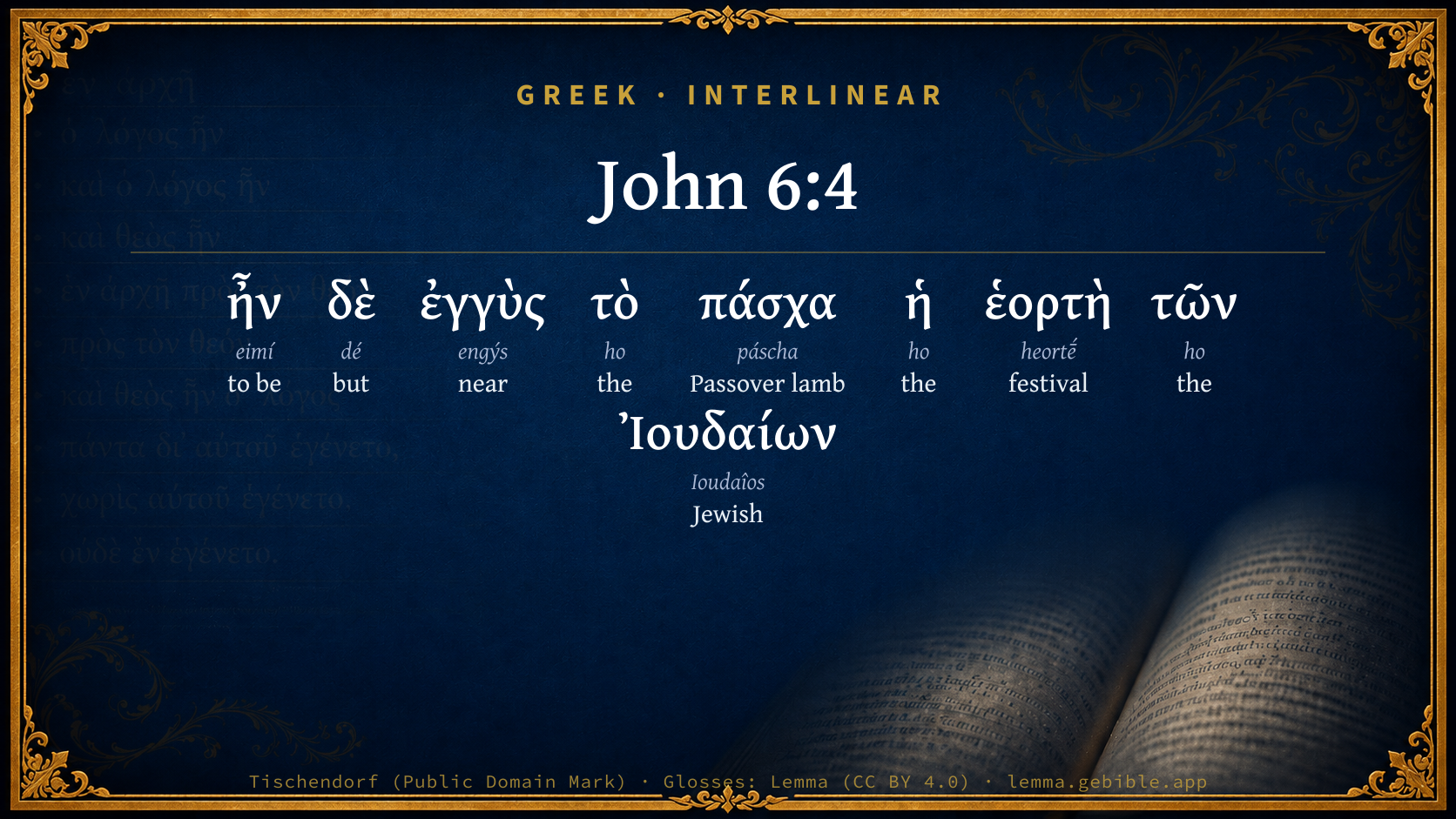
Greek (Tischendorf 8th ed.) John 6:4 appears in the Greek New Testament. The text above is from the Tischendorf 8th edition. Each word links to its Strong’s number and a concise gloss. Click any word for its full Thayer’s Greek Lexicon entry.
Download image
Cite this verse

John 6:4 (World English Bible). Public Domain. Lemma interlinear Bible study tool, https://lemma.gebible.app/v/john/6/4.

Show BibTeX & RIS
BibTeX
RIS
English Translation
Now the Passover, the feast of the Jews, was at hand.
World English Bible · Public Domain
Download a study sheet

One document with this verse’s original text, its word-by-word gloss line, the meaning frame, cross-references with their text, attributed commentary, and full source and license credits — printable, and it pastes into notes with its structure intact.

This verse Autodidact and up

Study sheet (.html) Plain text (.txt)

A passage Seminary Student

Up to 50 verses in one chapter. A passage sheet keeps up to 6 commentary sources and 12 cross-references per verse, in the order this page ranks them, and says so on the sheet whenever that leaves anything out. Ask for a single verse and you get the Autodidact verse sheet above.

Everything on this page stays free to read, with no account — the sheet is a download of what is already on screen, not access to it.

Want to remove ads? Support Godless Engineer
Compare translations 3

The same verse in 3 English versions, stacked beneath the original-language interlinear above. Click any original word for its lexicon entry.

Each is an independent rendering of the whole verse — the interlinear is not word-aligned to these translations.

Highlighted words mark where these versions differ — a whole-verse word diff, not a word-by-word alignment.

  • World English Bible Public Domain
    Now the Passover, the feast of the Jews, was at hand.
  • King James Version Public Domain
    And the passover, a feast of the Jews, was nigh.
  • unfoldingWord Literal Text CC BY-SA 4.0
    (Now the Passover, the festival of the Jews, was near.)

unfoldingWord Literal Text — © unfoldingWord, licensed CC BY-SA 4.0. Word-aligned USFM3 via Door43 (git.door43.org/unfoldingWord/en_ult).

Versions to compare (up to 4)

3 of 4 selected

Show all 19 translations

Every available English version of this verse, each an independent rendering of the whole verse.

  • World English Bible Public Domain
    Now the Passover, the feast of the Jews, was at hand.
  • Berean Standard Bible Public Domain
    Now the Jewish Feast of the Passover was near.
  • Majority Standard Bible Public Domain
    Now the Jewish Feast of the Passover was near.
  • King James Version Public Domain
    And the passover, a feast of the Jews, was nigh.
  • American Standard Version (1901) Public Domain
    Now the passover, the feast of the Jews, was at hand.
  • Revised Version (1885) Public Domain
    Now the passover, the feast of the Jews, was at hand.
  • Geneva Bible (1599) Public Domain
    Now the Passeouer, a feast of the Iewes, was neere.
  • Douay-Rheims (1899) Public Domain
    Now the pasch, the festival day of the Jews, was near at hand.
  • Young's Literal Translation Public Domain
    and the passover was nigh, the feast of the Jews.
  • Literal Standard Version CC BY-SA 4.0
    and the Passover was near, the celebration of the Jews.
  • Unlocked Literal Bible CC BY-SA 4.0
    (Now the Passover, the Jewish festival, was near.)
  • unfoldingWord Literal Text CC BY-SA 4.0
    (Now the Passover, the festival of the Jews, was near.)
  • Darby Bible Public Domain
    but the passover, the feast of the Jews, was near.
  • World Messianic Bible Public Domain
    Now the Passover, the Jewish festival, was at hand.
  • Webster's Bible Public Domain
    And the passover, a feast of the Jews, was nigh.
  • Free Bible Version CC BY-SA 4.0
    The time for the Jewish festival of the Passover was approaching.
  • Bible in Basic English Public Domain
    Now the Passover, a feast of the Jews, was near.
  • Text-Critical English NT CC BY 4.0
    (Now the Jewish feast of the Passover was near.)
  • Tyndale New Testament (1534) Public Domain
    And ester a feast of the Iewes was nye.

Literal Standard Version (2020), Covenant Press — licensed CC BY-SA 4.0. Text via the HelloAO Bible API (eBible.org). Unlocked Literal Bible (unfoldingWord) — licensed CC BY-SA 4.0. Text via the HelloAO Bible API (eBible.org). unfoldingWord Literal Text — © unfoldingWord, licensed CC BY-SA 4.0. Word-aligned USFM3 via Door43 (git.door43.org/unfoldingWord/en_ult). Free Bible Version, Dr. Jonathan Gallagher — licensed CC BY-SA 4.0. Text via the HelloAO Bible API (eBible.org).

Word by word

More ways to search: Search by grammar → Find every occurrence → Compare this word →

Practice this passage: Drill this verse → Learn its vocabulary →

About this verse

These counts appear in no published source. They are computed here, from the morphology-tagged text and Lemma’s own curated glosses. What Lemma adds →

9
words
7
distinct lemmas
Gospels
section

Notable vocabulary

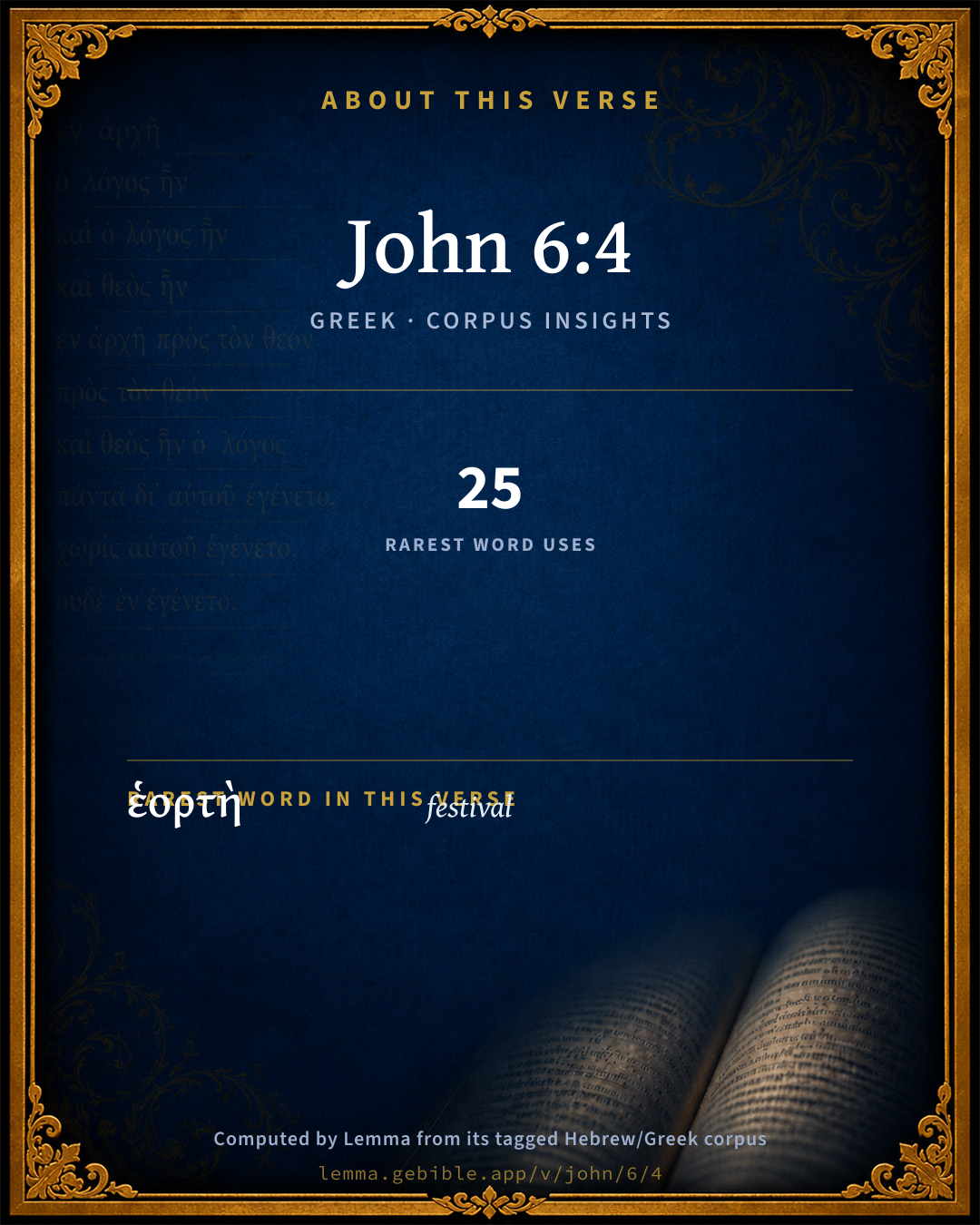
The rarest word here is ἑορτὴ festival G1859 — appearing just 25 times in the whole Greek New Testament.

Shared distinctive vocabulary

ἑορτὴ festival G1859 occurs in 23 verses of the Greek New Testament. Also found in:

Repetition

A word recurs within this verse:

Cross-references

9

Topical passages linked to John 6:4 in the Treasury of Scripture Knowledge — connected by theme and wording, ordered by reader-vote popularity; previews shown in the World English Bible.

  • John 2:13 The Passover of the Jews was at hand, and Jesus went up to Jerusalem.
  • John 11:55 Now the Passover of the Jews was at hand. Many went up from the country to Jerusalem before the Passover, to purify themselves.
  • Deuteronomy 16:1 Observe the month of Abib, and keep the Passover to Yahweh your God; for in the month of Abib Yahweh your God brought you forth out of Egypt by night.
  • John 5:1 After these things, there was a feast of the Jews, and Jesus went up to Jerusalem.
  • Exodus 12:6–14 and you shall keep it until the fourteenth day of the same month; and the whole assembly of the congregation of Israel shall kill it at evening.
  • Leviticus 23:5 In the first month, on the fourteenth day of the month in the evening, is Yahweh's Passover.
  • Leviticus 23:7 In the first day you shall have a holy convocation. You shall do no regular work.
  • John 12:1 Then six days before the Passover, Jesus came to Bethany, where Lazarus was, who had been dead, whom he raised from the dead.
  • John 13:1 Now before the feast of the Passover, Jesus knowing that his time had come that he would depart from this world to the Father, having loved his own who were in the world, he loved them to the end.

Cross-references courtesy of OpenBible.info (CC BY 4.0).

Commentary

Notes on John 6:4 from classic Christian and Jewish commentators (each source and its license shown beneath its notes). The classic Christian expositions comment on the surrounding passage and are grouped to its opening verse, so a note may address several verses; the Jewish commentaries on the Tanakh (Rashi and others) are per-verse, so they appear only where the commentator wrote on this verse.

Lemma curates 59 commentaries, every one of them public domain or Creative Commons licensed, each selected and text-cleaned for this edition rather than reprinted as found. About our sources →

Bengel's Gnomon

Johann Albrecht Bengel

Joh 6:4. Ἐγγύς, nigh) There was a great concourse of men at that time of the year: ch. Joh 11:55, “Many went out of the country up to Jerusalem, before the Passover, to purify themselves.”

Bengel's Gnomon of the New Testament — English translation (T&T Clark, Edinburgh, 1860) — public domain. Text from a community e-Sword module.

Meyer's Critical & Exegetical Commentary

Heinrich August Wilhelm Meyer

Joh_6:4. Ἐγγύς] close at hand. See on Joh_5:1. Paulus wrongly renders it not long since past. See, on the contrary, Joh_2:13, Joh_7:2, Joh_11:55. The statement is intended as introductory to Joh_6:5, explaining how it happened (comp. Joh_11:55) that Jesus, after He had withdrawn to the mountain, was again attended by a great multitude (Joh_6:5),a thing which could not have happened had not the Passover been nigh. It was another crowd (not, as is commonly assumed, that named in Joh_6:2, which had followed Him in His progress towards the lake), composed of pilgrims to the feast, who therefore were going the opposite way, from the neighbourhood of the lake in the direction of Jerusalem. Thus Joh_6:4 is not a mere chronological note (B. Crusius, Maier, Brückner, Ewald), against which the analogy of Joh_7:2 (with the οὖν following, Joh_6:3) is decisive; nor is it, because every more specific hint to that effect is wanting, to be looked upon as referring by anticipation[224] to the following discourse of Jesus concerning eating His flesh and blood as the antitype of the Passover (B. Bauer; comp. Baur, p. 262, Luthardt, Hengstenberg, and already Lampe).

ἡ ἑορτὴ τ. Ἰουδαίων] ΚΑΤ. ἘΞΟΧΉΝ. There is no intimation that Jesus Himself went up to this feast (Lücke). See rather Joh_7:1.

[224] Comp. also Godet: Jesus must have been in the position dun proscrit, and could not go to Jerusalem to the Passover; He therefore saw in the approaching multitudes a sign from the Father, and thought, Et moi aussi, je célébrerai une pâque. This is pure invention.

Meyer — Critical and Exegetical Commentary on the New Testament — English translation by Peter Christie, edited by Frederick Crombie (T&T Clark, 1880) — public domain. Text from a community e-Sword module.

Expositor's Greek Testament

ed. W. Robertson Nicoll

Joh 6:4 . But another crowd was to be accounted for, as Joh 6:4 intimates, ἦν δὲ ἐγγὺς … Ἰουδαίων , “now the Passover, the Jewish feast, was at hand”. [Grotius says: “Hoc ideo interjicit, ut intelligatur tempus fuisse opportunum ad eliciendam multitudinem, et quo melius cohaereat quod de herba sequitur”. Godet’s account of the insertion of this clause, that it was meant to show that the nearness of the Passover suggested to Jesus the idea “we will keep a Passover here,” is plainly out of the question.] ἐπάρας οὖν … Jesus therefore (or better, “accordingly”; οὖν connects what He saw with the foregoing statement).

The Expositor's Greek Testament, edited by W. Robertson Nicoll (1897–1910) — public domain. Text from a community e-Sword module.

International Critical Commentary

4. It has been pointed out2 that, although τὸ πάσχα is read here by all MSS. and vss., yet there are patristic comments on the verse which suggest that some early writers did not treat “the feast” of 6:4 as a Passover, and that therefore the texts before them did not include the words τὸ πάσχα at this point. Thus Irenæus (Hær. II. xxii. 3) is silent as to this Passover, although it would have been apposite to his argument to use it.3 If τὸ πάσχα were omitted here, it would be natural to identify the feast of this verse with the Feast of Tabernacles noted in 7:2. Having regard to the importance of the σκηνοπηγία, it might properly be described as pre-eminently ἡ ἑορτὴ τῶν Ἰουδαίων (see on 7:2). But it would be precarious to omit words so fully attested as τὸ πάσχα,1 and on the hypothesis, which has been adopted in this Commentary, that c. 5 comes after c. 6 (see Introd., p. xviii), all is clear. The Passover mentioned here as “near” is the feast whose celebration is narrated in 5:1; i.e. it was the second Passover of the public ministry of Jesus (that mentioned in 2:13 being the first), and was probably the Passover of the year 28 a.d.

For the phrase “feast of the Jews,” see on 2:13; and cf. 2:6, 19:21, 42.

It has been suggested that this note about the approaching Passover was introduced into the narrative to explain the large concourse of persons who were present on the occasion of the miracle, and who are supposed to have been thronging the roads on the way to Jerusalem for the observance of the feast. But the north-eastern corner of the lake is hardly a point at which we should expect to find thousands of such travellers. Jn. is fond of introducing notes of time into his narrative (see p. cii), and he has similar notes about approaching festivals at 2:13, 7:2, 11:55. ἐγγύς is a favourite word with him, both in relation to time and to distance.

International Critical Commentary — older volumes (1896–1929), various authors — public domain. Text from a community e-Sword module.

Jamieson, Fausset & Brown

Robert Jamieson, A. R. Fausset & David Brown

passover . . . was nigh--but for the reason mentioned (Joh 7:1), Jesus kept away from it, remaining in Galilee.

Jamieson, Fausset & Brown — Commentary Critical and Explanatory on the Whole Bible (1871) — public domain (CC PDM 1.0). Text via the HelloAO Bible API.

Adam Clarke's Commentary

Verse 4. And the passover - was nigh.] This happened about ten or twelve days before the third passover which Christ celebrated after his baptism. Calmet. For a particular account of our Lord's four passovers See Clarke on Joh 2:13.

For thirty days before the Passover there were great preparations made by the Jews, but especially in the last nineteen days, in order to celebrate the feast with due solemnity. Lightfoot supposes that what is here related happened within the last fifteen days. See Calmet's opinion above.

Adam Clarke's Commentary on the Bible (1810–1826) — public domain. Text from a community e-Sword/MySword module.

Ellicott's Commentary for English Readers

(4) A feast.—Better, the feast. Comp. Joh_5:1. This is added by St. John only, and is not simply a note of time, but gives a key of interpretation to the sign itself, and to the discourse which followed.

A Bible Commentary for English Readers, edited by Charles John Ellicott (1878–1897) — public domain. Text from a community e-Sword module.

The Cambridge Bible for Schools and Colleges

gen. ed. J. J. S. Perowne

4. And the Passover] Better, Now the Passover.

a feast of the Jews] Rather, the feast of the Jews. Possibly this near approach of the Passover is given merely as a date to mark the time. As already noticed (see on Joh_2:13), S. John groups his narrative round the Jewish festivals. But the statement may also be made as a further explanation of the multitude. Just before the Passover large bands of pilgrims on their way to Jerusalem would be passing along the east shore of the lake. But we find that the multitude in this case are quite ready (Joh_6:24) to cross over to Capernaum, as if they had no intention of going to Jerusalem; so that this interpretation of the verse is uncertain. Still more doubtful is the theory that this verse gives a key of interpretation to the discourse which follows, the eating of Christ’s flesh and blood being the antitype of the Passover. Of this there is no indication whatever. It is safest to regard the verse as a mere note to time. In any case the addition of ‘the feast of the Jews’ again indicates that the author is writing away from Palestine. From Joh_7:1 it would seem that Jesus did not go up to Jerusalem for this Passover

The Cambridge Bible for Schools and Colleges (gen. ed. J. J. S. Perowne; Cambridge University Press, 1878–1918) — public domain. Text from a community e-Sword module.

John Gill's Exposition

And the passover, a feast of the Jews, was nigh. This was the third passover, since our Lord's baptism, and entrance on his public ministry; see Joh 2:13. Whether Christ went up to this feast is not certain; some think he did not; but from what is said in Joh 7:1, it looks as if he did: how nigh it was to the feast, cannot well be said. Thirty days before the feast, they began to talk about it; and especially in the last fifteen days, they made preparations for it, as being at hand (b); and if there was now so long time to it, there was time enough for Jesus to go to it.

(b) T. Bab. Pesach. fol. 6. 1. Maimon. & Bartenora in Misn. Shekalim, c. 3. sect. 1.

John Gill's Exposition of the Whole Bible (1746–1763) — public domain (CC PDM 1.0). Text via the HelloAO Bible API.

Trapp's Complete Commentary

John Trapp

4 And the passover, a feast of the Jews, was nigh.

Ver. 4. And the passover] The third passover (likely) after his baptism. And this might occasion him to speak of the spiritual eating of himself, the true Paschal Lamb: for even "Christ our passover was sacrificed for us," 1Co 5:7.

John Trapp, A Commentary or Exposition upon All the Books of the Old and New Testament (1647–1656) — public domain. Text from a community e-Sword module.

Albert Barnes' Notes on the Bible

The passover - See the notes at Mat 26:2, Mat 26:17.

A feast of the Jews - This is one of the circumstances of explanation thrown in by John which show that he wrote for those who were unacquainted with Jewish customs.

Albert Barnes' Notes on the Bible (1834–1885) — public domain. Text from a community e-Sword/MySword module.

Haydock's Catholic Bible Commentary

From the circumstances of the passover, the number that followed Jesus was greatly increased. (Bible de Vence)

George Leo Haydock (1774–1849), Haydock's Catholic Family Bible and Commentary, 1859 edition — public domain. Excludes Psalms (Douay-Rheims chapter numbering differs from Protestant) and Deuterocanonical books (Catholic canon only).

Whedon's Commentary on the Bible

Daniel D. Whedon

4. The passover—A caravan on its way to the Passover may have furnished a large part of the concourse. These may have been specially taken with the idea of crowning Jesus as King Messiah, and bearing him in triumph to Jerusalem.

Daniel D. Whedon (gen. ed.), Commentary on the Old and New Testaments (1874–1909) — public domain. Text from a community e-Sword module.

The Pulpit Commentary

Now the Passover, the feast of the Jews, was at hand. The ordinary meaning of egguv need not be departed from. (cf. Joh_2:13 Joh 7:2Jn_1:11:55) This valuable note of time is confirmed by another hint incidentally dropped. A month later than the Passover it could not be said that "much grass" was in the place. In the late spring such a phrase would most inadequately represent the scene that was indelibly impressed on the fourfold tradition. Whatever the unnamed feast was, (Joh_5:1) whether Trumpets, Purim, or Passover, we have reached the month Abib, when the crowds of pilgrims were gathering for their southern journey. If the Purim were the unnamed feast, then the suggestion arises that Christ"s reception at Jerusalem had prevented his remaining until the Passover of that year. If the Passover be meant, (Joh_5:1) then a year has passed between ch. 5 and 6. Nor is this a day too long for the crowd of events and teachings recorded by the synoptists as having taken place before the death of John. The note of time may be recorded as implying the dominant sentiment in the minds of the people. The great deliverance from Egyptian bondage was burned into the national conscience, and the fanatic desire for a second Moses to lead them out of Roman servitude was at such seasons fanned into a flame. The Lord had his own thought about the Paschal lamb, and knew that God was preparing a Lamb for sacrifice. In mystic, parabolic sense he foreknew that men would and must consume the flesh of this sacrifice. He was ready, moreover, to show them that he could supply all their need. The great Prophet who had said of himself, "Behold the Lamb of God, which taketh away the sin of the world!" had just fallen beneath the executioner"s axe. The people were bereft of a great prophet and leader, and to Christ"s eye they were "as sheep without a shepherd." Verily he was preparing to lay down his life as a good Shepherd for these sheep to provide for them in the future a feast of living bread. All this may rationally be admitted, without for a moment conceding that second-century ideas like these were the formative causes of the narrative. The miracle that follows stands on an entirely distinct basis, and is more powerfully attested than any ether miracle, except the resurrection of Christ. If it stood in John"s record alone, there might be some colour for the supposition that we have merely a parable of great beauty. But the threefold tradition long anterior to John"s Gospel deprives even the pseudo-John of the possibility of inventing it. On the other hand, the appearance of the narrative in John"s Gospel deprives it of the mythical character which some have attributed to the authors of the synoptic Gospels. Thoma, in the spirit of Strauss, here imagines that the synoptists were busy in fashioning a miracle of sustenance and a portent upon the waters a sign on land and sea to correspond with the manna and Red Sea marvels of the Book of Exodus. "The mountain" (to orov) is, as he thinks, a similitude of the Mount Sinai, and, as the latter represented the giving of the Law, this was associated with the mountain of Beatitudes. He goes further, and sees in the Johannine narrative the Christian (agapae) feasts, and the deliverance of the Apostle Paul from shipwreck! He is even more ingenious still, and suggests that the "five thousand" fed at the first miraculous meal, with twelve baskets of fragments, correspond with the results of the first preaching of the twelve apostles, and that the seven loaves among the four thousand reflect "the many hundreds who were benefited by the seven evangelists. He endeavours by a most elaborate process to make it appear that John has here combined into one tableau minute traces derived from the five several accounts of the two miracles. The old rationalistic theory was that the miracle was only an exaggerated poetical statement of the fact; that a good example of charity on the part of the apostles was followed by others, and so food was found for the entire multitude. This hypothesis breaks on the rock that the authors of these Gospels intended to convey a perfectly different idea. The effect of such cheap philanthropy and pragmatic travesty of a royal act would not have been that the multitudes would have rushed to the conclusion that he had done a kingly deed, or one in the least way calculated to suggest the notion that he could feed armies at his will. All efforts to extirpate by such theories the supernatural character of the occurrence fail, and force the reader back upon the plain statements of the fourfold narrative.

The Pulpit Commentary (1880–1919), ed. H.D.M. Spence-Jones & Joseph S. Exell — public domain. Text from a community e-Sword module.

unfoldingWord translationNotes

Door43 World Missions Community

General Information:

The action in the story begins in verse 5.

Now the Passover, the Jewish festival, was near

John briefly stops telling about the events in the story in order to give background information about when the events happened. (See: Background Information)

But Jesus said this to test Philip, for he himself knew what he was going to do

John briefly stops telling about the events in the story in order to explain why Jesus asked Philip where to buy bread. (See: Background Information)

for he himself knew

The reflexive pronoun "himself" makes it clear that the word "he" refers to Jesus. Jesus knew what he would do. (See: Reflexive Pronouns)

translationWords

Passover

feast

Jew

Philip, the apostle

bread

unfoldingWord translationNotes — © Distant Shores Media and the Door43 World Missions Community, licensed CC BY-SA 4.0. Source: git.door43.org/Door43/en_tn.

Cambridge Greek Testament for Schools and Colleges

4. ἡ ἑορτὴ τ. Ἰ. The feast of the Jews. Possibly a mere date to mark the time. As already noticed (see on Joh 2:13), S. John groups his narrative round the Jewish festivals. But the statement may also be made as a further explanation of the multitude. Just before the Passover large bands of pilgrims on their way to Jerusalem would be passing along the east shore of the lake. But we find that the multitude in this case are quite ready (Joh 6:24) to cross over to Capernaum, as if they had no intention of going to Jerusalem; so that this interpretation of the verse is uncertain. Equally doubtful is the theory that this verse gives a key of interpretation to the discourse which follows, the eating of Christ’s Flesh and Blood being the antitype of the Passover. From Joh 7:1 it would seem that Jesus did not go up to Jerusalem for this Passover.

Cambridge Greek Testament for Schools and Colleges (Cambridge University Press, 1896; 21 vols, various authors incl. Carr, Maclear, Plummer, Farrar, Lumby, Moule, M. R. James, Simcox) — public domain. Text from a community e-Sword module.

Alford’s Greek Testament

Henry Alford

4.] This will account, not for so great a multitude coming to Him, but perhaps (?) for the circumstance that the people at that time were gathered in multitudes, ready to set out on their journey to Jerusalem. We must remember also that the reference of the following discourse to the Passover being so pointed, the remark would naturally be here inserted by the Evangelist: but I would not, with Luthardt (i. 80; ii. 41) insist on this as the only reason for his making it.

Henry Alford, The Greek Testament (1849–1861) — public domain. Text from a community e-Sword module.

Vincent's Word Studies in the New Testament

Marvin R. Vincent

A feast [η εορτη] . With the definite article, the feast; pointing to something well known.

Marvin R. Vincent, Word Studies in the New Testament (1887–1900) — public domain. Text from a community e-Sword/MySword module.

Lesson kit

Teaching starters — assembled from the data on this page, not authored interpretation. Every prompt links to the verse data it draws on. Edit before teaching.

John, in the Gospels, opens this verse with 9 words (7 distinct Greek lemmas). Its most distinctive word is heortḗ (“festival”). A historical commentator’s framing appears above. Read the whole chapter for the surrounding context.

Discussion questions

  1. What does “festival” (heortḗ) contribute to the verse as a whole?
  2. How does Matthew 26:5, which shares the word «festival», read alongside this verse?
  3. What does the repetition of “the” (3× in this one verse) do in this verse?
  4. The translations on this page render this verse differently — a whole-verse word diff, not a word-by-word alignment. What might account for the different wordings?
  5. Compare how Bengel's Gnomon and Meyer's Critical & Exegetical Commentary read this verse. Where do they agree or differ?

Things to notice

  • These translations choose different wording for 6 words in this verse.
  • “the” occurs 3× in this single verse.
  • 7 distinct Greek lemmas span 9 words in this verse.

Reading settings

Reading text

Shown beneath each verse's original-language words.

Old Testament
Old Testament edition

Read the OT as the Masoretic Hebrew (MT) or the Greek Septuagint (LXX).

English shown for the Greek Septuagint (in the Hebrew ↔ Greek comparison).

Comparing translations? Open the Compare panel on any verse page to stack up to four side by side.