
Genesis 2:12

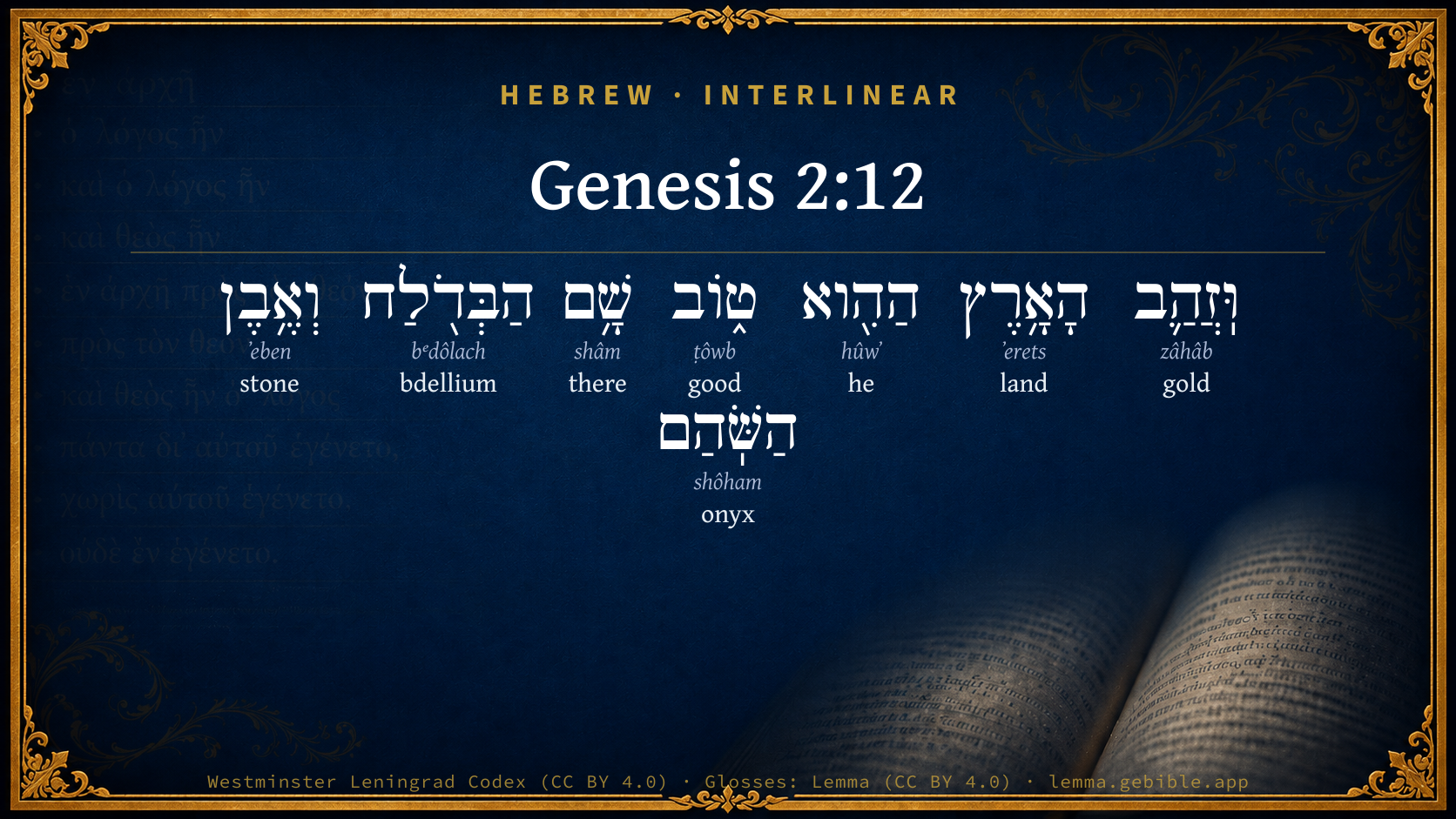
Hebrew (Westminster Leningrad Codex) Genesis 2:12 appears in the Hebrew Old Testament. The text above is from the Westminster Leningrad Codex. Each word links to its Strong’s number, a concise gloss, and parsing drawn from the Open Scriptures Hebrew Bible morphology. Click any word for its full Brown-Driver-Briggs (BDB) entry.
Download image
Cite this verse

Genesis 2:12 (World English Bible). Public Domain. Lemma interlinear Bible study tool, https://lemma.gebible.app/v/genesis/2/12.

Show BibTeX & RIS
BibTeX
RIS
English Translation
and the gold of that land is good. There is aromatic resin and the onyx stone.
World English Bible · Public Domain
Highlights
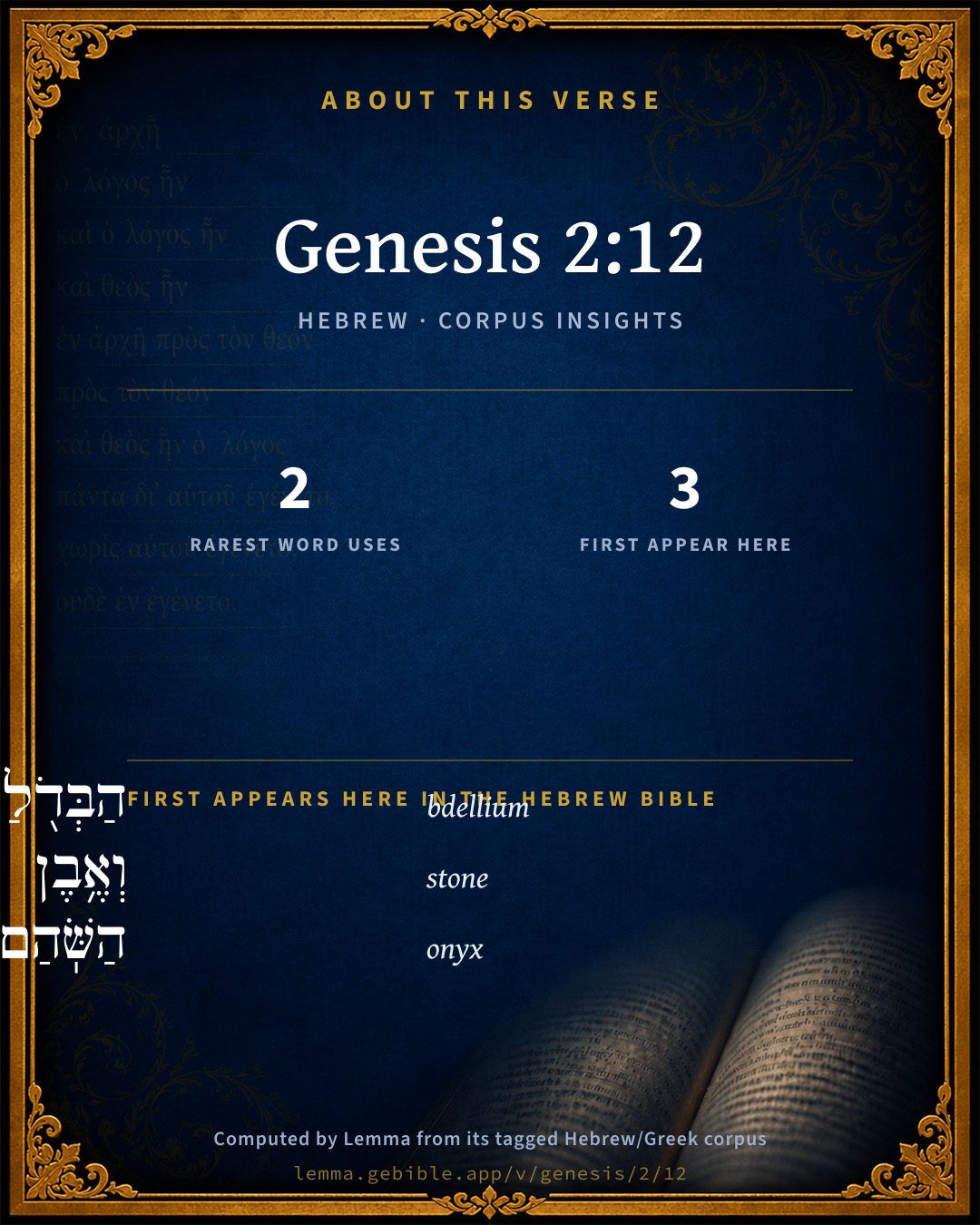
  • 3 first appearances in the Hebrew Bible
Full analysis ↓
Download a study sheet

One document with this verse’s original text, its word-by-word gloss line, the meaning frame, cross-references with their text, attributed commentary, and full source and license credits — printable, and it pastes into notes with its structure intact.

This verse Autodidact and up

Study sheet (.html) Plain text (.txt)

A passage Seminary Student

Up to 50 verses in one chapter. A passage sheet keeps up to 6 commentary sources and 12 cross-references per verse, in the order this page ranks them, and says so on the sheet whenever that leaves anything out. Ask for a single verse and you get the Autodidact verse sheet above.

Everything on this page stays free to read, with no account — the sheet is a download of what is already on screen, not access to it.

Want to remove ads? Support Godless Engineer
Compare translations 3

The same verse in 3 English versions, stacked beneath the original-language interlinear above. Click any original word for its lexicon entry.

Each is an independent rendering of the whole verse — the interlinear is not word-aligned to these translations.

Highlighted words mark where these versions differ — a whole-verse word diff, not a word-by-word alignment.

  • World English Bible Public Domain
    and the gold of that land is good. There is aromatic resin and the onyx stone.
  • King James Version Public Domain
    And the gold of that land is good: there is bdellium and the onyx stone.
  • unfoldingWord Literal Text CC BY-SA 4.0
    And the gold of that land good. Bdellium and onyx stone there.

unfoldingWord Literal Text — © unfoldingWord, licensed CC BY-SA 4.0. Word-aligned USFM3 via Door43 (git.door43.org/unfoldingWord/en_ult).

Versions to compare (up to 4)

3 of 4 selected

Show all 18 translations

Every available English version of this verse, each an independent rendering of the whole verse.

  • World English Bible Public Domain
    and the gold of that land is good. There is aromatic resin and the onyx stone.
  • Berean Standard Bible Public Domain
    And the gold of that land is pure, and bdellium and onyx are found there.
  • Majority Standard Bible Public Domain
    And the gold of that land is pure, and bdellium and onyx are found there.
  • King James Version Public Domain
    And the gold of that land is good: there is bdellium and the onyx stone.
  • American Standard Version (1901) Public Domain
    and the gold of that land is good: there is bdellium and the onyx stone.
  • Revised Version (1885) Public Domain
    and the gold of that land is good: there is bdellium and the onyx stone.
  • Geneva Bible (1599) Public Domain
    And the golde of that land is good: there is Bdelium, and the Onix stone.
  • Douay-Rheims (1899) Public Domain
    And the gold of that land is very good: there is found bdellium, and the onyx stone.
  • Young's Literal Translation Public Domain
    and the gold of that land `is' good, there `is' the bdolach and the shoham stone;
  • Literal Standard Version CC BY-SA 4.0
    and the gold of that land [is] good; the bdellium and the shoham stone [are] there;
  • Unlocked Literal Bible CC BY-SA 4.0
    The gold of that land is good. There are also bdellium and the onyx stone.
  • unfoldingWord Literal Text CC BY-SA 4.0
    And the gold of that land good. Bdellium and onyx stone there.
  • Darby Bible Public Domain
    And the gold of that land is good; bdellium and the onyx stone are there.
  • World Messianic Bible Public Domain
    and the gold of that land is good. Bdellium and onyx stone are also there.
  • Webster's Bible Public Domain
    And the gold of that land is good: there is bdellium and the onyx-stone.
  • Free Bible Version CC BY-SA 4.0
    (The gold from that land is pure. Bdellium and onyx stone are also found there.)
  • Bible in Basic English Public Domain
    And the gold of that land is good: there is bdellium and the onyx stone.
  • JPS Tanakh (1917) Public Domain
    and the gold of that land is good; there is bdellium and the onyx stone.

Literal Standard Version (2020), Covenant Press — licensed CC BY-SA 4.0. Text via the HelloAO Bible API (eBible.org). Unlocked Literal Bible (unfoldingWord) — licensed CC BY-SA 4.0. Text via the HelloAO Bible API (eBible.org). unfoldingWord Literal Text — © unfoldingWord, licensed CC BY-SA 4.0. Word-aligned USFM3 via Door43 (git.door43.org/unfoldingWord/en_ult). Free Bible Version, Dr. Jonathan Gallagher — licensed CC BY-SA 4.0. Text via the HelloAO Bible API (eBible.org).

Word by word

More ways to search: Search by grammar → Find every occurrence → Compare this word →

Practice this passage: Drill this verse → Learn its vocabulary →

About this verse

These counts appear in no published source. They are computed here, from the morphology-tagged text and Lemma’s own curated glosses. What Lemma adds →

8
words
8
distinct lemmas
Pentateuch
section

Notable vocabulary

The rarest word here is הַבְּדֹ֖לַח bdellium H916 — appearing just 2 times in the whole Hebrew Bible.

First appearance in Scripture

These words make their first canonical appearance in the Hebrew Bible here:

  • הַבְּדֹ֖לַח bdellium H916
  • וְאֶ֥בֶן stone H68
  • הַשֹּֽׁהַם onyx H7718

Shared distinctive vocabulary

הַבְּדֹ֖לַח bdellium H916 occurs in 2 verses of the Hebrew Bible. Also found in:

Grammatical profile

  • 5 nouns
  • 1 adjective
  • 1 pronoun
  • 1 adverb

Hebrew & Septuagint length

In English translation the verse runs 16 words from the Hebrew and 14 from the Septuagint (LXX English) — closely comparable.

A rough comparison of the two English renderings, which tokenize alike — not a word-level alignment.

Word counts can differ between the Hebrew and the Greek without any difference in meaning — e.g. the Hebrew direct-object marker אֵת has no separate Greek word, and Greek often adds the article ὁ.

Cross-references

5

Topical passages linked to Genesis 2:12 in the Treasury of Scripture Knowledge — connected by theme and wording, ordered by reader-vote popularity; previews shown in the World English Bible.

  • Ezekiel 28:13 You were in Eden, the garden of God; every precious stone adorned you: ruby, topaz, emerald, chrysolite, onx, jasper, sapphire, turquoise, and beryl. Gold work of tambourines and of pipes was in you. In the day that you were created they were prepared.
  • Exodus 28:20 and the fourth row a chrysolite, an onyx, and a jasper: they shall be enclosed in gold in their settings.
  • Job 28:16 It can't be valued with the gold of Ophir, With the precious onyx, or the sapphire.
  • Exodus 39:13 and the fourth row, a chrysolite, an onyx, and a jasper. They were enclosed in gold settings.
  • Numbers 11:7 The manna was like coriander seed, and the appearance of it as the appearance of bdellium.

Cross-references courtesy of OpenBible.info (CC BY 4.0).

Hebrew and Greek witnesses Masoretic Hebrew ↔ Greek Septuagint

The same verse in the two great witnesses to the Old Testament, shown verse-for-verse.

These are two independent witnesses, not word-aligned to each other, and the Septuagint is shown in lemma (dictionary) form.

Hebrew Genesis 2:12 Masoretic · Westminster Leningrad Codex

וּֽזֲהַ֛ב הָאָ֥רֶץ הַהִ֖וא ט֑וֹב שָׁ֥ם הַבְּדֹ֖לַח וְאֶ֥בֶן הַשֹּֽׁהַם

and the gold of that land is good. There is aromatic resin and the onyx stone.

World English Bible · Public Domain

Greek LXX Genesis 2:12 Septuagint · lemma form

ὁ δέ χρυσίον ὁ γῆ ἐκεῖνος καλός καί ἐκεῖ εἰμί ὁ ἄνθραξ καί ὁ λίθος ὁ πράσινος

And the gold of that land is good, there also is carbuncle and emerald.

LXX2012 (modern English Septuagint) · Public Domain

On this verse, The Cambridge Bible for Schools and Colleges discusses the Septuagint’s reading. Read the note in Commentary ↓

Hebrew: Westminster Leningrad Codex (CC BY 4.0). Greek: Septuagint (public domain); English from LXX2012 (modern English Septuagint) (Public Domain). How the Septuagint differs from the Hebrew →

Targum (Aramaic paraphrase)

2

The Targum is the ancient Jewish Aramaic paraphrase of the Hebrew Scriptures — an interpretive translation, not the Hebrew text itself. Onkelos (literal) and Pseudo-Jonathan (expansive) render the Torah, and Jonathan the Prophets. Coverage is partial: where no permissively-licensed English translation exists for a verse, only the Aramaic is shown. This is verse-level text, not a word-by-word alignment to the Hebrew.

  1. Targum Onkelos Torah (Genesis–Deuteronomy)
    וְדַהֲבָא דְאַרְעָא הַהִיא טָב תַּמָן בְּדָלְחָא וְאַבְנֵי בוּרְלָא

    (no public-domain English translation for this verse)

    Targum Onkelos — Aramaic: “Onkelos Genesis” (public domain); “Onkelos Exodus” (public domain); “Onkelos Leviticus” (public domain); “Onkelos Numbers” (public domain); “Onkelos Deuteronomy” (public domain). English: “Sefaria Community Translation” (CC0 1.0 (public-domain dedication)); “J.W. Etheridge. The Targums of Onkelos and Jonathan Ben Uzziel on the Pentateuch. London: Longmans, Green, 1862” (public domain). Text via Sefaria.

  2. Targum Pseudo-Jonathan Torah (Genesis–Deuteronomy)
    וְדַהֲבָא דְאַרְעָא הַהוּא בָּחִיר תַּמָן בִּידִילְחָא וְאַבְנִין טָבִין דְבוּרְלִין

    And the gold of that land is choice. There is the bedilcha, and the precious stones of byrils.

    Targum Pseudo-Jonathan — Aramaic: “Targum Jonathan on Genesis” (public domain); “Targum Jonathan on Exodus” (public domain); “Targum Jonathan on Leviticus” (public domain); “Targum Jonathan on Numbers” (public domain); “Targum Jonathan on Deuteronomy” (public domain). English: “The Targum of Jonathan ben Uzziel, trans. J. W. Etheridge, London, 1862” (public domain). Text via Sefaria.

Commentary

Notes on Genesis 2:12 from classic Christian and Jewish commentators (each source and its license shown beneath its notes). The classic Christian expositions comment on the surrounding passage and are grouped to its opening verse, so a note may address several verses; the Jewish commentaries on the Tanakh (Rashi and others) are per-verse, so they appear only where the commentator wrote on this verse.

Lemma curates 59 commentaries, every one of them public domain or Creative Commons licensed, each selected and text-cleaned for this edition rather than reprinted as found. About our sources →

Trapp's Complete Commentary

John Trapp

Gen 2:12 And the gold of that land [is] good: there [is] bdellium and the onyx stone.

Ver. 12. And the gold of that land is good.] But pale, because it feareth, saith one, wittily, those many that lie in wait for it. {Sed melius est pallens aurum, quam fulgens aurichalcum.} {a} The common cry is, "Who will show us any good?" {Psa 4:6} That will I, saith God to Moses, when he gave him a glimpse of his glory. {Exo 33:19} and I will "show thee, O man, what is good," &c. {Ostendam tibi omne bonum} {Mic 6:8-9} As for gold, how good soever in itself, it is to men but an imaginary good at best: for it is opinion which setteth the price upon it: brass or leather, {forma publica percussum} saith Seneca, that is, stamped for coin, may pass as well as gold; it did so some time in the Roman provinces; and here in England also, in the time of the barons’ wars. Yea, gold oft proves to the possessors a real evil. {Pro 1:19-20} It doth always so, when it gets within them, {b} as it did within the covetous Pharisees, so that they "said to the fine gold, Thou art my confidence". {as Job 31:24} Pindar saith, it was an opinion of the people concerning Rhodes, that Jupiter rained down gold upon that city, so rich it was; yet is it now in slavery to the Turk. America is said to have as much gold ore as other earth: yet are the Americans bound by the proud Spaniard to be both popish and poor upon pain of death. Susiana, the country here called Havilah, the gold whereof is so good, had its name from Shushan or Susa, the palace of the kings of Persia, the stones whereof were joined together with gold, saith Cassiodorus: yet is it now called, in the Persian tongue, Valdac, from the poverty of the place. "Trust not," therefore, "in uncertain riches, but in the living God, who giveth us richly all things to enjoy". {1Ti 6:17}

And the onyx-stone.] Precious stones are but earth blemished and impure. {terra maculae et immunditiae.}

{a} Bernard.

{b} τα ενοντα

John Trapp, A Commentary or Exposition upon All the Books of the Old and New Testament (1647–1656) — public domain. Text from a community e-Sword module.

Tyndale Open Study Notes

Tyndale Open Resources

2:12 The magnificence and fertility of the garden are pictured as spreading to the surrounding regions through the rivers flowing out from it. The four rivers possibly imply that the garden’s bounty flowed out to the four corners of the earth. • Gold and onyx were later used for decorating the Tabernacle, the Temple (Exod 25:3-9; 1 Chr 29:2), and the priests’ clothing (Exod 28:9-14, 20). • Resin was used in sacred incense (Exod 30:34).

Tyndale Open Study Notes — © Tyndale Open Resources, licensed CC BY-SA 4.0. Text via the HelloAO Bible API.

Geneva Bible (1599)

Geneva Bible translators

Or, precious stone, or pearl. Pliny saith it is the name of a tree.

Geneva Bible (1599) marginal notes — public domain. Text via Bolls.life.

Adam Clarke's Commentary

Verse 12. There is bdellium (בדלח bedolach) and the onyx stone, אבן השהם eben hashshoham.] Bochart thinks that the bedolach or bdellium means the pearl-oyster; and shoham is generally understood to mean the onyx, or species of agate, a precious stone which has its name from ονυξ a man's nail, to the colour of which it nearly approaches. It is impossible to say what is the precise meaning of the original words; and at this distance of time and place it is of little consequence.

Adam Clarke's Commentary on the Bible (1810–1826) — public domain. Text from a community e-Sword/MySword module.

The Cambridge Bible for Schools and Colleges

gen. ed. J. J. S. Perowne

12. bdellium] LXX ἄνθραξ: Lat. bdellium. In Num_11:7, “manna” is compared with “bdellium”; where the LXX gives κρύσταλλος. Possibly it may be identified with an aromatic transparent resin, obtained from balsam (balsamodendron mukul), and found in Arabia as well as in India, Bactria and Africa. The Hebrew name b’dôlaḥ is probably a foreign word. Another rendering, “pearls” (which are abundantly found in the Persian Gulf), would be more poetical, and possibly more appropriate for comparison, with “manna”; but we can only conjecture.

the onyx stone] or beryl. Hebrew Shoham mentioned elsewhere, Exo_25:7, Job_28:16. A precious stone is clearly intended; possibly = “carbuncle.” Assyriologists have identified it with an Assyrian word Samdu; but what Samdu was, is not known. Sayce conjectures “turquoise”; Haupt “pearl.”

The Cambridge Bible for Schools and Colleges (gen. ed. J. J. S. Perowne; Cambridge University Press, 1878–1918) — public domain. Text from a community e-Sword module.

John Gill's Exposition

And the gold of that land is good,.... Arabia was famous for gold: Diodorus Siculus (x) speaks of gold in Arabia, called "apyrus", which is not melted by fire out of small filings, as other; but as soon as dug is said to be pure gold, and that in the size of chestnuts, and of such a flaming colour, that the most precious stones are set in it by artificers for ornament: and in Colchis and Scythia, as Strabo (y) relates, there are rivers which produce gold; and from whence came the fable of the golden fleece, the Argonauts went to Colchis for:

there is the bdellium, and the onyx stone; the first of these is either an aromatic gum; the tree, according to Pliny (z), is black, and is of the size of an olive tree, has the leaf of an oak, and its fruit is like capers; it is found in Arabia, India, Media, and Babylon; but the best, according to him, is in Bactriana, and, next to that, the bdellium of Arabia: or else it is a precious stone, and which the Jewish writers (a) commonly take to be crystal; and, according to Solinus (b), the best crystal is in Scythia. Bochart (c) would have it that the pearl is meant, because of its whiteness and roundness, for which the manna is compared to it, Num 11:7 and the rather because of the pearl fishery at Catipha, taking Havilah to be that part of Arabia which lies upon the Persian gulf. The latter, the onyx, is a precious stone, which has its name from its being of the colour of a man's nail; and, according to Pliny (d), the onyx marble is found in the mountains of Arabia, and the ancients thought it was nowhere else; and he speaks elsewhere of the Arabian onyx precious stone, and of the sardonyx, as in the same country (e); and some think that is here meant; though the word is sometimes by the Septuagint rendered the emerald; and the best of these, according to Solinus (f) and Pliny (g), were in Scythia. (After the global destruction of Noah's flood, it is doubtful that the location of these places could be determined with degree of certainty today. Ed.)

(x) Bibliothec. l. 2. p. 133. (y) Geograph. l. 1. p. 31. & l. 11. p. 344. (z) Nat. Hist. l. 12. c. 9. (a) Jarchi in Numb. xi. 7. David de Pomis Tzemach David, fol. 8. 3. (b) Polyhistor. c. 25. (c) Hierozoic. par. 2. l. 5. c. 5. p. 675, &c. (d) Nat. Hist. l. 36. c. 7. (e) lb. l. 37. c. 6. (f) Polyhistor. ut supra. (c. 25) (g) Ut supra, (Nat. Hist. l. 36.) c. 5.

John Gill's Exposition of the Whole Bible (1746–1763) — public domain (CC PDM 1.0). Text via the HelloAO Bible API.

Matthew Poole's English Annotations

Good, i.e. better than ordinary.

Bdellium, which signifies either a precious gum, of which see Num 11:7, or gems and pearls. Once for all observe, that many of the Hebrew words or names of stones, trees, birds, and beasts, are even to the Hebrew doctors and others, both ancient and modern interpreters, of uncertain signification, and that without any considerable inconvenience to us, who are free from the obligations which the Jews were formerly under of procuring such stones, and abstaining in their diet from such beasts and birds as then were sufficiently known to them; and if any were doubtful, they had one safe course, to abstain from them.

The onyx stone, a kind of precious stone, of which see Exo 25:7; 28:9,20.

Matthew Poole's English Annotations on the Holy Bible (1683–1685) — public domain. Text from a community e-Sword/MySword module.

Whedon's Commentary on the Bible

Daniel D. Whedon

12. Bdellium — The word הבדלח occurs only here and in Num_11:7. The Septuagint renders it by ανθραξ in this passage, and by κρυσταλλος in Numbers. Gesenius, following Bochart and the rabbins, takes the word collectively in the sense of pearls. The English version, bdellium, follows Josephus, the Vulgate, and the Greek versions of Aquila, Theodotion, and Symmachus, and is as probably correct as any. Bdellium is a transparent, waxlike resin, now found on the trunks of trees in India.

Onyx stone — Some render beryl; others, sardonyx. Some precious stone is meant, but it is impossible to determine its identity.

Daniel D. Whedon (gen. ed.), Commentary on the Old and New Testaments (1874–1909) — public domain. Text from a community e-Sword module.

Radak

Rabbi David Kimhi (Radak)

והבדולח, Rabbi Saadyah gaon, as well as Ibn Ezra say that it is a small spherical white gemstone. This is supported by the reference to כעין הבדולח in Numbers 11,7 where the Torah describes the appearance of the manna. The same scholars believe that this stone is formed by what were originally small drops of dew which had descended on that river. This is the reason why this “stone” is round, just as a drop of dew. Seeing that each individual such stone is so small that it is useless as an effective tool in commerce and industry, this is the reason why the word אבן is not mentioned in connection with בדולח, as opposed to the שהם gemstone which is specifically described as a “stone.” The latter is a large stone, and many different kinds of vessels are made out of its material. Due to its cost, these vessels are found only in the homes of kings and wealthy individuals. The shoham stones on the epaulets of the High Priest had the names of the twelve tribes etched into them. (Exodus 28,9) This gemstone was chosen in preference to others as it is more precious than most, and is found in an almost pure form, not containing any flaws due to discolouration. This river flows in an easterly direction and does not continue through the ארץ חוילה, but flows around it and then enters the sea on its eastern shores. The reason most people called this river Pishon is because its waters help seeds irrigated by them to expand and produce substantial crops. Etymologically, the word פישון, is a derivative of the word פוש found in Jeremiah 50,11 כי תפושו כעגלה דשה, “when you stamped like a heifer treading grain.” Onkelos renders the word פרו, “be fruitful” as פושו in Genesis 1,28.

Radak on the Tanakh — English translations: “Sefaria Community Translation” (CC0 1.0 (public-domain dedication)); “Eliyahu Munk, HaChut Hameshulash” (CC BY 4.0); “Rabbi Mike Feuer, Jerusalem Anthology” (CC BY 4.0); and “R. David Kimhi on the first book of Psalms, Translated by R.G. Finch, London, 1919” (public domain). Text via Sefaria.

Lesson kit

Teaching starters — assembled from the data on this page, not authored interpretation. Every prompt links to the verse data it draws on. Edit before teaching.

Genesis, in the Pentateuch, opens this verse with 8 words (8 distinct Hebrew lemmas). Its most distinctive word is bᵉdôlach (“bdellium”). A historical commentator’s framing appears above. Read the whole chapter for the surrounding context.

Discussion questions

  1. How does “bdellium” (bᵉdôlach) shape what this verse is saying?
  2. 3 words make their first appearance in Scripture here. What does this debut establish?
  3. How does Numbers 11:7, which shares the word «bdellium», read alongside this verse?
  4. The translations on this page render this verse differently — a whole-verse word diff, not a word-by-word alignment. What might account for the different wordings?
  5. Compare how Trapp's Complete Commentary and Tyndale Open Study Notes read this verse. Where do they agree or differ?

Things to notice

  • 3 words make their first canonical appearance in Scripture here.
  • These translations choose different wording for 3 words in this verse.
  • 8 distinct Hebrew lemmas span 8 words in this verse.

Reading settings

Reading text

Shown beneath each verse's original-language words.

Old Testament
Old Testament edition

Read the OT as the Masoretic Hebrew (MT) or the Greek Septuagint (LXX).

English shown for the Greek Septuagint (in the Hebrew ↔ Greek comparison).

Comparing translations? Open the Compare panel on any verse page to stack up to four side by side.