John 7:53

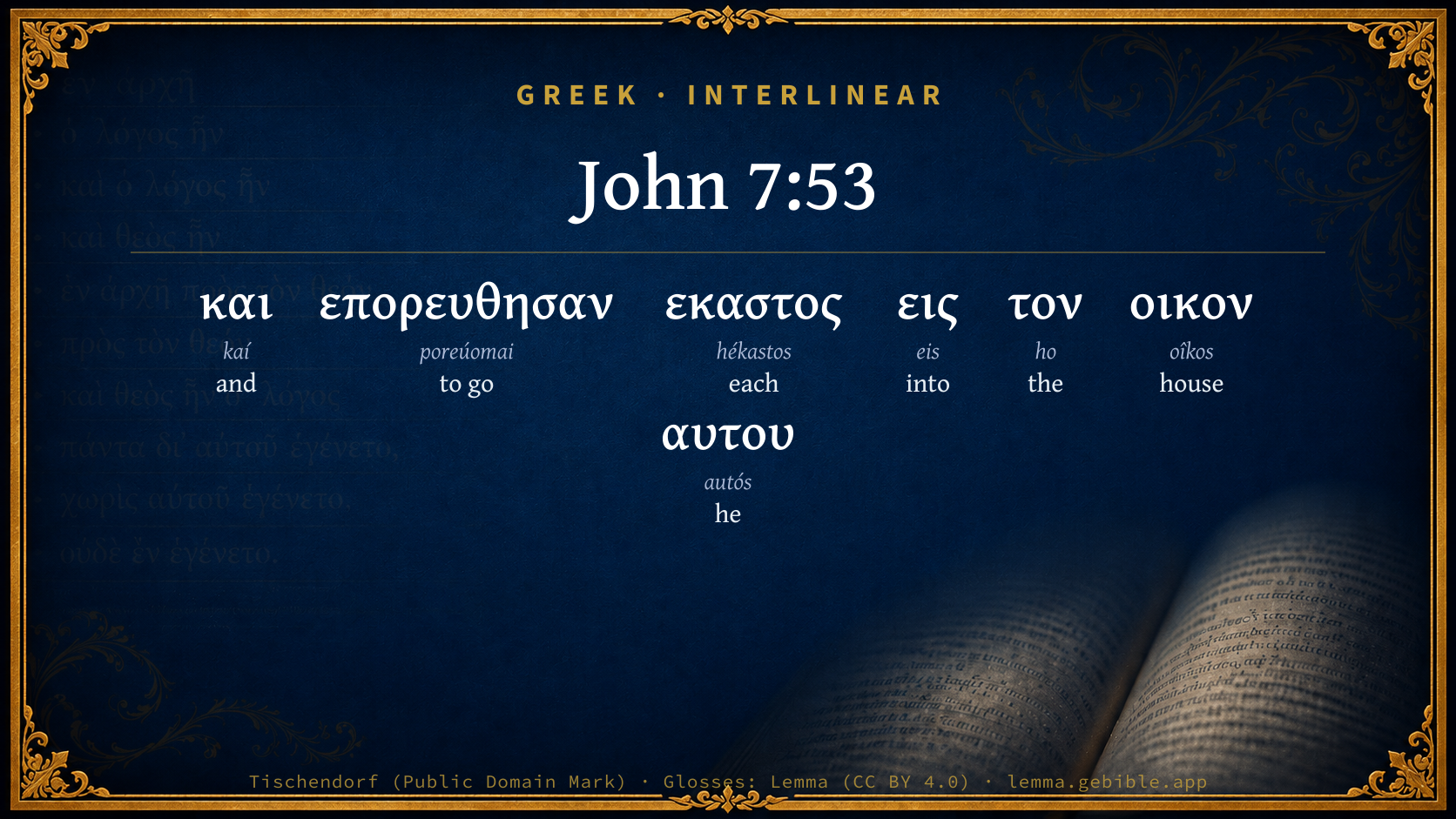
Greek (Tischendorf 8th ed.) John 7:53 appears in the Greek New Testament. The text above is from the Tischendorf 8th edition. Each word links to its Strong’s number and a concise gloss. Click any word for its full Thayer’s Greek Lexicon entry.
Download image
Cite this verse

John 7:53 (World English Bible). Public Domain. Lemma interlinear Bible study tool, https://lemma.gebible.app/v/john/7/53.

Show BibTeX & RIS
BibTeX
RIS
English Translation
Everyone went to his own house,
World English Bible · Public Domain
Download a study sheet

One document with this verse’s original text, its word-by-word gloss line, the meaning frame, cross-references with their text, attributed commentary, and full source and license credits — printable, and it pastes into notes with its structure intact.

This verse Autodidact and up

Study sheet (.html) Plain text (.txt)

A passage Seminary Student

Up to 50 verses in one chapter. A passage sheet keeps up to 6 commentary sources and 12 cross-references per verse, in the order this page ranks them, and says so on the sheet whenever that leaves anything out. Ask for a single verse and you get the Autodidact verse sheet above.

Everything on this page stays free to read, with no account — the sheet is a download of what is already on screen, not access to it.

Want to remove ads? Support Godless Engineer
Compare translations 3

The same verse in 3 English versions, stacked beneath the original-language interlinear above. Click any original word for its lexicon entry.

Each is an independent rendering of the whole verse — the interlinear is not word-aligned to these translations.

Highlighted words mark where these versions differ — a whole-verse word diff, not a word-by-word alignment.

  • World English Bible Public Domain
    Everyone went to his own house,
  • King James Version Public Domain
    And every man went unto his own house.
  • unfoldingWord Literal Text CC BY-SA 4.0
    [Then each went to his house.

unfoldingWord Literal Text — © unfoldingWord, licensed CC BY-SA 4.0. Word-aligned USFM3 via Door43 (git.door43.org/unfoldingWord/en_ult).

Versions to compare (up to 4)

3 of 4 selected

Show all 19 translations

Every available English version of this verse, each an independent rendering of the whole verse.

  • World English Bible Public Domain
    Everyone went to his own house,
  • Berean Standard Bible Public Domain
    Then each went to his own home.
  • Majority Standard Bible Public Domain
    Then each went to his own home.
  • King James Version Public Domain
    And every man went unto his own house.
  • American Standard Version (1901) Public Domain
    And they went every man unto his own house:
  • Revised Version (1885) Public Domain
    [And they went every man unto his own house:
  • Geneva Bible (1599) Public Domain
    And euery man wet vnto his owne house.
  • Douay-Rheims (1899) Public Domain
    And every man returned to his own house.
  • Young's Literal Translation Public Domain
    and each one went on to his house, but Jesus went on to the mount of the Olives.
  • Literal Standard Version CC BY-SA 4.0
    and each one went on to his house, but Jesus went on to the Mount of Olives.
  • Unlocked Literal Bible CC BY-SA 4.0
    [Then everyone went to his own house.
  • unfoldingWord Literal Text CC BY-SA 4.0
    [Then each went to his house.
  • Darby Bible Public Domain
    And every one went to his home.
  • World Messianic Bible Public Domain
    Everyone went to his own house,
  • Webster's Bible Public Domain
    And every man went to his own house.
  • Free Bible Version CC BY-SA 4.0
    Then they all went home,
  • Bible in Basic English Public Domain
    [And every man went to his house;
  • Text-Critical English NT CC BY 4.0
    And each went to his own house.
  • Tyndale New Testament (1534) Public Domain
    And every man went vnto his awne housse.

Literal Standard Version (2020), Covenant Press — licensed CC BY-SA 4.0. Text via the HelloAO Bible API (eBible.org). Unlocked Literal Bible (unfoldingWord) — licensed CC BY-SA 4.0. Text via the HelloAO Bible API (eBible.org). unfoldingWord Literal Text — © unfoldingWord, licensed CC BY-SA 4.0. Word-aligned USFM3 via Door43 (git.door43.org/unfoldingWord/en_ult). Free Bible Version, Dr. Jonathan Gallagher — licensed CC BY-SA 4.0. Text via the HelloAO Bible API (eBible.org).

Cross-references

4

Topical passages linked to John 7:53 in the Treasury of Scripture Knowledge — connected by theme and wording, ordered by reader-vote popularity; previews shown in the World English Bible.

  • Psalms 33:10 Yahweh brings the counsel of the nations to nothing. He makes the thoughts of the peoples to be of no effect.
  • Job 5:12–13 He frustrates the devices of the crafty, So that their hands can't perform their enterprise.
  • Psalms 76:5 Valiant men lie plundered, They have slept their last sleep. None of the men of war can lift their hands.
  • Psalms 76:10 Surely the wrath of man praises you. The survivors of your wrath are restrained.

Cross-references courtesy of OpenBible.info (CC BY 4.0).

Commentary

Notes on John 7:53 from classic Christian and Jewish commentators (each source and its license shown beneath its notes). The classic Christian expositions comment on the surrounding passage and are grouped to its opening verse, so a note may address several verses; the Jewish commentaries on the Tanakh (Rashi and others) are per-verse, so they appear only where the commentator wrote on this verse.

Lemma curates 59 commentaries, every one of them public domain or Creative Commons licensed, each selected and text-cleaned for this edition rather than reprinted as found. About our sources →

Adam Clarke's Commentary

Verse 53. And every man went, c.] The authority and influence of Nicodemus, in this case, was so great that the Sanhedrin broke up without being able to conclude any thing. As the feast was now ended, they were not obliged to continue any longer in or about Jerusalem and therefore all returned to their respective dwellings.

This verse and the first eleven verses of the following chapter are wanting in several MSS. Some of those which retain the paragraph mark it with obelisks, as a proof of spuriousness. Those which do retain it have it with such a variety of reading as is no where else found in the sacred writings. Professor Griesbach leaves the whole paragraph in the text with notes of doubtfulness. Most of the modern critics consider it as resting on no solid authority.

The following in the left-hand column, is a literal translation of the whole as it stands in the Codex Bezae. That on the right is a connected view of it from other manuscripts.

John 7:53; John 8:1-11.

td{vertical-align:top}From the Codex Bezae. From other MSS.

Joh 7:53. And every one went to his own house. 53. And every one went away to his own people. (ταιδιααυτου) Al. place.

Joh 8:1. And Jesus went to the mount of Olives. 1. And Jesus went out to the mount of Olives.

2. But he came again early into-the temple, and all the people came unto him. 2. But very early in the morning Jesus came again into the temple, and all the people came; and having sat down he taught them.

3. And the scribes and Pharisees brought a woman unto him, taken in sin; and, setting her in the midst, 3. And the chief priests and the Pharisees bring unto him a woman taken in adultery; and, having set her in the midst,

4. The priests say unto him, tempting him, that they might have an accusation against him, Teacher, this woman was taken committing adultery, in the very act: 4. They spoke, tempting him, Teacher, we found this one committing adultery, in the very act:

5. Now Moses, in the law, gave orders to stone such: but what dost thou say now? 5. And in the law Moses commanded us to stone such: What dost thou say concerning her?

6. But Jesus, having stooped down, wrote with his finger upon the ground. 6. But this they spoke tempting him, that they might find an accusation against him: but he, knowing it, stooped down,

(Al. bowed down,) and wrote with his finger upon the ground, seeming as if he did not hear.

(Al. pretending.)

7. But as they continued asking he lifted up himself, and said unto them, Let him who is without sin among you first cast a stone at her. 7. But as they continued asking him, having looked up, he saith, Let him who is without sin among you, first cast stone at her.

8. And stooping down again, he wrote with his finger upon the ground. 8. And stooping down again, he wrote with his finger upon the ground (the sins of every one of them.)

9. And each of the Jews went out, beginning from the oldest, so that all went out: and he was left alone, the woman being in the midst. 9. And each one of them went out, (Al. and hearing these things they departed one by one,) beginning from the oldest; and Jesus was left alone, and the woman in the midst of them.

10. And Jesus lifting up himself, said to the woman, Where are they? Hath no one condemned thee? 10. Jesus therefore looking up, saw her, and said, Woman, where are thy accusers? Hath no one condemned thee?

11. Then she said unto him, No one, sir. Then he said, Neither do I condemn thee; go, and from this time sin no more. 11. Then she said, No one, sir. And Jesus said, Neither will I judge thee; go away, and henceforth sin no more.

Adam Clarke's Commentary on the Bible (1810–1826) — public domain. Text from a community e-Sword/MySword module.

Ellicott's Commentary for English Readers

(53) The section which follows (Joh_7:53 to Joh_8:11) is one of the most striking instances of an undoubted addition to the original text of the Gospel narratives. We shall find reason to believe that it belongs to the Apostolic age, and preserves to us the record of an incident in the life of our Lord, but that it has not come to us from the pen of St. John. (Comp. Excursus B: Some Variations in the Text of St. John’s Gospel.) While, therefore, it is printed in the text here, our text being a reprint of the Authorised version, without addition or alteration, the reader will observe that it is an insertion which breaks the order of the discourse, and in working out the line of thought will bear this in mind.

And every man went unto his own house.—This is not to be taken, then, as marking the close of the discussion in the Sanhedrin. It joins the inserted section with something which has preceded, but we have no means of judging what this was.

A Bible Commentary for English Readers, edited by Charles John Ellicott (1878–1897) — public domain. Text from a community e-Sword module.

The Biblical Illustrator

Joseph S. Exell

Joh_7:53

And every man went to his own house.

Jesus went to the Mount of Olives.

If we group together the scenes of these chapters we might treat them.

1. A day with Jesus; in which we have not merely His answers to the disputing Jews, but His proclamation of love.

2. A night with Jesus on the Mount of Olives.

3. Dawn with Jesus in the Temple, listening to tits early teaching.

4. Sunrise with Jesus, as pointing to the East, He says, I am the light of the world. These two verses suggest--Man at home, Jesus not at home:

The crowd which had surrounded Him all the day gradually drops off,one by one, as the evening draws on, and Jesus is left alone. Each one has a home to go to, and retires to rest with his family; Jesus has nowhere to lay His head; they go one way, He goes another; they keep within the city walls, tie goes without the gate to Olivet, there to spend the night in prayer. He is not at home; even in the Temple which is His Fathers house, He must not stay; its gates are closing, and He is shut out. He can only go to the places where man is not; to the solitudes where, outside of Jerusalem, outside even of Bethany, He can meet with God. This homelessness was for us; that we might have a home in His Fathers house. He went without the gate that we might enter in. He became an exile, taking our place and life of banishment, that we might enter the celestial city, the paradise of God. Hast thou entered in? Or art thou still an exile from God though at home on earth? (H. Bonar, D. D.)

The Saviour and the Sanhedrim

We have here a notable instance of the injury done to the Scriptures by the arbitrary division into chapters and verses. The severance here diverts the attention from the object which the writer had in view. The greater part of chap. 7. is occupied with the conflicting opinions of the populace respecting Christ, and closes with a striking representation of a scene which took place in the council chamber of the metropolis. The officers had returned without their prisoner, and one of their own number dared to protest against their injustice. The distracted council break up and go home to concoct fresh schemes; the tranquil Saviour quietly departs to Olivet to meditate and pray. What a contrast! Those seventy men crossed in their cruel project; that one harmless wanderer, sustained by the conscious rectitude of His life! They seeking new channels for the pent up torrent of their wrath; He calm in the rich tides of peace that filled His soul; they to their luxuriant dwellings, whose enchantments were all marred by the days discomfiture; He to the mountain and the midnight, whose dark shadows threw into bold relief the presence of God and His glory. On their side all worldly influence; on His side all heaven. Their purpose, murder, and suppression of the truth; His purpose, salvation, and Gods eternal glory by His own self-sacrifice. (W. G. Lewis.)

The moral tangent

This parting of the ways exhibited

I. THE SEPARATENESS OF CHRIST AMID HIS OWN PEOPLE. It bears out chap

1:11. How could it have occurred in a region and amongst a race so notedfor hospitality? Such experiences may have begotten the realization Mat_8:20). Some offer may have been made, but, if so, it was either too half-hearted to tempt the great solitary, or still, night-wrapped Olivet exercised an irresistible fascination.

1. That the Founder of society in its true conception should have been Himself an outcast; imagination dwells on such a paradox.

2. To take the mildest view of the circumstance it was not to the credit of the social life of Jerusalem. Some defect in those home circles rendered them uncongenial. Hearts there were that hated Him, but the general sentiment was indifference.

3. And how did He regard their attitude? It was impossible for Him to be unconcerned. Not yet was the passionate wail, O Jerusalem, etc., but the woeful sorrow of which it was the outcry was even then gathering. Incarnate love could not but desire to be loved by those for whom He had descended to such depths; but it must be on His own terms.

II. A DIFFERENCE IN SPIRITUAL TENDENCY AND AIM.

1. The isolation of Christ did not arise from obscurity or insignificance. His departure must have been observed and felt. That lonely form, the centre of so much observation as with calm dignity it stepped from the wrangling crowd into the quiet fields, did it not judge them?

2. The mere departure convicted them of a lack of moral earnestness. The deadly conspiracy which had been hatched in their midst, and which had been arrested just when success seemed easy ought to have put every true man upon his honour, and made him open his doors to the homeless One. He had disturbed Judaean thought and life to its core. To an onlooker it might have seemed as if a moral revolution were impending. How near they were to the kingdom of God! But assenting to Christs lofty truths their hearts were indisposed to receive them. They lacked the courage of their convictions. Good men! it did not impair their digestion nor break the continuity of their little life. How trifling the spirit that can shelve the greatest question and stifle the grandest inspiration thus.

3. Not so easy was it for the Son of Man to put behind Him the strenuous controversy in which He had engaged. With Him heart as well as intellect were enlisted. Stung by their indifference, or horror-struck at their villany, the Great Sensitive Soul hurries forth to the only house of prayer where He can be alone with His Father, and to brace Himself for the effort of tomorrow. Yet how incomprehensible it must have been to minds so besotted with earthliness! They knew not that commerce with the skies. Conclusion: In every life there is such a moment quick with spiritual issues. Shall we follow Christ to Olivet or go to our own house? (St. John A. Frere, M. A.)

Diverging paths

I. EVERY MAN WENT TO HIS OWN HOUSE. A symbol of the general conduct of humanity. We have turned every one to his own way.

1. Our house is where we live, and represents all that we live for.

(1) Some men live for wealth and adorn their noble houses with elegant furniture and costly pictures.

(2) Some men live for pleasure, and their houses will be supplied with all that gratifies the senses--luxurious couches, expensive wines, and elaborate menus.

(3) Some men live for learning, and the principal room in the house will be the well-furnished library, and every department will proclaim, A scholar lives here.

(4) Some men live for friendship, and keep open house for their boon companions.

(5) Some men live for domestic felicities, and consult the comfort and fellowship of wife and children in all the appointments of the house.

2. We may go to our own house without Christ. A Christless house, a Christless life is that in which something else besides Christ predominates. Where wealth, pleasure, etc., are supreme Christ is not. He has gone to the Mount of Olives.

II. JESUS WENT TO THE MOUNT OF OLIVES.

1. Jesus went

(1) To cool His fevered brain and heart after the anxieties and labours of the day.

(2) To pray, and realize more deeply His union and communion with the Father. To brace Himself for the efforts of the coming day.

2. Jesus went alone, yet every member of the crowd He left needed to go with Him--and for the same reason. So do we. Only with Jesus shall we find rest, communion, strength.

3. Jesus came back to judge those who had forsaken Him (chap. 8:16), and will come to judge those who are forsaking Him now.

III. THE ALTERNATIVE

1. Is not house or Christ. He does not require us to break up our homes or desolate our lives. Let it be remembered that one reason for going to Olivet was because there was not a home in Jerusalem that would take Him in. He would have supped with the meanest who would have accorded Him a welcome.

2. The alternative is house without Christ or house with Him. We must take our Saviour into our house, and then take our house to Olivet--make Him the sacred centre round which wealth, pleasure, etc., may cluster, and sanctify all by sympathy with Him, prayer and consecration.

3. Thus the alternative sharply put is self or Christ. Which?

Conclusion:

1. If we let Christ alone He will let us alone. Hell in this life and in the next is abandonment by Christ.

2. Christ ascended Olivet--the Jews descended from Moriah. With Christs companions it is ever a going up till heaven at last is reached. With Christ-forsakers it is ever down--down until the depths of the bottomless pit are fathomed. (J. W. Burn.)

Chapter 8

Introduction to Joh_8:1-11

These verses, with Joh_7:53, form, perhaps, the gravest critical difficulty in the New Testament.

I. THE ARGUMENTS AGAINST the passage.

1. That it is not found in some of the oldest and best MSS.

2. That it is wanting in some of the earlier versions.

3. That it is not commented on by Greek Fathers, Origen, Cyril, Chrysostom, and Theophylact, in their exposition of St. John, nor quoted or referred to by Tertullian and Cyprian.

4. That it differs in style from the rest of St. Johns Gospel, and contains several words and forms of expression which are nowhere else used in his writings.

5. That the moral tendency of the passage is somewhat doubtful, and that it seems to represent our Lord as palliating a heinous sin.

II. THE ARGUMENTS IN FAVOUR of the passage are as follows:

1. That it is found in many old manuscripts, if not in the very oldest and best.

2. That it is found in the Vulgate Latin, and in the Arabic, Coptic, Persian, and Ethiopian versions.

3. That it is commented on by Augustine in his exposition of this Gospel; while in another of his writings he expressly refers to and explains its omission from some manuscripts; that it is quoted and defended by Ambrose, referred to by Jerome, and treated as genuine in the Apostolical constitutions.

4. That there is no proof whatever that there is any immoral tendency in the passage. Our Lord pronounced no opinion on the sin of adultery, but simply declined the office of a judge.

I lean decidedly to the side of those who think the passage is genuine, for the following reasons:

1. The argument from manuscripts appears to me inconclusive. We possess comparatively few very ancient ones. Even of them, some favour the genuineness of the passage. The same remark applies to the ancient versions. Testimony of this kind, to be conclusive, should be unanimous.

2. The argument from the Fathers seems to me more in favour of the passage than against it. On the one side the reasons are simply negative. Certain Fathers say nothing about the passage, but at the same time say nothing against it. On the other side the reasons are positive. Men of such high authority as Augustine and Ambrose not only comment on the passage, but defend its genuineness, and assign reasons for its omission by some mistaken transcribers. Let me add to this, that the negative evidence of the Fathers is not so weighty as it appears. Cyril of Alexandria is one. But his commentary on this chapter is lost, and what we have was supplied by a modern hand in 1510. Chrysostoms commentary on John consists of popular public homilies, in which we can easily imagine such a passage as this might possibly be omitted. Theophylact was notoriously a copier and imitator of Chrysostom. Origen, the only remaining commentator, is one whose testimony is not of first-rate value, and he has omitted many things in his exposition of St. John. The silence of Tertullian and Cyprian is, perhaps, accountable on the same principles by which Augustine explains the omission of the passage in some copies of this Gospel in his own time. Some, as Calovius, Maldonatus, Flacius, Aretius, and Piscator, think that Chrysostom distinctly refers to this passage in his Sixtieth Homily on John, though he passes it over in exposition.

3. The argument from alleged discrepancies between the style and language of this passage, and the usual style of St. Johns writing, is one which should be received with much caution. We are not dealing with an uninspired, but with an inspired, writer Surely it is not too much to say that an inspired writer may occasionally use words and constructions and modes of expression which he generally does not use, and that it is no proof that he did not write a passage because he wrote it in a peculiar way. The whole discussion may leave in our minds, at any rate, one comfortable thought. If even in the case of this notoriously disputed passage--more controverted and doubted than any in the New Testament--so much can be said in its favour, how immensely strong is the foundation on which the whole volume of Scripture rests! If even against this passage the arguments of opponents are not conclusive, we have no reason to fear for the rest of the Bible. After all, there is much ground for thinking that some critical difficulties have been purposely left by Gods providence in the text of the New Testament, in order to prove the faith and patience of Christian people. They serve to test the humility of those to whom intellectual difficulties are a far greater cross then either doctrinal or practical ones. To such minds it is trying, but useful, discipline to find occasional passages involving knots which they cannot quite untie, and problems which they cannot quite solve. Of such passages the verses before us are a striking instance. That the text of them is a hard thing it would be wrong to deny. But I believe our duty is not to reject it hastily, but to sit still and wait. In these matters, he that believeth shall not make haste. (Bp. Ryle.)

The internal evidence in favour of the passage

It bears the same relation to revelation as a ray of light does to the sun. Its consummate knowledge of the human heart; its masterly harmonizing of the demands of the Mosaic law with the gospel; its triumphant turning of the tables in the presence of insolent foes; its matchless teachings of mercy, mingled with the sternest rebuke to sin; its complete and glorious victory in their terrible defeat and shame, all point out and prove the handwriting of God. Gods Word is a great fact in the moral world, as the Alps are in the natural. A fragment of granite taken from the Alps proves God its Creator quite as fully as the mountain range. (W. H. Van Doren, D. D.)

The intrinsic truthfulness of the passage

Were the critical evidence against its genuineness far more overwhelming than it is, it would yet bear upon its surface the strongest proof of its authenticity. It is hardly too much to say that the mixture which it displays of tragedy and tenderness--the contrast which it involves between low, cruel cunning, and exalted nobility of intellect and emotion--transcends all power of the human imagination to have invented it; while the picture of a divine insight reading the inmost thoughts of the heart, and a yet diviner love which sees those inmost secrets with larger eyes than ours, furnish us with a conception of Christs power and person at once too lofty and too original to have been founded on anything but fact. No one could have invented, for few could even appreciate, the sovereign purity and ineffable charm--the serene authority of condemnation and pardon--by which the story is so deeply characterized. The repeated instances in which, without a moments hesitation, He foiled the crafty designs of His enemies, and in foiling them taught forever some eternal principles of thought and action, are among the most unique and decisive proofs of His more than human wisdom; and yet not one of those gleams of sacred light which were struck from Him by collision with the malice of man was brighter or more beautiful than this. The very fact that the narrative found so little favour in the early centuries; the fact that whole Churches regarded the narrative as dangerous in its tendency; the fact that eminent Fathers either ignore it or speak of it in a semi-apologetic tone--in these facts we see the most decisive proof that its real moral and meaning are too transcendent to admit of its having been originally invented or interpolated without adequate authority into the sacred text. Yet it is strange that any should have failed to see that, in the ray of mercy which thus streamed from heaven upon the wretched sinner, the sin assumed an aspect tenfold more hideous and repulsive to the conscience of mankind. (Archdeacon Farrar.)

The Biblical Illustrator, edited by Joseph S. Exell (c. 1880s–1900s) — public domain. Text from a community e-Sword module.

The Pulpit Commentary

They went every man to his own house. This clause belongs to the pericope of the woman taken in adultery, and is encumbered with the textual and other difficulties involved in that paragraph. The words apply most imperfectly to the preceding narrative, which terminates with a private conversation between Nicodemus and other members of the Sanhedrin, and, at the same time, rather suggest the scattering of the crowd or the return of the pilgrims to Galilee, both of which form a very improbable consequence of ver. 52. Ch. 7:53-8:11. (8) The pericope adulterae. (a) Excursus on the genuineness of Joh_7:53; Joh_8:1-11. It is our duty to examine the various grounds on which this passage has been almost universally concluded to have formed no portion of the original Fourth Gospel; and then the internal grounds on which it has been rejected, and some of the speculations as to its origin and value.

Doubts have beset the authenticity of the passage from the fourth and fifth centuries in the Eastern Church, both on external and internal grounds. The authority and practice of Augustine, Ambrose, and Jerome gave it a secure resting place till the criticism of Erasmus re-awakened doubt. Calvin expressed a more favourable opinion concerning it. Jansenius rejected it. Grotius considered it as an addition to John"s Gospel from the hand of Papias or one of his friends and fellow disciples of John. Wettstein, Semler, Griesbach, and Wegscheider seemed to leave for it no place in Scripture. Lachmann omitted it from his text. It has been condemned as spurious by the great bulk of modern critics, even of different schools and on somewhat different grounds. Some have rejected it as a spurious forgery (see Hengstenberg, in loc.); Keim derives much the same conclusion from its supposed teaching; others have admitted that, though it is not without a powerful apostolic ring about it, yet its proper place was probably at the close of Lu 21, where it is found in cursive 69 and three other cursives (13, 124, 346). Others (Scrivener) that, from its interruption of the narrative, it has no place here, but may be possibly regarded as an appendix to John"s Gospel, or a part of the later edition of that Gospel which contained ch. 21. There is no sufficient ground on which to build this hypothesis of two editions. (cf. notes on Joh_21:1) There are, however, manuscripts which preserve the paragraph in this position, viz. the cursive 1, and the majority of the Armenian manuscripts. A very damaging note accompanies it in 1 (see Tregelles, who gives it at length). The following critical editors have either displaced it or entirely rejected it from this place in John"s Gospel, though many among them admit its virtual authenticity as a record of a genuine occurrence in the life of our Lord: Lachmann, Tregelles, Tischendorf, Alford, Lucke, Meyer, Godet, Milligan, Scrivener, Moulton, Westcott and Hort, the Revised Text, and even Weiss and Wordsworth. On the other hand, it has been defended by Mill, Lampe, Michaelis, by Bengel, Scholz, Wieseler, Ebrard, Lange, Stier, M"Clellan, and by some of the Tubingen school like Hilgenfeld, who, attaching it to the Gospel, have made use of it to destroy the historic character of the Gospel itself. Griesbach retains it with double marks of doubt. Farrar, summarizing Lucke"s discussion of the evidence, inclines rather in its favour, and thinks it may have been early admitted into the Fourth Gospel from that according to the Hebrews, or from some Ur-marcus (Holtzmann). M"Clellan and Stier vehemently maintain it on both internal and external grounds. Edersheim says that it presents "insuperable difficulties in the "un-Jewish" account given of the accusers, the witnesses, the public examination, the bringing of the woman to Jesus, and the punishment claimed." Renan, "Ecce Homo," and Farrar have made very powerful biographic use of the narrative.

The evidence against it is:

1. That a, (A), B, (C), (L), X, (D), 33, 131, and 157 omit it. A and C are here defective, but they leave no sufficient space for its insertion; L and D leave gaps, to notify some omission, which the copyist for some reason did not or dared not fill. Though found in D, E, F, G, H, K, M, S, V, T, D, L, P, and numerous cursives, it is nevertheless obelized in some of the former as doubtful.

The first Greek writer in the twelfth century (Euthymius Zygadenus) who in this portion of the Gospel refers to the passage distinctly says that from Joh_7:53 to Joh_8:11 the passage was not found, or it was obelized in the most accurate copies; wherefore, he adds, it was first a gloss, and then an appendix (paregrapta , "written alongside of," kai prosyhkh , "added to"), and "a token of this is seen in the fact that Chrysostom had made no mention of it.

1. It was found in different places, even in several of the manuscripts which contain it (see above).

2. Ancient versions, such as some of the Italic, Aegyptian, Old Syriac, Gothic, early manuscripts of the Peschito and Armenian Versions, omit it.

3. It was not read by Tertullian (see "De Pudic.," 100:6), Cyprian, Origen, Theodore of Mopsuesfia, Chrysostom, Cyril of Alexandria, and Theophylact, where it might have been expected.

4. Though found in D (Codex Bezae), yet this testimony, without confirmation, throws doubt over it, by its adoption of the paragraph. D has given us several other additions, (such as Mat_20:28 Luk_6:5) which have never passed into authentic Scripture. Moreover, the text of D here differs from that of the later uncials in which it occurs, as well as from the body of cursives which contain it. Lucke powerfully argues, from the silence of Chrysostom and Origen, that they were in positive ignorance of the existence of the passage. The defenders of its authenticity allege that Origen"s commentary and homilies are lacking or mutilated over the fifth, sixth, and seventh chapters. While this is true, Origen ("Tom.," 19.) points out the connection between Joh_7:40 and Joh_8:12 without making the faintest reference to this pericope. "No catenae as yet examined contain notes on any of these verses" (Westcott and Hort).

5. The nature of the text differs from that with which it is supposed to be imbedded, as, for instance, in the use of the particle de in place of oun (John"s favourite particle), and of other words which are peculiar to itself, and certain expressions, such as "Mount of Olives," "sat and taught," etc., which are current in Luke and elsewhere (but see further for the value of this evidence).

6. The Constant. lection for Whit Sunday consists of Joh_7:37-52, followed immediately by Joh_8:12. Such an omission from John"s Gospel is only noticeable elsewhere where special reason can be assigned for it.

7. With the exception of the "Apostolic Constitutions," the Greek writers and commentators are ignorant of it, and there is no proof of its existence in any extant manuscript earlier than the sixth century.

The sum of this is that the most ancient known authorities are, from one cause or other (whether necessary, accidental, or prudential), silent concerning the passage; that mutilations of Scripture cannot be common offences, even though a strong ascetic spirit might be tempted to refuse a public reading of this paragraph, and to abstain from public comment on so difficult a passage.

The evidence for the paragraph is:

1. First and foremost, the Codex D and the later uncials (E), (F), G, H, K, M, G, (S), T, U, L (but in E, F, and S great doubts are expressed; F has a space to ver. 10; G ends at ver. 3). D probably belongs to the fifth or sixth century, K to the eighth or ninth, and the remaining uncials belong to the tenth, eleventh, or twelfth century. The whole group is, with the exception of T, representative of the Syrian Recension. Some of the best manuscripts of the Vulgate contain it, and the Aethiopic and Memphitic Versions. Griesbach enumerates a hundred cursives Alford says three hundred and especially in Latin manuscripts referred to by Ambrose, Augustine, and Jerome.

2. The supposed presence of it in the "Gospel according to the Hebrews" turns on the statement preserved by Eusebius in his account of Papias (of which we have other reasons for doubting the accuracy), "Hist. Ec:," 3:40, "He exhibits also another history concerning a woman (diablhyeishv) calumniously accused before the Lord of many sins, which is contained in the Gospel according to the Hebrews." On the credit of this statement, that apocryphal Gospel has been supposed to contain the famous passage. The idea is thrown out that John or his earliest editors may have sought to find a place for it, and imagined that the event preceded the solemn assertion of Joh_8:15, "Ye judge after the flesh; I judge no one." This ingenious supposition tells both ways. If the passage is an importation from the "Gospel according to the Hebrews," Eusebius becomes a witness that, in his day, and by him, it was not regarded as an integral portion of Johns Gospel. The very early existence of the narrative is, however, avouched, and the possible method suggested by which either John or the Ephesian presbyters adopted it. But there is no proof that this narrative is identical with a story no details of which are preserved. The slanderous or secret accusation of a woman is not parallel with the antoptic, uncontradicted assertion of Joh_8:4, that she was "taken in the very act." Nor is the accusation of "many sins" identical with the charge of one revolting crime. It is significant that Ruffinus, in his version of Eusebius, substitutes "a woman, an adulteress," for "a woman accused of many sins." This may have been due to his acquaintance with Jerome"s translation of the "Gospel according to the Hebrews." Moreover, on the supposition of identity, the story would more probably have been found in the cognate Gospel of Matthew than in the numerous manuscripts of the Fourth Gospel.

3. The testimony of ancient writers can be set over against the silence of Tertullian, Origen, Cyprian, etc. Thus, "Apost. Const.," 2:24, refers to the narrative, in vindication of the true reception of penitents. After referring to Luke 7, the writers say, "Another woman who had sinned, the elders placed before him, and left the judgment in his hands, and went out; but the Lord, who knoweth the hearts, having inquired of her whether the elders had condemned her, and she having said "No," said, "Go, then; neither do I condemn thee. This testimony cannot be positively made to show that the passage was in any Greek text earlier than the third century, and no reference occurs in it to the Gospel of John. The reference is valuable for the antiquity of the Gospel, if other reasons establish this passage as an integral portion of that Gospel.

4. The passage was undoubtedly admitted as part of the Gospel by both Jerome, Augustine, and Ambrose, and many later Fathers of the Western Church. Jerome did not discard it from the Vulgate Version, and distinctly says that it was found "in multis et Graecis et Latinis codicibus," and that it was read on the Feast of St. Pelagia (October 8). Ambrose quoted from it ("De Spir. Sancto" 3:2, 15), and reproached those who made a bad use of it. Augustine ("Adv. Pelag.," 2:17) admits that some were afraid of the passage, lest it should lead to laxity of morals, and so had erased it (auferrent) from their codices. Augustine comments on it verse by verse, and preached from several texts found in it.

5. The internal evidence in favour is the weakness of the objections which are said to arise:

(1) From the use of words and phrases foreign to John, and of proper names without explanations. Thus, "Mount of Olives" is referred to for the only time. But it must be admitted that "Kedron" thus occurs. (Joh_18:1) Pav o laov is said to be discrepant from the Johannine phrase oclov , used so frequently in ch. 7. and elsewhere, and is scarcely answered by M"Clellan when he says it is antithetic to "the doctors of the Law," itself an un-Johannine phrase. The statement that Jesus "sat down to teach" may not elsewhere be found in the Fourth Gospel. It is implied, however, that he was seated during the discourse of ch. 13., 14. The use of such words as katagrafein, anamarthtov epimenein kataleipesyai cannot prove anything whatever, as we may find in every chapter of John, and still more of the Apocalypse, apax legomena . Much is made of the absence of oun , John"s favourite particle, and the frequent use of de . But John uses oun two hundred and six times in his Gospel, and de two hundred and four times. Moreover, oun does not occur in Joh_1:1-20 Joh_3:1-24 Joh_4:12-27 Joh_11:22-30; nor in Joh 14 Joh 15 Joh 17. (M"Clellan). Very little argument ought to rest on this peculiarity.

(2) It is stated that the paragraph breaks the continuity of the narrative, which properly follows on ver. 45 or 52. This is not so clear. The Sanhedrin and the people disperse at the conclusion of Christ"s discourse; that last day of the feast is ended. Ch. 8:1 introduces a new day, the dawn of the morning when the event occurred providing Christ with his illustration, "I am the Light of the world;" and the recent occurrence, with the potent illustration of the declaration, "Ye judge after the flesh; I judge no one.

(3) The judgment of stoning is said to be the punishment adjudged to the man and woman, if the woman be the betrothed spouse of another man. In Deu_22:22 and Lev_20:10 death, without specifying the manner of it, is the punishment of adultery; in Deu_22:24 the ease of fornication with a betrothed virgin is punished with stoning. It has been argued by some that the specification of stoning in this one ease excludes it in the other ease, and by others that the one crime resembles the other so much that it is sufficiently near to justify the legal question put to Christ. In "Sanhedrin," adultery is not mentioned as a crime punishable with stoning, and in it is made punishable with impalement. That scribes and Pharisees should make use, without perfect accuracy, of Moses to tempt Christ does not appear to be a reason sufficient in itself to doubt the authenticity of the passage.

Our conclusion is that the passage, whether written as it stands by John or not, was introduced, in very early times, into the Western text (according to Ewald, "Die Joh. Schriften," 271); (as a gloss on Joh_8:15) that the external evidence is extremely unsatisfactory and conflicting; yet it must be admitted that the silence of the great Greek Fathers concerning it is accountable without disbelieving in its existence. While Chrysostom ignores it, Ambrose insists upon its teaching, and Jerome does not see sufficient reason to expunge it. The profound originality of the lessons it conveys, and the difficulty involved in a careless reading, may account for the non-appearance of it in the curliest manuscripts, and make the motive which could have maliciously devised or imagined such a scene inconceivable. Lucke, in his elaborate treatment (vol. 2, pp. 243-278), Tregelles, and Alford, Godet, in loco, Lightfoot (Contemporary Review, vol. 26.), Tischendorf, Westcott and Hort, declare against it in the most positive way. Meyer urges that it is not to be for a moment referred to an oral Johannine source, while it is in keeping, he says, with the tone of the synoptic Gospels. This is open to criticism. Scathing denunciations of every kind of corruption are far more frequent in the synoptic Gospels (cf. Mt 5-7, 23, etc.) than in the Fourth Gospel.

The most formidable objection is the state of the text, which, in addition to its deficiency of first-class testimony, is unusually discrepant in the authorities which preserve it. Thus there is the abridged form of the narrative in Codex Bezae (D) and the text of T.R., which rests on a large number of later uncials and cursives; and a third text, which seems like a mixture or conflation of the two texts. Lucke and Godet have suggested that the passage contains an extra-scriptural fact preserved by oral tradition that was first placed at the end of the Gospels, and therefore at the end of John"s Gospel, and was by some editors and copyists inserted in this particular connection, and by others in Luk_21:8, in the midst of the testing to which the Sanhedrin and the sectional parties submitted our Lord during the last week of his life. Bishop Lightfoot (Contemporary Review, vol. 26:847) thinks it may have been one of the illustrative anecdotes in the Collectanea of Papias. The only other illustration to which he refers is the supposed saying of our Lord preserved in Eusebius"s account of Papias, with reference to the extraordinary fertility of the vine in the latter days a passage which Lightfoot thinks may have been originally attached to Mat_26:29. That such an event did happen, and that we have here an authentic record of what occurred, is accepted by the great bulk of critics, who, nevertheless, expunge it from the text of John, on the combined ground of its internal difficulty and deficiency of external attestation. The difficulty, however, is one indication of the surpassing originality of the narrative. It is hard to imagine the motive which should induce any of the followers of Christ or of John to have invented it, while there are reasons, drawn from the ascetic tendencies mightily at work in certain sections of the Church, for its omission or the silence of homilists.

Though the spirit, atmosphere, and phrase suggest the synoptic tradition rather than the Johannine, yet it must not be forgotten that there are many synoptic passages in John"s Gospel, and Johannine phrases in the synoptists. The criticism proceeding from moral timidity has failed to recognize the grandeur of the entire proceeding. It contains no palliation of incontinence, but; a simple refusal of Jesus to assume the position of a civil Judge or Executor of the law in face of the established political supremacy of Rome; while the Lord made a demand for personal holiness, and an appeal to conscience so pungent that, in lieu of condemning to death a sinful woman, he judged a whole crowd of men, convincing them of sin, while he gave the overt transgressor time for repentance and holier living.

Ch. Luk_21:37 Luk_22:39) as the scene of the Lord"s retirement during the nights of the last week of his life. John"s mention of such a habit as this at an earlier period would in almost any other literature be regarded as mutual confirmation of the two documents, while the fact that "Bethany" lay on the opposite side of the hill, and the "garden" was, as a matter of fact, hidden on its slopes, and that both of these facts are known to the writer (Joh 11 and Joh 19) deprive the bare mention of the name of any inauthentic character.

Vers. 1-11. The woman caught in adultery.

This narrative, if not inspired Scripture, bears all the traces of a genuine tradition.

I THE PLOT OF THE SCRIBES AND PHARISEES. They brought to Jesus a woman caught in the act of adultery, and demanded his judgment concerning her act. "They say unto him, Master, this woman was taken in adultery, in the very act. Now Moses in the Law commanded us, that such should be stoned: what sayest thou?

1. Theft conduct was not dictated by their abhorrence of this sin; for all evidence goes to show flint Roman looseness had penetrated into every part of the Jewish community. Besides, if they had been sincere, they would have taken her to the lawful judge.

2. It was not due to any extreme respect they entertained for the Law of Moses; for they had on this question made it practically void by their traditions. Instead of putting the adulteress to death, they deprived her of her dowry and divorced her.

3. Their true motive was that they might have to accuse him.

(1) Moses" Law did not make adultery a capital offence in the case of all adulteresses, but attached the punishment of stoning to the case of betrothed virgins. (Deu_22:23)

(2) The scribes and Pharisees presented a serious dilemma to Jesus.

(a) If he answered that the woman should be stoned, he brought himself into collision with the Roman government, which retained the power of life and death in its own hands, and in any case did not punish adultery with death.

(b) If he answered that she should not be stoned, he would be charged with opposing the Law of Moses, and would thus be represented by the Sanhedrin as a false Messiah; for the true Messiah was to establish the supremacy of the Law.

(3) If he pronounced a severe judgment, he would lose his popularity with the multitudes; for he had the reputation of showing mercy to sinners, he ate with them and received them, and declared that publicans and harlots would enter the kingdom of heaven.

II MARK HOW OUR LORD BAFFLED HIS WILY QUESTIONERS.

1. He appears at first to disregard their appeal to his judgment; for he began to write upon the ground, and appeared to be absorbed in the act. His silence provokes them to insist upon an answer.

2. The answer is at once definite and effective. "Let him that is without sin first cast a stone at her.

(1) He does not say Let her be stoned. That might present him as harsh and unmerciful.

(2) He does not say Let her not be stoned. That would be to oppose the Law of Moses.

(3) He carries the question out of the judicial sphere altogether.

(a) He does not arrogate the right of a civil magistrate either to decree or inflict punishment. He once before declined to become a divider between two brothers in the matter of their inheritance.

(b) He disarmed the self-constituted judges of the woman, by carrying the question into a sphere in which they were themselves brought into judgment. Accordingly, they shrank in his presence from asserting their sinlessness; and they disappeared, one by one, from the scene, leaving the woman alone with Jesus.

III OUR LORD"S TREATMENT OF THE WOMAN. "Woman, where are those thine accusers? hath no man condemned thee? She said, No man, Lord. And Jesus said to her, Neither do I condemn thee: go, and sin no more.

1. Our Lord"s question does not excuse her sin, nor imply any connivance at it, but is designed to lead her to serious thoughts of it.

2. The woman does not deny her sin.

3. Our Lord"s saying does not imply forgiveness. "It is a declaration of sufferance, not of justification," and is designed to lead her to repentance and faith.

HOMILIES BY J.R. THOMSON Vers. 1-11. The accusers condemned and the accused absolved.

Whatever view be taken of the genuineness of this passage of the Gospel, there can be little doubt as to the authenticity of the narrative, and no doubt as to the justice of the picture it presents of the ministry and character of Jesus Christ.

I HERE IS A REPRESENTATION OF THE SINFUL SOCIETY IN WHICH THE SAVIOUR DEIGNED TO MIX The scene was the temple; the company gathered together were composed of those who wished to hear Jesus discourse, the motive of some being good, and that of others evil; the centre of the group was the Prophet of Nazareth, who claimed to be the world"s Light and Salvation. The audience and the Speaker were interrupted by an incident which, however, afforded a remarkable opportunity for most characteristic and memorable teaching on the part of our Divine Lord.

1. We see a picture of human frailty. As the poor, trembling, shame-stricken woman was dragged into the temple precincts, she furnished a sad instance of the moral weakness of humanity. For although her seducer was probably a hundredfold guiltier than she, it cannot be questioned that the adulteress was to blame, as having infringed both Divine and human laws.

2. We see a picture of human censoriousness. Sinful though the woman was, it does not seem that those who were so anxious to overwhelm her with disgrace were impelled by a sense of duty. They seem to have been of those who delight in another"s sin, who, instead of covering a fault, love to drag it into the light.

3. We see a picture of human malice. They sought to entrap Jesus into some utterance which might serve as a charge against him. It was impelled by this motive that they referred the case of the adulteress to him, who came not to destroy the Law, but to fulfil it. Their concern for the public morals was trifling when compared with their malignant hatred of him who was morality incarnate.

II HERE IS A REPRESENTATION OF THE MANNER IN WHICH THE SAVIOUR DEALT WITH HUMAN SIN.

1. He convinced the morally hardened and insensible, arousing their conscience, and compelling them to admit their own sinfulness. If the cunning of the Pharisees was great, the wisdom of the Saviour was greater still. He confounded their plot, and turned their weapons against themselves. Their own consciences witnessed against those who had been so anxious to condemn a fellow sinner.

2. He pardoned the penitent offender. The woman could not but feel how heinous had been her transgression, and in bow black colours it appeared to all who considered it aright. And all we know of Jesus assures us that he would never have forgiven, and dismissed in peace, one insensible of sin. She sorrowed over her fault; the presence of the pure and perfect Jesus was itself a rebuke and reproach to her, while his demeanour and language awakened her gratitude and restored her hopes, if not her self-respect.

3. He condemned and guarded against a repetition of the sin, in the admonition he pointedly addressed to her as she left him, "Sin no more. T.

HOMILIES BY D. YOUNG Vers. 1-23. Excluded from the destination of Jesus.

In one sense Jesus was very near to men, very closely connected with them. At the same time he was very far from them, separated in many ways. The Gospel of John abounds in indications of this felt difference and superiority. Yet there is much to help and cheer even in words like these: "Whither I go, ye cannot come." The truth of Jesus is the same, spoken to friends or to enemies, and everything Jesus said on the earth has something of gospel in it. If we are born again and take shape after the new creature, then we also shall be from above.

I THE DESTINATION THAT JESUS HIMSELF ASSUREDLY WILL REACH. Jesus is on a definite journey, knows where he is going, and that he will get there. His life is not an aimless wandering. In all his goings backwards and forwards between Galilee and Judaea his face was set towards Jerusalem, because there for him the door was to open from the seen to the unseen, from the life of time to the life of eternity. His enemies speak of him as if his thoughts were running in the same direction as those of Job. When Job sat among the ashes, despoiled of his property, bereaved of his children, smitten with pain all over the body, he thought death and the grave his best friends, where the wicked would cease from troubling and the weary be at rest. But Jesus was thinking of what he would attain, not what he would escape. The heavenly state, with its security, glory, and blessedness, was not an unexpected thing to Jesus. Jesus speaks as knowing for himself that the end depends on the way. Jesus knows where he is going, for he has been there already. In the autumn of 1492 three Spanish ships are making their way over the Atlantic, in waters where ship has never been known to pass before. Christopher Columbus of Genoa commands those ships, and he is going on an enterprise of pure faith. He believes there is a land ahead, but he has never been there. At present thousands go over that same Atlantic, returning home. And so Jesus was going back whence he had come. Every step took him nearer that day when he would pray the prayer, "Glorify thou me with thine own self, with that glory which I had with thee before the world was.

II THE DESTINATION THAT SOME MOST CERTAINLY WILL NOT REACH. Most of the listeners would trouble very little about what Jesus meant. They would say, "Let him go, or let him stay; it is no great concern of ours." But if we do really believe that Jesus has gone into a state of glory, that he individually can no longer suffer pain, no longer be exposed to temptation, must it not be serious for us to reflect that possibly we cannot go where he has gone? Heaven is not to be earth over again. The mixtures and conflicts of the lower world are not to be known in the upper one. Good people have no monopoly of transit to any place on the face of the earth; but there is a state to which the evil cannot reach. A man may say, if he likes, that he will have a garden without weeds, but that will not keep the weeds out. But Jesus is the great and effectual Excluder. Beyond the veil there are divisions more intense and more manifest than any that obtain here. Jesus came amid the unions of time to make the separations of eternity.

III THE DESTINATION THAT ALL MAY REACH. Speaking of exclusion is the strange work of Jesus. Even while he said, "Ye cannot come," at the same time he said, "Come." Any one can come who will enter in at the strait gate and tread the narrow way. Any one can come who will give the seed ground of his heart as good ground for the seed of eternal truth. Y.

The Pulpit Commentary (1880–1919), ed. H.D.M. Spence-Jones & Joseph S. Exell — public domain. Text from a community e-Sword module.

The Preacher's Complete Homiletical Commentary

Joseph S. Exell (gen. ed.)

EXPLANATORY AND CRITICAL NOTES

Joh_7:1-12. For the general exposition of this section see Homiletic Notes, pp. 233–235.

Joh_7:2. Early in the morning (ὄρθρου).—St. John’s usual word is πρωῒ (Joh_20:1, and comp. Luk_21:38).

Joh_7:3. The scribes and Pharisees.—St. John does not name the scribes in his Gospel; they are included under the general name the Jews.

Joh_7:6. As though He heard them not.—Omitted in best copies.

Joh_7:12. Again.—See Joh_7:37. Our Lord here perhaps makes use of the other great symbolical feature of the feast of tabernacles—the lighting of the candelabra at night in the Court of the Women. There were divided opinions regarding Him among the people, and He gave them another opportunity of arriving at the truth.

MAIN HOMILETICS OF THE PARAGRAPH.—Chap. Joh_7:53 to Joh_8:12

The Light of the World as Revealer.—Whatever view be taken of the position of this narrative in the gospel, its authenticity is generally held. The feast of tabernacles, with all its joyousness, was past. The joyous morning assemblages were over, the lights at eventide blazed no more in the temple courts. But the Saviour came early to the temple intent on His great work; and as the crowds of festival worshippers still remaining in Jerusalem gathered round Him, “assuming the position of an authoritative teacher” (Mat_5:1) He sat down and taught.

I. Jesus is the light of the world in revealing the evil in men’s hearts.—

1. Whilst engaged in teaching He was interrupted by His ever-vigilant foes. They brought before Him a poor creature, who, instead of having her heart brought nearer God in the religious and joyous feast just ended, had given herself over to sin of the grossest and most debasing nature. The guilty wretch had evidently been brought before the Sanhedrin for judgment; and it was so clear a case that had they dared they would have carried out the old sentence of capital punishment. Hearing that Jesus was teaching in the temple, they brought the guilty woman before Him, hoping thereby to entrap Him, and gain for themselves the name of being zealous for the law.

2. The Pharisees had formerly tempted Him on this subject (Mar_10:2-12), and had been sharply reproved for the laxity of their conceptions regarding the holiness of the marriage tie. On this occasion they probably thought they might “turn the tables” on Christ, by entrapping Him either into giving a too lenient judgment, or by answering their question in the affirmative, thus bringing Himself under the penalties of the Roman law.

3. And, moreover, they either misread their own law, or presumed that Jesus was ignorant of it. The punishment for adultery was stoning only in special circumstances (Deu_22:23-24). In what form the punishment was to be carried out in other cases was not specified (Lev_20:10). Here, then, “Jesus seemed forced to occupy a position opposed either to the law of Moses or to the Roman authority” (Luthardt). It was the same kind of snare into which they endeavoured to draw Him on the question of the tribute money (Mat_22:17).

4. But Jesus knew the hearts of these men (Joh_2:24-25). Their hypocrisy could not hide their true feelings and motives from Him. They professed to revere the law; but in reality this law, like others, had become a dead letter to them. The whole Jewish community, during our Lord’s time on earth, had become more or less corrupted by Roman licentiousness, and the sanctity of the marriage tie was disregarded. The more enlightened and spiritual custom of the time was to deprive the guilty woman of her dowry and divorce her; and our Lord seems to have stamped this method with His approval so far (Mat_5:31-32). But He sternly disapproved of the granting of divorce for trifling causes, and with so much facility as seems to have obtained. But these Jews did not want any direction or guidance as to their procedure; they simply wished to entrap the Saviour, and to render Him obnoxious to the people as a subverter of the law, or to the Roman authorities, as recommending the exercise of the power of life and death to the Jews.

II. Jesus is the light of the world in the revelation of the higher and spiritual law.—

1. The divine wisdom of the Saviour defeated the evil purpose of His enemies. He came “not to judge the world”—not to usurp the functions of human justice, but to reveal the higher law toward which human law and justice should ever be more closely conformed as men come under the influence of the gospel. He raised the case above a merely human level; and did He not perhaps point to what is too often forgotten, even among Christian communities, that the framers and administrators of the law should model their enactments and actions as nearly as possible to the revealed and eternal law of righteousness?—

“And earthly power doth then show likest God’s

When mercy seasons justice.… Consider this—

That in the course of justice none of us

Should see salvation: we do pray for mercy;

And that same prayer doth teach as all to render

The deeds of mercy.”

Shakespeare.

2. These men had no true sense of this divine attribute of justice; in brutal fashion they dragged in this poor criminal before the assembled people. They were therefore not the men to administer the law, since they had no true sense of the spirit of the law. Our Lord did not say that human justice in this and other cases should not be carried into effect; but the men who carry it into effect must have true ideas concerning it.

3. He, therefore, raised the case to a higher tribunal. He brought accusers and accused alike before the bar of conscience. Stooping down, He wrote on the ground (Joh_7:6), as if intimating that a judicial sentence such as they desired was to be delivered; for such sentences were not only spoken, but written. And when the sentence came it was with crushing effect—not first on the accused, but on the accusers: “He that is without sin,” etc. (Joh_7:7). Here the claims of the holy law were vindicated perfectly; and those self-constituted judges, conscience-smitten, stole away one by one in utter confusion.

III. Jesus is the light of the world in that He points out the way of safety.—

1. When the last footfall of the baffled and retreating conspirators had died away on the ear, our Lord turned to the poor sinner brought thus before Him in shame and disgrace.

2. The question, “Where are?” etc. (Joh_7:10), does not mean, Has no man accused and convicted thee of this crime? That, alas! was evidently plain enough. The meaning is, Hath no man offered to carry out the death sentence they threatened? Therefore His further words, “Neither do I,” etc., simply mean, “Neither do I pronounce that sentence.” He gave her indeed an opportunity for repentance, as His closing words show, while at the same time He intimated the enormity of her guilt: “Go and sin no more.”

3. He condemned the sin; and it is noteworthy there is no word of forgiveness and peace, such as we find at Luk_7:48. As in the case of the woman of Samaria, our Lord’s manner of reference to the sin stamps it with its true nature.

4. Thus “the judges were made to feel that freedom from outward guilt is no claim to sinlessness; and the offender, in her turn, was led to see that flagrant guilt does not bar hope” (Westcott).

5. We learn that human justice should be modelled on the divine righteousness; that those who carry into effect the decrees of human justice should be men of a righteous, God-fearing disposition; that there is another bar before which men, even though acquitted or condemned by human law, must stand; and that men must forsake sin ere they can have forgiveness and peace.

Joh_7:12. The world’s need of Christ, the Sun of righteousness.—How important is the material sun in its relation to our world! Without its light and heat-rays darkness and death would reign. The world’s existence, humanly speaking, depends on the continuity of our earth’s relation to that star. It is the most important to us of all the starry hosts. It would, therefore, be a bold assertion for any man to make that he was as important to the moral and spiritual life of men as the sun to their physical life. Yet here we have such an assertion made. Jesus came, as it appears from the narrative as it stands, over-night from Bethany to the temple early in the morning. The sun had lately risen, clothing in light “the mountains round Jerusalem,” and gladdening all nature by its rising. Jesus, in view of the glorious scene, seems to say, Just as the sun has awakened animated nature to new life in a new day, so am I come to give spiritual awakening to those slumbering in the darkness of sin and error. [Or if the narrative is to be continued from Joh_7:52 to Joh_8:12, then His reference may have been to the candelabra in the temple court, and His meaning somewhat similar.] And Jesus had given good reason to those who heard Him for this claim of His. His works of power, His words of wisdom, marked Him out as more than human—to be what He claimed to be, the Messiah, the promised Sun of righteousness, the Light of the world. Notice:—

I. The world needed such a light.—

1. There are some questions which have in all ages engrossed, and will engross, the minds of men, and which cannot be answered by unaided reason. There are problems that puzzle and perplex which no merely human intellect has solved or can solve. These subjects lie in lofty regions, on heights to which philosophy and science vainly attempt to climb. They have been shrouded in darkness, like earth at midnight—have been dimly discerned, as through a mist, distorted, etc.

2. This has been so with the knowledge of God, of the means of approach to Him, of a future life. By reason men have attained to only dim and illusory conceptions of these great subjects, and it has been long felt that reason alone cannot here pronounce decisively.

3. By the light of natural religion men can go only a little toward the verification of such great truths; and even when they seem to have attained to a clearer view, the mists of doubt roll down, and it vanishes from their ken.

II. Jesus is the light of the world in that He leads men to a true knowledge of the nature and character of God.—

1. Among the nations at large, as regards this, darkness prevailed. The most cultured nations of antiquity had not risen above idolatry. Only a few voices called men to a better knowledge, and they were either unheeded or stopped.

2. Amongst barbarous tribes the darkness “was such as might be felt.”

3. There was but one exception—Israel; and in their case tradition had encrusted the windows of the soul and darkened their spiritual vision.

4. The further men had gone from the primitive revelation, the further they had fallen from the true knowledge and love of God. They bowed down to all the hosts of heaven, and finally came to “worship devils” (1Co_10:20). And this description is still true of the great heathen world.

5. But in the gospel of Christ there is given such a view of the nature and character of God as satisfies the heart. The existence of such a Being clears up the enigmas of life, and makes what at first sight seems “a dubious maze without a plan” to appear full of meaning and order. There is revealed to us One immeasurably removed above our highest uninspired conceptions. His government is seen to be founded on laws which are the expression of His own perfect character, and obedience to which is seen to be for the welfare of the race, etc.

III. Jesus is the light of the world in that He made known the way by which men can approach to God acceptably.—

1. It is not enough for sinful men to know that there is a God; they must know how they stand related to Him. All the religions of the world were framed with a view to this end.

2. Even the chosen people, when Jesus came to earth, needed light on this subject of subjects. They had retained the letter of their law, but had lost the spirit of the law (Joh_7:23-24). They misapprehended the prophets. Tradition and ritual were what the Pharisee trusted in; whilst the Essene leaned to asceticism and the Sadducee to rationalism. But in none of these ways was there any true approach to God (Mic_6:6).

3. Jesus has shown us the way of access to the Father. He revealed God as holy, abhorring sin, by no means clearing the guilty; and as the sinner, gazing on His revelation of the Holy One, cries out, “Depart from me,” etc., Jesus presents Himself as the Lamb of God, etc. (Joh_1:29). Sinners are shown that, though eternal Justice forbids that a free, unconditional escape from the guilt and penalty of sin should be granted, yet a way has been found whereby justice and mercy can be and are reconciled. It is true certain conditions are affixed to this boon. Men are required to repent of and renounce sin, and accept the pardon and peace offered in Christ.

4. Thus Christ enlightened the world on this fact of such importance. The Morning Star of promise gleamed in sacrifice and rite and prophecy in the early Church. But it was when He came to earth that the full light shone on our world; and in view of His redemptive work He could say, “I am the light,” etc.

IV. Jesus is the light of the world in revealing to men the existence and eternity of life beyond the grave.—

1. For the assurance of the existence of a future life men have ever longed. This has been to them a supreme question. Reason can offer no final solution of the problem. The disproportion in the allotment of rewards and punishments here, and the longing after immortality, deep seated in the human heart, may lead to a presumption that there is a life beyond. But reason has no absolute authority, and cannot state definitely whether that life she longs and hopes for will be eternal.

2. Revelation tells us of a future spiritual life. In patriarchal times God’s people lived in the consciousness of that higher life. He was the God of the living, and not of the dead (Mat_22:32). But it was reserved for Jesus Christ, not only by His teaching, but by His actual rising from the dead, to bring “life and immortality to light.”

3. In view of all this Jesus has proved Himself to be “the light of the world.” But the knowledge of the truth will not avail unless He is to each individual the Sun of righteousness. He who enters some gloomy cell, shutting himself in from the brightness of noonday, may indirectly benefit from the sun, for its heat rays will warm even the air of his prison; but he cannot rejoice in its light. So if men shut themselves up in their sin and self-righteousness, the radiancy of the Light of the world will be well-nigh vain, so far as they are concerned. They must open their hearts to receive Him, if they would be blest by the brightness of His rising. And those on whom He has risen will shine in ever-increasing light until the perfect day of which Christ is the eternal light.

HOMILETIC NOTES

Joh_7:1-11. Pericope adulterœ.—Most Biblical scholars are now agreed that this narrative forms no part of the original text of this Gospel. Their conclusions rest not only on external but on internal grounds. Several great scholars, however, admit its genuineness, and defend it as part of the sacred text. The evidence for and against its retention may be briefly stated.

1. It must have existed as a part of the Gospel narrative in the third or even in the second century; for it is quoted in the Apostolic Constitutions.

2. The Church fathers Jerome, Ambrose, Augustine, etc., admit the genuineness of the passage, and comment upon it.

3. It is contained in MSS. ranging from the fifth to the eleventh century (D, F, G, H, etc.), and in about three hundred cursives; and, of course, some of these may be copies of earlier MSS. than any now known. Jerome, e.g., mentions that it was found in many MSS. of his time. And his evidence here is unimpeachable. It appears also in early MSS. of the Vulgate and Ethiopic versions, among others. Such are the main facts of the evidence for its genuineness as part of this Gospel. On the other hand, there is a great weight of evidence which seems to exclude it from its position here.

1. It is not found in the great uncial MSS. א, (A), B, (C), L, X, etc.; for although A and C are defective at this point, it is considered from an estimate of the extent of the portions missing that it was not in the complete copies. It is omitted also in fifty cursives.

2. The passage is marked with asterisks, etc., in several of the MSS. which contain it; whilst in others its position is altered. In one document it is placed after Joh_7:36; in others at the end of the Gospel; and in others still after Luk_21:3. It is not commented on by Origen, Cyril, Chrysostom, and others.—Scrivener, “Intro.,” etc.

Internal evidence.—

1. There is great variation in the texts where it is admitted. Griesbach distinguished three distinct texts: (a) the Textus Receptus, (b) that of Codex D, and (c) what might be called a composite text (see Godet).

2. There are in the narrative forms of expression which seem to distinguish the passage from the Gospel as a whole. But this part of the internal evidence must not be pressed too strongly. The occurrence here of one or two words and phrases nowhere else found in this Gospel is not conclusive against the authenticity of the passage. If τὸ ὅρος τῶν ἐλαιῶν, e.g., occurs here only, so does κέδρος in Joh_18:1. Nor must what seems a “want of harmony between the spirit of the narrative and the context of St. John” (Godet) be too much insisted on. Many scholars have failed to see this want of harmony. A consideration of the evidence for and against the passage seems to lead, at all events, to the conclusion that the narrative is a genuine apostolic tradition; and there is much force in the suggestion of Augustine that it was kept out of the text by those of little faith, who were afraid it might lead to moral laxity. It is not impossible that it was first “bracketed” in some MSS., as not to be read in the public assemblies, and in copies of the MSS. omitted. The following weighty words of Dr. Reynolds wisely sum up the controversy: “Though the spirit, atmosphere, and phrase suggest the Synoptic tradition rather than the Johannine, yet it must not be forgotten that there are many Synoptic passages in John’s Gospel, and Johannine phrases in the Synoptists. The criticism proceeding from moral timidity has failed to recognise the grandeur of the entire proceeding. It contains no palliation of incontinence, but a simple refusal of Jesus to assume the position of a civil judge or executor of the law, in face of the established political supremacy of Rome; while the Lord made a demand for personal holiness, and an appeal to conscience so pungent that, in lieu of condemning to death a sinful woman, He judged a whole crowd of men, convincing them of sin, while He gave the overt transgressor time for repentance and holier living.” Bishop Wordsworth (Greek Testament in loc.), whilst concluding that the passage contains a true history, in all probability from St. John, and delivered by him orally, considers that it was not a part of his written Gospel, and was probably added first on the margin of MSS., and thence crept into the text. And he draws from the investigation of the whole difficulty these moral inferences: a. Thankfulness to God for the solid foundation on which the proof of the genuineness and inspiration of the canon of Scripture rests. This passage consists of twelve verses only. Few doubt its authenticity. But its canonicity is the question at issue. How much and minutely has this been discussed! How rigid has been the scrutiny to which the canonical Scripture has been subjected before being received as the work of the Holy Spirit by the universal Church! And, in proportion to the rigidness of the scrutiny, how solid the ground of our belief in the inspiration of Scripture! b. It reminds us of our privilege in possessing so many MSS. belonging to an early age of the Church’s history—proofs of the genuineness of the text. c. It leads to a careful examination of the grounds on which our belief in the inspiration of Scripture is based. d. It excites us to thank Him who not only gave Scripture, but founded the Church universal to guard Scripture and assure us of its inspiration.

Joh_7:1-12. Illumination of the temple court at the feast of tabernacles.—One of the features of the joyful feast of tabernacles was the illumination of the city at nightfall, on at least the first evening of the festival, but probably on the other evenings as well. Large candelabra were lighted in the court of the women, and threw their radiance afar. Probably a partial illumination of the city took place; at all events, “many in the assembly carried flambeaux.” The wicks of the lamps in the temple court are said to have been “furnished from the cast-off garments of the priests.” Festivities were kept up for some time after the lighting of the lamps, the light of which was seen far and wide. Very striking must have been the spectacle on such occasions. And the ceremony had a meaning. Just as the pouring out of the water of Siloam in the morning reminded the people of God’s goodness to them at the rock in Horeb, so the sudden lighting up of the darkened temple court, and adjacent parts of the city, reminded the festive crowds of the “pillar of fire by night” (Exo_13:21) which guided them in the wilderness. If the passage Joh_7:53 to Joh_8:11 is not retained as part of this Gospel, then it may be held that in Joh_7:12 our Lord was referring to the preparations for lighting the candelabra or the actual lighting of them. He would thus call attention to Himself as the true guide over life’s pilgrim ways in the darkness of our present state: “He that followeth Me shall not walk in darkness.” If, however, the pericope be retained (from Joh_7:53 to Joh_8:11), we should infer that our Lord, entering the temple in the early morning and pointing to the rising sun, then drew attention to Himself as the true and only light of the world of men. Both images may be legitimately referred to Him (Isa_4:5; Mal_4:2).

ILLUSTRATIONS

Joh_7:12. The manner in which mankind had wandered from the light.—The early fathers of the race would hand down to their children the knowledge of God they possessed as the framer of the heavens and earth, which continually tell of His glory. “But,” as one has beautifully said, “this precious truth was vitiated among their hands. By dint of admiration for the works of God they took them in the end for God Himself; and the stars which appeared to announce His glory became in turn their divinities” (Massillon).

Joh_7:12. Men by nature have wandered far from the light and knowledge of God.

Chaldean shepherds, ranging trackless fields,

Beneath the concave of unclouded skies

Spread like a sea, in boundless solitude,

Look’d on the polar star, as on a guide

And guardian of their course, that never closed

His steadfast eye. The planetary five

With a submissive reverence they beheld;

Watch’d, from the centre of their sleeping flocks,

Those radiant Mercuries, that seem’d to move,

Carrying through ether, in perpetual round,

Decrees and resolutions of the gods;

And, by their aspects, signifying works

Of dim futurity, to man reveal’d.

The imaginative faculty was lord

Of observations natural; and, thus

Led on, those shepherds made report of stars

In set rotation passing to and fro,

Between the orbs of our apparent sphere

And its invisible counterpart, adorn’d

With answering constellations, under Earth,

Removed from all approach of living sight,

But present to the dead, who, so they deem’d,

Like those celestial messengers, beheld

All accidents, and judges were of all.

The lively Grecian, in a land of hills,

Rivers, and fertile plains, and sounding shores,

Under a cope of variegated sky,

Could find commodious place for every god,

Promptly received, as prodigally brought,

From the surrounding countries, at the choice

Of all adventurers. With unrivall’d skill,

As nicest observation furnish’d hints

For studious fancy, did his hand bestow

On fluent operations a fix’d shape;

Metal or stone, idolatrously served.

And yet, triumphant o’er this pompous show

Of art, this palpable array of sense,

On every side encounter’d; in despite

Of the gross fictions chanted in the streets

By wandering rhapsodists; and in contempt

Of doubt and bold denials hourly urged

Amid the wrangling schools—a “spirit” hung,

Beautiful region! o’er thy towns and farms,

Statues and temples, and memorial tombs;

And emanations were perceived, and acts

Of immortality, in nature’s course,

Exemplified by mysteries that were felt

As bonds, on grave philosopher imposed

And armèd warrior; and in every grove

A gay or pensive tenderness prevail’d

When piety more awful had relax’d.

Wordsworth

Joh_7:12. Reason not the light of men.

Dim as the borrow’d beams of moon and stars

To lonely, weary, wandering travellers,

Is reason to the soul: and as, on high,

Those rolling fires discover but the sky,

Not light as here; so reason’s glimmering ray

Was sent, not to assure our doubtful way,

But guide us upward to a better day.

And as those nightly tapers disappear

When day’s bright lord ascends our hemisphere;

So pale grows reason at religion’s sight;

So dies, and so dissolves in supernatural light.

Some few, whose lamp shone brighter, have been led

From cause to cause, to nature’s secret head,

And found that one first principle must be;

But what or who, that UNIVERSAL HE;

Whether some soul encompassing this ball,

Unmade, unmoved, yet making, moving all;

Not even the Stagirite himself could see,

And Epicurus guess’d as well as he.

As blindly groped they for a future state,

As rashly judged of Providence and fate,

But least of all could their endeavours find

What most concern’d the good of human kind.

Thus anxious thoughts in endless circles roll,

Without a centre where to fix the soul:

In this wild maze their vain endeavours end:

How can the less the greater comprehend?

Or finite reason reach Infinity?

For what could fathom God were more than He.—John Dryden.

Joh_7:12. Christians in Christ are lights in the world.—Every Christian is a light of the world; for he should know and be assured what manner of man he is, and what is his standing with God—that he comes from God, and … in Christ has a holy standing, having become a new man, and shall eternally abide with God. In this condition I live and bear the cross; therefore I know whence I have come. I am truly no more the old Hans or Claus, who was descended from Adam; but I am a Christian. I bear a name common to all, with all those who are new born.… And at the end of this life heaven stands open for me, so that with all the saints I may go thither. I am sure of my position; my glory has a most precious foundation. But the “evil men and seducers” stand in great peril; they know not whence they come and whither they go, are uncertain of their condition, and pass on as in a dream.—Luther, quoted by Besser.

The Preacher's Complete Homiletical Commentary (gen. ed. Joseph S. Exell; Funk & Wagnalls, c. 1892) — public domain (pre-1929). A full-Bible homiletical/sermon-outline anthology covering 65 of 66 books (2 John is absent from the source module). Text from a community e-Sword module.

Scofield Reference Notes

C. I. Scofield

and every man

Joh 7:53 to Joh 8:11; is not found in some of the most ancient manuscripts. Augustine declares that it was stricken from many copies of the sacred story because of a prudish fear that it might teach immorality! But the immediate context Joh 7:12-46 beginning with Christ’s declaration, "I am the light of the world." seems clearly to have its occasion in the conviction wrought in the hearts of the Pharisees, as recorded in; Joh 7:9; as also, it explains the peculiar virulence of the Pharisee’s words (Joh 7:41).

The Scofield Reference Bible (1917 edition), notes by C. I. Scofield — public domain. Text from a community e-Sword module.

Tyndale Open Study Notes

Tyndale Open Resources

7:53–8:11 This story, a later addition to the Gospel of John, does not appear in the earliest Greek manuscripts. However, it is likely an authentic story from Jesus’ life.

Tyndale Open Study Notes — © Tyndale Open Resources, licensed CC BY-SA 4.0. Text via the HelloAO Bible API.

unfoldingWord translationNotes

Door43 World Missions Community

General Information:

The best early texts do not have Joh 7:53 - 8:11. The ULB has set them apart in square brackets ([ ]) to show that John probably did not include them in his original text. Translators are encouraged to translate them, to set them apart with square brackets, and to include a footnote like the one written on John 7:53. (See: Textual Variants)

unfoldingWord translationNotes — © Distant Shores Media and the Door43 World Missions Community, licensed CC BY-SA 4.0. Source: git.door43.org/Door43/en_tn.

Bengel's Gnomon

Johann Albrecht Bengel

Joh 7:53. Καὶ ἀπῆλθον ἕκαστος εἰς τὸν οἶκον αὐτοῦ) Ant. Blackwall de Classicis Sacris, p. 497, ed. Woll., is of opinion, that these words ought to form the beginning of the chapter next following. If any change is to be made, you might end the 7th chapter with τῶν Ἐλαιῶν [ch. Joh 8:1], of Olives, in order that the conclusions of the days in the action, and of the divisions in the text, may coincide. A matter of trifling moment; but yet the ancient division is most conveniently retained, in order that the departure of Jesus to the mount of Olives may he connected closely with His entry into the temple on the following day.

Bengel's Gnomon of the New Testament — English translation (T&T Clark, Edinburgh, 1860) — public domain. Text from a community e-Sword module.

Meyer's Critical & Exegetical Commentary

Heinrich August Wilhelm Meyer

Joh_7:53. Belonging to the spurious section concerning the adulteress. And every one wentevery one, that is, of those assembled in the templeto his own house; so that the end of the scene described in Joh_7:37 f. is related. Chap. Joh_8:1 is against the view which understands it of the members of the Sanhedrim, who separated without attaining their object (against Grotius, Lampe, etc., even Maier and Lange). Chap. Joh_8:2 forbids our taking it as referring to the pilgrims at the feast returning to their homes (Paulus).

Meyer — Critical and Exegetical Commentary on the New Testament — English translation by Peter Christie, edited by Frederick Crombie (T&T Clark, 1880) — public domain. Text from a community e-Sword module.

Godet's Commentaries

Frédéric Louis Godet

Joh 7:53 to Joh 8:11. 53. “And every one went away to his own house. Joh 8:1. But Jesus went to the Mount of Olives. 2.And at the break of day, he came again into the temple; and all the people came to him;and he sat down and taught them. 3. Now the scribes and the Pharisees bring to him a woman taken in adultery;and having set her in the midst of the company, 4 they say to him, Master this woman has been taken in adultery, in the very Acts 5 now, in the law, Moses commanded us to stone such persons; as for thee therefore, what dost thou say? 6. They said this to test him, that they might be able to accuse him;but Jesus, stooping down, wrote with his finger on the ground. 7. As they continued asking him, he lifted himself up and said to them, He that is without sin among you, let him first cast the stone at her. 8. Then he stooped down again and wrote on the ground. 9. They having heard this and being reproved by their conscience, went out, one by one, beginning with the eldest even to the last;and Jesus was left alone with the woman who was standing in the midst of the company. 10. Then Jesus, lifting himself up and no longer seeing any one but the woman, said to her, Woman, where are thine accusers?Did no one condemn thee?11. She said, No one, Lord. Jesus said to her, Neither do I condemn thee; go, and sin no more.”

Ver. 53. Does the expression: every one went away refer, as seems natural from the context, to the members of the Sanhedrim, who return to their homes after the meeting, Joh 7:45-52? In that case, the remark is an idle one. Or does it refer to the whole people who, when the feast was ended, returned from the temple to their dwellings. This meaning would in itself be more acceptable. It was perhaps the meaning of this verse in the context from which the story has been detached. But in the narrative of John nothing leads us to this meaning of the word every one. Herein is an indication of a foreign intercalation.

The story of the woman taken in adultery: 7:53-8:11.

Three questions arise with regard to this section: Does it really belong to the text of our Gospel? If not, how was it introduced into it? What is to be thought of the truth of the fact itself?

The most ancient testimony for the presence of this passage in the New Testament, is the use made of it in the Apostolical Constitutions (Joh 1:2; Joh 1:24) to justify the employment of gentle means in ecclesiastical discipline with reference to penitents. This apocryphal work seems to have received its definitive form about the end of the third century. If then this passage is not authentic in John, its interpolation must go back as far as the third or the second century. The Fathers of the fourth century, Jerome, Ambrose, Augustine, admit its authenticity and think that it was rejected in a part of the documents by men who were weak in faith and who were afraid that “their wives might draw from it immoral inferences” (Augustine). Certain MSS. of the Itala (Veronensis, Colbertinus, etc.), from the fourth century to the eleventh, the Vulgate, the Jerusalem Syriac translation of the fifth century, the MSS. D F G K H U Γ, from the sixth century to the ninth, and more than three hundred Mnn. (Tischendorf), read this passage, and do not mark it with any sign of doubtfulness. On the other hand, it is wanting in the Peschito and in two of the best MSS. of the Itala, the Vercellensis, of the fourth, and the Brixianus, of the sixth century.Tertullian, Cyprian, Origen, Chrysostom do not speak of it. א A B C L T X Δ, from the fourth century to the ninth, and fifty Mnn., omit it entirely (L and Δ leaving a vacant space); E M S Λ Π and forty-five Mnn. mark it with signs of doubtfulness. Finally, in some documents it is found transposed to another place: one Mn. (225) places it after Joh 7:36; ten others, at the end of the Gospel; finally, four (13, 69, etc.), in the Gospel of Luke, after chap. 21Euthymius regards it as a useful addition; Theophylact rejects it altogether. From the point of view of external criticism, three facts prove interpolation:

1. It is impossible to regard the omission of this passage, in the numerous documents which we have just looked at, as purely accidental. If it were authentic, it must necessarily have been omitted of design, and with the motive which is supposed by some of the Fathers. But, at this rate, how many other omissions must have been made in the New Testament? And would such a liberty have been allowed with respect to a text decidedly recognized as apostolic?

2. Besides, there is an extraordinary variation in the text in the documents which present this passage; sixty variants are counted in these twelve verses. Griesbach has distinguished three altogether different texts: the ordinary text, that of D, and a third which results from a certain number of MSS. A true apostolic text could never have undergone such alterations.

3. How does it happen that this entire passage is found so differently located in the documents: after Joh 7:36, at the end of our Gospel, at the end of Luke 21 finally between chaps. 7 and 8 of our Gospel, as in the T. R.? Such hesitation is likewise without example with respect to a genuine apostolic text.

From the point of view of internal criticism, three reasons confirm this

1. The style does not have the Johannean stamp; it has much more the characteristics of the Synoptical tradition. The οὖν, the most common form of transition in John, is altogether wanting; it is replaced by δέ (11 times). The expressions ὄρθρου (John says πρωΐ), πάς ὁ λαός, καθίσας ἐδίδασκεν, οἱ γραμματεῖς καὶ οἱ φαρισαῖοι, are without analogy in John, and remind us of the Synoptic forms of expression. Whence could this difference arise, if the passage were genuine?

2. The preamble Joh 7:53 presents no precise meaning, as we shall see. It is of a suspicious amphibological character.

3. Finally, there is a complete want of harmony between the spirit of this story and that of the entire Johannean narrative. The latter presents us in this part the testimony which Jesus bears to Himself and the position of faith and unbelief which His hearers assume on this occasion. From this point of view, the story of the woman taken in adultery can only be regarded as a digression. As Reuss very well says: “Anecdotes of this kind tending to a teaching essentially moral are foreign to the fourth Gospel.” As soon as this passage is rejected, the connection between the testimony which precedes and that which follows, is obvious. It is expressly marked by the πάλιν, again, result: Joh 8:12, which joins the new declaration, Joh 8:12-20, to that of the great day of the feast, Joh 7:37 ff.

The authenticity of this passage is also no longer admitted, except by a small number of Protestant exegetes (Lange, Ebrard, Wieseler), by the Catholic interpreters (Hug, Scholz, Maier), and by some adversaries of the authenticity of the Gospel, who make a weapon of the internal improbabilities of the story (Bretschneider, Strauss, B. Bauer, Hilgenfeld). At the time of the Reformation it was judged to be unauthentic by Erasmus, Calvin and Beza;later, it was likewise expunged by Grotius, Wetstein, Semler, Lucke, Tholuck, Olshausen, de Wette, Baur, Reuss, Luthardt, Ewald, Hengstenberg, Lachmann, Tischendorf, Meyer, Weiss, Keil. According to Hilgenfeld (Einleit. ins. N. T.), this passage has in its favor preponderating testimonies; it places us in the very midst of the days which followed the great day of the feast; finally, it is required by the words of Joh 8:15. These arguments have no need to be refuted.

How was this passage introduced into our Gospel? Hengstenberg attributes the composition of it to a believer who was an enemy of Judaism and who wished to represent, under the figure of this degraded woman, whom Jesus had yet restored, the Gentile world pardoned by grace. In order to give more credit to this fiction, the author inserted it in the text of our Gospel with a preamble, and it found its way into a certain number of copies. But the allegorical intention which is thus supposed does not appear from any of the details of the story; besides, it is not exactly true that the woman was pardoned by Jesus. We shall give attention to the objections raised by Hengstenberg against the internal truthfulness of the story.

It is more simple to find in this passage the redaction of some ancient tradition. Eusebius relates (H. E., 3.40) that the work of Papias contained “the history of a woman accused before the Lord of numerous sins, a history which was contained also in the Gospel of the Hebrews.” Meyer, Weiss and Keil call in question the existence of any relation between this story of Papias and that with which we are occupied. But they have nothing to object against the identity of the two except the expression: of numerous sins, used by this Father, as if this very vague term could not be applied to the woman of whom our narrative speaks. The exhortation of Jesus: “Go, and sin no more,” undoubtedly does not refer to a single act of sin. For ourselves, it seems to us very difficult not to recognize in this story preserved by Papias that which is related in our pericope. A reader of Papias or of the Gospel of the Hebrews undoubtedly placed it as a note, either at the end of his collection of the Gospels, consequently at the end of John (hence its place in 10 Mnn.), or in a place which seemed to be suitable for it in the Gospel narrative, for example here, as an instance of the machinations of the rulers (Joh 7:45 ff.), or as an explanation of the words which are to follow Joh 8:15 (“I judge no man”), or indeed after Luk 21:38 (where it is found in 4 Mnn.), a passage which presents a striking analogy to our narrative (comp. especially Joh 8:1-2 of John with this verse of Luke). It was made the close of that series of tests to which the Sanhedrim, and then the Pharisees and Sadducees had subjected Jesus on that memorable day of the last week of His life. If it was so, we may rank this story in the number of the truly historical, but extra-Scriptural narratives, which the oral tradition of the earliest times has preserved.

Hitzig and Holtzmann have supposed that this passage originally formed a part of the writing which, according to them, was the source of our three Synoptics (the alleged primitive Mark), and that it was found there between the 17th and 18th verses of chap. 12 of our canonical Mark. Our three Synoptics omitted it, because of the indulgence with which adultery seemed to be treated in it. On the other hand, it found entrance into the Gospel of the Hebrews and by this door entered into our Gospels, in different places. But no explanation is given as to how in so short a time the sentiment of the Church could have completely changed, so that to a unanimous rejection there shortly succeeded so general a restoration. Our explanation appears to us at once more natural and less hypothetical. Moreover, Holtzmann himself now gives up the hypothesis of the Proto-Mark.

The question as to whether this story is the tradition of an actual fact or a valueless legend can only be solved by the detailed study of the passage. We will give the translation according to the T. R., indicating only the principal variations.

ADDITIONAL NOTES BY THE AMERICAN EDITOR.

7:53-8:11. In addition to the remarks of Godet in his full and able discussion of this passage, the writer of these notes would say only a few words. The recent English commentator, J. B. McClellan (The New Testament, a new translation, etc., etc., Vol. I. The Gospels, London, 1875), takes very strong ground in favor of the genuineness of the passage, and, as one of the latest presentations of that side of the question, the reader may be referred to his work.

The external argument here will depend largely for its force on the weight which is given to the oldest manuscripts. The comparatively small school among critics to which McClellan and Dean Burgon belong depreciate the value of א and B, and, in this case, the former dismisses them with the remark: “We are entitled—nay, we are bound entirely to throw out א B, as already discredited and worthless witnesses in a matter of this kind, in consequence of their ignorant or criminal omission of Mar 16:9-20.” If these and the other oldest MSS. are to be allowed a place worthy of respect in the matter of testimony, there can be but little doubt that the external evidence is decidedly against the genuineness of the passage as a part of John’s Gospel. As for the internal argument, the following remarks, it is believed, are justified:

(a) The progress of thought from Joh 7:37 to Joh 8:12 is so natural, especially if Godet’s explanation of the rivers of living water and the light is correct, that the connection of the two verses in the same discourse is antecedently probable. The passage in question seems to break the unity.—

(b) It can scarcely be questioned that there is a Synoptical, rather than a Johannean, character in this story, its language and style. No similar phenomenon of so remarkable a character is found in this Gospel.

(c) The peculiarities of expression, and particularly the use of δέ instead of οὖν, are points not easily reconciled with the Johannean authorship. McClellan says, indeed, with regard to δέ, that John uses it nearly as often as οὖν (the former about 204 times and the latter 206 times). He also calls attention to the fact that in chs. 1, Joh 3:1-24, chap. 14, etc. the particle οὖν is not used at all. The question in such cases is not to be determined by mere numbers, but by careful examination of the several instances which are alleged. The absence of the particle in chs. 1, 14, etc., is connected with the paratactic construction which is so characteristic of John in passages like these, and hence such passages have no bearing on the question now under consideration.

As to the other point, the exclusive use of δέ in this passage, as contrasted with that of οὖν, or οὖν and δέ together, in the preceding and following context, is a matter which cannot fail to be noticed by the careful student. Nowhere else in the Gospel is such a use of δέ in a long passage to be found. If δέ is found at all, it is found in connection with οὖν, as in Joh 7:37-52.

When the great number of variants is considered. in connection with these peculiarities of expression, the internal evidence must be regarded, like the external, as pointing somewhat strongly towards the view that the verses are an interpolation. It must be added, that the story does not seem to fall, as naturally as do the other narratives of this Gospel in general, into the line of testimony and of the development of belief in the minds of the disciples. This point, however, which is also hinted at by Godet, cannot be insisted upon as by any means decisive. R. V. places this passage in brackets and separates it from the preceding and following verses, with an indication in the margin as to the facts in the case so far as the external evidence is concerned.

Frédéric Louis Godet — Commentaries on Luke, John, Romans, and 1 Corinthians — English translation (T&T Clark, Edinburgh, 1870s–1890s) — public domain. Text from a community e-Sword module.

Geneva Bible (1599)

Geneva Bible translators

There is no counsel against the Lord.

Geneva Bible (1599) marginal notes — public domain. Text via Bolls.life.

Jamieson, Fausset & Brown

Robert Jamieson, A. R. Fausset & David Brown

every man went unto his own home--finding their plot could not at that time be carried into effect. Is your rage thus impotent, ye chief priests?

Next: John Chapter 8

Jamieson, Fausset & Brown — Commentary Critical and Explanatory on the Whole Bible (1871) — public domain (CC PDM 1.0). Text via the HelloAO Bible API.

John Calvin's Commentaries

53. And every man went to his own house. Now follows an astonishing close of the transaction. If any one take into account what was the reign of the priests at that time, with what rage they were excited, and how vast was their retinue, and, on the other hand, if he consider that Christ was unarmed and defenceless, and that there was no body of men to protect him, the conclusion must be, that it was all over with him a hundred times. When so formidable a conspiracy is dissolved of its own accord, and when all those men, like waver of the sea, break themselves by their own violence, who will not acknowledge that they were scattered by the hand of God? But God always continues to be like himself; and therefore, whenever he pleases, he will bring to nothing all the efforts of enemies, so that, while they have everything in their power, and are ready and prepared to execute their design, they will depart without having done their work. And we have often found that, whatever contrivances our enemies have made to extinguish the Gospel, yet by the amazing kindness of God, it immediately fell powerless to the ground.

John Calvin's Commentaries (1540-1563) — public domain. Text from the Calvin Translation Society English edition (1840s-50s) via the Christian Classics Ethereal Library (ccel.org). Calvin's coverage is partial (roughly two-thirds of the Bible); uncommented books and verses are honest gaps, never fabricated. The 19th-century editor's footnotes and remarks are omitted so the notes are faithfully Calvin's own voice.

The Cambridge Bible for Schools and Colleges

gen. ed. J. J. S. Perowne

53. That this verse, as well as Joh_8:1-2, is omitted in most MSS. shews that prudential reasons cannot explain the omission of the paragraph in more than a limited number of cases. Some MSS. omit only Joh_8:3-11.

every man went unto his own house] To what meeting this refers we cannot tell: of course not to the meeting of the Sanhedrin just recorded by S. John. It is unfortunate that the verse should have been left as the end of this chapter instead of beginning the next.

The Cambridge Bible for Schools and Colleges (gen. ed. J. J. S. Perowne; Cambridge University Press, 1878–1918) — public domain. Text from a community e-Sword module.

Trapp's Complete Commentary

John Trapp

53 And every man went unto his own house.

Ver. 53. And every man went, &c.] Nicodemus, with one word seasonably put in, dissolves the council; and keeps them, for this time, from attempting against Christ. See what one man may do against a mischievous multitude otherwise. Ille regit dictis animos, et pectora mulcet. (Virgil.) What a stickler was Nehemiah at Jerusalem, Paphnutius at the Nicene Council, Wycliffe, Huss, Luther, in their generations. It is good to be doing, though there be few or none to second us; and though we be asked, as that good Bishop Liberius was by the Arian emperor Constantius, Quota pars es tu orbis terrarum? (Theodoret, ii. 16.) It is said of Luther, Quod unus homo solus totius orbis impetum sustinuerit.

John Trapp, A Commentary or Exposition upon All the Books of the Old and New Testament (1647–1656) — public domain. Text from a community e-Sword module.

Albert Barnes' Notes on the Bible

And every man went unto his own house - There is every mark of confusion and disorder in this breaking up of the Sanhedrin. It is possible that some of the Sadducees might have joined Nicodemus in opposing the Pharisees, and thus increased the disorder. It is a most instructive and melancholy exhibition of the influence of pride, envy, contempt, and anger, when brought to bear on an inquiry, and when they are manifestly opposed to candor, to argument, and to truth. So wild and furious are the passions of men when they oppose the person and claims of the Son of God! It is remarkable, too, how God accomplishes his purposes. They wished to destroy Jesus. God suffered their passions to be excited, a tumult to ensue, the assembly thus to break up in disorder, and Jesus to be safe, for his time had not yet come. “The wrath of man shall praise thee; the remainder of wrath shalt thou restrain,” Psa 76:10.

Albert Barnes' Notes on the Bible (1834–1885) — public domain. Text from a community e-Sword/MySword module.

Matthew Poole's English Annotations

As little as Nicodemus said for Christ, it put a stop to their further proceedings against Christ at present. Some think that the party of the Sadducees in the council, who valued not the Pharisees’ rites and traditions, took part with Nicodemus; so as by the overruling hand of God Christ at this time escaped their wicked counsels against him. So much is certain; but what parties in the council concurred in it, is uncertain.

Matthew Poole's English Annotations on the Holy Bible (1683–1685) — public domain. Text from a community e-Sword/MySword module.

Whedon's Commentary on the Bible

Daniel D. Whedon

53. Every man went—These words are of the same disputed character as the first eleven verses of the following chapter, upon which see our notes.

Daniel D. Whedon (gen. ed.), Commentary on the Old and New Testaments (1874–1909) — public domain. Text from a community e-Sword module.

John Wesley's Explanatory Notes

And every man went to his own house - So that short plain question of Nicodemus spoiled all their measures, and broke up the council! A word spoken in season, how good it is! Especially when God gives it his blessing.

John Wesley, Explanatory Notes Upon the Whole Bible (1754–1765) — public domain. Text via the GEBible commentary corpus.

McGarvey & Pendleton's Commentaries

J. W. McGarvey

J. W. McGarvey's The Fourfold Gospel [LXXIX. Story of the Adulteress].

LXXIX. THE STORY OF THE ADULTERESS. (Jerusalem.) dJOHN VII. 53-VIII. 11.

[This section is wanting in nearly all older manuscripts, but Jerome (A. D. 346-420) says that in his time it was contained in "many Greek and Latin manuscripts," and these must have been as good or better than the best manuscripts we now possess. But whether we regard it as part of John's narrative or not, scholars very generally accept it as a genuine piece of history.] d53 And they went every man unto his own house [confused by the question of Nicodemus, the assembly broke up and each man went home]: 1 but Jesus went unto the mount of Olives. [Probably crossing the mountain to the house of Lazarus and sisters.] 2 And early in the morning he came again into the temple, and all the people came unto him; and he sat down [as an authoritative teacher did-- Mat_5:1], and taught them. 3 And the scribes and the Pharisees bring a woman taken in adultery; and having set her in the midst, 4 they say unto him, Teacher, this woman hath been taken in adultery, in the very act. [The woman had probably been brought to the rulers for trial, and they had seen in her case what appeared to be a promising means of entrapping Jesus. In the presence of the woman and the form of their accusation we see their coarse brutality. The case could have been presented to Jesus without the presence of the woman, and without a detailed accusation.] 5 Now in the law Moses commanded us to stone such [It was a case under Deu_22:22. Stoning was the legal method of capital punishment]: what then sayest thou of her? 6 And this they said, trying him, that they might have i whereof to accuse him. [They were placing Jesus in a dilemma. They reasoned that he [451] could not set aside the law of Moses and clear the woman without so losing the confidence and favor of the people as to frustrate his claim to be Messiah. They thought he would therefore be compelled to condemn the woman. But if he ordered her to be put to death, he would be assuming authority which belonged only to the Roman rulers, and could therefore be accused and condemned as a usurper.] But Jesus stooped down, and with his finger wrote on the ground. [His act was intended to make them vehement, and to give his answer greater effect. What he wrote is unimportant and immaterial, and hence was not told.] 7 But when they continued asking him [they insisted on an answer, hoping that he would so explain away the seventh commandment as to encourage them in breaking the sixth], he lifted up himself, and said unto them, He that is without sin among you, let him first cast a stone at her. [Under the law ( Deu_17:7), the witnesses were to cast the first stone. Jesus maintained and vindicated the law, but imposed a condition which they had overlooked. The one who executed the law must be free from the same crime, lest by stoning the woman he condemn himself as worthy of a like death. There is no doubt that the words of Jesus impressed upon them the truth that freedom from the outward act did not imply inward purity or sinlessness-- Mat_5:27, Mat_5:28.] 8 And again he stooped down, and with his finger wrote on the ground. [Thus giving them the opportunity to retire without the embarrassment of being watched.] 9 And they, when they heard it, went out one by one, beginning from the eldest, i even unto the last [the oldest was first to be convicted of his conscience, because his experience of life's sinfulness was necessarily the fullest]: and Jesus was left alone, and the woman, where she was, in the midst. [I. e., in the midst of the court, where the crowd had been.] 10 And Jesus lifted up himself, and said unto her, Woman, where are they? did no man condemn thee? [This question is asked to pave the way for the dismissal of the woman.] 11 And she said, No man, Lord. ["Lord" is ambiguous; it [452] may mean "Master" or simply "sir."] And Jesus said, Neither do I condemn thee: go thy way; from henceforth sin no more. [The woman did not ask forgiveness, so no words of pardon are spoken. Compare this case with Luk_12:14. Jesus did not come as an earthly judge; neither did he come to condemn, but to save. The narrative shows how Jesus could deal with malice and impurity in a manner so full of delicacy and dignity as to demonstrate the divine wisdom which dwelt within him.]

[FFG 451-453]

J. W. McGarvey (with Philip Y. Pendleton), Commentaries on the New Testament (The Fourfold Gospel, 1914; Acts; and the epistles) — public domain. Text from a community e-Sword/MySword module.

Cambridge Greek Testament for Schools and Colleges

53. That this verse, as well as Joh 8:1-2, is omitted in most MSS. shews that prudential reasons could not explain the omission of the paragraph in more than a very limited number of cases. It is a minority of MSS. which omit only Joh 8:3-11.

καὶ ἐπορ. ἕκαστος. see on Joh 8:1. And they went each man unto his own house. But Jesus went, &c. It is unfortunate that the verse should have been placed at the end of this chapter instead of at the beginning of the next: this arrangement destroys the contrast between Jesus and the others, and creates an impression that the verse records the breaking up of the meeting of the Sanhedrin.

Cambridge Greek Testament for Schools and Colleges (Cambridge University Press, 1896; 21 vols, various authors incl. Carr, Maclear, Plummer, Farrar, Lumby, Moule, M. R. James, Simcox) — public domain. Text from a community e-Sword module.

Alford’s Greek Testament

Henry Alford

53.] The circumstance that this verse is included in the dubious passage is remarkable, and seems to shew, as remarked above, that the doubt has not arisen from the ethical difficulty, as Aug. hints (var. readd.),—for then the passage would have begun with ch. 8:1. Nor can this verse have been expunged to keep up the connexion with ch. 8:12—for that is just as good with it,—if understood, as usually, of the members of the Sanhedrim. We must now regard it as fragmentary, forming the beginning of the account of the woman taken in adultery. It is therefore not clear to what the words apply. Taken in conjunction with what follows (see on ch. 8:5), I should say that they indicate some time during the last days of the Lord’s ministry, when He spent the nights on the Mount of Olives, as the date of the occurrence. Certainly the end of Luk_21. seems to be its fitter place.

Henry Alford, The Greek Testament (1849–1861) — public domain. Text from a community e-Sword module.

Vincent's Word Studies in the New Testament

Marvin R. Vincent

This verse, and the portion of Chapter 8, as far as ver. 12, are generally pronounced by the best critical authorities not to belong to John's Gospel.

Marvin R. Vincent, Word Studies in the New Testament (1887–1900) — public domain. Text from a community e-Sword/MySword module.

Lesson kit

Teaching starters — assembled from the data on this page, not authored interpretation. Every prompt links to the verse data it draws on. Edit before teaching.

John, in the Gospels, opens this verse with 7 words (7 distinct Greek lemmas). Its most distinctive word is hékastos (“each”). A historical commentator’s framing appears above. Read the whole chapter for the surrounding context.

Discussion questions

  1. The word hékastos carries the sense “each.” How does it shape the verse?
  2. Psalms 33:10 shares this passage’s theme. How do the two illuminate each other?
  3. These translations render this verse differently; the difference is in the English rendering, not the original. What questions does that raise?
  4. Reading how Adam Clarke's Commentary and Ellicott's Commentary for English Readers read this verse, where do the two commentators agree and where do they part?

Things to notice

Reading settings

Reading text

Shown beneath each verse's original-language words.

Old Testament
Old Testament edition

Read the OT as the Masoretic Hebrew (MT) or the Greek Septuagint (LXX).

English shown for the Greek Septuagint (in the Hebrew ↔ Greek comparison).

Comparing translations? Open the Compare panel on any verse page to stack up to four side by side.