John 2:20

Greek (Tischendorf 8th ed.) John 2:20 appears in the Greek New Testament. The text above is from the Tischendorf 8th edition. Each word links to its Strong’s number and a concise gloss. Click any word for its full Thayer’s Greek Lexicon entry.
Download image
Cite this verse

John 2:20 (World English Bible). Public Domain. Lemma interlinear Bible study tool, https://lemma.gebible.app/v/john/2/20.

Show BibTeX & RIS
BibTeX
RIS
English Translation
The Jews therefore said, "Forty-six years was this temple in building, and will you raise it up in three days?"
World English Bible · Public Domain
Download a study sheet

One document with this verse’s original text, its word-by-word gloss line, the meaning frame, cross-references with their text, attributed commentary, and full source and license credits — printable, and it pastes into notes with its structure intact.

This verse Autodidact and up

Study sheet (.html) Plain text (.txt)

A passage Seminary Student

Up to 50 verses in one chapter. A passage sheet keeps up to 6 commentary sources and 12 cross-references per verse, in the order this page ranks them, and says so on the sheet whenever that leaves anything out. Ask for a single verse and you get the Autodidact verse sheet above.

Everything on this page stays free to read, with no account — the sheet is a download of what is already on screen, not access to it.

Want to remove ads? Support Godless Engineer
Compare translations 3

The same verse in 3 English versions, stacked beneath the original-language interlinear above. Click any original word for its lexicon entry.

Each is an independent rendering of the whole verse — the interlinear is not word-aligned to these translations.

Highlighted words mark where these versions differ — a whole-verse word diff, not a word-by-word alignment.

  • World English Bible Public Domain
    The Jews therefore said, "Forty-six years was this temple in building, and will you raise it up in three days?"
  • King James Version Public Domain
    Then said the Jews, Forty and six years was this temple in building, and wilt thou rear it up in three days?
  • unfoldingWord Literal Text CC BY-SA 4.0
    Then the Jews said, “This temple was built in 46 years, and you will raise it up in three days?”

unfoldingWord Literal Text — © unfoldingWord, licensed CC BY-SA 4.0. Word-aligned USFM3 via Door43 (git.door43.org/unfoldingWord/en_ult).

Versions to compare (up to 4)

3 of 4 selected

Show all 19 translations

Every available English version of this verse, each an independent rendering of the whole verse.

  • World English Bible Public Domain
    The Jews therefore said, "Forty-six years was this temple in building, and will you raise it up in three days?"
  • Berean Standard Bible Public Domain
    “This temple took forty-six years to build,” the Jews replied, “and You are going to raise it up in three days?”
  • Majority Standard Bible Public Domain
    “This temple took forty-six years to build,” the Jews replied, “and You are going to raise it up in three days?”
  • King James Version Public Domain
    Then said the Jews, Forty and six years was this temple in building, and wilt thou rear it up in three days?
  • American Standard Version (1901) Public Domain
    The Jews therefore said, Forty and six years was this temple in building, and wilt thou raise it up in three days?
  • Revised Version (1885) Public Domain
    The Jews therefore said, Forty and six years was this temple in building, and wilt thou raise it up in three days?
  • Geneva Bible (1599) Public Domain
    Then said the Iewes, Fourtie and sixe yeeres was this Temple a building, and wilt thou reare it vp in three daies?
  • Douay-Rheims (1899) Public Domain
    The Jews then said: Six and forty years was this temple in building; and wilt thou raise it up in three days?
  • Young's Literal Translation Public Domain
    The Jews, therefore, said, `Forty and six years was this sanctuary building, and wilt thou in three days raise it up?'
  • Literal Standard Version CC BY-SA 4.0
    The Jews, therefore, said, “This temple was built [in] forty-six years, and will You raise it up in three days?”
  • Unlocked Literal Bible CC BY-SA 4.0
    Then the Jewish authorities said, “This temple was built in forty-six years, and you will raise it up in three days?”
  • unfoldingWord Literal Text CC BY-SA 4.0
    Then the Jews said, “This temple was built in 46 years, and you will raise it up in three days?”
  • Darby Bible Public Domain
    The Jews therefore said, Forty and six years was this temple building, and thou wilt raise it up in three days?
  • World Messianic Bible Public Domain
    The Judeans therefore said, “It took forty-six years to build this temple! Will you raise it up in three days?”
  • Webster's Bible Public Domain
    Then said the Jews, Forty and six years was this temple in building, and wilt thou rear it up in three days?
  • Free Bible Version CC BY-SA 4.0
    “It took forty-six years to build this Temple, and you're going to raise it up in three days?” the Jewish leaders replied.
  • Bible in Basic English Public Domain
    The Jews said, The building of this Temple took forty-six years; and you will put it up in three days!
  • Text-Critical English NT CC BY 4.0
    The Jews said, “It has taken forty-six years to build this temple, and will yoʋ raise it up in three days?”
  • Tyndale New Testament (1534) Public Domain
    Then sayde the Iewes: xlvi. yeares was this temple abuyldinge: and wylt thou reare it vp in thre dayes:

Literal Standard Version (2020), Covenant Press — licensed CC BY-SA 4.0. Text via the HelloAO Bible API (eBible.org). Unlocked Literal Bible (unfoldingWord) — licensed CC BY-SA 4.0. Text via the HelloAO Bible API (eBible.org). unfoldingWord Literal Text — © unfoldingWord, licensed CC BY-SA 4.0. Word-aligned USFM3 via Door43 (git.door43.org/unfoldingWord/en_ult). Free Bible Version, Dr. Jonathan Gallagher — licensed CC BY-SA 4.0. Text via the HelloAO Bible API (eBible.org).

Word by word

More ways to search: Search by grammar → Find every occurrence → Compare this word →

Practice this passage: Drill this verse → Learn its vocabulary →

ἓξ
héx
G1803
“six”
Adjective, Numeral (indeclinable)
Part of Speech
Adjective · Numeral (indeclinable)
Full Thayer's Definition

Origin: a primary numeral

TDNT: None

1. six
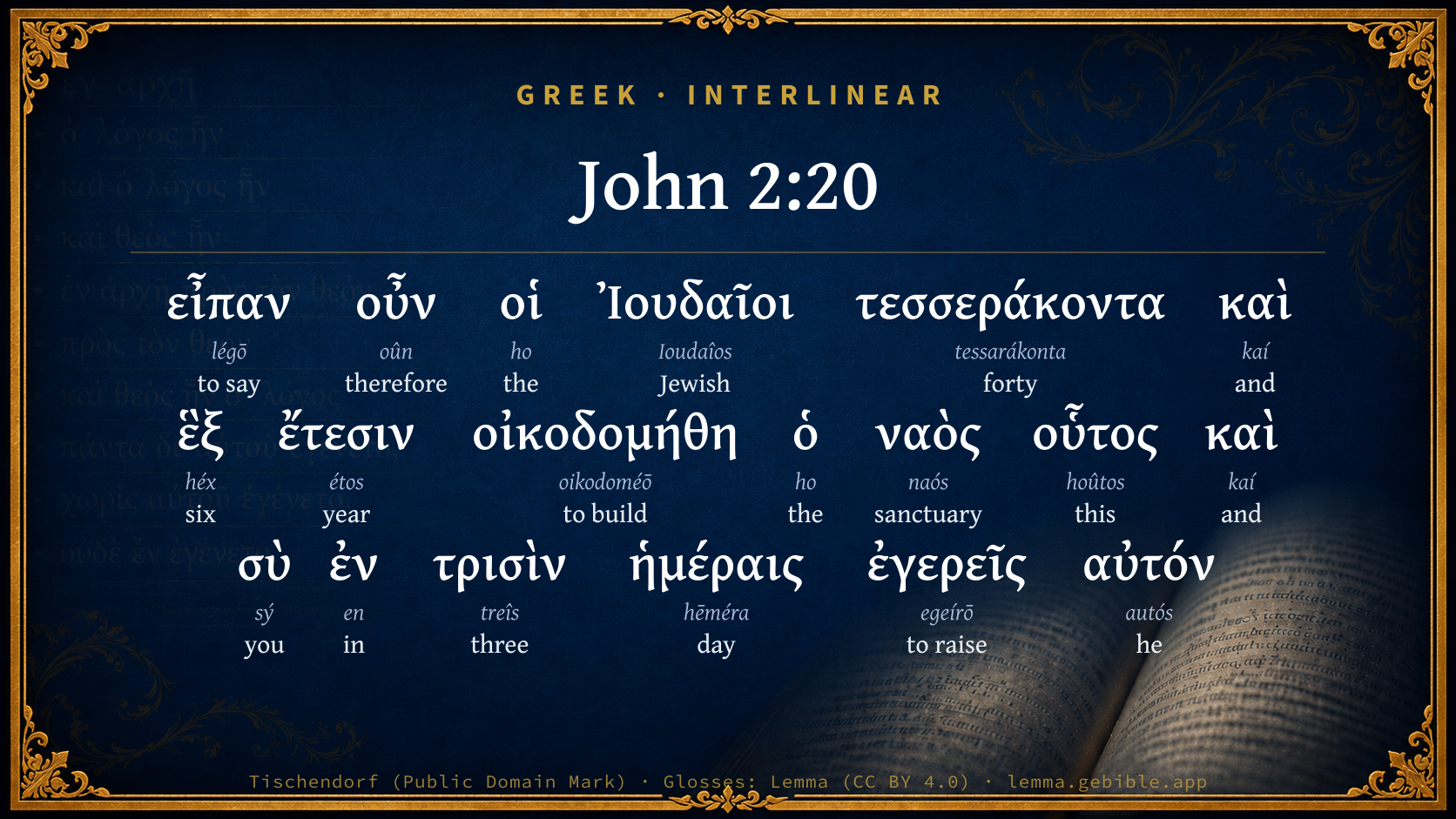
  1. εἶπαν légō G3004 “to say” Verb, Aorist, Active, Indicative, 3rd person, Plural
  2. οὖν oûn G3767 “therefore” Conjunction
  3. οἱ ho G3588 “the” Article, Nominative, Plural, Masculine
  4. Ἰουδαῖοι Ioudaîos G2453 “Jewish” Adjective, Nominative, Plural, Masculine
  5. τεσσεράκοντα tessarákonta G5062 “forty” Adjective, Numeral (indeclinable)
  6. καὶ kaí G2532 “and” Conjunction
  7. ἔτεσιν étos G2094 “year” Noun, Dative, Plural, Neuter
  8. οἰκοδομήθη oikodoméō G3618 “to build” Verb, Aorist, Passive, Indicative, 3rd person, Singular
  9. ὁ ho G3588 “the” Article, Nominative, Singular, Masculine
  10. ναὸς naós G3485 “sanctuary” Noun, Nominative, Singular, Masculine
  11. οὗτος hoûtos G3778 “this” Demonstrative pronoun, Nominative, Singular, Masculine
  12. καὶ kaí G2532 “and” Conjunction
  13. σὺ sý G4771 “you” Personal pronoun, 2nd person, Nominative, Singular
  14. ἐν en G1722 “in” Preposition
  15. τρισὶν treîs G5140 “three” Adjective, Dative, Plural, Feminine
  16. ἡμέραις hēméra G2250 “day” Noun, Dative, Plural, Feminine
  17. ἐγερεῖς egeírō G1453 “to raise” Verb, Future, Active, Indicative, 2nd person, Singular
  18. αὐτόν autós G846 “he” Personal pronoun, Accusative, Singular, Masculine

About this verse

These counts appear in no published source. They are computed here, from the morphology-tagged text and Lemma’s own curated glosses. What Lemma adds →

19
words
17
distinct lemmas
Gospels
section

Notable vocabulary

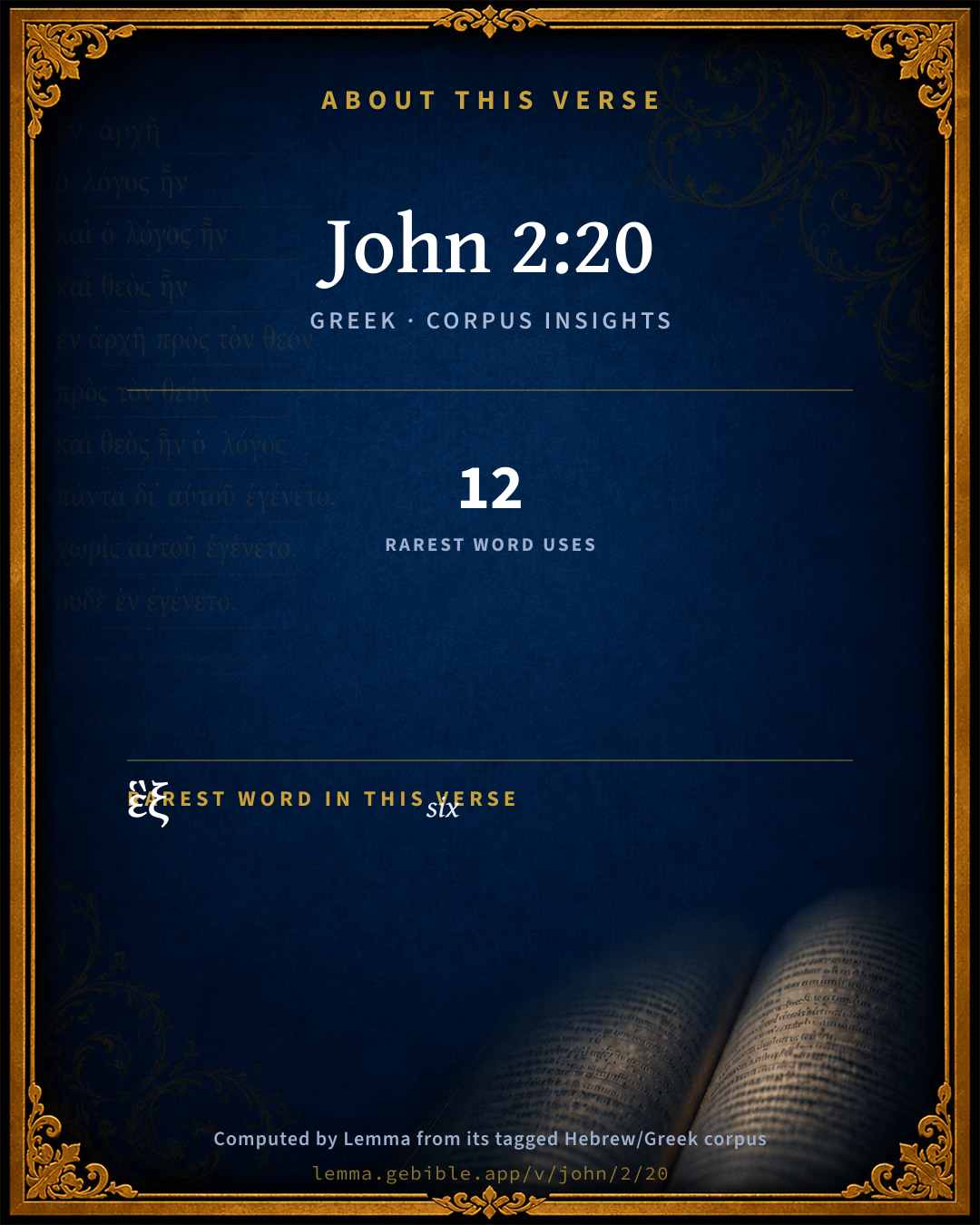
The rarest word here is ἓξ six G1803 — appearing just 12 times in the whole Greek New Testament.

Shared distinctive vocabulary

ἓξ six G1803 occurs in 12 verses of the Greek New Testament. Also found in:

Repetition

Words recur within this verse:

Commentary

Notes on John 2:20 from classic Christian and Jewish commentators (each source and its license shown beneath its notes). The classic Christian expositions comment on the surrounding passage and are grouped to its opening verse, so a note may address several verses; the Jewish commentaries on the Tanakh (Rashi and others) are per-verse, so they appear only where the commentator wrote on this verse.

Lemma curates 59 commentaries, every one of them public domain or Creative Commons licensed, each selected and text-cleaned for this edition rather than reprinted as found. About our sources →

Bengel's Gnomon

Johann Albrecht Bengel

Joh 2:20. Ὠκοδομήθη, was built [was in building]) by Herod the Great, and subsequently. See, besides others, Witsius in Misc. T. ii. p. 311.—καὶ σύ, and wilt thou) For this reason, the more they seem to have taken Jesus’ words literally, because He was called a workman. Mar 6:3, “Is not this the carpenter?” comp. Mat 26:61; Mat 27:63, [The Pharisees, after the crucifixion, to Pilate] “Sir, we remember that that deceiver said, while He was yet alive, After three days I will rise again.” Stupidity often, in the case of malice, is of advantage [proficit, prevails, makes progress, i.e. as to its own wicked purpose].

Bengel's Gnomon of the New Testament — English translation (T&T Clark, Edinburgh, 1860) — public domain. Text from a community e-Sword module.

Meyer's Critical & Exegetical Commentary

Heinrich August Wilhelm Meyer

Joh_2:20. An intended deductio ad ahsurdum. Τεσσαράκ. κ. ἓξ ἔτεσιν] length of time named without ἐν. Bernhardy, p. 81; Winer, p. 205 [E. T. p. 273]. The great number of years stands emphatically first.

ᾠκοδομήθη] i.e. so far as it was already complete. The proposed enlargement and renewal of the temple of Zerubbabel was begun in the 18th year of Herod the Greats reign (autumn of 7345; see Joseph. Antt. xv.11. 1), and was first completed, according to Josephus, Antt. xx. 9. 7, under Herod Agrippa II., A.D. 64. How the 46 years named here prove that the passover then being held was that of the year 782 (A.D. 29), corresponding with the year of the Baptists appearance according to Luk_3:1 (August 7812), see on Acts, Introd. § 4. Wieseler, p. 166, reckoning onwards from Nisan 735, places the end of the 46th year exactly in Nisan 781;[146] comp. also Wieseler in Herzogs Encykl. XXI. 546.

[146] Ewald reckons from B.C. 20 to A.D. 28, and, counting only the full intervening years, he gets the 46, thus omitting B.C. 20, the year in which the rebuilding began, and A.D. 28, the year of the passover named in our text.For the rest, it must be remembered (in opposition to Keims doubts in his Gesch. J. I. p. 615) that the statement in the text does not necessarily oblige us to suppose an οἰκοδομεῖσθαι without any interruptions. The building had been going on now for 46 years.

Meyer — Critical and Exegetical Commentary on the New Testament — English translation by Peter Christie, edited by Frederick Crombie (T&T Clark, 1880) — public domain. Text from a community e-Sword module.

Expositor's Greek Testament

ed. W. Robertson Nicoll

Joh 2:20 . The Jews naturally saw no reference to His own body or to its resurrection, and replied to the letter of His words, τεσσεράκοντα .… The Temple was begun to be rebuilt in the eighteenth year of Herod’s reign that is the autumn of 734 735. Jewish reckoning the beginning of a year was reckoned one year. Thus forty-six years might bring us to the autumn of 779 and the Passover of 780, i.e. , 27 A.D. would be regarded as forty-six years from the rebuilding; and this is Edersheim’s calculation. But several accurate chronologists think the following year is meant.

The Synoptical Gospels insert a similar incident at the close of Christ’s ministry, and there alone. Harmonists accordingly understand that the Temple was twice cleansed by Him. “Bis ergo Christus templum … purgavit” (Calvin). It is easy to find reasons for such action either at the beginning or at the close of the ministry. On the whole it seems more appropriate at the beginning. The Messiah might be expected to manifest Himself at the Temple.

The next paragraph extends from Joh 2:23 to Joh 3:21 , and contains (1) a brief description of the general result of Christ’s manifestation in Jerusalem (Joh 2:23-25 ), and (2) a longer description of an instance of the kind of faith and inquiry which were produced by this manifestation and of the manner in which Christ met it.

The Expositor's Greek Testament, edited by W. Robertson Nicoll (1897–1910) — public domain. Text from a community e-Sword module.

Jamieson, Fausset & Brown

Robert Jamieson, A. R. Fausset & David Brown

Forty and six years--From the eighteenth year of Herod till then was just forty-six years [JOSEPHUS, Antiquities, 15.11.1].

Jamieson, Fausset & Brown — Commentary Critical and Explanatory on the Whole Bible (1871) — public domain (CC PDM 1.0). Text via the HelloAO Bible API.

Adam Clarke's Commentary

Verse 20. Forty and six years was this temple in building] The temple of which the Jews spake was begun to be rebuilt by Herod the Great, in the 18th year of his reign: Jos. Ant. b. xv. c. 11, s. 1; and xx. c. 9, s. 5, 7. But though he finished the main work in nine years and a half, yet some additional buildings or repairs were constantly carried on for many years afterwards. Herod began the work sixteen years before the birth of our Lord: the transactions which are here related took place in the thirtieth year of our Lord, which make the term exactly forty-six years. Rosenmuller. Josephus, Ant. b. xx. c. 8, s. 5, 7, has told us that the whole of the buildings belonging to the temple were not finished till Nero's reign, when Albinus, the governor of Judea, was succeeded by Gessius Florus, which was eighty years after the eighteenth year of Herod's reign. See Bp. Pearce.

Adam Clarke's Commentary on the Bible (1810–1826) — public domain. Text from a community e-Sword/MySword module.

John Calvin's Commentaries

20. Forty and six years. The computation of Daniel agrees with this passage, (Daniel 9:25;) for he reckons seven weeks, which make Forty-nine years; but, before the last of these weeks had ended, the temple was finished. The time described in the history of Ezra is much shorter; but, though it has some appearance of contradiction, it is not at all at variance with the words of the Prophet. For, when the sanctuary had been reared, before the building of the temple was completed, they began to offer sacrifices. The work was afterwards stopped for a long time through the indolence of the people, as plainly appears from the complaints of the Prophet Haggai 1:4; for he severely reproves the Jews for being too earnestly engaged in building their private dwellings, while they left the Temple of God in an unfinished state.

But why does he mention that temple which had been destroyed by Herod about forty years before that time? For the temple which they had at that time, though it had been built with great magnificence and at a vast expense, had been completed by Herod, contrary to the expectation of men, as is related by Josephus, (Ant. Book 15. chapter 11.) I think it probable that this new building of the temple was reckoned as if the ancient temple had always remained in its original condition, that it might be regarded with greater veneration; and that they spoke in the usual and ordinary manner, that their fathers, with the greatest difficulty, had scarcely built the temple in Forty-six, years

This reply shows plainly enough what was their intention in asking a sign; for if they had been ready to obey, with reverence, a Prophet sent by God, they would not have so disdainfully rejected what he had said to them about the confirmation of his office. They wish to have some testimony of divine power, and yet they receive nothing which does not correspond to the feeble capacity of man. Thus the Papists in the present day demand miracles, not that they would give way to the power of God, (for it is a settled principle with them to prefer men to God, and not to move a hair’s breadth from what they have received by custom and usage;) but that they may not appear to have no reason for rebelling against God, they hold out this excuse as a cloak for their obstinacy. In such a manner do the minds of unbelievers storm in them with blind impetuosity, that they desire to have the hand of God exhibited to them and yet do not wish that it should be divine.

When therefore he was risen from the dead. This recollection was similar to the former, which the Evangelist lately mentioned, (verse 17.) The Evangelist did not understand Christ when he said this; but the doctrine, which appeared to have been useless, and to have vanished into air, afterwards produced fruit in its own time. Although, therefore, many of the actions and sayings of our Lord are obscure for a time, we must not give them up in despair, or despise that which we do not all at once understand. We ought to observe the connection of the words, that they believed the Scripture, and the word which Jesus had spoken; for the Evangelist means that, by comparing the Scripture with the word of Christ, they were aided in making progress in faith.

John Calvin's Commentaries (1540-1563) — public domain. Text from the Calvin Translation Society English edition (1840s-50s) via the Christian Classics Ethereal Library (ccel.org). Calvin's coverage is partial (roughly two-thirds of the Bible); uncommented books and verses are honest gaps, never fabricated. The 19th-century editor's footnotes and remarks are omitted so the notes are faithfully Calvin's own voice.

Ellicott's Commentary for English Readers

(20) They profess to seek a sign for evidence; they use it for cavil.

Forty and six years was this temple in building.—It is implied that it was not then finished. The date of the completion is given by Josephus (Ant. xx. 9, § 7) as A.D. 64. The same author gives the eighteenth year of the reign of Herod the Great (Nisan 734—Nisan 735, A.U.100) as the commencement of the renewal of the Temple of Zerubbabel (Ant. xv. 11, § 1). This would give A.U.C. 781-782, i.e., A.D. 28-29, as the date of the cleansing. In another passage Josephus gives the month Kislev A.U.C. 734, as the date of the festival connected with the building of the Temple (Ant. xiv. 16, § 4). This would fix our present date as the Passover of A.U.C. 781, i.e., A.D. 28. St. Luke furnishes us with an independent date for the commencement of the ministry of John the Baptist. If we count the “fifteenth year of the reign of Tiberius (comp. Note on Luk_3:1) from the commencement of his first reign with Augustus (A.U.C. 765, i.e., A.D. 12), this date will be A.U.C. 780, i.e., A.D. 27. The present Passover was in the following year, i.e., as before, A.D. 28. The sole reign of Tiberius commenced two years later (A.D. 14), so that while we have certainly no discrepancy between these independent dates, we have probably a very striking coincidence. Its bearing upon the authenticity of the present Gospel is evident.

Rear it up represents the same Greek word as “raise up,” in the previous verse; but the word fits the double meaning. It is the regular term for raising from the dead; but it is also used of rearing up a building, as, e.g., in 3 Ezra 5:44; Sir_49:11.

A Bible Commentary for English Readers, edited by Charles John Ellicott (1878–1897) — public domain. Text from a community e-Sword module.

The Cambridge Bible for Schools and Colleges

gen. ed. J. J. S. Perowne

20. Forty and six years, &c.] This was the third Temple. Solomon’s Temple was destroyed by Nebuchadnezzar. Zerubbabel’s was rebuilt by Herod the Great. The Greek implies that the building began 46 years ago, but not that it is now completed. “The building of the Temple, we are told by Josephus (Ant. xv. ii. 1), was begun in the 18th year of Herod the Great, 734–735 a. u. c. Reckoning 46 years from this point, we are brought to 781 or 782 a. u. c. = 28 or 29 a.d. Comparing this with the data given in Luk_3:1, the question arises, whether we are to reckon the 15th year of Tiberius from his joint reign with Augustus, which began a.d. 12; or from his sole reign after the death of Augustus, a.d. 14. This would give us a.d. 27 or 29 for the first public appearance of the Baptist, and at the earliest a.d. 28 or 30 for the Passover mentioned in this chapter.” S. p. 65. So that there seems to be exact agreement between this date and that of S. Luke, if we count S. Luke’s 15 years from the joint reign of Tiberius. It is incredible that this coincidence can have been planned; it involves an intricate calculation, and even with the aid of Josephus absolute certainty cannot be obtained. “By what conceivable process could a Greek in the second century have come to hit upon this roundabout expedient for giving a fictitious date to his invention?” S. p. 67.

rear it up] Better, raise it up; the same verb as in Joh_2:19. For other instances of gross misunderstanding of Christ’s words comp. Joh_3:4; Joh_3:9, Joh_4:11; Joh_4:15; Joh_4:33, Joh_6:34; Joh_6:52, Joh_7:35, Joh_8:22; Joh_8:33; Joh_8:52, Joh_11:12, Joh_14:5.

The Cambridge Bible for Schools and Colleges (gen. ed. J. J. S. Perowne; Cambridge University Press, 1878–1918) — public domain. Text from a community e-Sword module.

John Gill's Exposition

Then said the Jews,.... Unto him, as read the Syriac, Arabic, Persic, and Ethiopic versions:

forty and six years was this temple in building; which cannot be understood of the temple as built by Solomon, for that was but seven years in building, Kg1 6:37. But rather of the temple, as built by Zorobabel, commonly called the second temple, and might be more properly said to be "this temple"; the calculations of this made by learned men, are various and endless to recite. Daniel's seven weeks, or forty nine days, which are so many years, can have nothing to do with this account; since they regard not the building of the temple, but the city of Jerusalem; though from the second year of Cyrus, in which the temple began to be built, to the thirty second of Darius exclusive, were just forty six years; Cyrus reigning three years, Artaxerxes Ahasuerus fourteen years, and Artaxerxes Darius thirty two; but their account is more likely, which begins at the first of Artaxerxes Longimanus, who reigned forty years, and ends in the sixth year of Darius, his successor, in which year the temple was finished, Ezr 6:15. But to me it seems rather, that Herod's temple, or the temple as rebuilt, or repaired by Herod, is here meant; and which the Jews call, , "the building of Herod" (g); and say of it, that

"he who has not seen Herod's building, never saw a beautiful building.''

And this, according to Josephus (h), was begun in the "eighteenth" year of his reign, in the "thirty fifth" of which Christ was born, who was now "thirty" years of age: so that reckoning either the eighteenth year of Herod, or the thirtieth of Christ, the present year exclusively, just forty six years had run out, since the rebuilding or reparations were first begun; and which were not yet finished; for some years after this, the above writer observes (i), the temple was finished, even in the times of Nero and Agrippa: and agreeably to this, the words may be rendered, "forty six years has this temple been building"; and which still adds more force to the following reasoning of the Jews:

and wilt thou rear it up in three days? the thing is impossible and impracticable; it is madness to the last degree, to talk at this rate: thus from the length of time which had run out from Herod's first beginning to repair and beautify the temple, till now, and yet not finished, they argue the absurdity of his pretending to raise up such a fabric, should it be demolished, in three days time; they understanding him either ignorantly or wilfully, to speak of the material temple, when his sense was otherwise, as appears from the words of the evangelist, in the next verse. The Jew (k) objects to this account, of the temple being forty six years in building; he observes, that

"according to the sense of the Nazarenes, this was the building of king Herod, that was in the time of Jesus; and the whole time of his reign were but seven and thirty years, as is manifest from the book of Joseph ben Gorion, c. 65. Besides, that which Herod built, was built in eight years, as is evident from the same author, c. 55, wherefore the number of forty six years, in the words of the writer, (the evangelist,) is, a palpable error.''

To which may be replied, that admitting there is an error in this number, it is not the error of the evangelist, but of the Jews, whose words the evangelist relates; and supposing this was a mistake of theirs, either ignorantly or wilfully made, to aggravate the absurdity and impossibility of Christ's rebuilding the temple; and that even the evangelist knew it to be a mistake; yet he acts the most faithful and upright part, in repeating the words of the Jews, as they delivered them; and it lies upon the Jew to prove, that these words were not said by them, or that it is not credible that they should: that this was the building of Herod which is here referred to; and that he reigned but thirty seven years, will be granted; but this is no objection to its being forty six years in building, since in this account it is not said that it was forty six years in building by Herod; the sense is only, that such a number of years had passed, since it first began to be built by him: as for what Joseph ben Gorion says, of its being built by him in the space of eight years, it is not to be depended upon, since he is not the true Josephus, that wrote the history of the Jews, and is to be corrected by the genuine historian; and from what has been before observed, from the time which, according to the true Josephus, this building was begun, to this present year of Christ, when this discourse was had, were just forty six years; and admitting, that the main of the building was finished in eight years time, yet additions were continually made to it, so that it was not finished entirely, until many years after.

(g) T. Bab. Bava Bathra, fol. 4. 1. (h) Antiqu. Jud. l. 15. c. 14. (i) Antiqu. Jud. l. 20. c. 8. (k) R. Isaac Chizzuk Emuna, par. 2. c. 43. p. 434.

John Gill's Exposition of the Whole Bible (1746–1763) — public domain (CC PDM 1.0). Text via the HelloAO Bible API.

Trapp's Complete Commentary

John Trapp

20 Then said the Jews, Forty and six years was this temple in building, and wilt thou rear it up in three days?

Ver. 20. Forty and six years] All, save what lacks; for it was six years’ work only, but they reckon the interim of interruption, Ezr 3:1-13; Ezr 4:1-24; Ezr 5:1-17; Ezr 6:1-22; Ezr 7:1-28, to aggravate the matter. So they are not only blinded, but hardened.

John Trapp, A Commentary or Exposition upon All the Books of the Old and New Testament (1647–1656) — public domain. Text from a community e-Sword module.

Albert Barnes' Notes on the Bible

Then said the Jews ... - The Jews, either from the ambiguity of his language, or more probably from a design to cavil, understood him as speaking of the temple at Jerusalem. What he said here is all the evidence that they could adduce on his trial Mat 26:61; Mar 14:58, and they reproached him with it when on the cross, Mat 27:40. The Jews frequently perverted our Saviour’s meaning. The language which he used was often that of parables or metaphor; and as they Sought to misunderstand him and pervert his language, so he often left them to their own delusions, as he himself says, “that seeing they might not see, and hearing they might not understand,” Mat 13:13. This was a case which they “might,” if they had been disposed, have easily understood. They were in the temple; the conversation was about the temple; and though he probably pointed to his body, or designated it in some plain way, yet they chose to understand him as referring to the temple itself; and as it appeared so improbable that he could raise up that in three days, they sought to pervert his words and pour ridicule on his pretensions.

Forty and six years ... - The temple in which they then were was that which was commonly called “the second temple,” built after the return of the Jews from Babylon. See the notes at Mat 21:12. This temple Herod the Great commenced repairing, or began to rebuild, in the eighteenth year of his reign - that is, sixteen years before the birth of Christ (Jos. ‘Ant.,’ b. xv. Section 1). The main body of the temple he completed in “nine years and a half” (Jos. ‘Ant.,’ xv. 5, 6), yet the temple, with its outbuildings, was not entirely complete in the time of our Saviour. Herod continued to ornament it and to perfect it even until the time of Agrippa (Jos. ‘Ant.,’ b. xx. chapter viii. Section 11). As Herod began to rebuild the temple sixteen years before the birth of Jesus, and as what is here mentioned happened in the thirtieth year of the age of Jesus, so the time which had been occupied in it was “forty-six years.” This circumstance is one of the many in the New Testament which show the accuracy of the evangelists, and which prove that they were well acquainted with what they recorded. It demonstrates that their narration is true. Impostors do not trouble themselves to be very accurate about names and dates, and there is nothing in which they are more liable to make mistakes.

Wilt thou ... - This is an expression of contempt. Herod, with all his wealth and power, had been engaged in this work almost half a century. Can you, an obscure and unknown Galilean, accomplish it in three days? The thing, in their judgment, was ridiculous, and showed, as “they” supposed, that he had no authority to do what he had done in the temple.

Albert Barnes' Notes on the Bible (1834–1885) — public domain. Text from a community e-Sword/MySword module.

Haydock's Catholic Bible Commentary

Six and forty years, &c. This many understand of the time the second temple was building, from the edict of Cyrus to the sixth year of Darius Hystaspes. Others, of the enlarging and beautifying the temple, which was begun by Herod the great, forty-six years before the Jews spoke this to our Saviour. (Witham) --- Interpreters are much embarrassed by these words; as the building of the temple, which then existed, had been finished in much less than 46 years. Herod renewed the temple from the foundations, and spent in that work only nine years and a half. It was begun 46 years before the first Pasch at which our Saviour appeared. (Usher, ad an. Mundi 3987.) --- But this prince, according to Josephus, continued to make new building and embellishments to the very time in which the Jews uttered these words: it is now 46 years, &c.

George Leo Haydock (1774–1849), Haydock's Catholic Family Bible and Commentary, 1859 edition — public domain. Excludes Psalms (Douay-Rheims chapter numbering differs from Protestant) and Deuterocanonical books (Catholic canon only).

Matthew Poole's English Annotations

The Jews understood his words of that material temple in which they at this time were, which the best interpreters think was the temple built by Ezra and Zerubbabel; but how to make it out that it was forty six years building, they are not well agreed. Some say, Cyrus reigned thirty, Cambyses eight, Darius six; these added together make forty four. Others say that the Magi reigned two years more. Some reckon to Cyrus thirty one, to his son Cambyses nine, Darius six. Others say that the years wherein the building was hindered during Artaxerxes’s time, Ezr 4:21, added to the two years of Darius, Ezr 4:24, in whose sixth year it was finished, are reckoned together. The Jews thought it strange that our Saviour should undertake in three days to rear a building which had cost their forefathers so many years.

Matthew Poole's English Annotations on the Holy Bible (1683–1685) — public domain. Text from a community e-Sword/MySword module.

Whedon's Commentary on the Bible

Daniel D. Whedon

20. Forty and six years—The first temple was built by Solomon in seven years. The second temple was originally built by Zerubbabel; but when Herod assumed the government he proposed to build it anew. Such, however, was the jealousy of the Jews that Herod dare only repair and replace parts at a time, so that the rebuilding was a much longer work than the building, and Herod had a harder task than Solomon. Herod began his repairs about sixteen years before Christ; and as Jesus was now about thirty years of age, the reckoning seems to be exact. The work was not finished until the time of Nero. Nor was it, nevertheless, considered a third temple. Josephus, for instance, says the temple was destroyed twice; once by the Chaldeans, and once by Titus.

Wilt thou rear it up in three days?— Accepting the outermost meaning of his words, (which was the true one for them,) the Jews rightly understood our Lord’s announcement. His I will proclaimed him infinitely higher than Herod, than Zerubbabel, than Solomon. For surely the power that could rebuild the temple in three days, could rebuild it in three seconds of time.

Daniel D. Whedon (gen. ed.), Commentary on the Old and New Testaments (1874–1909) — public domain. Text from a community e-Sword module.

The Pulpit Commentary

Vers. 20, 21. The immediate reference of the words to the building before them was only one of a thousand misapplications of the words of Jesus. The seeds of truth which his words contain would take root in after days. Meanwhile the Jews answered and said taking the obvious and literal sense of the words, and treating them with an ill-concealed irony, if not scoff, to which our Lord made no replyIn forty and six years was this temple built as we see it today. This is one of the most important chronological data for the life of our Lord. Herod the Great, according to Josephus ("Ant.," 15:11 1), commenced the rebuilding of the second temple in the autumn of the eighteenth year of his reign. We find that his first year reckoned from Nisan, A.U.C. 717-718. Consequently, the eighteenth year must have commenced between Nisan, A.U.C. 734-735 and 735-736. The forty-sixth year after this would make the. Passover at which this speech was delivered the spring of A.U.C. 781 (Wieseler, "Chronicles Synopsis of the Four Gospels," translation; and Herzog, "Encyc.," 21:546. The fact that Josephus, in his "Bell. Jud:," 1:21, gives the fifteenth year of Herod"s reign instead of the eighteenth, is shown by Wieseler to be an error of the transcriber, see p. 152, note), which, if we compare with the other hints, is a fixed point from which to reckon the birth year and death year of our Lord. The "about thirty years old" of the Lord at his baptism throws us to about A.U.C. 751, B.C. 2, for the year of his birth, and if there be only one Passover mentioned in John"s Gospel between this and the last Passover, it gives A.U.C. 783 for the year of his death. This date is at least coincident with the date derived from the fifteenth year of Tiberius Caesar, as that of the commencement of the mission of John (see my examination of these dates in appendix to "John the Baptist"). The temple which Herod began to repair in the eighteenth year of his reign was not completed until A.D. 64, under Herod Agrippa II, a very short period before its utter destruction. The irony and scorn are manifest: Wilt thou raise it up in three days? John shows, in ver. 21, that, in the deep sense in which our Lord used the words, he abundantly justified his promise. But he ekeinov , the Lord, not the people, not the disciplesspake of the temple of his body. This is the reflection which was made upon the word of Jesus by the evangelists in after days. Even Mark (Mar_14:58) reveals the presence of a spiritual interpretation of the words by some of his unsympathetic listeners. It must not be forgotten that, in the synoptists, we find the presence of the idea that his service was a temple service, and that he was greater than the temple. (Mat_12:6; cf. also Heb_3:6 1Co_12:12, 27 6:15 Rom_12:5 Eph_4:12 Eph_1:22, Eph_1:23; with Eph_2:19-22) Nor must it be forgotten that the Logos itself was, in the figurative language of Philo, spoken of as the house, or temple, of God. Later rabbinical representations also describe "the body of man as the temple in which the Shechinah operates" (Wunsche). A difficulty arises from the Lord"s having claimed in these words to be on the point of raising himself from the dead, whereas elsewhere his resurrection is referred to the mighty power of God, as in ver. 22; Act_2:24 Act_3:15 Act_4:10 Rom_4:24 Gal_1:1 Eph_1:20, etc. Without doubt, God and the Father, the Supreme Power, was thus seen in living activity; but the Divine nature of Christ not infrequently so steps forward into his consciousness that he can say, "I and the Father are one;" and (Joh_10:17, Joh_10:18) "I will lay down my life that I may take it again". (cf. Eph_4:8-10)

The Pulpit Commentary (1880–1919), ed. H.D.M. Spence-Jones & Joseph S. Exell — public domain. Text from a community e-Sword module.

John Wesley's Explanatory Notes

Forty and six years - Just so many years before the time of this conversation, Herod the Great had begun his most magnificent reparation of the temple, (one part after another, ) which he continued all his life, and which was now going on, and was continued thirty-six years longer, till within six or seven years of the destruction of the state, city, and temple by the Romans.

John Wesley, Explanatory Notes Upon the Whole Bible (1754–1765) — public domain. Text via the GEBible commentary corpus.

unfoldingWord translationNotes

Door43 World Missions Community

General Information:

Verses 21 and 22 are not part of the main story line, but instead they comment on the story and tell about something that happens later. (See: End of Story)

forty-six years ... three days

"46 years ... 3 days" (See: Numbers)

you will raise it up in three days?

This remark appears in the form of a question to show that the Jewish authorities understand that Jesus wants to tear down the temple and build it again in three days. "Raise" is an idiom for "establish." AT: "you will establish it in three days?" or "you cannot possibly rebuild it in three days!" (See: Rhetorical Question and Idiom)

believed

Here "believe" means to accept something or trust that it is true.

this statement

This refers back to Jesus' statement in John 2:19.

translationWords

believe

word of God

unfoldingWord translationNotes — © Distant Shores Media and the Door43 World Missions Community, licensed CC BY-SA 4.0. Source: git.door43.org/Door43/en_tn.

Cambridge Greek Testament for Schools and Colleges

20. τεσσεράκοντα. This Ionic form of τεσσαράκοντα has good MS. authority here, Rev 11:2; Rev 13:5; Rev 14:1; Rev 21:17. Winer, p. 46.

20. τεσς. κ. ἓξ ἕτεσιν. For the dative comp. Joh 14:9. This was the third Temple. Solomon’s Temple was destroyed by Nebuchadnezzar. Zerubbabel’s was rebuilt by Herod the Great. “The building of the Temple, we are told by Josephus (Ant. XV. xi. 1), was begun in the 18th year of Herod the Great, 734–735 A.U.C. Reckoning 46 years from this point, we are brought to 781 or 782 A.U.C. = 28 or 29 A.D. Comparing this with the data given in Luk 3:1, the question arises, whether we are to reckon the 15th year of Tiberius from his joint reign with Augustus, which began A.D. 12; or from his sole reign after the death of Augustus, A.D. 14. This would give us A.D. 27 or 29 for the first public appearance of the Baptist, and at the earliest A.D. 28 or 30 for the Passover mentioned in this chapter.” So that there seems to be exact agreement between this date and that of S. Luke, if we count S. Luke’s 15 years from the joint reign of Tiberius. It is incredible that this can have been planned; it involves intricate calculation, and even with the aid of Josephus absolute certainty cannot be obtained. “By what conceivable process could a Greek in the second century have come to hit upon this roundabout expedient for giving a fictitious date to his invention?” (Sanday).

For other instances of misunderstanding of Christ’s words comp. Joh 3:4; Joh 3:9, Joh 4:11; Joh 4:15; Joh 4:33, Joh 6:34; Joh 6:52, Joh 7:35, Joh 8:22; Joh 8:33; Joh 8:52, Joh 11:12, Joh 14:5.

Cambridge Greek Testament for Schools and Colleges (Cambridge University Press, 1896; 21 vols, various authors incl. Carr, Maclear, Plummer, Farrar, Lumby, Moule, M. R. James, Simcox) — public domain. Text from a community e-Sword module.

Alford’s Greek Testament

Henry Alford

20.] The building of the temple by Herod the Great is stated by Josephus, in Antt. xv. 11. 1, to have been begun in the eighteenth year of his reign; in B. J. i. 21. 1, in the fifteenth: the difference being made by counting his reign from the death of Antigonus, or from his appointment by the Romans, see Antt. xvii. 8. 1. Reckoning from this latter, we shall have twenty years till the birth of Christ, and thirty years since that event, from which fifty, however, four must be taken, since our era is four years too late. This gives forty-six. The temple was not completed till a.d. 64, under Herod Agrippa II., and the procurator Albinus; so that ᾠκοδομήθη, was in building, must refer to the greater part of the work now completed. The sense of this aor. is curiously illustrated by a passage in Ezr 5:16, τότε Σαβανασὰρ ἐκεῖνος ἧλθε καὶ ἔδωκε θεμελίους τοῦ οἴκου τοῦ θεοῦ ἐν Ἱερουσαλήμ, καὶ ἀπὸ τότε ἕως τοῦ νῦν ᾠκοδομήθη καὶ οὐκ ἐτελέσθη.

Henry Alford, The Greek Testament (1849–1861) — public domain. Text from a community e-Sword module.

International Critical Commentary

20. Jn. relates several conversations of Jesus, cast in somewhat similar form to this. That is, there is first a difficult saying of His. It is misunderstood and its spiritual significance is not discerned, a too material interpretation being given to it by His hearers. Then either He Himself, or the evangelist, adds an explanatory statement. Cf., for instances of this, 3:4, 4:11, 33, 6:42, 51f. See Introd., p. cxi

ἐν τρισὶν ἡμέραις, “within three days,” not “after three days,” the preposition perhaps being significant.1

τεσσεράκοντα καὶ ἓξ ἔτεσοιν κτλ. Abbott (Diat. 2021-4) would refer these words to the original building of the Temple in the time of Ezra. If, with the LXX, we omit the words “of Babylon” after “Cyrus the king” at Ezr 5:13, and assume that “Cyrus king of Persia” (Ezr 1:1) is intended, we may take the first year of Cyrus king of Persia, i.e. 559 b.c., for the year in which the edict to build the Temple was issued. But according to Josephus (Antt. xi.i.1), it was completed in 513 b.c., i.e. forty-six years after; and so it is stated in the chronology of Eusebius. This is a summary of Abbott’s argument, which seems, however, to depend on too many subsidiary hypotheses to be satisfactory. Heracleon refers the words to Solomon’s Temple,1 which Origen refutes, but gives no satisfactory explanation of his own. It seems more likely, as has generally been held by modern editors, that Herod’s building is the subject of the allusion in this verse.

τεσσεράκοντα καὶ ἓξ ἔτεσιν οἰκοδομήθη κτλ. The aor. οἰκοδομήθη does not imply that the building was completed, as may be seen from a parallel sentence in Ezr 5:16 (appositely cited by Alford) describing the building of Ezra’s Temple, ἀπὸ τότε ἓως τοῦ νῦν ᾠκοδομήθη καὶ οὐκ ἐτελέσθη: it only implies that building operations had been in progress for forty-six years. In fact, Herod’s Temple was not completed until 64 a.d. in the time of Herod Agrippa.

According to Josephus, Herod the Great began to repair and rebuild the Temple in the eighteenth year of his reign (Antt. xv.xi.1), i.e. 20-19 b.c. This would give either 27 a.d. or 28 a.d. as the year of the Passover indicated in these verses.2 The year of the Crucifixion is not certain, but it was probably 29 a.d. or 30 a.d. It is not possible to draw exact chronological inferences from the “forty and six years” of this verse, but the phrase agrees well enough with the probable date, as gathered from other considerations. It is difficult to account for the attribution of so definite a statement of time to the Jewish objectors if it did not embody a reminiscence of fact. As to the fact itself, the Jews must have been well informed.

As at other points in the Gospel (v. 6, 5:5, 21:11), some critics have supposed that the number mentioned here is to be interpreted in an esoteric fashion, after the methods of Gematria. The name Ἀδάμ has 46 as its numerical equivalent, and thus the occult reference3 in “forty-six years hath this Temple been in building” would be to some contrast between the first and second Adam. It is unnecessary to dwell upon such extravagances.4 Hardly less fanciful is it to suppose, as Loisy does, that the forty-six years refer to the actual age of Jesus at the time, He being taken for a man forty-nine years old (8:57), near the end of His ministry.

International Critical Commentary — older volumes (1896–1929), various authors — public domain. Text from a community e-Sword module.

Vincent's Word Studies in the New Testament

Marvin R. Vincent

Forty and six years was this temple in building [τεσσαρακοντα και εξ ετεσιν ωκοδομηθη ο ναος ουτος] . Literally, In forty and six years was this temple built. It was spoken of as completed, although not finished until thirty - six years later.

Thou. The position of the Greek pronoun makes it emphatic.

Marvin R. Vincent, Word Studies in the New Testament (1887–1900) — public domain. Text from a community e-Sword/MySword module.

Godet's Commentaries

Frédéric Louis Godet

Ver. 20. “The Jews said, therefore: Forty-six years was this temple in building, and wilt thou raise it up in three days?”

The restoration of the temple by Herod had begun in the eighteenth year of his reign, according to Josephus (Antiqq. 15.11, 1). In the Jewish War, the same historian, by an error, mentions the fifteenth. The first year of the reign of this prince was that from the first of Nisan 717 U. C. to the first of Nisan 718; the eighteenth would consequently be the year included between the first of Nisan 734 and the first of Nisan 735: it was about the autumn of that year that the work began (Jos. Ant. 15.11, 1).

The time indicated, forty-six full years (ᾠκοδομήθη), brings us, therefore, as far as to the autumn of the year 780. The present Passover, consequently, must be that of the year 781, and as it was divided from the year in which Jesus died by the one alluded to in Joh 6:4, it follows therefrom, that Jesus died in 783. Now for many other reasons, that year seems really to have been the year of His death. Weiss objects that the expression: was built, does not necessarily imply that it was still in the course of building at that moment. But the work continued still for many years, until in 64 it was finished under Agrippa II. What reason could there be to suppose an interruption at the time in which our narrative places us?

Frédéric Louis Godet — Commentaries on Luke, John, Romans, and 1 Corinthians — English translation (T&T Clark, Edinburgh, 1870s–1890s) — public domain. Text from a community e-Sword module.

Lesson kit

Teaching starters — assembled from the data on this page, not authored interpretation. Every prompt links to the verse data it draws on. Edit before teaching.

John, in the Gospels, opens this verse with 19 words (17 distinct Greek lemmas). Its most distinctive word is héx (“six”). A historical commentator’s framing appears above. Read the whole chapter for the surrounding context.

Discussion questions

  1. The word héx carries the sense “six.” How does it shape the verse?
  2. How does Matthew 17:1, which shares the word «six», read alongside this verse?
  3. What does the repetition of “the” (2× in this one verse) do in this verse?
  4. These translations render this verse differently; the difference is in the English rendering, not the original. What questions does that raise?
  5. Compare how Bengel's Gnomon and Meyer's Critical & Exegetical Commentary read this verse. Where do they agree or differ?

Things to notice

Reading settings

Reading text

Shown beneath each verse's original-language words.

Old Testament
Old Testament edition

Read the OT as the Masoretic Hebrew (MT) or the Greek Septuagint (LXX).

English shown for the Greek Septuagint (in the Hebrew ↔ Greek comparison).

Comparing translations? Open the Compare panel on any verse page to stack up to four side by side.