John 7:8

Greek (Tischendorf 8th ed.) John 7:8 appears in the Greek New Testament. The text above is from the Tischendorf 8th edition. Each word links to its Strong’s number and a concise gloss. Click any word for its full Thayer’s Greek Lexicon entry.
Download image
Cite this verse

John 7:8 (World English Bible). Public Domain. Lemma interlinear Bible study tool, https://lemma.gebible.app/v/john/7/8.

Show BibTeX & RIS
BibTeX
RIS
English Translation
You go up to the feast. I am not yet going up to this feast, because my time is not yet fulfilled."
World English Bible · Public Domain
Download a study sheet

One document with this verse’s original text, its word-by-word gloss line, the meaning frame, cross-references with their text, attributed commentary, and full source and license credits — printable, and it pastes into notes with its structure intact.

This verse Autodidact and up

Study sheet (.html) Plain text (.txt)

A passage Seminary Student

Up to 50 verses in one chapter. A passage sheet keeps up to 6 commentary sources and 12 cross-references per verse, in the order this page ranks them, and says so on the sheet whenever that leaves anything out. Ask for a single verse and you get the Autodidact verse sheet above.

Everything on this page stays free to read, with no account — the sheet is a download of what is already on screen, not access to it.

Want to remove ads? Support Godless Engineer
Compare translations 3

The same verse in 3 English versions, stacked beneath the original-language interlinear above. Click any original word for its lexicon entry.

Each is an independent rendering of the whole verse — the interlinear is not word-aligned to these translations.

Highlighted words mark where these versions differ — a whole-verse word diff, not a word-by-word alignment.

  • World English Bible Public Domain
    You go up to the feast. I am not yet going up to this feast, because my time is not yet fulfilled."
  • King James Version Public Domain
    Go ye up unto this feast: I go not up yet unto this feast: for my time is not yet full come.
  • unfoldingWord Literal Text CC BY-SA 4.0
    You go up to the festival; I am not yet going to this festival, because my time has not yet been fulfilled.”

unfoldingWord Literal Text — © unfoldingWord, licensed CC BY-SA 4.0. Word-aligned USFM3 via Door43 (git.door43.org/unfoldingWord/en_ult).

Versions to compare (up to 4)

3 of 4 selected

Show all 19 translations

Every available English version of this verse, each an independent rendering of the whole verse.

  • World English Bible Public Domain
    You go up to the feast. I am not yet going up to this feast, because my time is not yet fulfilled."
  • Berean Standard Bible Public Domain
    Go up to the feast on your own. I am not going up to this feast, because My time has not yet come.”
  • Majority Standard Bible Public Domain
    Go up to the feast on your own. I am not yet going up to this feast, because My time has not yet come.”
  • King James Version Public Domain
    Go ye up unto this feast: I go not up yet unto this feast: for my time is not yet full come.
  • American Standard Version (1901) Public Domain
    Go ye up unto the feast: I go not up unto this feast; because my time is not yet fulfilled.
  • Revised Version (1885) Public Domain
    Go ye up unto the feast: I go not up yet unto this feast; because my time is not yet fulfilled.
  • Geneva Bible (1599) Public Domain
    Go ye vp vnto this feast: I wil not go vp yet vnto this feast: for my time is not yet fulfilled.
  • Douay-Rheims (1899) Public Domain
    Go you up to this festival day, but I go not up to this festival day: because my time is not accomplished.
  • Young's Literal Translation Public Domain
    Ye -- go ye up to this feast; I do not yet go up to this feast, because my time hath not yet been fulfilled;'
  • Literal Standard Version CC BY-SA 4.0
    You—go up to this celebration; I do not yet go up to this celebration, because My time has not yet been fulfilled”;
  • Unlocked Literal Bible CC BY-SA 4.0
    You go up to the festival; I am not going to this festival because my time has not yet been fulfilled.”
  • unfoldingWord Literal Text CC BY-SA 4.0
    You go up to the festival; I am not yet going to this festival, because my time has not yet been fulfilled.”
  • Darby Bible Public Domain
    Ye, go ye up to this feast. I go not up to this feast, for *my* time is not yet fulfilled.
  • World Messianic Bible Public Domain
    You go up to the feast. I am not yet going up to this feast, because my time is not yet fulfilled.”
  • Webster's Bible Public Domain
    Go ye up to this feast: I go not yet to this feast, for my time is not yet full come.
  • Free Bible Version CC BY-SA 4.0
    You go on to the festival. I'm not going to this festival because this is not the right time for me, not yet.”
  • Bible in Basic English Public Domain
    Go you up to the feast: I am not going up now to the feast because my time has not fully come.
  • Text-Critical English NT CC BY 4.0
    You go up to this feast; I am not yet going up to this feast, for my time has not yet been fulfilled.”
  • Tyndale New Testament (1534) Public Domain
    Go ye vp vnto this feast. I will not go vp yet vnto this feast for my tyme is not yet full come.

Literal Standard Version (2020), Covenant Press — licensed CC BY-SA 4.0. Text via the HelloAO Bible API (eBible.org). Unlocked Literal Bible (unfoldingWord) — licensed CC BY-SA 4.0. Text via the HelloAO Bible API (eBible.org). unfoldingWord Literal Text — © unfoldingWord, licensed CC BY-SA 4.0. Word-aligned USFM3 via Door43 (git.door43.org/unfoldingWord/en_ult). Free Bible Version, Dr. Jonathan Gallagher — licensed CC BY-SA 4.0. Text via the HelloAO Bible API (eBible.org).

Word by word

More ways to search: Search by grammar → Find every occurrence → Compare this word →

Practice this passage: Drill this verse → Learn its vocabulary →

ἑορτήν
heortḗ
G1859
“festival”
Noun, Accusative, Singular, Feminine
Part of Speech
Noun
Case
Accusative
Number
Singular
Gender
Feminine
Full Thayer's Definition

Origin: of uncertain affinity

TDNT: None

1. a feast day, festival
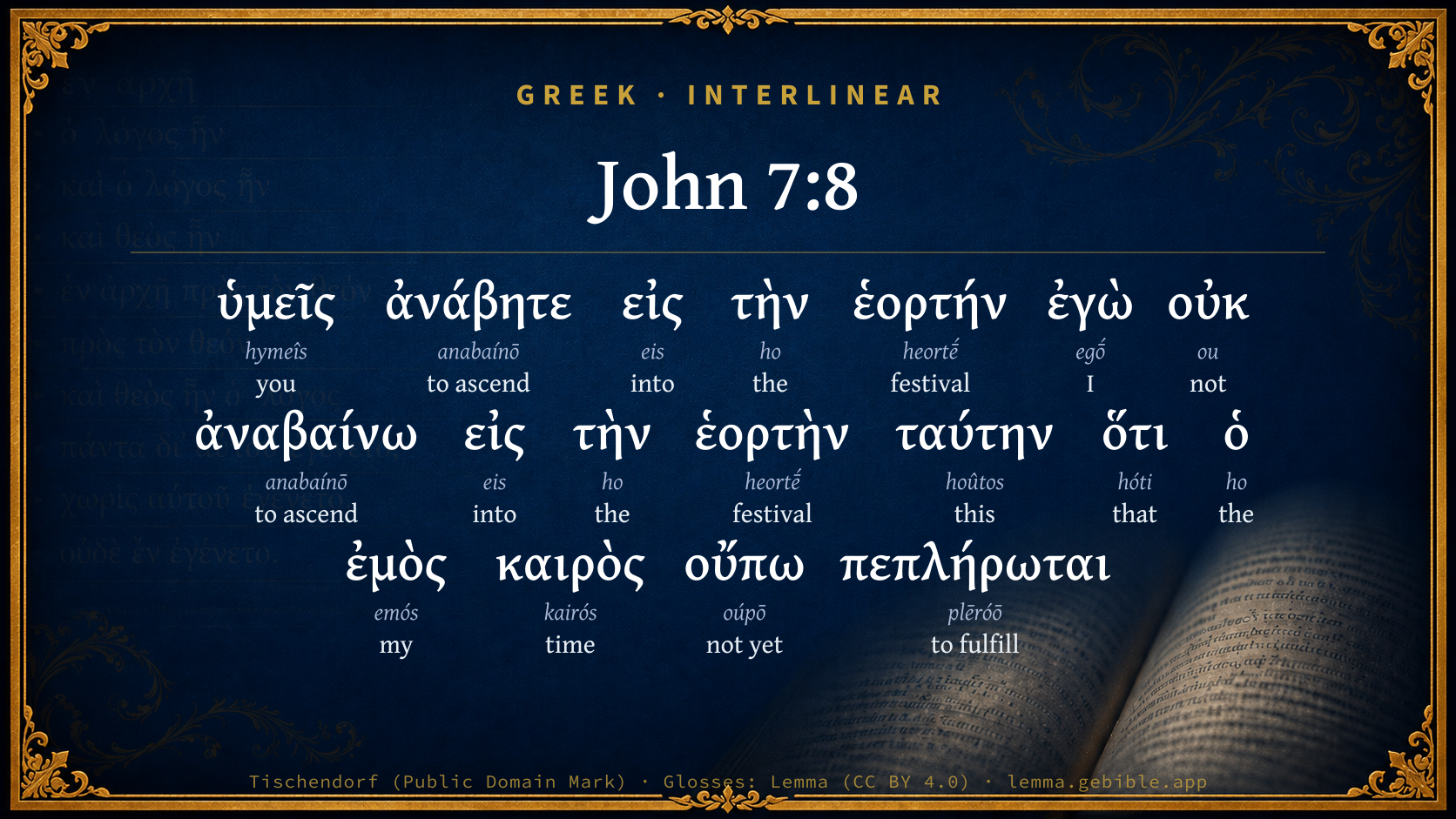
  1. ὑμεῖς hymeîs G5210 “you” Personal pronoun, 2nd person, Nominative, Plural
  2. ἀνάβητε anabaínō G305 “to ascend” Verb, Aorist, Active, Imperative, 2nd person, Plural
  3. εἰς eis G1519 “into” Preposition
  4. τὴν ho G3588 “the” Article, Accusative, Singular, Feminine
  5. ἐγὼ egṓ G1473 “I” Personal pronoun, 1st person, Nominative, Singular
  6. οὐκ ou G3756 “not” Particle, Negative
  7. ἀναβαίνω anabaínō G305 “to ascend” Verb, Present, Active, Indicative, 1st person, Singular
  8. εἰς eis G1519 “into” Preposition
  9. τὴν ho G3588 “the” Article, Accusative, Singular, Feminine
  10. ἑορτὴν heortḗ G1859 “festival” Noun, Accusative, Singular, Feminine
  11. ταύτην hoûtos G3778 “this” Demonstrative pronoun, Accusative, Singular, Feminine
  12. ὅτι hóti G3754 “that” Conjunction
  13. ὁ ho G3588 “the” Article, Nominative, Singular, Masculine
  14. ἐμὸς emós G1699 “my” Possessive pronoun, 1st person, Nominative, Singular, Masculine
  15. καιρὸς kairós G2540 “time” Noun, Nominative, Singular, Masculine
  16. οὔπω oúpō G3768 “not yet” Adverb, Negative
  17. πεπλήρωται plēróō G4137 “to fulfill” Verb, Perfect, Passive, Indicative, 3rd person, Singular

About this verse

These counts appear in no published source. They are computed here, from the morphology-tagged text and Lemma’s own curated glosses. What Lemma adds →

18
words
13
distinct lemmas
Gospels
section

Notable vocabulary

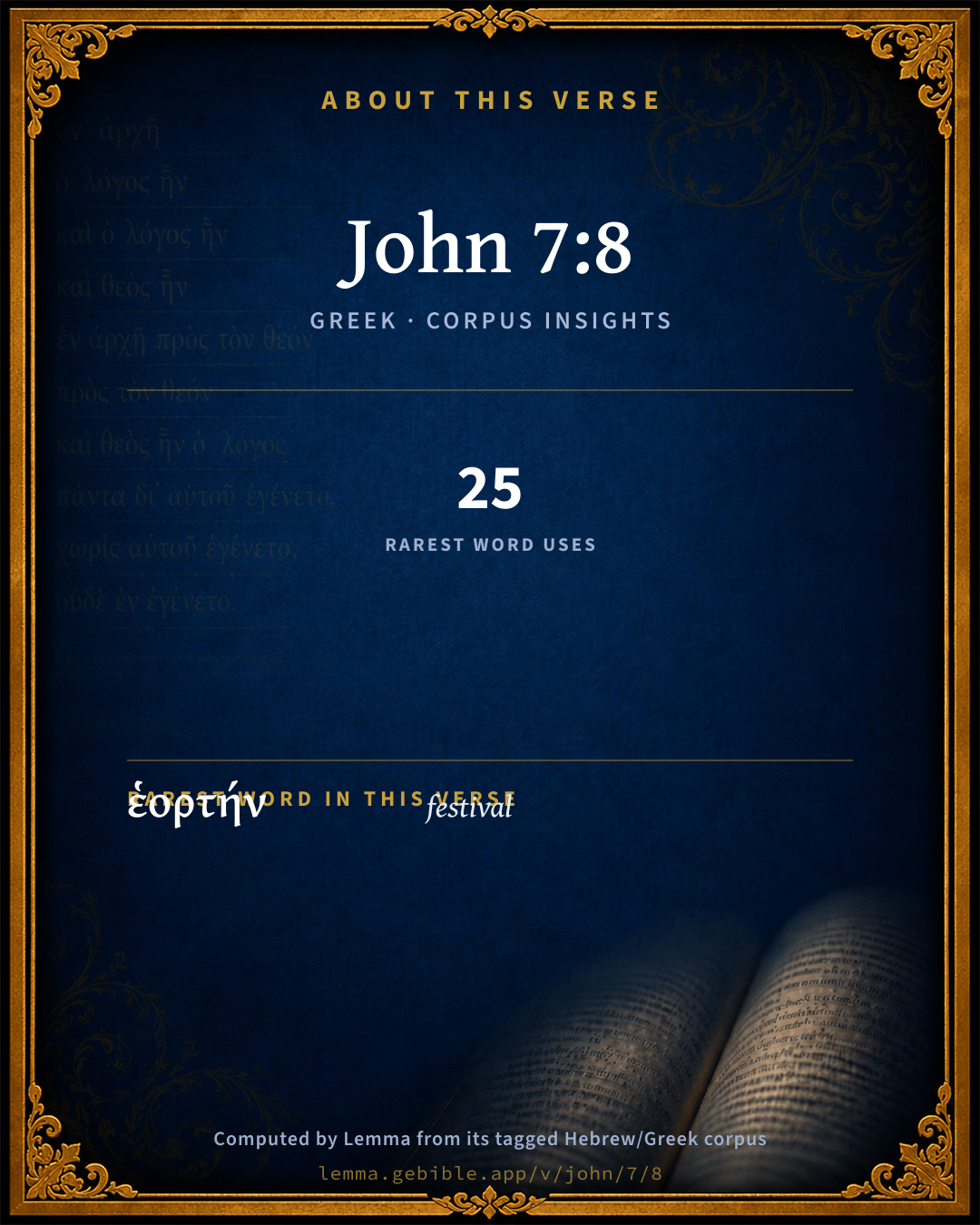
The rarest word here is ἑορτήν festival G1859 — appearing just 25 times in the whole Greek New Testament.

Shared distinctive vocabulary

ἑορτήν festival G1859 occurs in 23 verses of the Greek New Testament. Also found in:

Repetition

Words recur within this verse:

  • ἀνάβητε to ascend G305 ×2
  • εἰς into G1519 ×2
  • ἑορτήν festival G1859 ×2
  • τὴν the G3588 ×3

Cross-references

4

Topical passages linked to John 7:8 in the Treasury of Scripture Knowledge — connected by theme and wording, ordered by reader-vote popularity; previews shown in the World English Bible.

  • John 7:6 Jesus therefore said to them, "My time has not yet come, but your time is always ready.
  • John 8:20 Jesus spoke these words in the treasury, as he taught in the temple. Yet no one arrested him, because his hour had not yet come.
  • John 7:30 They sought therefore to take him; but no one laid a hand on him, because his hour had not yet come.
  • 1 Corinthians 2:15–16 But he who is spiritual discerns all things, and he himself is judged by no one.

Cross-references courtesy of OpenBible.info (CC BY 4.0).

Commentary

Notes on John 7:8 from classic Christian and Jewish commentators (each source and its license shown beneath its notes). The classic Christian expositions comment on the surrounding passage and are grouped to its opening verse, so a note may address several verses; the Jewish commentaries on the Tanakh (Rashi and others) are per-verse, so they appear only where the commentator wrote on this verse.

Lemma curates 59 commentaries, every one of them public domain or Creative Commons licensed, each selected and text-cleaned for this edition rather than reprinted as found. About our sources →

Bengel's Gnomon

Johann Albrecht Bengel

Joh 7:8. οὐκ, not) I do not now go up with you (Joh 7:10, When His brethren were gone up, then went He also up), as you advise, that I may be seen in the highway and in the city. For which reason He abode [still in Galilee], Joh 7:9. Ἀναβαίνω, I go up, is to be taken strictly in the present. Comp. οὐκ, not [= not yet], at Mat 11:11 [οὐκ ἐγήγερται—μείζων Ἰωάννου], where also the past tense ought to be understood in its strict sense. So σὐ, not, for οὔπω, not yet, Mar 7:18, “Are ye so without understanding? Do ye not (yet) perceive that,” etc.; οὐ νοεῖτε ὅτι: comp. Mat 15:17 [where Beng. with Rec. Text reads οὔπω. But [165][166][167] read Οὐ ΝΟΕῖΤΕ ὍΤΙ]. He who was not present on the first day of the feast, was likely to be thought not present at all. The Lord afterwards went up to the feast, but as it were incognito, and not so much to the feast, as to the temple; Joh 7:10, “not openly, but as it were in secret;” 14, “Jesus went up into the temple and taught.” There was now but one going up, in the proper sense, set before the Lord, namely, that at the passover of His passion: it is concerning this that He speaks in an enigmatical way.—ὁ καιρός, time [season]) Wisdom observes carefully the [right] time. His speech at Joh 7:6, “My time is not yet come,” refers to His time for going up to the feast; but in this verse, as it seems, it refers to His time of suffering: comp. Joh 5:30, “No man laid hands on Him, because His hour was not yet come.” This journey to the Feast of Tabernacles was His last journev but one to Jerusalem.

[165] the Vatican MS., 1209: in Vat. Iibr., Rome: fourth cent.: O. and N. Test. def.

[166] Bezæ, or Cantabrig.: Univ. libr., Cambridge: fifth cent.: publ. by Kipling, 1793: Gospels, Acts, and some Epp. def.

[167] Dubliniensis rescr.: Trin. Coll., Dublin: Matthew def.: sixth cent.: publ. by Barrett, 1801.

Bengel's Gnomon of the New Testament — English translation (T&T Clark, Edinburgh, 1860) — public domain. Text from a community e-Sword module.

Expositor's Greek Testament

ed. W. Robertson Nicoll

Joh 7:8 . ὑμεῖς … πεπλήρωται “Go ye up to the feast. I go not up yet to this Feast, for my time is not yet fulfilled.” His time for manifesting Himself publicly was not yet come, and therefore He did not wish to go up to the feast with His brothers , who were eager for some public display. Had He gone in their company He would have been proclaimed, and would have appeared to be the nominee of His own family. It was impossible He should go on any such terms.

The Expositor's Greek Testament, edited by W. Robertson Nicoll (1897–1910) — public domain. Text from a community e-Sword module.

Godet's Commentaries

Frédéric Louis Godet

Vv. 8 draws the practical consequence of this contrast. The meaning of the reply of Jesus is naturally in accord with that of the question, and especially of the words: “Manifest thyself to the world.” Jesus well knew that He must one day make the great Messianic demonstration which His brethren demanded, but He also knew that the time for it was not yet come. His earthly work was not accomplished. Moreover, it was not at the feast of Tabernacles, it was at that of the Passover that He must die. Hence, the special emphasis with which He says in the second clause, no longer as when speaking of His brethren: “Go up to the feast” (comp. the reading of B D, etc.), but “to this feast,” or even “this particular feast.” If the reply of Jesus is thus placed in close connection with the request of His brethren, it is no longer necessary, in order to justify it, to read with so many of the MSS.: “I go not yet up,” instead of: “I go not up.” The first reading is manifestly a correction by means of which an attempt was early made to remove the apparent contradiction between the reply of Jesus and His subsequent action (Joh 7:10). The reading, not yet, is not only suspicious for this reason; the meaning of it is altogether false. The antithesis which engages the thought of Jesus when He says: “I go not up to this feast,” is not the contrast between this day and some days later; it is that between this feast and another subsequent feast. What proves this, is the reason which He alleges: For my time is not yet fulfilled (Joh 7:8). The condition of things had not changed when Jesus went up to Jerusalem a few days afterwards. This very solemn expression, therefore, could only apply to the period of time which still remained before the future feast of the Passover, the destined limit of His earthly life.

The not yet which was well adapted to Joh 7:6, was wrongly introduced into our verse instead of not; comp. for this solemn sense of the word to be fulfilled Luk 9:31; Luk 9:51; Act 2:1, etc. As Jesus rejected at Cana a solicitation of His mother aiming substantially at the same result as the present summons of His brethren, and yet soon gave her satisfaction of her desire in a much more moderate way, so Jesus begins here by refusing to go up to Jerusalem in the sense in which He was urged to do so (that of manifesting Himself to the world), in order to go up afterwards in a wholly diffent sense. The conversion of His brethren, a few months afterwards, proves that the subsequent events were for them the satisfactory commentary on this saying, and that there did not remain in their minds the slightest doubt respecting the veracity and moral character of their brother. The following are the other explanations which have been given of this saying of Jesus.

1. That of Chrysostom, adopted by Lucke, Olshausen, Tholuck, Stier: “I go notnow,” deriving a νῦν (now), to be supplied, from the present ἀναβαίνω (I go). This ellipsis is not only needless, but false. Jesus, as we have seen, makes no allusion to a nearly approaching journey to Jerusalem, which perhaps was not yet even determined upon in His own mind.

2. Meyer holds that Jesus, in the interval between Joh 7:8 and Joh 7:10, formed a resolution which was altogether new; Gess, in like manner: God did not give Him the order until later (Joh 7:19). Reuss, nearly the same: Jesus reserved to Himself the liberty of acting according to His own desire, without consulting any one. Weiss: In accordance with prudence, Jesus was obliged to say: I go not up; but as His father gave Him afterwards the order to go, a promise was given to protect Him; and this is what took place. All this is very well conceived. But if Jesus did not yet know the Divine will, should He have said so positively: I go not up. This was to declare Himself far too categorically. He should have answered more vaguely: “I know not yet whether I shall go up; do you go up; nothing prevents your doing so.”

3. Others finally, as Bengel and Luthardt, explain in this way: “I go not up with the caravan; or, as Cyril, Lange, etc., “I go not up to celebrate the feast” (οὐχ οὕτως ἑορτάζων); which would not exclude the possibility that Jesus should go to Jerusalem during the feast. In fact, the full celebration of the feast, as the brethren of Jesus conceived of it, included certain indispensable rites, certain sacrifices of purification, which the pilgrims were obliged to offer before its beginning (Joh 11:55). And if it is objected that in Joh 7:10 John must have said, not: “He went up to the feast,” but: “He went up to Jerusalem,” this objection falls before the Alexandrian reading, which refers the words to the feast, not to: “And Jesus went up,” but to the clause: “When His brethren were gone up.” This very ingenious interpretation is not wanting in probability; its only defect is its excess of ingenuity. That which I have given in the first place, and to which the context more directly leads, seems to me preferable. It removes from Jesus, not only the accusation of falsehood, but also that of inconsistency which the philosopher Porphyry in the fourth century brought against Him on this account. The meaning given by Westcott: “I cannot yet go up as Messiah; but this does not prevent my going up as a prophet,” has a certain agreement with our explanation. Only it attributes to Jesus a reticence which is very much like mental reservation.

Frédéric Louis Godet — Commentaries on Luke, John, Romans, and 1 Corinthians — English translation (T&T Clark, Edinburgh, 1870s–1890s) — public domain. Text from a community e-Sword module.

Adam Clarke's Commentary

Verse 8. I go not up yet unto this feast] Porphyry accuses our blessed Lord of falsehood, because he said here, I will not go to this feast, and yet afterwards he went; and some interpreters have made more ado than was necessary, in order to reconcile this seeming contradiction. To me the whole seems very simple and plain. Our Lord did not say, I will not go to this feast; but merely, I go not yet, ουπω, or am not going, i.e. at present; because, as he said Joh 7:6, and repeats here, his time was not yet come-he had other business to transact before he could go. And it is very likely that his business detained him in Galilee till the feast was half over: for we do not find him at Jerusalem till the middle of the feast, Joh 7:14, i.e. till the feast had been begun four days. He might also be unwilling to go at that time, there being such a great concourse of people on the road to Jerusalem, and his enemies might say that he had availed himself of this time and multitude in order to excite sedition.

Adam Clarke's Commentary on the Bible (1810–1826) — public domain. Text from a community e-Sword/MySword module.

Ellicott's Commentary for English Readers

(8) Go ye up unto this feast.—This should be, rather, Go ye up unto the feast, with the stress on the pronoun “ye,” and the article instead of the demonstrative “this.”

I go not up yet unto this feast.—The “yet” is of doubtful authority, though it is found in some early MSS. and versions, and the more so because it removes an apparent difficulty. Without it, the words do not involve a change of purpose, and Porphyry’s often-repeated charge of fickleness has no real ground. He is not going up unto the feast in the sense in which they intended—openly, with the usual caravan from Galilee. Another going up publicly, as they intended, and with an issue the dark presages of which now crowd upon Him, is present to His mind. “Ye, go ye up to the feast; I go not up to this feast.” The verb is in the present, and its meaning does not exclude a going up afterwards. (See also Note on Joh_7:10.) They were then going; the caravan was preparing to start. I am not going up (now). The time is coming, but it has not yet fully come. (Comp. Note on Luk_9:51.)

A Bible Commentary for English Readers, edited by Charles John Ellicott (1878–1897) — public domain. Text from a community e-Sword module.

The Cambridge Bible for Schools and Colleges

gen. ed. J. J. S. Perowne

8. Go ye up unto this feast] ‘Ye’ is emphatic; ‘this’ is wanting in authority; we should read, go ye up unto the feast.

I go not up yet] ‘Yet,’ though very ancient, is possibly no part of the original text: it may have been inserted to avoid the charge of the heathen critic Porphyry, that Jesus here shews fickleness or deceit, and therefore cannot be Divine. But the sense is the same, whether ‘yet’ is inserted or not. He means ‘I am not going now; not going publicly in the general caravan of pilgrims; not going with you, who do not believe on Me.’ He does not say ‘I shall not go.’ The next two verses shew exactly what is meant by the negative.

The Cambridge Bible for Schools and Colleges (gen. ed. J. J. S. Perowne; Cambridge University Press, 1878–1918) — public domain. Text from a community e-Sword module.

John Gill's Exposition

When he had said these words unto them,.... Had exhorted them to go up to the feast, and told them that he should not go yet, and the reason of it:

he abode still in Galilee; and went not up with his brethren, nor at all at present; showing hereby a firmness and resolution of mind, not using lightness of speech; and his words being not yea, and nay, but all of a piece, and by which he abode.

John Gill's Exposition of the Whole Bible (1746–1763) — public domain (CC PDM 1.0). Text via the HelloAO Bible API.

Trapp's Complete Commentary

John Trapp

8 Go ye up unto this feast: I go not up yet unto this feast; for my time is not yet full come.

Ver. 8. I go not up yet] q.d. I will ere long: lest haply they should think that he disliked the public services, and would not come at them, because of the manifold corruptions that were then crept into them. All which notwithstanding, Christ never separated, nor commanded others so to do, but the contrary: "Go show thyself to the priest," Mat 8:4; "The scribes and Pharisees sit in Moses’ chair; hear them," Mat 23:2. It is noted as a great fault in Eli’s time, that men "abhorred the offering of the Lord," though the sin of the priests was very great before the Lord, and all was out of order; yet in abhorring the sacrifice, they "transgressed, even to a cry," 1Sa 2:17.

John Trapp, A Commentary or Exposition upon All the Books of the Old and New Testament (1647–1656) — public domain. Text from a community e-Sword module.

Albert Barnes' Notes on the Bible

I go not up yet - Jesus remained until about the middle of the feast, Joh 7:14. That is, he remained about four days after his brethren had departed, or until the mass of the people had gone up, so that his going might excite no attention, and that it might not be said he chose such a time to excite a tumult. We have here a signal instance of our Lord’s prudence and opposition to parade. Though it would have been lawful for him to go up at that time, and though it would have been a favorable period to make himself known, yet he chose to forego these advantages rather than to afford an occasion of envy and jealousy to the rulers, or to appear even to excite a tumult among the people.

Albert Barnes' Notes on the Bible (1834–1885) — public domain. Text from a community e-Sword/MySword module.

Haydock's Catholic Bible Commentary

Go you up to this festival day, which lasted eight days. --- I go not with you, nor to be there at the first day, nor in that public manner as you desire. But when the feast was half over, about the fourth day, Jesus went thither in a private manner, yet so that when he arrived, he spoke publicly in the temple. (Witham)

George Leo Haydock (1774–1849), Haydock's Catholic Family Bible and Commentary, 1859 edition — public domain. Excludes Psalms (Douay-Rheims chapter numbering differs from Protestant) and Deuterocanonical books (Catholic canon only).

Matthew Poole's English Annotations

Go ye up unto this feast; let not my forbearance to go up hinder your going up according to the law.

I go not up yet unto this feast; I have some particular reasons why as yet I will not go to be there at the beginning of it.

For my time is not yet full come; I know my time to go, when it will be most safe and proper for me. I shall be there some time during the feast, but my time is not yet come; I shall not be there at the beginning of it. It appeareth that he came not into the temple till about the middle of it, Joh 7:14, which was three or four days after it was began, for it held seven days, Lev 23:34. Or his time was not come, because he designed to go very privately without any notice taken of his coming; which must have been, if he had at that time gone up with his kindred and acquaintance.

Matthew Poole's English Annotations on the Holy Bible (1683–1685) — public domain. Text from a community e-Sword/MySword module.

Whedon's Commentary on the Bible

Daniel D. Whedon

8. I go not up yet—The best authorities decide that the word yet should be rejected from the text. His true Words are, I go not up to this feast. That Jesus did not then intend to go up to the feast is perfectly clear from the reason alleged, namely, My time is not yet. This of course clearly means that when his time came he would go up. It came and he went. Jesus uses a word that applied only to the present, I go not. He spoke not for the future; but, obediently unknowing the moment, he leaves the decision of the time to the Father, and tells precisely as he knows.

Not yet full come— Phraseology which clearly implies that his time was at an unknown nearness. Doubtless, the Divine Will was that Jesus should not encounter the preparations of the authorities to assassinate him at the beginning of the feast. Nor is he permitted to know and to reveal to his brothers his later coming, lest they should report it at Jerusalem, that he would be there before the close. At the proper moment, in the middle of the feast week, Jesus is suddenly within their midst, and amid the confusion of the elements he overrides and defeats all the machinations of the Jewish powers.

Daniel D. Whedon (gen. ed.), Commentary on the Old and New Testaments (1874–1909) — public domain. Text from a community e-Sword module.

The Pulpit Commentary

Go ye up to thefeast. "Join the pilgrim bands. Take part in the ceremonial of sacrifice and lustration. Be there in good time for the booth building. You have no testimony to deliver against the corruption of the holiest service, the hollowness of the ritual thanksgiving." I go not yetunto this feast. The text as it here stands frees the language of our Lord from the charge of Porphyry, or proves that it was founded on false premises; though the fact that the apparent refusal was so soon followed by a compliance makes it probable that the real point of the sentence rests not so much on the oupw as on the tauthn eorthn . Not as a pilgrim, not in triumphal procession, would he go to the Feast of Tabernacles. He reserved that solemn sacrificial act for a later occasion, He would suffer as the Paschal Lamb, not go to Jerusalem to assert the completion of its acceptable year, and to foment the self-satisfaction of its religious guides. This is not satisfactory, because there is no feast the special features of which seemed to furnish our Lord with more obvious illustrations of his own work and Person. Moreover, he did make his appearance in the midst of the feast. So Godet and Meyer accepted the ouk , and urge therefrom the fact that Jesus deliberately altered his intention, so soon as a new motive sufficiently strong presented itself. With the assistance of oupw , or with such an emphasis upon the present tense (anabainw) as to make it equivalent to the introduction of a nun , the passage means. "I am not going up now. Chrysostom, Lucke, De Wette, see in this suggestion the solution of the problem and a preparation for what follows. The word egguv , nigh" (ver. 2), may reasonably be interpreted with more latitude than is generally done. It might easily mean a date sufficiently near to be the topic of conversation in the family circle, even were it still a month before the celebration. The preparations may have been made, the pilgrims were beginning to assemble for their long journey, and the "not yet" and the emphasis on the present tense of anabainw may easily have been conditioned by some of the special work which had still to be completed in Galilee on the way to Judaea and Persea. Because my season my special opportunityhas not been yet fulfilled; or, fully come. Probably this clause points to the completion of the predestined hour of his consummation, of the baptism with which he should be baptized, the fire that he would kindle, the work which he would finish.

HOMILIES BY D. YOUNG Ver. 8. The time of Jesus when is it to come?

The course of life in every living thing is, to a great extent, according to a fixed order. Every human being has that in his whole appearance which tells something of the number of years he has been in the world. But in the life of the Lord Jesus there was something beyond the order of mere natural development. There was an order in his life which it depended on his own discernment and obedience to maintain. His brethren wanted him to rush at every opportunity that seemed likely to them. But Jesus was not one to pluck fruit before it was ripe. He began quietly, went on gradually, builded things up, and then, when the hour for full revelation came, the revelation came with it.

I THE PARTICULAR SEASON FOR WHICH JESUS WAS WAITING. His brethren wanted. him to make the best of the crowd that would be at Jerusalem for the Feast of Tabernacles. The Feast of Tabernacles, however, was only a secondary occasion compared with the Feast of the Passover. There could have been nothing to remember at the Feast of Tabernacles unless, first of all, there had been something to remember at the Feast of the Passover. All other glorious recollections which Israel had to cherish with gratitude and hope came out of the deliverance from Egypt. Thus, at the Feast of the Passover, the time of Jesus fully came, and the coming was made manifest by his public and triumphal entry. The multitude surrounding him had come up for the Passover, like himself. They shout "Hosannah!" that is, they utter forth a prayer for salvation. And this prayer was soon answered, though not as the multitude expected, and not in a way that many of them would profit by. Jesus was just about to be delivered over to men, that men might do their worst to him. Then, when men had done their worst, his Father in heaven would do his best. Everything was done just at the right time. And all this comes forth from that Lord of hosts who is wonderful in counsel and excellent in working. It is just what we should expect, that God"s great dealings in grace should have about them the order and regularity which mark his dealings in nature.

II HOW WE ARE TO PROFIT BY THE FULL COMING OF THE TIME OF JESUS. We can only profit by the coming of this time as we make it to profit. The time of Jesus has to come fully with each of us. Not a human being who has ever trod this planet but has to come somewhere and somehow in contact with Jesus. We can no more escape Jesus than we can escape death. Life is narrowing day by day, and we are getting pushed on to a wicket gate where face-to-face dealing with Jesus is inevitable. The time has fully come for Jesus to be showing something of his saving power in our experience. Whenever Jesus, in the days of his flesh, met with those who had divers diseases and infirmities, the time was fully come for him to take those diseases and infirmities away. And so the time of Jesus is fully come to save whenever the sinner feels his need of saving. When the lifeboat is built and put in the lifeboat house, the time is fully come for the boat to do its work. Whenever the work is ready for it, it is ready for the work. So Jesus is ready for the sinner whenever the sinner is ready for him. Ready to save, ready to govern, ready to comfort, ready to put in the way of a full recompense for an obedient life. Y.

The Pulpit Commentary (1880–1919), ed. H.D.M. Spence-Jones & Joseph S. Exell — public domain. Text from a community e-Sword module.

The People's New Testament

B. W. Johnson

8. I go not up yet. He does not say that he will not go, but he will not go yet. He did not wish to go in the great multitude of pilgrims that were en route, as there were reasons why he should go quietly.

B. W. Johnson's The People's New Testament with Notes (1889–1891) — public domain. Electronic text from the Christian Classics Ethereal Library (CCEL) ThML edition.

unfoldingWord translationNotes

Door43 World Missions Community

Connecting Statement:

Jesus continues speaking to his brothers.

my time has not yet been fulfilled

Here Jesus is implying that if he goes to Jerusalem, he will bring his work to an end. AT: "It is not the right time for me to go to Jerusalem" (See: Assumed Knowledge and Implicit Information)

translationWords

fulfill

Galilee

unfoldingWord translationNotes — © Distant Shores Media and the Door43 World Missions Community, licensed CC BY-SA 4.0. Source: git.door43.org/Door43/en_tn.

Cambridge Greek Testament for Schools and Colleges

8. Omit ταύτην after first ἑορτήν. Between οὔπω (BLT) and οὐκ (אDKM) before ἀναβαίνω it is impossible to decide with certainty.

8. ὑμεῖς. Emphatic; you, with all your fondness for publicity.

ἐγὼ οὐκ ἀν. Οὔπω, certainly very ancient, is possibly a correction. It may have been substituted for οὐκ to avoid the charge of the heathen critic Porphyry, that Jesus here shews fickleness or deceit, and therefore cannot be Divine. But the sense is the same, whether we read οὐκ or οὔπω; ‘I am not going now, publicly, in the general caravan of pilgrims; not going with you, who do not believe on Me.’ He does not say ‘I shall not go.’ The next two verses shew exactly what the negative means.

Cambridge Greek Testament for Schools and Colleges (Cambridge University Press, 1896; 21 vols, various authors incl. Carr, Maclear, Plummer, Farrar, Lumby, Moule, M. R. James, Simcox) — public domain. Text from a community e-Sword module.

International Critical Commentary

8. ὑμεῖς ἀνάβητε (the regular word for going up to Jerusalem; see on 2:13) εἰς τὴν ἑορτήν. א*ΓΔ add ταύτην here, but om. אcaBDLTNWΘ. ὑμεῖς is emphatic, “Go ye up to the feast.”

ἐγὼ οὔπω ἀναβαίνω εἰς τὴν ἑορτὴν ταύτην, “I (on the other hand) am not yet going up to this feast.”οὔπω is read by BLTNWΓΔΘ, but אD Syr. cur. have οὐκ. If οὔπω be read, Jesus is represented as saying that He is not going up immediately, as His brethren would have Him do. If we read οὐκ, His words would seem to convey to His hearers that He was not going up at all to this particular feast; and in that case He altered His plans afterwards (v. 10).

ὅτι ὁ ἐμὸς καιρὸς (this is the true reading here, as against ὁ καιρὸς ὁ ἐμός, which the rec. text reads, from v. 6 above) οὔπω πεπλήρωται. This is a repetition of the reason given in v. 6, with slight verbal changes, the stronger word πεπλήρωται being substituted for πάρεστιν. The fitting moment had not yet arrived for His public proclamation of His Messiahship. The repetition of the same thought in slightly different words is a feature of Jn.’s style. See on 3:16.

International Critical Commentary — older volumes (1896–1929), various authors — public domain. Text from a community e-Sword module.

Vincent's Word Studies in the New Testament

Marvin R. Vincent

This feast. For this, read the, the first time, but not the second. Full come [πεπληρωται] . Literally, has been fulfilled. So Rev., is not yet fulfilled.

Marvin R. Vincent, Word Studies in the New Testament (1887–1900) — public domain. Text from a community e-Sword/MySword module.

Lesson kit

Teaching starters — assembled from the data on this page, not authored interpretation. Every prompt links to the verse data it draws on. Edit before teaching.

John, in the Gospels, opens this verse with 18 words (13 distinct Greek lemmas). Its most distinctive word is heortḗ (“festival”). A historical commentator’s framing appears above. Read the whole chapter for the surrounding context.

Discussion questions

  1. How does “festival” (heortḗ) shape what this verse is saying?
  2. Matthew 26:5 shares the word «festival» with this verse. How do the two illuminate each other?
  3. “to ascend” occurs 2× in this one verse. What is the effect of the repetition?
  4. These translations render this verse differently; the difference is in the English rendering, not the original. What questions does that raise?
  5. Reading how Bengel's Gnomon and Expositor's Greek Testament read this verse, where do the two commentators agree and where do they part?

Things to notice

  • These translations choose different wording for 11 words in this verse.
  • “to ascend” occurs 2× in this single verse.
  • 13 distinct Greek lemmas span 18 words in this verse.

Reading settings

Reading text

Shown beneath each verse's original-language words.

Old Testament
Old Testament edition

Read the OT as the Masoretic Hebrew (MT) or the Greek Septuagint (LXX).

English shown for the Greek Septuagint (in the Hebrew ↔ Greek comparison).

Comparing translations? Open the Compare panel on any verse page to stack up to four side by side.