John 4:51

Greek (Tischendorf 8th ed.) John 4:51 appears in the Greek New Testament. The text above is from the Tischendorf 8th edition. Each word links to its Strong’s number and a concise gloss. Click any word for its full Thayer’s Greek Lexicon entry.
Download image
Cite this verse

John 4:51 (World English Bible). Public Domain. Lemma interlinear Bible study tool, https://lemma.gebible.app/v/john/4/51.

Show BibTeX & RIS
BibTeX
RIS
English Translation
As he was now going down, his servants met him and reported, saying "Your child lives!"
World English Bible · Public Domain
Download a study sheet

One document with this verse’s original text, its word-by-word gloss line, the meaning frame, cross-references with their text, attributed commentary, and full source and license credits — printable, and it pastes into notes with its structure intact.

This verse Autodidact and up

Study sheet (.html) Plain text (.txt)

A passage Seminary Student

Up to 50 verses in one chapter. A passage sheet keeps up to 6 commentary sources and 12 cross-references per verse, in the order this page ranks them, and says so on the sheet whenever that leaves anything out. Ask for a single verse and you get the Autodidact verse sheet above.

Everything on this page stays free to read, with no account — the sheet is a download of what is already on screen, not access to it.

Want to remove ads? Support Godless Engineer
Compare translations 3

The same verse in 3 English versions, stacked beneath the original-language interlinear above. Click any original word for its lexicon entry.

Each is an independent rendering of the whole verse — the interlinear is not word-aligned to these translations.

Highlighted words mark where these versions differ — a whole-verse word diff, not a word-by-word alignment.

  • World English Bible Public Domain
    As he was now going down, his servants met him and reported, saying "Your child lives!"
  • King James Version Public Domain
    And as he was now going down, his servants met him, and told him, saying, Thy son liveth.
  • unfoldingWord Literal Text CC BY-SA 4.0
    Now while he was going down, his servants met him and reported, saying that his son lives.

unfoldingWord Literal Text — © unfoldingWord, licensed CC BY-SA 4.0. Word-aligned USFM3 via Door43 (git.door43.org/unfoldingWord/en_ult).

Versions to compare (up to 4)

3 of 4 selected

Show all 19 translations

Every available English version of this verse, each an independent rendering of the whole verse.

  • World English Bible Public Domain
    As he was now going down, his servants met him and reported, saying "Your child lives!"
  • Berean Standard Bible Public Domain
    And while he was still on the way, his servants met him with the news that his boy was alive.
  • Majority Standard Bible Public Domain
    And while he was still on the way, his servants met him with the news: “Your boy is alive.”
  • King James Version Public Domain
    And as he was now going down, his servants met him, and told him, saying, Thy son liveth.
  • American Standard Version (1901) Public Domain
    And as he was now going down, his servants met him, saying, that his son lived.
  • Revised Version (1885) Public Domain
    And as he was now going down, his servants met him, saying, that his son lived.
  • Geneva Bible (1599) Public Domain
    And as he was nowe going downe, his seruants met him, saying, Thy sonne liueth.
  • Douay-Rheims (1899) Public Domain
    And as he was going down, his servants met him; and they brought word, saying, that his son lived.
  • Young's Literal Translation Public Domain
    and he now going down, his servants met him, and told, saying -- `Thy child doth live;'
  • Literal Standard Version CC BY-SA 4.0
    and he now going down, his servants met him, and told, saying, “Your child lives”;
  • Unlocked Literal Bible CC BY-SA 4.0
    While he was going down, his servants met him, saying that his son was living.
  • unfoldingWord Literal Text CC BY-SA 4.0
    Now while he was going down, his servants met him and reported, saying that his son lives.
  • Darby Bible Public Domain
    But already, as he was going down, his servants met him and brought [him] word saying, Thy child lives.
  • World Messianic Bible Public Domain
    As he was going down, his servants met him and reported, saying “Your child lives!”
  • Webster's Bible Public Domain
    And as he was now going down, his servants met him, and told him, saying, Thy son liveth.
  • Free Bible Version CC BY-SA 4.0
    While he was on his way, his servants met him with the news that his son was alive and recovering.
  • Bible in Basic English Public Domain
    And while he was going down, his servants came to him and said, Your boy is living.
  • Text-Critical English NT CC BY 4.0
    As he was going back down to his house, his servants met him and told him, “Yoʋr son is alive.”
  • Tyndale New Testament (1534) Public Domain
    And anone as he went on his waye his servantes met him and tolde him sayinge: thy chylde liveth.

Literal Standard Version (2020), Covenant Press — licensed CC BY-SA 4.0. Text via the HelloAO Bible API (eBible.org). Unlocked Literal Bible (unfoldingWord) — licensed CC BY-SA 4.0. Text via the HelloAO Bible API (eBible.org). unfoldingWord Literal Text — © unfoldingWord, licensed CC BY-SA 4.0. Word-aligned USFM3 via Door43 (git.door43.org/unfoldingWord/en_ult). Free Bible Version, Dr. Jonathan Gallagher — licensed CC BY-SA 4.0. Text via the HelloAO Bible API (eBible.org).

Word by word

More ways to search: Search by grammar → Find every occurrence → Compare this word →

Practice this passage: Drill this verse → Learn its vocabulary →

ὑπήντησαν
hypantáō
G5221
“to meet”
Verb, Aorist, Active, Indicative, 3rd person, Plural
Part of Speech
Verb
Tense
Aorist
Voice
Active
Mood
Indicative
Person
3rd person
Number
Plural
Full Thayer's Definition

Origin: from G5259 and a derivative of G473

TDNT: 13:25,4

1. to go to meet, to meet 2. in military reference a. of a hostile meeting
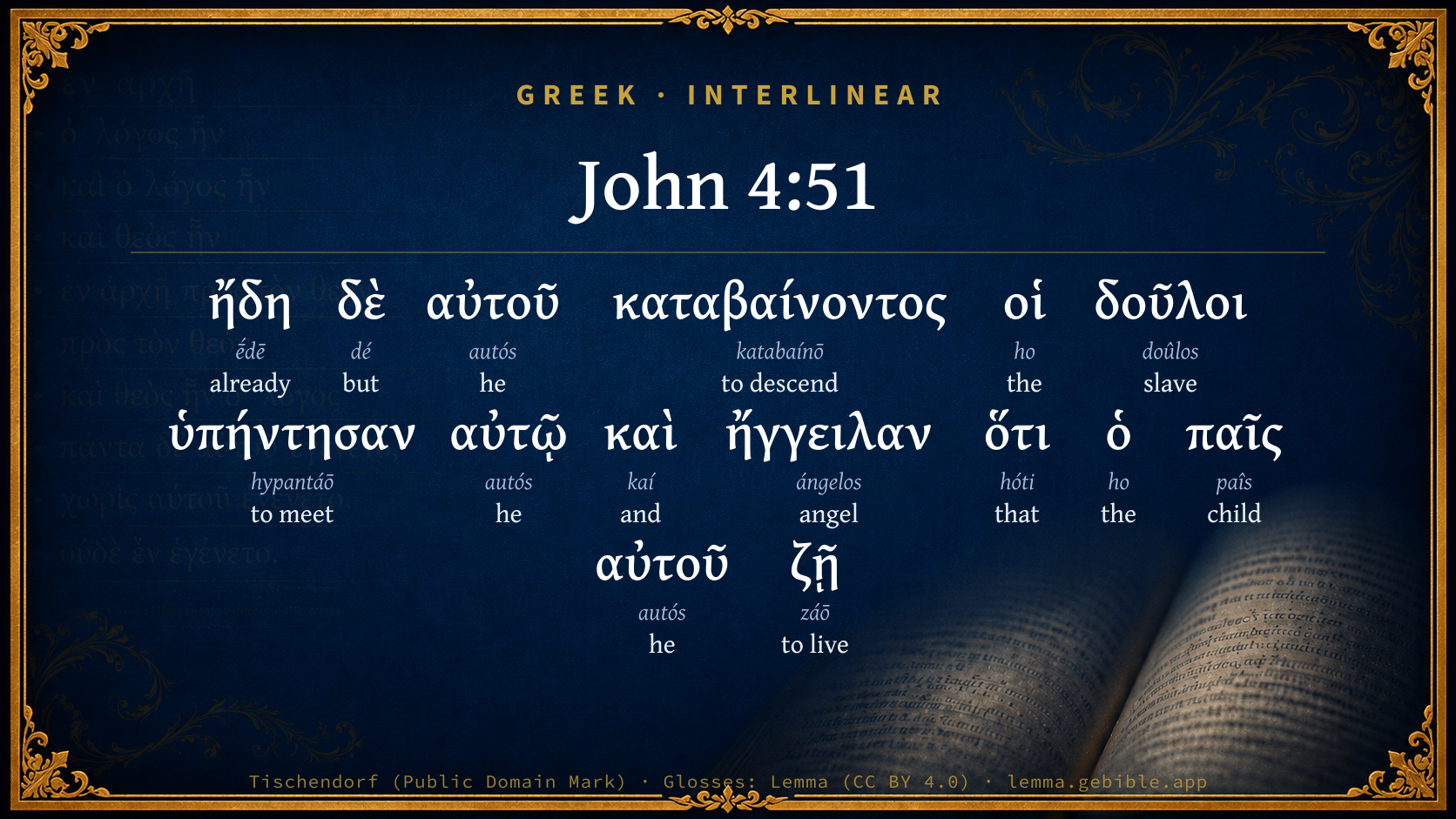
  1. ἤδη ḗdē G2235 “already” Adverb
  2. δὲ dé G1161 “but” Conjunction
  3. αὐτοῦ autós G846 “he” Personal pronoun, Genitive, Singular, Masculine
  4. καταβαίνοντος katabaínō G2597 “to descend” Verb, Present, Active, Participle, Genitive, Singular, Masculine
  5. οἱ ho G3588 “the” Article, Nominative, Plural, Masculine
  6. δοῦλοι doûlos G1401 “slave” Noun, Nominative, Plural, Masculine
  7. αὐτῷ autós G846 “he” Personal pronoun, Dative, Singular, Masculine
  8. καὶ kaí G2532 “and” Conjunction
  9. ἤγγειλαν ángelos G32 “angel” Verb, Aorist, Active, Indicative, 3rd person, Plural
  10. ὅτι hóti G3754 “that” Conjunction
  11. ὁ ho G3588 “the” Article, Nominative, Singular, Masculine
  12. παῖς paîs G3816 “child” Noun, Nominative, Singular, Masculine
  13. αὐτοῦ autós G846 “he” Personal pronoun, Genitive, Singular, Masculine
  14. ζῇ záō G2198 “to live” Verb, Present, Active, Indicative, 3rd person, Singular

About this verse

These counts appear in no published source. They are computed here, from the morphology-tagged text and Lemma’s own curated glosses. What Lemma adds →

15
words
12
distinct lemmas
Gospels
section

Notable vocabulary

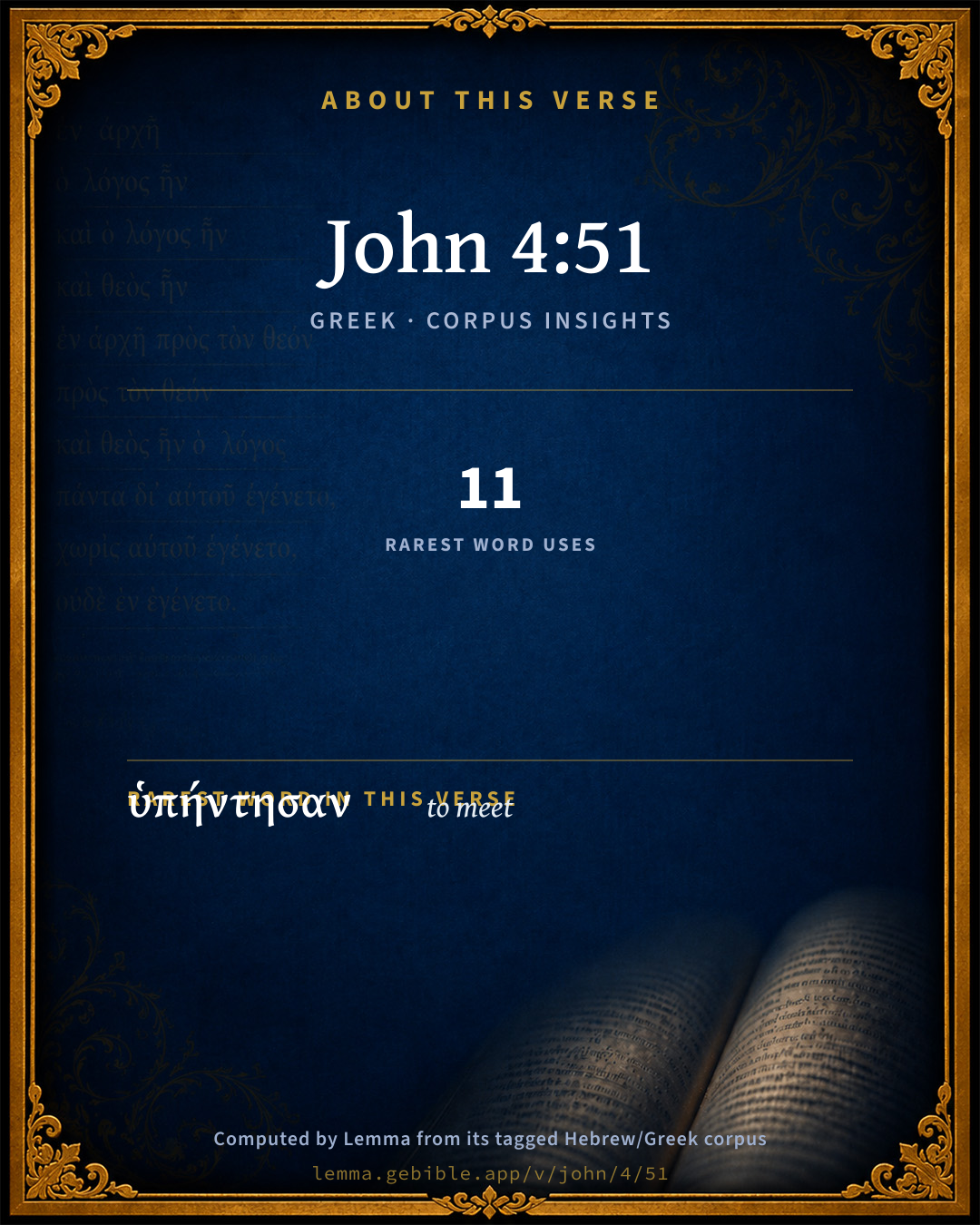
The rarest word here is ὑπήντησαν to meet G5221 — appearing just 11 times in the whole Greek New Testament.

Shared distinctive vocabulary

ὑπήντησαν to meet G5221 occurs in 11 verses of the Greek New Testament. Also found in:

Repetition

Words recur within this verse:

  • αὐτοῦ he G846 ×3
  • οἱ the G3588 ×2

Cross-references

1

Topical passages linked to John 4:51 in the Treasury of Scripture Knowledge — connected by theme and wording, ordered by reader-vote popularity; previews shown in the World English Bible.

  • 1 Kings 17:23 Elijah took the child, and brought him down out of the chamber into the house, and delivered him to his mother; and Elijah said, Behold, your son lives.

Cross-references courtesy of OpenBible.info (CC BY 4.0).

Where the printed editions differ

1 variant

Places in this verse where the major printed Greek editions disagree on the wording in a way that affects the translation — a comparison of editions, not a manuscript-by-manuscript collation. The editions are the modern critical texts (Nestlé-Aland 28/27, SBL, Westcott-Hort, Tregelles, Tyndale House) and the traditional texts behind the KJV (the Textus Receptus and the Byzantine/Majority text). It is not a claim about which reading is original.

  1. Different wording
    αὐτοῦ

    “of him”

    In NA28NA27TynSBLWHTreg Not in TRByz

    σου (sou) 'of you' occurs in traditional manuscripts (TR+Byz) instead of αὐτοῦ (autou) 'of him' in older manuscripts (NA28+NA27+Tyn+SBL+WH+Treg)

Textual data: Translators Amalgamated Greek New Testament (STEPBible TAGNT) · CC BY 4.0.

Commentary

Notes on John 4:51 from classic Christian and Jewish commentators (each source and its license shown beneath its notes). The classic Christian expositions comment on the surrounding passage and are grouped to its opening verse, so a note may address several verses; the Jewish commentaries on the Tanakh (Rashi and others) are per-verse, so they appear only where the commentator wrote on this verse.

Lemma curates 59 commentaries, every one of them public domain or Creative Commons licensed, each selected and text-cleaned for this edition rather than reprinted as found. About our sources →

Bengel's Gnomon

Johann Albrecht Bengel

Joh 4:51. Ἤδη, now) He was therefore hastening, in order that he might see those things which he believed: yet the trial of his faith lasted till the following day. He believes even his servants before that he sees.—οἱ δοῦλοι, servants) who themselves also subsequently believed.—ἀπήνησαν, met) Because the patient had so quickly become convalescent, they were desirous of knowing what had happened, and of gladdening their master by the tidings of his son’s recovery. Their joy was mutual. Without doubt the servants said, At this very seventh hour our master spake with Jesus [and so inferred, the cure was due to His miraculous power].—ζῇ, liveth) They announce the fact in the same words which Jesus had spoken [Joh 4:50].

Bengel's Gnomon of the New Testament — English translation (T&T Clark, Edinburgh, 1860) — public domain. Text from a community e-Sword module.

Meyer's Critical & Exegetical Commentary

Heinrich August Wilhelm Meyer

Joh_4:51-54. Αὐτοῦ καταβ.… αὐτῷ] see Buttmann, N. T. Gr. p. 270 [E. T. p. 315].

ἤδη] belongs to καταβ., not to ὑπήντ. (B. Crusius): when he was already going down, and now was no longer in Cana, but upon his journey back.

οἱ δοῦλοι, κ.τ.λ.] to reassure the father, and to prevent the now unnecessary coming of Jesus.

ζῇ] he is not dead, but the sickness has the opposite issue: he lives!

κομψότερον] finer, prettier, as in common life we are wont to say, he is pretty well. Exactly so in Arrian. Epict. iii. 10 of the sick: κομψῶς ἔχεις, and its opposite κακῶς ἔχεις. Comp. the Latin belle habere. Here it is an amoenum verbum (Bengel) of the fathers heart, which apprehends its good fortune still with feelings of tenderness and anxiety.

ἐχθές] see Lobeck, ad Phryn. p. 323.

ὥραν ἑβδόμην] He had therefore been on the way since one oclock the day before, because we must suppose from Joh_4:50 that he set out immediately after the assurance of Jesus. This also seems strange to us, considering the distance from Cana to Capernaum, not exactly known to us indeed, but hardly three geographical miles. That in his firm faith he travelled non festinans (Lampe) is unnatural; the impulse of parental love would hurry him home; and so is also the idea that he stayed the night somewhere on the way, or at Cana (Ewald assumes the latter, making the seventh hour seven in the evening, according to the Roman reckoning). We may suppose some delay not named, on the journey back, or (with Hengstenberg, Brückner, and others) take the to-day in the mind of the Jewish servants as denoting the day which began at six P.M. (sunset). According to Baur and Hilgenfeld, this noting of the time is to be attributed, not to the genuineness and originality of the account, but to the subjective aim of the writer, which was to make the miracle as great and pointed as possible (comp. Joh_4:54, note).

ἐν ἐκ. τ. ὥρᾳ] sc. ἀφῆκεν αὐτὸν ὁ πυρετός. Observe, with reference to ἐκεῖνος, that it does not mean idem, but is the simple relative ille.

κ. ἐπίστευσεν, κ.τ.λ.] upon Jesus as the Messiah. Καλῶς οὖν καθήψατο αὐτοῦ ὁ τὴν καρδίαν αὐτοῦ γινώσκων Χριστὸς, εἰπών· ὅτι ἐὰν μὴ σημεῖα, κ.τ.λ., Euthymius Zigabenus. Observe how faith here attains its realization as to its object, and further, the importance of this καὶ ἡ οἰκία αὐτοῦ (the first household), which now occurs for the first time. Comp. Act_16:14-15; Act_16:34; Act_18:8.

τοῦτο πάλιν δεύτερον, κ.τ.λ.] Referring back to Joh_2:11. Literally inaccurate, yet true as to its import, is the rendering of Luther: This is the second miracle that Jesus did; τοῦτο stands by itself, and the following δεύτ. σημ. supplies the place of the predicate (this Jesus did as the second miracle), hence no article follows τοῦτο. See on Joh_2:11, and Bremi, ad Lys. Exc. II. p. 436 f.; Ast, Lex. Plat. II. 406; Stallbaum, ad Plat. Apol. pp. 18 A, 24 B. Πάλιν, however, must not be overlooked, nor is it to be joined with δεύτερον (so usually) as a current pleonasm (see on Mat_26:42; comp. Joh_21:15, Act_10:15), for δεύτερον is not an adverb, but an adjective. It rather belongs to ἐποίησεν, thus affirming that Jesus now again did this as a second miracle (comp. Beza) upon His return from Judea to Galilee (as in Joh_2:1). Thus the idea that the miracle was a second time wrought upon His coming out of Judea into Galilee is certainly doubly expressed,once adverbially with the verb (πάλιν ἐποίησεν), and then adjectivally with the noun (δεύτερονσημ.); both receive their more minute definition by ἐλθὼν, κ.τ.λ. Schweizer (p. 78) quite arbitrarily considers the reference to the first miracle at Cana unjohannean.

Note.

The βασιλιχός is not the same with the Centurion of Mat_8:5 ff.; comp. Luk_7:2 ff. (Origen, Chrysostom, Theophylact, Euthymius Zigabenus, and most others). On the assumption of their identity (Irenaeus, Eusebius, Semler, Seyffarth, Strauss, Weisse, B. Bauer, Gfrörer, Schweizer, Ammon, Baumgarten Crusius, Baur, Hilgenfeld, Ewald, Weizsäcker), which thus attributes the greater originality on the one hand to Matthew and Luke (Strauss, B. Bauer, Weisse, Baur, Hilgenfeld), on the other to John (Gfrörer, Ewald), and to the latter an adjusting purpose (Weizsäcker), the discrepancies as to place, time, and even as regards the sick person, constitute lesser difficulties, as well as the entirely different character in which the suppliant appears in John and in the two Synoptics. In these latter he is still a heathen, which, according to John, he cannot be (against Cyril, Jerome, Baur, and Ewald); see Joh_4:48, which represents him as associated with Galileans, and therefore Jews; and this alone suffices to establish the difference of the two miracles, apart from the fact that there is no more objection against the supposition of two healings wrought at a distance than against one. This is at the same time against Schweizers view, that the section in John is an interpolation. Indeed, a single example of healing at a distance, the historical truth of which, moreover, even Ewald maintains, might more easily be resolved by the arbitrariness of criticism into a myth borrowed from the history of Naaman, 2Ki_9:5; 2Ki_9:9 ff. (Strauss), or be explained away as a misunderstanding of a parable (Weisse), or be dissolved into a subjective transposition and development of the synoptical materials on Johns part for his own purpose, which would make the belief in miracles plainly pass beyond the Jewish range of view (Hilgenfeld), and appears in its highest form as a πιστεύειν διὰ τὸν λόγον (Baur, p. 152);[202] although πιστεύειν τῷ λόγῳ, Joh_4:41, is something quite different from πιστεύειν διὰ τὸν λόγον, and the ἐπίστευσεν in Joh_4:53 took place, not διὰ τὸν λόγον, but διὰ τὸ σημεῖον.

[202] If John had really derived his matter from the Synoptics, it would be quite inconceivable how, according to the design attributed to him by Baur, he could have left unused the statement of Mat_8:10, especially if the βασιλικός is taken to be a Gentile. See Hase, Tübingen Schule, pp. 32, 33.

Meyer — Critical and Exegetical Commentary on the New Testament — English translation by Peter Christie, edited by Frederick Crombie (T&T Clark, 1880) — public domain. Text from a community e-Sword module.

Expositor's Greek Testament

ed. W. Robertson Nicoll

Joh 4:51 . And while already on his way down [ ἤδη showing that he did not remain with Christ until from some other source he heard that his son was healed], his servants met him and gave him the reward of his faith. ὁ παῖς σου ζῇ , an echo, as Weiss remarks, of the words of Jesus, Joh 4:50 . The servants seeing the improvement in the boy and not ascribing it to miracle, set out to save their master from bringing Jesus to Capernaum.

The Expositor's Greek Testament, edited by W. Robertson Nicoll (1897–1910) — public domain. Text from a community e-Sword module.

John Calvin's Commentaries

51. While he was still going down. Here is described the effect of faith, together with the efficacy of the word; for as Christ, by a word, restores to life this child who was just dying, so in one moment the father, by his faith, regains his son safe and sound. Let us therefore know that, whenever the Lord offers his benefits to us, his power will always be ready to accomplish whatever he promises, provided that the door be not shut against him by our unbelief. It does not always happen, I acknowledge, and even is not frequent or ordinary, that God instantly displays his arm for giving us assistance; but whenever he delays, he has always a good reason, and one that is highly advantageous to us. This at least is certain, that so far is he from delaying unnecessarily, that he rather contends with the obstacles which we throw in the way; and, therefore, when we do not see his immediate aid, let us consider how much of concealed distrust there is in us, or at least how small and limited our faith is. And we ought not to wonder if He is unwilling to allow his benefits to be lost, or to throw them at random on the ground, but chooses to bestow them on those who, by opening the bosom of their faith, are ready to receive them. And though he does not always assist his people in the same manner, yet in no instance will the faith of any one be fruitless, or hinder us from experiencing the truth of what the Prophet says, that the promises of God, even when they seem to delay, are in reality making great haste.

Though it tarry, wait for it; because it will surely come, it will not tarry, (Habakkuk 2:3.)

John Calvin's Commentaries (1540-1563) — public domain. Text from the Calvin Translation Society English edition (1840s-50s) via the Christian Classics Ethereal Library (ccel.org). Calvin's coverage is partial (roughly two-thirds of the Bible); uncommented books and verses are honest gaps, never fabricated. The 19th-century editor's footnotes and remarks are omitted so the notes are faithfully Calvin's own voice.

Ellicott's Commentary for English Readers

(51) And as he was now going.—Many a long mile lay between him and his child, and many an anxious thought must have come to his mind as he journeyed homeward. Now faith would be strong, and now almost give way; but he travels on with the words, “Thy son liveth,” which had come to him as a voice from heaven, sustaining and cheering him. Again he hears the same words, “Thy son liveth!” but they are spoken by the servants, who have come to meet him, and bring from Capernaum the glad news that he had himself heard at Cana.

A Bible Commentary for English Readers, edited by Charles John Ellicott (1878–1897) — public domain. Text from a community e-Sword module.

John Gill's Exposition

And as he was now going down,.... From Cana to Capernaum, the day after he had been with Christ:

his servants met him, and told him, saying, thy son liveth; as soon as this cure was wrought, though it was not known in the family how, and by whom it was done, immediately some of the servants were dispatched to carry the news to their master, that his sorrow might be removed; and he give himself no further trouble in seeking for a cure: these meeting him on the road, with an air of pleasure, at once address him with the joyful news, that his son was thoroughly recovered of his disorder, and was alive, and well; news which he was acquainted with, and believed before; though it must give him an additional, pleasure to have it confirmed.

John Gill's Exposition of the Whole Bible (1746–1763) — public domain (CC PDM 1.0). Text via the HelloAO Bible API.

Trapp's Complete Commentary

John Trapp

51 And as he was now going down, his servants met him, and told him, saying, Thy son liveth.

Ver. 51. Thy son liveth] So the son was restored by his father’s faith. It is a benefit to be born of good parents. Personal goodness is profitable to posterity.

John Trapp, A Commentary or Exposition upon All the Books of the Old and New Testament (1647–1656) — public domain. Text from a community e-Sword module.

Matthew Poole's English Annotations

The servants that met him to bring the acceptable news of his son’s recovery, knew nothing of the passages that had been betwixt Christ and their master, but merely came to tell their master what they knew would be acceptable to him.

Matthew Poole's English Annotations on the Holy Bible (1683–1685) — public domain. Text from a community e-Sword/MySword module.

The Pulpit Commentary

Now as he was going down to Capernaum (if we take any of the more recent determinations of the site of Cana, (see Joh_2:1, Joh_2:2) this means that he had traversed a distance of between twenty and twenty-five miles, so that there is no reason to treat with ridicule or regard as inexplicable the time taken for the return journey, or that a night should have been spent in the transit from Cana), his servants methim, saying, that his boy lived. The oblique form is certainly far more reasonable, less mechanical, and more likely to have been altered into the direct form by an incautious copyist from the previous verse, than to have constituted the original text. Note that Jesus used the most dignified title, "son" (uiov); the father employs the tender diminutive (paidion); while the servants use the domestic term (paiv).

The Pulpit Commentary (1880–1919), ed. H.D.M. Spence-Jones & Joseph S. Exell — public domain. Text from a community e-Sword module.

Kretzmann's Popular Commentary

Paul E. Kretzmann

Faith vindicated:

v. 51. And as he was now going down, his servants met him, and told him, saying, Thy son liveth.

v. 52.Then enquired he of them the hour when he began to amend. And they said unto him, Yesterday at the seventh hour the fever left him.

v. 53. So the father knew that it was at the same hour in the which Jesus said unto him, Thy son liveth; and himself believed and his whole house.

v. 54. This is again the second miracle that Jesus did when He was come out of Judea into Galilee.

The officer did not reach home that evening any more. But early the next morning he was met by some of his servants with the joyful news that his son was alive and doing well. It is a fine testimony for this master that his servants thought so much of him as to set out with their glad tidings at once. The careful official now insisted upon finding out the exact hour when the sickness had receded from his son and left him well. And when they told him that it had been on the day before, at one o’clock in the afternoon, he knew that it was at just that time that Jesus had spoken the words of reassurance. So he experienced the truth of Christ’s words, he found out that God keeps His promises. And therefore he himself was confirmed in his faith, greatly strengthened. And his family and servants, to whom he brought the glorious news of the manner of the cure, rejoiced and believed with him. Thus the nobleman’s faith progressed from weakness to strength, from trusting in external. visible evidence to believing in the Word only, as is the manner of faith the world over. "Thus the Lord God deals also with us, in order to make us more perfect and place us into a higher station. If we pass through such experiences, then we gain knowledge and become sure of our faith. " This miracle Jesus performed as the second in Galilee after He had come from Judea. The time of the full ministry of miracles in Galilee was still in the future.

Summary.Jesus has a long conversation with the woman of Samaria, through which He works faith in her heart and willingness to do missionary work for Him,. He then passes on into Galilee and heals the son of the nobleman of Capernaum.

Paul E. Kretzmann, Popular Commentary of the Bible (1921–1924) — public domain. Text from a community e-Sword module.

unfoldingWord translationNotes

Door43 World Missions Community

While

This word is used to mark two events that are happening at the same time. As the official was going home, his servants were coming to meet him on the road.

translationWords

servant

son

life

hour

unfoldingWord translationNotes — © Distant Shores Media and the Door43 World Missions Community, licensed CC BY-SA 4.0. Source: git.door43.org/Door43/en_tn.

Cambridge Greek Testament for Schools and Colleges

51. ὑπήντησαν (always used by S. Joh 11:20; Joh 11:30; Joh 12:18) for ἀπήντησαν (never used by him), with אBCDKL against A.

Cambridge Greek Testament for Schools and Colleges (Cambridge University Press, 1896; 21 vols, various authors incl. Carr, Maclear, Plummer, Farrar, Lumby, Moule, M. R. James, Simcox) — public domain. Text from a community e-Sword module.

Alford’s Greek Testament

Henry Alford

51.] He appears [see below] to have gone leisurely away,—for the hour (1 p.m.) was early enough to reach Capernaum the same evening (twenty-five miles): in confidence that an amendment was taking place, which he at present understood to be only a gradual one.

52,

Henry Alford, The Greek Testament (1849–1861) — public domain. Text from a community e-Sword module.

International Critical Commentary

51. ὑπήντησαν. So אBCDLNΘW; the rec. has ἀπήντησαν. Cf. 11:20, 30, 12:18.

After αὐτῷ the rec. adds καὶ ἀπήγγειλαν (אD have ἤγγειλαν); om. BLN.

ὁ παῖς. This is the only appearance of παῖς in Jn., and it is replaced (wrongly) by υἱός in DL fam. 13. See on v. 49.

For αὐτοῦ (אABCW), the rec. has σου (with DLΔΘ), as if ὅτι after λέγοντες were ὅτι recitantis, introducing the actual words of the servants.

International Critical Commentary — older volumes (1896–1929), various authors — public domain. Text from a community e-Sword module.

Godet's Commentaries

Frédéric Louis Godet

Vv. 51-53. “As he was now going down, his servants met him, and told him saying.Thy son liveth. 52. So he inquired of them the hour when he began to mend. They said to him: yesterday, at the seventh hour, the fever left him.

53. The father, therefore, knew that it was at that hour in which Jesus had said to him:Thy son liveth. And he believed, himself and all his house.” The servants, in their report, use neither the term of affection (παιδίον), which would be too familiar, nor that of dignity (υἱός), which would not be familiar enough, but that of family life:παῖς, the child, which the T. R. rightly gives. The selected term κομψότερον, suits well the mouth of a man of rank. It is the expression of a comparative improvement; as we say, finely. The seventh hour, according to the ordinary Jewish mode of reckoning, denotes one o’clock in the afternoon (see on Joh 1:40). But if it was at that hour that Jesus had given his answer to the father, how was it that he did not return to his home on the same day? For seven leagues only separate him from his house. Those also who, like Keil, Westcott, etc., think that John used, in general, the mode of reckoning the hours which was usual in the Roman courts, support their view, with a certain probability, by our passage. Nevertheless, even on the supposition that Χθές, yesterday, proves that it was really the following day, in the ordinary sense of the word, this delay may be explained either by the necessity of letting his horses rest or by the fear of traveling by night. But the term yesterday does not even compel us to suppose that a night has elapsed since the healing of the child. For as the day, according to the Hebrews, closed at sunset, the servants might, some hours after this, say yesterday.

At this moment the faith of this man rises, at last, to a higher degree, that of personal experience. Hence the repetition of the word: and he believed; comp. Joh 2:11. The entire household is borne on by this movement of faith impressed on the heart of their head.

Frédéric Louis Godet — Commentaries on Luke, John, Romans, and 1 Corinthians — English translation (T&T Clark, Edinburgh, 1870s–1890s) — public domain. Text from a community e-Sword module.

Lesson kit

Teaching starters — assembled from the data on this page, not authored interpretation. Every prompt links to the verse data it draws on. Edit before teaching.

John, in the Gospels, opens this verse with 15 words (12 distinct Greek lemmas). Its most distinctive word is hypantáō (“to meet”). A historical commentator’s framing appears above. Read the whole chapter for the surrounding context.

Discussion questions

  1. The word hypantáō carries the sense “to meet.” How does it shape the verse?
  2. How does Matthew 8:28, which shares the word «to meet», read alongside this verse?
  3. What does the repetition of “he” (3× in this one verse) do in this verse?
  4. These translations render this verse differently; the difference is in the English rendering, not the original. What questions does that raise?
  5. Compare how Bengel's Gnomon and Meyer's Critical & Exegetical Commentary read this verse. Where do they agree or differ?

Things to notice

Reading settings

Reading text

Shown beneath each verse's original-language words.

Old Testament
Old Testament edition

Read the OT as the Masoretic Hebrew (MT) or the Greek Septuagint (LXX).

English shown for the Greek Septuagint (in the Hebrew ↔ Greek comparison).

Comparing translations? Open the Compare panel on any verse page to stack up to four side by side.