
John 4:10

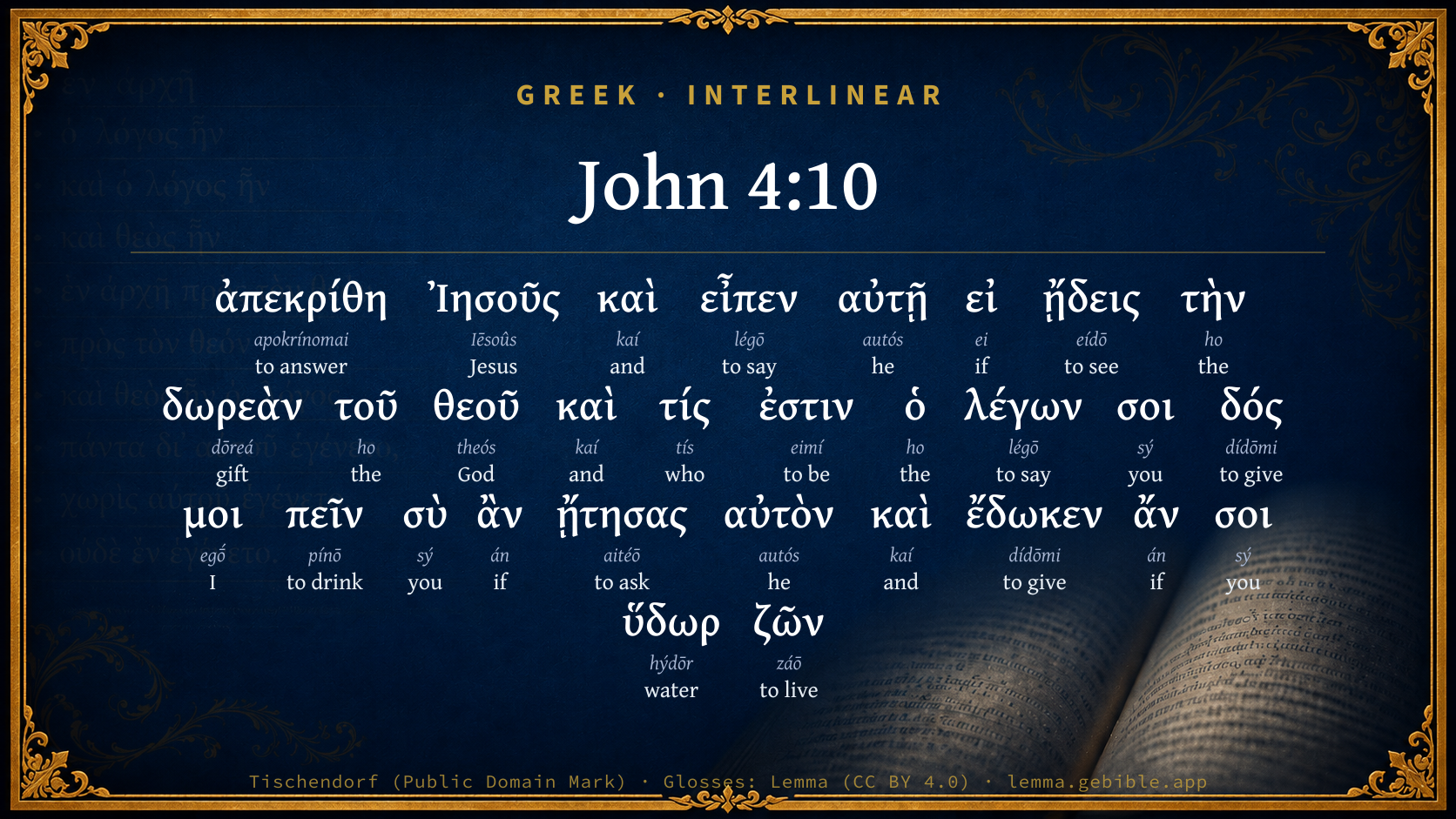
Greek (Tischendorf 8th ed.) John 4:10 appears in the Greek New Testament. The text above is from the Tischendorf 8th edition. Each word links to its Strong’s number and a concise gloss. Click any word for its full Thayer’s Greek Lexicon entry.
Download image
Cite this verse

John 4:10 (World English Bible). Public Domain. Lemma interlinear Bible study tool, https://lemma.gebible.app/v/john/4/10.

Show BibTeX & RIS
BibTeX
RIS
English Translation
Jesus answered her, "If you knew the gift of God, and who it is who says to you, 'Give me a drink,' you would have asked him, and he would have given you living water."
World English Bible · Public Domain
Highlights
  • 1 first appearance in the Greek New Testament
Full analysis ↓
Download a study sheet

One document with this verse’s original text, its word-by-word gloss line, the meaning frame, cross-references with their text, attributed commentary, and full source and license credits — printable, and it pastes into notes with its structure intact.

This verse Autodidact and up

Study sheet (.html) Plain text (.txt)

A passage Seminary Student

Up to 50 verses in one chapter. A passage sheet keeps up to 6 commentary sources and 12 cross-references per verse, in the order this page ranks them, and says so on the sheet whenever that leaves anything out. Ask for a single verse and you get the Autodidact verse sheet above.

Everything on this page stays free to read, with no account — the sheet is a download of what is already on screen, not access to it.

Want to remove ads? Support Godless Engineer
Compare translations 3

The same verse in 3 English versions, stacked beneath the original-language interlinear above. Click any original word for its lexicon entry.

Each is an independent rendering of the whole verse — the interlinear is not word-aligned to these translations.

Highlighted words mark where these versions differ — a whole-verse word diff, not a word-by-word alignment.

  • World English Bible Public Domain
    Jesus answered her, "If you knew the gift of God, and who it is who says to you, 'Give me a drink,' you would have asked him, and he would have given you living water."
  • King James Version Public Domain
    Jesus answered and said unto her, If thou knewest the gift of God, and who it is that saith to thee, Give me to drink; thou wouldest have asked of him, and he would have given thee living water.
  • unfoldingWord Literal Text CC BY-SA 4.0
    Jesus answered and said to her, “If you had known the gift of God and who is the one saying to you, ‘Give me to drink,’ you would have asked him, and he would have given you living water.”

unfoldingWord Literal Text — © unfoldingWord, licensed CC BY-SA 4.0. Word-aligned USFM3 via Door43 (git.door43.org/unfoldingWord/en_ult).

Versions to compare (up to 4)

3 of 4 selected

Show all 19 translations

Every available English version of this verse, each an independent rendering of the whole verse.

  • World English Bible Public Domain
    Jesus answered her, "If you knew the gift of God, and who it is who says to you, 'Give me a drink,' you would have asked him, and he would have given you living water."
  • Berean Standard Bible Public Domain
    Jesus answered, “If you knew the gift of God and who is asking you for a drink, you would have asked Him, and He would have given you living water.”
  • Majority Standard Bible Public Domain
    Jesus answered, “If you knew the gift of God and who is asking you for a drink, you would have asked Him, and He would have given you living water.”
  • King James Version Public Domain
    Jesus answered and said unto her, If thou knewest the gift of God, and who it is that saith to thee, Give me to drink; thou wouldest have asked of him, and he would have given thee living water.
  • American Standard Version (1901) Public Domain
    Jesus answered and said unto unto her, If thou knewest the gift of God, and who it is that saith to thee, Give me to drink; thou wouldest have asked of him, and he would have given thee living water.
  • Revised Version (1885) Public Domain
    Jesus answered and said unto her, If thou knewest the gift of God, and who it is that saith to thee, Give me to drink; thou wouldest have asked of him, and he would have given thee living water.
  • Geneva Bible (1599) Public Domain
    Iesus answered and saide vnto her, If thou knewest that gift of God, and who it is that saieth to thee, Giue mee drinke, thou wouldest haue asked of him, and hee woulde haue giuen thee, water of life.
  • Douay-Rheims (1899) Public Domain
    Jesus answered, and said to her: If thou didst know the gift of God, and who he is that saith to thee, Give me to drink; thou perhaps wouldst have asked of him, and he would have given thee living water.
  • Young's Literal Translation Public Domain
    Jesus answered and said to her, `If thou hadst known the gift of God, and who it is who is saying to thee, Give me to drink, thou wouldest have asked him, and he would have given thee living water.'
  • Literal Standard Version CC BY-SA 4.0
    Jesus answered and said to her, “If you had known the gift of God, and who it is who is saying to you, Give Me to drink, you would have asked Him, and He would have given you living water.”
  • Unlocked Literal Bible CC BY-SA 4.0
    Jesus answered and said to her, “If you had known the gift of God, and who it is that is saying to you, 'Give me a drink,' you would have asked him, and he would have given you living water.”
  • unfoldingWord Literal Text CC BY-SA 4.0
    Jesus answered and said to her, “If you had known the gift of God and who is the one saying to you, ‘Give me to drink,’ you would have asked him, and he would have given you living water.”
  • Darby Bible Public Domain
    Jesus answered and said to her, If thou knewest the gift of God, and who it is that says to thee, Give me to drink, thou wouldest have asked of him, and he would have given thee living water.
  • World Messianic Bible Public Domain
    Yeshua answered her, “If you knew the gift of God, and who it is who says to you, ‘Give me a drink,’ you would have asked him, and he would have given you living water.”
  • Webster's Bible Public Domain
    Jesus answered and said to her, If thou knewest the gift of God, and who it is that saith to thee, Give me to drink; thou wouldst have asked him, and he would have given thee living water.
  • Free Bible Version CC BY-SA 4.0
    Jesus answered her, “If you only recognized God's gift, and who is asking you, ‘Please could you give me a drink?’ you would have asked him and he would have given you the water of life.”
  • Bible in Basic English Public Domain
    In answer Jesus said, If you had knowledge of what God gives freely and who it is who says to you, Give me water, you would make your prayer to him, and he would give you living water.
  • Text-Critical English NT CC BY 4.0
    Jesus answered her, “If yoʋ knew the gift of God and who it is that is saying to yoʋ, ‘Give me some water to drink,’ yoʋ would have asked him, and he would have given yoʋ living water.”
  • Tyndale New Testament (1534) Public Domain
    Iesus answered and sayde vnto hir: yf thou knewest the gyfte of God and who it is that sayeth to the geve me drynke thou woldest have axed of him and he wolde have geven the water of lyfe.

Literal Standard Version (2020), Covenant Press — licensed CC BY-SA 4.0. Text via the HelloAO Bible API (eBible.org). Unlocked Literal Bible (unfoldingWord) — licensed CC BY-SA 4.0. Text via the HelloAO Bible API (eBible.org). unfoldingWord Literal Text — © unfoldingWord, licensed CC BY-SA 4.0. Word-aligned USFM3 via Door43 (git.door43.org/unfoldingWord/en_ult). Free Bible Version, Dr. Jonathan Gallagher — licensed CC BY-SA 4.0. Text via the HelloAO Bible API (eBible.org).

Word by word

More ways to search: Search by grammar → Find every occurrence → Compare this word →

Practice this passage: Drill this verse → Learn its vocabulary →

δωρεὰν
dōreá
G1431
“gift”
Noun, Accusative, Singular, Feminine
Part of Speech
Noun
Case
Accusative
Number
Singular
Gender
Feminine
Full Thayer's Definition

Origin: from G1435

TDNT: 04:46,2

1. a gift
  1. ἀπεκρίθη apokrínomai G611 “to answer” Verb, Aorist, Middle deponent, Indicative, 3rd person, Singular
  2. Ἰησοῦς Iēsoûs G2424 “Jesus” Noun, Nominative, Singular, Masculine
  3. καὶ kaí G2532 “and” Conjunction
  4. εἶπεν légō G3004 “to say” Verb, Aorist, Active, Indicative, 3rd person, Singular
  5. αὐτῇ autós G846 “he” Personal pronoun, Dative, Singular, Feminine
  6. εἰ ei G1487 “if” Conditional
  7. ᾔδεις eídō G1492 “to see” Verb, Pluperfect, Active, Indicative, 2nd person, Singular
  8. τὴν ho G3588 “the” Article, Accusative, Singular, Feminine
  9. τοῦ ho G3588 “the” Article, Genitive, Singular, Masculine
  10. θεοῦ theós G2316 “God” Noun, Genitive, Singular, Masculine
  11. καὶ kaí G2532 “and” Conjunction
  12. τίς tís G5101 “who” Interrogative pronoun, Nominative, Singular, Masculine
  13. ἐστιν eimí G1510 “to be” Verb, Present, Active, Indicative, 3rd person, Singular
  14. ὁ ho G3588 “the” Article, Nominative, Singular, Masculine
  15. λέγων légō G3004 “to say” Verb, Present, Active, Participle, Nominative, Singular, Masculine
  16. σοι sý G4771 “you” Personal pronoun, 2nd person, Dative, Singular
  17. δός dídōmi G1325 “to give” Verb, Aorist, Active, Imperative, 2nd person, Singular
  18. μοι egṓ G1473 “I” Personal pronoun, 1st person, Dative, Singular
  19. πεῖν pínō G4095 “to drink” Verb, Aorist, Active, Infinitive
  20. σὺ sý G4771 “you” Personal pronoun, 2nd person, Nominative, Singular
  21. ἂν án G302 “if” Particle
  22. ᾔτησας aitéō G154 “to ask” Verb, Aorist, Active, Indicative, 2nd person, Singular
  23. αὐτὸν autós G846 “he” Personal pronoun, Accusative, Singular, Masculine
  24. καὶ kaí G2532 “and” Conjunction
  25. ἔδωκεν dídōmi G1325 “to give” Verb, Aorist, Active, Indicative, 3rd person, Singular
  26. ἄν án G302 “if” Particle
  27. σοι sý G4771 “you” Personal pronoun, 2nd person, Dative, Singular
  28. ὕδωρ hýdōr G5204 “water” Noun, Accusative, Singular, Neuter
  29. ζῶν záō G2198 “to live” Verb, Present, Active, Participle, Accusative, Singular, Neuter

About this verse

These counts appear in no published source. They are computed here, from the morphology-tagged text and Lemma’s own curated glosses. What Lemma adds →

30
words
20
distinct lemmas
Gospels
section

Notable vocabulary

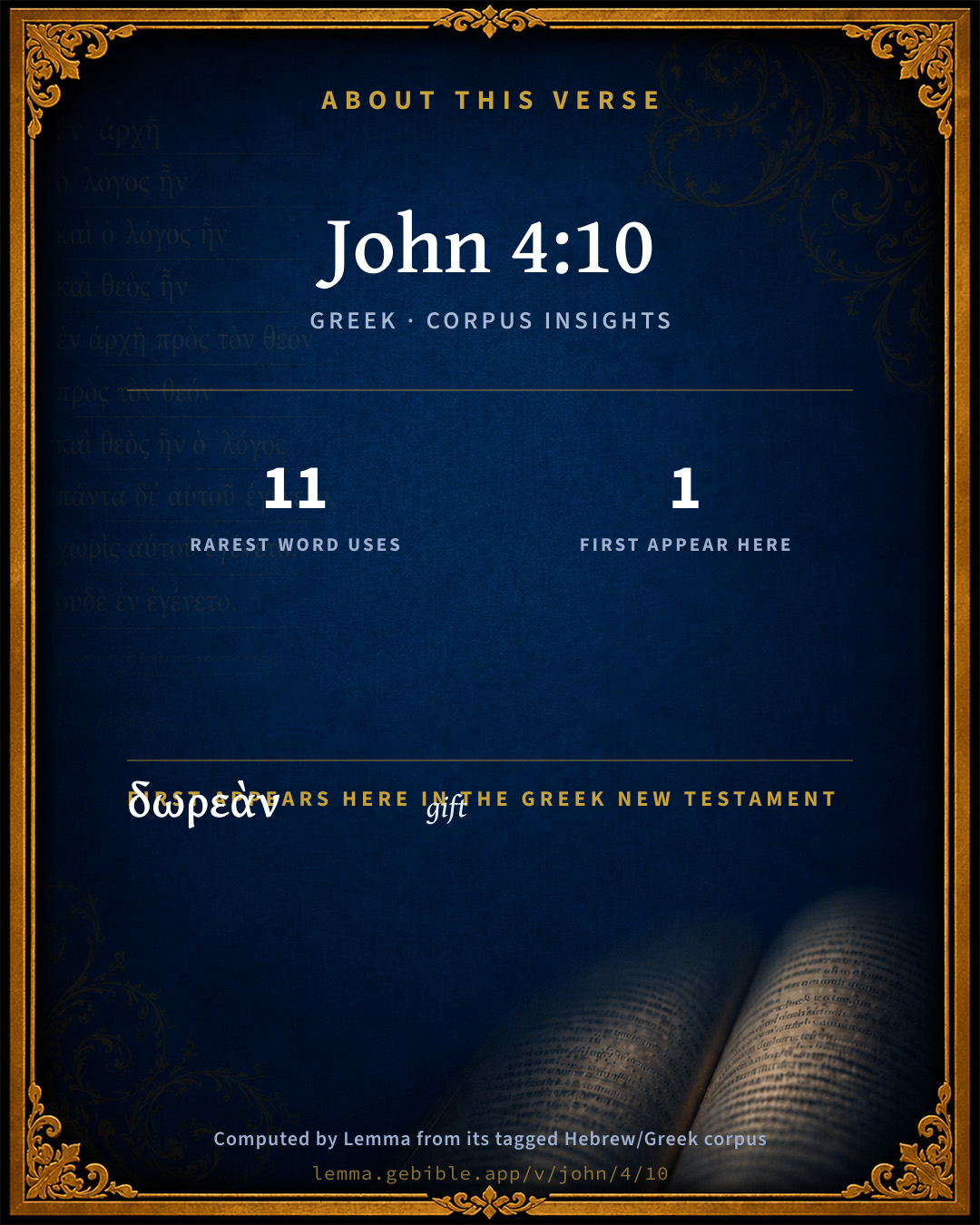
The rarest word here is δωρεὰν gift G1431 — appearing just 11 times in the whole Greek New Testament.

First appearance in Scripture

This word makes its first canonical appearance in the Greek New Testament here:

  • δωρεὰν gift G1431

Shared distinctive vocabulary

δωρεὰν gift G1431 occurs in 11 verses of the Greek New Testament. Also found in:
Repetition

Words recur within this verse:

Cross-references

45

Topical passages linked to John 4:10 in the Treasury of Scripture Knowledge — connected by theme and wording, ordered by reader-vote popularity; previews shown in the World English Bible.

  • John 4:14 but whoever drinks of the water that I will give him will never thirst again; but the water that I will give him will become in him a well of water springing up to eternal life."
  • Revelation 7:17 for the Lamb who is in the midst of the throne shepherds them, and leads them to springs of waters of life. And God will wipe away every tear from their eyes."
  • John 7:37–39 Now on the last and greatest day of the feast, Jesus stood and cried out, "If anyone is thirsty, let him come to me and drink!
  • Isaiah 44:3 For I will pour water on him who is thirsty, and streams on the dry ground; I will pour my Spirit on your seed, and my blessing on your offspring:
  • John 3:16 For God so loved the world, that he gave his one and only Son, that whoever believes in him should not perish, but have eternal life.
  • Revelation 21:6 He said to me, "It is done! I am the Alpha and the Omega, the Beginning and the End. I will give freely to him who is thirsty from the spring of the water of life.
  • Psalms 36:8–9 They shall be abundantly satisfied with the abundance of your house. You will make them drink of the river of your pleasures.
  • Jeremiah 2:13 For my people have committed two evils: they have forsaken me, the spring of living waters, and hewed them out cisterns, broken cisterns, that can hold no water.
  • Revelation 22:1–2 He showed me a river of water of life, clear as crystal, proceeding out of the throne of God and of the Lamb,
  • Zechariah 14:8 It will happen in that day, that living waters will go out from Jerusalem; half of them toward the eastern sea, and half of them toward the western sea; in summer and in winter will it be.
  • Romans 8:32 He who didn't spare his own Son, but delivered him up for us all, how would he not also with him freely give us all things?
  • Revelation 22:17 The Spirit and the bride say, "Come!" He who hears, let him say, "Come!" He who is thirsty, let him come. He who desires, let him take the water of life freely.
  • 1 Corinthians 10:4 and all drank the same spiritual drink. For they drank of a spiritual rock that followed them, and the rock was Christ.
  • Isaiah 12:3 Therefore with joy you shall draw water out of the wells of salvation.
  • John 6:35 Jesus said to them, "I am the bread of life. He who comes to me will not be hungry, and he who believes in me will never be thirsty.
  • Isaiah 55:1–3 Ho, everyone who thirsts, come you to the waters, and he who has no money; come you, buy, and eat; yes, come, buy wine and milk without money and without price.
  • Isaiah 49:10 They shall not hunger nor thirst; neither shall the heat nor sun strike them: for he who has mercy on them will lead them, even by springs of water will he guide them.
  • Isaiah 43:20 The animals of the field shall honor me, the jackals and the ostriches; because I give waters in the wilderness, and rivers in the desert, to give drink to my people, my chosen,
  • Zechariah 13:1 "In that day there will be a spring opened to the house of David and to the inhabitants of Jerusalem, for sin and for uncleanness.
  • John 6:51 I am the living bread which came down out of heaven. If anyone eats of this bread, he will live forever. Yes, the bread which I will give for the life of the world is my flesh."
  • John 17:3 This is eternal life, that they should know you, the only true God, and him whom you sent, Jesus Christ.
  • Exodus 17:6 Behold, I will stand before you there on the rock in Horeb. You shall strike the rock, and water will come out of it, that the people may drink." Moses did so in the sight of the elders of Israel.
  • Psalms 46:4 There is a river, the streams of which make the city of God glad, The holy place of the tents of the Most High.
  • Isaiah 35:6 Then shall the lame man leap as a hart, and the tongue of the mute shall sing; for in the wilderness shall waters break out, and streams in the desert.
  • Isaiah 41:17–18 The poor and needy seek water, and there is none, and their tongue fails for thirst; I, Yahweh, will answer them, I, the God of Israel, will not forsake them.
  • Isaiah 55:6–9 Seek you Yahweh while he may be found; call you on him while he is near:
  • Luke 11:13 If you then, being evil, know how to give good gifts to your children, how much more will your heavenly Father give the Holy Spirit to those who ask him?"
  • Isaiah 42:6 I, Yahweh, have called you in righteousness, and will hold your hand, and will keep you, and give you for a covenant of the people, for a light of the Gentiles;
  • Luke 18:13–14 But the tax collector, standing far away, wouldn't even lift up his eyes to heaven, but beat his breast, saying, 'God, be merciful to me, a sinner!'
  • John 4:25–26 The woman said to him, "I know that Messiah comes," (he who is called Christ). "When he has come, he will declare to us all things."
  • 2 Corinthians 9:15 Now thanks be to God for his unspeakable gift!
  • Isaiah 49:6–8 yes, he says, It is too light a thing that you should be my servant to raise up the tribes of Jacob, and to restore the preserved of Israel: I will also give you for a light to the Gentiles, that you may be my salvation to the end of the earth.
  • Ephesians 2:8 for by grace you have been saved through faith, and that not of yourselves; it is the gift of God,
  • 2 Chronicles 33:12–13 When he was in distress, he begged Yahweh his God, and humbled himself greatly before the God of his fathers.
  • Psalms 10:17 Yahweh, you have heard the desire of the humble. You will prepare their heart. You will cause your ear to hear,
  • Isaiah 9:6 For to us a child is born, to us a son is given; and the government shall be on his shoulder: and his name shall be called Wonderful, Counselor, Mighty God, Everlasting Father, Prince of Peace.
  • Ezekiel 47:1–9 He brought me back to the door of the house; and, behold, waters issued out from under the threshold of the house eastward; (for the forefront of the house was toward the east;) and the waters came down from under, from the right side of the house, on the south of the altar.
  • 1 Corinthians 1:30 But of him, you are in Christ Jesus, who was made to us wisdom from God, and righteousness and sanctification, and redemption:
  • 1 John 5:20 We know that the Son of God has come, and has given us an understanding, that we know him who is true, and we are in him who is true, in his Son Jesus Christ. This is the true God, and eternal life.
  • Luke 11:8–10 I tell you, although he will not rise and give it to him because he is his friend, yet because of his persistence, he will get up and give him as many as he needs.
  • Luke 23:42–43 He said to Jesus, "Lord, remember me when you come into your Kingdom."
  • John 9:35–38 Jesus heard that they had thrown him out, and finding him, he said, "Do you believe in the Son of God?"
  • John 16:3 They will do these things because they have not known the Father, nor me.
  • Acts 9:11 The Lord said to him, "Arise, and go to the street which is called Straight, and inquire in the house of Judas for one named Saul, a man of Tarsus. For behold, he is praying,
  • Revelation 3:17–18 Because you say, 'I am rich, and have gotten riches, and have need of nothing;' and don't know that you are the wretched one, miserable, poor, blind, and naked;

Cross-references courtesy of OpenBible.info (CC BY 4.0).

Commentary

Notes on John 4:10 from classic Christian and Jewish commentators (each source and its license shown beneath its notes). The classic Christian expositions comment on the surrounding passage and are grouped to its opening verse, so a note may address several verses; the Jewish commentaries on the Tanakh (Rashi and others) are per-verse, so they appear only where the commentator wrote on this verse.

Lemma curates 59 commentaries, every one of them public domain or Creative Commons licensed, each selected and text-cleaned for this edition rather than reprinted as found. About our sources →

The Biblical Illustrator

Joseph S. Exell

Joh_4:10

If thou knewest the gift of God

Wayside opportunities

I.

THE SIGNIFICANCE AND IMPORTANCE OF WAYSIDE OPPORTUNITIES. Speaking after the ordinary manner this transaction was accidental; apparently unpremeditated on the part of Christ, unexpected on the part of the woman.

1. We go into transactions which involve our highest good or greatest loss as unexpectedly. The woman was looking for the Messiah, but she little expected to find Him a tired traveller. You expect to find God in Church: do you ever expect to find Him in common events?

2. The character of a man, his real strength or weakness, appears not in his seizure of great events but of ordinary ones--not in martyrdom, but in endurance.

3. Opportunities for serving Christ are offered when truth has to be done or spoken, in doing and speaking it not boastfully or independently or impudently, but simply and in love.

4. You meet Christ by the wayside in every duty, great or small, which calls you from the wrong to the right.

5. Opportunities for religious instruction and worship are not confined to one day, place, or act, but every day, everywhere, and by everything that brings us in contact with God. And as the highest religious truth in nature lies close by the way if we will only pluck it, so in the Bible the great truths lie on the surface.

II. How CHRIST USED HIS OPPORTUNITIES.

1. He made them the occasion of a great and effective religious work.

2. The freedom and spontaneousness of Christs teaching fill us with wonder. It is perfectly independent of times and places, but makes all times and places consecrated and effective.

3. Why? Because religion in Him was a real matter. It is unreality that makes it unnatural, constrained, vague.

4. The man who is truly religious never forces His religion on any one. It goes wherever he goes. If the conversation takes a religious turn, what he says comes as spontaneously as it did from Christ.

5. This is the power of effective preaching. Some preaching is simply the setting forth of abstract doctrines. The real preaching passes the life up into the doctrines, being based on the realities of life.

III. THE WOMANS OPPORTUNITY.

1. That of ministration to the necessities of Christ. We cannot do this as she did; but Christs doctrine is, that what is done to the least of His brethren is done to Him. With every needy, weak claimant by the wayside Christ comes.

2. That of reception. The gift of God was her opportunity. Our evil is that we do not know our wants, and therefore do not know our opportunities. (E. H.Chapin, D. D.)

The two fountains

I. THERE IS A CONTRAST BETWEEN CHRISTS PRESENT BODILY NEED AND HIS PERMANENT SPIRITUAL ABUNDANCE. Give me to drink … He would have given thee living water.

1. The contrasts in the life of Jesus are very striking.

(1) Even in physical things. He sleeps from weariness, but awakes to hush the storm; He is hungry, but dooms the fig-tree to perpetual barrenness.

(2) More so in spiritual things, as when, crucified through weakness, He promised life to the malefactor.

2. The living water was not mere happiness, but the Holy Spirit, the Lord and Giver of Life. There is in man a thirst for God which only the Spirit can quench, a thirst of need or a thirst of desire.

3. Jesus would not have had living water to bestow had He not been in a condition to require the refreshment He asked. It was because He assumed a humanity, tempted in all points like as we are, that He could give the water of life.

II. THERE IS A CONTRAST HERE BETWEEN THE NARROWNESS OF RELIGIOUS PREJUDICE AND THE GENEROSITY OF CHRISTIAN GRACE. To tell a thirsty man that he belongs to another religion! The gift of man is hindered by what should have arrested and inspired it, the gift of God. Knows no obstacle but our unfitness.

1. The desire to bless was strong, constant, and spontaneous in Jesus.

2. As we possess Christs Spirit we shall do likewise. Do we want occasions for doing good? It is the occasions rather that want us; and the heart filled with Divine love will use occasions as they present themselves, just as water flows through the channels made for it.

3. In proportion to our likeness to Him will be our generosity. Living water cannot be restrained. Mere beliefs, feelings, customs, may be stagnant ponds, hut the power of the Divine Spirit is like running water: its movement keeps it fresh. Love must act to live. Grace gains by giving.

III. HERE IS A CONTRAST BETWEEN THE WOMANS RELATION TO CHRIST AND HER OWN CONCEPTION OF IT. She did not know Him or the boon He bore. A man may know and not do, but he cannot do unless he know. And knowledge of the principles of religion would secure its possession. If men knew Christs unspeakable gift they could not fail to seek it. The womans ignorance made her look on Christ as one to be ministered to. Had she known Him she would have been the supplicant. Our ignorance of Him is continually misrepresenting His requirements.

1. He requests our obedience, and we consider whether or not we shall comply, as if in doing we were to oblige Him. A full knowledge will make us realize our indebtedness to Him, and to see in His mighty help the only possibility of doing His will and to crave it.

2. The thought applies to the efficiency of works of faith and love. We think that is due to the intrinsic excellence of our deeds. But He employs us and renders His work effectual.

3. The same is applicable to rewards, which we expect on the ground of worthness; but all our goodness is from Him, and knowledge of Christ would make eternal glory a thing to be sought, not deserved.

IV. A CONTRAST BETWEEN EAGERNESS FOR THE LOWER GOOD AND INDIFFERENCE TO THE HIGHER. When the woman mistook Christ as meaning literal running water she said, Give me the water. Yet we are not told that when she learnt the sense of Jesus, she asked to be supplied with His spiritual gift. So men labour for the perishing and neglect the eternal. (A. J. Morris.)

The gift of God and living water

I. THE GIFT OF GOD.

1. There is nothing that is not a gift of God. Every good and perfect gift is from above. But what are all earthly gifts combined compared to the gift of Gods only-begotten Son?

2. The greatest gift sanctifies all minor ones: as the sun beautifies the tamest landscape. Christ is like the numeral which, put before the unmeaning cyphers, invests them with value.

3. While feelingly alive to Gods goodness in His other gifts we can heartily join in the estimate of the apostle, Thanks be unto God for His unspeakable gift. With this, Having nothing we possess all things.

II. LIVING WATER--the purchased blessing of Christs salvation, beginning with pardon here, and culminating in glory. Observe, it is

1. Living water. The tiniest stream has more true glory than the stagnant lake: the smallest flower than the inanimate trunk of the giant tree. So with all dead things wherein the soul has no part, and which are earthy, the mere accident of fleeting existence. They are streams, but not living streams--they evaporate as they flow; but the blessings of salvation are as deathless as the God who gave them.

2. The fountain head of this water is living. The gift of God is not dry doctrine, but a living Being.

III. THIS VERSE IS A GOLDEN GATE, TO OPEN WHICH THERE ARE TWO KEYS.

1. The key of faith. Had the woman apprehended Christs meaning, what a barrier there would have appeared between her and mercy--how often must she climb Gerizim to load its altars with sacrifices! Christ says, If thou knewest the gift of God. Faith brings the soul into immediate contact with the Saviour without the intervention of preparations and penances.

2. The key of prayer. Thou wouldst have asked. How many blessings are lost for the want of this I How often is the Divine saying verified, I said not unto the seed of Jacob, Seek ye my face in vain! (J. R.Macduff, D. D.)

Living water

The life of the Lord, living water, in distinction from the stale water of this worlds life.

I. THE LATTER PROVOKES THIRST, THE FORMER QUENCHES IT.

II. THE ONE BECOMES FOUL, THE OTHER TAKES AWAY FOULNESS.

III. THE ONE STANDS IN A MARSH, THE OTHER GUSHES AND FLOWS.

IV. THE ONE SINKS OR EVAPORATES, THE OTHER BECOMES AN ETERNAL FOUNTAIN. (Lange.)

Christs testimony concerning His mission

It is said that there is no passion so strong in human nature as an educated religious hatred, and history by many an example proves the assertion true. When fathers not only hand down to their children an heritage of antagonism against any party or sect, but, from a sense of duty to God, conscientiously teach them that the party or the sect is their natural foe with whom no terms can ever be made and no intercourse be held, it is not difficult to see what result will ensue. Bitterness, contempt, strife must be inevitable fruits of such an education. At any moment the passionate hostility will flame forth, and all humane and generous feeling will wither in the burning heat. How often you may find generation after generation inheriting and perpetuating the hatreds and conflicts of their ancestors! The memory of some wrong inflicted long ages ago, or of some fierce controversy which ought to have been dead, buried, and forgotten, is cherished with religious zeal, and manifests itself whenever an opportunity occurs. Peace on earth and goodwill among men are made almost impossible, because we all more or less inherit our ancestors prejudices. We start in life with an animus against certain people or forms of thought, and the hardest of all tasks is to free ourselves from the narrowing effects of our education. Illustrations of educated religious hatred are not wanting in the various churches of Christendom at the present day, and they are sometimes as fierce as the enmity was between the Jew and the Samaritan. This, as you know, rose to such a pitch that they refused all intercourse with each other. The education of the Jew made him a very determined hater, and every patriotic impulse and the whole fervour of his religious feeling quickened and intensified the hatred and contempt with which he looked upon a mongrel race who practised idolatry--the greatest crime known to a Jew--under the pretence of a rival worship of Jehovah. It was because of this strong national abhorrence that the woman of Samaria, when asked by this weary stranger for a draught of water, exclaimed, How is it that Thou, being a Jew, asketh drink of me, which am a woman of Samaria? for the Jews have no dealings with the Samaritans. It was a natural surprise on her part to find one of the proud race turned into a suppliant. No doubt she regarded Him as an enemy, and felt something of the antagonism of her race and education excited by His request. But I do not think that she meant to be particularly cruel, or to allow animosity to destroy her humanity. She had no intention to refuse what He asked. She seems to have been a shrewd, yet genial, easy-dispositioned sort of creature; but, human-like--perhaps woman-like--she could not refrain from this little bit of tantalisation and apparent triumph before giving the stranger what He, in His weariness, so much required. However, this bitter utterance of hers gives our Lord the opportunity which He desired to teach her some great spiritual truths. He makes no mention of the enmity of the two peoples; He will not enter upon that old controversy which she had started; He will not stir, by the slightest word of His, any anger in the soul He seeks to save. Yet in a way He accepts the challenge, and responds to her words, though in a different maturer from that which she had expected. She had seemingly set herself in antagonism against Him--Thou asketh me!--and Christ answers by putting His power of supply over against her need, If thou knewest the gift of God, and who it is that saith to thee, Give Me to drink; thou wouldest have asked of Him, and He would have given thee living water. You will mark here an important difference. Christ mentions nothing about Samaritan or Jew. He does not say, If thou, being a Samaritan, hadst asked of Me, a Jew, I would have given thee living water.

I. THE CHARACTER IN WHICH JESUS CHRIST PRESENTS HIMSELF TO THE WORLD. He declares that He is the gift of God. He claims to be a person of the highest importance. He does not disguise Himself, but boldly announces the majesty of His nature and the glory of His work. The woman saw in Him as yet only a wearied, travel-stained man of another race, and as such she treated Him. Her eye could not penetrate beneath the outward form to the Divine nature enshrined within it. He begins by awakening her curiosity concerning Himself. You regard Me, He seems to say, only as a Jew; but if thou knewest the gift of God, and who it is that saith to thee, Give Me to drink, your speech and conduct would be entirely changed; for I have resources in Me of which you know nothing. Living water. As we think of it, however, what could be more delightfully expressive than such a figure? Perhaps we in these cold lands, where water is often in superabundance, cannot appreciate the deep and attractive beauty of the phrase; but to an Eastern mind the idea conveyed by it is of the most fascinating character. Water is inexpressibly precious in a land where it is often scarce, where a well is a family fortune. Had she never known that the water was a gift of God? Had not thirst on a hot day, or the failure of the spring, taught her that? Was water a thing to traffic in? Did she never think of the gift of water as something very free and universal? Christ stands as Gods response to the thirst of human souls. Friends, there is no real need of your natures, however deep, that Christ cannot and does not meet. There is one who wants to know truth. He is ever asking questions that trouble and burden him. Is there a God? Is He mindful of men? Is He a Father? Is there a life hereafter, or are we extinguished at death? Brother, Christ meets that thirst of yours with living water, for he that hath seen Christ hath seen the Father, and He has brought life and immortality to light. There is another who has aspirations after nobleness, yet is sadly, bitterly conscious of sin. He would rise, but he is dragged down. Christ came to enter into your condition, to fight with your temptations, to sacrifice Himself for the removal of your sins, to stand by you in the terrific encounter, to sanctify your nature, to make it strong and brave and pure.

II. THE EFFECT WHICH A RECOGNITION OF CHRIST WOULD PRODUCE IN HUMAN HEARTS. There are three things here which are like links in a chain, a golden chain--three steps which naturally follow one after the other. First, If thou knewest; second, Thou wouldest have asked; third, He would have given. Let us see how these processes and results are related to one another.

1. The first is--knowledge. Mark how tenderly and gently our Lord charges His solitary hearer with ignorance. There is an exquisite tone of compassion in the words, if thou knewest. It recognizes at once that there is no wilful opposition to Him as the Christ, or to His great mission, for she had hitherto had no chance of knowing anything whatever about Him. Her religious responsibility had not yet begun, Reproach! condemnation! Christ has nothing of all this for the ignorant; it is their misfortune, not their fault. We have received the knowledge; Christ has been revealed to us. He stands before us in the glory of His character as the gift of God. To know Christ, that is the first thing; to know Him in all the glory of His Divine commission, in all the plentitude of His life-giving power, in all the reviving, refreshing, inspiring sweetness of His love, this is what is necessary, necessary to awaken trust and love; for does not Christ Himself declare, If thou knewest the gift of God, thou wouldest have asked, He would have given? Here we have the second step or link.

2. It is confidence. Knowledge produces trust. They that know Thy name will put their truest in Thee. Jesus Christs confidence in the effect of the revelation of Himself is most decisive. Most firmly do I believe that this is everywhere true. It is He who has created the desire, the appetite for these things, by making them known to us. It is as with children--so long as they are ignorant of the various good things which others enjoy, so long, of course, they have no wish for them; but bring them within the range of their knowledge, show them how beautiful and desirable and attainable they are, and immediately the craving to possess them arises. Their conceptions are enlarged by every new object presented to their view, and, as a rule, the desire to obtain it follows. It is so in all that pertains to our civilized life--it is knowledge that awakens appetite and longing to possess. All this, however, is general, and the particular illustration is, perhaps, that which we most require. Therefore I say that as soon as you and I see Christ as He really is, as soon as we know Him in the full purpose of His mission, we must seek the gift He has to bestow. When I see that He has come to teach me about God, I want to know about God; when I see that He has come to redeem me from sin, I realize how much I need redemption from sin; when I hear Him offering heart-rest amid the strifes of the world, and eternal rest hereafter, I know that is just the supreme and unspeakable blessing which will satisfy me. I never felt all that till Christ was revealed to me, and so in my ignorance I did not cry, Give me to drink.

3. The third link in the chain, the supreme result, is this--the asking is always followed by the giving. The asking must precede giving; but let this condition be fulfilled, and the result will ensue. So Christ teaches this ignorant woman the great secret of Divine giving. It is the response to prayer. (W. Braden.)

Christ and the woman of Samaria

These words open UP to you three of the features of the Lord Jesus.

1. It shows you His care of individual souls.

2. Christ loves to save the worst.

3. Christ bears with stupidity. This woman was very stupid in Divine things; the words of Christ seemed to make no impression. Let us attend closely to these words, and let us consider

I. THAT CHRIST IS THE GIFT OF GOD. If thou knewest the gift of God, etc. This is one of the sweetest names Christ bears--the gift of God. Thanks be unto God for His unspeakable gift; God so loved the world, that He gave His only begotten Son; The gift of God is eternal life. Whose gift is He? The gift of God. Some seem to think that no good thing can come from God. When they hear that God has kindled eternal fire for the wicked, they say, can any good thing come from Him? But, ah! there is this and this good thing. Observe what the gift is--The gift of God. He did not give a creature. He did not give angel or seraph. He gave His Son. Why did He give this gift? God so loved the world that He gave His only begotten Son, etc: Ah! here is the guilt of unbelief, that you do not take up what God has laid down.

II. CHRIST IS NEAR TO SINNERS. If thou knewest the gift of God, and who it was that said unto thee, give Me to drink, etc.

1. He is nigh thee on account of His two natures (Joh_1:18).

2. Christ has promised to be near in His ordinances -- I will come near and bless you. In secret prayer He records His name. In the broken bread and in the poured out wine He records His name. There are some of you who are awakened by the Spirit; now it is to such that Christ is near. Christ is as near to you as He was to the woman of Samaria. If Christ is so near, you ought to improve Him. You know that the farmers know how to improve the seasons. You know, brethren, that merchants do not let seasons pass.

III. IT IS IGNORANCE THAT KEEPS SINNERS FROM APPLYING TO CHRIST. If thou knewest the gift of God, and who it is that saith to thee, Give Me to drink, etc. It was ignorance that made the Jews crucify Christ. It was ignorance that made Paul persecute the Church. It was ignorance that made the woman answer Christ so rashly at the well. You are sailing over the sea of life, and you do not know that there are pearls below you. There is a thought comes over me, and it is this--that some of you will know when it is too late.

IV. WHAT IT IS THAT CHRIST IS WILLING TO GIVE SINNERS, even the chief, If thou knewest the gift of God, etc. The living water here spoken of is the Holy Spirit. Christ offered her here the very thing that she needed. It was an impure heart; now, Christ here says, I will give thee water to make thy heart clean. Again, this womans heart was full of sin. She had a constant craving for sin. But Christ says, I will here give thee water that will make thee thirst no more. Again, this womans heart was con- stantly boiling up with sin. Christ says to her, I wilt here give thee a well of water springing up--not a pond that may dry up--but a well of living water springing up into everlasting life. Again, this womans heart would have ended in the second death. Christ says, I will here give thee water--a well of water that will spring up to everlasting life. (R. M. McCheyne.)

The gift of living water

The turning points in our career have commonly nothing in them to distinguish them from common events, nothing to show that they are turning points. We do not know the faces that lie hidden all around us. We pass all our life along side of that which would make all eternity different to us, and yet, for lack of knowledge, for lack of consideration, for lack often of one hours serious, heart-searching thought, the thin veil continues to hide from us our true and lasting blessedness. Like the crew that were perishing from thirst, though surrounded by the fresh waters of the River Amazon that penetrated far into the salt ocean; so are we surrounded on all hands by God--the living, loving God--and upheld by Him, and living in Him, yet do not know Him, and refrain from dipping our buckets and drawing out of His life-giving fulness. How often, looking on those who, like this Samaritan woman, have gone wrong and know no recovery, who go through their daily duties sad and heavy at heart and weary of sin--how often do these words rise to our lips, If only thou knewest! How often does one long to be able to shed a sudden and universal light into the minds of men, that they may see things as they really are, that would reveal to them the goodness, the power, the all-conquering love of God! Two particulars our Lord mentions as being defective in this womans knowledge.

I. SHE DID NOT KNOW THE GIFT OF GOD. Her expectations were limited by her earthly condition and her physical wants. She had no belief that she had to do with the eternal loving God, and that God desired to communicate to her what was in Himself--deep and lasting blessedness. Through all ages, and for all men, there remains this gift of God, sought and found by those who know Him; different from, and superior to, the best human gifts, inheritances, and acquisitions; not to be drawn out of the deepest, most cherished wells of mans sinking; steadily arrogating to itself an infinite superiority to all that men have regarded and busily sunk their pitchers in--the gift which each man must ask for himself, and having for himself,knows to be the gift of God to him, the recognition by God of his personal wants, and the assurance to him of Gods everlasting regard. This gift of God, which carries to each soul the sense of Gods love, is his deliverance from all evil, his reunion with God Himself.

II. SHE DID NOT KNOW WHO IT WAS that said to her, Give Me to drink. And until we know Christ, we cannot know God. Often, like this woman, we are in Christs presence without knowing it, and listen, like her, to His appeals without understanding the majesty of His person and the greatness of our opportunity. It is always the same request that He urges, Give Me to drink. Is it cruelty to refuse a cup of cold water to a thirsty child, and no cruelty to refuse to quench the thirst of Him who hung upon the cross for us? Ought you to feel no shame that the Lord is still in want of what you can give? Has Christ not sufficiently shown the reality of His thirst for your friendship and faith? (Marcus Dods, D. D.)

Characteristics of living water

I. BRIGHTNESS.

II. REFRESHMENT.

III. FREENESS.

IV. ABUNDANCE.

V. CONTINUITY. He, every one that thirsteth, come. Now. (T. DeWitt Talmage, D. D.)

The gift of God

I. WHAT IS THE GIFT OF GOD?

1. The truth. The Old Testament gives this thought more than once. So Christ was taking an old illustration and applying it to His gospel. The old, old story is the story still. We commonly call this gift revelation. Men could not discover or shape it. Consider

(1) Its realness as contrasted with the shadows and dreams of idolatry and philosophy. The truth of God is a fact. Test it, O doubter!

(2) Its finality. Athens, with its thousands of gods, confesses there is an unknown God. In the gospel man gets his souls desire and is at rest. He has nothing to do but to keep drinking.

(3) Its dogmatic character. We wish to reason out and understand, but Gods dogmas are all axioms.

2. Christ Himself (1Co_10:4). Nor does this oppose the first interpretation, for Christ is the Truth, and pre-eminently the gift of God.

(1) Other good gifts only satisfy certain parts of our nature; this fully satisfies.

(2) Others satisfy only for a time; this for ever.

3. The present opportunity. Every invitation and opportunity is a gift of God. This woman embraced it. How many neglect it and lose it!

II. HOW THIS GIFT DESERVES THE NAME.

1. To be a gift it must be free. And so it is free and unmerited. The sinner has no resources. You cannot offer to God as purchase money what is His own.

2. That it is a gift appears in the eternity of its plan. Gods generosity is shown in His eternal purpose.

3. The fulness of the word appears when we consider how it is pressed on our acceptance. The word is nigh thee, brought to our very door.

4. The truth of the title given to the living water appears still more clearly when we learn how thoroughly it becomes ours in accepting it.

(1) It is absolutely bestowed.

(2) It becomes part of ourselves. Our heart becomes not a cistern, but a spring (Joh_4:14). Christ in you.

1. Springs of water are not for beauty, but for use and reproduction.

2. This reproduction is not a thing of constraint, except so far as constrained by the love of Christ.

3. Therefore with joy draw this water out of the well of salvation.

Conclusion: The inheritance of this gift brings responsibility. (J. J. Black, LL. B.)

The gift Of God

Perhaps no cry in Cairo is more striking than that of the water carrier. The gift of God, he says, as he goes along with his water skin on his shoulder it is very likely that water, so invaluable, and so often scarce in hot countries, was in Christs days spoken of, as now, as the gift of God, to denote its preciousness; if so the expression to the woman would be extremely forcible and full of meaning. (Ragged Life in Egypt.)

The gift of the Spirit

The purifying, refreshing, and fertilizing qualities of water aptly symbolize the operations of the Holy Spirit (Joh_7:38, Zec_14:6; Isa_44:3).

I. THE HOLY GHOST IS THE GIFT OF GOD, and is so styled by way of preeminence. He is a gift

1. Which virtually comprehends every other blessing.

2. Without it every other gift is unsatisfying.

3. Its attainment not only compensated for the loss of Christ, but made His departure expedient (Joh_16:7).

4. Without it even the unspeakable gift of the Saviour is vouchsafed in vain 1Pe_1:2).

II. The Holy Ghost is here represented as the GIFT OF CHRIST as well. He would have given thee.

1. From first to last the merits of Christ are the only procuring cause of our redemption.

2. As Mediator He has obtained the disposal of this gift (Col Act_2:33; Eph_4:7).

III. PRAYER IS THE APPOINTED MEANS FOR OBTAINING THIS GIFT. Thou wouldst have asked.

1. While Christ declares His readiness to bestow, He intimates the necessity of application. So does the Scripture throughout (Eze

36:37). This at once consults the honour of God and the infirmity of man; leaving to God the glory of supplying our necessities, but constituting a test of our humility, faith, and obedience.

2. The efficacy as well as the necessity of prayer is pointed out. He would have given (Luk_11:13).

IV. ONE CAUSE WHY MEN NEGLECT THIS GIFT IS THEIR IGNORANCE RESPECTING IT. They know not its nature and value; nor their own need of it; nor the manner of obtaining it; nor Christs power and willingness to impart it; therefore they make no inquiries about it. If thou knewest.

1. Whence does this ignorance arise? not from want of opportunity, instruction, or capacity, but want of attention to revealed truth. Whatever excuse may be urged for the woman there is none for you.

2. This ignorance will not extenuate guilt (Isa_5:12-13; Isa_27:11; Luk_19:44).

Ignorance and instruction

I. THE WOMANS IGNORANCE. Knowledge is acquired by few; ignorance is inherited by all.

1. She was ignorant of the Messiah with whom she was conversing. She saw the Jew, but not the Son of God; the weary man, but not the rest for weary souls; the thirsty, pilgrim, but not one who could quench the worlds thirst; one who sent for provisions, not one whose meat and drink was His Fathers will; a lonely person, but not one who had myriads of angels at His command.

2. She was ignorant of spiritual things. She mistook living water for running water. She asks for material and overlooks eternal things. Earth was all, and heaven nothing.

3. She was ignorant of the gift of God. She valued the well, but could only trace it to Jacob, not to God. God gives us all good gifts; some of them through our fathers, some through our own hands. All these must perish. One gift comes direct; that abides, even the Holy Spirit.

II. CHRISTS INSTRUCTIONS. They were

1. Progressive. The first impression was that He was a Jew; next she wanted to compare Him with Jacob; next He is a prophet; lastly the Messiah. Such was Christs gradual unfolding of Himself to her.

2. Effective. They had their desired effect in spite of her efforts to thwart them. He touched her conscience, awakened her thirst for God, and gave Himself for its satisfaction, after continuous evasions.

3. Practical.

III. GODS BLESSING.

1. Christ was so blessed that He forgot His thirst.

2. The woman was so blessed that she forgot her pitcher. As heaven becomes clear we lose sight of earth. (W. Griffith.)

Saving knowledge

One difficulty lay in the way of this womans salvation--ignorance of Christ. She was not an uninstructed woman. She was acquainted with portions of Bible history. She was versed in sectarian peculiarities. She shared the hopes of the Jewish and Samaritan people. In this age there are hundreds who know something about everything save Christ. Our text speaks

I. OF A GIFT, AND OF THE KNOWLEDGE OF IT.

1. It informs that the gift is Christ Himself.

(1) In the eternal purpose;

(2) in promise;

(3) in history;

(4)in experience;

(5) the faith that receives Christ is a gift; and

(6) the eternal life in which it issues is a gift.

2. The definite article shows this to be Gods gift beyond all others; the gift which comprehends and sanctifies all others.

(1) It is an unrivalled gift.

(2) It sweetens other gifts, and makes them effective.

(3) A most precious gift, because he who has it has, as the richest without it has not, the favour of God.

(4) If thou hast it, thou must prize it, because it is a token of thine everlasting salvation.

3. Knowledge is put with the gift.

(1) Till her eyes were opened Hagar could not see the well, nor can you see this gift of God.

(2) This knowledge is the gift of God. No man can say that Jesus is the Lord but by the Holy Ghost.

(3) This knowledge is personal, not second-hand, of a personal

Christ.

II. IF thou knowest the gift of God, WHAT THEN?

1. It supposes that many have not this knowledge.

2. It suggests that all may know it, and that a great change will come over them.

(1) The unconverted would be much happier.

(2) The scoffer would become a sympathizer.

(3) The trifler would make the present moment his convenient season.

(4) Darling sins would be renounced for the greater sweetness of Christ.

(5) The very worst would hope, believe, and find mercy.

3. Every point in Christs character, if known, would work good for us.

4. If we take a walk abroad, to how many could we apply the text, and its suggestions. If they knew the gift of God

(1) The working classes would spend their sabbaths differently.

(2) The formal worshippers in churches and chapels would worship the Father in spirit and in truth.

(3) The Christless preacher would abandon his eloquent flights, and declare the preciousness of Christs salvation.

(4) The ritualist would lay aside his robes, and confess the sinfulness of his priestly assumptions.

(5) The sinner, dying without hope, would depart in joy and peace.

III. HOW DOES THE IF CONCERN BELIEVERS? There are tens of thousands who know now, this gift. Is this your fault?

1. How shall they hear without a preacher?

2. Have you spoken so as to be understood?

3. If not, resolve that for the future no man shall perish for lack of knowledge through your fault. (C. H. Spurgeon.)

The preaching of Christ

Our Lord found many a topic of discourse in the scenes around Him. Even the humblest objects shine in His hands as I have seen a fragment of broken glass or earthenware, as it caught the sunbeam, light up, flashing like a diamond. With the stone of Jacobs well for a pulpit, and its water for a text, He preached salvation to the Samaritan woman. A little child, which He takes from its mothers side, and holds up blushing in His arms before the astonished audience, is the text for a sermon on humility. A husbandman on a neighbouring height, between Him and the sky, who strides with long and measured steps over the field he sows, supplies a text from which He discourses on the Gospel and its effects on different classes of hearers. In a woman baking; in two women who sit by some cottage door grinding at the mill; in an old, strong fortalice, perched on a rock, whence it looks across the brawling torrent to the ruined and roofless gable of a house swept away by mountain floods--Jesus found texts. From the birds that sung above His head, and the lilies that blossomed at His feet, He discoursed on the care of God--these His text, and providence His theme. (T. Guthrie, D. D.)

Salvation must be accepted as a free gift

A Christian lady was visiting a poor, sickly woman, and after conversing with her for a little she asked her if she had found salvation yet. No, she replied, but I am working hard for it. Ah, you will never get it that way, the lady said. Christ did all the working when He suffered and died for us, and made complete atonement for our sins. You must take salvation solely as a gift of free unmerited grace, else you can never have it at all. The poor woman was at first amazed beyond measure, and felt for the moment as if all hope had been taken from her; but very soon the enlightenment came, and she was enabled to rest joyously on Jesus alone.

Christ, a priceless blessing

Charles, Duke of Burgundy, being slain in battle by the Switzers at Nantz, anno 1476, had a jewel of very great value, which, being found about him, was sold by a soldier to a priest for a crown in money; the priest sold it for two crowns; afterwards it was sold for seven hundred florins, then for twelve thousand ducats, and last of all, for twenty thousand ducats, and set into the Popes triple crown, where it is to be seen at this day. But Christ Jesus is of far more value, better than rubies, saith Solomon; and all the things that may be desired are not to be compared to Him. He is that pearl of great price which the merchant purchased with all that ever he had. No man can buy such gold too dear. Joseph, then a precious jewel of the world, was far more precious, had the Ishmaelitish merchants known so much, than all the balms and myrrhs that they transported; and so is Christ, as all will yield that know Him. (J. Spencer.)

Salvation is a free gift

Mr. Miller spoke of dealing with a very intelligent young man, an engineer, at one of the meetings in the Temperance Institute. The sermon had been on the grace of God, and one of the illustrations that Mr. Moody used was very helpful to the young man. It was that of a teacher who offered his watch to various members of his class, who one after another declined to receive it, thinking that the teacher was only joking with them. Presently, however, a very little boy reached out his hand and took it. This anecdote threw light into the mans mind; he had no idea that salvation was so free, or that, in fact, it was open to every man to receive or refuse it.

Living water

I. WHAT ARE WE TO UNDERSTAND BY THE GIFT REPRESENTED BY LIVING WATER.

1. Christ, in an especial manner, is the gift of God (Joh_3:16; Rom_8:32; 2Co_9:15).

(1) He is the chief fountain of salvation, both as the gift of God and living water.

(2) An application to Him for this water arises from a knowledge of Him in order to which we must receive the spirit of wisdom and revelation Eph_1:17).

2. But the Holy Spirit is rather intended because He

(1) Cleanses the soul from the guilt and pollution of sin (Eze_36:25).

(2) Refreshes the thirsty (verse 14; Joh_7:37).

(3) Is the only source of life to the dead in sins, and having quickened He makes them fruitful in righteousness (Isa_32:15-18; Isa_44:3-4; Isa_51:3;Eph_2:9).

II. THE NECESSITY OF THIS WATER.

1. We are filthy, and need to be cleansed.

2. We are unhappy, and need to be refreshed.

3. We are dead, and need to be made alive.

4. We are barren, and need to be made fruitful.

III. THE EXCELLENCY OF THIS WATER (verse 14).

IV. WHERE THIS WATER IS TO BE HAD, BY WHOM, AND ON WHAT TERMS.

1. It is to be had in Christ, not only as our God, but as our Brother.

(1) It is procured for us by His death (Joh_16:7), and received on our behalf, in consequence of His resurrection and ascension (Psa_68:18; Act_2:33).

(2) Hence He waits to bestow it on those who apply to Him (John Rev_21:6); and from this consideration we have great encouragement to ask Christ for it.

2. It may be had

(1) by all that are poor, and need it (Isa_41:17);

(2) by all who thirst for it (Joh_7:37; Rev_21:6; Rev_22:17);

(3) by all who come to Christ, If any man thirst, said He, let him come unto Me;

(4) and by all who ask, Thou wouldest have asked of Me.

3. Though it was purchased dear by Christ, He gave a great price that He might have a right to impart it to sinners, and that He might render them capable of receiving it, yet we may have it as a free gift, without money and without price.

V. THE REASON WHY MEN ARE INDIFFERENT ABOUT IT, AND EITHER APPLY NOT TO CHRIST FOR IT, OR APPLY WITHOUT SUCCESS.

1. They know it not (Joh_14:17); neither its nature, value, nor necessity.

2. They know not Christ in the dignity of His person--in His great condescension and love--in the sufferings He endured that we might have this water--and as the fountain of it.

3. They do not apply, confess their need, nor ask its communication, or, if they ask, they do not ask aright, sincerely, earnestly, importunately, perseveringly, believingly, consistently.

Application:

1. Ignorance, arising from an aversion to saving knowledge, and the love of sin, is no excuse (Isa_5:12-13; Luk_19:44).

2. The state and danger of those who remain destitute of the sacred influence of the Spirit.

3. The duty and advantage of immediate and fervent supplication for it Pro_1:22-28; Pro_1:32). (J. Benson.)

The living water

Water is the emblem of the Holy Ghost. All that is necessary to our life, and which has not died for us, is the emblem of the Holy Ghost. Breath, Light, Fire, Water: these are the figures which set Him forth. We need not dwell at any length upon the meaning of the words. Within us are great needs and deep thirsts which God only can satisfy: a thirst which grows within us by all else with which we seek to quench it. To know God; to rest in His love; to be led by His wisdom; to seek to please Him; to have His presence; to journey towards His house as our home--this is our rest, our peace, our satisfaction. (Mark Guy Pearse.)

The Biblical Illustrator, edited by Joseph S. Exell (c. 1880s–1900s) — public domain. Text from a community e-Sword module.

Joseph Benson's Commentary

Joh 4:10-12. Jesus answered — And in his answer shows her that he was not under the power of such common prejudices; If thou knewest the gift of God — Which he is now bestowing on mankind by his Son; meaning the Holy Spirit and its fruits, styled, as here, δωρεα του Θεου, the gift of God, Act 8:20, and η δωρεα, the gift, Act 11:17; and who it is that saith unto thee, Give me to drink — How great a person he is who is now conversing with thee. Instead of scrupling to grant him so small a favour, thou wouldest have asked — Συ αν ητησας, thou surely wouldest have asked; of him, and he — Without objecting to thee on account of the people unto whom thou belongest; would readily have given thee living water — Water incomparably better than that which thou art drawing. By this our Lord intended to signify his ability and readiness to communicate those influences and graces of the Holy Spirit, which refresh the soul that earnestly desires them, as water refreshes a thirsty person. The influences of the Holy Spirit are termed living water also, Joh 8:38; and water of life, Rev 21:6; and Rev 22:1; Rev 22:17; and clean water, Eze 36:26-27. The phrase, living water, frequently signifying, in the language of Judea, only springing water, or running water, in opposition to that which stagnates, the woman mistook his meaning and replied, Thou hast nothing to draw with — Ουτε αντλημα εχεις, thou hast not a bucket, nor any other instrument wherewith thou canst draw the water; and this well — The only spring hereabout; is deep: from whence then hast thou — Whence canst thou obtain; that living water — Of which thou speakest? Or, what is the extraordinary supply which thou declarest may be had from thee? Mr. Maundrell tells us, that the well, now shown as Jacob’s, is thirty- five yards deep. Art thou greater — “Art thou a person of greater power, or more in favour with God; than our father Jacob — That thou canst procure water by supernatural means? He was obliged to dig this well, in order to provide drink for himself and his family: canst thou create water?” Although this woman speaks of Jacob as the father, or progenitor of the Samaritans, they were in truth not his progeny, but the descendants of those nations which the king of Assyria placed there in the room of the Israelites, whom he carried away captive, 2Ki 17:24; who gave us the well — In Joseph their supposed father; and drank thereof himself — So even he, great and holy as he was, had no better water than this. Observe here, reader, the reason why men are indifferent about the inestimable gift of God here spoken of, the Holy Spirit, and either do not sincerely and earnestly apply to God in prayer for it, or apply without success, is not their knowledge, and their preservation thereby from enthusiasm, but their ignorance, and their being destitute of all true religion through that ignorance. If, as Jesus says of this woman, they knew this gift of God, knew its nature, excellence, necessity, and attainableness, and together therewith the way of attaining it; and that Christ has received it for them, and how willing, as well as able, he is to bestow it, they surely would ask it of him, and he would not fail to give them this living water.

Joseph Benson's Commentary on the Old and New Testaments (1811–1818) — public domain. Text from a community e-Sword module.

MacLaren's Expositions of Holy Scripture

Alexander MacLaren

John

THE GIFT AND THE GIVER

Joh 4:10.

This Gospel has two characteristics seldom found together: deep thought and vivid character-drawing. Nothing can be more clear-cut and dramatic than the scene in the chapter before us. There is not a word of description of this Samaritan woman. She paints herself, and it is not a beautiful picture. She is apparently of the peasant class, from a little village nestling on the hill above the plain, come down in the broiling sunshine to Jacob’s well. She is of mature age, and has had a not altogether reputable past. She is frivolous, ready to talk with strangers, with a tongue quick to turn grave things into jests; and yet she possesses, hidden beneath masses of unclean vanities, a conscience and a yearning for something better than she has, which Christ’s words awoke, and which was finally so enkindled as to make her fit to receive the full declaration of His Messiahship, which Pharisees and priests could not be trusted with.

I need scarcely do more than remind you of the way in which the conversation between this strangely assorted pair began. The solitary Jew, sitting spent with travel on the well, asks for a draught of water; not in order to get an opening for preaching, but because He needs it. She replies with an exclamation of light wonder, half a jest and half a sarcasm, and challenging a response in the same tone.

But Christ lifts her to a higher level by the words of my text, which awed levity, and prepared for a fuller revelation. ‘Thou dost wonder that I, being a Jew, ask drink of thee, a Samaritan. If thou knewest who I am, thy wonder at My asking would be more. If thou knewest what I have to give, we should change places, and thou wouldest ask, and I should bestow.’

So then, we have here gift, Giver, way of getting, and ignorance that hinders asking. Let us look at these.

I. First, the gift of God. Now it is quite clear that our Lord means the same thing, whatever it may be, by the two expressions, the ‘gift of God’ and the ‘living water.’

For, unless He does, the whole sequence of my text falls to pieces. ‘Living water’ was suggested, no doubt, by the circumstances of the moment. There, in the well, was an ever-springing source, and, says He, a like supply, ever welling up for thirsty lips and foul hands, ever sweet and ever sufficient, God is ready to give.

We may remember how, all through Scripture, we hear the tinkle of these waters as they run. The force of the expression is to be gathered largely from the Old Testament and the uses of the metaphor there. It has been supposed that by the ‘living water’ which God gives is here meant some one specific gift, such as that of the Holy Spirit, which sometimes is expressed by the metaphor. Rather I should be disposed to say the ‘living water’ is eternal life. ‘With Thee is the fountain of life.’ And so, in the last resort, the gift of God is God Himself. Nothing else will suffice for us, brethren. We need Him, and we need none but Him.

Our Lord, in the subsequent part of this conversation, again touches upon this great metaphor, and suggests one or two characteristics, blessings, and excellences of it. ‘It shall be in him,’ it is something that we may carry about with us in our hearts, inseparable from our being, free from all possibility of being filched away by violence, being rent from us by sorrows, or even being parted from us by death. What a man has outside of him he only seems to have. Our only real possessions are those which have passed into the substance of our souls. All else we shall leave behind. The only good is inward good; and this water of life slakes our thirst because it flows into the deepest place of our being, and abides there for ever.

Oh! you that are seeking your satisfaction from fountains that remain outside of you after all your efforts, learn that all of them, by reason of their externality, will sooner or later be ‘broken cisterns that can hold no water.’ And I beseech you, if you want rest for your souls and stilling for their yearnings, look for it there, where only it can be found, in Him, who not only dwells in the heavens to rule and to shower down blessings, but enters into the waiting heart and abides there, the inward, and therefore the only real, possession and riches. ‘It shall be in him a fountain of water.’

It is ‘springing up’-with an immortal energy, with ever fresh fulness, by its own inherent power, needing no pumps nor machinery, but ever welling forth its refreshment, an emblem of the joyous energy and continual freshness of vitality, which is granted to those who carry God in their hearts, and therefore can never be depressed beyond measure, nor ever feel that the burden of life is too heavy to bear, or its sorrows too sharp to endure.

It springs up ‘into eternal life,’ for water must seek its source, and rise to the level of its origin, and this fountain within a man, that reaches up ever towards the eternal life from which it came, and which it gives to its possessor, will bear him up, as some strong spring will lift the clods that choked its mouth, will bear him up towards the eternal life which is native to it, and therefore native to him.

Brethren, no man is so poor, so low, so narrow in capacity, so limited in heart and head, but that he needs a whole God to make him restful. Nothing else will. To seek for satisfaction elsewhere is like sailors who in their desperation, when the water-tanks are empty, slake their thirst with the treacherous blue that washes cruelly along the battered sides of their ship. A moment’s alleviation is followed by the recurrence, in tenfold intensity, of the pangs of thirst, and by madness, and death. Do not drink the salt water that flashes and rolls by your side when you can have recourse to the fountain of life that is with God.

‘Oh!’ you say, ‘commonplace, threadbare pulpit rhetoric.’ Yes! Do you live as if it were true? It will never be too threadbare to be dinned into your head until it has passed into your lives and regulated them.

II. Now, in the next place, notice the Giver.

Jesus Christ blends in one sentence, startling in its boldness, the gift of God, and Himself as the Bestower. This Man, exhausted for want of a draught of water, speaks with parched lips a claim most singularly in contrast with the request which He had just made: ‘I will give thee the living water.’ No wonder that the woman was bewildered, and could only say, ‘The well is deep, and Thou hast nothing to draw with.’ She might have said, ‘Why then dost Thou ask me?’ The words were meant to create astonishment, in order that the astonishment might awaken interest, which would lead to the capacity for further illumination. Suppose you had been there, had seen the Man whom she saw, had heard the two things that she heard, and knew no more about Him than she knew, what would you have thought of Him and His words? Perhaps you would have been more contemptuous than she was. See to it that, since you know so much that explains and warrants them, you do not treat them worse than she did.

Jesus Christ claims to give God’s gifts. He is able to give to that poor, frivolous, impure-hearted and impure-lifed woman, at her request, the eternal life which shall still all the thirst of her soul, that had often in the past been satiated and disgusted, but had never been satisfied by any of its draughts.

And He claims that in this giving He is something more than a channel, because, says He, ‘If thou hadst asked of Me I would give thee.’ We sometimes think of the relation between God and Christ as being typified by that of some land-locked sea amidst remote mountains, and the affluent that brings its sparkling treasures to the thirsting valley. But Jesus Christ is no mere vehicle for the conveyance of a divine gift, but His own heart, His own power, His own love are in it; and it is His gift just as much as it is God’s.

Now I do not do more than pause for one moment to ask you to think of what inference is necessarily involved in such a claim as this. If we know anything about Jesus Christ at all, we know that He spoke in this tone, not occasionally, but habitually. It will not do to pick out other bits of His character or actions and admire these and ignore the characteristic of His teachings-His claims for Himself. And I have only this one word to say, if Jesus Christ ever said anything the least like the words of my text, and if they were not true, what was He but a fanatic who had lost His head in the fancy of His inspiration? And if He said these words and they were true, what is He then? What but that which this Gospel insists from its beginning to its end that He was-the Eternal Word of God, by whom all divine revelation from the beginning has been made, and who at last ‘became flesh’ that we might ‘receive of His fulness,’ and therein ‘be filled with all the fulness of God.’ Other alternative I, for my part, see none.

But I would have you notice, too, the connection between these human needs of the Saviour and His power to give the divine gift. Why did He not simply say to this woman, ‘If thou knewest who I am?’ Why did He use this periphrasis of my text, ‘Who it is that saith unto thee, “Give Me to drink”‘? Why but because He wanted to fix her attention on the startling contradiction between His appearance and His claims-on the one hand asserting divine prerogative, on the other forcing into prominence human weakness and necessity, because these two things, the human weakness and the divine prerogative, are inseparably braided together and intertwined. Some of you will remember the great scene in Shakespeare where the weakness of Caesar is urged as a reason for rejecting his imperial authority:-

‘Ay! and that tongue of his, that bade the Romans Mark him, and write his speeches in their books, Alas! it cried, “Give me some drink, . . . Like a sick girl.”‘

And the inference that is drawn is, how can he be fit to be a ruler of men? But we listen to our Caesar and Emperor, when He asks this woman for water, and when He says on the Cross, ‘I thirst,’ and we feel that these are not the least of His titles to be crowned with many crowns. They bring Him nearer to us, and they are the means by which His love reaches its end, of bestowing upon us all, if we will have it, the cup of salvation. Unless He had said the one of these two things, He never could have said the other. Unless the dry lips had petitioned, ‘Give Me to drink,’ the gracious lips could never have said, ‘I will give thee living water.’ Unless, like Jacob of old, this Shepherd could say, ‘In the day the drought consumed Me,’ it would have been impossible that the flock ‘shall hunger no more, neither shall they thirst any more, . . . for the Lamb that is in the midst of the throne shall lead them to living fountains of water.’

III. Again, notice how to get the gift.

Christ puts together, as if they were all but contemporaneous, ‘thou wouldst have asked of Me,’ and ‘I would have given thee.’ The hand on the telegraph transmits the message, and back, swift as the lightning, flashes the response. The condition, the only condition, and the indispensable condition, of possessing that water of life-the summary expression for all the gifts of God in Jesus Christ, which at the last are essentially God Himself-is the desire to possess it turned to Jesus Christ. Is it not strange that men should not desire; is it not strange and sad that such foolish creatures are we that we do not want what we need; that our wishes and needs are often diametrically opposite? All men desire happiness, but some of us have so vitiated our tastes and our palates by fiery intoxicants that the water of life seems dreadfully tasteless and unstimulating, and so we will rather go back again to the delusive, poisoned drinks than glue our lips to the river of God’s pleasures.

But it is not enough that there should be the desire. It must be turned to Him. In fact the asking of my text, so far as you and I are concerned, is but another way of speaking the great keyword of personal religion, faith in Jesus Christ. For they who ask, know their necessity, are convinced of the power of Him to whom they appeal to grant their requests, and rely upon His love to do so. And these three things, the sense of need, the conviction of Christ’s ability to save and to satisfy, and of His infinite love that desires to make us blessed-these three things fused together make the faith which receives the gift of God.

Remember, brethren, that another of the scriptural expressions for the act of trusting in Him, is taking, not asking. You do not need to ask, as if for something that is not provided. What we all need to do is to open our eyes to see what is there. If we like to put out our hands and take it. Why should we be saying, ‘Give me to drink,’ when a pierced hand reaches out to us the cup of salvation, and says, ‘Drink ye all of it’? ‘Ho, every one that thirsteth, come . . . and drink . . . without money and without price.’

There is no other condition but desire turned to Christ, and that is the necessary condition. God cannot give men salvation, as veterinary surgeons drench unwilling horses-forcing the medicine down their throats through clenched teeth. There must be the opened mouth, and wherever there is, there will be the full supply. ‘Ask, and ye shall receive’; take, and ye shall possess.

IV. Lastly, mark the ignorance that prevents asking.

Jesus Christ looked at this poor woman and discerned in her, though, as I said, it was hidden beneath mountains of folly and sin, a thirsty soul that was dimly longing for something better. And He believed that, if once the mystery of His being and the mercy of God’s gifts were displayed before her, she would melt into a yearning of desire that is certain to be fulfilled. In some measure the same thing is true of us all. For surely, surely, if only you saw realities, and things as they are, some of you would not be content to continue as you are-without this water of life. Blind, blind, blind, are the men who grope at noon-day as in the dark and turn away from Jesus. If you knew, not with the head only, but with the whole nature, if you knew the thirst of your soul, the sweetness of the water, the readiness of the Giver, and the dry and parched land to which you condemn yourselves by your refusal, surely you would bethink yourself and fall at His feet and ask, and get, the water of life.

But, brethren, there is a worse case than ignorance; there is the case of people that know and refuse, not by reason of imperfect knowledge, but by reason of averted will. And I beseech you to ponder whether that may not be your condition. ‘Whosoever will, let him come.’ ‘Ye will not come unto Me that ye might have life.’ I do not think I venture much when I say that I am sure there are people hearing me now, not Christians, who are as certain, deep down in their hearts, that the only rest of the soul is in God, and the only way to get it is through Christ, as any saint of God’s ever was. But the knowledge does not touch their will because they like the poison and they do not want the life.

Oh! dear friends, the instantaneousness of Christ’s answer, and the certainty of it, are as true for each of us as they were for this woman. The offer is made to us all, just as it was to her. We can gather round that Rock like the Israelites in the wilderness, and slake every thirst of our souls from its outgushing streams. Jesus Christ says to each of us, as He did to her, tenderly, warningly, invitingly, and yet rebukingly, ‘If thou knewest . . . thou wouldst ask, . . . and I would give.’

Take care lest, by continual neglect, you force Him at last to change His words, and to lament over you, as He did over the city that He loved so well, and yet destroyed. ‘If thou hadst known in thy day the things that belong to thy peace. But now they are hid from thine eyes.’

Alexander MacLaren, Expositions of Holy Scripture (1904–1910) — public domain. Text from a community e-Sword module.

Tyndale Open Study Notes

Tyndale Open Resources

4:10 Shechem had no rivers and thus no living water (see “Living Water” Theme Note). However, Jesus was speaking symbolically: This gift from God was the Holy Spirit (7:37-39).

Tyndale Open Study Notes — © Tyndale Open Resources, licensed CC BY-SA 4.0. Text via the HelloAO Bible API.

Bengel's Gnomon

Johann Albrecht Bengel

Joh 4:10. Εἰ ἤδεις, if thou hadst known) Ignorance is a hindrance; but the disclosure of her ignorance shows the compassion of the Lord, and kindled a longing desire in the woman’s heart.—τὴν δωρεάν, the gift) The gift is the living water.—τίς ἐστιν, who it is) He speaks in the third person, modestly. It is the prerogative of Him, who saith this, to give the living water. Subsequently He discloses, who it is; Joh 4:26.—σὺ ἂν ἤτησας—καὶ ἔδωκεν ἄν) thou wouldest ask—and He would give: or rather, thou wouldest have asked, and He would have given, i.e., not only would you not wonder at my asking, but even you of your own accord would have asked of Me. The pronoun σὺ, thou, employed in this place in particular, rather than with the verb ᾐδεις, hadst known, forms an emphatic opposition to that αἰτεῖς, dost thou ask? [Joh 4:9]. John is wont to put the imperfect tense with the particle ἄν, where the sentence requires that very time: ἐπιστεύετε ἄν, ἠγαπᾶτε ἄν, οὐκ ἂν εἴχετε, ἐφίλει ἄν, ἠγωνίζοντο ἄν, ch. Joh 5:46, Joh 8:42, Joh 9:41, Joh 15:19, Joh 18:36. But the Aorist has the same force as the Pluperfect, οὐκ ἂν ἐτεθνήκει, οὐκ ἂν ἀπέθανε, ch. Joh 11:21; Joh 11:32; though in Eph. 1Ch 2:19, he employs the Pluperfect itself, μεμενήκεισαν ἄν. The passages therefore may possibly seem doubtful in meaning ch. Joh 14:2; Joh 14:28, and here, ch. Joh 4:10: εἶπον ἄν: εἶπον ἄν, I would say, or I would have said; ἐχάρητε ἄν, ye would rejoice, or ye would have rejoiced; ᾔτησας ἄν, ἔδωκεν ἄν, thou wouldest seek, and He would give; or, thou wouldest have sought, and He would have given. But, however, since he might have written, and yet he does not write ἔλεγον, ἐχαίρετε, ᾔτεις, ἐδίδου; we understand the Aorist as a Pluperfect, as also at ch, Joh 18:30, [εἰ μὴ ἦν οὗτος κακοποιὸς, οὐκ ἄν σοι παρεδώκαμεν αὐτόν], we would not have delivered Him up: Gal 4:15; ἐδώκατε ἄν, ye would have given. The Lord then saith, Thou wouldest have asked from Me, before that I said to thee, Give Me to drink. And, He had said, Give Me to drink, that, conversely, the woman might learn to ask from Himself the living water.—ἔδωκεν ἄν) This ἄν depends on the former particle ἄν being previously brought into action.—ὓδωρ, water) In a similar way Jesus takes an allegory from bread, ch. Joh 6:27, etc. [Having fed 5000 with a few loaves, and being therefore followed by the crowd, He proceeds, “Labour not for the meat that perisheth, but for that meat, which endureth unto everlasting life, which the Son of Man shall give unto you,”] etc.: and from light, ch. Joh 8:12 “I am the light of the world:” [an image suggested perhaps by the sun then rising: comp. Joh 4:2], “early in the morning”: which things are in nature the first, the most elementary, necessary, common to all and salutary.—ζῶν) which is living, and thence life-imparting; Joh 4:14; “The water that I shall give him, shall be in him a well of water springing up into everlasting life:” ch. Joh 7:38; “He that believeth on Me, as the Scripture hath said, out of his belly shall flow rivers of water.” The expression living water, is here used in a more exalted sense, than at Lev 14:5, מים חיים, ὓδωρ ζῶν, [the priest commanding the bird to be killed “over running water”].

Bengel's Gnomon of the New Testament — English translation (T&T Clark, Edinburgh, 1860) — public domain. Text from a community e-Sword module.

Meyer's Critical & Exegetical Commentary

Heinrich August Wilhelm Meyer

Joh_4:10. Jesus certainly recognised at once the susceptibility of the woman; allowing, therefore, His own need to stand in abeyance, He began the conversation, which was sufficiently striking to excite at once the full interest of her sanguine temperament, though at the outset this interest was nothing but feminine curiosity.

τὴν δωρ. τ. θεοῦ] the gift of God, which you may now partake of by conversation with me. Not certainly the person of Jesus Himself (the Greek Fathers, Erasmus, Beza, and most others, even Hengstenberg and Godet), to which he refers only as the discourse advances with the καί of closer definition.

σὺ ἂν ᾔτησας ] thou wouldest have prayed Him (i.e. to give you to drink), and He would have, etc. Observe the emphatic σύ (the request would have come from you).

ὕδωρ ζῶν] The woman takes this to mean spring-water, מַיִם חַיִּים, Gen_26:19, Lev_14:5, Jer_2:13, as opposed to water in a cistern. Comp. vivi fontes and the like among the Romans; see Wetstein. Christ does indeed mean spring-water, but, as in Joh_7:38, in a spiritual sense (comp. Joh_4:14), namely, Gods grace and truth (Joh_1:14), which He, who is the possessor of them, communicates by His word out of His fulness, and which in its living, regenerating, and, for the satisfying of spiritual need, ever freshly efficacious power, is typified by water from the spring. Comp. analogous passages, Sir_15:3; Sir_24:21; Bar_3:12; Buxtorf, Lex. Talm. p. 2298. He does not mean Himself, His own life (Olshausen, Godet, following Epiphanius and most others), in the same manner as He speaks of Himself as the bread of life, Joh_6:35, for this is not indicated in any part of the present colloquy; nor does He mean faith (Joh_3:15), as Lücke thinks, nor the Spirit (Calovius, Baumgarten Crusius, Luthardt, Hofmann), the gift of which follows the communication of the living water. Any reference to baptism (Justin, Cyprian, Ambrose, and most others) is quite remote from the text. Calvin is substantially right when he sees typified totam renovationis gratiam.

Meyer — Critical and Exegetical Commentary on the New Testament — English translation by Peter Christie, edited by Frederick Crombie (T&T Clark, 1880) — public domain. Text from a community e-Sword module.

Expositor's Greek Testament

ed. W. Robertson Nicoll

Joh 4:10 . Ἀπεκρίθη … ὕδωρ ζῶν . “If thou knewest;” the pathos of the situation strikes Jesus. The woman stands on the brink of the greatest possibilities, but is utterly unconscious of them. Two things she did not know: (1) τὴν δωρεὰν τοῦ θεοῦ , the free gift of God. This is explained in the last words of the verse to be “living water”; but in its first occurrence it is indefinite: “If thou knewest the freeness of God’s giving, and that to each of His children He has a purpose of good”. But in God’s direction the woman cherished no hope. (2) She did not know τίς ἐστιν ὁ λέγων σοι , Δός μοι πιεῖν . So long as she thought Him an ordinary Jew she could expect nothing from Him. Had she known that Jesus was the bearer of God’s free gift to men, she would have asked of Him. σὺ ἀν ᾔτησας αὐτόν , σὺ is emphatic. You would have anticipated my request by a request on your own behalf. And instead of creating difficulties I would have given thee living water. ὕδωρ ζῶν , by which the woman understood that He meant spring water. What He did mean appears immediately. Joh 4:11 . λέγει αὐτῷ … τὸ ζῶν ; She addresses Him with κύριε , perhaps fancying from His saying, “If you had known who it is that says to you,” that He was some great person in disguise. But her answer breathes incredulity: οὔτε ἄντλημα ἔχεις . She began her sentence meaning to say, “You neither have a bucket, nor is the well shallow enough for you to reach the water without one,” but she alters its construction and puts the second statement in a positive form. The depth of the well is variously given. Conder found it 75 feet. πόθεν … She is mystified, μὴ σὺ μείζων … θρέμματα αὐτοῦ . Jesus had spoken as if independently of the well He could procure living water: but even Jacob (claimed by the Samaritans as their father, and whose bones lay in their midst), great as he was, used this well. θρέμματα . “What is nourished.” Kypke adduces several instances in which it is used of “domestics”. Plato, Laws , 953 E, uses it of “nurslings of the Nile,” the Egyptians. But Wetstein adduces many instances of its use in the sense of “cattle”. Theophylact thinks this points to the abundant supply of water.

The Expositor's Greek Testament, edited by W. Robertson Nicoll (1897–1910) — public domain. Text from a community e-Sword module.

Godet's Commentaries

Frédéric Louis Godet

Ver. 10. “Jesus answered and said unto her: If thou knewest the gift of God and who it is who says unto thee: Give me to drink, thou wouldst have asked of him thyself, and he would have given thee living water.”

To this observation of the woman Jesus replies, not by renewing His request, but by making her an offer by means of which He reassumes His position of superiority. To this end, it is enough to raise this woman’s thoughts to the spiritual sphere, where there is no more anything for Him but to give, and for her but to receive. The expression: The gift of God, may be regarded as an abstract notion, whose concrete reality is indicated by the following words: who it is that says to thee (so in our first edition). The words of Jesus in Joh 3:16 : “God so loved the world, that he gave his only-begotten Son,” favor this sense, according to which Jesus is Himself the gift of God. But as Jesus distinguishes Himself from the living water, in the following words, it is better to see in the words: He who says to thee, the agent through whom God makes this gift to the human soul. God gives Jesus to the world, and Jesus gives to it the living water. Living water, in the literal sense, denotes spring- water, in contrast with water of a cistern, or stagnant water. Gen 26:19 : “Israel’s servants dug in the valley, and found there a well of living water,” that is, a subterranean spring of which they made a well; comp. Lev 14:5. In the figurative sense, living water is, therefore, a blessing which has the property of incessantly reproducing itself, like a gushing spring, like life itself, and which consequently is never exhausted. What does Jesus mean by this?

According to Justin and Cyprian, baptism; according to Lucke, faith; according to Olshausen, Jesus Himself; according to Calvin, Luthardt, Keil, the Holy Spirit; according to Grotius, the evangelical doctrine; according to Meyer, truth; according to Tholuck, Weiss, the word of salvation; according to Westcott, eternal life, consisting in the knowledge of God and of His Son Jesus Christ (Joh 17:3); this scholar cites as analogous the Rabbinical proverb: “When the prophets speak of water, they mean the law.” Lange, according to Joh 4:14 : The interior life, especially with reference to peace in the heart. It seems to me that, according to Jesus Himself (Joh 4:13-14), it is, as Westcott thinks, eternal life, salvation, the full satisfaction of all the wants of the heart and the possession of all the holy energies of which the soul is susceptible. This state of soundness of the soul can only be the result of the dwelling of Jesus Himself in the heart, by means of His word made inwardly living by the Holy Spirit (chaps. 14-16). This explanation includes, therefore, all the others up to a certain point.

ADDITIONAL NOTES BY THE AMERICAN EDITOR.

6. The living water of which Jesus speaks in Joh 4:10 is supposed by Godet to be the eternal life, and he refers to Joh 4:13-14, as showing this to be the correct view. The words of those verses, however, speak of this water as being a well of water springing up into eternal life. We find also, in the sixth chapter, that the living bread and the bread of life are presented as that which is the means and support of life in the believer. It would seem more probable, therefore, that, in this expression, that which forms the basis and principle of the new life is referred to, than the new life itself. That which Jesus gives to the world—in one view, grace and truth, in another view, Himself as the source of life—may be understood as that to which He refers.

Frédéric Louis Godet — Commentaries on Luke, John, Romans, and 1 Corinthians — English translation (T&T Clark, Edinburgh, 1870s–1890s) — public domain. Text from a community e-Sword module.

Geneva Bible (1599)

Geneva Bible translators

By this word (That) we are given to understand, that Christ speaketh of some excellent gift, that is to say, even of himself, whom his Father offered to this woman.

This everlasting water, that is to say, the exceeding love of God, is called living, or of life, to make a difference between it, and the water that should be drawn out of a well: and these metaphors are very much used of the Jews, Jer. 2:13; Joel 3:18; Zech. 13:11.

Geneva Bible (1599) marginal notes — public domain. Text via Bolls.life.

Jamieson, Fausset & Brown

Robert Jamieson, A. R. Fausset & David Brown

If thou knewest, &c.--that is, "In Me thou seest only a petitioner to thee but if thou knewest who that Petitioner is, and the Gift that God is giving to men, thou wouldst have changed places with Him, gladly suing of Him living water--nor shouldst thou have sued in vain" (gently reflecting on her for not immediately meeting His request).

Jamieson, Fausset & Brown — Commentary Critical and Explanatory on the Whole Bible (1871) — public domain (CC PDM 1.0). Text via the HelloAO Bible API.

Adam Clarke's Commentary

Verse 10. If thou knewest the gift of God] δωρεαν signifies a free gift. A gift is any thing that is given, for which no equivalent has been or is to be returned: a free gift is that which has been given without asking or entreaty. Such a gift of kindness was Jesus Christ to the world, Joh 3:16; and through him comes the gift of the Spirit, which those who believe on his name were to receive. Christ was not an object of desire to the world-no man asked for him; and God, moved thereto by his own eternal mercy, freely gave him. Through this great gift comes the Holy Spirit, and all other gifts which are necessary to the salvation of a lost world.

Living water.] By this expression, which was common to the inhabitants both of the east and of the west, is always meant spring water, in opposition to dead, stagnant water contained in ponds, pools, tanks, or cisterns; and what our Lord means by it is evidently the Holy Spirit, as may be seen, Joh 7:38-39.

As water quenches the thirst, refreshes and invigorates the body, purifies things defiled, and renders the earth fruitful, so it is an apt emblem of the gift of the Holy Ghost, which so satisfies the souls that receive it that they thirst no more for earthly good: it purifies also from all spiritual defilement, on which account it is emphatically styled the Holy Spirit; and it makes those who receive it fruitful in every good word and work.

Adam Clarke's Commentary on the Bible (1810–1826) — public domain. Text from a community e-Sword/MySword module.

John Calvin's Commentaries

10. Jesus answered. Christ now, availing himself of the opportunity, begins to preach about the grace and power of his Spirit, and that to a woman who did not at all deserve that he should speak a word to her. This is certainly an astonishing instance of his goodness. For what was there in this wretched woman, that, from being a prostitute, she suddenly became a disciple of the Son of God? Though in all of us he has displayed a similar instance of his compassion. All the women, indeed, are not prostitutes, nor are all the men stained by some heinous crime; but what excellence can any of us plead as a reason why he deigned to bestow on us the heavenly doctrine, and the honor of being admitted into his family? Nor was it by accident that the conversation with such a person occurred; for the Lord showed us, as in a model, that those to whom he imparts the doctrine of salvation are not selected on the ground of merit. And it appears at first sight a wonderful arrangement, that he passed by so many great men in Judea, and yet held familiar discourse with this woman. But it was necessary that, in his person, it should be explained how true is that saying of the Prophet,

I was found by them that sought me not; I was made manifest to them that asked not after me. I said to those who sought me not, Behold, here I am, (Isaiah 65:1.)

If thou knewest the gift of God. These two clauses, If thou knewest the gift of God, and, who it is that talketh with thee, I read separately, viewing the latter as an interpretation of the former. For it was a wonderful kindness of God to have Christ present, who brought with him eternal life. The meaning will be more plain if, instead of and, we put namely, or some other word of that kind, thus: If thou knewest the gift of God, namely, who it is that talketh with thee By these words we are taught that then only do we know what Christ is, when we understand what the Father hath given to us in him, and what benefits he brings to us. Now that knowledge begins with a conviction of our poverty; for, before any one desires a remedy, he must be previously affected with the view of his distresses. Thus the Lord invites not those who have drunk enough, but the thirsty, not those who are satiated, but the hungry, to eat and drink. And why would Christ be sent with the fullness of the Spirit, if we were not empty?

Again, as he has made great progress, who, feeling his deficiency, already acknowledges how much he needs the aid of another; so it would not be enough for him to groan under his distresses, if he had not also hope of aid ready and prepared. In this way we might do no more than waste ourselves with grief, or at least we might, like the Papists, run about in every direction, and oppress ourselves with useless and unprofitable weariness. But when Christ appears, we no longer wander in vain, seeking a remedy where none can be obtained, but we go straight to him. The only true and profitable knowledge of the grace of God is, when we know that it is exhibited to us in Christ, and that it is held out to us by his hand. In like manner does Christ remind us how efficacious is a knowledge of his blessings, since it excites us to seek them and kindles our hearts. If thou knewest, says he, thou wouldst have asked. The design of these words is not difficult to be perceived; for he intended to whet the desire of this woman, that she might not despise and reject the life which was offered to her.

He would have given thee. By these words Christ testifies that, if our prayers be addressed to him, they will not be fruitless; and, indeed, without this confidence, the earnestness of prayer would be entirely cooled. But when Christ meets those who come to him, and is ready to satisfy their desires, there is no more room for sluggishness or delay. And there is no man who would not feel that this is said to all of us, if he were not prevented by his unbelief.

Living water. Though the name Water is borrowed from the present occurrence, and applied to the Spirit, yet this metaphor is very frequent in Scripture, and rests on the best grounds. For we are like a dry and barren soil; there is no sap and no rigour in us, until the Lord water us by his Spirit. In another passage, the Spirit is likewise called clean water, (Hebrews 10:22,) but in a different sense; namely, because he washes and cleanses us from the pollutions with which we are entirely covered. But in this and similar passages, the subject treated of is the secret energy by which he restores life in us, and maintains and brings it to perfection. There are some who explain this as referring to the doctrine of the Gospel, to which I own that this appellation is fully applicable; but I think that Christ includes here the whole grace of our renewal; for we know that he was sent for the purpose of bringing to us a new life. In my opinion, therefore, he intended to contrast water with that destitution of all blessings under which mankind groan and labor. Again, living water is not so called from its effect, as life-giving, but the allusion is to different kinds of waters. It is called living, because it flows from a living fountain.

John Calvin's Commentaries (1540-1563) — public domain. Text from the Calvin Translation Society English edition (1840s-50s) via the Christian Classics Ethereal Library (ccel.org). Calvin's coverage is partial (roughly two-thirds of the Bible); uncommented books and verses are honest gaps, never fabricated. The 19th-century editor's footnotes and remarks are omitted so the notes are faithfully Calvin's own voice.

Ellicott's Commentary for English Readers

(10) If thou knewest the gift of God.—Expositors differ very widely as to the meaning to be given to “the gift of God” and “living water.” See, e.g., the summaries of views in the notes of Meyer and Godet, both of which are now translated into English. Yet there can be little doubt of the true meaning if we observe the turn given to her question by the emphatic pronouns, “Thou wouldest have asked of Him.” You stand by this deep well that for centuries has been God’s gift of refreshment to man and beast; you have the means of drawing the water, and are thus the apparent benefactor to Him who asks for your aid. It is not really so. There is a deep well of spiritual truth in communion with God, as necessary for man’s true life as water is for the natural life. I stand here with the means to draw, with the power to enter the depths hidden from man, and reveal to your spirit the Being of God. It is really you that are the traveller in the journey of life, weary with the burning heat of its trials, and travel-stained by the sins through which you have passed, thirsting in the hopes and fears of that spirit that cannot rest apart from God, helpless at the very side of the well, for the Eternal is ever near you, and you know Him not. If you knew this gift of God, and knew Who it is that is now here to reveal it to you, you would have asked, and He would have given you that Spirit, which would have been in you as a fountain of living water.

A Bible Commentary for English Readers, edited by Charles John Ellicott (1878–1897) — public domain. Text from a community e-Sword module.

The Cambridge Bible for Schools and Colleges

gen. ed. J. J. S. Perowne

10. the gift of God] What He is ready to give thee, what is now held out to thee, thy salvation. For ‘knewest’ read hadst known. Comp. Joh_11:21; Joh_11:32, Joh_14:28, where we have the same construction; and contrast Joh_5:46 and Joh_8:19, where the A. V. makes the converse mistake of translating imperfects as if they were aorists.

thou wouldest have asked of him] instead of His asking of thee: ‘thou’ is emphatic. ‘Spiritually our positions are reversed. It is thou who art weary, and foot-sore, and parched, close to the well, yet unable to drink; it is I who can give thee the water from the well, and quench thy thirst for ever.’ There is a scarcely doubtful reference to this passage in the Ignatian Epistles, Romans VII. See on Joh_6:33, to which there is a clear reference in this same chapter. The passage with these references to the Fourth Gospel is found in the Syriac as well as in the shorter Greek versions of Ignatius; so that we have almost certain evidence of this Gospel being known as early as a.d. 115. See on Joh_3:3.

The Cambridge Bible for Schools and Colleges (gen. ed. J. J. S. Perowne; Cambridge University Press, 1878–1918) — public domain. Text from a community e-Sword module.

John Gill's Exposition

Jesus answered and said unto her,.... In a very serious manner, in a different way from hers:

if thou knewest the gift of God; meaning, not the Holy Spirit with his gifts and graces, as some think, but himself; for the following clause is explanatory of it;

and who it is that saith to thee, give me to drink; and Christ is also spoken of in the Old Testament, as the gift of God, Isa 9:6 and he had lately spoken of himself as such, Joh 3:16 and he is, by way of eminency, "the gift of God"; which is comprehensive of all others, is exceeding large, and very suitable to the wants and cases of men; and is irrevocable, unchangeable, and unspeakable: for he is God's gift, as he is his own and only begotten Son; and he is given for a covenant to the people, with all the promises and blessings of it; and as an head, both of eminence and influence; and to be a Saviour of them, and a sacrifice for their sins; and as the bread of life, for them to feed and live upon; of which gift, men are naturally ignorant, as this woman was: they know not the dignity of his person; nor the nature and usefulness of his offices; nor the way of peace, righteousness, and salvation by him; nor do they see any amiableness, or loveliness in him; and whatever notional knowledge some natural men may have of him, they know him not spiritually and experimentally, or as the gift of God to them:

thou wouldst have asked of him; a favour and benefit; for such who truly know Christ, the worth and value of him, and their need of him, will apply to him for grace, as they have encouragement to do; since all grace is treasured up in him, and he gives it freely, and upbraideth not; and souls are invited to ask it of him, and take it freely; nor is it to be had anywhere else: but knowledge of Christ, is absolutely necessary, to asking anything of him; for till he is known, he will not be applied to; but when he is made known to any, in his fulness and suitableness, they will have recourse to him, and ask grace and mercy of him; and which is freely had: the Vulgate Latin very wrongly adds, "perhaps"; reading it, "perhaps thou wouldst have asked"; whereas our Lord's meaning is, that she would certainly have asked:

and he would have given thee living water; pardoning and justifying grace, every branch of sanctifying grace, and all the supplies of it; so called, because his grace quickens sinners dead in sin, and dead in law, and in, their own apprehensions; and causes them to live in themselves, and before God; and because it refreshes and comforts, revives and cheers, and is like rivers of water in a dry land; and because it maintains and supports spiritual life in their souls; and it ever abides, and continues, and springs up unto everlasting life: for the allusion is to spring water, that bubbles up in a fountain, and is ever running; for such water the Jews call "living water"; see Gen 26:19; where in the Hebrew text it is "living water"; which we, and also the Chaldee paraphrase, render "springing water". So living waters with them, are said to be always flowing, and never cease (t).

(t) Bartenora in Misn. Negaim, c. 14. sect. 1.

John Gill's Exposition of the Whole Bible (1746–1763) — public domain (CC PDM 1.0). Text via the HelloAO Bible API.

Trapp's Complete Commentary

John Trapp

10 Jesus answered and said unto her, If thou knewest the gift of God, and who it is that saith to thee, Give me to drink; thou wouldest have asked of him, and he would have given thee living water.

Ver. 10. The gift of God] That is, Christ himself, called by St Paul the benefit, ευεργεσια, 1Ti 6:2. Let him not be to us as Jether’s sword to him, which he drew not, used not; but as Goliath’s sword to David, none to that. None but Christ, none but Christ, said that martyr.

John Trapp, A Commentary or Exposition upon All the Books of the Old and New Testament (1647–1656) — public domain. Text from a community e-Sword module.

Albert Barnes' Notes on the Bible

The gift of God - The word “gift,” here denotes “favor.” It may refer to Jesus Himself, as the gift of God to the world, given to save men from death Joh 3:16; 2Co 9:15, or it may refer to the opportunity then afforded her of seeking salvation. If thou knewest how favorable an opportunity God now gives thee to gain a knowledge of himself, etc.

And who it is ... - If thou knewest that the Messiah was speaking.

Living water - The Jews used the expression “living water” to denote springs, fountains, or running streams, in opposition to dead and stagnant water. Jesus here means to denote by it his doctrine, or his grace and religion, in opposition to the impure and dead notions of the Jews and the Samaritans. See Joh 4:14. This was one of the many instances in which he took occasion from common topics of conversation to introduce religious discourse. None ever did it so happily as he did, but, by studying his example and manner, we may learn also to do it. One way to acquire the art is to have the mind full of the subject; to make religion our first and main thing; to carry it with us into all employments and into all society; to look upon everything in a religious light, and out of the abundance of the heart the mouth will speak, Mat 12:34.

Albert Barnes' Notes on the Bible (1834–1885) — public domain. Text from a community e-Sword/MySword module.

Haydock's Catholic Bible Commentary

Thou didst know the gift of God; i.e. the favour now offered thee by my presence, of believing in me. --- And he would have given thee living water, meaning divine graces; but the woman understood him literally of such water as was there in the well. (Witham)

George Leo Haydock (1774–1849), Haydock's Catholic Family Bible and Commentary, 1859 edition — public domain. Excludes Psalms (Douay-Rheims chapter numbering differs from Protestant) and Deuterocanonical books (Catholic canon only).

Matthew Poole's English Annotations

Many by the gift of God here understand Christ, whom God gave to the world, Joh 3:16; and who is the greatest gift that God ever gave to the world; so as the latter words, who it is, &c., expound the former.

Thou wouldst have asked of him, and he would have given thee, either a true knowledge of the doctrine or the grace tendered in the gospel; or the Holy Spirit, called water, because it washes and cleanses the soul; and

living water, because it is always running and flowing.

Matthew Poole's English Annotations on the Holy Bible (1683–1685) — public domain. Text from a community e-Sword/MySword module.

Whedon's Commentary on the Bible

Daniel D. Whedon

10. If thou knewest—Lange unworthily makes our Lord say this as a sort of contest or issue with her. On the contrary, here commences a train of suggestion and query by which the Lord directly leads her mind to the perception that he is not merely a soothsayer or clairvoyant, but a holy prophet of the true Jehovah. Joh_4:19. He does this, first, by (10-15) raising her thoughts from the material to the supernatural; and, second, by leading her, through a route which discloses to herself her sin, to himself as the prophetic searcher of guilt, 16-19.

The gift of God—The divine gift of the draught of eternal life through the Messiah.

Living water—By a suggestive double sense, living water may mean pure running water, or it may mean the water of divine life, thus forming a transition from the physical to the spiritual.

Daniel D. Whedon (gen. ed.), Commentary on the Old and New Testaments (1874–1909) — public domain. Text from a community e-Sword module.

The Pulpit Commentary

Vers. 10-15. (b) The living water offered and misunderstood.

Jesus answered and said unto her, If thou hadst known the gift of God (but thou dost not; this conclusion is involved in the form of the conditional sentence), and who it is that saith unto thee, Give me to drink. Many suggestions are offered as to the meaning here of the "gift of God." Elsewhere (Joh_3:16) Christ is himself God"s Gift, and St. Paul speaks of Christ as God"s unspeakable Gift (Hengstenberg). Paul also declares that "the gift of God is eternal life through Jesus Christ." The living water, the refreshing, life-giving stream of blessedness which Christ is opening in this wilderness, is the meaning put back by some into these memorable words as they first fell from the lips of Jesus. So Lampe and Godet. But Augustine and others point to Joh_7:39, where John tellsus that the living water of which Jesus speaks as welling up like a river in the heart of a believer, in the bosom of one who has come to him to slake his otherwise quenchless thirst, is "the Spirit," which those who believe on him should receive when Jesus would be glorified. This sublime renewal of the greatest gift of God by the Spirit is set forth under similar imagery in Isa_44:3 and Joe_2:28. However, words are functions of two minds; what they must or might have meant to her must have been Christ"s meaning when he uttered them. The explanatory clause, Who it is that saith to thee, Give me to drink, solves the perplexity. That the Son of God, that the Loges in flesh, should have so emptied himself of his eternal glory as to ask for water from a Samaritan, and a woman, is in itself a gift, the supreme gift, of God. She did not know the fulness of his nature. So Lange, Grotius, and others. A remark by Dr. Yeomans is singularly suggestive: "The context shows that "the gift of God" is a gift which God had already given, rather than one yet held in reserve the actual gift of his condescension, rather than the offered gift of living water, or the Holy Ghost." Had she known it and put the two thoughts together in the rudest fashion, she would have known the gift of God, and she would have become the suppliant at once and he the Giver. Thou wouldest have asked (prayed, taken the position of the inferior) of him, and he would have given to thee living water. (For the phrase, "living water," see Gen_26:19; and for its application, Zec_14:8; Jeremiah Rev_7:17 Rev_21:6 Rev_22:1) The Divine supply of heaven-sent life, which will slake all thirst for lesser gifts, and which will constitute the perennial blessedness of saved and glorified spirits. The gift of God is the full discovery of personal relations with the veritable Source of all life. This becomes life eternal as it leads to knowledge of the only God and Jesus Christ whom he has sent; and assists a full realization of the life, the Source and End of which are God. It is interesting to notice that Philo, in many places, declares these wells of water (Gen_29:2) to mean "true philosophy or wisdom, deep and only with difficulty drawn upon." "Flowing water is the Loges himself, "cisterns" represent memories of past knowledge;" but the Old Testament usage quoted above is a far more rational justification of the language used by our Lord.

"If thou knewest!

How easily and how skilfully in these words did Jesus turn the conversation with the Samaritan woman from the water of the well to those blessings which that water symbolized! What more fitted to provoke curiosity and further inquiry? What more fitted to suggest refection upon spiritual wants, and spiritual satisfaction, than thin reply of our Lord to the woman"s strange and almost unfriendly remark upon his application? As a matter of fact, the language of Jesus did serve to raise and to sustain a conversation to which we owe some of the most precious and the most sublime utterances which fell from our Saviour"s lips. What was said to this woman was really spoken by him for the benefit of all who fail to gain from him the blessings which are at his command and disposal, and are within their reach.

I WHAT MEN FAIL TO SEE AND TO HEAR.

1. The unenlightened and unspiritual do not recognize in Christ the Gift of God. They do not look beneath the surface, and consequently do not recognize the true glory, the Divine power, which are the rent attributes of the Son of man.

2. They do not discern in the tones of the Saviour"s voice the Divine authority with which he ever speaks. In every word of his may be perceived, by the spiritually cultured, "grace and truth," the utterance of superhuman wisdom and superhuman love. But to multitudes his speech has, alas! no Divine significance.

II WHAT MEN CONSEQUENTLY FAIL TO ASK. Had the woman of Samaria known more of Jesus, she would have asked of him, and thus have received the "living water." And it is reasonable to believe that ignorance, more or less culpable, is the reason why many remain unblest when blessing is within their reach. They do not ask, either

(1) because they do not feel the need of the "living water," which alone can bring life, satisfaction, and refreshment to the soul; or

(2) because they do not think of the Lord Jesus as of the One Being who alone can supply the wants experienced.

III WHAT MEN, THEREFORE, FAIL TO ENJOY. It is observable that Jesus gave the woman to understand that asking would have secured the supply of her deepest needs. As the conversation proceeded, the Saviour unfolded the nature of the blessings he came to bring, and which men withhold from themselves only by restraining faith and prayer. These blessings are within the reach of all whose hearts are athirst for the water of life, and are obtainable upon the simple condition of compliance with the terms appointed by Divine wisdom. Free as the streams which flow from mountain springs are the blessings of the gospel of God. Yet to multitudes these blessings are inaccessible, simply from their want of knowledge, their want of spiritual appreciation, and their want of believing prayer. T.

The Pulpit Commentary (1880–1919), ed. H.D.M. Spence-Jones & Joseph S. Exell — public domain. Text from a community e-Sword module.

John Wesley's Explanatory Notes

If thou hadst known the gift - The living water; and who it is - He who alone is able to give it: thou wouldst have asked of him - On those words the stress lies. Water - In like manner he draws the allegory from bread, chap. vi, 27, and from light, viii, 12; the first, the most simple, necessary, common, and salutary things in nature. Living water - The Spirit and its fruits. But she might the more easily mistake his meaning, because living water was a common phrase among the Jews for spring water.

John Wesley, Explanatory Notes Upon the Whole Bible (1754–1765) — public domain. Text via the GEBible commentary corpus.

Burkitt's Expository Notes on the New Testament

William Burkitt

The Samaritan woman had refused Christ a draught of water in the former verse, he offers her the water of life in this verse. O! how kindly doth Christ deal with those that dealt unkindly with him! If thou knowest the gift of God, &e.

Here observe, 1. The mercy which Christ had for, and was so desirous to bestow upon, this poor woman: it was the gift of God; that is, himself, his Holy Spirit, in the sanctifying gifts, and saving graces of it. All which are compared to water, in regard of their effects and operations, which are to purify the unclean , and to satisfy the thirsty.

Observe, 2. The way and course which this woman and every lost sinner ought to take, in order to the obtaining of this inestimable gift; and that it is by asking it, Thou wouldst have asked, and he would have given thee living water.

Learn hence, That Christ himself, his Holy Spirit; with all the sanctifying graces of it, must be earnestly sought of God, and such as do unfeignedly seek them, shall certainly obtain them.

Observe, 3. The true cause and reason assigned, why sinners ask not for, and seek not after, Jesus Christ, and the graces of the Holy Spirit; and that is ignorance of the worth of Christ, and insensibleness of the want of him, that makes persons so indifferent in their desires after him, and so remiss in their endeavours for the obtaining of him.

Oh sinners! did you but know who and what Christ is, that is offered to you, did you but see his beauty, fulness, and suitableness, and were you but sensible of the worth and want of him, all the world could not keep you from him; you would break through all difficulities and dangers through all sufferings and reproaches, to come unto the enjoyment of him!

William Burkitt's Expository Notes on the New Testament (1700–1703) — public domain. Text from a community e-Sword module.

The People's New Testament

B. W. Johnson

10. If thou knewest the gift of God, and who it is that saith to thee, Give me to drink. The great gift of God is not water, not even peace of soul, but Christ himself, God's “unspeakable gift,” “God gave his only begotten Son.” Had she known, the Savior declares, Thou wouldest have asked of him, and he would have given thee living water. Observe: (1) That Christ asks a favor in order to confer a greater one. (2) The well and the water suggest the thirst of the soul and the waters of life. Living water. Water of life. The woman thought he meant running water.

B. W. Johnson's The People's New Testament with Notes (1889–1891) — public domain. Electronic text from the Christian Classics Ethereal Library (CCEL) ThML edition.

Cambridge Greek Testament for Schools and Colleges

10. εἰ ᾔδεις. If thou hadst known; on account of the aorists which follow: οἶδα has no aorist; comp. Joh 11:21; Joh 11:32, Joh 14:28, for the same construction; and contrast Joh 5:46 and Joh 8:19, where A.V. makes the converse mistake of translating imperfects as aorists.

τ. δωρεὰν τ. θεοῦ. What He is ready to give to all, what is now held out to thee, salvation, or the living water. Comp. Rom 5:15; 2Co 9:15.

σὺ ἂν ᾔτ. Σύ is emphatic; ‘instead of His asking of thee.’ ‘Spiritually our positions are reversed. It is thou who art weary, and footsore, and parched, close to the well, yet unable to drink; it is I who can give thee the water from the well, and quench thy thirst for ever.’ There is a scarcely doubtful reference to this passage in the Ignatian Epistles, Romans, VII. See p. xxi. and on Joh 6:33, to which there is a clear reference in this same chapter, and on Joh 3:8. The passage with these references to the Fourth Gospel is found in the Syriac as well as in the shorter Greek versions of Ignatius; so that we have almost certain evidence of this Gospel being known A.D. 115.

Cambridge Greek Testament for Schools and Colleges (Cambridge University Press, 1896; 21 vols, various authors incl. Carr, Maclear, Plummer, Farrar, Lumby, Moule, M. R. James, Simcox) — public domain. Text from a community e-Sword module.

Alford’s Greek Testament

Henry Alford

10.] The important words the gift of God have been misunderstood by many Commentators. Some suppose them to mean ‘our Lord himself,’ and to be in apposition with the next clause, καὶ τίς ἐστιν κ.τ.λ. Others, ‘this opportunity of speaking with me.’ Doubtless both these meanings are involved,—especially the former: but neither of them is the primary one, as addressed to the woman. The water is, in this first part of the discourse, the subject, and serves as a point of connexion, whereby the woman’s thoughts may be elevated, and her desire aroused. The process of the discourse in this particular is similar to that in Act 14:17. From recognizing this water as the gift of God, in its limitation, ver. 13, and its parabolic import, ver. 14, her view is directed to Him who was speaking with her, and the Gift which He should bestow,—the gift of the Holy Spirit: see ch. 7:37-39.

τίς ἐστιν] These pregnant words form the second step in our Lord’s declaration. He who speaks with thee is no ordinary Ἰουδαῖος, nor any ordinary man, but One who can give thee the gift of God; One sent from God, and God Himself. All this lies in the words, which however only serve to arouse in the woman’s mind the question of ver. 12 (see below).

ὕδωρ ζῶν] Designedly used in a double sense by our Lord, that the woman may lay hold of the material meaning, and by it be awakened to the higher one (see reff.). The words bring with them, and in our Lord’s inner meaning involved, the performance of all such prophetic promises as Eze 36:25: Zec 13:1 (see also Jer 2:13); but, as regarded the woman, the ordinary sense was that intended for her to fasten on, which she does accordingly. On the question, how this living water could be now given, before Jesus was glorified, see on ch. 7:38, 39.

11,

Henry Alford, The Greek Testament (1849–1861) — public domain. Text from a community e-Sword module.

International Critical Commentary

10. ἀπεκρ. καὶ εἶπ. For the constr., see on 1:50.

εἰ ᾔδεις τὴν δωρ. κτλ., “If thou knewest the gift of God”; Cf. 8:19. δωρεά, a free gift, occurs in the Gospels adverbially (Mat 10:8), and is always used in the Acts and Epistles of a divine gift. It refers here to the “living water” mentioned in the next sentence, i.e. to the gift of the Holy Spirit (which σωρεά always indicates in the Acts). Some commentators have referred to 3:16, and have interpreted it of the gift which God gave of His Son, and the revelation of salvation through Him.

τίς ἐστιν ὁ λέγων σοι. The woman had taken Him for a Jew. But He was no ordinary Jew, and if she had understood who He was, she would have been the suppliant (σὺ ἂν ἤτησας αὐτόν, “It is you who would have asked Him), and He would have granted her request (cf. Mat 7:7); He would have given her “living water.”

ἔδωκεν ἄν σοι ὕδωρ ζῶν. This saying was paradoxical in its form, like the saying with which the attention of Nicodemus was arrested (3:3). The woman did not understand it (v. 11), nor could she have been expected to do so. But Jesus is here following the method by which He was accustomed to convey instruction to simple people who were willing to learn; and the discourse which follows may be particularly compared with 6:26f. The plan of these instructions, for which there are Synoptic parallels, has been discussed in the Introduction, p. cxi.

ὕδωρ ζῶν. “Living water” is water issuing from a spring or fountain, unlike the water in Jacob’s Well, which was due to percolation and rainfall,1 being collected in a kind of cistern or pit (τὸ φρέαρ, v. 12). This was good water, but had not the virtues of “running” or “living” water, such as was always preferred, especially for purposes of purification (Gen 26:19, Lev 14:5, Num 19:17).

Water was full of symbolism to Eastern thought, and in the O.T. it is often symbolic of the Divine Wisdom which is the source of life. Thus “the law of the wise” is πηγὴ ζωῆς (Pro 13:14; cf. Pro 14:27). The Son of Sirach declares that he that possesses the law shall obtain wisdom: “with bread of understanding shall she feed him, and give him water of wisdom to drink” (Ecclus. 15:2, 3). Zechariah’s vision of hope is that “living waters shall go out from Jerusalem” (Zec 14:8; cf. Eze 47:1, Joe 3:18), i.e. that in the glorious future the blessings of the Law shall be extended far and wide. The promise of Isaiah (12:3) is “with joy shall ye draw water out of the wells of salvation,” a passage specially parallel to the declaration of Christ here.

“If thou hadst known who it is that speaketh to thee, thou wouldest have asked Him, and He would have given thee living water.” To appreciate the depth of this saying, it must be remembered that, according to the O.T., it is Yahweh Himself who is the Fountain of living waters (Psa 36:9, Jer 2:13, Jer 2:17:13; cf. Son 4:15, where the mystic Bride is described as φρέαρ ὕδατος ζῶντος). So also in the Apocalypse, the river of the Water of Life proceeds from the throne of God and of the Lamb (Rev 22:1; cf. Rev 7:17). Thus the statement of Jesus to the Woman of Samaria that, had He been asked, He would have given her living water, implies His claim to be One with the Lord of the O.T. prophets, who is alone the Source and Spring of the living waters which refresh the soul and assuage the spiritual thirst of men. See further on v. 14.

Note that Jesus does not call Himself the Living Water, although He calls Himself the Living Bread (6:51). It is from Him that the Living Water proceeds, for this is the symbol of the Spirit which He was to send (7:39).

There is no exact parallel in Philo to this doctrine of the Living Water which flows from the Word, although the similar idea expounded by St. Paul (1Co 10:4) of the mystical meaning of the Rock in the Desert from which water flowed forth for the refreshment of Israel is found in Leg. Alleg. ii. 21: ἡ γὰρ ἀκρότομος πέτρα ἡ σοφία τοῦ θεοῦ ἐστιν, ἣν ἄκραν καὶ πρωτίστην ἔτεμεν ἀπὸ τῶν ἑαυτοῦ δυνάμεων, ἐξ ἧς ποτίζει τὰς φιλοθέους ψυχάς.

In the Messianic forecast of Isa 35:7 one of the promised blessings was εἰς τὴν διψῶσαν γῆν πηγὴ ὕδατος, and at v. 26 below (where see note) Jesus is represented as declaring that He was Messiah. See on 9:1 for a quotation of this Messianic passage by Justin Martyr.

International Critical Commentary — older volumes (1896–1929), various authors — public domain. Text from a community e-Sword module.

Vincent's Word Studies in the New Testament

Marvin R. Vincent

If thou knewest, etc. Answering rather something latent in the question than the question itself, as in Jesus ' first answer to Nicodemus. The gift [δωρεαν] . Only here in the Gospels, though Luke uses it in Acts four times, and the kindred adverb, dwrhma, freely, is found once in Matthew. The word carries the sense of a bountiful, free, honorable gift. Compare dwrhma, gift, and see on Jas 1:17.

Asked [ητησας] . Jesus uses the same word for ask which the woman had employed of his asking her, the word expressing the asking of the inferior from the superior. Here it is the appropriate word.

Living water [υδωρ ζων] . Fresh, perennial. A familiar figure to the Jews. See Jer 2:13; Jer 17:13; Zec 14:8. Not necessarily the same as water of life (udwr zwhv, Rev 21:6; Rev 22:1, 17).

Marvin R. Vincent, Word Studies in the New Testament (1887–1900) — public domain. Text from a community e-Sword/MySword module.

Lesson kit

Teaching starters — assembled from the data on this page, not authored interpretation. Every prompt links to the verse data it draws on. Edit before teaching.

John, in the Gospels, opens this verse with 30 words (20 distinct Greek lemmas). Its most distinctive word is dōreá (“gift”). A historical commentator’s framing appears above. Read the whole chapter for the surrounding context.

Discussion questions

  1. What does “gift” (dōreá) contribute to the verse as a whole?
  2. The word “gift” first appears here in Scripture. What is being introduced at this debut?
  3. Acts 2:38 shares the word «gift» with this verse. How do the two illuminate each other?
  4. “to say” occurs 2× in this one verse. What is the effect of the repetition?
  5. The translations on this page render this verse differently — a whole-verse word diff, not a word-by-word alignment. What might account for the different wordings?
  6. Reading how The Biblical Illustrator and Joseph Benson's Commentary read this verse, where do the two commentators agree and where do they part?

Things to notice

  • 1 word makes its first canonical appearance in Scripture here.
  • These translations choose different wording for 10 words in this verse.
  • “to say” occurs 2× in this single verse.
  • 20 distinct Greek lemmas span 30 words in this verse.

Reading settings

Reading text

Shown beneath each verse's original-language words.

Old Testament
Old Testament edition

Read the OT as the Masoretic Hebrew (MT) or the Greek Septuagint (LXX).

English shown for the Greek Septuagint (in the Hebrew ↔ Greek comparison).

Comparing translations? Open the Compare panel on any verse page to stack up to four side by side.