Matthew 2:5

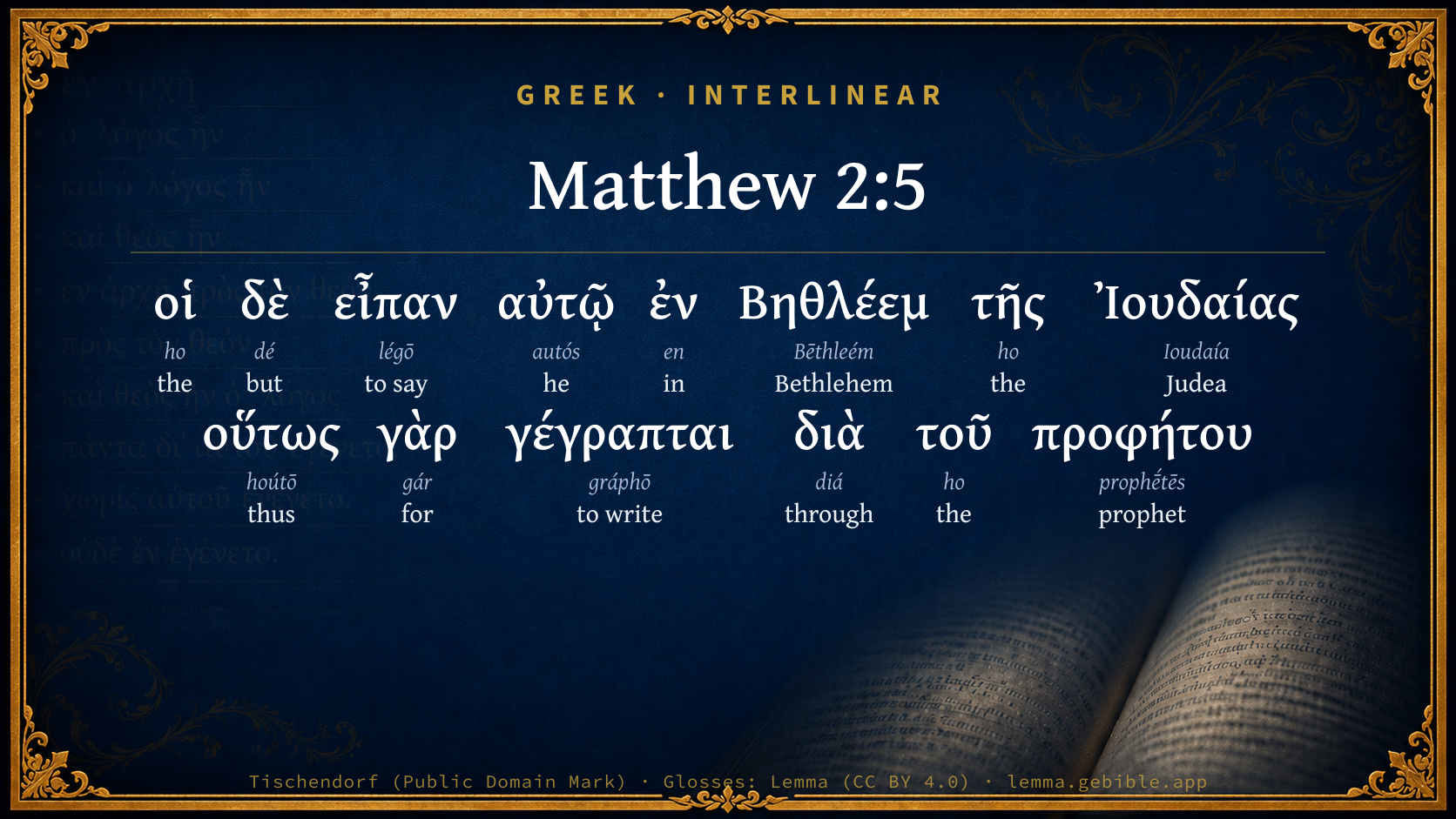
Greek (Tischendorf 8th ed.) Matthew 2:5 appears in the Greek New Testament. The text above is from the Tischendorf 8th edition. Each word links to its Strong’s number and a concise gloss. Click any word for its full Thayer’s Greek Lexicon entry.
Download image
Cite this verse

Matthew 2:5 (World English Bible). Public Domain. Lemma interlinear Bible study tool, https://lemma.gebible.app/v/matthew/2/5.

Show BibTeX & RIS
BibTeX
RIS
English Translation
They said to him, "In Bethlehem of Judea, for thus it is written through the prophet,
World English Bible · Public Domain
Highlights
  • 1 first appearance in the Greek New Testament
Full analysis ↓
Download a study sheet

One document with this verse’s original text, its word-by-word gloss line, the meaning frame, cross-references with their text, attributed commentary, and full source and license credits — printable, and it pastes into notes with its structure intact.

This verse Autodidact and up

Study sheet (.html) Plain text (.txt)

A passage Seminary Student

Up to 50 verses in one chapter. A passage sheet keeps up to 6 commentary sources and 12 cross-references per verse, in the order this page ranks them, and says so on the sheet whenever that leaves anything out. Ask for a single verse and you get the Autodidact verse sheet above.

Everything on this page stays free to read, with no account — the sheet is a download of what is already on screen, not access to it.

Want to remove ads? Support Godless Engineer
Compare translations 3

The same verse in 3 English versions, stacked beneath the original-language interlinear above. Click any original word for its lexicon entry.

Each is an independent rendering of the whole verse — the interlinear is not word-aligned to these translations.

Highlighted words mark where these versions differ — a whole-verse word diff, not a word-by-word alignment.

  • World English Bible Public Domain
    They said to him, "In Bethlehem of Judea, for thus it is written through the prophet,
  • King James Version Public Domain
    And they said unto him, In Bethlehem of Judaea: for thus it is written by the prophet,
  • unfoldingWord Literal Text CC BY-SA 4.0
    And they said to him, “In Bethlehem of Judea, for thus it has been written through the prophet,

unfoldingWord Literal Text — © unfoldingWord, licensed CC BY-SA 4.0. Word-aligned USFM3 via Door43 (git.door43.org/unfoldingWord/en_ult).

Versions to compare (up to 4)

3 of 4 selected

Show all 19 translations

Every available English version of this verse, each an independent rendering of the whole verse.

  • World English Bible Public Domain
    They said to him, "In Bethlehem of Judea, for thus it is written through the prophet,
  • Berean Standard Bible Public Domain
    “In Bethlehem in Judea,” they replied, “for this is what the prophet has written:
  • Majority Standard Bible Public Domain
    “In Bethlehem in Judea,” they replied, “for this is what the prophet has written:
  • King James Version Public Domain
    And they said unto him, In Bethlehem of Judaea: for thus it is written by the prophet,
  • American Standard Version (1901) Public Domain
    And they said unto him, In Bethlehem of Judaea: for thus it is written through the prophet,
  • Revised Version (1885) Public Domain
    And they said unto him, In Bethlehem of Judaea: for thus it is written by the prophet,
  • Geneva Bible (1599) Public Domain
    And they saide vnto him, At Beth-leem in Iudea: for so it is written by the Prophet,
  • Douay-Rheims (1899) Public Domain
    But they said to him: In Bethlehem of Juda. For so it is written by the prophet:
  • Young's Literal Translation Public Domain
    And they said to him, `In Beth-Lehem of Judea, for thus it hath been written through the prophet,
  • Literal Standard Version CC BY-SA 4.0
    And they said to him, “In Beth-Lehem of Judea, for thus it has been written through the prophet:
  • Unlocked Literal Bible CC BY-SA 4.0
    They said to him, “In Bethlehem of Judea, for this is what was written by the prophet,
  • unfoldingWord Literal Text CC BY-SA 4.0
    And they said to him, “In Bethlehem of Judea, for thus it has been written through the prophet,
  • Darby Bible Public Domain
    And they said to him, In Bethlehem of Judaea; for thus it is written through the prophet:
  • World Messianic Bible Public Domain
    They said to him, “In Bethlehem of Judea, for this is written through the prophet,
  • Webster's Bible Public Domain
    And they said to him, In Bethlehem of Judea: for thus it is written by the prophet,
  • Free Bible Version CC BY-SA 4.0
    “Bethlehem in Judea,” they told him, “for that's what the prophet wrote:
  • Bible in Basic English Public Domain
    And they said to him, In Beth-lehem of Judaea; for so it is said in the writings of the prophet,
  • Text-Critical English NT CC BY 4.0
    They told him, “In Bethlehem of Judea, for so it is written by the prophet,
  • Tyndale New Testament (1534) Public Domain
    And they sayde vnto hym: at Bethlee in Iury. For thus it is written by the Prophet.

Literal Standard Version (2020), Covenant Press — licensed CC BY-SA 4.0. Text via the HelloAO Bible API (eBible.org). Unlocked Literal Bible (unfoldingWord) — licensed CC BY-SA 4.0. Text via the HelloAO Bible API (eBible.org). unfoldingWord Literal Text — © unfoldingWord, licensed CC BY-SA 4.0. Word-aligned USFM3 via Door43 (git.door43.org/unfoldingWord/en_ult). Free Bible Version, Dr. Jonathan Gallagher — licensed CC BY-SA 4.0. Text via the HelloAO Bible API (eBible.org).

Word by word

More ways to search: Search by grammar → Find every occurrence → Compare this word →

Practice this passage: Drill this verse → Learn its vocabulary →

About this verse

These counts appear in no published source. They are computed here, from the morphology-tagged text and Lemma’s own curated glosses. What Lemma adds →

14
words
12
distinct lemmas
Gospels
section

Notable vocabulary

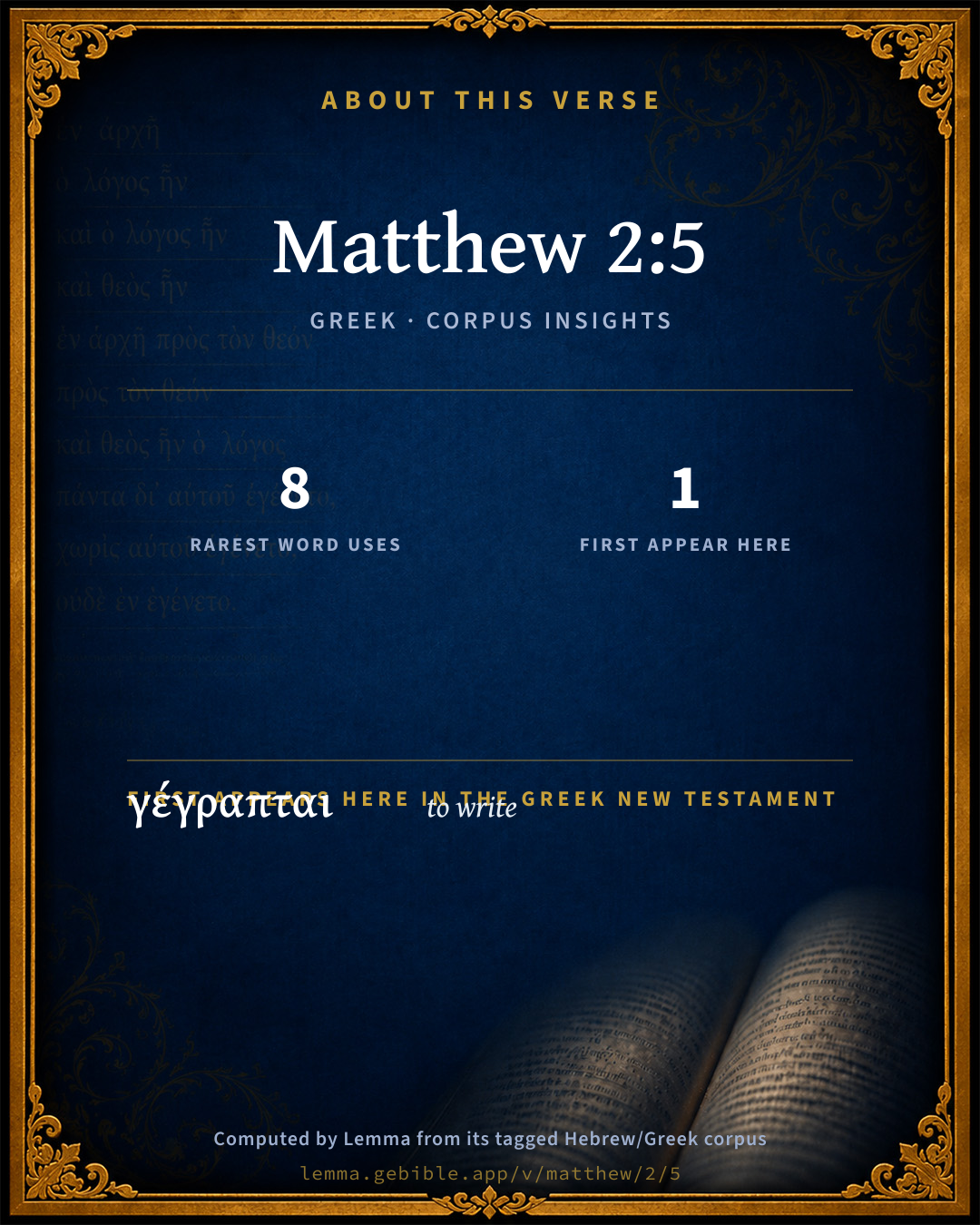
The rarest word here is Βηθλέεμ Bethlehem G965 — appearing just 8 times in the whole Greek New Testament.

First appearance in Scripture

This word makes its first canonical appearance in the Greek New Testament here:

  • γέγραπται to write G1125

Shared distinctive vocabulary

Βηθλέεμ Bethlehem G965 occurs in 8 verses of the Greek New Testament. Also found in:

Repetition

A word recurs within this verse:

Cross-references

7

Topical passages linked to Matthew 2:5 in the Treasury of Scripture Knowledge — connected by theme and wording, ordered by reader-vote popularity; previews shown in the World English Bible.

  • John 7:42 Hasn't the Scripture said that the Christ comes of the seed of David, and from Bethlehem, the village where David was?"
  • Ruth 1:1 It happened in the days when the judges judged, that there was a famine in the land. A certain man of Bethlehem Judah went to sojourn in the country of Moab, he, and his wife, and his two sons.
  • 1 Samuel 16:1 Yahweh said to Samuel, How long will you mourn for Saul, seeing I have rejected him from being king over Israel? fill your horn with oil, and go: I will send you to Jesse the Bethlehemite; for I have provided me a king among his sons.
  • Ruth 2:4 Behold, Boaz came from Bethlehem, and said to the reapers, Yahweh be with you. They answered him, Yahweh bless you.
  • Joshua 19:15 and Kattath, and Nahalal, and Shimron, and Idalah, and Bethlehem: twelve cities with their villages.
  • Ruth 1:19 So they two went until they came to Bethlehem. It happened, when they were come to Bethlehem, that all the city was moved about them, and [the women] said, Is this Naomi?
  • Ruth 4:11 All the people who were in the gate, and the elders, said, We are witnesses. Yahweh make the woman who has come into your house like Rachel and like Leah, which two built the house of Israel: and do you worthily in Ephrathah, and be famous in Bethlehem:

Cross-references courtesy of OpenBible.info (CC BY 4.0).

Commentary

Notes on Matthew 2:5 from classic Christian and Jewish commentators (each source and its license shown beneath its notes). The classic Christian expositions comment on the surrounding passage and are grouped to its opening verse, so a note may address several verses; the Jewish commentaries on the Tanakh (Rashi and others) are per-verse, so they appear only where the commentator wrote on this verse.

Lemma curates 59 commentaries, every one of them public domain or Creative Commons licensed, each selected and text-cleaned for this edition rather than reprinted as found. About our sources →

Bengel's Gnomon

Johann Albrecht Bengel

Mat 2:5. Βηθλεὲμ, Bethlehem) The knowledge which the scribes, who do not go themselves, have derived from their ancestors, is of service to the Magi, who are seeking for Christ.—οὓτω γὰρ γέγραπται διὰ τοῦ προφήτου, for thus it is written by the prophet) This reason was alleged by the council; but St Matthew has stamped it with his approval.

Bengel's Gnomon of the New Testament — English translation (T&T Clark, Edinburgh, 1860) — public domain. Text from a community e-Sword module.

Expositor's Greek Testament

ed. W. Robertson Nicoll

Mat 2:5-6 . The answer of the experts . οἱ δὲ εἶπον , etc. This is not a Christian opinion put into the mouth of the scribes. It was the answer to be expected from them as reflecting the current opinion of the time. The Targum put upon the oracle in Micah a Messianic interpretation (Wetstein, and Wünsche, Beiträge ). Yet with the Talmudists the Messiah was the one who should come forth from a strange, unknown place (Weber, Die Lehren des Talmud , p. 342). Vide on this point Schanz, who quotes Schegg as denying the statement of Wetstein, and refers to Celsus as objecting that this view about Messiah’s birthplace was not current among the Jews. (Origen, c. Celsum , i. 51. Cf. Joh 7:27 ; Joh 7:42 .) οὕτω γὰρ γεγραπται , etc.: The Scripture proof that Messiah’s birth-place was Bethlehem is taken from Mic 5:2 . The oracle put into the mouth of the experts consulted by Herod receives its shape from the hand of the evangelist. It varies very considerably both from the original Hebrew and from the Sept [5] The “least” becomes “by no means the least,” “among the thousands” becomes “among the princes,” and the closing clause, “who shall rule my people Israel,’ departs from the prophetic oracle altogether, and borrows from 2Sa 5:2 , God’s promise to David; the connecting link apparently being the poetic word descriptive of the kingly function common to the two places ποιμανεῖ in Mic 5:3 , ποιμανεῖς in 2Sa 5:2 . The second variation arises from a different pointing of the same Hebrew word באלפי , בְאַלפֵי = among the thousands, בְאַלֻּפֵי = among the heads of thousands. Such facts are to be taken as they stand. They do not correspond to modern ideas of Scripture proof.

[5] Septuagint.

The Expositor's Greek Testament, edited by W. Robertson Nicoll (1897–1910) — public domain. Text from a community e-Sword module.

Jamieson, Fausset & Brown

Robert Jamieson, A. R. Fausset & David Brown

And they said unto him, In Bethlehem of Judea--a prompt and involuntary testimony from the highest tribunal; which yet at length condemned Him to die.

for thus it is written by the prophet-- (Mic 5:2).

Jamieson, Fausset & Brown — Commentary Critical and Explanatory on the Whole Bible (1871) — public domain (CC PDM 1.0). Text via the HelloAO Bible API.

Adam Clarke's Commentary

Verse 5. In Bethlehem of Judea: for thus it is written by the prophet] As there have been several confused notions among the Jews, relative not only to the Messiah, and his character, but also to the time of his birth, it may be necessary to add, to what has already been said on this subject, the following extracts from the Talmudists and Gemarists, quoted by LIGHTFOOT. At the close of a long dissertation on the year of our Lord's birth, (which he places in the 35th of the reign of Herod, not the last or 37th as above,) he says: "It will not be improper here to produce the Gemarists themselves openly confessing that the Messias had been born, a good while ago before their times. For so they write: After this the children of Israel shall be converted, and shall inquire after the Lord their God, and David their king: Ho 3:5. Our rabbins say, That is King Messias, If he be among the living, his name is David, or if dead, David is his name. R. Tanchum said, Thus I prove it: He showeth mercy to David his Messiah. (Ps 18:50.) R. Joshua ben Levi saith, His name is tsemach, a Branch. (Zec 3:8.) R. Juban bar Arbu saith, His name is Menahem. (That is, παρακλητος, the Comforter.) 'And that which happened to a certain Jew, as he was ploughing, agreeth with this business. A certain Arabian travelling, and hearing the ox bellow, said to the Jew at plough, O Jew, loose thy oxen, and loose thy ploughs, והא יליר מלכא משיחא for behold! The temple is laid waste. The ox belloweth the second time; the Arabian saith to him, O Jew, Jew, yoke thy oxen, and fit thy ploughs: For behold! King Messiah is born. But, saith the Jew, What is his name? Menahem, saith he (i.e. the Comforter.) And what is the name of his Father? Hezekiah, saith the Arabian. To whom the Jew, But whence is He? The other answered, From the palace of the king of Bethlehem Judah. Away he went, and sold his oxen and his ploughs, and became a seller of infants' swaddling clothes, going about from town to town. When he came to that city, (Bethlehem,) all the women bought of him, but the mother of Menahem bought nothing. He heard the voice of the women saying, O thou mother of Menahem, thou mother of Menahem, carry thy son the things that are here sold. But she replied, May the enemies of Israel be strangled, because on the day that he was born, the temple was laid waste. To whom he said, But we hoped, that as it was laid waste at his feet, so at his feet it would be built again. She saith, I have no money. To whom he replied, But why should this be prejudicial to him? Carry him what you buy here, and if you have no money today, after some days I will come back and receive it. After some days, he returned to that city, and saith to her, How does the little infant? And she said, From the time you saw me last, spirits and tempests came, and snatched him away out of my hands. R. Bon saith, What need have we to learn from an Arabian? Is it not plainly written, And Lebanon shall fall before the powerful one? (Isa 10:34.) And what follows after? A branch shall come out of the root of Jesse. (Isa 11:1.)

"The Babylonian doctors yield us a confession not very unlike the former. R. Charinah saith: After four hundred years are passed from the destruction of the temple, if any one shall say to you, Take to thyself for one penny a field worth a thousand pence, do not take it. And again, After four thousand two hundred thirty and one years from the creation of the world, if any shall say to you, Take for a penny a field worth a thousand pence, take it not. The gloss is, For that is the time of redemption, and you shall be brought back to the holy mountain, to the inheritance of your fathers; why, therefore, should you misspend your penny?

"You may fetch the reason of this calculation, if you have leisure, out of the tract Sanhedrin. The tradition of the school of Elias, the world is to last six thousand years, c. And a little after, Elias said to Rabh Judah, The world shall last not less than eighty-five jubilees: and in the last jubilee shall the Son of David come. He saith to him, Whether in the beginning of it, or in the end? He answered him, I know not. Whether is this whole time to be finished first, or not? He answered him, I know not. But Rabh Asher asserted, that he answered thus, Until then, expect him not, but from thence expect him. Hear your own countrymen, O Jew! How many centuries of years are passed by and gone from the eighty-fifth jubilee of the world, that is, the year MMMMCCL, and yet the Messias of your expectation is not yet come!

"Daniel's weeks had so clearly defined the time of the true Messias, his coming, that the minds of the whole nation were raised into the expectation of him. Hence, it was doubted of the Baptist, whether he were not the Messias, Lu 3:15. Hence it was, that the Jews are gathered together from all countries unto Jerusalem, Acts 2:, expecting and coming to see, because at that time the term of revealing the Messias, that had been prefixed by Daniel, was come. Hence it was that there was so great a number of false Christs, Mt 24:5, c., taking the occasion of their impostures hence, that now the time of that great expectation was at hand, and fulfilled: and in one word, They thought the kingdom of God should presently appear, Lu 19:11.

"But when those times of expectation were past, nor did such a Messias appear as they expected, (for when they saw the true Messias, they would not see him,) they first broke out into various, and those wild, conjectures of the time and at length, all those conjectures coming to nothing, all ended in this curse (the just cause of their eternal blindness) של מתשכי קצי הפת רות, May their soul be confounded who compute the times!" They were fully aware that the time foretold by the prophets must be long since fulfilled and that their obstinacy must be confounded by their own history, and the chronology of their own Scriptures; and therefore they have pronounced an anathema on those who shall attempt to examine, by chronological computations, the prophecies that predict his coming. Who can conceive a state of wilful blindness or determined obstinacy superior to this!

Adam Clarke's Commentary on the Bible (1810–1826) — public domain. Text from a community e-Sword/MySword module.

Ellicott's Commentary for English Readers

(5) In Bethlehem of Judæa.—The words of the people in Joh_7:42 show the same belief thirty years later. The Targum, or Jewish paraphrase, of Mic_5:2, inserts the very words, “Out of thee the Messiah shall come.”

A Bible Commentary for English Readers, edited by Charles John Ellicott (1878–1897) — public domain. Text from a community e-Sword module.

The Cambridge Bible for Schools and Colleges

gen. ed. J. J. S. Perowne

5. by the prophet] Lit. by means of, through—the prophet is regarded as the instrument. In Mat_2:17 and Mat_3:3, some MSS. have the preposition signifying personal agency (ὑπό), instead of the instrumental preposition (διά); but the usual formula is as in Mat_2:15, “by the Lord through the prophet.”

Bethlehem of Judea] To distinguish this Bethlehem from the Bethlehem in the tribe of Zebulun (Jos_19:15).

The Cambridge Bible for Schools and Colleges (gen. ed. J. J. S. Perowne; Cambridge University Press, 1878–1918) — public domain. Text from a community e-Sword module.

John Gill's Exposition

And they said unto him,.... They answer without any hesitation, it being a generally received notion, and a thing well known among them,

in Bethlehem of Judea; and give their reason for it; for

thus it is written by the prophet, that is, the prophet Micah, in whose prophecy, Mic 5:2 it stands, and is as follows:

John Gill's Exposition of the Whole Bible (1746–1763) — public domain (CC PDM 1.0). Text via the HelloAO Bible API.

Trapp's Complete Commentary

John Trapp

5 And they said unto him, In Bethlehem of Judaea: for thus it is written by the prophet,

Ver. 5. And they said unto him, In Bethlehem] Lo, how readily and roundly, out of the Scriptures, they could answer to this capital question; giving such signs of the Messias as did evidently agree to Jesus Christ. Yet were they for their obstinace so infatuated, that when God showed them the man to whom their own signs agree, they cannot allow him. Unless the Lord give a mind as well as means, sight as well as light, and irradiate the organ as well as the object, we grope as blind men in the dark, Isa 59:10; we err in heart, as not knowing God’s ways, yet cannot wander so wide as to miss hell: to original blindness we add actual stubbornness, Psa 95:8, the devil holding his black hand (as it were) afore our eyes, that we may not see and be saved, Act 26:19.

John Trapp, A Commentary or Exposition upon All the Books of the Old and New Testament (1647–1656) — public domain. Text from a community e-Sword module.

Albert Barnes' Notes on the Bible

By the prophet - The Sanhedrin answered without hesitation. The question where he would be born had been settled by prophecy. This prophecy is found in Mic 5:2. In that prophecy both the place of his birth and the character of the Messiah are so clearly set forth that there was no room to doubt. It will be observed that there is a considerable difference between the passage as quoted by the Sanhedrin and as it stands in Micah. The main point, however, is retained - the place of his birth. We are not concerned, therefore, in showing how these passages can be reconciled. Matthew, moreover, is not responsible for the correctness of the quotation. He affirms only that the chief priests and scribes gave this answer to Herod, and that Herod was satisfied. Admitting that they did not quote the passage correctly, it does not prove that Matthew has not reported their answer as they gave it, and this is all that he pretends to give.

Art not the least - In Micah, “though thou be little.” Though a small place so far as population is concerned, yet it shall not be small, or be the least in honor; for the Messiah shall be born there. His birth gave the place an honor which could not be conferred on the larger cities by all their numbers, their splendor, and their wealth. The birth of a distinguished personage was always supposed to give honor and importance to a city or country. Thus, seven cities contended for the honor of giving birth to Homer; Stratford-upon-Avon is distinguished as the birthplace of Shakespeare; and Corsica as the birthplace of Napoleon.

A Governor - A ruler. This is one of the characters of the Messiah, who is the king of his people, Joh 18:37. The word “rule” here means to rule as a shepherd does his flock, in faithfulness and tenderness. Compare Joh 10:11; Isa 40:10-11; Isa 9:7.

Albert Barnes' Notes on the Bible (1834–1885) — public domain. Text from a community e-Sword/MySword module.

Matthew Poole's English Annotations

It was (as it seems) so received a tradition, and interpretation of Mic 5:2, that they gave him an answer without any hesitation, telling him he was to be born

in Bethlehem of Judea; this they confirm by the prophecy of the prophet Micah, Mic 5:2; so confirming the Son of the virgin Mary (at unawares) to be the Messiah from the testimony of the prophet Micah. The words in Micah something vary from those here mentioned; they are thus: But thou, Bethlehem Ephrata, though thou be little among the thousands of Judah, yet out of thee shall he come forth unto me that is to be Ruler in Israel; whose goings forth have been from of old, from everlasting. We must know,

1. That the writers of the New Testament, in their quotations out of the Old Testament, ordinarily quote only so much of them as makes to their purpose, and not always in the very terms in which they are found in the Old Testament: but keeping to the sense.

2. That it is more than probable that the evangelist keeps to the words in which the priests and scribes delivered in their answer to the king, for in this relation he is but reciting their answer.

The sole question propounded to them was: What the place was, where the Messiah, according to their records, was to be born? They answer: In Bethlehem Judah: they prove their answer from the testimony of the prophet. If any object that the prophet calls it Bethlehem Ephratah, not Bethlehem Judah, the answer is, that it is in sense the same, for Bethlehem Ephratah was within the tribe of Judah. It should seem by Gen 35:19; 48:7 that it was formerly in Jacob’s time called Ephrath. Some think that it was a town within Caleb’s portion, and called Ephratah from his second wife, whose name was Ephrath, or Ephratah, 1Ch 2:19,50, if it were not the same place, only fortified anew. We read of another Bethlehem in Judah builded by Rehoboam, 2Ch 11:6; whether it had this addition from its old name in Jacob’s time, or from Caleb’s wife, or to distinguish it from Bethlehem belonging to the tribe of Zebulun, is hard to say: it is plain that that Bethlehem is meant, both by Micah and Matthew, which was in Judah; possibly in tract of time the addition Ephratah was lost.

But, say some, there is a contradiction between Micah and Matthew; Micah saith it was the least, Matthew saith it was not the least.

Answer: Here is no contradiction; consider Bethlehem itself, it was but a small city, (if it were in Caleb’s lot it is not named), but in other respects it was not the least. It was of old famous for Ibzan, one of the judges, for Elimelech, Boaz, Jesse, David; and now last of all for the birth of Christ, where respect to which the evangelist calls it not the least; or if he reciteth the scribes’ and priests’ words, they might call it not the least upon the account of Boaz, Jesse, and David, all which were born or dwelt there; and particularly with respect to Christ, who was born there. The prophet calls it the least with respect to its state in his time, the evangelist not the least with respect to its state then, its state being magnified by the birth of Christ. Micah saith among the thousands. Matthew,

among the princes. It is the same thing, for, Num 1:16, their princes were heads of thousands in Israel. The Jews would by no means have this text interpreted of Christ, but either of Zerubbabel or David: but as to Zerubbabel, he was born in Babylon, not in Bethlehem, and David was dead long before this prophecy; neither could the following words, whose goings forth have been from of old, from everlasting, agree to Zerubbabel or David: Zerubbabel’s name tells us where he was born, and we never read that Bethlehem was thus celebrated with reference to David, though he was born there, 1Sa 16:1; 17:58, upon which account it is called the city of David, Luk 2:4. The prophecy certainly related to Christ, and him only, and so is interpreted by the Chaldee paraphrast, who some think was one of this council called by Herod in this cause.

Matthew Poole's English Annotations on the Holy Bible (1683–1685) — public domain. Text from a community e-Sword/MySword module.

The Pulpit Commentary

And they said unto him, In Bethlehem of Judaea: for thus it is written by the prophet. For" by" the Revised Version margin has "through". (Mat_1:22, not)

Vers. 5, 6. The honour of a city.

"Out of thee shall come a Governor." It is not its architecture, or its situation, or its history, or its polity, or its wealth. It is its men. A city is ennobled by the heroes, the poets, the race-leaders, who are born in it. This leads some seven distinct cities to lay claim to be the birthplace of Homer. One of the later psalmists gives expression to this truth, when he says," Glorious things are spoken of thee, O city of God Of Zion it shall be said, This man and that man was born in her; and the Highest himself shall establish her". (Psa_87:3-5) Bethlehem was but a little and insignificant town, scarcely more than what we should call a village; not even important for its situation, since it was not on any of the main caravan-routes. And yet it stands out most prominently of all cities in Palestine, save Jerusalem, the capital. Everybody knows Bethlehem. Every traveller must go and see Bethlehem. We should smile at the woeful ignorance of a traveller who did not know enough to compel him to go to Bethlehem. Both the Old Testament and the New give prominence to it, and we may properly call it the twice-honoured city. Descriptions of it, as it was in our Lord"s time and now, are at very easy command in modern "Lives of Christ" and books of travel.

I HONOURED AS THE BIRTHPLACE OF DAVID. David is the hero of Old Testament history. He is the proper founder of the Jewish monarchy; and is specially commended because he founded it on strictly theocratical lines. He is worthy of honour

(1) for his personal character on the whole;

(2) for his kingly rule, with some marked exceptions;

(3) and he is specially interesting because his reign was distinctly typical of the Messianic reign.

Jerusalem gained honour as the "city of David," Bethlehem as his birthplace. Showing interest in a birthplace is a common sign of our interest in him who was born there. And we even expect to find relations between the genius of the man and the genius of the place.

II HONOURED AS THE BIRTHPLACE OF DAVID"S GREATER SON. Trace the orderings of Divine providence which brought Mary to Bethlehem. Martin Luther was born unexpectedly at an inn, when his parents were journeying from home. Talk, how you may, the praises of cities, call them "beautiful for situation," record the struggles for liberty of which they may have been the centres, still you must leave the supreme honours for "little Bethlehem." The "Lamb of God," the "Saviour of the world," was born there. R.T.

The Pulpit Commentary (1880–1919), ed. H.D.M. Spence-Jones & Joseph S. Exell — public domain. Text from a community e-Sword module.

The People's New Testament

B. W. Johnson

5. In Bethlehem of Judea; for thus it is written by the prophet. The prophet here referred to is Micah, who lived about seven centuries before Christ. See Micah 5:1, 2.

B. W. Johnson's The People's New Testament with Notes (1889–1891) — public domain. Electronic text from the Christian Classics Ethereal Library (CCEL) ThML edition.

Cambridge Greek Testament for Schools and Colleges

5. Βηθλεὲμ τῆς Ἰουδαίας. To distinguish this Bethlehem from the Bethlehem in the tribe of Zebulun (Jos 19:15).

γέγραπται, well expressed by Luther’s translation, stehet geschrieben. The tense marks the continued validity of a law or a prophecy; so also in the classics, ἐν τοῖς φονικοῖς γέγραπται νόμοις … καὶ ἄτιμος τεθνάτω. Dem. Phil. 3. 44.

διὰ τοῦ προφήτου, ‘by means of,’ ‘through’—the prophet is regarded as the instrument. In Mat 2:17 and Mat 3:3, some MSS. have the preposition signifying personal agency (ὑπό), instead of the instrumental preposition (διά); but the usual formula is as in Mat 2:15, ὑπὸ Κυρίου διὰ τοῦ προφήτου.

Cambridge Greek Testament for Schools and Colleges (Cambridge University Press, 1896; 21 vols, various authors incl. Carr, Maclear, Plummer, Farrar, Lumby, Moule, M. R. James, Simcox) — public domain. Text from a community e-Sword module.

International Critical Commentary

5, 6. And they said, In Bethlehem of Judæa: for so it is written through the prophet, And thou Bethlehem, land of Judah, art in no wise least amongst the rulers of Judah: for from thee shall come forth a ruler, who shall shepherd My people Israel.]

τῆς Ἰουδίας] cf. on v. 1. For the official expectation of the Messiah from Bethlehem, cf. Joh 7:41 ff., and the Targ. on Mic 5:1. Also Jer. Berach. v. a, quoted by Lightfoot on Mat 2:1. The quotation comes from Mic 5:1, Mic 5:3, with an assimilation of the last clause to 2 S 5:2. The LXX. text is not followed here, though it seems to have been in the mind of the editor; for ὄστις ποιμανεῖ τὸν λαόν μου τὸν Ἰσραήλ, which reminds us of 2 S 5:2 σὺ ποιμανεῖς τὸν λαόν μου τὸν Ἰσραήλ, seems to have been suggested by Ἰσραήλ and ποιμανεῖ of Mic 5:1, Mic 5:3 LXX. The rest of the quotation appears to be an independent rendering of the Hebrew text. καὶ σὺ Βηθλεέμ corresponds to ואתח בית־לחם. γῆ Ἰούδα is substituted for אפרתה by assimilation to vv. 1, 5. οὐδαμῶς ἐλαχίστη ειͅ (LXX. ὀλιγοστὸς ειͅ τοῦ ειͅναι) seems to represent a Hebrew original לא הּיית צעיר (M.T. צעיד להיות). ἐν τοῖς ἡγεμόσιν Ἰούδα (LXX.: ἐν χιλιάσιν Ἰούδα) corresponds to באלפי יהודה, אַלְפֵי being read as אלופי; cf. Gen 36:15, Exo 15:15. ἐκ σοῦ = ממך. γάρ is inserted as a necessary connecting link. ἐξελεύσεται = יצא. So LXX. לי is omitted. ὅστις ποιμανεῖ τὸν λαόν μον τὸν Ἰσραήλ represents בישראל מושל, the Greek words being assimilated to 2 S 5:2. γέγραπται means “it stands written,” the inspired text runs. It corresponds to כתוב or כתיב of the Jewish literature. Cf. Basher, ii. 90.

(P)

5. Ἰουδαίας] ff1 g1 K* S2 have Judah.

5. Assuming, then, that the tradition of the supernatural birth might have arisen on Palestinian soil in the first century a.d., is it possible to define more closely the period of their publication?

International Critical Commentary — older volumes (1896–1929), various authors — public domain. Text from a community e-Sword module.

Lesson kit

Teaching starters — assembled from the data on this page, not authored interpretation. Every prompt links to the verse data it draws on. Edit before teaching.

Matthew, in the Gospels, opens this verse with 14 words (12 distinct Greek lemmas). Its most distinctive word is Bēthleém (“Bethlehem”). A historical commentator’s framing appears above. Read the whole chapter for the surrounding context.

Discussion questions

  1. What does “Bethlehem” (Bēthleém) contribute to the verse as a whole?
  2. This is the first place “to write” appears in Scripture (first appears here). What does its debut here establish?
  3. How does Matthew 2:1, which shares the word «Bethlehem», read alongside this verse?
  4. What does the repetition of “the” (3× in this one verse) do in this verse?
  5. The translations on this page render this verse differently — a whole-verse word diff, not a word-by-word alignment. What might account for the different wordings?
  6. Compare how Bengel's Gnomon and Expositor's Greek Testament read this verse. Where do they agree or differ?

Things to notice

  • 1 word makes its first canonical appearance in Scripture here.
  • These translations choose different wording for 5 words in this verse.
  • “the” occurs 3× in this single verse.
  • 12 distinct Greek lemmas span 14 words in this verse.

Reading settings

Reading text

Shown beneath each verse's original-language words.

Old Testament
Old Testament edition

Read the OT as the Masoretic Hebrew (MT) or the Greek Septuagint (LXX).

English shown for the Greek Septuagint (in the Hebrew ↔ Greek comparison).

Comparing translations? Open the Compare panel on any verse page to stack up to four side by side.