
John 1:20

Greek (Tischendorf 8th ed.) John 1:20 appears in the Greek New Testament. The text above is from the Tischendorf 8th edition. Each word links to its Strong’s number and a concise gloss. Click any word for its full Thayer’s Greek Lexicon entry.
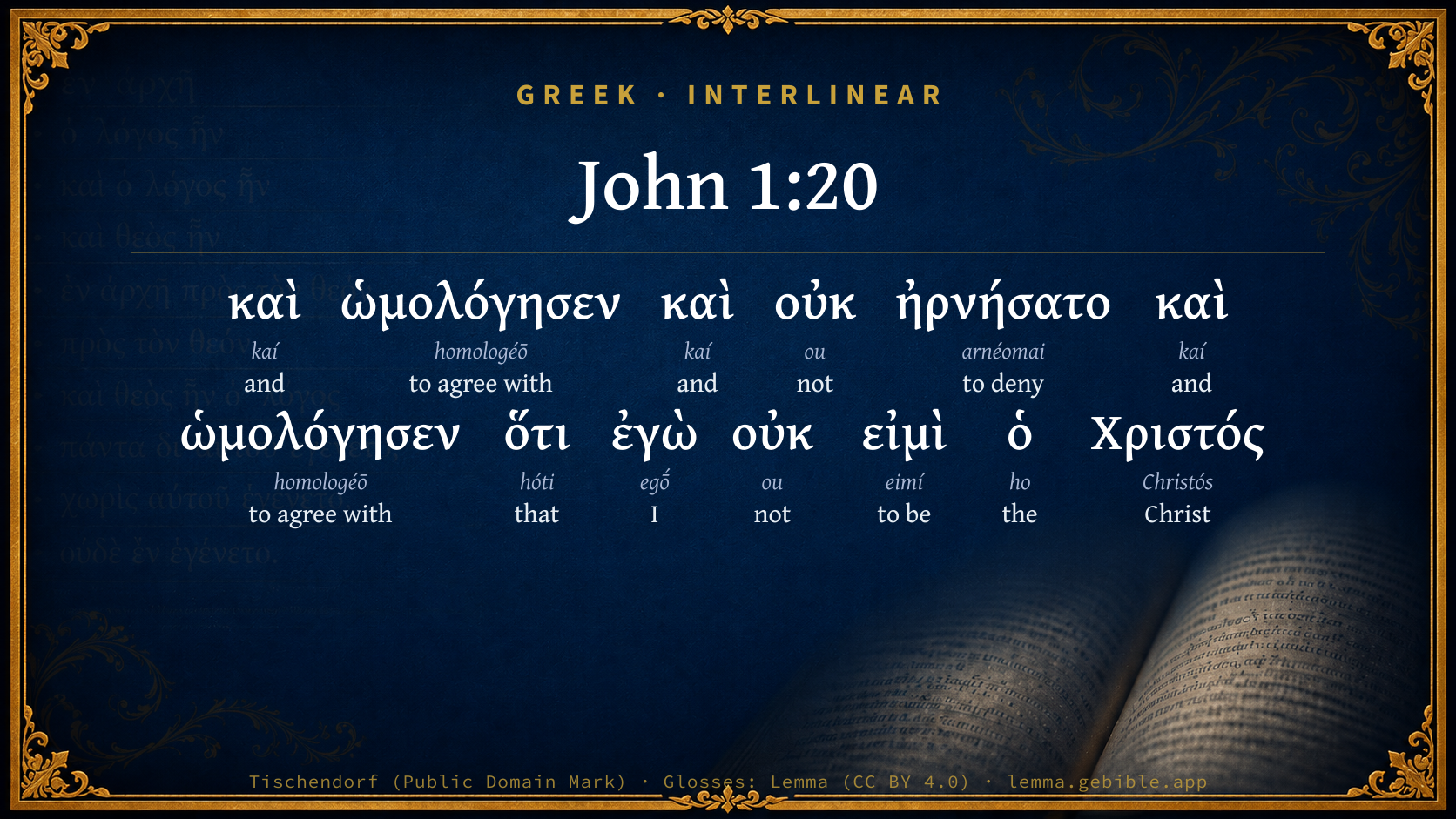
Download image
Cite this verse

John 1:20 (World English Bible). Public Domain. Lemma interlinear Bible study tool, https://lemma.gebible.app/v/john/1/20.

Show BibTeX & RIS
BibTeX
RIS
English Translation
He confessed, and didn't deny, but he confessed, "I am not the Christ."
World English Bible · Public Domain
Download a study sheet

One document with this verse’s original text, its word-by-word gloss line, the meaning frame, cross-references with their text, attributed commentary, and full source and license credits — printable, and it pastes into notes with its structure intact.

This verse Autodidact and up

Study sheet (.html) Plain text (.txt)

A passage Seminary Student

Up to 50 verses in one chapter. A passage sheet keeps up to 6 commentary sources and 12 cross-references per verse, in the order this page ranks them, and says so on the sheet whenever that leaves anything out. Ask for a single verse and you get the Autodidact verse sheet above.

Everything on this page stays free to read, with no account — the sheet is a download of what is already on screen, not access to it.

Want to remove ads? Support Godless Engineer
Compare translations 3

The same verse in 3 English versions, stacked beneath the original-language interlinear above. Click any original word for its lexicon entry.

Each is an independent rendering of the whole verse — the interlinear is not word-aligned to these translations.

Highlighted words mark where these versions differ — a whole-verse word diff, not a word-by-word alignment.

  • World English Bible Public Domain
    He confessed, and didn't deny, but he confessed, "I am not the Christ."
  • King James Version Public Domain
    And he confessed, and denied not; but confessed, I am not the Christ.
  • unfoldingWord Literal Text CC BY-SA 4.0
    And he confessed—and he did not deny, but confessed—“I am not the Christ.”

unfoldingWord Literal Text — © unfoldingWord, licensed CC BY-SA 4.0. Word-aligned USFM3 via Door43 (git.door43.org/unfoldingWord/en_ult).

Versions to compare (up to 4)

3 of 4 selected

Show all 19 translations

Every available English version of this verse, each an independent rendering of the whole verse.

  • World English Bible Public Domain
    He confessed, and didn't deny, but he confessed, "I am not the Christ."
  • Berean Standard Bible Public Domain
    He did not refuse to confess, but openly declared, “I am not the Christ.”
  • Majority Standard Bible Public Domain
    He did not refuse to confess, but openly declared, “I am not the Christ.”
  • King James Version Public Domain
    And he confessed, and denied not; but confessed, I am not the Christ.
  • American Standard Version (1901) Public Domain
    And he confessed, and denied not; and he confessed, I am not the Christ.
  • Revised Version (1885) Public Domain
    And he confessed, and denied not; and he confessed, I am not the Christ.
  • Geneva Bible (1599) Public Domain
    And he confessed and denied not, and said plainely, I am not that Christ.
  • Douay-Rheims (1899) Public Domain
    And he confessed, and did not deny: and he confessed: I am not the Christ.
  • Young's Literal Translation Public Domain
    and he confessed and did not deny, and confessed -- `I am not the Christ.'
  • Literal Standard Version CC BY-SA 4.0
    And he confessed and did not deny, and confessed, “I am not the Christ.”
  • Unlocked Literal Bible CC BY-SA 4.0
    He confessed—he did not deny, but confessed—”I am not the Christ.”
  • unfoldingWord Literal Text CC BY-SA 4.0
    And he confessed—and he did not deny, but confessed—“I am not the Christ.”
  • Darby Bible Public Domain
    And he acknowledged and denied not, and acknowledged, I am not the Christ.
  • World Messianic Bible Public Domain
    He declared, and didn’t deny, but he declared, “I am not the Messiah.”
  • Webster's Bible Public Domain
    And he confessed, and denied not; but confessed, I am not the Christ.
  • Free Bible Version CC BY-SA 4.0
    John declared plainly and clearly without hesitation, “I am not the Messiah.”
  • Bible in Basic English Public Domain
    He said quite openly and straightforwardly, I am not the Christ.
  • Text-Critical English NT CC BY 4.0
    He did not refuse to answer, but openly declared, “I am not the Christ.”
  • Tyndale New Testament (1534) Public Domain
    And he confessed and denyed not and sayde playnly: I am not Christ.

Literal Standard Version (2020), Covenant Press — licensed CC BY-SA 4.0. Text via the HelloAO Bible API (eBible.org). Unlocked Literal Bible (unfoldingWord) — licensed CC BY-SA 4.0. Text via the HelloAO Bible API (eBible.org). unfoldingWord Literal Text — © unfoldingWord, licensed CC BY-SA 4.0. Word-aligned USFM3 via Door43 (git.door43.org/unfoldingWord/en_ult). Free Bible Version, Dr. Jonathan Gallagher — licensed CC BY-SA 4.0. Text via the HelloAO Bible API (eBible.org).

Word by word

More ways to search: Search by grammar → Find every occurrence → Compare this word →

Practice this passage: Drill this verse → Learn its vocabulary →

ὡμολόγησεν
homologéō
G3670
“to agree with”
Verb, Aorist, Active, Indicative, 3rd person, Singular
Part of Speech
Verb
Tense
Aorist
Voice
Active
Mood
Indicative
Person
3rd person
Number
Singular
Full Thayer's Definition

Origin: from a compound of the base of G3674 and G3056

TDNT: 08:19,7

1. to say the same thing as another, i.e. to agree with, assent 2. to concede a. not to refuse, to promise b. not to deny 1. to confess 2. declare 3. to confess, i.e. to admit or declare one's self guilty of what one is accused of 3. to profess a. to declare openly, speak out freely b. to profess one's self the worshipper of one 4. to praise, celebrate
  1. καὶ kaí G2532 “and” Conjunction
  2. καὶ kaí G2532 “and” Conjunction
  3. οὐκ ou G3756 “not” Particle, Negative
  4. ἠρνήσατο arnéomai G720 “to deny” Verb, Aorist, Middle deponent, Indicative, 3rd person, Singular
  5. καὶ kaí G2532 “and” Conjunction
  6. ὡμολόγησεν homologéō G3670 “to agree with” Verb, Aorist, Active, Indicative, 3rd person, Singular
  7. ὅτι hóti G3754 “that” Conjunction
  8. ἐγὼ egṓ G1473 “I” Personal pronoun, 1st person, Nominative, Singular
  9. οὐκ ou G3756 “not” Particle, Negative
  10. εἰμὶ eimí G1510 “to be” Verb, Present, Active, Indicative, 1st person, Singular
  11. ὁ ho G3588 “the” Article, Nominative, Singular, Masculine
  12. Χριστός Christós G5547 “Christ” Noun, Nominative, Singular, Masculine

About this verse

These counts appear in no published source. They are computed here, from the morphology-tagged text and Lemma’s own curated glosses. What Lemma adds →

13
words
9
distinct lemmas
Gospels
section

Shared distinctive vocabulary

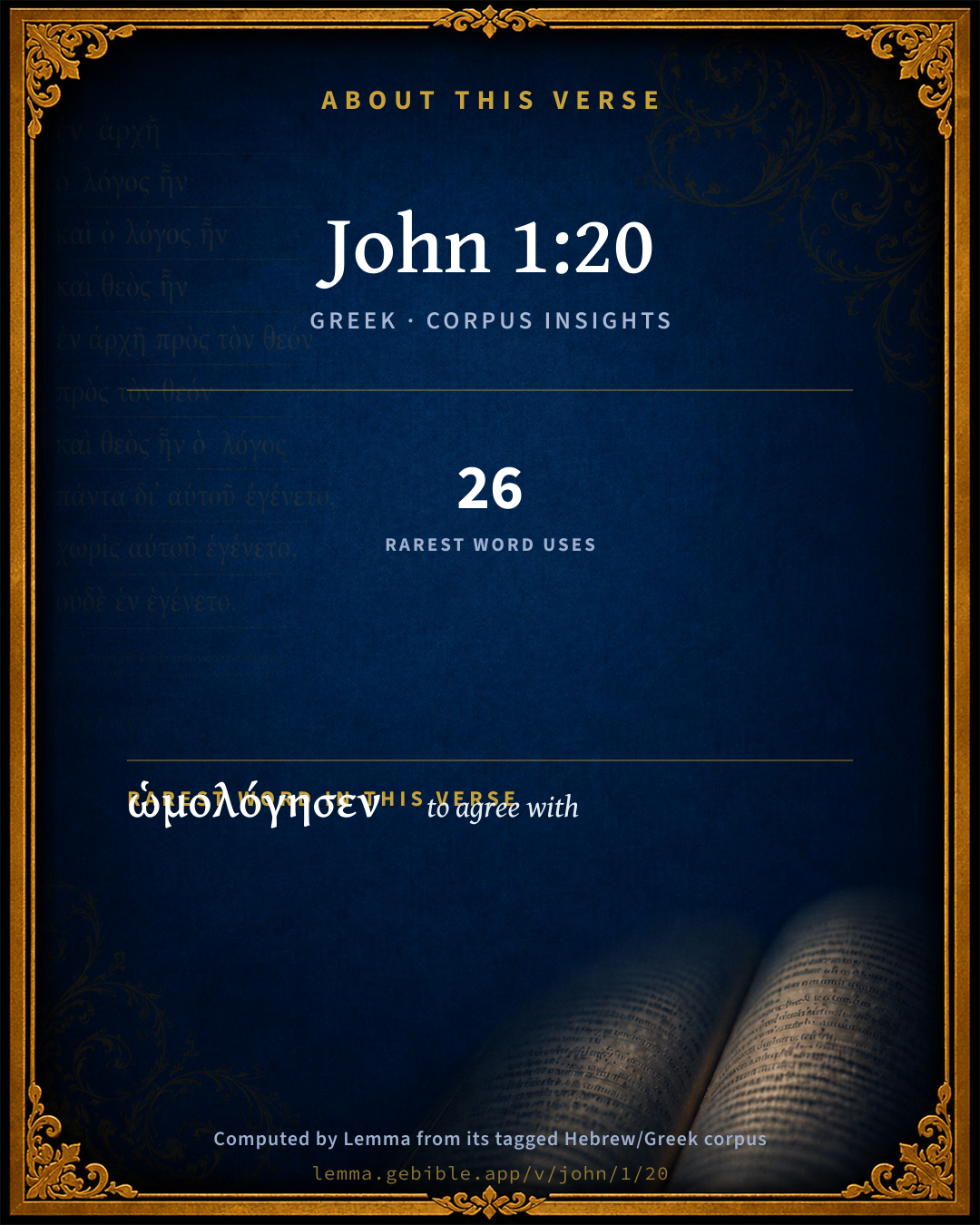
ὡμολόγησεν to agree with G3670 occurs in 23 verses of the Greek New Testament. Also found in:
Repetition

Words recur within this verse:

  • ὡμολόγησεν to agree with G3670 ×2
  • καὶ and G2532 ×3
  • οὐκ not G3756 ×2

Cross-references

4

Topical passages linked to John 1:20 in the Treasury of Scripture Knowledge — connected by theme and wording, ordered by reader-vote popularity; previews shown in the World English Bible.

  • Matthew 3:11–12 I indeed baptize you in water for repentance, but he who comes after me is mightier than I, whose shoes I am not worthy to carry. He will baptize you in the Holy Spirit.
  • Mark 1:7–8 He preached, saying, "After me comes he who is mightier than I, the thong of whose sandals I am not worthy to stoop down and loosen.
  • Luke 3:15–17 As the people were in expectation, and all men reasoned in their hearts concerning John, whether perhaps he was the Christ,
  • John 3:28–36 You yourselves testify that I said, 'I am not the Christ,' but, 'I have been sent before him.'

Cross-references courtesy of OpenBible.info (CC BY 4.0).

Commentary

Notes on John 1:20 from classic Christian and Jewish commentators (each source and its license shown beneath its notes). The classic Christian expositions comment on the surrounding passage and are grouped to its opening verse, so a note may address several verses; the Jewish commentaries on the Tanakh (Rashi and others) are per-verse, so they appear only where the commentator wrote on this verse.

Lemma curates 59 commentaries, every one of them public domain or Creative Commons licensed, each selected and text-cleaned for this edition rather than reprinted as found. About our sources →

The Biblical Illustrator

Joseph S. Exell

Joh_1:20

He confessed and denied not

John and Jesus

I.

THE DIGNITY OF TRUTH.

1. It seems easy for John to have confessed and denied not. But here is a people ripe for Christ. They had been expecting Him for four hundred years. Moreover, no sooner did John appear than there was a tendency in the whole nation to recognize him as the Christ. They ask expecting an affirmative. For in John they recognize a born leader, a man which met the traditional conception of what the Messiah was to be. The ball was at his feet; the sceptre within his grasp; the hermit of the desert may to-morrow be a king. One word decides the future, but the hardest temptation--that to power--is resisted.

2. It was not easy for John to resist; is it easy for us? How many are content to appear just as and what they are? There are very few who are not ready to appear more learned, clever, innocent, and better off than we really are, if our fellows will only give us credit for it. How much need there is for absolute truth telling in social life! When a man hates another he generally says what he means; but to speak truth at all times, in the ordinary dealings of life, even though admiring deputations leave us and in spite of neglect and pain, this is difficult.

3. This reality was the secret of Johns power.

(1) He was trained for it in the desert. He had been face to face with God and had learned to pray, think, act for himself without consulting any but his conscience and his God. He had accustomed himself, too, to self-denial and to do without enervating luxuries and dissipating companionships. The desert enters too little into the curriculum of our education.

(2) The evidence of Johns reality was his popularity. This position may seem doubtful, because we often find that a mans popularity is in inverse proportion to his sincerity. Yet men love reality. Johns preaching was direct, personal, frank, hard hitting; and yet the crowd was always there: the homely citizen, the publican, the warrior, the Pharisee, all swept into the vortex of this mans influence, and the reason was Johns reality. At heart the world hates humbug; and it is this religious manliness that we want to-day. The Church has grown afraid of plain speaking, and her apologetic hope I dont intrude the world listens to with disguised contempt and dismisses with easy scorn.

II. THE GRANDEUR OF SELF REPRESSION.

1. This a rare gift in the great scramble of life, where every man sets his heart upon a common prize. Here is a great, powerful, popular man swaying a nation, and yet at the very crisis of victory obliterates himself in favour of another.

2. Thus early in history we are taught that Christ must be all in all. They called John the Baptist; but John dismissed the title. He said, No, there is another baptism in comparison with which mine is nothing. We are not Wesleyans, Baptists, Churchmen--these are ephemeral distinctions which men set up. When the Master comes, all such distinctions die. We are Christians only. And when we begin to decrease into nothingness, when our poor getting on, our thirst for power, is swept out of us and there is left nothing but the desire that Christ shall shine--then there is increase for the Church.

3. Christ and John--how near they stand together; yet how far apart! Christ like John could be stern. It was to Johns murderer that Christ uttered the one purely contemptuous expression that ever passed His lips. John like Christ could be gentle. The most beautiful thing ever said of Christ was said by this stern ascetic. But John was not Jesus; and he confessed it. (W. J. Dawson.)

The Biblical Illustrator, edited by Joseph S. Exell (c. 1880s–1900s) — public domain. Text from a community e-Sword module.

Tyndale Open Study Notes

Tyndale Open Resources

1:20 The Jews expected the Messiah (the Hebrew form of the Greek word Christ) to bring spiritual leadership and political redemption to Israel (see Deut 18:15; see also the Jewish intertestamental book Psalms of Solomon).

Tyndale Open Study Notes — © Tyndale Open Resources, licensed CC BY-SA 4.0. Text via the HelloAO Bible API.

Bengel's Gnomon

Johann Albrecht Bengel

Joh 1:20. Ὡμολόγησε, he confessed) the truth. Comp. Joh 1:8; ch. Joh 5:33.—οὐκ ἠρνήσατο, he denied not) Whilst he denied himself, he did not deny Christ [Psa 118:15-16 (Perhaps Beng. means Ps. 119 = 118 in the Septuag.)]—ἐγώ, I) By thus limiting his speech [to the denial that he was the Christ] he gives a handle to the thought arising, that the Christ is not far off.—ὁ χριστός, the Christ) they had suspected that John was the Christ.

Bengel's Gnomon of the New Testament — English translation (T&T Clark, Edinburgh, 1860) — public domain. Text from a community e-Sword module.

Geneva Bible (1599)

Geneva Bible translators

He did acknowledge him, and spake of him plainly and openly.

This repeating of the one and the selfsame thing, though in divers words, is used much of the Hebrews, and it hath great force: for they used to speak one thing twice, to set it out more certainly and plainly.

Geneva Bible (1599) marginal notes — public domain. Text via Bolls.life.

Jamieson, Fausset & Brown

Robert Jamieson, A. R. Fausset & David Brown

confessed, &c.--that is, While many were ready to hail him as the Christ, he neither gave the slightest ground for such views, nor the least entertainment to them.

Jamieson, Fausset & Brown — Commentary Critical and Explanatory on the Whole Bible (1871) — public domain (CC PDM 1.0). Text via the HelloAO Bible API.

Adam Clarke's Commentary

Verse 20. He confessed, and denied not; but confessed] A common mode of Jewish phraseology. John renounces himself, that Jesus may be all in all. Though God had highly honoured him, and favoured him with peculiar influence in the discharge of his work, yet he considered he had nothing but what he had received, and therefore, giving all praise to his benefactor, takes care to direct the attention of the people to him alone from whom he had received his mercies. He who makes use of God's gifts to feed and strengthen his pride and vanity will be sure to be stripped of the goods wherein he trusts, and fall down into the condemnation of the devil. We have nothing but what we have received; we deserve nothing of what we possess; and it is only God's infinite mercy which keeps us in the possession of the blessings which we now enjoy.

Adam Clarke's Commentary on the Bible (1810–1826) — public domain. Text from a community e-Sword/MySword module.

John Calvin's Commentaries

20. And he confessed, and denied not. That is, he confessed openly, and without any ambiguity or hypocrisy. The word confess, in the first instance, means generally, that he stated the fact as it really was. In the second instance, it is repeated in order to express the form of the confession. He replied expressly, that he was not the Christ

John Calvin's Commentaries (1540-1563) — public domain. Text from the Calvin Translation Society English edition (1840s-50s) via the Christian Classics Ethereal Library (ccel.org). Calvin's coverage is partial (roughly two-thirds of the Bible); uncommented books and verses are honest gaps, never fabricated. The 19th-century editor's footnotes and remarks are omitted so the notes are faithfully Calvin's own voice.

Ellicott's Commentary for English Readers

(20) Confessed, and denied not; but confessed.—Comp. for the style, Note on Joh_1:3.

I am not.—The better reading places the pronoun in the most emphatic position: “It is not I who am the Messiah.” He understands their question, then, “Who art thou?” as expressing the general expectation, “Is it thou who art the Messiah?”

A Bible Commentary for English Readers, edited by Charles John Ellicott (1878–1897) — public domain. Text from a community e-Sword module.

The Cambridge Bible for Schools and Colleges

gen. ed. J. J. S. Perowne

20. confessed, and denied not] Antithetic parallelism, as in Joh_1:3.

but confessed] Rather, and he confessed, to introduce what he confessed.

I am not the Christ] ‘I’ is emphatic, implying that some one else not far distant is the Christ. Throughout the section (20–34) John contrasts himself with the Christ by an emphasis on ‘I.’

the Christ] It is to be regretted that our translators have so often omitted the definite article before ‘Christ,’ although it is inserted in the Greek. In the Gospel narratives the article should always be preserved in English as here. Comp. Mat_16:16; Mat_26:63; Mar_8:29; and contrast Mat_24:5; Luk_23:35; Luk_23:39, &c. To us ‘Christ’ is a proper name, but to the Evangelists it is a title, ‘the Christ,’ the Messiah so long expected. See Lightfoot, On Revision, p. 100.

The Cambridge Bible for Schools and Colleges (gen. ed. J. J. S. Perowne; Cambridge University Press, 1878–1918) — public domain. Text from a community e-Sword module.

John Gill's Exposition

And he confessed, and denied not,.... He freely, and without any reserve, declared, and in the plainest and strongest terms professed to the messengers before all the people, that he was not the Messiah; nor did he retract his confession, or draw in his words again, or drop any thing that looked doubtful or suspicious,

but confessed, I am not the Christ: he stood to it, and insisted on it, that he was not that illustrious person; nor had they any reason to entertain such an opinion of him; nor would he have them do so; they might assure themselves he was not Christ.

John Gill's Exposition of the Whole Bible (1746–1763) — public domain (CC PDM 1.0). Text via the HelloAO Bible API.

Trapp's Complete Commentary

John Trapp

20 And he confessed, and denied not; but confessed, I am not the Christ.

Ver. 20. He confessed and denied not, but confessed] Sincerely and studiously; he put away that honour with both hands earnestly, as knowing the danger of wronging the jealous God in his glory, that is as his wife. All the fat was to be sacrificed to God. It is well observed, that nineteen times doth John use this kind of double affirmation. First, to strengthen our belief. Secondly, to show how sparing he was of an oath. Thirdly, for the greater certainty of the thing.

John Trapp, A Commentary or Exposition upon All the Books of the Old and New Testament (1647–1656) — public domain. Text from a community e-Sword module.

Albert Barnes' Notes on the Bible

I am not the Christ - This confession proves that John was not an impostor. He had a wide reputation. The nation was expecting that the Messiah was about to come, and multitudes were ready to believe that John was he, Luk 3:15. If John had been an impostor he would have taken advantage of this excited state of public feeling, proclaimed himself to be the Messiah, and formed a large party in his favor. The fact that he did not do it is full proof that he did not intend to impose on people, but came only as the forerunner of Christ; and his example shows that all Christians, and especially all Christian ministers, however much they may be honored and blessed, should be willing to lay all their honors at the feet of Jesus; to keep themselves back and to hold up before the world only the Son of God. To do this is one eminent mark of the true spirit of a minister of the gospel.

Albert Barnes' Notes on the Bible (1834–1885) — public domain. Text from a community e-Sword/MySword module.

Matthew Poole's English Annotations

And he confessed; he being asked openly and plainly, professed,

and denied not; and did not dissemble nor halt in his speech. These negatives are in Scripture often added to affirmatives, to exclude all exceptions, Job 5:17; Psa 40:10-12. But confessed: he did not tell them once so, but again and again, because many were musing about it, Luk 3:15.

I am not the Christ; I am not that great Messiah which God hath promised you, and in the expectation of whom you live, Luk 2:26,38; Lu 19:11; Joh 4:25. The diligence we shall constantly observe in the servants of God in holy writ, to avoid the arrogating of that honour to themselves which is due only to God and Christ; and this, together with John’s steadiness and plainness, doth very well become all professors, but the ministers of the gospel especially.

Matthew Poole's English Annotations on the Holy Bible (1683–1685) — public domain. Text from a community e-Sword/MySword module.

Whedon's Commentary on the Bible

Daniel D. Whedon

20. Not the Christ—Some of his disciples may, in their pride, have given out that their master was the Messiah himself. This committee cross-examine him, and thus draw out a prompt and explicit denial, which our Evangelist adduces to silence all false claimants in John’s behalf.

Daniel D. Whedon (gen. ed.), Commentary on the Old and New Testaments (1874–1909) — public domain. Text from a community e-Sword module.

The Pulpit Commentary

Vers. 20, 21. (1) He deflates his own position, negatively.

And he confessed, and denied not. Perhaps the double form of statement, or rather the introduction of the clause, "he denied not," before the repetition of the confession with its contents, was adopted to, indicate that John might have been tempted to "deny" that he was not the Christ. If he had hesitated at all, he would have denied the real Christ, the Son of God, who had been revealed to him by special means. I for my part very emphaticamnot the Christ. This implies, not only that the supposition over which they are brooding is unfounded, not only that he is not the Christ, but that he knows more, and that he knows another to be the Christ. If this reading of the text is correct, the Baptist, by his negative reply, gave to the priests more than they asked.

The Pulpit Commentary (1880–1919), ed. H.D.M. Spence-Jones & Joseph S. Exell — public domain. Text from a community e-Sword module.

John Wesley's Explanatory Notes

I am not the Christ - For many supposed he was.

John Wesley, Explanatory Notes Upon the Whole Bible (1754–1765) — public domain. Text via the GEBible commentary corpus.

The People's New Testament

B. W. Johnson

20–23. Some conjectured that John was the expected Christ; others that he was Elijah who was first to come (Mal. 4:5); others that he was “that prophet,” the one predicted by Moses (Deut. 18:15); but he declared that he was none of these. When they insisted that he should declare who he was, he quoted Isaiah, and said he was The voice of one crying in the wilderness. See note on Matt. 3:3. His work was preparation for the Lord.

B. W. Johnson's The People's New Testament with Notes (1889–1891) — public domain. Electronic text from the Christian Classics Ethereal Library (CCEL) ThML edition.

Cambridge Greek Testament for Schools and Colleges

20. ὡμολόγησεν καὶ οὐκ ἠρνήσατο. Antithetic parallelism (Joh 1:3).

ἐγὼ οὐκ εἰμί. So the best MSS., making ἐγώ emphatic; the Received Text having οὐκ εἰμὶ ἐγώ. The Baptist hints that though he is not the Messiah, the Messiah is near at hand.

ὁ Χριστός. The Evangelist has dropped the philosophic term Λόγος and adopted the Jewish title of the Messiah. He was familiar with both aspects of Jesus and makes the transition naturally and easily. See above on Joh 1:17.

Cambridge Greek Testament for Schools and Colleges (Cambridge University Press, 1896; 21 vols, various authors incl. Carr, Maclear, Plummer, Farrar, Lumby, Moule, M. R. James, Simcox) — public domain. Text from a community e-Sword module.

Alford’s Greek Testament

Henry Alford

20.] ὡμολόγησεν, he openly and formally confessed. This emphatic notice of his declaration seems to be introduced not with any view of removing too high an estimate of John’s work and office, as sometimes supposed, but rather to shew the importance of his testimony, which was so publicly and officially delivered,—that the Messiah was come (see ch. 5:33-35); and the way in which he depreciated himself in comparison with Him who came after him.

Henry Alford, The Greek Testament (1849–1861) — public domain. Text from a community e-Sword module.

International Critical Commentary

20. καὶ ὡμολόγησεν καὶ οὐκ ἠρνήσατο καὶ ὡμολόγησεν, a good example of parataxis, or the habit of using co-ordinate sentences conjoined by καί, which is so marked a feature of Jn.’s style. See above on v. 10.

The alternation of affirmative and negative statements, so as to make explicit what is meant, is also thoroughly Johannine; cf. 1Jn 1:5, 1Jn 1:2:4, 27. See above on v. 3.

With “confessed and denied not,” cf. Josephus, Antt. VI. vii. 4, Σαοῦλος δὲ ἀδικεῖν ὡμολόγει καὶ τὴν ἁμαρτίαν οὐκ ἠρνεῖτο.

Jn. has ὁμολογεῖν again 9:22, 12:42, 1Jn 1:9, 1Jn 1:2:23, 1Jn 1:4:2, 15.

John the Baptist is bold and direct in his reply to them, saying ἐγὼ οὐκ εἰμὶ ὁ χριστός, ἐγώ being emphatic, “I am not the Christ,” the form of his answer suggesting that they might have to reckon with the Christ, nevertheless. Lk. (3:15) tells in like manner of John’s disclaimer, which is mentioned again 3:28 below (cf. also Act 13:25).

ἐγὼ οὐκ εἰμί. So אABC*LW 33; rec. has οὐκ εἰμὶ ἐγώ (C3Θ). In c. 1, the Baptist’s use of ἐγώ is a feature of the narrative (vv. 23, 26, 27, 30, 31, 33), his distinctive ministry being thus brought into clear view.

Jn. dwells with special emphasis on the acceptance by John the Baptist of a ministry quite subordinate to that of Jesus (cf. 3:28-30, 5:33f., 10:41). Disciples of the Baptist had been found by Paul at Ephesus (Act 19:1-7); and there is some evidence that by the end of the first century a Baptist community was prominent there, whose members offered allegiance to their founder rather than to Christ. As late as the middle of the third century, the Clementine Recognitions mention such a sect explicitly: “ex discipulis Johannis qui … magistrum suum ueluti Christum praedicarunt” (i. § 54 and § 60).1 The necessity of refuting such claims made for the Baptist in Ephesus and its neighbourhood sufficiently explains the importance which the Fourth Gospel attaches to John the Baptist’s confession, “I am not the Christ.”

International Critical Commentary — older volumes (1896–1929), various authors — public domain. Text from a community e-Sword module.

Godet's Commentaries

Frédéric Louis Godet

Ver. 20. “And he confessed, and denied not, and confessed:I am not the Christ.”

Before pointing out the contents of the response of John the Baptist, the evangelist sets forth its characteristics: it was ready, frank, categorical. The first he confessed, indicates spontaneity, eagerness. By the negative form: he denied not, the evangelist means to say he did not for an instant yield to the temptation which he might have had to deny. The second he confessed is added in order to connect with it the profession which is to follow. This remarkable form of narrative (comp. Joh 1:7-8) seems to us, whatever Weiss may say of it, to be more naturally explained if we suppose an allusion to people who were inclined to give to the person of John the Baptist an importance superior to his real dignity. According to the reading of the Alexandrian authorities and Origen, we must translate: “It is not I who am the Christ (ἐγὼ οὐκ εἰμί).” This reply would have been suitable, if the question had been, “Is it thou who art the Christ?” But the question is merely, “Who art thou?” and the true response is consequently that which is found in the T. R. following the Byzantine authorities: “I am not the Christ (οὐκ εἰμί ἐγώ),” that is, “I am indeed something, but not the Christ.”

Frédéric Louis Godet — Commentaries on Luke, John, Romans, and 1 Corinthians — English translation (T&T Clark, Edinburgh, 1870s–1890s) — public domain. Text from a community e-Sword module.

Lesson kit

Teaching starters — assembled from the data on this page, not authored interpretation. Every prompt links to the verse data it draws on. Edit before teaching.

John, in the Gospels, opens this verse with 13 words (9 distinct Greek lemmas). Its most distinctive word is homologéō (“to agree with”). A historical commentator’s framing appears above. Read the whole chapter for the surrounding context.

Discussion questions

  1. What does “to agree with” (homologéō) contribute to the verse as a whole?
  2. Matthew 7:23 shares the word «to agree with» with this verse. How do the two illuminate each other?
  3. “to agree with” occurs 2× in this one verse. What is the effect of the repetition?
  4. These translations render this verse differently; the difference is in the English rendering, not the original. What questions does that raise?
  5. Reading how The Biblical Illustrator and Tyndale Open Study Notes read this verse, where do the two commentators agree and where do they part?

Things to notice

  • These translations choose different wording for 8 words in this verse.
  • “to agree with” occurs 2× in this single verse.
  • 9 distinct Greek lemmas span 13 words in this verse.

Reading settings

Reading text

Shown beneath each verse's original-language words.

Old Testament
Old Testament edition

Read the OT as the Masoretic Hebrew (MT) or the Greek Septuagint (LXX).

English shown for the Greek Septuagint (in the Hebrew ↔ Greek comparison).

Comparing translations? Open the Compare panel on any verse page to stack up to four side by side.