John 2:17

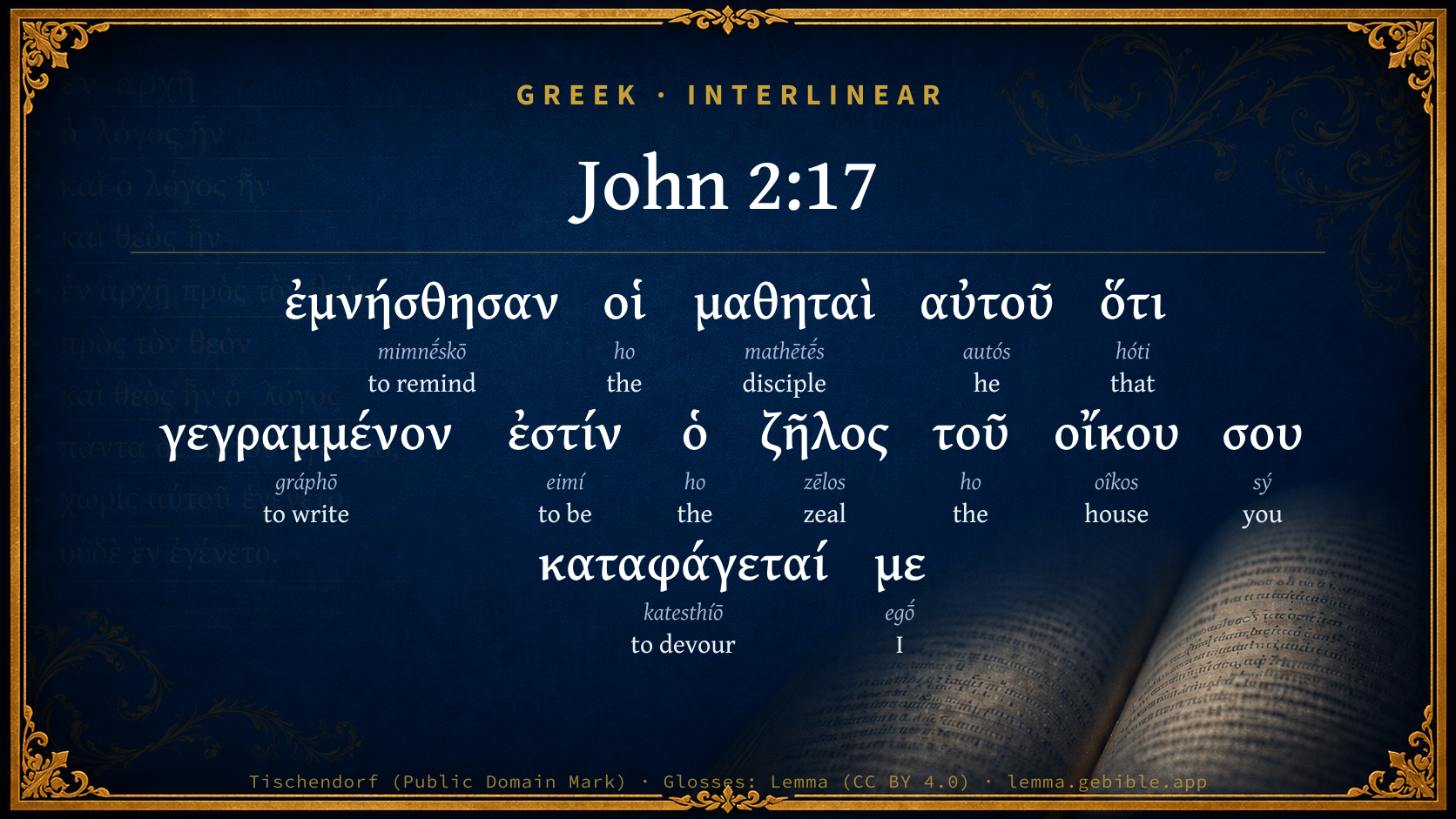
Greek (Tischendorf 8th ed.) John 2:17 appears in the Greek New Testament. The text above is from the Tischendorf 8th edition. Each word links to its Strong’s number and a concise gloss. Click any word for its full Thayer’s Greek Lexicon entry.
Download image
Cite this verse

John 2:17 (World English Bible). Public Domain. Lemma interlinear Bible study tool, https://lemma.gebible.app/v/john/2/17.

Show BibTeX & RIS
BibTeX
RIS
English Translation
His disciples remembered that it was written, "Zeal for your house will eat me up."
World English Bible · Public Domain
Highlights
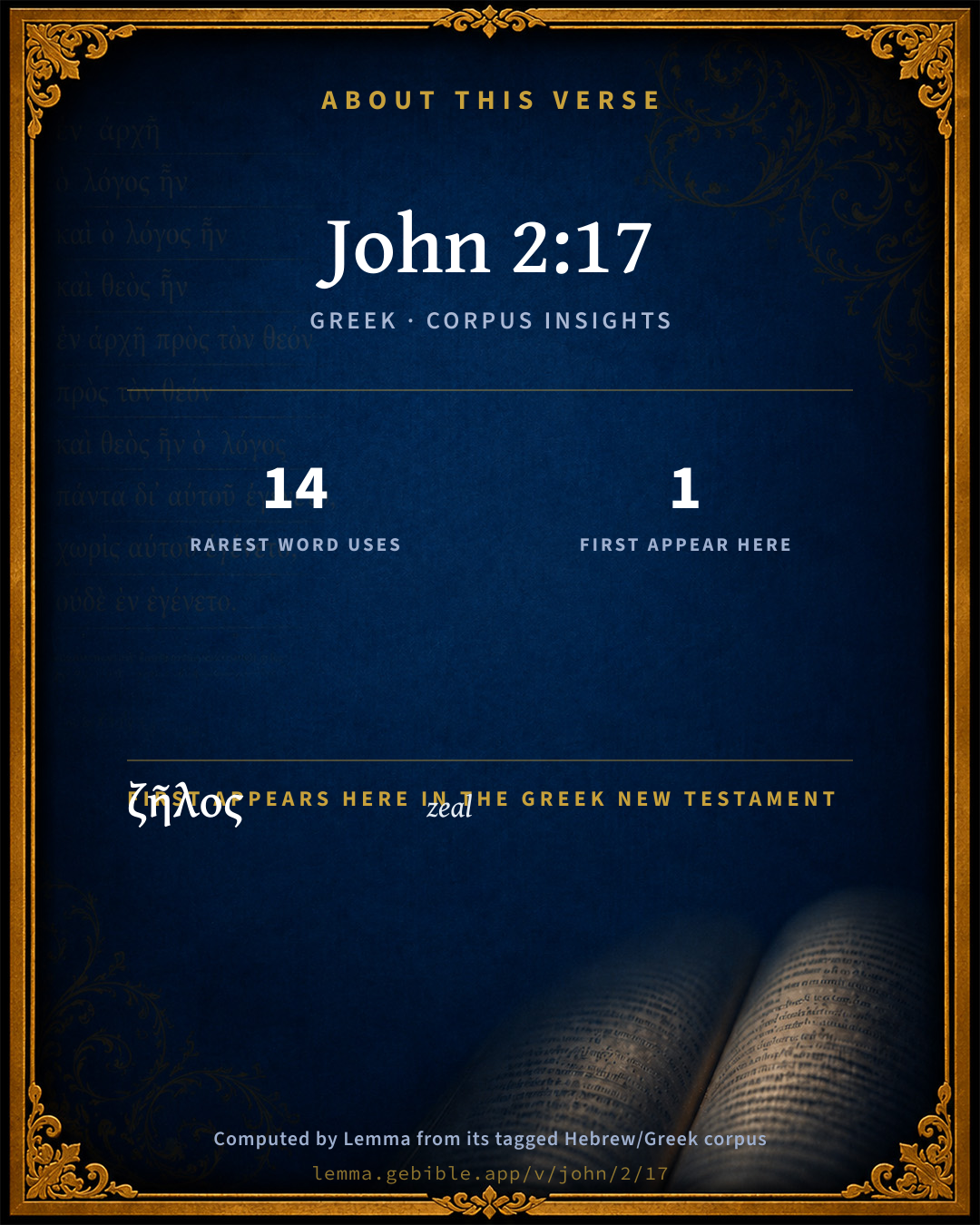
  • 1 first appearance in the Greek New Testament
Full analysis ↓
Download a study sheet

One document with this verse’s original text, its word-by-word gloss line, the meaning frame, cross-references with their text, attributed commentary, and full source and license credits — printable, and it pastes into notes with its structure intact.

This verse Autodidact and up

Study sheet (.html) Plain text (.txt)

A passage Seminary Student

Up to 50 verses in one chapter. A passage sheet keeps up to 6 commentary sources and 12 cross-references per verse, in the order this page ranks them, and says so on the sheet whenever that leaves anything out. Ask for a single verse and you get the Autodidact verse sheet above.

Everything on this page stays free to read, with no account — the sheet is a download of what is already on screen, not access to it.

Want to remove ads? Support Godless Engineer
Compare translations 3

The same verse in 3 English versions, stacked beneath the original-language interlinear above. Click any original word for its lexicon entry.

Each is an independent rendering of the whole verse — the interlinear is not word-aligned to these translations.

Highlighted words mark where these versions differ — a whole-verse word diff, not a word-by-word alignment.

  • World English Bible Public Domain
    His disciples remembered that it was written, "Zeal for your house will eat me up."
  • King James Version Public Domain
    And his disciples remembered that it was written, The zeal of thine house hath eaten me up.
  • unfoldingWord Literal Text CC BY-SA 4.0
    His disciples remembered that it is written, “Zeal for your house will consume me.”

unfoldingWord Literal Text — © unfoldingWord, licensed CC BY-SA 4.0. Word-aligned USFM3 via Door43 (git.door43.org/unfoldingWord/en_ult).

Versions to compare (up to 4)

3 of 4 selected

Show all 19 translations

Every available English version of this verse, each an independent rendering of the whole verse.

  • World English Bible Public Domain
    His disciples remembered that it was written, "Zeal for your house will eat me up."
  • Berean Standard Bible Public Domain
    His disciples remembered that it is written: “Zeal for Your house will consume Me.”
  • Majority Standard Bible Public Domain
    His disciples remembered that it is written: “Zeal for Your house will consume Me.”
  • King James Version Public Domain
    And his disciples remembered that it was written, The zeal of thine house hath eaten me up.
  • American Standard Version (1901) Public Domain
    His disciples remembered that it was written, Zeal for thy house shall eat me up.
  • Revised Version (1885) Public Domain
    His disciples remembered that it was written, The zeal of thine house shall eat me up.
  • Geneva Bible (1599) Public Domain
    And his disciples remembred, that it was written, The zeale of thine house hath eaten me vp.
  • Douay-Rheims (1899) Public Domain
    And his disciples remembered, that it was written: The zeal of thy house hath eaten me up.
  • Young's Literal Translation Public Domain
    And his disciples remembered that it is written, `The zeal of Thy house did eat me up;'
  • Literal Standard Version CC BY-SA 4.0
    And His disciples remembered that it is written: “The zeal of Your house ate Me up”;
  • Unlocked Literal Bible CC BY-SA 4.0
    His disciples remembered that it was written, “Zeal for your house will consume me.”
  • unfoldingWord Literal Text CC BY-SA 4.0
    His disciples remembered that it is written, “Zeal for your house will consume me.”
  • Darby Bible Public Domain
    [And] his disciples remembered that it is written, The zeal of thy house devours me.
  • World Messianic Bible Public Domain
    His disciples remembered that it was written, “Zeal for your house will eat me up.”
  • Webster's Bible Public Domain
    And his disciples remembered that it was written, The zeal of thy house hath eaten me up.
  • Free Bible Version CC BY-SA 4.0
    His disciples remembered the Scripture that says, “My devotion for your house is like a fire burning inside me!”
  • Bible in Basic English Public Domain
    And it came to the minds of the disciples that the Writings say, I am on fire with passion for your house.
  • Text-Critical English NT CC BY 4.0
    And his disciples remembered that it is written, “Zeal for yoʋr house will consume me.”
  • Tyndale New Testament (1534) Public Domain
    And his disciples remembred how that it was wrytten: the zele of thyne housse hath even eaten me.

Literal Standard Version (2020), Covenant Press — licensed CC BY-SA 4.0. Text via the HelloAO Bible API (eBible.org). Unlocked Literal Bible (unfoldingWord) — licensed CC BY-SA 4.0. Text via the HelloAO Bible API (eBible.org). unfoldingWord Literal Text — © unfoldingWord, licensed CC BY-SA 4.0. Word-aligned USFM3 via Door43 (git.door43.org/unfoldingWord/en_ult). Free Bible Version, Dr. Jonathan Gallagher — licensed CC BY-SA 4.0. Text via the HelloAO Bible API (eBible.org).

Word by word

More ways to search: Search by grammar → Find every occurrence → Compare this word →

Practice this passage: Drill this verse → Learn its vocabulary →

καταφάγεταί
katesthíō
G2719
“to devour”
Verb, Future, Middle deponent, Indicative, 3rd person, Singular
Part of Speech
Verb
Tense
Future
Voice
Middle deponent
Mood
Indicative
Person
3rd person
Number
Singular
Full Thayer's Definition

Origin: from G2596 and G2068 (including its alternate)

TDNT: None

1. to consume by eating, to eat up, devour a. of birds b. of a dragon c. of a man eating up the little book 2. metaph. a. to devour i.e. squander, waste: substance b. to devour i.e. forcibly appropriate: widows' property c. to strip one of his goods 1. to ruin (by the infliction of injuries) d. by fire, to devour i.e. to utterly consume, destroy e. of the consumption of the strength of body and mind by strong emotions
  1. ἐμνήσθησαν mimnḗskō G3403 “to remind” Verb, Aorist, Passive, Indicative, 3rd person, Plural
  2. οἱ ho G3588 “the” Article, Nominative, Plural, Masculine
  3. μαθηταὶ mathētḗs G3101 “disciple” Noun, Nominative, Plural, Masculine
  4. αὐτοῦ autós G846 “he” Personal pronoun, Genitive, Singular, Masculine
  5. ὅτι hóti G3754 “that” Conjunction
  6. γεγραμμένον gráphō G1125 “to write” Verb, Perfect, Passive, Participle, Nominative, Singular, Neuter
  7. ἐστίν eimí G1510 “to be” Verb, Present, Active, Indicative, 3rd person, Singular
  8. ὁ ho G3588 “the” Article, Nominative, Singular, Masculine
  9. ζῆλος zēlos G2205 “zeal” Noun, Nominative, Singular, Masculine
  10. τοῦ ho G3588 “the” Article, Genitive, Singular, Masculine
  11. οἴκου oîkos G3624 “house” Noun, Genitive, Singular, Masculine
  12. σου sý G4771 “you” Personal pronoun, 2nd person, Genitive, Singular
  13. με egṓ G1473 “I” Personal pronoun, 1st person, Accusative, Singular

About this verse

These counts appear in no published source. They are computed here, from the morphology-tagged text and Lemma’s own curated glosses. What Lemma adds →

14
words
12
distinct lemmas
Gospels
section

Notable vocabulary

The rarest word here is καταφάγεταί to devour G2719 — appearing just 14 times in the whole Greek New Testament.

First appearance in Scripture

This word makes its first canonical appearance in the Greek New Testament here:

Shared distinctive vocabulary

καταφάγεταί to devour G2719 occurs in 14 verses of the Greek New Testament. Also found in:

Repetition

A word recurs within this verse:

Cross-references

2

Topical passages linked to John 2:17 in the Treasury of Scripture Knowledge — connected by theme and wording, ordered by reader-vote popularity; previews shown in the World English Bible.

  • Psalms 69:9 For the zeal of your house consumes me. The reproaches of those who reproach you have fallen on me.
  • Psalms 119:139 My zeal wears me out, Because my enemies ignore your words.

Cross-references courtesy of OpenBible.info (CC BY 4.0).

Commentary

Notes on John 2:17 from classic Christian and Jewish commentators (each source and its license shown beneath its notes). The classic Christian expositions comment on the surrounding passage and are grouped to its opening verse, so a note may address several verses; the Jewish commentaries on the Tanakh (Rashi and others) are per-verse, so they appear only where the commentator wrote on this verse.

Lemma curates 59 commentaries, every one of them public domain or Creative Commons licensed, each selected and text-cleaned for this edition rather than reprinted as found. About our sources →

The Biblical Illustrator

Joseph S. Exell

Joh_2:17

The zeal of Thine house hath eaten Me up

I.

ZEAL FOR THE STRUCTURE OF THE HOUSE.

1. It is the duty of the Church to provide convenient places for the public worship of God. Over-building is a lamentable waste of strength; but under-building is a sin. The Church who neglects to provide proper accommodation for the fast growing population of the country, is guilty of a grievous breach of Christian trust.

2. The house of God should be in consonance with the most chastened taste. Beauty is as cheap as ugliness. The fiat roof was prevalent in antiquity, but Christianity, elevating the human mind, has given us the dome and the spire. Our conscience, like Davids, should smite us when our house is better than Gods.

3. The same zeal which prompts us to build and beautify should prompt us to pay, and not leave a burden of debt to coming generations; but those who inherit the burdens should believe in the strength of God and remove them. Many have been obliged to go through the bankruptcy court because of too much liberality in the cause of the devil; none through over liberality in the cause of God.

II. ZEAL FOR THE ORDINANCES OF THE HOUSE.

1. The means of grace, the ordinary services; if we neglect the means we shall not have the grace. God promised to be a small sanctuary to the Babylonish exiles; so He will be to those who are in sore captivity through affliction. But if in health, God expects you to be in the assembly of His people. The social character of Christianity must be thus maintained.

2. Two institutions in particular go under the name of ordinances. About these there has been much controversy. Extremes are to be avoided

(1) That they are miracles.

(2) That they are empty ceremonies. True zeal shuns both extremes.

3. There must be zeal not only for but in ordinances. Warmth is always attractive and contagious. One of the objects of the gospel is to warm mans natural frigidity. Fervour in the pulpit, in the prayer-meeting, etc., imperative. But it is not respectable! God preserve us from respectability, then. But there is enthusiasm enough in political and social gatherings and in business.

III. FOR THE DISCIPLINE OF THE HOUSE.

1. Wickedness should be rebuked. Purity must be maintained at all costs. Some churches need the scourge of small cords to drive out the men who, by their negligence or immorality, disgrace the altars of God.

2. Virtue should be fortified. In the family and the Church, discipline should aim at the development of goodness, so that the doctrine of God our Saviour may be adorned in all things.

3. Our interest in the holiness of the Church should be all aflame with sacred zeal. In proportion as we are zealous for God, He will bless our efforts at evangelization.

IV. FOR THE DOCTRINES OF THE HOUSE. It is the Church s vocation, not that of the ministry as an official order to defend the faith.

1. Zeal for the doctrine implies mental hostility to error. The tendency of to-day is to tolerate not only heretics, which is right, but heresy, which is wrong.

2. Whilst opposing heresy, our chief concern should be the vindication and exposition of truth. Zeal not for sect and party, but for the truth--particularly the cardinal truth of the cross. (J. Cynddylan Jones, D. D.)

Christs zeal

I. ITS SPHERE. We cannot confine it to the temple or any other ecclesiastical structure.

1. The universe, in all the glory of its interminable spreadings, is the house of God. There is not a lonely spot which is not full of Deity.

2. And when we divide this universe into sections we know that there is some scene hououred above others with the Almightys presence--where angels cluster, and where the Creator may be said more emphatically to dwell.

3. The whole company of the faithful upon earth constitute the house of God--builded together for a habitation of God through the Spirit.

4. Nay, there is not a solitary individual, over whom the great change has passed, who is not tenanted by the High and Lofty One.

II. CHRISTS ZEAL WORKING IN THIS SPHERE. Zeal devoured the spirit of our Saviour, and in driving out the traffickers from the temple we can recognize the workings of the principle, but we cannot limit it to this. We gather from the expression

1. That Jesus was consumed with a lofty desire to benefit the denizens of the universe.

2. Over the inhabitants of heaven Christ poured His amazing solicitudes.

3. An ardent longing to rescue this world from its degradation, and to build up its desecrated fragments into s temple of the living God, throbbed in the heart of Jesus of Nazareth. Confined, as it might have seemed, to a single race, its effect branched out into every quarter of the house of God, and orders of intelligence which needed not to be brought to the Saviour might have been confirmed and sustained by that which put man within the circles of acceptance.

4. Viewing Gods house as including the believing remnants of Adams descendants, we see Him entering on His course as the sun enters on his march in the firmament. His soul yearned over those who had destroyed themselves. He entered into the nature on which rested the awful curse; and when the race He had come to redeem rejected Him, the zeal of Gods house kept Him fast on His pathway of pain. (H. Melvill.)

Christs zeal

I. The OBJECT of zeal--Thy house. The Jewish temple as symbolizing

1. The Old Testament Church.

2. The world of sinners.

3. Corrupted Christian communities.

II. The NATURE of zeal. True and godly zeal, says Bp. Jewell, eateth and devoureth up the heart, even as the thing that is eaten is turned into the substance of him that eateth it; and as iron, while iris burning hot, is turned into the nature of the fire, so great and just is the grief that they which have this zeal conceive when they see Gods house spoiled, or His holy name dishonoured.

III. The MANIFESTATION of the zeal.

1. In rigidly expelling the defiling and the false.

2. In replacing and building up the pure and the true.

The zeal of Christ

It is said that sometimes when a crowd see a vessel that is going to pieces, and hear the cries of the drowning men, they seem as if they were all seized with madness, because, not being able to give vent to their kindness toward the perishing ones by any practical activity, they know not what to do, and are ready to sacrifice their lives if they might but do something to save others. Men feel that they must work in the presence of so dreadful a need. And Christ saw this world of ours quivering over the pit. He saw it floating, as it were, in an atmosphere of fire, and he wished to quench those flames and make the world rejoice, and therefore He must work to that end. He could not rest and be quiet. (C. H. Spurgeon.)

The zeal of our Lord to be imitated

Let the zeal of the house of God ever eat thee. For example: seest thou a brother running to the theatre? stop him, warn him, be grieved for him, if the zeal of Gods house hath now eaten thee. Seest thou others running and wanting to drink themselves drunk? Stop whom thou canst, hold whom thou canst, frighten whom thou canst; whom thou canst, win in gentleness: do not in any wise sit still and do nothing. (Augustine.)

Commendable zeal

The most remarkable examples of zeal are found in the records of the early itinerant ministers. Richard Nolley, one of these, came upon the fresh trail of an emigrant in the wilderness, and followed it till he overtook the family. When the emigrant saw him he said, What? a Methodist preacher! I quit Virginia to be out of the way of them; but in my settlement in Georgia I thought I should be beyond their reach. There they were; and they got my wife and daughter into their church. Then I come here to Chocktaw Corner, find a piece of land, feel sure that I shall have some peace from the preachers; and here is one before I have unloaded my waggon! The preacher exhorted him to make his peace with God, that he might not be troubled by the everywhere present Methodist preachers.

Christian zeal necessary

A young Brahman put this question to the Rev. E. Lewis, of Bellary--Do the Christian people of England really believe that it would be a good thing for the people of India to become Christians? Why, yes, to be sure they do, he replied. What I mean is this, continued the Brahman, do they in their hearts believe that the Hindoos would be better and happier if they were converted to Christianity? Certainly they do, said Mr. Lewis. Why, then, do they act in such a strange way? Why do they send so few to preach their religion? When there are vacancies in the Civil Service, there are numerous applicants at once; when there is a military expedition, a hundred officers volunteer for it; in commercial enterprises, also, you are full of activity, and always have a strong staff. But it is different with your religion. I see one missionary with his wife here, and one hundred and fifty miles away is another, and one hundred miles in another direction is a third. How can the Christians of England expect to convert the people of India from their hoary faith with so little effort on their part? (Chronicle of London Missionary Society.)

Consuming zeal

When Baxter came to Kidderminster there was about one family in a street which worshipped God at home. When he went away there were some streets in which there was not more than one family on a side that did not do it; and this was the case even with inns and public-houses. While some Divines were wrangling about the Divine right of Episcopacy or Presbytery, or splitting hairs about reprobation and free-will, Baxter was always visiting from house to house, and beseeching men, for Christs sake, to be reconciled to God and flee from the wrath to come. (Bp. Ryle.)

Zealous, but not furious

It is in the matter of religion as with the tending of a still; if we put in too much fire it burns, if too little, it works not: a middle temper must be kept. A heat there must be, but a moderate one. We may not be like a drowsy judge upon a Grecian bench, who is fain to bite upon beans, to keep himself from sleeping; neither may we be like that Grecian player, who acted mad Ajax on the stage; but we must be soberly fervent and discreetly active. St. Pauls spirit was stirred within him at Athens because of its idolatry, and it breaks out of his mouth in a grave reproof: I do not see him put his hand furiously to demolish them. And if a Juventius and Maximinian, in the heat of zeal, shall rail on wicked Julian at a feast, he justly casts their death, not on their religion, but on their petulancy. It was a well-made decree in the council of Eliberis, that if any man did take upon him to break down idols, and were slain, he should not be reckoned amongst the martyrs. There must then be two moderators of zeal, discretion and charity, without either and both of which it is no other than a wild distemper; and with them, it is no less than the very life-blood of the Christian. (Bp. Hall.)

The Biblical Illustrator, edited by Joseph S. Exell (c. 1880s–1900s) — public domain. Text from a community e-Sword module.

Bengel's Gnomon

Johann Albrecht Bengel

Joh 2:17. Ἐμνήσθησαν, they remembered) Comp. Joh 2:22, ch. Joh 12:16 [His triumphant entry into Jerusalem], “These things understood not His disciples at the first; but when Jesus was glorified, then remembered they that these things were written of Him.” Concerning the time of remembrance, also ch. Joh 14:26, “The Holy Ghost shall bring all things to your remembrance, whatsoever I have said unto you.”—ὁ ζῆλος—καταφάγεταί με, Zeal—shall eat Me up[46]) So Septuagint, Psa 69:10. In truth, His enemies afterwards killed Jesus on account of His zeal for His Father’s house.—οἴκου, house) See Joh 2:16.

[46] So ABP, the best authorities, read; but the old Latin Versions abc Vulg., and the Rec. Text, read κατέφαγέ, hath eaten Me up.—E. and T.

Bengel's Gnomon of the New Testament — English translation (T&T Clark, Edinburgh, 1860) — public domain. Text from a community e-Sword module.

Meyer's Critical & Exegetical Commentary

Heinrich August Wilhelm Meyer

Joh_2:17. Ἐμνήσθησαν] At the very time of the occurrence, and not (as Olshausen asserts) after the resurrection, a circumstance which has to be stated in Joh_2:22 (comp. Joh_12:16).

The text quoted is Psa_69:10; the theocratic sufferer in this psalm, a psalm written during the exile, is a type of the Messiah; see Joh_15:25, Joh_19:28 ff. Comp. Rom_15:3; Rom_11:9; Act_1:20

καταφάγεταί με] will devour or consume me, is to be understood of a power which wears one out internally, Psa_119:139, not to be referred to the death of Jesus (Bengel, Olshausen, Hofmann, Weissag. u. Erf. p. 111; Luthardt, comp. Brückner), for the disciples could at that time have thought of anything but His death; comp. Joh_2:22. In this wrathful zeal, which they saw had taken hold of Jesus, they thought they saw the Messianic fulfilment of that word in the psalm, wherein the speaker declares his great zeal for Gods house, which was yet to wear him out. The fulfilment relates to the ὁ ζῆλος τοῦ οἴκου σου, whereof the καταφάγεται indicates only the violence and permanence; and there is therefore no ground for imagining already any gloomy forebodings on the part of the disciples (Lange). For ἐσθίειν and ἔδειν, used of consuming emotions (as in Aristophanes, Vesp. 287), see Jacobs, ad Anthol. VI. 280; Del. epigr. p. 257. As to the future φάγομαι, which belongs to the LXX. and Apocrypha, see Lobeck, ad Phryn. p. 327; like the classical ἔδομαι, it never stands as present (against Tholuck, Hengstenberg, Godet, and others).

Note.

If there was but one cleansing of the temple, then either John or the Synoptics have given an erroneous narrative. But if it happened twice,[140] first at the beginning, and then at the end of the Messianic ministry of Jesus,a supposition which in itself corresponds too well to the significance of the act (in so far as its repetition was occasioned by the state of disorder remaining unchanged after so long an interval had elapsed) to be inconceivable (as has been asserted by some), or even merely to pass the limits of probability,it is then, on the one hand, conceivable that the Synoptics do not contain the first cleansing, because Christs early labours in Jerusalem do not belong to the range of events which they generally narrate; and, on the other hand, that John passes over the second cleansing, because he had already recorded the Messianic ΣΗΜΕῖΟΝ of the same kind. We are not therefore to suppose that the one account is true, and the other false, but to assume that the act was repeated. See on Mat_21:12-13. So the Fathers and most subsequent writers; also Schleiermacher, Tholuck, Olshausen, B. Crusius, Maier, Ebrard, Luthardt, Riggenbach, Lange, Baumgarten, Hengstenberg, Godet, etc. Others, on the contrary, admitting only one temple-cleansing, decide in favour, some of the synoptical account (Strauss, Weisse, Baur, Hilgenfeld, Scholten, Schenkel[141]), and some in favour of Johns (Lücke, De Wette, Ammon, Krabbe, Brückner, Ewald, Weizsäcker, and many others; Bäumlein hesitatingly). The latter would be the correct view, because John was an eye-witness; although we are not to suppose, as Baur, in keeping with his view of the fourth Gospel, thinks, that John derived the facts from the Synoptics, but fixed the time of the transaction independently, in consistency with the idea of reformatory procedure. See also Hilgenfeld, who traces here the idiosyncrasy of John, who, with reference at least to the knowledge of the disciples and the relations of Jesus to the Jews, begins where the Synoptics leave off; and thus his narrative is merely a peculiar development of synoptical materials. Besides, upon the supposition of two distinct cleansings of the temple, any essential difference between the two acts themselves is not to be discovered. Luthardt, indeed, following Hofmann (comp. Lichtenstein, p. 156), thinks that, in the synoptical account, Jesus as prophet protects the place of divine worship, but that in Johns He as Son exercises His authority over the house; but the ὁ οἶκός μου of the Synoptics, as the declaration of God, exactly corresponds with ΤῸΝ ΟἾΚΟΝ ΤΟῦ ΠΑΤΡΌς ΜΟΥ in John as the word of Christ. The distinction, moreover, that the first cleansing was the announcement of reformation, and the second that of judgment (Hengstenberg), cannot be made good, separates what is clearly connected, and attaches too much importance to collateral minutiae. This remark in answer to Godet, who regards the first cleansing as un appel, the second as une protestation. The essential element of difference in Johns account lies in the very striking declaration of Jesus about the temple of His body, Joh_2:19, of which the Synoptics have not a word, and which possesses great prophetic significance as uttered at the very outset of His Messianic ministry, but has no special fitness at the end of it. Jesus accordingly did not utter it again at the second cleansing, but only at the first, though upon that second cleansing also, occasion was given for so doing (Mat_21:23). It is this very declaration, however, which marks unmistakeably the Messianic character of the appearance of Jesus in Jerusalem from the very first (against Weizsäcker, Evang. Gesch. p. 260). Chap. Joh_7:3 is not the first place which treats of that Messianic appearance.

[140] Whether it took place before or after, once or twice, it takes nothing from our faith.LUTHER.

[141] Comp. also Luther: It seems to me that John here skips over the three first years.

Meyer — Critical and Exegetical Commentary on the New Testament — English translation by Peter Christie, edited by Frederick Crombie (T&T Clark, 1880) — public domain. Text from a community e-Sword module.

Godet's Commentaries

Frédéric Louis Godet

Vv. 17-22.

The effect is described in Joh 2:17-22. We meet here a fact, which will repeat itself at every manifestation of the Lord’s glory; a twofold impression is produced, according to the moral predisposition of the witnesses; some find in the act of Jesus nourishment for their faith; for others the same act becomes a subject of offense. It is the pre-existing moral sympathy or antipathy that determines the impression.

Ver. 17. “His disciples remembered that it was written: The zeal of thy house shall eat me up.”

This recollection took place immediately; comp. Joh 2:22, where the opposite fact is expressly pointed out. Psalms 69, the ninth verse of which presents itself at this moment to the remembrance of the disciples, is only indirectly Messianic—that is to say, the subject contemplated by the Psalmist is not the person of the Messiah (comp. Joh 2:6 : “Thou knowest my foolishness, and my sins are not hid from thee”), but the theocratic righteous person, suffering for the cause of God. The highest realization of this ideal is the Messiah. Weiss claims that this quotation finds an explanation only so far as this Psalm was, at that time, exclusively, and through an error, referred to the Messiah. But in order to this, the reading of Joh 2:6 must have been forgotten. The unanimity of the Mjj. decides in favor of the reading καταφάγεται . This verb is a future; the evangelist substitutes it for the past κατέφαγε, hath eaten up, of the LXX. which is in conformity with the Hebrew text. The disciples are thinking, not of Jesus’ last sufferings, which were at that time beyond the thoughts which occupied their minds, but on the consuming force of His zeal, on that living holocaust, the first act of which they beheld at this moment. This also is the meaning of the word hath eaten up, in the Psalm.

While the disciples compare the Scriptures, and this remembrance strengthens their faith, the Jews reason and object, just as the inhabitants of Nazareth do, Luk 4:22. Instead of letting the act of Jesus speak, as every manifestation of holiness should, to their conscience, they demand the external sign which should legitimate this act, as if it did not contain in itself its own legitimation!

Frédéric Louis Godet — Commentaries on Luke, John, Romans, and 1 Corinthians — English translation (T&T Clark, Edinburgh, 1870s–1890s) — public domain. Text from a community e-Sword module.

Geneva Bible (1599)

Geneva Bible translators

Zeal in this place is taken for a wrathful indignation and displeasure of the mind, conceived of some naughty and evil dealing towards them whom we love well.

Geneva Bible (1599) marginal notes — public domain. Text via Bolls.life.

Jamieson, Fausset & Brown

Robert Jamieson, A. R. Fausset & David Brown

eaten me up--a glorious feature in the predicted character of the suffering Messiah (Psa 69:9), and rising high even in some not worthy to loose the latchet of His shoes. (Exo 32:19, &c.).

Jamieson, Fausset & Brown — Commentary Critical and Explanatory on the Whole Bible (1871) — public domain (CC PDM 1.0). Text via the HelloAO Bible API.

Adam Clarke's Commentary

Verse 17. The zeal of thine house] See Ps 59:10. Zeal to promote thy glory, and to keep thy worship pure.

Adam Clarke's Commentary on the Bible (1810–1826) — public domain. Text from a community e-Sword/MySword module.

John Calvin's Commentaries

17. And his disciples remembered. It is to no purpose that some people tease themselves with the inquiry how the disciples remembered a passage of Scripture, with the meaning of which they were hitherto unacquainted. For we must not understand that this passage of Scripture came to their remembrance at that time; but afterwards, when, having been taught by God, they considered with themselves what was the meaning of this action of Christ, by the direction of the Holy Spirit this passage of Scripture occurred to them. And, indeed, it does not always happen that the reason of God’s works is immediately perceived by us, but afterwards, in process of time, He makes known to us his purpose. And this is a bridle exceedingly well adapted to restrain our presumption, that we may not murmur against God, if at any time our judgment does not entirely approve of what he does. We are at the same time reminded, that when God holds us as it were in suspense, it is our duty to wait for the time of more abundant knowledge, and to restrain the excessive haste which is natural to us; for the reason why God delays the full manifestation of his works is, that he may keep us humble.

The zeal of thine house hath eaten me up. The meaning is, that the disciples at length came to know, that the zeal for the house of God, with which Christ burned, excited him to drive out of it those profanations. By a figure of speech, in which a part is taken for the whole, David employs the name of the temple to denote the whole worship of God; for the entire verse runs thus:

the zeal of thy house hath eaten me up, and the reproaches of them who reproached thee have fallen on me, (Psalm 69:9.)

The second clause corresponds to the first, or rather it is nothing else than a repetition explaining what had been said. The amount of both clauses is, that David’s anxiety about maintaining the worship of God was so intense, that he cheerfully laid down his head to receive all the reproaches which wicked men threw against God; and that he burned with such zeal, that this single feeling swallowed up every other. He tells us that he himself had such feelings; but there can be no doubt that he described in his own person what strictly belonged to the Messiah.

Accordingly, the Evangelist says, that this was one of the marks by which the disciples knew that it was Jesus who protected and restored the kingdom of God. Now observe that they followed the guidance of Scripture, in order to form such an opinion concerning Christ as they ought to entertain; and, indeed, no man will ever learn what Christ is, or the object of what he did and suffered, unless he has been taught and guided by Scripture. So far, then, as each of us shall desire to make progress in the knowledge of Christ, it will be necessary that Scripture shall be the subject of our diligent and constant meditation. Nor is it without a good reason that David mentions the house of God, when the divine glory is concerned; for though God is sufficient for himself, and needs not the services of any, yet he wishes that his glory should be displayed in the Church. In this way he gives a remarkable proof of his love towards us, because he unites his glory — as it were, by an indissoluble link — with our salvation.

Now as Paul informs us that, in the example of the head, a general doctrine is presented to the whole body, (Romans 15:3,) let each of us apply to the invitation of Christ, that — so far as lies in our power — we may not permit the temple of God to be in any way polluted. But, at the same time, we must beware lest any man transgress the bounds of his calling. All of us ought to have zeal in common with the Son of God; but all are not at liberty to seize a whip, that we may correct vices with our hands; for we have not received the same power, nor have we been entrusted with the same commission.

John Calvin's Commentaries (1540-1563) — public domain. Text from the Calvin Translation Society English edition (1840s-50s) via the Christian Classics Ethereal Library (ccel.org). Calvin's coverage is partial (roughly two-thirds of the Bible); uncommented books and verses are honest gaps, never fabricated. The 19th-century editor's footnotes and remarks are omitted so the notes are faithfully Calvin's own voice.

Ellicott's Commentary for English Readers

(17) Was written . . . hath eaten me up .—More literally, is written . . . shall eat me up. The verse is full of interest in many ways. It gives us the thought of the disciples at the time (comp. Joh_2:22) which could be known only to one of their number. It shows us what we too seldom realise in reading the New Testament, that the Jewish mind was filled to overflowing with thoughts of the Old Testament. The child was taught to say by heart large portions of the Law and Psalms and Prophets, and they formed the very texture of the mind, ready to pass into conscious thought whenever occasion suggested. With the exception of the 22nd Psalm, no part of the Old Testament is so frequently referred to in the New as the psalm from which these words are taken (Psa_69:9), and yet that psalm could not have been in its historic meaning Messianic (see, e.g., Joh_2:5; Joh_2:22-25). This reference to it gives us, then, their method of interpretation. Every human life is typical. The persecution without reason, the wrong heaped upon the innocent, the appeal to and trust in Jehovah, the song of thanksgiving from him whose parched throat was weary of calling—all this was true of some representative sufferer of earlier days, and we may hear in it almost certainly the voice of Jeremiah; but it was true of him in that he was a forerunner of the representative sufferer. The darker features of the psalm belong to the individual; the Life which sustains in all, and the Light which illumines in all, was even then in the world, though men knew Him not. The words of Jeremiah are Messianic, because his life—like every noble, self-forgetting, others’ sorrow bearing, man and God loving life—was itself Messianic.

The change of tense, from the past of the Psalmist to the future here, is itself significant. The words were true of the inner burning which consumed the prophet-priest. They come to the heart as true, with a fuller truth, of Christ’s spirit burning with righteous indignation, and cast down by deepest sorrow; but shrinking not from the painful task, which leaves its mark falling on that face as the shadow of a deeper darkness. They are to be, in a deeper sense, truer still.

A Bible Commentary for English Readers, edited by Charles John Ellicott (1878–1897) — public domain. Text from a community e-Sword module.

The Cambridge Bible for Schools and Colleges

gen. ed. J. J. S. Perowne

17. remembered] Then and there. Who could know this but a disciple? Who would think of inventing it? See above on Joh_2:11.

was written] Better, is written; in the Greek it is the perf. part. pass. with the auxiliary, which S. John almost always uses in quotations, while the Synoptists commonly use the perf. pass. Comp. Joh_6:31; Joh_6:45, Joh_10:34, Joh_12:14 (Joh_19:19).

hath eaten me up] Rather, will devour, or consume me, i.e. wear me out. Psa_69:9, a psalm referred to again Joh_15:25 and Joh_19:28.

It is difficult to believe that this cleansing of the Temple is identical with the one placed by the Synoptists at the last Passover in Christ’s ministry; difficult also to see what is gained by the identification. If they are the same event, either S. John or the Synoptists have made a gross blunder in chronology. Could S. John, who was with our Lord at both Passovers, make such a mistake? Could S. Matthew, who was with Him at the last Passover, transfer to it an event which took place at the first Passover, a year before his conversion? When we consider the immense differences which distinguish the last Passover from the first in Christ’s ministry, it seems incredible that anyone who had contemporary evidence could through any lapse of memory transfer a very remarkable incident indeed from one to the other. On the other hand the difficulty of believing that the Temple was twice cleansed is very slight. Was Christ’s preaching so universally successful that one cleansing would be certain to suffice? And if two years later He found that the evil had returned, would He not be certain to drive it out once more? Differences in the details of the narratives corroborate this view.

The Cambridge Bible for Schools and Colleges (gen. ed. J. J. S. Perowne; Cambridge University Press, 1878–1918) — public domain. Text from a community e-Sword module.

John Gill's Exposition

And his disciples remembered that it was written,.... In Psa 69:9, which Psalm belongs to the Messiah, as is manifest from the citations out of it in the New Testament, and the application of them to Christ, as in Joh 15:25, compared with Psa 69:4. Christ is represented in it, as suffering for the sins of his people; for he himself was innocent; and was hated without a cause; but having the sins of his people imputed to him, he made satisfaction for them, and so restored what he took not away. His sufferings are spoken of in it as very great; and from it we learn, that they are fitly called, by himself, a baptism, which he desired to be baptized with, Luk 12:50, since the waters are said to come into his soul, and he to be in deep waters, where the floods overflowed him; so that he was as one immersed in them: it is not only prophesied of him in it, that he should be the object of the scorn and contempt of the Jewish nation, and be rejected by them, and treated with the utmost indignity, and loaded with reproaches; but it foretold, that they should give him gall to eat, and vinegar to drink, which were literally fulfilled in him: and even the Jews themselves seem to be under some conviction, that the Psalm has respect to him; for Aben Ezra, a noted commentator of theirs, on the last words of the Psalm, has this note;

"the sense is, they and their children shall inherit it in the days of David, or in the days of the Messiah.''

It appears from hence, that the disciples of Christ were acquainted with the sacred writings, and had diligently read them, and searched into them, and had made them their study; and upon this wonderful action of Christ, called to mind, and reflected upon the following passage of Scripture, which they judged very proper and pertinent to him:

the zeal of thine house hath eaten me up. This passage, so far as it is cited, agrees exactly, word for word, with the original text in Psa 69:9, wherefore it is very strange that Surenhusius (f) should remark a difference, and give himself a good deal of trouble to reconcile it: he observes, that in the Hebrew text, it is read, "the zeal of the Lord", in the third person; whereas it is there, , "the zeal of thine house", as here, in the second person: indeed, the word "for", is left out, as he remarks, there being no need of it in the citation; the evangelist only historically relating the accommodation of it to Christ, by the disciples; whereas in the original text, the words contain a reason of the reproach and shame which Christ endured, and was put to by the Jews on account of his zeal for the house, honour, and worship of God; and the latter part of the text is not produced at all, being not for the present purpose, though very applicable to Christ; and is cited, and applied to him by the apostle, in Rom 15:3. Such was Christ's regard to his Father's house, and which was typical of the church of God; and such his concern for his honour, ordinances, and worship, that when he saw the merchandise that was carried on in the temple, his zeal, which was a true and hearty affection for God, and was according to knowledge, was stirred up in him, and to such a degree, that it was like a consuming fire within him, that ate up his spirits; so that he could not forbear giving it vent, and expressing it in the manner he did, by driving those traders out of it. Phinehas and Elias were in their zeal, as well as other things, types of Christ; and in the Spirit and power of the latter he came; and Christ not only expressed a zeal for the house of God, the place of religious worship, but for the church and people of God, whose salvation he most earnestly desired, and most zealously pursued: he showed his strong, and affectionate regard to it, by his suretyship engagements for them, by his assumption of their nature, by his ardent desire to accomplish it, and by his voluntary and cheerful submission to death on account of it. And such was his zeal for it, that it eat him up, it inflamed his Spirit and affections, consumed his time and strength, and, at last, his life: and he also showed a zeal for the discipline of God's house, by his severe reflections on human traditions; by asserting the spirituality of worship; by commanding a strict regard to divine institutions; and by sharply inveighing against the sins of professors of religion: and he discovered a warm zeal for the truths of the Gospel, by a lively and powerful preaching of them; by his constancy and assiduity in it; by the many fatiguing journeys he took for that purpose; by the dangers he exposed himself to by it; and by the care he took to free the Gospel from prejudice and calumnies: and it becomes us, in imitation of our great master, to be zealous for his truths and ordinances, and for the discipline of his house, and not bear with either the erroneous principles, or the bad practices of wicked men.

(f) Biblos Katallages, p. 347.

John Gill's Exposition of the Whole Bible (1746–1763) — public domain (CC PDM 1.0). Text via the HelloAO Bible API.

Trapp's Complete Commentary

John Trapp

17 And his disciples remembered that it was written, The zeal of thine house hath eaten me up.

Ver. 17. The zeal of thine house] Apostates, on the other side, eat up their zeal of God’s house. But as in falling forward is nothing so much danger as backward; so the zealot, though not so discreet, is better than the apostate: howbeit, zeal should eat us up (saith Mr Vines), but not eat up our wisdom, nor should pride eat up our zeal. Mr Greenham had this saying of David often in his mouth, and well he might. He also usually prayed that he might keep up his young zeal with his old discretion.

John Trapp, A Commentary or Exposition upon All the Books of the Old and New Testament (1647–1656) — public domain. Text from a community e-Sword module.

Albert Barnes' Notes on the Bible

It was written ... - This is recorded in Psa 69:9. Its meaning is, that he was affected with great zeal or concern for the pure worship of God.

The zeal of thine house - “Zeal” is intense ardor in reference to any object. The “zeal of thine house” means extraordinary concern for the temple of God; intense solicitude that the worship there should be pure, and such as God would approve.

Hath eaten me up - Hath absorbed me, or engaged my entire attention and affection; hath surpassed all other feelings, so that it may be said to be the one great absorbing affection and desire of the mind. Here is an example set for ministers and for all Christians. In Jesus this was the great commanding sentiment of his life. In us it should be also. In this manifestation of zeal he began and ended his ministry. In this we should begin and end our lives. We learn, also, that ministers of religion should aim to purify the church of God. Wicked men, conscience-smitten, will tremble when they see proper zeal in the ministers of Jesus Christ; and there is no combination of wicked men, and no form of depravity, that can stand before the faithful, zealous, pure preaching of the gospel. The preaching of every minister should be such that wicked men will feel that they must either become Christians or leave the house of God, or spend their lives there in the consciousness of guilt and the fear of hell.

Albert Barnes' Notes on the Bible (1834–1885) — public domain. Text from a community e-Sword/MySword module.

Matthew Poole's English Annotations

The disciples, as well as the rest of the people there present, could not but be astonished at this so strange a thing, to see a single person, and he in no repute but as a private person, to make a whip, and with authority drive the buyers and sellers out of the temple, and nobody to oppose him; but they remembered the words of David, Psa 69:9. Some think that John here reports what they did after Christ’s resurrection; and, indeed, whoso considereth the following part of the gospel history, would think that it were so; for they did not seem so early to have had a persuasion of Christ’s Divine nature, nor that he was the Messiah; or if they at this time remembered it, and apprehended that Christ was the Son of David, the impression seems to have worn off. It is a greater question whether Psa 69:1-36 (from whence this quotation is) is to be understood of Christ, properly and literally, or merely as the Antitype to David, of whom that Psalm is literally to be understood? Some of the Lutherans think that Psalm primarily concerned Christ. Mr. Calvin and others think it only concerned Christ as David’s Antitype. The former, for their opinion, take notice of the frequent quotation of it in the New Testament, Mat 27:48; Joh 19:28; Act 1:20; Rom 15:3. The other urge that there are some things in that Psalm which cannot agree to Christ. The matter is not much. Zeal is nothing but a warmth of love and anger. It is good to be zealous, yea, swallowed up with zeal, in a good cause; but men must take heed of the Pharisaical zeal, not according to knowledge. Christ was zealous, but the cause was good.

Matthew Poole's English Annotations on the Holy Bible (1683–1685) — public domain. Text from a community e-Sword/MySword module.

Whedon's Commentary on the Bible

Daniel D. Whedon

17. His disciples—Only, as yet, the five from Bethsaida. See notes on Joh_2:2, and Joh_1:40-51. Among these was John himself, and therefore a witness of this cleansing.

Remembered—As at Joh_2:22, afterward. But it called to mind the psalm at the time.

Written—In Psa_69:9. This Psalm, though written in the person of David, was applied even by the ancient Jews to the Messiah. Aben Ezra has on the last verse of that psalm this note: “The sense is, they and their children shall inherit, not in the days of David, but in the days of the Messiah.”

Zeal of thine house—Rather, zeal for thy house.

Eaten me up—A figure in all ages to express the consuming, emaciating effects of care and passion.

Daniel D. Whedon (gen. ed.), Commentary on the Old and New Testaments (1874–1909) — public domain. Text from a community e-Sword module.

The Pulpit Commentary

His disciples remembered that it was written, The zeal of thy house will consume me. The future tense, affirmed by the best manuscripts, never (Meyer) bears the present meaning. The disciples, familiar with the Old Testament, remembered at the time the words of Psa_69:9. In that psalm the theocratic Sufferer approached the climax of his sorrows, and admitted that a holy zeal for God"s house will ultimately consume him eat him up. Tile word is used for consuming emotions (cf. Aristoph., "Vespae," 287), and there is a foreshadowing of the reproach and agony which will befall the righteous Servant of God in his passion for God"s honour. The parallelism of the second clause of the verse, "The reproaches of them that reproached thee have fallen upon me," confirm the application, though the words are not cited. Several other citations are made in the New Testament from this psalm, which, whether it be Messianic in the oracular sense or not, is dearly one that furnished the mind of the early Church with abundant illustration of the suffering of the Christ. (Rom_15:3 Rom_11:9, 10 Act_1:20; cf. also Psa_69:21 with the narrative of the Crucifixion) Thoma labours to find in the Old Testament prophecies generally the true source of the Johannine narrative. He points to Hos_6:5 Mal_3:11 Jer_25:29.

The Pulpit Commentary (1880–1919), ed. H.D.M. Spence-Jones & Joseph S. Exell — public domain. Text from a community e-Sword module.

John Wesley's Explanatory Notes

Psalm lxix, 9.

John Wesley, Explanatory Notes Upon the Whole Bible (1754–1765) — public domain. Text via the GEBible commentary corpus.

Burkitt's Expository Notes on the New Testament

William Burkitt

The disciples upon this occasion called to remembrance the words of David, The zeal of thine house hath eaten me up: Psa 69:9 which was verified in Christ as well as in David.

Where observe, 1. The grace described, zeal, which is the ardour of the affections, carrying forth a man to the utmost for God’s glory, and his church’s good. Zeal is not so much one affection, as the intense degree of all the affections.

Observe, 2. The object about which our Saviour’s zeal was conversant, God’s house, that is, all things relating to the worship of God, temple, tabernacle, ark, &c. which were the pledges of God’s presence.

Observe, 3. The effect of this, it hath eaten me up, like fire that eats up and devours that whereon it lights. What was said of St. Peter, That he was a man made up all of fire; and of St. Paul in respect of his sufferings, that he was a spark of fire burning in the midst of the sea, may much more truly be said of Christ, when he was engaged in the work of church-reformation.

Learn, That as Christ was, so Christians ought to be, very zealous for the glory of God, the honour of his house, and the purity of his worship. The zeal of thine house, that is, for the honour of thine house, hath eaten me up, &c.

William Burkitt's Expository Notes on the New Testament (1700–1703) — public domain. Text from a community e-Sword module.

The People's New Testament

B. W. Johnson

17. The zeal of thine house. Quoted from Psalm 69:9.

B. W. Johnson's The People's New Testament with Notes (1889–1891) — public domain. Electronic text from the Christian Classics Ethereal Library (CCEL) ThML edition.

unfoldingWord translationNotes

Door43 World Missions Community

it was written

This can be stated in an active form. AT: "someone had written" (See: Active or Passive)

your house

This term refers to the temple, God's house.

consume

The word "consume" points to the metaphor of "fire." Jesus' love for the temple is like a fire that burns within him. (See: Metaphor)

sign

This refers to an event that proves something is true.

these things

This refers to Jesus' actions against the money changers in the temple.

Destroy this temple, ... I will raise it up

Jesus is stating a hypothetical situation in which something would certainly happen if something else that is not true were true. In this case, he would certainly raise the temple up if the Jewish authorities were to destroy it. He is not commanding the Jewish authorities to tear down the actual temple building. You can translate the words "destroy" and "raise" using the usual words for tearing down and rebuilding a building. AT: "If you destroy this temple, I will certainly raise it up" or "You can be certain that if you were to destroy this temple, I would raise it up" (See: Hypothetical Situations and Metaphor)

raise it up

"cause it to stand"

translationWords

written

zeal

house of God

Jewish authorities

sign

miracle

unfoldingWord translationNotes — © Distant Shores Media and the Door43 World Missions Community, licensed CC BY-SA 4.0. Source: git.door43.org/Door43/en_tn.

Cambridge Greek Testament for Schools and Colleges

17. καταφάγεταί (אABP) has been altered to κατέφαγε in order to bring the quotation into harmony with the LXX.

17. ἐμνήσθ. Then and there; contrast Joh 2:22. Who could know this but a disciple who was present? Who would think of inventing it? See on Joh 2:11.

γεγραμμ. ἐστίν In quotations S. John almost always uses the perf. part. with the auxiliary (Joh 6:31; Joh 6:45, Joh 10:34, Joh 12:14, [Joh 19:19]), whereas the Synoptists commonly use the perf. pass.

καταφάγεται. Will devour, or consume me, i.e. wear me out (Psa 69:9). Excepting the 22nd, no psalm is so often alluded to in N.T. as the 69th; comp. Joh 15:25, Joh 19:28; Act 1:20; Rom 15:3; Rom 11:9-10. There is no thought of Christ’s zeal proving fatal to Him; of that the disciples as yet knew nothing. Nor are we to understand that it was as a ‘Zealot,’ one who like Phinehas (Numbers 25) took the execution of God’s law into his own hands, that Christ acted on this occasion. If this were so, why did He not do this long before? Rather, He acts as the Messiah, as the Son in His Father’s house: therefore He waits till His hour has come, till His Messianic career has commenced. Just at the time when every Jew was purifying himself for the Feast, the Lord has suddenly come to His Temple to purify the sons of Levi (Mal 3:1-3).

It is difficult to believe that this cleansing of the Temple is identical with the one placed by the Synoptists at the last Passover in Christ’s ministry; difficult also to see what is gained by the identification. If they are the same event, either S. John or the Synoptists have made a gross blunder in chronology. Could S. John, who was with our Lord at both Passovers, make such a mistake? Could S. Matthew, who was with Him at the last Passover, transfer to it an event which took place at the first Passover, a year before his conversion? When we consider the immense differences which distinguish the last Passover from the first in Christ’s ministry, it seems incredible that anyone who had contemporary evidence could through any lapse of memory transfer a very remarkable incident indeed from one to the other. On the other hand the difficulty of believing that the Temple was twice cleansed is very slight. Was Christ’s preaching so universally successful that one cleansing would be certain to suffice? He was not present at the next Passover (Joh 6:4), and the evil would have a chance of returning. And if two years later He found that the evil had returned, would He not be certain to drive it out once more? Differences in the details of the narratives corroborate this view.

Cambridge Greek Testament for Schools and Colleges (Cambridge University Press, 1896; 21 vols, various authors incl. Carr, Maclear, Plummer, Farrar, Lumby, Moule, M. R. James, Simcox) — public domain. Text from a community e-Sword module.

Alford’s Greek Testament

Henry Alford

17.] ἐμνήσθησαν, at the time, not afterwards, which would have been expressed, as in ver. 22. But the very remembrance itself was prophetic. The καταφαγεῖν spoken of in that passion-Psalm, was the marring and wasting of the Saviour’s frame by His zeal for God and God’s Church, which resulted in the buffeting, the scourging, the Cross.

καταφάγεται is a well-known future, contracted from καταφαγήσεται: see reff. and cf. the prophecy, 4 Kings 9:36, καταφάγονται οἱ κύνες τὰς σάρκας Ἱεζάβελ.

Henry Alford, The Greek Testament (1849–1861) — public domain. Text from a community e-Sword module.

International Critical Commentary

17. οἱ μαθηταὶ αὐτοῦ, sc. who were present (see on 2:2). They saw in the action of Jesus in purifying the Temple courts an illustration of that burning zeal of which the Psalmist had sung, “The zeal of thy house hath consumed me” (Psa 69:9). No Psalm is so frequently quoted in the N.T. as this. The rest of v. 9, “The reproaches of them that reproach thee are fallen upon me,” is applied by Paul to the Christ (Rom 15:3). Jn. represents Jesus as citing v. 4, “They hated me without a cause,” as fulfilled in His own experience (15:25), and as saying, “I thirst,” on the Cross in fulfilment of v. 21.1 It appears, then, that Psa_69 was regarded as prophetic of Messiah, and the disciples, as they watched Jesus, seem to have regarded His Cleansing of the Temple as a Messianic action (cf. Mal 3:1-5). They foresee that the fiery energy which He displays will wear Him out at last, and they substitute for the past tense of the Psalmist, “hath consumed me” (κατέφαγεν), the future καταφάγεται, “will consume me.”

The rec. text here has (κατέφαγε), but the uncials give καταφάγεται. The true text of the LXX at Psa 69:10 seems to be κατέφαγε (following the Hebrew), but B reads καταφάγεται.

Other citations from Psa_69 are found, Act 1:20 (v. 25), Rom 11:9, Rom 11:10 (vv. 22, 23). Cf. also Mat 27:34, Mat 27:48.

The Synoptists always have γέγραπται for citations from the O.T.; Jn. prefers γεγραμμένον ἐστίν (as here and at 6:31, 45, 10:34, 12:14; but see 8:17 and critical note there).

International Critical Commentary — older volumes (1896–1929), various authors — public domain. Text from a community e-Sword module.

Vincent's Word Studies in the New Testament

Marvin R. Vincent

It was written [γεγραμμενον εστιν] . Literally, it stands written. This form of the phrase, the participle with the substantive verb, is peculiar to John in place of the more common gegraptai. For a similar construction see Joh 3:21.

The zeal of thine house. Jealousy for the honor of God 's house. Zeal, zhlov, from zew, to boil. See on Jas 3:14.

Hath eaten me up [κατεφαγε με] . So the Sept., Psalms 68 (A. V., 69 9). But the best texts read katafagetai, shall eat up. So Rev., Wyc., "The fervor of love of thine house hath eaten me."

Marvin R. Vincent, Word Studies in the New Testament (1887–1900) — public domain. Text from a community e-Sword/MySword module.

Lesson kit

Teaching starters — assembled from the data on this page, not authored interpretation. Every prompt links to the verse data it draws on. Edit before teaching.

John, in the Gospels, opens this verse with 14 words (12 distinct Greek lemmas). Its most distinctive word is katesthíō (“to devour”). A historical commentator’s framing appears above. Read the whole chapter for the surrounding context.

Discussion questions

  1. What does “to devour” (katesthíō) contribute to the verse as a whole?
  2. This is the first place “zeal” appears in Scripture (first appears here). What does its debut here establish?
  3. How does Matthew 13:4, which shares the word «to devour», read alongside this verse?
  4. What does the repetition of “the” (3× in this one verse) do in this verse?
  5. These translations render this verse differently; the difference is in the English rendering, not the original. What questions does that raise?
  6. Compare how The Biblical Illustrator and Bengel's Gnomon read this verse. Where do they agree or differ?

Things to notice

  • 1 word makes its first canonical appearance in Scripture here.
  • These translations choose different wording for 5 words in this verse.
  • “the” occurs 3× in this single verse.
  • 12 distinct Greek lemmas span 14 words in this verse.

Reading settings

Reading text

Shown beneath each verse's original-language words.

Old Testament
Old Testament edition

Read the OT as the Masoretic Hebrew (MT) or the Greek Septuagint (LXX).

English shown for the Greek Septuagint (in the Hebrew ↔ Greek comparison).

Comparing translations? Open the Compare panel on any verse page to stack up to four side by side.