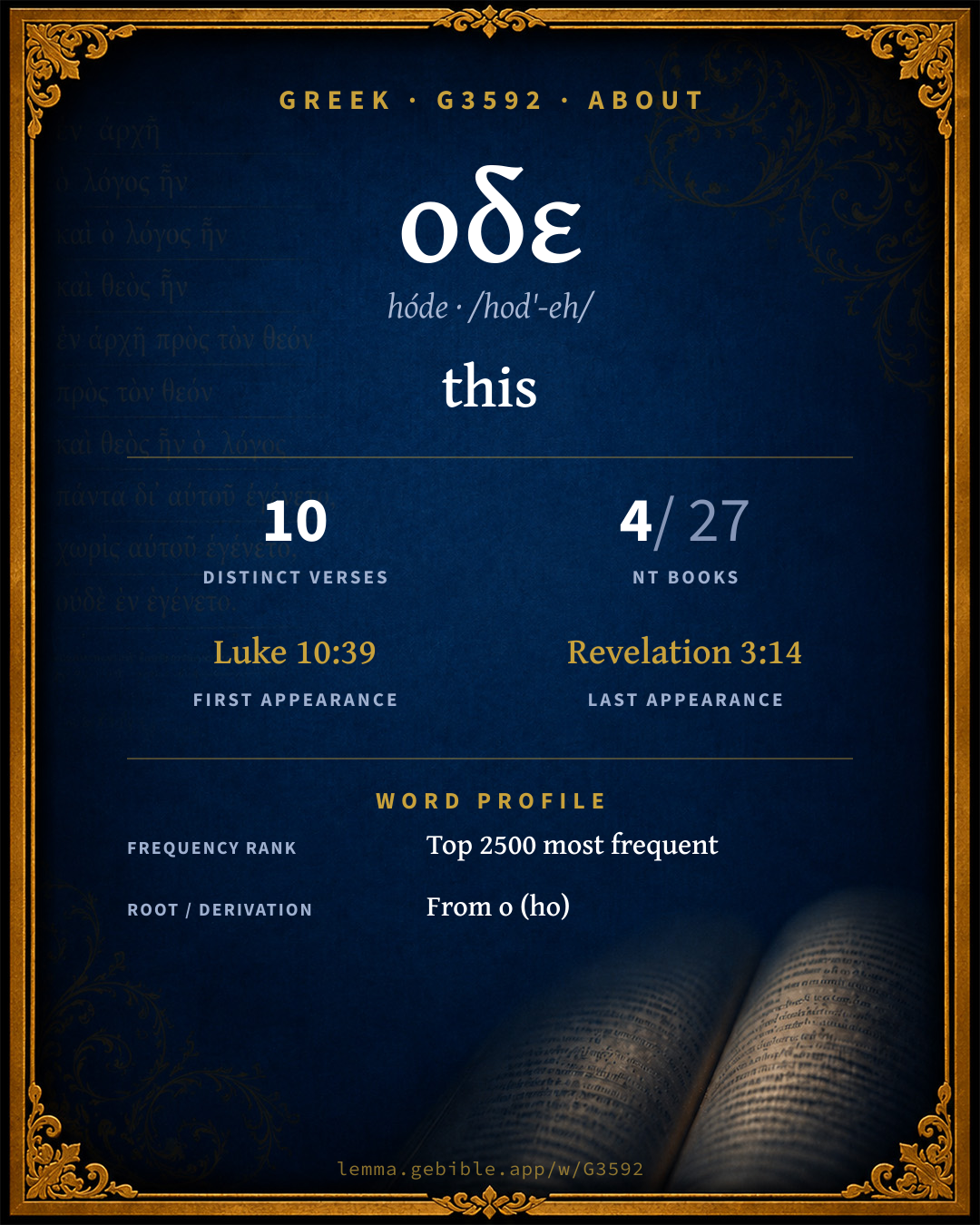
οδε
this
Full lexicon entry — Thayer's Greek Lexicon
From Thayer's Greek Lexicon
Where this word appears
See every Accusative-case word in the Greek New Testament →
Grammar key — what these labels mean
Part of speech
- Demonstrative pronoun
- Points something out (“this,” “that”).
Case
- Accusative
- The case of the direct object and of extent.
- Dative
- The case of the indirect object, means, or location — “to / for / with / in.”
Gender
- Neuter
- Grammatically neuter.
- Feminine
- Grammatically feminine.
Number
- Plural
- More than one.
- Singular
- One.
Grammatical forms
- Demonstrative pronoun, Accusative, Plural, Neuter 8 times (80%)
- Demonstrative pronoun, Accusative, Singular, Feminine 1 time (10%)
- Demonstrative pronoun, Dative, Singular, Feminine 1 time (10%)
Parsed forms decoded from the imported morphology (Robinson–Tischendorf, public domain), counted across 10 parsed occurrences — not distinct verses.
Every verse where G3592 appears — 10 distinct verses across 4 books. Click any verse to open its interlinear word-by-word view. Verse text shown in the World English Bible for context — . Each verse’s Greek form is shown with its reference; the English is not keyword-highlighted, since the data carries no word-level English alignment. Use “Compare translations” on any verse to read it across multiple English versions. This concordance covers the Greek New Testament; Septuagint (Greek Old Testament) occurrences of this word are not indexed here.
Luke 1 verse
Acts 1 verse
James 1 verse
Revelation 7 verses
- Revelation 2:1 τάδε dem.pron acc pl neut To the angel of the assembly in Ephesus write: "He who holds the seven stars in his right hand, he who walks among the seven golden lampstands says these things:
- Revelation 2:8 τάδε dem.pron acc pl neut "To the angel of the assembly in Smyrna write: "The first and the last, who was dead, and has come to life says these things:
- Revelation 2:12 τάδε dem.pron acc pl neut "To the angel of the assembly in Pergamum write: "He who has the sharp two-edged sword says these things:
- Revelation 2:18 τάδε dem.pron acc pl neut "To the angel of the assembly in Thyatira write: "The Son of God, who has his eyes like a flame of fire, and his feet are like burnished brass, says these things:
- Revelation 3:1 τάδε dem.pron acc pl neut "And to the angel of the assembly in Sardis write: He who has the seven Spirits of God, and the seven stars says these things: "I know your works, that you have a reputation of being alive, but you are dead.
- Revelation 3:7 τάδε dem.pron acc pl neut "To the angel of the assembly in Philadelphia write: "He who is holy, he who is true, he who has the key of David, he who opens and no one can shut, and who shuts and no one opens, says these things:
- Revelation 3:14 τάδε dem.pron acc pl neut "To the angel of the assembly in Laodicea write: "The Amen, the Faithful and True Witness, the Head of God's creation, says these things:
About this entry
At a glance — auto-summarized from this page’s data, not written by a person. Every figure links to its source below. This summary describes the numbers; it doesn’t interpret them.
The Greek word οδε centers on the idea of “this.” The word gravitates to Revelation (70%), then Luke and Acts. It turns up in 10 verses across 4 books, an uncommon footprint. First canonically at Luke 10:39, it enters the text early. Translators differ — “things” in the King James Version, then “these” (Berean Standard Bible), as the renderings breakdown shows. Dig into 10-verse concordance and the renderings breakdown below.
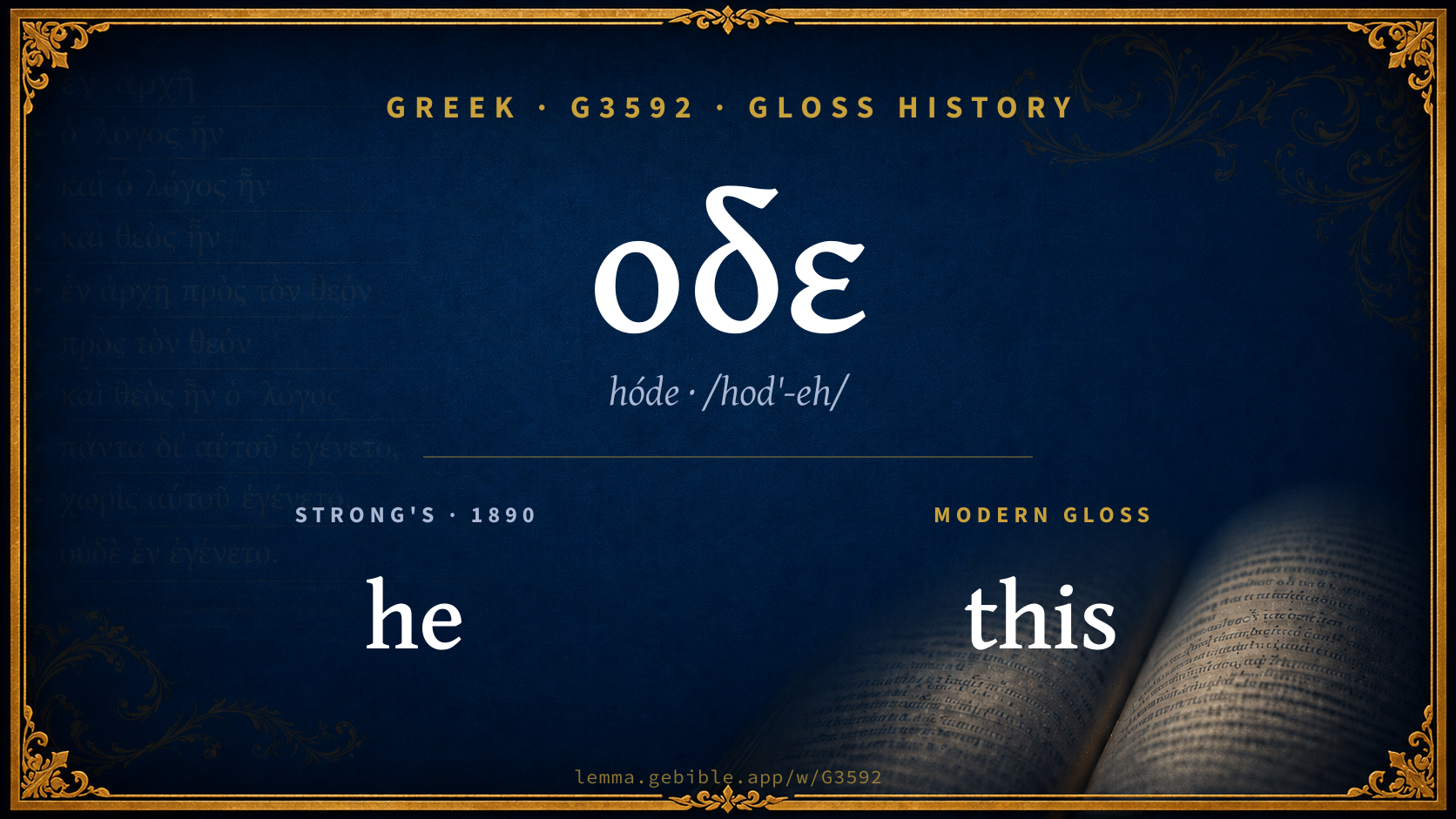
Gloss history
Strong's 1890 vs modern scholarship
About this word
Strong's G3592 catalogs a Greek word from the Greek New Testament.
These counts are not copied from any lexicon or concordance. They are computed here, from the morphology-tagged Greek New Testament. What Lemma adds →
- 10
- distinct verses
- The word appears in 10 distinct verses.
- 4 / 27
- NT books
- The word appears in 4 of 27 New Testament books.
- #1,056
- by frequency
- Top 2500 most frequent Greek words (rank 1,056 of 5,347 Greek words by occurrence).
View all 10 occurrences in the concordance →
Most concentrated in
- Revelation 7 verses 70%
- Luke 1 verse 10%
- Acts 1 verse 10%
By section of the New Testament
By traditional corpus
Conventional, traditional groupings — biblical authorship is debated, so this is a traditional corpus grouping, not an authorship claim. Some books belong to more than one corpus (Luke is in both the Gospels and the Lukan corpus, and so on), so these shares overlap and need not total 100%. Each figure is a share of the word’s 10 distinct verses.
- Johannine 7 verses · 70%
- Revelation 7 verses · 70%
- Lukan (Luke–Acts) 2 verses · 20%
- Gospels 1 verse · 10%
- General (Catholic) Epistles 1 verse · 10%
How translations render this word
Counts come from each version’s own published word-to-Strong’s tagging or interlinear alignment — an approximate guide to how each version renders this word, not a word-level alignment the data otherwise carries. Because each total is that version’s own tagged count, the per-version totals vary from one another and need not match the appearance or distinct-verse counts above. These counts may also differ from a printed concordance because Lemma counts each distinctly tagged rendering and does not collapse phrase taggings into a single head-word total. This is a fixed set of word-tagged versions (KJV, ASV, BSB, ULT) and does not change with the reading translation you choose elsewhere. Each version’s license is shown beside its name below (and on Sources).
- King James Version: Things 7×
- American Standard Version: Things 7×, Thus 2×
- Berean Standard Bible: These 7×
- unfoldingWord Literal Text: Things 8×
King James Version Public Domain
Renders G3592 across 11 tagged occurrences — most commonly:
Plus 4 renderings that appear only once — usually multi-word phrases or single function words the recovered tagging swept in, not distinct renderings. Not rendered by a distinct English word in 1 further occurrence.
American Standard Version Public Domain
Renders G3592 across 13 tagged occurrences — most commonly:
Plus 4 renderings that appear only once — usually multi-word phrases or single function words the recovered tagging swept in, not distinct renderings.
Berean Standard Bible Public Domain
Renders G3592 across 9 tagged occurrences — most commonly:
Plus 2 renderings that appear only once — usually multi-word phrases or single function words the recovered tagging swept in, not distinct renderings. Not rendered by a distinct English word in 1 further occurrence.
unfoldingWord Literal Text CC BY-SA 4.0
Renders G3592 across 10 tagged occurrences — most commonly:
Plus 2 renderings that appear only once — usually multi-word phrases or single function words the recovered tagging swept in, not distinct renderings.
Senses in Thayer's
The 1 sense Thayer's distinguishes for this word, in lexicon order (not ranked by frequency or importance). The full entry — with sub-senses — is in the Lexicon Entry tab.
- this one here, these things, as follows, thus
Word origin
Derived from ο (ho) (G3588).
Forms in the corpus
The 3 distinct written forms G3592 takes in the Greek New Testament, most frequent first — each parse links to that case’s occurrences in the concordance.
| Form | Parsing | Example | Uses |
|---|---|---|---|
| τάδε táde | Demonstrative pronoun, Accusative, Plural, Neuter | Acts 21:11 | 8 |
| τήνδε tḗnde | Demonstrative pronoun, Accusative, Singular, Feminine | James 4:13 | 1 |
| τῇδε tē̂de | Demonstrative pronoun, Dative, Singular, Feminine | Luke 10:39 | 1 |
Same root — word family
Other Thayer's entries built from the same root as G3592, grouped by Strong’s listed origin. These share a root / origin per the lexicon — not necessarily a shared meaning. Each links to that word’s own entry.
Derives from
Shares the same root
- τανυν tanŷn G3569 present
- οιος hoîos G3634 what sort of
- ος hós G3739 who
- ουτος hoûtos G3778 this
- σημερον sḗmeron G4594 this day
- ταυτα tautá G5024 thus
- τηλικουτος tēlikoûtos G5082 of such size
- τοι toí G5104 truly
- τοσουτος tosoûtos G5118 so great
- τοτε tóte G5119 then
- του toû G5120 his
- τουναντιον tounantíon G5121 on the contrary
- τουνομα toúnoma G5122 by name
Derived from this word
Proper names from this root
People and places named from this root — a name, not an additional meaning of the word.
- θεος theós G2316 God
- ο ων και ο ην και ο ερχομενος ho ṑn kaí ho ēn kaí ho erchómenos G3801 He who is
Compare all same-root words → Showing 4 of 18 — not the complete family. 2 of the same-root words are proper names (people or places). They share a root, not necessarily a meaning.
Septuagint usage
The same Greek word οδε appears 420 times in the Greek Old Testament (Septuagint), across 393 verses in 25 books.
- 420
- LXX occurrences
- Tagged occurrences of this Greek word in the Septuagint.
- 393
- verses
- Distinct Septuagint verses containing this word.
- 25 / 39
- OT books
- The word appears in 25 of the 39 Old Testament books.
Sample Septuagint occurrences
- Genesis 25:24 ὅδε
- Exodus 4:22 ὅδε
- Leviticus 10:16 ὅδε
- Numbers 14:40 ὅδε
- Joshua 7:13 ὅδε
- Judges 2:1 ὅδε
- Ruth 1:17 ὅδε
- 1 Samuel 2:14 ὅδε
- 2 Samuel 3:9 ὅδε
- 1 Kings 2:23 ὅδε
- 2 Kings 1:4 ὅδε
- 1 Chronicles 17:7 ὅδε
Septuagint occurrences (same lexeme)
Every verse where the same Strong’s number (G3592) appears in the Greek Septuagint — showing the first 50 of 393. Verse text shown in the World English Bible for context; the Greek form is the matched word — the English is not keyword-highlighted.
- Genesis 25:24 ὅδε When her days to be delivered were fulfilled, behold, there were twins in her womb.
- Genesis 38:27 ὅδε It happened in the time of her travail, that behold, twins were in her womb.
- Genesis 43:21 ὅδε and it happened, when we came to the lodging-place, that we opened our sacks, and, behold, every man's money was in the mouth of his sack, our money in full weight. We have brought it again in our hand.
- Genesis 45:9 ὅδε Hurry, and go up to my father, and tell him, 'This is what your son Joseph says, "God has made me lord of all Egypt. Come down to me. Don't wait.
- Genesis 50:18 ὅδε His brothers also went and fell down before his face; and they said, "Behold, we are your servants."
- Exodus 4:22 ὅδε You shall tell Pharaoh, 'Thus says Yahweh, Israel is my son, my firstborn,
- Exodus 5:1 ὅδε Afterward Moses and Aaron came, and said to Pharaoh, "This is what Yahweh, the God of Israel, says, 'Let my people go, that they may hold a feast to me in the wilderness.'"
- Exodus 5:10 ὅδε The taskmasters of the people went out, and their officers, and they spoke to the people, saying, This is what Pharaoh says: "I will not give you straw.
- Exodus 7:17 ὅδε Thus says Yahweh, "In this you shall know that I am Yahweh. Behold, I will strike with the rod that is in my hand on the waters which are in the river, and they shall be turned to blood.
- Exodus 7:26 ὅδε
- Exodus 8:16 ὅδε Yahweh said to Moses, "Tell Aaron, 'Stretch out your rod, and strike the dust of the earth, that it may become lice throughout all the land of Egypt.'"
- Exodus 8:25 ὅδε Pharaoh called for Moses and for Aaron, and said, "Go, sacrifice to your God in the land!"
- Exodus 9:1 ὅδε Then Yahweh said to Moses, "Go in to Pharaoh, and tell him, 'This is what Yahweh, the God of the Hebrews, says: "Let my people go, that they may serve me.
- Exodus 9:13 ὅδε Yahweh said to Moses, "Rise up early in the morning, and stand before Pharaoh, and tell him, 'This is what Yahweh, the God of the Hebrews, says: "Let my people go, that they may serve me.
- Exodus 10:3 ὅδε Moses and Aaron went in to Pharaoh, and said to him, "This is what Yahweh, the God of the Hebrews, says: 'How long will you refuse to humble yourself before me? Let my people go, that they may serve me.
- Exodus 11:4 ὅδε Moses said, "This is what Yahweh says: 'About midnight I will go out into the midst of Egypt,
- Exodus 17:6 ὅδε Behold, I will stand before you there on the rock in Horeb. You shall strike the rock, and water will come out of it, that the people may drink." Moses did so in the sight of the elders of Israel.
- Exodus 19:3 ὅδε Moses went up to God, and Yahweh called to him out of the mountain, saying, "This is what you shall tell the house of Jacob, and tell the children of Israel:
- Exodus 20:22 ὅδε Yahweh said to Moses, "This is what you shall tell the children of Israel: 'You yourselves have seen that I have talked with you from heaven.
- Exodus 32:27 ὅδε He said to them, "Thus says Yahweh, the God of Israel, 'Every man put his sword on his thigh, and go back and forth from gate to gate throughout the camp, and every man kill his brother, and every man his companion, and every man his neighbor."
- Leviticus 10:16 ὅδε Moses diligently inquired about the goat of the sin offering, and, behold, it was burned: and he was angry with Eleazar and with Ithamar, the sons of Aaron who were left, saying,
- Leviticus 13:55 ὅδε Then the priest shall examine it, after the plague is washed; and, behold, if the plague hasn't changed its color, and the plague hasn't spread, it is unclean; you shall burn it in the fire. It is a mildewed spot, whether the bareness is inside or outside.
- Numbers 14:40 ὅδε They rose up early in the morning, and got them up to the top of the mountain, saying, Behold, we are here, and will go up to the place which Yahweh has promised: for we have sinned.
- Numbers 17:7 ὅδε Moses laid up the rods before Yahweh in the tent of the testimony.
- Numbers 20:14 ὅδε Moses sent messengers from Kadesh to the king of Edom, Thus says your brother Israel, You know all the travail that has happened to us:
- Numbers 22:16 ὅδε They came to Balaam, and said to him, Thus says Balak the son of Zippor, Please let nothing hinder you from coming to me:
- Numbers 23:6 ὅδε He returned to him, and, behold, he was standing by his burnt-offering, he, and all the princes of Moab.
- Numbers 23:16 ὅδε Yahweh met Balaam, and put a word in his mouth, and said, Return to Balak, and thus shall you speak.
- Numbers 23:17 ὅδε He came to him, and, behold, he was standing by his burnt offering, and the princes of Moab with him. Balak said to him, What has Yahweh spoken?
- Joshua 7:13 ὅδε Up, sanctify the people, and say, Sanctify yourselves against tomorrow: for thus says Yahweh, the God of Israel, There is a devoted thing in the midst of you, Israel; you can not stand before your enemies, until you take away the devoted thing from among you.
- Joshua 22:16 ὅδε Thus says the whole congregation of Yahweh, What trespass is this that you have committed against the God of Israel, to turn away this day from following Yahweh, in that you have built you an altar, to rebel this day against Yahweh?
- Joshua 24:2 ὅδε Joshua said to all the people, Thus says Yahweh, the God of Israel, Your fathers lived of old time beyond the River, even Terah, the father of Abraham, and the father of Nahor: and they served other gods.
- Judges 2:1 ὅδε The angel of Yahweh came up from Gilgal to Bochim. He said, I made you to go up out of Egypt, and have brought you to the land which I swore to your fathers; and I said, I will never break my covenant with you:
- Judges 6:8 ὅδε that Yahweh sent a prophet to the children of Israel: and he said to them, Thus says Yahweh, the God of Israel, I brought you up from Egypt, and brought you forth out of the house of bondage;
- Judges 11:37 ὅδε She said to her father, Let this thing be done for me: let me alone two months, that I may depart and go down on the mountains, and bewail my virginity, I and my companions.
- Judges 19:3 ὅδε Her husband arose, and went after her, to speak kindly to her, to bring her again, having his servant with him, and a couple of donkeys: and she brought him into her father's house; and when the father of the young lady saw him, he rejoiced to meet him.
- Ruth 1:17 ὅδε where you die, will I die, and there will I be buried: Yahweh do so to me, and more also, if anything but death part you and me."
- 1 Samuel 2:14 ὅδε and he struck it into the pan, or kettle, or caldron, or pot; all that the flesh-hook brought up the priest took therewith. So they did in Shiloh to all the Israelites who came there.
- 1 Samuel 2:27 ὅδε There came a man of God to Eli, and said to him, Thus says Yahweh, Did I reveal myself to the house of your father, when they were in Egypt [in bondage] to Pharaoh's house?
- 1 Samuel 2:30 ὅδε Therefore Yahweh, the God of Israel, says, I said indeed that your house, and the house of your father, should walk before me forever: but now Yahweh says, Be it far from me; for those who honor me I will honor, and those who despise me shall be lightly esteemed.
- 1 Samuel 3:17 ὅδε He said, "What is the thing that [Yahweh] has spoken to you? Please don't hide it from me. God do so to you, and more also, if you hide anything from me of all the things that he spoke to you."
- 1 Samuel 9:9 ὅδε (In earlier times in Israel, when a man went to inquire of God, thus he said, Come, and let us go to the seer; for he who is now called a Prophet was before called a Seer.)
- 1 Samuel 10:18 ὅδε and he said to the children of Israel, Thus says Yahweh, the God of Israel, I brought up Israel out of Egypt, and I delivered you out of the hand of the Egyptians, and out of the hand of all the kingdoms that oppressed you:
- 1 Samuel 11:7 ὅδε He took a yoke of oxen, and cut them in pieces, and sent them throughout all the borders of Israel by the hand of messengers, saying, Whoever doesn't come forth after Saul and after Samuel, so shall it be done to his oxen. The dread of Yahweh fell on the people, and they came out as one man.
- 1 Samuel 11:9 ὅδε They said to the messengers who came, Thus shall you tell the men of Jabesh Gilead, Tomorrow, by the time the sun is hot, you shall have deliverance. The messengers came and told the men of Jabesh; and they were glad.
- 1 Samuel 14:9 ὅδε If they say thus to us, Wait until we come to you; then we will stand still in our place, and will not go up to them.
- 1 Samuel 14:10 ὅδε But if they say thus, Come up to us; then we will go up; for Yahweh has delivered them into our hand: and this shall be the sign to us.
- 1 Samuel 14:41 ὅδε Therefore Saul said to Yahweh, the God of Israel, Show the right. Jonathan and Saul were taken [by lot]; but the people escaped.
- 1 Samuel 14:44 ὅδε Saul said, God do so and more also; for you shall surely die, Jonathan.
- 1 Samuel 15:2 ὅδε Thus says Yahweh of Hosts, I have marked that which Amalek did to Israel, how he set himself against him in the way, when he came up out of Egypt.
These are occurrences of the same Greek lexeme (G3592) in the Septuagint — not a translation of any one Hebrew word. The store carries no word-level Hebrew↔Greek alignment, so no Hebrew original is asserted here. Counts come from the recovered LXX Strong's tagging — high-frequency vocabulary is well covered, while rare or late forms may be untagged — so they reflect tagged occurrences and may slightly undercount.